A Computational Fluid Dynamics Analysis of Multiphase Flow in the Anode Side of a Proton Exchange Membrane Electrolyzer


Abstract
1. Introduction
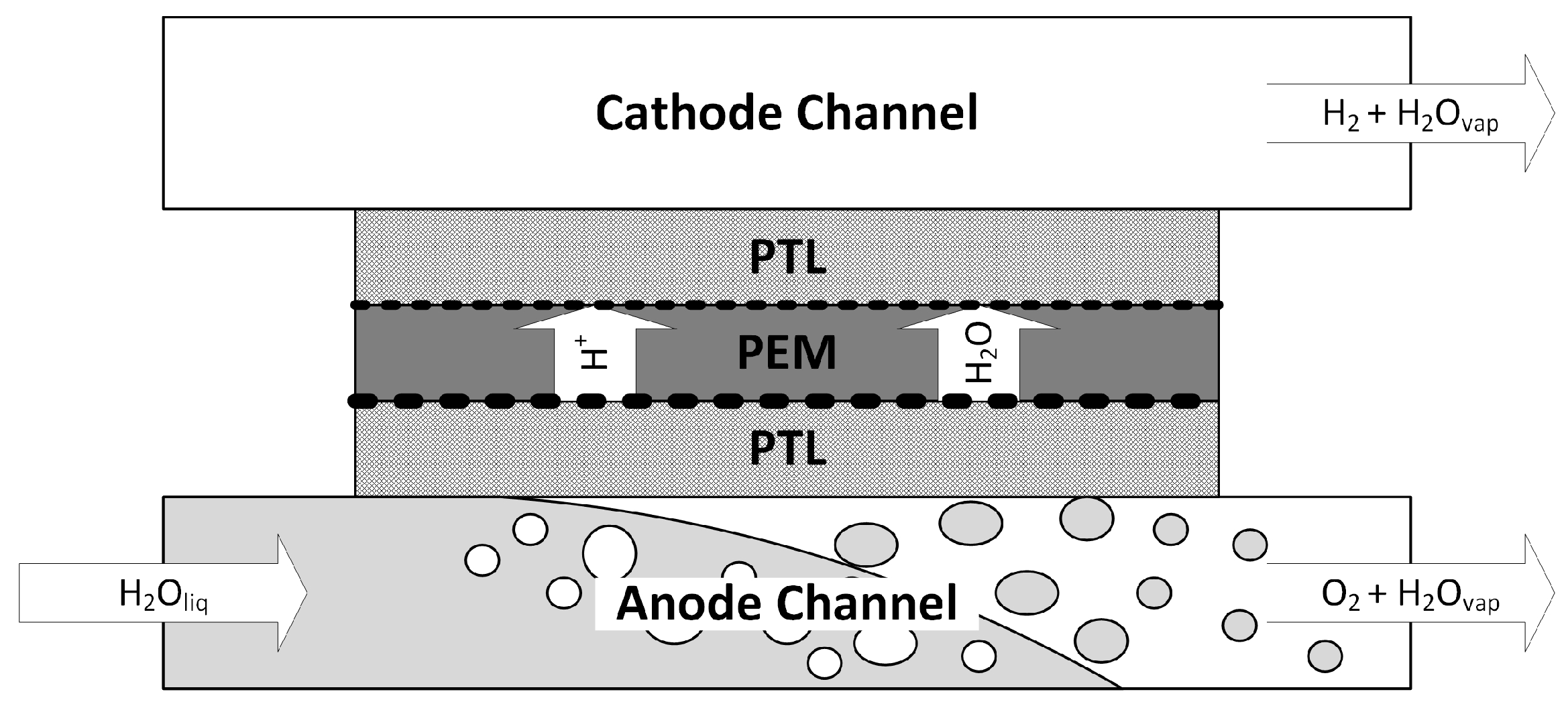
2. Model Description
2.1. Assumptions
- The problem is steady-state.
- The flow is laminar.
- The gas phase is an ideal gas.
- The liquid phase contains only water.
- The porous medium is isotropic.
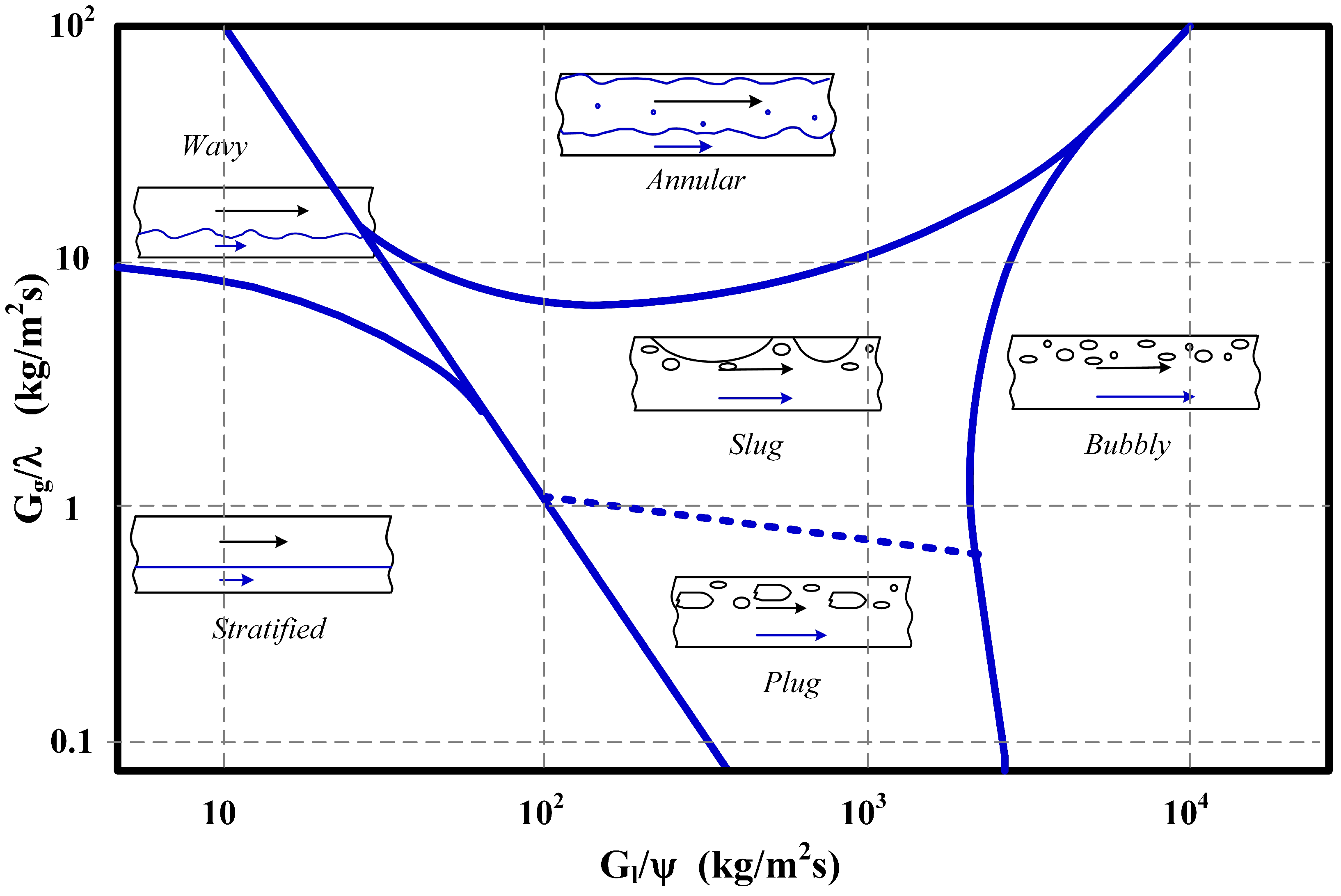
- In the channel, the flow is segregated and in the Stokes regime.
- The catalyst layer is a thin interface and its thickness is ignored.
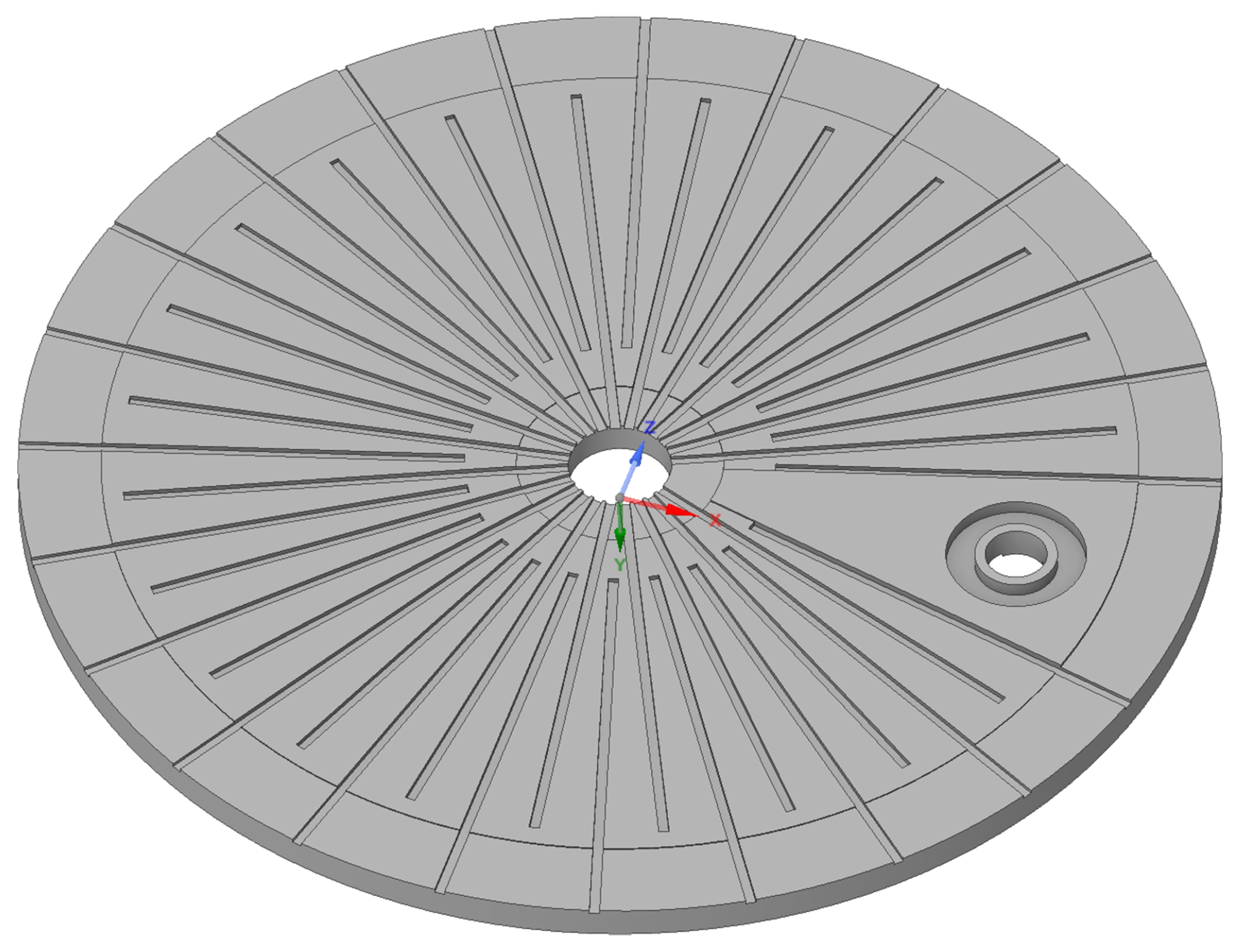
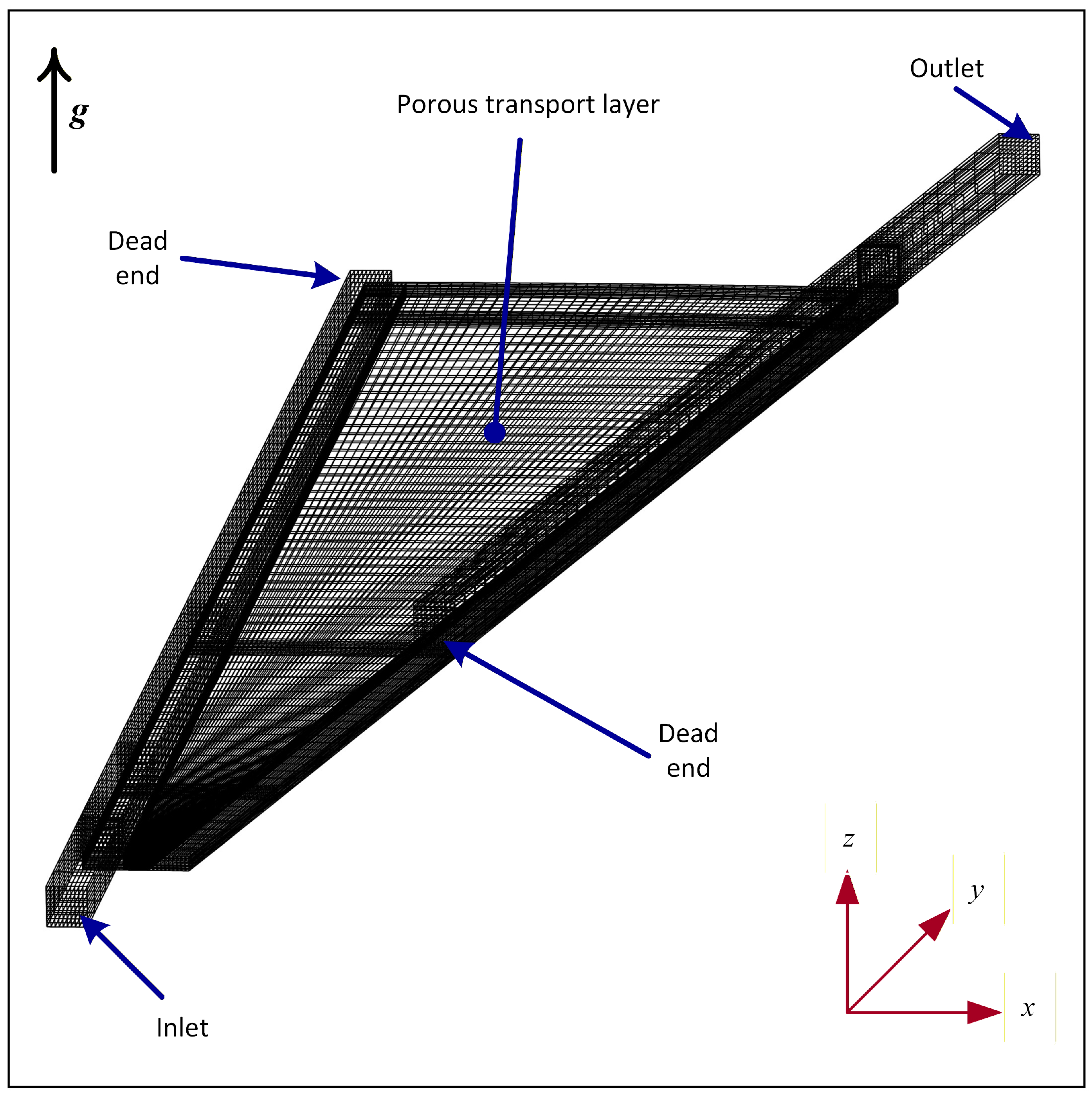
2.2. Modeling Domain and Computational Grid
2.3. Model Equations
2.4. Source Term Implementation
2.4.1. Calculation of the Local Current Density
2.4.2. Implementation of Porous Media Resistance
2.4.3. Implementation of Drag Terms
2.4.4. Implementation of Phase Change
2.4.5. Energy Equation
2.5. Boundary Conditions
2.6. Material Properties
2.7. Solution Procedure
- (1)
- Run the case with liquid water only, where water is running through the geometry at a prescribed combination of current density and stoichiometry. This is similar to experiments, where first water is run through the stack without drawing current, and then the current density is step-wise increased while keeping the flow rate constant.
- (2)
- Switch on the oxygen source term, assuming the current density is uniform. The thus obtained results already yield useful insights in the gas–liquid distribution.
- (3)
- Switch on phase change of water. The results then indicate to which degree the gas phase is saturated with vapor, and they can be used to determine the concentration ratio between oxygen and water vapor. However, only mass transfer is considered, not yet the energy terms.
- (4)
- Adjust the local current density to account for the water vapor distribution, and switch on the sink term for water vapor.
- (5)
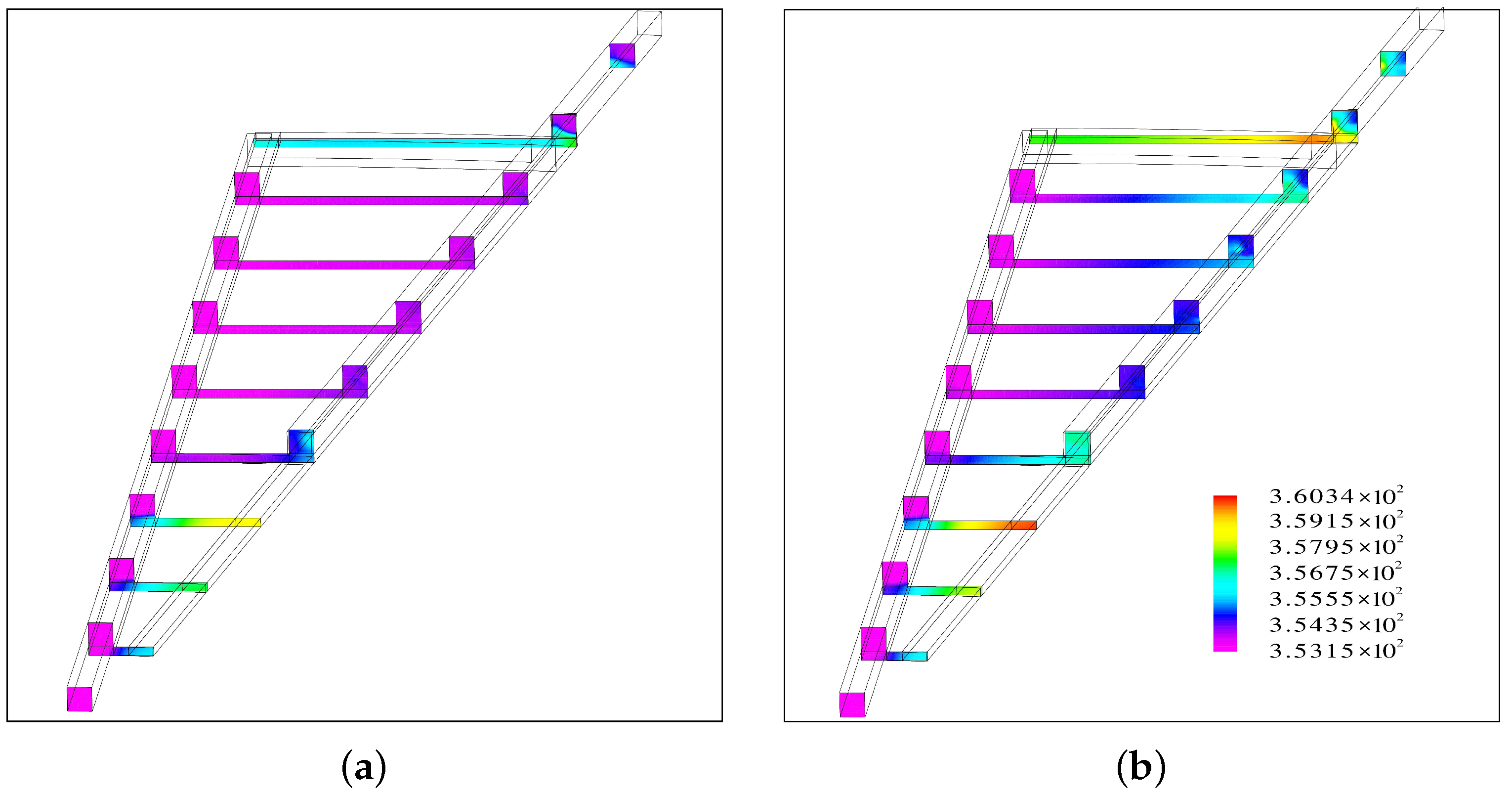
- Switch on the sink and source terms in the energy equation to obtain the temperature distribution.
2.8. Numerical Procedure
3. Results
3.1. Base Case Results
3.2. Parametric Study Results
4. Conclusions
Author Contributions
Funding
Data Availability Statement
Conflicts of Interest
References
- Schmidt, O.; Gambhir, A.; Staffell, I.; Hawkes, A.; Nelson, J.; Few, S. Future cost and performance of water electrolysis: An expert elicitation study. Int. J. Hydrogen Energy 2017, 42, 30470–30492. [Google Scholar] [CrossRef] [Scilit]
- Feng, Q.; Yuan, X.; Liu, G.; Wei, B.; Zhang, Z.; Li, H.; Wang, H. A review of proton exchange membrane water electrolysis on degradation mechanisms and mitigation strategies. J. Power Sources 2017, 366, 33–55. [Google Scholar] [CrossRef] [Scilit]
- Wang, C.R.; Stansberry, J.M.; Mukundan, R.; Chang, H.M.J.; Kulkarni, D.; Park, A.M.; Plymill, A.B.; Firas, N.M.; Liu, C.P.; Lang, J.T.; et al. Proton Exchange Membrane (PEM) Water Electrolysis: Cell-Level Considerations for Gigawatt-Scale Deployment. Chem. Rev. 2025, 125, 1257–1302. [Google Scholar] [CrossRef] [Scilit] [PubMed]
- Berning, T.; Barbir, F. A concept for high efficiency operation of a proton exchange membrane electrolyzer. Int. J. Hydrogen Energy 2026, 201, 152898. [Google Scholar] [CrossRef] [Scilit]
- Grigoriev, S.; Porembskiy, V.; Korobtsev, S.; Fateev, V.; Auprêtre, F.; Millet, P. High-pressure PEM water electrolysis and corresponding safety issues. Int. J. Hydrogen Energy 2011, 36, 2721–2728. [Google Scholar] [CrossRef] [Scilit]
- Nie, J.; Chen, Y. Numerical modeling of three-dimensional two-phase gas–liquid flow in the flow field plate of a PEM electrolysis cell. Int. J. Hydrogen Energy 2010, 35, 3183–3197. [Google Scholar] [CrossRef] [Scilit]
- Ruiz, D.D.H.; Sasmito, A.P.; Shamim, T. Numerical Investigation of the High Temperature PEM Electrolyzer: Effect of Flow Channel Configurations. ECS Trans. 2013, 58, 99. [Google Scholar] [CrossRef] [Scilit]
- Olesen, A.C.; Rømer, C.; Kær, S.K. A numerical study of the gas-liquid, two-phase flow maldistribution in the anode of a high pressure PEM water electrolysis cell. Int. J. Hydrogen Energy 2016, 41, 52–68. [Google Scholar] [CrossRef] [Scilit]
- Lafmejani, S.S.; Olesen, A.C.; Kær, S.K. VOF modelling of gas–liquid flow in PEM water electrolysis cell micro-channels. Int. J. Hydrogen Energy 2017, 42, 16333–16344. [Google Scholar] [CrossRef] [Scilit]
- Olesen, A.C.; Frensch, S.H.; Kær, S.K. Towards uniformly distributed heat, mass and charge: A flow field design study for high pressure and high current density operation of PEM electrolysis cells. Electrochim. Acta 2019, 293, 476–495. [Google Scholar] [CrossRef] [Scilit]
- Toghyani, S.; Afshari, E.; Baniasadi, E.; Atyabi, S. Thermal and electrochemical analysis of different flow field patterns in a PEM electrolyzer. Electrochim. Acta 2018, 267, 234–245. [Google Scholar] [CrossRef] [Scilit]
- Toghyani, S.; Afshari, E.; Ehsan Baniasadi, E. Three-dimensional computational fluid dynamics modeling of proton exchange membrane electrolyzer with new flow field pattern. J. Therm. Anal. Calorim. 2019, 135, 1911–1919. [Google Scholar] [CrossRef] [Scilit]
- Zinser, A.; Papakonstantinou, G.; Sundmacher, K. Analysis of mass transport processes in the anodic porous transport layer in PEM water electrolysers. Int. J. Hydrogen Energy 2019, 44, 28077–28087. [Google Scholar] [CrossRef] [Scilit]
- Upadhyay, M.; Lee, S.; Jung, S.; Choi, Y.; Moon, S.; Lim, H. Systematic assessment of the anode flow field hydrodynamics in a new circular PEM water electrolyser. Int. J. Hydrogen Energy 2020, 45, 20765–20775. [Google Scholar] [CrossRef] [Scilit]
- Millet, P.; Ngameni, R.; Grigoriev, S.; Fateev, V. Scientific and engineering issues related to PEM technology: Water electrolysers, fuel cells and unitized regenerative systems. Int. J. Hydrogen Energy 2011, 36, 4156–4163. [Google Scholar] [CrossRef] [Scilit]
- Upadhyay, M.; Kim, A.; Paramanantham, S.S.; Kim, H.; Lim, D.; Lee, S.; Moon, S.; Lim, H. Three-dimensional CFD simulation of proton exchange membrane water electrolyser: Performance assessment under different condition. Appl. Energy 2022, 306, 118016. [Google Scholar] [CrossRef] [Scilit]
- Ma, Z.; Witteman, L.; Wrubel, J.A.; Bender, G. A comprehensive modeling method for proton exchange membrane electrolyzer development. Int. J. Hydrogen Energy 2021, 46, 17627–17643. [Google Scholar] [CrossRef] [Scilit]
- Lin, R.; Lu, Y.; Xu, J.; Huo, J.; Cai, X. Investigation on performance of proton exchange membrane electrolyzer with different flow field structures. Appl. Energy 2022, 326, 120011. [Google Scholar] [CrossRef] [Scilit]
- Corda, G.; Cucurachi, A.; Fontanesi, S.; d’Adamo, A. Three-Dimensional CFD Simulation of a Proton Exchange Membrane Electrolysis Cell. Energies 2023, 16, 5968. [Google Scholar] [CrossRef] [Scilit]
- Su, X.; Zhang, Q.; Xu, L.; Hu, B.; Wu, X.; Qin, T. A novel combined flow field design and performance analysis of proton exchange membrane electrolysis cell. Int. J. Hydrogen Energy 2024, 61, 444–459. [Google Scholar] [CrossRef] [Scilit]
- Mu, R.; Cao, X.; Zhang, Y.; He, Y.; Wang, Z. Developing a New Type of Annular Flow Field Based on Murray’s Law in Proton Exchange Membrane Water Electrolyzers. Processes 2025, 13, 1553. [Google Scholar] [CrossRef] [Scilit]
- Berning, T. Design of a Proton Exchange Membrane Electrolyzer. Hydrogen 2025, 6, 30. [Google Scholar] [CrossRef] [Scilit]
- Marshall, A.; Børresen, B.; Hagen, G.; Tsypkin, M.; Tunold, R. Hydrogen production by advanced proton exchange membrane (PEM) water electrolysers—Reduced energy consumption by improved electrocatalysis. Energy 2007, 32, 431–436. [Google Scholar] [CrossRef] [Scilit]
- Millet, P.; Ngameni, R.; Grigoriev, S.; Mbemba, N.; Brisset, F.; Ranjbari, A.; Etiévant, C. PEM water electrolyzers: From electrocatalysis to stack development. Int. J. Hydrogen Energy 2010, 35, 5043–5052. [Google Scholar] [CrossRef] [Scilit]
- Berning, T.; Djilali, N. A 3D, Multiphase, Multicomponent Model of the Cathode and Anode of a PEM Fuel Cell. J. Electrochem. Soc. 2003, 150, A1589. [Google Scholar] [CrossRef] [Scilit]
- Gurau, V.; Zawodzinski, T.A., Jr.; Mann, J.A., Jr. Two-Phase Transport in PEM Fuel Cell Cathodes. J. Fuel Cell Sci. Technol. 2008, 5, 021009. [Google Scholar] [CrossRef] [Scilit]
- Baker, O. Design of Pipelines for the Simultaneous Flow of Oil and Gas. In Proceedings of the Fall Meeting of the Petroleum Branch of AIME, Dallas, TX, USA, 19–21 October 1953. [Google Scholar]
- Scott, D.S. Properties of Cocurrent Gas-Liquid Flow. In Advances in Chemical Engineering; Academic Press: Cambridge, MA, USA, 1964; Volume 4, pp. 199–277. [Google Scholar] [CrossRef] [Scilit]
- Taitel, Y.; Dukler, A.E. A model for predicting flow regime transitions in horizontal and near horizontal gas-liquid flow. AIChE J. 1976, 22, 47–55. [Google Scholar] [CrossRef] [Scilit]
- Bird, R.; Stewart, W.; Lightfoot, E. Transport Phenomena; Number v. 1 in Transport Phenomena; Wiley: Hoboken, NJ, USA, 2006. [Google Scholar]
- Olesen, A.C.; Kær, S.K.; Berning, T. A Multi-Fluid Model for Water and Methanol Transport in a Direct Methanol Fuel Cell. Energies 2022, 15, 6869. [Google Scholar] [CrossRef] [Scilit]
- Nam, J.H.; Kaviany, M. Effective diffusivity and water-saturation distribution in single-and two-layer PEMFC diffusion medium. Int. J. Heat Mass Transf. 2003, 46, 4595–4611. [Google Scholar] [CrossRef] [Scilit]
- Marrero, T.R.; Mason, E.A. Gaseous Diffusion Coefficients. J. Phys. Chem. Ref. Data 1972, 1, 3–118. [Google Scholar] [CrossRef] [Scilit]
- Grigoriev, S.; Millet, P.; Volobuev, S.; Fateev, V. Optimization of porous current collectors for PEM water electrolysers. Int. J. Hydrogen Energy 2009, 34, 4968–4973. [Google Scholar] [CrossRef] [Scilit]
- Barbir, F. PEM Fuel Cells: Theory and Practice; Academic Press: Cambridge, MA, USA, 2012. [Google Scholar]



| Property | Symbol | Unit | Value |
|---|---|---|---|
| Porosity | [-] | 0.75 | |
| Tortuosity | [-] | 5 | |
| Hydraulic Permeability | K | [m2] | 2 × |
| Thermal Conductivity | [W/m-K] | 5.0 |
| Back Pressure [kPa] | [mol/m3] | [mol/m3] | : [-] |
|---|---|---|---|
| 101.3 | 13.07 | 17.29 | 0.76 |
| 80.0 | 14.36 | 11.45 | 1.25 |
| 60.0 | 15.22 | 5.07 | 3.00 |
| 50.0 | 14.71 | 3.44 | 4.27 |
| Back Pressure [kPa] | [mole/s] | [mole/s] | [W] | [mole/s] | [W] |
|---|---|---|---|---|---|
| 101.3 | −0.15 | −0.49 | |||
| 80 | −0.25 | −0.63 | |||
| 60 | −0.64 | −0.99 | |||
| 50 | −3.10 | −1.18 |
Disclaimer/Publisher’s Note: The statements, opinions and data contained in all publications are solely those of the individual author(s) and contributor(s) and not of MDPI and/or the editor(s). MDPI and/or the editor(s) disclaim responsibility for any injury to people or property resulting from any ideas, methods, instructions or products referred to in the content. |
© 2025 by the authors. Licensee MDPI, Basel, Switzerland. This article is an open access article distributed under the terms and conditions of the Creative Commons Attribution (CC BY) license.
Share and Cite
Berning, T.; Condra, T. A Computational Fluid Dynamics Analysis of Multiphase Flow in the Anode Side of a Proton Exchange Membrane Electrolyzer. Energies 2026, 19, 84. https://doi.org/10.3390/en19010084
Berning T, Condra T. A Computational Fluid Dynamics Analysis of Multiphase Flow in the Anode Side of a Proton Exchange Membrane Electrolyzer. Energies. 2026; 19(1):84. https://doi.org/10.3390/en19010084
Chicago/Turabian StyleBerning, Torsten, and Thomas Condra. 2026. "A Computational Fluid Dynamics Analysis of Multiphase Flow in the Anode Side of a Proton Exchange Membrane Electrolyzer" Energies 19, no. 1: 84. https://doi.org/10.3390/en19010084
APA StyleBerning, T., & Condra, T. (2026). A Computational Fluid Dynamics Analysis of Multiphase Flow in the Anode Side of a Proton Exchange Membrane Electrolyzer. Energies, 19(1), 84. https://doi.org/10.3390/en19010084