Article

Purification of Methane Pyrolysis Gas for Turquoise Hydrogen Production Using Commercial Polymeric Hollow Fiber Membranes

Clean Energy Conversion Center, Institute for Advanced Engineering, Yongin-si 17180, Republic of Korea
*
Author to whom correspondence should be addressed.
Energies 2026, 19(1), 179; https://doi.org/10.3390/en19010179 (registering DOI)
Submission received: 25 November 2025 / Revised: 18 December 2025 / Accepted: 26 December 2025 / Published: 29 December 2025
(This article belongs to the Section A5: Hydrogen Energy)

Abstract

Membrane separation is a promising, low-energy technology for purifying turquoise hydrogen from methane pyrolysis streams. However, there is a critical knowledge gap between the performance of membrane materials and the practical application of large-scale modules under realistic process conditions. This study evaluates commercial polyimide and polysulfone hollow fiber membranes for H2/CH4 separation. The effect of feed composition and pressure on the membrane separation performance were studied, revealing that the separation efficiency is overwhelmingly dominated by concentration polarization, which reduced the H2/CH4 separation factor by up to 80% compared to ideal values. Despite this, by optimizing process conditions, we successfully achieved a permeate purity of 99.3% H2 at 85% recovery. Furthermore, Aspen Plus simulations of an integrated pyrolysis reactor with the membrane unit and a recycle stream demonstrate significant process benefits. The integration increased the H2 production rate from 10.3 to 17.6 kmol/h and substantially reduced the specific energy consumption from 40.3 to 24.9 kJ/g H2 compared to non-integrated systems. This work shows that a membrane process can improve not only the product H2 purity but also the overall energy efficiency of a turquoise hydrogen production process.

1. Introduction

Hydrogen is gaining significant attention as a next-generation energy carrier, valued for its potential to serve as a fuel and a medium for renewable energy storage, thereby acting as a key enabler for global carbon reduction. Driven by this growing interest, global hydrogen demand reached 95 million metric tons in 2022, and is projected to reach nearly 180 Mt annually by 2030 [1]. While most of this hydrogen is conventionally produced by the steam methane reforming (SMR) process, recent progress on large-scale methane pyrolysis processes suggests that it may become a viable method for the production of clean hydrogen [2,3]. Although the SMR process is economically attractive ($1.2~$1.5/kg H2), it carries a significant environmental drawback, emitting approximately 10 kg of CO2 per kg of H2 produced [1]. In 2023 alone, global hydrogen production resulted in over 1406 Mt of CO2-equivalent emissions, primarily attributed to SMR [4]. Emerging low-carbon pathways for hydrogen production include photocatalytic water splitting [5] and electrocatalysis [6] which utilize solar energy and renewable electricity, respectively, to derive carbon-free hydrogen directly from water. Alternatively, methane pyrolysis offers a unique advantage by pyrolyzing natural gas into hydrogen and solid carbon, eliminating gaseous CO2 emissions associated with traditional reforming [2]. Hydrogen produced via methane pyrolysis, classified as turquoise hydrogen, represents an economical, near-term solution for a scalable, clean hydrogen infrastructure. The theoretical energy requirement of this process is lower than that of SMR (37.4 kJ/mol H2 vs. 63.3 kJ/mol H2) [7]. A primary advantage is the co-production of solid carbon rather than CO2, eliminating the need for additional carbon capture processes [8]. This solid carbon can be sequestered or sold as a valuable material for applications in electrodes, concrete or rubber, enhancing the process’s economic viability [1].
However, a critical challenge in methane pyrolysis is achieving high-purity hydrogen, as the product gas is typically contaminated with unreacted methane and byproduct hydrocarbons [9]. Conventional hydrogen purification techniques, such as pressure swing adsorption (PSA), cryogenic distillation, and amine absorption, are energy-intensive and require large footprints [10,11]. Membrane separation processes offer a compelling alternative due to their compact footprint, higher energy efficiency, low capital costs, and modularity [12,13]. In particular, polymeric hollow fiber membranes are highly desirable for their cost-effectiveness and robust mechanical properties [14,15]. Materials such as polysulfone and polyimide are widely utilized, offering a favorable balance of permeability and selectivity alongside excellent thermal and chemical resistance [16].
Commercial membrane processes, such as Polysep (UOP) and PRISM (Air Products) are widely deployed to recover H2 from process streams in refineries and petrochemical plants [17]. PRISM membranes, introduced in 1980 for ammonia plants, utilize a polysulfone selective layer to upgrade hydrocracker off-gas streams (20–30 mol% H2) to 70–90% purity in a single stage, or up to 95% in a two-stage configuration [18]. Similarly, MTR’s VaporSep, recovers H2 from refinery waste gases and adjusts H2/CO ratios in syngas. Capable of handling feed pressures up to 170 bar with H2 concentrations of 30–95 mol%, it yields a permeate stream with 90–99 mol% purity [17]. These membranes are often benchmarked against traditional purification technologies like PSA. In a feasibility study evaluating H2 separation from refinery off-gas (72 mol% hydrogen with C1–C6 hydrocarbons), a polyimide-based membrane demonstrated a significantly better H2 recovery of 79% compared to a PSA system [19]. While the membrane’s hydrogen purity of 98.3 mol% was slightly lower than that of PSA (99.4 mol%), the capital costs for both systems were nearly identical.
Despite extensive research on novel membrane materials, significant knowledge gaps remain, particularly concerning the use of large-area membrane modules. The performance of these modules in mixed-gas environments often deviates substantially from predictions based on ideal, pure-gas measurements. This discrepancy is largely driven by the interplay of non-ideal phenomena, including concentration polarization and permeate pressure build-up. Consequently, few studies have systematically investigated the effects of process parameters such as feed composition and feed pressure on the stage cut and H2 separation performance of the membrane process. Furthermore, studies quantifying how the integration of a membrane unit affects the overall production capacity of a methane pyrolysis process remain limited.
Herein, the H2/CH4 separation performance of commercial polymeric hollow fiber membrane modules are investigated. The objective of this work is to elucidate the effects of critical process parameters on a membrane unit integrated with a methane pyrolysis process. First, the transport properties of the modules are characterized under single-gas conditions to determine permeance and ideal selectivity across a range of operating pressures. Subsequently, various scenarios were examined to determine the impact of feed pressure and feed composition on the membrane system’s productivity. Using process modeling, the H2 production capacity and the energy consumption of an integrated methane pyrolysis process equipped with a membrane module and a recycle stream was determined, demonstrating the importance of the membrane unit in enhancing overall process productivity.

2. Materials and Methods

H2 and CH4 (99.95%) were supplied by JC Gas Co (Anseong, Republic of Korea). Two commercial hollow fiber membranes modules, MBG-1512A (PI, effective membrane area of 1.4 m2) and MCH-1307 (PSF, effective membrane area of 0.64 m2) were purchased from Airrane Co (Cheongju, Republic of Korea).
Hydrogen (H2), and methane (CH4) single gas permeation experiments were conducted using the constant volume/variable pressure method at 25 °C. H2/CH4 mixed-gas permeation experiments were also conducted using the constant volume/variable pressure method at 25 °C, at a feed flow rate of 0.5 Nm3/h. The feed flow rate was selected based on preliminary tests conducted over a range of 0.2 to 0.6 Nm3/h, which demonstrated that higher feed velocities improved permeate purity (increasing from 94.7% to 99.0%) by mitigating concentration polarization (Figure S1). Consequently, 0.5 Nm3/h was established as the standard operating condition to minimize boundary layer resistance while remaining within the stable operating limits of the experimental apparatus.
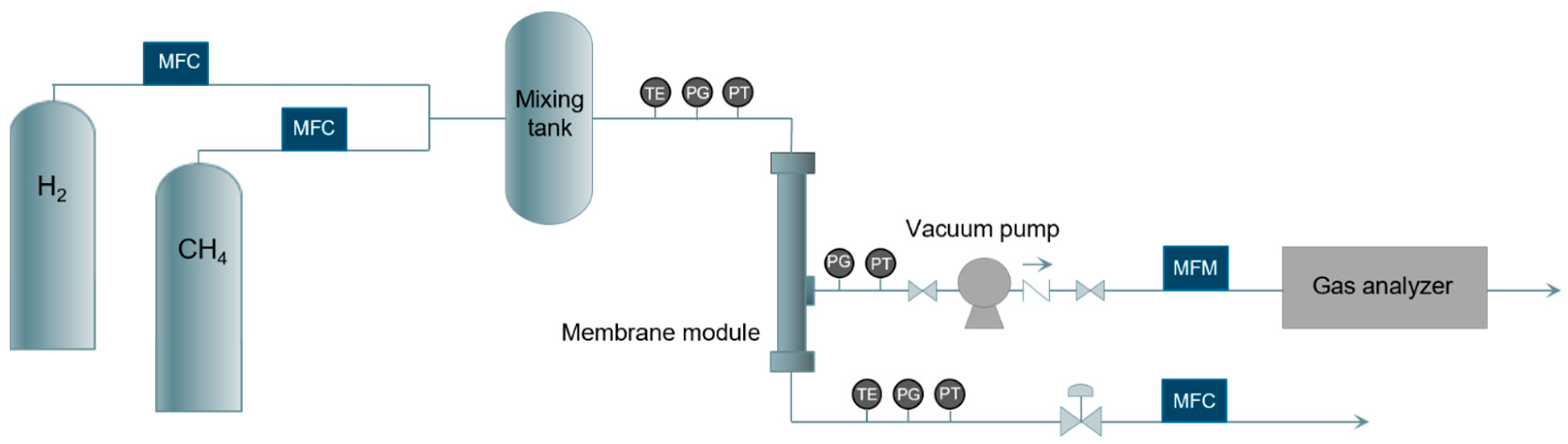
H2 and CH4 was introduced through mass flow controllers (MFC Korea, Incheon, Republic of Korea) into a mixing tank, then injected to the bore side of the hollow fiber, while the permeate was obtained from the shell side (Figure 1). The bore-side configuration was chosen due to limitations of the configuration of the commercial modules used in this work. The upstream pressure was controlled with a back pressure regulator located in the retentate stream, and a pressure transmitter was used to measure the pressure at the upstream and the downstream. A mass flow meter (MFC Korea, Incheon, Republic of Korea) was equipped to measure the flow rate of the retentate and the permeate streams. The composition of the permeate stream was analyzed with an emission analyzer (MRU Instruments, Humble, TX, USA). To differentiate between the effects of concentration polarization and permeate pressure buildup, an additional experiment was conducted by reducing the permeate-side pressure from the standard condition of 1.1 bar (absolute) to 0.2 bar (absolute) using a vacuum pump.
The permeance of component i (Pi) through the membrane, expressed in gas permeation units (GPU, where 1 GPU = 10−6 cm3(STP)/(cm2∙s∙cmHg)), was calculated with the following equation:
P i = u P y i A p i
where uP is the molar flow rate of the permeate, yi is the mole fraction of component i in the permeate, A is the effective membrane area, and Δpi is the partial pressure difference of component i across the membrane. Δpi was obtained with the following equation:
p i = p F x i ¯ p P y i
where pF and pP represent feed pressure and permeate pressure, x i ¯ is the representative mole fraction of component i in the bore side of the membrane. Because the concentration of gases changes along the length of the hollow fiber as permeation occurs, x i ¯ is estimated with the following equation:
x i ¯ = u F x i , F + u R x i , R u F + u R
where xi,F and xi,R are the mole fractions of component i in the feed and retentate streams, respectively. uF and uR indicate the molar flow rates of the feed and retentate streams, respectively.
The membrane H2/CH4 permselectivity, or ideal selectivity, was calculated as the simple ratio of the permeance of single-gas H2 and CH4 permeances:
αH2/CH4 = PH2/PCH4
The separation factor (βH2/CH4), represents the separation efficiency in mixed-gas environments, defined as the ratio of mole fractions in the permeate and retentate streams.
βH2/CH4 = (yH2/yCH4)/(xH2/xCH4)
The H2 recovery, RH2, was calculated as the ratio of the amount of H2 collected in the permeate stream to the total amount of H2 supplied to the module in the feed stream:
RH2 = uPxH2,P/uFxH2,F
where uP is the molar flow rate of the permeate stream, and xH2,P is the mole fraction of H2 in the permeate stream.
The stage cut, θ, was calculated as the permeate flow to feed flow:
θ = uP/uF
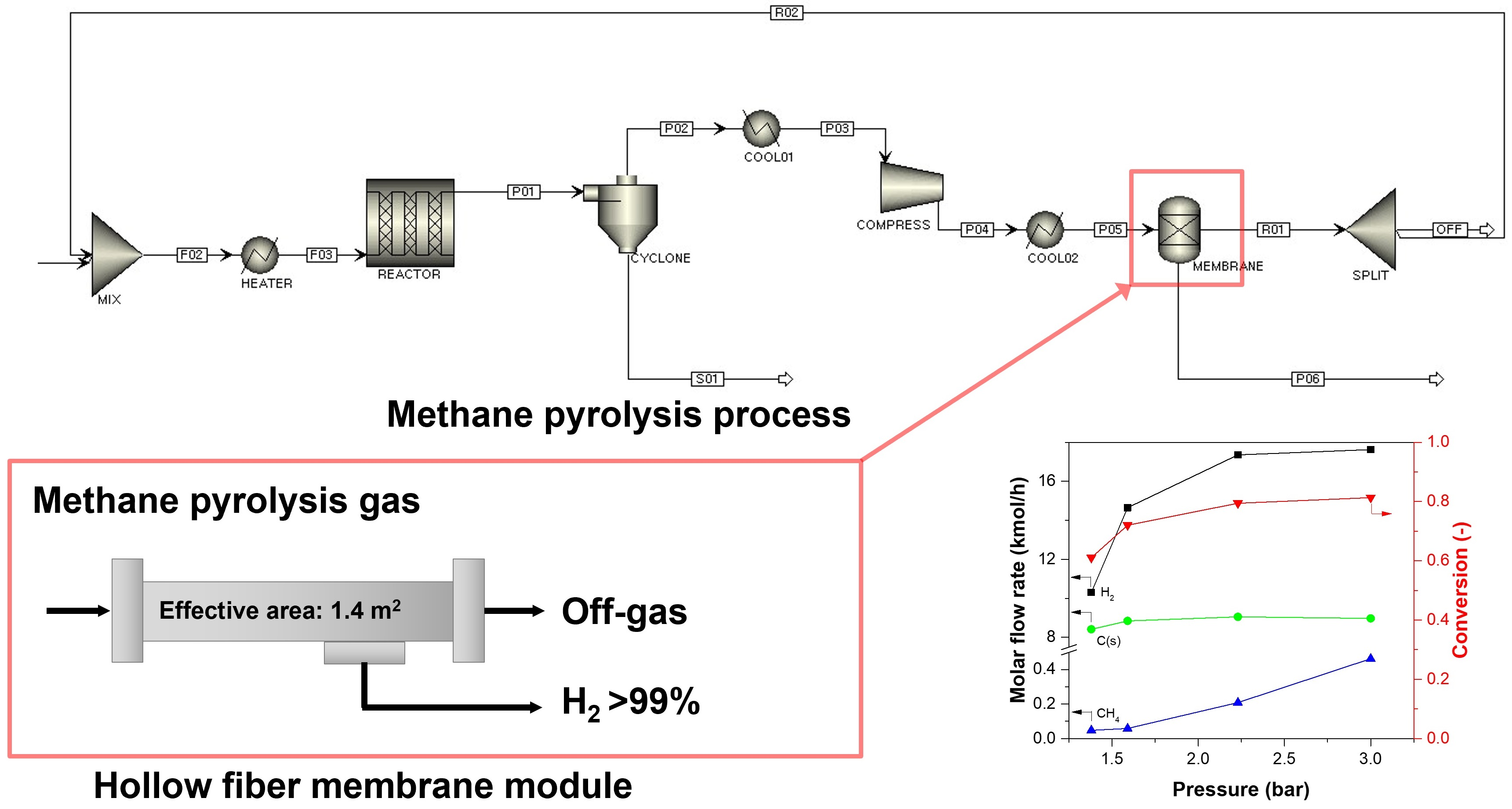
A thermal methane pyrolysis reaction process integrated with a downstream membrane separation unit was developed in Aspen Plus, following the method reported by Patibandla (Figure S2) [20]. The methane pyrolysis reactor was modeled as an isothermal, isobaric plug flow reactor operating at a steady state. The reaction kinetics were implemented based on the global model developed by Keipi et al. [21], which provides rate constants and reaction orders for the forward and backward reactions. The reactor inlet temperature was set to 1273 K, the pressure was maintained at 1 bar, and a target CH4 conversion rate of 85% was specified. The membrane unit was modeled in Aspen Plus using a Calculator block. The Calculator block determines the component split fractions based on a fixed product purity and recovery obtained experimentally from a 95/5 mol% H2/CH4 feed mixture at 2 bar. Although the recycle loop reduces the steady-state membrane feed composition to ~90% H2, potentially inducing minor performance overestimation, this approach provides a sufficient approximation for the system-level energy assessment. Details including kinetic parameters, reactor design assumption, and process flowsheet are summarized in Supporting Information.

3. Results and Discussion

3.1. Single Gas Transport Properties of Membranes

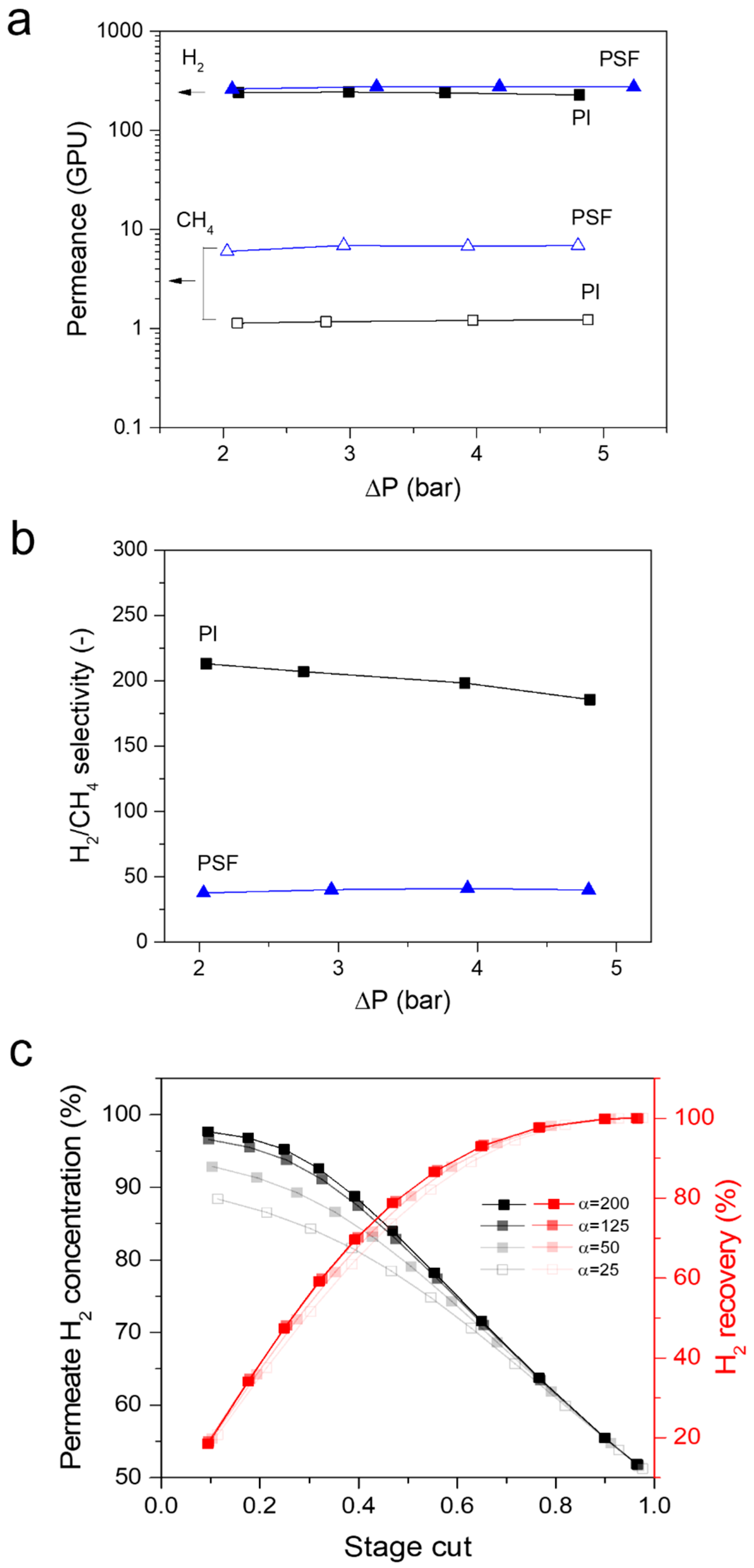
Single gas permeances of PI and PSF hollow fiber modules were evaluated by measuring pure H2 and CH4 permeances at feed pressures ranging from 2.1 to 4.8 bar. As shown in Figure 2a, the permeances of both gases was independent of feed pressure, which is characteristic of transport in glassy polymers governed by the dual-mode transport model [22]. Consequently, the ideal H2/CH4 selectivity for each module remained constant across this pressure range. While both modules exhibited comparable H2 permeances of approximately 200 GPU, the PI module exhibited a significantly higher H2/CH4 ideal selectivity of 200, compared to 40 for the PSF module (Figure 2b). This superior selectivity is attributed to the rigid polymer chains typical of polyimides, which more effectively hinder the diffusion of larger CH4 molecules while allowing smaller H2 molecules to permeate [23]. The performance of the PSF module was consistent with previously reported ideal selectivities of 30~50 for polysulfone membranes [24,25].
To understand how these material properties translate to process performance, a numerical simulation was conducted (Figure 2c). The numerical model assumes plug flow (i.e., perfect radial mixing and no axial mixing) with negligible pressure drop, a common approach for bore-side feed modules [26]. The change in permeate H2 purity and recovery were investigated as a function of membrane selectivity and stage cut. It should be noted that the effect of permeance on process performance was not examined, as permeance does not influence the trade-off between permeate purity and recovery. The simulation results revealed that as stage cut increases, H2 recovery increases but eventually reaches a plateau. This is due to the depletion of H2 in the feed stream, which reduces the H2 partial pressure and diminishes the driving force for permeation at higher recovery levels. This reduction in driving force also causes permeate H2 purity to decrease at higher stage cuts. Furthermore, while higher membrane selectivity improved permeate purity for a fixed stage cut [27], this effect had diminishing returns, with minimal purity gains observed for selectivities above 125. At high stage cuts (>0.7), the influence of selectivity on separation performance became negligible as the process became limited by the low H2 concentration in the feed.

3.2. Effect of Process Parameters on Mixed-Gas H2/CH4 Separation Performance

This section evaluates the mixed-gas H2/CH4 separation performance of the highly selective PI module and the lower-selectivity PSF module. We examined how feed composition and pressure affect separation performance and compared the experimental results to simulations calculated assuming ideal transport with negligible pressure drop along the feed side. Experimental measurements confirmed the validity of the negligible pressure drop assumption, showing less than 0.1 bar difference in pressure at the feed and the retentate side.
While this study utilized binary H2/CH4 mixtures to establish a baseline performance, it should be noted that the actual product gas from methane pyrolysis typically contains trace impurities, including C2–C6 hydrocarbons and aromatics. In practical applications, these species can affect membrane stability through antiplasticization and competitive adsorption. Aromatic impurities such as toluene are known to induce antiplasticization in glassy polymers; this phenomenon increases chain rigidity and reduces fractional free volume, potentially lowering H2 permeance [28,29,30]. Additionally, strong adsorption of heavier hydrocarbons could lead to competitive adsorption, potentially blocking permeation pathways for H2 [28].

3.2.1. Effect of Feed Composition on Separation Performance

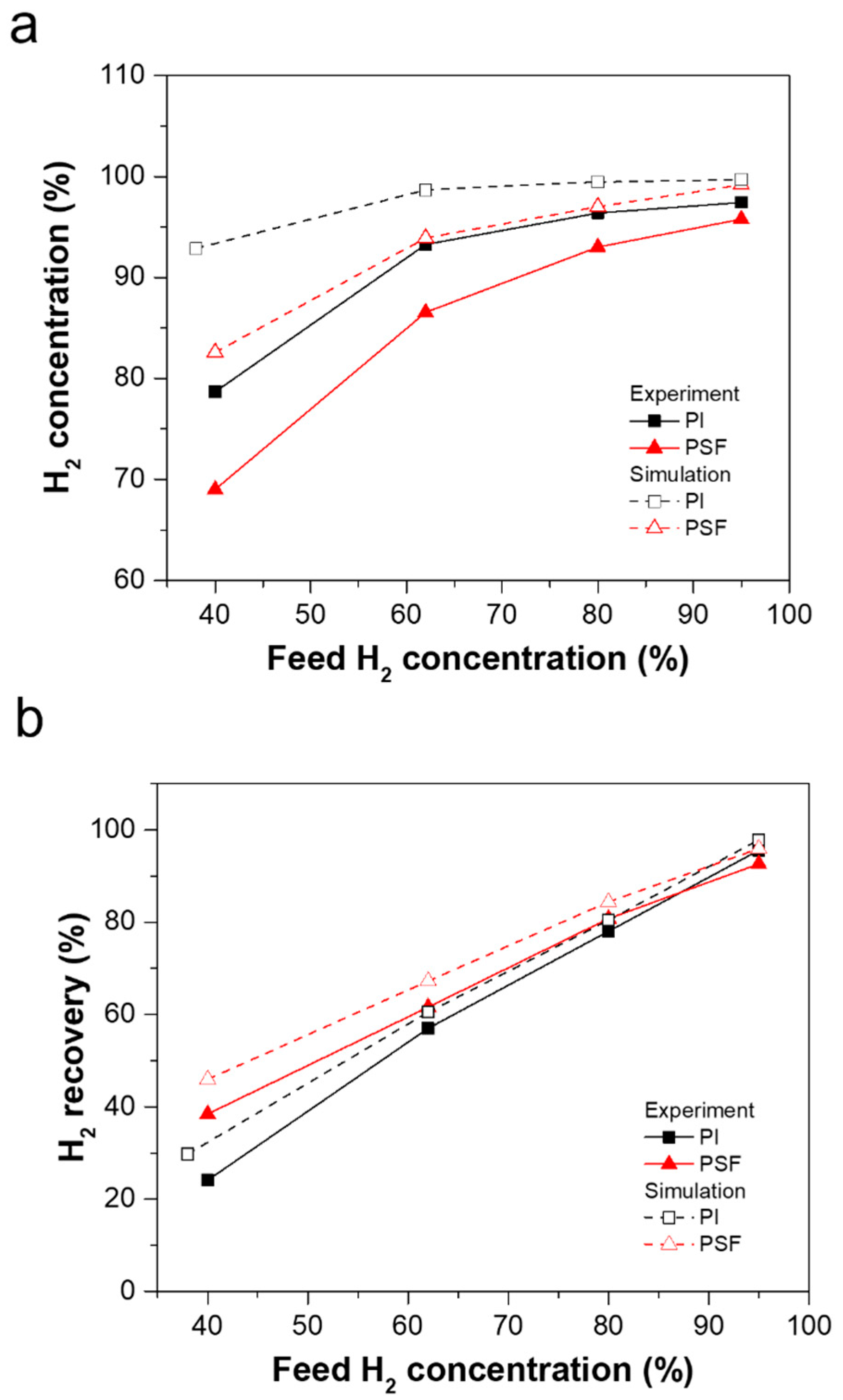
The effect of feed H2 concentration on the membrane separation performance is summarized in Figure 3. Binary H2/CH4 mixtures containing either 40, 62, 80, or 95 mol% H2 were supplied to the membrane module at a total pressure of 3 bar and a constant feed flow rate of 0.5 Nm3/h. Increasing the H2 concentration in the feed gas (from 40% to 95%) primarily resulted in increased permeate H2 purity and recovery for both modules. As shown in Figure 3a, the H2 purity in the permeate rose from 78.7% to 97.4% for the PI module and from 69% to 95.8% for the PSF module. The difference in separation performance between the two materials is attributable to their distinct free volume architectures. The PI membrane, characterized by a more rigid chain structure or smaller free volume elements, exhibits higher intrinsic selectivity compared to the PSF membrane, resulting in higher permeate purities across the tested concentration range.
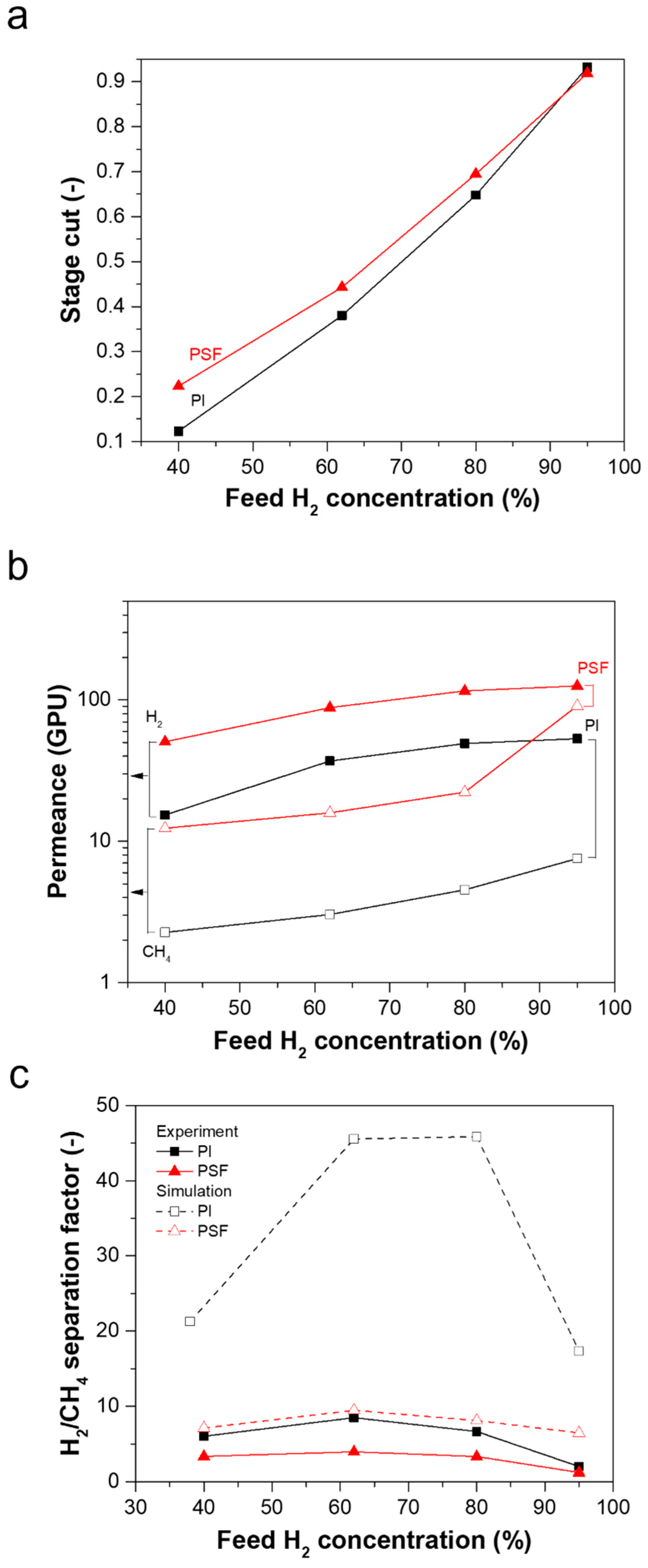
The increase in permeate purity and recovery is primarily driven by the substantial rise in stage cut as the feed stream became richer in the highly permeable H2 (Figure 4a). Conversely, this high stage cut negatively impacted the H2/CH4 separation factor (Figure 4c). As the stage cut increased, the H2 partial pressure decreased along the module length relative to that of CH4, causing the separation factor to drop from a maximum of 8.5 to 2 for the PI module, which is merely a fraction of the ideal selectivity of ~200. Notably, the experimental purity and recovery values were significantly lower than those predicted by ideal simulations, indicating that non-ideal phenomena severely limited performance.
To identify the primary cause of this performance loss, we distinguished between the effects of concentration polarization and permeate pressure build-up. Concentration polarization involves the accumulation of the slow-permeating species (i.e., CH4) near the membrane surface, obstructing H2 permeation. Permeate pressure buildup, meanwhile, refers to the accumulation of product gas on the permeate side, creating back-pressure that reduces the driving force. An experiment applying a vacuum to the permeate side showed only a slight improvement in the separation factor, confirming that permeate pressure buildup was not the dominant issue and that performance loss was primarily governed by concentration polarization.
These non-ideal phenomena also explain the trends in apparent gas permeance (Figure 4b). Severe concentration polarization at the membrane interface increased the local CH4 partial pressure, resulting in an apparent CH4 permeance 2 to 14 times higher than single-gas values. Additionally, the PI module exhibited lower apparent H2 permeance (13~53 GPU) compared to the PSF module (51~126 GPU), despite having similar intrinsic H2 permeance. This discrepancy is attributed to permeate pressure buildup; the PI module utilizes longer fibers, which induce a greater pressure drop on the permeate side and a corresponding loss of driving force [31].
In summary, while single-gas experiments indicated high potential, the mixed-gas separation performance was severely compromised by concentration polarization. This effect was most pronounced with the 95% H2 feed, where separation efficiency decreased drastically. The severity of concentration polarization observed in these relatively moderate-permeance modules (~200 GPU) can be attributed to the strong coupling between permeance and ideal selectivity. He et al. [32] established that concentration polarization is not exclusive to high-permeance membranes; it becomes significant even at permeances around 200 GPU if the selectivity exceeds 10. The separation performances of modules used in this work, with an ideal selectivity of ~200, are in this regime, where the rapid selective removal of H2 creates a steep concentration gradient. Furthermore, the bore-side feed configuration likely exacerbated this effect. As noted by Feng et al., bore-fed fibers are more susceptible to concentration polarization due to the presence of stagnant gas zones within the porous substrate [33]. To mitigate this, transitioning to a shell-side feed configuration is recommended, as it minimizes these stagnant gas zones [33]. Additionally, incorporating baffles can actively enhance mass transfer by inducing local turbulence and radial mixing [34,35]. These structural optimizations disrupt the stagnant boundary layer, thereby maintaining a high driving force across the membrane.

3.2.2. Effect of Feed Pressure on Separation Performance

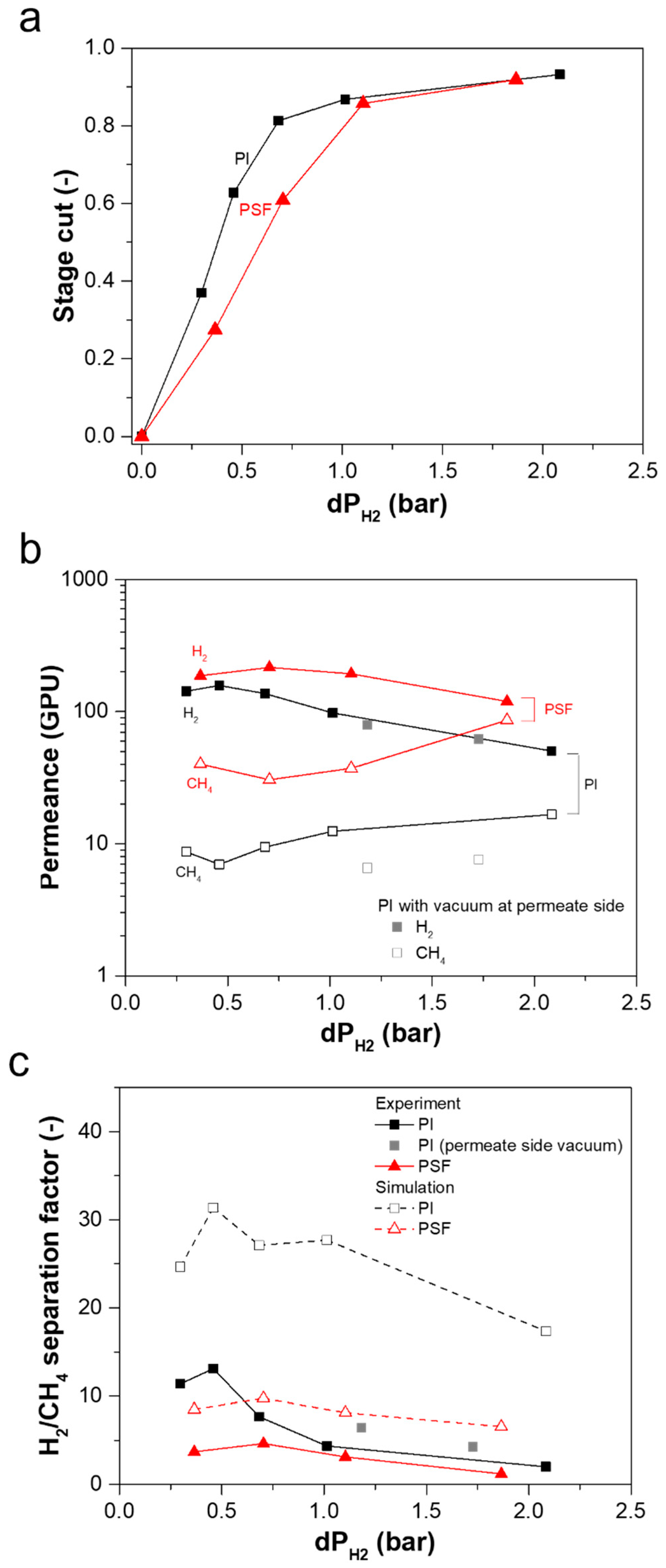
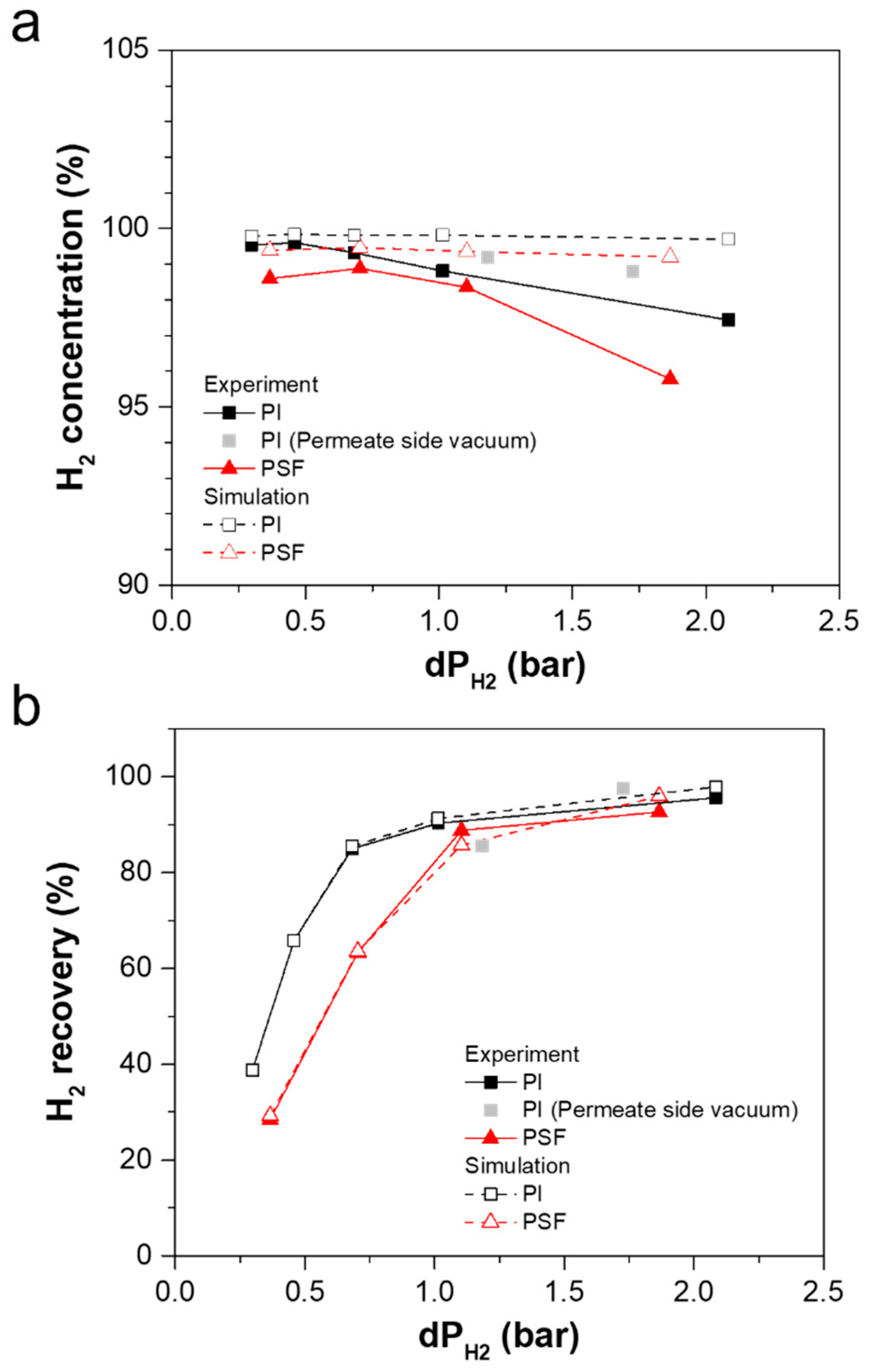
Subsequently, we investigated the effect of feed pressure on the separation performance of the membranes. Using a fixed feed composition of 95/5 mol/mol H2/CH4, the transmembrane H2 partial pressure difference (dPH2) was varied from 0.3 to 2.2 bar at a constant feed flow rate of 0.5 Nm3/h. As anticipated, increasing dPH2 enhanced the driving force for permeation, resulting in a higher stage cut (Figure 5a). However, the increased H2 flux intensified concentration polarization at the membrane surface, suppressing the apparent H2 permeance while increasing the apparent CH4 permeance (Figure 5b) [31]. Consequently, the experimental H2/CH4 separation factor was significantly lower than the ideal simulated values (Figure 5c). Consistent with previous findings, the high-selectivity PI module exhibited lower apparent H2 permeance compared to the PSF module, attributed to its greater susceptibility to permeate pressure buildup. Similarly to the feed composition studies, applying a vacuum to the permeate side only marginally improved the separation factor. This confirms that concentration polarization, rather than permeate pressure buildup, was the primary cause of the performance loss.
The impact of these phenomena on the permeate purity and H2 recovery is illustrated in Figure 6. As the stage cut increased with rising transmembrane H2 partial pressure difference (dPH2), the permeate H2 purity decreased for both modules, remaining well below the simulated ideal values (Figure 6a). Specifically, permeate H2 concentration dropped from 99.5% to 97.4% for PI, and from 98.6% to 95.8% for PSF due to increased stage cut. Applying a vacuum to the permeate side improved purity, mirroring the trend observed for the separation factor. Interestingly, the experimental H2 recovery closely matched the simulated results across the entire pressure range (Figure 6b). This finding suggests that while concentration polarization severely degrades the permeate purity, it has a negligible impact on the overall H2 recovery. Consequently, H2 recovery appears to be dictated almost entirely by the operational stage cut, independent of the non-ideal effects occurring at the membrane surface.

3.3. Simulation of the Performance of a Methane Pyrolysis Reaction Process Equipped with a Membrane

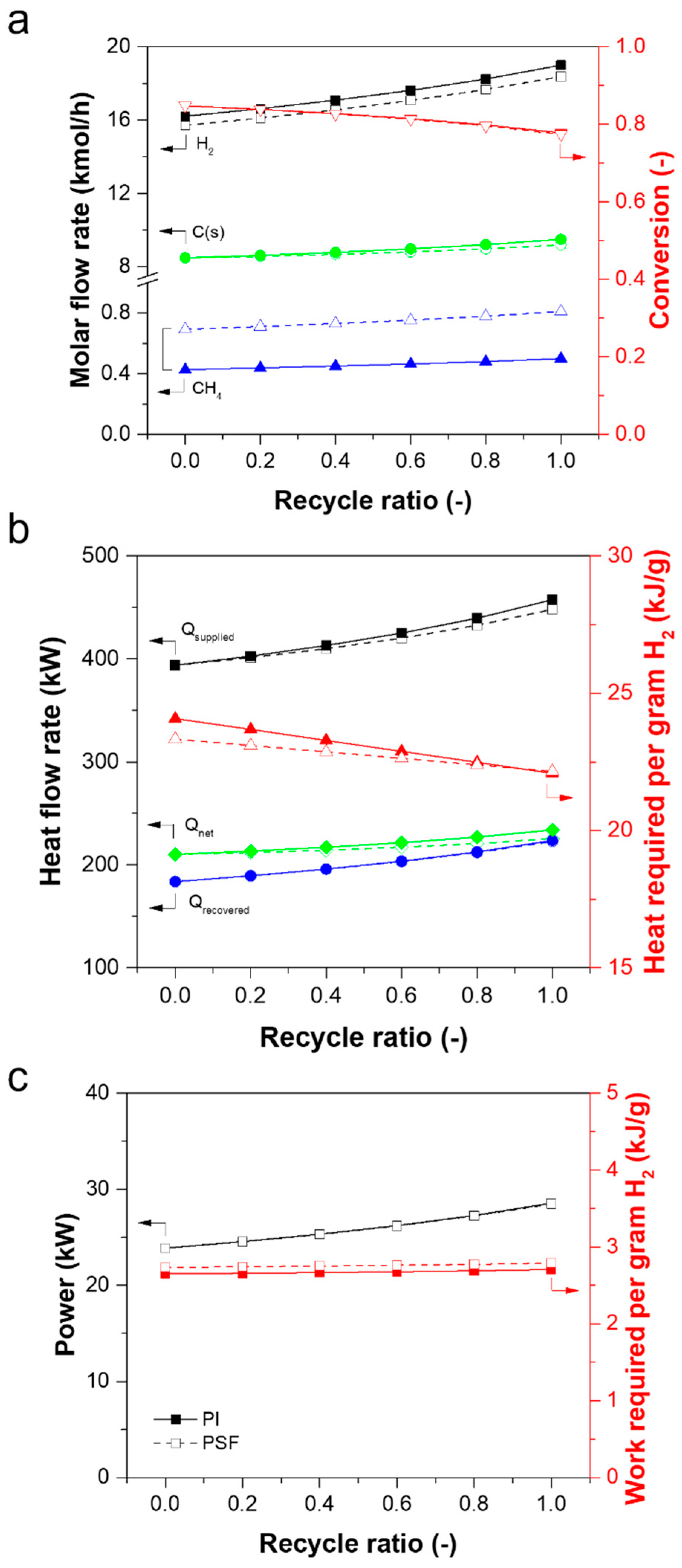
To evaluate the system-level performance, the membrane module was integrated into a simulated methane pyrolysis process. To ensure the assessment reflects realistic operating conditions, the simulation input parameters were calibrated using the experimental product purity and recovery obtained from the mixed-gas experiments in Section 3.2, thereby accounting for the performance losses attributed to concentration polarization. The effects of the retentate recycle ratio and membrane feed pressure were investigated to determine energy efficiency and H2 production capacity. First, the impact of recycling the methane-rich retentate stream was analyzed (Figure 7). The recycle ratio, defined as the fraction of retentate stream recycled into the reactor, was varied from 0 to 1. Increasing the recycle ratio raised the total molar flow rates of all species due to the increased reactor inlet volume. This led to an increased H2 production rate from 16.2 kmol/h to 19 kmol/h, with the high-selectivity PI membrane consistently outperforming the PSF membrane (Figure 7a). While the higher total flow rate caused a slight reduction in the single-pass reactor conversion (e.g., decreasing from 0.848 to 0.774 for the PI system), the overall process yield improved.
As a result, this increase in recycled flow raised the total heating demand and compressor power required (Figure 7b,c). However, a more critical metric for process efficiency is the energy consumption per unit of H2 produced. Due to the significant increase in H2 production, the heat demand per unit of H2 produced decreased from 23.3 to 22.2 kJ/g H2. It is noteworthy that the compression work per unit of H2 produced remained constant despite the increased recycle ratio. This indicates that the rise in absolute compressor power consumption, caused by the higher volumetric flow rate of the recycle stream, was directly proportional to the increase in hydrogen production rate. Essentially, the energy penalty associated with compressing the recycled unreacted methane was fully offset by the gain in hydrogen yield, indicating a net improvement in the process’s thermal efficiency with increased recycling.
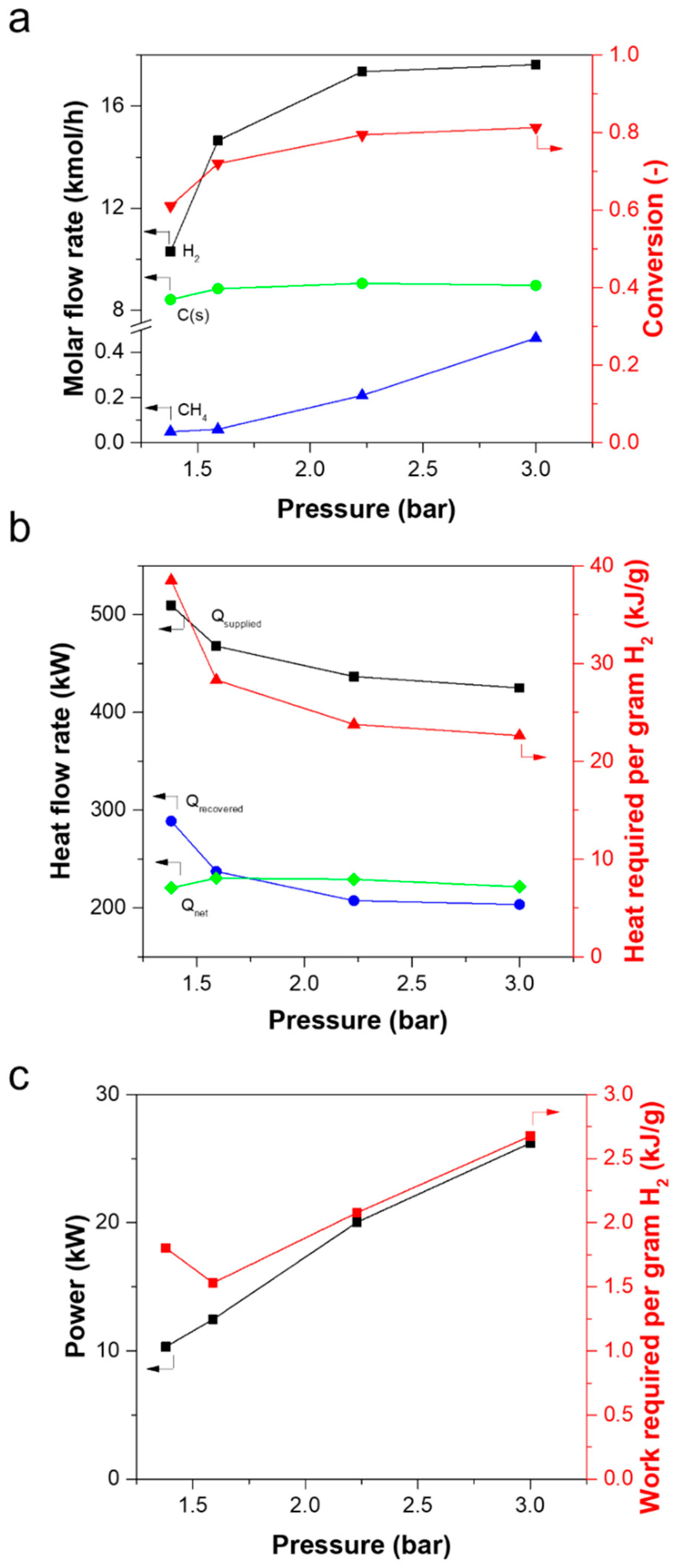
Subsequently, the influence of membrane feed pressure was evaluated for the PI module at a fixed membrane recovery of 0.6 (Figure 8). Increasing the feed pressure enhanced H2 permeation, significantly raising the H2 molar flow rate in the permeate stream from 10 to 17.6 kmol/h (Figure 8a). An important secondary benefit was the increase in the overall reactor conversion. This improvement arises because efficient separation at higher pressures yields a retentate stream with a lower H2 content, thereby increasing the CH4 concentration in the recycled reactor feed. From an energy perspective, higher feed pressure substantially improved the system’s efficiency (Figure 8b). Although the required compressor power increased, the substantial rise in H2 production led to a significant reduction in the specific heat demand, from 38.5 to 22.6 kJ/g H2. The total specific energy consumption, accounting for both heat and work, was minimized at the highest tested pressure, reaching approximately 24.9 kJ/g H2.
This result highlights a key competitive advantage of the membrane-integrated system. For comparison, a catalytic methane pyrolysis process utilizing pressure swing adsorption typically requires a net energy input of ca. 39 kJ/g H2 [36]. Therefore, the membrane-based process demonstrated here is significantly more energy-efficient, primarily due to the lower thermal input required for the separation unit.

4. Conclusions

This study demonstrates the viability of utilizing commercial polymeric membranes for purification of turquoise hydrogen from methane pyrolysis gas. Despite performance limitations imposed by non-ideal transport phenomena, the process was optimized to achieve a permeate stream with 99.3% H2 purity at 85% recovery from a feed containing 95 mol% H2. A key finding was that mixed-gas separation performance was not limited by the intrinsic transport properties of the membrane material, but was dominated by concentration polarization. This non-ideal effect degraded the H2/CH4 separation factor by as much as 80% compared to ideal values, a trend particularly pronounced at high stage cuts. The severity of concentration polarization observed in these relatively low-permeance modules was unexpected, suggesting that non-ideal flow patterns within the bore-fed hollow fiber modules exacerbated the phenomenon. Notably, while concentration polarization significantly reduced permeate purity, it had a negligible effect on overall H2 recovery, which was dictated primarily by the operational stage cut.
Furthermore, process simulations based on the experimental results confirmed that integrating a membrane unit with a recycle stream offers an energy-efficient pathway for high-purity turquoise hydrogen production. Recycling the methane-rich retentate to the pyrolysis reactor, combined with raising the membrane feed pressure from 1.38 bar to 3 bar, significantly improved the overall process yield, increasing the H2 production rate from 10.3 to 17.6 kmol/h. More importantly, this integration led to a substantial reduction in energy consumption from 40.3 kJ/g H2 to 24.9 kJ/g H2, a value considerably lower than the 39 kJ/H2 reported for conventional PSA-based purification systems [36].
In conclusion, while the ideal selectivity of commercial membranes is sufficient for high-purity hydrogen production, practical separation efficiency was ultimately constrained by module-induced concentration. Therefore, future work should prioritize module design optimizations, such as adopting shell-side feed configuration or incorporating baffles, to mitigate these non-ideal effects and realize the full potential of membrane technology in this application.

Supplementary Materials

The following supporting information can be downloaded at: https://www.mdpi.com/article/10.3390/en19010179/s1. Table S1: Kinetic parameters for methane pyrolysis reaction used for process simulation in this work; Table S2: Parameters for the plug flow reactor used for process simulation in this work; Figure S1: Effect of feed flow rate on the H2 concentration of permeate and retentate, and H2 recovery under 1 bar of H2/CH4 (60/40 mol/mol) feed at 25 °C (Stage cut = 0.5); Figure S2: Flow sheet of a thermal methane pyrolysis reaction process integrated with a membrane separation unit.

Author Contributions

Conceptualization, H.J.Y.; investigation, H.J.Y.; formal analysis, D.K.P.; writing—original draft preparation, H.J.Y.; writing—review and editing, H.J.Y., D.K.P. and J.-H.R.; supervision, J.-H.R.; funding acquisition, J.-H.R. All authors have read and agreed to the published version of the manuscript.

Funding

This study was conducted with the support of the Korea Institute of Energy Technology Evaluation and Planning (KETEP) as a new and renewable energy core technology development project funded by the Ministry of Trade, Industry and Energy in 2024. (No. 202400459131).

Data Availability Statement

The original contributions presented in this study are included in the article/Supplementary Material. Further inquiries can be directed to the corresponding author.

Conflicts of Interest

The authors declare no conflicts of interest. The funders had no role in the design of the study; in the collection, analyses, or interpretation of data; in the writing of the manuscript; or in the decision to publish the results.

References

  1. Alhamed, H.; Behar, O.; Saxena, S.; Angikath, F.; Nagaraja, S.; Yousry, A.; Das, R.; Altmann, T.; Dally, B.; Sarathy, S.M. From Methane to Hydrogen: A Comprehensive Review to Assess the Efficiency and Potential of Turquoise Hydrogen Technologies. Int. J. Hydrogen Energy 2024, 68, 635–662. [Google Scholar] [CrossRef]
  2. Shokrollahi, M.; Teymouri, N.; Ashrafi, O.; Navarri, P.; Khojasteh-Salkuyeh, Y. Methane Pyrolysis as a Potential Game Changer for Hydrogen Economy: Techno-Economic Assessment and GHG Emissions. Int. J. Hydrogen Energy 2024, 66, 337–353. [Google Scholar] [CrossRef]
  3. Moghaddam, A.L.; Hejazi, S.; Fattahi, M.; Kibria, M.G.; Thomson, M.J.; AlEisa, R.; Khan, M.A. Methane Pyrolysis for Hydrogen Production: Navigating the Path to a Net Zero Future. Energy Environ. Sci. 2025, 18, 2747–2790. [Google Scholar] [CrossRef]
  4. International Energy Agency (IEA). Hydrogen. Available online: https://www.iea.org/energy-system/low-emission-fuels/hydrogen (accessed on 24 November 2025).
  5. Ullah, I.; Amin, M.; Zhao, P.; Qin, N.; Xu, A.-W. Recent Advances in Inorganic Oxide Semiconductor-Based S-Scheme Heterojunctions for Photocatalytic Hydrogen Evolution. Inorg. Chem. Front. 2025, 12, 1329–1348. [Google Scholar] [CrossRef]
  6. Nanda, S.; Rana, R.; Zheng, Y.; Kozinski, J.A.; Dalai, A.K. Insights on Pathways for Hydrogen Generation from Ethanol. Sustain. Energy Fuels 2017, 1, 1232–1245. [Google Scholar] [CrossRef]
  7. Abánades, A.; Rubbia, C.; Salmieri, D. Technological Challenges for Industrial Development of Hydrogen Production Based on Methane Cracking. Energy 2012, 46, 359–363. [Google Scholar] [CrossRef]
  8. Prabowo, J.; Lai, L.; Chivers, B.; Burke, D.; Dinh, A.H.; Ye, L.; Wang, Y.; Wang, Y.; Wei, L.; Chen, Y. Solid Carbon Co-Products from Hydrogen Production by Methane Pyrolysis: Current Understandings and Recent Progress. Carbon 2024, 216, 118507. [Google Scholar] [CrossRef]
  9. Olsvik, O.; Rokstad, O.A.; Holmen, A. Pyrolysis of Methane in the Presence of Hydrogen. Chem. Eng. Technol. 1995, 18, 349–358. [Google Scholar] [CrossRef]
  10. Bhattacharyya, R.; Bhanja, K.; Mohan, S. Simulation Studies of the Characteristics of a Cryogenic Distillation Column for Hydrogen Isotope Separation. Int. J. Hydrogen Energy 2016, 41, 5003–5018. [Google Scholar] [CrossRef]
  11. Liemberger, W.; Groß, M.; Miltner, M.; Harasek, M. Experimental Analysis of Membrane and Pressure Swing Adsorption (PSA) for the Hydrogen Separation from Natural Gas. J. Clean. Prod. 2017, 167, 896–907. [Google Scholar] [CrossRef]
  12. Ockwig, N.W.; Nenoff, T.M. Membranes for Hydrogen Separation. Chem. Rev. 2007, 107, 4078–4110. [Google Scholar] [CrossRef]
  13. Ma, X.; Wu, X.; Caro, J.; Huang, A. Polymer Composite Membrane with Penetrating ZIF-7 Sheets Displays High Hydrogen Permselectivity. Angew. Chem. Int. Ed. 2019, 58, 16156–16160. [Google Scholar] [CrossRef] [PubMed]
  14. Goh, P.S.; Ismail, A.F.; Sanip, S.M.; Ng, B.C.; Aziz, M. Recent Advances of Inorganic Fillers in Mixed Matrix Membrane for Gas Separation. Sep. Purif. Technol. 2011, 81, 243–264. [Google Scholar] [CrossRef]
  15. Yu, H.J.; An, H.; Shin, J.H.; Brunetti, A.; Lee, J.S. A New Dip-Coating Approach for Plasticization-Resistant Polyimide Hollow Fiber Membranes: In Situ Thermal Imidization and Cross-Linking of Polyamic Acid. Chem. Eng. J. 2023, 473, 145378. [Google Scholar] [CrossRef]
  16. Choi, S.-H.; Brunetti, A.; Drioli, E.; Barbieri, G. H2 Separation from H2/N2 and H2/CO Mixtures with Co-Polyimide Hollow Fiber Module. Sep. Sci. Technol. 2010, 46, 1–13. [Google Scholar] [CrossRef]
  17. Alqaheem, Y.; Alomair, A.; Vinoba, M.; Pérez, A. Polymeric Gas-Separation Membranes for Petroleum Refining. Int. J. Polym. Sci. 2017, 2017, 4250927. [Google Scholar] [CrossRef]
  18. Zhang, X.; Qian, X.; Xiao, C.; Yin, X.; Wang, X.; Wang, Z.; Yu, H.; Han, Z.; Lin, L. Advancements in Purification and Holistic Utilization of Industrial By-Product Hydrogen: Progress, Challenges, and Prospects. Green Energy Resour. 2024, 2, 100098. [Google Scholar] [CrossRef]
  19. Mivechian, A.; Pakizeh, M. Hydrogen Recovery from Tehran Refinery Off-Gas Using Pressure Swing Adsorption, Gas Absorption and Membrane Separation Technologies: Simulation and Economic Evaluation. Korean J. Chem. Eng. 2013, 30, 937–948. [Google Scholar] [CrossRef]
  20. Patibandla, A. Process Deisgn & Economic Analysis of Methane Pyrolysis for Production of Hydrogen from Natural Gas. Master’s Thesis, Delft University of Technology, Delft, The Netherlands, 2023. [Google Scholar]
  21. Keipi, T.; Li, T.; Løvås, T.; Tolvanen, H.; Konttinen, J. Methane Thermal Decomposition in Regenerative Heat Exchanger Reactor: Experimental and Modeling Study. Energy 2017, 135, 823–832. [Google Scholar] [CrossRef]
  22. Ghosal, K.; Freeman, B.D. Gas Separation Using Polymer Membranes: An Overview. Polym. Adv. Technol. 1994, 5, 673–697. [Google Scholar] [CrossRef]
  23. Robeson, L.M. The Upper Bound Revisited. J. Membr. Sci. 2008, 320, 390–400. [Google Scholar] [CrossRef]
  24. Pakizeh, M.; Moghadam, A.N.; Omidkhah, M.R.; Namvar-Mahboub, M. Preparation and Characterization of Dimethyldichlorosilane Modified SiO2/PSf Nanocomposite Membrane. Korean J. Chem. Eng. 2013, 30, 751–760. [Google Scholar] [CrossRef]
  25. Ruiz-Treviño, F.A.; Paul, D.R. Modification of Polysulfone Gas Separation Membranes by Additives. J. Appl. Polym. Sci. 1997, 66, 1925–1941. [Google Scholar] [CrossRef]
  26. Weller, S.; Steiner, W.A. Separation of Gases by Fractional Permeation through Membranes. J. Appl. Phys. 1950, 21, 279–283. [Google Scholar] [CrossRef]
  27. Koros, W.J.; Fleming, G.K. Membrane-Based Gas Separation. J. Membr. Sci. 1993, 83, 1–80. [Google Scholar] [CrossRef]
  28. Al-Juaied, M.; Koros, W.J. Performance of Natural Gas Membranes in the Presence of Heavy Hydrocarbons. J. Membr. Sci. 2006, 274, 227–243. [Google Scholar] [CrossRef]
  29. Vu, D.Q.; Koros, W.J.; Miller, S.J. Effect of Condensable Impurity in CO2/CH4 Gas Feeds on Performance of Mixed Matrix Membranes Using Carbon Molecular Sieves. J. Membr. Sci. 2003, 221, 233–239. [Google Scholar] [CrossRef]
  30. Ma, C.; Koros, W.J. Effects of Hydrocarbon and Water Impurities on CO2/CH4 Separation Performance of Ester-Crosslinked Hollow Fiber Membranes. J. Membr. Sci. 2014, 451, 1–9. [Google Scholar] [CrossRef]
  31. Mourgues, A.; Sanchez, J. Theoretical Analysis of Concentration Polarization in Membrane Modules for Gas Separation with Feed inside the Hollow-Fibers. J. Membr. Sci. 2005, 252, 133–144. [Google Scholar] [CrossRef]
  32. He, G.; Mi, Y.; Lock Yue, P.; Chen, G. Theoretical Study on Concentration Polarization in Gas Separation Membrane Processes. J. Membr. Sci. 1999, 153, 243–258. [Google Scholar] [CrossRef]
  33. Feng, X.; Ivory, J.; Rajan, V.S.V. Air Separation by Integrally Asymmetric Hollow-Fiber Membranes. AIChE J. 1999, 45, 2142–2152. [Google Scholar] [CrossRef]
  34. Vishwakarma, S.K.; Kumar, K.; Upadhyay, R.K. Experimental Investigation of Circular Baffles Pitch and Aperture Ratio on the Concentration Polarization of Pd–Ag Membrane Module for Enhanced Hydrogen Separation. Int. J. Hydrogen Energy 2025, 169, 151136. [Google Scholar] [CrossRef]
  35. Ma, R.; Castro-Dominguez, B.; Dixon, A.G.; Ma, Y.H. Scalability of Multitube Membrane Modules for Hydrogen Separation: Technical Considerations, Issues and Solutions. J. Membr. Sci. 2018, 564, 887–896. [Google Scholar] [CrossRef]
  36. Riley, J.; Atallah, C.; Siriwardane, R.; Stevens, R. Technoeconomic Analysis for Hydrogen and Carbon Co-Production via Catalytic Pyrolysis of Methane. Int. J. Hydrogen Energy 2021, 46, 20338–20358. [Google Scholar] [CrossRef]
Figure 1. Schematic diagram of the apparatus used for gas permeation experiments.
Energies 19 00179 g001
Figure 2. Single gas H2/CH4 separation performance of hollow fiber membrane modules at 25 °C. (a) H2 and CH4 permeance, (b) H2/CH4 selectivity. (c) Simulated permeate H2 purity and H2 recovery as a function of membrane selectivity.
Energies 19 00179 g002
Figure 3. Effect of feed H2 concentration on H2/CH4 separation performance at 3 bar, 25 °C. (a) permeate H2 concentration, and (b) H2 recovery.
Energies 19 00179 g003
Figure 4. Effect of feed H2 concentration on H2/CH4 separation performance at 3 bar, 25 °C. (a) stage cut, (b) H2 and CH4 permeance, (c) H2/CH4 separation factor.
Energies 19 00179 g004
Figure 5. Effect of transmembrane H2 partial pressure difference (dPH2) on H2/CH4 separation performance at 25 °C, under 95/5 mol/mol H2/CH4 feed: (a) stage cut, (b) H2 and CH4 permeance, (c) H2/CH4 separation factor.
Energies 19 00179 g005
Figure 6. Effect of dPH2 on H2/CH4 separation performance at 25 °C, under 95/5 mol/mol H2/CH4 feed: (a) permeate and H2 concentration and (b) H2 recovery.
Energies 19 00179 g006
Figure 7. Effect of retentate recycle ratio on the performance of a methane pyrolysis reaction process equipped with a membrane module: (a) product molar flow rate and conversion, (b) heat flow rate and heat demand, (c) power and work demand. Filled and open symbols indicate the results for a process using PI and PSF membrane modules, respectively.
Energies 19 00179 g007
Figure 8. Effect of membrane feed pressure on the performance of a methane pyrolysis reaction process equipped with module PI: (a) product molar flow rate and conversion, (b) heat flow rate and heat demand, (c) power and work demand.
Energies 19 00179 g008
Disclaimer/Publisher’s Note: The statements, opinions and data contained in all publications are solely those of the individual author(s) and contributor(s) and not of MDPI and/or the editor(s). MDPI and/or the editor(s) disclaim responsibility for any injury to people or property resulting from any ideas, methods, instructions or products referred to in the content.