Article

Investigation on Multi-Load Reaction Characteristics and Field Synergy of a Diesel Engine SCR System Based on an Eley-Rideal and Langmuir-Hinshelwood Dual-Mechanism Coupled Model


1
Sino-German College of Intelligent Manufacturing, Shenzhen Technology University, Shenzhen 518118, China
2
School of Automotive Studies, Tongji University, Shanghai 201804, China
*
Author to whom correspondence should be addressed.
Energies 2025, 18(24), 6571; https://doi.org/10.3390/en18246571
Submission received: 5 November 2025 / Revised: 2 December 2025 / Accepted: 10 December 2025 / Published: 16 December 2025

Abstract

The selective catalytic reduction (SCR) system is a key component for addressing NOx emissions from internal combustion engines. To resolve the issues of modeling distortion in SCR systems and the difficulty in characterizing the local reaction mechanism, a multi-dimensional SCR reaction model based on the coupling of Eley-Rideal (E-R) and Langmuir-Hinshelwood (L-H) dual mechanisms was established and conducted by experiment. The SCR catalytic characteristics and the dual-mechanism reaction process were systematically investigated. Additionally, based on the combined analysis of species concentration distribution coupled with temperature characteristics, a calculation method for the synergy of concentration-temperature fields was developed, and the synergistic characteristics of the concentration-temperature fields were explored. The results showed that high load accelerated the light-off speed, but this effect was counteracted by the negative impact of high flow rate. A strong negative correlation was maintained between temperature and NOx concentration across the full load range, and the axial consistency increased with load increasing. The results provide important theoretical support for the mechanism analysis of diesel engine SCR reactions and the optimization of thermal management.

1. Introduction

Diesel engines occupy an important position in transportation, construction machinery, and other fields due to their characteristics of high efficiency and high reliability. Traditional vehicle internal combustion engines have long relied on petroleum fuels (such as gasoline and diesel). A large amount of carbon dioxide (CO2), as well as pollutants including nitrogen oxides (NOx) and particulate matter (PM), are generated during their combustion process. They are among the major contributors to urban air pollution and greenhouse gas emissions [1]. Nitrogen oxides (NOx) are the cause of ozone pollution, which not only threaten the quality of the ecological environment and human health. Under strict emission regulations, strict restrictions have been imposed on coordinated emission reduction of pollutants, and NOx emission control has been continuously upgraded. The emission control of NO has become a research hotspot in the fields of energy and electricity. Driven by the strict emission regulations, the SCR technology has become the core approach for NOx emission reduction in diesel engines. At present, a multidisciplinary integrated research method is usually adopted for development in the SCR field. In the research field of SCR technology, the development of catalytic materials is based on characterization techniques such as temperature-rise experiments, in situ Fourier transform infrared spectroscopy, and steady-state isotopic transient kinetic analysis [2,3], leading to multidimensional technological breakthroughs.
Mohan et al. [4] prepared Cu-based catalysts via ion exchange method. Combined with characterizations including scanning electron microscopy (SEM) and X-ray diffraction, it was confirmed that a Cu loading of 62.5 wt% could achieve the highest NOx conversion efficiency, and the experimental conclusions were verified through kinetic modeling. The In/H-Beta@cerium catalyst developed by Nkinahamira et al. [5] still maintained excellent anti-toxicity performance under harsh SO2/H2O atmosphere. Under optimized conditions, the denitration efficiency (de-NOx) reached 97.5% at 600 °C. For the red mud-supported Ce-Zr catalyst prepared by Nie et al. [6], the NO conversion rate reached 85% at 250 °C when the Ce:Zr ratio was 1:1. Fedyna et al. [7] prepared Cu-zeolites with different topological structures (such as BEA and MFI) through the impregnation method and solid-state ion exchange method. It was revealed that zeolites with three-dimensional channels were more likely to initiate low-temperature adsorption, and their adsorption–desorption behavior was mainly regulated by Brønsted acid sites. Jablonska et al. [8] modified Y-zeolite with copper ions and conducted NOx loading tests on it. The tests showed that 7.7 wt% of Cu ions exhibited the optimal catalytic activity, and the de-NOx could be further improved by physical mixing of pristine Y-zeolite and Y-zeolite modified with copper ions. Jablonska et al. [9] also investigated the H2-SCR catalytic performance of Pt-based catalysts. The results showed that the catalytic reactions of the catalyst were mainly concentrated on the applied supports (i.e., inorganic oxides and zeolites). In addition, the dispersibility of Pt particles also exerted a significant influence on the de-NOx. Takemoto et al. [10] converted δ-MnO2 octahedral manganese molecular sieve catalyst into β-MnOOH via grinding method to achieve higher mesoporous properties. The results indicated that this method endowed the catalyst with more surface oxygen vacancies and stronger surface acidity, which significantly improved the catalytic capacity. Karkhaneh et al. [11] studied the effect of the synergistic action between Ce and Ti ions on the NO catalytic characteristics of NiMn2O4. The results demonstrated that the space velocity performance of the catalyst was significantly enhanced by the addition of Ti and Ce ions; meanwhile, the optimal catalytic characteristics were exhibited when the Ce ion content was 5%. Research on bench application focused on the engineering coupling between the SCR system and power units. Tushar et al. [12] proposed an air preheating technology scheme that coupled Pt-Rh catalyst with exhaust heat energy. Under the low-load condition of the engine, a de-NOx of 55% was achieved, and the CO emission was reduced by 19% simultaneously. Park et al. [13] found in the loading experiment of the SCR aftertreatment system for NH3 direct-injection SI engine that increasing the intake O2 concentration could effectively inhibit the escape of unburned NH3, enabling the maximum de-NOx of the SCR system to reach 74.5%.
Simulation technology provides theoretical support for the optimization of SCR systems. Buttignol et al. [14] prepared iron-exchanged zeolite (Fe-ZSM-5), and conducted characteristic characterization and loading tests on the modified zeolite. The study showed that N2O could promote NO conversion to varying degrees at different temperatures, and the oxidation activity of the catalyst was mainly determined by partial Fe2+ sites. N2O determined the NO reaction to a certain extent, and the NO reaction controlled by N2O decreased with the increase in Fe aggregates; therefore, optimizing the morphology of Fe aggregates could promote the NO reaction. Vedagiri et al. [15] compared SCR systems with and without mixers using computational fluid dynamics (CFD) method. It was confirmed that the mixer could increase the conversion rate of urea pyrolysis/hydrolysis to NH3 by approximately 40%. Bendrich et al. [16] integrated multi-mechanism pathways to construct a surface reaction mechanism, which covered standard SCR, fast SCR, NO2-SCR reactions and the transient effect of nitrate storage. The potential impact of nitrates on catalytic reactions under long-term low-temperature operating conditions was revealed. Bjerregaard et al. [17] introduced a long-range Coulomb interaction force field to enhance the reliability of the machine learning model. The regulatory effect of Cu loading and Al distribution on NH3-SCR activity, as well as the influencing factors of [Cu(NH3)2]+-CHA mobility, were clarified. Samosir et al. [18] constructed a NOx reaction prediction model based on deep neural network. With exhaust gas temperature, NOx concentration and other parameters as input variables, accurate estimation of de-NOx was realized.
Domestic and international research on SCR technology has mainly focused on the development and performance characterization of catalytic materials, as well as the testing of the actual operation matching performance of the system. Although studies on microcosmic active sites and surface mechanisms are abundant, the characterization of gas–solid coupled mass/heat transfer and the spatiotemporal distribution of reaction zones is insufficient. This makes it difficult to explain the effects of inhomogeneous inlet local rate and ammonia slip [19,20]. In engineering models, simplified kinetics or a single reaction pathway are often adopted. The variation in the proportion of parallel Eley-Rideal (E-R) and Langmuir-Hinshelwood (L-H) pathways with temperature and load has not been characterized. As a result, obvious distortion occurs in the model under low-temperature or high-temperature conditions, and the data show severe inaccuracy [21].
To address the issues of SCR modeling distortion and the difficulty in characterizing the local reaction mechanism, a dual-mechanism coupling model of E-R and L-H was established for the diesel engine SCR system in this study. Joint calibration was conducted with experimental data, and the SCR catalytic characteristics and dual-mechanism reaction process under multi-load conditions were systematically investigated. Through the analysis of reaction characteristics, the dynamic performance of the catalyst reaction mechanism in the catalytic reaction was explored. Based on the catalyst reaction characteristics, the reaction performance of concentration fields of different substances in the catalyst was further investigated. In addition, the effects of different loads and axial positions on the catalyst reaction characteristics and temperature characteristics were studied. The synergy between the concentration field and temperature field was analyzed using the field synergy analysis method. This study provides theoretical support for the mechanism analysis of SCR system reactions and the optimization of thermal management.

2. Materials and Methods

2.1. Experimental Method and Data Accuracy

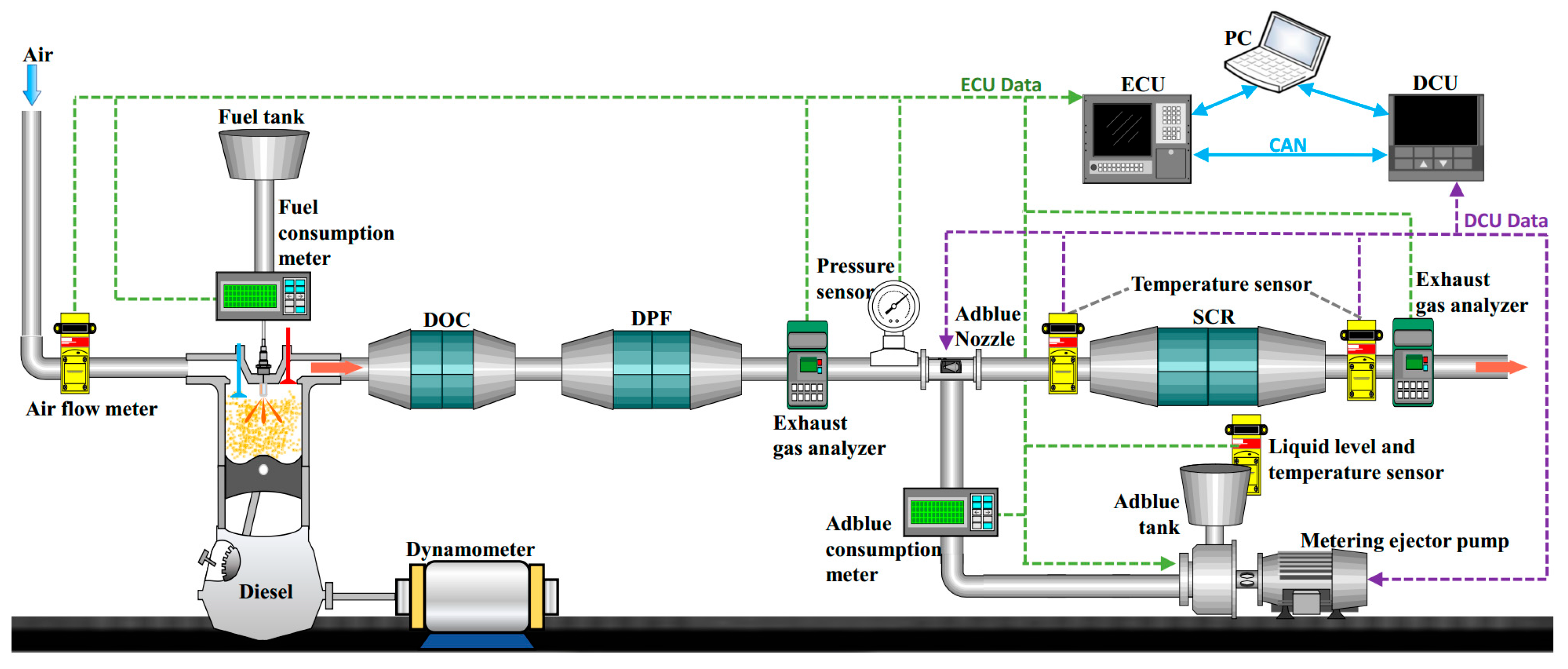
In order to better reflect the impact of the ETC cycle on the SCR system, the experimental setup of this study is shown in Figure 1. The metering ejector pump is a product of the Danish GRUNDFOS company (Denmark), which combines adding blue supply and metering in a single unit, and is used in conjunction with mechanical nozzles. The pump has an integrated microprocessor and communicates with the outside world using the SAE1939 CAN protocol [22]. The aqueous urea solution currently used for SCR meets the European DIN 70070 standard [23]. The density of adblue decreased slightly with increasing temperature and was controlled at an average of 1.09 g/cm3 [24]. In the experiments, a commercial SCR catalyst was employed, consisting primarily of V2O5 as the active component supported on TiO2, with WO2 serving as a co-catalyst. Based on the engine displacement, the catalyst substrate volume was configured as 48 L.

2.2. Experimental Equipment

During the tests, the specifications of the YC6L280-42 diesel engine (Guangxi, China) were summarized in Table 1. The SCR system comprised a catalytic muffler, an air-assisted urea dosing unit, a 30 L urea solution tank, a urea injector, a compressed-air filter, a domain controller unit (DCU), and the associated piping and wiring harness, all linked to the electronic control unit (ECU) via CAN. Urea delivery was regulated by the DCU in coordination with the ECU, using the temperature difference across the catalyst as the feedback signal. The use of compressed air produced a finer spray, which favored high-temperature thermolysis of urea to HNCO and NH3; the HNCO then hydrolyzed further to NH3 and CO2 at elevated temperatures. The plastic AdBlue tank integrated a top-mounted sensor and heater, enabling liquid-level and temperature monitoring.

2.3. Urea Injection Control

During the experiment, the crank linkage mechanism and consequently the diaphragm pump which was driven by a stepper motor. Owing to its excellent speed controllability, the stepper motor flexibly adjusted the pump’s output and precisely regulated the urea injection quantity. The exhaust flow signal was processed by the DCU and transmitted to the control unit, which determined the corresponding urea dosing command. The urea solution was then discharged through the injector, where it mixed with a compressed air stream of approximately 2 bar to achieve fine atomization. The injector featured four spray orifices with a diameter of 0.5 mm, producing droplets with an average size of about 50 μm. The microprocessor automatically managed pump functions such as emptying, metering, purging, and anti-icing, while continuously monitoring the operational status of sensors and actuators. In the event of an abnormal condition, diagnostic information was generated to assist in system troubleshooting.

2.4. Data Acquisition

During the experiment, in order to ensure the accuracy of the data in the experiment, the working condition data of the experimental stand was strictly adjusted as shown in Table 2. In addition, a large number of sensors and controllers needed to be installed, and the main experimental equipment was shown in Table 3. The total length of the experiment was 1800 s, and the readings were collected once every second.

2.5. Simulation Physics Model and Basic Reaction Equation

2.5.1. Physics Model

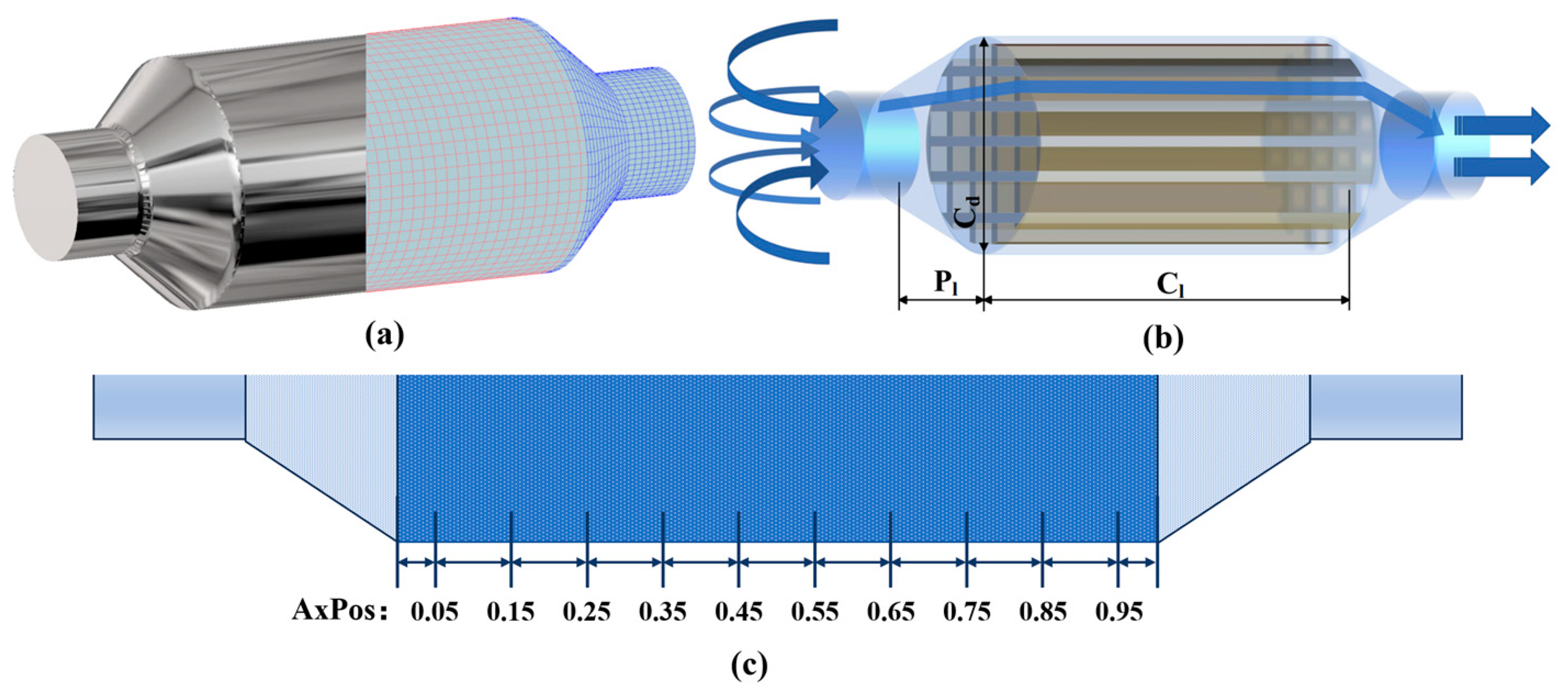
The simulation process is implemented through AVL-FIRE 2020.1 software. The SCR catalyst model was established based on the physical SCR parameters of the engine, and its physical model and structural diagram are shown in Figure 2. The establishment of the physical model usually focused on the fluid domain of the catalyst, which would ignore the thickness of the physical boundary layer. Therefore, the inner diameter of the catalyst’s external channel was set by subtracting the boundary thickness from the total external radius. The established porous channel adopted a square honeycomb structure, and its total wall thickness was the sum of the coating thickness and the carrier thickness. In the original aftertreatment system, the rear end was an ammonia slip catalyst, which was replaced by an SCR channel in the modeling. Thus, the subsequent oxidation process of NH3 was not considered in the simulation. The basic parameters of the SCR system are presented in Table 4.

2.5.2. Energy Model

The energy model was established by integrating multi-physical field mechanisms including heat conduction, chemical reaction heat, gas–solid heat transfer, and radiative heat transfer. It could be used to simulate the temperature evolution law of gas during the reaction process, and the calculation method is as follows:
ρ c p d T d t = ( k eff T ) + i ( Δ H r , i ) R i + h gs ( T s T g ) + q ˙ rad
where ρ is gas density, kg·m−3; cp is gas constant-pressure specific heat capacity, J·kg−1·K−1; T is gas temperature, K; keff is effective thermal conductivity of gas and turbulence, W·m−1·K−1; Δ H r , i is enthalpy change in the i-th reaction, J·mol−1; Ri is reaction rate of the reaction, mol·m−3·s−1; hgs is gas–solid volumetric interface heat transfer coefficient, W·m−3·K−1; Ts is temperature of the solid, K; Tg is gas temperature, K; q ˙ rad is the volumetric radiative heat transfer term, W·m−3; t is time, s.

2.5.3. Pressure Drop Model

The SCR catalyst channel was a coupled combination of square channels and porous media channels. The pressure drop in the macroscopic square channels was calculated using the Darcy-Weisbach equation, and the calculation method is as follows [26]:
Δ p c = f L D h + K in + K out ρ u m 2 2
where Δpc is the pressure drop of the macroscopic channel, Pa; f is the Darcy–Weisbach friction factor; L is the channel length, m; Dh is the hydraulic diameter of the channel, m; Kin is the inlet local loss coefficient; Kout is the outlet local loss coefficient; ρ is the gas density, kg·m−3; um is the mean gas velocity inside the channel, m·s−1.
The gas flow in the porous medium caused additional pressure drop due to the influence of channel shape and porous medium on the channel. Therefore, Darcy’s law was applied to calculate the pressure drop inside the wall, and the calculation method is as follows:
Δ p w = μ u L w k
where Δpw is the pressure drop inside the porous wall, Pa; μ is the dynamic viscosity of the gas, Pa·s; u is the superficial gas velocity normal to the wall, m·s−1; Lw is the effective wall thickness (seepage flow path length), m; k is the permeability of the porous wall, m2.
The total pressure drop of the SCR carrier was the superposition result of the channel pressure drop and the wall seepage pressure drop, and the calculation is as follows:
Δ p t = Δ p c + Δ p w
where Δpc is channel pressure drop.

2.5.4. Simulation Simplification Assumption

Simulation assumptions are essential steps to exclude the influence of external factors and highlight system characteristics. In this study, to simplify calculations and emphasize the main influencing factors, the following assumptions and limitations were made: The influence of H2O vapor on the hydrothermal aging process of the SCR system was ignored, and the discussion on the hydrothermal aging effect of the catalyst was not involved in the model; Only the main reaction pathways were considered in the reaction system, while other side reactions such as NO oxidation were excluded; The study focused on investigating the influence of various inlet parameters of the catalyst on catalytic characteristics and efficiency. Therefore, side processes such as the decomposition and crystalline deposition of NH3 aqueous solution were not considered; the complete decomposition of HNCO into NH3 was regarded as complete and uniform, and the distribution of NH3 when entering the reaction channel was assumed to be uniform; The gas-phase reactants were assumed to be incompressible fluids, and the gas-phase components exhibited a two-dimensional steady-state distribution on the inlet cross-section of the catalyst channel; The model boundary was adiabatic from the external environment, and heat exchange between the catalyst carrier and the external environment was not considered; The catalytic reaction kinetic model only included the main chemical reaction process between NOx and adsorbed NH3, while the adsorption and desorption stages of NH3 were ignored [27].

2.6. Grids Independence Analysis

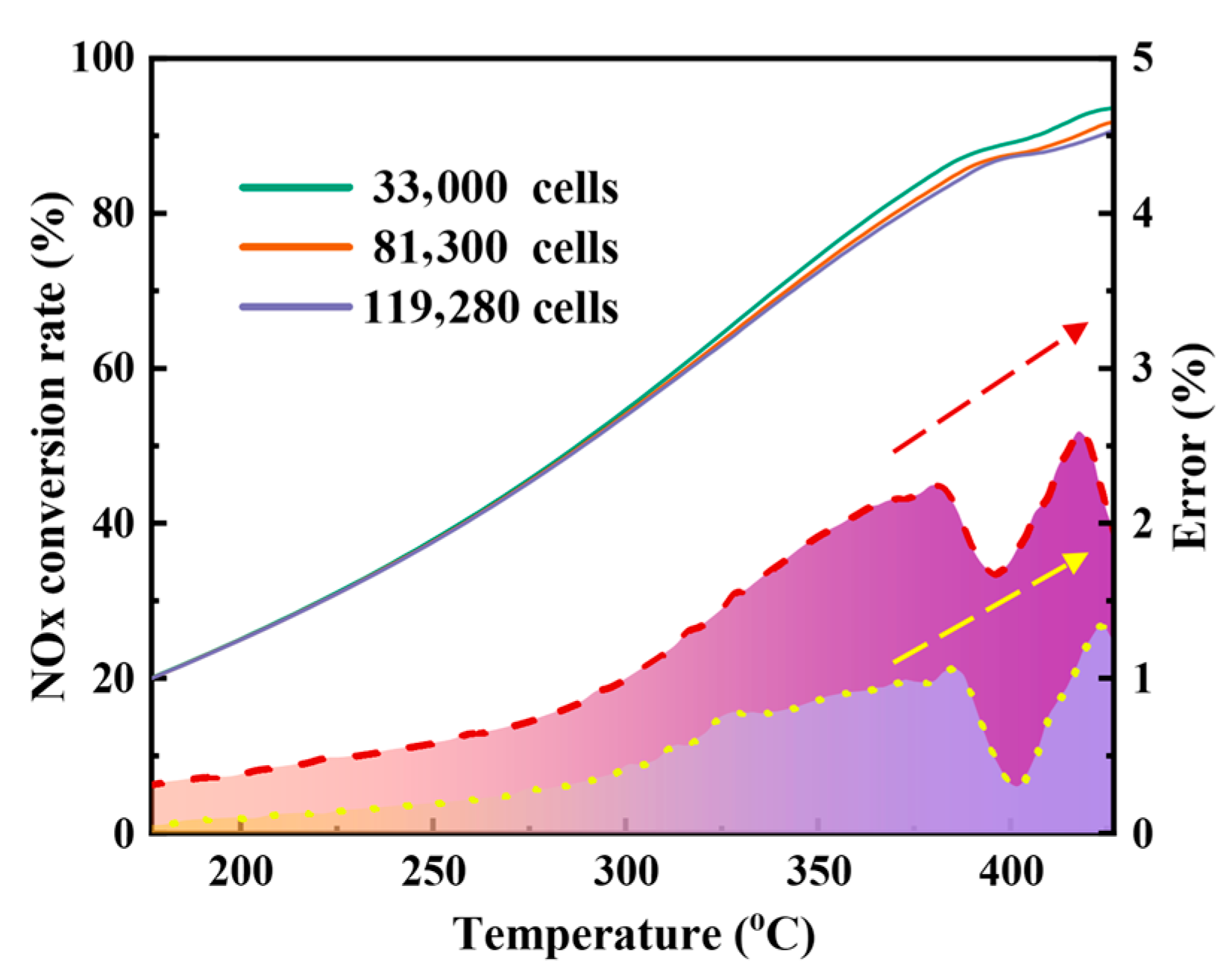
The independence verification scheme for the simulation was implemented by fitting and comparing models with different grid densities, and the errors were analyzed. As shown in Figure 3, models with different numbers of cells were generated using the grid division tool of the simulation software. Meanwhile, calculations and comparisons of their temperature and catalytic efficiency were conducted. It was found through calculations that the model calculations showed good consistency under different grid densities. Through error calculation, all errors were controlled within 3%. To maximize the calculation accuracy, a medium-density calculation grid was selected for the simulation.

2.7. Construction of Reaction Mechanism and Verification of Model

L-H mechanism and E-R mechanism are key catalytic mechanisms in SCR reactions [28]. The L-H mechanism describes that reactants (such as NH3 and NOx) must first be adsorbed on the active sites of the catalyst, respectively, to form adsorbed species. Then, reactions occur on the surface to generate products (such as N2 and H2O), which are subsequently desorbed from the surface. This reaction is highly dependent on adsorption sites, and its reaction efficiency is limited at low temperatures. In contrast, the E-R mechanism indicates that only one reactant (usually NH3) is adsorbed on the catalyst surface, while the other reactant (usually gaseous NOx) is not adsorbed and directly reacts with the adsorbed reactant on the surface. Therefore, the reaction has poor selectivity, and its activity tends to decay at high temperatures [29]. A dual-reaction mechanism model was established in this study to comprehensively describe the reactions. It optimized the insufficient low-temperature activity of the L-H mechanism and simultaneously compensated for the reaction decay and poor selectivity of the E-R mechanism at high temperatures. Among the reactions, R1, R2, R4, R6, and R8 were the basic equations of the E-R reaction model, while R3, R5, and R7 were the basic equations of the L-H reaction model. The calculation methods are shown in Table 5 [30].
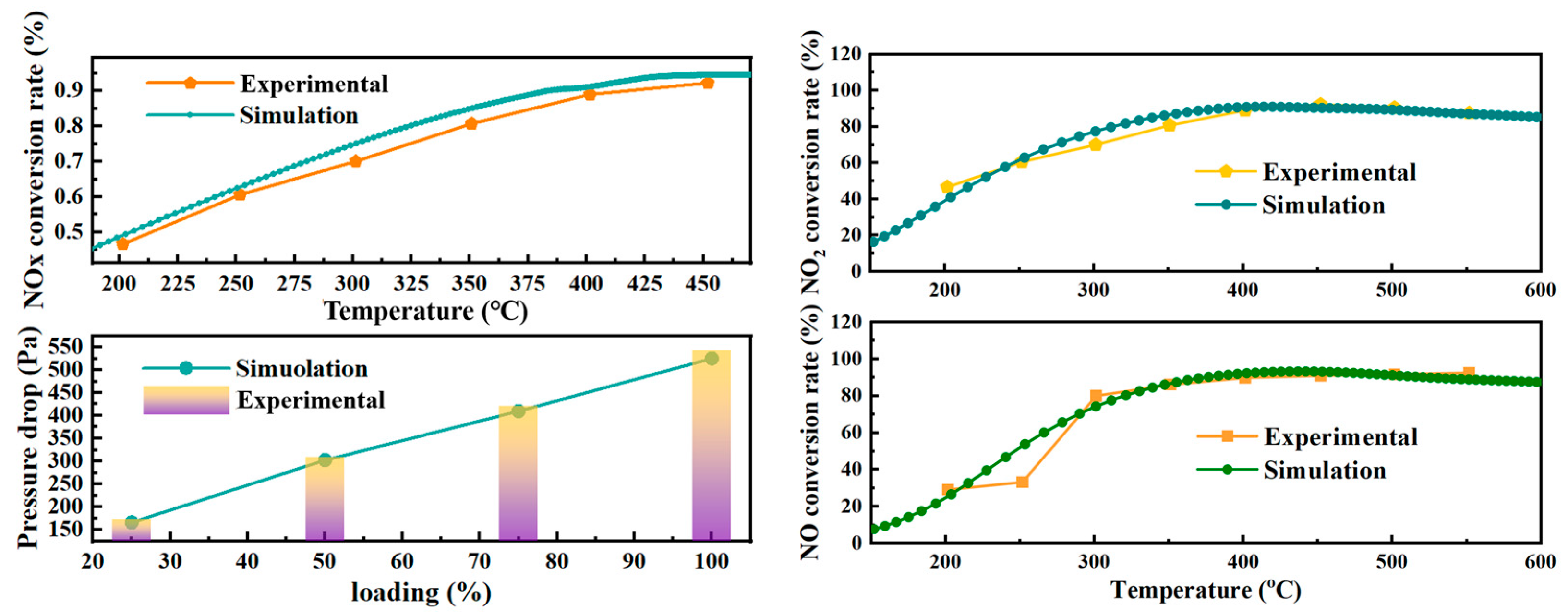
As shown in Figure 4 the model verification results indicated that the simulation was in good overall agreement with the experiment. The conversion rate curves of NOx, NO2, and NO showed consistent trends, all increasing with the rise in temperature, which demonstrated that the model could accurately reflect the temperature characteristics of the SCR reaction. The simulated values were slightly higher in the low-temperature range, mainly due to the simplification of adsorption and diffusion processes. The pressure drop increased linearly with the increase in load, and the simulated values were slightly higher than the experimental ones, but the deviation was within an acceptable range. In general, the model could well predict the reaction and flow characteristics of the catalyst, and it possessed high reliability and engineering applicability [31].

3. Results and Discussion

3.1. Boundary and Initial Conditions Setting

The inlet boundary conditions for the SCR system simulation were determined based on the test scheme under multi-load conditions, covering four typical diesel engine load conditions: 25%, 50%, 75%, and 100%. The inlet parameters under each load condition are presented in Table 6. In the engine bench tests, the diesel engine operated under relatively high excess-air conditions (without EGR or with only a small amount of EGR). As a result, a substantial amount of excess oxygen remained after combustion, leading to an exhaust O2 volume fraction of approximately 10–16%. Since the experimental data did not provide detailed speciation of NOx, the present study considered NO and NO2 as the only NOx components. According to the formation characteristics of engine-out NO2, NO is the dominant species, and after passing through the diesel oxidation catalyst (DOC), the NO/NO2 ratio typically approaches 9:1. This ratio was therefore adopted as the inlet boundary condition for the SCR model [26].
In the initialization of the SCR system, the catalyst and pipe wall temperatures were uniformly set to ambient conditions, and the outlet pressure was specified as standard atmospheric pressure to establish an initial state close to a cold-start scenario. At the beginning of the simulation, the NH3 surface coverage on the catalyst was set to zero, assuming no pre-adsorbed ammonia species within the washcoat. To avoid the influence of spray atomization and mixing non-uniformities on the adsorption/desorption behavior and reaction kinetics, NH3 was introduced into the SCR inlet in a uniformly premixed form together with NOx, rather than explicitly modeling the urea injection and spray processes. This treatment allows the analysis to focus on mass-transfer and reaction phenomena occurring inside the catalytic monolith.

3.2. Analysis of SCR Catalytic Characteristics

In this study, the above parameters were adopted as the inlet boundary conditions for the simulations, effectively covering the typical load range of the diesel engine. These inputs provided realistic operating conditions for characterizing the denitrification reaction kinetics, flow-field evolution, and heat–mass transfer processes of the SCR system under different operating loads. During the simulation process, load-specific boundary settings were applied, and the gas compositions and corresponding values for each load were aligned with experimental measurements. This ensured accurate control of the inlet boundary conditions and established a solid foundation for subsequent multidimensional analysis and optimization of the system’s NOx reduction performance and NH3 slip behavior.
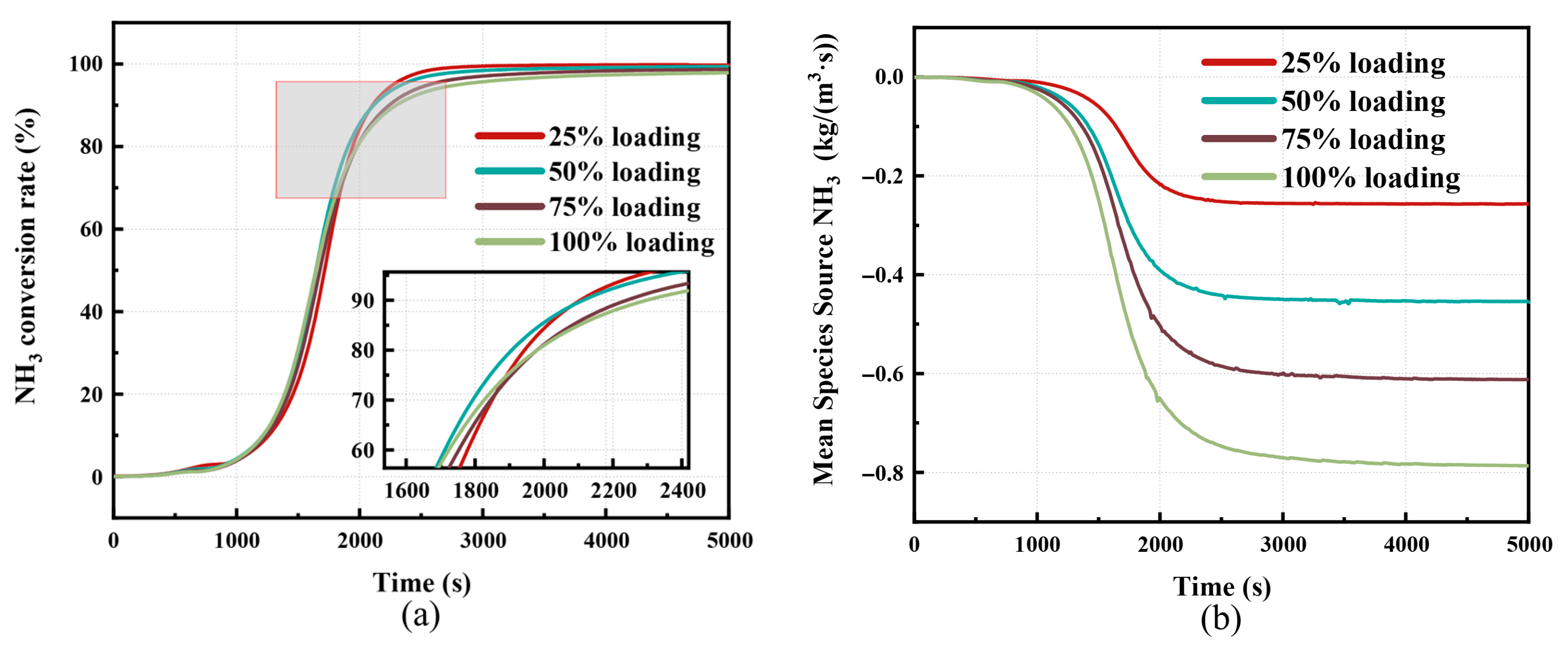
As shown in Figure 5a,b, under the four load conditions, the NH3 conversion rate increased in an S-shaped curve over time and finally tended to be stable. Correspondingly, the average source term of NH3 was first close to zero, then rapidly decreased to a stable negative value, and the absolute value became larger as the load increased.
The mechanism behind this phenomenon was as follows: an increase in load not only raised the exhaust temperature and NOx concentration but also increased the exhaust flow rate simultaneously. Higher temperature and higher reactant concentration accelerated the activation of active sites and promoted surface reactions, leading to faster consumption of NH3. On the one hand, higher flow rate enhanced convective heat transfer and mass transfer, thinned the boundary layer, and improved mixing, thereby further promoting the initiation and acceleration stages of the reaction [32]. On the other hand, it shortened the residence time in the channel, exerting a certain negative impact on the final conversion rate. Therefore, the conversion curves under different loads showed little difference in the steady-state stage but more significant differences in the acceleration stage. Overall, high load was mainly affected by the coupling effect of high temperature, high concentration, and high flow rate, which significantly increased the absolute value of the NH3 source term. However, the short residence time under high flow rate restricted the further increase in NH3 conversion rate, which explained the common characteristics of NH3 mass in both dynamic and steady-state stages.
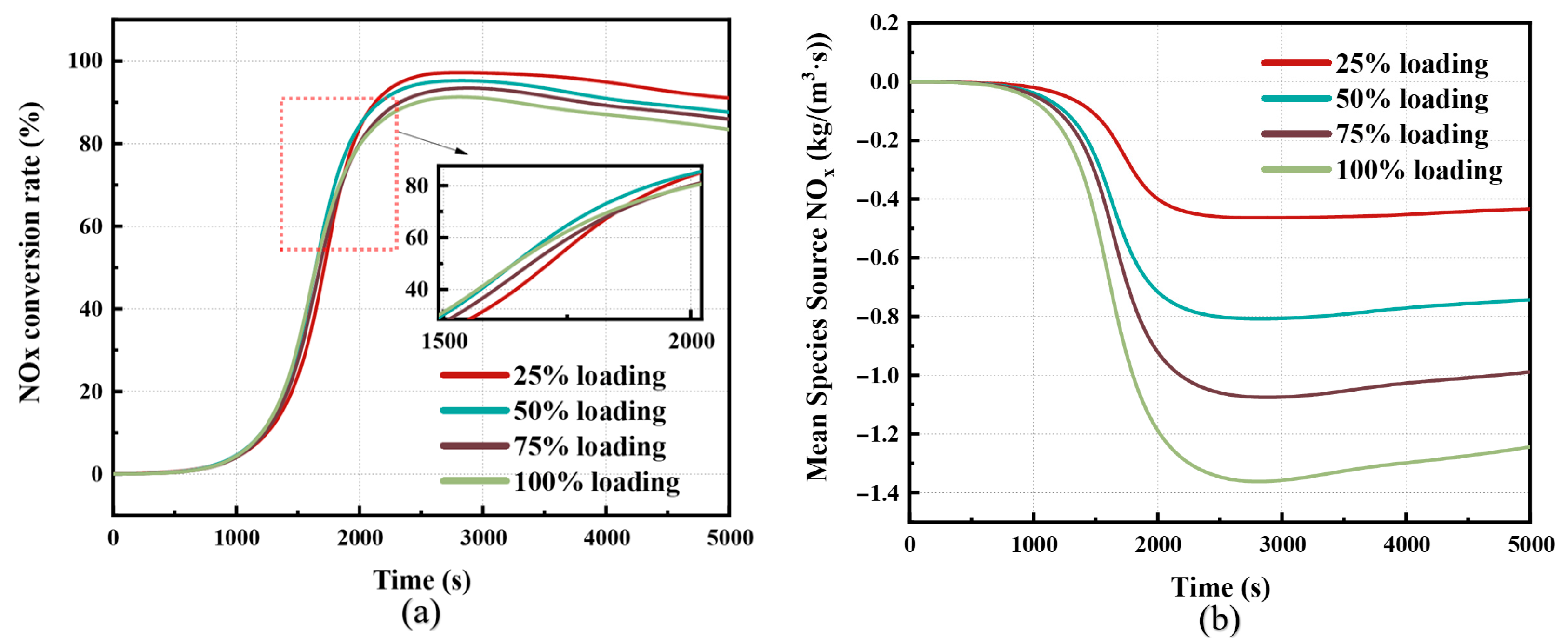
As shown in Figure 6a,b, the test matrix covered four discrete load points, over which the exhaust temperature and exhaust flow rate increased with engine load. In Figure 6a, under low load, the exhaust flow rate was low and the reactant residence time was sufficient. Although the exhaust temperature was relatively low, the NOx conversion rate increased extremely rapidly in the initiation stage and stabilized at a high conversion rate in the later stage. Under high load, the exhaust temperature was high but the flow rate was fast, resulting in a short reactant residence time. This led to a slow increase in the conversion rate during the initiation stage; however, in the later stage, the reaction kinetic rate was promoted by the high temperature, so the conversion rate still reached a high level. At the initial stage, NH3 exhibited a strong adsorption driving force while the gas-phase NOx concentration remained high, resulting in a relatively high SCR reaction rate. As time progressed, part of the NH3 was consumed by the reactions, whereas the remaining fraction occupied a substantial number of active sites in the adsorbed state. Meanwhile, the gas-phase NOx concentration decreased markedly, leading to a reduced mass-transfer driving force. This ultimately led to a decrease in the NOx conversion rate of the reaction after t > 3000 s.
In Figure 6b, under high load, the exhaust temperature was high and the flow rate was fast, which synergistically enhanced the reaction kinetics and mass transfer efficiency, resulting in the maximum NOx conversion rate. Under low load, the exhaust temperature was low and the flow rate was slow, leading to relatively mild reaction intensity and the smallest absolute value of the negative source term. The load exerted a coupled influence on the light-off speed of the SCR system and the reactant consumption rate by affecting the exhaust temperature and flow rate.

3.3. Analysis of Dual Mechanism Dynamic Reaction Process

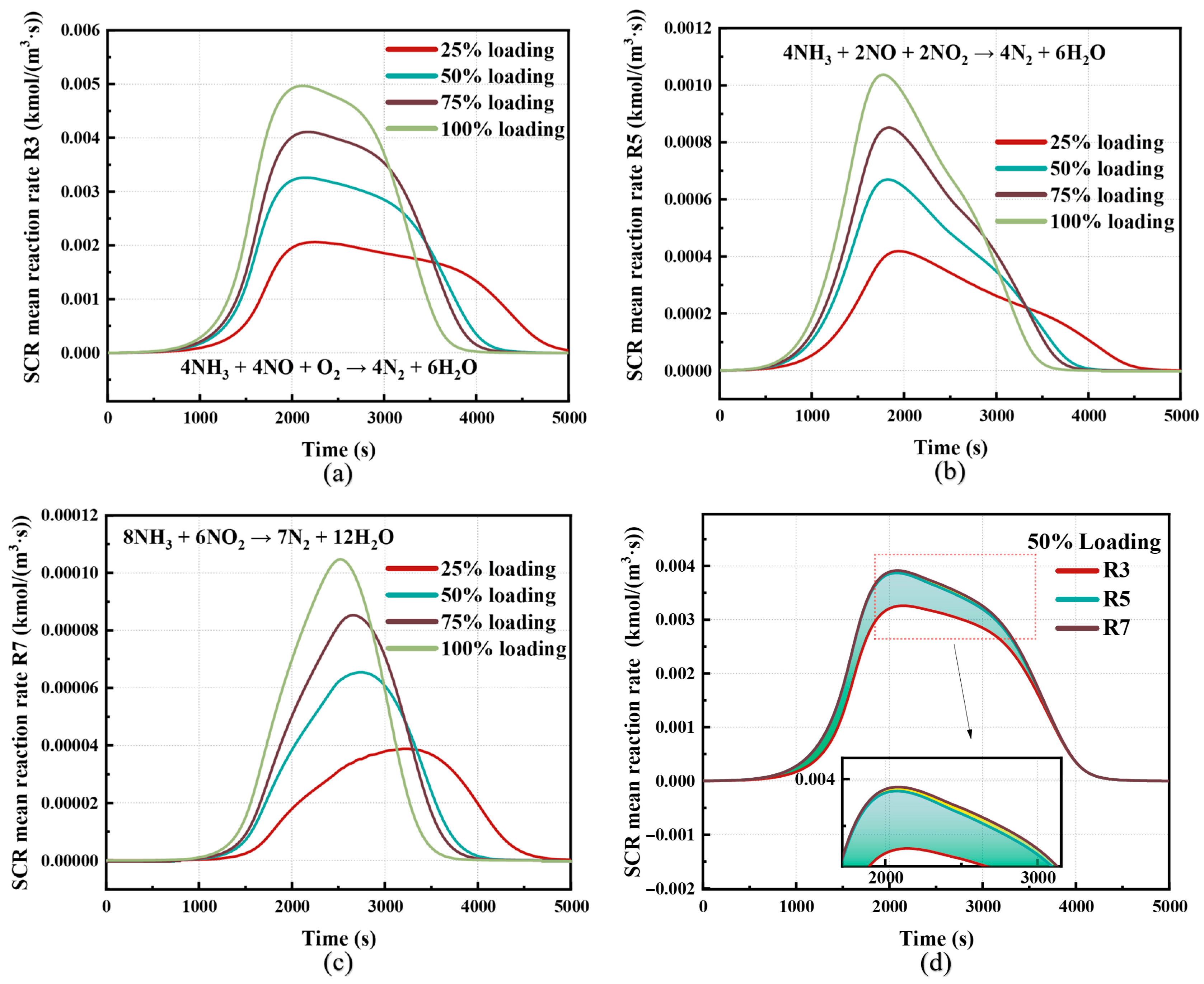
As shown in Figure 7a–d, different SCR reaction pathways exhibited significant selective responses under different diesel engine loads [33]. It could be seen from Figure 7a that for R3, under high loads of 75% and 100%, the surface reaction kinetics were enhanced by high temperature, resulting in a high peak reaction rate and fast initiation. From Figure 7b, it was observed that R5 had a more prominent peak rate under low load, which was attributed to the optimized adsorption efficiency caused by medium temperature and long residence time. Figure 7c indicated that the peak rate of R7 was significantly increased under 100% high load, as high temperature promoted kinetics and the NO2 concentration was indirectly elevated. However, as shown in Figure 7d, under 50% load, the reactions of R3, R5, and R7 presented dynamic competition between main and side reactions, especially in the medium-temperature reaction region.
These phenomena were essentially the embodiment of the coupling effect between adsorption capacity and surface reaction kinetics in the L-H mechanism. This could be reflected in that standard SCR and NO2-SCR relied on high-temperature kinetics under high load, while fast SCR depended on adsorption efficiency and residence time under low load. As shown in Figure 7d, various reactions exhibited competition between main and side reactions in the medium-load and medium-temperature range. Among them, the standard SCR reaction remained the main reaction in the catalyst, followed by the fast reaction, which played a supporting role in the medium-low temperature stage. This was the key reason for the rapid increase in de-NOx efficiency of the catalyst in this temperature stage.
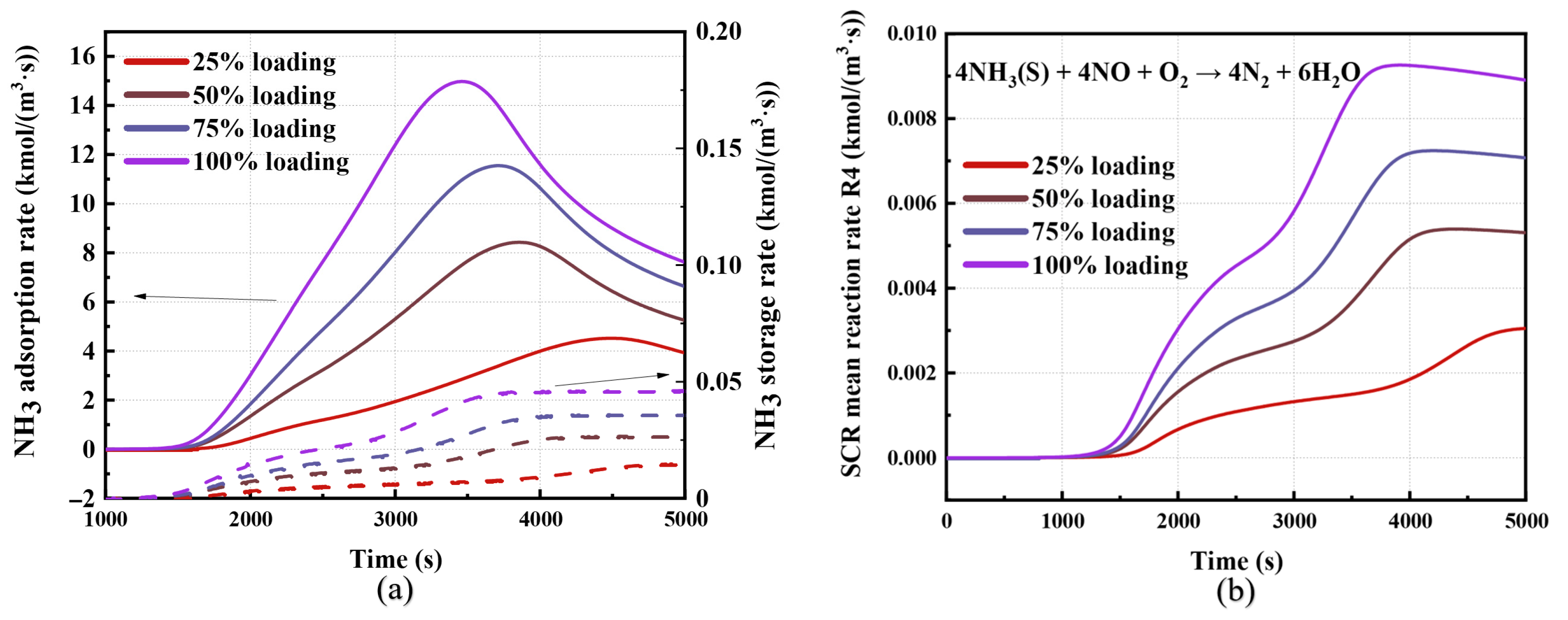
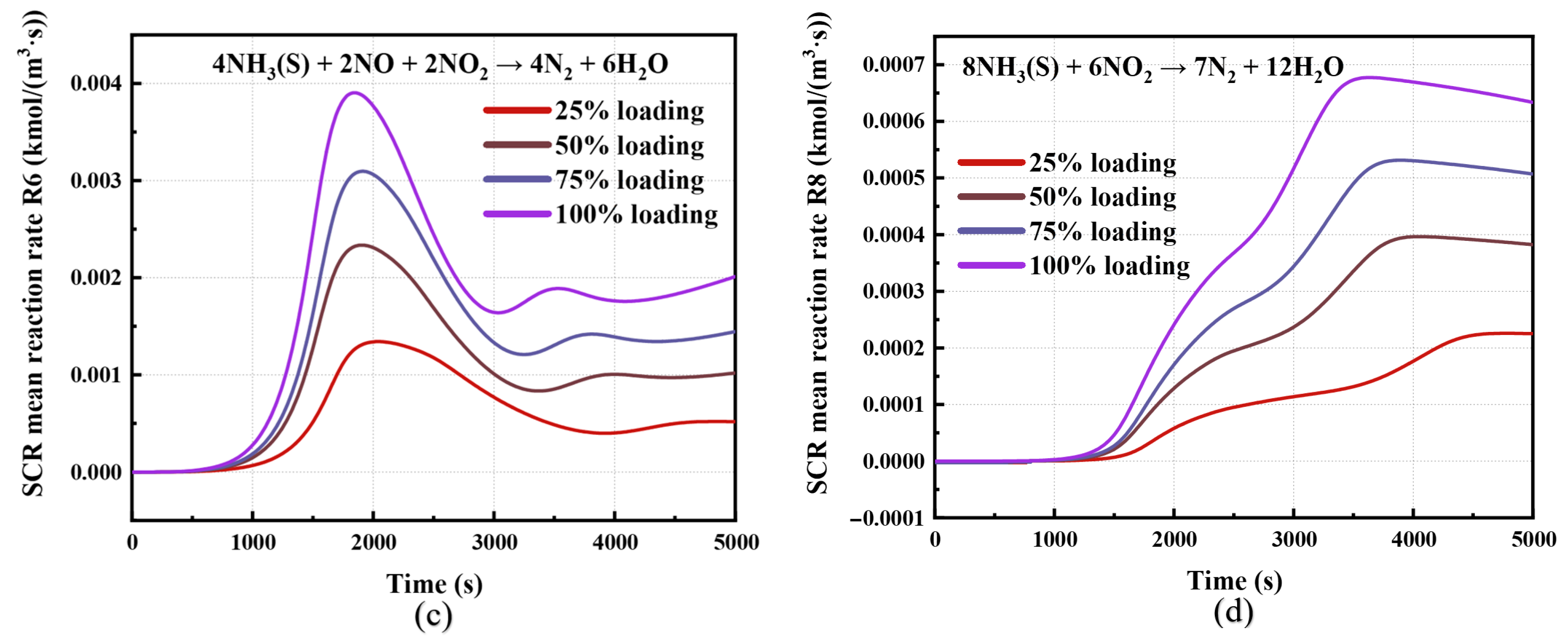
As shown in Figure 8a, the adsorption rate of NH3 increased rapidly during the temperature rise stage, reached a peak at approximately 3500 s, and then decreased slowly. In contrast, the retention rate of NH3 increased continuously and gradually tended to be stable. With the increase in load, both the adsorption rate and retention rate increased significantly, with the highest peak under 100% load. This indicated that the increase in load led to higher exhaust temperature, flow rate, and NOx concentration, which gradually activated the active sites on the catalyst surface and enhanced the surface adsorption capacity of NH3. Meanwhile, the stronger convective mass transfer effect promoted the transport of NH3 to the wall and accelerated the establishment of the adsorption layer. In the early stage of temperature rise, the adsorption of NH3 and surface coverage increased rapidly; subsequently, under the combined action of increased reaction rate and desorption equilibrium, the adsorption rate decreased while the retention rate remained stable, indicating that a sustainable NH3 reservoir had been formed on the catalytic surface. The relatively low NH3 storage rate is essentially governed by the different roles of the two reaction pathways. In the E-R mechanism, only the stored NH3 participates in the surface reaction, whereas the remaining gas-phase NH3 can still react via the L-H mechanism rather than directly contributing to ammonia slip. Therefore, the fraction of NH3 that is not stored on the catalyst surface does not imply that it is entirely released downstream. During the later stage of the SCR process, the calculated NH3 slip level remains extremely low, indicating that its impact on the overall reaction behavior is negligible. As shown in Figure 8b, the average rate of the R4 reaction increased monotonically with time and continued to increase with the rise in load in the steady-state stage. The reason for this was that under high load, the exhaust temperature was higher, the NO concentration increased, and the adsorption and mass transfer rates of NH3 were enhanced synchronously, thus significantly promoting the surface reaction. As shown in Figure 8c, the R6 reaction showed a peak at approximately 2000 s and then decreased gradually. This was because the production of NO2 increased rapidly during the temperature rise stage and triggered the reaction peak, while in the steady-state stage, NO2 was consumed and the reaction gradually shifted to be dominated by standard SCR. Higher load accelerated the production of NO2 and made the peak appear earlier, reflecting that the system was affected by exhaust temperature. As shown in Figure 8d, the overall rate of the R8 reaction was relatively low but increased gradually with the rise in temperature and load, indicating that this reaction had a certain compensation effect under high temperature and high load [34]. The adsorption and retention behaviors of NH3 directly determined the dynamic response of each reaction pathway.

3.4. Analysis of NH3 Loading Situation

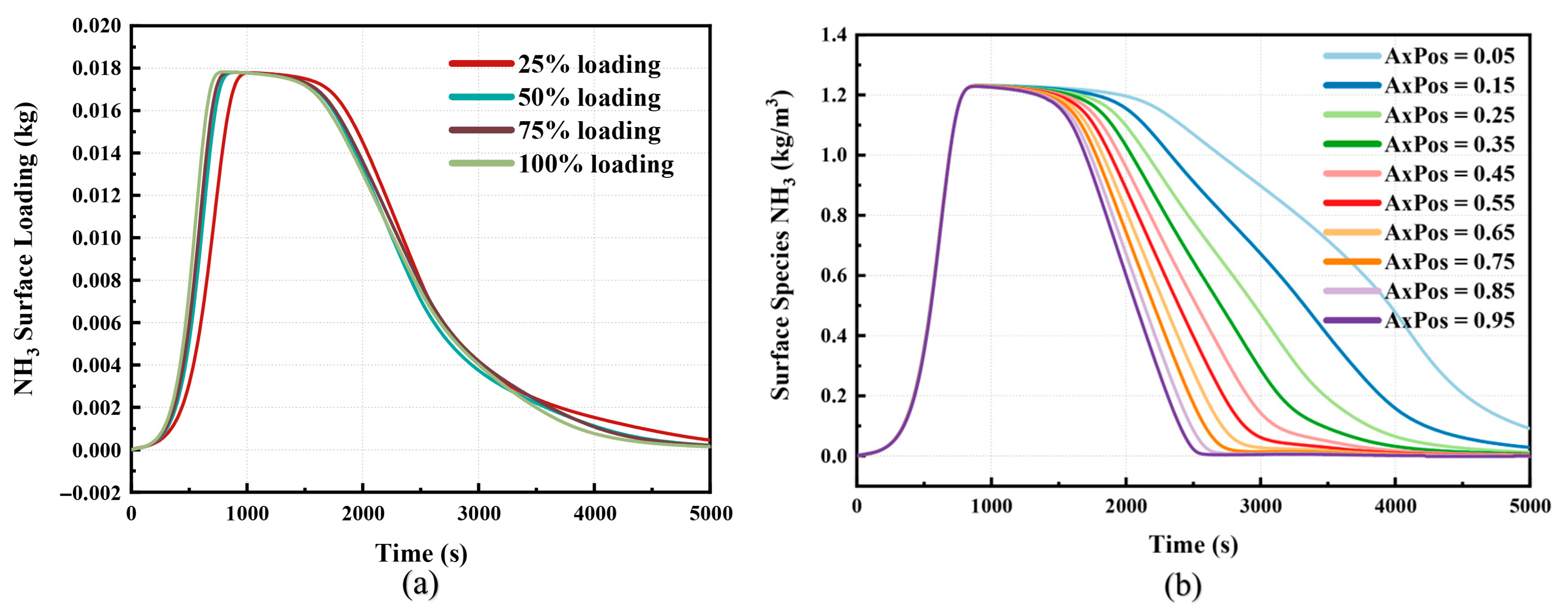
As shown in Figure 9a, under different loads, the NH3 surface coverage exhibited a trend of rapidly rising to a peak and then slowly decreasing over time. The higher the load, the earlier the peak appeared, and the closer the peak coverage values were to each other. High load corresponded to higher exhaust temperature and NOx concentration, which accelerated the activation of catalyst active sites and the surface adsorption of NH3, while the peak coverage capacities tended to be consistent under all loads. The subsequent decrease in NH3 coverage was due to the consumption of NH3 in the reduction reaction, and the influence of load on reaction consumption was affected by temperature, leading to the final convergence of coverage values under different loads.
To further analyze the reaction behavior of the SCR catalyst at different axial locations, Axis x positions (AxPos) of the SCR device were indexed and labeled, as illustrated in Figure 2. As shown in Figure 9b, at different AxPos, the concentration of NH3 surface species rose rapidly to a peak over time and then decreased quickly. The closer the axial position of the peak was to the rear end of the catalyst, the lower the peak concentration [29]. This was because the axial distribution of NH3 in the catalyst was affected by the coupling of mass transfer and reaction: NH3 at the front end contacted the catalyst first, so adsorption and reaction were initiated earlier, resulting in an earlier peak appearance and higher concentration. NH3 at the rear end had to undergo a longer mass transfer process, and part of the NH3 had been consumed by the front-end reaction, leading to a later peak appearance and lower concentration.

3.4.1. Analysis of SCR Catalytic Efficiency of Different AxPos

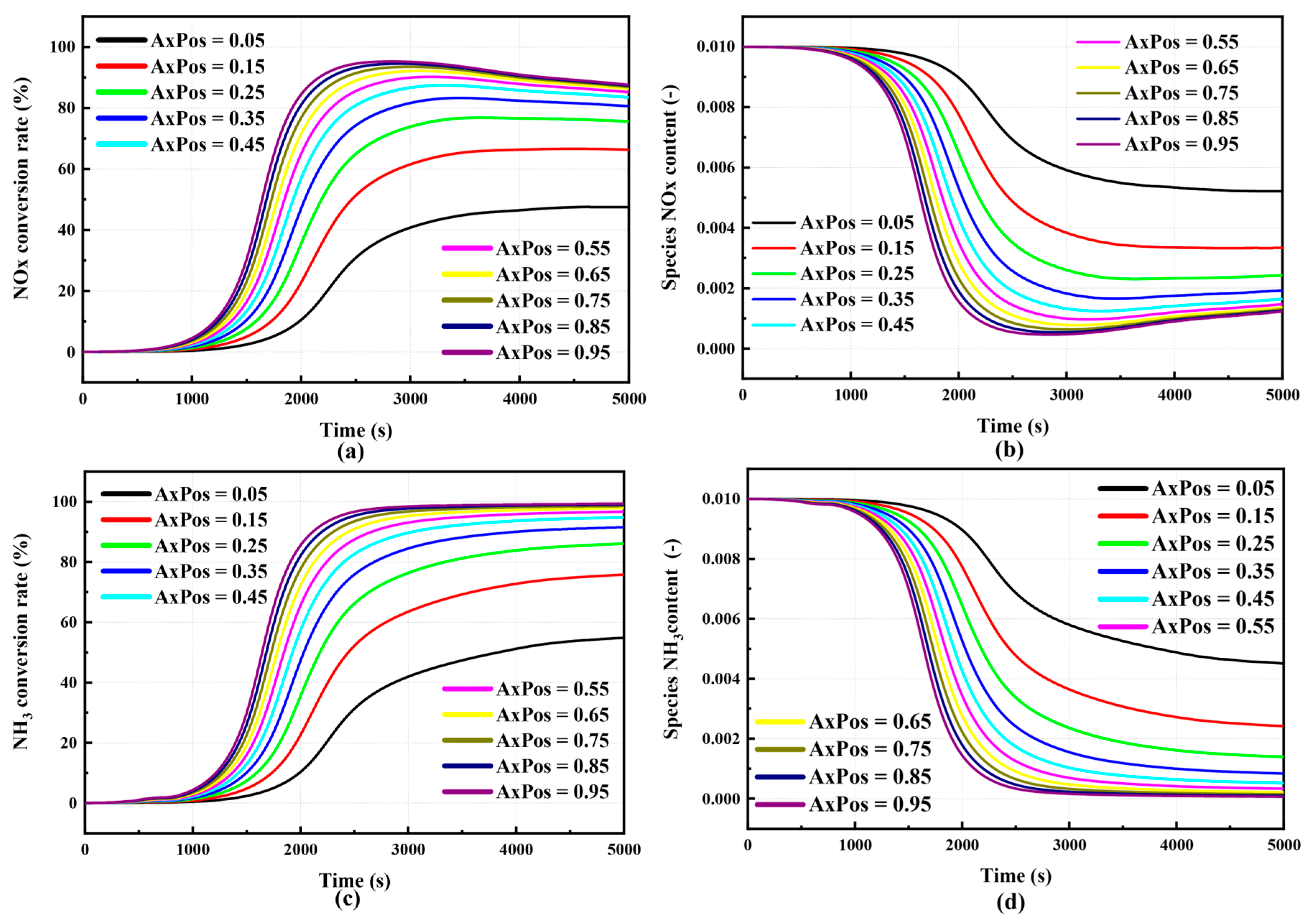
As shown in Figure 10a,c, at different AxPos, both the NOx and NH3 conversion rates increased rapidly over time and then tended to stabilize. The smaller the AxPos, the faster the conversion rate initiation and the higher the final stable value. This was because the front-end catalyst contacted the reactants first, and its active sites were activated earlier, which led to faster initiation of the NOx reduction reaction and NH3 consumption reaction. In contrast, the reactants at the rear end underwent consumption by the front-end reaction and mass transfer delay, resulting in slower light-off of the conversion rate.
As shown in Figure 10b,d, at different AxPos, the concentrations of NOx and NH3 surface species rose rapidly to peaks over time and then decreased quickly. The smaller the AxPos, the earlier the species concentration peaks appeared, the higher the peaks were, and the faster the decrease in the later stage. The reason was that the front-end catalyst had strong adsorption and reaction activity, which could quickly accumulate and consume reactant species. This resulted in early and high concentration peaks, followed by a rapid decrease in the later stage due to continuous consumption by the reaction [35].
The reaction characteristics and catalytic efficiency of the SCR catalyst were significantly affected by the axial position. This axial difference reflected the coupling effect of mass transfer and reaction kinetics in the spatial dimension, providing a basis for the structural optimization and operating condition matching of the SCR catalyst.
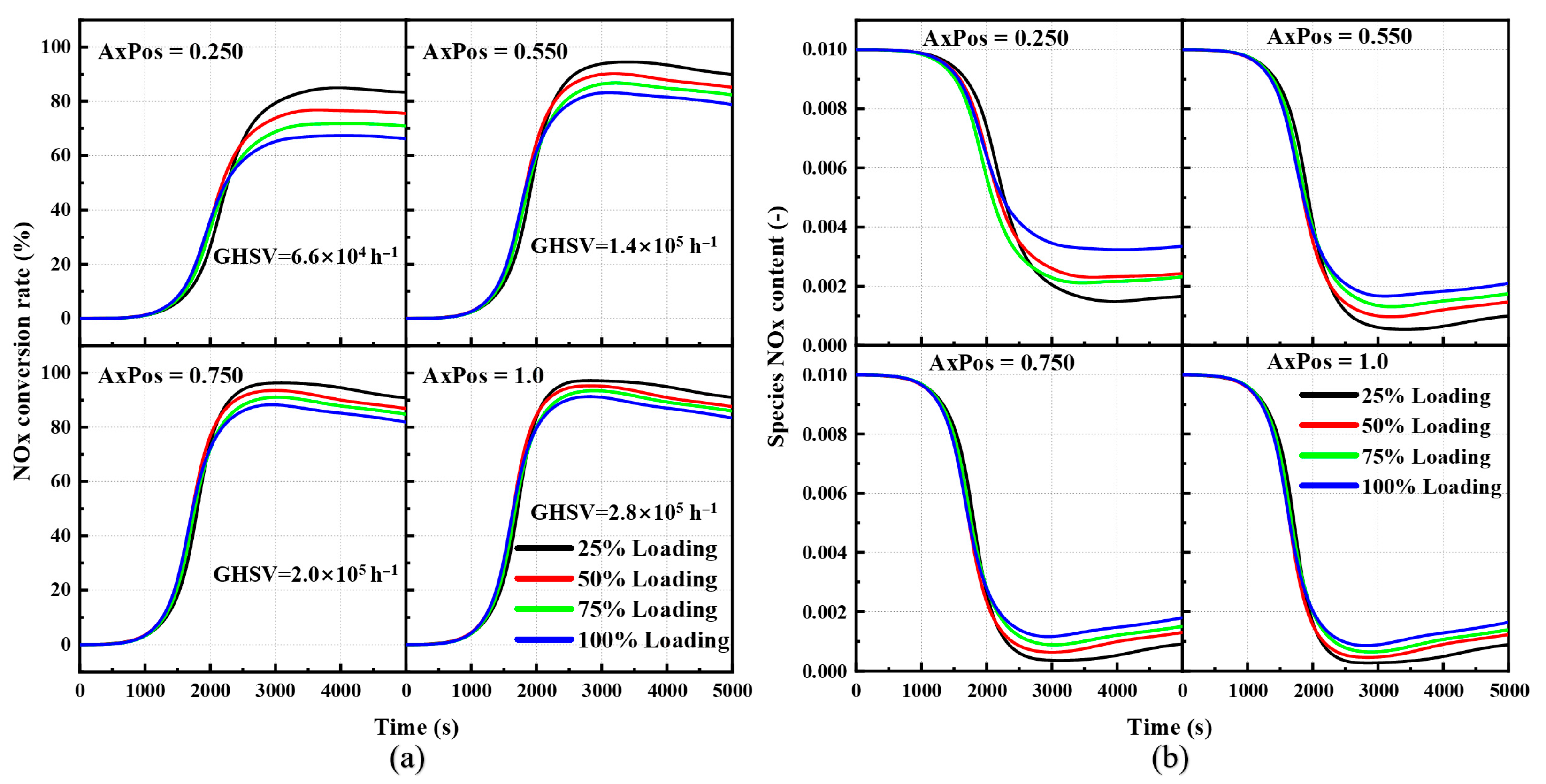
As shown in Figure 11a, under different AxPos and loads, the NOx conversion rate exhibited a trend of rising rapidly and then tending to stabilize over time. During the catalytic reaction, the NOx conversion rate shows only a slight increase from AxPos = 0.75 to 0.95. This is because most of the NOx has already been effectively reduced within the upstream 0–0.75 axial region, while the downstream section mainly provides additional reaction capacity and NH3 storage margin under transient and aging conditions. In addition, the space velocity (GHSV) at 100% load (2.8 × 10⁵ h−1) remains within the commonly accepted engineering design range for SCR systems.
As shown in Figure 11b, the concentration of NOx surface species showed a trend of rising rapidly to a peak and then decreasing quickly with time. These results indicated that the closer the axial position was to the front end and the higher the load, the faster the NOx conversion rate initiated, the higher the final stable value, the earlier the species concentration peak appeared, the higher the peak value, and the faster the decrease in the later stage.
The reason was that at the front end and under high load, the catalyst had strong adsorption and reaction activity, which could quickly accumulate and consume NOx species. This led to an early and high concentration peak, followed by a rapid decrease in the later stage due to continuous consumption by the reaction [36].

3.4.2. Performance of Species Concentration Field

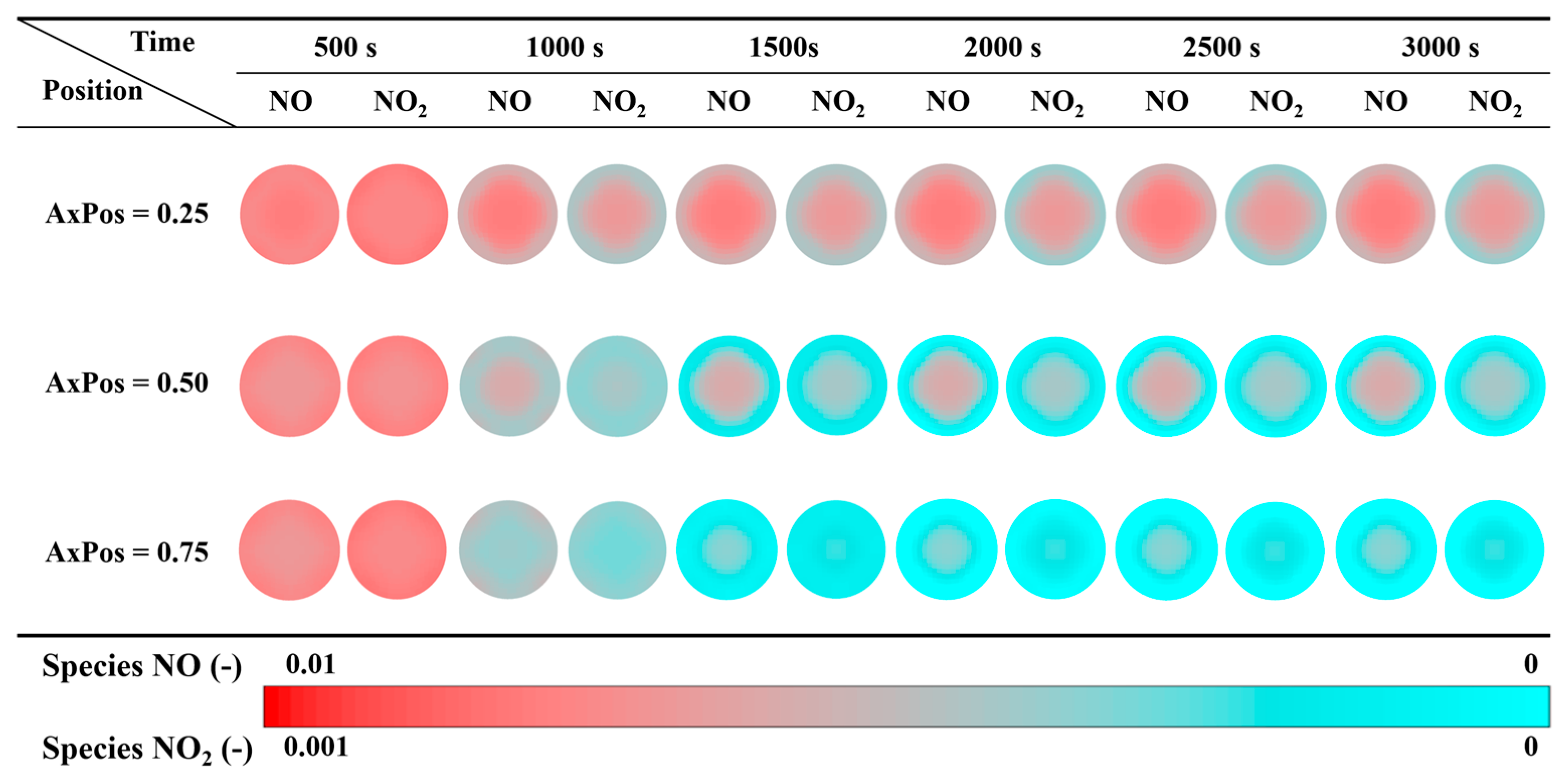
As shown in Figure 12, from the perspective of time evolution, in the early stage, the NO concentration at all positions was relatively high overall, while the NO2 concentration was low, with only slight accumulation at the inlet end. This indicated that the system was still in the cold start stage, and the catalyst activity was limited. As time progressed to 1500–2000 s, the catalytic temperature increased and the catalyst surface was gradually activated, leading to a significant enhancement in NO2 generation. The color transitioned from red to light blue, showing a conversion trend of decreasing NO content and increasing NO2 content. This change was more significant especially in the middle and rear reaction zones (AxPos = 0.50–0.75).
In the later stage, the NO2 concentration increased further, NO was basically completely consumed, and the system tended to reach reaction equilibrium. At this time, the reaction was mainly dominated by standard SCR, and the NO2/NOx ratio was stabilized at a high level. From the perspective of axial distribution, AxPos = 0.50 was the key reaction zone for the conversion of NO to NO2, where NO2 concentration accumulated rapidly. In contrast, AxPos = 0.75 was mainly light blue, indicating that a large amount of NO2 had been generated and the system reaction was close to equilibrium [37].
In the early stage, there was an obvious radial gradient in concentration distribution, with slightly higher concentration in the central area and slightly lower concentration in the edge area. This reflected insufficient fluid mixing and limited wall mass transfer in the initial stage. As the reaction continued, the color distribution gradually became uniform and the radial concentration gradient weakened, indicating that mixing and diffusion in the system became gradually sufficient and the reaction tended to be stable.

3.5. Analysis of SCR Temperature Characteristics

3.5.1. Temperature Variation Characteristics of Catalysts

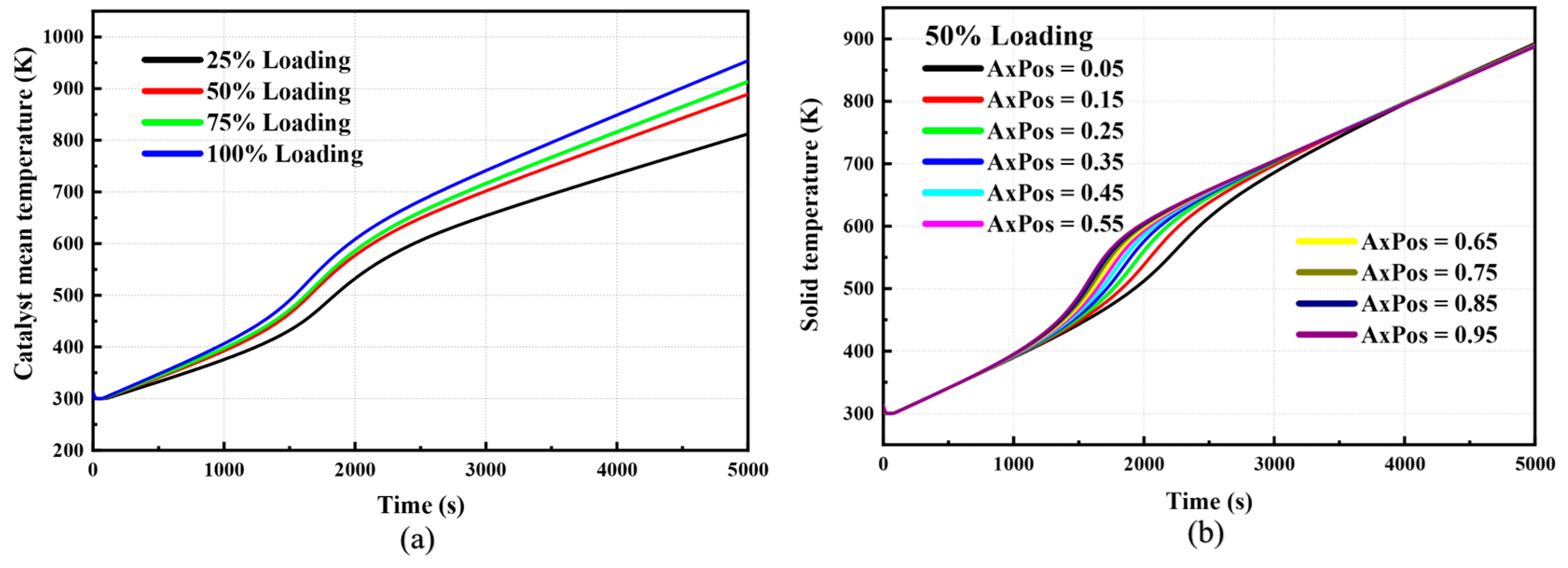
As shown in Figure 13a, under different loads, the average temperature of the catalyst exhibited a “continuous rising” trend over time. The higher the load, the faster the temperature rise rate and the higher the final temperature. This was because high load corresponded to higher exhaust temperature and reaction exothermic intensity; the two factors synergistically accelerated the heat accumulation of the catalyst, leading to a rapid temperature rise. Under low load, the exhaust temperature and total reaction heat release were weak, resulting in a slow temperature rise and a low final temperature.
As shown in Figure 13b, under 50% load, the catalyst temperature at different AxPos also followed a continuous rising law over time. The closer the axial position was to the rear end, the faster the temperature rise rate and the higher the final temperature. The reason was that the rear-end catalyst was affected by the superposition of heat conduction from the front-end reaction exotherm and its own reaction exotherm, resulting in more significant heat accumulation.
This temperature change law directly affected the catalytic reaction kinetics, providing a key basis for the thermal management and operating condition matching of the SCR system [38].
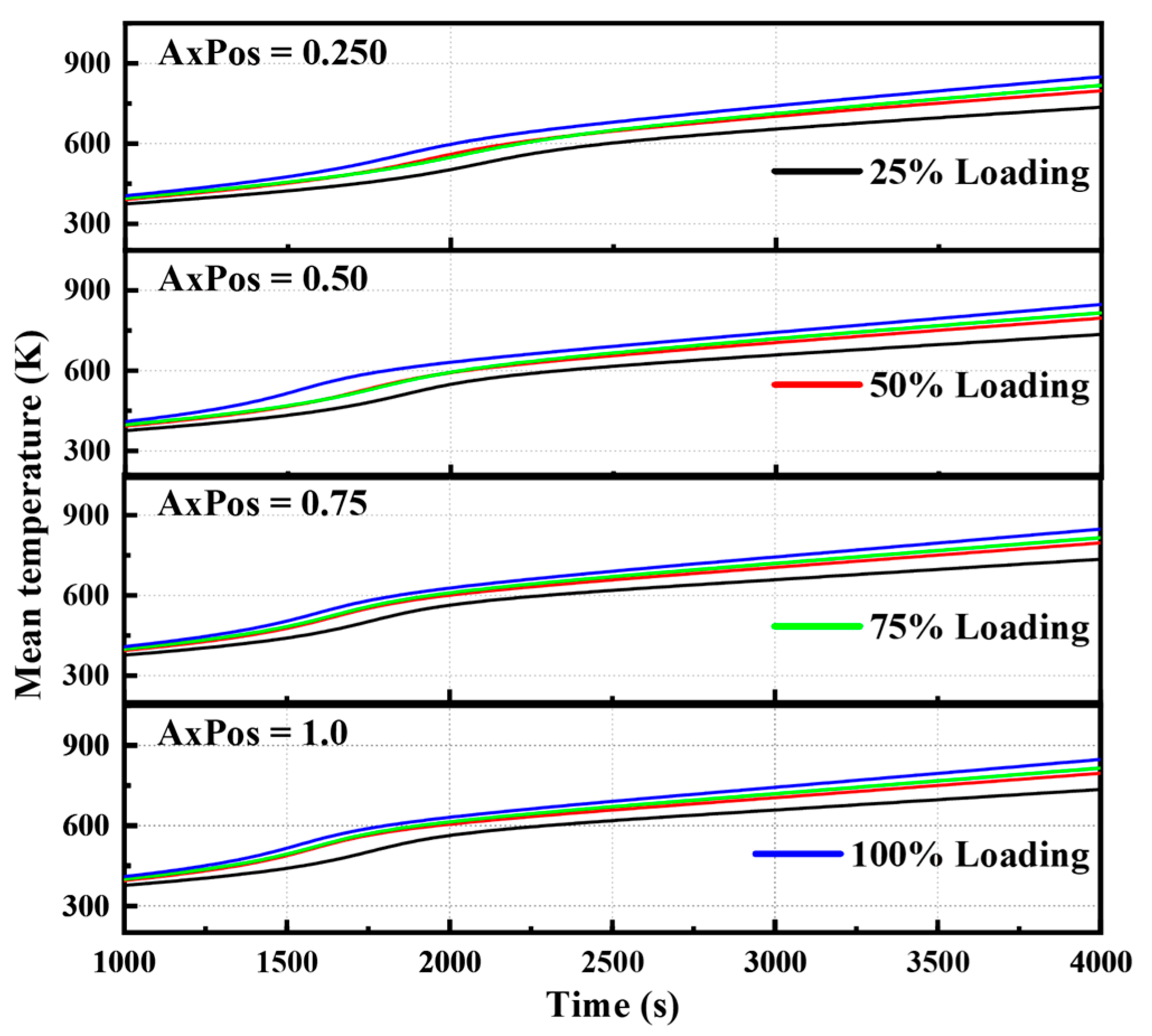
As shown in Figure 14, under different AxPos and loads, the average temperature of the catalyst exhibited a continuous rising trend over time. Among these conditions, the higher the load and the more rearward the AxPos, the faster the temperature rise rate and the higher the final average temperature. This phenomenon was because high load corresponded to higher exhaust temperature and reaction exothermic intensity; the rear-end catalyst was further affected by the superposition of heat conduction from the front-end reaction exotherm and its own reaction exotherm, leading to more significant heat accumulation. In contrast, under low load and at front-end axial positions (small AxPos), the temperature rise was relatively gentle. This was due to low exhaust temperature, weak reaction heat release, and more heat conduction losses [39].
The temperature histories at the same AxPos for different loads converge and follow nearly identical trends After about 2250 s. This is because the inlet temperature prescribed for each load in the SCR model is kept constant throughout the simulation. During 0–2000 s, the system warms up from a cold state, and the catalyst substrate, honeycomb walls and shell continuously absorb heat. After 2250 s, the net heat flux associated with gas–solid convection, solid conduction and radiation approaches balance, so the differences in catalyst temperature evolution between loads become very small and the curves collapse into almost parallel lines. In this stage, the temperature under each load increases only slightly and slowly, while the temperature offset between loads remains essentially constant; thus, this period can be regarded as a thermal stabilization under fixed boundary conditions.

3.5.2. Temperature Field Distribution of Catalyst

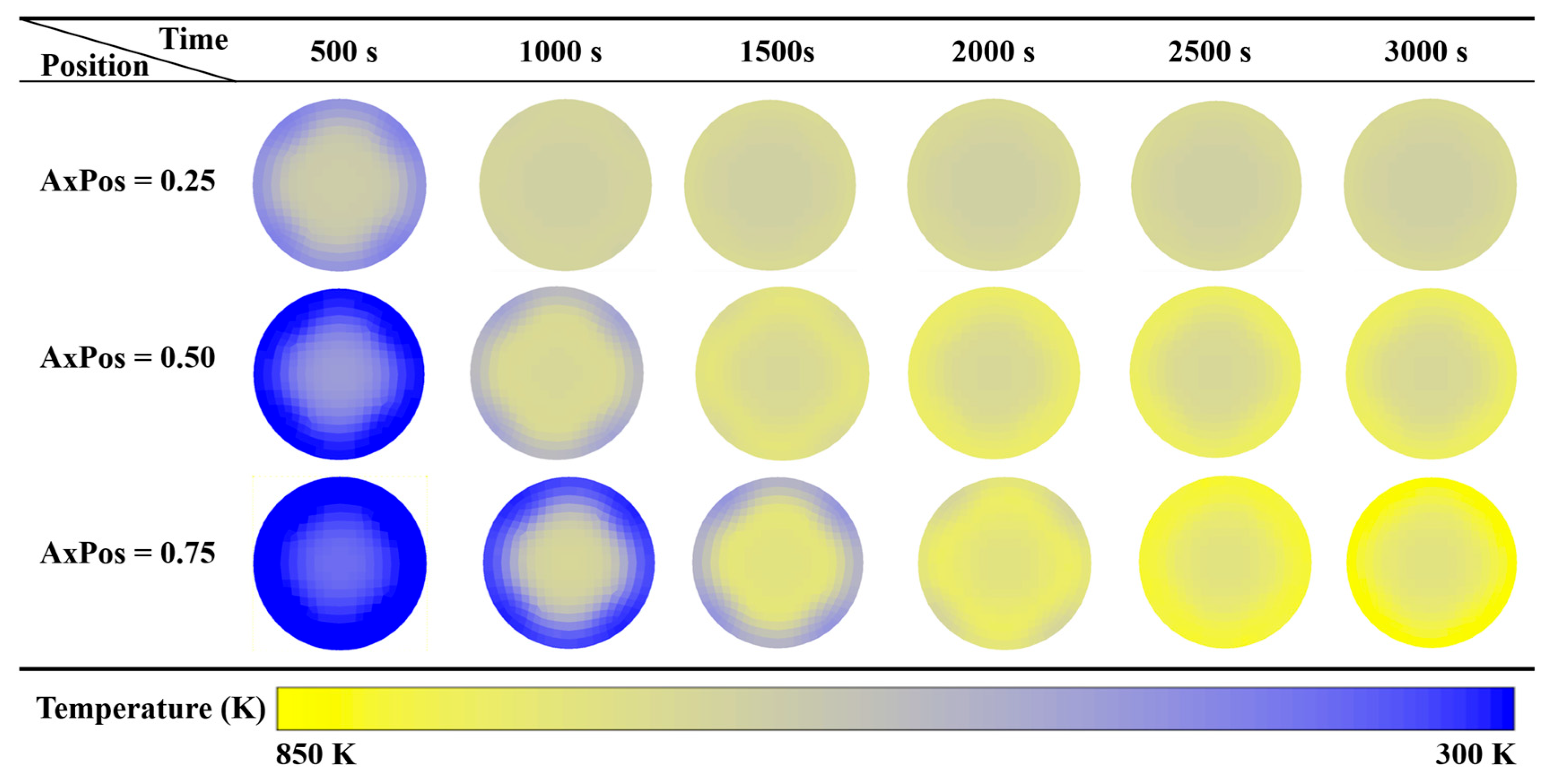
As shown in Figure 15, under the 50% operating condition, the temperature fields at different AxPos exhibited significant distribution differences over time. The closer the AxPos was to the rear end, the faster the temperature rise rate and the higher the final temperature. From the perspective of AxPos: the temperature at AxPos = 0.25 started to rise the earliest, but the variation range was relatively small; the temperature gradient in the AxPos = 0.5 region was the most obvious, which was the main concentration area for heat transfer and reaction heat release; the temperature at AxPos = 0.75 was the lowest in the early stage, but it rose the fastest as time passed and gradually approached the temperature of the middle section in the later stage.
This phenomenon indicated that the reaction heat was transferred along the gas flow direction, and the outlet region achieved temperature inversion in the later stage due to the dual heating effect of continuous reaction and heat conduction. At the same axial position, the temperature increased gradually over time. In the initial stage, the overall temperature was low, and the cross-sectional color was blue, which indicated that the system was still in the cold start stage, with heat mainly concentrated in the center of the channel and insufficient heat transfer in the wall area. As the reaction continued, the temperature field gradually expanded uniformly from the center to the outside, and the overall color changed from blue to gray. This reflected the combined effect of reaction heat release and gas convective heat transfer, making the temperature in the channel tend to be consistent. When the time reached 3000 s, the temperature field stabilized in the yellow region, indicating that the catalyst temperature distribution had become basically uniform and the system entered the steady-state thermal equilibrium stage.
In summary, the rear axial positions and the later time stages showed higher temperatures due to the superposition of heat conduction and continuous heat input. This spatiotemporal distribution law of temperature directly affected the catalytic reaction kinetics, providing an intuitive basis for the thermal characteristic analysis and reaction process optimization of the SCR system under the 50% operating condition [40].

3.6. Field Synergy Analysis of Concentration Temperature

3.6.1. Field Synergy Method

Field synergy usually refers to the synergistic property between reaction progress and temperature field. Since reaction progress was affected by multiple factors such as catalyst temperature and reaction time, the use of the field synergy method to calculate the positions where the reaction field and temperature field were highly co-directional had certain significance for structural design.
In the design process of the SCR catalyst, a monotonic and consistent axial gradient needed to be considered. Higher synergy indicated a clear reaction front, which also showed that the expected conversion varied with length; more effective control over the reaction region could be achieved through design. In contrast, poor synergy might lead to heat and mass mismatches caused by local cold spots, uneven ammonia injection mixing, local channel blockage, aging, and poisoning. The structural length could be optimized through calculation [41].

3.6.2. Building Field Synergy Method

The field synergy method was constructed in the following way. To eliminate the influence of dimensions, the temperature and concentration signals needed to be standardized, respectively, and the calculation methods were as follows [42]:
T z s ( t ) = T ( t ) T ¯ σ T ,    C z s ( t ) = C ( t ) C ¯ σ C
where T ¯ is average temperature, C ¯ is average concentration, which both represent the average values of temperature and concentration, respectively; σ T is temperature standard deviation, σ C is concentration standard deviation which are their standard deviations. T z s ( t ) is normalized temperature signal, C z s ( t ) is normalized concentration signal, which denote the normalized temperature and concentration signals, respectively.
The correlation coefficient was calculated, which corresponds to the most synchronous phase difference between the two signals and is used to quantitatively describe the temporal correlation between the two signals. The calculation method is as follows:
T lag = arg   min T [ ρ ( T ) ]
When T lag > 0 (where T denotes the optimal delay), the temperature change leads the concentration change; when T lag < 0 , the concentration change leads the temperature change.
Waveform superposition is calculated based on the time series aligned by the optimal delay, and its calculation method is as follows:
T z s ( ov ) ( t ) = T z s ( t ) ,    C z s ( ov ) ( t ) = C z s ( t + τ lag ) ,    t [ t 0 , t 0 + T rec | T lag | ]
The concentration signal is shifted by τ lag which is optimal delay along the time axis to achieve the alignment of the two curves under the condition of maximum synergy.
The synergy coefficient is used to reflect the instantaneous synergy between the two fields, and its calculation method is as follows:
ρ T - C = t = 1 N ( T z s ( t ) T z s ¯ ) ( C z s ( t ) C z s ¯ ) t = 1 N ( T z s ( t ) T z s ¯ ) 2 t = 1 N ( C z s ( t ) C z s ¯ ) 2
when ρ T - C 1 , the temperature and concentration are negatively correlated; when ρ T - C + 1 they are positively correlated.
The calculation methods for the sample data volume and the actual time lag are as follows:
T lag = k lag Δ t
where k lag is the sample lag, and Δ t is the data sampling interval.

3.6.3. Results of Field Synergy Analysis

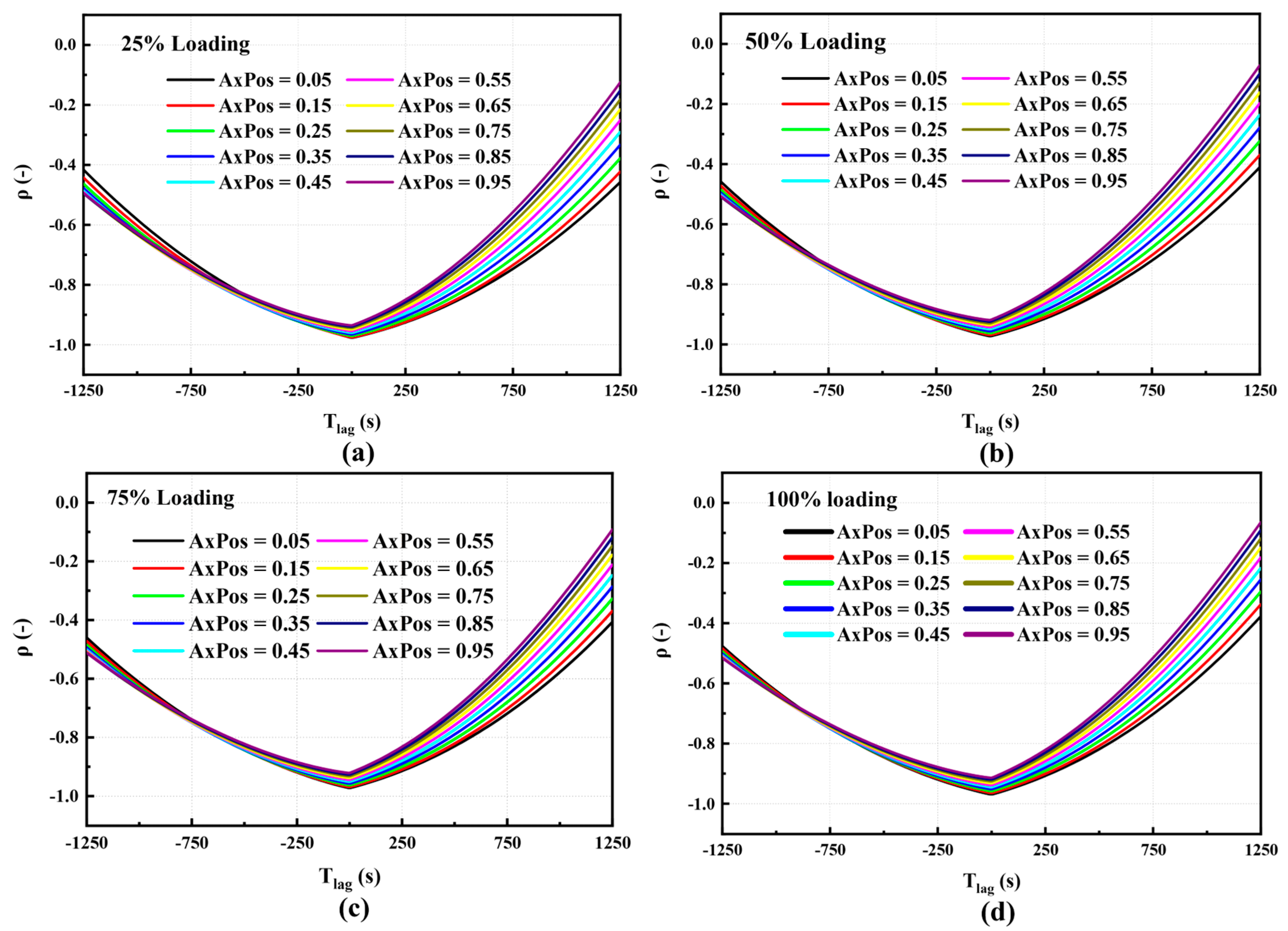
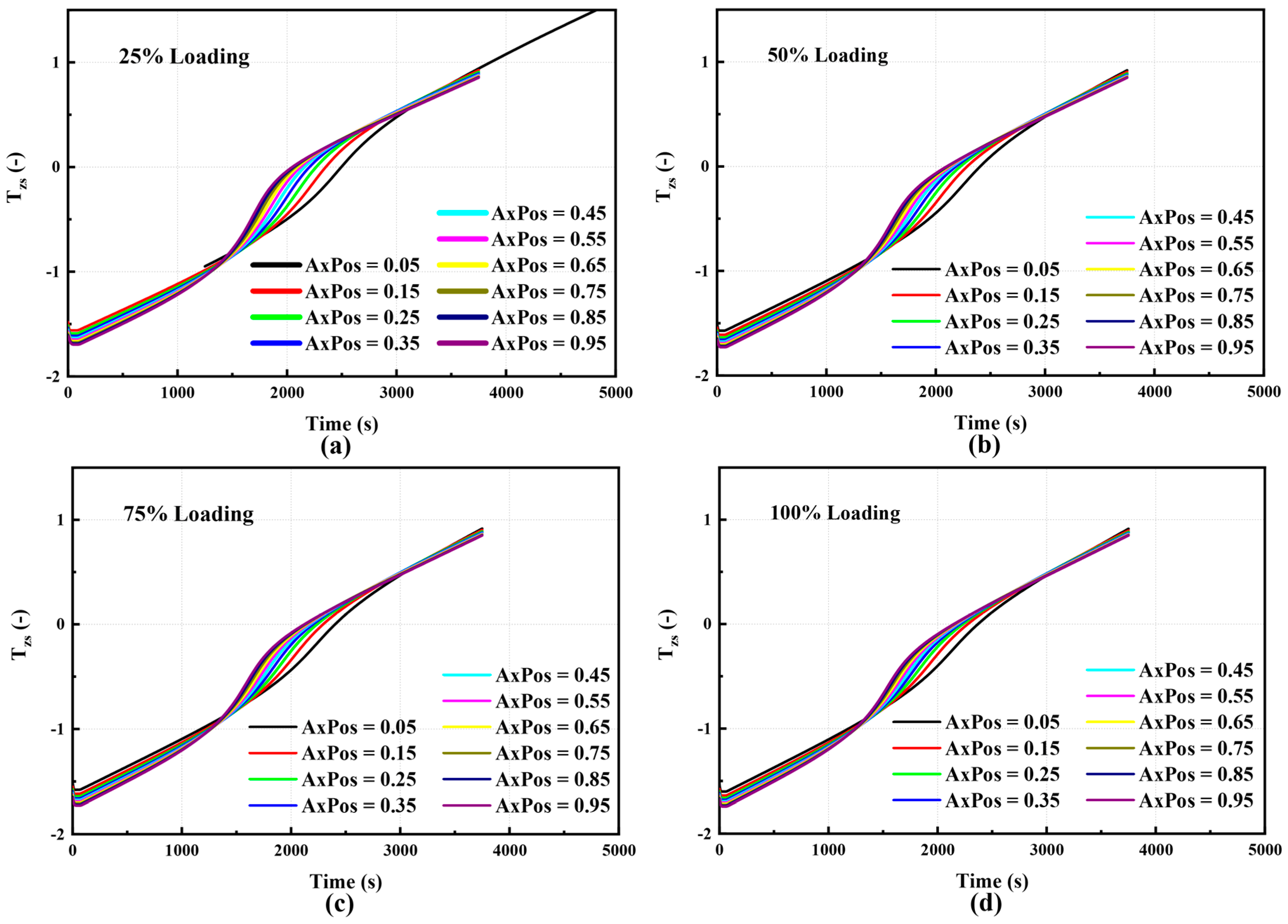
In the result analysis, the cross-correlation curves indicated the maximum correlation and Tlag during the catalyst reaction process. The ρ was used to represent the degree of correlation between temperature and NOx under this lag. The Tlag indicated the temporal relationship between the changes in concentration and temperature signals: a Tlag > 0 indicated that the concentration signal lagged behind the temperature; a Tlag < 0 indicated that the concentration signal led the temperature; and a Tlag = 0 indicated synchronous response. The waveform superposition curves showed the variation relationship between the two factors, with the normalized temperature value (Temperature z-score, Tzs) and normalized NOx concentration value (concentration z-score, Czs) used for representation.
As shown in Figure 16a–d, the ρ–Tlag curves at different AxPos locations and for all loads between 25% and 100% exhibit an approximately symmetric “U-shaped” distribution, with the minimum of ρ consistently occurring at Tlag ≈ 0. This indicates that the local solid temperature Tzs and species concentration Czs are most strongly and negatively correlated at this time lag, i.e., the temperature and concentration fields achieve their highest synergy when the local response is nearly in phase with the global heating process. The fact that the position of the minimum remains almost unchanged with load implies that Tlag mainly reflects the relative thermal lag governed by the catalyst substrate heat capacity, thermal conductivity and geometric position, and is only weakly affected by the absolute temperature level induced by engine load. However, with increasing load the curve bundles become denser and their intersection points shift towards smaller Tlag showing that the system enters the strong-synergy region more rapidly and that the temporal coupling between temperature and concentration in the reaction zone is strengthened.
As shown in Figure 16a, the troughs of all axial segments were generally biased toward Tlag > 0, meaning that temperature changes led to the NOx concentration response. This was because the combustion heat release and gas transport rate under low load were low, resulting in obvious hysteresis in chemical reactions and mass transfer. As shown in Figure 16b, the troughs converged toward Tlag ≈ −750 s, and the spacing between curves narrowed. This indicated that heat release was enhanced, turbulence and heat transfer were accelerated, which shortened the response delay of NOx to temperature and weakened the along-the-way differences. As shown in Figure 16c, the curves of all axial segments almost overlapped and their troughs were close to Tlag ≈ 0, showing that the reaction zone had the most synchronous timing. As can be seen in Figure 16d, the trough was slightly biased toward Tlag < 0, meaning that NOx slightly led the temperature. It was speculated that the NOx generation kinetics were accelerated at high temperatures and the temperature measurement position was relatively lagging, resulting in the concentration wave arriving first while the temperature signal arrived later. In general, the increase in load caused Tlag to change from positive to zero and then to slightly negative. Among them, 75% load was the optimal synergy point, and 100% load showed a slightly advanced NOx response.
As shown in Figure 17a–d, Tzs and Czs evolved together in an S-shape over time, but their phases changed with load. As shown in Figure 17a, the curves of all axial segments were scattered: the front-end segments jumped first, while the tail-end segments lagged significantly. This manifested as Tlag > 0 and ρ ≈ −1, meaning temperature changed first and NOx responded later. The reason was insufficient heat release and transport under low load, leading to slow reaction kinetics. As shown in Figure 17b, compared with the curves at 25% loading, the curve cluster was more convergent and the overall jump moved forward, with Tlag shortened. This indicated that enhanced turbulence and heat transfer accelerated the response of NOx to temperature. As shown in Figure 17c, almost all axial segments overlapped and jumped synchronously, with Tlag ≈ 0 and the strongest synergy. At this point, the chemical time scale matched the transport scale optimally. As shown in Figure 17d, Tzs showed high overlap, but the starting point of the jump had a slight advance. This indicated that NOx generation kinetics were accelerated under high temperature.
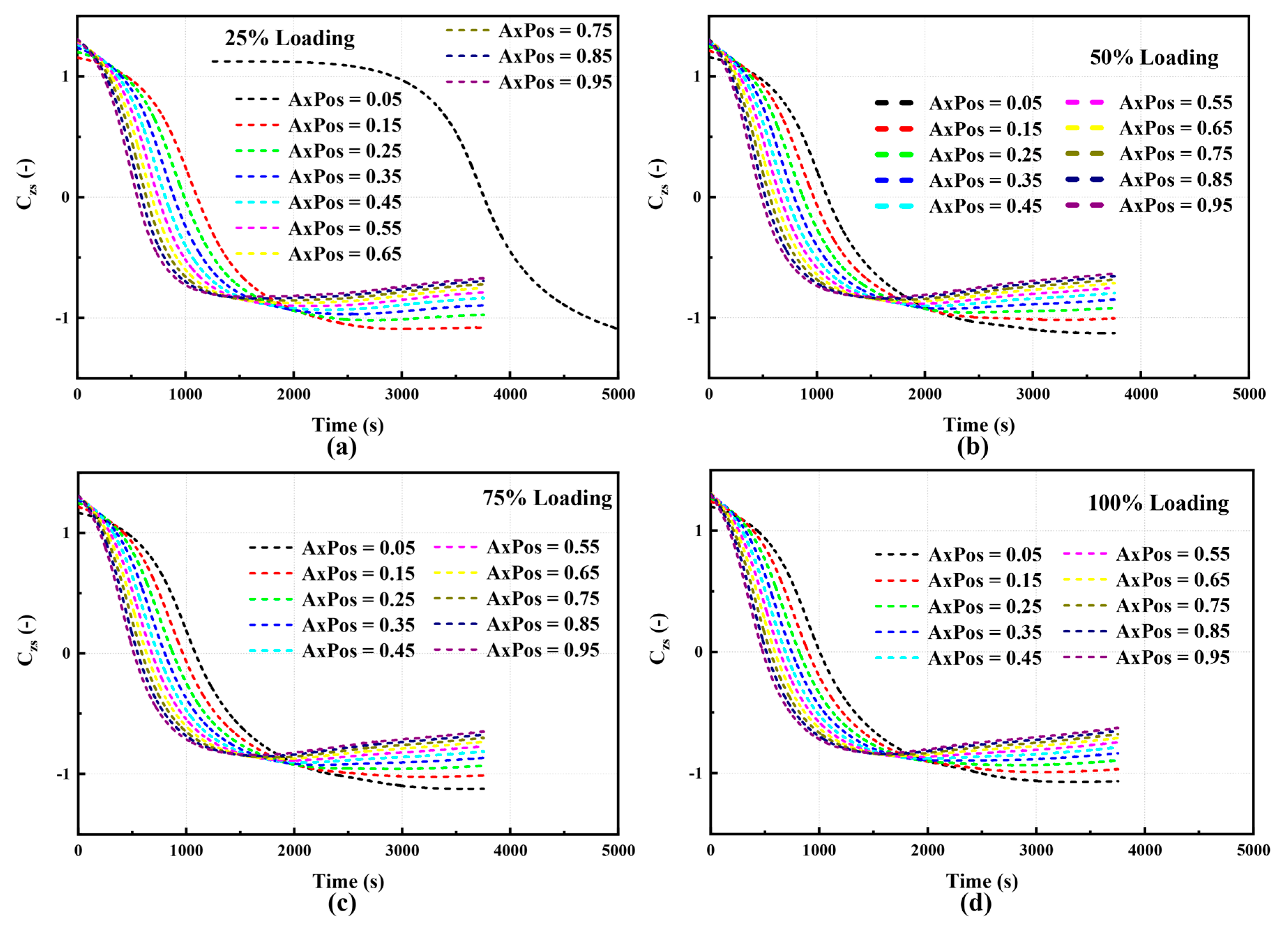
As shown in Figure 18a–d, Czs generally decayed in an S-shape over time. The higher the load, the more concentrated the curves were and the stronger the axial synchrony became. As shown in Figure 18a, when AxPos ≈ 0.05–0.35, Czs decreased rapidly first; when AxPos ≥ 0.75, it lagged significantly. Among them, some curves remained relatively high until approximately 3000 s, which indicated that there was a significant time delay in both NOx generation and emission under low load. This was because the temperature was low, and both reaction kinetics and convective diffusion were slow. Moreover, the influence of load on the overall relative conversion profile is limited; however, at the near-inlet region (AxPos = 0.05), the flow and concentration fields are still in the developing stage. The local turbulence intensity and cross-sectional species distribution are more sensitive to the inlet operating conditions. As a result, differences in flow velocity and temperature under various loads cause noticeable deviations in the normalized NOx concentration at this position. In contrast, further downstream (with increasing AxPos), the flow becomes fully developed and the mass-transfer–reaction processes gradually reach equilibrium, causing these deviations to diminish progressively. As shown in Figure 18b, the overall descending stage moved forward and the curves converged, with axial lag weakened, which shortened the response time. As shown in Figure 18c, the curves were almost parallel and entered the stable descending region synchronously at approximately 1500–2500 s. This indicated that the chemical reaction and transport time scales were optimally matched, with the smallest along-the-way differences. As shown in Figure 18d, the curves overlapped further, the decline was steeper, and the end times were consistent. This was because kinetics dominated at high temperatures, NOx generation and emission were nearly synchronous, and the significance of axial gradient was reduced.
In general, when the load increased from 25% to 100% loading, the phase difference between Tzs and Czs gradually converged from temperature leading to near synchronization, and weak NOx leading appeared at full load. Among them, 75% load was the optimal point for synergy and stability [43].

4. Conclusions

In this study, a dual mechanism reaction system for SCR was established, and explored the catalytic characteristics, dual mechanism reaction process, NH3 load and concentration field distribution, temperature characteristics, and concentration temperature field synergy law of diesel SCR system. The regulation mechanisms of load and axial position on system performance were clarified, providing key theoretical support for SCR system optimization. The core conclusions are as follows:
  • The exhaust temperature and flow rate are key factors affecting the catalytic characteristics of SCR systems. The high temperature caused by high load will accelerate the ignition rate, while low load relies on long residence time to improve catalytic efficiency.
  • NH3 loading and NOx concentration were synergistically regulated by load and axial position, the concentration and conversion efficiency were higher in the front-end region, while lower in the rear-end region due to mass transfer lag, showing obvious spatial gradient and reaction coupling characteristics.
  • The catalyst temperature evolution was jointly determined by load and axial position. High load and rear-end positions produced a significant heat accumulation effect, resulting in higher temperature rise rates and final temperatures, which enhance the reaction kinetics process.
  • The field synergy analysis showed that a strong negative correlation was maintained across the entire load range. Axial consistency was enhanced with the increase in load, and the synergy curves tended to overlap from dispersion. This indicated that heat-mass coupling and transport were more matched under medium and high loads, and the reaction zone was more stable. Specifically, temperature led with a large time lag at 25% load; the time lag was significantly shortened at 50% load; near synchronization was achieved at 75% load; and a slight NOx lead appeared at 100% load.
The differences in SCR conversion efficiency and temperature discussed in this study provide theoretical support at the mechanistic level for the design of catalyst active sites and fine calibration under different operating conditions. This support facilitates efficient denitrification and reaction network optimization of SCR systems under fully operational conditions. Subsequent research will focus on the synergistic comparison and analysis of temperature characteristics and residence time of gaseous substances, further deepening the analysis of gas dynamic activity processes.

Author Contributions

Conceptualization, M.N., W.Z., L.Z. and H.Z.; Methodology, M.N., W.Z. and H.Z.; Software, M.N. and W.Z.; Validation, M.N., J.L., W.Z. and S.L.; Formal analysis, M.N., J.L., W.Z. and S.L.; Investigation, H.Z.; Resources, M.N., W.Z. and L.Z.; Data curation, M.N., J.L., W.Z. and S.L.; Writing—original draft, M.N. and J.L.; Writing—review & editing, M.N. and J.L.; Supervision, L.Z. and H.Z.; Project administration, L.Z. and H.Z.; Funding acquisition, L.Z., S.L. and H.Z. All authors have read and agreed to the published version of the manuscript.

Funding

This study was supported by Natural Science Foundation of Top Talent of SZTU (Grant No. GDRC202203) and Shenzhen Science and Technology Program (Grant No. JCYJ20241202124703004).

Data Availability Statement

The original contributions presented in this study are included in the article. Further inquiries can be directed to the corresponding author.

Acknowledgments

This work was supported by the School of Automotive Studies, Tongji University and Sino-German College of Intelligent Manufacturing, Shenzhen Technology University through technical assistance. The authors gratefully acknowledge the resources and expertise provided by these institutions, which were instrumental in conducting the experiments described in this paper.

Conflicts of Interest

The authors declare no conflicts of interest.

References

  1. Ponce, J.; Barbier, A.; Palau, C.E.; Guardiola, C. A novel approach in constructing virtual real driving emission trips through genetic algorithm optimization. Eng. Appl. Artif. Intell. 2025, 139, 109637. [Google Scholar] [CrossRef]
  2. Nemitallah, M.A.; Nabhan, M.A.; Alowaifeer, M.; Haeruman, A.; Alzahrani, F.; Habib, M.A.; Elshafei, M.; Abouheaf, M.I.; Aliyu, M.; Alfarraj, M. Artificial intelligence for control and optimization of boilers’ performance and emissions: A review. J. Clean. Prod. 2023, 417, 138109. [Google Scholar] [CrossRef]
  3. Isles, P.D.F. A random forest approach to improve estimates of tributary nutrient loading. Water Res. 2024, 248, 120876. [Google Scholar] [CrossRef] [PubMed]
  4. Mohan, S.; Dinesha, P.; Dasari, H. Cu/BEA catalysts for the selective catalytic reduction of engine-out NOx emissions: Experimental and kinetic investigations. Fuel 2024, 357, 130041. [Google Scholar] [CrossRef]
  5. Nkinahamira, F.; Sun, S.; Zhu, R. Core-shell In/H-Beta@Ce catalyst with enhanced sulfur and water tolerance for selective catalytic reduction of NOx by CH4. J. Hazard. Mater. 2025, 487, 137204. [Google Scholar] [CrossRef] [PubMed]
  6. Nie, W.; Song, X.; Hua, Y.; Liu, C.; Lian, J.; Wu, H.; Wang, C. Effect of cerium-zirconium oxide-loaded red mud on the selective catalytic reduction of NO in downhole diesel vehicle exhaust. Environ. Pollut. 2025, 368, 125690. [Google Scholar] [CrossRef]
  7. Fedyna, M.; Legutko, P.; Marzec, M.; Sojka, Z. Influence of zeolite framework, copper speciation, and water on NO2 and N2O formation during NH3-SCR. Appl. Catal. B Environ. Energy 2025, 361, 124632. [Google Scholar] [CrossRef]
  8. Jabłońska, M.; Suharbiansah, R.S.R.; Góra-Marek, K.; Rotko, M.; Ruszak, M.; Fernadi Lukman, M.; Palčić, A.; Denecke, R.; Bertmer, M.; Grams, J.; et al. NH3-SCR-DeNOx Activity of Cu-Containing Commercial Zeolite Y. Ind. Eng. Chem. Res. 2024, 63, 17075–17085. [Google Scholar] [CrossRef]
  9. Jabłońska, M.; Osorio Hernández, A. Selective Catalytic Reduction of Nitrogen Oxides with Hydrogen (H2-SCR-DeNOx) over Platinum-Based Catalysts. ChemCatChem 2024, 16, e202400977. [Google Scholar] [CrossRef]
  10. Takemoto, M.; Fujinuma, H.; Sugawara, Y.; Sasaki, Y.; Iyoki, K.; Okubo, T.; Yamaguchi, K.; Wakihara, T. Superior low temperature activity over α-MnO2/β-MnOOH catalyst for selective catalytic reduction of NOx with ammonia. RSC Adv. 2024, 14, 35498–35504. [Google Scholar] [CrossRef]
  11. Karkhaneh, S.; Latifi, S.M.; Kashi, E.; Salehirad, A. Promotional effects of cerium and titanium on NiMn2O4 for selective catalytic reduction of NO by NH3. Int. J. Chem. React. Eng. 2023, 21, 835–843. [Google Scholar] [CrossRef]
  12. Tushar, M.S.H.K.; Mannan, M.I.; Azmain, A. Exhaust gas after treatment using air preheating and selective catalytic reduction by urea to reduce NOx in diesel engine. Heliyon 2025, 11, e42399. [Google Scholar] [CrossRef] [PubMed]
  13. Park, C.; Choi, Y.; Park, G.; Jang, I.; Kim, M.; Kim, Y.; Choi, Y. Investigation on the reduction in unburned ammonia and nitrogen oxide emissions from ammonia direct injection SI engine by using SCR after-treatment system. Heliyon 2024, 10, e37684. [Google Scholar] [CrossRef] [PubMed]
  14. Buttignol, F.; Garbujo, A.; Biasi, P.; Kröcher, O.; Ferri, D. N2O Activation and NO Adsorption Control the Simultaneous Conversion of N2O and NO Using NH3 over Fe-ZSM-5. J. Am. Chem. Soc. 2025, 147, 8978–8990. [Google Scholar] [CrossRef]
  15. Vedagiri, P.; Martin, L.J.; Varuvel, E.G. Characterization of urea SCR using Taguchi technique and computational methods. Environ. Sci. Pollut. Res. 2021, 28, 11988–11999. [Google Scholar] [CrossRef]
  16. Bendrich, M.; Scheuer, A.; Hayes, R.E.; Votsmeier, M. Unified mechanistic model for Standard SCR, Fast SCR, and NO2 SCR over a copper chabazite catalyst. Appl. Catal. B Environ. 2018, 222, 76–87. [Google Scholar] [CrossRef]
  17. Bjerregaard, J.D.; Votsmeier, M.; Grönbeck, H. Influence of aluminium distribution on the diffusion mechanisms and pairing of Cu(NH3)2+ complexes in Cu-CHA. Nat. Commun. 2025, 16, 603. [Google Scholar] [CrossRef]
  18. Samosir, B.F.; Quach, N.Y.; Chul, O.K.; Lim, O. NOx emissions prediction in diesel engines: A deep neural network approach. Environ. Sci. Pollut. Res. 2024, 31, 713–722. [Google Scholar] [CrossRef]
  19. Arfaoui, J.; Ghorbel, A.; Petitto, C.; Delahay, G. New SCR Catalysts Based on Mn Supported on Simple or Mixed Aerogel Oxides: Effect of Sulfates Addition. Catal. Lett. 2024, 155, 1. [Google Scholar] [CrossRef]
  20. Jankowska, A.; Fidowicz, K.; Rutkowska, M.; Kowalczyk, A.; Michalik, M.; Chmielarz, L. Low-temperature NO conversion with NH3 over cerium-doped MWW derivatives activated with copper species. Catal. Sci. Technol. 2025, 15, 1456–1472. [Google Scholar] [CrossRef]
  21. Jabłońska, M.; Mollá Robles, A.; Rotko, M.; Vuong, T.H.; Lei, H.; Lavrič, Ž.; Grilc, M.; Lukman, M.F.; Valiullin, R.; Bertmer, M.; et al. Unraveling the NH3-SCR-DeNOx Mechanism of Cu-SSZ-13 Variants by Spectroscopic and Transient Techniques. ChemSusChem 2024, 17, e202400198. [Google Scholar] [CrossRef]
  22. SAE J1939; Recommended Practice for Data Communication in Heavy Duty Vehicle Networks. Society of Automotive Engineers: Warrendale, PA, USA, 2018.
  23. DIN 70070; Road Vehicles—Diagnostic Communication with Road Vehicles—Electrical and Signal Characteristics of Diagnostic Communication. German Institute for Standardization (DIN): Berlin, Germany, 2001.
  24. Luo, J.B.; Xu, H.X.; Wang, J.; Liu, Z.H.; Tie, Y.H.; Li, M.S.; Yang, D.Y. The research on dynamic performance of single channel selective catalytic reduction system with different shapes. J. Environ. Chem. Eng. 2022, 10, 12. [Google Scholar] [CrossRef]
  25. Zhang, Z.; Zhong, W.; Mao, C.; Xu, Y.; Lu, K.; Ye, Y.; Guan, W.; Pan, M.; Tan, D. Multi-objective optimization of Fe-based SCR catalyst on the NOx conversion efficiency for a diesel engine based on FGRA-ANN/RF. Energy 2024, 294, 130899. [Google Scholar] [CrossRef]
  26. Zhang, Z.; Zhong, W.; Pan, M.; Yin, Z.; Lu, K. Multi-objective optimization of structural parameters of SCR system under Eley-Rideal reaction mechanism based on machine learning coupled with response surface methodology. Fuel Process. Technol. 2024, 265, 108141. [Google Scholar] [CrossRef]
  27. He, Z.; Wang, Y.; Liu, Y.; Lian, L.; Kong, D.; Zhao, Y. Recent advances in sulfur poisoning of selective catalytic reduction (SCR) denitration catalysts. Fuel 2024, 365, 131126. [Google Scholar] [CrossRef]
  28. Zhang, M.; Guan, Z.; Qiao, Y.; Zhou, S.; Chen, G.; Guo, R.; Pan, W.; Wu, J.; Li, F.; Ren, J. The impact of catalyst structure and morphology on the catalytic performance in NH3-SCR reaction: A review. Fuel 2024, 361, 130541. [Google Scholar] [CrossRef]
  29. Daya, R.; Deka, D.J.; Goswami, A.; Menon, U.; Trandal, D.; Partridge, W.P.; Joshi, S.Y. A redox model for NO oxidation, NH3 oxidation and high temperature standard SCR over Cu-SSZ-13. Appl. Catal. B Environ. 2023, 328, 122524. [Google Scholar] [CrossRef]
  30. Hu, Y.; Wang, B.; Sun, Y.; Zhao, J.; Xie, F.; Chen, H. A temporal discretization and spatial integration SCR model with dual temperature-related parameters. Fuel 2024, 367, 131405. [Google Scholar] [CrossRef]
  31. Wu, G.; Chen, H.; Li, Y.; Gao, H.; Sun, F.; Du, J.; Li, Y. Experimental investigation of NOx emissions and SCR optimization in hydrogen internal combustion engines under full-range operating conditions. J. Energy Inst. 2025, 123, 102232. [Google Scholar] [CrossRef]
  32. Xie, M.; Xiao, X.; Wang, J.; Chen, J.; Kang, H.; Wang, N.; Chu, W.; Li, L. Mechanistic insights into the cobalt promotion on low-temperature NH3-SCR reactivity of Cu/SSZ-13. Sep. Purif. Technol. 2023, 315, 123617. [Google Scholar] [CrossRef]
  33. Han, P.; Shen, X.; Shen, B. A simulation study on NOx reduction efficiency in SCR catalysts utilizing a modern C3-CNN algorithm. Fuel 2024, 363, 130985. [Google Scholar] [CrossRef]
  34. Liu, D.; Sun, H.; Hong, Z.; He, C.; Toyao, T.; Matsuoka, M.; Chen, H. Bifunctional mechanism for low-temperature Methanol-SCR on H-FER zeolite doped by trace amount of cobalt. Appl. Catal. A: Gen. 2025, 696, 120201. [Google Scholar] [CrossRef]
  35. Luo, J.; Jia, Z.; Xu, S.; Chen, G.; Zhang, H.; Jiang, C. Influence and correlation analysis of urea injection method and mixer combination on SCR performance. Chem. Eng. Process.-Process Intensif. 2025, 217, 110513. [Google Scholar] [CrossRef]
  36. Tang, T.; Xue, J.; Su, X.; Chen, J.; Qiao, W.; Zhang, H.; Li, S.; Li, X.; Du, X. Selective NH3 trapping as the enabler for efficient bifunctional catalysis of NH3-SCR and CO oxidation reactions. Appl. Catal. B Environ. Energy 2025, 375, 125430. [Google Scholar] [CrossRef]
  37. Jung, C.; Lee, S.; Jang, J.; Na, S.; Choi, G.; Choi, M.; Park, Y. Performance optimization of static mixer in urea-SCR system considering flow and turbulence characteristics. Results Eng. 2025, 26, 104951. [Google Scholar] [CrossRef]
  38. Li, W.; Du, X.; Li, Z.; Tao, Y.; Xue, J.; Chen, Y.; Yang, Z.; Ran, J.; Rac, V.; Rakić, V. Electrothermal alloy embedded V2O5-WO3/TiO2 catalyst for NH3-SCR with promising wide operating temperature window. Process Saf. Environ. Prot. 2022, 159, 213–220. [Google Scholar] [CrossRef]
  39. Sun, Y.; Qian, Y.; Gong, Z.; Meng, S.; Wei, X.; Ma, B. The impact of energy flow on catalytic behavior in advanced DOC+SCR emission control systems. J. Ind. Eng. Chem. 2025, 143, 663–678. [Google Scholar] [CrossRef]
  40. Zhang, J.; Sun, W.; Li, Z. Optimal Design and Experimental Study of Tightly Coupled SCR Mixers for Diesel Engines. Energy Eng. 2024, 121, 2893–2906. [Google Scholar] [CrossRef]
  41. Lee, J.H.; Kim, T.Y. Reconstruction of flow and temperature fields of exhaust gas flow for enhancing the energy harvesting performance of a thermoelectric generator. Appl. Therm. Eng. 2025, 280, 128035. [Google Scholar] [CrossRef]
  42. Zhang, Z.; Ye, J.; Lv, J.; Xu, W.; Tan, D.; Jiang, F.; Huang, H. Investigation on the effects of non-uniform porosity catalyst on SCR characteristic based on the field synergy analysis. J. Environ. Chem. Eng. 2022, 10, 107056. [Google Scholar] [CrossRef]
  43. Fan, L.; Shi, W.; Jing, J.; Dong, Z.; Yuan, J.; Qu, L. An artificial intelligence strategy for multi-objective optimization of Urea-SCR for vehicle diesel engine by RSM-VIKOR. Energy 2025, 317, 134667. [Google Scholar] [CrossRef]
Figure 1. The schematic diagram of experimental device [24].
Energies 18 06571 g001
Figure 2. The established SCR physical model (a); Schematic diagram of structural parameters (b); Schematic diagram of SCR axis x positions (c).
Energies 18 06571 g002
Figure 3. Model independence verification.
Energies 18 06571 g003
Figure 4. Comparison and verification of simulation and experimental data.
Energies 18 06571 g004
Figure 5. NH3 conversion rate (a) and NH3 species source (b) of SCR under different loads.
Energies 18 06571 g005
Figure 6. NOx conversion rate (a) and NOx species source (b) of SCR under different loads.
Energies 18 06571 g006
Figure 7. The L-H model reaction performance in SCR: (a) R3; (b) R5; (c) R7; (d) Proportion of total reaction.
Energies 18 06571 g007
Figure 8. The E-R model reaction performance in SCR: (a) NH3 adsorption and storage rate; (b) R4; (c) R6; (d) R8.
Energies 18 06571 g008aEnergies 18 06571 g008b
Figure 9. (a) Adsorption and storage rate of NH3 under different loading; (b) NH3 surface species concentration under 50% loading.
Energies 18 06571 g009
Figure 10. The concentration reaction of different species at different positions under 50% loading: (a) NO conversion rate; (b) NO species concentration; (c) NH3 conversion rate; (d) NH3 species concentration.
Energies 18 06571 g010
Figure 11. Characteristics of NOx conversion rate (a) and concentration (b) variation under different AxPos.
Energies 18 06571 g011
Figure 12. Distribution of NO and NO2 concentrations over time under 50% loading condition.
Energies 18 06571 g012
Figure 13. Temperature variation characteristics of SCR catalyst. (a) Catalyst mean temperature; (b) Catalyst temperature distribution.
Energies 18 06571 g013
Figure 14. Temperature characteristics of SCR under different positions and loads.
Energies 18 06571 g014
Figure 15. Temperature distribution map of SCR at different positions under 50% operating conditions.
Energies 18 06571 g015
Figure 16. Time evolution of ρ at different AxPos under (a) 25% loading, (b) 50%loading, (c) 75% loading, (d) 100% loading.
Energies 18 06571 g016
Figure 17. Time evolution of Tzs at different AxPos under (a) 25% loading, (b) 50% loading, (c) 75% loading, (d) 100% loading.
Energies 18 06571 g017
Figure 18. Time evolution of normalized NOx concentration Czs at different axial positions under (a) 25% loading, (b) 50%loading, (c) 75% loading, (d) 100% loading.
Energies 18 06571 g018
Table 1. The detailed parameters of diesel engine [25].
ParameterValueUnit
Engine typeSix-cylinder, four-stroke, direct-injection, water-cooled, electronically controlled diesel engine
Bore/stroke113 × 140mm
Compression ratio17.5: 1
Displacement8.4L
Rated power206kW
Rated speed2200r·min−1
Maximum torque1100N·m
Table 2. Test condition range [25].
SubsystemParameterSetpoint/LimitUnit
Intake systemPressure drop ≤4 (calibration point)kPa
Intercooler pressure loss≤11 (calibration point)kPa
Charge-air temperature after intercooler49 ± 2 (calibration point)°C
Cooling systemJacket water temperature88 ± 5°C
Fuel systemFuel temperature37 ± 2°C
Fuel typeDiesel, sulfur ≤ 50ppm
Exhaust systemExhaust back pressure≤16 (calibration point)kPa
Maximum exhaust temperature≤650°C
Table 3. Main experimental test apparatus [25].
Measured ItemInstrument/ModelManufacturerRangeAccuracy
Engine powerControl test benchAVL (Graz, Austria)10–2500 kW
Fuel consumptionFuel consumption meterAVL0.5–500 L/h±0.05 L/h
Smoke opacityFilter paper smoke meterAVL0–10 FSN±0.05 FSN
Intake air mass flowAir flow meterABB (Zurich, Switzerland)0–200 kg/min±0.1 kg/min
Gas temperatureTemperature sensorAVL0–1000 °C±1 °C
Exhaust gas concentrationGas analyzerContinental (Hanover, Germany)0–5000 ppm±10 ppm
Table 4. Main physical parameters of the SCR.
ParametersAbbreviationValueUnit
Carrier diameterCd320mm
Carrier lengthCl600mm
Side pipe lengthPl60mm
Catalytic pore densityCPSI4001/in2
Borehole widthBw1.2mm
Wall thicknessWt0.165mm
Washcoat thicknessWct0.0165mm
Table 5. Reaction equations of E-R and L-H mechanism.
Reaction TypeReaction EquationReaction Model
NH3 adsorptionR1: NH3 + S → NH3(S) r 1 = k a c N H 3 ( 1 θ N H 3 )
NH3 desorptionR2: NH3(S) → NH3 + S r 2 = k d exp E d R T ( 1 α 1 θ N H 3 ) θ N H 3
Standard SCR reactionR3: 4NH3 + 4NO + O2 → 4N2 + 6H2O R 3 = ( 1 ξ ) K 3 c N O L K N H 3 , 3 c N H 3 L 1 + K N H 3 , 3 c N H 3 L ξ = f c N O 2 L c N O L
R4: 4NH3(S) + 4NO + O2 → 4N2 + 6H2O r 4 = K 4 c N O L Z N H 3 * 1 exp ( Z N H 3 Z N H 3 * )
Fast SCR reactionR5: 4NH3 + 2NO + 2NO2 → 4N2 + 6H2O R 5 = ξ K 5 c N O L c N O 2 L K N H 3 , 5 C N H 3 L 1 + K N H 3 , 5 C N H 3 L
R6: 4NH3(S) + 2NO + 2NO2 → 4N2 + 6H2O r 6 = K 6 c N O L c N O 2 L Z N H 3 * 1 exp ( Z N H 3 Z N H 3 * )
NO2-SCR reactionR7: 8NH3 + 6NO2 → 7N2 + 12H2O R 7 = ξ K 7 c N O 2 L K N H 3 , 7 c N H 3 L 1 + K N H 3 , 7 c N H 3 L
R8: 8NH3(S) + 6NO2 → 7N2 + 12H2O r 8 = K 8 c N O 2 L Z N H 3 * 1 exp ( Z N H 3 Z N H 3 * )
Where ka is adsorption rate constant, mol·m−2; kd is desorption rate constant, mol·m−2; Ed is activation energy, J·mol−1; α is model constant, mol·m−2, R is ideal gas constant, J·mol−1·K−1; T is temperature, K; r is reaction rate,·m−2·s−1; K is frequency factor, s−1; Z is surface site fraction without unit; Z* is critical surface fraction without unit; θ is NH3 surface coverage without unit; c is concentration of the reactant, mol·m−3.
Table 6. Experimental scheme and inlet boundary conditions [22].
Parameters25% Load50% Load75% Load100% Load
NOx concentration (ppm)1218113110541124
O2 concentration (%)16.1615.0614.5613.69
CO2 concentration (%)3.604.384.755.37
H2O concentration (%)3.133.123.113.11
Velocity inlet (m/s)11.5020.5127.8436.05
Exhaust flow (kg/s)0.631.121.521.97
Exhaust temperature (°C)225320350400
Disclaimer/Publisher’s Note: The statements, opinions and data contained in all publications are solely those of the individual author(s) and contributor(s) and not of MDPI and/or the editor(s). MDPI and/or the editor(s) disclaim responsibility for any injury to people or property resulting from any ideas, methods, instructions or products referred to in the content.