You are currently viewing a new version of our website. To view the old version click .
Energies
  • Review
  • Open Access

8 December 2025

Advances in North American CCUS-EOR Technology and Implications for China’s Development

,
,
,
,
,
and
1
School of Engineering Sciences, University of Chinese Academy of Sciences, Beijing 100049, China
2
Institute of Porous Flow and Fluid Mechanics, Chinese Academy of Sciences, Langfang 065007, China
3
National Key Laboratory of Enhanced Oil and Gas Recovery, Beijing 100083, China
4
Research Institute of Petroleum Exploration and Development, PetroChina, Beijing 100083, China
Energies2025, 18(24), 6406;https://doi.org/10.3390/en18246406 
(registering DOI)
This article belongs to the Section H1: Petroleum Engineering

Abstract

CCUS-EOR combines emission reduction with economic benefits, making it one of the key technologies for addressing global climate change. Addressing the lack of systematic comparative studies on the differences in geological endowments and engineering conditions between China and North America in existing literature, this paper systematically reviews the progress of North American CO2-EOR in areas such as gas source structure transformation, capture technologies, and pipeline network construction, based on a self-constructed database of typical projects. It then conducts a quantitative comparative analysis of typical projects in China and the United States from three dimensions: reservoir geological endowment, gas source composition, and infrastructure. The study reveals that the advancement of U.S. CO2-EOR projects benefits from increasing industrial CO2 supply and the construction of cross-regional pipeline networks. Comparative analysis indicates that North American projects primarily feature miscible displacement in medium-to-low temperature and light oil reservoirs. This contrasts fundamentally with the characteristics of China’s continental reservoirs, which exhibit “strong heterogeneity, high viscosity, and high minimum miscibility pressure (MMP)”. Currently, China’s CCUS-EOR is transitioning from engineering demonstration to commercial application. However, gaps persist compared to more mature international systems in areas such as low-concentration CO2 capture, pipeline network construction for source-sink matching, and suitability for continental reservoir EOR. Moving forward, China can draw on U.S. CCUS-EOR development experience, accelerate research on relevant technologies tailored to its continental reservoir characteristics, and establish a differentiated whole-industry-chain CCUS-EOR technology system.

1. Introduction

In recent years, extreme weather events have become increasingly frequent, and global climate change has intensified, with significant temperature rises observed both on land and in the oceans [1]. Growing evidence indicates that greenhouse gases generated by human activities are the primary drivers of global warming, particularly CO2 emissions from fossil fuel combustion and agricultural activities, which contribute approximately two-thirds to global warming [2,3]. Currently, reducing greenhouse gas emissions is a challenge that all humanity must collectively address to counteract the drastic changes in the global climate.
The Paris Agreement aims to reduce the risks and impacts of climate change by limiting the global average temperature increase to well below 2 °C above pre-industrial levels and pursuing efforts to limit the temperature increase to 1.5 °C above pre-industrial levels [4]. In 2021, the International Energy Agency (IEA) released its first Net Zero Emissions Roadmap, targeting global energy sector CO2 Net-Zero Emissions [5]. The Intergovernmental Panel on Climate Change (IPCC) Sixth Assessment Report sets emission requirements: limiting global warming to 1.5 °C above pre-industrial levels necessitates reducing greenhouse gas emissions by 43% relative to 2019 levels by 2030 and by 84% by 2050 [6]. China has set its “dual carbon” goals: achieving peak carbon emissions before 2030 and carbon neutrality before 2060. Similarly, the United States has established targets to achieve a carbon-free electricity sector by 2035 and net-zero greenhouse gas emissions by 2050 [7].
CCUS encompasses the capture, utilization, and storage of CO2, adding a utilization phase to CCS. Scholars recognize that focusing solely on storage efficiency is less effective than deploying CO2 for beneficial purposes to mitigate its impact on the global carbon cycle [8]. Moreover, CCUS holds commercial value and stands as one of the most attractive strategies for addressing greenhouse gas emissions. CCUS Enhanced Oil Recovery (EOR) technology not only injects captured CO2 into reservoirs for permanent storage but also boosts oil recovery rates, increasing project profitability and significantly enhancing investment viability. It has become an effective means of implementing CO2 emissions reduction in many countries today. In 1972, the world’s first commercial CO2-EOR project commenced operations at the Kelly-Snyder oilfield in Texas, USA, significantly boosting local oil production [9]. By the end of 2022, nearly 100 CCUS projects were either operational or in the planning stage in China, with CCUS-EOR technology being the primary deployed CCUS approach [10].
The United States holds a world-leading position in CCUS-EOR technology, having advanced to the commercial deployment phase. The U.S. federal government’s 45Q tax credit policy introduced in 2018 has further accelerated the deployment of local CCUS-EOR projects [11,12,13,14]. China’s overall CCUS-EOR technology development still lags behind the United States, with technologies remaining immature and large-scale application facing numerous challenges. Currently at the industrial application stage, it struggles to meet the urgent demands of low-carbon development. Therefore, absorbing and learning from North American CCUS-related technologies can accelerate China’s technological advancement.
However, current reviews mainly focus on specific technologies or regional projects. They lack systematic comparisons between China and the United States. Specifically, differences in geology, infrastructure, and policies are often ignored. This leads to adaptability issues when applying these technologies. Therefore, this paper uses a self-constructed dataset of North American projects. We analyze the technical logic behind the dominance of miscible flooding. We also systematically compare the key differences in reservoir properties, gas sources, and pipeline networks between the two countries. The aim is to move beyond simple technology replication. Based on the characteristics of China’s continental reservoirs (such as low permeability and strong heterogeneity), we propose tailored technical and policy directions. This provides targeted references for the large-scale application of CCUS-EOR in China.

2. CCUS-EOR Technology Process

Carbon dioxide capture and storage (CCS) is one of the most critical technologies required to achieve global low-carbon goals. Among all CCS methods, CO2-enhanced oil recovery (EOR) represents a technique with significant inherent economic value [15]. The primary objective of CCS-EOR technology is to reduce emissions through geological CO2 sequestration while simultaneously leveraging the revenue generated by enhanced oil recovery (EOR) to make high-cost CCS projects economically viable. Carbon Capture, Utilization, and Storage (CCUS) expands upon CCS by incorporating CO2 utilization. This concept was first proposed by Shen Pingping et al. [16], emphasizing the integration of CO2 reduction with its beneficial application. They recognized that focusing solely on carbon sequestration efficiency is less effective than deploying CO2 for productive uses [8,17]. CCUS-EOR technology represents one application of CCUS. Compared to CCS-EOR, it prioritizes utilizing CO2 to enhance oil production rather than emphasizing emission reduction through permanent sequestration. CO2 storage emerges as a natural environmental benefit during the enhanced oil recovery process [18]. CCUS-EOR technology encompasses CO2 capture, transportation, EOR, and storage. Figure 1 illustrates a typical CCUS-EOR process flow.
Figure 1. CCUS-EOR Full Process Flow Diagram.

2.1. CO2 Capture

CO2 emissions primarily originate from industrial processes, fossil fuel combustion, agricultural activities and transportation. CO2 capture involves the process of capturing and separating CO2 from these sources. The captured CO2 is purified to produce a high-concentration, high-purity CO2 stream, which is then compressed, transported, utilized, and sequestered [19,20]. For the power generation sector, CO2 capture technologies can be categorized into three approaches: pre-combustion capture, oxy-fuel combustion capture, and post-combustion capture [21,22]. Concurrently, emerging carbon capture technologies such as chemical looping combustion (CLC), electrochemical capture, and direct air capture (DAC) are progressively developing [23].
The three traditional capture methods each possess distinct advantages and disadvantages in terms of efficiency, cost, and retrofit flexibility [24,25,26,27,28,29]. Post-combustion capture, owing to its ease of retrofitting, remains the most widely adopted method today [30,31]. The potential of the other two approaches lies in reducing equipment costs and energy consumption. Emerging technologies further broaden the scope of carbon capture applications. Direct air capture (DAC) [32,33] differs from traditional stationary source capture by addressing dispersed emissions, such as those from vehicles on highways. By capturing CO2 from the air using adsorbent materials and then desorbing and purifying it, the resulting product can be utilized in industrial processes like enhanced oil recovery and biofuel synthesis [34,35]. However, developing highly efficient and low-cost adsorbents remains a core challenge in current R&D efforts. The advantages and disadvantages of different capture methods are summarized in Table 1.
Regardless of the CO2 capture technology employed, one step involves separating CO2 [36]. CO2 separation technologies are primarily categorized into physical and chemical methods [37]. Physical methods include solvent absorption, adsorption, membrane separation, and cryogenic distillation [38]. Chemical methods encompass solvent absorption, adsorption, membrane absorption, electrochemical processes, and hydrate formation [39,40].
Table 1. Advantages and Disadvantages of Various CO2 Capture Methods.
CO2 Capture TechnologyAdvantagesDisadvantagesApplicable Targets
Pre-combustion CaptureCaptured CO2 has high concentration [41]; CO2 is easily separable [42]; Purified hydrogen can be used as fuel for fuel cells and as feedstock for synthesizing high-value chemicals [31,43]; Water consumption is lower [44].Separation process equipment requires high investment costs [45]; Gasification processes may generate polluting gases; Existing equipment requires retrofitting [31].Integrated Coal Gasification Combined Cycle (IGCC) power plants, steel, cement, glass industries, etc. [46]
Oxy-fuel combustionReduces emissions of pollutants such as nitrogen oxides; compared to air combustion, nitrogen oxide emissions decrease by 60–70% [46]; High combustion efficiency, low consumption.Separating oxygen from air consumes significant energy, impacting overall power plant efficiency [46].Combustion systems such as boilers, furnaces, and gas turbines
Post-combustion captureTechnologically flexible and cost-effective, applicable for retrofitting existing power plants; additionally removes nitrogen oxides and sulfur oxides.Low partial pressure of CO2 in flue gas, requiring large gas volumes to be treated, resulting in higher costs [44].Suitable for existing coal-fired power plants
Direct air captureFlexible site selection reduces subsequent transportation costs.Expensive equipment, relatively low efficiencyDistributed emission sources (e.g., transportation vehicles)
Physical absorption achieves CO2 separation by adjusting operating pressure and temperature, without any chemical reaction between CO2 and the absorbent. Mature industrial processes include Rectisol (using methanol), NHD (polyethylene glycol dimethyl ether), and Selexol, which are primarily suitable for high-pressure and low-temperature environments [47]. Physical adsorption widely employs Pressure Swing Adsorption (PSA) technology [30], commonly utilizing traditional adsorbents such as zeolite molecular sieves and activated carbon. However, current research is increasingly focusing on novel adsorbent materials; Metal–Organic Frameworks (MOFs) [44] are considered the next generation of high-efficiency adsorbents due to their ultra-high specific surface area and tunable pore sizes. In contrast, chemical absorption demonstrates higher capture efficiency at low partial pressures. The industry mainly uses amine-based solutions (e.g., MEA, MDEA) as absorbents, though they are associated with high-energy consumption [48]. Emerging solvents like Ionic Liquids possess excellent thermal stability but face high cost barriers, requiring further research for industrial implementation. Additionally, Mixed Matrix Membranes (MMMs) [49] combine the processability of polymers with the high separation performance of inorganic fillers, effectively overcoming the ‘trade-off’ effect of traditional membrane materials and significantly improving gas separation efficiency.

2.2. CO2 Transport

Since utilization and storage sites are often distant from capture sources, CO2 transportation becomes a critical link in the entire CCUS chain, with transport costs accounting for approximately 25% of total CCUS project expenses [50]. In Wales, UK, lacking domestic geological storage sites, the UK government plans to invest in transporting CO2 generated by factories and power plants in North Wales to the seabed in Liverpool Bay [51]. In Canada, the Alberta Carbon Trunk line project operates a 240-kilometer pipeline transporting CO2 captured from central Alberta’s industrial zone to oil fields in the central and southern regions for enhanced oil recovery [52]. In 2023, China completed its first 100-kilometer-long transport pipeline (total length 109 km), laying the foundation for scaling up the entire CCUS industry chain [53]. Safe and reliable transportation methods are critical for CCUS projects.
Currently, CO2 transportation primarily involves two methods: pipeline transport and tank container transport. Pipeline transport is divided into onshore and offshore pipelines, while tank container transport includes rail, road tanker trucks, and ship transportation [45,54]. Pipeline transport offers low costs and high capacity, making it suitable for long-distance transportation and the current mainstream method. Road and rail transport are appropriate for small-scale, short-distance CO2 shipments. When distances are excessively long or involve crossing large bodies of water, ship transport becomes more economical.
Each CCUS project must comprehensively evaluate various factors to determine the optimal transportation solution. Precise alignment of costs, scale, and distance across different modes ensures efficient CO2 transport from capture to utilization. The maturity of transportation technologies and the completeness of infrastructure are key factors constraining the large-scale application of CCUS. Therefore, building transportation networks is a crucial pillar for the scaled development of CCUS.

2.3. CO2-EOR Mechanism

CO2 utilization refers to using captured CO2 to produce valuable products or enhance resource recovery, achieving economic benefits alongside partial carbon sequestration. It primarily encompasses physical, chemical, biological, and geological utilization, with geological utilization being the most common approach [55,56]. CO2 Enhanced Oil Recovery (CO2-EOR), as the core technology of geological utilization, delivers both social and economic benefits [57].
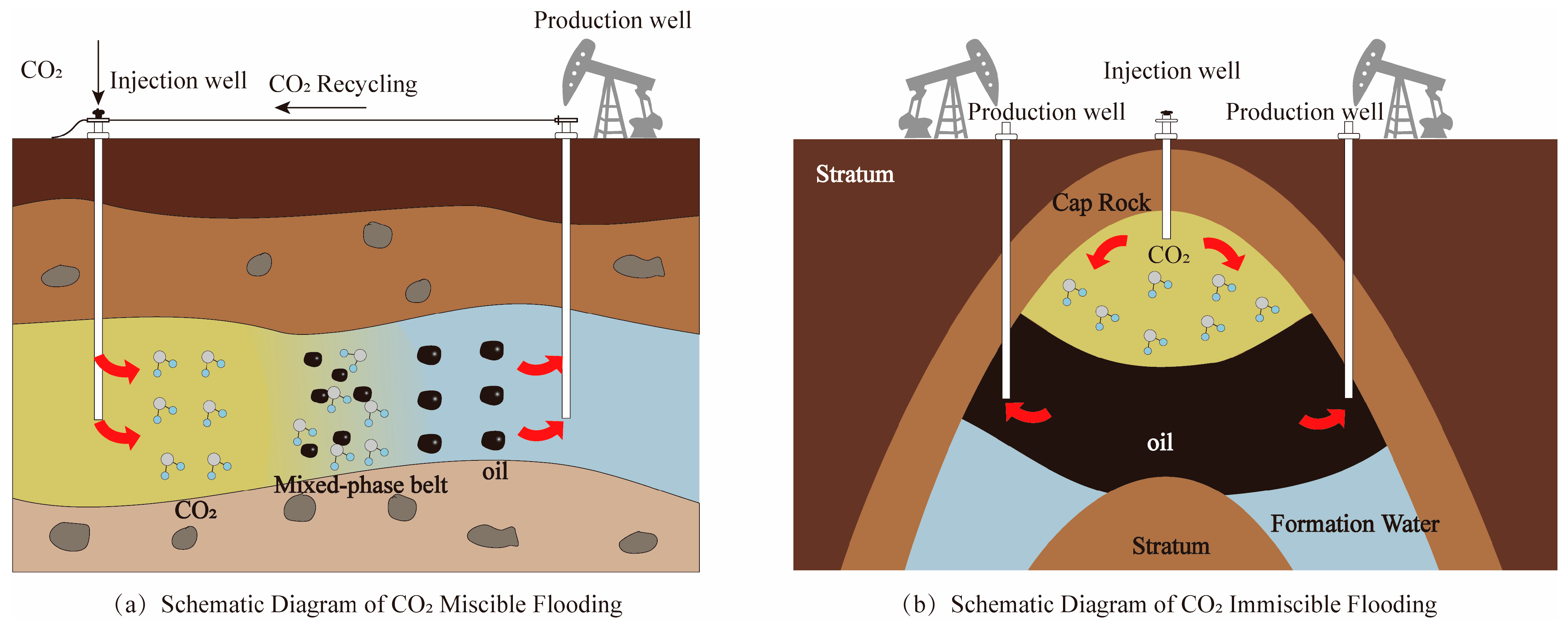
The core mechanism of CO2EOR primarily leverages CO2 to alter the flow properties of crude oil. Under reservoir temperature and pressure conditions, supercritical CO2 enhances crude oil mobility by expanding its volume, reducing interfacial tension, lowering viscosity, and extracting light hydrocarbons from the crude. This process ultimately increases oil recovery rates [58]. Based on the relationship between reservoir pressure and minimum miscibility pressure (MMP), displacement mechanisms are categorized into miscible displacement (Figure 2a), near-miscible displacement, and immiscible displacement (Figure 2b) [59]. When reservoir pressure exceeds the minimum miscible pressure (MMP), CO2 becomes fully miscible with crude oil and forms a miscible zone at the displacement front. Theoretically, this achieves 100% micro-displacement efficiency and optimal displacement efficiency [60]. When pressure falls below MMP, non-miscible displacement occurs, primarily leveraging CO2 dissolution and viscosity reduction to enhance oil recovery [61,62], with displacement efficiency slightly lower than miscible displacement. Near-miscible displacement occurs in the transitional zone where reservoir pressure approaches but remains slightly below MMP. Zhang Xiansong et al. [63] conducted CO2 near-miscible displacement studies using capillary experiments and numerical simulations. They categorized the displacement process into three stages: displacement phase (dominated by expansion), mixing phase (viscosity reduction), and breakthrough phase (extraction effect), providing a useful framework for understanding near-miscible displacement. Complex near-critical phase behavior and multiphase dynamic mass transfer processes remain key factors hindering theoretical progress in near-miscible displacement.
Figure 2. Carbon dioxide flooding methods: (a) miscible flooding; (b) immiscible flooding.
Although the micro-mechanism of CO2 enhanced oil recovery primarily relies on miscible effects, in field practice, a rational injection method can effectively expand the gas sweep volume and delay gas migration. Common injection methods mainly include continuous gas injection production, water-gas alternation, and CO2 slug injection. The advantages and disadvantages of different methods are shown in Table 2.
Table 2. Different Gas Injection Methods and Their Advantages and Disadvantages [64,65,66].
Continuous CO2 injection operations are relatively straightforward and were initially applied extensively in West Texas, USA (e.g., during the early stages of SACROC). However, they are highly prone to gas migration in heterogeneous reservoirs, resulting in low sweep efficiency. Water–gas alternation (WAG) involves alternating water and gas injections, utilizing water to control the Mobility Ratio and suppress viscosity index progression. This is currently the most widely applied technique in North America, particularly in Permian Basin carbonate reservoirs, effectively balancing production rates with sweep volumes. CO2 gulping is suitable for small-scale reservoirs lacking pipeline infrastructure or with poor injection-production connectivity, offering low investment and rapid results. Pulsed injection suppresses front expansion through unstable pressure fields, delaying gas migration.
In the United States, approximately 40 billion barrels of oil remain recoverable after primary and secondary extraction, with an additional 14 billion barrels of residual oil beneath and adjacent to existing fields. CO2-EOR technology can produce nearly 250,000 barrels of oil per day [70], demonstrating the feasibility of significantly enhancing oil recovery rates using CO2.

2.4. CO2 Geological Sequestration

CO2 sequestration technology involves capturing CO2 from emission sources, transporting it, and injecting it into designated storage sites. Through physicochemical means, CO2 is stored and permanently isolated from the external environment, preventing its release into the atmosphere [41], thereby effectively mitigating the greenhouse effect. Geological CO2 sequestration has become the mainstream storage method due to its minimal disturbance to surface ecosystems and the stability of deep storage.
CO2 geological sequestration mechanisms are typically categorized into four primary types: structural traps, residual traps, dissolution traps, and mineralization traps. The sequestration of CO2 within a hydrocarbon reservoir is influenced by one or a combination of these mechanisms. Structural and residual traps utilize physical means for sequestration [71]. The former relies on the sealing properties of cap rocks and faults to achieve large-scale CO2 sequestration. The P18-4 oilfield in the Netherlands demonstrates the critical role of cap rock and fault sealing in sequestration [72]. The latter method utilizes capillary forces within pores to confine CO2 as dispersed phases like bubbles [73,74]. Dissolution traps and mineral traps exemplify chemical sequestration. Dissolution traps achieve storage by dissolving CO2 into reservoir fluids [75], while mineral traps achieve permanent sequestration by chemically converting CO2 into solid carbonate minerals. Although they offer superior storage stability, their chemical reaction cycles are significantly longer than physical processes, and their storage capacity is relatively low. Tang et al. [76] calculated the CO2 sequestration potential in depleted reservoirs, finding that structural, dissolution, and mineral traps account for 90.6%, 4%, and 5.4% of CO2 storage, respectively. This indicates tectonic traps play the primary role in the overall sequestration mechanism.
The core logic of CO2 geological sequestration mirrors nature’s fossil fuel storage mechanisms: injecting CO2 into specific geological formations at defined depths for storage [20]. Potential CO2 geological storage sites currently include deep saline aquifers, depleted oil and gas reservoirs, unmineable coal beds, shale formations, basalt formations, and CO2 hydrate storage [77,78,79]. While depleted oil and gas reservoirs account for a limited share of storage capacity, they represent one of the most mature technologies today. Millennia of hydrocarbon storage history validate their structural integrity for carbon sequestration. Prior exploration has clarified geological features, and existing wellhead equipment and pipeline infrastructure can be directly repurposed, significantly reducing costs [80]. More importantly, CO2-EOR technology enables economic recovery of residual oil while achieving sequestration [79]. Canada’s Weyburn-Midale sequestration project employs this technology [81].
The selection of CO2 storage sites requires consideration of multiple factors beyond storage capacity alone, including storage costs, technological maturity, stability, and environmental risks. Future trends in site selection will shift from a singular focus on “storage capacity” toward a balanced approach that integrates technological, economic, environmental, and social considerations.

3. North American CCUS-EOR Technology Advancements and Applications

3.1. Data Sources and Statistical Methods

To systematically evaluate the geological suitability and engineering characteristics of CCUS-EOR technologies in North America, this study constructed a specialized database comprising 148 representative projects, serving as the foundational dataset for subsequent technical analysis. Data collection primarily relied on the authoritative global EOR project survey published in the Journal of Petroleum and Natural Gas, which has been led by the team of Larry Lake, a distinguished professor at the University of Texas at Austin, and holds significant industry reference value [82]. Considering data timeliness and completeness, a “baseline and update” construction strategy was adopted: using the 2014 survey list as the baseline, the database was supplemented and updated with parameters for CO2 flooding projects commissioned between 2014 and 2023, primarily integrating the latest industry reports published by Advanced Resources International (ARI) [83,84]. This ensures the database reflects the current technological landscape in North America. Furthermore, to guarantee data accuracy, this study cross-validated key reservoir parameters using publicly available geological data from the U.S. Department of Energy (DOE) and selected project operators.
Regarding sample selection, to ensure broad industrial representativeness of statistical results, this study prioritized commercial and pilot projects located in five core regions: the Permian Basin, Gulf Coast, Rocky Mountains, Midcontinent, and Midwest. These areas account for the vast majority of total CO2-EOR production in the United States. For the 148 valid projects selected, this study established a multidimensional dataset incorporating engineering information and geological properties. Key indicators were systematically compiled, including operator, production start date, displacement type (miscible/immiscible), primary reservoir lithology, porosity, permeability, reservoir depth, crude oil gravity (API), and formation crude oil viscosity.

3.2. Overview of CO2 Source Supply in the United States

CO2 is a critical factor in implementing CCUS-EOR technology, with its sources, distribution, and supply stability directly impacting project feasibility. North America’s CO2 sources primarily include natural CO2 sources and industrial CO2 sources. Early North American projects leveraged the discovery of large CO2-rich gas reservoirs, providing ample, stable, and inexpensive CO2 supplies that enabled sustained large-scale CO2 injection. In contrast, other regions globally face challenges in developing CO2-EOR projects due to the scarcity of natural CO2 [85]. As natural CO2 consumption in the United States declines and capture technology advances, reducing capture costs, CO2 captured from waste gases emitted by industrial plants and other facilities is increasingly being utilized to enhance oil and gas recovery [86].
It should be pointed out that the generalized CO2-EOR technology includes two types of gas sources: CO2 from natural gas reservoirs and industrially captured CO2. Strictly speaking, only the process of using CO2 captured from industrial emissions falls into the category of CCUS-EOR. Early projects in the United States were mostly based on natural gas sources and belonged to CO2-EOR; with the increasing demand for emission reduction, the proportion of industrial sources has risen, and they are gradually transitioning to CCUS-EOR.
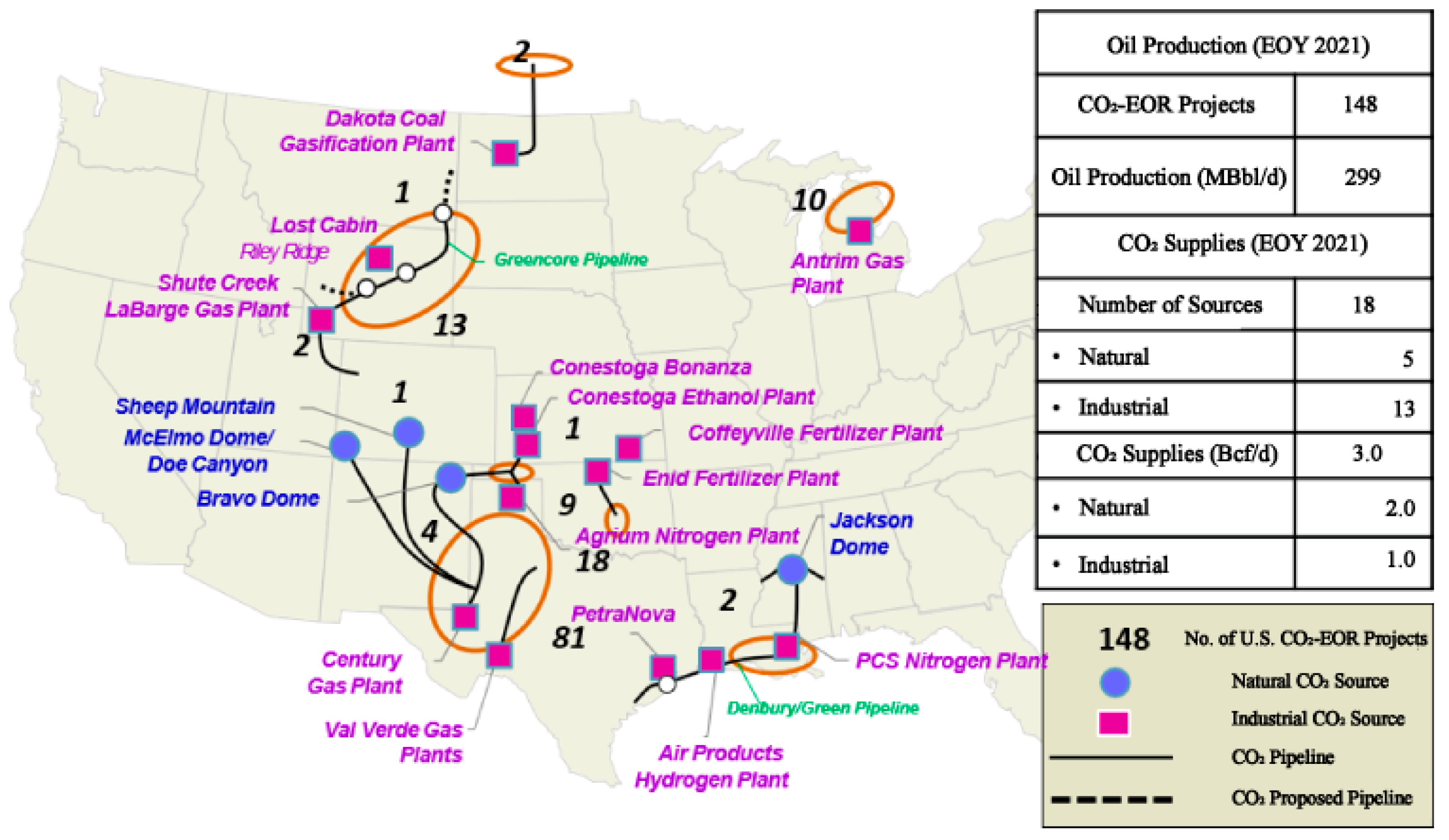
The United States has 32 CCS-EOR operators across 147 projects in five regions: the Permian Basin, the Gulf of Mexico, the Rocky Mountains, the Central Continent, and the Midwest. By 2021, CO2 enhanced oil recovery projects in the U.S. had increased recovery rates to 299,300 barrels per day. Across 147 projects operated by 32 distinct operators, the total daily CO2 supply reached 85 million cubic meters, comprising 57 million cubic meters of natural CO2 and 28 million cubic meters of industrial CO2. Figure 3 illustrates the distribution of CCS-EOR projects in the United States as of 2021. For these projects, 5 natural CO2 sources and 13 industrially captured CO2 sources are utilized to supply the required CO2. In 2021, the supply of natural CO2 in the United States decreased to 6 million cubic meters per day, marking a significant decline from 2014 levels. Conversely, industrial CO2 sources continue to expand, with growth observed across all regions. Despite the decline in natural gas sources, U.S. CCS-EOR crude oil production remains stable at nearly 300,000 barrels per day, sufficiently demonstrates that industrial gas sources have begun to support production capacity.
Figure 3. Overview of U.S. CO2-EOR Projects. Adapted from [82,83,84]. The orange circles represent regional project clusters, and the numbers indicate the count of projects.
Natural CO2 serves solely as a resource carrier, whereas industrial CO2 capture not only reduces carbon emissions but also meets oil recovery demands, representing a major pathway for low-carbon synergistic technology development. Currently, transforming gas source structures still faces significant challenges. In 2010, the U.S. CCS-EOR project projected CO2 sources for 2021 at 181 million cubic meters per day, with industrial CO2 accounting for 85 million cubic meters per day. However, actual 2021 total CO2 sources amounted to 85 million m3/day, with industrial CO2 accounting for only 28 million m3/day. The actual proportion of industrial CO2 sources fell below projections, indicating ongoing challenges for the U.S. CCS-EOR project in diversifying CO2 sources and scaling industrial CO2 capture. On one hand, capture costs remain high and scale is limited for small-to-medium industrial emitters. On the other hand, poor spatial alignment between some oilfields and industrial clusters, coupled with high transportation costs, restricts the viability of industrial CO2 sources. Looking ahead, natural CO2 production will steadily decline. Low-cost industrial gas supplies will become critical for U.S. CCS-EOR to sustain oil production. Developing the entire chain—from industrial capture to transportation and utilization—will be the core challenge facing the United States.

3.3. Analysis of North American CO2-EOR Technical Indicators

U.S. CCUS-EOR projects account for approximately 90% of the global total [87]. To understand the intrinsic drivers of CO2 flooding in North America, a thorough analysis of key reservoir parameters is essential. The effectiveness of CO2 flooding technology implementation is highly correlated with multidimensional indicators such as reservoir properties, fluid characteristics, and phase conditions. Regarding reservoir properties, rock permeability and porosity are central factors [88,89]. Permeability influences CO2’s transport capacity within reservoirs, while jointly regulating CO2 convective transport processes with porosity. Regarding fluid properties, crude oil viscosity determines its inherent flow ability. While high-viscosity crude exhibits poor mobility, CO2 dissolution significantly reduces its viscosity [90]. Crude oil saturation reflects the volume fraction of crude oil within reservoir pores, with higher initial oil saturation indicating greater extraction potential. Regarding phase conditions, miscible flooding—a mainstream technology in the United States—requires achieving the minimum miscible pressure, which is influenced by CO2 purity, crude oil composition, and reservoir temperature [91]. These indicators collectively influence CO2 enhanced oil recovery efficiency from different dimensions. Analyzing these technical metrics helps define reservoir criteria for CO2-EOR, providing a reference for identifying potential reservoirs in other regions and reducing trial-and-error costs.
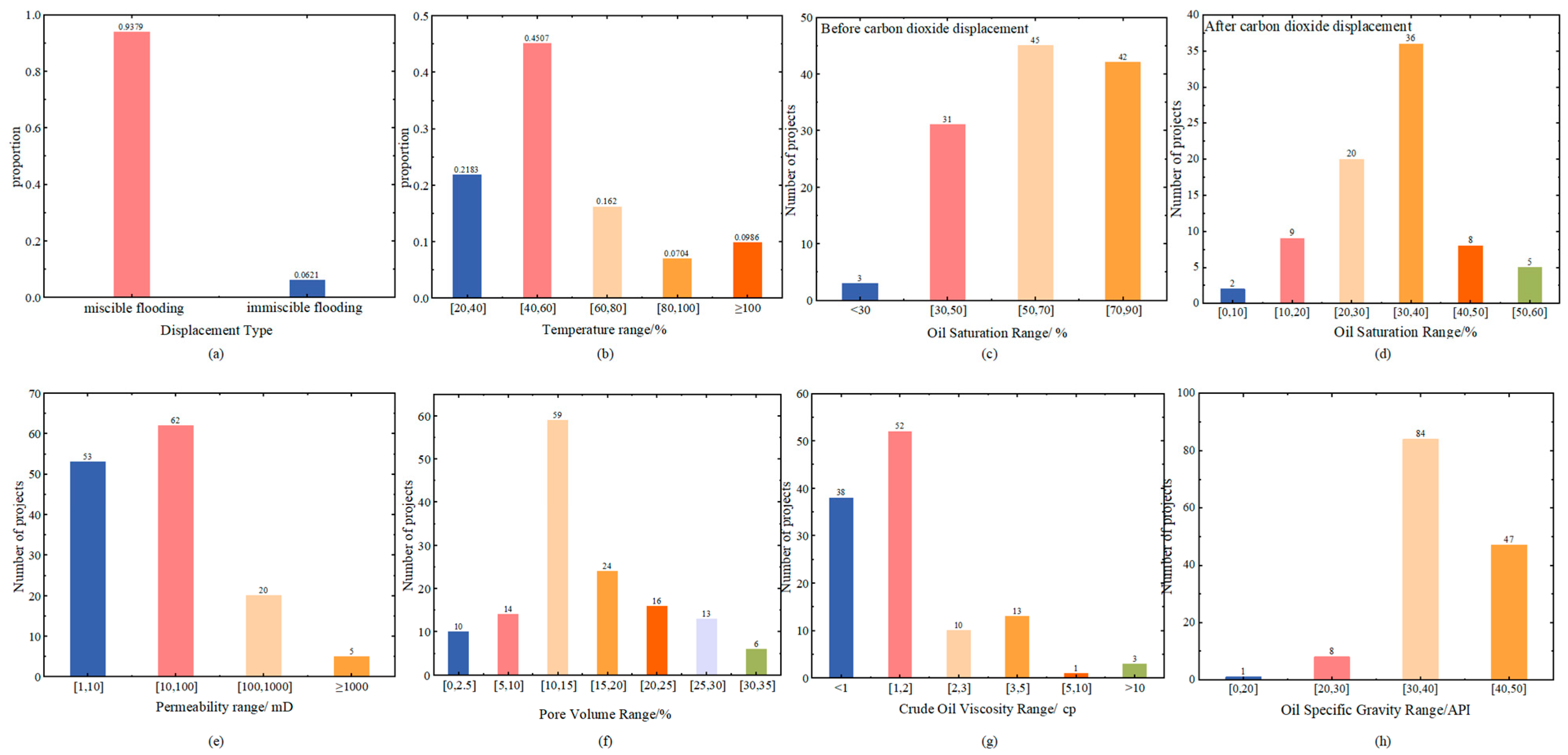
This study surveyed 148 CCS-EOR projects across U.S. states. Among these, Texas hosts 82 projects, Mississippi 19, Wyoming 15, and Michigan 10, while other states have only 1–2 projects each. Results are shown in Figure 4.
Figure 4. Technical Specifications for U.S. CCUS-EOR Projects [82,83,84]. (a) Displacement type; (b) Temperature range; (c) Oil saturation before carbon dioxide displacement; (d) Oil saturation after carbon dioxide displacement; (e) Permeability range; (f) Pore volume range; (g) Crude oil viscosity range; (h) Oil specific gravity range (API).
Among these 148 projects, 93.79% are CO2 miscible flooding projects. The composition of crude oil significantly affects the minimum miscible pressure (MMP); the higher the proportion of light components, the lower the MMP. As can be seen from Figure 4h, most North American reservoirs contain crude oil with API grades between 30 and 40, classified as light oil with low miscible pressure. Consequently, most North American reservoirs are suitable for miscible flooding. It can be seen from Figure 4b that 45.07% of the reservoir temperatures are between 40–60 °C and the average reservoir temperature is 56 ℃. Considering that, higher temperatures increase the minimum pressure required to achieve miscibility, projects implementing miscible flooding generally opt for the medium-to-low temperature range to reduce operational complexity and costs. As can be seen from Figure 4h. The proportion of projects with initially high oil saturation reservoirs has significantly decreased, demonstrating CO2 flooding is effective in lowering residual oil saturation. As shown in Figure 4e–g, permeability values predominantly ranged from 10 to 100 mD, with low permeability (<10 mD) accounting for 37.85%, categorizing these reservoirs as low-to-medium permeability. Despite the inherent poor fluid mobility of low-to-medium permeability reservoirs, the widespread application in North American projects demonstrates CO2’s unique advantage in overcoming flow resistance in low-permeability reservoirs. Porosity values predominantly range from 10–15%, with most crude oil viscosities falling between 1–5 cP, classifying them as low-viscosity oils.
In summary, reservoirs in North America suitable for CO2 flooding exhibit the following characteristics: miscible flooding dominance, moderate to low temperatures, high oil saturation, medium to low permeability, moderate porosity, and light, low-viscosity crude oil. This summary of characteristics provides a reference for CO2 flooding technology in similar reservoirs worldwide.

3.4. Key Block Technology Application: Case Study of the SACROC Formation in the Permian Basin

The Permian Basin ranks among the highest-producing major oil-rich basins, hosting over half of North America’s onshore oil rigs. The majority of U.S. CCUS projects are concentrated in the West Texas carbonate region of the Permian Basin [92,93]. Spanning New Mexico and West Texas, the basin comprises three sub-basins: the Midland Basin, Delaware Basin and Central Basin [94], with original oil in place estimated at 95.4 billion barrels. In the 1970s, large-scale CO2 enhanced oil recovery EOR trials were conducted in the Permian Basin of West Texas and southeastern Mexico, initiating the technology’s large-scale application [95].
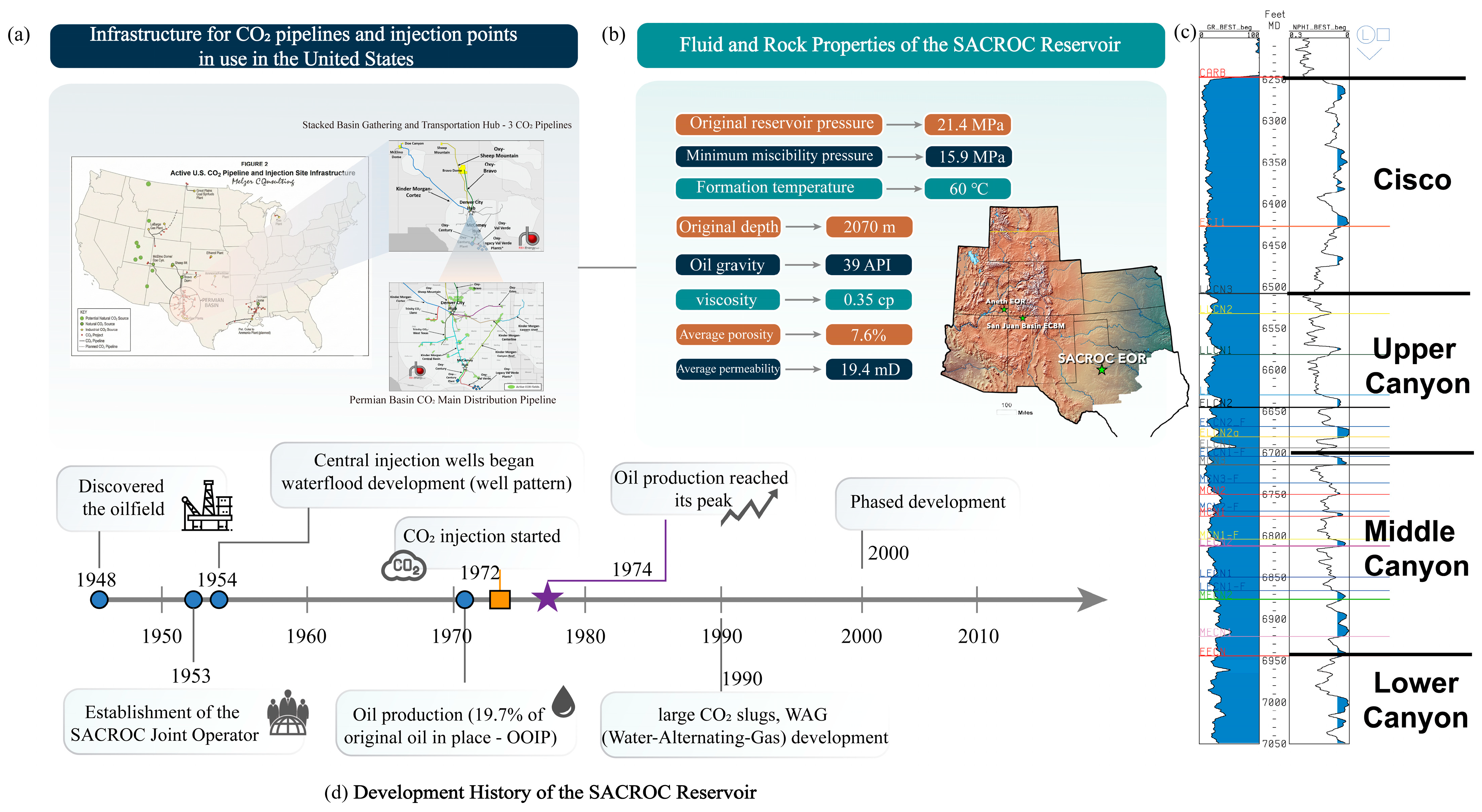
The success of CO2 flooding technology in the Permian Basin hinges on robust infrastructure and data support. On one hand, Advanced Resources developed a database encompassing 207 Permian Basin reservoirs, using five key indicators—reservoir depth, crude oil gravity, reservoir pressure, reservoir temperature, and crude oil composition—to identify formations suitable for enhanced oil recovery via CO2 miscible flooding [96]. On the other hand, the project benefited from abundant underground pure CO2 sources and robust infrastructure. While early CO2 supply relied on natural gas separation in the southern part of the basin, Chevron constructed the first supercritical CO2 pipeline (CRC), transporting CO2 from the Val Verde Basin to the SACROC block. By the early 1980s, the development of the Bravo Dome, McElmo Dome, and Sheep Mountain gas fields, coupled with the construction of a large-scale pipeline network, secured CO2 supply (Figure 5a). Companies like ExxonMobil leveraged this network for their projects. Subsequently, Occidental Petroleum invested $850 million to build natural gas and CO2 processing plants along with cross-regional pipelines, further enhancing gas transportation capacity [70]. Edwards et al. [97] analyzed the pipeline network connecting ethanol plants to the basin, broadening perspectives on industrial gas sourcing.
Figure 5. (a): Infrastructure for CO2 pipelines and injection points in use in the United States (Image adapted from [95]); (b): SACROC reservoir-related parameters; (c) Reservoir longitudinal geological cross-section; (d) Development history of the SACROC reservoir.
As EOR projects scale up, existing natural gas sources and pipeline infrastructure struggle to satisfy current requirements. Although industrial CO2 supply continues to grow, it still falls short of filling the gap, with significant disparities remaining between natural and industrial CO2 in terms of cost and scale. However, Kuuskraa et al. [70], through their research on CO2 flooding projects in the Permian Basin, have confirmed that industrial CO2 has huge economic potential in the market, providing a key basis for the transformation of gas sources.
Supported by a comprehensive industrial system, CO2 flooding has demonstrated remarkable effectiveness in the Permian Basin. As the basin’s first large-scale CO2-EOR project, SACROC holds original geological oil reserves of 4.1 × 10⁸ tons, equivalent to approximately 2.8 billion barrels. Production commenced in 1949, peaking at 1020 × 104 tons in 1974 before declining to 40 × 104 tons by 1998 (The development history is shown in Figure 5d). Following CO2 miscible flooding in 2002, output rebounded to 150 × 104 tons by 2005. As of 2020, the field has maintained stable production for 16 years, with cumulative output reaching 2456 × 104 tons. Enhanced recovery rates are projected to exceed 26% [98].
The SACROC reservoir [99] has an average depth of 2070 m, average porosity of 7.6%, and average permeability of 19.4 mD. The reservoir consists of Permian Canyon and Cisco carbonate formations (Figure 5c), characterized by extremely complex geological conditions and high heterogeneity. The reservoir has a formation pressure of 21.4 MPa, a minimum miscible pressure of 15.9 MPa, an oil specific gravity of 39 API, a viscosity of 0.35 cP, and a formation temperature of 60 °C, classifying it as a miscible light oil reservoir (Reservoir parameters are shown in Figure 5b). However, even if miscible drive can be achieved, mitigating the impact of its vertical heterogeneity remains challenging. The Canyon interval exhibits significant permeability gradation, with the upper section developing secondary pores and karst cavities featuring permeability as high as 100 D. Conversely, the lower portion consists of a tight, continuous layer with permeability below 10 mD. This geological feature—the coexistence of high-conductivity channels and a tight matrix—created severe engineering bottlenecks during the field expansion and adjustment phase from 1996 to 2001. Injected CO2 rapidly advanced through upper high-permeability channels, triggering severe ineffective circulation and gas-lock failures in electric submersible pumps of production wells. This also prevented effective penetration of low-permeability zones rich in reserves, causing rapid decline in block production.
To address the challenge of early gas channeling induced by reservoir heterogeneity, the operators of the SACROC project abandoned the traditional injection mode, gradually established and implemented a comprehensive profile control technology system comprising “3 reservoir-based measures” and “5 wellbore-based measures”. In terms of wellbore control, the project extensively adopted technologies such as dual/triple-string separate-layer injection, mechanical packers, and expandable liners, achieving forced separate-layer injection through physical isolation. For the more critical mobility control in deep reservoirs, gas-soluble surfactant alternating gas (SAG) and crosslinked polyacrylate gel technologies were introduced. Particularly, the SAG technology utilizes surfactants that generate foam with CO2 as they penetrate deep into the formation, effectively plugging the high-permeability preferential channels in the Canyon formation. Field monitoring data confirmed that after the application of this technology, the CO2 absorption profile underwent a fundamental reversal, CO2 absorption shifted from a single high-permeability layer to uniform absorption across multiple layers. This successfully activated the long-untapped low-permeability intervals and significantly improved vertical sweep efficiency.
The journey of the SACROC project from “early gas breakthrough” to “precise control” holds significant implications for the development of CCUS-EOR in China. Although China’s primary reservoirs are predominantly Continental sedimentary formations (such as the Ordos and Songliao basins), differing in lithology from SACROC’s carbonate rocks, both face the core engineering challenge of “strong inter-layer heterogeneity and large permeability gradients.” Therefore, when advancing large-scale CO2 enhanced oil recovery in China, the “3 + 5” system experience from SACROC should be adopted: On one hand, from the initial wellbore design stage, the construction of “layered injection capability” should be strengthened, reserving space for multiple tubing strings or intelligent injection control to avoid limitations imposed by the wellbore that could hinder subsequent fine-tuning. On the other hand, given that simple water-gas alternation (WAG) struggles to resolve severe cross-flow in fractures or high-permeability zones, there is an urgent need to develop next-generation flow control technologies resistant to high temperatures and salts. Key research should focus on intelligent foam or gel systems similar to SAG. This approach enables the dual objectives of significantly enhancing recovery rates and ensuring safe sequestration within highly heterogeneous reservoirs.

3.5. Scientific Advances in North American CCS-EOR Technology

Over the past few decades, the U.S. Department of Energy has been supporting the deployment of CCS technology. The U.S. Department of Energy has focused on the development of combined CO2 enhanced oil recovery and storage technologies. Among the projects currently funded by the U.S. Department of Energy, the focus is on four technologies: mobility control, displacement profile improvement, monitoring optimization, and reservoir simulation, as shown in Table 3.
Table 3. List of Projects Currently Funded by the U.S. Department of Energy (2001–2025).
This focus reflects the core challenges facing the commercial application of CCUS-EOR technology in the United States today. During CO2 enhanced oil recovery, the significantly lower viscosity of CO2 compared to crude oil causes the gas to undergo viscous fingering within the reservoir. This leads to premature breakthrough, limited displacement volume, and low recovery rates. In addition, because the density of CO2 is lower than that of crude oil, under the action of gravity, CO2 will channel to the structurally higher parts, resulting in uneven oil displacement and low displacement efficiency. The U.S. focus on flow control and displacement profile improvement technologies fundamentally enhances recovery rates, increases project profitability, and prevents CO2 accumulation in localized high-permeability zones, thereby mitigating leakage risks. Simultaneously, significant investments in monitoring optimization and reservoir simulation technologies enable real-time tracking of CO2 migration pathways within formations, optimize production strategies, and ensure long-term, safe, and effective CO2 sequestration. This innovation in CCUS-EOR technology, driven by economic incentives while serving environmental protection, forms the critical foundation for the large-scale commercial application of U.S. CCUS-EOR technology.

4. Challenges and Prospects for China’s CCUS-EOR Technology Development

4.1. Current Progress of China’s CCUS-EOR Technology
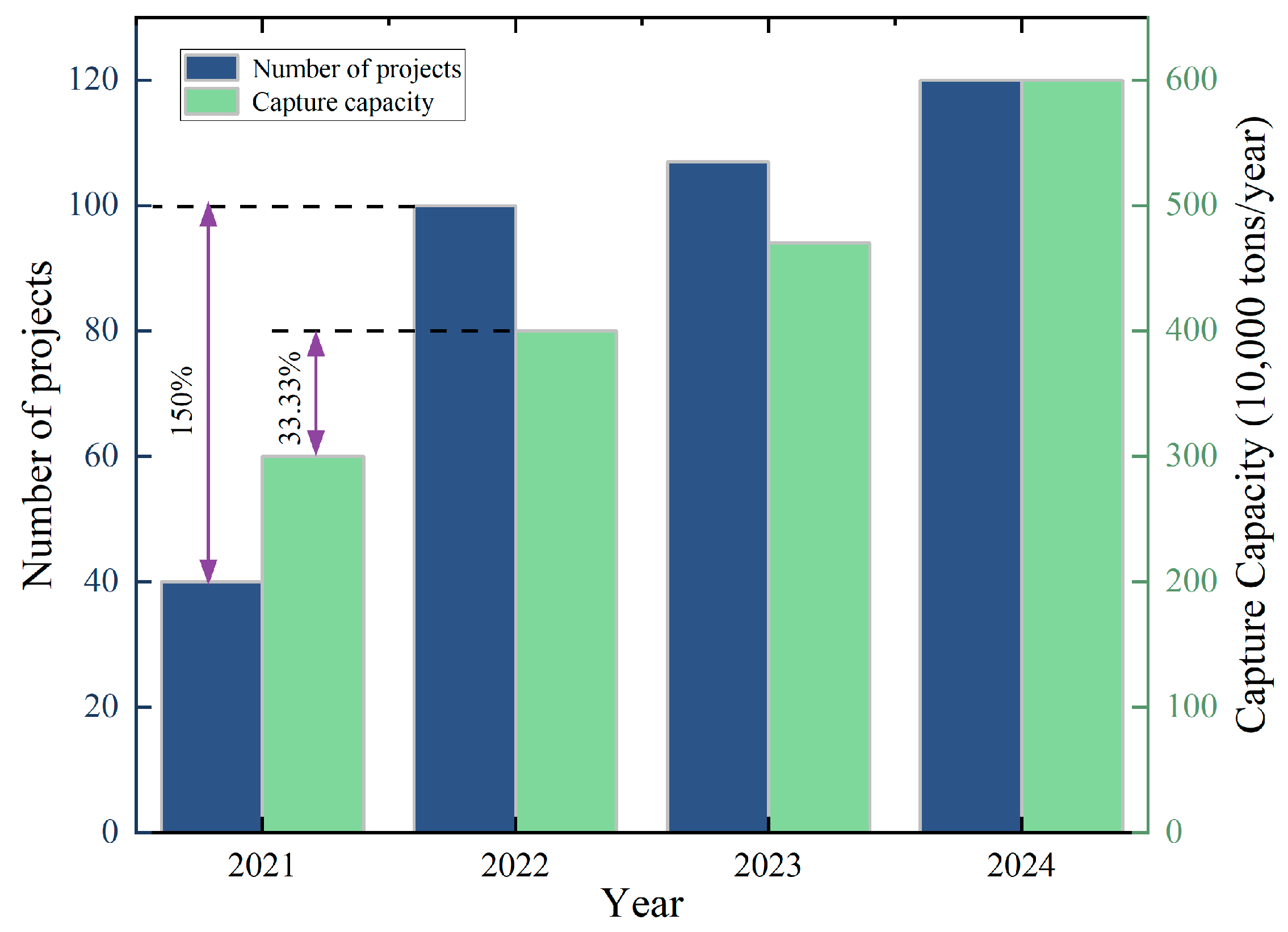
Although China initiated CCUS-EOR technology early, industrialization has lagged due to constraints such as gas supply limitations, insufficient understanding of mechanisms and equipment challenges. The technology is currently transitioning from engineering demonstration to commercial application [100]. Supported by China’s national “dual carbon” goals and a series of related policies, CCUS has achieved significant progress in engineering practice, with a continuous increase in project numbers. From 2021 to July 2024, the number of projects grew from approximately 40 to about 120, as shown in Figure 6. Project scales have surpassed the million-ton level, and the scope has expanded beyond enhanced oil recovery to include high-emission industries such as power generation, steel, and cement.
Currently, carbon capture technologies are accelerating their integration into industrial processes. Some relatively mature carbon capture technologies have achieved significant improvements in energy efficiency, with their large-scale application expanding further. Major breakthroughs have been made in the research and development of emerging carbon capture technologies. In 2023, the world’s largest chemical looping combustion carbon capture demonstration facility was completed, with a thermal power of 4 megawatts. The chemical looping combustion technology employed offers low cost and low energy consumption, with operating costs only one-third of traditional capture technologies [101]. Additionally, CO2 transportation technology is advancing toward larger scales and longer distances. The commissioning of a 100-kilometer CO2 pipeline and the planned construction of a 400-kilometer pipeline have significantly propelled the scaled development of China’s entire CCUS industry chain. Regarding enhanced oil recovery (EOR) technologies, addressing the complex lithology, high heterogeneity, and thin reservoir characteristics of China’s Continental sedimentary reservoirs, extensive technical research and field trials have established an engineering system tailored to these reservoir features [102].
Figure 6. Growth of China’s CCUS Projects and Carbon Capture Capacity, 2021–2024 [103].

4.2. Comparative Analysis of Key Characteristics of CO2-EOR in China and the United States

4.2.1. Comparison of Typical Project Parameters

Despite China’s significant progress in engineering demonstrations, substantial differences exist between its reservoirs and those in the United States in terms of geological endowment and development metrics when compared to mature commercial applications in the U.S. Table 4 summarizes key parameters for typical CO2-EOR projects in China and the U.S. regarding reservoir geology, fluid properties, and infrastructure.
Table 4. Key Parameter Comparison of Typical CO2-EOR Projects in China and the United States [67,84].
Table 4 reveals significant differences in resource endowment and development stages between China and the United States in CO2-EOR projects. These differences fundamentally determine the selection of technical pathways and the ultimate development outcomes.
Reservoir temperature and crude oil composition are key factors determining CO2 displacement mechanisms. Most U.S. reservoirs fall within the thermodynamically favorable range of “low-to-medium temperatures (<60 °C) and light crude oils,” readily meeting minimum miscible pressure (MMP) conditions to achieve highly efficient miscible displacement. In contrast, Chinese projects (such as Caoshe Oilfield) commonly face complex conditions characterized by “high temperatures (>100 °C)” and “high viscosity (>10 cP)”. The high-temperature environment significantly elevates crude oil MMP, making it difficult to achieve miscible conditions. Statistics indicate that in China’s Continental reservoirs, reservoirs with miscible pressures exceeding 25 MPa account for as high as 82.6% [104]. If China were to strictly adopt the U.S. selection criteria, only a small fraction of Chinese reservoirs would qualify as potential “miscible drive” reservoirs. Therefore, China primarily screens potential reservoirs for miscible drive implementation based on crude oil relative density, depth, and crude oil viscosity [105].
The Permian Basin in the United States is predominantly marine sedimentary, featuring good reservoir connectivity and relatively uniform permeability distribution. In contrast, China’s typical demonstration projects, influenced by Continental sedimentary environments, exhibit “dual-low” characteristics (low porosity and low permeability) alongside strong heterogeneity. The dense reservoir properties not only cause significant increases in injection pressure, limiting injection capacity, but also readily induce gas migration along high-permeability pathways. This severely hampers improvements in macro-scale sweep efficiency. Additionally, the crude oil contains high levels of asphaltene and gum, resulting in high viscosity. The fluidity ratio between CO2 and crude oil is far greater than 1, making viscous fingering highly likely and leading to low sweep efficiency.
To address these parameter differences, one approach involves developing chemical agents and flow control technologies that reduce MMP, thereby adapting to such challenging reservoir conditions. Another strategy involves modifying injection and production methods to suppress gas entrainment. Given the high minimum miscibility pressure in most Chinese reservoirs, the pursuit of “full miscibility” should be de-emphasized, with a focus instead on developing a “near-miscible flooding” technology system. Given the pronounced heterogeneity of Chinese reservoirs, large-scale CO2 continuous injection—common in the United States—is impractical. Consequently, WAG technology and its modified forms (e.g., surfactant-assisted WAG) are better suited for most heterogeneous sandstone reservoirs in China to enhance profile mobilization. Examples include the WAG applications in Caoshe and Yaoyingtai oilfields. Furthermore, considering that some Chinese oilfields (e.g., Changqing and certain Xinjiang blocks) are in the early stages of pipeline network development and feature fragmented blocks, CO2 flooding offers greater economic viability and flexibility during initial evaluation phases. It can serve as a transitional approach toward large-scale enhanced oil recovery.

4.2.2. Infrastructure and Economic Viability Comparison

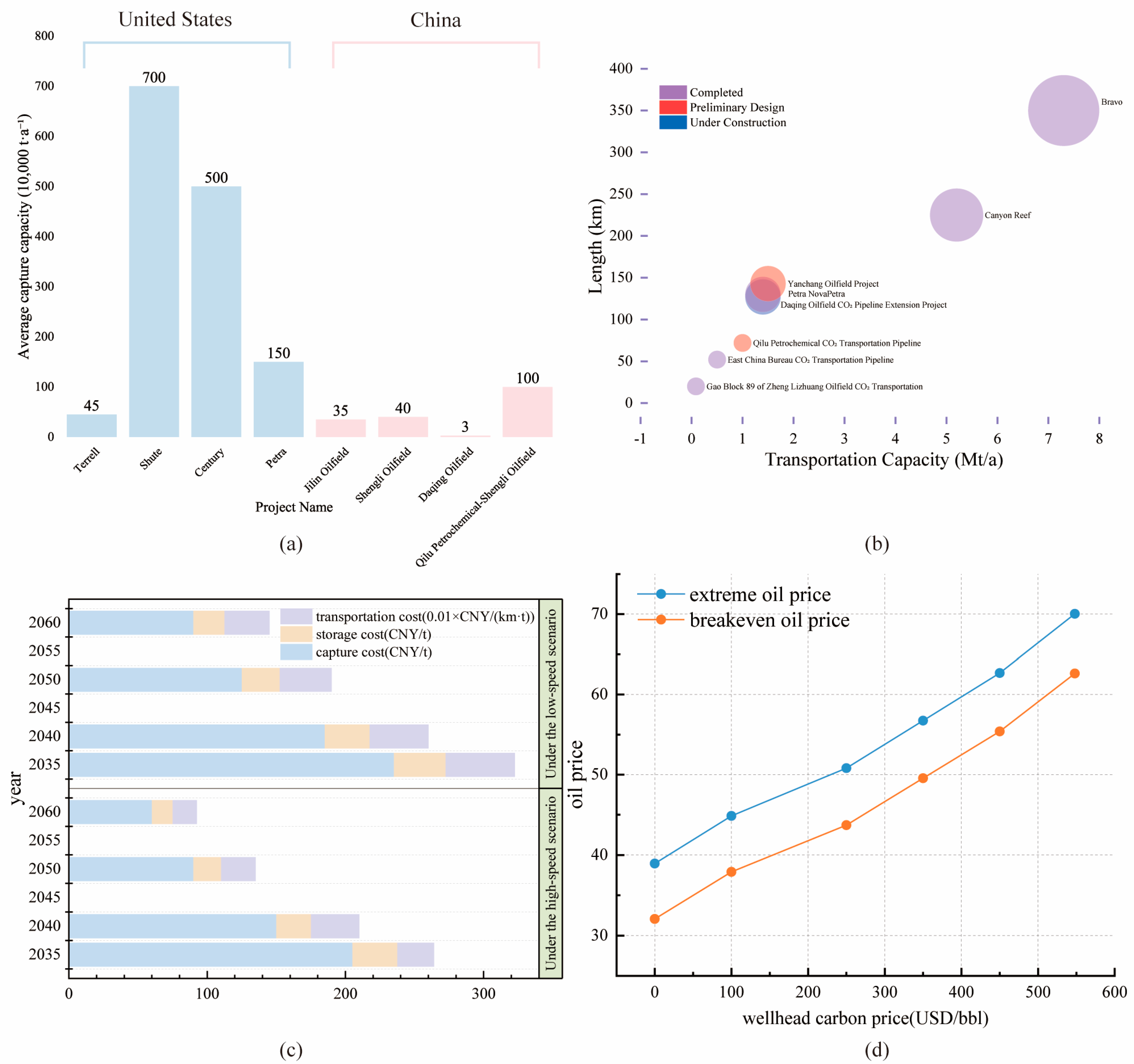
China’s CCUS-EOR holds immense potential. From 2018 to 2021, China’s average proven geological oil reserves stood at 13.3 × 10⁸ tons per annum, while its theoretical storage capacity ranges from 1.21 to 4.13 trillion tons. Additionally, China accounts for approximately 30% of global carbon emissions, presenting substantial reduction demands. To achieve the maximum annual emission reduction target of 654 million tons of CO2, over 17,000 km of CO2 transport pipelines would be required. To further reach the maximum annual reduction of 1.536 billion tons of CO2, an estimated 26,000 km of transport pipelines would need to be constructed [106]. This indicates that China must indeed invest heavily in constructing thousands of kilometers of pipeline networks, similar to the United States in the 1980s, while simultaneously enhancing project capture capabilities (as shown in Figure 7a,b).
Figure 7. (a): CO2 capture capacity of major CO2-EOR projects in China and the United States; (b): Length and transport capacity of typical CO2 pipelines in China and the United States; (c): Cost trends for each stage of CCUS under different scenarios from 2035 to 2060; (d): Changes in oil prices under different carbon prices [107,108,109,110].
Economically, unlike the United States with abundant low-cost natural CO2, China primarily relies on low-concentration industrial sources such as coal-fired power plants. Currently, the average capture cost in China’s thermal power sector ranges from 300 to 450 yuan per ton (approximately $40 to $60 per ton), and installing capture equipment increases power generation costs by about 60%. Spatial mismatch leads to high transportation costs: over 80% of China’s carbon sources are concentrated in the eastern coastal regions, while 90% of its storage potential (oil fields/saline aquifers) lies in the northwest. Currently, point-to-point tanker truck transportation is costly (approximately 0.5–0.6 yuan/(t·km)), keeping overall process costs elevated. Only by constructing regional pipeline networks, such as the “Ningxia-Changqing” or “Xinjiang” routes, can transportation costs be reduced to the pipeline-transportation level of 0.15–0.20 yuan/(t·km) [107].
Furthermore, constrained by the geological characteristics of Continental reservoirs—low porosity and low permeability—China struggles to replicate the high-profit model of single-well high productivity seen in the Permian Basin in the United States. Currently, the net emission reduction costs for China’s CCUS projects generally range between 300–700 yuan/ton. Only in a few demonstration projects, such as the Jilin Oilfield, has a critical break-even carbon price of approximately 236 yuan/t been achieved through full-industry-chain optimization. However, the logic driving this high-cost investment differs from that in the United States. While U.S. CCUS development is primarily driven by commercial profits from EOR, China’s development is dual-driven by the national “dual carbon” strategy and energy security. Although initial implementation relies on substantial infrastructure investment, capture and transportation costs are projected to decline significantly by 2060 as economies of scale take effect (as shown in Figure 7c). Therefore, even if single-well production and economic returns cannot match U.S. levels in the short term, cultivating the industrial chain and sharing infrastructure costs through EOR projects remains an essential pathway for China to achieve its carbon neutrality goals.

4.2.3. Policy Incentive Mechanisms and Oil Price Sensitivity Analysis

The fundamental difference in the commercial logic of CCUS-EOR between China and the United States stems from how policy tool combinations reshape project economics. Based on the latest quantitative research on international policy frameworks and economic assessments of typical projects, the underlying mechanisms of this divergence can be revealed. Currently, global CCUS policy frameworks are evolving toward prioritizing economic incentives. Xie Xiaoyu et al. (2025) [111] conducted a panel regression analysis using global data from 1970 to 2024, demonstrating that among various policy instruments, economic incentive policies exert the most significant effect on project implementation. This impact far exceeds that of legislative regulation and national strategies. The United States has established an incentive system centered on the “45Q tax credit,” with the latest amendment raising EOR sequestration subsidies to $60/t and geological sequestration to $85/t. Canada has legislated an Investment Tax Credit (ITC), offering up to 60% tax credits for DAC projects and 50% for the CCUS capture phase. In contrast, China’s current policy framework primarily consists of national strategy documents (plans, roadmaps). Although multiple plans have been issued under the “1 + N” policy system, no comprehensive, universal fiscal and tax incentive policies covering the entire process have been introduced. The absence of economic incentives results in insufficient direct driving force for market entities.
The lack of economic incentives directly resulted in Chinese projects being extremely sensitive to oil price fluctuations. Yang Junfeng et al. (2025) [108] used an economic evaluation model to calculate the relationship between different wellhead carbon prices and break-even oil prices (as shown in Figure 7d). When the wellhead carbon price (including capture and transportation costs) is approximately 450 yuan/ton, the marginal break-even oil price for CCUS-EOR projects reaches as high as $62.68/barrel, rendering them unsustainable under normal oil price conditions. However, under a scenario introducing subsidies simulating the intensity of the U.S. 45Q program (reducing the wellhead carbon price to 0 yuan/ton), the project’s marginal oil price can be significantly lowered to $38.93/barrel. Relying solely on national strategies is insufficient to drive large-scale CCUS commercialization. A hybrid incentive mechanism combining “financial subsidies and tax credits” is key to overcoming cost barriers.

4.3. Challenges Faced

Despite significant progress in China’s CCUS-EOR technology, numerous challenges remain for achieving large-scale commercial application.
A stable and affordable CO2 gas supply is critical for advancing CCUS-EOR technology. Early U.S. efforts relied on CO2 from natural gas reservoirs to sustain large-scale CO2 enhanced oil recovery projects. However, natural CO2 struggles to meet emission reduction targets, and its scarcity has become increasingly evident as reserves are depleted. Consequently, the U.S. has progressively increased its reliance on industrial CO2. Compared to the high-concentration industrial CO2 sources in the U.S., CO2 emissions from China’s power plants, steel mills, and cement factories generally have lower concentrations and contain more impurities like sulfur and nitrogen oxides. Currently, high-concentration CO2 capture technology is relatively mature and cost-effective, but low-concentration CO2 capture technology is still in its developmental stage, with higher costs and energy consumption. Some emerging capture technologies can achieve negative emissions, but their high costs constrain commercial application. There is an urgent need to coordinate technological innovation, large-scale demonstration projects, and business model innovation to reduce costs and transition from policy-driven to market-driven implementation.
The lagging transportation infrastructure and spatial mismatch pose another challenge for CCUS-EOR technology. Currently, most CCUS projects still rely primarily on road tanker trucks for transportation, resulting in low efficiency and high costs. China’s carbon sources mainly originate from high-energy-consuming factories in the eastern coastal regions, while CO2 sequestration reservoirs are concentrated in Northeast, Northwest, and Southwest regions. This spatial mismatch between sources and sinks significantly increases road tanker transportation costs, undermining project economics. The United States began large-scale construction of CO2 pipeline infrastructure in the 1980s, now operating over 50 independent CO2 transport pipelines with a combined network exceeding 7200 km. To meet global carbon emission targets, North America’s pipeline network is projected to reach 43,000 km by 2025 [106]. In contrast, China’s first CO2 pipeline capable of transporting over 100 km only commenced operations in 2023, with pipeline network development still in its infancy. This has become a critical bottleneck constraining the development of the entire CCUS industry chain. Therefore, establishing a cross-regional CCUS pipeline network represents a major challenge for China today.
China’s reservoirs are predominantly Continental sedimentary formations characterized by strong heterogeneity, low permeability, and low light hydrocarbon content in crude oil. Existing enhanced oil recovery (EOR) technologies face adaptability and compatibility issues in such reservoirs, struggling to achieve ideal miscible effects and encountering technical hurdles in enhancing recovery rates. Furthermore, the high cost of low-concentration CO2 purification technology, coupled with insufficient field-testing of low-concentration mixed-gas EOR and inadequate research on the migration patterns of multi-component gases within reservoirs, hinders the efficient utilization of low-concentration gas sources. The pronounced heterogeneity of Continental sedimentary reservoirs exacerbates issues such as CO2 gas migration, limited flooding volume, and low flooding efficiency, resulting in production increases that fall short of project expectations.
Methods for evaluating storage potential and long-term safety monitoring systems require further refinement. Although China possesses extensive oil and gas reservoirs and saline aquifers that provide favorable storage sites for CO2, geological storage potential assessment methods have primarily been developed by adapting models established in North America to the specific conditions of domestic oilfields [112,113,114,115]. Most evaluation methods are constructed based on material balance theory and volume balance theory after considering structural traps, residual traps, and dissolution traps. There is a lack of more precise, efficient, and standardized methods for evaluating storage potential. Furthermore, there is a shortage of extensive reservoir data and understanding of coefficients in relevant storage capacity calculation formulas [116], making it difficult to meet the precise assessment requirements for complex reservoirs. The safety and monitoring system (MRV) for long-term storage has not undergone large-scale validation. There is a lack of long-term liability attribution, cross-regional regulatory frameworks, and standardized systems, necessitating breakthroughs in technological demonstration, legal regulations, and institutional innovation.
Compared to North America, which possesses extensive CCUS application experience, China’s relevant policies require refinement and business models remain underdeveloped. Due to high costs and low returns, CCUS projects struggle to generate economic benefits, with some projects yet to commence formal operations [117]. Currently, the primary revenue source for domestic CCUS projects is enhanced oil recovery (EOR) using CO2. However, this revenue is influenced by oil prices and reservoir geological conditions. For reservoirs with complex geology, CO2-EOR struggles to achieve significant production increases. Volatile oil prices create substantial uncertainty in the profitability of CCUS-EOR projects, posing major challenges to scaling up the technology through market mechanisms alone.

4.4. Outlook

China’s CCUS-EOR technology still lags behind international standards. Drawing on global technical expertise while adapting to domestic conditions, and propelled by the “dual carbon” policy, CCUS-EOR is poised to enter a new phase of rapid, large-scale development. To address these challenges, it is imperative not to simply replicate the North American model. Instead, there is an urgent need to establish a comprehensive theoretical and technical standards system for the entire industrial chain that is tailored to China’s context, encompassing technological innovation, infrastructure development, and policy incentives.
Focusing on technological innovations such as low-cost capture and mobility control is the core driver. Future efforts must accelerate the transition of CO2 capture technology from high-concentration to medium- and low-concentration applications, focusing on developing efficient and low-cost separation methods while overcoming bottlenecks in large-scale production to meet the commercialization demands of CCUS-EOR technology [100,118]. Oil and gas companies must also continuously enhance industrial CO2 supply, strengthen collaboration with high-carbon-emission enterprises such as refining, coal-fired power generation, and coal chemical industries to ensure stable and reliable gas sources [119]. According to break-even analysis, subsequent efforts should focus on reducing the CO2 capture cost of low-concentration industrial flue gas to approximately 200 yuan/ton to meet commercial application requirements. Regarding oil displacement technologies, given the characteristics of China’s continental sedimentary reservoirs—high temperature, high crude oil viscosity, and strong reservoir heterogeneity—achieving miscible displacement poses substantial challenges. Thus, priority should be given to near-miscible displacement. Additionally, innovative mobility control technologies must be developed to expand the swept volume under conditions where miscible displacement is unfeasible. Concurrently, key supporting technologies such as well spacing optimization, water-alternating-gas (WAG) injection, and corrosion-inhibited injection-production processes should be refined.
Accelerating industrial clustering and infrastructure sharing is key to reducing transportation costs. Although multiple pipelines spanning hundreds of kilometers are currently under construction, China will ultimately need to build a dedicated CO2 pipeline network exceeding 17,000 km in total length to support the annual emission reduction demand of 654 million tons. It is recommended to prioritize establishing industrial clusters in regions with high source-sink matching potential, such as Xinjiang and Ordos. By sharing infrastructure, transportation costs can be reduced from the current road transport level to 0.15–0.20 yuan/(t·km). Concurrently, establish parallel evaluation methods for the storage capacity of oil and gas reservoirs and deep saline aquifers at the same stratum level. Utilize multi-field coupled numerical simulation to optimize storage solutions and develop dynamic monitoring technologies to mitigate leakage risks.
China’s CO2 emissions far exceed its sequestration capacity, indicating immense potential for CCUS development. However, commercial application remains constrained by high costs. Government policy incentives are crucial, drawing inspiration from the U.S. Section 45Q tax credit policy to transition from “investment subsidies” to “operational subsidies.” Differentiated subsidy standards should be established for CCUS-EOR projects to bridge the gap between current high capture costs and oilfield affordability. Concurrently, carbon pricing mechanisms and CCUS regulations must be refined—particularly by establishing clear long-term liability transfer and risk response protocols. Expanding industry coverage, introducing diverse trading entities, and discovering effective carbon prices will incentivize societal-wide emissions reduction. Active international cooperation should leverage mature foreign technologies while mitigating potential risks.
In the future, with strengthened policy support, accelerated technological innovation, and deepened industrial coordination, China will continue to build a complete and efficient CCUS industrial chain, providing crucial support for achieving the dual carbon goals.

5. Conclusions

(1) Carbon capture, utilization, and storage (CCUS) is an indispensable technology for supporting global carbon neutrality goals. Among its applications, CCUS-enhanced oil recovery (EOR) has emerged as a key pathway for large-scale deployment due to its dual potential for emissions reduction and economic viability.
(2) Quantitative analysis of 148 representative projects indicates that the commercial success of North American CCUS-EOR relies on a specific resource combination: natural/high-purity gas sources + mature pipeline networks + easily miscible marine reservoirs. Its technological evolution has shifted from early-stage pure oil displacement to focusing on flow control, displacement profile enhancement, and full-lifecycle monitoring—aiming to resolve the synergy between long-term sequestration and efficient oil recovery. Comparative studies reveal fundamental differences in engineering boundary conditions between China and the United States: North American CO2-based displacement primarily targets mixed-phase drive in medium-to-low temperature, light-grade reservoirs, whereas China’s Continental reservoirs commonly face challenges of “strong heterogeneity, high viscosity, high mixed-phase pressure,” and spatial mismatch between sources and sinks.
(3) Given these differences, China’s CCUS-EOR development cannot simply replicate the U.S. model. Moving forward, China should establish a differentiated full-industry-chain system tailored to its Continental sedimentary characteristics. To address the challenge of achieving miscibility in continental sedimentary reservoirs, research should focus on near-miscible/immiscible flooding and Mobility Control Technology. For low-concentration gas sources, breakthroughs in low-cost capture materials are essential. Furthermore, drawing lessons from the Permian Basin experience, infrastructure sharing and industrial cluster development should be prioritized in regions with high source-sink compatibility (e.g., Xinjiang, Ordos Basin) to reduce transportation costs. Referencing the U.S. 45Q experience while adapting to China’s national conditions, research should explore establishing incentive mechanisms transitioning from “investment subsidies” to “operational subsidies,” and clarify long-term storage responsibility boundaries to facilitate the leap from engineering demonstration to commercial application.

Funding

This research was supported by the National Major Projects for Oil and Gas (2024ZD1406602) and the Major Project of EOR of PetroChina (2023ZZ04).

Data Availability Statement

No new data were created or analyzed in this study.

Conflicts of Interest

Authors Ming Gao and Hongwei Yu were employed by the China National Petroleum Corporation. The remaining authors declare that the research was conducted in the absence of any commercial or financial relationships that could be construed as a potential conflict of interest. The authors declare that this study received funding from PetroChina. The funder was not involved in the study design, collection, analysis, interpretation of data, the writing of this article or the decision to submit it for publication.

Abbreviations

The following abbreviations are used in this manuscript:
CCUSCarbon capture, utilization, and storage
EOREnhanced oil recovery
DACdirect air capture

References

  1. Hurlbert, M.; Osazuwa-Peters, M. Carbon Capture and Storage in Saskatchewan: An Analysis of Communicative Practices in a Contested Technology. Renew. Sustain. Energy Rev. 2023, 173, 113104. [Google Scholar] [CrossRef]
  2. Yu, G.; Hao, T.; Zhu, J. Discussion on Action Strategies of China’s Carbon Peak and Carbon Neutrality. Bull. Chin. Acad. Sci. 2022, 37, 423–434. [Google Scholar]
  3. Intergovernmental Panel on Climate Change (IPCC). Special Report on the Ocean and Cryosphere in a Changing Climate. Available online: https://www.ipcc.ch/srocc/ (accessed on 20 July 2025).
  4. Jacoby, H. The Paris Agreement|MIT Climate Portal. Available online: https://climate.mit.edu/explainers/paris-agreement (accessed on 20 July 2025).
  5. IEA—International Energy Agency. Available online: https://www.iea.org (accessed on 20 July 2025).
  6. Climate Change 2022: Mitigation of Climate Change; Shukla, P.R., Skea, J., Reisinger, A.R., IPCC, Eds.; IPCC: Geneva, Switzerland, 2022; Volume 17, ISBN 978-92-9169-160-9. [Google Scholar]
  7. Fam, A.; Fam, S. Review of the US 2050 Long Term Strategy to Reach Net Zero Carbon Emissions. Energy Rep. 2024, 12, 845–860. [Google Scholar] [CrossRef]
  8. Paltsev, S.; Morris, J.; Kheshgi, H.; Herzog, H. Hard-to-Abate Sectors: The Role of Industrial Carbon Capture and Storage (CCS) in Emission Mitigation. Appl. Energy 2021, 300, 117322. [Google Scholar] [CrossRef]
  9. Langston, M.V.; Hoadley, S.F.; Young, D.N. Definitive CO2 Flooding Response in the SACROC Unit. In Proceedings of the SPE/DOE Enhanced Oil Recovery Symposium, Tulsa, Oklahoma, 17–20 April 1988; OnePetro: Richardson, TX, USA, 1988. [Google Scholar]
  10. Miao, L.; Feng, L.; Ma, Y. Comprehensive Evaluation of CCUS Technology: A Case Study of China’s First Million-Tonne CCUS-EOR Project. Environ. Impact Assess. Rev. 2025, 110, 107684. [Google Scholar] [CrossRef]
  11. Li, X.-Y.; Gao, X.; Xie, J.-J. Comparison and Clarification of China and US CCUS Technology Development. Atmosphere 2022, 13, 2114. [Google Scholar] [CrossRef]
  12. Edmonds, J.; Nichols, C.; Adamantiades, M.; Bistline, J.; Huster, J.; Iyer, G.; Johnson, N.; Patel, P.; Showalter, S.; Victor, N.; et al. Could Congressionally Mandated Incentives Lead to Deployment of Large-Scale CO2 Capture, Facilities for Enhanced Oil Recovery CO2 Markets and Geologic CO2 Storage? Energy Policy 2020, 146, 111775. [Google Scholar] [CrossRef]
  13. Dindi, A.; Coddington, K.; Garofalo, J.F.; Wu, W.; Zhai, H. Policy-Driven Potential for Deploying Carbon Capture and Sequestration in a Fossil-Rich Power Sector. Environ. Sci. Technol. 2022, 56, 9872–9881. [Google Scholar] [CrossRef]
  14. Xiao, T.; Chen, T.; Ma, Z.; Tian, H.; Meguerdijian, S.; Chen, B.; Pawar, R.; Huang, L.; Xu, T.; Cather, M.; et al. A Review of Risk and Uncertainty Assessment for Geologic Carbon Storage. Renew. Sustain. Energy Rev. 2024, 189, 113945. [Google Scholar] [CrossRef]
  15. Lau, H.C.; Ramakrishna, S.; Zhang, K.; Radhamani, A.V. The Role of Carbon Capture and Storage in the Energy Transition. Energy Fuels 2021, 35, 7364–7386. [Google Scholar] [CrossRef]
  16. Qin, J.; Han, H.; Liu, X. Application and Enlightenment of Carbon Dioxide Flooding in the United States of America. Pet. Explor. Dev. 2015, 42, 232–240. [Google Scholar] [CrossRef]
  17. Davoodi, S.; Vo Thanh, H.; Wood, D.A.; Mehrad, M.; Rukavishnikov, V.S.; Dai, Z. Machine-Learning Predictions of Solubility and Residual Trapping Indexes of Carbon Dioxide from Global Geological Storage Sites. Expert. Syst. Appl. 2023, 222, 119796. [Google Scholar] [CrossRef]
  18. Harvey, C.; House, K. Every Dollar Spent on This Climate Technology Is a Waste. The New York Times. 16 August 2022. Available online: https://www.nytimes.com/2022/08/16/opinion/climate-inflation-reduction-act.html (accessed on 16 August 2025).
  19. Zhang, Z.; Pan, S.-Y.; Li, H.; Cai, J.; Olabi, A.G.; Anthony, E.J.; Manovic, V. Recent Advances in Carbon Dioxide Utilization. Renew. Sustain. Energy Rev. 2020, 125, 109799. [Google Scholar] [CrossRef]
  20. Yao, J.; Han, H.; Yang, Y.; Song, Y.; Li, G. A Review of Recent Progress of Carbon Capture, Utilization, and Storage (CCUS) in China. Appl. Sci. 2023, 13, 1169. [Google Scholar] [CrossRef]
  21. Song, C.; Liu, Q.; Deng, S.; Li, H.; Kitamura, Y. Cryogenic-Based CO2 Capture Technologies: State-of-the-Art Developments and Current Challenges. Renew. Sustain. Energy Rev. 2019, 101, 265–278. [Google Scholar] [CrossRef]
  22. Al-Shargabi, M.; Davoodi, S.; Wood, D.A.; Rukavishnikov, V.S.; Minaev, K.M. Carbon Dioxide Applications for Enhanced Oil Recovery Assisted by Nanoparticles: Recent Developments. ACS Omega 2022, 7, 9984–9994. [Google Scholar] [CrossRef] [PubMed]
  23. Zhang, S.; Shen, Y.; Zheng, C.; Xu, Q.; Sun, Y.; Huang, M.; Li, L.; Yang, X.; Zhou, H.; Ma, H.; et al. Recent Advances, Challenges, and Perspectives on Carbon Capture. Front. Environ. Sci. Eng. 2024, 18, 75. [Google Scholar] [CrossRef]
  24. Ming, Z.; Shaojie, O.; Yingjie, Z.; Hui, S. CCS Technology Development in China: Status, Problems and Countermeasures—Based on SWOT Analysis. Renew. Sustain. Energy Rev. 2014, 39, 604–616. [Google Scholar] [CrossRef]
  25. Nazir, S.M.; Cloete, J.H.; Cloete, S.; Amini, S. Efficient Hydrogen Production with CO2 Capture Using Gas Switching Reforming. Energy 2019, 185, 372–385. [Google Scholar] [CrossRef]
  26. Chao, C.; Deng, Y.; Dewil, R.; Baeyens, J.; Fan, X. Post-Combustion Carbon Capture. Renew. Sustain. Energy Rev. 2021, 138, 110490. [Google Scholar] [CrossRef]
  27. Guo, Y.; Luo, L.; Liu, T.; Hao, L.; Li, Y.; Liu, P.; Zhu, T. A Review of Low-Carbon Technologies and Projects for the Global Cement Industry. J. Environ. Sci. 2024, 136, 682–697. [Google Scholar] [CrossRef] [PubMed]
  28. Ma, C.; Li, B.; Chen, D.; Wenga, T.; Ma, W.; Lin, F.; Chen, G. An Investigation of an Oxygen-Enriched Combustion of Municipal Solid Waste on Flue Gas Emission and Combustion Performance at a 8 MWth Waste-to-Energy Plant. Waste Manag. 2019, 96, 47–56. [Google Scholar] [CrossRef] [PubMed]
  29. Adamczyk, W.P.; Bialecki, R.A.; Ditaranto, M.; Gladysz, P.; Haugen, N.E.L.; Katelbach-Wozniak, A.; Klimanek, A.; Sladek, S.; Szlek, A.; Wecel, G. CFD Modeling and Thermodynamic Analysis of a Concept of a MILD-OXY Combustion Large Scale Pulverized Coal Boiler. Energy 2017, 140, 1305–1315. [Google Scholar] [CrossRef]
  30. Wilberforce, T.; Olabi, A.G.; Sayed, E.T.; Elsaid, K.; Abdelkareem, M.A. Progress in Carbon Capture Technologies. Sci. Total Environ. 2021, 761, 143203. [Google Scholar] [CrossRef]
  31. Osman, A.I.; Hefny, M.; Abdel Maksoud, M.I.A.; Elgarahy, A.M.; Rooney, D.W. Recent Advances in Carbon Capture Storage and Utilisation Technologies: A Review. Env. Chem. Lett. 2021, 19, 797–849. [Google Scholar] [CrossRef]
  32. Zhang, J.; Guo, W.; Zhang, B.; Zhang, R.; Yang, B.; Wu, Z. Research Progress on Direct Air Capture of CO2 Technology. Clean Coal Technol. 2021, 27, 57–68. [Google Scholar] [CrossRef]
  33. Barahimi, V.; Ho, M.; Croiset, E. From Lab to Fab: Development and Deployment of Direct Air Capture of CO2. Energies 2023, 16, 6385. [Google Scholar] [CrossRef]
  34. Wu, X.; Krishnamoorti, R.; Bollini, P. Technological Options for Direct Air Capture: A Comparative Process Engineering Review. Annu. Rev. Chem. Biomol. Eng. 2022, 13, 279–300. [Google Scholar] [CrossRef]
  35. McQueen, N.; Gomes, K.V.; McCormick, C.; Blumanthal, K.; Pisciotta, M.; Wilcox, J. A Review of Direct Air Capture (DAC): Scaling up Commercial Technologies and Innovating for the Future. Prog. Energy 2021, 3, 032001. [Google Scholar] [CrossRef]
  36. Zhang, Y.; Xiong, X.; Zhou, Y.; Wei, P.; Tan, H. Research Progress on CO2 Capture, Utilization and Storage Technology. J. China Coal Soc. 2024, 50, 515–533. [Google Scholar] [CrossRef]
  37. Nakao, S.; Yogo, K.; Goto, K.; Kai, T.; Yamada, H. Advanced CO2 Capture Technologies: Absorption, Adsorption, and Membrane Separation Methods; Springer Briefs in Energy; Springer International Publishing: Cham, Switzerland, 2019; ISBN 978-3-030-18857-3. [Google Scholar]
  38. Qazvini, O.T.; Babarao, R.; Telfer, S.G. Selective Capture of Carbon Dioxide from Hydrocarbons Using a Metal-Organic Framework. Nat. Commun. 2021, 12, 197. [Google Scholar] [CrossRef]
  39. Gong, Y.; Song, W.; Yang, P. Current Status and Application Prospects of CCUS Technology-Sci-Tech Innovation for Sustainable Development Research Institute. Available online: https://sisd.org.cn/express/express598.html (accessed on 1 July 2025).
  40. Wang, P.; Li, Y.; Sun, N.; Han, S.; Wang, X.; Su, Q.; Li, Y.; He, J.; Yu, X.; Du, S.; et al. Hydrate Technologies for CO2 Capture and Sequestration: Status and Perspectives. Chem. Rev. 2024, 124, 10363–10385. [Google Scholar] [CrossRef] [PubMed]
  41. Bui, M.; Adjiman, C.S.; Bardow, A.; Anthony, E.J.; Boston, A.; Brown, S.; Fennell, P.S.; Fuss, S.; Galindo, A.; Hackett, L.A.; et al. Carbon Capture and Storage (CCS): The Way Forward. Energy Environ. Sci. 2018, 11, 1062–1176. [Google Scholar] [CrossRef]
  42. Omodolor, I.S.; Otor, H.O.; Andonegui, J.A.; Allen, B.J.; Alba-Rubio, A.C. Dual-Function Materials for CO2 Capture and Conversion: A Review. Ind. Eng. Chem. Res. 2020, 59, 17612–17631. [Google Scholar] [CrossRef]
  43. Osman, A.I.; Deka, T.J.; Baruah, D.C.; Rooney, D.W. Critical Challenges in Biohydrogen Production Processes from the Organic Feedstocks. Biomass Conv. Bioref. 2023, 13, 8383–8401. [Google Scholar] [CrossRef]
  44. Elhenawy, S.E.M.; Khraisheh, M.; AlMomani, F.; Walker, G. Metal-Organic Frameworks as a Platform for CO2 Capture and Chemical Processes: Adsorption, Membrane Separation, Catalytic-Conversion, and Electrochemical Reduction of CO2. Catalysts 2020, 10, 1293. [Google Scholar] [CrossRef]
  45. Davoodi, S.; Al-Shargabi, M.; Wood, D.A.; Rukavishnikov, V.S.; Minaev, K.M. Review of Technological Progress in Carbon Dioxide Capture, Storage, and Utilization. Gas. Sci. Eng. 2023, 117, 205070. [Google Scholar] [CrossRef]
  46. Olajire, A.A. CO2 Capture and Separation Technologies for End-of-Pipe Applications–A Review. Energy 2010, 35, 2610–2628. [Google Scholar] [CrossRef]
  47. Xiang, Y.; Hou, L.; Du, M.; Jia, N.; Lü, W. Research Progress and Development Prospect of CCUS-EOR Technology in China. Pet. Geol. Recovery Effic. 2023, 30, 1–17. [Google Scholar] [CrossRef]
  48. Xiang, Y.; Xie, W.; Ni, S.; He, X. Comparative Study of A106 Steel Corrosion in Fresh and Dirty MEA Solutions during the CO2 Capture Process: Effect of NO3. Corros. Sci. 2020, 167, 108521. [Google Scholar] [CrossRef]
  49. Li, X.; Liu, Y.; Zhu, Z.; Zhang, X. Progress in the Application of Mixed Matrix Membranes in CO2/CH4 Separation. Polym. Mater. Sci. Eng. 2025, 41, 153–162. [Google Scholar] [CrossRef]
  50. Simonsen, K.R.; Hansen, D.S.; Pedersen, S. Challenges in CO2 Transportation: Trends and Perspectives. Renew. Sustain. Energy Rev. 2024, 191, 114149. [Google Scholar] [CrossRef]
  51. Welsh Government. A Carbon Capture, Utilisation, and Storage Network for Wales. Available online: https://www.gov.wales/carbon-capture-utilisation-and-storage-network-wales-report (accessed on 2 September 2025).
  52. Enhance Energy; Wolf Midstream. Enhance Energy and Wolf Midstream Sign Agreement to Finance and Construct the Alberta Carbon Trunk Line. Wolf Midstream. 2 August 2018. Available online: https://www.wolfmidstream.com/enhance-energy-and-wolf-midstream-sign-agreement-to-finance-and-construct-the-alberta-carbon-trunk-line/ (accessed on 2 September 2025).
  53. Wang, Y.; Cao, X.; Pang, S. China’s Longest Carbon Dioxide Pipeline Put Into Operation. Science and Technology Daily. 12 July 2023, p. 1. Available online: https://kns.cnki.net/kcms2/article/abstract?v=fvaKTeWl6eJ24EByPpFGIW_tn_k9IP3oN9VdPRlAGG4RBVjmkfYpcJV_3MFuM2knsGWWo-4p5pHmvJqjWspL4EqhfTqyb-74eu47ajKRyMwTPZtZu3KF74m4-kWiqfS4Wye3pkctHNvnsKOZ5eDc3OcxFwuLuxATLJRaAxcxWa3ui9N2zbd_ex82fugmaWm7&amp;uniplatform=NZKPT&amp;language=CHS (accessed on 30 November 2025). (In Chinese) [CrossRef]
  54. Wilkes, M.D.; Mukherjee, S.; Brown, S. Linking CO2 Capture and Pipeline Transportation: Sensitivity Analysis and Dynamic Study of the Compression Train. Int. J. Greenh. Gas. Control 2021, 111, 103449. [Google Scholar] [CrossRef]
  55. Leitner, W.; Franciò, G.; Scott, M.; Westhues, C.; Langanke, J.; Lansing, M.; Hussong, C.; Erdkamp, E. Carbon2Polymer–Chemical Utilization of CO2 in the Production of Isocyanates. Chem. Ing. Tech. 2018, 90, 1504–1512. [Google Scholar] [CrossRef]
  56. Zhang, L.; Wang, Y.; Miao, X.; Gan, M.; Li, X. Geochemistry in Geologic CO2 Utilization and Storage: A Brief Review. Adv. Geo-Energ. Res. 2019, 3, 304–313. [Google Scholar] [CrossRef]
  57. Gao, M.; Sun, Y.; Yin, H.; Liu, W. Progress and Prospect of Carbon Dioxide Capture, Oil Displacement and Storage Technology. Pet. Sci. Technol. Forum 2024, 43, 58–65. Available online: https://kns.cnki.net/kcms2/article/abstract?v=UsPV4INcYzjW0Iau1WsIJo3lsMWTzq5AE-80I5xYiBC4-4CklZ_a_sOXZqja28WSGkq9gr15T9oCpx4nDJcctQda1AAxU0TKSaQ2JecZCW4Q5vfgdYVD4DbD82WbK1IaYznHSa3aF4pdhpFZ_V0RkNaOMeLkvlWt-8pOeBksdq5QcgJE47gu3g==&uniplatform=NZKPT&language=CHS (accessed on 30 November 2025). (In Chinese).
  58. Hao, M.; Song, Y. Research Status of CO2 Enhanced Oil Recovery Technology. Drill. Prod. Technol. 2010, 33, 59–63. Available online: https://kns.cnki.net/kcms2/article/abstract?v=UsPV4INcYziM-8OSD0CUbfTjxEU2FeRNBRmAZhrYhfkQt3hf-i_7sZ1i5-hdqXTaZunB-CNCWmeGrAx3I1KDyttMiVNh48Y3LxDyryuqULlPFkDVstmD_oDHR40PUrRtz6hop5p8xwBftZzzlkje5sW52RXqW4WE19MNUtIZ_4LjNzBGnz5UBg==&uniplatform=NZKPT&language=CHS (accessed on 30 November 2025). (In Chinese).
  59. Tan, F.; Jiang, R.; Ma, C.; Jing, Y.; Chen, K.; Lu, Y. CO2 Oil Displacement and Geological Storage Status and Prospects. Energy Sci. Eng. 2025, 13, 475–511. [Google Scholar] [CrossRef]
  60. Song, X.; Wang, F.; Ma, D.; Gao, M.; Zhang, Y. Progress and Prospect of Carbon Dioxide Capture, Oil Displacement and Storage Technology in PetroChina. Pet. Explor. Dev. 2023, 50, 206–218. [Google Scholar] [CrossRef]
  61. Zhou, X.; Jiang, Q.; Yuan, Q.; Zhang, L.; Feng, J.; Chu, B.; Zeng, F.; Zhu, G. Determining CO2 Diffusion Coefficient in Heavy Oil in Bulk Phase and in Porous Media Using Experimental and Mathematical Modeling Methods. Fuel 2020, 263, 116205. [Google Scholar] [CrossRef]
  62. Liang, M.; Yuan, H.; Yang, Y.; Lin, J.; Yang, Y. A review on the mechanism of CO2 in the process of oil displacement. Petrochem. Ind. Appl. 2016, 35, 1–5. Available online: https://kns.cnki.net/kcms2/article/abstract?v=UsPV4INcYzh8rSe_UVxOQoFkXbmNhxhXQq_04kjsCGKVPAsPEyh7kea3Fxg60Dm8Mc_UtZYiixIxEYgb0DGhXK87vLFZIwIEm5p9FZqQGj-9PUMRa-LBxcnYkP5PSFDTP0Cfp3AFqY0UcbIHJSMkh0jGKtYSQkklEg0zPvAIh9VpY3sYx8ODcQ==&uniplatform=NZKPT&language=CHS (accessed on 30 November 2025). (In Chinese).
  63. Zhang, X.; Li, B.; Wang, X.; Yang, G. Numerical Simulation Study on Mechanism and Development Effect of Near-Miscible Displacement with Non-Pure CO2. China Offshore Oil Gas 2020, 32, 77–81. Available online: https://kns.cnki.net/kcms2/article/abstract?v=UsPV4INcYzgdiJcbde6X6gKsly_hYgPfJLfoPH9bTlu5pbEuoesw6MR8nZJ7msMePsXSCStpzo73FS4nSDqF9TL5B30rpDr1aVMWtKjmL1XpMeY5gs3-7-AmmZGz9kCPdd9gL87gu7fv3Cpy8R74YrWjAwsOLRaJG-B-kZdSZ4VcNk-SMfM1DQ==&uniplatform=NZKPT&language=CHS (accessed on 30 November 2025). (In Chinese).
  64. Zhang, Y.-Q.; Yang, S.-L.; Bi, L.-F.; Gao, X.-Y.; Shen, B.; Hu, J.-T.; Luo, Y.; Zhao, Y.; Chen, H.; Li, J. A Technical Review of CO2 Flooding Sweep-Characteristics Research Advance and Sweep-Extend Technology. Pet. Sci. 2025, 22, 255–276. [Google Scholar] [CrossRef]
  65. Yang, Q.; Liang, J.; Tuo, L. Development and Challenges of CO2 Flooding Technology. Prog. Fine Petrochem. 2025, 26, 22–27. (In Chinese) [Google Scholar] [CrossRef]
  66. Cao, J.; Li, N.; Wang, X. Research Status of CO2 Injection Technology for Enhanced Oil Recovery in Tight Reservoirs. Shandong Chem. Ind. 2022, 51, 133–135. Available online: https://kns.cnki.net/kcms2/article/abstract?v=fvaKTeWl6eKQUxlAN4mSYgACUeW3A5V78ao6Beg3nAFq4TDEIEm6mDjRWe2S77wQGXVKgpfPrOBwr_DW_Isd5hSwN7BcMn75k-GovrRY3Wp3jk2YjuDIVZSq9oV4yuc2mlAsQ46qFRtNVs5wgR2ndd5qOTP8l0_JFNLYCVdouyY=&amp;uniplatform=NZKPT&amp;language=CHS (accessed on 30 November 2025). (In Chinese) [CrossRef]
  67. Ji, B.; He, Y. Practice and Understanding of CO2 Flooding in Low-Permeability Reservoirs of Sinopec. Reserv. Eval. Dev. 2021, 11, 805–811. [Google Scholar] [CrossRef]
  68. Li, Y.; Huang, W.; Jin, Y.; He, Y.; Chen, Z.; Tang, Y.; Wu, G. Development and Application of CO2 Flooding Enhanced Oil Recovery Technology for Different Reservoir Types in Sinopec under the Vision of Carbon Neutrality and Carbon Peaking. Pet. Reserv. Eval. Dev. 2021, 11, 793–804. [Google Scholar] [CrossRef]
  69. Kong, L. The Application of Double Tube Pulse Steam Injection Technology in Girasol Oilfield. J. Oil Gas Technol. 2019, 41, 39–44. [Google Scholar] [CrossRef]
  70. Kuuskraa, V.A.; Godec, M.L.; Dipietro, P. CO2 Utilization from “Next Generation” CO2 Enhanced Oil Recovery Technology. Energy Procedia 2013, 37, 6854–6866. [Google Scholar] [CrossRef]
  71. Kim, Y.; Jang, H.; Kim, J.; Lee, J. Prediction of Storage Efficiency on CO2 Sequestration in Deep Saline Aquifers Using Artificial Neural Network. Appl. Energy 2017, 185, 916–928. [Google Scholar] [CrossRef]
  72. Arts, R.J.; Vandeweijer, V.P.; Hofstee, C.; Pluymaekers, M.P.D.; Loeve, D.; Kopp, A.; Plug, W.J. The Feasibility of CO2 Storage in the Depleted P18-4 Gas Field Offshore the Netherlands (the ROAD Project). Int. J. Greenh. Gas. Control 2012, 11, S10–S20. [Google Scholar] [CrossRef]
  73. Rui, Z.; Li, Y.; Xue, Z.; Liu, Y. Suggestions on the Development of Key Technologies for CO2-Enhanced Oil and Gas Recovery and Geological Storage. Front. Sci. Technol. 2023, 2, 145–160. Available online: https://kns.cnki.net/kcms2/article/abstract?v=UsPV4INcYzjGF9gzUJnsVTXW5i-mHgyd0ajkQR4wr6V6bV9Xg6G9BTRSqOqRx8bYysY7rPzxH-uTiVdkCDyeaqTseoU4afra32ULs-LOnZ2rRnyW3Sfc0eMTv1xry8_qBNpt_SZ2a4Zuo0TUkGUoZCacrUnrtkvDnXOFSJ4gN8mRExy1akCGmg==&uniplatform=NZKPT&language=CHS (accessed on 30 November 2025). (In Chinese).
  74. Gershenzon, N.I.; Ritzi, R.W.; Dominic, D.F.; Mehnert, E.; Okwen, R.T. Capillary Trapping of CO2 in Heterogeneous Reservoirs during the Injection Period. Int. J. Greenh. Gas. Control 2017, 59, 13–23. [Google Scholar] [CrossRef]
  75. Liang, B.; Chen, C.; Jia, C.; Wang, C.; Wang, X.; Zha, Y.; Wang, R.; Meng, Z.; Wang, H. Carbon Capture, Utilization and Storage (CCUS) in Oil and Gas Reservoirs in China: Status, Opportunities and Challenges. Fuel 2024, 375, 132353. [Google Scholar] [CrossRef]
  76. Tang, L.; Jia, Y.; Yan, J.; Li, G.; Wang, Y.; He, Y.; Qin, J.; Tang, Y. Study on Calculation Method for CO2 Storage Potential in Depleted Gas Reservoirs. Pet. Reserv. Eval. Dev. 2021, 11, 858–863. Available online: https://kns.cnki.net/kcms2/article/abstract?v=fvaKTeWl6eLX9JWP2wvk6WGsEyfOy-pkW_5eKiL5tMYhEKW5cCoZHuZQZYfqdD8ZhPnDDkgpAiAwjYbSOSFXjPKL8SLGrtWvLUlBslQDkdCvCUiaA14e1XDBQg-lco2pKJ8A2FEJPbOvwujZmckcdpZzaYwRRq5SZk4Wbzi0YQtsNG60LG6u1w==&amp;uniplatform=NZKPT&amp;language=CHS (accessed on 30 November 2025). (In Chinese) [CrossRef]
  77. Jiang, S.; Li, Y.; Wang, F.; Sun, H.; Wang, H.; Yao, Z. A State-of-the-Art Review of CO2 Enhanced Oil Recovery as a Promising Technology to Achieve Carbon Neutrality in China. Environ. Res. 2022, 210, 112986. [Google Scholar] [CrossRef] [PubMed]
  78. Bashir, A.; Ali, M.; Patil, S.; Aljawad, M.S.; Mahmoud, M.; Al-Shehri, D.; Hoteit, H.; Kamal, M.S. Comprehensive Review of CO2 Geological Storage: Exploring Principles, Mechanisms, and Prospects. Earth-Sci. Rev. 2024, 249, 104672. [Google Scholar] [CrossRef]
  79. Gür, T.M. Carbon Dioxide Emissions, Capture, Storage and Utilization: Review of Materials, Processes and Technologies. Prog. Energy Combust. Sci. 2022, 89, 100965. [Google Scholar] [CrossRef]
  80. Hannis, S.; Lu, J.; Chadwick, A.; Hovorka, S.; Kirk, K.; Romanak, K.; Pearce, J. CO2 Storage in Depleted or Depleting Oil and Gas Fields: What Can We Learn from Existing Projects? Energy Procedia 2017, 114, 5680–5690. [Google Scholar] [CrossRef]
  81. Aminu, M.D.; Nabavi, S.A.; Rochelle, C.A.; Manovic, V. A Review of Developments in Carbon Dioxide Storage. Appl. Energy 2017, 208, 1389–1419. [Google Scholar] [CrossRef]
  82. Jarrell, P.M.; Fox, C.E.; Stein, M.H.; Webb, S.L. Practical Aspects of CO2 Flooding; Society of Petroleum Engineers; OnePetro: Richardson, TX, USA, 2002; ISBN 978-1-55563-096-6. [Google Scholar]
  83. Advanced Resources International, Inc. U.S. CO2 Enhanced Oil Recovery Survey 2021 Update. Available online: https://www.eoriwyoming.org/projects-resources/publications/publications/314-co2-eor-survey-update-2021 (accessed on 19 August 2025).
  84. Advanced Resources International, Inc. The U.S. CO2 Enhanced Oil Recovery Survey. Available online: https://www.adv-res.com/pdf/ARI-EOY-2023-CO2-EOR-Survey-JUL-22-2025.pdf (accessed on 19 August 2025).
  85. Hill, L.B.; Li, X.; Wei, N. CO2-EOR in China: A Comparative Review. Int. J. Greenh. Gas. Control 2020, 103, 103173. [Google Scholar] [CrossRef]
  86. Li, S.; Sun, L.; Chen, Z.; Li, J.; Tang, Y.; Pan, Y. Re-discussion on the Development of Reservoir Engineering Concepts and Development Modes for CO2 Flooding to Enhance Oil Recovery. Pet. Reserv. Eval. Dev. 2020, 10, 1–14. [Google Scholar] [CrossRef]
  87. Liu, Y.; Feng, M. Study on Influencing Factors of Technical Effects of CO2 Flooding for Enhanced Oil Recovery. Inn. Mong. Petrochem. Ind. 2019, 45, 64–67. [Google Scholar]
  88. Wang, M. Study on the Influence of Different Permeabilities on the Oil Displacement Effect of Supercritical Carbon Dioxide. China Pet. Chem. Ind. Stand. Qual. 2018, 38, 114–115. Available online: https://kns.cnki.net/kcms2/article/abstract?v=UsPV4INcYzjcvQN-VeMVzQ3BpCCxhB_dJxPC-foCQm0o6likMARYBeOB6Z2-gju6a9PTxqob4EZW2CWseD3i542c26_DrUD7pJlxk96MLmpAm2JBrM8mKxLApGrWfh3b5i-gGFDjAJuWueD4-aww9K3eQsFq_p0XCEcmqs5Z7Vdh7Ttvhznujw==&uniplatform=NZKPT&language=CHS (accessed on 30 November 2025). (In Chinese).
  89. Zhanbolat, Z. Study on Influencing Factors of CO2 Flooding in Low-Permeability Multi-Layer Reservoirs—A Case Study of the Mao 3 Reservoir. Master’s Thesis, China University of Geosciences (Beijing), Beijing, China, 2020. [Google Scholar]
  90. Su, Y.; Wu, X.; Hou, Y.; Hou, Z. Mechanism and influencing factors of CO2 miscible flooding in low-permeability reservoirs. J. China Univ. Pet. (Nat. Sci. Ed.) 2011, 35, 99–102. Available online: https://kns.cnki.net/kcms2/article/abstract?v=UsPV4INcYzguHGMMDy_0wet59Tbums9HgIYLbilWtPW7OYG7rTo0_44hje0ABMOscUvUlgDcoA6O2sevIXbGcRsIsoNzzw-BfFInhvAER4UVCUSnxLj6W4irVEECRpSKd8ods15JiqVj_cmKDypRiE41VIhzi25gO1wh5LIH95jj19l7p1ZRHQ==&uniplatform=NZKPT&language=CHS (accessed on 30 November 2025). (In Chinese).
  91. Sun, Z. Study on Influencing Factors of CO2 Flooding Effect. Master’s Thesis, Daqing Petroleum Institute, Daqing, China, 2010. [Google Scholar]
  92. Xu, T.; Zheng, W.; Baihly, J.; Dwivedi, P.; Shan, D.; Utech, R.; Miller, G. Permian Basin Production Performance Comparison Over Time and the Parent-Child Well Study. In Proceedings of the SPE Hydraulic Fracturing Technology Conference and Exhibition, The Woodlands, TX, USA, 5–7 February 2019; p. D021S004R004. [Google Scholar]
  93. Kokal, S.; Al-Kaabi, A. Enhanced Oil Recovery: Challenges & Opportunities; Environment and Sustainability: Williamsburg, VA, USA, 2010. [Google Scholar]
  94. Bidhendi, M.M.; Kazempour, M.; Ibanga, U.; Nguyen, D.; Arruda, J.; Lantz, M.; Mazon, C. A Set of Successful Chemical Enhanced Oil Recovery Trials in Permian Basin: Promising Field and Laboratory Results. In Proceedings of the Proceedings of the 7th Unconventional Resources Technology Conference, Denver, CO, USA, 22–24 July 2019; American Association of Petroleum Geologists: Denver, CO, USA, 2019. [Google Scholar]
  95. Melzer, L.S. Carbon Dioxide Enhanced Oil Recovery (CO2 EOR): Factors Involved in Adding Carbon Capture, Utilization and Storage (CCUS) to Enhanced Oil Recovery; Center for Climate and Energy Solutions: Arlington, VA, USA, 2012. [Google Scholar]
  96. Basin Oriented Strategies for CO2 Enhanced Oil Recovery: Rocky Mountain Region|Electronic University Archive. Available online: https://collections.lib.utah.edu/details?id=213298 (accessed on 1 August 2025).
  97. Ryan, W.J.; Edwards, M.A. Infrastructure to Enable Deployment of Carbon Capture, Utilization, and Storage in the United States. Proc. Natl. Acad. Sci. USA 2018, 115, E8815–E8824. [Google Scholar] [CrossRef]
  98. Yuan, S.; Ma, D.; Li, J.; Zhou, T.; Ji, Z.; Han, H. Progress and Prospects of Carbon Dioxide Capture, EOR-Utilization and Storage Industrialization. Pet. Explor. Dev. 2022, 49, 955–962. [Google Scholar] [CrossRef]
  99. Vida, G.; Shahab, M.D.; Mohammad, M. Smart Proxy Modeling of SACROC CO2-EOR. Fluids 2019, 4, 85. [Google Scholar] [CrossRef]
  100. Yang, Y. Progress and Development Direction of Carbon Capture, Utilization and Storage Technology in China. Acta Pet. Sin. 2024, 45, 325–338. Available online: https://kns.cnki.net/kcms2/article/abstract?v=UsPV4INcYziKe6JVoyCDjHOItYNvozRpEvLbf0oBk8qQVFnVvsq01-Gr6El1_qj954NJjpktunDAY-rYNOoVpQ7Zxk923IppqLebuhEM7A1Nc5qlsrOFxBpoRo_kZ6fV9Pn-SuH0AL4shgvHegb8noOLVTQ7yRTgZfSfzxXsUe8NvzDlzsCTtw==&uniplatform=NZKPT&language=CHS (accessed on 30 November 2025). (In Chinese).
  101. The World’s Largest Chemical Looping Carbon Capture Equipment has Successfully Passed the Test; Chemical Industry Management: Jalan Samulun, Singapore, 2024; Volume 88.
  102. Cai, M.; Yang, Z.; Zhao, M. Progress and Prospect of CCUS-EOR Engineering Technology. Pet. Sci. Technol. Forum 2023, 42, 49–56. Available online: https://kns.cnki.net/kcms2/article/abstract?v=UsPV4INcYzgWQR4elcYCam6Yew2nXnW3nOARcmOsLqE_NFn_mfd49EzzUxwnGmUg5S33pCjtnSHb0xzKfJTnakOSWZLxm8qvLo9MUc0B7mxAnPH7BEnKqwUCM9cIMpkVrnqQorrSw5PG28h-NkTV71jcTAi6ETJ5ag5m8ejKnrcXdTaFTdqUYg==&uniplatform=NZKPT&language=CHS (accessed on 30 November 2025). (In Chinese).
  103. Chinese Society for Environmental Sciences Carbon Capture, Utilization, and Storage Professional Committee. China Carbon Capture, Utilization and Storage Progress Series Report 2025—New Progress, New Stage, New Trends; Chinese Society for Environmental Sciences Carbon Capture, Utilization, and Storage Professional Committee: Beijing, China, 2025. [Google Scholar]
  104. Cao, X.; Lü, G.; Wang, J.; Zhang, D.; Ren, M. Current Status and Future Research Directions of CO2 Flooding Technology in Shengli Oilfield. Reserv. Eval. Dev. 2020, 10, 51–59. (In Chinese) [Google Scholar] [CrossRef]
  105. Li, S.; Guo, P.; Dai, L.; Sun, L. Developing gas injection technology to enhance oil recovery. J. Southwest Pet. Inst. 2000, 3, 41–45. Available online: https://kns.cnki.net/kcms2/article/abstract?v=UsPV4INcYziylwvdDsnoV1n_AMt2IpdyK9HI2t3hQLsgZ69ZgGLy4ctA9-XESeRUvG1ViLscdXrhHaA7KwemIvgQ8yqzPxBkRBnNsTvJM_C15j3z0CZP2KFHQbae7VYvdFrzCuYNntCw5_kaio6Dd0SGq8Du6x1Y4dQXRDpQ8yjbgNmxV1Qb1w==&uniplatform=NZKPT&language=CHS (accessed on 30 November 2025). (In Chinese).
  106. Center for Energy and Environmental Policy Research, Beijing Institute of Technology. Layout Planning and Outlook of China’s CCUS Transportation Pipeline Network-Annual Forecast Report-Center for Energy and Environmental Policy Research. Available online: https://ceep.bit.edu.cn/zxcg/ndycbg/43a64c9e68ad4d09a117899900440d46.htm (accessed on 17 September 2025).
  107. Yang, Y.; Zhou, J.; Hu, H.; Guo, C.; Luo, M.; Ma, J.; Guo, F.; Huang, Z. Current Development Status, Economic Benefits and Future Prospects of the CCUS-EOR Industry. China Min. Ind. 2025, 34, 190–203. Available online: https://kns.cnki.net/kcms2/article/abstract?v=UsPV4INcYzguNWyFVnbUYqlpMmJSjmzzy39R3zFACb7UshuRVyEGh5l3kHwmAbwIIrVdmiuObtpmd_zeUNbWL3G23dfcFd8OaanxnQvLcQiXXLoFiR_c_yj1RdBeqyrP6vqbY4KXU-G9i9HQ1uj781rZ0FCuxKLpGMRpBQ7c5K_lDAoqCMt6Kw==&uniplatform=NZKPT&language=CHS (accessed on 30 November 2025). (In Chinese).
  108. Yang, J.; Luo, M.; Luo, J.; Fu, N.; Yang, L. Research on Economic Benefits and Case Analysis of CCUS-EOR Projects under the Background of “Double Carbon”. Pet. Sci. Technol. Forum 2025, 44, 98–106. Available online: https://kns.cnki.net/kcms2/article/abstract?v=UsPV4INcYzgXtwUCJIOVp3cCzKiR8N5YQ7rwPlfFDqEUcsODTqG8UT-bcaZB30E3f7BogKNNNoz3mK1L4fRQRdBQpbm4Vl-g5JOigojLQKb9acZVmiYy_sBeW-xq-oonSLBI50RrImcX88adfeUPI7TI4TIsPPTU1Dl70d0TQRwKEhMI4nSQDA==&uniplatform=NZKPT&language=CHS (accessed on 30 November 2025). (In Chinese).
  109. Lun, X.X.; Wang, Q.; Wu, B. Global innovations in carbon dioxide capture, utilization, and storage technology. J. Saf. Environ. 2025, 25, 3362–3370. Available online: https://kns.cnki.net/kcms2/article/abstract?v=fvaKTeWl6eL9tJ_N04-h_peLv4Dzz2PNpeT4APO-q3tZRLcwx8wCElBCvy-R0Sjgd7-EwEMxZ7c927JoWaEWVXh3ucUHrj5NUHXeeZcoZK055VkPsmczzurFgGELrAM78oV4KevXjV6qYrU9chV0jNa2nu2YwmS-BMzUbNEXtx0=&amp;uniplatform=NZKPT&amp;language=CHS (accessed on 30 November 2025). (In Chinese) [CrossRef]
  110. Lu, S.J.; Zhang, J.J.; Yang, F.; Wang, F.; Liu, M.M.; Gong, Y.P.; Fan, Z.N.; Fang, Q.Q.; Li, Q.F.; Chen, H.F. Progress and future development trend of CO2 pipeline transportation technology. J. Nanjing Univ. (Nat. Sci.) 2022, 58, 944–952. (In Chinese) [Google Scholar] [CrossRef]
  111. Xie, X.; Zhang, X.; Peng, X.; Da, Y.; Zhao, Y.; Xiang, X.; Kong, J.; Fan, J. Research on Historical Development Experience of International CCUS Policy Systems. Clean Coal Technol. 2025, 31, 9–20. [Google Scholar] [CrossRef]
  112. Pingping, S.; Xinwei, L.; Qiujie, L. Methodology for Estimation of CO2 Storage Capacity in Reservoirs. Pet. Explor. Dev. 2009, 36, 216–220. [Google Scholar] [CrossRef]
  113. Zhao, F.; Xin, C. Research on CO2 Storage Capacity in Reservoirs. Unconv. Oil Gas 2020, 7, 72–76. Available online: https://kns.cnki.net/kcms2/article/abstract?v=UsPV4INcYzhXh1R-lVl_HctE2KjFc8YSPo-qNYL__QqNETs7M1bwqfMjYQ-qcUUQJckTvhRvdukTxc7z6S435nlAzhnJQHhLV2mJVL-3rQwwI1y_Crt6JGd-3aO1HBBIi8kTwwDsGIYU3Ppo12YAbrrRkPdRr1fcb7p8AFgwjpMXa5RvrVwETQ==&uniplatform=NZKPT&language=CHS (accessed on 30 November 2025). (In Chinese).
  114. Li, P.; Feng, Q. Numerical Simulation Study on CO2 Flooding and Storage in Low-Permeability Reservoirs Considering Sealing Mechanisms. In Proceedings of the 2025 International Petroleum and Petrochemical Technology Conference (IPPTC), Beijing, China, 25 March 2025; pp. 406–413. [Google Scholar]
  115. Cao, X.; Xiong, Y.; Feng, Q.; Zhao, L.; Zhang, S.; Liu, T.; Wang, S.; Yang, Y. A synergistic evaluation method for CO2 flooding and storage in low-permeability and tight oil reservoirs. Pet. Geol. Recovery Effic. 2023, 30, 44–52. (In Chinese) [Google Scholar] [CrossRef]
  116. Zhao, X.; Liao, X.; Wang, W.; Chen, C. Evaluation Model of Carbon Dioxide Storage Potential and Determination of Key Parameters. Spec. Oil Gas Reserv. 2013, 20, 72–74. Available online: https://kns.cnki.net/kcms2/article/abstract?v=UsPV4INcYzjRxJlp8R3pqmFOMw-sgp3A-opOufQDOsdByd2RrYe94Rz7fXMuwxUiVvUsCoYJqkZigGPJfZYwXZaM9BvmiLH5bLk-TJcZ0tbmV2au-Fg9gYcq7YCtr8wh0tlVka0ceiNokHtoztdPY9Wywd4e-gPDGntSM6Kv2MMNfZiDLGeD-A==&uniplatform=NZKPT&language=CHS (accessed on 30 November 2025). (In Chinese).
  117. Liu, B. Challenges and Countermeasures for Oil and Gas Field Enterprises in Promoting the Application of CCUS Technology. Pet. Sci. Technol. Forum 2022, 41, 34–42. Available online: https://kns.cnki.net/kcms2/article/abstract?v=UsPV4INcYzgHBQyCm9IqKGmtotWm4jtDN3uB__39YA_XIVhTpNw9B8DfEZBDs4eZTp-MQe7Jzud-_7psdjQFy8CnkO4bamTDQ40t2j5CUS-P_vZGEBNoMmIqcESeRVJ0yMnzR4ssQ7VYAFXbTko2TpttR74VU2hNveI5HvDCDq__pfadQqtj1g==&uniplatform=NZKPT&language=CHS (accessed on 30 November 2025). (In Chinese).
  118. “Annual Report on Carbon Dioxide Capture, Utilization and Storage (CCUS) in China (2023)” released. Polyvinyl Chloride 2023, 51, 42. Available online: https://www.acca21.org.cn/trs/000100170002/16690.html (accessed on 30 November 2025). (In Chinese).
  119. Yuan, S.; Ma, D.; Li, J.; Zhou, T.; Ji, Z.; Han, H. Industrialization Progress and Prospect of Carbon Dioxide Capture, Oil Displacement and Storage. Pet. Explor. Dev. 2022, 49, 828–834. [Google Scholar]
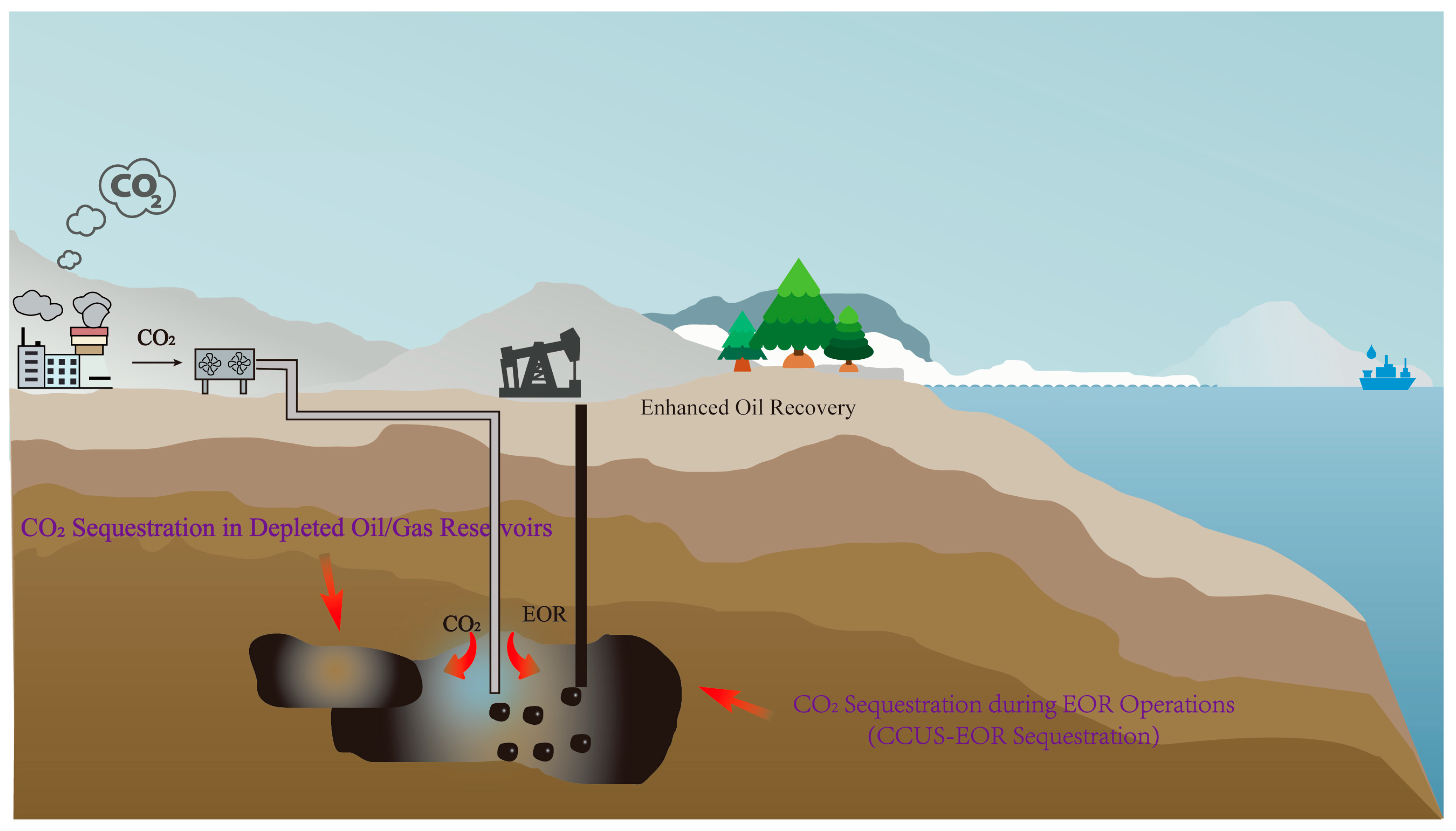
Disclaimer/Publisher’s Note: The statements, opinions and data contained in all publications are solely those of the individual author(s) and contributor(s) and not of MDPI and/or the editor(s). MDPI and/or the editor(s) disclaim responsibility for any injury to people or property resulting from any ideas, methods, instructions or products referred to in the content.

Article Metrics

Citations

Article Access Statistics

Article metric data becomes available approximately 24 hours after publication online.