Artificial Intelligence for Underground Gas Storage Engineering: A Review with Bibliometric and Knowledge-Graph Insights
 , and
, and
Abstract
1. Introduction
2. Methods
2.1. Data Collection
2.2. Knowledge Graph and Bibliometric Analysis
3. Typical Application Scenarios of AI in UGS Engineering
3.1. Intelligent Characterization of Rock Mechanical Parameters for UGS
3.2. Multiphysics Coupling and Surrogate Modeling
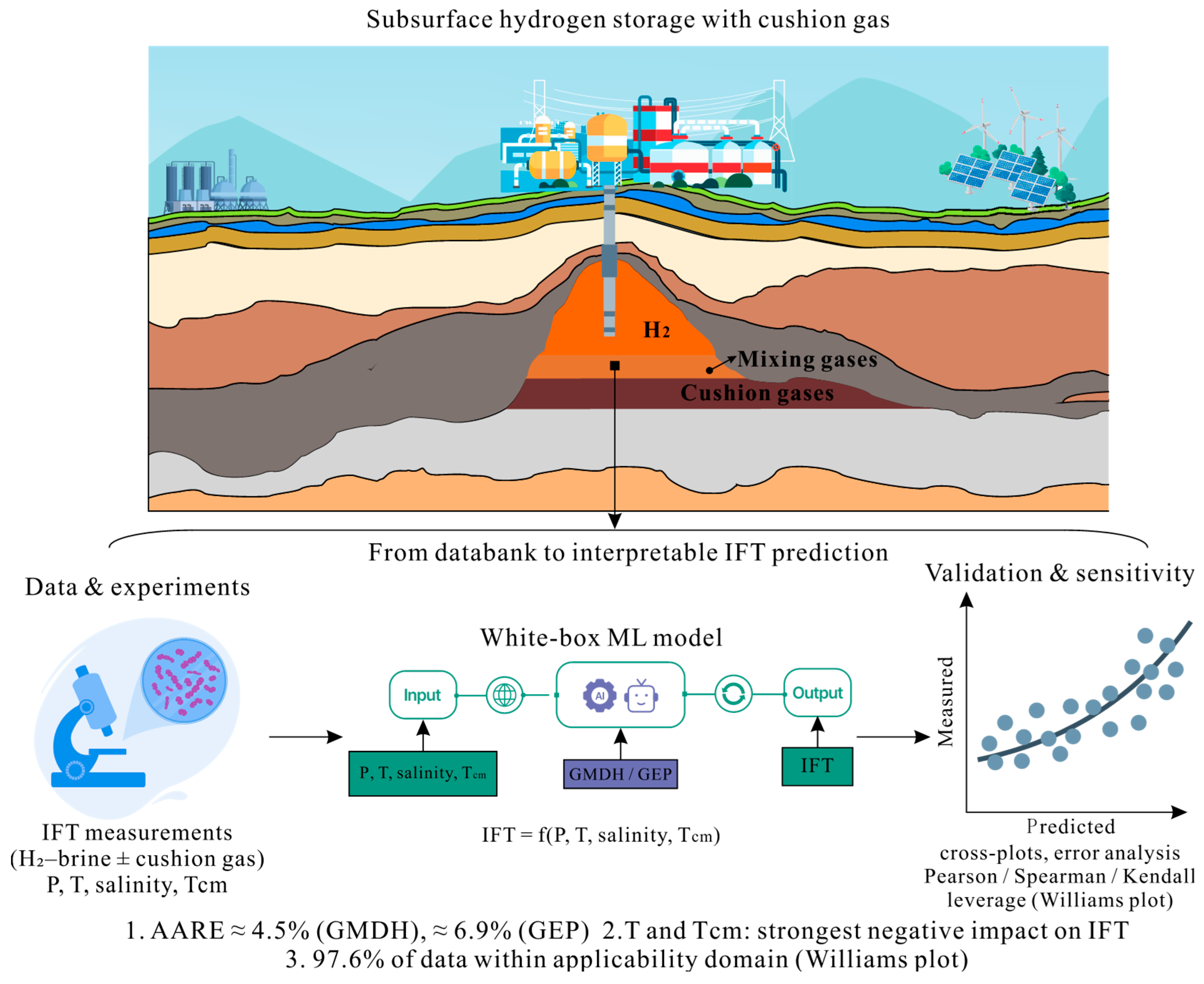
3.3. Gas–Rock–Fluid Interaction, Wettability and Interfacial Behavior Prediction
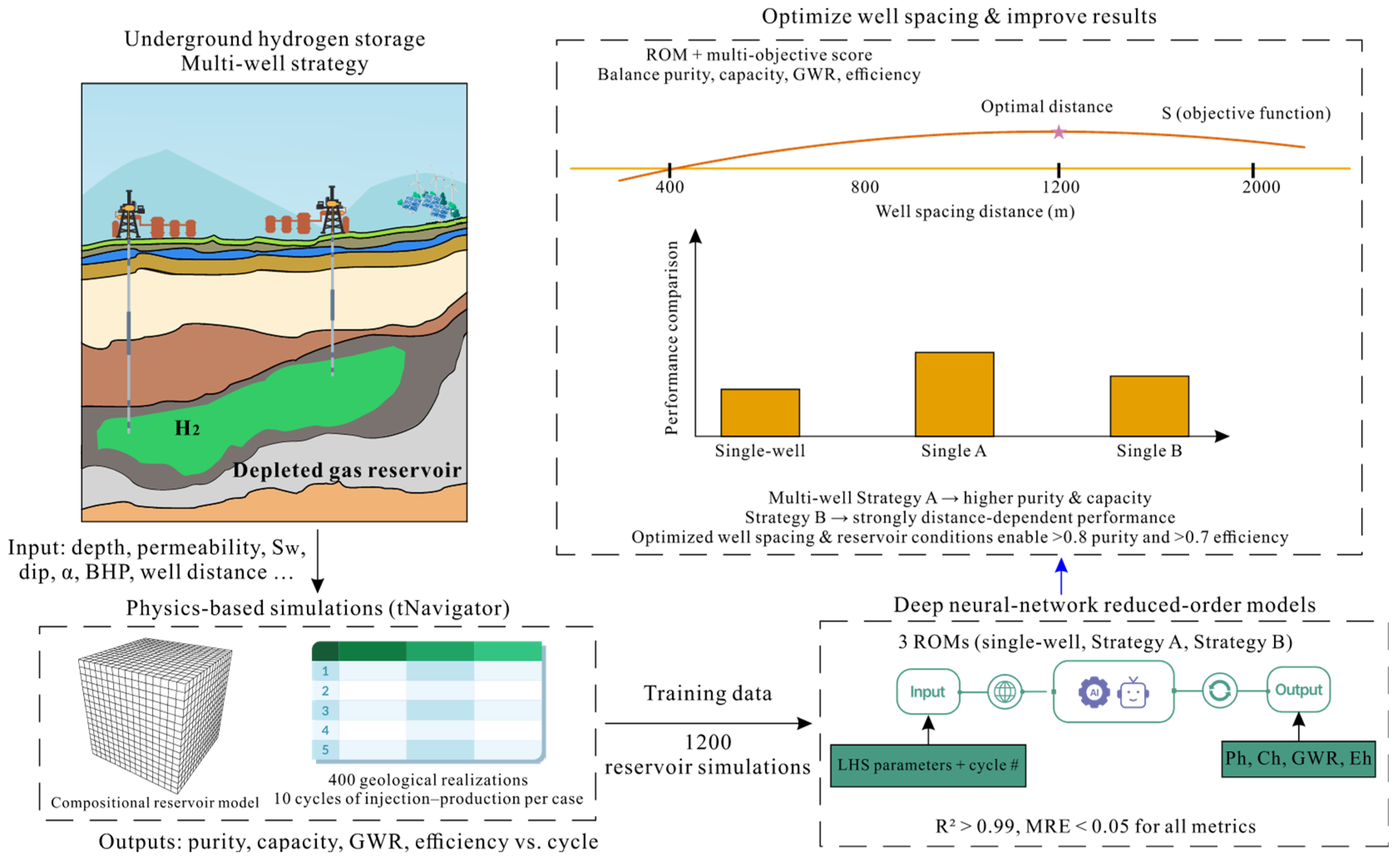
3.4. Injection-Production Process Optimization
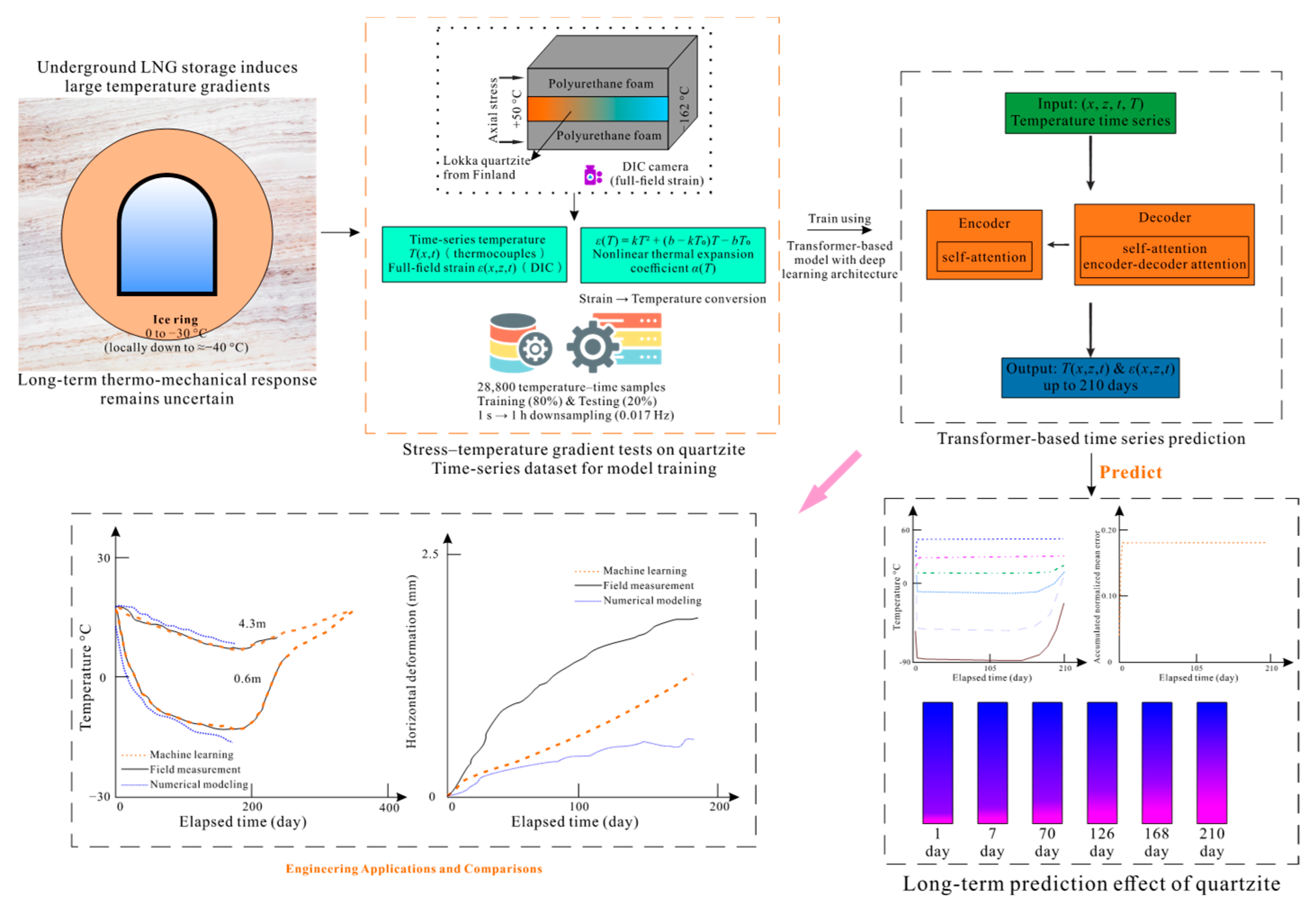
3.5. Monitoring, Risk Assessment and Integrity Evaluation
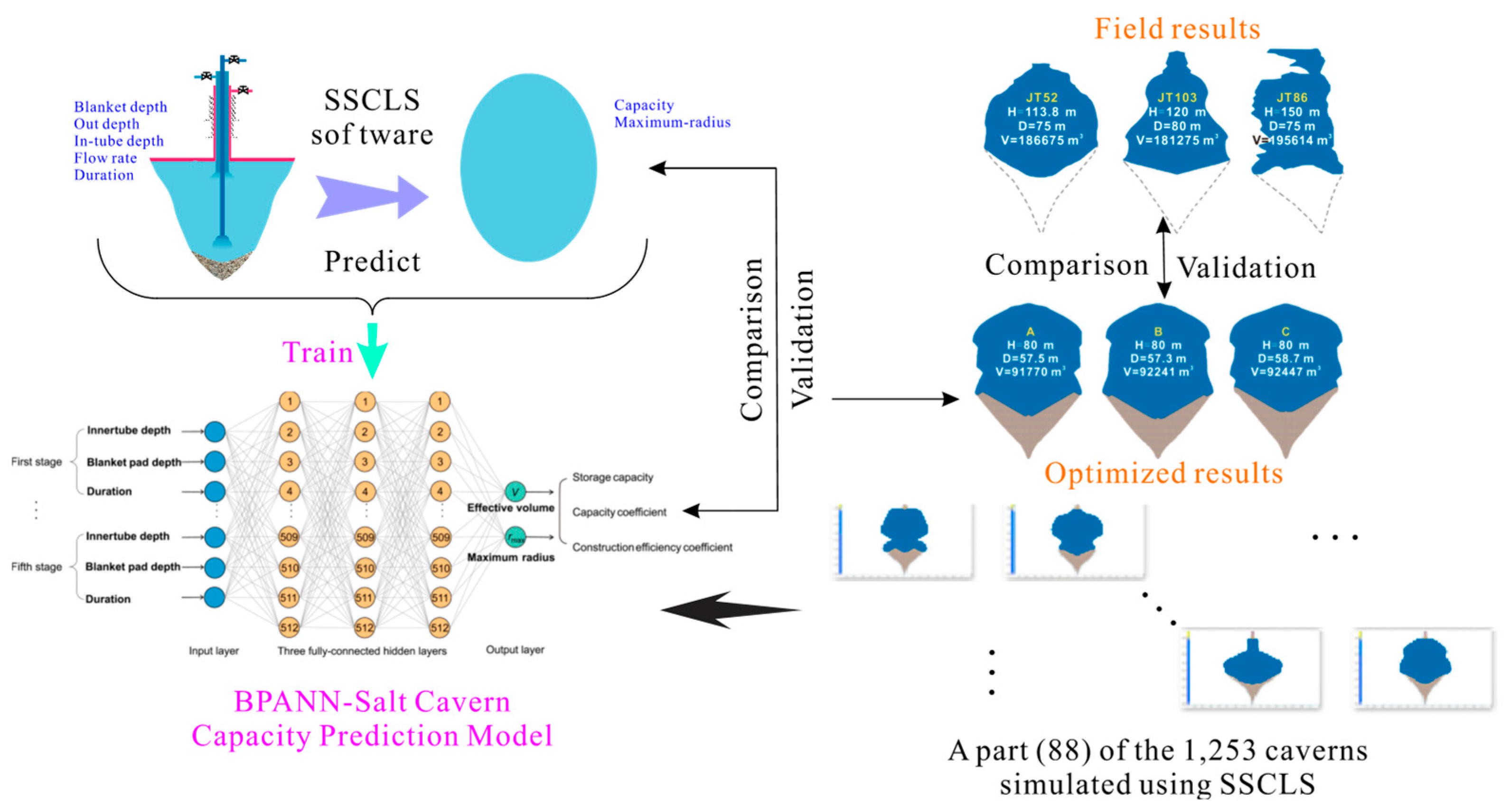
3.6. Intelligent Design and Construction of Underground Storage Cavern
4. Conclusions
- (1)
- Since 2017, AI research in UGS has rapidly transitioned from traditional ANNs toward advanced deep learning and physics-informed frameworks, with underground hydrogen storage emerging as the dominant frontier.
- (2)
- ML models such as CNN–LSTM, transformer networks, and FNO-based operators have enabled orders-of-magnitude acceleration in multiphysics simulations, enhanced predictive accuracy in interfacial behavior, and improved real-time monitoring capabilities.
- (3)
- AI-driven optimization frameworks—integrating reinforcement learning, GAs, and digital twin systems—have achieved measurable gains in operational efficiency, energy utilization, and safety reliability across salt caverns, depleted reservoirs, and lined rock caverns.
- (4)
- Despite promising progress, AI applications still face challenges related to data scarcity, geological heterogeneity, and physical interpretability. Addressing these requires the fusion of multi-source data, domain knowledge, and physics-guided constraints.
Author Contributions
Funding
Data Availability Statement
Acknowledgments
Conflicts of Interest
Abbreviations
| UGS | Underground gas storage |
| AI | Artificial intelligence |
| CAES | Compressed air energy storage |
| ML | Machine learning |
| IFT | Interfacial tension |
| GA | Genetic algorithm |
| ANN | Artificial neural network |
| WoSCC | Web of Science Core Collection |
References
- Yang, C.H.; Wang, T.T.; Chen, H.S. Theoretical and technological challenges of deep underground energy storage in China. Engineering 2023, 25, 168–181. [Google Scholar] [CrossRef]
- Ali, M.; Isah, A.; Yekeen, N.; Hassanpouryouzband, A.; Sarmadivaleh, M.; Okoroafor, E.R.; Al Kobaisi, M.; Mahmoud, M.; Vahrenkamp, V.; Hoteit, H. Recent progress in underground hydrogen storage. Energy Environ. Sci. 2025, 18, 5740–5810. [Google Scholar] [CrossRef]
- Chellal, H.; Malki, M.; Indro, A.; Mao, S.; Min, W.; Egenhoff, S.; Mehana, M. A quantitative risk assessment framework for fault reactivation in underground hydrogen storage: Coupled simulation and deep learning approach. J. Rock Mech. Geotech. Eng. 2025, in press. [Google Scholar] [CrossRef]
- Wei, X.; Shi, X.; Ma, H.; Ban, S. A comprehensive feasibility evaluation of hydrogen-carbon-salt cavern-renewable energy (HCSR) system. Energy 2025, 331, 137040. [Google Scholar] [CrossRef]
- Berest, P.; Louvet, F. Aspects of the thermodynamic behavior of salt caverns used for gas storage. Oil Gas Sci. Technol. 2020, 75, 10. [Google Scholar] [CrossRef]
- Huang, J.; Ge, X.; Ma, H.; Zhao, T.; Li, Y.; Shi, X. A study on thermodynamic coupling in dynamic injection and production processes of compressed air energy storage. Energy 2025, 319, 135093. [Google Scholar] [CrossRef]
- Wan, M.; Ji, W.; Wan, J.; He, Y.; Li, J.; Liu, W.; Jurado, M.J. Compressed air energy storage in salt caverns in China: Development and outlook. Adv. Geo-Energy Res. 2023, 9, 54–67. [Google Scholar] [CrossRef]
- Xia, C.C.; Xu, Y.J.; Zhou, S.W.; Qin, S.K.; He, X.H. Fracture initiation and propagation in the lined underground caverns for compressed air energy storage: Coupled thermo-mechanical phase-field modeling. Comput. Geotech. 2023, 157, 21. [Google Scholar] [CrossRef]
- Chen, X.; Wang, J.G. Stability analysis for compressed air energy storage cavern with initial excavation damage zone in an abandoned mining tunnel. J. Energy Storage 2022, 45, 103725. [Google Scholar] [CrossRef]
- Yang, C.; Wang, T. Underground Rock Salt Used for Energy Storage: Theory and Engineering Practice; Springer Nature: Berlin/Heidelberg, Germany, 2024. [Google Scholar]
- Huang, Y.; Shi, X.; Zhu, S.; Wei, X.; Bai, W.; Li, P.; Xu, M.; Li, Y.; Yang, C. Comparative techno-economic analysis of large-scale underground hydrogen storage. Appl. Energy 2025, 400, 126564. [Google Scholar] [CrossRef]
- Tackie-Otoo, B.N.; Haq, M.B. A comprehensive review on geo-storage of H2 in salt caverns: Prospect and research advances. Fuel 2024, 356, 129609. [Google Scholar] [CrossRef]
- Staudtmeister, K.; Rokahr, R.B. Rock mechanical design of storage caverns for natural gas in rock salt mass. Int. J. Rock Mech. Min. Sci. 1997, 34, 300.e1–300.e13. [Google Scholar] [CrossRef]
- Yang, C.; Wang, T. Deep Underground Energy Storage: Aiming for Carbon Neutrality and Its Challenges. Engineering 2023, 29, 11–14. [Google Scholar] [CrossRef]
- Yang, C.-H.; Wang, G.-B.; Shi, X.-L.; Zhu, S.-J.; Zheng, Z.-Y.; Liu, W.; Fan, J.-Y. Demands and challenges of large-scale salt cavern hydrogen storage in China. Rock Soil Mech. 2024, 45, 1–19. [Google Scholar]
- Körner, F.; Baumgärtel, L.; Leuger, B. Numerical and laboratory investigations of thermally induced fractures in rock salt. IOP Conf. Ser. Earth Environ. Sci. 2023, 1124, 012080. [Google Scholar] [CrossRef]
- Mohanty, S.; Vandergrift, T. Long term stability evaluation of an old underground gas storage cavern using unique numerical methods. Tunn. Undergr. Space Technol. 2012, 30, 145–154. [Google Scholar] [CrossRef]
- Heinemann, N.; Alcalde, J.; Miocic, J.M.; Hangx, S.J.T.; Kallmeyer, J.; Ostertag-Henning, C.; Hassanpouryouzband, A.; Thaysen, E.M.; Strobel, G.J.; Schmidt-Hattenberger, C.; et al. Enabling large-scale hydrogen storage in porous media—The scientific challenges. Energy Environ. Sci. 2021, 14, 853–864. [Google Scholar] [CrossRef]
- Kanaani, M.; Sedaee, B.; Asadian-Pakfar, M. Role of Cushion Gas on Underground Hydrogen Storage in Depleted Oil Reservoirs. J. Energy Storage 2022, 45, 103783. [Google Scholar] [CrossRef]
- Khaledi, K.; Mahmoudi, E.; Datcheva, M.; Schanz, T. Stability and serviceability of underground energy storage caverns in rock salt subjected to mechanical cyclic loading. Int. J. Rock Mech. Min. Sci. 2016, 86, 115–131. [Google Scholar] [CrossRef]
- Berest, P. Heat transfer in salt caverns. Int. J. Rock Mech. Min. Sci. 2019, 120, 82–95. [Google Scholar] [CrossRef]
- Kim, H.M.; Rutqvist, J.; Ryu, D.W.; Choi, B.H.; Sunwoo, C.; Song, W.K. Exploring the concept of compressed air energy storage (CAES) in lined rock caverns at shallow depth: A modeling study of air tightness and energy balance. Appl. Energy 2012, 92, 653–667. [Google Scholar] [CrossRef]
- Kim, H.M.; Rutqvist, J.; Jeong, J.H.; Choi, B.H.; Ryu, D.W.; Song, W.K. Characterizing Excavation Damaged Zone and Stability of Pressurized Lined Rock Caverns for Underground Compressed Air Energy Storage. Rock Mech. Rock Eng. 2013, 46, 1113–1124. [Google Scholar] [CrossRef]
- Menéndez, J.; Ordóñez, A.; Álvarez, R.; Loredo, J. Energy from closed mines: Underground energy storage and geothermal applications. Renew. Sustain. Energy Rev. 2019, 108, 498–512. [Google Scholar] [CrossRef]
- Aghdam, M.A.; Fazaeli, M.; Kanaani, M.; Sedaee, B. Multi-Objective Optimization of Cushion Gas Design in Underground Gas Storage Using Machine Learning. Results Eng. 2025, 27, 106659. [Google Scholar] [CrossRef]
- Lu, D.; Wu, W. Long-term thermo-mechanical response of surrounding rock in underground cryogenic storage. Eng. Geol. 2025, 354, 108178. [Google Scholar] [CrossRef]
- Foulger, G.R.; Wilson, M.P.; Gluyas, J.G.; Julian, B.R.; Davies, R.J. Global review of human-induced earthquakes. Earth Sci. Rev. 2018, 178, 438–514. [Google Scholar] [CrossRef]
- Pan, B.; Song, T.; Yin, X.; Jiang, Y.; Yue, M.; Hoteit, H.; Mahani, H.; Iglauer, S. A Machine Learning Based Framework for Brine-Gas Interfacial Tension Prediction: Implications for H2, CH4 and CO2 Geo-Storage. In Proceedings of the GOTECH, Dubai, United Arab Emirates, 7–9 May 2024. [Google Scholar]
- Kim, S.; Kim, T.-W.; Jo, S. Artificial intelligence in geoenergy: Bridging petroleum engineering and future-oriented applications. J. Pet. Explor. Prod. Technol. 2025, 15, 35. [Google Scholar] [CrossRef]
- Ali, M.; Tariq, Z.; Mubashir, M.; Kamal, M.S.; Yan, B.; Hoteit, H. In Prediction of Pure Mineral-H2-Brine Wettability Using Data-Driven Machine Learning Modeling: Implications for H2 Geo-Storage. In Proceedings of the International Petroleum Technology Conference, Dhahran, Saudi Arabia, 12 February 2024. [Google Scholar]
- Al-Mukainah, H.; Al-Yaseri, A.; Yekeen, N.; Hamad, J.A.; Mahmoud, M. Wettability of shale–brine–H2 system and H2-brine interfacial tension for assessment of the sealing capacities of shale formations during underground hydrogen storage. Energy Rep. 2022, 8, 8830–8843. [Google Scholar] [CrossRef]
- Turkson, J.N.; Md Yusof, M.A.; Darkwah-Owusu, V.; Sokama-Neuyam, Y.A.; Fjelde, I.; Alakbari, F.S.; Tackie-Otoo, B.N. An interpretable machine-learning-driven tool (HyWEC) for hydrogen wettability estimation: Implications for underground hydrogen storage. Int. J. Hydrogen Energy 2025, 155, 150256. [Google Scholar] [CrossRef]
- Tackie-Otoo, B.N.; Turkson, J.N.; Darkwah-Owusu, V.; Md Yusof, M.A. Integrating Bayesian Optimization with Machine Learning for Predicting Interfacial Tension in Quaternary Aqueous Hydrogen Systems: Implications for Underground Hydrogen Storage. Arab. J. Sci. Eng. 2025, 50, 21403–21431. [Google Scholar] [CrossRef]
- Ishola, N.; Gbadamosi, A.; Muhammed, N.S.; Epelle, E.; Haq, B.; Patil, S.; Al Shehri, D. Data-driven modelling to predict interfacial tension of hydrogen–brine system: Implications for underground hydrogen storage. Results Eng. 2025, 26, 104608. [Google Scholar] [CrossRef]
- Thanh, H.V. Revolutionizing hydrogen storage: Predictive modeling of hydrogen-brine interfacial tension using advanced machine learning and optimization technique. Int. J. Hydrogen Energy 2025, 128, 406–424. [Google Scholar] [CrossRef]
- Chen, Y.; Tang, S.; Xi, Z.; Sun, S.; Jiao, P.; Mei, X.; Zhou, T.; Sun, J.; Zeng, F. A Machine Learning Approach for Estimating Shale Micro-Mechanical Properties from High Resolution SEM–EDS Images. Rock Mech. Rock Eng. 2025, in press. [Google Scholar] [CrossRef]
- Mohanto, S.; Deb, D. Prediction of Plastic Damage Index for Assessing Rib Pillar Stability in Underground Metal Mine Using Multi-variate Regression and Artificial Neural Network Techniques. Geotech. Geol. Eng. 2020, 38, 767–790. [Google Scholar] [CrossRef]
- Shin, Y.; Shin, S. Rock Classification in a Vanadiferous Titanomagnetite Deposit Based on Supervised Machine Learning. Minerals 2022, 12, 461. [Google Scholar] [CrossRef]
- Honório, H.T.; Houben, M.; Bisdom, K.; van der Linden, A.; de Borst, K.; Sluys, L.J.; Hajibeygi, H. A multi-step calibration strategy for reliable parameter determination of salt rock mechanics constitutive models. Int. J. Rock Mech. Min. Sci. 2024, 183, 105922. [Google Scholar] [CrossRef]
- He, Q.; Liu, J.; Wu, F.; Li, C.; Chen, J.; Gao, R.; Ye, C.; Zhu, S. Fatigue properties and constitutive model of Jintan salt rock subjected to complex cyclic loading. Int. J. Min. Sci. Technol. 2025, 35, 121–133. [Google Scholar] [CrossRef]
- Guan, W.; Cai, W.; Li, Z.; Lu, H. Microscopic Characterization and Fractal Analysis of Pore Systems for Unconventional Reservoirs. J. Mar. Sci. Eng. 2024, 12, 908. [Google Scholar] [CrossRef]
- Zhu, L.; Bijeljic, B.; Blunt, M.J. Diffusion Model-Based Generation of Three-Dimensional Multiphase Pore-Scale Images. Transp. Porous Media 2025, 152, 22. [Google Scholar] [CrossRef]
- Seydi, A.; Sadeghnejad, S.; Enzmann, F.; Khoozan, D.; Al-Raoush, R.I.; Kersten, M. Prediction of fine particle retention at the pore-scale using deep learning. Phys. Fluids 2025, 37, 062019. [Google Scholar] [CrossRef]
- Maleki, M.; Dehghani, M.R.; Kafi, M.; Akbari, A.; Kazemzadeh, Y.; Ranjbar, A. Machine learning analysis of CO2 and methane adsorption in tight reservoir rocks. Sci. Rep. 2025, 15, 24575. [Google Scholar] [CrossRef]
- Kalam, S.; Arif, M.; Raza, A.; Lashari, N.; Mahmoud, M. Data-driven modeling to predict adsorption of hydrogen on shale kerogen: Implication for underground hydrogen storage. Int. J. Coal Geol. 2023, 280, 104386. [Google Scholar] [CrossRef]
- Wang, T.; Tang, H. FFINO: Factorized Fourier Improved Neural Operator for Modeling Multiphase Flow in Underground Hydrogen Storage. arXiv 2025, arXiv:2506.17344. [Google Scholar] [CrossRef]
- Asghari, M.; Emami Niri, M.; Sedaee, B. UHSNet: Deep learning-based smart proxy modeling for underground hydrogen storage. Energy 2025, 329, 136763. [Google Scholar] [CrossRef]
- Sirota, D.D.; Gushchin, K.A.; Khan, S.A.; Kostikov, S.L.; Butov, K.A. Neural Operators for Hydrodynamic Modeling of Underground Gas Storages. Mosc. Univ. Phys. Bull. 2024, 79, S922–S934. [Google Scholar] [CrossRef]
- Zhou, J.; Li, Z.; Liu, S.; Li, C.; Zhao, Y.; Zhou, Z.; Liang, G. Hybrid genetic algorithm for parametric optimization of surface pipeline networks in underground natural gas storage harmonized injection and production conditions. Nat. Gas Ind. B 2025, 12, 234–250. [Google Scholar] [CrossRef]
- Ma, M.; Zhang, Z.; Chen, J.; Xiong, Q.; Hu, E.; Wang, T.; Xiao, Y. Physics-informed machine learning-driven active utilization of ventilation and heat exchange in large underground tunnels. Renew. Energy 2025, 250, 123283. [Google Scholar] [CrossRef]
- Wang, J.; Hu, Z.; Yan, X.; Yao, J.; Sun, H.; Yang, Y.; Zhang, L.; Zhong, J. Gradient-boosted spatiotemporal neural network for simulating underground hydrogen storage in aquifers. J. Comput. Phys. 2025, 521, 113557. [Google Scholar] [CrossRef]
- Hosseini, M.; Leonenko, Y. Prediction of hydrogen−brine interfacial tension at subsurface conditions: Implications for hydrogen geo-storage. Int. J. Hydrogen Energy 2024, 58, 485–494. [Google Scholar] [CrossRef]
- Hosseini, M.; Leonenko, Y. Predicting interfacial tension in brine-hydrogen/cushion gas systems under subsurface conditions: Implications for hydrogen geo-storage. Int. J. Hydrogen Energy 2024, 91, 1394–1406. [Google Scholar] [CrossRef]
- Gbadamosi, A.; Adamu, H.; Usman, J.; Usman, A.G.; Jibril, M.M.; Salami, B.A.; Gbadamosi, S.L.; Oyedele, L.O.; Abba, S.I. New-generation machine learning models as prediction tools for modeling interfacial tension of hydrogen-brine system. Int. J. Hydrogen Energy 2024, 50, 1326–1337. [Google Scholar] [CrossRef]
- Xie, M.; Zhang, M.; Jin, Z. Machine Learning-Based Interfacial Tension Equations for (H2 + CO2)-Water/Brine Systems over a Wide Range of Temperature and Pressure. Langmuir 2024, 40, 5369–5377. [Google Scholar] [CrossRef]
- Akbari, A. Application of machine learning in modelling gas dispersion coefficients for hydrogen storage in porous media. Can. J. Chem. Eng. 2025. [Google Scholar] [CrossRef]
- Vo Thanh, H.; Rahimi, M.; Dai, Z.; Zhang, H.; Zhang, T. Predicting the wettability rocks/minerals-brine-hydrogen system for hydrogen storage: Re-evaluation approach by multi-machine learning scheme. Fuel 2023, 345, 128183. [Google Scholar] [CrossRef]
- Lv, Q.; Xue, J.; Li, X.; Rezaei, F.; Larestani, A.; Norouzi-Apourvari, S.; Abdollahi, H.; Hemmati-Sarapardeh, A. White-box machine-learning models for accurate interfacial tension prediction in hydrogen–brine mixtures. Clean Energy 2024, 8, 252–264. [Google Scholar] [CrossRef]
- Alqahtani, F.M.; Nait Amar, M.; Djema, H.; Ourabah, K.; Alanazi, A.; Ghasemi, M. Machine Learning–Based Estimation of Hydrogen Solubility in Brine for Underground Storage in Saline Aquifers. Greenh. Gases Sci. Technol. 2025, 15, 409–420. [Google Scholar] [CrossRef]
- Huohai, Y.; Qinghui, H.; Chao, M.; Ping, Z.; Hancheng, L.; Yu, F.; Renze, L.; Zonglin, L.; Chenglian, D. Injection-mining scheme optimization of underground gas storage based on agent model. Geoenergy Sci. Eng. 2025, 244, 213406. [Google Scholar] [CrossRef]
- Li, Z.; Li, C.; Jia, W.; Chen, Y.; Zhang, C.; Xiao, H.; Pu, Z. Co-optimization method for injection strategy of underground natural gas storage integrating aboveground and underground parts. Gas Sci. Eng. 2024, 128, 205376. [Google Scholar] [CrossRef]
- Kuk, E.; Stopa, J.; Kuk, M.; Janiga, D.; Wojnarowski, P. Optimal Well Control Based on Auto-Adaptive Decision Tree—Maximizing Energy Efficiency in High-Nitrogen Underground Gas Storage. Energies 2022, 15, 3413. [Google Scholar] [CrossRef]
- Indro, A.; Chellal, H.; Malki, M.; Mao, S.; Gross, M.; Mehana, M. Optimizing underground hydrogen storage performance through multi-well strategies in depleted gas reservoirs. Int. J. Hydrogen Energy 2025, 106, 672–685. [Google Scholar] [CrossRef]
- GÜmrah, B.G.F. Gas Production Rate Optimization by Genetic Algorithm. Energy Sources 2001, 23, 295–304. [Google Scholar] [CrossRef]
- Guyaguler, B.; Gumrah, F. Comparison of genetic algorithm with linear programming for the optimization of an underground gas-storage field. IN SITU 1999, 23, 131–149. [Google Scholar]
- Wamriew, D.; Dorhjie, D.B.; Bogoedov, D.; Pevzner, R.; Maltsev, E.; Charara, M.; Pissarenko, D.; Koroteev, D. Microseismic Monitoring and Analysis Using Cutting-Edge Technology: A Key Enabler for Reservoir Characterization. Remote Sens. 2022, 14, 3417. [Google Scholar] [CrossRef]
- Su, F.; Li, X.; Feng, Y.; Li, S.; Wang, Y.; Gu, C.; Si, X. Sophisticated distributed acoustic sensing (DAS) for real-time monitoring and analysis of wellbore integrity. Geoenergy Sci. Eng. 2026, 256, 214162. [Google Scholar] [CrossRef]
- Huang, W.; Liao, W.; Li, J.; Qiao, X.; Yusan, S.; Yasen, A.; Li, X.; Zhang, S. The Long-Term Surface Deformation Monitoring and Prediction of Hutubi Gas Storage Reservoir in Xinjiang Based on InSAR and the GWO-VMD-GRU Model. Remote Sens. 2025, 17, 2480. [Google Scholar] [CrossRef]
- Zhang, N.; Gao, X.; Lai, X.; Xu, H.; Liu, Y.; Ma, H. Research on crack detection method for shallow-buried underground compressed air energy storage cavern based on improved mask R-CNN model. Earth Energy Sci. 2025, 1, 203–212. [Google Scholar] [CrossRef]
- He, Y.; Xu, J.; Wang, M.; Liu, R.; Chen, X.; Sui, J. Intelligent prediction study on the seepage evolution of rock-concrete interface in compressed air energy storage artificial caverns under cyclic loading. Phys. Fluids 2025, 37, 067115. [Google Scholar] [CrossRef]
- Gutiérrez-Oribio, D.; Stathas, A.; Stefanou, I. AI-Driven Approach for Sustainable Extraction of Earth’s Subsurface Renewable Energy While Minimizing Seismic Activity. Int. J. Numer. Anal. Methods Geomech. 2025, 49, 1126–1138. [Google Scholar] [CrossRef]
- Sugan, M.; Peruzza, L.; Romano, M.A.; Guidarelli, M.; Moratto, L.; Sandron, D.; Plasencia Linares, M.P.; Romanelli, M. Machine learning versus manual earthquake location workflow: Testing LOC-FLOW on an unusually productive microseismic sequence in northeastern Italy. Geomat. Nat. Hazards Risk 2023, 14, 2284120. [Google Scholar] [CrossRef]
- Gao, K.; Creasy, N.M.; Huang, L.; Gross, M.R. Underground hydrogen storage leakage detection and characterization based on machine learning of sparse seismic data. Int. J. Hydrogen Energy 2024, 61, 137–161. [Google Scholar] [CrossRef]
- Vo Thanh, H.; Safaei-Farouji, M.; Wei, N.; Band, S.S.; Mosavi, A. Knowledge-based rigorous machine learning techniques to predict the deliverability of underground natural gas storage sites for contributing to sustainable development goals. Energy Rep. 2022, 8, 7643–7656. [Google Scholar] [CrossRef]
- Wei, W.; Hou, J.; Liu, X. Evaluating and predicting deliverability of natural gas storage sites using stacking machine learning models. Geoenergy Sci. Eng. 2025, 249, 213771. [Google Scholar] [CrossRef]
- Derakhshani, R.; Lankof, L.; GhasemiNejad, A.; Zaresefat, M. Artificial intelligence-driven assessment of salt caverns for underground hydrogen storage in Poland. Sci. Rep. 2024, 14, 14246. [Google Scholar] [CrossRef] [PubMed]
- Zhao, K.; Yu, S.; Wong, L.N.Y. Long-term stability forecasting for energy storage salt caverns using deep learning-based model. Energy 2025, 319, 134854. [Google Scholar] [CrossRef]
- Baronio, E.; Abdo, E.; Mauro, S.; Troise, M.; Salamina, L. Case Study of the Use of a Digital Twin for Leak Detection and Quantification in Underground Gas Storage Wells. In Proceedings of the SPE EuropEC—Europe Energy Conference Featured at the 84th EAGE Annual Conference & Exhibition, Vienna, Austria, 5–8 June 2023. [Google Scholar]
- Wang, Z.; Chen, J.; Wang, G.; Li, J.; Li, S.; Azhar, M.U.; Ma, S.; Xu, W.; Zhuang, D.; Zhan, L.; et al. Geometry prediction and design for energy storage salt caverns using artificial neural network. Energy 2024, 308, 132820. [Google Scholar] [CrossRef]
- Li, J.; Wang, Z.; Zhang, S.; Shi, X.; Xu, W.; Zhuang, D.; Liu, J.; Li, Q.; Chen, Y. Machine-learning-based capacity prediction and construction parameter optimization for energy storage salt caverns. Energy 2022, 254, 124238. [Google Scholar] [CrossRef]
- Li, J.; Liu, J.; Li, K.; Zhang, S.; Xu, W.; Zhuang, D.; Zhan, L.; Chen, Y. Three dimensional interface normal prediction for Volume-of-Fluid method using artificial neural network. Eur. J. Mech. B Fluids 2024, 106, 13–20. [Google Scholar] [CrossRef]
- He, T.; Wang, T.; Yang, C.; Liao, Y.; Xie, D.; Ding, Z.; Daemen, J.J.K. A mathematical model for the shape prediction of bedded salt cavern used for energy storage. Int. J. Rock Mech. Min. Sci. 2025, 186, 106029. [Google Scholar] [CrossRef]
- Teng, T.; Chen, Y.; Wang, S.; Jia, W.; Wang, Y.; Liu, K.; Li, Z. Water injection softening modeling of hard roof and application in Buertai coal mine. Environ. Earth Sci. 2025, 84, 54. [Google Scholar] [CrossRef]



| Application Scenario (Section) | AI Task Type | Algorithms | Data Source | Key Challenges/Limitations |
|---|---|---|---|---|
| 3.1 Intelligent characterization of rock mechanical parameters | Regression/Prediction/Classification | XGBoost, ANN, SVM, PSO, GMM, CNN, Autoencoder, U-Net | Nanoindentation and SEM–EDS tests, XRD composition, micro-CT imaging, pore-scale datasets | Limited high-resolution geomechanical data; sample heterogeneity; model interpretability and scalability |
| 3.2 Multiphysics coupling and surrogate modeling | Surrogate modeling/Forecasting/Optimization | FFINO (Fourier Neural Operator), UHSNet, Tensor-decomposed FNO, HGA–GRG, LSTM–Seq2Seq + Attention | Multiphase flow simulations, hydrogen–brine experiments, thermal–fluid monitoring data | Coupling of physics and data; generalization to complex geometries; training cost for large datasets |
| 3.3 Gas–rock–fluid interaction, wettability and interfacial behavior prediction | Property prediction/Regression/Interpretability | XGBoost, LightGBM, SVR, RBFNN–AGTO, GMDH, GEP, HyWEC (Bayesian Optimization) | Molecular simulation results, hydrogen–brine experiments, thermodynamic datasets | Data availability and quality; physical interpretability of ML models; transferability to different gas systems |
| 3.4 Injection–production process optimization | Multi-objective optimization/Control | GA, NSGA-III, Reinforcement Learning, Deep Reinforcement Learning, DNN proxy models | Field operation records, numerical reservoir simulations, digital-twin data | Nonlinear coupling of surface–subsurface systems; limited field validation; computational cost |
| 3.5 Monitoring, risk assessment and integrity evaluation | Anomaly detection/Classification/Forecasting | CNN, BiLSTM, CWT–CNN, Mask R-CNN, GWO–VMD–GRU, Transformer, DDPG RL | DAS acoustic signals, InSAR data, sensor logs, time-lapse seismic data | Data noise and imbalance; real-time processing; model transfer to different storage types |
| 3.6 Intelligent design and construction of underground storage cavern | Geometry prediction/Capacity estimation/Design optimization | GRU, BP Neural Network, ANN-based VOF model | Multi-stage leaching records, operational logs, flow simulation data | Lack of standardized datasets; limited on-site data for model validation; scaling from lab to field |
Disclaimer/Publisher’s Note: The statements, opinions and data contained in all publications are solely those of the individual author(s) and contributor(s) and not of MDPI and/or the editor(s). MDPI and/or the editor(s) disclaim responsibility for any injury to people or property resulting from any ideas, methods, instructions or products referred to in the content. |
© 2025 by the authors. Licensee MDPI, Basel, Switzerland. This article is an open access article distributed under the terms and conditions of the Creative Commons Attribution (CC BY) license (https://creativecommons.org/licenses/by/4.0/).
Share and Cite
Chen, J.; Wang, G.; Bai, X.; Duan, C.; Lu, J.; Xiao, L.; Ge, X.; Zhang, G.; Li, J. Artificial Intelligence for Underground Gas Storage Engineering: A Review with Bibliometric and Knowledge-Graph Insights. Energies 2025, 18, 6354. https://doi.org/10.3390/en18236354
Chen J, Wang G, Bai X, Duan C, Lu J, Xiao L, Ge X, Zhang G, Li J. Artificial Intelligence for Underground Gas Storage Engineering: A Review with Bibliometric and Knowledge-Graph Insights. Energies. 2025; 18(23):6354. https://doi.org/10.3390/en18236354
Chicago/Turabian StyleChen, Jiasong, Guijiu Wang, Xuefeng Bai, Chong Duan, Jun Lu, Luokun Xiao, Xinbo Ge, Guimin Zhang, and Jinlong Li. 2025. "Artificial Intelligence for Underground Gas Storage Engineering: A Review with Bibliometric and Knowledge-Graph Insights" Energies 18, no. 23: 6354. https://doi.org/10.3390/en18236354
APA StyleChen, J., Wang, G., Bai, X., Duan, C., Lu, J., Xiao, L., Ge, X., Zhang, G., & Li, J. (2025). Artificial Intelligence for Underground Gas Storage Engineering: A Review with Bibliometric and Knowledge-Graph Insights. Energies, 18(23), 6354. https://doi.org/10.3390/en18236354