Abstract
Underground hydrogen storage (UHS) is a relatively new technology that demonstrates notable potential for the efficient storage of large quantities of green hydrogen. Its large-scale implementation requires a comprehensive understanding of numerous factors, including safe and effective storage methods, as well as overcoming various thresholds and challenges. This article presents strategies for accelerating the implementation of this technology, identifying the thresholds and challenges affecting the development and future scale-up of UHS. It characterises challenges and constraints related to geology (including the type and geological characterisation of structures, hydrogen storage capacity, and hydrogen interactions with underground environments), the technological aspects of hydrogen storage (such as infrastructure, management, and monitoring), and economic and legal considerations. The need for the rapid implementation of demonstration projects has been emphasised. The identified thresholds and challenges, along with the resulting recommendations, are crucial for paving the way for the large-scale implementation of UHS. Addressing these issues will significantly influence the implementation of this technology post-2030.
1. Introduction
Hydrogen is an environmentally friendly and emission-free energy source that has the potential to replace fossil fuels in the near term. Low-carbon green hydrogen can be produced from renewable energy sources (RESs) using water electrolysis. Energy scenarios and transition plans, both globally and regionally, indicate the significant role that hydrogen will play in future energy systems. According to the IRENA report, under the 1.5 °C by 2050 scenario, green hydrogen will account for 14% of final energy consumption, and this gas and its derivatives will reduce CO2 emissions by 12% [1].
Hydrogen has been a key component of several EU policies and legislation in recent years. It plays an important role in achieving the goals enshrined in the ‘European Green Deal’ [2], which aims for climate neutrality by 2050 [3]. Published in July 2020, “Hydrogen Strategy for a Climate Neutral Europe” [4] highlights the critical role of hydrogen in reducing greenhouse gas emissions. By 2050, the share of hydrogen in European energy is estimated to increase from its current level of less than 2% to 13–14% [4,5]. As part of the ‘Ready for 55’ package in December 2021, the European Commission (EC) proposed a revision of the EU gas market structure. The gradual substitution of natural gas with gases produced using RES, including hydrogen, is envisaged. The RePowerEU plan, announced by the EC in 2022 to accelerate the energy transition, anticipates a greater use of hydrogen. By 2030, the EU aims to produce 10 million tonnes of renewable hydrogen and import another 10 million tonnes [6].
The projected growth in demand for hydrogen from low-carbon and zero-carbon energy sources, combined with the intermittency of energy production from RES, indicates that interest in underground hydrogen storage (UHS) will increase notably in the near future (Figure 1). A hydrogen economy that offers a scalable and long-term solution must be developed for reliable and sustainable hydrogen energy systems. According to assessments made by Gas Infrastructure Europe, the demand for hydrogen storage capacity (for the 21 countries covered by the European Hydrogen Backbone) will be approximately 70 TWh by 2030, increasing to 450 TWh by 2050 [7].
Figure 1.
Production, storage, and usage of green hydrogen.
1.1. Underground Hydrogen Storage
In underground gas storage (UGS) [8], as an example, large storage capacities can be provided by UHS in dedicated geological structures, such as deep aquifers, depleted natural gas fields, and leached caverns in salt deposits [9,10,11]. No two geological structures are identical. Therefore, storages located in different types of geological structures will differ in the type of reservoir rocks and sealing overburden rocks, capacity, and tightness. Additionally, different reactions and interactions occur between the storage formation and hydrogen. Several similarities between UHS and UGS in terms of storage in the same types of geological structures, the principles of searching for suitable sites, and the conduct of storage operations allow for the application of previous experience with natural gas storage. However, notable differences exist in the behaviour of hydrogen below the Earth’s surface, which affects the safety, efficiency, and effectiveness of storage [11,12,13,14,15,16,17,18,19,20,21,22].
Aquifers: Hydrogen can be stored in the geological structures of deep saline aquifers. During injection, it is immobilised in the pore spaces of rocks via various mechanisms, including structural, capillary, mineral, and dissolution trapping. To prevent gas migration out of the reservoir rock, impermeable rocks (such as clay rocks, salts, and anhydrites) with sufficiently large thicknesses must act as barriers against unwanted hydrogen escape [9,11,13,16,20,23,24,25].
Depleted gas fields: Hydrogen can be stored in the pores of rocks that were previously filled with natural gas. The presence of a natural gas deposit in a structural or stratigraphic trap confirms effective sealing. However, due to the properties of hydrogen, the tightness of the structure confirmed for natural gas does not guarantee absolute tightness for hydrogen storage. Tightness must be confirmed through testing before the storage facility is built. In this type of reservoir, some natural gas remains after operation, affecting the purity of the hydrogen retrieved from underground storage. Conversely, the remaining natural gas can provide the cushion gas (CG) needed for the underground storage operation [8,11,13,16,20,26,27,28,29,30,31,32,33,34].
Salt caverns: Hydrogen can also be stored in caverns that are leached from rock salt deposits. Such caverns typically measure dozens of metres in diameter and can reach several hundred metres in height. The properties of rock salt provide good containment not only for natural gas but also for hydrogen. The design of caverns is strongly influenced by the lithological variability of salt rocks, the occurrence of overburdened non-salt rocks or readily soluble evaporites, and the presence of salt deposits in the form of salt seams or salt outcrops. The leaching of caverns requires access to fresh water, followed by the safe removal of brine [13,16,20,21,35,36,37,38].
Experiments on hydrogen storage date back to the 1970s and primarily involve salt caverns (such as those at Teesside in the United Kingdom and Moss Bluff and Clemes in the US) [18,22,39]. Town gas, which is a mixture containing up to 50% hydrogen, is also stored in both depleted reservoirs and aquifers [21,39,40,41,42,43]. Numerous pilot and demonstration projects for UHS have been conducted [13,18,22,27,42,44,45]. In Austria, in 2023, the first storage facility in the world for pure hydrogen in an underground porous reservoir was operated as part of the Underground Sun Storage project [18,46].
Pilot projects for underground hydrogen storage (UHS) represent a critical phase in the advancement of this technology, providing empirical data on safety, monitoring, and process efficiency under various geological conditions (Hematpur et al., 2023 [13]; Miocic et al., 2023 [42]; Zivar et al., 2021 [22]). These initiatives facilitate the transition from theoretical modelling to practical, operational solutions by enabling the assessment of hydrogen behaviour across diverse rock formations.
In Europe, ongoing initiatives encompass salt caverns, depleted hydrocarbon reservoirs, and deep aquifers, enabling a comparative assessment of these geological structures in terms of storage capacity and sealing integrity. Among the most significant projects is HyUnder [47], the first pan-European study of UHS potential. HyStock [48] focuses on hydrogen storage in salt caverns integrated with the national gas transmission network and is operated by Gasunie. HyPSTER [49] serves as a demonstrator of green hydrogen storage in the Etrez salt cavern, incorporating advanced chemical and biological monitoring systems. Underground Sun Storage/Conversion [50] developed by RAG Austria, employs depleted natural gas fields for seasonal hydrogen storage.
The accumulated experience from these projects demonstrates that European pilot initiatives provide a crucial foundation for the development of monitoring standards, risk assessment methodologies, and legal frameworks for UHS. Their findings reaffirm the importance of integrating technological innovation, safety measures, and risk management practices in the future evolution of underground hydrogen storage.
1.2. Purpose and Scope of the Study
Underground hydrogen storage is still an immature technology, the implementation of which requires the removal and overcoming of numerous obstacles. The identification of these obstacles is crucial and of interest to numerous groups planning to use UHS. First, state administration must establish regulations for the use of hydrogen in various fields and areas. Entrepreneurs planning to carry out UHS, scientists seeking interesting topics for their research, and, ultimately, the local communities in which hydrogen storage facilities will be built are also stakeholders in this process.
However, the specific properties of hydrogen present several challenges. These issues must be addressed before UHS technology becomes sufficiently mature for commercial applications. Research in various areas, along with prior pilot and demonstration projects, is required. The results of these studies will address important knowledge gaps and confirm the outcomes of laboratory tests and numerical modelling under real subsurface conditions. They will also enable the testing of new technical solutions for the storage facility, insights into safety and monitoring aspects of the operation, costs associated with hydrogen storage, and public acceptance of the use of this technology. Therefore, defining the key issues faced by UHS is important.
The aim of this discussion is to identify the existing thresholds and challenges for industrial-scale UHS. The authors have identified thresholds and challenges facing UHS concerning geological, technical, economic, and legal considerations throughout the entire life cycle of UHS. The performance and efficiency of storage operations are significantly influenced by geological aspects. The chosen storage sites should enable the intended purpose to be technically feasible. The economic and legal aspects of UHS are crucial for future investors. Identifying factors that influence the public acceptance of UHS technology will help ensure the positive perception of future green hydrogen underground storage projects.
The thresholds and challenges identified in this article, along with the resulting recommendations, highlight the obstacles that exist today, which the authors consider key to paving the way for the demonstration and large-scale deployment of UHS. Overcoming these issues will impact the implementation of this technology in the years following 2030. The results presented here reflect the authors’ experiences concerning the fundamental obstacles and limitations facing UHS. They did not exclude alternative perspectives on the issue, which would be a valuable addition to their conclusions.
2. Materials and Methods
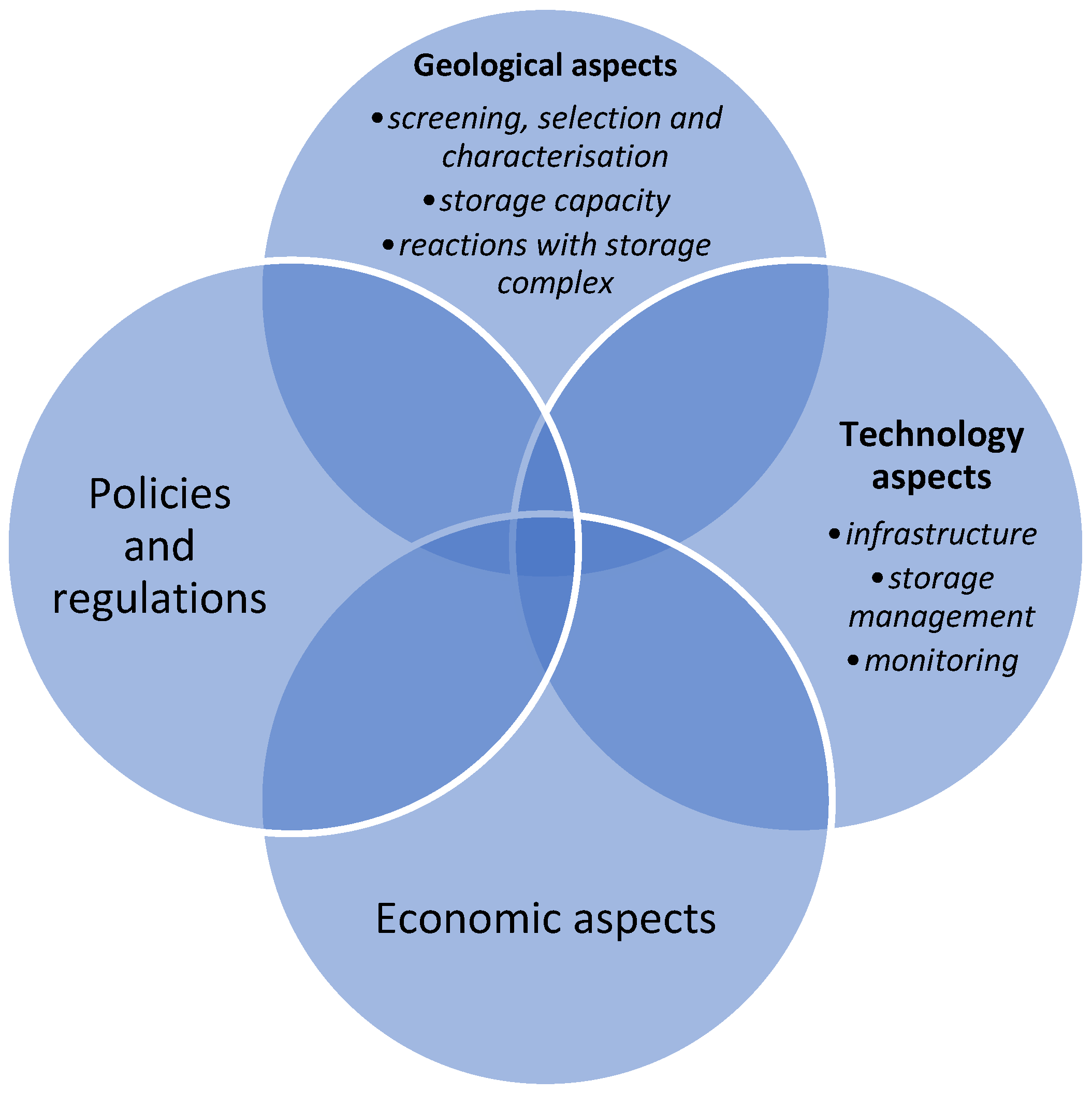
Thresholds and challenges were identified in eight thematic areas: the typing and geological characterisation of structures, hydrogen storage capacity, hydrogen interaction with the storage formation in terms of geology, storage infrastructure, and hydrogen storage management monitoring in relation to technological aspects of hydrogen injection/withdrawal and the economic and legal aspects of UHS (Figure 2).
Figure 2.
Aspects important for UHS development.
In this study, a challenge is defined as a fundamental and often systemic obstacle that significantly hinders the implementation of industrial-scale underground hydrogen storage under specific conditions, locations, or timeframes (e.g., lack of harmonised regulations for hydrogen storage, absence of long-term national hydrogen strategies, or widespread public opposition). Challenges are typically broad in scope, involving multiple interdependent factors such as regulatory uncertainty, lack of social acceptance, or insufficient international coordination.
In contrast, a threshold refers to a more specific and localised problem that interferes with achieving a defined objective (e.g., incomplete subsurface geological data at a selected storage site, or temporary lack of funding to construct a demonstration-scale facility). Thresholds usually involve fewer and more concrete elements, such as limited site-specific geological data or insufficient short-term funding for pilot infrastructure. While challenges are understood in a general and often external context, thresholds are viewed as internal, technical, or operational limitations.
Overcoming a challenge requires substantial effort, time, long-term commitment, and multi-level problem-solving often across national or institutional boundaries. Because challenges may lie beyond the direct control of UHS project developers, addressing them typically demands political, social, or structural change in addition to financial investment.
Conversely, overcoming a threshold generally requires less time and can be primarily addressed through the targeted allocation of financial resources toward research, development, or technical deployment. The following steps were required for theme implementation:
- A literature review was conducted to identify key scientific findings summarising the state-of-the-art UHS technologies for different types of geological structures. This review included articles that provided a broader view of UHS and the major issues identified by various authors across the eight topic areas considered (see Table 1). Publications that presented at least three of the eight aspects analysed were included.
Table 1. Publications analysing aspects relevant to the identification of thresholds and challenges to underground hydrogen storage. - Identification and definition of thresholds and challenges facing UHS in the thematic areas considered.
3. Domains Relevant for UHS Development
3.1. Geological Aspects
3.1.1. Screening, Selection, and Characterisation of Storage Sites
The selection of a suitable site is essential to ensure the success of UHS. The construction of UHS systems is a complex process that is closely linked to the geological exploration of potential storage sites. Hydrogen storage site screening is an assessment of prospective areas to identify potential sites for constructing an UHS facility. Site selection for underground storage involves identifying structures that meet the siting criteria established during the site screening phase. Site characterisation is the assessment of a potential storage site that meets the siting criteria for which further design work and activities will be undertaken to obtain a construction permit [67,68].
Currently, there is no generally accepted methodology is available for selecting hydrogen storage sites. The procedures used are based on a diverse set of criteria and various methods for ranking potential storage sites. The selection of UHS sites considers geological, technical, economic, environmental, social, political, and administrative–legal factors [69]. The following criteria are used to classify hydrogen storage sites in the aquifers: reservoir volume, overburden impermeability, tectonic involvement, reservoir depth, and exploration status [70]. Both the Hystories project [71,72] and earlier assessments [70] have demonstrated that site selection for hydrogen storage is determined not solely by geological criteria, but also by environmental and administrative considerations. Notably, the Hystories project placed greater emphasis on the regulatory dimension, underscoring the need for harmonised legal frameworks and permitting processes in the deployment of underground hydrogen storage infrastructure.
Methods for site screening for UHS have been the subject of articles [70,73,74] and Hystories project reports [75], as well as HyUnder [15]. Site selection methodologies differ in their analytical approaches. The classical scoring method [15] offers simplicity and transparency, whereas multi-criteria decision-making techniques such as the analytic hierarchy process (AHP) [70] and the fuzzy Delphi method [76] incorporate expert judgement and account for data uncertainty, making them more adaptable to complex decision-making environments. A distinct approach was introduced by Thaysen et al. (2021) [77], who were the first to consider the risk of biotic processes as a criterion in site evaluation. This sets their work apart from earlier studies that focused exclusively on geological and technical parameters. The Hystories Project has developed a methodology for the selection of hydrogen storage sites based on exclusion (criteria that must be met) and evaluation criteria [75].
Underground hydrogen storage site characterisation involves assessing potential hydrogen storage sites. Further work and activities will be conducted at these sites to obtain permission for the construction of a storage facility. Characterisation is performed based on existing data, which should be updated with information from new boreholes and monitoring. Potential hydrogen storage sites should be identified concerning their lithology, tectonics, hydrogeology, geothermal conditions, rock petrophysics and geomechanics, reservoir conditions, reservoir fluid composition, and terrain features. For depleted hydrocarbon reservoirs, the production history, characteristics, and conditions of the existing wells should also be considered. The assessment of the effectiveness of UHS is an integral part of site representation. It is based on numerical models that consider the hydrodynamic, thermal, geochemical, geomechanical, and geophysical effects of hydrogen injection under various scenarios. These models account for uncertainties arising from data availability, distributions of values, resolution, accuracy, and quality of measurements, as well as necessary assumptions and simplifications [78]. The extent to which investigations are performed at the site characterisation stage depends on the type of structure. Hydrocarbon reservoirs are the best-identified reservoirs, whereas aquifers require many additional, diverse, and costly studies.
In summary, although numerous projects and studies propose diverse methodologies for the selection and characterisation of structures suitable for UHS, there is a notable lack of methodological consistency—particularly regarding ranking criteria and the required level of geological data detail (threshold). Methods based on AHP, fuzzy Delphi, and scoring or exclusion criteria highlight the growing need for formalisation of the decision-making process (threshold). However, comparability of outcomes across projects remains limited due to divergent approaches to risk assessment and the absence of harmonised standards (challenge). Moreover, there is a discernible predominance of analyses focused on hydrocarbon reservoirs, while deep aquifers remain underexplored and require more comprehensive investigation (challenge). As a result, the harmonisation of selection criteria and the standardisation of approaches to site characterisation currently represent one of the major challenges for the effective development of UHS under diverse geological conditions (challenge).
3.1.2. Storage Capacity
The storage capacity of hydrogen is defined as the mass of gas or amount of energy that can be stored in a given location or area. To date, no uniform standardised methods for estimating hydrogen storage capacity have been developed. Hydrogen storage capacity can be estimated in several different ways, depending on the type of geological structure being considered for storage.
Hydrogen storage capacity in porous rock formations is estimated using either static or dynamic methods. Static approaches rely on straightforward calculations of the pore volume, whereas dynamic methods employ modelling techniques that account for gas flow, pressure variations, and temporal changes within the reservoir [79]. Estimates can be obtained on a regional scale or for individual geological structures [80]. The dynamic storage capacity of porous structures is typically determined using hydrodynamic modelling methods [72,81].
Hydrogen storage capacities in depleted natural gas reservoirs are determined based on an assessment of the available pore space. Unlike salt caverns, this implies a greater dependence on the existing reservoir geometry and its production history, which significantly influence storage potential and operational performance (for example, [26,82,83]) or based on the size of recoverable gas reserves (for example, [84,85,86]).
The hydrogen storage capacity of caverns leached in rock salt formations depends on the size of the deposit and the number of caverns that can be technically developed within it. This represents a key advantage over porous structures, whose adaptability is significantly more constrained due to geological heterogeneity and limited spatial flexibility. The hydrogen storage capacity can be adapted to the volume of demand by leaching more caverns. This flexibility allows for the storage of large amounts of hydrogen (approximately 1 million m3 gas and more) [13,22,36,37,39,87,88]. Currently, hydrogen storage facilities operating in salt caverns typically have volumes ranging from 350,000 to approximately 1,000,000 m3 [22,43,89]. The amount of hydrogen stored can be displayed as a map. These maps indicate the amount of energy stored in a given area [36]. Depleted hydrocarbon deposits [13], particularly structures in aquifers [82] allow hydrogen storage facilities with capacities at least an order of magnitude greater than those in salt caverns [88].
Several studies have been conducted to identify and assess the hydrogen storage capacity and potential of the geological structures in Europe. As part of the Hystories project, the total theoretical hydrogen storage capacities of 750 gas fields and deep aquifers in Europe were estimated [90]. The capacity of structures located in the EU27 and UK was estimated to be 6925 TWh, of which 2725 TWh were located in 506 onshore traps [45]. The potential for hydrogen storage in geological structures in France, Germany, the Netherlands, Romania, Spain, and the United Kingdom was evaluated by the HyUnder project [91]. The capacity of natural gas fields in the United Kingdom sector of the North Sea was estimated in a study on the possibility of storing hydrogen produced by offshore wind energy [86,92]. In a different paper on this topic, this capacity was also investigated [75,81]. An estimated 93 billion m3 (277 TWh) of hydrogen storage potential has been identified in depleted hydrocarbon fields in the Netherlands [93]. The estimated hydrogen storage capacities in the natural gas fields located in the northwest of Poland range from 0.01 to 42.4 TWh of hydrogen energy equivalent [94]. The theoretical potential for hydrogen storage in European UGS in porous reservoirs was estimated in the HyUSPRe project [80]. For some countries, such as Germany [79] and Ireland [95], hydrogen storage capacities in aquifers and hydrocarbon reservoirs have also been estimated. The assessments of the hydrogen storage capacity in aquifers in Poland have shown that it ranges from 0.016 to 4.46 TWhH2 [88], depending on the location. The theoretical hydrogen storage potential of salt caverns in Europe has been estimated at 84.8 PWh (27% onshore), 42% of which are located in Germany (35.6 PWh) [35]. Assessments of the hydrogen storage potential have also been made for individual European countries, such as Poland [36,37,88,96,97] and Germany [98]. Capacity assessments for hydrogen storage in depleted gas reservoirs, salt caverns, and deep aquifers have indicated comparable potential, with some regions capable of meeting up to 30% of their energy demand through underground storage. However, porous formations offer the greatest potential for project scalability, particularly in large-scale energy systems, as demonstrated by modelling results for the Intermountain West region of the United States, where storage could theoretically supply up to 30% of the total energy consumption in each state [99]. Capacity estimates in the United States have shown that UGS can store 327 TWh of pure hydrogen [100]. Ciotta et al. (2023) estimated that the potential for storing hydrogen in depleted Brazilian gas fields is equivalent to 10 times the total annual electricity consumption of Brazil [101].
Although the topic of hydrogen storage capacity has been extensively addressed, the analysis reveals several critical gaps and limitations. There is currently no unified methodology for assessing storage capacity across different types of geological structures, which hampers meaningful comparisons between locations and technologies. Static and dynamic models are often used interchangeably, yet few studies directly compare their performance under realistic operating conditions. A major barrier remains the limited availability of geological data and the lack of harmonised reporting standards across countries.
From a technological standpoint, advancing hydrodynamic modelling methods and integrating Geographic Information System (GIS) approaches for improved spatial visualisation of storage potential are essential next steps. The leaching flexibility of salt caverns, often considered a technological advantage, requires further investigation in the context of scalability. Moreover, comprehensive economic assessments for selected storage types under varying hydrogen consumption scenarios are notably lacking.
3.1.3. Hydrogen Interactions with Storage Complex
Geochemical, microbial, and geomechanical interactions related to UHS greatly influence the storage process. These reactions occur in both the salt caverns and porous rock formations. These interactions vary significantly depending on the type of formation. Salt caverns are characterised by a simpler chemical environment, whereas porous formations allow for more complex reactions involving fluids and minerals. They can lead to the dissolution and precipitation of new minerals, gas formation, changes in porosity and permeability [22,102], rock deformation [103,104], changes in rock strength [41,105], and other phenomena. The injection of hydrogen into underground storage results in increased pressure, and thus, changes in stress patterns [106,107,108]. This process can result in faults and crack propagation [45]. These and other phenomena, as described below, need to be considered when designing UHS systems.
Geochemical impacts
In the underground storage of hydrogen, a variety of geochemical interactions occur between components such as stored hydrogen, CG, reservoir fluids, and minerals [109,110]. Compared to porous formations, the range of possible transformations in salt caverns is limited—mainly to the dissolution of hydrogen in brine and reactions with salt minerals. [111,112]. Mineral dissolution and precipitation processes cause changes in petrophysical properties and mineral composition, which, in turn, affect reservoir strength [41,105].
This indicates that geochemical reactions in underground hydrogen stores occur with greater intensity at temperatures above 80 °C [45]. Hydrogen dissolved in water reacts with redox-sensitive minerals. These reactions in porous reservoirs lead to the dissolution/precipitation of minerals or their mobilisation. They may alter the fluid flow and rock mechanical properties, consume hydrogen, alter the H2 composition, and produce other gases (H2S, CH4, or CO2). Hydrogen stored in salt caverns can partially dissolve in brine (at the cavern floor). Brine can react with other minerals [113]. The operation, capacity, long-term safety, and stability of a storage site can be affected by geochemical processes within porous and salt rocks [45]. Geochemical reactions occur particularly in rocks containing carbonates, sulphates, sulphides, and ferruginous minerals [66,111,114,115]. The common sulphide mineral pyrite, in the presence of hydrogen, can be partially converted to another mineral, pyrrhotite, and combined with H+ to form HS and H2S [116]. Nitrates are reduced to ammonia in the presence of hydrogen and metals (stainless steel, carbon steel, and native iron) [105,117]. Some of these reactions, which have been observed under laboratory conditions, are less likely to occur under the reservoir conditions of UHS facilities [45]. The existing knowledge gaps regarding the interactions associated with hydrogen-induced dissolution/precipitation reactions in underground storage facilities have been highlighted by Malvoisin and Baumgartner [118].
The propagation of cracks and fractures may also be affected by geochemical reactions (dissolution/precipitation of minerals and sorption/desorption of clay minerals) [119,120,121,122] and fault stability violations. Owing to the properties of hydrogen (a very small molecule), the diffusion of this gas through sealing rocks is possible. Studies have shown that this is unlikely to affect the volume of stored hydrogen [115,116]. The results of reactive hydrogen transport calculations indicate that the geochemical interactions of hydrogen with brine and overburden clay rocks are of minor importance, with the gas penetrating only a few metres into the cap rock [66]. Minerals present on fault surfaces may react with hydrogen (dissolution), resulting in the widening of existing fractures [123].
Microbiological interactions
The environment below the Earth’s surface is not sterile. Some microorganisms are indigenous to rocks, even at great depths, as well as those introduced by anthropogenic activities [124]. Methanogens, acetogens, and sulphur-reducing microorganisms are the most important hydrogen-consuming microorganisms at UHS sites. Iron-reducing bacteria may also be important; however, their activity under field conditions is remains unexplored [125,126,127]. Porous formations, due to their higher moisture content and greater availability of nutrients, are considerably more conducive to microbial activity than the comparatively sterile environment of salt caverns.
Microorganisms living below the surface derive energy from chemical redox (reduction-oxidation) reactions [127,128], and their activity has implications for UHS [45]. Microorganisms can cause biotic processes, such as methanogenesis, acetogenesis, and sulphate reduction. Thaysen et al. highlighted the impact of subsurface microorganisms using H+ on hydrogen recovery from underground storage sites, as well as on UHS processes (corrosion and blockage) [74]. Wang et al. emphasised that microbial risk assessment is crucial to the feasibility of UHS [129].
UHS will change the conditions of the storage complex, which may have implications for the composition of microbial diversity [130]. The assessment of the long-term effects of microbial activity on UHS is important. To date, the short- and long-term effects of microbial activity are poorly understood. These effects may impact the efficiency of UHS, such as hydrogen loss due to microbial consumption; hydrogen contamination by other gases [23], resulting from the formation of H2S [131,132,133]; or the blocking of pores through biofilms [126]. The conversion of hydrogen to methane (biomethanisation) is sometimes seen as a positive side effect of UHS [134].
In salt caverns, the risk of microbial activity during hydrogen storage is thought to be lower than in porous rocks [135,136,137]. Data on microbial reactions in salt-cavern hydrogen storage are limited; however, more information is available on porous rocks. In an underground storage facility for town gas in the aquifer of Lobodice (Czech Republic) [138], changes were found in the composition of the gas extracted from storage (higher methane content and a decrease in acid gas content) compared to the original gas [139]. Methanogenesis (Hychico project) and microbial reactions (Underground Sun Storage and Underground Sun Conversion projects) have been found to occur when hydrogen is stored in depleted natural gas fields [140,141].
Geomechanical influences
When hydrogen is injected into an underground storage site, the pressure increases, altering the stress behaviour (see [106,107,108]. Many cycles of hydrogen injection and withdrawal, especially in salt cavern storage, have a major impact on the reservoir rock and overburden (intergranular swelling and shrinkage cycles). The hydrogen injection regime affects subsidence/uplift, induced seismicity, and fracture propagation. These phenomena affect the integrity of the overburden or movement along pre-existing faults [22,142,143,144,145,146]. Porous formations are more susceptible to subsidence and changes in porosity over time, whereas salt caverns tend to better maintain their geometry due to the plasticity of rock salt.
Cyclic stress variations near the wellbore, in porous rocks and faults, have been indicated to cause reservoir level compaction, resulting in reduced porosity or rock subsidence, as well as fault reactivation or microseismicity [106,146,147,148,149]. The scales of these processes change over time [150,151]. In the rocks directly overlying the reservoir rock, cyclic changes in stress (tension and shear) can cause the reservoir rock to fail [152,153,154]. No studies have quantified the impact of changes in the stress regime on the mechanical behaviour of the reservoir and its surroundings or on the formation and propagation of fractures caused by injected hydrogen [45].
Deformation in the reservoir, sealing overburden, and fault zones may have been caused by clay swelling [120,155]. This phenomenon affects the long-term underground storage stability and safety [66,156] and requires further research. With regard to the impact of geomechanical interactions on hydrogen storage, underground natural gas storage, nuclear waste storage, and geothermal energy exploitation can provide useful insights [42].
Underground gas storage experience shows that salt caverns retain their mechanical integrity for their lifetime (decades at least) (for example, [15,157,158]). The geometry of the salt cavern can be maintained throughout its lifetime owing to the high compressive strength of rock salt. The integrity of salt rocks can be compromised by the effects of hydrogen on the sulphate or clay overburden present in the salt and the cyclic injection and withdrawal of gas [159]. However, these processes have not been sufficiently recognised. In addition, temperature fluctuations during compression and decompression associated with cyclic hydrogen injection/withdrawal can affect the integrity of the salt cavern. Acceptable ranges of hydrogen and cavern temperature variations must be defined [22,35]. The rock salt creep phenomenon observed in caverns can potentially offset gas-injection-induced fractures [160,161]. Previous experience with UGS in salt caverns has shown how frequent changes in pressure and temperature affect the integrity and efficiency of hydrogen storage in salt, the self-healing of cracks, and the relaxation of deviatoric stresses owing to the creep phenomenon [160], which can be used for hydrogen storage [162,163,164,165]. The local desiccation of rocks in salt caverns [166] can affect the recrystallisation and creep of salts under pressure, which has not been sufficiently investigated to date [163]. Compared to porous reservoirs, salt caverns offer a potential self-sealing capability for microfractures, making them a more geomechanically stable environment over longer time horizons. The processes involved in underground hydrogen storage are complex and encompass geochemical, microbiological, and geomechanical interactions, the intensity and consequences of which vary depending on the type of formation—porous or salt-based.
Significant research gaps remain, including the lack of data on hydrogen reactivity with caprock minerals and their impact on long-term seal integrity, limited understanding of microbial activity in deep salt formations, and a shortage of quantitative models that describe the effects of cyclic pressure and temperature variations on the structural integrity of geological formations. Major challenges include the difficulty of translating laboratory findings to real reservoir conditions, restricted access to detailed geological data, and the high costs and complexity of conducting research in deep subsurface environments.
Overcoming these challenges requires addressing several technological thresholds, such as the standardisation of reactive hydrogen transport models, the assessment of fault and microseismic risk under variable pressure regimes, and the integration of geochemistry, microbiology, and geomechanics into a unified predictive modelling framework.
3.2. Technological Aspects
3.2.1. Storage Infrastructure
A UHS facility includes a reservoir (one or more salt caverns, a structure in an aquifer, or a depleted gas field), wells for gas injection and withdrawal, pipelines, and connections to the transport network. The key components of the hydrogen injection infrastructure are the wellhead, cemented casing, last cemented casing shoe, tailpipe, production tubing, packer, and subsurface safety valve [167,168]. The hydrogen storage well requirements are not significantly different from those of natural gas storage wells, and the well designs are largely similar [169]. However, compared to natural gas, hydrogen exhibits significantly higher diffusivity and a smaller molecular size, necessitating more stringent sealing standards to ensure containment integrity. Because of the specific properties of hydrogen and fluctuations in the reservoir parameters (temperature and pressure) at the storage site, the materials and components used in the construction of the system must be carefully selected. In comparison to conventional gas infrastructure, components used in UHS systems must withstand higher diffusive loads and more variable operational conditions. The specific nature of UHS means that the materials and components used in infrastructure construction must be able to resist long-term exposure to hydrogen and hydrogen reaction products. Materials used in the construction of downhole infrastructures that are potentially exposed to the negative effects of hydrogen include steel, elastomers, and cement.
Materials typically used in the oil and gas industry must be tested before being used for hydrogen storage. Hydrogen is a reactive gas that can react with rocks, reservoir fluids, and infrastructure, and induce microbial activity, causing microbial corrosion in wells and surface facilities. The very small size of hydrogen molecules (much smaller than those of natural gas) makes them highly diffusible, and the low viscosity of this gas makes it more likely to leak than natural gas [11]. This poses a challenge for the design of well barriers [41,170].
Hydrogen has a detrimental effect on the mechanical properties of the steel used, which can be seen as a reduction in ductility and fracture resistance and an increase in the susceptibility of steel to fatigue, leading to cracks through which hydrogen can escape to the environment [45]. Compared to natural gas, the risk of hydrogen embrittlement is significantly higher, necessitating the use of steels with high hydrogen resistance. Among the various mechanisms of hydrogen damage in metals, the most important include hydrogen embrittlement, hydrogen-induced cracking, and blister formation [29]. The corrosion of injection systems for UHS is an important problem. This can be attributed to the interactions between salt, wet hydrogen gas, H2S, CO2 [171,172,173], and microorganisms [41,174,175]. Research is underway to select steels for storing hydrogen underground [176,177].
Another group of materials used in the construction of UHS infrastructure includes elastomers, which are used in components that form barriers in boreholes, such as blowout preventers, packers, and liner hangers [178,179]. Elastomers can be degraded by exposure to extreme temperatures, aggressive chemicals (CO2 and H2S), or high pressure. This degradation can result in changes in mechanical properties (hardness, compressive and tensile strength, and elasticity), elastomer chain structures, and the formation of cracks, blisters, and microplastics [180,181,182].
Cement in wells that inject and receive hydrogen from underground storage provides hydraulic and mechanical barriers that prevent fluid migration and gas leakage. The loss of cement integrity results in a lack of isolation between aquifers, a lack of protection of the casing against corrosion, and a failure to provide formation stability or increase the casing strength, usually resulting in the creation of leakage pathways for well fluids [183,184]. Poor cement placement and design, cement degradation caused by temperature and pressure cycling, severe mechanical stresses, and chemical interactions may all affect leak performance [29]. Improper cement slurry formulations can lead to excessive shrinkage, microannuli formation, and reduced mechanical properties of cement. Poor cement distribution can result in cement detachment from rock formations and/or microannuli formations [29,45]. Chemical degradation occurs through the interaction of cement with fluids such as CO2 and H2S. The carbonation and sulphate corrosion occurring in cements alter parameters such as strength, permeability, and porosity [185,186]. Initially, the cement strength and porosity increase and the permeability decreases. As these gases interact with cement over time, the strength [187] and permeability increase, while the porosity decreases [168,188,189]. Despite numerous studies on the reaction of H2 S and CO2 with cement [185,189,190], the mechanisms underlying their degradation remain largely unclear [29].
Cyclic fluctuations in mechanical and thermal loads associated with hydrogen injection and withdrawal can cause the weakening and cracking of the cement sheath and tubing connection [29,191,192], as well as reducing cement integrity [193]. Compared to conditions for natural gas, hydrogen cycling is more aggressive and frequent, imposing greater durability requirements on wellbore cement and structural integrity. This is particularly important for salt cavern storage, where more hydrogen is injected and withdrawn than from porous rock. Pressure changes in the pores of reservoir rocks can cause particulate production, leading to damage to pipelines and wellbore components [194].
Underground hydrogen storage infrastructure requires the use of materials resistant to hydrogen and its reaction products. Currently, one of the major challenges lies in the limited data on the long-term durability of cements, elastomers, and steels under reservoir conditions, particularly under variable pressure and temperature, and in the presence of gases such as CO2 and H2S. An additional challenge is the lack of comprehensive studies on the effects of cyclic thermomechanical loads on wellbore integrity. A key technological threshold remains the development of standardised testing methods for materials under near-realistic conditions and their integration into a coherent design framework for UHS systems.
3.2.2. Storage Management
The operational parameters for hydrogen storage include volumetric capacity, number of cycles, injection and withdrawal rates, and gas composition before and after withdrawal from storage. Surface and subsurface injection facilities should be designed so that the injection process and state of the storage gas are controlled [42,45]. The parameters determining the correctness of the underground hydrogen injection include pressure, temperature, injection rate, the quantity and quality of the CG, and the quality of the hydrogen withdrawn. Other factors, such as the configuration of production wells, also affect the efficiency of hydrogen withdrawal from underground storage [195] and the heterogeneity of the reservoir [196].
The pressure in UHS projects, including surface facilities, should be managed holistically [45]. The operating pressure (maximum and minimum) and rate of change in the UHS must be maintained within a defined range of values [42]. The pressure range should be determined by considering the type and characteristics of the underground storage and the wells that are maintained during UHS operations. Excessively high operating pressures can cause damage to the integrity of the borehole or rocks of the storage complex, as well as phase changes in reservoir gases or deposition of particulates. For storage in porous rocks, the pressure must not be too low to induce seismicity, compaction, or subsidence. Attention must be paid to the capillary pressure in the overburden rocks of the storage site [197,198,199,200]. In depleted hydrocarbon reservoirs, particular attention should be paid to the initial and final pressures and the change in reservoir pressure once the UHS plant is operational. In addition, in the case of salt caverns, pressure management is important to prevent cavern convergence, which can result in the loss of well or chamber integrity.
The temperature of the injected and withdrawn hydrogen should be kept within limits to ensure that the thermodynamic (phase-changing) behaviour of the gas is compatible with the design of the wells and surface facilities and should prevent, for example, the formation of hydrates. During storage, the composition of the injected hydrogen must be controlled. The solid, liquid, and gaseous impurities present in the injected and received hydrogen should not exceed certain limits because of their potential negative impact on the integrity and durability of the system (e.g., owing to corrosion) and the possibility of injection into the hydrogen transport network [45].
Underground hydrogen storage requires the injection of a cushion gas, which remains in the underground storage facilities for the duration of operations [9,11,13,17,30,57,175,201,202]. Its role is to ensure optimal conditions for the injection and withdrawal of gas from an underground storage facility by creating pressure and preventing water inflow to the storage site [14,203]. In the case of hydrogen storage, the proportion of CG in underground storage varies and is variously estimated, from 22% [204] to 75% or more [205]. The amount of CG is greatest for aquifer storage, ranging from 33% to 80%, while in depleted hydrocarbon reservoirs, the amount of CG varies from 33% to 60% [22,54,175] and in salt caverns, it is the lowest, at approximately 20% to 33% [175,203]. In addition to hydrogen, other CGs such as CO2, methane, and nitrogen have been considered [175,206]. Residual methane remaining in depleted natural gas reservoirs can reduce the need for CG and increase hydrogen recovery to almost 90% [207]. The purity of injected hydrogen may be adversely affected by the use of a buffer gas other than hydrogen or residual methane [43]. Simulation results using different CGs have shown varied effects of CGs on the UHS process [208].
The effective management of hydrogen injection and withdrawal requires the precise control of operational parameters, including pressure, temperature, gas composition, and the quantity of cushion gas—all of which must be tailored to the specific characteristics of the geological formation. Maintaining stable pressure conditions is critical in both salt caverns and porous reservoir structures to prevent wellbore integrity loss and mitigate seismic risks.
One of the primary challenges is the absence of unified operational standards for underground hydrogen storage (UHS), along with limited data on the long-term effects of cyclic pressure and temperature variations on geological stability. Another persistent uncertainty involves the optimal volume and type of cushion gas suitable for different reservoir types. In this context, key technological thresholds include the development of models that account for geological heterogeneity in determining injection and withdrawal efficiency and the establishment of selection and management criteria for cushion gas to minimise hydrogen losses and contamination risks.
3.2.3. Storage Monitoring
Currently, no established standards exist for monitoring underground hydrogen storage, in contrast to the well-developed and formalised procedures applied in CO2 sequestration projects. As with carbon dioxide storage, monitoring should begin prior to the start of injection; however, due to hydrogen’s smaller molecular size and higher diffusivity, this process demands the even more precise calibration of monitoring tools and a longer pre-injection observation period.
Underground hydrogen storage (UHS) requires more advanced monitoring systems than UGS and CCS technologies due to hydrogen’s high diffusivity and reactivity. Monitoring is a key element for ensuring operational safety and system integrity, integrating geological, technical, and environmental data. It operates on two levels: operational, focused on real-time anomaly detection, and strategic, aimed at long-term assessment of reservoir and infrastructure stability.
Leak detection is carried out using high-sensitivity gas sensors, spectroscopic techniques, thermal imaging cameras, and satellite observations (InSAR). Storage integrity is assessed through SCADA systems, leakage tests, and strain sensors, while environmental monitoring includes geochemical and microbiological analyses of formation waters.
The collected data are integrated in digital environments such as digital twins and GIS platforms, supporting the validation of predictive models and risk management. An effective UHS monitoring system should be sensitive, reliable, and compliant with international standards [209,210], with a structure adapted to all phases of the storage facility’s life cycle. This is particularly important for determining the conditions of existing wells and reservoirs, such as their storage in depleted gas fields. Well integrity studies (cementing assessment, corrosion, pressure history, etc.) prior to the start of hydrogen injection are necessary to ensure that wells function properly throughout the project lifecycle or are decommissioned. The reservoir conditions should also be determined before the commencement of hydrogen injection. The results of these surveys will be used to compare the conditions of the storage formation before and during hydrogen injection, as well as during storage decommissioning. In the case of cavern storage facilities, as part of the baseline assessment, the level of subsidence and possible seismicity associated with the existence of caverns used for salt production or the storage of gases and liquids should be determined [12,45].
During the operation phase of an UHS facility, monitoring should be carried out to confirm that the facility is operating according to the standards and rules set out in the permit to use the storage facility, minimise risk, and reduce the impact of any adverse events, including hydrogen leakage, induced seismicity, or subsidence. Monitoring in UHS installations will need to focus on wellbore integrity, reservoir and cavern stability, and overall geomechanical performance. However, the scope of monitoring must be broader than that in conventional underground gas storage (UGS) projects, due to hydrogen’s higher reactivity and the more complex physicochemical interactions involved. Well integrity monitoring includes monitoring the gas injection/withdrawal performance, gas pressure and composition, corrosion and erosion of the downhole system, and general integrity testing. Ground movement and deformation should also be monitored [45].
The safety of hydrogen storage in geological structures is one of the most prominent topics addressed in the literature, and its characteristics differ significantly from those associated with underground gas storage (UGS) for natural gas. This is primarily due to the increased difficulty in detecting leaks and the higher risk associated with hydrogen migration through micropores and sealing materials. Boreholes, overburdens (storage in porous rocks), fault zones, and fractures have been identified as the main potential leakage pathways from underground storage. Zeng et al. in “Storage integrity during…” [211] reviewed the major challenges of hydrogen storage integrity, including geochemical reactions, microbial activity, fault reactivation and propagation, and well instability. They proposed a technical control tool that considers the factors, risks, and consequences affecting the integrity of hydrogen storage [211]. Ugarte and Salehi identified mechanisms that can compromise the integrity of a well and cause leaks, as well as ways to prevent these adverse processes from occurring [212]. Fernandez et al. discussed the challenges of maintaining good UHS integrity in depleted hydrocarbon reservoirs. They identified knowledge gaps and technical barriers in this area and proposed a leakage risk assessment method [29]. Van der Valk et al. described the potential risks associated with UHS in salt caverns and depleted gas fields, which should serve as the basis for risk identification and management in UHS projects [213]. One of the potential migration pathways for hydrogen outside the storage formation is diffusion through nanopores in clay-rich rocks. This mechanism distinguishes UHS from CO2 storage, where similar diffusion processes are less pronounced due to the larger molecular size and differing physicochemical properties of carbon dioxide. The correct assessment of this process is crucial for reliably assessing the risk of hydrogen leakage through the cap rock [214]. McMahon et al. described natural hydrogen leaks as analogues of potential leaks from UHS facilities, indicating their potential use in monitoring [215].
During the decommissioning phase of an UHS facility, the integrity of well barriers must be assessed, a standard practice when abandoning and decommissioning storage in natural gas fields. Currently, no guidelines are available on whether it is necessary to monitor underground storage after closure, analogous to the monitoring standards for CO2 sequestration [45].
The monitoring of underground hydrogen storage remains an area with limited standardisation, particularly when compared to the mature practices developed for CO2 sequestration. A key challenge is the lack of established methodologies for verifying the integrity of wells and reservoirs under the unique conditions associated with hydrogen—such as its high diffusivity and specific physicochemical interactions. Although analogies can be drawn from monitoring practices in UGS projects, UHS monitoring must account for additional risks related to geochemical reactions, microbial activity, and microseismicity. Potential hydrogen leakage pathways—through wellbores, overburden, faults, and fractures—require detailed analysis supported by appropriate predictive tools. A significant research gap persists regarding empirical data on the effectiveness of long-term post-closure monitoring, as well as an incomplete understanding of hydrogen behaviour under reservoir conditions. Additional challenges include the high cost of monitoring installations, the difficulty in adapting existing UGS infrastructure to UHS requirements, and the absence of precise regulatory frameworks. Critical technological thresholds include the integration of real-time monitoring data, the development of hydrogen-specific leakage risk models, and the validation of tools capable of detecting hydrogen diffusion through sealing rocks.
3.3. Economic Aspects
The economic aspects of UHS are among the key factors that will accelerate the deployment of UHS technology. The significant similarities between UGS and UHS enable approximate cost estimations for the construction and operation of UHS based on business models developed for natural gas storage. However, in comparison to UGS, the specific characteristics of hydrogen—such as its higher diffusivity, smaller molecular size, and greater reactivity—may lead to additional operational costs that are not accounted for in models adapted from natural gas infrastructure. However, only the implementation of UHS demonstration plants for various types of underground storage will enable more precise estimates of UHS costs [45].
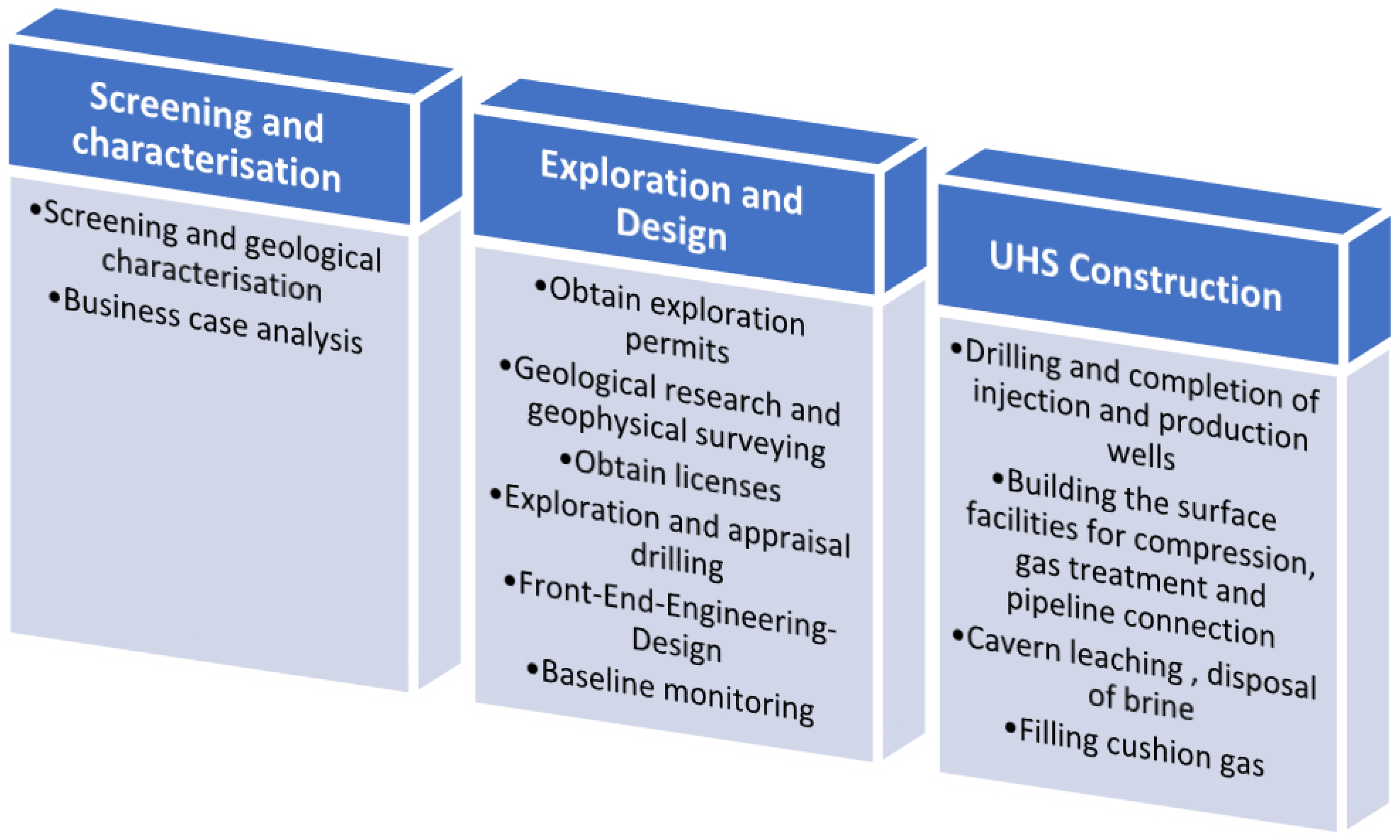
The cost estimate for any UHS project includes the capital cost (above- and below-ground infrastructure) and the cost of gas storage [216,217]. The investment costs include—exploration and appraisal (at the screening and characterisation stage), geological and geophysical surveys, and the drilling of exploration and appraisal wells, as well as design and baseline monitoring (at the exploration and design stage). Other costs include drilling and equipping wells, the construction of surface infrastructure (compression, gas treatment, and pipeline connection facilities), cavern leaching in the case of salt field storage, and pillow gas fill at the UHS construction stage. Investment costs are influenced by the type of geological structure chosen for UHS and the geological conditions. Porous media and caverns in salt deposits have site-specific parameters that affect UHS costs. In the case of deep saline aquifers, site characterisation for hydrogen storage will require higher investment in exploration and drilling compared to depleted natural gas reservoirs. This indicates that geological differences between these types of structures have a significant impact on upfront costs, even when the same UHS technology is applied. The cost of storage is also influenced by the depth of the reservoir and the location of the storage site, whether onshore or offshore. The presence of wells that need to be plugged or sealed (particularly in the case of depleted hydrocarbon fields) and the number of required production wells significantly impact the construction cost of a UHS facility. For salt caverns, the costs also depend on the depth and thickness of the salt deposit in which the caverns are to be leached, access to the water required to leach the salt, and the cost of disposing of or reusing the brine [45].
Surface infrastructure capital expenditures (CAPEX) include (Figure 3) equipment such as compressors, while subsurface infrastructure includes wells [218]. A part of the capital cost of UHS is the CG [219]. The amount and type of CG determine the cost. The requirement for CG depends on the type of geological structure used for hydrogen storage. Hydrogen storage in salt caverns is characterised by a higher working gas-to-cushion gas ratio compared to storage in porous formations. This may reduce the economic efficiency of salt cavern storage, particularly in scenarios where access to buffer gas is limited. Analyses indicate that using nitrogen instead of hydrogen as the cushion gas can significantly lower this component of capital cost, suggesting that innovative cushion gas strategies could become a key factor in cost optimisation for UHS [220].
Figure 3.
CAPEX elements of UHS (based on [45]).
The following components are considered the most cost-intensive for a surface plant: compressors, hydrogen dehydration and purification equipment, and gas transport pipelines. For the underground part of the UHS, the largest CAPEXs are incurred in appraisal studies, drilling, well equipment, and costs associated with filling the storage facility with CG [45].
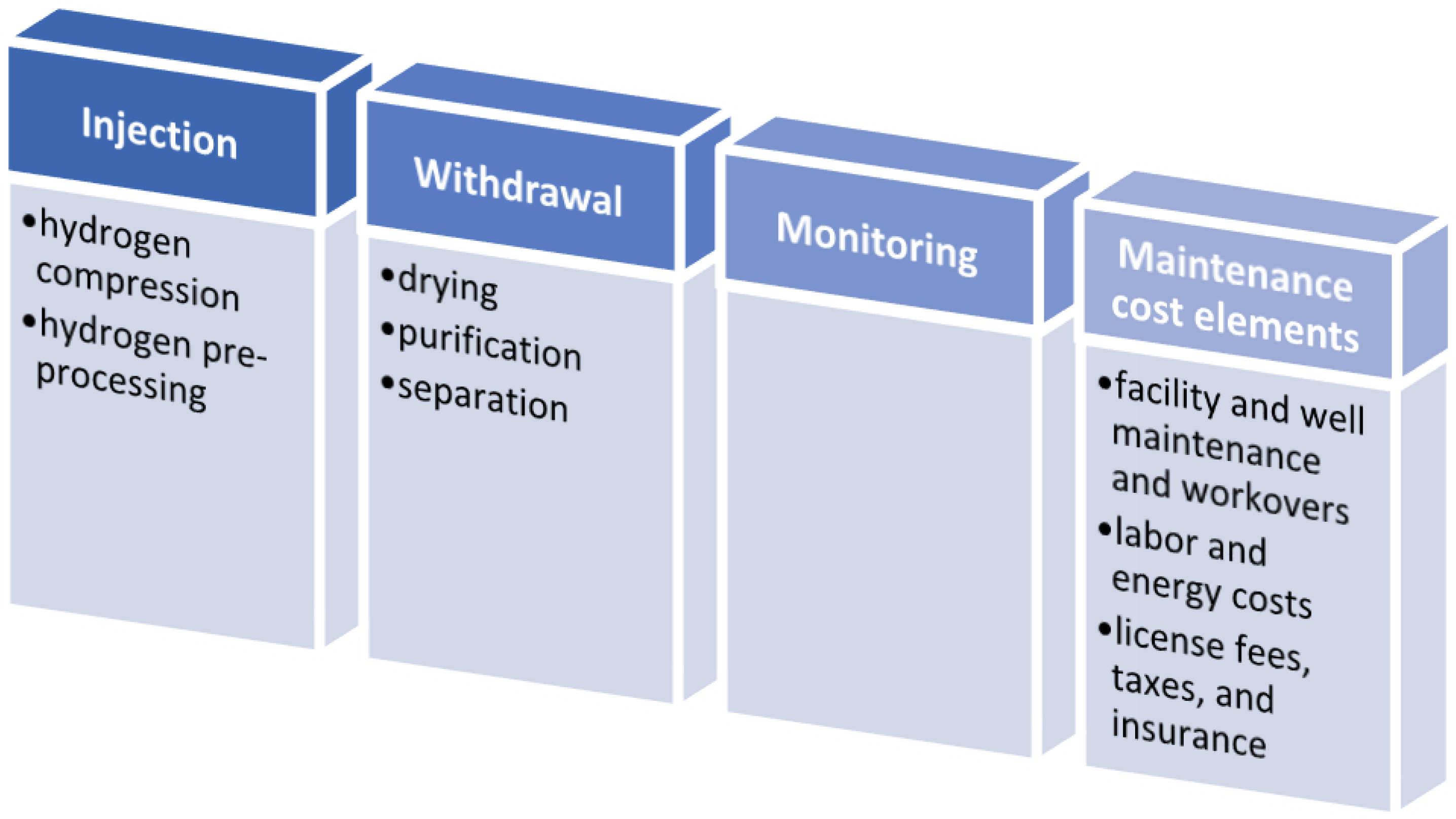
The operating expenses (OPEX) of hydrogen storage (Figure 4) over the lifetime of an underground storage facility consist of the costs of injection (hydrogen preparation and compression), withdrawal (gas drying, purification, and separation), monitoring, and storage management (equipment maintenance and resource consumption) [45,99]. The costs for hydrogen injection/withdrawal are primarily energy costs, and in the case of gas withdrawal, they include costs for additional hydrogen treatment materials. Monitoring costs consist of measurement and testing expenses carried out to the extent that they depend on regulations. Maintenance costs represent the financial expenses incurred for regular and occasional maintenance, repairs, and inspections. Hydrogen injection/withdrawal costs are assumed to have a medium to high impact on the total operating costs, monitoring costs have a low impact, and maintenance costs have a potentially high impact [45].
Figure 4.
OPEX elements of UHS (based on [45]).
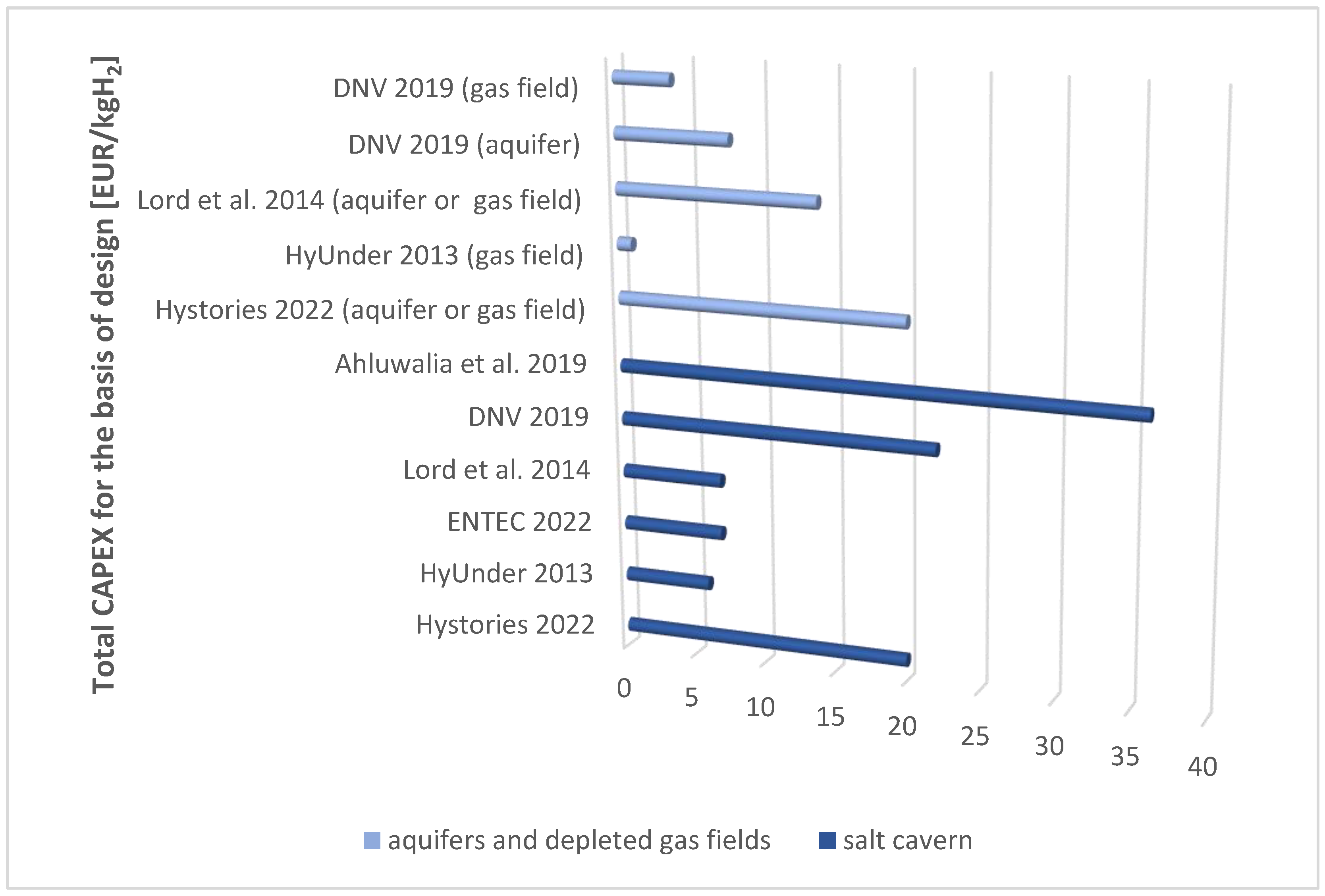
The cost estimates for UHS have been published (Figure 5), showing a wide variation in costs due to the assumptions made and the geological variations in the hydrogen storage sites [45]. OPEX costs are assumed to be 1–4% of CAPEX, depending on the estimate [45,221,222].
Figure 5.
UHS capital investment costs for the basis of design (data based on sub [91,217,223,224,225,226]).
Project HyStories (Hydrogen Storage in European Subsurface, 2021–2024) [226] represents one of the first comprehensive studies focused on the economics of underground hydrogen storage in Europe. One of the project’s main objectives was the development of a standardised cost model covering both CAPEX and OPEX across the full life cycle of UHS infrastructure, from design and construction through operation to decommissioning.
Analyses were conducted for two main types of geological structures: salt caverns and porous formations, including depleted hydrocarbon reservoirs and deep saline aquifers. The results demonstrated that salt caverns currently represent the most mature and economically viable UHS technology, offering high containment integrity, simpler site preparation, and shorter implementation timelines. Although porous formations require more advanced geological investigations and monitoring, they offer promising long-term potential for large-scale storage due to their high capacity.
Ultimately, the study concluded that the economic viability of UHS depends not only on the type of geological formation but also on site-specific geological conditions, existing infrastructure, and the intended operational strategy—emphasising the importance of individual site assessments.
The cost analyses of UHS indicate that depleted gas reservoirs are the most economically viable option among the three main types of underground hydrogen storage [224]. Compared to salt caverns and other porous formations, this suggests that the reuse of existing infrastructure may offer a significant cost advantage in many regions. The costs of hydrogen storage in aquifers are slightly higher (up to 28 EUR/kg H2), while the highest costs are associated with storage in salt caverns (up to approximately 60 EUR/kg H2) [224]. Analyses indicate that the largest impact on the CAPEX costs for porous rock storage comes from CG and the construction of salt cavern storage [99]. Talukdar et al. estimated the current and future costs of UHS based on information from European UGSs. The capital costs for UHS range from USD 10 million to USD 1 billion. Porous rock and salt cavern storage sites with a minimum storage capacity of 0.5 TWh WGE have costs of USD 1.5 per kilogram of hydrogen and USD 0.8/kg of hydrogen, respectively [227]. There is a lack of reliable information on the relevant operational costs, revenue, and economic viability of UHS. Projections of hydrogen storage demand are often based on uncertain assumptions. The indicated discrepancies in the estimation results demonstrate that future projects will enable a reasonable estimate of the costs of UHS.
The economic aspects of underground hydrogen storage (UHS) are critical to its implementation, yet they face substantial challenges. The main barriers include high capital investment costs—particularly for salt caverns and deep saline aquifers—uncertainty regarding future demand for UHS, and the lack of empirical data from demonstration-scale installations. Variations in CAPEX and OPEX across storage types arise from factors such as the proportion of cushion gas, reservoir depth, and the need to adapt materials to hydrogen’s chemically aggressive environment. Key implementation thresholds include the development of standardised and regionally adapted cost models, improving the transparency of economic assessments, integrating techno-economic analysis with technical risk evaluation, and deploying pilot projects for each geological storage type. Only through such initiatives can reliable comparisons of UHS costs and economic feasibility be made relative to alternative energy storage technologies.
3.4. Policies and Regulations
To date, no specific standards or regulatory frameworks have been established for UHS technology, in contrast to carbon capture and storage (CCS), where more advanced regulations already exist and serve as a reference point for emerging hydrogen-related legislation. An integrated vision for a hydrogen infrastructure is still in the early stages of legislation. It should be emphasised that the legal requirements cover different aspects of UHS and fall under various types of legislation: mining, construction, environmental, health and safety, and other related legislation [228]. Hydrogen storage projects require a high level of safety regulation, comparable to that in the petrochemical and CCS sectors. However, they must also account for the specific properties of hydrogen—particularly its high diffusivity and propensity for leakage—which pose unique safety and containment challenges [57,229].
The hydrogen economy has been incorporated into a number of EU policies and legislations in recent years. These documents acknowledge that hydrogen is an essential element in achieving the objectives enshrined in the “European Green Deal”, the Hydrogen Strategy for a Climate Neutral Europe [4], and the ‘Ready for 55’ package. In response to these policy documents, regulations on hydrogen have begun to be developed at the EU level. In March 2023, EU Member States agreed on a council position [3] to create a hydrogen market, integrate renewable gases (including hydrogen) into the gas grid, and enhance security of supply and cooperation. Two EC hydrogen regulations are expected to be published in 2023. Regulation 2023/1184 envisions the creation of a hydrogen market, the integration of renewable gases (including hydrogen) into the gas grid, and increased security of supply and cooperation. Regulation 2023/1184 [230] provides a methodology for calculating the carbon footprint of hydrogen-based fuels, referred to as renewable fuels of nonbiological origin. The subsequent Commission Delegated Regulation (EU) 2023/1185 [231] outlines the necessary conditions for hydrogen to be considered renewable hydrogen (green hydrogen). The EC has already taken steps toward including hydrogen in the European gas directives. Projects such as GRHYD, HyDeploy, and HIGG, which assume blending up to 20% hydrogen into the gas network, are preparing a technical basis for increasing these limits [228].
In most existing regulations across EU member states, hydrogen is classified as a chemical product rather than an energy carrier. Unlike the legal definition of natural gas, this classification limits the applicability of energy-sector regulations and subsidies to UHS, thereby constraining its integration within broader energy policy frameworks. This is a significant obstacle to the development of UHS. Therefore, it is necessary to revise this definition to recognise hydrogen as an energy carrier [228].
Existing regulations governing natural gas storage and CO2 sequestration are frequently cited as reference frameworks for the development of UHS-specific legislation. Nevertheless, compared to these sectors, UHS requires additional regulatory provisions to account for hydrogen’s unique risks—such as migration through nanostructures and material reactivity. Safety and related aspects of hydrogen storage should be considered in future UHS regulations. Thus, there is a need to regulate the underground storage of hydrogen, starting with the selection of a storage site and extending through the injection process, including monitoring and a post-closure action plan. An important issue to be addressed is the safe storage of H2, which should be performed under appropriate licences [19,232,233]. Legislators should distinguish between onshore and offshore hydrogen storage [40,157,234,235]. Legislation should distinguish between onshore and offshore hydrogen storage [236]. Government authorities should have adequate means of control or oversight, which could ultimately lead to the revocation of UHS licences [19,237].
UHS regulations should consider companies involved in UHS, stakeholders interested in the use of RES, various industrial sectors (power and petrochemical plants), transport, and other stakeholders [19,237,238]. These are required by the relevant authorities to establish permitting and licencing procedures and to oversee development and operation in a responsible manner. Operators must rely on a stable and foreseeable regulatory framework to justify their high investment costs and long lead times.
A UHS can give rise to conflicts of interest in relation to different uses of geological structures, spatial planning, and nature conservation [237]. For example, a hydrogen storage site could potentially have other uses, such as natural gas and fuel storage, CO2 storage, or geothermal energy exploitation [19,233]. Policies in most countries lack conflict-of-law rules for regulating geology, mining, spatial development, and property management, which would guarantee equal access to geological resources for different entities.
The legal situation for UHS varies among EU countries. The legislation in force is at different stages of the procedure, and each country has its own regulations for different areas of hydrogen use (such as energy, mining, or environment). A study carried out by the Hystories project analysed the existing legal situation in European countries regarding underground natural gas and hydrogen storage. Of the 18 countries examined, only four (Austria, Denmark, Germany, and the United Kingdom) have UHS regulations to varying extents, three of which are being developed (France, the Netherlands, and Poland). In Austria, UHS can only be implemented for scientific research projects. In Germany, the existing legislation for the underground storage of chemical products is not specific to UHS. Due to its long experience in hydrogen storage, only the United Kingdom has established UHS regulations [228].
The development of underground hydrogen storage (UHS) in Europe faces significant limitations due to the absence of a unified legal framework and the fragmentation of national regulations, which hinders both investment and procedural standardisation. At present, hydrogen lacks a clearly defined legal status within the European Union’s legislative system—it is not fully integrated into existing energy, climate, or environmental directives. This ambiguity complicates its classification as a storage medium and obstructs the formulation of consistent regulatory measures.
As a result, EU member states adopt divergent legislative approaches: Germany and the Netherlands are working on adapting regulations originally developed for underground natural gas storage, while countries in Central and Eastern Europe—such as Poland, the Czech Republic, and Romania—still lack specific legal provisions dedicated to UHS. These disparities also extend to issues of ownership, environmental liability, and the procedures for obtaining geological and mining permits.
Analyses from the HyStories project [226] emphasise the urgent need to harmonise regulations at the EU level through the development of common definitions, technical standards, safety criteria, and risk assessment protocols. The project also highlights the importance of integrating UHS into existing legal frameworks for UGS and CCS, which would facilitate the establishment of a coherent regulatory system to support the expansion of hydrogen infrastructure across Europe.
The legal regulations governing underground hydrogen storage (UHS) remain in the early stages of development, representing a major barrier to the deployment of this technology. Unlike more established sectors—such as natural gas storage or CO2 sequestration—the absence of coherent legislation creates significant investment and operational uncertainty. Key regulatory challenges include discrepancies in the classification of hydrogen as a chemical product rather than an energy carrier, the lack of comprehensive safety standards, and legislative inconsistency across EU member states. A critical threshold lies in the need to harmonise regulations at the European level by establishing a legal framework that spans the entire lifecycle of UHS projects—from site selection and injection to monitoring and eventual decommissioning—while also addressing potential conflicts in subsurface land use.
At the same time, regulatory experience from the CCS and natural gas sectors should serve as a reference point in designing UHS-specific rules, with appropriate adjustments to reflect the distinct properties and risks associated with hydrogen.
4. Towards Underground Hydrogen Storage
In view of the urgent need to replace fossil fuels with RES, global and regional energy scenarios foresee a significant role for low- and zero-emission hydrogen in future energy systems. Therefore, the demand for large-scale green hydrogen storage is expected to increase. This will be necessary to balance fluctuations in energy supply and demand and to strategically secure energy access on a daily and seasonal scale. The quantities of H2 anticipated for future storage indicate that this can only be realised practically through underground storage in suitable geological formations. UHS is considered a key technology for achieving the storage capacity of GWh to TWh needed to meet peak and seasonal energy demands.
The similarity of UHS to UGS technology, which has been in commercial use for several decades, suggests that there are lessons to be learned in this area. UHS targets the same underground reservoirs as UGS and incorporates similar principles of design, well and plant construction, and underground storage operations. Although there are many similarities between UHS and UGS, significant differences exist due to the distinct physical and chemical properties of hydrogen compared with those of methane or natural gas. Results have shown that the presence of hydrogen in various types of storage formations can have different effects. These factors can adversely affect storage operations (injection efficiency, reservoir integrity, withdrawal volume, and the quality of the hydrogen withdrawn) and other important aspects of UHS. This applies to varying extents for storage in porous structures and salt caverns. The early recognition of the impact of injected hydrogen on the underground environment and technical infrastructure, along with a determination of the economic and legal aspects of this technology, is essential.
Currently, UHS technology is in the early stages of development and is not ready for full industrial-scale deployment. We have limited experience with the underground storage of pure hydrogen at a few sites in the United States and the United Kingdom, and only in salt caverns. The commercial storage of mixtures of hydrogen and other gases such as methane, CO2, and nitrogen (known as ‘town gas’) has decades of experience. Trials are underway to inject hydrogen-natural gas mixtures into depleted gas fields. Such experiments are important for understanding the behaviour of hydrogen in a real underground environment, despite the limited scale and underground storage of hydrogen mixtures with other gases.
Interest in UHS has increased in recent years. This has resulted in a surge in the number of research projects and studies on the feasibility of UHS under different conditions, as well as scientific articles. Several new pieces of information and knowledge have been generated. This can and should be applied to and demonstrated in real geological environments. Today, the technical development of UHS is either at the conceptual level or in the preparation stage of pre-commercial pilot projects. What remains to be done is to demonstrate UHS on a full scale. Large-scale pilot and demonstration projects will address important knowledge gaps and validate the experimental results in underground environments. They contribute to building industrial experience, demonstrate business cases, and allow stakeholders and the public to become familiar with the benefits and implications of UHS.
However, UHS remains immature. Many technical, economic, and regulatory barriers must be overcome to accelerate commercial implementation; the road to mature and commercial deployment of UHS is still long. Experience must be gained from pilot and demonstration projects. The emerging demand for storage capacity, which is likely to grow rapidly beyond 2030, shows promise for the development of this technology. Collaboration among academia, industry, governmental and non-governmental organisations, and other stakeholders is crucial. Adequate efforts to gain new knowledge, reduce risk, and build trust and experience in UHS will overcome the existing barriers and pave the way for the demonstration and use of the knowledge gained.
There are several fundamental and practical challenges associated with the properties and behaviour of hydrogen that need to be addressed before the technology is sufficiently mature for commercial applications. These challenges include hydrogen’s high reactivity, extremely low density under standard conditions, relatively low viscosity, high diffusivity, and low water solubility. Although research under laboratory conditions is still ongoing, concepts related to the scale-up and integration of UHS into future energy systems should be tested and verified in a real underground environment. This provides a basis for establishing a robust regulatory framework and best practices for developing UHS in a safe and socially acceptable manner.
TCP-Task 42 representing the collective voices of discussion among numerous experts, provides important recommendations regarding the development of UHS. These recommendations focus on increasing confidence in UHS technology based on laboratory, model, and pilot tests conducted across various geological environments and under diverse operational conditions; developing the UHS market; identifying and addressing market gaps; improving and validating methods and strategies for risk assessment and uncertainty reduction; and establishing a systematic approach to the social rooting of UHS.
The considerations presented in this article raise the question of what is needed today and what actions should be taken to accelerate the demonstration and deployment of UHS. Answering this question requires a knowledge analysis of the various aspects of UHS and their impact on the development and deployment of this technology. Additionally, it is essential to address the key actions required to improve the technological and economic readiness of UHS while contributing to public acceptance of this technology. A comprehensive approach to identifying the thresholds and challenges facing UHS is beneficial.
This article presents the thresholds and challenges confronting UHS in relation to eight relevant topic areas: site screening and selection, geological characterisation, hydrogen storage capacity, hydrogen interactions with storage formations, hydrogen storage infrastructure, hydrogen injection/withdrawal management, UHS monitoring, economic aspects, and legal and regulatory aspects of UHS. The thresholds and challenges considered important by the authors for accelerating UHS demonstration and deployment are presented in Table 2.
Table 2.
Thresholds and challenges to underground hydrogen storage.
Thresholds and challenges to underground hydrogen storage
Site screening, selection, and characterisation. Each geological structure considered for UGS has unique characteristics that must be characterised. Unlike engineering technologies, geological concepts cannot be replicated without assessing the site-specific conditions. Often, experience is not transferable from one site to another. Significant uncertainty in the geological characteristics of a site impacts many risks associated with a UHS project.
Hydrogen storage capacity. The hydrogen storage capacity is understood differently for storage in porous rocks compared to salt caverns. Storage in porous rocks pertains more to the geological conditions that allow for the filling of the free space between rock grains. In the case of caverns in salt deposits, it refers to technical considerations related to the leaching of a sufficient number of caverns for storage.
Interactions of hydrogen with the storage complex. Hydrogen is a highly reactive element that can induce geochemical and microbiological reactions in underground storage, which may affect the geomechanical behaviour of the storage complex and the sealing overburden rocks. The peculiar properties of hydrogen necessitate laboratory results that relate to actual underground storage activities, allowing for reliable predictions and the monitoring of the behaviour and effects of hydrogen injection. Experience with safe and efficient injection and the tightness of natural gas stored for years in porous rock formations and salt caverns can be leveraged here.
Hydrogen storage infrastructure. UHS facilities have designs, construction, and operational concepts similar to those of typical UGS facilities. However, uncertainties exist regarding the necessary adaptations of various components of the facility and wells, as well as the suitability of existing wells and UHS infrastructure components for safe and efficient hydrogen storage. Hydrogen can adversely affect the mechanical properties of the steel used, and the elastomers can degrade when exposed to extreme temperatures and aggressive chemicals, potentially leading to a loss of cement integrity.
Hydrogen storage management. Numerous natural gas UGS facilities operating in salt caverns and porous reservoirs provide valuable analogues for assessing storage performance. These experiences can be extrapolated to UHS but only to a limited extent due to the differing physical and chemical properties of hydrogen. The primary differences arise from the expected requirements for higher injection/withdrawal and cycle rates to match changing demand and purity of the hydrogen received. Technologies for purifying the gas from storage are crucial for meeting the quality criteria for hydrogen transferred to the hydrogen transport network and end users.
Hydrogen storage monitoring. Monitoring the behaviour of hydrogen stored underground is still in an early stage of development. The advancement of appropriate monitoring techniques to detect leaks and identify integrity problems in UHS infrastructure is still pending implementation. Therefore, new monitoring techniques must be tested in actual subsurface environments. The lack of in situ observations and test results complicates the validation and fitting of numerical models, leading to higher operational and economic risks that affect storage security.
Economic aspects of UHS. Experience with storage in salt caverns allows for a fairly reliable estimate of the CAPEX and operating costs associated with UHS. However, a much greater uncertainty arises for reservoirs in porous rocks. Currently, the UHS market is immature, with a lack of information on relevant operating costs, revenue, and the economic viability of UHS. Forecasts regarding the demand for hydrogen storage are often based on uncertain assumptions. Furthermore, unclear futures market regulations contribute a high degree of uncertainty to future revenues and magnify investment risks.
Policies and regulations of UHS. To date, standards and regulations specifically for UHS technology have not been developed. Legal requirements related to UHS fall under different types of legislation. The recognition of hydrogen as a chemical product rather than as an energy carrier poses a major obstacle to the implementation of UHS. UHS operators should function under a stable and predictable regulatory framework that justifies their high costs, investment risks, and long lead times. The regulations governing UHS should meet the needs of all stakeholders interested in utilising this technology.
Author Contributions
Conceptualisation, R.T. and B.U.-M.; methodology, R.T. and B.U.-M.; writing—original draft preparation, R.T. and B.U.-M.; writing—review and editing, R.T. and B.U.-M. All authors have read and agreed to the published version of the manuscript.
Funding
This research was funded by AGH University of Krakow (Subsidy No. 16.16.190.779) and the Mineral and Energy Economy Research Institute of the Polish Academy of Sciences (research subvention).
Data Availability Statement
No new data were created or analysed in this study. The original contributions presented in the study are included in the article, further inquiries can be directed to the corresponding author.
Conflicts of Interest
The authors declare no conflicts of interest.
Abbreviations
The following abbreviations are used in this manuscript:
| CAPEX | Capital expenditure |
| CG | Cushion gas |
| OPEX | Operational expenditure |
| RES | Renewable energy source |
| UGS | Underground natural gas storage |
| UHS | Underground hydrogen storage |
References
- IRENA. International Co-Operation to Accelerate Green Hydrogen Deployment; International Renewable Energy Agency: Abu Dhabi, United Arab Emirates, 2024. [Google Scholar]
- European Commission. COM/2019/640 Communication from the Commission—The European Green Deal; European Commission: Brussels, Belgium, 2019. [Google Scholar]
- European Council European Green Deal. Available online: https://www.consilium.europa.eu/en/policies/green-deal/ (accessed on 16 September 2024).
- European Commission. COM/2020/301 Communication from the Commission to the European Parliament, the Council, the European Economic and Social Committee and the Committee of the Regions a Hydrogen Strategy for a Climate-Neutral Europe; European Commission: Brussels, Belgium, 2020. [Google Scholar]
- Directorate-General for Energy in Focus: Hydrogen—Driving the Green Revolution. Available online: https://commission.europa.eu/news/focus-hydrogen-driving-green-revolution-2021-04-14_en (accessed on 16 September 2024).
- European Commission. COM(2022) 230 Final Communication from the Commission to the European Parliament, the European Council, the Council, the European Economic and Social Committee and the Committee of the Regions REPowerEU Plan; European Commission: Brussels, Belgium, 2022. [Google Scholar]
- Cihlar, J.; Mavins, D.; van der Leun, K. Picturing the Value of Underground Gas Storage to the European Hydrogen System; Gas Infrastructure Europe: Brussels, Belgium, 2021. [Google Scholar]
- Al-Shafi, M.; Massarweh, O.; Abushaikha, A.S.; Bicer, Y. A Review on Underground Gas Storage Systems: Natural Gas, Hydrogen and Carbon Sequestration. Energy Reports 2023, 9, 6251–6266. [Google Scholar] [CrossRef]
- Tarkowski, R. Underground Hydrogen Storage: Characteristics and Prospects. Renew. Sustain. Energy Rev. 2019, 105, 86–94. [Google Scholar] [CrossRef]
- Ali, S.; Saddam, M.; Khan, H.; Kabir, A.; Amin Tuhin, R.; Azad, A.K.; Farrok, O. Hydrogen Energy Storage and Transportation Challenges: A Review of Recent Advances. In Hydrogen Energy Conversion and Management; Elsevier Inc.: Amsterdam, The Netherlands, 2024; pp. 255–287. ISBN 9780443153297. [Google Scholar]
- Aftab, A.; Hassanpouryouzband, A.; Xie, Q.; Machuca, L.L.; Sarmadivaleh, M. Toward a Fundamental Understanding of Geological Hydrogen Storage. Ind. Eng. Chem. Res. 2022, 61, 3233–3253. [Google Scholar] [CrossRef]
- Bauer, J.F.; Amro, M.M.; Nassan, T.; Alkan, H. Reservoir Engineering Aspects of Geologic Hydrogen Storage. In Proceedings of the International Petroleum Technology Conference, IPTC 2024, Dhahran, Saudi Arabia, 12–14 February 2024; pp. 1–32. [Google Scholar]
- Hematpur, H.; Abdollahi, R.; Rostami, S.; Haghighi, M.; Blunt, M.J. Review of Underground Hydrogen Storage: Concepts and Challenges. Adv. Geo-Energy Res. 2023, 7, 111–131. [Google Scholar] [CrossRef]
- Heinemann, N.; Scafidi, J.; Pickup, G.; Thaysen, E.M.; Hassanpouryouzband, A.; Wilkinson, M.; Satterley, A.K.; Booth, M.G.; Edlmann, K.; Haszeldine, R.S. Hydrogen Storage in Saline Aquifers: The Role of Cushion Gas for Injection and Production. Int. J. Hydrogen Energy 2021, 46, 39284–39296. [Google Scholar] [CrossRef]
- Kruck, O.; Crotogino, F. Benchmarking of Selected Storage Options—“HyUnder” Project; IEA: Paris, France, 2013. [Google Scholar]
- Muhammed, N.S.; Haq, B.; Al Shehri, D.; Al-Ahmed, A.; Rahman, M.M.; Zaman, E. A Review on Underground Hydrogen Storage: Insight into Geological Sites, Influencing Factors and Future Outlook. Energy Rep. 2022, 8, 461–499. [Google Scholar] [CrossRef]
- Navaid, H.B.; Emadi, H.; Watson, M.; Herd, B.L. A Comprehensive Literature Review on the Challenges Associated with Underground Hydrogen Storage. Int. J. Hydrogen Energy 2023, 48, 10603–10635. [Google Scholar] [CrossRef]
- Sambo, C.; Dudun, A.; Samuel, S.A.; Esenenjor, P.; Muhammed, N.S.; Haq, B. A Review on Worldwide Underground Hydrogen Storage Operating and Potential Fields. Int. J. Hydrogen Energy 2022, 47, 22840–22880. [Google Scholar] [CrossRef]
- Tarkowski, R.; Uliasz-Misiak, B.; Tarkowski, P. Storage of Hydrogen, Natural Gas, and Carbon Dioxide—Geological and Legal Conditions. Int. J. Hydrogen Energy 2021, 46, 20010–20022. [Google Scholar] [CrossRef]
- Thiyagarajan, S.R.; Emadi, H.; Hussain, A.; Patange, P.; Watson, M. A Comprehensive Review of the Mechanisms and Efficiency of Underground Hydrogen Storage. J. Energy Storage 2022, 51, 104490. [Google Scholar] [CrossRef]
- Wang, H.; Xin, Y.; Kou, Z.; Qu, Y.; Wang, L.; Ning, Y.; Ren, D. Numerical Study of the Efficiency of Underground Hydrogen Storage in Deep Saline Aquifers, Rock Springs Uplift, Wyoming. J. Clean. Prod. 2023, 421, 138484. [Google Scholar] [CrossRef]
- Zivar, D.; Kumar, S.; Foroozesh, J. Underground Hydrogen Storage: A Comprehensive Review. Int. J. Hydrogen Energy 2021, 46, 23436–23462. [Google Scholar] [CrossRef]
- Heinemann, N.; Alcalde, J.; Miocic, J.M.; Hangx, S.J.T.; Kallmeyer, J.; Ostertag-Henning, C.; Hassanpouryouzband, A.; Thaysen, E.M.; Strobel, G.J.; Schmidt-Hattenberger, C.; et al. Enabling Large-Scale Hydrogen Storage in Porous Media—The Scientific Challenges. Energy Environ. Sci. 2021, 14, 853–864. [Google Scholar] [CrossRef]
- Raza, A.; Arif, M.; Glatz, G.; Mahmoud, M.; Al Kobaisi, M.; Alafnan, S.; Iglauer, S. A Holistic Overview of Underground Hydrogen Storage: Influencing Factors, Current Understanding, and Outlook. Fuel 2022, 330, 125636. [Google Scholar] [CrossRef]
- Wang, J.; Wu, R.; Wei, M.; Bai, B.; Xie, J.; Li, Y. A Comprehensive Review of Site Selection, Experiment and Numerical Simulation for Underground Hydrogen Storage. Gas Sci. Eng. 2023, 118, 205105. [Google Scholar] [CrossRef]
- Amid, A.; Mignard, D.; Wilkinson, M. Seasonal Storage of Hydrogen in a Depleted Natural Gas Reservoir. Int. J. Hydrogen Energy 2016, 41, 5549–5558. [Google Scholar] [CrossRef]
- Diamantakis, N.; Peecock, A.; Shahrokhi, O.; Pitchaimuthu, S.; Andresen, J.M. A Review of Analogue Case Studies Relevant to Large-Scale Underground Hydrogen Storage. Energy Reports 2024, 11, 2374–2400. [Google Scholar] [CrossRef]
- Ekpotu, W.F.; Akintola, J.; Obialor, M.C.; Philemon, U. Historical Review of Hydrogen Energy Storage Technology. World J. Eng. Technol. 2023, 11, 454–475. [Google Scholar] [CrossRef]
- Maury Fernandez, D.; Emadi, H.; Hussain, A.; Thiyagarajan, S.R. A Holistic Review on Wellbore Integrity Challenges Associated with Underground Hydrogen Storage. Int. J. Hydrogen Energy 2024, 57, 240–262. [Google Scholar] [CrossRef]
- Miocic, J.; Heinemann, N.; Edlmann, K.; Scafidi, J.; Molaei, F.; Alcalde, J. Underground Hydrogen Storage: A Review. Geol. Soc. London, Spec. Publ. 2022, 528, 2022. [Google Scholar] [CrossRef]
- Perera, M.S.A. A Review of Underground Hydrogen Storage in Depleted Gas Reservoirs: Insights into Various Rock-Fluid Interaction Mechanisms and Their Impact on the Process Integrity. Fuel 2023, 334, 126677. [Google Scholar] [CrossRef]
- Safari, A.; Zeng, L.; Nguele, R.; Sugai, Y.; Sarmadivaleh, M. Review on Using the Depleted Gas Reservoirs for the Underground H2 Storage: A Case Study in Niigata Prefecture, Japan. Int. J. Hydrogen Energy 2023, 48, 10579–10602. [Google Scholar] [CrossRef]
- Sekar, L.K.; Kiran, R.; Okoroafor, E.R.; Wood, D.A. Review of Reservoir Challenges Associated with Subsurface Hydrogen Storage and Recovery in Depleted Oil and Gas Reservoirs. J. Energy Storage 2023, 72, 108605. [Google Scholar] [CrossRef]
- Zhong, H.; Wang, Z.; Zhang, Y.; Suo, S.; Hong, Y.; Wang, L.; Gan, Y. Gas Storage in Geological Formations: A Comparative Review on Carbon Dioxide and Hydrogen Storage. Mater. Today Sustain. 2024, 26, 100720. [Google Scholar] [CrossRef]
- Caglayan, D.G.; Weber, N.; Heinrichs, H.U.; Linßen, J.; Robinius, M.; Kukla, P.A.; Stolten, D. Technical Potential of Salt Caverns for Hydrogen Storage in Europe. Int. J. Hydrogen Energy 2020, 45, 6793–6805. [Google Scholar] [CrossRef]
- Lankof, L.; Tarkowski, R. Assessment of the Potential for Underground Hydrogen Storage in Bedded Salt Formation. Int. J. Hydrogen Energy 2020, 45, 19479–19492. [Google Scholar] [CrossRef]
- Lankof, L.; Urbańczyk, K.; Tarkowski, R. Assessment of the Potential for Underground Hydrogen Storage in Salt Domes. Renew. Sustain. Energy Rev. 2022, 160, 112309. [Google Scholar] [CrossRef]
- Ozarslan, A. Large-Scale Hydrogen Energy Storage in Salt Caverns. Int. J. Hydrogen Energy 2012, 37, 14265–14277. [Google Scholar] [CrossRef]
- Panfilov, M. Underground and Pipeline Hydrogen Storage. In Compendium of Hydrogen Energy; Gupta, R.B., Basile, A., Veziroglu, T.N., Eds.; Elsevier: Amsterdam, The Netherlands, 2016; Volume 2, pp. 91–115. [Google Scholar]
- Tarkowski, R.; Uliasz-Misiak, B. Use of Underground Space for the Storage of Selected Gases (CH4, H2, and CO2)—Possible Conflicts of Interest. Gospod. Surowcami Miner. Resour. Manag. 2021, 37, 141–160. [Google Scholar] [CrossRef]
- Reitenbach, V.; Ganzer, L.; Albrecht, D.; Hagemann, B. Influence of Added Hydrogen on Underground Gas Storage: A Review of Key Issues. Environ. Earth Sci. 2015, 73, 6927–6937. [Google Scholar] [CrossRef]
- Miocic, J.M.; Heinemann, N.; Alcalde, J.; Edlmann, K.; Schultz, R.A. Enabling Secure Subsurface Storage in Future Energy Systems. Geol. Soc. London Spec. Publ. 2023, 528, 1–7. [Google Scholar] [CrossRef]
- Kruck, O.; Crotogino, F.; Prelicz, R.; Rudolph, T. A Overview on All Known Underground Storage Technologies for Hydrogen; IEA: Paris, France, 2013. [Google Scholar]
- Kalam, S.; Abu-Khamsin, S.A.; Kamal, M.S.; Abbasi, G.R.; Lashari, N.; Patil, S.; Abdurrahman, M. A Mini-Review on Underground Hydrogen Storage: Production to Field Studies. Energy Fuels 2023, 37, 8128–8141. [Google Scholar] [CrossRef]
- van Gessel, S.; Hajibeygi, H. Hydrogen TCP-Task 42: Underground Hydrogen Storage—Technology Monitor Report 2023; IEA Hydrogen Technology Collaboration Program Task 42; IEA: Paris, France, 2023. [Google Scholar]
- IEA. Global Hydrogen Review 2023; IEA: Paris, France, 2023. [Google Scholar]
- HyUnder Project HYUNDER. Available online: https://hyunder.eu/ (accessed on 9 October 2025).
- HyStock Project HyStock. Available online: https://www.hystock.nl/en (accessed on 9 January 2025).
- HyPSTER HyPSTER—1st Demonstrator for H2 Green Storage. Available online: https://hypster-project.eu/ (accessed on 9 January 2025).
- Bauer, S. Underground Sun Storage: Final Report Public; Underground Sun Storage: Vienna, Austria, 2017. [Google Scholar]
- Amirthan, T.; Perera, M.S.A. The Role of Storage Systems in Hydrogen Economy: A Review. J. Nat. Gas Sci. Eng. 2022, 108, 104843. [Google Scholar] [CrossRef]
- Bade, S.O.; Tomomewo, O.S.; Meenakshisundaram, A.; Ferron, P.; Oni, B.A. Economic, Social, and Regulatory Challenges of Green Hydrogen Production and Utilization in the US: A Review. Int. J. Hydrogen Energy 2024, 49, 314–335. [Google Scholar] [CrossRef]
- Bagchi, C.; Patwardhan, S.D.; Iglauer, S.; Ben Mahmud, H.; Ali, M.F.J. A Critical Review on Parameters Affecting the Feasibility of Underground Hydrogen Storage. ACS Omega 2025, 10, 11658–11696. [Google Scholar] [CrossRef]
- Bai, M.; Song, K.; Sun, Y.; He, M.; Li, Y.; Sun, J. An Overview of Hydrogen Underground Storage Technology and Prospects in China. J. Pet. Sci. Eng. 2014, 124, 132–136. [Google Scholar] [CrossRef]
- Du, Z.; Dai, Z.; Yang, Z.; Zhan, C.; Chen, W.; Cao, M.; Thanh, H.V.; Soltanian, M.R. Exploring Hydrogen Geologic Storage in China for Future Energy: Opportunities and Challenges. Renew. Sustain. Energy Rev. 2024, 196, 114366. [Google Scholar] [CrossRef]
- Gianni, E.; Tyrologou, P.; Couto, N.; Carneiro, J.F.; Scholtzová, E.; Koukouzas, N. Underground Hydrogen Storage: The Techno-Economic Perspective. Open Res. Eur. 2024, 4, 17. [Google Scholar] [CrossRef]
- Jafari Raad, S.M.; Leonenko, Y.; Hassanzadeh, H. Hydrogen Storage in Saline Aquifers: Opportunities and Challenges. Renew. Sustain. Energy Rev. 2022, 168, 112846. [Google Scholar] [CrossRef]
- Khanjani, M.; Omirbekov, S.; Riazi, M. A Comprehensive Review of Hydrogen Storage in Depleted Oil and Gas Reservoirs: Parameters, Experiments, and Challenges. Renew. Sustain. Energy Rev. 2026, 225, 116123. [Google Scholar] [CrossRef]
- Leng, G.; Yan, W.; Chen, Z.; Li, Z.; Liu, B.; Deng, P.; Zhang, C.; Liu, W.; Qi, H. Technical Challenges and Opportunities of Hydrogen Storage: A Comprehensive Review on Different Types of Underground Storage. J. Energy Storage 2025, 114, 115900. [Google Scholar] [CrossRef]
- Ma, N.; Zhao, W.; Wang, W.; Li, X.; Zhou, H. Large Scale of Green Hydrogen Storage: Opportunities and Challenges. Int. J. Hydrogen Energy 2024, 50, 379–396. [Google Scholar] [CrossRef]
- Mulky, L.; Srivastava, S.; Lakshmi, T.; Sandadi, E.R.; Gour, S.; Thomas, N.A.; Shanmuga Priya, S.; Sudhakar, K. An Overview of Hydrogen Storage Technologies—Key Challenges and Opportunities. Mater. Chem. Phys. 2024, 325, 129710. [Google Scholar] [CrossRef]
- Mwakipunda, G.C.; Franck Kouassi, A.K.; Ayimadu, E.T.; Komba, N.A.; Nadege, M.N.; Mgimba, M.M.; Ngata, M.R.; Yu, L. Underground Hydrogen Storage in Geological Formations: A Review. J. Rock Mech. Geotech. Eng. 2025, 17, 6704–6741. [Google Scholar] [CrossRef]
- Pan, B.; Yin, X.; Ju, Y.; Iglauer, S. Underground Hydrogen Storage: Influencing Parameters and Future Outlook. Adv. Colloid Interface Sci. 2021, 294, 102473. [Google Scholar] [CrossRef]
- Davoodi, S.; Al-Shargabi, M.; Wood, D.A.; Longe, P.O.; Mehrad, M.; Rukavishnikov, V.S. Underground Hydrogen Storage: A Review of Technological Developments, Challenges, and Opportunities. Appl. Energy 2025, 381, 125172. [Google Scholar] [CrossRef]
- Taiwo, G.O.; Tomomewo, O.S.; Oni, B.A. A Comprehensive Review of Underground Hydrogen Storage: Insight into Geological Sites (Mechanisms), Economics, Barriers, and Future Outlook. J. Energy Storage 2024, 90, 111844. [Google Scholar] [CrossRef]
- Zeng, L.; Vialle, S.; Ennis-King, J.; Esteban, L.; Sarmadivaleh, M.; Sarout, J.; Dautriat, J.; Giwelli, A.; Xie, Q. Role of Geochemical Reactions on Caprock Integrity during Underground Hydrogen Storage. J. Energy Storage 2023, 65, 107414. [Google Scholar] [CrossRef]
- Uliasz-Misiak, B.; Misiak, J. Underground Gas Storage in Saline Aquifers: Geological Aspects. Energies 2024, 17, 1666. [Google Scholar] [CrossRef]
- DOE/NETL BEST PRACTICES: Risk Management and Simulation for Geologic Storage Projects; National Energy Technology Laboratory: Albany, OR, USA, 2017.
- Lankof, L.; Tarkowski, R. GIS-Based Analysis of Rock Salt Deposits’ Suitability for Underground Hydrogen Storage. Int. J. Hydrogen Energy 2023, 48, 27748–27765. [Google Scholar] [CrossRef]
- Lewandowska-Śmierzchalska, J.; Tarkowski, R.; Uliasz-Misiak, B. Screening and Ranking Framework for Underground Hydrogen Storage Site Selection in Poland. Int. J. Hydrogen Energy 2018, 43, 4401–4414. [Google Scholar] [CrossRef]
- Barison, E.; Donda, F.; Merson, B.; Le Gallo, Y.; Réveillère, A. An Insight into Underground Hydrogen Storage in Italy. Sustainability 2023, 15, 6886. [Google Scholar] [CrossRef]
- Bouteldja, M.; Le Gallo, Y. From Hydrogen Storage Potential to Hydrogen Capacities in Underground Hydrogen Storages. In Proceedings of the 84th EAGE Annual Conference & Exhibition, Vienna, Austria, 5–8 June 2023; Volume 2023, pp. 1–5. [Google Scholar] [CrossRef]
- Nemati, B.; Mapar, M.; Davarazar, P.; Zandi, S.; Davarazar, M.; Jahanianfard, D.; Mohammadi, M. A Sustainable Approach for Site Selection of Underground Hydrogen Storage Facilities Using Fuzzy-Delphi Methodology. J. Settl. Spat. Plan. 2020, 2020, 5–16. [Google Scholar] [CrossRef]
- Thaysen, E.M.; Armitage, T.; Slabon, L.; Hassanpouryouzband, A.; Edlmann, K. Microbial Risk Assessment for Underground Hydrogen Storage in Porous Rocks. Fuel 2023, 352, 128852. [Google Scholar] [CrossRef]
- Bouteldja, M.; Acosta, T.; Carlier, B.; Reveillere, A.; Jannel, H.; Fournier, C. Definition of Selection Criteria for a Hydrogen Storage Site in Depleted Fields or Aquifers; European Union: Brussels, Belgium, 2021. [Google Scholar]
- Behrouz, T.; Askari, A.; Forghaani, S.; Basirat, R.M.; Teymouri, A.; Bonyad, H. Fast Screening Method to Prioritize Underground Gas Storage Structures for Site Selection. In Proceedings of the International Gas Union Research Conference (IGRC 2014), Copenhagen, Denmark, 17–19 September 2014; Volume 3, pp. 2378–2386. [Google Scholar]
- Thaysen, E.M.; McMahon, S.; Strobel, G.J.; Butler, I.B.; Ngwenya, B.T.; Heinemann, N.; Wilkinson, M.; Hassanpouryouzband, A.; McDermott, C.I.; Edlmann, K. Estimating Microbial Growth and Hydrogen Consumption in Hydrogen Storage in Porous Media. Renew. Sustain. Energy Rev. 2021, 151, 111481. [Google Scholar] [CrossRef]
- IEA GHG. CCS Site Characterisation Criteria; IEA Greenhouse Gas R&D Programme: Cheltenham, UK, 2009. [Google Scholar]
- Alms, K.; Ahrens, B.; Graf, M.; Nehler, M. Linking Geological and Infrastructural Requirements for Large-Scale Underground Hydrogen Storage in Germany. Front. Energy Res. 2023, 11, 1172003. [Google Scholar] [CrossRef]
- Cavanagh, A.J.; Yousefi, S.H.; Wilkinson, M.; Groenenberg, R.M. Hydrogen Storage Potential of Existing European Gas Storage Sites in Depleted Gas Fields and Aquifers; IEA: Paris, France, 2022. [Google Scholar]
- Luboń, K.T.; Tarkowski, R. Numerical Simulation of Hydrogen Storage in the Konary Deep Saline Aquifer Trap. Gospod. Surowcami Miner.–Miner. Resour. Manag. 2023, 39, 103–124. [Google Scholar] [CrossRef]
- Scafidi, J.; Wilkinson, M.; Gilfillan, S.M.V.; Heinemann, N.; Haszeldine, R.S. A Quantitative Assessment of the Hydrogen Storage Capacity of the UK Continental Shelf. Int. J. Hydrogen Energy 2021, 46, 8629–8639. [Google Scholar] [CrossRef]
- Ventisky, E.; Gilfillan, S.M.V. Assessment of the Onshore Storage Capacity of Hydrogen in Natural Gas Fields in Argentina. Geoenergy 2023, 18, 2023. [Google Scholar] [CrossRef]
- Emmel, B.; Bjørkvik, B.; Frøyen, T.L.; Cerasi, P.; Stroisz, A. Evaluating the Hydrogen Storage Potential of Shut down Oil and Gas Fields along the Norwegian Continental Shelf. Int. J. Hydrogen Energy 2023, 48, 24385–24400. [Google Scholar] [CrossRef]
- Hassanpouryouzband, A.; Joonaki, E.; Edlmann, K.; Haszeldine, R.S. Offshore Geological Storage of Hydrogen: Is This Our Best Option to Achieve Net-Zero? ACS Energy Lett. 2021, 6, 2181–2186. [Google Scholar] [CrossRef]
- Mouli-Castillo, J.; Heinemann, N.; Edlmann, K. Mapping Geological Hydrogen Storage Capacity and Regional Heating Demands: An Applied UK Case Study. Appl. Energy 2021, 283, 116348. [Google Scholar] [CrossRef]
- Hévin, G. Underground Storage of Hydrogen in Salt Caverns. In Proceedings of the European Workshop on Underground Energy Storage, Paris, France, 7–8 November 2019. [Google Scholar]
- Tarkowski, R.; Lankof, L.; Luboń, K.; Michalski, J.; Le Gallo, Y.; Tarkowski, R. Hydrogen Storage Capacity of Salt Caverns and Deep Aquifers versus Demand for Hydrogen Storage: A Case Study of Poland. Appl. Energy 2024, 355, 122268. [Google Scholar] [CrossRef]
- Crotogino, F.; Donadei, S.; Bünger, U.; Landinger, H. Large-Scale Hydrogen Underground Storage for Securing Future Energy Supplies. In Proceedings of the WHEC, Essen, Germany, 16–21 May 2010; Institute of Energy Research-Fuel Cells: Essen, Germany, 2010; pp. 37–45. [Google Scholar]
- Vincent, C.; Smith, N.; Kirk, K.; Bow, J.; Vosper, H.; Rautenberg, S.; Cartwright, C.; Anthonsen, K.; Bader, A.G.; Dudu, A.; et al. Opportunities in Europe for Geological Storage of Hydrogen in Depleted Hydrocarbon Fields and Saline Aquifers. D1.4-1-Project Hystories. 2021. Available online: https://www.researchgate.net/publication/384013260_Opportunities_in_Europe_for_geological_storage_of_hydrogen_in_depleted_hydrocarbon_fields_and_saline_aquifers (accessed on 28 October 2025).
- HyUnder. Assessment of the Potential the Actors and Relevant Usiness Cases for Large Scale and Long Term Storage of Renewable Electricity by Hydrogen Underground Storage in Europe: Executive Summary; IEA: Paris, France, 2014. [Google Scholar]
- Mouli-Castillo, J.; Edlmann, K.; Thaysen, E.; Scafidi, J. Enabling Large-Scale Offshore Wind with Underground Hydrogen Storage. First Break 2021, 39, 59–62. [Google Scholar] [CrossRef]
- Juez-Larré, J.; van Gessel, S.; Dalman, R.; Remmelts, G.; Groenenberg, R. Assessment of Underground Energy Storage Potential to Support the Energy Transition in the Netherlands. First Break 2019, 37, 57–66. [Google Scholar] [CrossRef]
- Uliasz-Misiak, B.; Lewandowska-Śmierzchalska, J.; Matuła, R. Hydrogen Storage Potential in Natural Gas Deposits in the Polish Lowlands. Energies 2024, 17, 374. [Google Scholar] [CrossRef]
- English, J.M.; English, K.L. Overview of Hydrogen and Geostorage Potential in Ireland. First Break 2023, 41, 41–49. [Google Scholar] [CrossRef]
- Lankof, L.; Luboń, K.; Le Gallo, Y.; Tarkowski, R. The Ranking of Geological Structures in Deep Aquifers of the Polish Lowlands for Underground Hydrogen Storage. Int. J. Hydrogen Energy 2024, 62, 1089–1102. [Google Scholar] [CrossRef]
- Tarkowski, R.; Czapowski, G. Salt Domes in Poland—Potential Sites for Hydrogen Storage in Caverns. Int. J. Hydrogen Energy 2018, 43, 21414–21427. [Google Scholar] [CrossRef]
- Michalski, J.; Bünger, U.; Crotogino, F.; Donadei, S.; Schneider, G.S.; Pregger, T.; Cao, K.K.; Heide, D. Hydrogen Generation by Electrolysis and Storage in Salt Caverns: Potentials, Economics and Systems Aspects with Regard to the German Energy Transition. Int. J. Hydrogen Energy 2017, 42, 13427–13443. [Google Scholar] [CrossRef]
- Chen, F.; Ma, Z.; Nasrabadi, H.; Chen, B.; Saad Mehana, M.Z.; Van Wijk, J. Capacity Assessment and Cost Analysis of Geologic Storage of Hydrogen: A Case Study in Intermountain-West Region USA. Int. J. Hydrogen Energy 2023, 48, 9008–9022. [Google Scholar] [CrossRef]
- Lackey, G.; Freeman, G.M.; Buscheck, T.A.; Haeri, F.; White, J.A.; Huerta, N.; Goodman, A. Characterizing Hydrogen Storage Potential in U.S. Underground Gas Storage Facilities. Geophys. Res. Lett. 2023, 50, e2022GL101420. [Google Scholar] [CrossRef]
- Ciotta, M.; Tassinari, C.; Larizatti Zacharias, L.G.; van der Zwaan, B.; Peyerl, D. Hydrogen Storage in Depleted Offshore Gas Fields in Brazil: Potential and Implications for Energy Security. Int. J. Hydrogen Energy 2023, 48, 39967–39980. [Google Scholar] [CrossRef]
- Hemme, C.; van Berk, W. Potential Risk of H2S Generation and Release in Salt Cavern Gas Storage. J. Nat. Gas Sci. Eng. 2017, 47, 114–123. [Google Scholar] [CrossRef]
- Peng, H.; Fan, J.; Zhang, X.; Chen, J.; Li, Z.; Jiang, D.; Liu, C. Computed Tomography Analysis on Cyclic Fatigue and Damage Properties of Rock Salt under Gas Pressure. Int. J. Fatigue 2020, 134, 105523. [Google Scholar] [CrossRef]
- Pijnenburg, R.P.J.; Verberne, B.A.; Hangx, S.J.T.; Spiers, C.J. Inelastic Deformation of the Slochteren Sandstone: Stress-Strain Relations and Implications for Induced Seismicity in the Groningen Gas Field. J. Geophys. Res. Solid Earth 2019, 124, 5254–5282. [Google Scholar] [CrossRef]
- Truche, L.; Jodin-Caumon, M.C.; Lerouge, C.; Berger, G.; Mosser-Ruck, R.; Giffaut, E.; Michau, N. Sulphide Mineral Reactions in Clay-Rich Rock Induced by High Hydrogen Pressure. Application to Disturbed or Natural Settings up to 250 °C and 30 Bar. Chem. Geol. 2013, 351, 217–228. [Google Scholar] [CrossRef]
- Vilarrasa, V.; Makhnenko, R.; Gheibi, S. Geomechanical Analysis of the Influence of CO2 Injection Location on Fault Stability. J. Rock Mech. Geotech. Eng. 2016, 8, 805–818. [Google Scholar] [CrossRef]
- Song, Y.; Jun, S.; Na, Y.; Kim, K.; Jang, Y.; Wang, J. Geomechanical Challenges during Geological CO2 Storage: A Review. Chem. Eng. J. 2023, 456, 140968. [Google Scholar] [CrossRef]
- Rutqvist, J. The Geomechanics of CO2 Storage in Deep Sedimentary Formations. Geotech. Geol. Eng. 2012, 30, 525–551. [Google Scholar] [CrossRef]
- Saeed, M.; Jadhawar, P.; Bagala, S. Geochemical Effects on Storage Gases and Reservoir Rock during Underground Hydrogen Storage: A Depleted North Sea Oil Reservoir Case Study. Hydrogen 2023, 4, 323–337. [Google Scholar] [CrossRef]
- Yekta, A.E.; Pichavant, M.; Audigane, P. Evaluation of Geochemical Reactivity of Hydrogen in Sandstone: Application to Geological Storage. Appl. Geochem. 2018, 95, 182–194. [Google Scholar] [CrossRef]
- Bo, Z.; Zeng, L.; Chen, Y.; Xie, Q. Geochemical Reactions-Induced Hydrogen Loss during Underground Hydrogen Storage in Sandstone Reservoirs. Int. J. Hydrogen Energy 2021, 46, 19998–20009. [Google Scholar] [CrossRef]
- Hassannayebi, N.; Azizmohammadi, S.; De Lucia, M.; Ott, H. Underground Hydrogen Storage: Application of Geochemical Modelling in a Case Study in the Molasse Basin, Upper Austria. Environ. Earth Sci. 2019, 78, 177. [Google Scholar] [CrossRef]
- Tackie-Otoo, B.N.; Haq, M.B. A Comprehensive Review on Geo-Storage of H2 in Salt Caverns: Prospect and Research Advances. Fuel 2024, 356, 129609. [Google Scholar] [CrossRef]
- Hassanpouryouzband, A.; Adie, K.; Cowen, T.; Thaysen, E.M.; Heinemann, N.; Butler, I.B.; Wilkinson, M.; Edlmann, K. Geological Hydrogen Storage: Geochemical Reactivity of Hydrogen with Sandstone Reservoirs. ACS Energy Lett. 2022, 7, 2203–2210. [Google Scholar] [CrossRef]
- Hemme, C.; van Berk, W. Hydrogeochemical Modeling to Identify Potential Risks of Underground Hydrogen Storage in Depleted Gas Fields. Appl. Sci. 2018, 8, 2282. [Google Scholar] [CrossRef]
- Labus, K.; Tarkowski, R. Modeling Hydrogen—Rock—Brine Interactions for the Jurassic Reservoir and Cap Rocks from Polish Lowlands. Int. J. Hydrogen Energy 2022, 47, 10947–10962. [Google Scholar] [CrossRef]
- Truche, L.; Berger, G.; Albrecht, A.; Domergue, L. Engineered Materials as Potential Geocatalysts in Deep Geological Nuclear Waste Repositories: A Case Study of the Stainless Steel Catalytic Effect on Nitrate Reduction by Hydrogen. Appl. Geochem. 2013, 35, 279–288. [Google Scholar] [CrossRef]
- Malvoisin, B.; Baumgartner, L.P. Mineral Dissolution and Precipitation Under Stress: Model Formulation and Application to Metamorphic Reactions. Geochem. Geophys. Geosystems 2021, 22, e2021GC009633. [Google Scholar] [CrossRef]
- Didier, M.; Leone, L.; Greneche, J.M.; Giffaut, E.; Charlet, L. Adsorption of Hydrogen Gas and Redox Processes in Clays. Environ. Sci. Technol. 2012, 46, 3574–3579. [Google Scholar] [CrossRef]
- Mondelli, C.; Bardelli, F.; Vitillo, J.G.J.G.; Didier, M.; Brendle, J.; Cavicchia, D.R.D.R.; Robinet, J.-C.J.C.; Charlet, L. Hydrogen Adsorption and Diffusion in Synthetic Na-Montmorillonites at High Pressures and Temperature. Int. J. Hydrogen Energy 2015, 40, 2698–2709. [Google Scholar] [CrossRef]
- Spiers, C.J.; Hangx, S.J.T.; Niemeijer, A.R. New Approaches in Experimental Research on Rock and Fault Behaviour in the Groningen Gas Field. Geol. Mijnb./Neth. J. Geosci. 2017, 96, s55–s69. [Google Scholar] [CrossRef]
- Wentinck, H.M.; Busch, A. Modelling of CO2 Diffusion and Related Poro-Elastic Effects in a Smectite-Rich Cap Rock above a Reservoir Used for CO2 Storage. Geol. Soc. Spec. Publ. 2017, 454, 155–173. [Google Scholar] [CrossRef]
- Cappa, F.; Rutqvist, J. Modeling of Coupled Deformation and Permeability Evolution during Fault Reactivation Induced by Deep Underground Injection of CO2. Int. J. Greenh. Gas Control 2011, 5, 336–346. [Google Scholar] [CrossRef]
- Shu, W.S.; Huang, L.N. Microbial Diversity in Extreme Environments. Nat. Rev. Microbiol. 2021, 20, 219–235. [Google Scholar] [CrossRef]
- Dopffel, N.; An-Stepec, B.A.; Bombach, P.; Wagner, M.; Passaris, E. Microbial Life in Salt Caverns and Their Influence on H2 Storage—Current Knowledge and Open Questions. Int. J. Hydrogen Energy 2024, 58, 1478–1485. [Google Scholar] [CrossRef]
- Dopffel, N.; Jansen, S.; Gerritse, J. Microbial Side Effects of Underground Hydrogen Storage—Knowledge Gaps, Risks and Opportunities for Successful Implementation. Int. J. Hydrogen Energy 2021, 46, 8594–8606. [Google Scholar] [CrossRef]
- Gregory, S.P.; Barnett, M.J.; Field, L.P.; Milodowski, A.E. Subsurface Microbial Hydrogen Cycling: Natural Occurrence and Implications for Industry. Microorganisms 2019, 7, 53. [Google Scholar] [CrossRef] [PubMed]
- Thullner, M.; Regnier, P. Microbial Controls on the Biogeochemical Dynamics in the Subsurface. Rev. Mineral. Geochem. 2019, 85, 265–302. [Google Scholar] [CrossRef]
- Wang, G.; Pickup, G.; Sorbie, K.; de Rezende, J.R.; Zarei, F.; Mackay, E. Bioreaction Coupled Flow Simulations: Impacts of Methanogenesis on Seasonal Underground Hydrogen Storage. Int. J. Hydrogen Energy 2024, 55, 921–931. [Google Scholar] [CrossRef]
- Vigneron, A.; Alsop, E.B.; Lomans, B.P.; Kyrpides, N.C.; Head, I.M.; Tsesmetzis, N. Succession in the Petroleum Reservoir Microbiome through an Oil Field Production Lifecycle. ISME J. 2017, 11, 2141–2154. [Google Scholar] [CrossRef]
- Bernardez, L.A.; De Lima, L.R.P.A.; De Jesus, E.B.; Ramos, C.L.S.; Almeida, P.F. A Kinetic Study on Bacterial Sulfate Reduction. Bioprocess Biosyst. Eng. 2013, 36, 1861–1869. [Google Scholar] [CrossRef]
- Jørgensen, B.B.; Isaksen, M.F.; Jannasch, H.W. Bacterial Sulfate Reduction Above 100C in Deep-Sea Hydrothermal Vent Sediments. Science 1992, 258, 1756–1757. [Google Scholar] [CrossRef]
- Machel, H.G. Bacterial and Thermochemical Sulfate Reduction in Diagenetic Settings—Old and New Insights. Sediment. Geol. 2001, 140, 143–175. [Google Scholar] [CrossRef]
- Strobel, G.; Hagemann, B.; Huppertz, T.M.; Ganzer, L. Underground Bio-Methanation: Concept and Potential. Renew. Sustain. Energy Rev. 2020, 123, 109747. [Google Scholar] [CrossRef]
- Vreeland, R.H.; Rosenzweig, W.D.; Powers, D.W. Isolation of a 250 Million-Year-Old Halotolerant Bacterium from a Primary Salt Crystal. Nature 2000, 407, 897–900. [Google Scholar] [CrossRef]
- Ma, Y.; Galinski, E.A.; Grant, W.D.; Oren, A.; Ventosa, A. Halophiles 2010: Life in Saline Environments. Appl. Environ. Microbiol. 2010, 76, 6971. [Google Scholar] [CrossRef] [PubMed]
- Schwab, L.; Popp, D.; Nowack, G.; Bombach, P.; Vogt, C.; Richnow, H.H. Structural Analysis of Microbiomes from Salt Caverns Used for Underground Gas Storage. Int. J. Hydrogen Energy 2022, 47, 20684–20694. [Google Scholar] [CrossRef]
- Šmigáň, P.; Greksák, M.; Kozánková, J.; Buzek, F.; Onderka, V.; Wolf, I. Methanogenic Bacteria as a Key Factor Involved in Changes of Town Gas Stored in an Underground Reservoir. FEMS Microbiol. Lett. 1990, 73, 221–224. [Google Scholar] [CrossRef]
- Tremosa, J.; Jakobsen, R.; Le Gallo, Y. Assessing and Modeling Hydrogen Reactivity in Underground Hydrogen Storage: A Review and Models Simulating the Lobodice Town Gas Storage. Front. Energy Res. 2023, 11, 1145978. [Google Scholar] [CrossRef]
- Bauer, S.; Beyer, C.; Dethlefsen, F.; Dietrich, P.; Duttmann, R.; Ebert, M.; Feeser, V.; Görke, U.; Köber, R.; Kolditz, O.; et al. Impacts of the Use of the Geological Subsurface for Energy Storage: An Investigation Concept. Environ. Earth Sci. 2013, 70, 3935–3943. [Google Scholar] [CrossRef]
- Pichler, M. Underground Sun Storage Results and Outlook. In Proceedings of the EAGE/DGMK Joint Workshop on Underground Storage of Hydrogen, Celle, Germany, 24 April 2019; European Association of Geoscientists and Engineers, EAGE: Utrecht, The Netherlands, 2019; Volume 2019, pp. 1–4. [Google Scholar]
- Vavra, C.L.; Kaldi, J.G.; Sneider, R.M. Geological Applications of Capillary Pressure: A Review. Am. Assoc. Pet. Geol. Bull. 1992, 76, 840–850. [Google Scholar] [CrossRef]
- Veil, J.A.; Puder, M.G.; Elcock, D.; Redweik, J.R.J. A White Paper Describing Produced Water from Production of Crude Oil, Natural Gas, and Coal Bed Methane; Argonne National Laboratory: Lemont, IL, USA, 2004. [Google Scholar]
- Wei, L.; Jie, C.; Deyi, J.; Xilin, S.; Yinping, L.; Daemen, J.J.K.; Chunhe, Y. Tightness and Suitability Evaluation of Abandoned Salt Caverns Served as Hydrocarbon Energies Storage under Adverse Geological Conditions (AGC). Appl. Energy 2016, 178, 703–720. [Google Scholar] [CrossRef]
- England, W.A.; Mackenzie, A.S.; Mann, D.M.; Quigley, T.M. The Movement and Entrapment of Petroleum Fluids in the Subsurface. J. Geol. Soc. London 1987, 144, 327–347. [Google Scholar] [CrossRef]
- Ramesh Kumar, K.; Honorio, H.; Chandra, D.; Lesueur, M.; Hajibeygi, H. Comprehensive Review of Geomechanics of Underground Hydrogen Storage in Depleted Reservoirs and Salt Caverns. J. Energy Storage 2023, 73, 108912. [Google Scholar] [CrossRef]
- Dautriat, J.; Gland, N.; Guelard, J.; Dimanov, A.; Raphanel, J.L. Axial and Radial Permeability Evolutions of Compressed Sandstones: End Effects and Shear-Band Induced Permeability Anisotropy. Pure Appl. Geophys. 2009, 166, 1037–1061. [Google Scholar] [CrossRef]
- Ostermeier, R.M. Deepwater Gulf of Mexico Turbidites—Compaction Effects on Porosity and Permeability. SPE Form. Eval. 1995, 10, 79–85. [Google Scholar] [CrossRef]
- Suckale, J. Moderate-to-Large Seismicity Induced by Hydrocarbon Production. Lead. Edge 2010, 29, 310–319. [Google Scholar] [CrossRef]
- Hangx, S.; Bakker, E.; Bertier, P.; Nover, G.; Busch, A. Chemical–Mechanical Coupling Observed for Depleted Oil Reservoirs Subjected to Long-Term CO2-Exposure—A Case Study of the Werkendam Natural CO2 Analogue Field. Earth Planet. Sci. Lett. 2015, 428, 230–242. [Google Scholar] [CrossRef]
- Song, J.; Zhang, D. Comprehensive Review of Caprock-Sealing Mechanisms for Geologic Carbon Sequestration. Environ. Sci. Technol. 2012, 47, 9–22. [Google Scholar] [CrossRef]
- Sun, J.; Xu, H.; Wang, J.; Shi, L.; Li, C.; Tang, L.; Zhong, R. Injection–Production Mechanisms and Key Evaluation Technologies for Underground Gas Storages Rebuilt from Gas Reservoirs. Nat. Gas Ind. B 2018, 5, 616–622. [Google Scholar] [CrossRef]
- Teatini, P.; Castelletto, N.; Ferronato, M.; Gambolati, G.; Janna, C.; Cairo, E.; Marzorati, D.; Colombo, D.; Ferretti, A.; Bagliani, A.; et al. Geomechanical Response to Seasonal Gas Storage in Depleted Reservoirs: A Case Study in the Po River Basin, Italy. J. Geophys. Res. Earth Surf. 2011, 116, F02002. [Google Scholar] [CrossRef]
- Zheng, D.; Xu, H.; Wang, J.; Sun, J.; Zhao, K.; Li, C.; Shi, L.; Tang, L. Key Evaluation Techniques in the Process of Gas Reservoir Being Converted into Underground Gas Storage. Pet. Explor. Dev. 2017, 44, 840–849. [Google Scholar] [CrossRef]
- Bardelli, F.; Mondelli, C.; Didier, M.; Vitillo, J.G.; Cavicchia, D.R.; Robinet, J.C.; Leone, L.; Charlet, L. Hydrogen Uptake and Diffusion in Callovo-Oxfordian Clay Rock for Nuclear Waste Disposal Technology. Appl. Geochem. 2014, 49, 168–177. [Google Scholar] [CrossRef]
- van Noort, R. Effects of Clay Swelling or Shrinkage on Shale Caprock Integrity. In Proceedings of the 80th EAGE Conference and Exhibition 2018, Copenhagen, Denmark, 11–14 June 2018; Volume 2018, pp. 1–5. [Google Scholar] [CrossRef]
- Stone, H.B.J.; Veldhuis, I.; Richardson, R.N. Underground Hydrogen Storage in the UK. Geol. Soc. London Spec. Publ. 2009, 313, 217–226. [Google Scholar] [CrossRef]
- US-DOE. Ensuring Safe and Reliable Underground Natural Gas Storage Final Report of the Interagency Task Force on Natural Gas Storage Safety; US Department of Energy: Washington, DC, USA, 2016.
- Peach, C.J. Influence of Deformation on the Fluid Transport Properties of Salt Rocks; Facultiet Aardwetenschappen der Rijksuniversiteit Utrecht: Utrecht, The Netherlands, 1991; ISBN 9789071577314. [Google Scholar]
- Houben, M.E.; ten Hove, A.; Peach, C.J.; Spiers, C.J.; Houben, M.E.; ten Hove, A.; Peach, C.J.; Spiers, C.J. Crack Healing in Rocksalt via Diffusion in Adsorbed Aqueous Films: Microphysical Modelling versus Experiments. Phys. Chem. Earth 2013, 64, 95–104. [Google Scholar] [CrossRef]
- Arson, C.; Xu, H.; Chester, F.M. On the Definition of Damage in Time-Dependent Healing Models for Salt Rock. Géotechnique Lett. 2015, 2, 67–71. [Google Scholar] [CrossRef]
- Hunsche, U.; Hampel, A. Rock Salt—The Mechanical Properties of the Host Rock Material for a Radioactive Waste Repository. Eng. Geol. 1999, 52, 271–291. [Google Scholar] [CrossRef]
- Spiers, C.J.; Schutjens, P.M.T.M.; Brzesowsky, R.H.; Peach, C.J.; Liezenberg, J.L.; Zwart, H.J. Experimental Determination of Constitutive Parameters Governing Creep of Rocksalt by Pressure Solution. Geol. Soc. Spec. Publ. 1990, 54, 215–227. [Google Scholar] [CrossRef]
- Urai, J.L.; Spiers, C.J. The Effect of Grain Boundary Water on Deformation Mechanisms and Rheology of Rocksalt during Long-Term Deformation. In The Mechanical Behavior of Salt—Understanding of THMC Processes in Salt, Proceedings of the 6th Conference on the Mechanical Behavior of Salt (SaltMech6), Hannover, Germany, 22–25 May 2007; CRC Press: Boca Raton, FL, USA, 2007; pp. 149–158. [Google Scholar] [CrossRef]
- Urai, J.L.; Spiers, C.J.; Zwart, H.J.; Lister, G.S. Weakening of Rock Salt by Water during Long-Term Creep. Nature 1986, 324, 554–557. [Google Scholar] [CrossRef]
- Ramesh Kumar, K.; Makhmutov, A.; Spiers, C.J.; Hajibeygi, H. Geomechanical Simulation of Energy Storage in Salt Formations. Sci. Rep. 2021, 11, 19640. [Google Scholar] [CrossRef]
- Van Essen, H. Global Forum on Transport and Environment in a Globalising World the Environmental Impacts of Increased International Road and Rail Freight Transport—Past Trends and Future Perspectives. In Proceedings of the OECD/ITF Global Forum on Transport and Environment in a Globalising World, Guadalajara, Mexico, 10–12 November 2008; OECD/International Transport Forum: Paris, France, 2008; pp. 1–38. [Google Scholar]
- Kiran, R.; Teodoriu, C.; Dadmohammadi, Y.; Nygaard, R.; Wood, D.; Mokhtari, M.; Salehi, S. Identification and Evaluation of Well Integrity and Causes of Failure of Well Integrity Barriers (A Review). J. Nat. Gas Sci. Eng. 2017, 45, 511–526. [Google Scholar] [CrossRef]
- Tritto, C.; De Simoni, M.; Roccaro, E.; Pontiggia, M.; Panfili, P.; del Gaudio, L.; Visconti, L.; Iorio, V.S.; dell’Elce, G. Underground Hydrogen Storage in Depleted Gas Reservoirs: Opportunity Identification and Project Maturation Steps. Chem. Eng. Trans. 2022, 96, 313–318. [Google Scholar] [CrossRef]
- Shi, Z.; Jessen, K.; Tsotsis, T.T. Impacts of the Subsurface Storage of Natural Gas and Hydrogen Mixtures. Int. J. Hydrogen Energy 2020, 45, 8757–8773. [Google Scholar] [CrossRef]
- Elgaddafi, R.; Ahmed, R.; Shah, S. Corrosion of Carbon Steel in CO2 Saturated Brine at Elevated Temperatures. J. Pet. Sci. Eng. 2021, 196, 107638. [Google Scholar] [CrossRef]
- El-Sherik, A.M. Trends in Oil and Gas Corrosion Research and Technologies; Woodhead Publishing: Cambridge, UK, 2017; ISBN 9780081011058. [Google Scholar]
- Askari, M.; Aliofkhazraei, M.; Jafari, R.; Hamghalam, P.; Hajizadeh, A. Downhole Corrosion Inhibitors for Oil and Gas Production—A Review. Appl. Surf. Sci. Adv. 2021, 6, 100128. [Google Scholar] [CrossRef]
- Panfilov, M. Underground Storage of Hydrogen: In Situ Self-Organisation and Methane Generation. Transp. Porous Media 2010, 85, 841–865. [Google Scholar] [CrossRef]
- Muhammed, N.S.; Haq, M.B.; Al Shehri, D.A.; Al-Ahmed, A.; Rahman, M.M.; Zaman, E.; Iglauer, S. Hydrogen Storage in Depleted Gas Reservoirs: A Comprehensive Review. Fuel 2023, 337, 127032. [Google Scholar] [CrossRef]
- Trautmann, A.; Oberndorfer, M.; Mori, G.; Bauer, S. Susceptibility of Selected Steel Grades to Hydrogen Embrittlement—Simulating Field Conditions by Performing Laboratory Wheel Tests with Autoclaves. In Proceedings of the CORROSION 2019, Nashville, TN, USA, 24–28 March 2019; p. NACE-2019-13402. [Google Scholar]
- Loder, B. Summary Report on Steels K55, L80 Including H2S Containing Atmosphere and a Quenched Reference Material; European Union: Brussels, Belgium, 2022. [Google Scholar]
- Ahmed, S.; Patel, H.; Salehi, S. Numerical Modeling and Experimental Study of Elastomer Seal Assembly in Downhole Wellbore Equipment: Effect of Material and Chemical Swelling. Polym. Test. 2020, 89, 106608. [Google Scholar] [CrossRef]
- Ahmed, S.; Salehi, S. Failure Mechanisms of the Wellbore Mechanical Barrier Systems: Implications for Well Integrity. J. Energy Resour. Technol. Trans. ASME 2021, 143, 073007. [Google Scholar] [CrossRef]
- Ahmed, S.; Salehi, S.; Ezeakacha, C.; Teodoriu, C. Experimental Investigation of Elastomers in Downhole Seal Elements: Implications for Safety. Polym. Test. 2019, 76, 350–364. [Google Scholar] [CrossRef]
- Hill, D.M. Degradation of Elastomers. In Latex Dipping; De Gruyter: Berlin, Germany, 2019; pp. 73–78. [Google Scholar] [CrossRef]
- Harwood, H.J. Ethylene-Propylene-Diene Monomer (EPDM) and Fluorocarbon (FKM) Elastomers in the Geothermal Environment. J. Test. Eval. 1983, 11, 289–298. [Google Scholar] [CrossRef]
- Al-Hadrami, H.; Emadi, H.; Hussain, A. Investigating the Effects of Hydrogen on Wet Cement for Underground Hydrogen Storage Applications in Oil and Gas Wells. Int. J. Struct. Constr. Eng. 2022, 16, 252–258. [Google Scholar]
- Bihua, X.; Bin, Y.; Yongqing, W. Anti-Corrosion Cement for Sour Gas (H2S-CO2) Storage and Production of HTHP Deep Wells. Appl. Geochem. 2018, 96, 155–163. [Google Scholar] [CrossRef]
- Kutchko, B.G.; Strazisar, B.R.; Hawthorne, S.B.; Lopano, C.L.; Miller, D.J.; Hakala, J.A.; Guthrie, G.D. H2S–CO2 Reaction with Hydrated Class H Well Cement: Acid-Gas Injection and CO2 Co-Sequestration. Int. J. Greenh. Gas Control 2011, 5, 880–888. [Google Scholar] [CrossRef]
- Peng, Z.; Lv, F.; Feng, Q.; Zheng, Y. Enhancing the CO2-H2S Corrosion Resistance of Oil Well Cement with a Modified Epoxy Resin. Constr. Build. Mater. 2022, 326, 126854. [Google Scholar] [CrossRef]
- Ugarte, E.R.; Tetteh, D.; Salehi, S. Experimental Studies of Well Integrity in Cementing during Underground Hydrogen Storage. Int. J. Hydrogen Energy 2024, 51, 473–488. [Google Scholar] [CrossRef]
- Jahanbakhsh, A.; Liu, Q.; Mosleh, M.H.; Agrawal, H.; Farooqui, N.M.; Buckman, J.; Recasens, M.; Maroto-Valer, M.; Korre, A.; Durucan, S. An Investigation into CO2–Brine–Cement–Reservoir Rock Interactions for Wellbore Integrity in CO2 Geological Storage. Energies 2021, 14, 5033. [Google Scholar] [CrossRef]
- Jacquemet, N.; Pironon, J.; Lagneau, V.; Saint-Marc, J. Armouring of Well Cement in H2S–CO2 Saturated Brine by Calcite Coating—Experiments and Numerical Modelling. Appl. Geochem. 2012, 27, 782–795. [Google Scholar] [CrossRef]
- Jacquemet, N.; Pironon, J.; Saint-Marc, J. Mineralogical Changes of a Well Cement in Various H2S-CO2(-Brine) Fluids at High Pressure and Temperature. Environ. Sci. Technol. 2008, 42, 282–288. [Google Scholar] [CrossRef] [PubMed]
- Alkhamis, M.; Imqam, A. A Simple Classification of Wellbore Integrity Problems Related to Fluids Migration. Arab. J. Sci. Eng. 2021, 46, 6131–6141. [Google Scholar] [CrossRef]
- Zhao, L.; Yan, Y.; Wang, P.; Yan, X. A Risk Analysis Model for Underground Gas Storage Well Integrity Failure. J. Loss Prev. Process Ind. 2019, 62, 103951. [Google Scholar] [CrossRef]
- Bai, M.; Shen, A.; Meng, L.; Zhu, J.; Song, K. Well Completion Issues for Underground Gas Storage in Oil and Gas Reservoirs in China. J. Pet. Sci. Eng. 2018, 171, 584–591. [Google Scholar] [CrossRef]
- Hu, C.; Agostini, F.; Skoczylas, F.; Jeannin, L.; Potier, L. Poromechanical Properties of a Sandstone Under Different Stress States. Rock Mech. Rock Eng. 2018, 51, 3699–3717. [Google Scholar] [CrossRef]
- Harati, S.; Rezaei Gomari, S.; Ramegowda, M.; Pak, T. Multi-Criteria Site Selection Workflow for Geological Storage of Hydrogen in Depleted Gas Fields: A Case for the UK. Int. J. Hydrogen Energy 2024, 51, 143–157. [Google Scholar] [CrossRef]
- Jadhawar, P.; Saeed, M. Mechanistic Evaluation of the Reservoir Engineering Performance for the Underground Hydrogen Storage in a Deep North Sea Aquifer. Int. J. Hydrogen Energy 2024, 50, 558–574. [Google Scholar] [CrossRef]
- Luboń, K.; Tarkowski, R. The Influence of the First Filling Period Length and Reservoir Level Depth on the Operation of Underground Hydrogen Storage in a Deep Aquifer. Int. J. Hydrogen Energy 2023, 48, 1024–1042. [Google Scholar] [CrossRef]
- Luboń, K.; Tarkowski, R. Influence of Capillary Threshold Pressure and Injection Well Location on the Dynamic CO2 and H2 Storage Capacity for the Deep Geological Structure. Int. J. Hydrogen Energy 2021, 46, 30048–30060. [Google Scholar] [CrossRef]
- Luboń, K.; Tarkowski, R. Numerical Simulation of Hydrogen Injection and Withdrawal to and from a Deep Aquifer in NW Poland. Int. J. Hydrogen Energy 2020, 45, 2068–2083. [Google Scholar] [CrossRef]
- Luboń, K.; Tarkowski, R.; Uliasz-Misiak, B. Impact of Depth on Underground Hydrogen Storage Operations in Deep Aquifers. Energies 2024, 17, 1268. [Google Scholar] [CrossRef]
- Marousi, G.E. Hydrogen and Energy Storage within Porous Rocks. Ph.D. Thesis, Aristotle University of Thessaloniki School of Geology, Thessaloniki, Greece, 2022. [Google Scholar]
- Ershadnia, R.; Singh, M.; Mahmoodpour, S.; Meyal, A.; Moeini, F.; Hosseini, S.A.; Sturmer, D.M.; Rasoulzadeh, M.; Dai, Z.; Soltanian, M.R. Impact of Geological and Operational Conditions on Underground Hydrogen Storage. Int. J. Hydrogen Energy 2023, 48, 1450–1471. [Google Scholar] [CrossRef]
- Bünger, U.; Michalski, J.; Crotogino, F.; Kruck, O. Large-Scale Underground Storage of Hydrogen for the Grid Integration of Renewable Energy and Other Applications. In Compendium of Hydrogen Energy; Ball, M., Basile, A., Veziroğlu, T.N., Eds.; Woodhead Publishing: Cambridge, UK, 2016; pp. 133–163. ISBN 978-1-78242-364-5. [Google Scholar]
- Sainz-Garcia, A.; Abarca, E.; Rubi, V.; Grandia, F. Assessment of Feasible Strategies for Seasonal Underground Hydrogen Storage in a Saline Aquifer. Int. J. Hydrogen Energy 2017, 42, 16657–16666. [Google Scholar] [CrossRef]
- Foh, S.; Novil, M.; Rockar, E.; Randolph, P. Underground Hydrogen Storage, Final Report; Brookhaven National Laboratory: New York, NY, USA, 1979. [Google Scholar]
- Lysyy, M.; Fernø, M.; Ersland, G. Seasonal Hydrogen Storage in a Depleted Oil and Gas Field. Int. J. Hydrogen Energy 2021, 49, 25160–25174. [Google Scholar] [CrossRef]
- Kanaani, M.; Sedaee, B.; Asadian-Pakfar, M. Role of Cushion Gas on Underground Hydrogen Storage in Depleted Oil Reservoirs. J. Energy Storage 2022, 45, 103783. [Google Scholar] [CrossRef]
- Zhao, Q.; Wang, Y.; Chen, C. Numerical Simulation of the Impact of Different Cushion Gases on Underground Hydrogen Storage in Aquifers Based on an Experimentally-Benchmarked Equation-of-State. Int. J. Hydrogen Energy 2024, 50, 495–511. [Google Scholar] [CrossRef]
- Domonik, A.; Dziedzic, A.; Jarząbkiewicz, A.; Łukasiak, D.; Łukaszewski, P.; Pinińska, J. Zintegrowany System Gromadzenia, Przetwarzania i Wizualizacji Danych Geomechanicznych-Baza Danych Geomechanicznych. Górnictwo Geoinżynieria 2009, 33, 113–123. [Google Scholar]
- ISO 27914:2017; Carbon Dioxide Capture, Transportation and Geological Storage—Geological Storage. ISO: Geneva, Switzerland, 2017.
- Zeng, L.; Sarmadivaleh, M.; Saeedi, A.; Chen, Y.; Zhong, Z.; Xie, Q. Storage Integrity during Underground Hydrogen Storage in Depleted Gas Reservoirs. Earth-Sci. Rev. 2023, 247, 104625. [Google Scholar] [CrossRef]
- Ugarte, E.R.; Salehi, S. A Review on Well Integrity Issues for Underground Hydrogen Storage. J. Energy Resour. Technol. Trans. 2022, 144, 042001. [Google Scholar] [CrossRef]
- van der Valk, K.; van Unen, M.; Brunner, L.G.; Groenenberg, R.M. Inventory of Risks Associated with Underground Storage of Compressed Air (CAES) and Hydrogen (UHS), and Qualitative Comparison of Risks of UHS vs. Underground Storage of Natural Gas (UGS); Underground Storage of Natural Gas: Utrecht, The Netherlands, 2020.
- Liu, J.; Wang, S.; Javadpour, F.; Feng, Q.; Cha, L. Hydrogen Diffusion in Clay Slit: Implications for the Geological Storage. Energy Fuels 2022, 36, 7651–7660. [Google Scholar] [CrossRef]
- McMahon, C.J.; Roberts, J.J.; Johnson, G.; Edlmann, K.; Flude, S.; Shipton, Z.K. Natural Hydrogen Seeps as Analogues to Inform Monitoring of Engineered Geological Hydrogen Storage. Geol. Soc. Spec. Publ. 2023, 528, 461–489. [Google Scholar] [CrossRef]
- Chen, Y.; Niasar, V.; Ma, L.; Xie, Q. Effect of Salinity, Mineralogy, and Organic Materials in Hydrogen Wetting and Its Implications for Underground Hydrogen Storage (UHS). Int. J. Hydrogen Energy 2023, 48, 32839–32848. [Google Scholar] [CrossRef]
- Lord, A.S.; Kobos, P.H.; Borns, D.J. Geologic Storage of Hydrogen: Scaling up to Meet City Transportation Demands. Int. J. Hydrogen Energy 2014, 39, 15570–15582. [Google Scholar] [CrossRef]
- Le Duigou, A.; Bader, A.G.; Lanoix, J.C.; Nadau, L. Relevance and Costs of Large Scale Underground Hydrogen Storage in France. Int. J. Hydrogen Energy 2017, 42, 22987–23003. [Google Scholar] [CrossRef]
- Taylor, J.B.; Alderson, J.E.A.; Kalyanam, K.M.; Lyle, A.B.; Phillips, L.A. Technical and Economic Assessment of Methods for the Storage of Large Quantities of Hydrogen. Int. J. Hydrogen Energy 1986, 11, 5–22. [Google Scholar] [CrossRef]
- Yousefi, S.H.; Groenenberg, R.; Koornneef, J.; Juez-Larré, J.; Shahi, M. Techno-Economic Analysis of Developing an Underground Hydrogen Storage Facility in Depleted Gas Field: A Dutch Case Study. Int. J. Hydrogen Energy 2023, 48, 28824–28842. [Google Scholar] [CrossRef]
- Gorre, J.; Ruoss, F.; Karjunen, H.; Schaffert, J.; Tynjälä, T. Cost Benefits of Optimizing Hydrogen Storage and Methanation Capacities for Power-to-Gas Plants in Dynamic Operation. Appl. Energy 2020, 257, 113967. [Google Scholar] [CrossRef]
- Moran, C.; Deane, P.; Yousefian, S.; Monaghan, R.F.D. The Hydrogen Storage Challenge: Does Storage Method and Size Affect the Cost and Operational Flexibility of Hydrogen Supply Chains? Int. J. Hydrogen Energy 2024, 52, 1090–1100. [Google Scholar] [CrossRef]
- Ahluwalia, R.K.; Papadias, D.D.; Peng, J.-K.; Roh, H.S. System Level Analysis of Hydrogen Storage Options. In Proceedings of the 2019 Annual Merit Review and Peer Evaluation Meeting, Crystal City, VA, USA, 29 April–1 May 2019; U.S.DOE Hydrogen and Fuel Cells Program: Washington, DC, USA, 2019. [Google Scholar]
- ENTEC. The Role of Renewable H2 Import & Storage to Scale up the EU Deployment of Renewable H2; Publications Office of the European Union: Luxembourg, 2022. [Google Scholar]
- DNV. CO2QUALSTORE Guideline for Selection and Qualification of Sites and Projects for Geological Storage of CO2; Det Norske Veritas: Oslo fjord at Høvik, Norway, 2010. [Google Scholar]
- Hystories Project Hystories. Available online: https://hystories.eu/project-hystories/ (accessed on 28 March 2022).
- Talukdar, M.; Blum, P.; Heinemann, N.; Miocic, J. Techno-Economic Analysis of Underground Hydrogen Storage in Europe. iScience 2024, 27, 108771. [Google Scholar] [CrossRef]
- Martinez, S.; Simon, J. Hystories D.6.1-1—Assessment of the Regulatory Framework; IEA: Paris, France, 2021. [Google Scholar]
- Mittal, H.; Kushwaha, O.S. Policy Implementation Roadmap, Diverse Perspectives, Challenges, Solutions Towards Low-Carbon Hydrogen Economy. Green Low-Carbon Econ. 2024, 2024, 1–19. [Google Scholar] [CrossRef]
- European Commission. Commission Delagated Regulation (EU) 2023/1184 of 10 February 2023 Supplementing Directive (EU) 2018/2001 of the European Parliament and of the Council by Establishing a Union Methodology Setting out Detailed Rules for the Production of Renewable liquid and gaseous transport fuels of non-biological origin. Off. J. Eur. Union 2023, 157, 11–19. [Google Scholar]
- European Commission. Commission Delagated Regulation (EU) 2023/1185 of 10 February 2023 Supplementing Directive (EU) 2018/2001 of the European Parliament and of the Council by Establishing a Minimum Threshold for Greenhouse Gas Emissions Savings of Recycled Carbon Fuels and by specifying a methodology for assessing greenhouse gas emissions savings from renewable liquid and gaseous transport fuels of non-biological origin and from recycled carbon fuels. Off. J. Eur. Union 2023, 157, 20–33. [Google Scholar]
- Koteras, A.; Chećko, J.; Urych, T.; Magdziarczyk, M.; Smolinski, A. An Assessment of the Formations and Structures Suitable for Safe CO2 Geological Storage in the Upper Silesia Coal Basin in Poland in the Context of the Regulation Relating to the CCS. Energies 2020, 13, 195. [Google Scholar] [CrossRef]
- Uliasz-Misiak, B.; Przybycin, A. Present and Future Status of the Underground Space Use in Poland. Environ. Earth Sci. 2016, 75, 1430. [Google Scholar] [CrossRef]
- Uliasz-Misiak, B.; Przybycin, A. The Perspectives and Barriers for the Implementation of CCS in Poland. Greenh. Gases Sci. Technol. 2015, 6, 7–18. [Google Scholar] [CrossRef]
- Zhu, S.; Shi, X.; Yang, C.; Li, Y.; Li, H.; Yang, K.; Wei, X.; Bai, W.; Liu, X. Hydrogen Loss of Salt Cavern Hydrogen Storage. Renew. Energy 2023, 218, 119267. [Google Scholar] [CrossRef]
- Wilson, E.J.; Johnson, T.L.; Keith, D.W. Regulating the Ultimate Sink: Managing the Risks of Geologic CO2 Storage. Environ. Sci. Technol. 2003, 37, 3476–3483. [Google Scholar] [CrossRef]
- Tarkowski, R.; Uliasz-Misiak, B. Towards Underground Hydrogen Storage: A Review of Barriers. Renew. Sustain. Energy Rev. 2022, 162, 112451. [Google Scholar] [CrossRef]
- Feng, T.-t.; Gong, X.-l.; Guo, Y.-h.; Yang, Y.-s.; Dong, J. Regulatory Mechanism Design of GHG Emissions in the Electric Power Industry in China. Energy Policy 2019, 131, 187–201. [Google Scholar] [CrossRef]
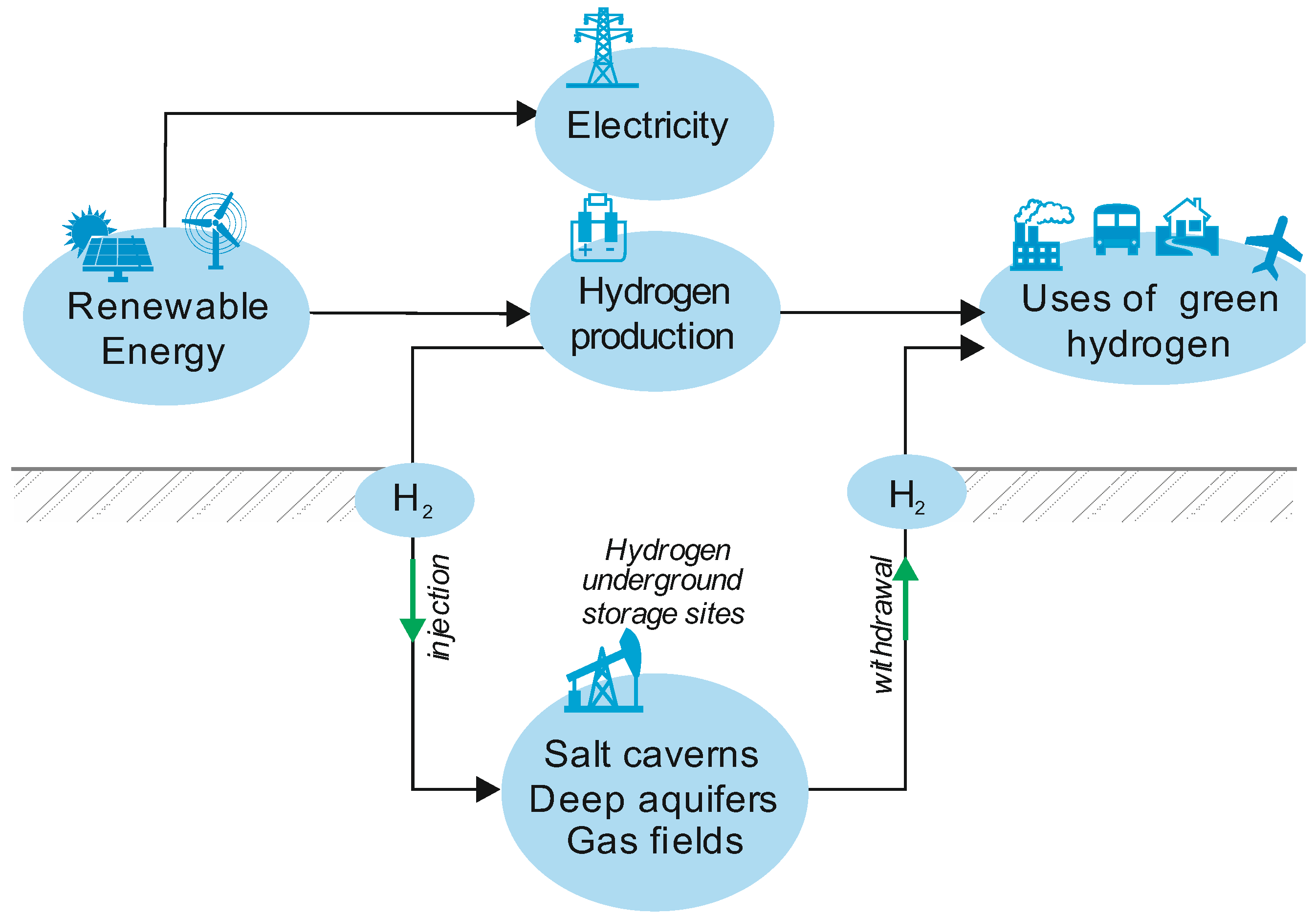
Disclaimer/Publisher’s Note: The statements, opinions and data contained in all publications are solely those of the individual author(s) and contributor(s) and not of MDPI and/or the editor(s). MDPI and/or the editor(s) disclaim responsibility for any injury to people or property resulting from any ideas, methods, instructions or products referred to in the content. |
© 2025 by the authors. Licensee MDPI, Basel, Switzerland. This article is an open access article distributed under the terms and conditions of the Creative Commons Attribution (CC BY) license (https://creativecommons.org/licenses/by/4.0/).