Abstract
Power cyber–physical systems such as multi-area power systems (MAPSs) have gained considerable attention due to their integration of power electronics with wireless communications technologies. Incorporating a communication setup enhances the sustainability, reliability, and efficiency of these systems. Amidst these exceptional benefits, such systems’ distributed nature invites various cyber-attacks. This work focuses on the equal power sharing of MAPSs in the event of false data injection (FDI) attacks. The proposed work uses a sliding mode control (SMC) mechanism to ensure timely detection of challenges such as FDI attacks and load change, making MAPSs reliable and secure. First, a SMC-based strategy is deployed to enable the detection and isolation of compromised participants in MAPS operations to achieve equal power sharing. Second, time-varying FDI attacks on MAPSs are formulated and demonstrate their impact on equal power sharing. Third, a robust adaptive sliding mode observer is used to accurately assess the state of the MAPS to handle state errors robustly and automatically adjust parameters for identifying FDI attacks and load changes. Lastly, simulation results are presented to explain the useful ability of the suggested method.
1. Introduction
Recently, the integration of power electronics and wireless communication technology has generated significant interest in power cyber–physical systems (CPSs) such as multi-area power systems (MAPSs) among experts and scholars [1]. With the increase in power demand, traditional power distribution systems are under immense strain, and renewable energy has emerged as a leading solution to alleviate this pressure on traditional power supplies [2]. Advanced power systems, functioning as CPSs, integrate physical power plants with network communication capabilities, enhancing the overall system efficiency by improving response times to fluctuations in energy supply and demand while reducing operational costs [3]. This integration enables flexible state estimation, wide-area control, and cost-effective economic dispatching [4]. However, distributed energy systems are exposed to cyber-attacks because they rely on communication networks [4]. The increasing number of cyber-threats highlights the critical need for robust detection mechanisms, especially following notable incidents such as the 2015 Ukraine blackout [5] and the 2019 Utah grid disruption [6]. These incidents underscore the urgent need for effective detection mechanisms to promptly identify malicious attacks and mitigate potential loss to power systems.
The cyber-attack detection problem of CPSs has been extensively studied [7,8], but a significant focus is false data injection (FDI) attacks [9]. FDI attacks have emerged as a considerable threat to CPSs due to their ability to manipulate data exchanged between components, disrupting critical operations such as state estimation and frequency control [7]. These attacks compromise power system operations by impacting essential functions such as frequency and voltage restoration, load sharing, power sharing, and state estimation [10]. For instance, research indicates that FDI attacks can lead to a 20% to 30% decrease in system efficiency and result in up to 50% longer recovery times [11]. Intelligent attacks can further undermine MAPS operations discreetly, making them challenging to detect [12]. Traditional data security measures, including data integrity checks, access control, and cryptography, are often inadequate for protecting MAPSs against such cyber-threats. Their inadequacy stems from limited integration with the unique data collection and processing methods inherent to power system operations [13]. This highlights the urgent need for advanced detection and mitigation strategies that can effectively address the impacts of FDI attacks on grid resilience and efficiency.
Several techniques have been proposed to address these attacks, typically categorized into knowledge-based and data-driven approaches [14]. Data-driven techniques, including machine learning, can infer system models from real-time data but are often computationally demanding and require extensive training datasets [15]. Knowledge-based detection methods, such as residual-based detection, compare system models with observed data, though they face scalability challenges in large, distributed systems [13]. In recent years, detection strategies such as Kalman-filter-based methods [16] have been proposed for smart grids, but these techniques may fail when FDI attacks mimic historical data patterns. Euclidean-distance-based metrics [17] and observer-based techniques [18] have improved detection in simulations, but these methods still face limitations in large-scale, decentralized MAPSs, where communication delays and scalability concerns arise. Similarly, the reliability of SMC has been utilized to address external disturbances [19], along with an adaptive SMC-based technique for detecting attacks and reconstructing subsequent impacts in the power system [18]. It is important to note that these detection strategies have primarily been implemented in centralized architectures, necessitating comprehensive knowledge of the entire power system. However, this centralized approach may not be feasible or practical for extensive distributed power systems.
Given the complex and large-range nature of MAPSs, there has been a shift towards decentralized and distributed approaches for control design, state estimation, and economic dispatching. In contrast to centralized control methods, distributed control strategies involve using distributed energy resources (DERs) to share data among neighboring units via a limited communication network. These strategies find broad application in power systems such as microgrid operations, managing tasks such as restoring voltage and frequency, sharing both active power and reactive power in proportion, optimizing economic operations, and more [20]. The operational parameters of DERs involved, such as frequencies, voltages, incremental costs, and active power distribution, are treated as variables of consensus. Networked control schemes are designed to guide variables towards targeted values based on specialized objectives [21], such as equal power sharing. These strategies enable simultaneous data processing, accelerating the system’s responsiveness to fluctuating DERs and loads. This efficiency helps reduce infrastructure costs and enhance system scalability by leveraging sparse communication networks, yet these are susceptible to external attacks such as denial of service attacks, deception attacks, and FDI attacks.
Various schemes have been proposed for identifying and mitigating attacks such as FDI in MAPSs, including invariant-based detection [22], software-defined networking [23], active synchronous detection [24], Kalman-filter-based feedback control [17], and trust/reputation-based control [25]. An efficient density-based method for global sensitivity assessment has also been introduced [26], effectively identifying critical inputs and allocating defense assets to combat FDI threats. While these approaches provide valuable insights and strategies, they often fall short in delivering robust and efficient mechanisms for power sharing in MAPSs during FDI attacks. For instance, some methods treat cyber-threat signals as constant manipulations of MAPS operating points, and trust-based protocols have been designed to detect attacks [27]. However, these techniques can impose substantial communication and computational demands, potentially delaying response times [28]. Alternative approaches, such as those treating time-variant attacks as noise [29], may be ineffective if attackers possess detailed knowledge of the power system’s communication structure. In contrast, the proposed technique utilizing SMC stabilizes the system within 0.15 s to 0.2 s post-attack and effectively removes attack effects thereafter, achieving a high detection accuracy. This method demonstrates superior performance, efficiency, and resilience compared to existing approaches, addressing the limitations of traditional techniques.
Hence, a resilient control strategy against cyber-attacks for equal power sharing of a MAPS has been proposed using an SMC-based consensus control mechanism in the event of FDI attacks. The contributions of this study are outlined as follows:
- A resilient control strategy is proposed that detects potential cyber-attacks in a timely manner and isolates compromised areas (nodes) in a decentralized approach without disrupting normal MAPS operations. The resilience of this approach has been verified across numerous operational scenarios, such as load fluctuations and power sharing in the presence of FDI attacks.
- Time-varying FDI attacks on communication between different areas of MAPS are formulated and demonstrate their impact on MAPS operations. In the event of FDI attacks, the proposed control strategy effectively detects and isolates threats and swiftly restores optimal operational conditions, such as equal power sharing.
- A robust adaptive sliding mode observer is deployed to accurately assess the state of power in a CPS, such as a MAPS. Unlike traditional sliding mode observers, the proposed observer handles state errors robustly and automatically adjusts parameters to identify FDI attacks and load changes.
2. Preliminaries of Graphs
Suppose is a graph of a MAPS, which consists of n cooperating areas such that , with vertices and edges of the graph. Let an undirected path from area i to area j be represented as a sequence of edges such as . Consider Å to be an adjacency matrix, also known as the diagonal matrix, expressed as and Å. Let be a diagonal matrix where the diagonal elements represent the degree of the ith area. Specifically, D is a matrix in which all off-diagonal elements are zero, and the diagonal element corresponds to the degree of the ith area. Thus, D can be expressed as:
where denotes the degree of the ith area.
Suppose the Laplacian matrix is a semi-positive definite and symmetric matrix, expressed as Å and . If , then ; otherwise,
3. System Modeling
This section presents the mathematical framework of the networked MAPS. Consider a MAPS consisting of n number of areas, which coordinate with each other to perform consensus types of tasks such as equal power sharing and load frequency control. Also, suppose that sensor data of each area are sent to the centralized power control in the MAPS to facilitate the generation of required control signals. A dynamical model of MAPS can be written as
Here, , , , and denote the states, input vectors, and attack signal of nonlinear mode, respectively. C and n denote the identity matrix and number of nodes, respectively. In the same way, define the ith states of the area, where , and correspond to power deviation . The control errors of the area can be defined as
Here, represents the power bias factor. It is already defined that is an identity matrix and the remaining and F are the constant matrices, written as
Also, the matrices , and for can be written as:
Here, represents the stiffness constant of ith and jth areas. Also, , and denote unique attributes of the ith power areas such as the speed-droop coefficient, generator’s inertia, governor time constant, coefficient of damping, and time constant of the turbine, respectively.
Suppose any ith area of the MAPS is under FDI attack. Then, the actuator and sensor attacks can be expressed as
Here, and denote the injected attack signal, corrupted control input, and control input to the actuator. is a binary value used to determine whether there is an attack, i.e., , or no attack, . Further sensor attacks on the MAPS can be expressed as
Here, , and represent the attack signal, corrupted state, and normal state, respectively. The presence of an attack signal depends on the binary constant . If , an attack exist; otherwise, .
By using (10) and (11), the overall attack signal to any area of the MAPS can be modeled as
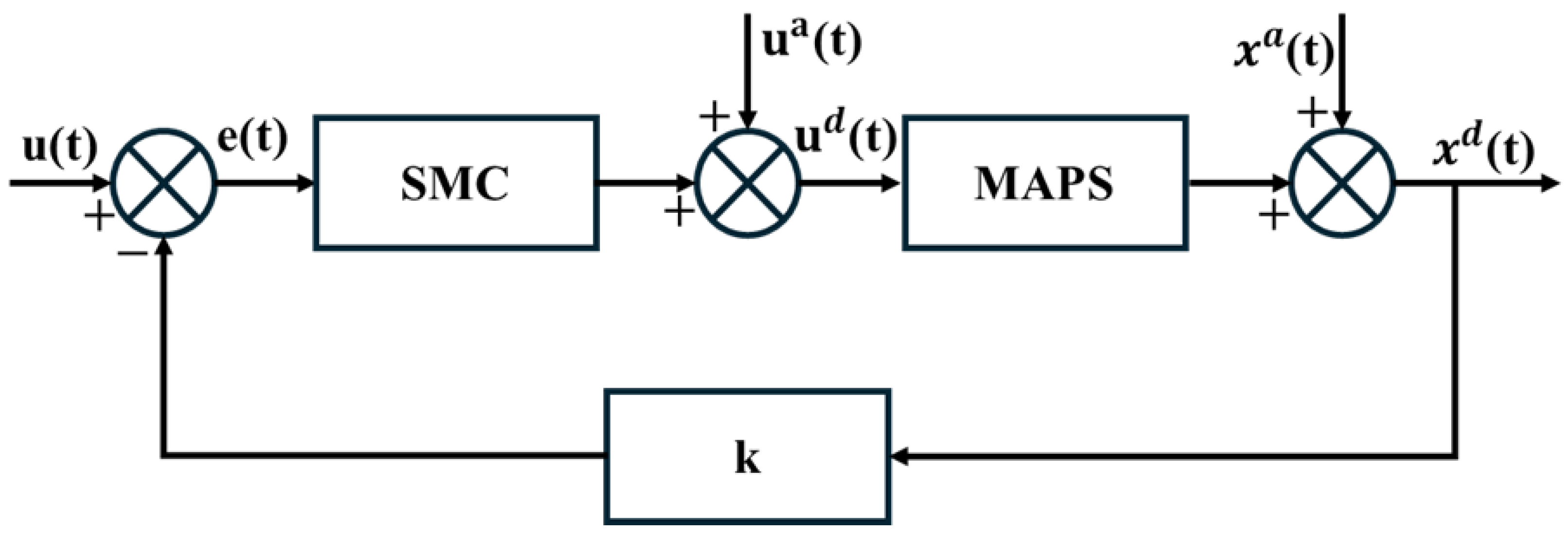
Here, the feedback gain, scalar gain, and adjacency of matrix A are represented through , and , respectively. Figure 1 shows the controller design for the MAPS to ensure equal power sharing.
Figure 1.
SMC-based control of MAPS.
4. Attack Detection
In this section, attack detection mechanisms for the real-time detection of FDI attacks are discussed. This section describes a Luenberger observer (LO) and an Artificial Neural Network (ANN) observer. ANNs are renowned for their ability to handle data-driven dynamics. They are extensively used for pattern recognition and event prediction based on evolving dynamics [30]. For instance, ANNs are employed in the production processes of renewable energy within microgrids to ensure stability and effectively balance power sharing amidst uncertainties [31]. ANNs can be deployed to detect faults and cyber-attacks, such as FDI attacks, on microgrids [32,33]. The details of both these components are presented in the subsequent sections.
4.1. ANN Observer
An ANN can be accurately used to estimate the behavior of a MAPS due to the nonlinear and unpredictable nature of FDI attacks. Therefore, the proposed attack observer can be written as follows
Here, the vector state of the LO, Luenberger gain, and ANN observer are represented by , and , respectively. Further, is described by
Here, the ith vector of observer is represented by , ∀. At time t, associated weights of ith output of the ANN are represented by and . Also, , in which the sampling time or step is represented by . The activation function is denoted by and defined as
For ith element of observer , the ANN observer be expressed as
where
updates its input iterative using past a sample input of observer and past b sample error of the MAPS at the output . Provided that for sample inputs and for sample output, the selection of a and b depends upon the required training time and accuracy of the system. Larger ranges of a and b ensure better accuracy and convergence of ANN training, but they can also increase calculation cost (time) and introduce unwanted delays as a result of the extended training period. Moreover, excessive values of a and b are not beneficial in scenarios involving non-periodic FDI attacks. Therefore, to achieve immediate and precise attack diagnosis, both a and b must be selected according to the required accuracy of the system dynamics as well as the characteristics of frequency response.
4.2. ANN Updated Law
For a resilient MAPS to ensure immediate attack detection, the ANN’s weights must be updated rapidly. In this article, a resilient tuning scheme using an extended Kalman filter (EKF) is presented. This scheme facilitates the online updating of ANN learning weights by leveraging the EKF, ensuring swift convergence of the ANN. Updating factors of the EKF for the ith element can be expressed as follows
Here, the sampling time is represented by such that .
Parameters of the ANN are updated by employing EKF algorithm at every sampling time by
Here, denotes the coefficient of learning, represents the matrix of covariance for state error estimation, indicates the Kalman gain, and refers to the matrix of covariance for the estimation of noise, which is computed recursively as follows
Here, the derivation of with respect to is represented by , which can be calculated using observer input based on (13) given as
4.3. Luenberger Observer (LO)
An LO is configured to estimate and transmits its observed data to the ANN unit to alleviate the computational burden on the ANN. The ANN utilizes the disparity between the LO and the system output as input for detecting attacks within the MAPS. The error rate for the suggested attack detection can be expressed as , via the subtraction of (21) from (1), which gives
Luenberger design can be streamlined through ANN observer , resulting in the simplification given below
Here, the gain of LO is denoted by . Suitable values of the gain are determined such that the matrix will have all negative, real eigenvalues. This ensures that the estimation error converges to 0 at . The gain could be determined by the pole-placement technique.
5. Equal Power-Sharing Condition Based on Consensus
5.1. Consensus Conditions with Communication Delay Caused by FDI Attack
This section presents the consensus conditions in the event of communication delay due to FDI attack. Suppose the control conditions given below
Here, and represents the gain constants. Let the composite state such that and . Therefore, composite dynamics can be expressed as
Here, .
Lemma 1.
In the control protocol described above, area i is ensured to experience the same delay ρ due to uncertainties such as FDI attacks. This ensures that accurate error signals are utilized in feedback mechanisms to maintain consensus. In scenarios where area i has instantaneous knowledge of , this information must be delayed before application in . In cases where only relative information is available such as rather than directly, and if there is a time delay in measurement, it is natural to apply the same delay to both area i and area j of the MAPS.
Likewise, composite dynamics with communication delay due to FDI attack can be written as
Therefore, error dynamics can be rewritten as
The control protocol (24) ensures that the MAPS defined by (1) achieves consensus if and only if the error system (27) exhibits asymptotic stability.
The Laplace transform of (27) can be calculated to analyze the characteristic equation of the MAPS, given as
Here, represents quasi-polynomials given below
5.2. Continuous Consensus Based on Sliding Mode Control
This section presents a control strategy for a MAPS in the presence of FDI attack. By using Equation (1), a control law for the MAPS using SMC is adapted. The adjusted SMC surface can be expressed as:
Here, is the starting condition of the . The SMC-based integrator state for the MAPS is maintained by . So, one obtains
Following this, an enhanced SMC-based consensus framework can be formulated as
The vector form of (32) can be expressed as
Here, parameters , and stand for control inputs where holds such that is a positive scalar quantity.
6. Design of Proposed Resilient Controller
This section first describes the SMC-based strategy to evaluate the MAPS under FDI attack. Subsequently, we ensure resilient consensus performance for the MAPS under FDI attack. The sufficient criteria for modeling the controller are given below
Theorem 1.
The control strategy to ensure equal power sharing for the MAPS is outlined in the previous Section 2. It is clear from that section that the MAPS must adhere to the SMC surface within a bounded time.
Proof.
To obtain the proof of this theorem, let us recall (1); substituting the differentiation of into (1) yields
From (32), the above is expressed by
If , (35) is illustrated by
Now, apply the Lyapunov function as given
Here, .
The differentiation of the is described by
Here, Differentiating the Lyapunov function as defined in (37), considering the dynamics of the system (36), yields
Here, and are related through the Lyapunov equation, which can be expressed as:
Expression (40) describes that if . will be the unique solution. Thus, justifies the Lyapunov function.
The inequality shown by (39) is adjusted accordingly to satisfy
, given below
In this context, let . The relation . Consequently, we can express . □
Next, Theorem 2 is provided to illustrate the performance tracking of the MAPS in the presence of FDI attacks on the sliding surface.
Theorem 2.
Proof.
To prove Theorem 2, it is first necessary to select an appropriate Lyapunov function as follows:
Here, , and . The derivative of the can be written as
Here, represents , i.e., the positive ratio of odd numbers.
Similarly, and It is evident that approaches 0 within a finite time. Thus, the time taken for stabilization can be expressed as
Therefore, holds , and . The equal power-sharing performance of the MAPS in the event of FDI threats can be ensured at a designated interval. □
Remark 1.
Given that and represents the equal power sharing of the MAPS under attack with and , it is important to note that if , then the power-sharing factor works as an observer for attacks, meaning that .
Equal Power Sharing of Multi-Area Power System with Attack Observer
This section outlines a relationship between malicious information and topological data, which can be particularly challenging in the presence of FDI attacks. To achieve equal power sharing, a high-level switching gain is chosen, potentially leading to significant actuator chattering and elevated energy use in real-time scenarios. For instance, friction can worsen actuator chattering. Thus, such a situation is investigated by , and positive values for ∂ and are utilized. The increase in switching gain is restricted by the term .
Initially, for the estimation of attacks on the MAPS, an attack observer is introduced. The attack observer is illustrated by the following dynamics
In this context, and P represent the internal state of the observer, the attack, and the observer gain. By employing this attack observer, it is possible to derive
Here, , . With the help of input state stability argument, one may conclude that is valid after an appropriate period of time.
Secondly, the controller comprises discontinuous dynamics, which may reduce the longevity of the actuator. Consequently, it induces chattering and affects the performance of MAPSs. Hence, it is essential to integrate continuous dynamics into the design of an adaptive consensus law to effectively handle attacks.
Therefore, to mitigate the effects of attacks, the following integral SMC is proposed
The MAPS states are maintained on the integral SMC, characterized by . When , it signifies
Hence, an integral SMC-based equal power sharing strategy is illustrated by
Provided that next, the integral SMC law of MAPSs in the presence of FDI attacks are being explained by Theorem 3.
Theorem 3.
It is assumed that equal power sharing in the consensus control problem of the MAPS can be addressed using an integral SMC-based law combined with resilient control techniques, even in the presence of FDI attacks.
Proof.
To demonstrate this theorem, we first calculate the first derivative of (47), specifically the sliding surface . Consequently, the Lyapunov function’s candidate can be formulated as follows
where the upper bound of is , where be
Now, differentiation of with the trajectory of consensus control gives
Case 1:
Since
where .
Case 2: If , for , then
One can write
Since therefore it is clear that has the maximum value of when . Hence, we obtain Here,
Case 3: If applies to certain areas of the network, then holds for other areas. Similarly, one can derive the following
where .
Building on the previous discussion, the following expression can be verified whichever , i.e,
where From the aforementioned results, the boundary layer may attained in bounded time on an appropriate sliding surface. □
Next, Theorem 4 will describe the equal power sharing of the MAPS based on communication infrastructure in the presence of attacks.
Theorem 4.
If the MAPS adheres to a one-way communication framework, the equal power sharing problem under FDI attacks can be tackled by introducing a continuous integral SMC along with standard communication infrastructure.
Proof.
To obtain proof of Theorem 4, an appropriate Lyapunov function is considered by
One may have
If ,
Hence, it is verifiable that
Also, , which ensures adaptive power sharing of the MAPS in the presence of FDI attacks using the SMC protocol. If , subsequently, the MAPS can achieve the specified desired trajectories, namely, . □
Remark 2.
The response of the proposed SMC approach is affected by ε. The parameters Ξ and ∂ are maintained at low values to improve tracking performance. However, time delays ∂ can result in chattering effects. This study mitigates chattering by utilizing an integral adaptive SMC instead of a non-continuous one. Also, the suggested scheme is resilient to variations in attacks and the communication framework of the MAPS.
7. Simulations
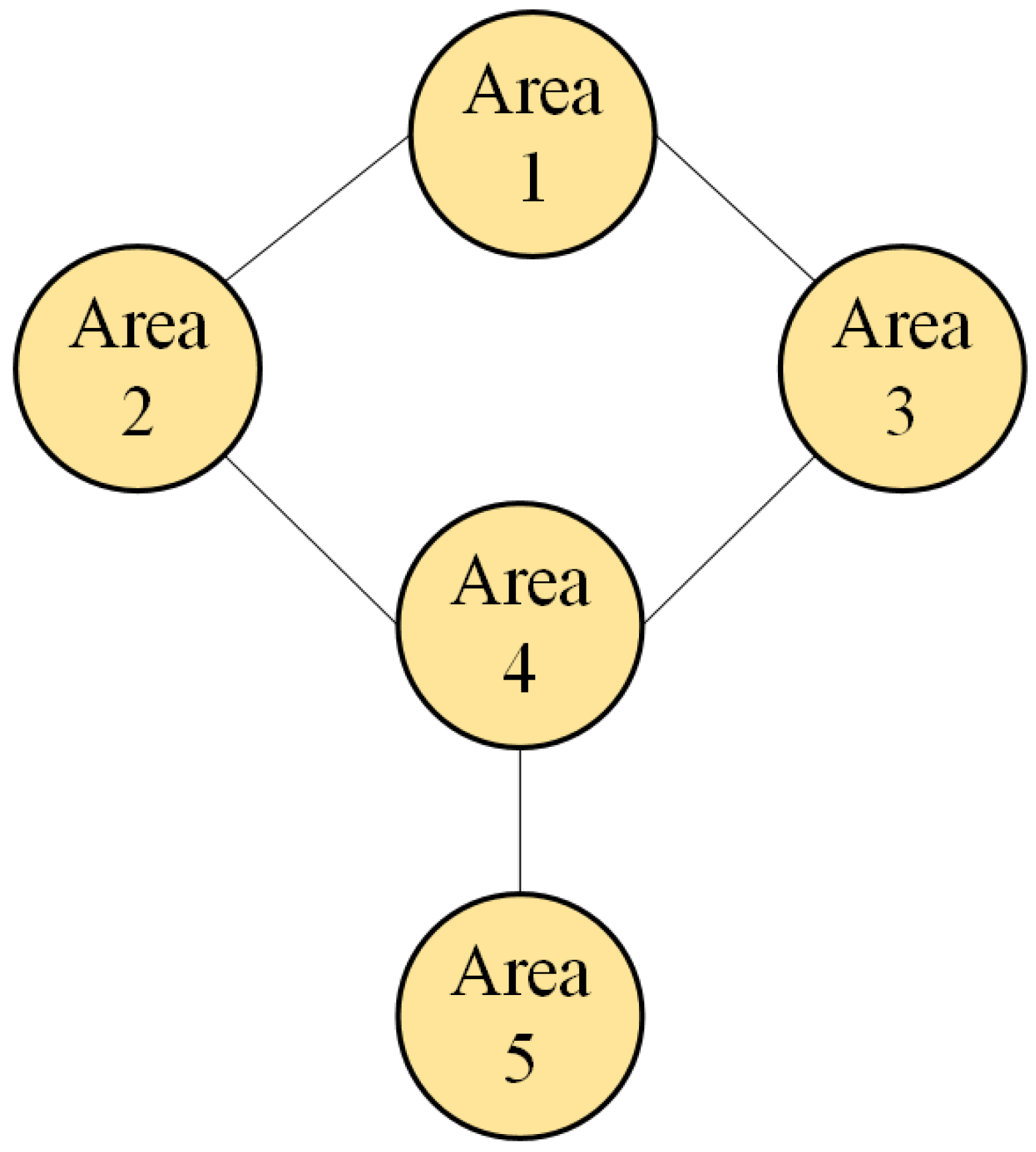
This section presents the simulation outcomes and discusses the performance of a MAPS using SMC in the presence of FDI attacks and load change while achieving equal power sharing within the MAPS. To conduct experiments and provide simulation outcomes, we considered a communication topology, as shown in Figure 2, in which areas communicate with each other to ensure equal power sharing. For a better understanding, simulation results are described through five different cases based on FDI attacks and load change conditions.
Figure 2.
Communication topology of MAPS.
Case 1: Normal MAPS.
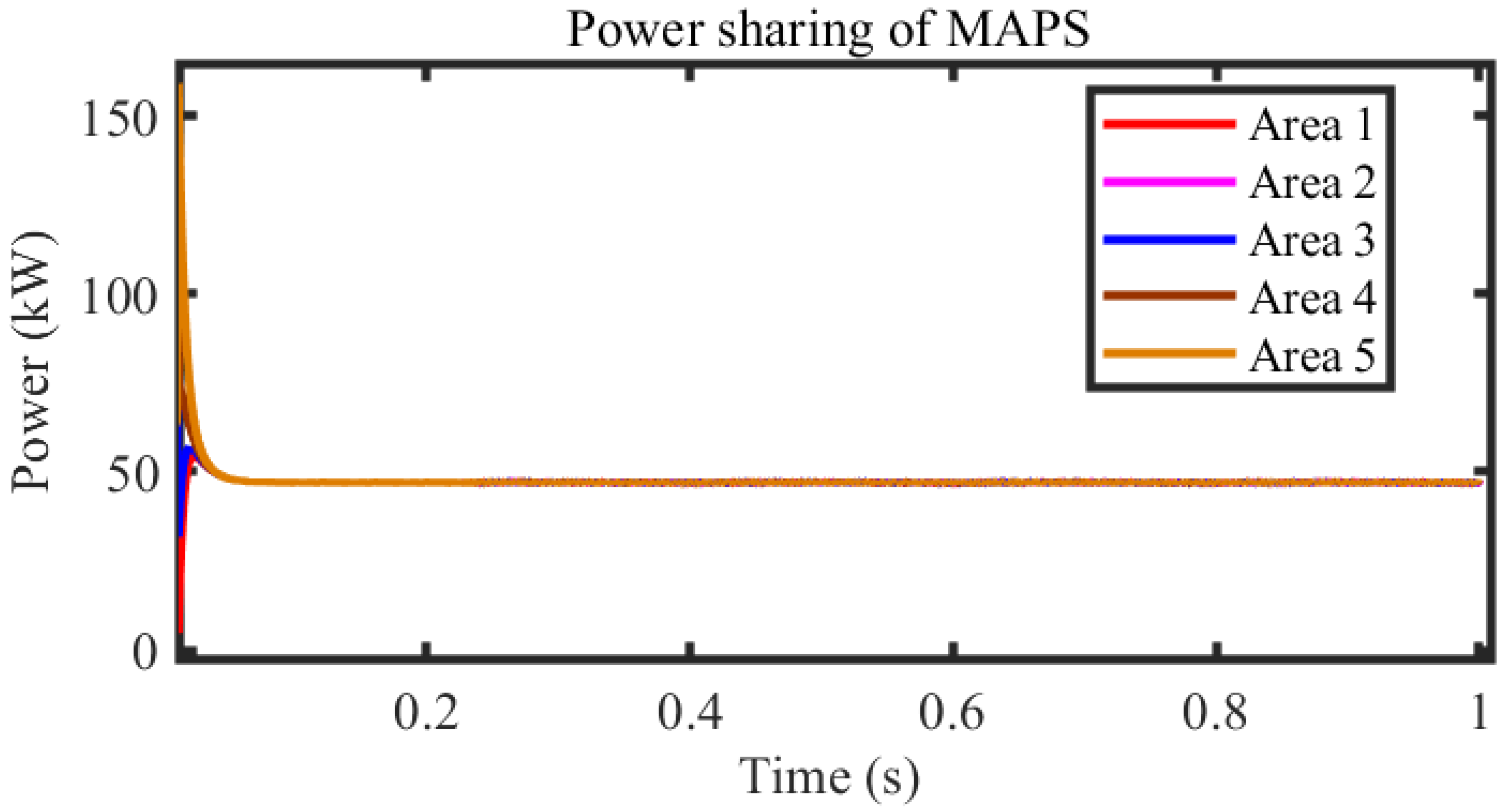
In this case, a MAPS is assumed to perform its standard operations without any hurdle. All the areas of the MAPS ensure equal power sharing in the absence of uncertainties such as FDI attacks or sudden load changes, as given in (1). This serves as a baseline since any interruption in power sharing would be identified through this.
The simulation results presented in Figure 3 provide a detailed closed-loop analysis of the MAPS. Figure 3 demonstrates that all areas of the MAPS achieve equal power sharing under normal conditions, as depicted in Case 1, where no attacks or load changes are present. This uniform power distribution highlights the system’s baseline efficiency and stable operations in the absence of disturbances.
Figure 3.
Equal power sharing of a MAPS in the absence of attacks.
Case 2: Unstable or unequal power-sharing MAPS.
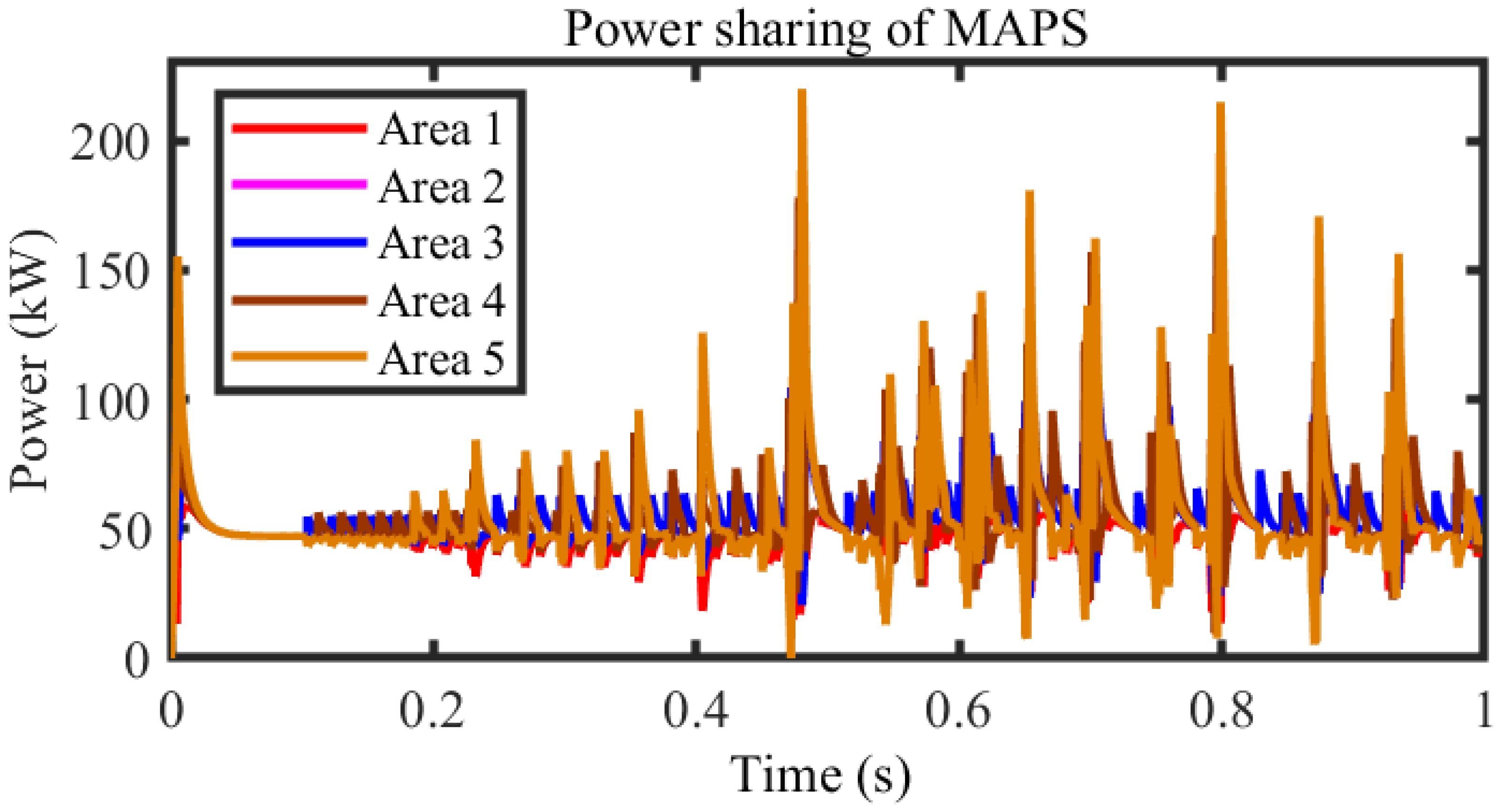
This case describes the performance of a MAPS when subjected to FDI attacks without any control mechanism. In this case, the equal power-sharing state of the MAPS is affected by FDI attacks. As a result, the MAPS fails to achieve equal power sharing.
Figure 4 illustrates the significant effects of FDI attacks on the MAPS. This figure demonstrates how FDI attacks disrupt MAPS operations by impairing key functionalities such as maintaining an equal power-sharing state. Specifically, Figure 4 shows undesired fluctuations in the power-sharing response caused by the attack. These fluctuations are so severe that they lead to persistent instability within the MAPS, as evidenced by the continuous random ripples observed in the power-sharing response. This instability prevents the system from achieving or maintaining an equal power-sharing state, underscoring the detrimental impact of FDI attacks on the overall stability and efficiency of the MAPS. The visual representation in Figure 4 highlights the challenge of restoring system equilibrium under such attack conditions, emphasizing the need for effective detection and mitigation strategies.
Figure 4.
Unstable or unequal power sharing of a MAPS in the presence of attacks.
Case 3: MAPS under root node (area) FDI attack.
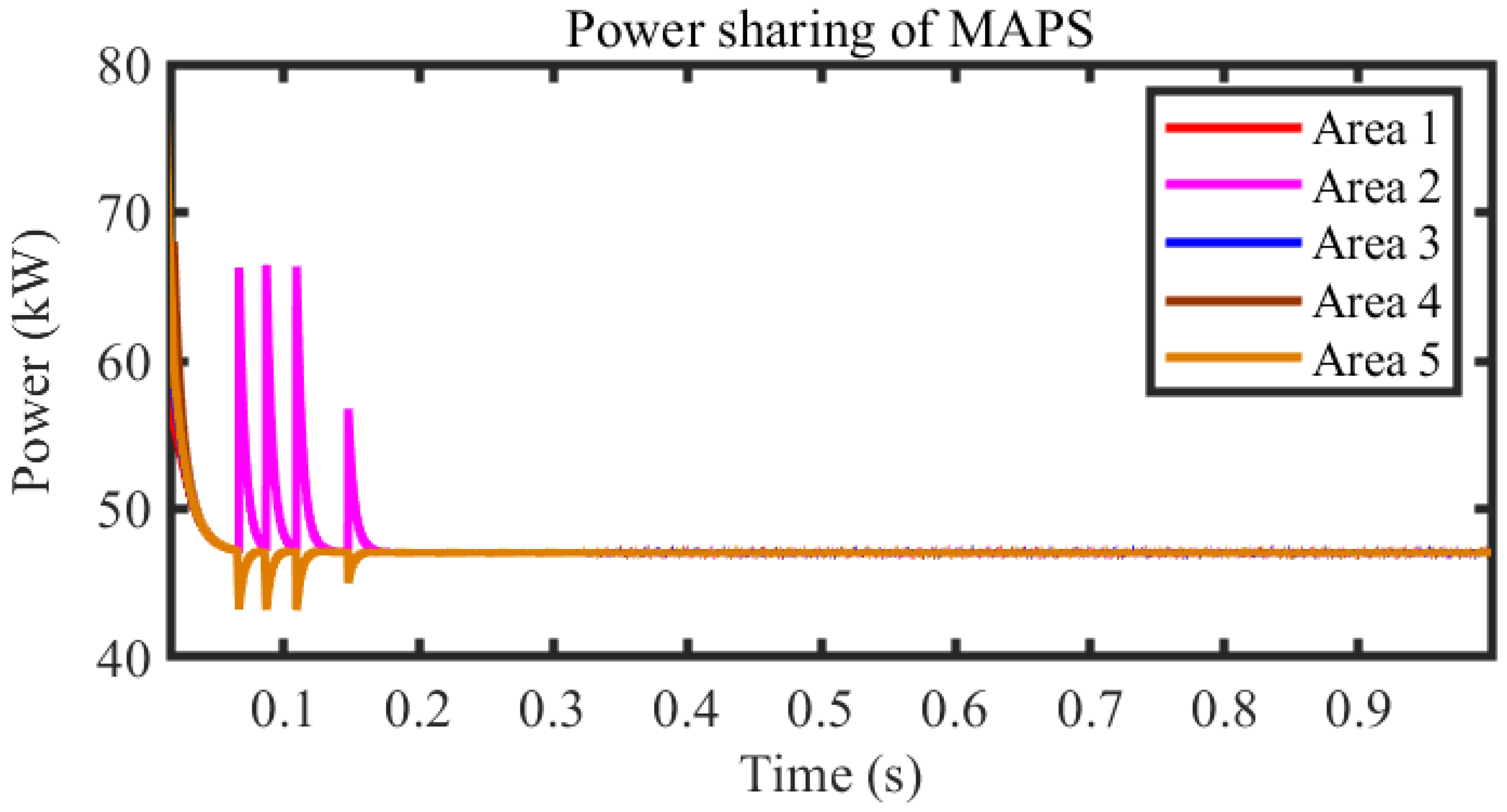
This case focuses on the equal power sharing of the MAPS with the FDI attack, as expressed in (12). In this case, the coordination of different areas in the MAPS is affected by FDI attacks by injecting noise or random signals. Also, the existence of communication delay due to FDI attacks results in a latency of power information sharing between the MGs. As a result, there will be no coordinated power-sharing information, and this can cause the MAPS to fail to achieve an equal power-sharing state.
Figure 5 illustrates the power-sharing response of the proposed resilient consensus control mechanism for equal power sharing in a MAPS under root area attacks. The figure demonstrates that while the power-sharing response exhibits some compromised regulation performance and minor ripples due to the presence of FDI attacks, the system remains largely effective. Specifically, Figure 5 shows that the equal power-sharing state is temporarily affected from approximately t = 0.09 s to t = 0.15 s. Despite these temporary disturbances, the the MAPS achieves a stable equal power-sharing state shortly after the transient period. This behavior aligns with Theorems 2–4 and Case 3, which confirm that the proposed scheme is sufficiently resilient to root area attacks, ensuring that the the MAPS returns to and maintains equal power sharing effectively.
Figure 5.
Equal power sharing of a MAPS in the presence of root node under attacks.
Case 4: MAPS under non-root (area) attacks.
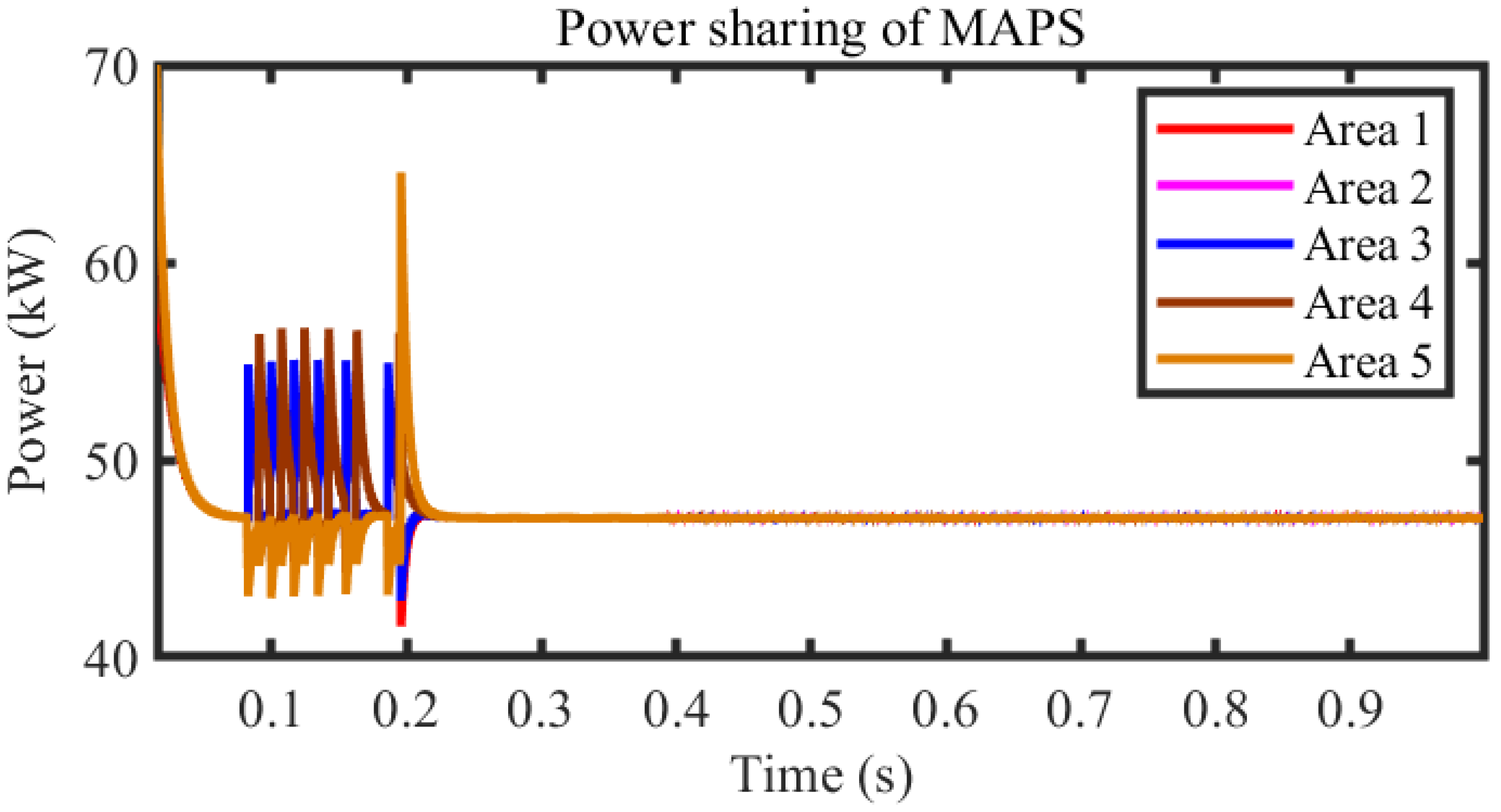
This case explores MAPSs under non-root attacks, as described in (1), (12), and (30). In a non-root attack, the attacker injects false data into the legitimate power-sharing information shared between the coordinating areas of the MAPS. It is assumed that area 2, area 3, area 4, and area 5 are under FDI attack which further affects the overall performance of the MAPS. This work is expected to ensure equal power distribution among the areas within the MAPS while maintaining consensus between them based on SMC.
Figure 6 depicts the response of the equal power-sharing state of the MAPS under a non-root node attack. According to Theorems 2–4 and Case 4, the MAPS is expected to maintain an equal power-sharing state despite the presence of these attacks. However, Figure 6 illustrates that non-root area attacks disrupt the flow of measurement power information between the areas of MAPSs, leading to significant deviations in the equal power-sharing state. Specifically, the figure shows fluctuations in the power-sharing response from approximately t = 0.09 s to t = 0.20 s, indicating the impact of the attacks. These observations underscore the importance of the proposed controller, as discussed in Theorems 2–4. The proposed consensus control technique effectively balances security measures with power-sharing requirements, demonstrating its capability to maintain equal power sharing across the MAPS even in non-root area attack scenarios.
Figure 6.
Equal power sharing of a MAPS in the presence of non-root node under attacks.
Case 5: MAPS under load change conditions.
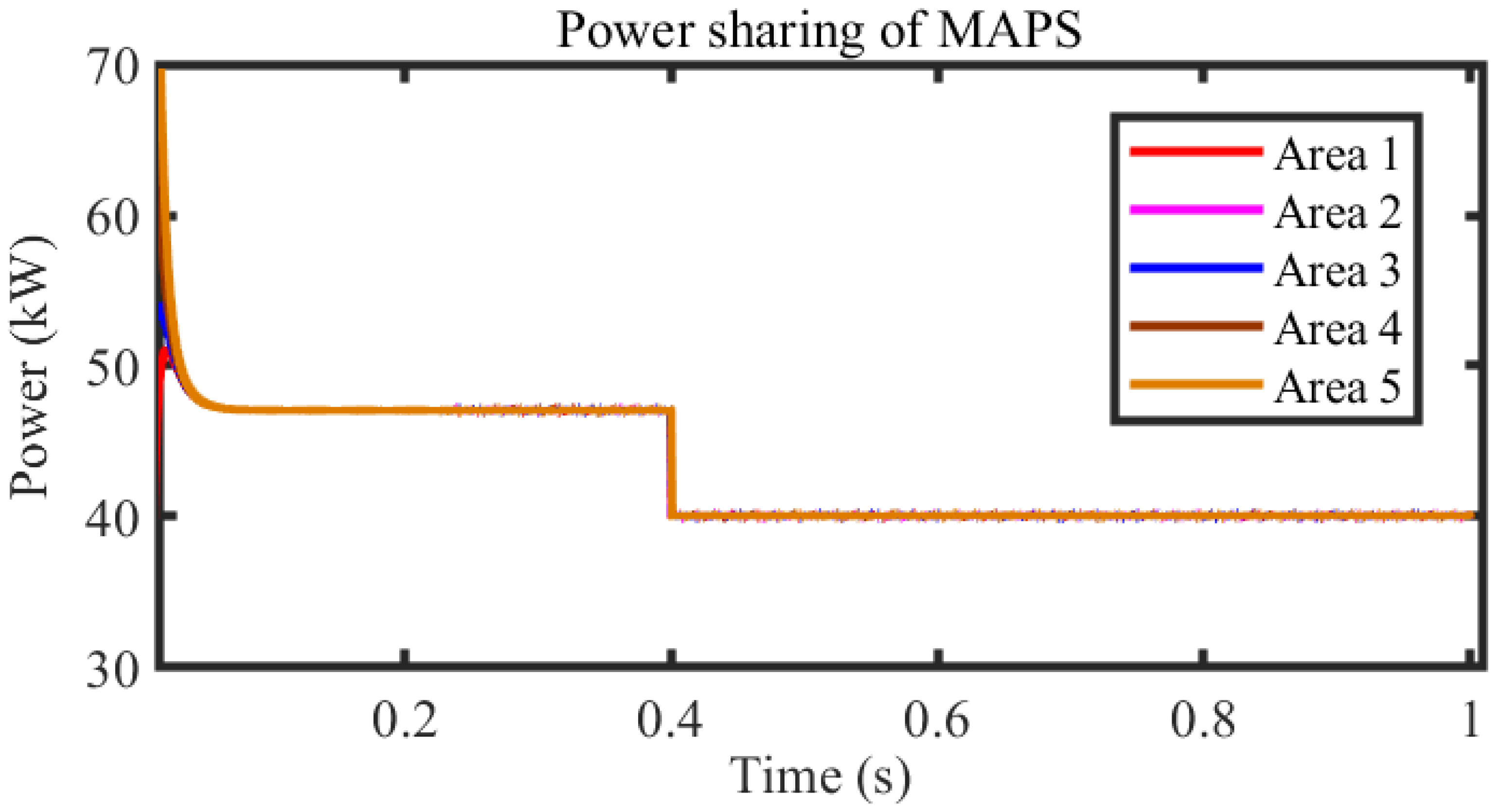
The MAPS in this case is subjected to load changes. Consensus control of the MAPS ensures equal power sharing despite uncertainties. Despite the increased or decreased electrical load in a particular area, the SMC-based control mechanism adapts to ensure stability and efficiency across the MAPS.
Figure 7 illustrates the impact of load changes and communication delays caused by FDI attacks on MAPSs. Despite substantial load variations starting around t = 0.4 s, the proposed SMC-based techniques effectively maintain equal power sharing among the areas of MAPSs. This figure demonstrates the resilience of the proposed method in managing significant disruptions. Table 1 provides a summary of various cases, their status, and the stability times for the MAPS under attack. This table confirms that the proposed method achieves promising results in ensuring balanced power sharing across MAPSs and effectively mitigates the effects of attacks, achieving high detection accuracy. This comprehensive analysis highlights the robustness and reliability of the proposed approach in maintaining system stability and performance despite external disturbances and attack-induced challenges.
Figure 7.
Equal power sharing of a MAPS in the presence of non-root node under load change conditions.
Table 1.
Summary of the time required to restore stability in each case.
8. Conclusions
In this paper, the detection and isolation of FDI attacks to ensure equal power sharing in MAPSs have been addressed. The proposed SMC-based strategy offers notable advantages by enabling robust and timely detection of FDI attacks while preserving normal system operations. By utilizing adaptive sliding mode observers and distributed control principles, this strategy not only enhances resilience against cyber–physical threats but also improves network efficiency. Specifically, the SMC-based approach ensures high detection accuracy and effectively manages uncertainties such as attacks and load changes. This results in significant energy savings by minimizing power disruptions and inefficiencies, as well as reducing the need for excessive backup power and operational adjustments despite attacks and load changes. The efficient management of attacks and disruptions contributes to better overall network performance and stability. Future research directions include further optimization of detection algorithms for real-time applications and the integration of advanced cybersecurity measures into power system infrastructures to bolster resilience, security, and energy efficiency.
Author Contributions
All authors contributed equally where Z.A. led the conceptualization, methodology, and initial drafting of the manuscript, also overseeing the software development and project administration. M.N. focused on data curation, validation, and formal analysis and provided critical review and editing. D.M.A. contributed through supervision, funding acquisition, and manuscript review. M.Z.H.S. conducted investigations and managed resources, assisting with the manuscript review. D.S.A. provided supervision, resources, and validation and reviewed the manuscript. Finally, F.A. contributed to software implementation, data analysis, and visualization, supporting the original draft preparation. All authors have read and agreed to the published version of the manuscript.
Funding
This research is funded by Princess Nourah bint Abdulrahman University Researchers Supporting Project number (PNURSP2024R435), Princess Nourah bint Abdulrahman University, Riyadh, Saudi Arabia.
Data Availability Statement
No new data were created or analyzed in this study. Data sharing is not applicable to this article.
Acknowledgments
The authors would like to acknowledge the support of Princess Nourah bint Abdulrahman University Researchers Supporting Project number (PNURSP2024R435), Princess Nourah bint Abdulrahman University, Riyadh, Saudi Arabia.
Conflicts of Interest
The authors declare no conflicts of interest.
References
- Wen, S.; Yu, X.; Zeng, Z.; Wang, J. Event-triggering load frequency control for multiarea power systems with communication delays. IEEE Trans. Ind. Electron. 2015, 63, 1308–1317. [Google Scholar] [CrossRef]
- Wang, Z.; Liu, Y.; Yang, Z.; Yang, W. Load frequency control of multi-region interconnected power systems with wind power and electric vehicles based on sliding mode control. Energies 2021, 14, 2288. [Google Scholar] [CrossRef]
- Xu, K.; Niu, Y. Decentralized event-triggered sliding mode scheme for frequency regulation of multi-area power systems under deception attacks. Trans. Inst. Meas. Control 2023, 01423312231156237. [Google Scholar] [CrossRef]
- Yue, D.; Hu, S.; Cheng, Z.; Yue, D.; Hu, S.; Cheng, Z. Secure Distributed Optimal Frequency Regulation of Power Grid with Time-Varying Voltages Under False Data Injection Attacks. In Secure Control of Networked Control Systems and Its Applications; Springer: Singapore, 2021; pp. 251–270. [Google Scholar]
- Liang, G.; Weller, S.R.; Zhao, J.; Luo, F.; Dong, Z.Y. The 2015 Ukraine blackout: Implications for false data injection attacks. IEEE Trans. Power Syst. 2016, 32, 3317–3318. [Google Scholar] [CrossRef]
- Zhao, P.; Gu, C.; Ding, Y.; Liu, H.; Bian, Y.; Li, S. Cyber-resilience enhancement and protection for uneconomic power dispatch under cyber-attacks. IEEE Trans. Power Deliv. 2020, 36, 2253–2263. [Google Scholar] [CrossRef]
- Ahmed, Z.; Saeed, M.A.; Jenabzadeh, A.; Xu, X.; Zhang, W. Frequency domain resilient consensus of multi-agent systems under IMP-based and non IMP-based attacks. Automatica 2022, 146, 110582. [Google Scholar] [CrossRef]
- Ahmed, Z.; Ali, N.; Zhang, W. H2 Resilient Consensus Control of Multiagent Systems Under Deception Attack. IEEE Trans. Circuits Syst. II Express Briefs 2023, 70, 2530–2534. [Google Scholar] [CrossRef]
- Tan, S.; Xie, P.; Guerrero, J.M.; Vasquez, J.C. False data injection cyber-attacks detection for multiple DC microgrid clusters. Appl. Energy 2022, 310, 118425. [Google Scholar] [CrossRef]
- Zhou, Q.; Shahidehpour, M.; Alabdulwahab, A.; Abusorrah, A. A cyber-attack resilient distributed control strategy in islanded microgrids. IEEE Trans. Smart Grid 2020, 11, 3690–3701. [Google Scholar] [CrossRef]
- He, H.; Yan, J. Cyber-physical attacks and defences in the smart grid: A survey. IET Cyber-Phys. Syst. Theory Appl. 2016, 1, 13–27. [Google Scholar] [CrossRef]
- Ranjbar, M.H.; Kheradmandi, M.; Pirayesh, A. Assigning operating reserves in power systems under imminent intelligent attack threat. IEEE Trans. Power Syst. 2019, 34, 2768–2777. [Google Scholar] [CrossRef]
- Pasqualetti, F.; Dörfler, F.; Bullo, F. Attack detection and identification in cyber-physical systems. IEEE Trans. Autom. Control 2013, 58, 2715–2729. [Google Scholar] [CrossRef]
- Paridari, K.; O’Mahony, N.; Mady, A.E.D.; Chabukswar, R.; Boubekeur, M.; Sandberg, H. A framework for attack-resilient industrial control systems: Attack detection and controller reconfiguration. Proc. IEEE 2017, 106, 113–128. [Google Scholar] [CrossRef]
- Zhang, X.G.; Yang, G.H.; Ren, X.X. Network steganography based security framework for cyber-physical systems. Inf. Sci. 2022, 609, 963–983. [Google Scholar] [CrossRef]
- Rawat, D.B.; Bajracharya, C. Detection of false data injection attacks in smart grid communication systems. IEEE Signal Process. Lett. 2015, 22, 1652–1656. [Google Scholar] [CrossRef]
- Manandhar, K.; Cao, X.; Hu, F.; Liu, Y. Detection of faults and attacks including false data injection attack in smart grid using Kalman filter. IEEE Trans. Control Netw. Syst. 2014, 1, 370–379. [Google Scholar] [CrossRef]
- Ao, W.; Song, Y.; Wen, C. Adaptive cyber-physical system attack detection and reconstruction with application to power systems. IET Control Theory Appl. 2016, 10, 1458–1468. [Google Scholar] [CrossRef]
- Yan, Y.; Yu, S.; Yu, X. Euler’s discretization effect on a sliding-mode control system with supertwisting algorithm. IEEE Trans. Autom. Control 2020, 66, 2817–2824. [Google Scholar] [CrossRef]
- Zhou, Q.; Shahidehpour, M.; Yan, M.; Wu, X.; Alabdulwahab, A.; Abusorrah, A. Distributed secondary control for islanded microgrids with mobile emergency resources. IEEE Trans. Power Syst. 2019, 35, 1389–1399. [Google Scholar] [CrossRef]
- Zhou, Q.; Tian, Z.; Shahidehpour, M.; Liu, X.; Alabdulwahab, A.; Abusorrah, A. Optimal consensus-based distributed control strategy for coordinated operation of networked microgrids. IEEE Trans. Power Syst. 2019, 35, 2452–2462. [Google Scholar] [CrossRef]
- Beg, O.A.; Johnson, T.T.; Davoudi, A. Detection of false-data injection attacks in cyber-physical DC microgrids. IEEE Trans. Ind. Inform. 2017, 13, 2693–2703. [Google Scholar] [CrossRef]
- Jin, D.; Li, Z.; Hannon, C.; Chen, C.; Wang, J.; Shahidehpour, M.; Lee, C.W. Toward a cyber resilient and secure microgrid using software-defined networking. IEEE Trans. Smart Grid 2017, 8, 2494–2504. [Google Scholar] [CrossRef]
- Li, Y.; Zhang, P.; Zhang, L.; Wang, B. Active synchronous detection of deception attacks in microgrid control systems. IEEE Trans. Smart Grid 2016, 8, 373–375. [Google Scholar] [CrossRef]
- Duan, J.; Chow, M.Y. A resilient consensus-based distributed energy management algorithm against data integrity attacks. IEEE Trans. Smart Grid 2018, 10, 4729–4740. [Google Scholar] [CrossRef]
- Wang, H.; Yan, Z.; Xu, X.; He, K. Probabilistic power flow analysis of microgrid with renewable energy. Int. J. Electr. Power Energy Syst. 2020, 114, 105393. [Google Scholar] [CrossRef]
- Lu, L.Y.; Liu, H.J.; Zhu, H.; Chu, C.C. Intrusion detection in distributed frequency control of isolated microgrids. IEEE Trans. Smart Grid 2019, 10, 6502–6515. [Google Scholar] [CrossRef]
- Che, L.; Liu, X.; Li, Z.; Wen, Y. False data injection attacks induced sequential outages in power systems. IEEE Trans. Power Syst. 2018, 34, 1513–1523. [Google Scholar] [CrossRef]
- Abhinav, S.; Schizas, I.D.; Lewis, F.L.; Davoudi, A. Distributed noise-resilient networked synchrony of active distribution systems. IEEE Trans. Smart Grid 2016, 9, 836–846. [Google Scholar] [CrossRef]
- Brentan, B.M.; Campbell, E.; Lima, G.; Manzi, D.; Ayala-Cabrera, D.; Herrera, M.; Montalvo, I.; Izquierdo, J.; Luvizotto, E., Jr. On-line cyber attack detection in water networks through state forecasting and control by pattern recognition. In Proceedings of the World Environmental and Water Resources Congress 2017, Sacramento, CA, USA, 21–25 May 2017; pp. 583–592. [Google Scholar]
- Sabzehgar, R.; Amirhosseini, D.Z.; Rasouli, M. Solar power forecast for a residential smart microgrid based on numerical weather predictions using artificial intelligence methods. J. Build. Eng. 2020, 32, 101629. [Google Scholar] [CrossRef]
- Canaan, B.; Colicchio, B.; Abdeslam, D.O. Detecting Cyber-Physical-Attacks in AC microgrids using artificial neural networks. In Proceedings of the 2021 IEEE 30th International Symposium on Industrial Electronics (ISIE), Kyoto, Japan, 20–23 June 2021; pp. 1–6. [Google Scholar]
- Abudin, M.J.; Thokchom, S.; Naayagi, R.; Panda, G. Detecting False Data Injection Attacks Using Machine Learning-Based Approaches for Smart Grid Networks. Appl. Sci. 2024, 14, 4764. [Google Scholar] [CrossRef]
Disclaimer/Publisher’s Note: The statements, opinions and data contained in all publications are solely those of the individual author(s) and contributor(s) and not of MDPI and/or the editor(s). MDPI and/or the editor(s) disclaim responsibility for any injury to people or property resulting from any ideas, methods, instructions or products referred to in the content. |
© 2024 by the authors. Licensee MDPI, Basel, Switzerland. This article is an open access article distributed under the terms and conditions of the Creative Commons Attribution (CC BY) license (https://creativecommons.org/licenses/by/4.0/).