

Demonstrative Application to an OECD/NEA Reactor Physics Benchmark of the 2nd-BERRU-PM Method—II: Nominal Computations Apparently Inconsistent with Measurements



Abstract
:1. Introduction
2. Method: Second-Order Predictive Modeling Methodology (2nd-BERRU-PM)
- (i)
- Matrices are denoted using capital bold letters, while vectors are denoted using either capital or lower-case bold letters.
- (ii)
- The components of the vector denote the best-estimate values of the responses. The quantity “TR” denotes the “total number of responses” under consideration. The symbol “” is used to denote “is defined as” or “is by definition equal to”. Transposition is indicated by a dagger superscript.
- (iii)
- The components of the vector denote the expected values of the experimentally measured responses. The letter “e” is used either as a superscript or a subscript to indicate experimentally measured quantities.
- (iv)
- The quantity denotes the covariance matrix of experimentally measured responses. The component covariance values stem from measurements.
- (v)
- The quantity denotes the “vector of expected values of computed responses”, and its components, , are obtained by determining the expectation value of the multivariate Taylor expansion of the computed response with respect to the benchmark model’s uncertain parameters, evaluated around the parameters’ mean values. The complete expression of the expected value of a generic response is presented in [1]. The particular response considered in this work is the neutron leakage out of the benchmark’s outer surface, and the impact of the standard deviation of the benchmark’s total cross-sections is illustrated by considering that these cross-sections are uncorrelated and normally distributed. Under these circumstances, the mean value, , of the computed leakage response takes the following form (up to fourth-order sensitivities):where neutrons/sec denotes the value of the computed leakage response at the nominal parameter values and where denotes the “total number” of microscopic total cross-sections comprised in the benchmark’s computational model. As has been discussed in [1,5], the largest relative sensitivities of the leakage response are with respect to the benchmark’s 180 microscopic total cross-sections, and the contributions stemming from the benchmark’s remaining parameters are negligible, their combined contribution to the expectation value and variance of the computed leakage response being of the order of 5%.
- (vi)
- The quantity in Equation (1) denotes the covariance matrix for the computed responses. The complete expression of the covariance between two computed responses and is provided in [1]. In this section, only the neutron leakage response will be analyzed, and the 180 microscopic total cross-sections, which will be considered the benchmark’s imprecisely known parameters, are assumed to be uncorrelated and normally distributed. Under these circumstances, the matrix reduces to the (scalar) variance, , of the computed leakage response, , having the following simplified form of the corresponding expression provided in [1]:
3. Results
3.1. Measured Response n/sec; Relative ; Parameters’ Relative SD = 5%
- (i)
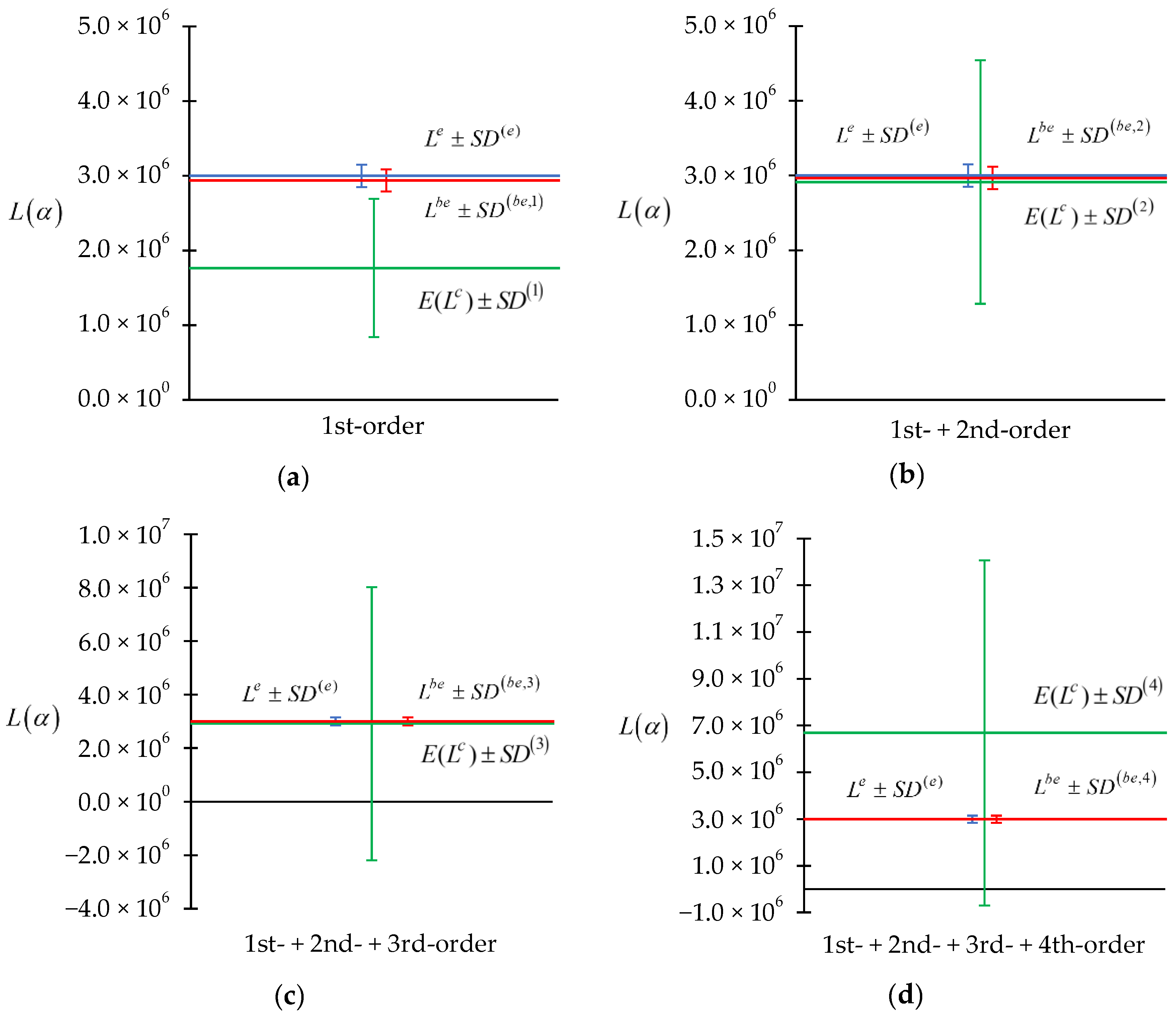
- When considering only the first-order sensitivities, the standard deviation of the measured response does not overlap with the standard deviation of the computed response. Thus, when considering just the first-order sensitivities, the measured response value appears to be “inconsistent” (“discrepant”) with the computed nominal value of the response. Nevertheless, the best-estimate predicted response value, , is very close to the measured value, with a standard deviation that is also close to (and smaller than) the measured value.
- (ii)
- As expected from Equations (3) and (4), the values of both and increase progressively as the contributions from the higher-order sensitivities are progressively taken into account for . When the second-order sensitivities are considered, the computational results appear to become consistent with the measured values, since the respective measured and computed standard deviation values overlap as soon as the second-order sensitivities are considered.
- (iii)
- The best-estimate predicted response value, , remains close to the measured value, even though the expected response value continues to increase divergently as higher-order sensitivities are considered.
3.2. Measured Response n/sec; Relative ; Parameters’ Relative SD = 10%
- (i)
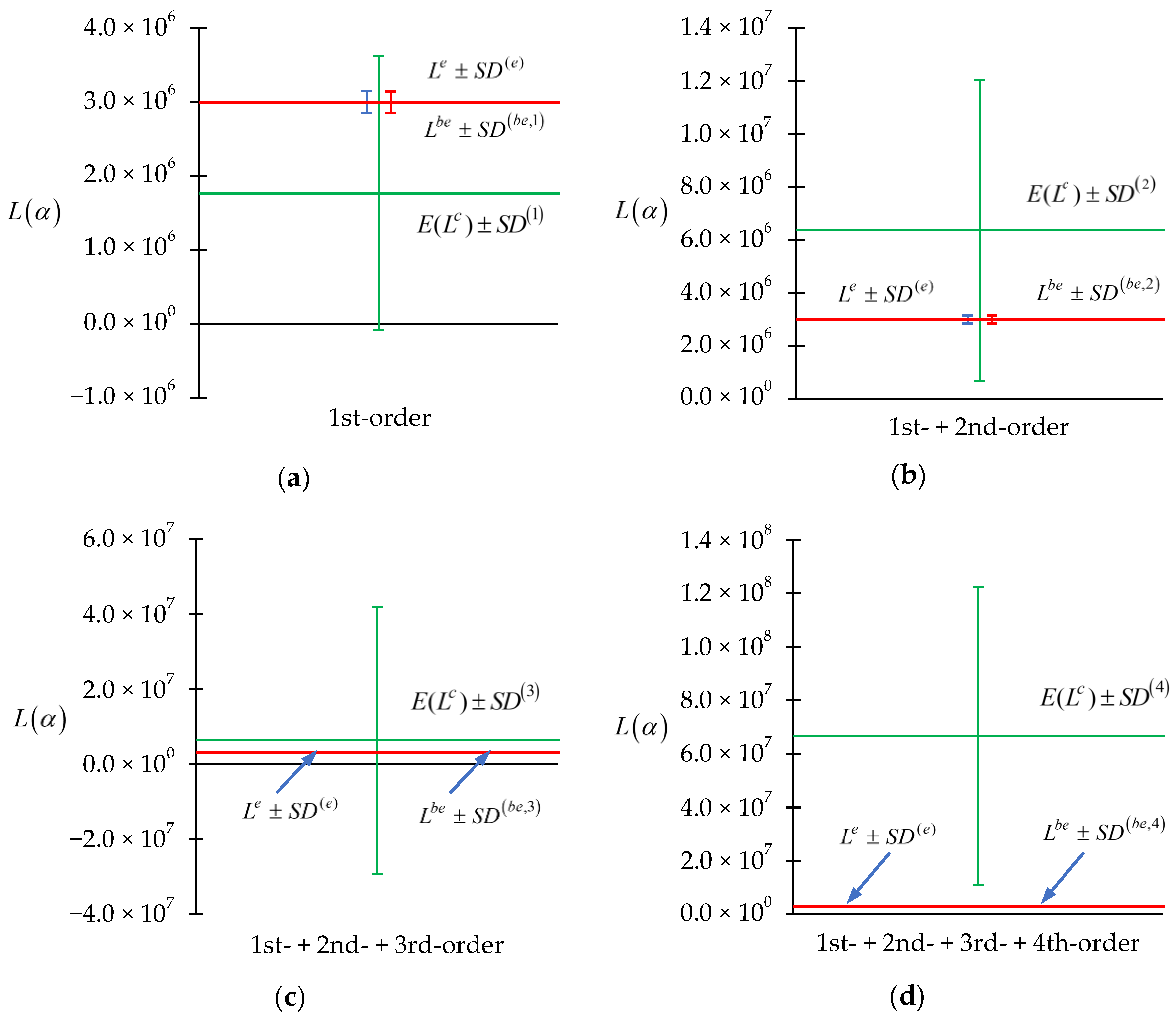
- The computed results appear to be consistent with the measured results.
- (ii)
- The divergent nature of the computations for the values of and are apparent, as they increase significantly when the contributions from the higher-order sensitivities are progressively taken into account for . Nevertheless, the best-estimate predicted response value, , remains close to the measured value, even if only the first-order sensitivities are considered.
3.3. Measured Response n/sec; Relative ; Parameters’ Relative SD = 2%
- (i)
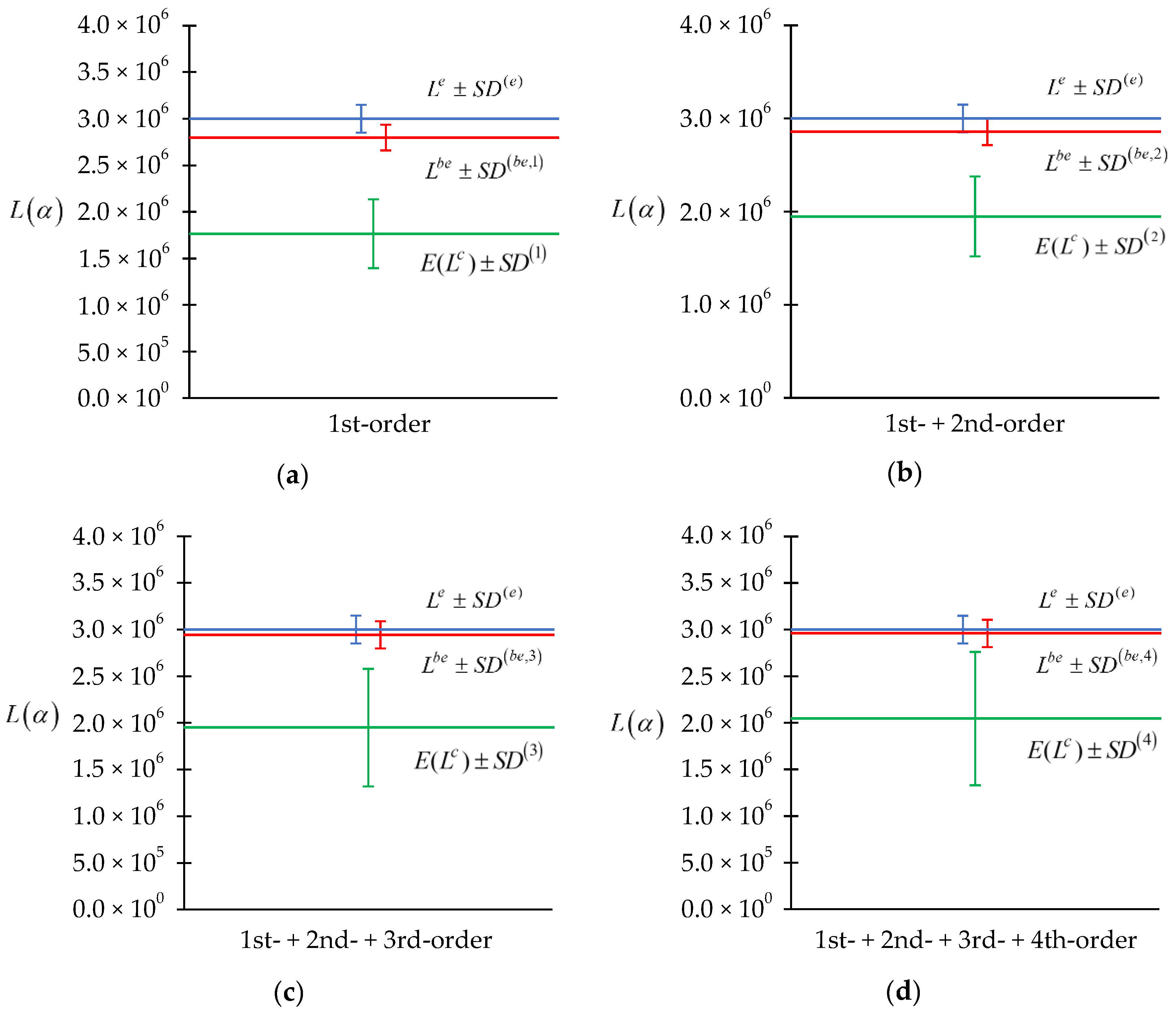
- The computed results appear to be inconsistent with the measured results because the small standard deviation considered for the parameters yields small values for the standard deviation of the computed response. This fact is particularly evident when only the first-order sensitivities are considered, which is a situation similar to the situation depicted in Figure 1a.
- (ii)
- As higher-order sensitivities are progressively considered for , the agreement between the measured and the computed quantities is progressively improved, indicating a possible convergence if sensitivities of orders higher than four were to be included.
- (iii)
- In all cases, however, the predicted best-estimate values remain consistent with the measured values. The best-estimate predicted response value, , moves progressively closer to the measured value as progressively higher-order sensitivities are considered, while the best-estimate standard deviation is, in all cases, close to, albeit smaller than, the experimentally measured standard deviation .
4. Discussion
Author Contributions
Funding
Data Availability Statement
Conflicts of Interest
References
- Cacuci, D.G.; Fang, R. Demonstrative Application to an OECD/NEA Reactor Physics Benchmark of the 2nd-BERRU-PM Method. I: Nominal Computations Consistent with Measurements. Energies 2023, 16, 5552. [Google Scholar] [CrossRef]
- Cacuci, D.G. Second-Order MaxEnt Predictive Modelling Methodology. I: Deterministically Incorporated Computational Model (2nd-BERRU-PMD). Am. J. Comput. Math. 2023, 13, 236–266. [Google Scholar] [CrossRef]
- Cacuci, D.G. Second-Order MaxEnt Predictive Modelling Methodology. II: Probabilistically Incorporated Computational Model (2nd-BERRU-PMP). Am. J. Comput. Math. 2023, 13, 267–294. [Google Scholar] [CrossRef]
- Valentine, T.E. Polyethylene-Reflected Plutonium Metal Sphere Subcritical Noise Measurements. SUB-PU-METMIXED-001, International Handbook of Evaluated Criticality Safety Benchmark Experiments; NEA/NSC/DOC(95)03/I-IX; Organization for Economic Co-Operation and Development: Paris, France; Nuclear Energy Agency: Paris, France, 2006. [Google Scholar]
- Cacuci, D.G.; Fang, R. The nth-Order Comprehensive Adjoint Sensitivity Analysis Methodology: Overcoming the Curse of Dimensionality: Vol. II: Application to a Large-Scale System; Springer: Cham, Switzerland, 2023; ISBN 978-3-031-19634-8; 978-3-031-19635-5. (eBook). [Google Scholar] [CrossRef]



| Order of Sensitivities Considered | (Neutrons/sec) | (Neutrons/sec) | (Neutrons/sec) |
|---|---|---|---|
| 1st-order () | 3.000 × 10⁶ ± 1.500 × 10⁵ | 1.765 × 10⁶ ± 9.246 × 10⁵ | 2.968 × 10⁶ ± 1.481 × 10⁵ |
| 1st- + 2nd-order () | 2.914 × 10⁶ ± 1.629 × 10⁶ | 2.969 × 10⁶ ± 1.494 × 10⁵ | |
| 1st- + 2nd- + 3rd-order () | 2.914 × 10⁶ ± 5.103 × 10⁶ | 2.999 × 10⁶ ± 1.499 × 10⁵ | |
| 1st- + 2nd- + 3rd- + 4th-order () | 6.681 × 10⁶ ± 7.386 × 10⁶ | 3.002 × 10⁶ ± 1.499 × 10⁵ |
| Order of Sensitivities Considered | (Neutrons/sec) | (Neutrons/sec) | (Neutrons/sec) |
|---|---|---|---|
| 1st-order () | 3.000 × 10⁶ ± 1.500 × 10⁵ | 1.765 × 10⁶ ± 1.849 × 10⁶ | 2.992 × 10⁶ ± 1.495 × 10⁵ |
| 1st- + 2nd-order () | 6.363 × 10⁶ ± 5.675 × 10⁶ | 3.002 × 10⁶ ± 1.499 × 10⁵ | |
| 1st- + 2nd- + 3rd-order () | 6.363 × 10⁶ ± 3.561 × 10⁷ | 3.001 × 10⁶ ± 1.499 × 10⁵ | |
| 1st- + 2nd- + 3rd- + 4th-order () | 6.662 × 10⁷ ± 5.562 × 10⁷ | 3.001 × 10⁶ ± 1.499 × 10⁵ |
| Order of Sensitivities Considered | (Neutrons/sec) | (Neutrons/sec) | (Neutrons/sec) |
|---|---|---|---|
| 1st-order () | 3.000 × 10⁶ ± 1.500 × 10⁵ | 1.765 × 10⁶ ± 3.698 × 10⁵ | 2.826 × 10⁶ ± 1.390 × 10⁵ |
| 1st- + 2nd-order () | 1.949 × 10⁶ ± 4.276 × 10⁵ | 2.885 × 10⁶ ± 1.415 × 10⁵ | |
| 1st- + 2nd- + 3rd-order () | 1.949 × 10⁶ ± 6.288 × 10⁵ | 2.943 × 10⁶ ± 1.459 × 10⁵ | |
| 1st- + 2nd- + 3rd- + 4th-order () | 2.045 × 10⁶ ± 7.157 × 10⁵ | 2.960 × 10⁶ ± 1.468 × 10⁵ |
Disclaimer/Publisher’s Note: The statements, opinions and data contained in all publications are solely those of the individual author(s) and contributor(s) and not of MDPI and/or the editor(s). MDPI and/or the editor(s) disclaim responsibility for any injury to people or property resulting from any ideas, methods, instructions or products referred to in the content. |
© 2023 by the authors. Licensee MDPI, Basel, Switzerland. This article is an open access article distributed under the terms and conditions of the Creative Commons Attribution (CC BY) license (https://creativecommons.org/licenses/by/4.0/).
Share and Cite
Fang, R.; Cacuci, D.G. Demonstrative Application to an OECD/NEA Reactor Physics Benchmark of the 2nd-BERRU-PM Method—II: Nominal Computations Apparently Inconsistent with Measurements. Energies 2023, 16, 5614. https://doi.org/10.3390/en16155614
Fang R, Cacuci DG. Demonstrative Application to an OECD/NEA Reactor Physics Benchmark of the 2nd-BERRU-PM Method—II: Nominal Computations Apparently Inconsistent with Measurements. Energies. 2023; 16(15):5614. https://doi.org/10.3390/en16155614
Chicago/Turabian StyleFang, Ruixian, and Dan G. Cacuci. 2023. "Demonstrative Application to an OECD/NEA Reactor Physics Benchmark of the 2nd-BERRU-PM Method—II: Nominal Computations Apparently Inconsistent with Measurements" Energies 16, no. 15: 5614. https://doi.org/10.3390/en16155614
APA StyleFang, R., & Cacuci, D. G. (2023). Demonstrative Application to an OECD/NEA Reactor Physics Benchmark of the 2nd-BERRU-PM Method—II: Nominal Computations Apparently Inconsistent with Measurements. Energies, 16(15), 5614. https://doi.org/10.3390/en16155614