Risk Assessment of User Aggregators in Demand Bidding Markets
Abstract
1. Introduction
2. Risk Model for Demand Bidding
- In the day-ahead demand-bidding market, the revenue of the user aggregators is defined as follows:in the day-ahead demand bidding market, the average revenue of the user aggregator can be obtained by adding the power demand that can be sold at the estimated power expectation for each period (the total demand amount of user aggregators). The expected revenue operator in total periods can be changed as follows:where is the power demand (MW) bid by the user aggregator during the period , and is the expected total revenue of the user aggregator. is the demand price of the user aggregator during the period . is the total period of demand bidding (the total peak period was 6 h which included from 10 a.m. to 12 p.m. and from 1 p.m. to 5 p.m. is the expected value operator of the random variable ;
- During the 6 h of the peak period, the profits of each period affect each other. The total variation value of revenue during the peak period of 6 h is calculated as follows:is the variance operator of the random variable.is the covariance matrix of the demand price .and are the power demand (MW) bid by the user aggregators, and they are converted into rows and columns. Because the demand price is the only random variable, the variation of total profit can be expressed by taking the demand price as the covariance matrix. The covariance matrix of the day is:
- If the bidding history data of the demand trading market are collected up to day, the covariance matrix formula of day can be expressed by the actual and predicted values as follows:where ture represents the superscript of the actual value, and is the total number of days that is the greatest and contains day. When Equation (5) is directly used, due to the nature of the price characteristics of the demand trading market, they may have multiple seasonal characteristics and high variability, as well as unusual purchase prices affected by high load;
- In order to obtain an accurate prediction, it could be modified with the exponentially weighted moving average equation [23]:where is the data on the demand price of past user aggregators, which is multiplied by the weight value . The closer to the estimated day, the greater the weight value; the further from the estimated day, the more exponentially the weight value decays. Therefore, old data have less influence on the variance and covariance because they generate outliers due to excessive load. Equations (5) and (6) are both modified formulas representing the covariance matrix . However, the larger the value, the smaller the unreasonable estimation offset. In addition, the smaller the estimation offset, the more accurate the estimation result;
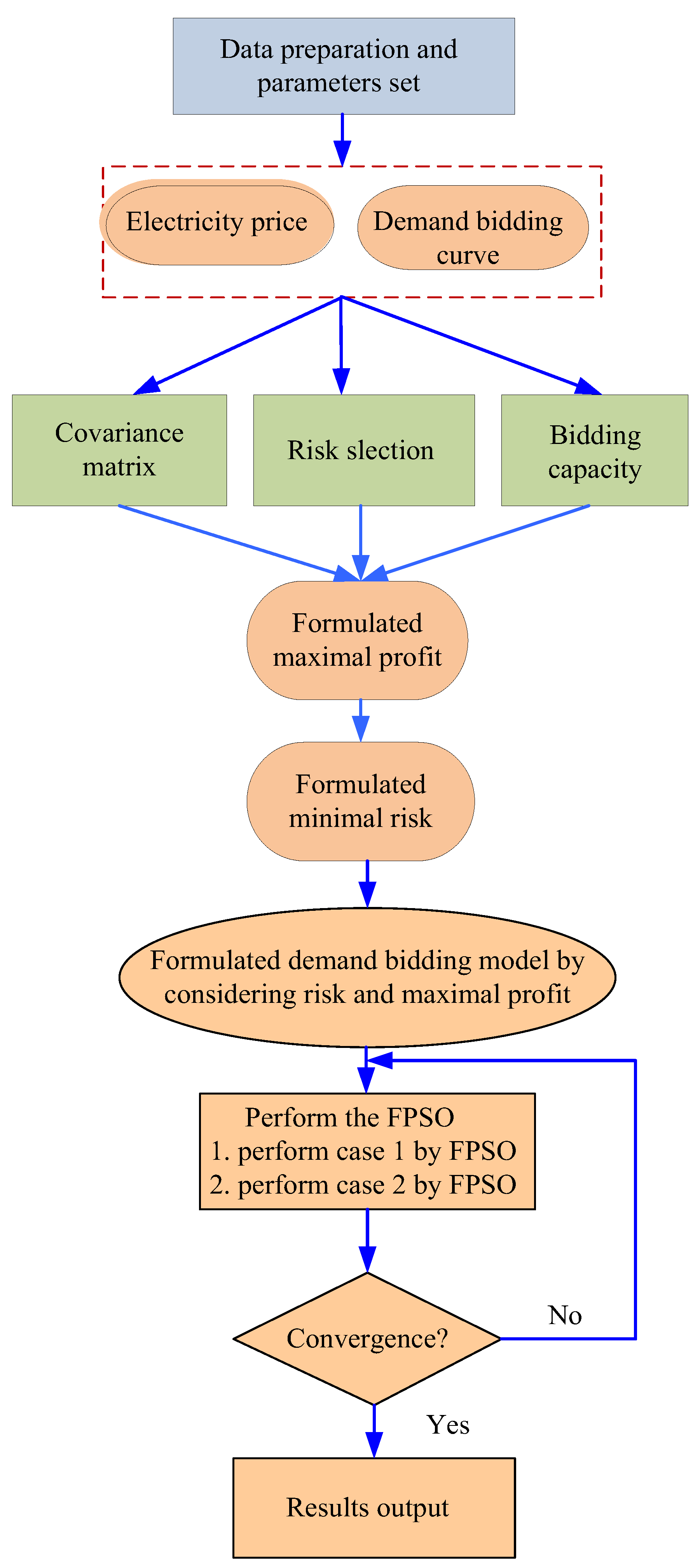
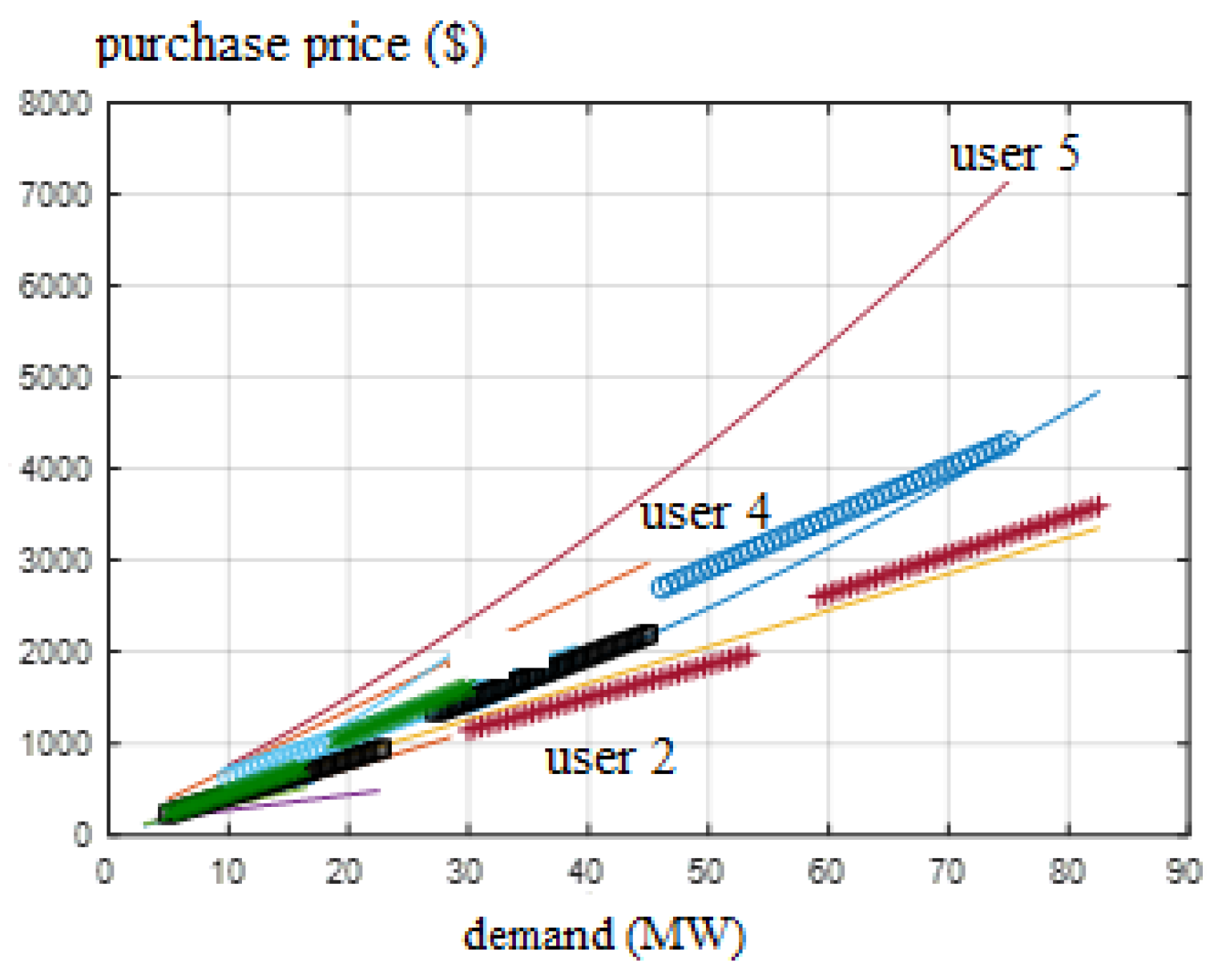
- Regarding the demand bidding planning of the user aggregators, the demand planning strategy for maximum profit can be formulated as follows:where is the purchase status of the user aggregators for downstream users during the period . and are the cost function and electricity amount of the user aggregators in the demand bidding, respectively. , and are the demand bidding curves of user aggregators. is a feasible solution. is the number of user aggregators who took part in the demand bidding during the time period . The demand bidding must face the tradeoff between the maximum profit and the minimum risk. If the user aggregators seek to minimize risk regardless of profit, the risk minimization procedure can be formulated as follows:
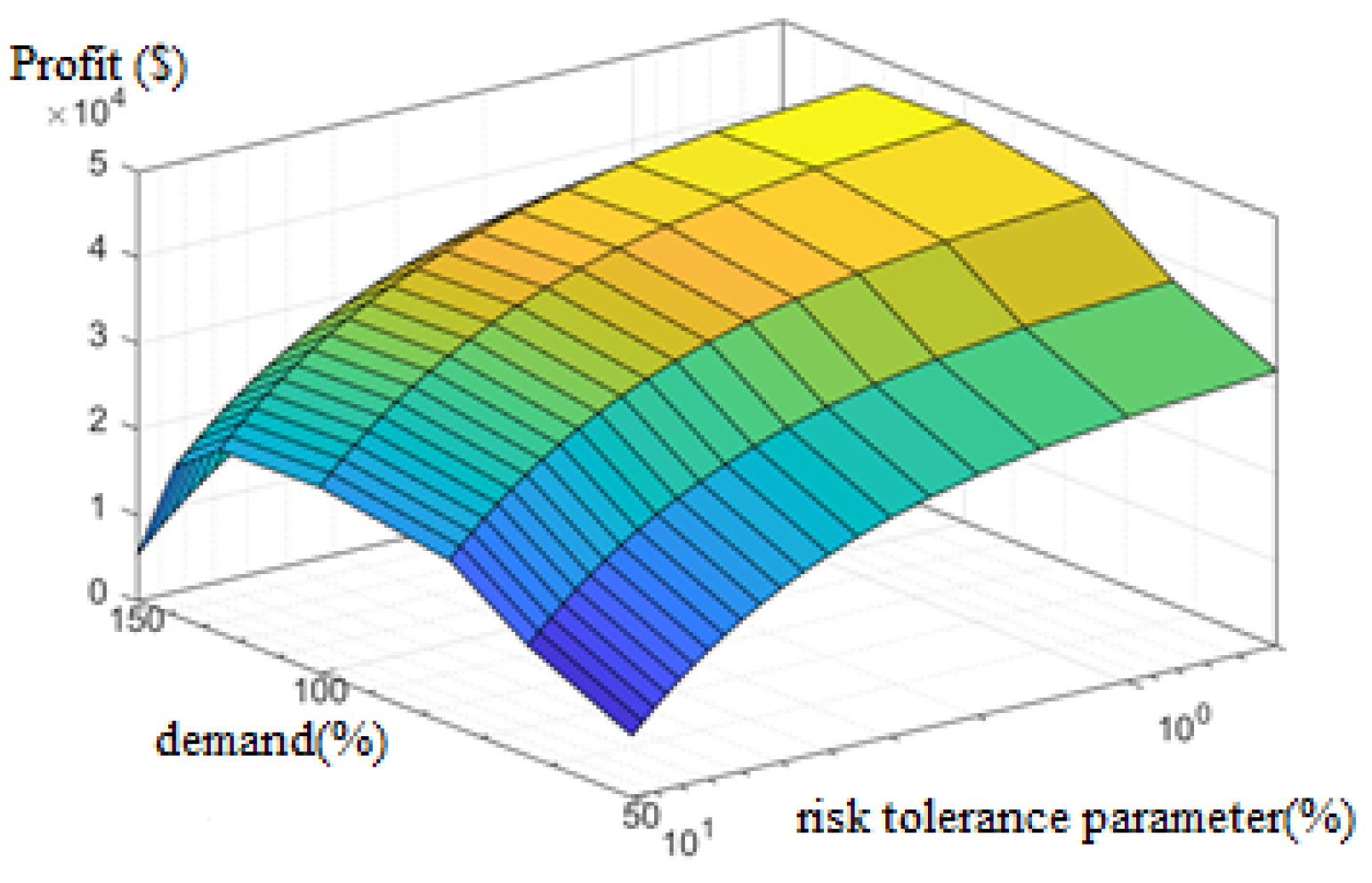
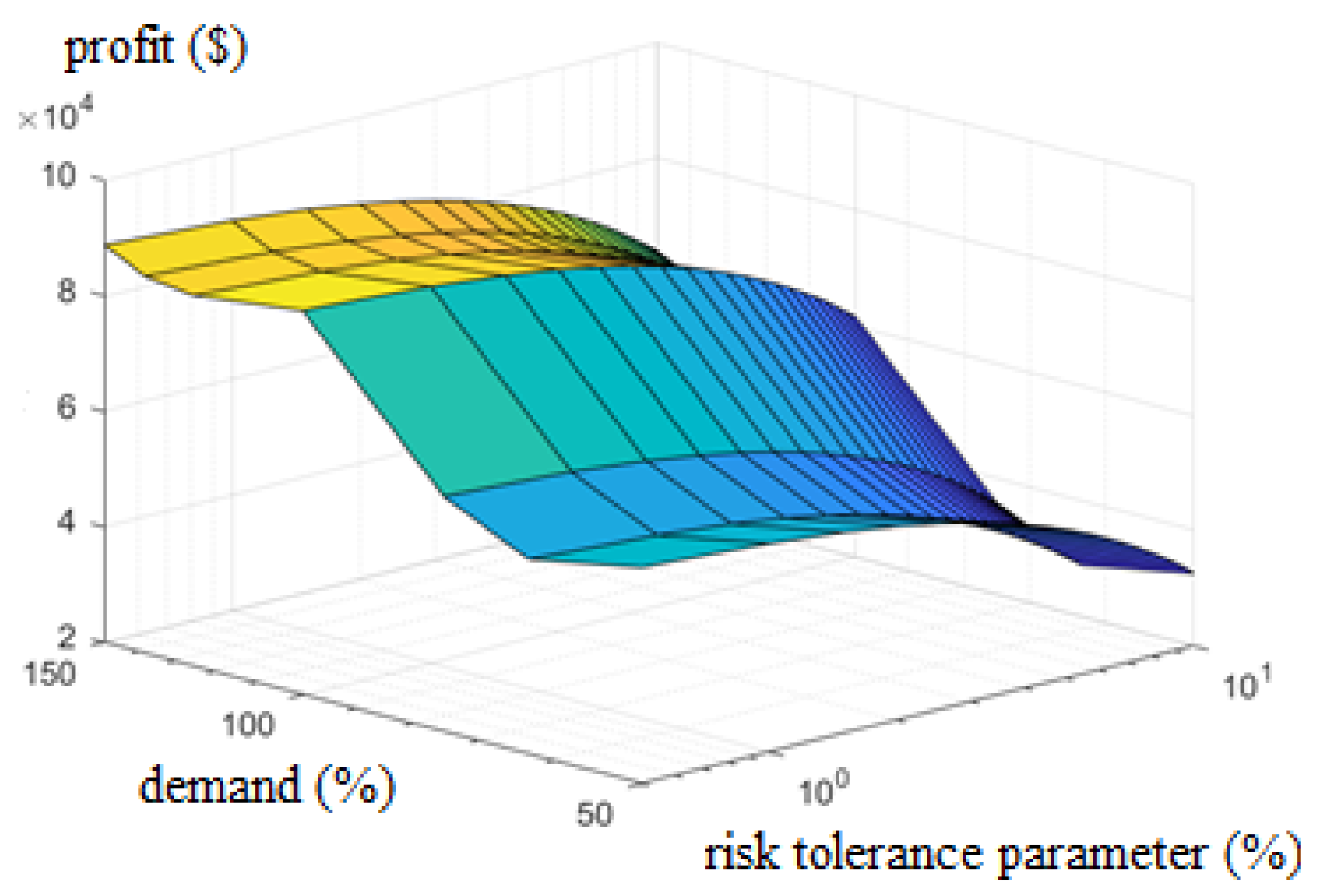
- is the risk variation of the demand price of the utility during the peak hours, while and are the demand bids by the user aggregators. The user aggregators are most interested in the best demand bidding to make profits, and the demand bidding of these user aggregators have the maximum profit with the minimum risk. In order to compromise these two conflicting goals, the best choice is complemented by a risk-tolerance parameter . Therefore, the demand bidding for the user aggregators, taking both risk and maximum profit into consideration, can be formulated as Equation (10):in addition, it should meet the restriction conditions of period as in Equation (11):profit and risk are two different objectives. Hence, a compromise solution is required to solve the demand bidding problem. Equation (10) is an objective function in this paper. The objective function adopted the concepts of “profit” and “risk” to obtain the maximum profit by controlling the “risk”. When the risk-tolerance parameter is higher, the profit is lower.
3. Feasible Particle Swarm Optimization
4. Case Study and Analysis
5. Conclusions
Author Contributions
Funding
Institutional Review Board Statement
Informed Consent Statement
Data Availability Statement
Conflicts of Interest
References
- Taiwan Power Company. Available online: http://www.taipower.com.tw/content/new_info/ (accessed on 1 April 2022).
- Taiwan Power Company. Time-of-Use Rate for Industry. Available online: http://www.taipower.com.tw/electricity (accessed on 1 April 2022).
- Glazunova, A. Development of a Day-Ahead Demand Side Management Strategy to Improve the Microgrid Efficiency. IFAC-Papers OnLine 2022, 55, 256–261. [Google Scholar] [CrossRef]
- Chung, C.Y. The study of the electricity analysis and demand response strategy of shopping malls. Master’s Thesis, Cheng-Shing University, Kaohsiung, Taiwan, 2021. [Google Scholar]
- Pasetti, M.; Rinaldi, S.; Manerba, D. A virtual plant architecture for the demand-side management of smart prosumers. Appl. Sci. 2018, 8, 432. [Google Scholar] [CrossRef]
- Duan, Q. A price-based demand response scheduling model in day-ahead electricity market. In Proceedings of the 2016 IEEE Power and Energy Society General Meeting (PESGM), Boston, MA, USA, 17–21 July 2016. [Google Scholar]
- Safar, A.; Tahmasebi, M.; Pasupuleti, J. Smart buildings aggregator bidding strategy as a negawatt demand response resources in the spinning reserve electricity market. In Proceedings of the 2019 IEEE PES Innovative Smart Grid Technologies Europe (ISGT-Europe), Bucharest, Romania, 29 September–2 October 2019. [Google Scholar]
- Jia, Y.; Mi, Z.; Yu, Y.; Song, Z.; Liu, L.; Sun, X. Purchase bidding strategy for load agent with the incentive-based demand response. IEEE Access 2019, 7, 58626–58637. [Google Scholar] [CrossRef]
- Dadashi, M.; Haghifam, S.; Zare, K.; Haghifam, M.R.; Abapour, M. Short-term scheduling of electricity retailers in the presence of Demand Response Aggregators: A two-stage stochastic bi-Level programming approach. Energy 2020, 205, 117926. [Google Scholar] [CrossRef]
- Abapour, S.; Mohammadi, B.; Hagh, M.T. Robust bidding strategy for demand response aggregators in electricity market based on game theory. J. Clean. Prod. 2020, 243, 118393. [Google Scholar] [CrossRef]
- Liu, X.; Li, Y.; Lin, X.; Guo, J.; Shi, Y.; Shen, Y. Dynamic bidding strategy for a demand response aggregator in the frequency regulation market. Appl. Energy 2022, 314, 118998. [Google Scholar] [CrossRef]
- Li, S.; Zhang, L.; Nie, L.; Wang, J. Trading strategy and benefit optimization of load aggregators in integrated energy systems considering integrated demand response: A hierarchical Stackelberg game. Energy 2022, 249, 123678. [Google Scholar] [CrossRef]
- Pourramezan, A.; Samadi, M. A novel approach for incorporating incentive-based and price-based demand response programs in long-term generation investment planning. Int. J. Electr. Power Energy Syst. 2022, 142, 108315. [Google Scholar] [CrossRef]
- Tang, W.; Yang, H.T. Optimal operation and bidding strategy of a virtual power plant integrated with energy storage systems and elasticity demand response. IEEE Access 2019, 7, 79798–79809. [Google Scholar] [CrossRef]
- Dahraie, M.V.; Kermani, H.R.; Moghadda, A.A. Risk-averse probabilistic framework for scheduling of virtual power plants considering demand response and uncertainties. Int. J. Electr. Power Energy Syst. 2020, 121, 106126. [Google Scholar] [CrossRef]
- Liang, Z.; Alsafasfeh, Q.; Jin, T.; Pourbabak, H.; Su, W. Risk-constraints optimal energy management for virtual power plants considering correlated demand response. IEEE Trans. Smart Grid 2019, 10, 1577–1587. [Google Scholar] [CrossRef]
- Zare, K.; Nojavan, S. Risk-based optimal bidding strategy of generation company in day-ahead electricity market using information gap decision theory. Int. J. Electr. Power Energy Syst. 2013, 147, 83–92. [Google Scholar]
- Kim, H.J.; Kim, M.K. Risk-based hybrid energy management with developing bidding strategy and advanced demand response of grid-connected microgrid based on stochastic/information gap decision theory. Int. J. Electr. Power Energy Syst. 2021, 131, 107046. [Google Scholar] [CrossRef]
- Tian, M.T.; Yan, S.R.; Tian, X.T.; Nojavan, S.; Jermsittiparsrt, K. Risk and profit-based bidding and offering strategies for pumped hydro storage in the energy market. J. Clean. Prod. 2020, 256, 120715. [Google Scholar] [CrossRef]
- Fazlalipour, P.; Ehsan, M.; Mohammadi-Ivatloo, B. Risk-aware stochastic bidding strategy of renewable micro-grids in day-ahead and real-time markets. Energy 2019, 171, 689–700. [Google Scholar] [CrossRef]
- Alexander, C. Risk Management and Analysis- Volume 1 Measuring and Modeling Financial Risk; John Wiley & Sons Ltd.: Hoboken, NJ, USA, 2000. [Google Scholar]
- Taiwan Power Company. The Demand Response Load Management Strategy. Available online: https://www.taipower.com.tw/tc/news2.aspx (accessed on 15 December 2021).
- Lucas, A.; Zhang, X. Score-driven exponentially weighted moving averages and Value-at-Risk forecasting. Int. J. Forecast. 2016, 32, 293–302. [Google Scholar] [CrossRef]
- Kennedy, J.; Eberhart, R.C. Particle Swarm Optimization. In Proceedings of the IEEE International Conference on Neural Networks, Perth, WA, Australia, 27 November–1 December 1995; Volume 4, pp. 1942–1948. [Google Scholar]
- Lin, W.M.; Gow, H.J.; Tsai, M.T. Electricity Price Forecasting Using Enhanced Probability Neural Network. Energy Convers. Manag. 2010, 51, 2707–2714. [Google Scholar] [CrossRef]
- Taiwan Power Company. The Sustainable Operation of White Paper for Taiwan Power Company; Taiwan Power Company: Taipei, Taiwan, 2021. [Google Scholar]



| Hour | 10 | 11 | 13 | 14 | 15 | 16 |
|---|---|---|---|---|---|---|
| Price | 66.609 | 78.372 | 85.698 | 78.273 | 72.072 | 63.342 |
| Hour | 10 | 11 | 13 | 14 | 15 | 16 |
|---|---|---|---|---|---|---|
| DR(MW) | 352.81 | 364.18 | 417.69 | 396.41 | 387.3795 | 370.56 |
| Hour | 10 | 11 | 13 | 14 | 15 | 16 |
|---|---|---|---|---|---|---|
| 10 | 0.0036 | −0.0018 | 0.0054 | −0.0036 | −0.0018 | 0.0018 |
| 11 | −0.0018 | 0.0009 | −0.0027 | 0.0018 | 0.0009 | −0.0009 |
| 13 | 0.0054 | −0.0027 | 0.0081 | −0.0054 | −0.0027 | 0.0027 |
| 14 | −0.0036 | 0.0018 | −0.0054 | 0.0036 | 0.0018 | −0.0018 |
| 15 | −0.0018 | 0.0009 | −0.0027 | 0.0018 | 0.0009 | −0.0009 |
| 16 | 0.0018 | −0.0009 | 0.0027 | −0.0018 | −0.0009 | 0.0009 |
| Aggregator | Max. (MW) | Min. (MW) | a | b | C |
|---|---|---|---|---|---|
| 1 | 17.1 | 3 | 0.69 | 33.65 | 9.4705 |
| 2 | 28.5 | 5 | 0.942 | 40.9 | 36.903 |
| 3 | 45 | 5 | 0.357 | 40.15 | 28.771 |
| 4 | 45 | 5 | 0.605 | 64.5 | 0 |
| 5 | 75 | 10 | 0.421 | 62.5 | 91.34 |
| 6 | 75 | 10 | 0.708 | 45.75 | 172.83 |
| 7 | 82.5 | 15 | 0.313 | 39.85 | 64.783 |
| 8 | 82.5 | 30 | 0.298 | 33.15 | 78.596 |
| 9 | 82.5 | 30 | 0.277 | 35.5 | 80.132 |
| 10 | 22.5 | 4 | 0.52124 | 16.65 | 105.51 |
| 11 | 28.5 | 5 | 0.16 | 32.15 | 22.292 |
| 12 | 30 | 5 | 0.01 | 44.75 | 10.787 |
| 13 | 16.5 | 3 | 1.61 | 29.4 | 30.745 |
| Unit | Demand Amount (MW/hour) | Total (MW) | Total Purchase Price (USD) | Purchase Price Per Unit (USD/MW) | |||||
|---|---|---|---|---|---|---|---|---|---|
| 10 | 11 | 13 | 14 | 15 | 16 | ||||
| 1 | 17.09 | 17.10 | 17.10 | 17.05 | 17.10 | 17.07 | 102.52 | 4715.04 | 45.99 |
| 2 | 16.34 | 15.63 | 18.04 | 17.11 | 18.22 | 14.83 | 100.17 | 5902.04 | 58.92 |
| 3 | 42.37 | 45.00 | 45.00 | 44.90 | 45.00 | 45.00 | 267.27 | 15,155.67 | 56.71 |
| 4 | 0 | 0 | 0 | 0 | 0 | 0 | 0 | 0 | 0 |
| 5 | 0 | 0 | 0 | 0 | 0 | 0 | 0 | 0 | 0 |
| 6 | 13.65 | 19.80 | 23.19 | 21.32 | 22.71 | 16.94 | 117.61 | 8097.63 | 68.85 |
| 7 | 42.57 | 42.97 | 59.50 | 54.15 | 46.93 | 47.21 | 293.33 | 16,635.63 | 56.71 |
| 8 | 63.96 | 71.16 | 82.50 | 68.97 | 72.71 | 65.05 | 424.35 | 23,549.40 | 55.49 |
| 9 | 62.92 | 59.43 | 75.17 | 76.31 | 69.79 | 69.21 | 412.82 | 23,064.65 | 55.87 |
| 10 | 22.50 | 22.50 | 22.50 | 22.50 | 22.39 | 22.50 | 134.89 | 4459.83 | 33.06 |
| 11 | 28.50 | 28.50 | 28.50 | 28.50 | 28.50 | 28.34 | 170.84 | 6404.57 | 37.49 |
| 12 | 30.00 | 29.94 | 30.00 | 29.92 | 30.00 | 30.00 | 179.86 | 8167.34 | 45.41 |
| 13 | 12.10 | 11.97 | 16.50 | 15.28 | 14.65 | 13.87 | 84.35 | 4599.60 | 54.53 |
| Aggregator | 1 | 2 | 3 | 4 | 5 | 6 | 7 |
|---|---|---|---|---|---|---|---|
| Max. | 17.1 | 28.5 | 45 | 45 | 75 | 75 | 82.5 |
| Min. | 3 | 5 | 5 | 5 | 10 | 10 | 15 |
| A | 0 | 0.942 | 0 | 0 | 0.421 | 0 | 0 |
| b1 | 33.65 | 40.9 | 40.15 | 64.5 | 62.5 | 45.75 | 39.85 |
| C | 9.4705 | 36.903 | 28.771 | 72.282 | 91.34 | 172.83 | 64.783 |
| b2 | 0 | 0 | 48.18 | 0 | 0 | 54.9 | 0 |
| Not Operate Min. | 23 | 40 | |||||
| Not Operate Max. | 27 | 45 | |||||
| Aggregator | 8 | 9 | 10 | 11 | 12 | 13 | |
| Max. | 82.5 | 82.5 | 22.5 | 28.5 | 30 | 16.5 | |
| Min. | 30 | 30 | 4 | 5 | 5 | 3 | |
| A | 0.298 | 0 | 0 | 0.16 | 0 | 0 | |
| b1 | 33.15 | 35.5 | 16.65 | 32.15 | 44.75 | 29.4 | |
| C | 78.596 | 80.132 | 105.51 | 22.292 | 10.787 | 30.745 | |
| b2 | 0 | 42.6 | 0 | 0 | 53.7 | 0 | |
| Not Operate Min. | 54 | 16 | |||||
| Not Operate Max. | 59 | 19 |
| Unit | The Demand Amount (MW/Hour) | Total (MW) | Total Purchase Price (USD) | Purchase Price Per Unit (USD/MW) | |||||
|---|---|---|---|---|---|---|---|---|---|
| 10 | 11 | 13 | 14 | 15 | 16 | ||||
| 1 | 17.10 | 15.65 | 17.10 | 17.08 | 17.09 | 17.10 | 101.12 | 3459.43 | 34.21 |
| 2 | 0.00 | 0.00 | 14.77 | 0.00 | 0.00 | 0.00 | 14.77 | 846.80 | 57.32 |
| 3 | 45.00 | 44.40 | 45.00 | 45.00 | 45.00 | 44.97 | 269.37 | 10,934.02 | 40.59 |
| 4 | 0 | 0 | 0 | 0 | 0 | 0 | 0 | 0 | 0 |
| 5 | 0 | 0 | 0 | 0 | 0 | 0 | 0 | 0 | 0 |
| 6 | 38.83 | 75.00 | 75.00 | 75.00 | 75.00 | 64.84 | 403.67 | 18,090.70 | 44.82 |
| 7 | 81.13 | 82.50 | 82.50 | 82.50 | 82.50 | 82.50 | 493.63 | 20,059.66 | 40.64 |
| 8 | 54.73 | 43.36 | 52.08 | 46.85 | 40.86 | 34.65 | 272.52 | 13,276.11 | 48.72 |
| 9 | 47.72 | 35.79 | 53.87 | 53.92 | 53.35 | 52.94 | 297.59 | 12,120.89 | 40.73 |
| 10 | 22.50 | 22.50 | 22.50 | 22.50 | 22.50 | 22.50 | 135.00 | 2880.81 | 21.34 |
| 11 | 28.50 | 28.29 | 28.50 | 28.50 | 28.50 | 28.50 | 170.79 | 6402.65 | 37.49 |
| 12 | 0 | 0 | 10.18 | 8.15 | 6.69 | 5.54 | 30.57 | 2260.65 | 73.96 |
| 13 | 16.50 | 16.50 | 16.50 | 16.50 | 16.50 | 16.47 | 98.97 | 3094.24 | 31.26 |
Disclaimer/Publisher’s Note: The statements, opinions and data contained in all publications are solely those of the individual author(s) and contributor(s) and not of MDPI and/or the editor(s). MDPI and/or the editor(s) disclaim responsibility for any injury to people or property resulting from any ideas, methods, instructions or products referred to in the content. |
© 2022 by the authors. Licensee MDPI, Basel, Switzerland. This article is an open access article distributed under the terms and conditions of the Creative Commons Attribution (CC BY) license (https://creativecommons.org/licenses/by/4.0/).
Share and Cite
Tien, C.-J.; Tu, C.-S.; Tsai, M.-T. Risk Assessment of User Aggregators in Demand Bidding Markets. Energies 2023, 16, 156. https://doi.org/10.3390/en16010156
Tien C-J, Tu C-S, Tsai M-T. Risk Assessment of User Aggregators in Demand Bidding Markets. Energies. 2023; 16(1):156. https://doi.org/10.3390/en16010156
Chicago/Turabian StyleTien, Ching-Jui, Chia-Sheng Tu, and Ming-Tang Tsai. 2023. "Risk Assessment of User Aggregators in Demand Bidding Markets" Energies 16, no. 1: 156. https://doi.org/10.3390/en16010156
APA StyleTien, C.-J., Tu, C.-S., & Tsai, M.-T. (2023). Risk Assessment of User Aggregators in Demand Bidding Markets. Energies, 16(1), 156. https://doi.org/10.3390/en16010156