


Wellbore Stabilization Technology of “Fluid-Solid-Chemical Coupling” in Continental Shale Oil—A Case Study of Shale Oil in Block GL

Abstract
1. Introduction
2. Causes of Wellbore Instability
3. The Safe Density Window of Drilling Fluid
3.1. A Prediction Model of Collapse Pressure
3.1.1. Analysis of In-Situ Stress in the Block
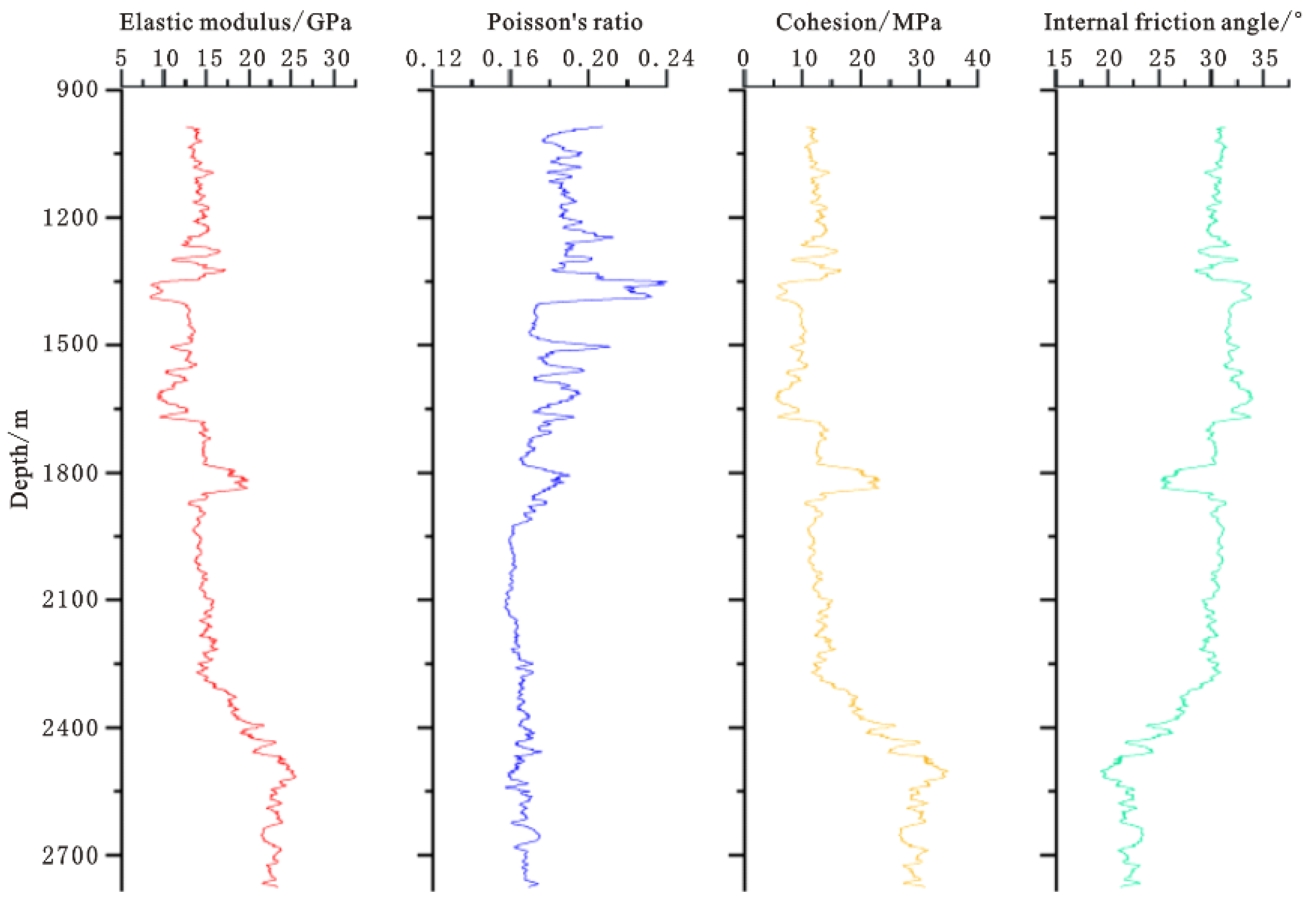
3.1.2. Rock Mechanics Parameter Section
3.1.3. A “Fluid-Solid-Chemical” Coupling Collapse Pressure Prediction Model
- (1)
- Fluid-chemical coupling model
- (2)
- Fluid-solid coupling model
- (3)
- The change rule model of stratum strength with the soaking time of drilling fluid.
- (4)
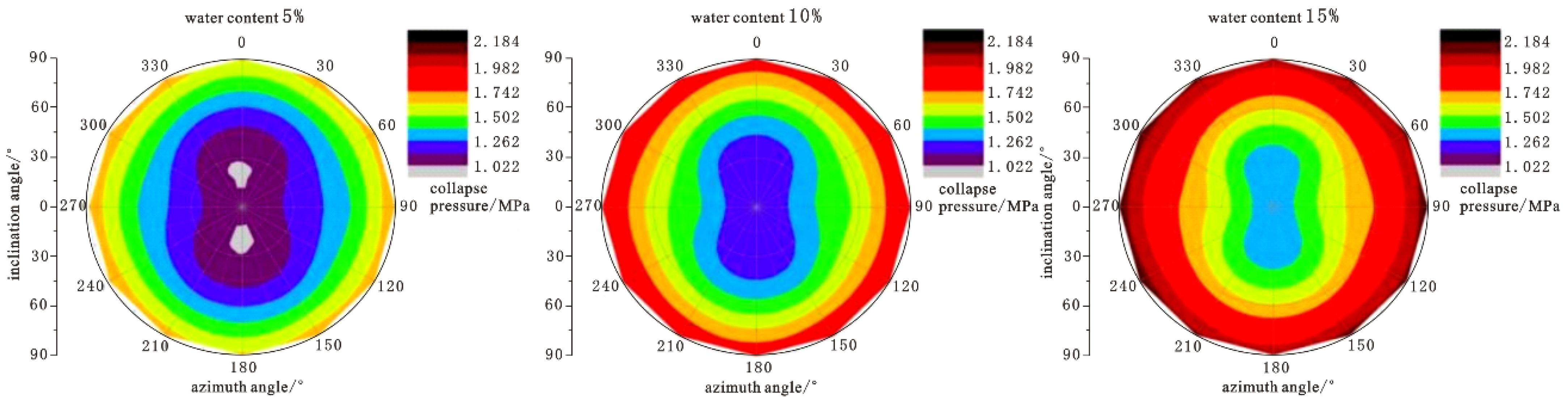
- “Fluid-solid-chemical” coupling collapse pressure model
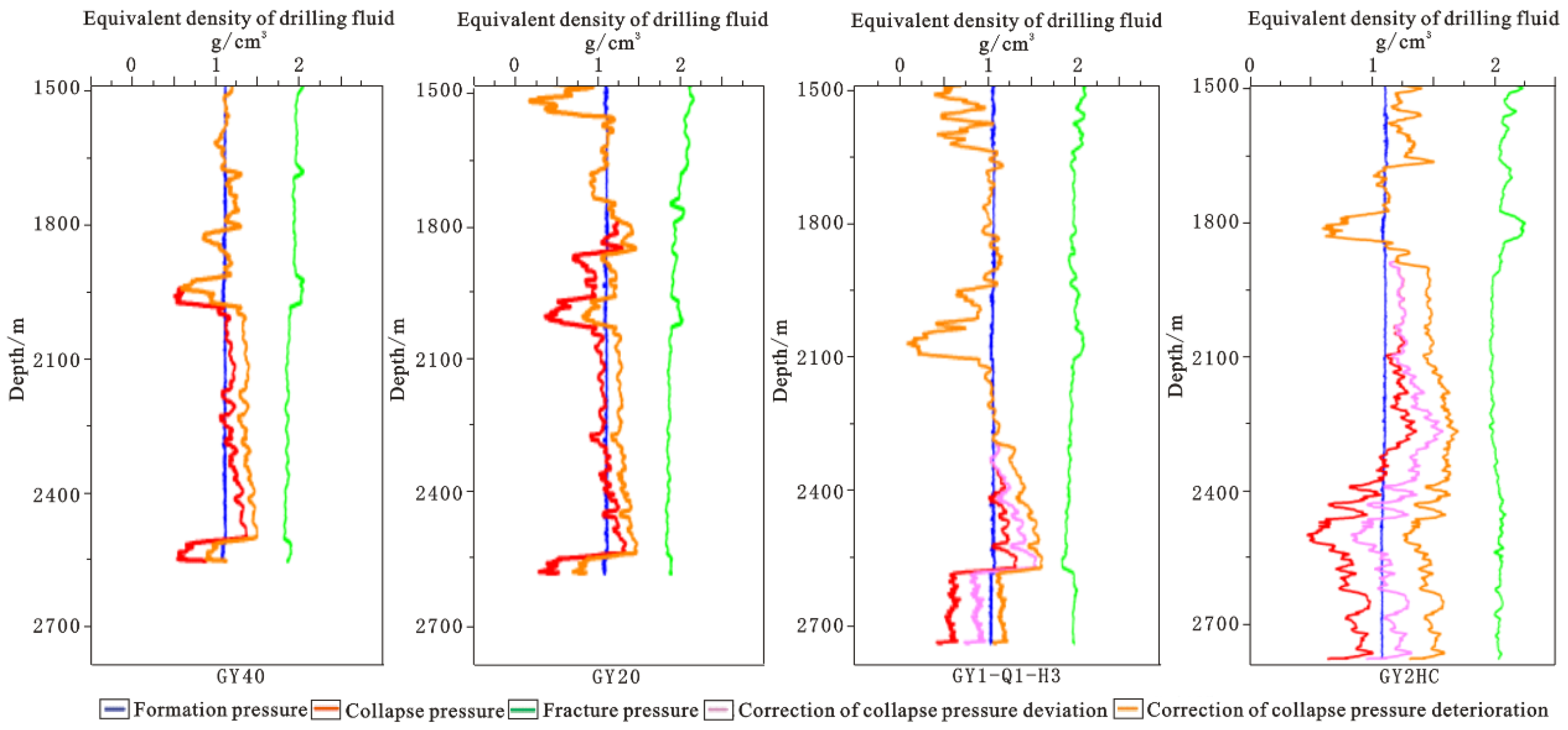
3.2. Prediction of Three-Pressure Section
4. Development of Drilling Fluid System
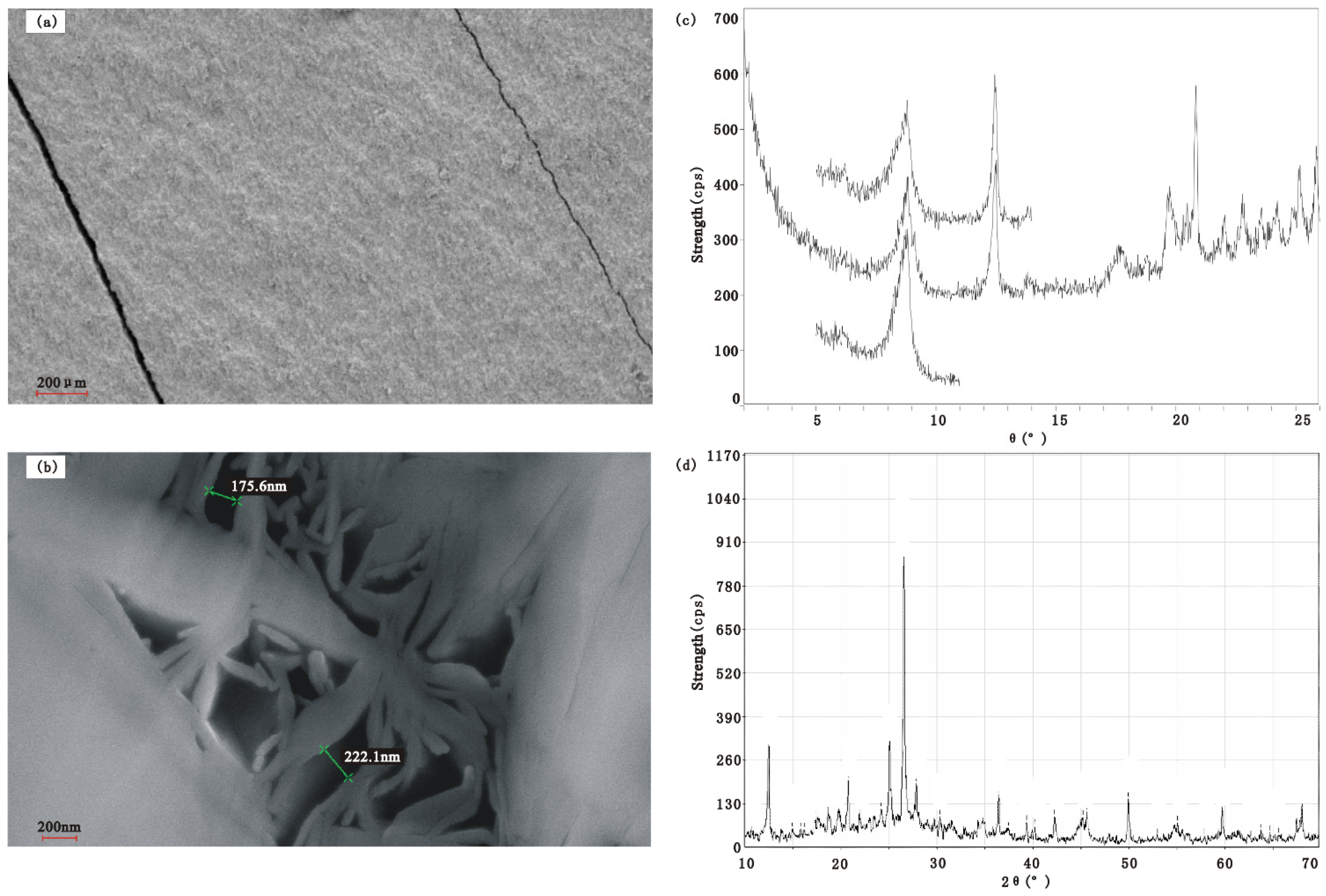
4.1. Analysis of the Characteristics of Shale Deterioration
4.2. Development of High Thixotropic Plugging Oil-Based Drilling Fluid System
5. Wellsite Test
6. Conclusions
Author Contributions
Funding
Conflicts of Interest
References
- Sun, L.; Liu, H.; He, W.; He, W.; Li, G.; Zhang, S.; Zhu, R.; Jin, X.; Meng, S.; Jiang, H. Analysis of major scientific issues and research paths of Daqing Gulong shale oil. Pet. Explor. Dev. 2021, 48, 527–540. [Google Scholar] [CrossRef] [Scilit]
- Liu, H.; Cui, S.; Zhu, D.; Li, Y.; Zhang, L. Study on microstructure and mechanical properties of hard and brittle shale. J. Undergr. Space Eng. 2019, 15, 34–39. [Google Scholar]
- Wang, G. Hydration Characteristics of Hard and Brittle Shale and Its Influence on Wellbore Collapse Pressure; Southwest Petroleum University: Chengdu, China, 2017. [Google Scholar]
- Liu, H.; Cui, S.; Meng, Y.; Li, Z.; Yu, X.; Sun, H.; Zhou, Y.; Luo, Y. Rock Mechanics and Wellbore Stability of Deep Shale During Drilling and Completion Processes. J. Pet. Sci. Eng. 2021, 205, 108882. [Google Scholar] [CrossRef] [Scilit]
- He, W.; Meng, Q.; Zhang, J. Main control factors and classification evaluation of Gulong shale oil enrichment in Songliao Basin. Daqing Pet. Geol. Dev. 2021, 40, 1–12. [Google Scholar]
- Song, M.; Liu, H.; Wang, Y.; Li, Y. Understanding and exploration practice of Paleogene shale oil enrichment in Jiyang Depression. Pet. Explor. Dev. 2020, 47, 225–235. [Google Scholar] [CrossRef] [Scilit]
- Yao, J.; Zhao, Y.; Liu, G.; Qi, Y.; Li, Y.; Luo, A.; Zhang, X. Reservoir-forming conditions and key technologies of exploration and development in Qingcheng Oilfield. Acta Pet. Sin. 2020, 41, 777–795. [Google Scholar]
- Liu, B.; Shi, J.; Fu, X.; Lyu, Y.; Sun, X.; Gong, L.; Bai, Y. Lithofacies characteristics of continental shale rock series and shale oil enrichment conditions—A case study of organic-rich shale in one section of Qingshankou Formation of Cretaceous in Gulong Depression, Songliao Basin. Pet. Explor. Dev. 2018, 45, 828–838. [Google Scholar] [CrossRef] [Scilit]
- Liu, G. Petroleum Geology; Petroleum Industry Press: Beijing, China, 2018; pp. 158–162. [Google Scholar]
- Chen, Z.; Meng, Q.; Wan, T.; Jia, Q.; Zhang, T. Numerical simulation of tectonic stress field in Gulong Depression of Songliao Basin by elastic-plastic incremental method. Earth Sci. Front. 2002, 9, 483–492. [Google Scholar]
- Zhou, J.; He, S.; Tang, M.; Huang, Z.; Chen, Y.; Chi, J.; Zhu, Y.; Yuan, P. Analysis of wellbore stability considering the effects of bedding planes and anisotropic seepage during drilling horizontal wells in the laminated formation. J. Pet. Sci. Eng. 2018, 170, 507–524. [Google Scholar] [CrossRef] [Scilit]
- Hu, S.; Bai, B.; Tao, S.; Bian, C.; Zhang, T.; Chen, Y.; Liang, X.; Wang, L.; Zhu, R.; Jia, J.; et al. Heterogeneous geological conditions and differential enrichment characteristics of high maturity shale oil in China. Pet. Explor. Dev. 2022, 49, 224–237. [Google Scholar] [CrossRef] [Scilit]
- Chen, P.; Ma, T.; Xia, H. Prediction Model of Shale Horizontal Well Collapse with Multiple Weak Faces. Nat. Gas Ind. 2014, 34, 87–93. [Google Scholar]
- Wang, B.; Sun, J.; Shen, F.; Li, W.; Zhang, W. Mechanism of wellbore instability in continental shale gas horizontal sections and its water-based drilling fluid countermeasures. Nat. Gas Ind. B 2020, 7, 680–688. [Google Scholar]
- Zhang, G.; Zhang, J.; Zhao, Y.; Lv, J.; Cheng, X.; Yang, H.; Lu, G.; Ma, M. Main control factors for the enrichment of interbedded shale oil in the two section of Qingshankou Formation in Qijia area of northern Songliao Basin. Pet. Geol. Dev. 2019, 38, 143–150. [Google Scholar]
- Wang, Y.; Liang, J.; Zhang, J.; Zhao, B.; Zhao, Y.; Liu, X.; Xia, D. Resource potential and exploration direction of shale oil in Gulong of Songliao Basin. Pet. Geol. Dev. 2020, 39, 15. [Google Scholar]
- Chenevert, M.E. Shale alteration by water adsorption. J. Pet. Technol. 1970, 22, 141–148. [Google Scholar] [CrossRef] [Scilit]
- Van Oort, E. On the physical and chemical stability of shales. J. Pet. Eng. 2003, 38, 213–235. [Google Scholar] [CrossRef] [Scilit]
- Hale, A.H.; Mody, F.K.; Salisbury, D.P. Influence of chemical potential on wellbore stability. SPE Drill. Completion 1993, 8, 207–216. [Google Scholar] [CrossRef] [Scilit]
- Deng, F. Study on the Law of Drilling Fluid Invading Shale Formation and Its Influence on Wellbore Stability; Southwest Petroleum University: Chengdu, China, 2019. [Google Scholar]
- Chen, G.; Ewy, R.T.; Yu, M. Analytic solutions with ionic flow for a pressure transmission test on shale. J. Pet. Sci. Eng. 2010, 72, 158–165. [Google Scholar] [CrossRef] [Scilit]
- Oort, E.V.; Hale, A.H.; Mody, F.K.; Roy, S. Critical parameters in modeling the chemical aspects of borehole stability in shales and in designing improved water based shale drilling fluids. J. Pet. Technol. 1994, 171–186. [Google Scholar]
- Xiang, C.; Chen, J.; Yang, G. Experiment on strength characteristics of brittle shale under drilling fluid immersion. Fault Block Oil Gas Field 2018, 25, 803–806. [Google Scholar]
- Wang, J. Study on the Mechanochemical Coupling Model of Shale Wellbore Stability; China University of Petroleum: Beijing, China, 2007. [Google Scholar]
- Lu, Y.; Chen, M.; Yuan, J.; Jin, Y.; Teng, X. Instability mechanism of inclined shaft in anisotropic stratum. Acta Pet. Sin. 2013, 34, 563–568. [Google Scholar]
- Zhang, W.; He, S.; Guo, Q. Prediction method and prospect of seismic data pressure. Adv. Geophys. 2005, 20, 814–817. [Google Scholar]
- Keyes, D.E.; Mcinnes, L.C.; Woodward, C.; Gropp, W.; Myra, E.; Pernice, M.; Bell, J.; Brown, J.; Clo, A.; Connors, J.; et al. Multiphysics Simulations Challenges and opportunities. In Proceedings of the IEEE International Conference on High Performance Computing, Data, and Analytics, Bengaluru, India, 18–21 December 2013. [Google Scholar]
- Zhang, H.; Guo, J.; Lu, J.; Li, F.; Xu, Y.; Downar, T.J. An Assessment of Coupling Algorithms in HTR Simulator TINTE. Nucl. Sci. Eng. J. Am. Nucl. Soc. 2018, 190, 287–309. [Google Scholar] [CrossRef] [Scilit]
- Fernández, M.A.; Moubachir, M. A Newton method using exact jacobians for solving fluid–structure coupling. Comput. Struct. 2005, 83, 127–142. [Google Scholar] [CrossRef] [Scilit]
- Roatei, S. On the variational formulation of a chemically active shale constitutive model. Proc. Rom. Acad. Ser. A 2010, 11, 116–124. [Google Scholar]
- Sarout, J.; Detournay, E. Chemoporoelastic analysis and experimental validation of the pore pressure transmission test for reactive shales. Int. J. Rock Mech. Min. Sci. 2011, 48, 759–772. [Google Scholar] [CrossRef] [Scilit]
- Li, J.; Liu, G.; Chen, M. A new stress model of rock around the wellbore in orthotropic stratum. J. Rock Mech. Eng. 2011, 30, 2481–2485. [Google Scholar]
- Zhang, S.; Wang, H.; Qiu, Z.; Cao, W.; Huang, H.; Chen, Z. Calculation method of safety density window of fluid-solid-chemical coupling in shale wellbore wall. Pet. Explor. Dev. 2019, 46, 1197–1205. [Google Scholar]
- Biot, M.A. Theory of Elasticity and Consolidation for a Porous Anisotropic Solid. J. Appl. Phys. 1955, 26, 182–185. [Google Scholar] [CrossRef] [Scilit]
- Rice, J.R.; Cleary, M.P. Some Basic Stress Diffusion Solutions for Fluid-Saturated Elastic Porous Media with Compressible Constituents. Rev. Geophys. Space Phys. 1976, 14, 227–241. [Google Scholar] [CrossRef] [Scilit]
- Xiao, Z. Study and Application of Fluid-Solid-Chemical Coupling Model of Hard and Brittle Shale Wellbore Wall Stability; Yangtze University: Wuhan, China, 2020. [Google Scholar]
- Ma, T.; Zhang, Y.; Qiu, Y.; Liu, Y.; Chen, P. Risk assessment method of inclined shaft instability based on reliability theory. Acta Pet. Sin. 2021, 42, 1486–1498. [Google Scholar]
- Xiao, Z.; Jia, S.; Qi, X.; Dai, Y.; Lv, F.; Jia, L.; Wen, C. Discussion on progressive failure effect of hard and brittle shale wellbore wall under fluid-solid-chemical coupling condition. J. Cent. South Univ. Nat. Sci. Ed. 2019, 50, 2464–2480. [Google Scholar]
- Ma, T. Study on the Mechanism of Wellbore Collapse and Instability of Shale Gas Horizontal Wells; Southwest Petroleum University: Chengdu, China, 2015. [Google Scholar]
- Ding, L.; Wang, Z.; Lu, J.; Sun, Y. Stability model of inclined wellbore wall in layered strata based on Mogi-Coulomb strength criterion of surrounding rock ontology. J. Rock Mech. Eng. 2017, 36, 622–632. [Google Scholar]
- Yan, C.; Deng, J.; Wei, B.; Tan, Q.; Deng, F.; Zhu, H.; Hu, L.; Chen, Z. Study on wellbore collapse pressure of shale gas reservoir. J. Rock Mech. Eng. 2013, 32, 1595–1602. [Google Scholar]
- Guang, X.; Chen, Z.; Liu, X.; Wang, Y.; Si, N. Study on wellbore stability of rational shale formation under triaxial stress. Sci. Technol. Eng. 2015, 15, 54–57. [Google Scholar]
- Chen, J. Evaluation method of drilling fluid wellbore stability for hard and brittle shale. Oilfield Chem. 2018, 35, 151–156. [Google Scholar]

| Method | Well | Stratum | Depth (m) | Vertical Stress Gradient (MPa) | Maximum Horizontal Geostress Gradient (MPa) | Minimum Horizontal Geostress Gradient (MPa) | Angle with Marking Line (°) | Marking Line Direction (°) | The Maximum Horizontal Geostress Direction (°) |
|---|---|---|---|---|---|---|---|---|---|
| Paleomagnetic directional experiment combined with differential strain analysis | G693-66-S68 | Q1 | 2319.54–2319.67 | 58.7 | 43.1 | 34.8 | 121° | N219° E | N98° E |
| Q1 | 2325.45–2325.60 | 54.2 | 44.2 | 37.0 | 86° | N207° E | N121° E | ||
| Q2, Q3 | 2277.56–2277.71 | 54.9 | 42.8 | 37.4 | −84° | N49° E | N133° E | ||
| Q2, Q3 | 2234.85–2235.01 | 54.7 | 43.6 | 36.0 | 35° | N163° E | N128° E | ||
| Kaiser effect measurement method of acoustic emission | GX7091 | Q1 | 2247.98–2248.10 | 56.2 | 42.7 | 36.6 | −66° | N30° E | N96° E |
| Q1 | 2269.75–2269.87 | 57.1 | 42.0 | 37.0 | 92° | N204° E | N112° E | ||
| Q1 | 2260.94–2261.07 | 56.8 | 42.7 | 36.2 | 93° | N197° E | N104° E |
| Core Number | Stratum | Coring Depth (m) | Loading Direction | Cohesion (MPa) | Internal Friction Angle (°) | Internal Friction Coefficient |
|---|---|---|---|---|---|---|
| 12 | Q1 | 2275.17–2275.31 | Parallel foliation | 11.386 | 12.95 | 0.230 |
| 25 | Q1 | 2317.79–2317.91 | Vertical foliation | 22.464 | 13.06 | 0.232 |
| 28 | Q1 | 2305.75–2305.90 | Foliation of 30° | 15.698 | 7.57 | 0.133 |
| 39 | Q1 | 2302.31–2302.47 | Foliation of 45° | 8.338 | 6.39 | 0.112 |
| 29 | Q1 | 2345.27–2345.39 | Foliation of 60° | 4.775 | 4.40 | 0.077 |
| Drilling Fluid | Coring Direction | Depth (m) | Soaking Time (d) | Rock Mechanics Parameter | ||
|---|---|---|---|---|---|---|
| Triaxial Compressive Strength (MPa) | Elastic Modulus (MPa) | Poisson’s Ratio | ||||
| Water-based | Horizontal | 2326.61–2326.79 | 0 | 65.658 | 12,199.4 | 0.172 |
| 2 | 43.326 | 7155.2 | 0.195 | |||
| Vertical | 2317.79–2317.91 | 0 | 93.678 | 6567.3 | 0.178 | |
| 2 | 81.321 | 10,347.7 | 0.213 | |||
| Oil-based | Horizontal | 2326.61–2326.79 | 0 | 65.658 | 12,199.4 | 0.172 |
| 10 | 53.262 | 12,589.5 | 0.174 | |||
| Vertical | 2317.79–2317.91 | 0 | 93.678 | 6567.3 | 0.178 | |
| 10 | 77.450 | 13,453.3 | 0.145 | |||
| Formula | Apparent Viscosity/mPa·s | Static Shear Force/Pa | Plastic Viscosity/mPa·s | Dynamic Shear Force/Pa | Demulsification Voltage/V | |||
|---|---|---|---|---|---|---|---|---|
| Φ600/Φ300 | Φ200/Φ100 | Φ6/Φ3 | Initial Shear Force | Final Shear Force | ||||
| Base drilling fluid | 28/18 | 14/10 | 4/3 | 2 | 3 | 10 | 4 | 699 |
| Base drilling fluid + 2% wetting agent | 26/17 | 13/9 | 4/3 | 2 | 3 | 9 | 4 | 702 |
| Weighted drilling fluid | 86/55 | 42/29 | 10/9 | 5 | 9 | 31 | 12 | 912 |
| Weighted drilling fluid + 2% wetting agent | 77/50 | 37/26 | 9/8 | 4 | 8 | 27 | 11.5 | 997 |
Publisher’s Note: MDPI stays neutral with regard to jurisdictional claims in published maps and institutional affiliations. |
© 2022 by the authors. Licensee MDPI, Basel, Switzerland. This article is an open access article distributed under the terms and conditions of the Creative Commons Attribution (CC BY) license (https://creativecommons.org/licenses/by/4.0/).
Share and Cite
Ai, X.; Chen, M. Wellbore Stabilization Technology of “Fluid-Solid-Chemical Coupling” in Continental Shale Oil—A Case Study of Shale Oil in Block GL. Energies 2022, 15, 6962. https://doi.org/10.3390/en15196962
Ai X, Chen M. Wellbore Stabilization Technology of “Fluid-Solid-Chemical Coupling” in Continental Shale Oil—A Case Study of Shale Oil in Block GL. Energies. 2022; 15(19):6962. https://doi.org/10.3390/en15196962
Chicago/Turabian StyleAi, Xin, and Mian Chen. 2022. "Wellbore Stabilization Technology of “Fluid-Solid-Chemical Coupling” in Continental Shale Oil—A Case Study of Shale Oil in Block GL" Energies 15, no. 19: 6962. https://doi.org/10.3390/en15196962
APA StyleAi, X., & Chen, M. (2022). Wellbore Stabilization Technology of “Fluid-Solid-Chemical Coupling” in Continental Shale Oil—A Case Study of Shale Oil in Block GL. Energies, 15(19), 6962. https://doi.org/10.3390/en15196962

