Abstract
Nowadays, increased urbanization is visible in most European Union countries. At the same time, it can be noticed that in the studied period (2000–2018), GDP per capita increased, and emissions per capita and energy consumption per capita decreased. These trends should be assessed in an unequivocally positive way. Considering these trends, especially with regard to economic development, our research goal is to answer the following questions: is there a long-run relationship between urbanization, energy consumption, economic growth, and carbon dioxide emissions, and what roles do urbanization and energy consumption play in the concept of the environmental Kuznets curve? This study aims to contribute to this growing area of research by exploring the European Union countries in the period covering the accession of new member states from Central Europe that needs intensifying European environmental policy. In order to test cointegration, we used Pedroni and Westerlund’s panel tests. To estimate the long-run coefficients, we employed the FMOLS, MG, CCEMG, and AMG tests. Our findings confirmed the long-run relationship between variables. We find that urbanization has a high negative impact on carbon dioxide emissions per capita. Interestingly, our studies’ results differ from those in most of the previously published articles about European countries. For this reason, our results provide a new insight for policymakers in European Union institutions.
1. Introduction
Nowadays, over half of the world’s inhabitants live in cities. The United Nations’ prognoses point out that the total population in the world in 2050 will reach 9.31 billion, while the urban population will increase to 6.25 billion, and the urbanization index will be 67.2% [1]. It is largely the civilization advance, together with all the accompanying effects, which has made the population in cities grow dramatically. However, all these aspects and assumptions have consequences as far as the natural environment, the population growth, and the population distribution in particular areas of the globe, especially in cities, are concerned. In the European Union countries, urbanization is progressing continuously, extending into new regions. In the years 2000–2018, its increase was visible in most countries. The urbanization index dropped only in four countries: Slovak Republic, Austria, Cyprus, and Poland. Minor changes (less than 1%) in this respect occurred only in the Baltic countries (Estonia, Latvia, and Lithuania), the Czech Republic, and Belgium (Table A1 in Appendix A). Based on World Bank Statista data, in 2019, 75% of the population lived in cities and the suburbs of the European Union countries, while only 25% lived in rural areas. It is noteworthy that at the same time, a decrease in carbon dioxide emissions can be observed along with the process of growing urbanization.
In most countries, a decreasing carbon dioxide emissions tendency is seen in comparing the emissions in the years 2000 and 2018. For example, Luxembourg, the leader in this ranking in 2000, witnessed significant changes in the field of applied policy concerning emissions reduction. In this region, the estimated decrease in emissions was from 19.7 metric tons per capita in 2000 to 15.3 in 2018 (Table A1 in Appendix A). The visible changes (more than 1%), in this respect, proceed in another direction in the Baltic countries (Lithuania, Latvia, and Estonia). There, an increase in carbon dioxide emissions took place by 1.03, 1.13, and 1.50 metric tons per capita, respectively. However, it must be noted that in most countries, the ongoing changes are an element of the idea of climate neutrality, which is the aim of the European Union for the next decades.
The European Union treats the problem of climate change in a very emphatic way, and it undertakes activities in this direction. Prevention of those changes is one of its priority goals, reflected in the tasks designed for the decades to come, for example, through a reduction in greenhouse gas emissions [2]. The European Green Deal is a strategy for growth, transforming the economic and political union of 27 European democratic countries into places that are neutral to climate. The activities accompanying the major goal refer to significant aspects. Firstly, it is the establishment of a modern, resource-efficient, and competitive economy where there will be no net emissions of greenhouse gases in 2050. Secondly, it is a separation of economic growth from the use of resources. The third aspect refers to guaranteeing the protection and strengthening of neutral capital. Finally, the fourth, but nonetheless very important point, is to ensure citizens’ health protection, security, and well-being, which is aimed at protecting them from the environmental effects of climate change.
Considering the formulated aims of climate neutrality, as well as the economic development and the progressing process of urbanization in the European Union countries, our main research goal is to answer the question, is there a long-run relationship between urbanization, energy consumption, economic growth, and the carbon dioxide emissions, and what roles do urbanization and energy consumption play in the concept of the environmental Kuznets curve? This study aims to contribute to this growing area of research by exploring the European Union countries in the period, which covers the accession of new member states from Central Europe. This enlargement needs intensifying cooperation between EU member states, especially in environmental policy. The relationship is tested using the concept of the environmental Kuznets curve, where, apart from carbon dioxide emissions and economic growth, urbanization and final energy consumption are considered. To this aim, the Pedroni and Westerlund panel cointegration tests are used. To estimate the long-run coefficients of the cointegration association, we employed the panel Fully Modified Ordinary Least Squares (FMOLS) test. To test the robustness of the estimation results, we used the Pesaran and Smith Mean Group (MG) estimator, the Pesaran Common Correlated Effects Mean Group (CCEMG), and Augmented Mean Group (AMG) estimators.
The remaining sections of this research are planned as follows. Section 2 presents a brief literature review on the relationship between urbanization, environmental degradation, and economic growth, analyzed within the environmental Kuznets curve (EKC) concept. Section 3 contains the data, model and empirical methodology. The research results and discussion are presented in Section 4. Section 5 concludes the research and provides policy recommendations.
2. Literature Review
Research on the effect of urbanization on the quality of the environment is frequently conducted using the concept of the environmental Kuznets curve, which appeared at the beginning of the 1990s in the work by Grossman and Krueger [3]. The Authors proved that the scale of environmental pollution is connected with the level of economic development of a given country. In the initial stages of economic development, an increase in the level of pollution related to the exploitation of natural resources also takes place, intending to create welfare. This tendency is reversed after a certain level of income (turning point) is trespassed. Then, the situation changes, and expenditures on environmental protection start to increase. The conclusions drawn by Grossman and Kruger became the basis for creating a model according to which the relationships between economic growth and the emissions of pollutants have an inverted U-shaped curve. In recent years, the popularity of the environmental Kuznets curve, which additionally used different variables, grew. A complex review of the literature in this area can be found, for instance, in Shahbaz and Sinha [4,5], Purcel [6], Koondhar et al. [7], and Xia et al. [8]. This article focuses on research that primarily considers the variables characterizing the urbanization process, urban population, and energy consumption.
It needs to be emphasized that this research was carried out in various regions and states with different levels of economic development, for instance, in emerging economies, developing countries, or developed countries. Most of those studies confirm the relationships defined by the environmental Kuznets curve, but the results of the effect of urbanization on the quality of the environment are not conclusive. For example, Maneejuk et al. [9] analyzed the relationship between GDP per capita, urbanization, financial development, the industrial sector, and the emissions of for the Association of Southeast Asian Nations (ASEAN), the European Free Trade Association (EFTA), the European Union (EU), Group of Seven (G7), Gulf Cooperation Council (GCC), Mercosur, the North American Free Trade Agreement (NAFTA) and the Organization for Economic Co-operation and Development (OECD) in the years 2001–2016. The findings indicate that the EKC hypothesis is valid in only three out of eight international economic communities, namely, the EU, OECD, and G7. It follows from the research that urbanization, as well as financial development and the industrial sector, increase emissions, while the use of renewable energy reduces degradation of the environment. In the case of urbanization, statistical significance and the highest positive effect were displayed by ASEAN (0.823), and then by GCC (0.563), Mercosur (0.553), UEU (0.123), and G7 (0.019). In the other groups, the effect of urbanization on emissions was statistically insignificant.
Similar results were obtained by Wang et al. [1]. The Authors analyzed the effect of urbanization on economic growth and the quality of the environment in the period 1996–2015 based on data from 134 countries. Studies confirmed the occurrence of an inverted U-shaped relationship between economic growth and emissions for the countries in the lower middle-income group, and a U-shaped relationship for the high-income group of countries. The Authors showed that the emissions of increased together with increased urbanization. The same direction of the effect of urbanization on carbon dioxide emissions was defined by Sun Y. et al. [10], who conducted research on the Middle East and North African (MENA) economies.
However, it deserves to be pointed out that an increase in urbanization can increase the emissions of carbon dioxide only to a certain level, after which its further progress will reduce these emissions. Such relationships were confirmed in the studies by Gierałtowska et al. [11], who indicated that urbanization has an inverted U-shaped relationship with emissions in the group covering 163 countries over the period from 2000 to 2016. This relationship can be confirmed by the results of studies obtained by Li and Haneklaus [12], where the Authors showed that increased urbanization decreases emissions in the group of G7 countries in the years 1979 to 2019, and by Balsalobre-Lorente et al. [13] in the BRICS states in the years 1914–2014. Likewise, studies by Saidi and Mbarek [14], on the effect of urbanization, income, trade openness, and financial development on the carbon dioxide emissions in nineteen emerging economies during 1990–2013, indicate that urbanization decreases emissions. According to the Authors, this is a powerful argument for politicians and city planners in shaping contemporary policies in those regions.
Previous studies conducted in European countries indicated the opposite results. Based on research carried out in 33 European countries and covering the period 1996–2017, Ali et al. [15] showed that urbanization together with economic growth, export, import, and energy consumption are the main factors that increase environmental degradation. The coefficients associated with urbanization are positive and statistically significant: 0.188 for model I, and 0.011 for model II. At the same time, the Authors point to energy innovation, which should help to reduce the rate of environmental degradation. A similar group of European countries (36) was studied by Wang et al. [16], who indicated a positive and significant effect of urbanization, as well as economic growth and foreign direct investment, on emissions in the years 2000–2018. A slightly bigger group was examined by Khezri et al. [17]. The results of studies for 43 European countries between 1996 and 2018 also confirmed the relationship defined as the environmental Kuznets curve and urbanization’s positive effect on carbon dioxide emissions (coefficients 0.659–0.760).
Comparable results, but for smaller groups of European countries, were obtained by Balsalobre-Lorente et al. [18]. The Authors studied the relationships between GDP per capita, urbanization, foreign direct investment, renewable energy consumption, and emissions in Portugal, Ireland, Italy, Greece, and Spain, in the years 1990–2019. The study confirmed the relationship between economic growth and emissions in the inverted U-shaped and N-shaped curves. The urbanization process increases the emissions of in such a way that an increase in urbanization by 1% increases emissions within the range from 0.44% to 6.36%, depending on the adopted model. Verbič et al. [19] conducted studies for the countries of South-Eastern Europe in the years 1997–2014. The evidence points to an inverted U-shaped relationship between GDP per capita and the emissions of carbon dioxide in the long run in the whole sample. Short-term estimates evidence the existence of EKC in the inverted U-shape only for Greece and Moldavia. The Authors pointed to a statistically significant positive influence of urbanization on emissions (coefficient 1.057, FMOLS).
However, not all studies confirm the negative or positive effects of urbanization on the emissions of carbon dioxide. To give an example, no relation between urbanization and carbon dioxide emissions was indicated by Destek et al. [20]. Their research sample comprised Central European countries such as Albania, Bulgaria, Croatia, the Czech Republic, Macedonia, Hungary, Poland, Romania, Slovakia, and Slovenia. The main goal was to find the relationship between emissions, urbanization, GDP per capita, energy consumption, and trade openness in the years 1991–2011. Studies confirmed the hypothesis of the environmental Kuznets curve in the sample. Results indicate a short-run two-directional causal relation between and GDP per capita as well as between GDP per capita and energy consumption. There is no relation, however, between urbanization and carbon dioxide emissions. Similar results were obtained by Amin, et al. [21], who point out that urbanization in European countries does have a positive effect on environmental pollution, but it is statistically insignificant. Interestingly, the Authors saw a need to analyze the transport sector as a consequence of the process of urbanization. The Authors argue that transport significantly affects the air quality. They also point out that using renewable energy reduces carbon dioxide emissions from transportation. At the same time, they emphasize that necessary measures should be taken to increase ecological consciousness, especially among the urban population. In this process, it is important to promote environmentally friendly and energy-efficient means of transportation.
Although, the impact of urbanization on the environment in the European Union is related to the fact that some countries have undergone deindustrialization and offshored the environmental effects of their consumption to other countries. Research on industrialization’s impact on carbon dioxide emissions mainly focuses on structural changes, where structural changes towards services, usually at higher levels of economic development, improve environmental quality [22,23,24]. Previous works, including Cherniwchan [25], and Raheem and Ogebe [26], have shown that industrialization is an important determinant in environmental quality changes. Another problem is offshoring the negative ecological impacts, which is often the result of differences in carbon prices in different regions. This phenomenon can lead to the production of energy-intensive goods into “carbon havens”, thus creating a “carbon leakage”. The observed industry relocation is a significant problem for the European Union and national policymakers [27].
3. Materials and Methods
We use the model that characterizes the relationships between economic development and the degree of environmental pollution. The first studies on these relationships included those by Grossman and Krueger [3,28], Shafik and Bandyopadhyay [29], Panayotou [30], and Selden and Song [31]. A fast increase in the number of studies led to the formulation of the concept of the environmental Kuznets curve, for example, see Gruszecki and Jóźwik [32]. It assumes a relationship between economic escalation (GDP per capita) and the level of nature contamination (e.g., due to carbon dioxide emissions), mostly in the inverted U-shaped curve. It happens because industrialization is followed by certain negative consequences (for example, pollution of man’s natural environment), which grow to a certain point, after which they decrease, even though economic development proceeds. This, on the other hand, follows on from the fact that at a certain stage of advanced economic development, a change can be noticed in the mechanism of demands exhibited by consumers who then, to function, need more services and a cleaner environment. Technological progress also takes place, which does away with the negative effects of contamination of the surrounding world following economic development.
Considering the realization of our research goal, an important problem proves to be the aforementioned relationship described by the environmental Kuznets curve and the observed increase in urbanization and technological progress in the European Union countries. This relationship induces a search for the answer to the following question: is there a long-run relationship between urbanization, energy consumption, economic growth, and carbon dioxide emissions, and what roles do urbanization and energy consumption play in the concept of the environmental Kuznets curve? We use the econometric model with the urbanization variable to answer the questions. The model with the urbanization variable was employed, for example, by Kasman and Duman [33], Ozatac, Gokmenoglu, and Taspinar [34] as well as by Kirikkaleli and Kalmaz [35], Musa et al. [36], and Anwar et al. [37]. Our model will also consider final energy consumption.
The relationship between carbon dioxide emissions, GDP per capita, urban population (urbanization), and final energy consumption per capita is expressed in model I (Equation (1)). We also use model II (Equation (2)) for a robustness check where environmental degradation is proxied as greenhouse gas emissions, expressed in units of equivalents. All variables are transformed into a natural logarithm format, to avoid multicollinearity issues, reduce the possible outliers from the dataset, as well as overcome the chances of data sharpness and normality [13].
where —regression coefficients, —carbon dioxide emissions in metric tons per capita, —greenhouse gas emissions per capita, —gross domestic product per capita (constant 2015 USD), —urban population (% of total population), —final energy consumption in tonnes of oil equivalent per capita, —error correction term. It should be pointed out that in many scientific studies, the standard measure of urbanization is the share of the population living in urban areas [38].
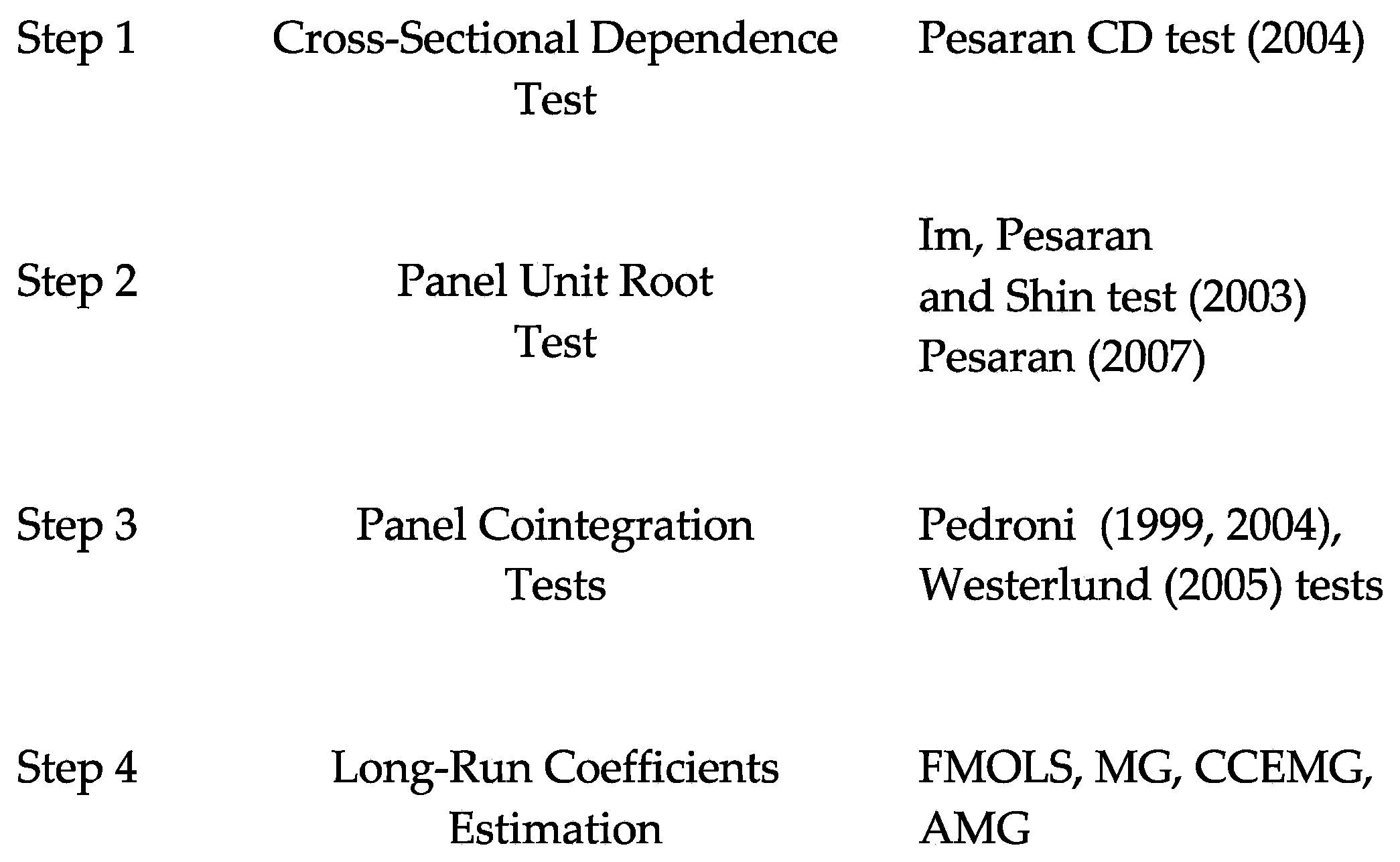
Before estimating the models, some preliminary tests need to be applied to the panel data. Figure 1 shows the entire research procedure. Initially, we test for cross-section dependence using the Pesaran CD-test [39]. Afterward, in order to discover whether the data of selected variables have stationarity or non-stationarity, we apply the Im–Pesaran–Shin panel unit root test [40] and the second-generation unit root test in the presence of cross-section dependence proposed by Pesaran [41]. Next, we test the long-run relationship (cointegration) among selected variables. To do this, we performed the Pedroni [42,43] and Westerlund [44] panel cointegration tests. These tests are recommended when inter-country convergence is confirmed [45]. The final step of the empirical analysis is estimating the long-run coefficients (elasticities) of the cointegration association concerning urbanization. For that purpose, we employed the panel Fully Modified Ordinary Least Squares test, the Pesaran and Smith [46] Mean Group estimator, the Pesaran [47] Common Correlated Effects Mean Group, and Augmented Mean Group estimators.
Figure 1.
The model estimation method. Notes: FMOLS—Fully Modified Ordinary Least Squares test; MG—Pesaran and Smith Mean Group estimator; CCEMG—Pesaran Common Correlated Effects Mean Group estimator; AMG—Augmented Mean Group estimator.
Our study sample consists of 28 countries for which we have complete data for the 2000–2018 period (532 observations for each variable). All data were retrieved from the World Bank and Eurostat databases. Table 1 describes the variables and sources of data. Table 2 shows the summary statistics. It should be noted that the differences between the values of the variables are appreciable in our research sample. The emissions range between 2.97 metric tons per capita in Latvia and 25.67 in Luxemburg, while GDP per capita ranges between USD 3668.65 in Bulgaria and 105,454.7 in Luxemburg. At the same time, we observe considerable differentiation in the urban population, where the smallest values occur in Slovenia (59.7), and the biggest in Belgium (98.0).
Table 1.
Variables descriptions and sources of data.
Table 2.
Summary statistics.
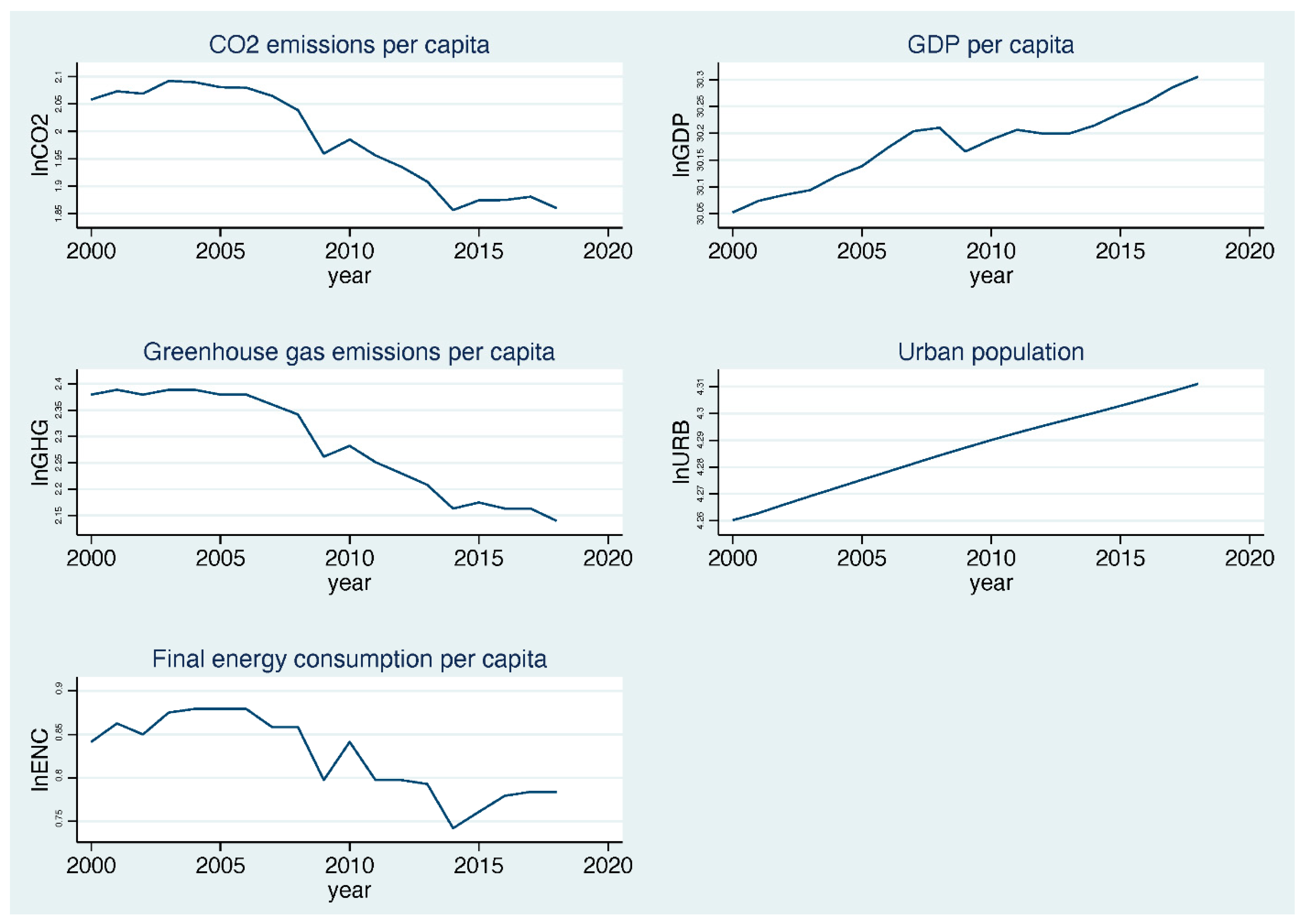
Figure 2 presents changes in aggregated variables for the European Union countries in the years 2000–2018. In the examined period, a decrease in per capita and greenhouse gas emissions, final energy consumption, and an increase in GDP per capita and urban population occurred. These trends should be assessed in a positive way. Another issue is a growing proportion of the population living in cities (urbanization), which is undoubtedly connected with the demographic changes, economic development, and technological advance observed in economically developed countries.
Figure 2.
emissions per capita, greenhouse gas emissions per capita, GDP per capita, urban population, and final energy consumption per capita in the European Union between 2000 and 2018.
4. Results and Discussion
As outlined above, the first step in our method is to observe whether series are generating common shocks in the long run. To this aim, we test for cross-section dependence in our panel time-series data. The outcomes of the Pesaran cross-sectional dependency test [39] are shown in Table 3. The test results rejected the null hypothesis and confirmed the presence of cross-country dependency, which is not unexpected because the European Union countries share a common market and economic policy. A number of the conducted studies point to systematic economic convergence between these countries in recent years, for example, see Jóźwik [48] or Bernardelli et al. [49]. Because of this convergence, one country’s economic and environmental transformations can easily be transferred to its neighboring countries. Therefore, we need to use a proper stationarity approach to circumvent the common effect and provide reliable results [45].
Table 3.
Results of cross-sectional dependency Pesaran test.
In the second step, we identify the order of integration of the variables by employing the Im–Pesaran–Shin panel unit root test. We subtracted the cross-sectional averages from the series and requested that the number of lags of the series be chosen in such a way that the AIC for the regression is minimized (max AIC is four). The stationarity test results in Table 4 confirm that the data series is unstable at this level. However, after considering the first difference, the test confirmed that the series became stationary at the 1% significance.
Table 4.
Im–Pesaran–Shin Panel unit root test (W-t-bar statistics).
In addition, we employed the panel second generation unit root test in the presence of cross-section dependence proposed by Pesaran [41]. We assume that the serial correlation order to be tasted with the Breusch–Godfrey Lagrange multiplier test in each regression is one, and the number of lags is four. Table 5 displays results for two deterministic models’ specifications: with individual-specific intercepts and incidental linear trends. The test results confirm that the variables are stationary at the first difference, almost all at the 1% significance.
Table 5.
Pesaran panel unit root test in the presence of cross-section dependence.
As noted previously, environmental degradation can be proxied in various ways. We selected emissions as a proxy for environmental degradation in the model I, but for a robustness check, we also used the greenhouse gas emissions per capita variable. In this respect, we checked the cointegration (long-run relationship) between variables using the Pedroni and Westerlund tests. The tests have a common null hypothesis of no cointegration. The alternative hypothesis of the Pedroni tests is that the variables are cointegrated in all panels. In the version of the Westerlund test in which the AR parameter is panel specific, the alternative hypothesis is that the variables are cointegrated in some of the panels. In the version of the Westerlund test in which the AR parameter is the same over the panels, the alternative hypothesis is that the variables are cointegrated in all the panels. In the Pedroni tests, we subtracted the cross-sectional averages from the series and requested that the number of lags of the series be chosen in such a way that the AIC for the regression is minimized (max AIC is four), as in the panel unit root tests calculations. Table 6 reports results for cointegration where six out of seven Pedroni tests confirm cointegration in Model I and Model II. The results of the Westerlund tests indicate that the variables are cointegrated in some of the panels.
Table 6.
Pedroni and Westerlund panel cointegration tests results.
In the final step, we estimated the coefficients of Equations (1) and (2). Table 7 provides the FMOLS test results. To test the robustness of the estimated results, we used the Pesaran and Smith Mean Group estimator, the Pesaran Common Correlated Effects Mean Group, and the Augmented Mean Group estimators. These tests, which concern with correlation across panel members (cross-section dependence), were introduced by Eberhardt and Teal [50] and Bond and Eberhardt [51]. The advantage of using these estimators is that they are designed for ‘moderate-T and moderate-N’ macro panels. These results are presented in Table 8.
Table 7.
Panel FMOLS test results.
Table 8.
Mean Group (MG), Augmented Mean Group (AMG), and Common Correlated Effects Mean Group (CCEMG) estimation results.
As can be seen from Table 7 and Table 8, in both models, the significant coefficients of the real GDP per capita are positive, whereas those of the squared GDP per capita are negative. It means that the long-run linkage between emissions per capita and GDP per capita is an inverted U-shape implying that the environmental Kuznets curve concept is verified for the whole group of the European Union countries. The economic growth and development are supportive of carbon emissions in that region. Similar results of studies for the group of European countries were recently obtained by Destek et al. [20], Maneejuk et al. [9], and Verbič et al. [19], as well as by Balsalobre-Lorente et al. [18]. Despite significant technological advances in the European Union countries, energy consumption still positively influences carbon emissions per capita. Our results are similar to the papers mentioned earlier, as well as to those that have been published recently, namely, Khezri et al. [17], Kar [52], and Mohsin et al. [53].
Interestingly, all results from Table 7 and Table 8 indicate that urbanization negatively impacts carbon emissions per capita. However, there are differences in the significance level of the coefficients depending on the method used. Nevertheless, this shows that urbanization has an essential effect on environmental protection in the European Union area, nowadays. For example, the results of FMOLS for model I show that a 1% increase in a share of the urban population decreases emissions per capita by 5.02% if all other variables remain the same. We want to highlight that our study on the urbanization process’ effect on carbon dioxide emissions points to different results than many studies mentioned in the literature review section. As we remember, the significant results indicate that urbanization positively impacted the carbon dioxide emissions in different groups of European countries. To give an example, in an article by Ali et al. [15], coefficients are positive and equal to 0.188 and 0.011; in the study by Balsalobre-Lorente et al. [18], between 0.44 and 6.36; while in the studies by Destek et al. [20] and Amin et al. [21] there was no relationship. This difference probably results from a few reasons, some of which include research methods, samples, and periods. Another reason can be related to trespassing the threshold after which both increased income per capita and the coefficient of urbanization give rise to improved quality of the environment, which was indicated by Gierałtowska et al. [11]. This effect can be enhanced by the deindustrialization process we wrote about in the literature review. Dong et al. [54] highlighted that from the perspective of income level, industrialization contributes to the growth in carbon emissions. The effect of industrialization on emissions gradually increases in the low- and intermediate-income levels. Azam et al. [55] also state that the industrialization process in OPEC economies increases environmental pollution, while the impacts on income are the opposite. However, the effect of industrialization begins to weaken at the high-income level according to research conducted by Dong et al. [54]. Probably this effect is observed in the European Union countries with a high-income level. Furthermore, economic development supports human capital, which significantly improves environmental quality [56]. Thus, our results indicate that studies in this area should be extended to different research models and methods.
5. Conclusions and Recommendations
In our research, we took into consideration two trends. First is the urbanization process, which increased the urban population in most European Union countries in years 2000–2018, and the second trend is a decrease in carbon dioxide emissions, which is indirectly the consequence of technological advances and the applied European climate policy. Considering these two trends, our research goal was to answer the following question: is there a long-run relationship between urbanization, energy consumption, economic growth, and carbon dioxide emissions, and what roles do urbanization and energy consumption play in the concept of the environmental Kuznets curve in European Union countries? We used the data from 28 European Union countries to assess the relationships. Our findings confirmed the long-run relationship between variables. We validated the environmental Kuznets curve hypothesis, indicating that economic growth has an inverted U-shaped effect on emissions.
However, energy consumption still positively influences carbon emissions per capita, even though European Union countries have made significant economic and technological progress. At the same time, urbanization has a highly negative impact on carbon dioxide emissions per capita. If all other variables remain the same, a 1% increase in a share of the urban population decreases emissions per capita by 5.02%. The result of our study is different from the results in the majority of earlier published articles. This difference probably arises from a few reasons. One of them may be the fact that the threshold after which both an increase in income per capita and urban population causes a decrease in carbon dioxide emissions in European Union countries has been trespassed in recent years.
Our results provide new insights for policymakers in European Union institutions. The findings suggest that the European policy should support the process of urbanization in a complex manner to fulfill the European Green Deal and achieve the Sustainable Development Goals related to improving environmental quality, especially by promoting urbanization with a low-carbon infrastructure and transport (smart technology and energy-efficient hybrid vehicles). A positive coefficient associated with energy consumption indicates that local authorities should support the development of home renewable energy infrastructure, for example, energy-efficient electric appliances and solar energy. Another important practical implication is related to human capital. The urban population can be motivated to adopt a sustainable lifestyle, including energy-saving, renewable energy sources, and public transportation [56]. It is very important in this context that urbanization be carried out according to environmental norms, possibly without social compromises in this respect. In addition, modern technological solutions enable the development of intelligent cities that are environmentally neutral.
However, we only conducted a preliminary empirical analysis of the relationship between environmental degradation and urbanization, and our study has a few limitations. The first limitation refers to sample size. The sample covers the period 2000–2018, this means we should be cautious in generalizing the findings. Second, although we have robust results using an alternative measure of environmental degradation, the two proxies ( and greenhouse emissions) might limit the ecological degradation effects. Additionally, it would be interesting to examine the consumption environmental impacts offshored to other countries and the deindustrialization processes. Third, we did not divide the European Union countries, for example, into less developed countries (Central European countries) and developed countries (Western European countries) to make a comparative analysis. These limitations could be addressed in future research.
Undoubtedly, in further research, we must also remember that climate neutrality is a global challenge. This means that it requires international dialogue and cooperation between the states. Although the pressure applied usually refers to particular countries and their economic structures, international activity is also an issue that plays a predominant role. It is especially important due to the necessity of creating a synergy between the European and international climate initiatives. For this reason, understanding that adaptation to climate changes is important; however, this is not in itself the aim, but rather a principle. It should, however, be a component of properly functioning and developing countries and societies.
Author Contributions
Conceptualization, B.J. and K.G.; methodology, B.J. and A.-V.G.; software, B.J.; formal analysis and investigation, B.J., K.G. and A.-V.G.; writing—original draft preparation, B.J., K.G. and A.-V.G.; writing—review and editing, B.J.; visualization, B.J.; project administration, B.J. All authors have read and agreed to the published version of the manuscript.
Funding
The APC was funded by the John Paul II Catholic University of Lublin.
Institutional Review Board Statement
Not applicable.
Informed Consent Statement
Not applicable.
Data Availability Statement
Publicly available datasets were analyzed in this study. This data can be found here: https://data.worldbank.org and https://ec.europa.eu/eurostat.
Conflicts of Interest
The authors declare no conflict of interest.
Appendix A
Table A1.
emissions per capita and urban population in the European Union countries.
Table A1.
emissions per capita and urban population in the European Union countries.
| Country | Emissions (Metric Tons per Capita) | Urban Population (% of Total Population) | ||
|---|---|---|---|---|
| 2000 | 2018 | 2000 | 2018 | |
| Austria | 17,690 | 15,476 | 60,213 | 58,297 |
| Belgium | 11,441 | 8180 | 97,129 | 98,001 |
| Bulgaria | 5303 | 5855 | 68,899 | 75,008 |
| Croatia | 4040 | 4056 | 53,428 | 56,947 |
| Cyprus | 7495 | 6079 | 68,648 | 66,810 |
| Czech Rep. | 12,011 | 9641 | 73,988 | 73,792 |
| Denmark | 12,011 | 9641 | 85,100 | 87,874 |
| Estonia | 10,609 | 12,103 | 69,368 | 68,880 |
| Finland | 10,645 | 8043 | 82,183 | 85,382 |
| France | 6127 | 4619 | 75,871 | 80,444 |
| Germany | 10,097 | 8558 | 74,965 | 77,312 |
| Greece | 8742 | 6083 | 72,716 | 79,058 |
| Hungary | 5350 | 4746 | 64,575 | 71,351 |
| Ireland | 11,201 | 7624 | 59,155 | 63,170 |
| Italy | 7662 | 5376 | 67,222 | 70,438 |
| Latvia | 2927 | 3959 | 68,067 | 68,142 |
| Lithuania | 3003 | 4137 | 66,986 | 67,679 |
| Luxembourg | 19,665 | 15,330 | 84,216 | 90,981 |
| Malta | 5460 | 3198 | 92,368 | 94,612 |
| Netherlands | 10,191 | 8773 | 76,795 | 91,490 |
| Poland | 7729 | 8235 | 61,716 | 60,058 |
| Portugal | 5992 | 4841 | 54,399 | 65,211 |
| Romania | 3960 | 3845 | 53,004 | 53,998 |
| Slovak Rep. | 7065 | 6059 | 56,233 | 53,726 |
| Slovenia | 7310 | 6775 | 50,754 | 54,541 |
| Spain | 7230 | 5520 | 76,262 | 80,321 |
| Sweden | 6005 | 3538 | 84,026 | 87,431 |
| United Kingdom | 9001 | 5399 | 78,651 | 83,398 |
Source: World Development Indicators.
References
- Wang, Q.; Wang, X.; Li, R. Does urbanization redefine the environmental Kuznets curve? An empirical analysis of 134 Countries. Sustain. Cities Soc. 2022, 76, 103382. [Google Scholar] [CrossRef]
- Lapinskienė, G.; Peleckis, K.; Slavinskaitė, N. Energy consumption, economic growth and greenhouse gas emissions in the European Union countries. J. Bus. Econ. Manag. 2017, 18, 1082–1097. [Google Scholar] [CrossRef]
- Grossman, G.M.; Krueger, A.B. Environmental Impacts of a North American Free Trade Agreement. NBER Working Papers. 1991. No. 3914. Available online: http://www.nber.org/papers/w3914 (accessed on 20 June 2022). [CrossRef]
- Shahbaz, M.; Sinha, A. Environmental Kuznets Curve for CO2 Emission: A Literature Survey. J. Econ. Stud. 2019, 46, 106–168. [Google Scholar] [CrossRef]
- Sarkodie, S.A.; Strezov, V. A review on environmental Kuznets curve hypothesis using bibliometric and meta-analysis. Sci. Total Environ. 2019, 649, 128–145. [Google Scholar] [CrossRef] [PubMed]
- Purcel, A.-A. New insights into the environmental Kuznets curve hypothesis in developing and transition economies: A literature survey. Environ. Econ. Policy Stud. 2020, 22, 585–631. [Google Scholar] [CrossRef]
- Koondhar, M.A.; Shahbaz, M.; Memon, K.A.; Ozturk, I.; Kong, R. A visualization review analysis of the last two decades for environmental Kuznets curve “EKC” based on co-citation analysis theory and pathfinder network scaling algorithms. Environ. Sci. Pollut. Res. 2021, 28, 16690–16706. [Google Scholar] [CrossRef]
- Xia, L.; Wang, Z.; Du, S.; Tian, D.; Zhao, S. New insight into the Bibliometric Analysis on the Topic of Environmental Kuznets Curve. E3s Web Conf. 2022, 350, 01003. [Google Scholar] [CrossRef]
- Maneejuk, N.; Ratchakom, S.; Maneejuk, P.; Yamaka, W. Does the Environmental Kuznets Curve Exist? An International Study. Sustainability 2020, 12, 9117. [Google Scholar] [CrossRef]
- Sun, Y.; Li, H.; Andlib, Z.; Genie, M.G. How do renewable energy and urbanization cause carbon emissions? Evidence from advanced panel estimation techniques. Renew. Energ. 2022, 185, 996–1005. [Google Scholar] [CrossRef]
- Gierałtowska, U.; Asyngier, R.; Nakonieczny, J.; Salahodjaev, R. Renewable Energy, Urbanization, and CO2 Emissions: A Global Test. Energies 2022, 15, 3390. [Google Scholar] [CrossRef]
- Li, B.; Haneklaus, N. Reducing CO2 emissions in G7 countries: The role of clean energy consumption, trade openness and urbanization. Energy Rep. 2022, 8, 704–713. [Google Scholar] [CrossRef]
- Balsalobre-Lorente, D.; Driha, O.M.; Halkos, G.; Mishra, S. Influence of growth and urbanization on CO2 emissions: The moderating effect of foreign direct investment on energy use in BRICS. Sustain. Dev. 2022, 30, 227–240. [Google Scholar] [CrossRef]
- Saidi, K.; Mbarek, M.B. The impact of income, trade, urbanization, and financial development on CO2 emissions in 19 emerging economies. Environ. Sci. Pollut. Res. 2017, 24, 12748–12757. [Google Scholar] [CrossRef] [PubMed]
- Ali, M.; Raza, S.A.; Khamis, B. Environmental degradation, economic growth, and energy innovation: Evidence from European countries. Environ. Sci. Pollut. Res. 2020, 27, 28306–28315. [Google Scholar] [CrossRef] [PubMed]
- Wang, J.; Mamkhezri, J.; Khezri, M.; Karimi, M.S.; Khan, Y.A. Insights from European nations on the spatial impacts of renewable energy sources on CO2 emissions. Energy Rep. 2022, 8, 5620–5630. [Google Scholar] [CrossRef]
- Khezri, M.; Karimi, M.S.; Khan, Y.A.; Khodaei, M. Environmental implications of regional financial development on air pollution: Evidence from European countries. Environ. Dev. Sustain. 2022, 1–21. [Google Scholar] [CrossRef]
- Balsalobre-Lorente, D.; Ibáñez-Luzón, L.; Usman, M.; Shahbaz, M. The environmental Kuznets curve, based on the economic complexity, and the pollution haven hypothesis in PIIGS countries. Renew. Energy 2022, 185, 1441–1455. [Google Scholar] [CrossRef]
- Verbič, M.; Satrovic, E.; Muslija, A. Environmental Kuznets curve in Southeastern Europe: The role of urbanization and energy consumption. Environ. Sci. Pollut. Res. 2021, 28, 57807–57817. [Google Scholar] [CrossRef]
- Destek, M.A.; Balli, E.; Manga, M. The relationship between CO2 emission, energy consumption, urbanization and trade openness for selected CEECs. Res. World Econ. 2016, 7, 52–58. [Google Scholar] [CrossRef]
- Amin, A.; Altinoz, B.; Dogan, E. Analyzing the determinants of carbon emissions from transportation in European countries: The role of renewable energy and urbanization. Clean Technol. Environ. Policy 2020, 22, 1725–1734. [Google Scholar] [CrossRef]
- Duro, J.A.; Alcántara, V.; Padilla, E. International inequality in energy intensity levels and the role of production composition and energy efficiency: An analysis of OECD countries. Ecol. Econ. 2010, 69, 2468–2474. [Google Scholar] [CrossRef]
- Mulder, P.; De Groot, H.L.; Pfeiffer, B. Dynamics and determinants of energy intensity in the service sector: A cross-country analysis, 1980–2005. Ecol. Econ. 2014, 100, 1–15. [Google Scholar] [CrossRef]
- Du, X.; Xie, Z. Occurrence of turning point on environmental Kuznets curve in the process of (de) industrialization. Struct. Chang. Econ. Dyn. 2020, 53, 359–369. [Google Scholar] [CrossRef]
- Cherniwchan, J. Economic growth, industrialization, and the environment. Resour. Energy Econ. 2012, 34, 442–467. [Google Scholar] [CrossRef]
- Raheem, I.D.; Ogebe, J.O. CO2 emissions, urbanization and industrialization: Evidence from a direct and indirect heterogeneous panel analysis. Manag. Environ. Qual. 2017, 28, 851–867. [Google Scholar] [CrossRef]
- Aus dem Moore, N.; Grosskurth, P.; Themann, M. Multinational corporations and the EU Emissions Trading System: The specter of asset erosion and creeping deindustrialization. J. Environ. Econ. Manag. 2019, 94, 1–26. [Google Scholar] [CrossRef]
- Grossman, G.M.; Krueger, A.B. Economic growth and the environment. Q. J. Econ. 1995, 110, 353–377. [Google Scholar] [CrossRef]
- Shafik, N.; Bandyopadhyay, S. Economic Growth and Environmental Quality Time-Series and Cross-Country Evidence; Background Paper for the World Development Report 1992; The World Bank: Washington, DC, USA, 1992. [Google Scholar]
- Panayotou, T. Empirical Tests and Policy Analysis of Environmental Degradation at Different Stages of Economic Development; World Employment Programme Research, Working Paper No 238; International Labor Office: Geneva, Switzerland, 1993; pp. 1–42. [Google Scholar]
- Selden, T.; Song, D. Environmental quality and development: Is there a Kuznets curve for air pollution emissions. J. Environ. Econ. Manag. 1994, 27, 147–162. [Google Scholar] [CrossRef]
- Gruszecki, L.; Jóźwik, B. Theoretical reconstruction of the environmental Kuznets curve. Gospodarka Narodowa. Pol. J. Econ. 2019, 299, 95–117. [Google Scholar] [CrossRef]
- Kasman, A.; Duman, Y.S. CO2 emissions, economic growth, energy consumption, trade and urbanization in new EU member and candidate countries: A panel data analysis. Econ. Model. 2015, 44, 97–103. [Google Scholar] [CrossRef]
- Ozatac, N.; Gokmenoglu, K.K.; Taspinar, N. Testing the EKC hypothesis by considering trade openness, urbanization, and financial development: The case of Turkey. Environ. Sci. Pollut. Res. 2017, 24, 16690–16701. [Google Scholar] [CrossRef] [PubMed]
- Kirikkaleli, D.; Kalmaz, D.B. Testing the moderating role of urbanization on the environmental Kuznets curve: Empirical evidence from an emerging market. Environ. Sci. Pollut. Res. 2020, 27, 38169–38180. [Google Scholar] [CrossRef] [PubMed]
- Musa, K.S.; Maijama’a, R.; Yakubu, M. The causality between urbanization, industrialization and CO2 emissions in Nigeria: Evidence from Toda and Yamamoto Approach. Energy Econ. Lett. 2021, 8, 1–14. [Google Scholar] [CrossRef]
- Anwar, A.; Sinha, A.; Sharif, A.; Siddique, M.; Irshad, S.; Anwar, W.; Malik, S. The nexus between urbanization, renewable energy consumption, financial development, and CO2 emissions: Evidence from selected Asian countries. Environ. Dev. Sustain. 2022, 24, 6556–6576. [Google Scholar] [CrossRef]
- Aller, C.; Ductor, L.; Grechyna, D. Robust determinants of CO2 emissions. Energy Econ. 2021, 96, 105154. [Google Scholar] [CrossRef]
- Pesaran, M.H. General Diagnostic Tests for Cross Section Dependence in Panels’ IZA; Discussion Paper No. 1240; 2004. Available online: https://www.iza.org/publications/dp/1240/general-diagnostic-tests-for-cross-section-dependence-in-panels (accessed on 5 July 2022).
- Im, K.S.; Pesaran, M.H.; Shin, Y. Testing for unit roots in heterogeneous panels. J. Econom. 2003, 115, 53–74. [Google Scholar] [CrossRef]
- Pesaran, M.H. A Simple Panel Unit Root Test in The Presence Of Cross-section Dependence. J. Appl. Econom. 2007, 22, 265–312. [Google Scholar] [CrossRef]
- Pedroni, P. Critical values for cointegration tests in heterogeneous panels with multiple regressors. Oxf. Bull. Econ. Stat. 1999, 61, 653–670. [Google Scholar] [CrossRef]
- Pedroni, P. Panel cointegration: Asymptotic and finite sample properties of pooled time series tests with an application to the PPP hypothesis. Econ. Theory 2004, 20, 597–625. [Google Scholar] [CrossRef]
- Westerlund, J. New simple tests for panel cointegration. Econom. Rev. 2005, 24, 297–316. [Google Scholar] [CrossRef]
- Sharma, R.; Shahbaz, M.; Kautish, P.; Vo, X.V. Analyzing the impact of export diversification and technological innovation on renewable energy consumption: Evidences from BRICS nations. Renew. Energy 2021, 178, 1034–1045. [Google Scholar] [CrossRef]
- Pesaran, M.H.; Smith, R.P. Estimating long-run relationships from dynamic heterogeneous panels. J. Econom. 1995, 68, 79–113. [Google Scholar] [CrossRef]
- Pesaran, M.H. Estimation and inference in large heterogeneous panels with a multifactor error structure. Econometrica 2006, 74, 967–1012. [Google Scholar] [CrossRef]
- Jóźwik, B. Realna Konwergencja Gospodarcza Państw Członkowskich Unii Europejskiej z Europy Środkowej i Wschodniej: Transformacja, Integracja i Polityka Spójności; Wydawnictwo Naukowe PWN: Warszawa, Poland, 2017. [Google Scholar]
- Bernardelli, M.; Próchniak, M.; Witkowski, B. Towards the Similarity of the Countries in Terms of Business Cycle Synchronization and Income Level Equalization–Empirical Analysis. J. Adm. Bus. Stud. 2019, 5, 291–302. [Google Scholar] [CrossRef][Green Version]
- Teal, F.; Eberhardt, M. Productivity Analysis in Global Manufacturing Production; Economics Series Working Papers, 515; University of Oxford: Oxford, UK, 2010. [Google Scholar]
- Eberhardt, M.; Bond, S. Cross-Section Dependence in Nonstationary Panel Models: A Novel Estimator; MPRA Paper, No. 17692; University Library of Munich: Munich, Germany, 2009; Available online: https://mpra.ub.uni-muenchen.de/id/eprint/17692 (accessed on 5 July 2022).
- Kar, A.K. Environmental Kuznets curve for CO2 emissions in Baltic countries: An empirical investigation. Environ. Sci. Pollut Res. 2022, 29, 47189–47208. [Google Scholar] [CrossRef] [PubMed]
- Mohsin, M.; Naseem, S.; Sarfraz, M.; Azam, T. Assessing the effects of fuel energy consumption, foreign direct investment and GDP on CO2 emission: New data science evidence from Europe & Central Asia. Fuel 2022, 314, 123098. [Google Scholar] [CrossRef]
- Dong, F.; Wang, Y.; Su, B.; Hua, Y.; Zhang, Y. The process of peak CO2 emissions in developed economies: A perspective of industrialization and urbanization. Resour. Conserv. Recyc. 2019, 141, 61–75. [Google Scholar] [CrossRef]
- Azam, M.; Rehman, Z.U.; Ibrahim, Y. Causal nexus in industrialization, urbanization, trade openness, and carbon emissions: Empirical evidence from OPEC economies. Environ. Dev. Sustain. 2022, 1–21. [Google Scholar] [CrossRef]
- Ahmed, Z.; Zafar, M.W.; Ali, S. Linking urbanization, human capital, and the ecological footprint in G7 countries: An empirical analysis. Sustain. Cities Soc. 2020, 55, 102064. [Google Scholar] [CrossRef]
Publisher’s Note: MDPI stays neutral with regard to jurisdictional claims in published maps and institutional affiliations. |
© 2022 by the authors. Licensee MDPI, Basel, Switzerland. This article is an open access article distributed under the terms and conditions of the Creative Commons Attribution (CC BY) license (https://creativecommons.org/licenses/by/4.0/).