1. Introduction
Commonly used geothermal systems are designed and operated independently by separating the geothermal system and other heat source systems. Most buildings do not use consistent cooling and heating throughout the year. When the amount of cooling used increases, the temperature of the existing geothermal system increases with increasing number of years of use. In contrast, the temperature drops when the amount of heating is high. This deteriorates the performance of the geothermal system. The problem of such a geothermal system can be solved by increasing the capacity of the heat exchanger of the geothermal system or increasing the borehole spacing. Such changes are difficult to apply practically because of the increase in initial investment cost from the increased heat exchanger capacity or increased required area of the ground due to the increase in borehole spacing.
The performance degradation problem of geothermal systems can be solved, and hybrid geothermal systems have been designed and operated economically. This study developed operating technology for hybrid geothermal systems. The geothermal system performance calculation criteria were developed using the heat source side temperature and performance prediction methods for the hybrid geothermal system operation to utilize geothermal system performance when selecting the operating conditions.
ASHRAE (1995) [
1] described the reduction in the installation area and initial investment cost of the underground heat exchanger when the hybrid geothermal system was used, and Kavanaugh and Ratterty (1997) [
2] discussed the design of the geothermal system for the commercial and institutional buildings described. When designing a hybrid geothermal system, they stated that the capacity of the auxiliary heat source system should be designed according to the difference in the maximum load for heating and cooling. Through this, it is possible to prevent the occurrence of temperature problems on the side of the heat source due to differences in heating and cooling loads. Yavuzturk and Spitler (2000) [
3] conducted a comparative study of hybrid geothermal system control strategies using simulation. An economics analysis was conducted to select the control strategy with the lowest cost. Wang (2012) [
4] proposed a hybrid geothermal system combined with a solar system for office buildings and analyzed system performance through dynamic energy simulation. Zang (2015) [
5] compared operation strategies to optimize the performance of hybrid geothermal systems for small office buildings; using the difference between the existing fluid temperature and wet bulb temperature of the ground loop as a control variable is a method of reducing the initial cost of the hybrid geothermal system.
There are many studies on the effects of the design method and use of hybrid geothermal systems. There is also a study on the control strategy of hybrid geothermal systems [
6,
7,
8,
9,
10,
11,
12,
13,
14,
15,
16,
17,
18]. In most previous studies, the operation of hybrid geothermal systems utilizes temperature as an operating point. This study aims to develop operational technology that utilizes performance as a hybrid geothermal system changeover operating point. The operation of the auxiliary heat source of the hybrid geothermal system is determined by comparing the performance when operating the single geothermal system and the performance when operating the hybrid geothermal system. To this end, it aims to develop a hybrid geothermal system performance prediction technology using the heat source side temperature.
2. Hybrid Geothermal Heat Pump System
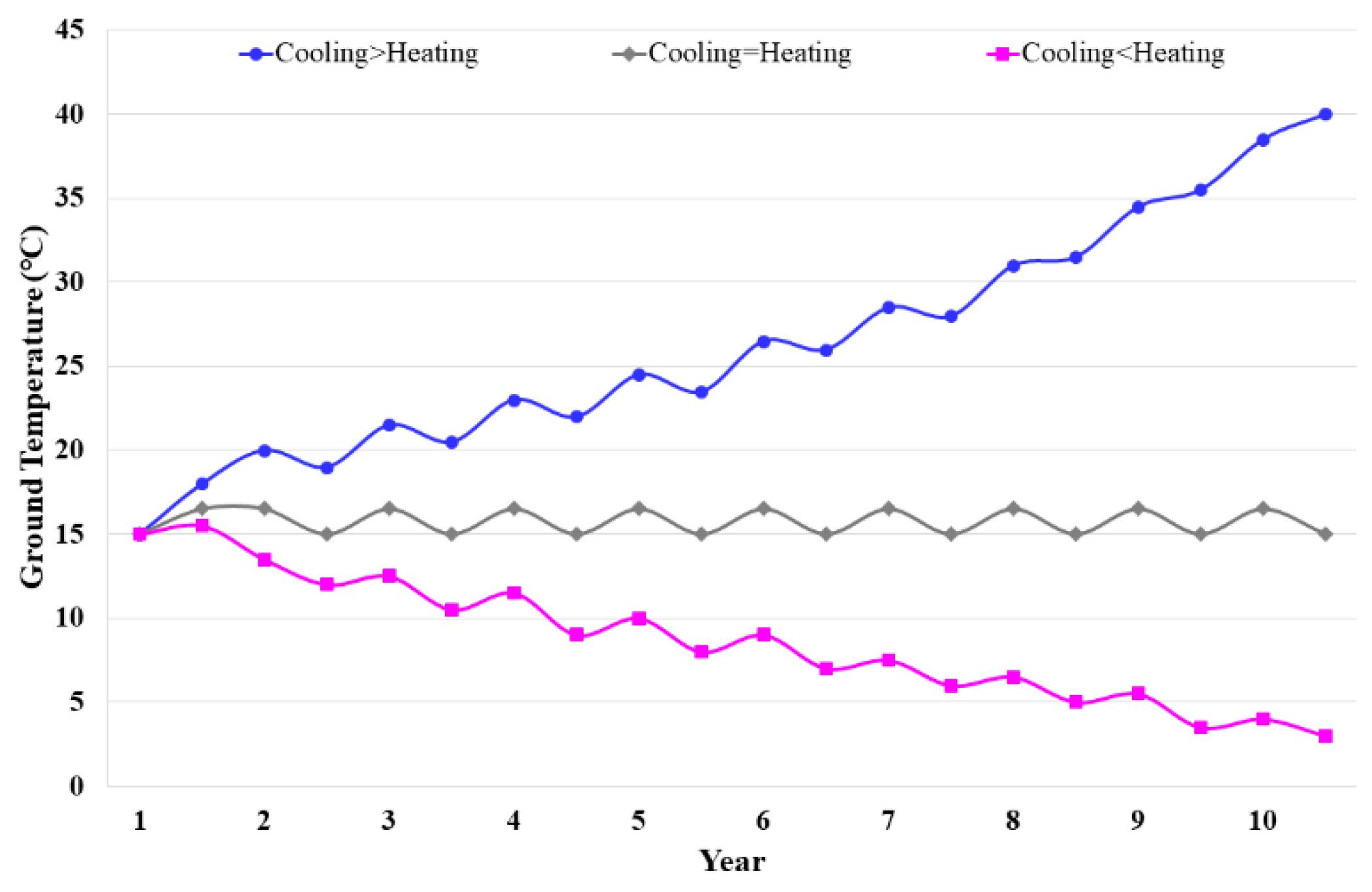
Geothermal systems are generally used as geothermal systems that are installed and operated independently of other heat source systems. The problem caused by the design technology of existing general geothermal systems, which are designed separately from the geothermal system and other heat source systems, is that the temperature increases with increasing number of years of use of the geothermal system caused by the characteristics of general buildings where the use of cooling and heating throughout the year is not constant. Rising or falling occurs, which results in performance degradation of the geothermal system. As shown in the
Figure 1, when the cooling load is greater than the heating load, the underground temperature rises, and when the heating load is greater than the cooling load, the ground temperature decreases.
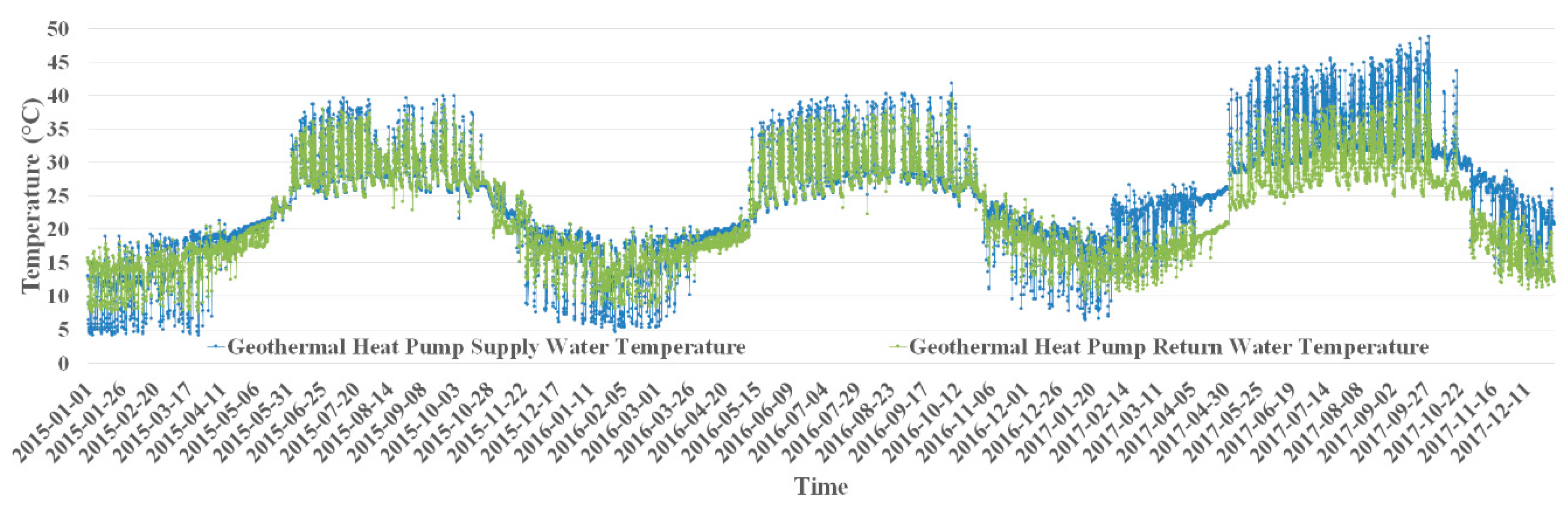
For buildings in which the geothermal system is operating, temperature changes were analyzed when the heating and cooling load is unbalanced. As shown in
Figure 2, the analysis building is being used for office purposes, and the amount of cooling is higher than that of heating. An analysis of the operation data from 2015 to 2017 during the geothermal operation data collection period showed that the temperature on the heat source side of the geothermal system increases with increasing number of years of operation. This occurs when there is an imbalance between the cooling and heating loads of the building. Moreover, the temperature of the heat source side increases due to underground heat accumulation when the geothermal system is operated for a long time.
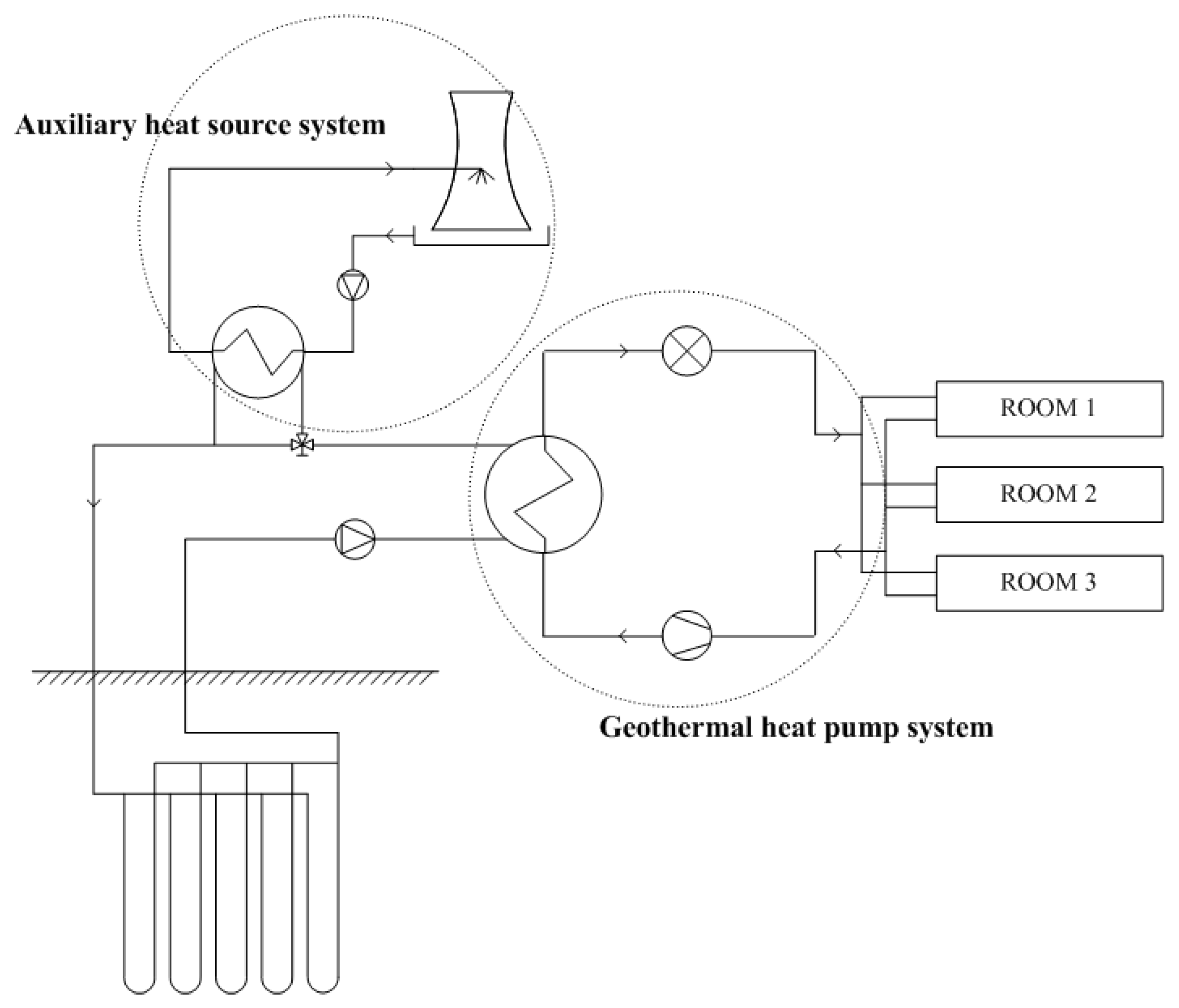
The hybrid geothermal system refers to a system in which a geothermal system and a heating auxiliary heat source, such as a boiler or solar heat, or a cooling auxiliary heat source, such as a cooling tower or a refrigerator, are connected and utilized.
Figure 3 shows a hybrid geothermal heat pump system with an additional cooling auxiliary heat source. The underground temperature can be maintained in the optimal state by linking the auxiliary heat wall with the geothermal system, which can solve the problem of the occurrence of underground temperature problems and the degradation of the geothermal system performance caused by an imbalance of the heating and cooling load. The hybrid geothermal system is capable of reducing the number or size of heat exchangers. Moreover, it has an economic advantage by reducing the initial installation cost and installation area of the geothermal system.
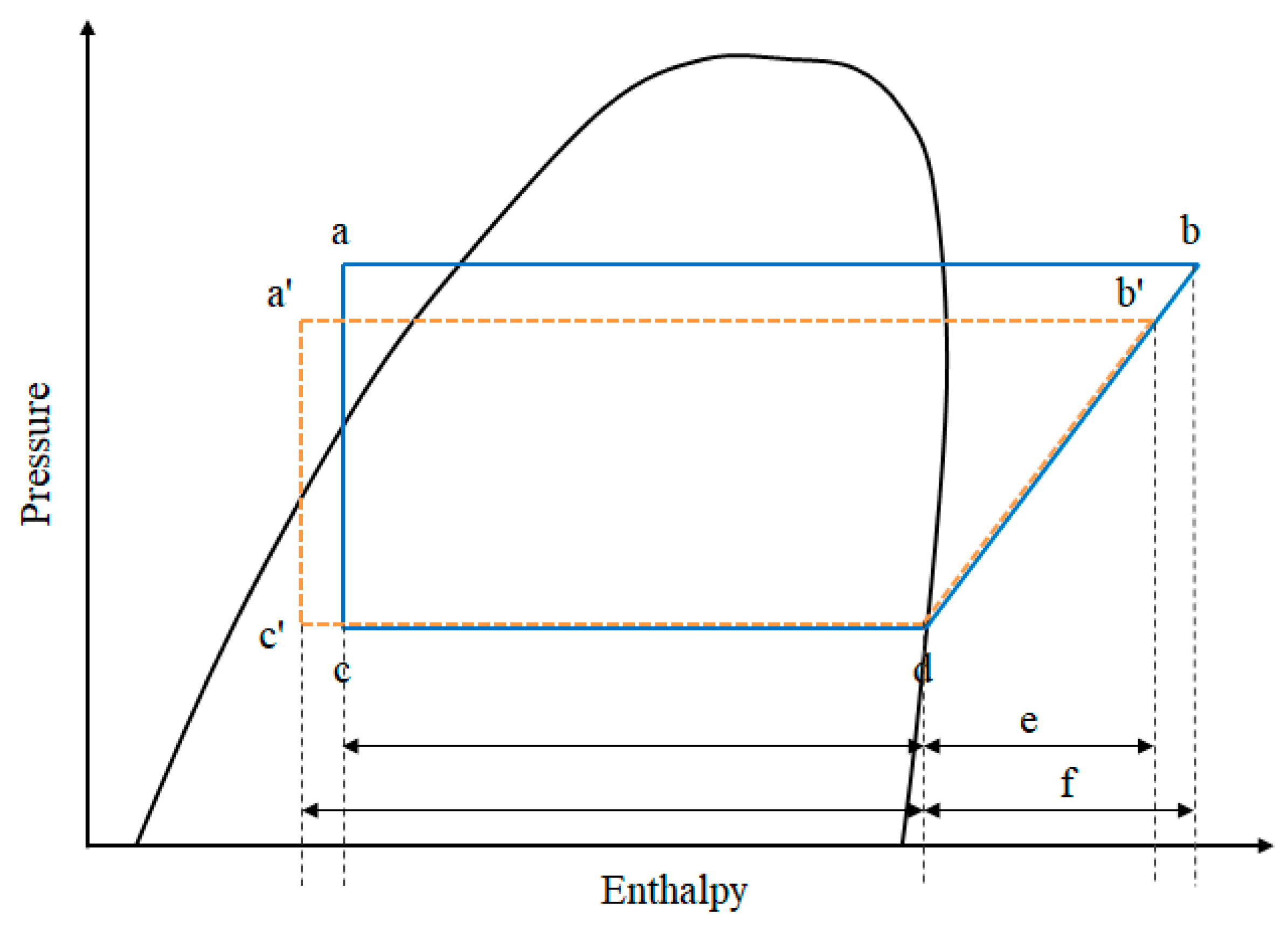
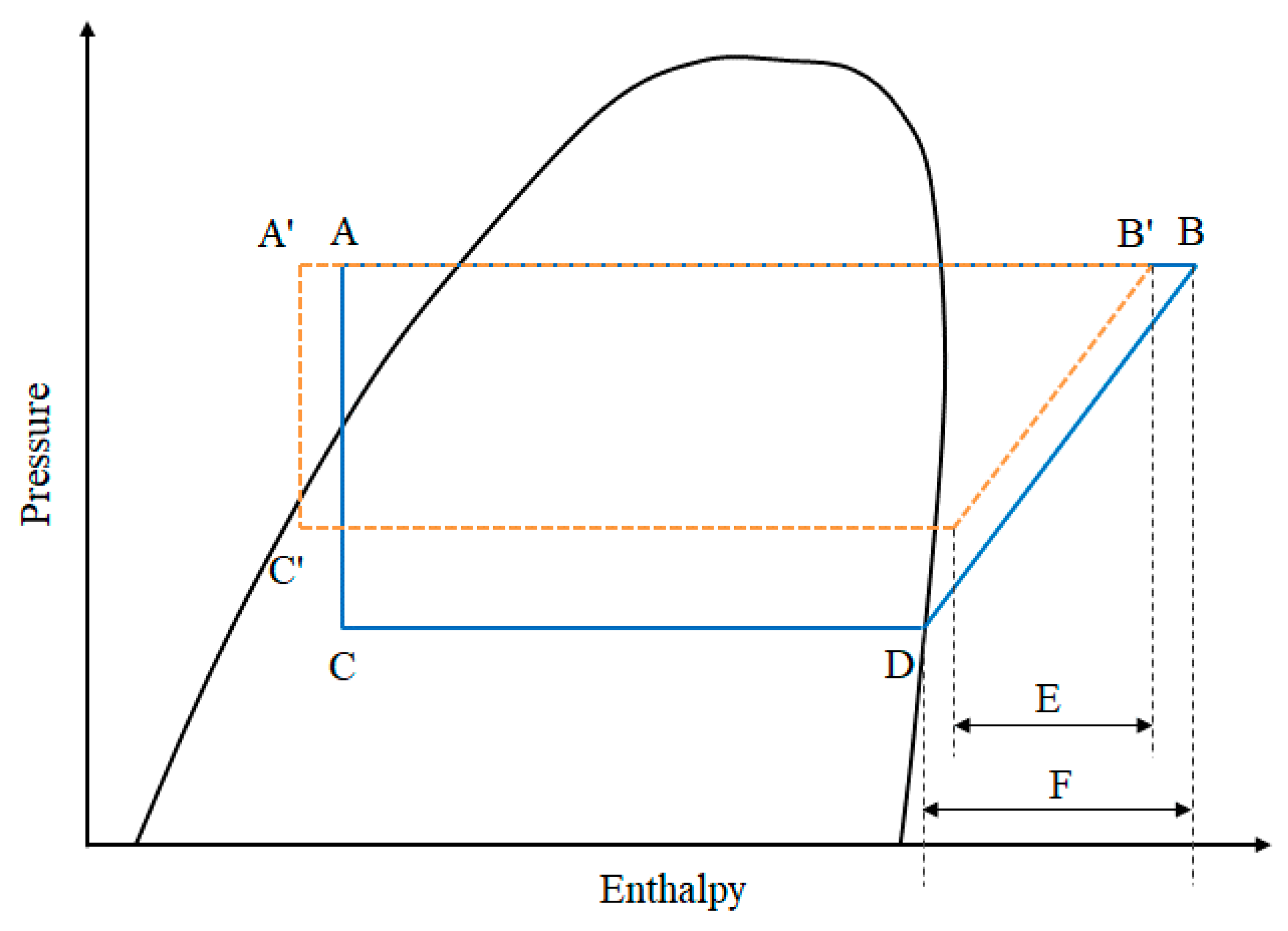
In the P-h (Pressure-Enthalpy) diagram of hybrid geothermal heat pump system in
Figure 4, the condenser line goes down from a–b to a′–b′ due to the addition of low-temperature water from the auxiliary heat source during cooling operation, reducing the amount of heat from the compressor. As a result, cooling COP (Coefficient of Performance) increases when operating hybrid geothermal systems rather than geothermal systems.
In the P-h diagram of the hybrid geothermal heat pump system in
Figure 5, the evaporator line rises from C–D to C′–D′ due to the addition of high temperature water from the auxiliary heat source during cooling operation, and the compressor heat quantity decreases. As a result, heating COP increases when operating hybrid geothermal systems rather than geothermal systems.
3. Performance Prediction of Hybrid Geothermal Heat Pump System through Field Test and Numerical Analysis
The existing general hybrid geothermal heat pump system operation technology is a method of determining whether to operate the hybrid system based on the temperature at the inlet side of the heat source. It is theoretically expected that it can solve the problem of performance degradation caused by an increase in the inlet temperature on the heat source side that occurs during cooling operation of the hybrid geothermal heat pump system. When using the existing operating method, it cannot be directly confirmed that the performance is improved compared to the single operation of the geothermal heat pump system. Therefore, in this study, the performance of the system is used as a changeover operating point for determining the operation of the hybrid geothermal heat pump system. For this, this study attempts to predict the performance of hybrid geothermal systems. Through field tests, data related to the performance of the geothermal heat pump system under various conditions are collected, and performance predictions are made through numerical analysis. The performance of the hybrid geothermal system is determined by the geothermal circulating water temperature and the circulating water temperature of the auxiliary heat source. The performance of the hybrid geothermal heat pump system is predicted by considering the temperature change in the inlet side of the geothermal system heat source by the auxiliary heat source.
3.1. Introduction of Field Test
In order to predict the performance of the hybrid geothermal heat pump system, a field test was conducted to analyze the performance according to temperature conditions not provided by the manufacturer. The summary of the heat pump used in the field test is shown in
Table 1.
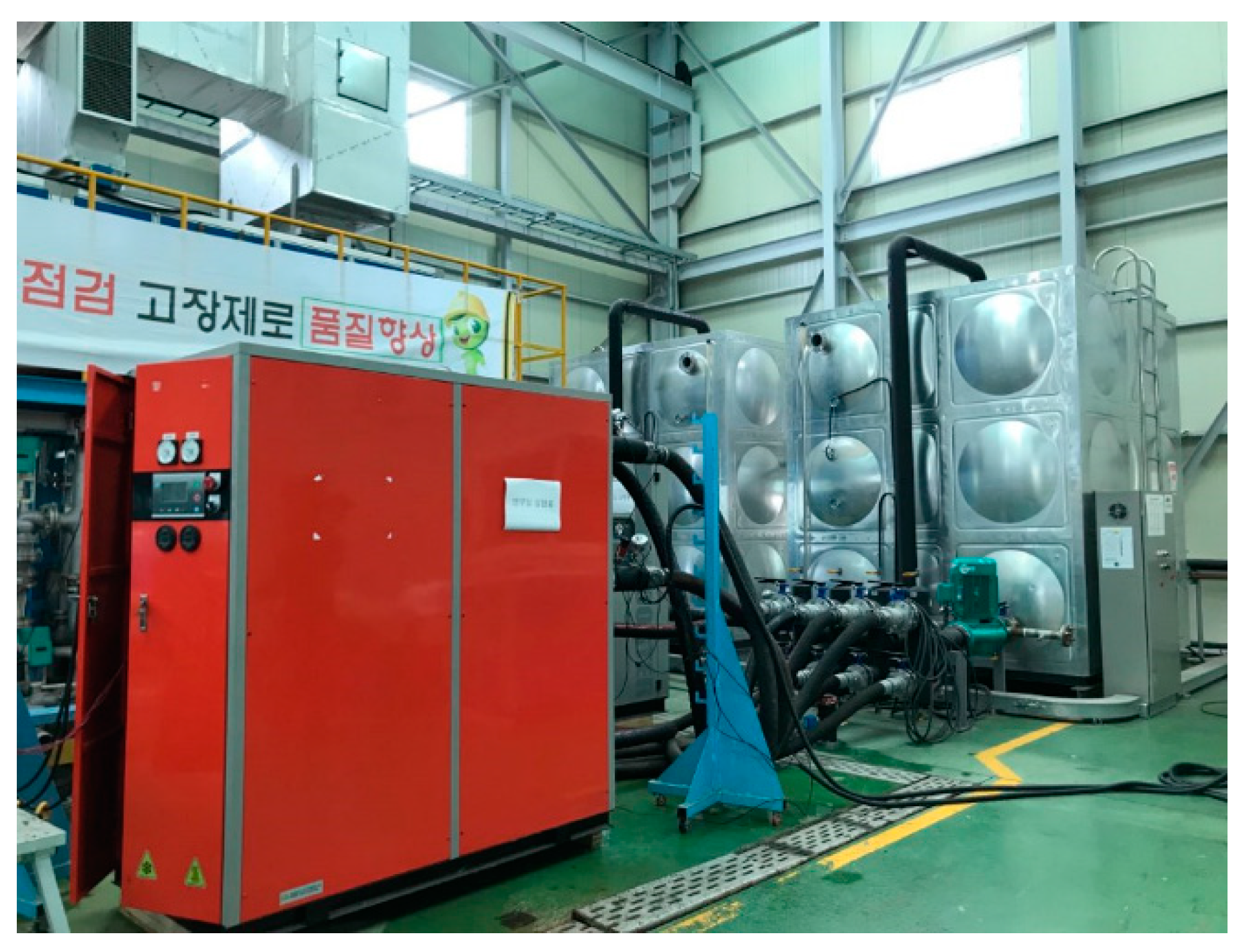
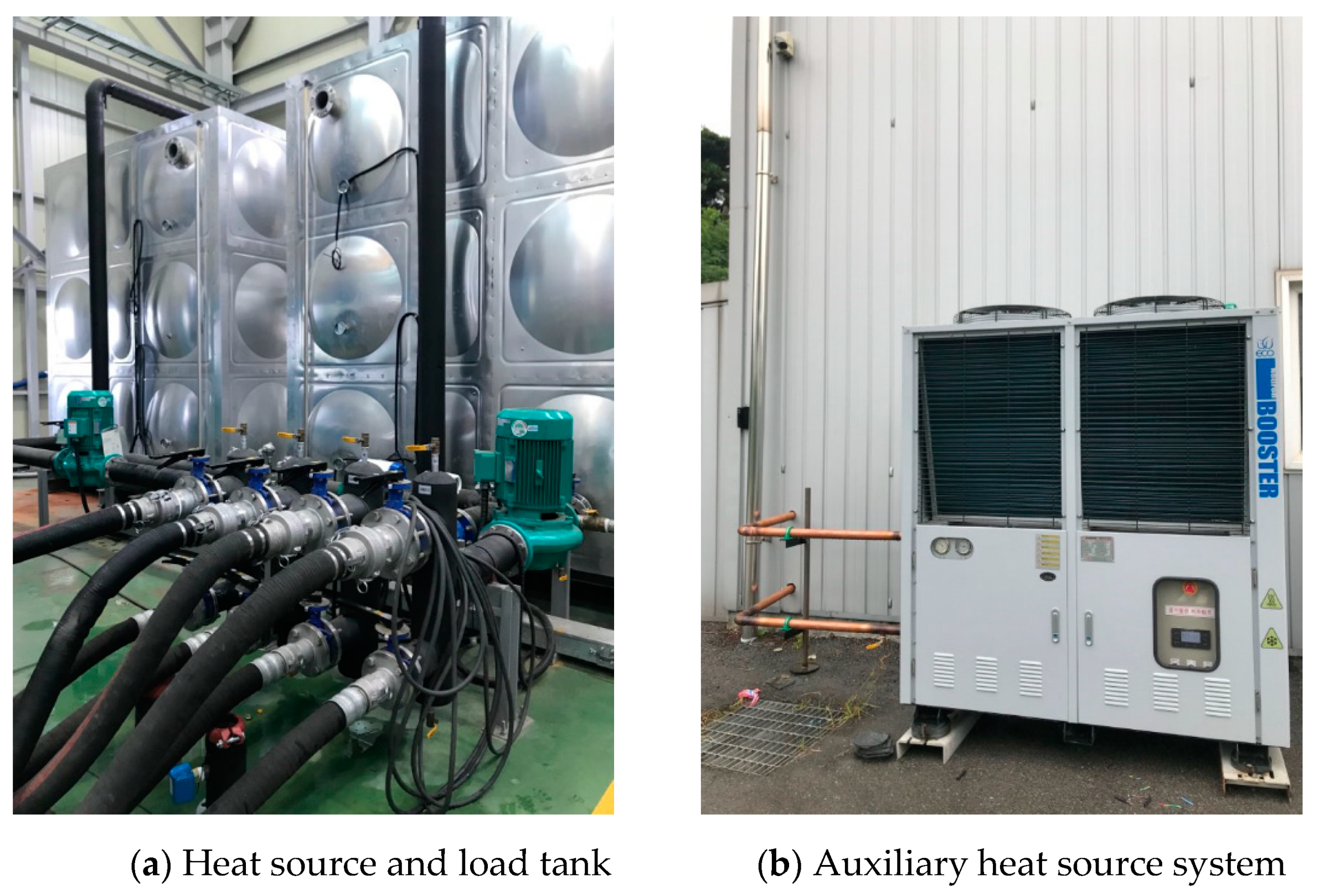
A constant temperature tank is connected to the heat pump to simulate the heat source, load side, and heat source side for performance tests according to the changes in temperature, and it is used to supply cooling and heating heat sources and maintain the temperature through an air-cooled auxiliary heat source.
Table 2 gives a summary of the experimental system.
Figure 6 and
Figure 7 presents the equipment used in the field experiment.
For performance evaluation, the factors affecting the performance of geothermal heat pumps, such as the difference in inlet and outlet temperature, flow rate, and power consumption, and the temperature of the outside air are measured every minute. The heat source and load-side inlet and outlet temperatures are stored using a data logger connected to an RTD (Resistance Temperature Detector) temperature sensor. The flow rate is measured through a thermostat system on the load and heat source side and a flow meter installed in the water pipeline. The power consumption is measured by installing a watt-hour meter in the heat pump. Before data collection, the standard uncertainty of the temperature sensor and flow rate meter was calculated. The measurement uncertainty of temperature was repeated five times each under 10 °C, 30 °C, and 50 °C conditions. The flow rate was measured three times each from 15 m
3/h to 250 m
3/h. As for the measurement uncertainty, as shown in
Table 3, the uncertainty of the temperature measuring device is 0.2 and the uncertainty of the flow meter is 0.26~0.32.
The performance under a broader range of heat-source-side inlet-temperature conditions, considering the actual operating situation, is evaluated by measuring each item according to the heat-source-side inlet temperature in the range of 8.1–26.8 °C during heating operation and 20–49 °C during cooling operation. This study aims to predict the performance of hybrid geothermal systems through numerical analysis of data obtained through field tests.
3.2. Performance Prediction through Field Test and Numerical Analysis
In this study, performance prediction is made in order to use the performance as a changeover point in the operating method of the hybrid geothermal heat pump system. Hybrid geothermal heat pump system performance is predicted through numerical analysis of performance-related data based on field test. Among the factors that have an important influence on the performance of a geothermal heat pump system, performance is predicted by using the heat source side temperature and the load-side temperature which can be easily monitored. When operating the hybrid geothermal heat pump system, the inlet temperature on the source side of the geothermal system is changed by the auxiliary heat source system. Therefore, in this study, the temperature at the source side of the geothermal system is calculated according to the operation of the auxiliary heat source system. The hybrid geothermal system performance is predicted through the changed geothermal system heat source and load-side temperatures.
During the cooling operation of the hybrid geothermal heat pump system, the temperature of the supplied circulating water is lowered through heat exchange between the circulating water at the source side and the cooling water at the cooling tower. Assuming that the heat exchange efficiency of the circulating water and the cooling water on the heat source side of the geothermal heat pump system is 100%, the amount of heat exchanged is the same. This is the same as Equation (1).
Through this, the inlet temperature on the heat source side of the geothermal heat pump system changed according to the operation of the auxiliary heat source shown in Equation (2).
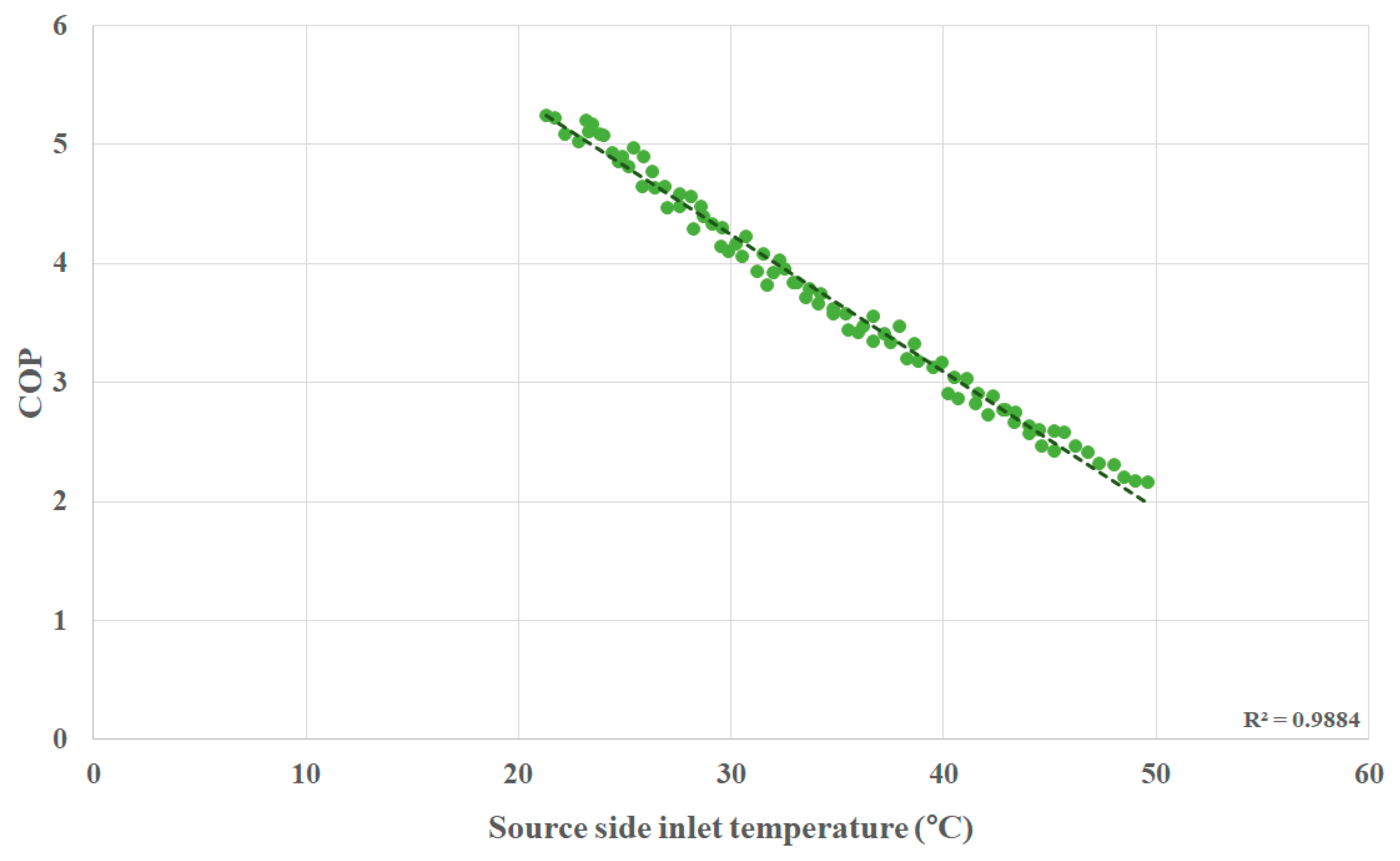
In order to predict the performance of the hybrid geothermal system, a numerical analysis of data based on field experiments was performed. The relationship between the source side inlet temperature and performance was analyzed, and the analysis result is shown in
Figure 8. Performance deteriorates as the inlet temperature on the heat source side increases.
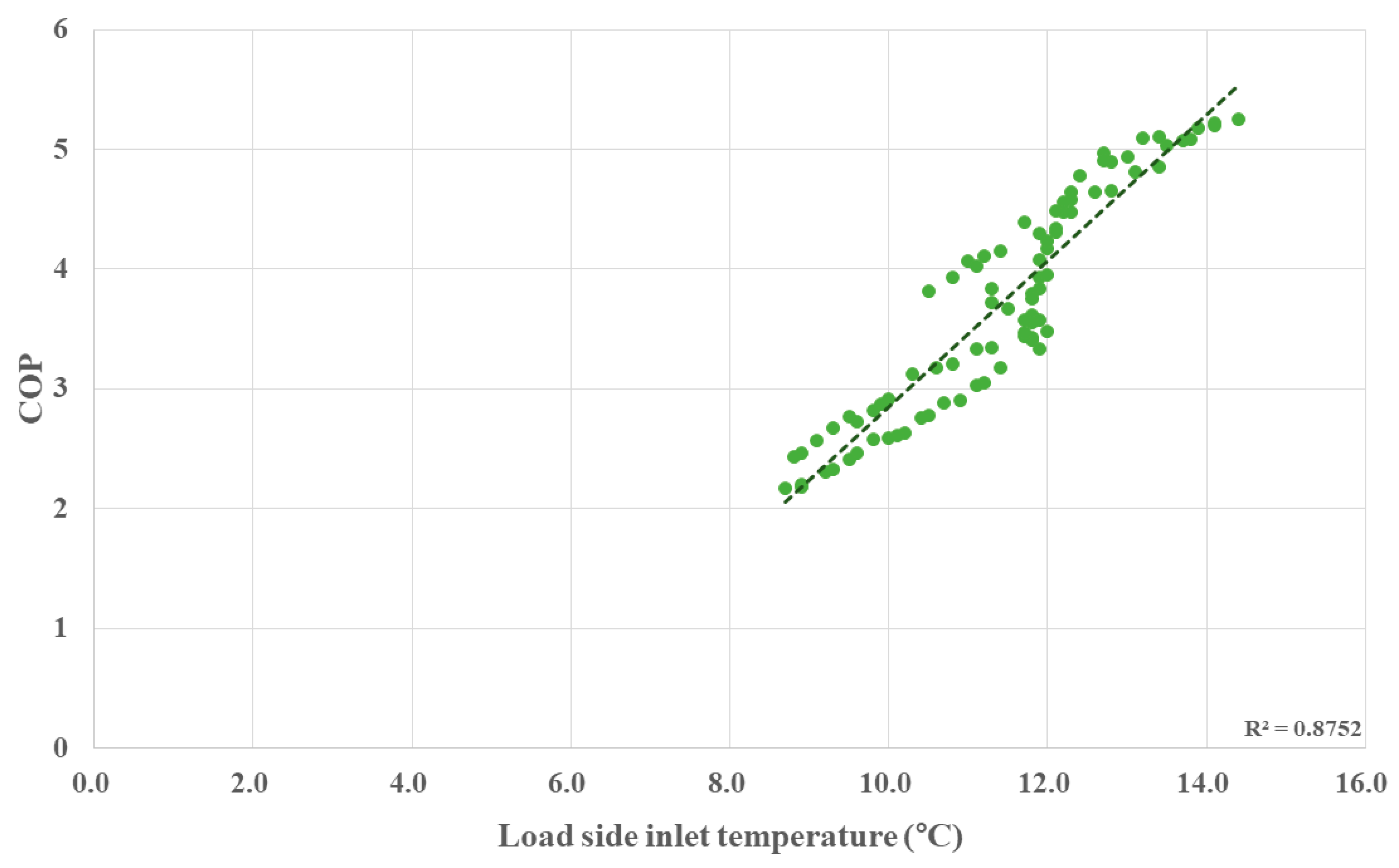
The relationship between load-side inlet temperature and performance is shown in
Figure 9. It is possible to check the phenomenon opposite to the temperature on the heat source side.
The performance prediction method was derived through multiple regression analysis between the performance and the heat source side and the load-side temperature. The performance prediction equation is shown in Equation (3).
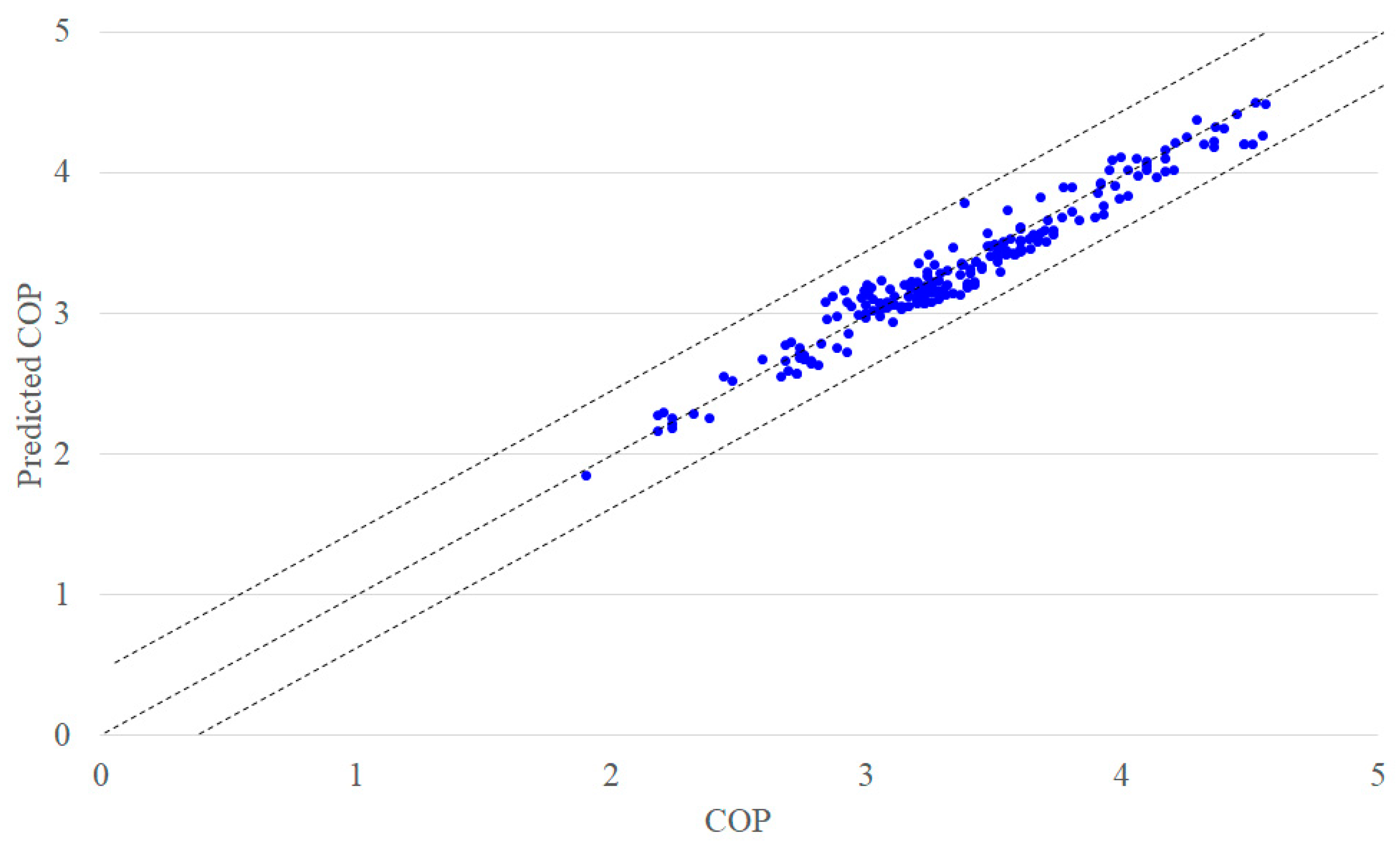
Figure 10 shows the performance prediction verification results of the hybrid geothermal heat pump system.
Table 4 shows the error analysis results, the relative error was −6–12% and the R
2 was 0.9537.
4. Development of Changeover Operating Method Based on Performance Prediction of Hybrid Geothermal Heat Pump Systems
4.1. Development of Changeover Operating Method
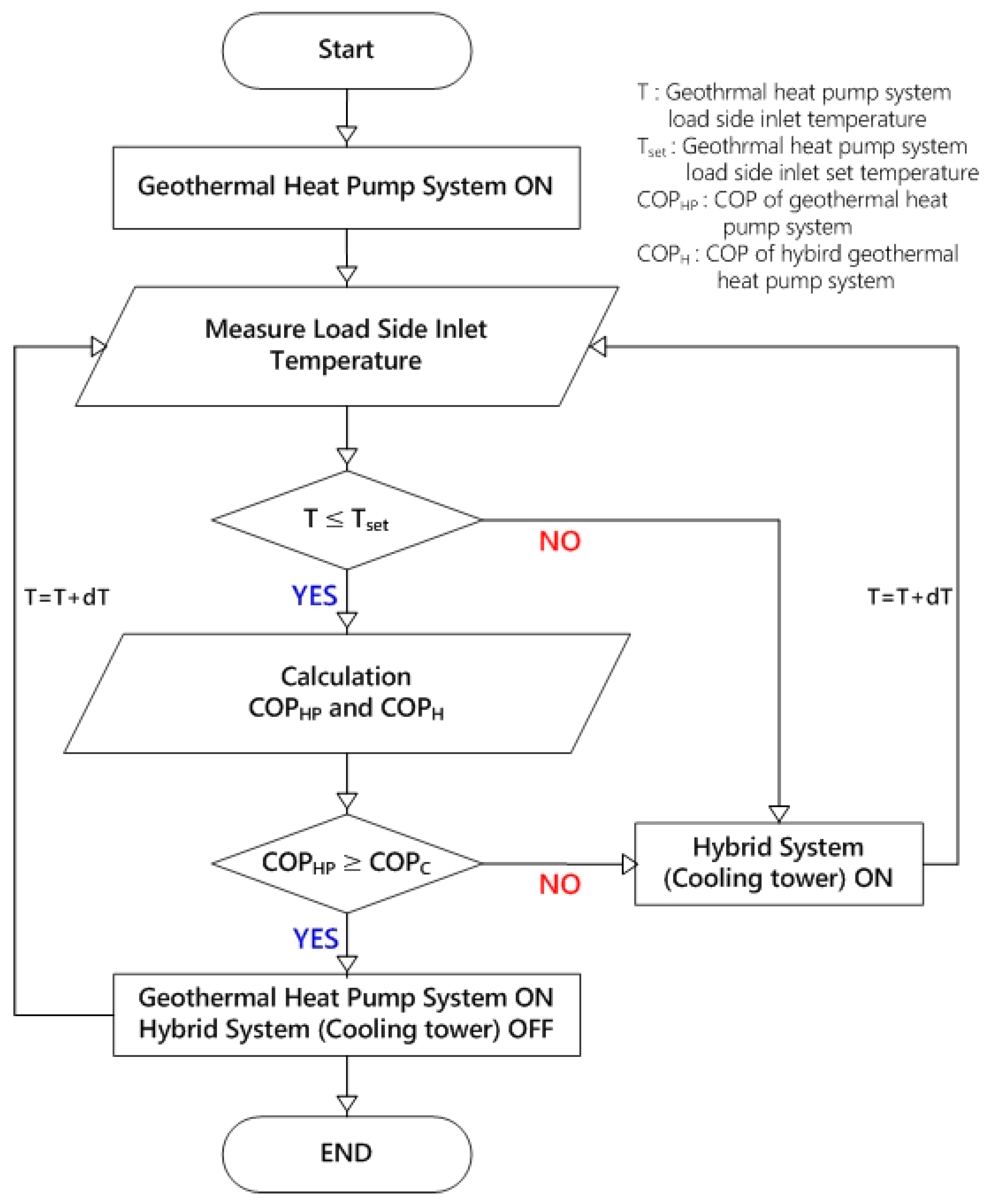
In this study, a changeover operating method based on the performance prediction of hybrid geothermal heat pump system was developed for efficient geothermal heat pump system operation. When operating a geothermal system, system performance is used as the changeover point of hybrid system operation. When a geothermal heat pump system is operated alone without an auxiliary heat source, and when performance decreases due to an increase in temperature on the heat source side, the hybrid geothermal system is operated when it is determined that performance improvement is possible by operating the hybrid system. The developed hybrid geothermal heat pump system operation algorithm is shown in
Figure 11.
When the system is stabilized after the start of the geothermal system cooling operation, the geothermal system has sufficient capacity to handle the load generated from the building if the inlet temperature on the load side is lower than or equal to the set temperature, and the geothermal system continues to operate. Hybrid system operation is started when it is judged that the load generated from the building is insufficient for the geothermal system to be in charge, or when it is determined that operating a hybrid system will improve performance rather than continue to operate the geothermal system. After the operation of the hybrid system, after a certain period (dt = 10 min), the operation of the hybrid system is judged, and the operation continues if necessary.
- (1)
Operation of geothermal heat pump system
When a load occurs, the geothermal heat pump system operates alone. If the load-side inlet temperature of the geothermal heat pump system is lower than the design reference temperature, the geothermal heat pump system continues to operate alone ().
- (2)
Changeover operation of hybrid geothermal heat pump system
When the load-side inlet temperature of the geothermal heat pump system is higher than the design reference temperature, the auxiliary heat source system is operated, and the hybrid geothermal heat pump system is operated (). The performance of the hybrid geothermal heat pump system is predicted using the proposed hybrid geothermal heat pump system performance prediction method. If the performance of the hybrid system is higher than that of the single operation of the geothermal heat pump system, the operation of the hybrid geothermal heat pump system continues (). If the performance of the geothermal heat pump alone is better, the hybrid geothermal heat pump system is stopped ().
4.2. Application of Changeover Operating Method
The changeover operating method of the hybrid geothermal heat pump system was applied to compare the performance and economic analysis between the general geothermal system and the hybrid geothermal heat pump system through simulation. The target building is an office building, and the information is shown in
Table 5.
The target building uses a geothermal heat pump system and a cooling tower as an auxiliary heat source, and the information on the geothermal heat pump system is shown in
Table 6, and the information on the auxiliary heat source system is shown in
Table 7.
4.2.1. Performance Analysis
To analyze the performance of the changeover operating method of hybrid geothermal heat pump system, COP is compared when operating a general geothermal system and a hybrid system. In addition, the load that could not be solved due to the shutdown of the geothermal system due to the decrease in performance due to the temperature increase on the heat source side is compared. The comparison results are shown in
Table 8.
During the cooling operation period of the geothermal heat pump system, if the inlet temperature on the source side exceeds 40 °C, the operation is stopped. When operating a general geothermal heat pump system, due to the increase in temperature on the heat source side, the system shutdown time is 76 h, which is 8.7% of the total cooling demand. The unresolved load due to performance degradation and shutdown is 55,030 kwh/hr, which is 11.9% of the total cooling load. When applying the changeover operating method of hybrid geothermal heat pump system, the operating downtime was 5 h, which was reduced by 8% compared to the operation of the general geothermal heat pump system, and the unresolved load decreased by about 11%.
During the operation of a general geothermal heat pump system, there was a date that the system was suspended for one day. On the other hand, in the case of hybrid system operation, the operation is stopped only at some time, so the building user does not feel great inconvenience or cause a major problem in operation.
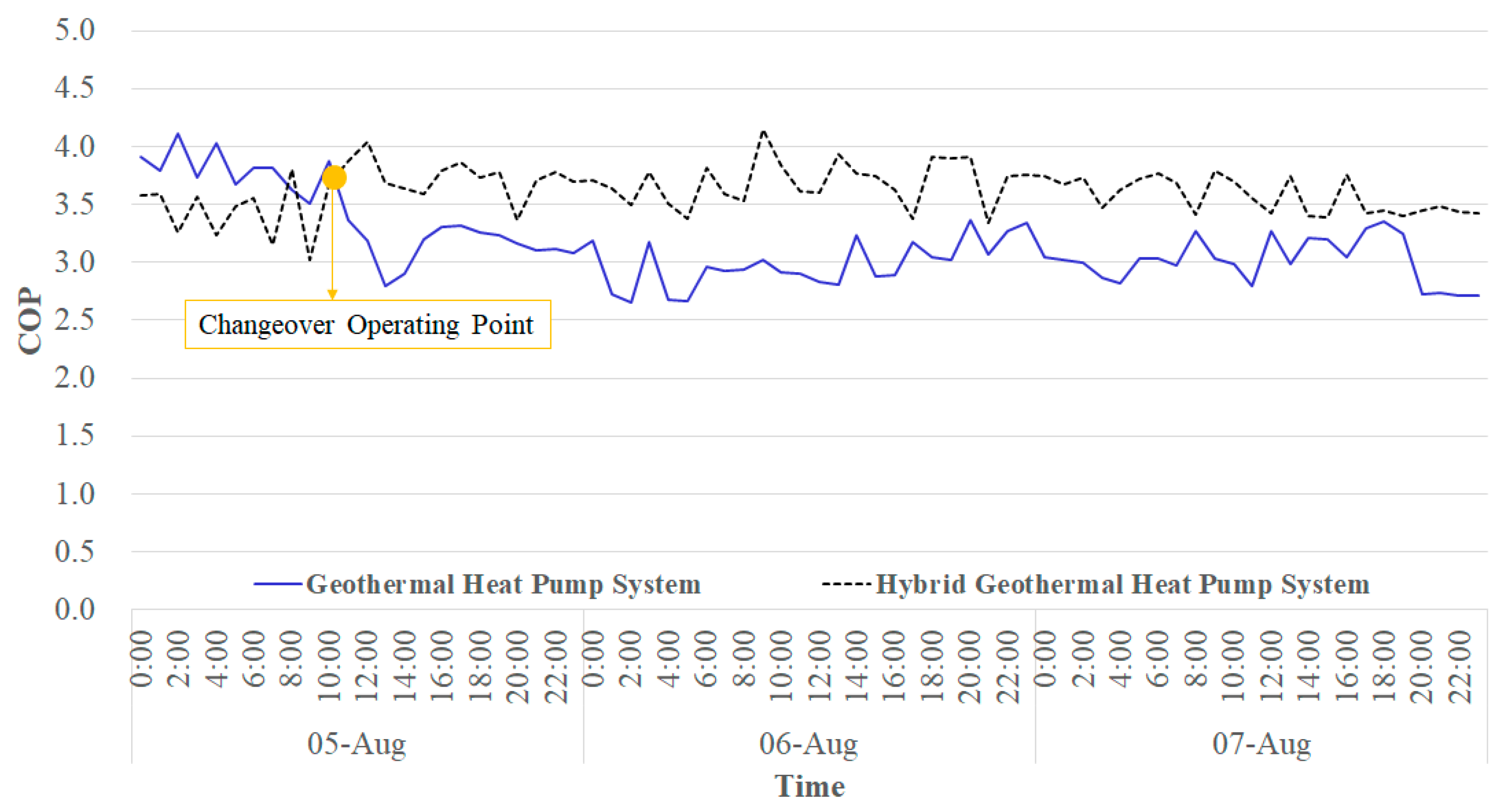
Figure 12 shows the COP analysis result when operating a hybrid system. During the operation of the geothermal heat pump system, the point at which the hybrid geothermal heat pump system operation starts, due to the COP being higher when the hybrid geothermal heat pump system is operated, is called the changeover operating point. During the entire analysis period, when the geothermal heat pump system was operated, the COP ranged from 1.8 to 4.1 and the hybrid geothermal heat pump system operated from the lowest 3 to the highest 4.5.
4.2.2. Economic Analysis
In this study, the analysis of economic is analyzed through the initial investment cost method based on investment cost and operating cost. In the case of a hybrid geothermal heat pump system, the initial investment cost increases with the addition of an auxiliary heat source. The annual electricity usage and cost are shown in
Table 9.
The economic analysis results are shown in
Table 10.
An additional KRW 32,473,497 is used compared to the general geothermal heat pump system. The operating cost is calculated based on the annual electricity consumption used for heating and cooling operations. Electricity rates are based on KEPCO (Korea Electric Power Corporation)’s electricity rates. Compared to general geothermal heat pump systems, power consumption is reduced because it can achieve high performance due to the decrease in temperature on the side of the heat source due to operation of the auxiliary heat source. Compared to the previous operation, it was reduced by KRW 2,125,165, resulting in a simple initial investment payback period of 15.3 years.
5. Conclusions
The purpose of this study is to develop a hybrid geothermal heat pump system operation method that utilizes performance as a changeover operating point to stabilize temperature and improve system performance. Hybrid geothermal heat pump system performance is predicted through numerical analysis of performance-related data based on field tests. Through the application of the developed changeover operating method of hybrid geothermal heat pump system, the performance analysis and economic analysis of the geothermal heat pump system were conducted. The results of this study are as follows.
- (1)
Performance is predicted through numerical analysis of data related to the performance of geothermal heat pump systems under various conditions collected through field tests. The performance of a hybrid geothermal system is determined by the geothermal circulation water temperature and the circulating water temperature of the auxiliary heat source. The performance of the hybrid geothermal heat pump system is predicted by considering the temperature change at the inlet side of the geothermal system heat source by the auxiliary heat source.
- (2)
In this study, a changeover operating method based on the performance prediction of hybrid geothermal heat pump system was developed for efficient geothermal heat pump system operation. When operating a geothermal system, system performance is used as the changeover point of hybrid system operation. When a geothermal heat pump system is operated alone without an auxiliary heat source, and when performance decreases due to an increase in temperature on the heat source side, the hybrid geothermal system is operated when it is determined that performance improvement is possible by operating the hybrid system.
- (3)
The developed hybrid geothermal heat-pump-system operation method was verified though performance and economic analysis. When applying the changeover operating method of the hybrid geothermal heat pump system, the operating downtime was 5 h, which was reduced by 8% compared to the operation of the general geothermal heat pump system, and the unresolved load decreased by about 11%. Compared to the geothermal heat pump system operation, operating cost was reduced by KRW 2,125,165 and initial cost was increased by KRW 32,473,497, resulting in a simple initial investment payback period of 15.3 years.