Article

A Multisensory, Green, and Energy Efficient Housing Neuromarketing Method


1
Department of Construction Management and Real Estate, Faculty of Civil Engineering, Vilnius Gediminas Technical University, Sauletekio al. 11, 10223 Vilnius, Lithuania
2
Department of Civil Engineering and Architecture, Tallinn University of Technology, Ehitajate tee 5, 19086 Tallinn, Estonia
*
Author to whom correspondence should be addressed.
Energies 2019, 12(20), 3836; https://doi.org/10.3390/en12203836
Submission received: 10 September 2019 / Revised: 28 September 2019 / Accepted: 2 October 2019 / Published: 10 October 2019
(This article belongs to the Section B: Energy and Environment)

Abstract

Green products, clean energy, energy union, green buildings, eco-innovations, environment-related, and similar initiatives and policies have become very popular and widely applied all over the world. A pleasant built environment (parks, flowerbeds, beautiful buildings) and a repulsive environment (noise, polluted surroundings) influence a buyer’s outlook on an advertisement differently. An aesthetic, comfortable, and clean built environment evokes positive emotional states, not only at the time of housing selection and purchase but during the building’s life cycle as well. Potential housing buyers always feel comfortable in certain built environments, and they are inclined to spend more time there. The issues needing answers are how to measure the segmentation/physiological indicators (crowd composition by gender and age groups), as well as the emotional (happy, sad, angry, valence) and physiological (heart rate) states of potential homebuyers realistically, to produce an integrated evaluation of such data and offer buyers rational, green, and energy efficient housing alternatives. To achieve this purpose, the Multisensory, green and energy efficient housing neuromarketing method was developed to generate the necessary conditions. Here, around 200 million multisensory data recordings (emotional and physiological states) were accumulated, and the environmental air pollution (CO, NO2, PM10, volatile organic compounds) and noise pollution were investigated. Specific green and energy efficient building case studies appear in this article to demonstrate the developed method clearly. The obtained research results are in line with those from previous and current studies, which state that the interrelation of environmental responsiveness and age forms an inverse U and that an interest in green and energy efficient housing depends on age.
Keywords: green and energy efficient housing; neuromarketing method; human emotional and physiological states; video ads; correlations; multicriteria analysis green and energy efficient housing; neuromarketing method; human emotional and physiological states; video ads; correlations; multicriteria analysis
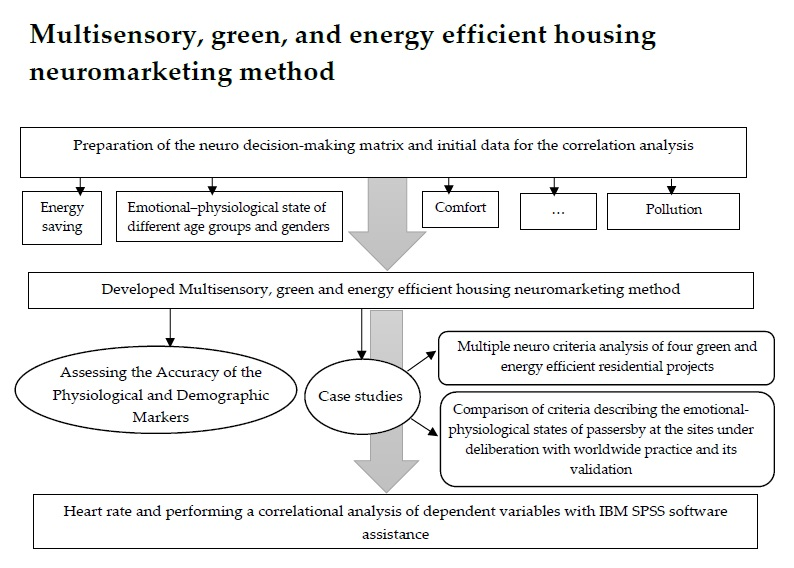
Graphical Abstract