Article

Board Diversity and Sustainability Disclosure: Empirical Evidence from Palestine

by
Ali H. I. Aljadba
1,
Abdallah A. S. Fayad
2,*,
Khaled O. Alotaibi
3 and
Ahmad F. Almutairi
3
1
Accounting Department, Faculty of Administration and Finance, Al-Aqsa University Gaza, Gaza P.O. Box 4051, Palestine
2
Faculty of Accountancy, Universiti Teknologi MARA, Kampus Puncak Alam, Puncak Alam 42300, Selangor, Malaysia
3
College of Business Studies, Public Authority for Applied Education and Training (PAAET), Kuwait City 13092, Kuwait
*
Author to whom correspondence should be addressed.
J. Risk Financ. Manag. 2026, 19(9), 713; https://doi.org/10.3390/jrfm19090713
Submission received: 16 July 2026 / Revised: 29 August 2026 / Accepted: 2 September 2026 / Published: 10 September 2026

Abstract

Given the limited environmental, social, and governance disclosure (ESGD) among Palestinian firms, this study’s purpose is to explore potential connections between diversity of board gender and nationality, as well as representation of non-executive directors, environmental, social, and governance factors and aggregate ESG disclosure. The study focuses on industrial companies listed on the Palestine Exchange (PEX), employing random-effects panel-data regression with firm-clustered robust standard errors on a balanced panel of 11 industrial companies, all listed on PEX from 2018 to 2024. The results show that ESGD is positively associated with female directors, foreign directors, and non-executive directors and provide support for agency theory, resource dependence theory, and stakeholder theory. This study furthers the literature via empirical evidence (from a conflict-affected emerging market) on the impact of board gender diversity, nationality diversity, and non-executive directors on ESGD. The study recommends that policymakers and stakeholders promote board independence and diversity of gender and nationality, with a view to enhancing ESG disclosure in Palestine.

1. Introduction

Given the increased significance of environmental, social, and governance (ESG) factors within corporate frameworks, particularly in emerging markets, ESG disclosure (ESGD) is now an important component of corporate governance (CG), regulatory reforms, and investment decision-making worldwide. Moreover, ESGD enhances transparency and accountability as it reflects firms’ environmental, social, and governance effects alongside their financial outcomes (Aljarrah, 2026; Ali Basah et al., 2024). Incorporating ESG into accounting and financial reporting systems assists firms in identifying risks and supports the creation of long-term value (Fayad et al., 2024; Alodat et al., 2024). Investors and stakeholders expect companies to disclose their ESG activities, especially following recent international developments including the International Sustainability Standards Board’s initiatives (ISSB). However, despite growing global attention to ESG performance, empirical evidence from unstable and conflict-affected contexts remains limited (Gherghina, 2024; Aljarrah, 2026). Most sustainability research has focused on developed countries, with emerging markets receiving less attention (Alodat et al., 2024; Rudolph & Aliamutu, 2026; Aljarrah, 2026). Empirical research on ESG performance and its dimensions in Palestine is limited, despite increasing interest in corporate sustainability and CG reforms.
Among the key determinants of ESG performance, board of directors’ characteristics have attracted significant academic attention. Board independence and diversity (particularly of gender and nationality) are regarded as important CG mechanisms that enhance monitoring effectiveness and improve strategic decision-making (Omenihu et al., 2025). Diverse boards are more likely to incorporate different perspectives and experiences, improving responsiveness to stakeholder expectations (Şener & Karaye, 2014). Some empirical evidence suggests that gender-diverse boards are associated with stronger ESGD and better sustainability outcomes (Wang et al., 2023; Almaqtari et al., 2024; Omenihu et al., 2025; Zhu & Chen, 2025; Gavana et al., 2025; Tarda et al., 2024). Female directors are frequently linked to more ethical and careful decision-making processes, strengthening CG quality (Almaqtari et al., 2024). In addition, board independence improves oversight and reduces managerial opportunism, while nationality diversity broadens international exposure and awareness of global sustainability practices. However, most empirical studies in these areas have concentrated on developed economies. Research in developing markets remains limited, and very few studies have examined this relationship in the Palestinian context. To the best of the researchers’ knowledge, there is limited empirical evidence on the influence of board diversity dimensions on ESG performance among industrial companies listed on PEX.
This study is rooted in stakeholder theory, resource dependence theory (RDT), and agency theory. Stakeholder theory posits that long-term success is facilitated by considering the interests of a broad range of stakeholders (Dmytriyev & Freeman, 2023). From this perspective, boards that are diverse and independent understand and address stakeholder concerns more effectively, potentially improving ESG performance. Agency theory emphasizes the role of governance mechanisms in reducing agency costs and potential conflicts of interest between shareholders and managers. Independent and diverse board members can strengthen monitoring and align managerial actions with shareholder and stakeholder interests. Accordingly, the study intends to examine the relationship between board diversity, proxied by gender diversity, nationality diversity and non-executive directors’ representation, and ESGD in the industrial companies listed on PEX. By providing empirical evidence from a developing and institutionally constrained context, this research extends the literature on CG and sustainability, identifying practical implications for companies and policymakers in Palestine.
Theoretically, it is expected that an improved information environment and stronger CG frameworks are likely to improve business value. Current evidence, however, is mixed. In emerging markets, extensive ESGD may have a detrimental impact on corporate performance. This is because investors may view ESG initiatives as expensive endeavors that divert resources from profit-generating operations (Itan et al., 2025). Alternative views contend that ESG programs may occasionally be utilized for managerial opportunism or impression management, rather than as sincere sustainability efforts (Ararat et al., 2021). Conversely, transparent disclosure can boost business value by reducing agency conflicts and information asymmetry. Voluntary ESGD is crucial for providing stakeholders with relevant non-financial information in emerging economies with diverse CG systems and regulatory enforcement (Ellili, 2022; Sain & Kashiramka, 2024). In this spirit, the study’s purpose is to consider, across industrial companies listed on PEX, connections between board members’ gender and nationality diversity; representation of non-executive directors; environmental, social, and governance factors; and aggregate ESGD. This research contributes in three ways to CG and the sustainability literature. Firstly, it examines board gender diversity, board nationality diversity, and incidence of non-executive directors, as opposed to foregrounding a single board characteristic. Secondly, by distinguishing between aggregate ESGD and environmental, social and governance aspects, the study demonstrates that the three board-level characteristics display diverse associations across ESG dimensions. Finally, the evidence from Palestinian industrial companies augments the hitherto-limited ESG literature on conflict-affected and institutionally constrained emerging markets.
The study is structured as follows: Section 2 describes the conceptual framework; Section 3 reviews the extant literature and formulates the hypotheses. Section 4 outlines the study methodology. Section 5 presents the variable measurements of the study; Section 6 specifies the econometric models; Section 7 presents the findings; Section 8 reports the results of the random-effects regression models; Section 9 discusses the results; Section 10 presents the robustness checks; and Section 11 concludes and provides suggestions for future research directions.

2. Conceptual Framework

The increasing importance of research into ESG performance offers a more comprehensive picture of an organization’s performance, in terms of corporate accountability and sustainability beyond financial outcomes. Much attention has been paid to the governance processes influencing ESG performance, among which board diversity is prominent (Omenihu et al., 2025). Diverse boards are more likely to afford a range of viewpoints, beliefs, and life experiences in decision-making, in turn encouraging creativity, innovation, and responsiveness to stakeholder interests. Despite the diversity of results across institutional and sectoral contexts, board attributes (including gender diversity, independence, knowledge, and nationality) significantly impact ESG outcomes (Bani-Khaled et al., 2024). Theoretical perspectives such as agency theory, stakeholder theory, and RDT encourage the participation of female, foreign, and non-executive directors in boardrooms, all of whose diverse perspectives and backgrounds may enhance decision-making and sustainability performance (Nour et al., 2025). The conceptual framework of this study is underpinned by these three theories, exploring the association between board diversity and ESGD.

2.1. Theoretical Foundation

2.1.1. Agency Theory

Conflicts of interest and information asymmetry between managers and shareholders are identified as potential threats to performance and productivity; agency theory explains how boards may minimize these via effective monitoring (Jensen & Meckling, 1976). With regard to ESG, transparency may be improved by stronger board oversight and by restriction of managerial discretion over non-financial disclosure. Monitoring may be reinforced by board gender diversity and by the advent of divergent perspectives, reducing group conformity (Bravo & Reguera-Alvarado, 2019; Buchetti et al., 2025). Equally, heterogeneous nationality on boards may amplify oversight; however, its effectiveness is a function of foreign directors’ meaningful participation and familiarity with the institutional environment (Al Lawati & Alshabibi, 2023). The most direct role of agency theory is enjoyed by non-executive directors, whose limited engagement with quotidian management may enhance oversight and accountability. Evidence from Palestine also notes a positive association between board independence and CSR disclosure (Tarda et al., 2023). Agency theory suggests that such board attributes potentially enhance ESG disclosure via more robust monitoring and reduced asymmetry of information.

2.1.2. Stakeholder Theory

Stakeholder theory foregrounds the interests of a broad range of stakeholders, as opposed to exclusively focusing on shareholders (Freeman, 1984; Mitchell et al., 1997). In this context, ESG disclosure facilitates firms’ communication of their responses to environmental, social, and governance concerns. This may be bolstered by board diversity, given the wider variety of experiences among directors with heterogeneous backgrounds, raising awareness of varied stakeholder expectations. Social and environmental concerns may be highlighted by the presence of female directors, while directors of different nationalities potentially introduce transnational or even global perspectives. It is possible that accountability to extra-managerial stakeholders may be reinforced by non-executive directors. A key tenet of stakeholder theory holds that increased responsiveness and more comprehensive ESG disclosure are supported by a more diverse board.

2.1.3. Resource Dependence Theory

In resource dependence theory, the board of directors is considered a significant authority in relation to knowledge, expertise, legitimacy, networking, and access to external resources (Pfeffer & Salancik, 1978; Hillman et al., 2009). Board diversity may therefore widen the firm’s range of available resources. Female directors may contribute different gendered experiences and perspectives, while international knowledge, networks, and exposure to global sustainability practices may be contributed by directors of diverse nationalities. Non-executive directors potentially contribute independent know-how and/or professional connections. These resources extend firms’ comprehension of ESG risks and stakeholder expectations, improving sustainability disclosure. Benefits such as these nonetheless require appropriate access to relevant information and are more likely to be forthcoming when directors participate meaningfully in decision-making at the board level.

2.2. Integration of the Theoretical Perspectives

Theoretical perspectives such as agency theory, stakeholder theory, and RDT underscore the potential for female, transnational, and non-executive directors to enhance decision-making and ESG performance via diversity of viewpoints and backgrounds (Nour et al., 2025). Nevertheless, the anticipated consequences of board diversity on ESGD are not universal; they are institutionally contingent. According to the logic of institutional contingency, the efficacy of a heterogeneous directorate depends on the regulatory, political, cultural, and organizational environment within which it operates (Gavana et al., 2025). ESG oversight at the director level is likely to be facilitated by robust and efficaciously enforced disclosure regulations, by access to firm-specific information, and by active participation in committees. Conversely, their influence may be restricted by political instability, weak regulatory enforcement, cultural and linguistic barriers, limited sustainability expertise, and symbolic board appointments. Such contingencies are of particular relevance in Palestine, where conflict-related disruption and institutional constraints may preclude board diversity from producing the effects characteristic of more stable markets (Aljarrah, 2026; Zaid et al., 2020). Thus, diversity at the board level is more likely to advance ESG disclosure when directors possess appropriate expertise, engage meaningfully and operate within governance structures that facilitate such contributions. Accordingly, agency theory, stakeholder theory, and RDT explain the potential benefits of board heterogeneity, while institutional contingency reasoning explains the potential variation in these benefits across ESG dimensions and national contexts.
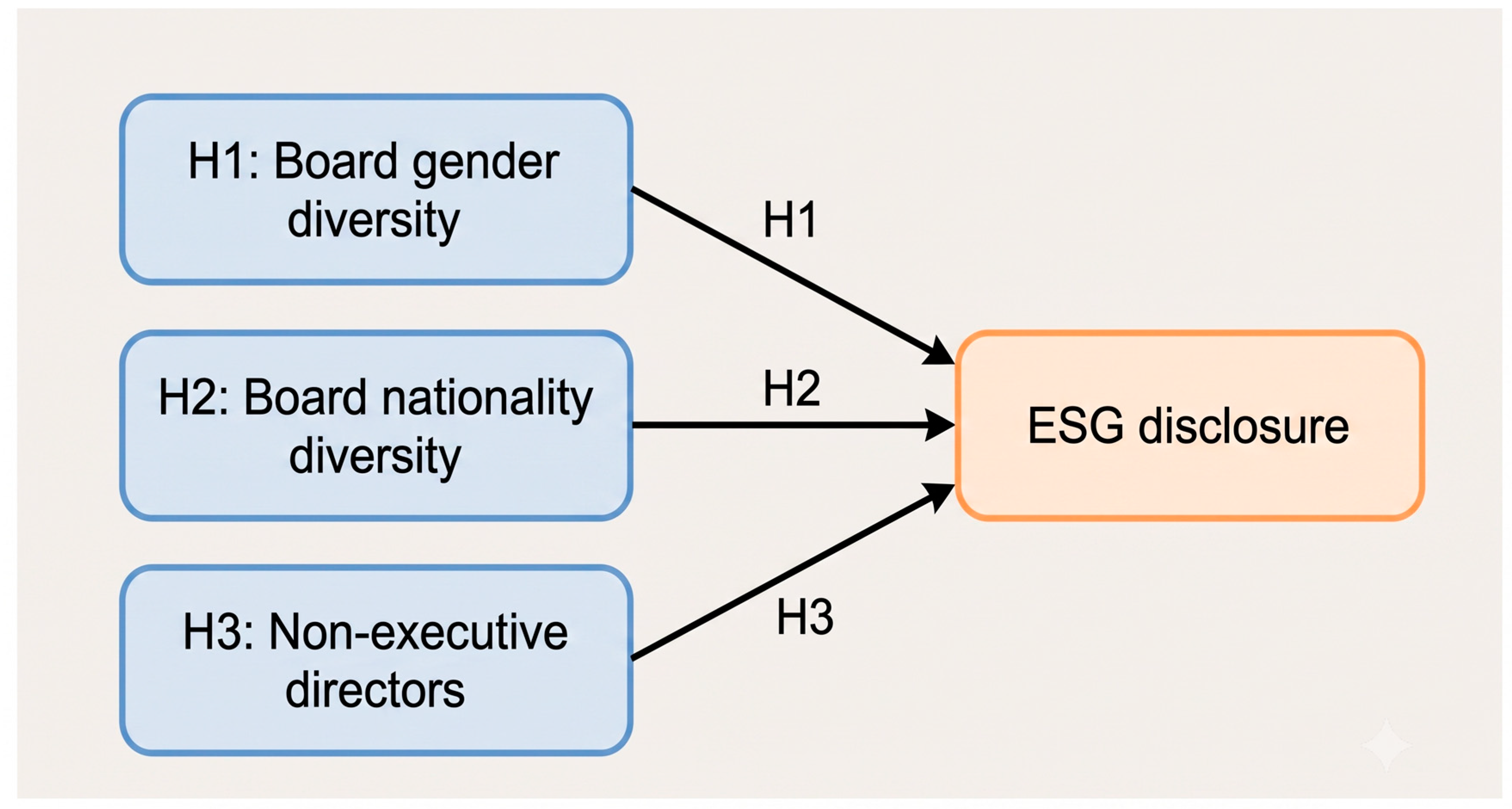
Following the above observations, the study considers the association between diversity of gender and nationality at the board level, representation of non-executive directors, and ESG disclosure. Figure 1 demonstrates the study’s integrated conceptual framework.

3. Literature Review and Hypothesis Development

3.1. ESG Disclosure in Palestine

The focus on ESG disclosures and sustainability reporting has, in recent years, been amplified by green global regulatory developments, notably given the establishment of the International Sustainability Standards Board (ISSB) and the release of IFRS S1 and S2 standards addressing financial disclosures related to climate change and sustainability. The implementation of these standards, however, is largely a function of institutional preparedness and national regulatory frameworks. Many developing economies are still assessing the advantages, legal requirements, and organizational preparedness of adopting sustainability disclosure standards, though some markets are moving towards mandatory implementation. Consequently, sustainability reporting remains optional in many contexts, frequently being incorporated into larger annual reporting procedures (Milhem, 2025).
Sustainability reporting in Palestine occurs within an emerging market characterized by evolving regulatory and governance frameworks and significant ESG issues. PEX, established in 1997, currently comprises 49 listed companies. The Palestinian Capital Market Authority (PCMA) was established based on Law No. 13-2004 and is responsible for regulating, monitoring, and developing PEX, including requirements for reporting and disclosure. Compilation and disclosure of the financial statements of publicly listed companies is mandatory under IFRS. Palestine may therefore be regarded as a “pure” IFRS environment, given the latter’s position as the original financial reporting framework endorsed by registered Palestinian firms (Abu Alia et al., 2024).
In comparison to developed markets, sustainability and ESG disclosure procedures remain relatively new in the Palestinian environment. However, some research highlights the importance of CG practices in Palestinian firms for improved ESG disclosure and openness. More recent research suggests that board attributes such as gender diversity, nationality diversity, and independence are critical to the enhancement of ESGD and performance sustainability in the Palestinian context (Alslaibi & Abdelkarim, 2024; Hardan et al., 2026). Such outcomes concur with the broader CG literature, which suggests that effective boardrooms may improve accountability, transparency, and the fulfillment of stakeholder expectations.
Because sustainability reporting in Palestine is still in its infancy, evaluating the current state of ESG disclosure is crucial in determining whether listed companies are prepared to implement new international sustainability standards such as IFRS S1 and IFRS S2. This observation also provides insight into the institutional and governance factors that potentially influence ESG disclosure practices. In this context, analysis of the significance of board diversity becomes particularly pertinent since diverse boards may offer broader perspectives, expertise, and stakeholder representation, thus potentially motivating companies to adopt more transparent and comprehensive sustainability disclosure practices. Additionally, in fragile and politically unstable situations like Palestine, CG and ESG challenges have drawn more attention.
According to Milhem (2025) and Zaid et al. (2020), Palestinian companies face difficult operating conditions that enhance ESG risks and increase stakeholder expectations for transparency and responsible corporate behavior. In this context, risk management and preserving the legitimacy and resilience of businesses require robust board supervision and governance. ESG disclosure has become more crucial given stakeholder demand for non-financial information (Bani-Khaled et al., 2024). Nonetheless, there remains a paucity of empirical data in Palestine (much of it conflicting), especially regarding the effects of board diversity on ESG performance. This study contributes to the accounting literature by providing empirical evidence from Palestine on the role of board diversity in enhancing ESGD.

3.2. Board Gender Diversity (FEM) and ESGD

Diversity in the boardroom has received significant attention from academics and policymakers as a key attribute of CG systems that potentially influences sustainability outcomes. Gender diversity is a fundamental mechanism of board diversity that may enhance ESG performance. Stakeholder theory argues that companies must consider stakeholders’ interests to ensure sustainability and success (Dmytriyev & Freeman, 2023). A gender-diverse boardroom is more likely to incorporate a wider range of stakeholder perspectives, potentially aligning business practices with societal expectations and values, ultimately benefiting firms reputationally (Muhammad & Farooq, 2025). According to RDT, diverse boards may provide an impetus for firms to improve performance, reducing risks and uncertainty (Pfeffer & Salancik, 1978; Hillman et al., 2009). Board gender diversity can provide diverse perspectives and skills, leading to more innovative and effective solutions and decision-making processes by better aligning an organization with the external environment and resources (Buchetti et al., 2025). Diverse boards are essentially a valuable resource for a firm, as they can better harmonize external requirements (ESG indicators) with the firm’s objectives and operations (Disli et al., 2022; Kamran et al., 2023). Agency theory perceives the presence of females on a board as a mechanism for enhanced monitoring of management behavior, thereby improving firms’ transparency and ensuring ESG integration into company operations (Buchetti et al., 2025; Bravo & Reguera-Alvarado, 2019; Cambrea et al., 2023).
A substantial body of empirical evidence supports the existence of a positive relationship between female presence on a board and ESG outcomes. The prior literature suggests that gender diversity on boards is positively related to environmental disclosure, enhanced stakeholder engagement, and greater environmental innovation (Wang et al., 2023; Almaqtari et al., 2024; Omenihu et al., 2025; Zhu & Chen, 2025; Gavana et al., 2025; Q. Wu et al., 2024b; Tarda et al., 2024). Wang et al. (2023) revealed a positive relationship between gender diversity and environmental performance among Turkish companies: increased female presence on boards is linked to better environmental sustainability performance. Almaqtari et al. (2024) analyzed 8094 Asian and European firms from 2016 to 2021, finding that board gender diversity positively impacts environmental sustainability performance. They offer guidance for board members and policymakers to enforce sustainability disclosure regulations and encourage the establishment of environmental teams and committees to promote sustainability performance.
Omenihu et al. (2025) examined the association between gender diversity in boardrooms and ESGD, noting that companies with a minimum of three female directors enjoy a significant positive association with ESGD. On the other hand, those with fewer than three female directors have a significant negative relationship with ESGD. In the UK context, board gender diversity is positively associated with ESGD, suggesting that this relationship is shaped by institutional frameworks and the regulatory environment. Binhadab (2026) examined the association between gender diversity and ESG performance in Gulf Cooperation Council (GCC)-listed companies, finding a positive association between gender diversity, aggregate ESG performance, and environmental and social dimensions.
Evidence from China reveals that board gender diversity has a positive influence on overall ESG performance, although the strength of this association varies according to firms’ compliance behaviors and innovation strategies (Zhu & Chen, 2025). Evidence from Europe indicates that female directors improve social and environmental performance and strengthen ESG strategies (Gavana et al., 2025; Q. Wu et al., 2024b). Although contextual differences may affect the magnitude of the relationship, the direction of the effect remains largely consistent. In Palestine, Tarda et al. (2024) showed that board gender diversity positively influences CSR disclosure. These results underscore the role of female representation on boards of directors as a key driver of social sustainability in emerging and institutionally constrained markets such as Palestine.
Overall, theoretically and empirically, board gender diversity plays a fundamental role in improving companies’ ESG performance. Therefore, the following hypothesis is formulated:
H1. 
Board gender diversity (FEM) has a positive relationship with ESGD.

3.3. Board Nationality Diversity (FORE) and ESGD

Nationality diversity in the boardroom provides an important indicator of a firm’s openness to best global governance practices. In line with RDT, board nationality diversity may influence ESG disclosure due to the various skills, resources, and experiences of directors (Marashdeh et al., 2021; Al Lawati & Alshabibi, 2023; Abdelkader & Gao, 2023). This perspective is supported by Shehadeh et al. (2021), who investigated the association between online disclosure and nationality diversity in US firms. The results showed that foreign directors may bring unique skills and expertise to the boardroom, resulting in increased creativity and innovation. This is consistent with Dobija et al. (2023), who identified the vital role of foreign directors in improving non-financial disclosure, driving sustainable development. Similarly, agency theory argues that the presence of foreign directors in the boardroom potentially reduces conflict between firm insiders and outsiders.
Foreign nationals on a board can strengthen monitoring quality, minimize information asymmetry, and restrict managerial opportunism (Al Lawati & Alshabibi, 2023). Wan Ismail et al. (2026) conducted a study of over 18 countries from 2009 to 2020, examining the relationship between board cultural diversity and ESG performance. This study indicates that board cultural diversity is positively associated with ESG performance, especially the environmental and social dimensions. However, it has a weak association with the governance dimension. H. Wu et al. (2024a) investigated the association between board nationality diversity and corporate ESG performance, using data from Chinese listed firms between 2012 and 2022. The outcomes showed that foreign directors positively affect ESG performance. Abdelkader and Gao (2023) investigated the impact of board nationality diversity and ESG performance in South African-listed companies between 2015 and 2020, revealing that diverse board nationality positively influences ESG performance.
In contrast, Al Lawati and Alshabibi (2023) investigated the influence of board attributes and ESGD in Omani financial institutions listed on the Muscat Stock Exchange for the period from 2016 to 2020. This study showed that nationality and gender diversity of a board are negatively related to ESGD. This finding contradicts the RDT argument, possibly because foreign directors are not involved effectively in firms’ daily activities. Consequently, their knowledge about corporate sustainability is poorly leveraged. Moreover, it is likely that directors focus more on the disclosure of financial outcomes to improve the image of institutions. Additional evidence from the Jordanian banking industry suggests that foreign directors are negatively associated with disclosure tone, due to cultural and language constraints (Kayed et al., 2024). Empirical evidence from Palestine indicates a non-significant relationship between nationality diversity and ESG performance, likely due to the proximate cultures shared by the directors and Palestine (Zaid et al., 2020). Jeyhunov et al. (2025) explored the impact of board diversity on ESG performance in Korean-listed companies; they found that foreign directors have no significant effect on ESG performance, suggesting that country-contextual factors may constrain foreign directors’ influence on boardrooms.
To summarize, empirical evidence on board nationality diversity is inconclusive. Despite the transnational experience, extraneous connections, and wider sustainability perspectives potentially provided by directors from other countries, cultural, linguistic, organizational, and institutional considerations may restrict their effect. Consequently, diverse nationalities on a board cannot be presumed to have an entirely positive effect on ESG disclosure; their influence may depend on the level and quality of their participation and on the institutional context. This leads us to propose the following hypothesis:
H2. 
Board nationality diversity (FORE) is significantly associated with ESGD.

3.4. Non-Executive Directors’ Representation (INDEP) and ESGD (H3)

Non-executive directors have been discussed extensively due to their importance in minimizing agency conflicts and maximizing monitoring to improve management efficiency (Al-Sarraf et al., 2025). Both non-executive directors and independent boards can provide firms with valuable resources, such as knowledge, skills, and experience, which enable boards to improve their oversight and assessment of firms’ ESG performance (Al-Sarraf et al., 2025). Consistent with agency theory, board independence drives effective monitoring and is positively associated with environmental disclosure (Raghu Kumari et al., 2022). Stakeholder theory argues that higher board independence alleviates conflicts of interest due to improved transparency and accountability. Therefore, board independence is a crucial mechanism for improving ESG performance, reducing agency costs and favoring stakeholders’ interests (Almaqtari et al., 2024).
The prior literature suggests a strong positive relationship between board independence and ESG performance, leading to stronger sustainability outcomes. Bani-Khaled et al. (2024) found that independent board members in European firms contribute positively to ESG performance by reinforcing accountability and transparency, in addition to constraining managerial discretion and opportunistic behavior. Chebbi and Ammer (2022) provided empirical evidence from Saudi Arabia showing a positive association between board independence and ESGD scores. Disli et al. (2022) conducted a study on publicly listed non-financial firms across 20 emerging economies from 2010 to 2019, exploring the impact of board independence and other attributes on sustainability performance. They found that independent boards contribute to better environmental and governance performance. Al Lawati and Alshabibi (2023) showed that board independence leads to better disclosure of sustainable development goals in Omani-listed firms. Almaqtari et al. (2024) found that board independence positively correlates with ESG performance in Asian and European companies.
In Palestine, Tarda et al. (2023) noted that the proportion of non-executive directors on boards correlates positively with CSR disclosure. In Jordan, Shanak and Khader (2024) noted a positive correlation between autonomy at the board level and environmental disclosure. In light of the foregoing results, this study recommends increased levels of both board independence and female directorship to improve environmental disclosure in emerging economies.
Conversely, Shu et al. (2024) reported a negative association between board independence and ESG score, indicating that the influence of independent directors on ESG performance may vary across different contexts and CG structures. Kayed et al. (2024) identified no association between board independence and disclosure tone. Musa et al. (2025) investigated the impact of board attributes on ESGD among Saudi-listed firms from 2021 to 2023, noting that board independence has no significant relationship with ESG disclosure. Based on the above, the following hypothesis is postulated:
H3. 
Non-executive directors’ representation (INDEP) has a positive relationship with ESGD.

4. Methodology

The present research aims to identify and explore any links between board-level heterogeneity (of both gender and nationality), incidence of non-executive directors, environmental, social, and governance factors, and aggregate ESGD across PEX-listed industrial companies. The researchers selected the industrial sector because of the transparent nature of its productive, environmental, and social activities. Among these are resource consumption, energy use, waste production, worker welfare, and community impact. Features such as these foreground the relevance of industrial enterprises, notably in the context of ESGD in Palestine. Furthermore, companies’ ESGD scores are more commensurate when research highlights only one sector; doing so minimizes heterogeneity resulting from diverse business models, regulatory requirements, and disclosure practices across industries.
Accordingly, this research employed a quantitative approach to estimate the relationship between boardroom diversity and ESGD of all PEX-listed industrial firms between 2018 and 2024. As its population, the study selected all 11 PEX-listed industrial companies for the time under investigation. To be selected, a company’s annual reports (from 2018 to 2024) had to contain data appropriate for the measurement of pertinent board characteristics, ESGD, and control variables. All 11 eligible firms fulfilled these requirements, meaning that the study utilized a census of the listed industrial sector, as opposed to the selection of a sample from that population. Thus, the final dataset involves a field of 11 companies over seven years, with a total of 77 firm-year observations. The sample period was selected to reflect the institutional development of board diversity and sustainability reporting in Palestine. The data were manually collected from the firms’ annual reports. ESGD data was extracted through a structured content analysis based on recognized frameworks, particularly the Refinitiv ESG classification model, which comprises 15 items equally distributed over the three dimensions of ESG performance.

5. Measures of the Study Variables

5.1. Dependent Variable: ESGD

5.1.1. Environmental Disclosure (ENVD)

This dimension comprises environmental policy, renewable energy initiatives, energy efficiency, waste management, and water disclosure. Each item was coded as a binary score (1 if disclosed, 0 otherwise), based on the published annual reports. The score was computed as follows:
E N V D i t = j = 1 5 E N V D i j t 5
where:
ENVDijt = 1 if environmental item j is disclosed by company i in year t and 0 if not disclosed.
5 = total environmental items.

5.1.2. Social Disclosure (SOCD)

This dimension includes employee training programs, health and safety strategy, community support, client satisfaction policy, and diversity disclosure. Each item was coded using a binary scoring system (1 if disclosed, 0 otherwise), based on the published annual reports. The score was calculated using the following equation:
S O C D i t = j = 1 5 S O C D i j t 5
where:
SOCDijt = 1 if social item j is disclosed by company i in year t and 0 if not disclosed.
5 = total social items.

5.1.3. Governance Disclosure (GOVD)

This dimension includes CG policy, disclosure of risk management, transparency strategy, presence of an audit committee, and anti-corruption policy.
G O V D i t = j = 1 5 G O V D i j t 5
where:
GOVDijt = 1 if governance item j is disclosed by company i in year t and 0 if not disclosed.
5 = total governance items.

5.1.4. ESGD

ESGD is an aggregate measure of the three dimensions, computed as follows:
E S G D i t = j = 1 5 E N V D i j t + j = 1 5 S O C D i j t + j = 1 5 G O V D i j t 15
To investigate the three hypotheses, the study focuses primarily on its principal dependent variable, aggregate ESGD score. Beyond this, to investigate any diverse links between features of boards and ESG dimensions, it considers (as unconnected dependent variables) ENVD, SOCD, and GOVD.

5.2. Independent Variables: Board Diversity

This study used three independent variables to represent board diversity: board gender diversity (FEM), non-executive directors’ representation (INDEP), and board nationality diversity (FORE). FEM was measured as “the share of female directors in the boardroom” (Saleh et al., 2021). In considering robustness, the study employed the Blau index as a proxy for gender diversity. INDEP was measured as “the proportion of non-executive directors’ representation in the boardroom” (Tarda et al., 2023), while FORE indicated “the share of foreign directors in the boardroom” (Dwekat et al., 2025). Diversity of nationality demarcates Palestinian from non-Palestinian directors in accordance with the nationality declared beside each board member in the companies’ annual reports. Based on resource dependence theory, non-Palestinian directors are identified as external “resources”, potentially contributing expertise, experience, and transnational viewpoints.

5.3. Control Variables

Three control variables were included. The first was company size (FSIZE), i.e., the natural logarithm of a given firm’s total assets. Larger firms have more capacity to invest in sustainability activities, leading to higher ESG scores (Qureshi et al., 2020). The second was company age (FAGE), which refers to the period from when each company was established to the observation year. Older companies may have more awareness of the importance of disclosing ESG activities, leading to better ESG disclosure quality (Setiawan & Yusup, 2025). The final control variable was CEO duality (a governance attribute) because it is among the main factors of CG structure that influence ESG activities (Nour et al., 2025). Table 1 lists the variables and their measures.

6. Econometric Model Specification

This study estimates the influence of board diversity on ESG disclosure among listed industrial firms in Palestine. The panel regression models are specified as follows:

6.1. Model (1): Environmental Disclosure

ENVDit = β0 + β1FEM_it + β2FORE_it + β3INDEP_it + β4FAGE_it + β5FSIZE_it + β6CEOD_it + μi + εit

6.2. Model (2): Social Disclosure

SOCDit = β0 + β1FEMit + β2FOREit + β3INDEPit + β4FAGEit + β5FSIZEit + β6CEOD_it+ μi + εit

6.3. Model (3): Governance Disclosure

GOVDit = β0 + β1FEMit + β2FOREit + β3INDEPit + β4FAGEit + β5FSIZEit + β6CEODit + μi + εit

6.4. Model (4): Aggregate ESG Disclosure

ESGDit = β0 + β1 FEMit + β2 FOREit + β3 INDEPit + β4 FAGEit + β5 FSIZEit + β6 CEODit + μi + εit
where i denotes the company; t refers to the year; ESGD is the aggregate of ESG disclosure; and FEM, FORE, and INDEP represent board gender diversity, board nationality diversity, and non-executive directors’ representation, respectively. FAGE, FSIZE, and CEOD are the control variables representing firm age, firm size, and CEO duality, respectively. μi captures the unobserved company-specific effect, while εit is the idiosyncratic error term.

7. Findings

7.1. Descriptive Statistics

Table 2 provides the descriptive statistics. The aggregate ESGD score of 0.32 was relatively modest, indicating limited ESG reporting culture. Individually, the mean value of ENVD was 0.31, that of SOCD was 0.30, and that of GOVD was 0.34. The higher governance score suggests that firms tend to prioritize governance reporting. In terms of board diversity, FEM was very low (M = 0.07), which means that there is limited gender diversity in the sample firms’ boardrooms. Nonetheless, the maximum value of female representation was 0.40, suggesting high female participation in some firms.
INDEP’s high average (0.87) suggests that most directors were non-executive, likely due to regulatory compliance rather than substantive independence. FORE’s low mean (0.04) implies that most directors are locals. FAGE had a mean of 3.54, with moderate dispersion. FSIZE had a mean value of 7.36, also with low variability. CEOD showed an average of 0.30, indicating that almost 30% of firms combine CEO and chairperson roles, which may have governance implications. Table 2 presents descriptive results for FEMBLAU, FLEV, and BSIZE; the study uses these as a proxy for board gender diversity in its assessment of robustness. They are also used as supplementary control variables for firm leverage and board size.

7.2. Multicollinearity Tests

Table 3 shows the correlation matrix and variance inflation factor (VIF) results. It is apparent that the maximal magnitude of correlation across explanatory variables was 0.777, obviously less than the threshold of 0.8 (Aljadba et al., 2021). The VIF scores did not exceed 5, ranging between 1.10 and 3.37, with a mean of 2.09; as such, multicollinearity was irrelevant, suggesting it was not a requirement for consideration.

7.3. Regression Diagnostic Tests

Diagnostic tests also indicated no significant role of multicollinearity, given the maximum VIF of 3.37 and the mean VIF of 2.09. The modified Wald test suggested groupwise heteroskedasticity (χ2 (11) = 510.44, p < 0.001). Random-effects models were deployed to estimate firm-clustered robust standard errors; this explains the heteroskedasticity and within-firm dependence. No first-order autocorrelation (F (1,10) = 0.094, p = 0.7652) was suggested by the Wooldridge test. Diagnostic results supported continuing with panel-data estimation, via the use of firm-clustered robust standard errors.

7.4. Breusch–Pagan LM and Hausman Tests

Table 4 displays both the Breusch–Pagan Lagrange Multiplier (BP–LM) test, which detects panel effects, and the Hausman specification test (used to differentiate between fixed- and random-effects models). The statistical significance of the four dependent variables in the LM tests led us to reject the H0 of no panel effects, suggesting firm-specific heterogeneity. It may subsequently be inferred that panel-data estimation is more appropriate than pooled OLS. The lack of statistical significance in subsequent Hausman tests for ENVD, SOCD, GOVD, and ESGD led us to favor the random-effects estimator over the fixed-effects estimator. For this reason, we chose random-effects models for all four specifications.

8. Random-Effects Regression Results

Table 5 reports the random-effects regression findings, estimated using Stata 14 by means of firm-clustered robust standard errors. The hypotheses are tested via the aggregate ESGD model. Further evidence relating to heterogeneous associations among ESG components is provided by the environmental, social, and governance dimensions.

9. Discussion

9.1. Board Gender Diversity and ESGD (H1)

Table 5 indicates that board gender diversity was positively and significantly associated with ENVD (b = 0.752, z = 1.77, p < 0.1), SOCD (b = 0.805, z = 2.21, p < 0.05), and ESGD b = 0.675, z = 2.03, p < 0.05). Therefore, H1 was accepted, suggesting that more women directors could enhance ESGD among the sample firms. This finding (that board gender diversity provides diverse perspectives and skills, driving more effective solutions to ESG issues by aligning the organization with the external environment and resources) is consistent with RDT (Buchetti et al., 2025). In essence, diverse boards are perceived as a valuable resource for a company, as they can better harmonize external requirements (ESG indicators) with the firm’s objectives and operations (Disli et al., 2022; Kamran et al., 2023). Moreover, RDT highlights the broader range of resources and the networks they offer (Hillman et al., 2009; Pfeffer & Salancik, 1978). Stakeholder theory emphasizes their potential for balancing diverse stakeholder interests more effectively (Dmytriyev & Freeman, 2023; Mitchell et al., 1997). This synergy can lead to more ethical, responsible, and sustainable CG, enhancing ESG performance. Agency theory argues that women in boardrooms can enhance the monitoring function and thereby improve firm transparency and ESG integration into company operations (Buchetti et al., 2025). These results are consistent with the prior literature confirming the significant and positive association between female representation on boards and ESGD (e.g., Almaqtari et al., 2024; Omenihu et al., 2025; Zhu & Chen, 2025; Gavana et al., 2025; Tarda et al., 2024; Binhadab, 2026). In Palestine, Tarda et al. (2024) indicated that a higher percentage of women directors is positively associated with CSR disclosure. These outcomes underscore the role of women’s representation on boards of directors as a key driver of social sustainability in emerging and institutionally constrained markets, such as Palestine.
Nonetheless, the study’s conclusion diverges from that of Al Lawati and Alshabibi (2023), whose analysis of Omani financial institutions identified a negative association between gender diversity among directors and ESGD. This discrepancy might indicate inconsistency in sectoral features, cultures of governance, levels of participation by female directors, and the magnitude of female involvement in sustainability-related decisions at the board level. In the context of Palestinian industrial firms, it is possible that female directors amplify stakeholder responsiveness and consideration of environmental and social concerns. Such a possibility would account for their positive association with ESGD.

9.2. Board Nationality Diversity and ESGD (H2)

Table 5 illustrates the positive and significant correlation between board nationality diversity and both ENVD (b = 2.24, z = 2.05, p < 0.05) and aggregate ESGD (b = 0.744, z = 1.69, p < 0.10). The former demonstrates no statistically significant association with either SOCD or GOVD. H2 is therefore upheld. These inferences suggest a link between the presence of foreign directors and increased ESG transparency; this association is especially apparent in environmental disclosure.
The above result is consistent with resource dependence theory (RDT), which views a transnational range of directors as a valuable repository of knowledge, understanding, external links, and extranational viewpoints (Abdelkader & Gao, 2023). Foreign directors may heighten boards’ awareness of global sustainability procedures, environmental regulation, and the views of stakeholders, thus boosting attention to environmental hazards and disclosure. This inference is consistent with Wan Ismail et al. (2026) and Dobija et al. (2023), who highlighted the importance of nationally diverse directors in the advancement of non-financial disclosure and sustainable development. The increasingly transnational nature of environmental reporting, climate-related expectations, and investor concerns is perhaps reflected in the stronger association with ENVD. Social and governance practices may, conversely, be influenced more directly by domestic governance, links between local stakeholders, administrative procedures, and governmental requirements, perhaps accounting for the dearth of meaningful links with SOCD and GOVD.
The inconclusive nature of evidence from various countries again underlines the contextual contingency of the efficacy of transnational directors. Al Naim and Alomair (2024) demonstrated that ESG disclosure was improved by non-Saudi directors and that improvements in company administration reinforced this relationship, underlining the significant role of regulatory support. Al Lawati and Alshabibi (2023), by contrast, noted a negative relationship in Oman, while Kayed et al. (2024) concluded that the influence of foreign directors on the decisions of Jordanian companies may be restricted by cultural and linguistic barriers. Çolakoğlu et al. (2020) recorded no meaningful effect of foreign directors on CSR performance in Türkiye, suggesting that, in the absence of real participation in decision-making, board presence by itself is insufficient. In the context of Palestine, Zaid et al. (2020) noted that the influence of transnational directors’ viewpoints may be limited by cultural and geographical proximity.
A largely context-specific and dimension-specific quality regarding the contribution of nationality diversity to sustainability disclosure is inferred. The benefit derived from foreign directors in terms of ESG transparency may well be a function of regulatory support, linguistic/cultural dissonance/proximity, access to corporate systems, participation in board projects, and level of engagement in sustainability oversight. The positive association of nationality diversity with aggregate ESGD, and particularly with environmental disclosure, may be explained by the above factors, while the link between such diversity and social/governance disclosure remains of limited significance.

9.3. Non-Executive Directors’ Representation and ESGD (H3)

Table 5 shows that there was a strong relationship between the incidence of non-executive directors and SOCD (b = 0.543, z = 2.05, p < 0.05) and ESGD (b = 0.449, z = 1.83, p < 0.10). Conversely, a positive (though weak) association between such incidence and both ENVD and GOVD was apparent. Thus, H3 was accepted at the 10% significance level for aggregate ESGD: non-executive directors are effective in enhancing ESGD among the sample firms. Furthermore, directors without executive capacity contribute to improving the disclosure of social activities. This finding is consistent with previous studies in both developed and developing contexts, which indicate a strong positive relationship between board independence and ESG performance, in turn contributing to more robust sustainability results (Al Lawati & Alshabibi, 2023; Bani-Khaled et al., 2024; Almaqtari et al., 2024; Chebbi & Ammer, 2022; Disli et al., 2022). In Palestine, Tarda et al. (2023) showed a positive and significant relationship between the incidence of independent board members and CSR disclosure. These results are consistent with agency theory, which suggests that non-executive directors are a crucial factor in the mitigation of agency costs. Directors of this type also have a strategic vision for long-term economic, social, and environmental performance.
Nonetheless, our findings diverge from the negative relationship between board independence and ESGD claimed by Shu et al. (2024), and also from the lack of significant association asserted by Musa et al. (2025). These differences may reflect the diversity of institutional milieux, sectoral features, implementation of regulations, and extent of directorial autonomy. In the present study, INDEP evaluates the proportion of independent directors, as opposed to the formal independence measured by official criteria. The stronger relationship with SOCD may suggest that non-executive directors set more store by visible stakeholder- and community-related considerations. In contrast, specialist ESG knowledge, purposeful sustainability committees, and stronger regulatory frameworks may be required by ENVD, and GOVD may require specialized ESG expertise, dedicated sustainability committees, and stronger regulatory requirements.

9.4. Control Variables and ESGD

With regard to the control variables, company size was positively and significantly associated with ESGD. In this respect, the current findings are consistent with Qureshi et al.’s (2020) inference that bigger firms generally enjoy greater resources for sustainability initiatives while facing a higher degree of transparency and stakeholder inspection, potentially stimulating increased ESGD. Conversely, company age did not correlate significantly with ESGD, from which it may be inferred that in the absence of regulatory or stakeholder pressure, organizational maturity is not a sufficient condition for more robust ESGD. CEO duality also appeared insignificant, implying that concentration of leadership structure may be a lesser factor than board composition and corporate resources in accounting for ESGD across the Palestinian industrial firms considered.

10. Robustness Checks

In Table 6 three more model specifications were utilized to evaluate the study’s robustness. Firstly, the board diversity variables were lagged by one year in the hope of attenuating potential simultaneity considerations. Lagged gender diversity stayed positive and significant at the 5% level (β = 0.663, p = 0.049), while lagged nationality diversity also maintained positivity and significance (β = 0.677, p = 0.054). The lagged representation of independent directors remained positive but statistically insignificant (b = 0.452, p = 0.113). Secondly, the Blau index was utilized to remeasure female board diversity. The Blau index remained positive and statistically significant (b = 0.486, p = 0.032), confirming robustness to an alternative measurement of the gender diversity result. Thirdly, the researchers introduced leverage and board size as additional controls. Female incidence remained positive and significant at the 10% level (b = 0.669, p = 0.050), while the incidence of non-executive directors’ representation was positive and significant at the 5% level (b = 0.459, p = 0.036). Neither leverage nor board size was statistically significant. Taken together, these additional analyses imply that the main results were not significantly influenced by variation in measurement, synchroneity, or the exclusion of such supplementary controls.

11. Conclusions

This study considers 11 PEX-listed Palestinian industrial firms from 2018 to 2024, identifying and examining links between diversity of directorial gender and nationality, incidence of non-executive directors, and ESGD. The findings indicate a positive and significant association between all three board characteristics and aggregate ESGD. Nonetheless, such associations are not consistent across the environmental, social, and governance dimensions, implying heterogeneity in effects on individual ESG components.
With regard to monitoring, stakeholder responsiveness, expertise, and resource benefits linked with diverse boards, the overall results support the perspectives of agency theory, stakeholder theory, and resource dependence theory. Directorial gender diversity, nationality diversity at the board level, and non-executive directors’ representation are all significantly associated with aggregate ESGD, implying that these characteristics can collectively reinforce companies’ overall sustainability disclosure. Nevertheless, the lack of uniform significance across the environmental, social, and governance dimensions allows the inference of a lack of consistency in their influence across individual ESG components, raising the possibility that the contribution made by directorial diversity may depend on factors such as the specific disclosure domain, the efficacy (or otherwise) of participation in decision-making, access to firm-specific data and resources, relevant ESG expertise, and wider considerations of governance and regulation. The study contributes to the literature via the provision of evidence from a conflict-affected and institutionally restricted emerging market. As far as the authors are aware, it is one of the first studies that explores relationships between multiple board diversity characteristics and ESG disclosure in a Palestinian context.

11.1. Practical and Policy Implications

The results have practical implications for executives, directors, managers, and listed companies in Palestine. Executives may wish to consider incremental measures to elevate the number of female company directors, simultaneously promoting effective participation by women in board decisions and committees. Because the incidence of non-executive directors is positively associated with aggregate ESG disclosure, firms would do well to increase said directors’ access to pertinent information and participation in ESG oversight.
Policy measures concerning nationality diversity should not be restricted to increasing the number of transnational directors. The Palestine Capital Market Authority (PCMA) and PEX could contemplate compelling listed companies to disclose transnational directors’ levels of attendance at meetings, committee membership, ESG expertise, and involvement in sustainability oversight. At the corporate level, companies could furnish foreign directors with Arabic–English board materials, guidance on the institutional environment in Palestine, and timely access to ESG and operational data. Companies could also assign appropriate foreign directors to committees dealing with risk, audit, or sustainability, annually evaluating their contributions to ESG oversight. Such measures may help translate nationality diversity into meaningful involvement and boost its contribution to ESGD. The significant positive association between nationality diversity and overall ESG disclosure supports policies encouraging meaningful involvement of transnational directors; however, the evidence alone does not necessitate mandatory nationality quotas. A more suitable way forward would be an approach focusing on competency and participation.

11.2. Limitations and Suggestions for Future Research

The present study has several limitations; these imply potential orientation for forthcoming research. Firstly, it considers three board characteristics: diversity of gender, diversity of nationality, and incidence of non-executive directors. Future studies could consider the education of directors and their financial expertise, tenure, age, meeting attendance, and ESG-related experience. Secondly, the relatively small sample (11 PEX-listed industrial companies) potentially limits the generalizability of our findings beyond Palestine’s industrial sector. The study therefore affords insights relevant to PEX-listed industrial firms; these findings should not be automatically generalized to other sectors in Palestine or to other national and/or institutional contexts. Future research could extend the sample to companies in the financial, service, or investment sectors. Alternatively, comparative analyses could be conducted between Palestine and other conflict-affected Middle Eastern markets, such as Lebanon, Iraq, and Yemen. Such comparisons could explore how the efficacy of board diversity is conditioned by regulatory administration, institutional cohesion, concentration of corporate control, and severity of conflict.
Thirdly, future studies could analyze the effects of political instability. Board meetings, information availability, resource allocation, and the implementation of sustainability policies are in all likelihood negatively impacted by conflict. Fourthly, forthcoming investigations could explore corporate legitimacy, stakeholder involvement, or sustainability committee effectiveness as mediating or moderating mechanisms by which boards with significant diversity influence ESGD. Finally, given this study’s measurement of disclosed ESG items, future qualitative or mixed-methods research might evaluate such variables as disclosure tone, specificity, balance, credibility, quantitative support, and consistency between theoretical commitments and real-world practices.

Author Contributions

Conceptualization, A.H.I.A. and A.A.S.F.; methodology, A.H.I.A. and A.A.S.F.; software, A.H.I.A.; validation, A.A.S.F., K.O.A. and A.F.A.; formal analysis, A.H.I.A.; investigation, A.H.I.A.; resources, K.O.A. and A.F.A.; data curation, A.H.I.A. and A.A.S.F.; writing—original draft preparation, A.H.I.A.; writing—review and editing, A.H.I.A., A.A.S.F., K.O.A. and A.F.A.; visualization, A.H.I.A.; supervision, A.A.S.F.; project administration, A.H.I.A. All authors have read and agreed to the published version of the manuscript.

Funding

This research received no external funding.

Institutional Review Board Statement

Not applicable.

Informed Consent Statement

Not applicable.

Data Availability Statement

The data will be available upon reasonable request.

Conflicts of Interest

The authors declare no conflicts of interest.

References

  1. Abdelkader, M., & Gao, Y. (2023). Uncovering the role of foreign ownership in the relationship between board nationality diversity and ESG. International Journal of Research in Business and Social Science, 12(9), 288–302. [Google Scholar] [CrossRef] [Scilit]
  2. Abu Alia, M., Amarneh, K., & Abdeljawad, I. (2024). The relevance of IFRS accounting information: Evidence from a pure IFRS environment. An-Najah University Journal for Research—B (Humanities), 38(5), 987–1018. [Google Scholar] [CrossRef] [Scilit]
  3. Abu Qa’dan, M. B., & Suwaidan, M. S. (2019). Board composition, ownership structure and corporate social responsibility disclosure: The case of Jordan. Social Responsibility Journal, 15(1), 28–46. [Google Scholar] [CrossRef] [Scilit]
  4. Ali Basah, M. Y., Marzuki, A., Ramli, N. A., Mat Nor, F., Ab Aziz, M. R., Shahwan, S., & Sabri, H. (2024). Conceptual framework of environmental, social, and governance (ESG) research: Trends, themes, and emerging perspectives. The Journal of Muamalat and Islamic Finance Research, 21(2), 17–36. [Google Scholar] [CrossRef] [Scilit]
  5. Aljadba, A. H. I., Islam, M., & Eldaia, M. (2026). The impact of corporate governance characteristics on corporate financial performance in Palestine: Does board gender matter? The Indonesian Journal of Accounting Research, 29(1), 27–58. [Google Scholar] [CrossRef] [Scilit]
  6. Aljadba, A. H. I., Nawai, N., & Laili, N. H. (2021). The impact of corporate governance on earnings management in Palestine: The moderating effects of political instability. Journal of Information Technology Management, 13(2), 113–138. [Google Scholar] [CrossRef] [Scilit]
  7. Aljarrah, A. (2026). Environmental, social, and governance (ESG) adoption in firms operating in Palestine: A policy and practice analysis in a fragile and constrained economy. Journal of Accounting, Business, Governance and Sustainability, 1(1), 1–23. [Google Scholar] [CrossRef] [Scilit]
  8. Al Lawati, H., & Alshabibi, B. (2023). Does board structure drive Sustainable Development Goals disclosure? Evidence from an emerging market. Journal of Governance & Regulation, 12(2), 166–175. [Google Scholar] [CrossRef] [Scilit]
  9. Almaqtari, F. A., Elmashtawy, A., Farhan, N. H. S., Almasria, N. A., & Alhajri, A. (2024). The moderating effect of board gender diversity in the environmental sustainability and financial performance nexus. Discover Sustainability, 5, 318. [Google Scholar] [CrossRef] [Scilit]
  10. Al Naim, A. S., & Alomair, A. (2024). Board composition and environmental, social, and governance reporting: Impact of foreign and busy directors in Saudi-listed firms. Sustainability, 16(20), 8985. [Google Scholar] [CrossRef] [Scilit]
  11. Alodat, A. Y., Salleh, Z., Hashim, H. A., & Sulong, F. (2024). Investigating the mediating role of sustainability disclosure in the relationship between corporate governance and firm performance in Jordan. Management of Environmental Quality: An International Journal, 35(7), 1691–1720. [Google Scholar] [CrossRef] [Scilit]
  12. Al-Sarraf, J., Al-Swidi, A. K., & Al-Hakimi, M. A. (2025). Board diversity matters: Assessing ESG performance through the lens of firm size. Corporate Governance, 25(7), 1809–1833. [Google Scholar] [CrossRef] [Scilit]
  13. Alslaibi, N., & Abdelkarim, N. (2024). The power of ESG factors in driving financial growth: Insights from Palestine. Discover Sustainability, 5, 241. [Google Scholar] [CrossRef] [Scilit]
  14. Ararat, M., Claessens, S., & Yurtoglu, B. B. (2021). Corporate governance in emerging markets: A selective review and an agenda for future research. Emerging Markets Review, 48, 100767. [Google Scholar] [CrossRef] [Scilit]
  15. Bani-Khaled, S., Azevedo, G., & Oliveira, J. (2024). Exploring the role of board characteristics in shaping corporate ESG performance: An empirical analysis. In G. Azevedo, E. Vieira, R. Marques, & L. Almeida (Eds.), The challenges of Era 5.0 in accounting and finance innovation: ICAFI 2024 (pp. 47–75). Springer. [Google Scholar] [CrossRef] [Scilit]
  16. Binhadab, N. (2026). Gender diversity, board size, and ESG performance: Sectoral evidence from GCC-listed firms. Sustainability, 18(3), 1607. [Google Scholar] [CrossRef] [Scilit]
  17. Bravo, F., & Reguera-Alvarado, N. (2019). Sustainable development disclosure: Environmental, social, and governance reporting and gender diversity in the audit committee. Business Strategy and the Environment, 28(2), 418–429. [Google Scholar] [CrossRef] [Scilit]
  18. Buchetti, B., Arduino, F. R., & Perdichizzi, S. (2025). A literature review on corporate governance and ESG research: Emerging trends and future directions. International Review of Financial Analysis, 97, 103759. [Google Scholar] [CrossRef] [Scilit]
  19. Cambrea, D. R., Paolone, F., & Cucari, N. (2023). Advisory or monitoring role in ESG scenario: Which women directors are more influential in the Italian context? Business Strategy and the Environment, 32(7), 4299–4314. [Google Scholar] [CrossRef] [Scilit]
  20. Chebbi, K., & Ammer, M. A. (2022). Board composition and ESG disclosure in Saudi Arabia: The moderating role of corporate governance reforms. Sustainability, 14(19), 12173. [Google Scholar] [CrossRef] [Scilit]
  21. Çolakoğlu, N., Eryılmaz, M., & Martínez-Ferrero, J. (2020). Is board diversity an antecedent of corporate social responsibility performance in firms? A research on the 500 biggest Turkish companies. Social Responsibility Journal, 17(2), 243–262. [Google Scholar] [CrossRef] [Scilit]
  22. Disli, M., Yilmaz, M. K., & Mohamed, F. F. M. (2022). Board characteristics and sustainability performance: Empirical evidence from emerging markets. Sustainability Accounting, Management and Policy Journal, 13(4), 929–952. [Google Scholar] [CrossRef] [Scilit]
  23. Dmytriyev, S. D., & Freeman, R. E. (Eds.). (2023). R. Edward Freeman’s selected works on stakeholder theory and business ethics. Springer. [Google Scholar] [CrossRef] [Scilit]
  24. Dobija, D., Arena, C., Kozłowski, Ł., Krasodomska, J., & Godawska, J. (2023). Towards sustainable development: The role of directors’ international orientation and their diversity for non-financial disclosure. Corporate Social Responsibility and Environmental Management, 30(1), 66–90. [Google Scholar] [CrossRef] [Scilit]
  25. Dwekat, A., Taweel, A., & Salameh, A. (2025). Boardroom diversity and financial performance in Palestinian banks and insurers. Discover Sustainability, 6, 40. [Google Scholar] [CrossRef] [Scilit]
  26. Ellili, N. O. D. (2022). Impact of environmental, social and governance disclosure on dividend policy: What is the role of corporate governance? Evidence from an emerging market. Corporate Social Responsibility and Environmental Management, 29(5), 1399–1413. [Google Scholar] [CrossRef] [Scilit]
  27. Fayad, A. A. S., Khatib, S. F. A., Alomair, A., & Al Naim, A. S. (2024). Audit chair characteristics and ESG disclosure: Evidence from the Saudi stock market. Sustainability, 16(24), 11011. [Google Scholar] [CrossRef] [Scilit]
  28. Freeman, R. E. (1984). Strategic management: A stakeholder approach. Pitman. [Google Scholar]
  29. Gavana, G., Gottardo, P., & Moisello, A. M. (2025). The impact of board gender diversity on ESG disclosure: A contingency perspective. Meditari Accountancy Research, 33(7), 1–29. [Google Scholar] [CrossRef] [Scilit]
  30. Gherghina, Ș. C. (2024). Corporate finance and environmental, social, and governance (ESG) practices. Journal of Risk and Financial Management, 17(7), 308. [Google Scholar] [CrossRef] [Scilit]
  31. Hardan, A., Daas, G., Nour, A., & Abudiak, A. (2026). Board characteristics, ownership structure, and financial sustainability: Evidence from Palestine and Jordan. Future Business Journal, 12(25), 25. [Google Scholar] [CrossRef] [Scilit]
  32. Hillman, A. J., Withers, M. C., & Collins, B. J. (2009). Resource dependence theory: A review. Journal of Management, 35(6), 1404–1427. [Google Scholar] [CrossRef] [Scilit]
  33. Itan, I., Sylvia, S., Septiany, S., & Chen, R. (2025). The influence of environmental, social, and governance disclosure on market reaction: Evidence from emerging markets. Discover Sustainability, 6, 347. [Google Scholar] [CrossRef] [Scilit]
  34. Jamil, N. N., & Tri Wahyuni, E. (2025). ESG score, board structure and financial performance: Evidence from Malaysia and Indonesia public listed companies. The Journal of Muamalat and Islamic Finance Research, 22(2), 14–26. [Google Scholar] [CrossRef] [Scilit]
  35. Jensen, M. C., & Meckling, W. H. (1976). Theory of the firm: Managerial behavior, agency costs and ownership structure. Journal of Financial Economics, 3(4), 305–360. [Google Scholar] [CrossRef] [Scilit]
  36. Jeyhunov, A., Kim, J. D., & Bae, S. M. (2025). The Effects of board diversity on Korean companies’ ESG performance. Sustainability, 17(2), 787. [Google Scholar] [CrossRef] [Scilit]
  37. Kamran, M., Djajadikerta, H. G., Mat Roni, S., Xiang, E., & Butt, P. (2023). Board gender diversity and corporate social responsibility in an international setting. Journal of Accounting in Emerging Economies, 13(2), 240–275. [Google Scholar] [CrossRef] [Scilit]
  38. Kayed, S., Ramadan, A. H., Morshed, A., Alshurafat, H., & Al-Zyoudi, R. (2024). The effect of board of directors’ characteristics on disclosing tone in the annual reports: Evidence from Amman Stock Exchange. Discover Sustainability, 5, 338. [Google Scholar] [CrossRef] [Scilit]
  39. Marashdeh, Z., Alomari, M. W., Khataybeh, M., & Alkhataybeh, A. (2021). Female representation on the boards of directors of non-financial companies. Journal of Governance & Regulation, 10(2), 44–54. [Google Scholar] [CrossRef] [Scilit]
  40. Milhem, J. J. (2025). Sustainability disclosure standards IFRS S1 and S2, readiness for implementation: Case of Palestinian listed companies. An-Najah University Journal for Research—B (Humanities), 39(11), 973–996. [Google Scholar] [CrossRef] [Scilit]
  41. Mitchell, R. K., Agle, B. R., & Wood, D. J. (1997). Toward a theory of stakeholder identification and salience: Defining the principle of who and what really counts. Academy of Management Review, 22(4), 853–886. [Google Scholar] [CrossRef] [Scilit]
  42. Muhammad, H., & Farooq, M. (2025). The effectiveness of board gender diversity and sustainability committees in mitigating ESG controversies. Meditari Accountancy Research, 33(3), 994–1027. [Google Scholar] [CrossRef] [Scilit]
  43. Musa, A. M. H., Alqubaysi, R., & Alqahtani, H. A. (2025). The effect of board characteristics on ESG commitment in Saudi Arabia: How diversity, independence, size, and expertise shape corporate sustainability practices. Sustainability, 17(12), 5552. [Google Scholar] [CrossRef] [Scilit]
  44. Nour, A. I., Dagher, A. A., Douglas, S. B., & Jebreen, K. (2025). Board of directors’ attributes and quality of sustainability reports among industrial companies and banks listed on a stock exchange. In A. M. A. Musleh Al-Sartawi, A. I. Nour, & I. Abdeljawad (Eds.), Business resilience and business innovation for sustainability (pp. 177–198). Springer. [Google Scholar] [CrossRef] [Scilit]
  45. Omenihu, C. M., Abdrakhmanova, M., & Koufopoulos, D. N. (2025). Board gender diversity and environmental, social, and governance (ESG) disclosure in developed countries. Administrative Sciences, 15(4), 141. [Google Scholar] [CrossRef] [Scilit]
  46. Pfeffer, J., & Salancik, G. R. (1978). The external control of organizations: A resource dependence perspective. Harper & Row. [Google Scholar]
  47. Qureshi, M. A., Kirkerud, S., Theresa, K., & Ahsan, T. (2020). The impact of sustainability (environmental, social, and governance) disclosure and board diversity on firm value: The moderating role of industry sensitivity. Business Strategy and the Environment, 29, 1199–1214. [Google Scholar] [CrossRef] [Scilit]
  48. Raghu Kumari, P. S., Makhija, H., Sharma, D., & Behl, A. (2022). Board characteristics and environmental disclosures: Evidence from sensitive and non-sensitive industries of India. International Journal of Managerial Finance, 18(4), 677–700. [Google Scholar] [CrossRef] [Scilit]
  49. Rudolph, M. L., & Aliamutu, K. (2026). Corporate governance mechanisms and ESG disclosure: Evidence from emerging financial markets. International Journal of Economics and Financial Issues, 16(1), 54–63. [Google Scholar] [CrossRef] [Scilit]
  50. Sain, A., & Kashiramka, S. (2024). Do corporate governance mechanisms and ESG disclosures improve bank performance and stability in an emerging economy? Journal of Advances in Management Research, 21(4), 530–555. [Google Scholar] [CrossRef] [Scilit]
  51. Saleh, M. W., Zaid, M. A., Shurafa, R., Maigoshi, Z. S., Mansour, M., & Zaid, A. (2021). Does board gender enhance Palestinian firm performance? The moderating role of corporate social responsibility. Corporate Governance, 21(4), 685–701. [Google Scholar] [CrossRef] [Scilit]
  52. Setiawan, B., & Yusup, A. K. (2025). Board diversity and ESG performance in Indonesia: The role of financial performance moderators. Journal of Management Studies and Development, 4(3), 295–313. [Google Scholar] [CrossRef] [Scilit]
  53. Shanak, H., & Khader, O. (2024). The effect of board independence on environmental disclosure: The moderating role of gender diversity in Amman Stock Exchange. Palestine Technical University Research Journal, 12(2), 80–93. [Google Scholar] [CrossRef] [Scilit]
  54. Shehadeh, E., Aly, D., & Yousef, I. (2021). The impact of boardroom internationalisation on online disclosures of S&P 500. Journal of Financial Reporting and Accounting, 19(4), 596–614. [Google Scholar] [CrossRef] [Scilit]
  55. Shu, P.-G., Chiang, S.-J., & Wu, T.-Y. (2024). Board network and ESG performance: Evidence from China. Corporate Social Responsibility and Environmental Management, 31(6), 5709–5729. [Google Scholar] [CrossRef] [Scilit]
  56. Şener, İ., & Karaye, A. B. (2014). Board composition and gender diversity: Comparison of Turkish and Nigerian listed companies. Procedia—Social and Behavioral Sciences, 150, 1002–1011. [Google Scholar] [CrossRef] [Scilit]
  57. Tarda, O., Haron, H., Ramli, N., & Salleh, S. (2024). Board gender diversity toward corporate social responsibility disclosure in Palestinian companies: Financial performance as mediation. Cogent Economics & Finance, 12(1), 2379577. [Google Scholar] [CrossRef] [Scilit]
  58. Tarda, O., Haron, H., Ramli, N. M., & Salleh, S. (2023). The impact of board of directors’ independence on corporate social responsibility disclosure in Palestinian companies. The Journal of Muamalat and Islamic Finance Research, 20(2), 192–204. [Google Scholar] [CrossRef] [Scilit]
  59. Wang, Y., Ones, D. S., Yazar, Y., & Mete, I. (2023). Board gender diversity and organizational environmental performance: An international perspective. Current Research in Ecological and Social Psychology, 5, 100164. [Google Scholar] [CrossRef] [Scilit]
  60. Wan Ismail, W. A., Kamarudin, K. A., Hassan, N. H., & Ahmad, M. (2026). Enhancing ESG performance through board cultural diversity: International evidence. Journal of Applied Accounting Research, 27(3), 547–573. [Google Scholar] [CrossRef] [Scilit]
  61. Wu, H., Sun, Q., Zhang, Z., & Wang, D. (2024a). Does board internationalization affect corporate ESG performance? Evidence from Chinese A-share-Listed Companies. Sustainability, 16(23), 10738. [Google Scholar] [CrossRef] [Scilit]
  62. Wu, Q., Shahbaz, M., & Bigerna, S. (2024b). Does board gender diversity benefit for corporate ESG performance: Evidence from Germany. Journal of Environmental Management, 372, 123304. [Google Scholar] [CrossRef] [Scilit] [PubMed]
  63. Yue, S., Bajuri, N. H., Wang, B., & Samara, H. (2026). Artificial intelligence and sustainable governance: The moderating role of board gender and age diversity. Journal of Management and Governance, 30. [Google Scholar] [CrossRef] [Scilit]
  64. Zaid, M. A. A., Wang, M., Adib, M., Sahyouni, A., & Abuhijleh, S. T. F. (2020). Boardroom nationality and gender diversity: Implications for corporate sustainability performance. Journal of Cleaner Production, 251, 119652. [Google Scholar] [CrossRef] [Scilit]
  65. Zhu, Y., & Chen, J. (2025). How does board gender diversity shape ESG performance? Finance Research Letters, 74, 106717. [Google Scholar] [CrossRef] [Scilit]
Figure 1. The study’s integrated conceptual framework.
Jrfm 19 00713 g001
Table 1. Variable definitions and measurements.
VariableCodeMeasurementReference
Environmental DisclosureENVDEnvironmental pillar score spanning from 0 to 1.Al-Sarraf et al. (2025)
Social Disclosure SOCDSocial pillar score spanning from 0 to 1.Al-Sarraf et al. (2025)
Governance DisclosureGOVDGovernance pillar score spanning from 0 to 1.Al-Sarraf et al. (2025)
ESG DisclosureESGDAggregate ESG score spanning from 0 to 1, computed as an average of environmental, social, and governance scores for each year and company.Omenihu et al. (2025)
Board Gender DiversityFEMNumber of female directors divided by board size.Tarda et al. (2024); Jamil and Tri Wahyuni (2025)
Board Nationality DiversityFORENumber of foreign directors divided by board size.Abu Qa’dan and Suwaidan (2019)
Incidence of Non-Executive Directors INDEPNumber of non-executive directors divided by board size.Tarda et al. (2023)
Firm AgeFAGENatural logarithm of the number of years since company was first established.Setiawan and Yusup (2025)
Firm SizeFSIZENatural logarithm of total assets.Setiawan and Yusup (2025)
CEO DualityCEODBinary variable, assigned 1 if the CEO also serves as board chairperson and 0 otherwise.Nour et al. (2025)
Board Gender Diversity: alternative proxy according to Blau index FEMBLAUBlau index of board gender diversity.Yue et al. (2026)
Firm LeverageFLEVTotal liabilities divided by total assets.Aljadba et al. (2026)
Board of Directors SizeBSIZETotal number of directors on the board.Aljadba et al. (2026)
Table 2. Descriptive statistics analysis.
VariableObsMeanStd. Dev.MinMax
ESGD770.320.2000.67
ENVD770.310.3001.00
SOCD770.300.2400.80
GOVD770.340.2100.80
FEM770.070.0900.40
INDEP770.870.130.61.00
FORE770.040.0600.20
FAGE773.540.412.944.26
FSIZE777.360.585.888.09
CEOD770.300.4601.00
FEMBLAU770.120.1400.48
FLEV770.330.150.120.71
BSIZE777.982.02511
Table 3. Correlation matrix and VIF test.
VariablesESGDENVDSOCDGOVDFEMFOREINDEPFAGEFSIZECEODVIF
ESGD1
ENVD0.84441
SOCD0.8450.57271
GOVD0.69590.3260.47141
FEM0.43340.42370.41870.15761 1.10
FORE−0.0580.0213−0.0688−0.1212−0.16721 1.64
INDEP0.21890.15110.29240.0804−0.18010.09461 3.21
FAGE0.23680.14260.27540.16370.0965−0.2634−0.10621 1.33
FSIZE0.17880.02470.16290.2964−0.0783−0.5120.16390.44741 1.90
CEOD−0.0742−0.0289−0.16870.01850.19−0.362−0.77740.16940.121713.37
Table 4. Panel-data model selection.
Dependent VariableBP-LMp-ValueHausman χ2 (6)p-ValueSelected Model
ENVD48.850.00007.530.2750RE
SOCD2.790.04747.150.3076RE
GOVD3.350.03368.840.1831RE
ESGD12.580.000210.340.1111RE
Table 5. Random-effects regression results.
VariablesModel 1Model 2Model 3Model 4
ENVDSOCDGOVDESGD
FEM0.752 *
(1.77)
0.805 **
(2.21)
0.484
(0.85)
0.675 **
(2.03)
FORE2.24 **
(2.05)
0.382
(0.68)
0.151
(0.23)
0.744 *
(1.69)
INDEP0.668
(1.50)
0.543 **
(2.05)
0.224
(0.52)
0.449 *
(1.83)
FAGE−0.122
(−0.41)
0.122
(1.26)
−0.051
(−0.63)
−0.001
(−0.01)
FSIZE0.322 ***
(3.03)
0.064
(0.80)
0.194 ***
(3.30)
0.178 ***
(2.69)
CEOD0.136 *
(1.82)
0.049
(0.60)
0.073
(0.56)
0.095
(1.31)
_cons−2.393 *
(−1.89)
−1.158 *
(−1.96)
−1.152 **
(−2.33)
−1.484 ***
(−3.29)
Wald χ218.5097.6226.2077.96
Prob > χ20.00510.00000.00020.0000
R20.18150.3620.11390.213
Observations77777777
ModelRERERERE
Robust SEYesYesYesYes
Note: Firm-clustered robust z-statistics are reported in parentheses. p < 0.10 (*), p < 0.05 (**), and p < 0.01 (***).
Table 6. Robustness checks.
VariablesESGDESGDESGD
Lagged Board DiversityBlau Gender MeasureAdditional Controls
L.FEM0.663 **
(1.97)
--
FEM--0.669 **
(1.96)
FEMBLAU-0.486 **
(2.15)
-
L.FORE0.677 *
(1.92)
--
FORE-0.656
(1.52)
0.747
(1.58)
L.INDEP0.452
(1.58)
--
INDEP-0.353 *
(1.67)
0.459 **
(2.10)
FAGE−0.001
(−0.01)
−0.008
(−0.08)
−0.024
(−0.24)
FSIZE0.158 **
(2.57)
0.168 **
(2.51)
0.249 ***
(3.60)
CEOD0.067
(0.84)
0.062
(0.99)
0.104 *
(1.75)
FLEV--−0.007
(−0.02)
BSIZE--−0.011
(−1.03)
_cons−1.313 ***
(−3.40)
−1.292 ***
(−3.00)
−1.799 ***
(−2.85)
Wald χ283.1183.52228.62
Prob > χ20.00000.00000.0000
R2 (overall)0.3000.2420.158
Observations667777
ModelRERERE
Robust SEYesYesYes
Note: Firm-clustered robust z-statistics are stated in parentheses. p < 0.10 (*), p < 0.05 (**), and p < 0.01 (***).
Disclaimer/Publisher’s Note: The statements, opinions and data contained in all publications are solely those of the individual author(s) and contributor(s) and not of MDPI and/or the editor(s). MDPI and/or the editor(s) disclaim responsibility for any injury to people or property resulting from any ideas, methods, instructions or products referred to in the content.