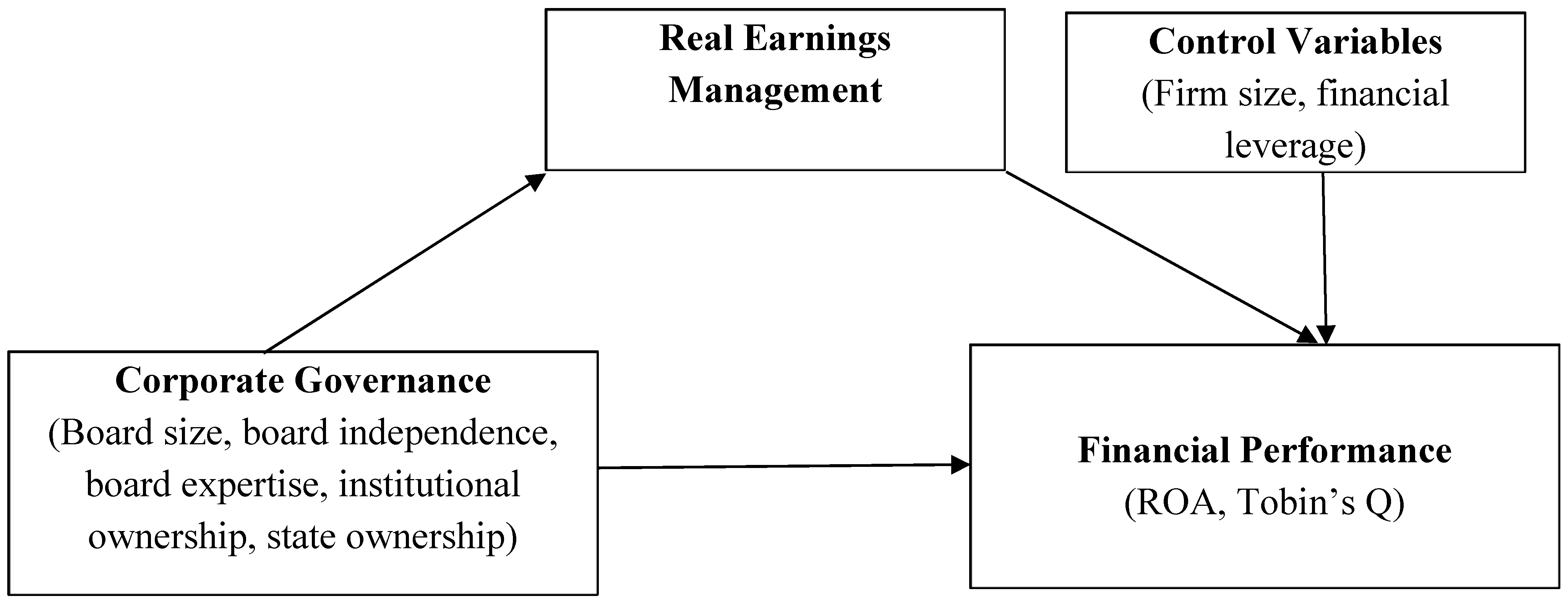

The Impact of Corporate Governance on Financial Performance: The Mediating Role of Real Earnings Management


Abstract
1. Introduction
2. Theoretical Framework and Research Hypotheses
2.1. Theoretical Framework
2.2. Research Hypotheses
2.2.1. Board Characteristics and Financial Performance
2.2.2. Ownership Structure and Financial Performance
2.2.3. The Mediating Role of Real Earnings Management
3. Methodology
4. Results and Discussion
4.1. Results
4.2. Discussion
4.3. Robustness Tests
5. Conclusions
6. Limitations and Future Research Directions
Author Contributions
Funding
Institutional Review Board Statement
Informed Consent Statement
Data Availability Statement
Conflicts of Interest
References
- Abedin, S. H., Haque, H., Shahjahan, T., & Kabir, M. N. (2022). Institutional ownership and firm performance: Evidence from an emerging economy. Journal of Risk and Financial Management, 15(12), 567. [Google Scholar] [CrossRef]
- Aidoo, S., Nombare, E., & Boamah, J. Y. (2024). Board size, board independence, board expertise and the financial performance of listed manufacturing firms in Ghana: Does board commitment play a role? Journal of Economics, Finance and Accounting Studies, 6(2), 49–69. [Google Scholar] [CrossRef]
- Al-Duais, S. D., Malek, M., Hamid, M. A. A., & Almasawa, A. M. (2022). Ownership structure and real earnings management: Evidence from an emerging market. Journal of Accounting in Emerging Economies, 12(2), 380–404. [Google Scholar] [CrossRef]
- Al-Haddad, L., & Whittington, M. (2019). The impact of corporate governance mechanisms on real and accrual earnings management practices: Evidence from Jordan. Corporate Governance: The International Journal of Business in Society, 19(6), 1167–1186. [Google Scholar] [CrossRef]
- Ali, M. J., Biswas, P. K., Chapple, L., & Kumarasinghe, S. (2024). Institutional ownership and earnings quality: Evidence from China. Pacific-Basin Finance Journal, 84, 102275. [Google Scholar] [CrossRef]
- Al-Shattarat, B., Hussainey, K., & Al-Shattarat, W. (2022). The impact of abnormal real earnings management to meet earnings benchmarks on future operating performance. International Review of Financial Analysis, 81, 101264. [Google Scholar] [CrossRef]
- Anderson, R. C., Mansi, S. A., & Reeb, D. M. (2004). Board characteristics, accounting report integrity, and the cost of debt. Journal of Accounting and Economics, 37(3), 315–342. [Google Scholar] [CrossRef]
- Arora, A., & Bodhanwala, S. (2018). Relationship between corporate governance index and firm performance: Indian evidence. Global Business Review, 19(3), 675–689. [Google Scholar] [CrossRef]
- Asmaranti, Y., Lokman, N., & Rahman, R. A. (2024). Corporate governance and real earnings management: Evidence from Indonesian fraudulent and non-fraudulent listed companies. Asia-Pacific Management Accounting Journal, 19(1), 1–23. [Google Scholar] [CrossRef]
- Bhagat, S., & Black, B. (1999). The uncertain relationship between board composition and firm performance. The Business Lawyer, 54(3), 921–963. [Google Scholar]
- Blach, J., Bukalska, E., Kaźmierska-Jóźwiak, B., & Pesa, A. R. (2025). Sustainability performance, corporate governance, and financial performance: Evidence from Poland and Central European listed companies. Journal of Entrepreneurship, Management and Innovation, 21(1), 58–80. [Google Scholar] [CrossRef]
- Bojan, A. M., Lungu, C. I., & Caraiani, C. (2024). Does corporate governance moderate the relationship between earnings management and financial performance? European Conference on Management, Leadership and Governance, 20(1), 45–53. [Google Scholar] [CrossRef]
- Boubakri, N., Cosset, J. C., & Saffar, W. (2008). Political connections of newly privatized firms. Journal of Corporate Finance, 14(5), 654–673. [Google Scholar] [CrossRef]
- Cadbury, A. (1992). Report of the committee on the financial aspects of corporate governance. Gee Publishing. [Google Scholar]
- Chhibber, P., & Majumdar, S. K. (1998). State as investor and state as owner: Consequences for firm performance in India. Economic Development and Cultural Change, 46(3), 561–580. [Google Scholar] [CrossRef] [PubMed]
- Chouaibi, J., Harres, M., & Brahim, N. B. (2018). The effect of board director’s characteristics on real earnings management: Tunisian-listed firms. Journal of the Knowledge Economy, 9(3), 999–1013. [Google Scholar] [CrossRef]
- Cohen, D. A., & Zarowin, P. (2010). Accrual-based and real earnings management activities around seasoned equity offerings. Journal of Accounting and Economics, 50(1), 2–19. [Google Scholar] [CrossRef]
- Danso, F. K., Adusei, M., Sarpong-Danquah, B., & Prempeh, K. B. (2024). Board expertise diversity and firm performance in sub-Saharan Africa: Do firm age and size matter? Future Business Journal, 10(1), 98. [Google Scholar] [CrossRef]
- Detthamrong, U., Chancharat, N., & Vithessonthi, C. (2017). Corporate governance, capital structure and firm performance: Evidence from Thailand. Research in International Business and Finance, 42, 689–709. [Google Scholar] [CrossRef]
- DiMaggio, P. J., & Powell, W. W. (1983). The iron cage revisited: Institutional isomorphism and collective rationality in organizational fields. American Sociological Review, 48(2), 147–160. [Google Scholar] [CrossRef]
- Faccio, M. (2006). Politically connected firms. American Economic Review, 96(1), 369–386. [Google Scholar] [CrossRef]
- Finegold, D., Benson, G. S., & Hecht, D. (2007). Corporate boards and company performance: Review of research in light of recent reforms. Corporate Governance: An International Review, 15(5), 865–878. [Google Scholar] [CrossRef]
- Firth, M., Fung, P. M., & Rui, O. M. (2007). Ownership, two-tier board structure, and the informativeness of earnings: Evidence from China. Journal of Accounting and Public Policy, 26(4), 463–496. [Google Scholar] [CrossRef]
- Guner, A. B., Malmendier, U., & Tate, G. (2008). Financial expertise of directors. Journal of Financial Economics, 88(2), 323–354. [Google Scholar] [CrossRef]
- Gunny, K. A. (2010). The relation between earnings management using real activities manipulation and future performance: Evidence from meeting earnings benchmarks. Contemporary Accounting Research, 27(3), 855–888. [Google Scholar] [CrossRef]
- Habib, A. M. (2024). Does real earnings management affect a firm’s environmental, social, and governance (ESG), financial performance, and total value? A moderated mediation analysis. Environment, Development and Sustainability, 26(4), 28239–28268. [Google Scholar] [CrossRef]
- Hillman, A. J., & Dalziel, T. (2003). Boards of directors and firm performance: Integrating agency and resource dependence perspectives. Academy of Management Review, 28(3), 383–396. [Google Scholar] [CrossRef]
- Hong, N. T. H., Anh, N. T., Hoang, N. T. V., & Minh, D. N. (2023). Corporate governance, external financing, and earnings management: New evidence from an emerging market. Future Business Journal, 9(1), 27. [Google Scholar] [CrossRef]
- Hong, N. T. H., & Linh, T. K. (2023). Institutional investors, corporate governance and firm performance in an emerging market: Evidence from Vietnam. Cogent Economics & Finance, 11(1), 2159735. [Google Scholar] [CrossRef]
- Hsu, M. F., & Wen, S. Y. (2015). The influence of corporate governance in Chinese companies on discretionary accruals and real earnings management. Asian Economic and Financial Review, 5(3), 391–406. [Google Scholar] [CrossRef]
- Jensen, M. C. (1993). The modern industrial revolution, exit and the failure of internal control systems. The Journal of Finance, 48(3), 831–880. [Google Scholar] [CrossRef]
- Jensen, M. C., & Meckling, W. H. (1976). Theory of the firm: Managerial behaviour, agency costs and ownership structure. Journal of Financial Economics, 3(4), 305–360. [Google Scholar] [CrossRef]
- Johl, S. K., Kaur, S., & Cooper, B. J. (2015). Board characteristics and firm performance: Evidence from Malaysian public listed firms. Journal of Economics, Business and Management, 3(2), 239–243. [Google Scholar] [CrossRef]
- Kang, S. A., & Kim, Y. S. (2011). Does earnings management amplify the association between corporate governance and firm performance? Evidence from Korea. International Business & Economics Research Journal, 10(2), 53–66. [Google Scholar] [CrossRef]
- Khan, M. J., Saleem, F., Din, S. U., & Khan, M. Y. (2024). Nexus between boardroom independence and firm financial performance: Evidence from South Asian emerging market. Humanities and Social Sciences Communications, 11, 590. [Google Scholar] [CrossRef]
- Kirimi, P. N., Kariuki, S. N., & Ocharo, K. N. (2022). Ownership structure and financial performance: Evidence from Kenyan commercial banks. PLoS ONE, 17(5), e0268301. [Google Scholar] [CrossRef] [PubMed]
- Kor, Y. Y., & Sundaramurthy, C. (2008). Experience-based human capital and social capital of outside directors. Journal of Management, 35(4), 981–1006. [Google Scholar] [CrossRef]
- Kubo, K., & Phan, H. V. (2019). State ownership, sovereign wealth fund and their effects on firm performance: Empirical evidence from Vietnam. Pacific-Basin Finance Journal, 58, 101220. [Google Scholar] [CrossRef]
- Kyere, M., & Ausloos, M. (2020). Corporate governance and firms financial performance in the United Kingdom. International Journal of Finance & Economics, 26(2), 1871–1885. [Google Scholar] [CrossRef]
- Lee, C. Y., Wen, C. R., & Thi-Thanh-Nguyen, B. (2024). Board expertise background and firm performance. International Journal of Financial Studies, 12(1), 17. [Google Scholar] [CrossRef]
- Lim, J. H., & Mali, D. (2023). An analysis of the positive effect of real earnings management on financial performance. Asian Review of Accounting, 31(2), 284–316. [Google Scholar] [CrossRef]
- Lipton, M., & Lorsch, J. W. (1992). A modest proposal for improved corporate governance. The Business Lawyer, 48(1), 59–77. [Google Scholar]
- Manan, F., & Amin, K. (2023). The effect of corporate governance on firm financial performance with mediating role of earnings management: Evidence from Pakistan Stock Exchange. Pakistan Journal of Humanities and Social Sciences, 11(1), 532–547. [Google Scholar] [CrossRef]
- Mansoori, E., & Al-Abdallah, G. (2024). Revisiting corporate governance mechanisms and real earnings management activities in emerging economies. Accounting Research Journal, 37(3), 288–307. [Google Scholar] [CrossRef]
- Medina, A., De La Cruz, A., & Tang, Y. (2022). Corporate ownership and concentration (OECD Corporate Governance Working Papers No. 27). OECD Publishing. [Google Scholar] [CrossRef]
- Mensah, L., & Bein, M. A. (2023). Sound corporate governance and financial performance: Is there a link? Evidence from manufacturing companies in South Africa, Nigeria, and Ghana. Sustainability, 15(12), 9263. [Google Scholar] [CrossRef]
- Mohsin, H. J., Ahmed, S. A., & Streimikiene, D. (2020). Evaluating the financial performance by considering the effect of external factors on organization cash flow. Contemporary Economics, 14(3), 406–414. [Google Scholar] [CrossRef]
- Mwangi, M., & Murigu, J. W. (2015). The determinants of financial performance in general insurance companies in Kenya. European Scientific Journal, 11(1), 1857–1881. [Google Scholar]
- Nguyen, B., Do, H., & Le, C. (2022). How much state ownership do hybrid firms need for better performance? Small Business Economics, 59(3), 845–871. [Google Scholar] [CrossRef]
- Nguyen, Q., Kim, M. H., & Ali, S. (2024). Corporate governance and earnings management: Evidence from Vietnamese listed firms. International Review of Economics and Finance, 89, 775–801. [Google Scholar] [CrossRef]
- North, D. C. (1990). Institutions, institutional change and economic performance. Cambridge University Press. [Google Scholar]
- Pearce, J. A., & Zahra, S. A. (1992). Board composition from a strategic contingency perspective. Journal of Management Studies, 29(4), 411–438. [Google Scholar] [CrossRef]
- Pfeffer, J., & Salancik, G. R. (1978). The external control of organizations: A resource dependence perspective. Harper & Row. [Google Scholar] [CrossRef]
- Queiri, A., Madbouly, A., Reyad, S., & Dwaikat, N. (2021). Corporate governance, ownership structure and firms’ financial performance: Insights from Muscat securities market (MSM30). Journal of Financial Reporting and Accounting, 19(4), 640–665. [Google Scholar] [CrossRef]
- Rizani, F., Syam, A. Y., & Lisandri, L. (2022). Mediating effect of earnings management on financial performance: The importance of good corporate governance. Australasian Accounting, Business and Finance Journal, 16(4), 14–28. [Google Scholar] [CrossRef]
- Rostami, S., Rostami, Z., & Kohansal, S. (2016). The effect of corporate governance components on return on assets and stock return of companies listed in Tehran Stock Exchange. Procedia Economics and Finance, 36, 137–146. [Google Scholar] [CrossRef]
- Roychowdhury, S. (2006). Earnings management through real activities manipulation. Journal of Accounting and Economics, 42(3), 335–370. [Google Scholar] [CrossRef]
- Saidat, Z., Silva, M., & Seaman, C. (2019). The relationship between corporate governance and financial performance: Evidence from Jordanian family and non-family firms. Journal of Family Business Management, 9(1), 54–78. [Google Scholar] [CrossRef]
- Semsomboon, M., Dampitakse, K., & Boonyanet, W. (2024). The relationship between managerial ownership and firm performance mediated by real earnings management of Thai IPO firms. WSEAS Transactions on Computer Research, 12, 29–43. [Google Scholar] [CrossRef]
- Shivani, M. V., Jain, P. K., & Yadav, S. S. (2017). Governance structure and accounting returns: Study of NIFTY500 corporates. Business Analyst, 37(2), 179–194. [Google Scholar]
- Shleifer, A., & Vishny, R. W. (1997). A survey of corporate governance. The Journal of Finance, 52(2), 737–783. [Google Scholar] [CrossRef]
- Tawfik, O. I., Alsmady, A. A., Rahman, R. A., & Alsayegh, M. F. (2022). Corporate governance mechanisms, royal family ownership and corporate performance: Evidence in Gulf Cooperation Council (GCC) market. Heliyon, 8(12), e12389. [Google Scholar] [CrossRef] [PubMed]
- Tuan, D. A., & Dung, N. N. K. (2024). The impact of COVID-19 on earnings management: Empirical evidence from Vietnam. Sage Open, 14(3), 1–16. [Google Scholar] [CrossRef]
- Velentzas, J., Broni, G., & Skalidis, L. (2017). Corporate governance: Legal, managerial, and auditing dimensions. In Advances in applied economic research: Proceedings of the 2016 international conference on applied economics (ICOAE) (pp. 783–798). Springer. [Google Scholar] [CrossRef]
- Yermack, D. (1996). Higher market valuation of companies with a small board of directors. Journal of Financial Economics, 40(2), 185–211. [Google Scholar] [CrossRef]


| Industry | Number of Firms | Firm-Year Observations | Percentage (%) |
|---|---|---|---|
| Real estate | 47 | 235 | 10.83 |
| Healthcare | 22 | 110 | 5.07 |
| Information technology | 5 | 25 | 1.15 |
| Industrials | 79 | 395 | 18.20 |
| Utilities | 25 | 125 | 5.76 |
| Telecommunications services | 22 | 110 | 5.07 |
| Energy | 23 | 115 | 5.30 |
| Materials | 109 | 545 | 25.12 |
| Consumer discretionary | 53 | 265 | 12.21 |
| Consumer staples | 49 | 245 | 11.29 |
| Total | 434 | 2170 | 100.00 |
| Measurement of REM Following Roychowdhury (2006) | |
|---|---|
| The level of abnormal cash flow from operating activities (REM_CFO) is estimated using the residual from the following model: |
|
| The level of abnormal discretionary expenses (REM_DISC) is estimated as the residual from the following model: | |
| The level of abnormal production costs (REM_PROD) is estimated as the residual from the following model: | |
| The aggregate REM index is calculated as follows: REM = (−1) × REM_CFO + REM_PROD + (−1) × REM_DISC | |
| Variable | Obs | Mean | SD | Min | Max |
|---|---|---|---|---|---|
| ROA | 2170 | 0.056 | 0.071 | −0.302 | 0.603 |
| TQ | 2170 | 1.195 | 0.731 | 0.180 | 17.173 |
| BS | 2170 | 5.498 | 1.353 | 2.000 | 11.000 |
| BI | 2170 | 0.731 | 0.163 | 0.200 | 1.000 |
| BE | 2170 | 0.026 | 0.071 | 0.000 | 0.667 |
| IN | 2170 | 0.559 | 0.232 | 0.000 | 0.999 |
| ST | 2170 | 0.196 | 0.277 | 0.000 | 0.993 |
| REM | 2170 | −0.206 | 0.363 | −2.052 | 3.450 |
| FS | 2170 | 27.965 | 1.736 | 23.603 | 34.360 |
| LE | 2170 | 0.461 | 0.211 | 0.013 | 1.295 |
| ROA | TQ | BS | BI | BE | IN | ST | REM | FS | LE | |
|---|---|---|---|---|---|---|---|---|---|---|
| ROA | 1.000 | |||||||||
| TQ | 0.404 *** | 1.000 | ||||||||
| BS | 0.084 *** | 0.187 *** | 1.000 | |||||||
| BI | −0.066 *** | 0.020 | 0.086 *** | 1.000 | ||||||
| BE | −0.034 | −0.015 | 0.004 | −0.017 | 1.000 | |||||
| IN | 0.126 *** | 0.115 | −0.033 | 0.041 * | 0.048 ** | 1.000 | ||||
| ST | 0.078 *** | 0.083 *** | −0.018 | −0.101 *** | 0.057 *** | 0.461 *** | 1.000 | |||
| REM | −0.454 *** | −0.300 *** | −0.130 *** | 0.037 * | 0.057 *** | −0.168 *** | −0.159 *** | 1.000 | ||
| FS | −0.087 *** | 0.100 *** | 0.354 *** | 0.056 *** | −0.033 | −0.118 *** | −0.030 | 0.107 *** | 1.000 | |
| LE | −0.392 *** | −0.092 *** | 0.046 ** | −0.024 | −0.026 | −0.080 *** | −0.015 | 0.198 *** | 0.364 *** | 1.000 |
| Variables | Model 1 (ROA) | Model 2 (REM) | Model 3 (ROA) | |||
|---|---|---|---|---|---|---|
| VIF | 1/VIF | VIF | 1/VIF | VIF | 1/VIF | |
| REM | 1.12 | 0.893 | ||||
| BS | 1.16 | 0.862 | 1.16 | 0.862 | 1.20 | 0.836 |
| BI | 1.03 | 0.970 | 1.03 | 0.970 | 1.03 | 0.967 |
| BE | 1.01 | 0.995 | 1.01 | 0.995 | 1.01 | 0.988 |
| IN | 1.30 | 0.767 | 1.30 | 0.767 | 1.32 | 0.760 |
| ST | 1.30 | 0.771 | 1.30 | 0.771 | 1.31 | 0.763 |
| FS | 1.34 | 0.744 | 1.34 | 0.744 | 1.35 | 0.739 |
| LE | 1.17 | 0.857 | 1.17 | 0.857 | 1.20 | 0.835 |
| Mean VIF | 1.19 | 1.19 | 1.19 | |||
| Variables | Model 1 (ROA) | Model 2 (REM) | Model 3 (ROA) | |||
|---|---|---|---|---|---|---|
| Coef. | p (Sig) | Coef. | p (Sig) | Coef. | p (Sig) | |
| REM | −0.0440 | 0.000 | ||||
| BS | 0.0031 | 0.000 | −0.0284 | 0.000 | 0.0027 | 0.000 |
| BI | −0.0162 | 0.000 | 0.1311 | 0.000 | −0.0137 | 0.000 |
| BE | 0.0004 | 0.961 | 0.1448 | 0.011 | 0.0009 | 0.917 |
| IN | 0.0193 | 0.000 | −0.1305 | 0.000 | 0.0174 | 0.000 |
| ST | 0.0064 | 0.014 | −0.0627 | 0.000 | 0.0017 | 0.477 |
| FS | 0.0017 | 0.001 | 0.0175 | 0.000 | 0.0026 | 0.000 |
| LE | −0.1057 | 0.000 | 0.2620 | 0.000 | −0.0998 | 0.000 |
| _cons | 0.0343 | 0.009 | −0.6620 | 0.000 | −0.0004 | 0.965 |
| Observations | 2170 | 2170 | 2170 | |||
| Prob > chi2 | 0.0000 | 0.0000 | 0.0000 | |||
| Variables | Model 1 (TQ) | Model 2 (REM) | Model 3 (TQ) | |||
|---|---|---|---|---|---|---|
| Coef. | p (Sig) | Coef. | p (Sig) | Coef. | p (Sig) | |
| REM | −0.1536 | 0.000 | ||||
| BS | 0.0473 | 0.000 | −0.0284 | 0.000 | 0.0477 | 0.000 |
| BI | −0.0425 | 0.184 | 0.1311 | 0.000 | −0.0920 | 0.003 |
| BE | −0.0393 | 0.587 | 0.1448 | 0.011 | 0.0588 | 0.470 |
| IN | 0.1557 | 0.000 | −0.1305 | 0.000 | 0.1305 | 0.000 |
| ST | 0.0513 | 0.046 | −0.0627 | 0.000 | 0.0396 | 0.111 |
| FS | 0.0182 | 0.001 | 0.0175 | 0.000 | 0.0300 | 0.000 |
| LE | −0.1472 | 0.000 | 0.2620 | 0.000 | −0.1431 | 0.000 |
| _cons | 0.3356 | 0.020 | −0.6620 | 0.000 | 0.0277 | 0.834 |
| Observations | 2170 | 2170 | 2170 | |||
| Prob > chi2 | 0.0000 | 0.0000 | 0.0000 | |||
| Variables | Model 1 (ROA) | Model 2 (REM) | Model 3 (ROA) |
|---|---|---|---|
| L.ROA | 0.300 *** | 0.275 *** | |
| (0.085) | (0.070) | ||
| L.REM | 0.074 | ||
| (0.059) | |||
| REM | −0.057 *** | ||
| (0.009) | |||
| BS | 0.003 * | −0.044 *** | 0.000 |
| (0.001) | (0.009) | (0.001) | |
| BI | −0.029 *** | 0.101 * | −0.023 ** |
| (0.011) | (0.055) | (0.010) | |
| BE | −0.042 * | 0.284 * | −0.028 |
| (0.023) | (0.166) | (0.021) | |
| IN | 0.021 ** | −0.095 * | 0.013 * |
| (0.009) | (0.049) | (0.008) | |
| ST | 0.010 | −0.157 *** | 0.002 |
| (0.008) | (0.047) | (0.007) | |
| FS | 0.002 * | 0.016 * | 0.003 *** |
| (0.001) | (0.009) | (0.001) | |
| LE | −0.096 *** | 0.229 *** | −0.085 *** |
| (0.014) | (0.056) | (0.012) | |
| Year fixed effects | Yes | Yes | Yes |
| Industry fixed effects | Yes | Yes | Yes |
| Observations | 1736 | 1736 | 1736 |
| Firms | 434 | 434 | 434 |
| Instruments | 24 | 24 | 25 |
| AR(1) p-value | 0.000 | 0.000 | 0.000 |
| AR(2) p-value | 0.397 | 0.628 | 0.306 |
| Hansen p-value | 0.322 | 0.171 | 0.514 |
| Diff-in-Hansen p-value | 0.244 | 0.093 | 0.315 |
Disclaimer/Publisher’s Note: The statements, opinions and data contained in all publications are solely those of the individual author(s) and contributor(s) and not of MDPI and/or the editor(s). MDPI and/or the editor(s) disclaim responsibility for any injury to people or property resulting from any ideas, methods, instructions or products referred to in the content. |
© 2026 by the authors. Licensee MDPI, Basel, Switzerland. This article is an open access article distributed under the terms and conditions of the Creative Commons Attribution (CC BY) license.
Share and Cite
Hoai, T.T.T.; Thu, H.N.T.; Anh, T.D. The Impact of Corporate Governance on Financial Performance: The Mediating Role of Real Earnings Management. J. Risk Financial Manag. 2026, 19, 451. https://doi.org/10.3390/jrfm19060451
Hoai TTT, Thu HNT, Anh TD. The Impact of Corporate Governance on Financial Performance: The Mediating Role of Real Earnings Management. Journal of Risk and Financial Management. 2026; 19(6):451. https://doi.org/10.3390/jrfm19060451
Chicago/Turabian StyleHoai, Thuong Thai Thi, Hien Nguyen Thi Thu, and Tuan Dang Anh. 2026. "The Impact of Corporate Governance on Financial Performance: The Mediating Role of Real Earnings Management" Journal of Risk and Financial Management 19, no. 6: 451. https://doi.org/10.3390/jrfm19060451
APA StyleHoai, T. T. T., Thu, H. N. T., & Anh, T. D. (2026). The Impact of Corporate Governance on Financial Performance: The Mediating Role of Real Earnings Management. Journal of Risk and Financial Management, 19(6), 451. https://doi.org/10.3390/jrfm19060451