1. Introduction
Investor decision-making is a central concern in financial markets, as it directly influences capital allocation, market efficiency, and overall economic growth. Investors must evaluate not only financial performance but also companies’ sustainability practices, relying on accurate, credible reporting to guide their choices. Sustainability reporting can help organizations measure, understand, and communicate their economic, environmental, social, and governance performance and then set goals and manage change more effectively.
Sustainability reporting enables organizations to assess, interpret, and disclose their economic, environmental, social, and governance performance, which, in turn, supports goal setting and more effective management of change (
Mortimore, 2020).
Bhasin and Shaikh (
2013) argue that voluntary disclosure can serve as a highly effective means of communication. Sustainability reports are increasingly used to communicate a company’s non-financial performance, but their reliability can vary. Assurance engagements are one way to enhance the credibility of sustainability information.
O’Dwyer (
2011) describes independent assurance of sustainability reports as a practice intended to build confidence in their reliability and completeness. According to
Arens et al. (
2007), assurance services are independent professional services that improve the quality of information for decision-makers. Accounting theory defines assurance as “an engagement in which a practitioner expresses a conclusion designed to enhance the degree of confidence of the intended users other than the responsible party about the outcome of the evaluation or measurement of a subject matter against criteria” (
International Auditing and Assurance Standards Board, 2012).
According to the
International Auditing and Assurance Standards Board (
2013), these engagements can provide either reasonable assurance or limited assurance, each offering a different level of confidence. The level of assurance, along with the type of assurer, can influence how investors perceive risk and, consequently, their investment decisions. Despite the importance of these factors, limited experimental research has systematically examined how variations in assurance level and assurer type influence investor behavior. This study aims to fill this gap by investigating the effects of these variables on investor reactions through a controlled experimental approach.
Despite growing reliance on sustainability disclosures in investment decision-making, three important gaps remain. First, prior studies have examined assurance level and assurer type largely in isolation, leaving the joint influence of these factors on investor reactions underexplored. Second, experimental evidence from emerging markets where assurance practices are still evolving, and non-professional investors rely more heavily on external credibility signals, remains scarce. Third, the relative dominance of assurance level over assurer type has not been directly tested through a controlled factorial design, leaving regulators and firms without clear empirical guidance. This study addresses these gaps by employing a 2 × 2 experimental design that simultaneously manipulates both dimensions in an emerging market context (Egypt), combining non-parametric analysis with exploratory machine learning (SHAP), which is considered a methodological innovation in this literature.
The main objective of this study is to experimentally determine the influence of assurance levels and types of assurers on investment reactions of non-professional investors in Egypt. By doing so, it contributes to a deeper understanding of the mechanisms through which assurance practices shape investor confidence and market outcomes. Accordingly, this study aims to answer the following research questions. RQ1: How do different levels of assurance (reasonable versus limited) on sustainability disclosures affect the investment reactions of non-professional investors in Egypt? RQ2: How does the type of assurer (audit firm versus non-audit firm) on sustainability disclosures influence the investment reactions of non-professional investors in Egypt? RQ3: Does the effect of assurance level on non-professional investors’ reactions differ depending on the type of assurer? RQ4: Which factor assurance level or assurer type plays a more influential role in shaping the investment reactions of non-professional investors in Egypt? To address these research questions, this study employs a controlled experimental design using data collected from non-professional investors in Egypt.
This study contributes to the literature as follows. First, it provides experimental evidence on how assurance characteristics influence non-professional investors’ reactions to sustainability disclosures in an emerging market context. By employing a controlled 2 × 2 experimental design, this study disentangles these effects. It demonstrates that the assurance level is the primary driver of investor responses, thereby addressing a key gap in the literature. Second, this study advances theory by drawing on and extending agency, legitimacy, and cognitive load frameworks in an integrated way. On the agency theory front (
Kamperman, 2016;
Leuz & Verrecchia, 2000), the findings confirm that reasonable assurance reduces perceived information asymmetry more effectively than limited assurance. The results also refine legitimacy theory in an important respect. Credibility is not simply a function of who provides the assurance; it is shaped more by the rigor of the engagement itself, meaning the identity of the assurer carries less weight than the strength of the assurance level. Finally, building on cognitive load theory (
Sweller, 2011), the study shows that investors tend to rely on assurance level as a practical heuristic when working through complex sustainability disclosures. Processing that kind of information is not straightforward, and the assurance level gives investors something concrete to anchor their judgments on.
Third, the study offers novel insights into the mechanisms underlying investor decision-making by combining traditional non-parametric analysis with exploratory machine learning techniques. The findings reveal that assurance primarily influences investment decisions indirectly through perceived sustainability performance and reliance on information, rather than through decision confidence alone, extending prior work on investor information processing (
Hirshleifer & Teoh, 2003;
Maines & McDaniel, 2000). Finally, beyond developed economies, this study extends the literature to an underexplored emerging market setting (i.e., Egypt), providing context-specific evidence highly relevant to regulators, firms, and assurance providers seeking to enhance the credibility and usefulness of sustainability disclosures.
The remainder of the paper is organized as follows.
Section 2 presents the theoretical framework, reviews the relevant literature, and develops the research hypotheses.
Section 3 describes the experimental design and methodological approach.
Section 4 reports the findings of the testing of the hypotheses.
Section 5 introduces additional analyses.
Section 6 discusses the results, and
Section 7 concludes.
2. Theoretical Background, Literature, and Hypotheses
Sustainability reporting has become an increasingly important component of corporate reporting systems because investors, regulators, and other stakeholders demand information regarding firms’ environmental, social, governance, and economic performance and their implications for long-term value creation. Beyond traditional financial reporting, sustainability disclosures provide information about risks, opportunities, and strategic initiatives that may affect future firm performance. More recently, integrated reporting has emerged as a reporting framework that combines financial and non-financial information to provide a holistic view of organizational value creation. The growing adoption of sustainability reporting and integrated reporting has increased the importance of ensuring the credibility and reliability of disclosed sustainability information (
Barth et al., 2017;
de Villiers et al., 2017;
Venter & Krasodomska, 2024).
Because sustainability information often contains qualitative assessments, estimates, forward-looking statements, and non-financial performance indicators, stakeholders may question its reliability and objectivity. Consequently, organizations increasingly seek independent assurance of sustainability disclosures to enhance stakeholder confidence and improve the credibility of reported information. Sustainability assurance is an independent professional engagement designed to increase users’ confidence in sustainability information by evaluating it against established reporting criteria. Assurance services enhance information quality and decision usefulness by reducing uncertainty and improving the reliability of disclosed information available to investors and other stakeholders (
Delgado Sánchez et al., 2026;
International Auditing and Assurance Standards Board, 2013;
O’Dwyer, 2011).
Recent regulatory and professional developments have reinforced the growing importance of sustainability assurance. The International Sustainability Standards Board (ISSB), the European Corporate Sustainability Reporting Directive (CSRD), and the International Standard on Sustainability Assurance (ISSA 5000) have increased attention to assurance quality, assurance levels, and assurance providers. These developments reflect a broader recognition that sustainability information can contribute effectively to investment decision-making only when stakeholders perceive it as credible, reliable, and independently verified (
Delgado Sánchez et al., 2026;
IAASB, 2024;
Venter & Krasodomska, 2024).
The relationship between sustainability assurance and investor reactions can be explained through several complementary theoretical perspectives. Agency theory provides the primary theoretical foundation for this study because it directly addresses information asymmetry between corporate managers and investors. According to agency theory, managers possess private information regarding organizational performance that is not directly observable by investors. This information asymmetry creates uncertainty regarding the reliability of corporate disclosures and increases agency costs. Independent assurance serves as a monitoring mechanism that reduces information asymmetry by providing external verification of sustainability information, thereby increasing investor confidence and improving the usefulness of disclosed information for decision-making purposes (
Jensen & Meckling, 1976;
Kamperman, 2016;
Leuz & Verrecchia, 2000).
Legitimacy theory provides a complementary explanation for organizations’ decisions to obtain sustainability assurance. According to legitimacy theory, organizations operate under a social contract and seek to align their activities with societal expectations and stakeholder norms. Sustainability disclosures and independent assurance represent mechanisms through which organizations demonstrate accountability, transparency, and responsible corporate behavior. By obtaining external assurance, organizations can strengthen the perceived legitimacy of sustainability disclosures and enhance stakeholder trust in reported sustainability performance (
Deegan et al., 2002;
Donaldson & Dunfee, 1995;
Radhouane et al., 2020;
Shalhoob & Hussainey, 2022).
Stakeholder theory further suggests that organizations must address the information needs of multiple stakeholder groups, including investors, regulators, customers, employees, and society at large. Sustainability assurance contributes to this objective by increasing the credibility of sustainability disclosures and enhancing stakeholders’ ability to evaluate corporate sustainability performance. From this perspective, assurance serves not only investors but also broader stakeholder groups that rely on sustainability information for decision-making and accountability purposes (
de Villiers et al., 2017;
Freeman, 1984;
Wang, 2017).
In addition to these organizational theories, investor reactions to sustainability assurance can be explained through information-processing and psychological theories. Information Processing Theory suggests that investors face cognitive limitations when evaluating complex financial and non-financial information. Sustainability reports frequently contain extensive qualitative and quantitative disclosures that may be difficult for non-professional investors to assess independently. External assurance provides a credibility signal that reduces information uncertainty and facilitates the processing and evaluation of sustainability information during investment decision-making (
Bhaskar et al., 2024;
Hirshleifer & Teoh, 2003;
Maines & McDaniel, 2000).
Similarly, Cognitive Load Theory proposes that individuals simplify complex decision environments by relying on salient cues and signals when cognitive resources are limited. Sustainability assurance is one such cue, as it provides investors with an observable signal of the reliability of sustainability disclosures. When investors lack the expertise necessary to evaluate technical sustainability information directly, assurance characteristics may significantly influence their perceptions and judgments (
Bhaskar et al., 2024;
Sweller, 2011;
Vera-Muñoz et al., 2020).
This argument is further supported by Dual-Process Theory, which suggests that decision-makers alternate between analytical and heuristic modes of information processing. Under conditions of information complexity and uncertainty, investors frequently rely on heuristic cues rather than conducting detailed analytical evaluations. Assurance characteristics such as assurance level and assurer identity may therefore function as heuristic signals that influence investor perceptions of disclosure credibility and investment attractiveness. This mechanism is particularly relevant for non-professional investors who may have limited expertise regarding sustainability reporting and assurance standards (
Bhaskar et al., 2024;
Chen et al., 2025;
Kahneman, 2011).
Collectively, agency theory predicts that stronger assurance should reduce information asymmetry and improve investor judgments; legitimacy theory explains how external assurance enhances the credibility and legitimacy of sustainability disclosures; stakeholder theory highlights the importance of reliable sustainability information for diverse stakeholder groups; and information-processing, cognitive load, and dual-process theories explain how investors utilize assurance-related cues when evaluating complex sustainability disclosures. Together, these theories provide a comprehensive framework for understanding how assurance level and assurer type influence investor reactions (
Kahneman, 2011;
Leuz & Verrecchia, 2000;
Sweller, 2011;
Venter & Krasodomska, 2024).
2.1. Assurance Level
Assurance level reflects the degree of confidence provided by the assurance engagement regarding the reliability and credibility of sustainability disclosures. Under ISAE 3000, assurance engagements may provide either limited assurance or reasonable assurance. Limited assurance involves less extensive evidence-gathering procedures and provides a negatively worded conclusion. In contrast, reasonable assurance requires substantially more extensive testing procedures and provides a positive conclusion regarding the reliability of the reported information. Consequently, reasonable assurance offers a higher degree of confidence than limited assurance and is generally perceived as a stronger verification mechanism (
Aly & Badawy, 2024;
International Auditing and Assurance Standards Board, 2013;
Vera-Muñoz et al., 2020).
From an agency theory perspective, reasonable assurance should reduce information asymmetry more effectively than limited assurance, because investors receive stronger independent verification regarding the quality and reliability of sustainability disclosures. As the level of assurance increases, investors should perceive lower reporting risk, higher information credibility, and greater confidence in management disclosures. Accordingly, higher assurance levels are expected to enhance the usefulness of sustainability information for investment decision-making (
Chen et al., 2025;
Kamperman, 2016;
Leuz & Verrecchia, 2000).
Information Processing Theory and Cognitive Load Theory provide additional support for this prediction. Because sustainability information is often complex and difficult to evaluate independently, investors rely on assurance-related cues when assessing disclosure credibility. Reasonable assurance communicates a stronger signal of reliability than limited assurance, as it reflects more extensive assurance procedures and a higher level of independent verification. Consequently, investors are expected to place greater reliance on sustainability information accompanied by reasonable assurance than on information accompanied by limited assurance (
Bhaskar et al., 2024;
Chen et al., 2025;
Sweller, 2011).
Empirical evidence generally supports these theoretical predictions.
Hodge et al. (
2009) found that assurance enhances confidence in sustainability disclosures and increases perceived information reliability.
Vera-Muñoz et al. (
2020) reported that reasonable assurance generates more favorable investor judgments than limited assurance.
Bhaskar et al. (
2024) demonstrated that non-professional investors distinguish between assurance levels and rely heavily on assurance signals when evaluating sustainability information. More recently,
Chen et al. (
2025) found that higher assurance levels strengthen investor confidence and improve investment judgments, particularly when sustainability information is perceived as relevant and credible. Furthermore, recent reviews of sustainability assurance research conclude that assurance level remains one of the most influential determinants of stakeholder confidence in sustainability disclosures (
Delgado Sánchez et al., 2026;
Venter & Krasodomska, 2024).
Although previous studies suggest that contextual factors may influence the magnitude of assurance-level effects, the combined predictions of agency theory, information-processing theory, cognitive load theory, and recent empirical evidence suggest that stronger assurance should generally enhance disclosure credibility and improve investor reactions. Therefore, the following hypothesis is proposed:
H1. Investor reaction will be more favorable for sustainability disclosures accompanied by reasonable assurance than for sustainability disclosures accompanied by limited assurance.
2.2. Assurer Type
In addition to the assurance level, investors may consider the identity of the assurance provider when evaluating sustainability disclosures. Sustainability assurance may be provided by traditional audit firms or by non-audit assurance providers such as sustainability consultants, engineering firms, and specialized verification organizations. These assurance providers differ in professional background, expertise, methodologies, reporting approaches, and perceived independence, potentially influencing investor perceptions of disclosure credibility (
Liao et al., 2018;
Perego, 2009;
Perego & Kolk, 2012).
Legitimacy theory suggests that audit firms may enjoy greater reputational capital and institutional legitimacy because of their established role in providing independent assurance services. Audit firms are often associated with professional standards, rigorous quality-control procedures, independence requirements, and strong reputational incentives to maintain reporting quality. Consequently, investors may perceive sustainability disclosures assured by audit firms as more credible and trustworthy than disclosures assured by non-audit providers (
Hodge et al., 2009;
Pflugrath et al., 2011;
Simnett et al., 2010).
However, stakeholder theory offers an alternative perspective. Non-audit assurance providers frequently possess specialized sustainability expertise, industry-specific knowledge, and technical competencies that may enhance the quality and relevance of sustainability assurance engagements. Such expertise may be particularly valuable when evaluating environmental and social performance indicators that extend beyond traditional accounting domains. Consequently, stakeholders may perceive non-audit assurance providers as equally capable, or even superior, in certain sustainability assurance contexts (
Lu et al., 2023;
O’Dwyer & Owen, 2005;
Perego & Kolk, 2012).
Information-processing and cognitive theories further suggest that assurer identity may be less influential than assurance level in shaping investor reactions. Because non-professional investors often rely on simplified decision cues, they may focus primarily on the strength of the assurance engagement rather than on the identity of the assurance provider. Under this perspective, assurance level serves as a more salient credibility signal than assurer type, potentially reducing the incremental effect of provider identity on investor judgments (
Bhaskar et al., 2024;
Kahneman, 2011;
Sweller, 2011).
Empirical evidence regarding assurer type remains mixed.
Hodge et al. (
2009) and
Pflugrath et al. (
2011) reported that audit firms may confer greater credibility because of their professional reputation and perceived independence. Conversely,
Birkey et al. (
2016) found limited evidence that assurer identity significantly affects stakeholder perceptions.
Lu et al. (
2023) highlighted potential benefits associated with combining financial statement audits and sustainability assurance through knowledge spillovers. More recently,
Bentley-Goode et al. (
2025) found that assurance-provider choice influences sustainability reporting quality and restatement outcomes; however, the effect of provider identity on investor-facing credibility perceptions appears less consistent than the effect of assurance level. Recent reviews of sustainability assurance research similarly conclude that evidence regarding assurer-type effects remains inconclusive and that assurance level often emerges as the more influential determinant of stakeholder confidence (
Delgado Sánchez et al., 2026;
Venter & Krasodomska, 2024).
Despite the mixed empirical evidence, legitimacy theory suggests that the reputational advantages and institutional credibility associated with audit firms may lead investors to react more favorably to sustainability disclosures assured by audit firms than to those assured by non-audit providers. Therefore, the following hypothesis is proposed:
H2. Investor reaction will be more favorable for sustainability disclosures assured by an audit firm than for sustainability disclosures assured by a non-audit firm.
3. Research Methodology
3.1. Research Design and Participants
This study employed a 2 (assurance level: limited vs. reasonable) × 2 (assurer type: audit firm vs. non-audit firm) mixed-design experiment. Assurer type was manipulated between subjects: participants who are MBA and DBA students serving as proxies for non-professional investors were randomly assigned to one of two cases—Case 1 (audit firm assurer) or Case 2 (non-audit firm assurer)—and evaluated only one assurer type throughout the experiment. Assurance level was manipulated within subjects, within their assigned case; all participants evaluated both limited and reasonable assurance conditions sequentially, allowing direct comparison of their reactions across assurance levels while holding assurer type constant. This structure yields a mixed design, with assurance level as the within-subject factor and assurer type as the between-subject factor, resulting in independent groups of 25 (Case 1) and 23 (Case 2) valid responses after exclusions. The dependent variable was the investors’ reaction. In both experiments, we manipulated the assurance level provided by the auditor’s report (Limited vs. Reasonable). We informed participants in both experiments that their task was to answer questions about an assurance report for a hypothetical company’s sustainability report.
MBA and DBA students are considered an appropriate proxy for non-professional investors in this study for several reasons. First, they possess sufficient financial literacy and familiarity with accounting and investment concepts to engage meaningfully with the experimental task while remaining distinct from professional analysts or institutional investors. Second, this proxy is consistent with the target population of this study: non-professional investors who lack the specialized expertise to evaluate non-financial disclosures independently and therefore rely more heavily on external credibility signals such as the assurance level. Third, the use of graduate business students as non-professional investor proxies is well-established and explicitly validated in experimental accounting research (
Bhaskar et al., 2024;
Ibrahim & Badawy, 2019;
Kachelmeier et al., 2020;
Shawat et al., 2021;
Vera-Muñoz et al., 2020).
3.2. Experiment Design
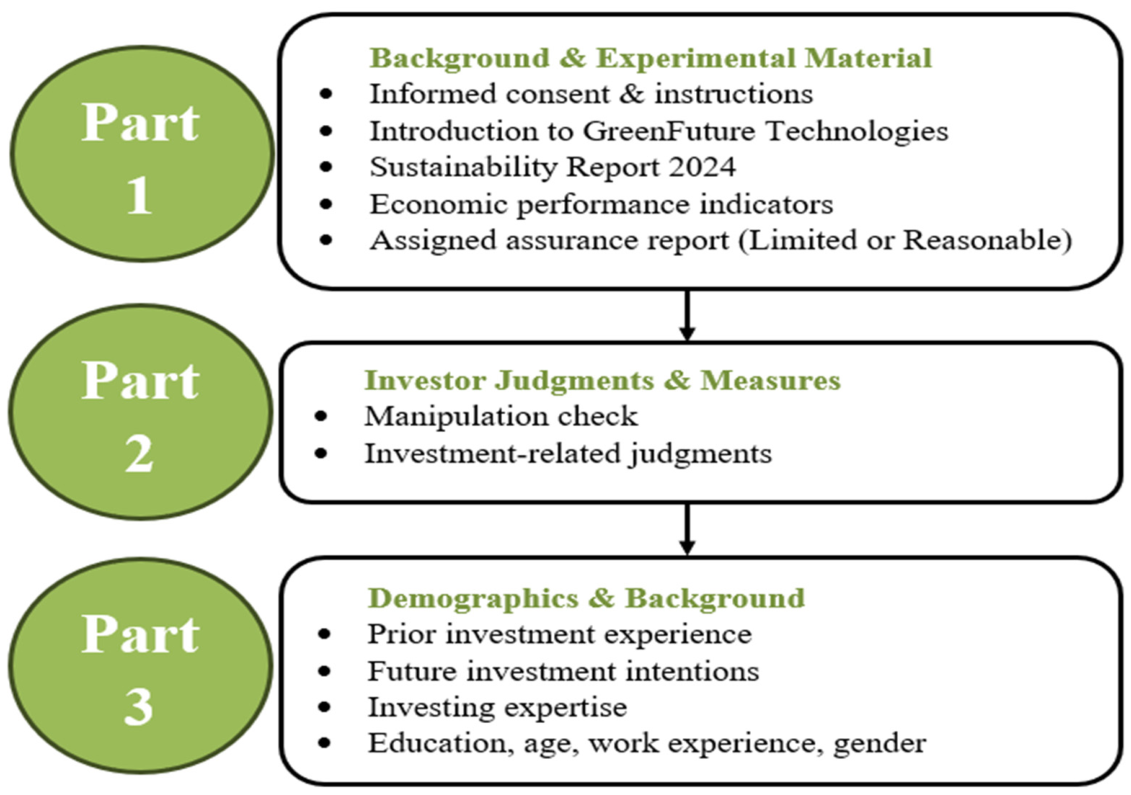
To minimize order effects, all participants within each case received the limited assurance condition before the reasonable assurance condition, consistent with a natural progression from lower to higher credibility signals. While this fixed ordering precludes counterbalancing, it reflects the realistic sequence in which investors are likely to encounter and update their judgments about sustainability disclosures. The experiment was divided into three main parts; the first part began with informed consent outlining the study’s purpose, voluntary participation, and confidentiality. Followed by a set of keywords explaining different assurance levels. Participants were introduced to GreenFuture Technologies Egypt (GFT Egypt), a mid-sized renewable energy firm, and provided with background on its business model, sustainability commitment, and alignment with SDG 8. They reviewed the company’s sustainability report, including economic disclosures such as workforce metrics, local procurement, and R&D investment, alongside 2023–2024 performance indicators. Finally, participants received an independent assurance report from either an audit firm or a non-audit firm, conveying either limited or reasonable assurance over the company’s sustainability information.
In the second part, participants were instructed to assume the role of an investor evaluating GreenFuture Technologies and to refrain from referring to the previous information once they began answering the questions. After that, they responded to a series of questions designed to capture their perceptions and investment judgments. First, manipulation check questions assessed whether participants correctly recognized the type of assurance (limited or reasonable). Next, participants completed a set of investment-related measures, including assessments of the company’s fulfillment of economic sustainability responsibilities, their willingness to rely on the sustainability information for investment decisions, likelihood of recommending the company, likelihood of investing personal funds, intended number of shares to purchase, expectations of stock price appreciation, perceived stock valuation, and reliance on both the sustainability report and the assurance report in making investment decisions.
The third and final part of the experiment collected demographic and background information to characterize the sample and assess its representativeness. Participants reported their prior investment experience, future investment intentions, self-assessed investing expertise, the number of accounting and finance courses they had completed, their age, work experience, and gender, as indicated in
Figure 1.
3.3. Dependent Variable Measures
Investor reaction is operationalized as a multidimensional construct captured through six judgment measures: perceived sustainability performance, reliance on sustainability information, investment intention, stock appreciation, perceived stock valuation, and decision confidence. These measures are treated as separate dependent variables in the non-parametric hypothesis tests, preserving the ordinal nature of each item. The CFA reported in
Section 4.3 confirms that all six items load onto a single underlying dimension, providing empirical support for treating them as indicators of a common latent construct. For robustness, both item-level and composite-level analyses are reported, and results are consistent across both approaches.
The primary dependent measures capture participants’ investment-related judgments and confidence in GreenFuture Technologies Egypt’s economic sustainability information, given the assurance report they reviewed. Specifically, participants were first asked, “Based on the information presented, please indicate how well you believe GreenFuture Technologies Egypt is fulfilling its economic sustainability responsibilities (SDG 8—Decent Work and Economic Growth)” using a continuous scale from 0% (not fulfilling) to 100% (fully fulfilling). To assess the perceived credibility and usefulness of the disclosures, participants then responded to the question, “Based on the disclosures provided by GreenFuture Technologies Egypt, to what extent are you willing to rely on this economic sustainability information to make an investment decision?” measured on a 0 (not at all) to 100 (fully) scale.
Participants’ investment intentions and behavioral responses were further captured through multiple items, including the likelihood of investing a portion of their available funds in the company’s stock (“If you have 200,000 EGP, how likely are you to invest a portion of your money in GreenFuture Technologies Egypt stock?”), measured on a five-point scale from extremely unlikely to extremely likely; perceived likelihood that the stock would appreciate over the next 12 months “Please assess the potential that the stock of GreenFuture Technologies Egypt will appreciate during the coming 12 months,” measured on a five-point scale from extremely unlikely to extremely likely; and a subjective stock valuation measured on a continuous 0 (Low)–10 (High) scale “Please indicate what you believe to be an appropriate common stock valuation for GreenFuture Technologies Egypt, ranging from low to high.”
Finally, to directly capture the role of sustainability disclosures and assurance in participants’ judgments, participants indicated their agreement with the statement, “I rely on the information presented in GreenFuture Technologies Egypt’s economic sustainability report to make my investment decision,” measured on 10-point Likert-type scales from 0 (strongly disagree) to 10 (strongly agree).
3.4. Data Collection Procedures
The two cases were randomly distributed among participants. The total sample included 87 responses, divided into 43 in case (1) and 44 in case (2), from MBA and DBA students at a large public Egyptian university. 39 responses were excluded from the data because they did not correctly identify the assurance level presented to them. While we cannot rule out systematic differences between excluded and retained participants, we acknowledge that excluded participants may differ systematically from retained ones, for example, in financial literacy, familiarity with assurance concepts, or task engagement, illustrating that the retained sample may reflect a more attentive or financially literate subset of non-professional investors. Additionally, the manipulation check serves as a necessary validity criterion, ensuring that only participants who understood the experimental conditions are included in hypothesis testing.
The final sample included 48 responses.
Table 1 summarizes the number of responses and exclusions in each case.
3.5. Data Analysis
The data analysis followed a structured, multi-stage approach prioritizing non-parametric techniques due to the ordinal nature of variables, non-normal distributions, and small cell sizes. After excluding 39 participants who failed the manipulation check, the final sample comprised 48 valid observations. Descriptive statistics, including means and medians, were computed, with emphasis placed on medians and dispersion measures for interpretation.
Measurement reliability and validity were established using Cronbach’s alpha for internal consistency and KMO/Bartlett’s tests for sampling adequacy. Confirmatory Factor Analysis (CFA) confirmed a unidimensional latent structure for investor reactions with excellent model fit. Hypothesis testing employed two non-parametric techniques suited to the ordinal, non-normally distributed data. Wilcoxon signed-rank tests assessed within-subject differences in investor reactions between limited and reasonable assurance conditions (H1), while Mann–Whitney U tests compared between-subject reactions across assurer type conditions (H2). Interactions (RQ3) were assessed via Aligned Rank Transform (ART) ANOVA, supplemented by rank-biserial correlations for effect sizes and within-subject difference scores to measure belief updating.
Robustness was verified through leave-one-out sensitivity analyses and alternative summary measures (e.g., winsorized values). Although limited variation precluded formal mediation/moderation modeling, subgroup analyses explored heterogeneity in investment experience.
In addition to the confirmatory statistical analyses used to test the study hypotheses, an exploratory machine-learning analysis was conducted to provide supplementary insights into the factors associated with investors’ decisions. Specifically, a gradient-boosted decision tree model was estimated because of its ability to capture potentially non-linear relationships and interactions among variables without imposing restrictive distributional assumptions.
To enhance the interpretability of the machine-learning model, SHapley Additive exPlanations (SHAP) values were calculated. SHAP is an explainable artificial intelligence (XAI) technique derived from cooperative game theory that quantifies the contribution of each predictor variable to a model’s output (
Lundberg & Lee, 2017). Specifically, SHAP values estimate the average marginal contribution of a variable across all possible combinations of predictors, thereby providing a transparent measure of variable importance.
In the present study, SHAP analysis was employed to identify the relative contribution of perceived sustainability performance, reliance on sustainability information, perceived stock valuation, investment intention, stock appreciation expectations, and decision confidence in predicting investors’ binary investment decisions. The objective of this analysis was exploratory rather than confirmatory. Given the relatively modest sample size, the machine-learning and SHAP analyses are intended to provide diagnostic insights into patterns within the observed data rather than evidence of causal relationships or predictive generalizability.
4. Results
4.1. Descriptive Statistics
Table 2 presents the descriptive statistics for participants’ responses across the four experimental conditions: Audit Firm × Limited Assurance, Audit Firm × Reasonable Assurance, Non-Audit Firm × Limited Assurance, and Non-Audit Firm × Reasonable Assurance.
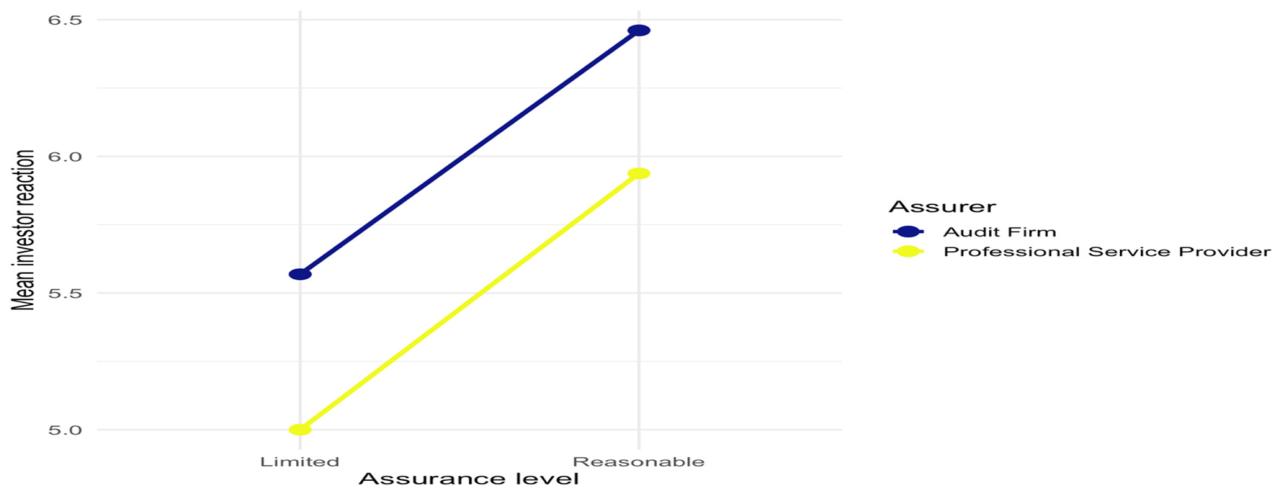
Across all six measures, a consistent pattern emerges: reasonable assurance conditions yield higher mean responses than limited assurance conditions, regardless of whether the assurer is an audit or non-audit firm. This suggests that participants systematically perceive reasonable assurance as more favorable or credible than limited assurance. For every question, the reasonable assurance case yields higher means than the limited assurance case. The difference is especially pronounced for Q1 (6.48 vs. 7.56), Q2 (6.04 vs. 7.56), Q5 (6.24 vs. 7.20), and Q6 (6.32 vs. 7.48). A similar pattern is observed for the non-audit firm assurer, with mean responses uniformly higher under reasonable assurance than under limited assurance across all six questions.
Differences between audit and non-audit firm assurers within the same assurance level are comparatively small, suggesting that assurance level exerts a stronger influence on participant reactions than assurer type. It could be concluded that reasonable assurance consistently enhances participant reactions across all measured dimensions. This effect is robust across both audit and non-audit firm assurers.
Figure 2 visually illustrates the dominant effect of assurance level on investor reactions. Investor responses increase substantially from limited to reasonable assurance for both audit and non-audit assurers, while differences between assurer types within each assurance level remain modest.
4.2. Reliability Test
Cronbach’s alpha reliability test was used to assess the internal consistency and reliability of the measurement scales across assurance levels and assurer types. As shown in
Table 3, all alpha coefficients exceed the commonly accepted threshold of 0.60, indicating high instrument reliability in each of the four cases (
Thanh Hai et al., 2020).
4.3. Confirmatory Factor Analysis (CFA)
Before conducting the main analyses, a dimensionality assessment was performed to evaluate the suitability and internal structure of the investor reaction measures. Following common practice, the Kaiser–Meyer–Olkin (KMO) measure of sampling adequacy and Bartlett’s test of sphericity were used to assess whether the data were suitable for factor extraction. The results indicate satisfactory sampling adequacy across the four experimental conditions, with KMO values ranging from 0.710 to 0.859 and statistically significant Bartlett’s test results in all cases (
p < 0.001), suggesting that the correlation matrices were appropriate for factor analysis presented in
Table 4.
The component matrix results further indicate that the six investor reaction measures load strongly on a single underlying dimension across all experimental conditions. These findings provide preliminary evidence that the measures capture a common construct related to investor reaction while maintaining sufficient consistency for subsequent analyses. Given the exploratory purpose of this assessment and the relatively modest sample size, the analysis is intended to evaluate dimensionality and measurement consistency rather than to estimate a full confirmatory measurement model.
4.4. Hypotheses Testing
4.4.1. Limited vs. Reasonable Assurance
To test the H1 which expects that investor reaction will be more favorable in case of a reasonable assurance level, the Wilcoxon Signed Ranks test results shown in
Table 5 reveal that investors’ reaction is significantly more favorable when sustainability reports are accompanied by reasonable assurance provided by the audit firm than when they are accompanied by limited assurance (Mean Rank = 14.97, Z = −3.091, Sig. = 0.002). This result confirms the researchers’ expectation that higher audit assurance enhances the credibility of corporate disclosures, thereby increasing investors’ confidence and positively influencing their reactions. In addition, the findings align with prior literature indicating that higher assurance levels improve the perceived reliability of reported information and lead to more favorable investor judgments. Specifically,
Hasan et al. (
2003) and
Vera-Muñoz et al. (
2020) show that reasonable assurance is associated with greater investor confidence in sustainability information than limited assurance. Similarly,
Hoang and Trotman (
2021) report that investors assign higher firm values when sustainability disclosures are supported by reasonable assurance rather than limited assurance, provided they are not prompted to evaluate financial and non-financial performance separately. Collectively, these studies support the notion that the credibility and objectivity conveyed by reasonable assurance positively influence investor perceptions and reactions.
Moreover, the results presented in
Table 6 indicate that investors’ reactions are significantly higher when a non-audit firm provides reasonable assurance than when it provides limited assurance (Mean Rank = 12.53, Z = −1.999, Sig. = 0.046). This result supports the researchers’ expectation that increasing the level of assurance, even when provided by a non-audit firm, enhances the perceived credibility of non-financial disclosures and strengthens investors’ confidence, which is reflected in more favorable investor reactions.
Overall, the findings demonstrate that investors react more favorably to higher levels of assurance regardless of the assurer type, supporting H1, which states that investor confidence will be higher for sustainability disclosures with reasonable versus limited assurance; however, the strength of this effect differs by assurer type. While reasonable assurance significantly improves investors’ reactions in both the audit firm and non-audit firm conditions, the effect is stronger and more statistically robust when the assurance is provided by an audit firm (Z = −3.091, p = 0.002) compared to a non-audit firm (Z = −1.999, p = 0.046). This suggests that although investors value greater assurance in general, they place greater confidence in reasonable assurance when issued by professional audit firms, reflecting the superior credibility of the auditing profession.
4.4.2. Audit Firm Assurer vs. Non-Audit Firm Assurer
To test the H2 which expects that investor reaction will be higher for sustainability disclosures in case the assurer is an audit firm versus a non-audit firm, the Mann–Whitney U test results reported in
Table 7 indicate that there is no statistically significant difference in investors’ reaction when an audit firm provides limited assurance compared to a non-audit firm (Mean Rank = 23.06 for audit firm vs. 26.07 for non-audit firm; Z = −0.748, Sig. = 0.455). This result suggests that under a limited assurance setting, the type of assurer does not materially influence investors’ reactions, as investors appear to perceive limited assurance from audit and non-audit firms as offering a similar level of credibility.
Additionally, in the case of a reasonable assurance level, the Mann–Whitney U test results presented in
Table 8 show that there is no statistically significant difference in investors’ reactions when an audit firm provides reasonable assurance compared to a non-audit firm (mean rank = 24.98 for audit firm vs. 23.98 for non-audit firm; Z = −0.249, Sig. = 0.804). This result confirms that when the level of assurance is high, investors respond similarly regardless of whether the assurance is provided by an audit firm or a non-audit firm, suggesting that the assurance level itself plays a more dominant role in shaping investor judgments than the identity of the assurer. This finding aligns with
Birkey et al. (
2016), who report that the choice between audit and consulting firms for ESG assurance does not significantly influence a firm’s environmental reputation, indicating that the professional identity of the assurer may be less important when credibility and reliability signals are already strong. Hence, H2 is not supported.
5. Additional Analyses
5.1. Dominance of Assurance Level over Assurer Type
To further confirm the finding that the level of assurance plays a more important role than the type of assurer, a non-parametric test for two independent samples was conducted to compare an audit firm’s limited assurance with a non-audit firm’s reasonable assurance.
The results confirm the main analysis, where the Mann–Whitney U test results presented in
Table 9 reveal a statistically significant difference in investors’ reactions between the two conditions (Mean Rank = 19.56 for audit firms with limited assurance vs. 29.87 for non-audit firms with reasonable assurance; Z = −2.558, Sig. = 0.011). This result indicates that investors react more favorably when sustainability disclosures are accompanied by reasonable assurance from a non-audit firm than when they are accompanied by limited assurance from an audit firm.
This finding highlights the dominant role of assurance level over assurer type, as investors appear to value the strength of the assurance engagement more than the identity of the assurance assurer. Even when a non-audit firm delivers the assurance, reasonable assurance generates significantly higher investor confidence than limited assurance issued by an audit firm.
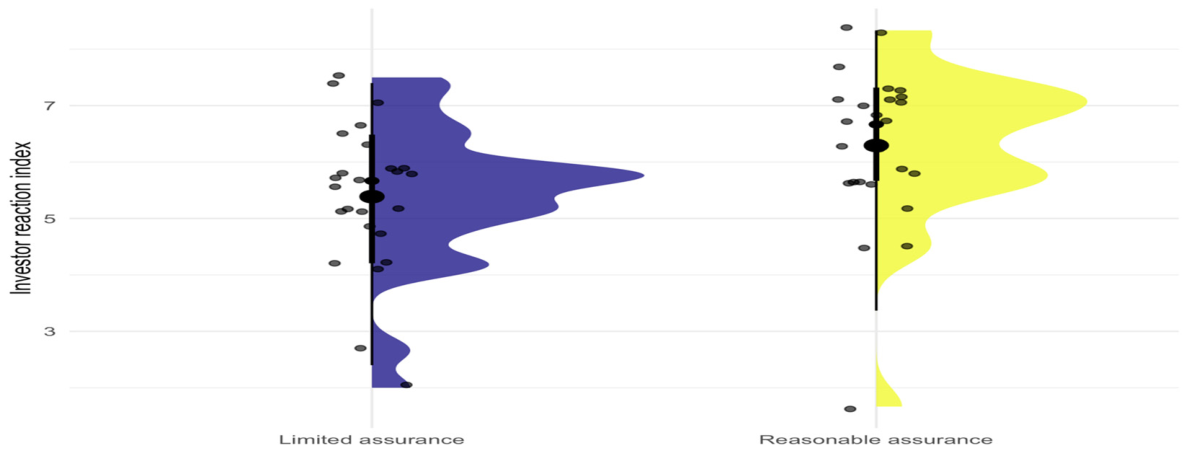
Consistent with the Wilcoxon signed-rank test results,
Figure 3 shows a clear rightward shift in the distribution of investor reactions under reasonable assurance relative to limited assurance.
5.2. Item-Level Analyses
To provide deeper insight into the findings, additional item-level analyses were conducted to examine how assurance characteristics influence specific dimensions of investor reaction. Specifically, Mann–Whitney U tests were used to compare investor responses between the audit firm–limited assurance condition and the non-audit firm–reasonable assurance condition for each of the six judgment measures. This comparison contrasts the weakest and strongest assurance conditions observed in the study and provides a more detailed assessment of the mechanisms underlying the overall results.
Table 10 reports the results of these analyses. Statistically significant differences were observed for perceived sustainability performance (Z = −2.703,
p = 0.007), reliance on sustainability information (Z = −2.512,
p = 0.012), and perceived stock valuation (Z = −2.379,
p = 0.017). In all three cases, mean ranks were higher for the non-audit firm–reasonable assurance condition, indicating more favorable investor evaluations when sustainability disclosures were accompanied by a higher level of assurance. These findings suggest that the assurance level has a particularly strong influence on credibility-related and valuation-related judgments.
By contrast, no statistically significant differences were found for investment intention (p = 0.485), expected stock appreciation (p = 0.511), or decision confidence (p = 0.116). These results indicate that although assurance level influences certain aspects of investor evaluation, its effects do not extend uniformly across all dimensions of investor reaction.
5.3. Effect Size and Interaction Analysis
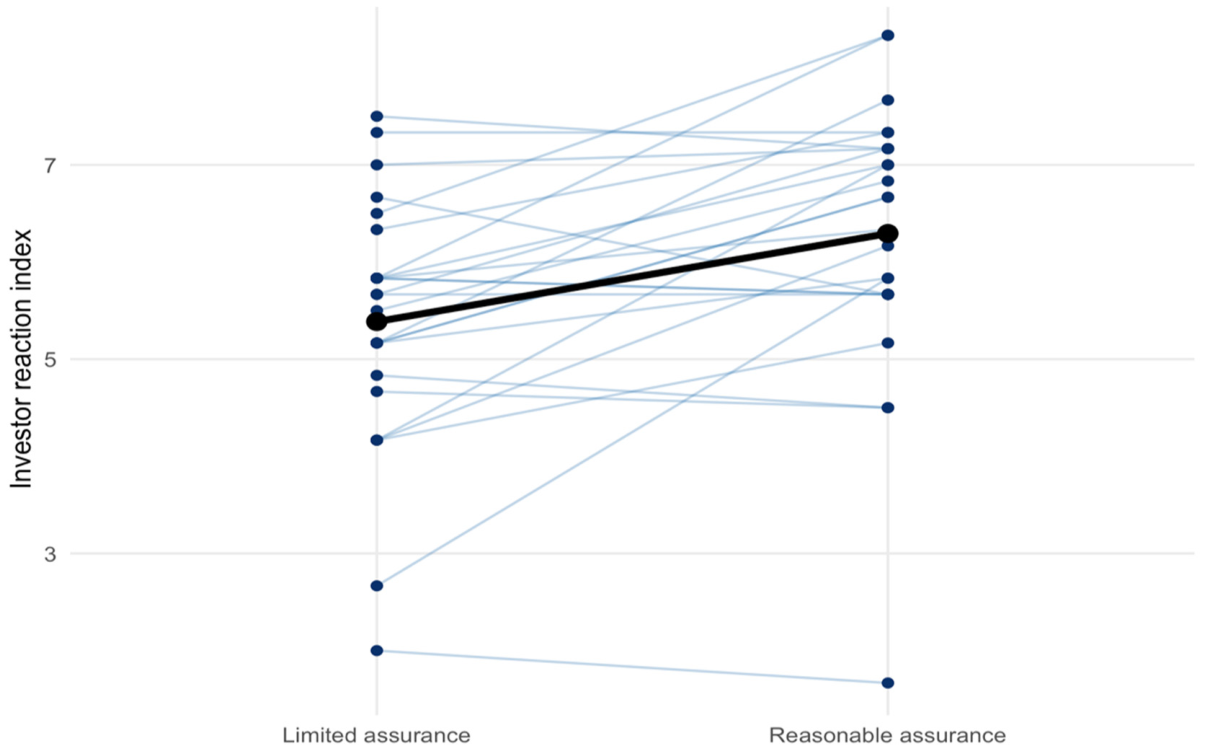
To quantify the magnitude of belief updating at the individual participant level, within-subject difference scores were computed by subtracting investor reactions under limited assurance from reactions under reasonable assurance. Descriptive statistics for these difference scores are reported in
Table 11. The mean change in investor reaction is positive, indicating that participants, on average, revised their judgments upward when moving from limited to reasonable assurance. Wilcoxon signed-rank test results reported in
Table 12 confirm that this increase is statistically significant (
p < 0.01). The associated rank-biserial correlation indicates a large effect size (r = 0.74), demonstrating that the assurance-level effect is not only statistically significant but also economically meaningful. This finding underscores the substantive importance of assurance strength in shaping investor reactions.
Figure 4 illustrates within-subject belief updating, showing that the majority of participants revise their investor reactions upward when moving from limited to reasonable assurance.
5.4. Interaction Analysis: Assurance Level × Assurer Type
To examine whether assurance level and assurer type interact in influencing investor reactions, an Aligned Rank Transform (ART) ANOVA was conducted. This approach allows for factorial analysis while retaining the robustness of non-parametric testing. Results are reported in
Table 13. The analysis reveals a statistically significant main effect of assurance level (
p < 0.05), indicating that investor reactions differ systematically between limited and reasonable assurance. In contrast, the main effect of assurer type is not statistically significant, nor is the interaction between assurance level and assurer type.
These findings indicate that the positive effect of reasonable assurance on investor reactions does not depend on whether the assurer is an audit firm or a non-audit firm, further reinforcing the conclusion that assurance level is the primary determinant of investor responses.
5.5. Exploratory Machine Learning Analysis
To complement the primary hypothesis-testing procedures, an exploratory machine-learning analysis was conducted using a gradient-boosted decision tree model. The objective of this analysis was not to develop a predictive model for generalization to a broader population, but rather to provide additional insights into the relative importance of different investor judgment variables within the observed sample. Given the relatively modest sample size, the machine-learning results should be interpreted as exploratory and diagnostic rather than confirmatory evidence.
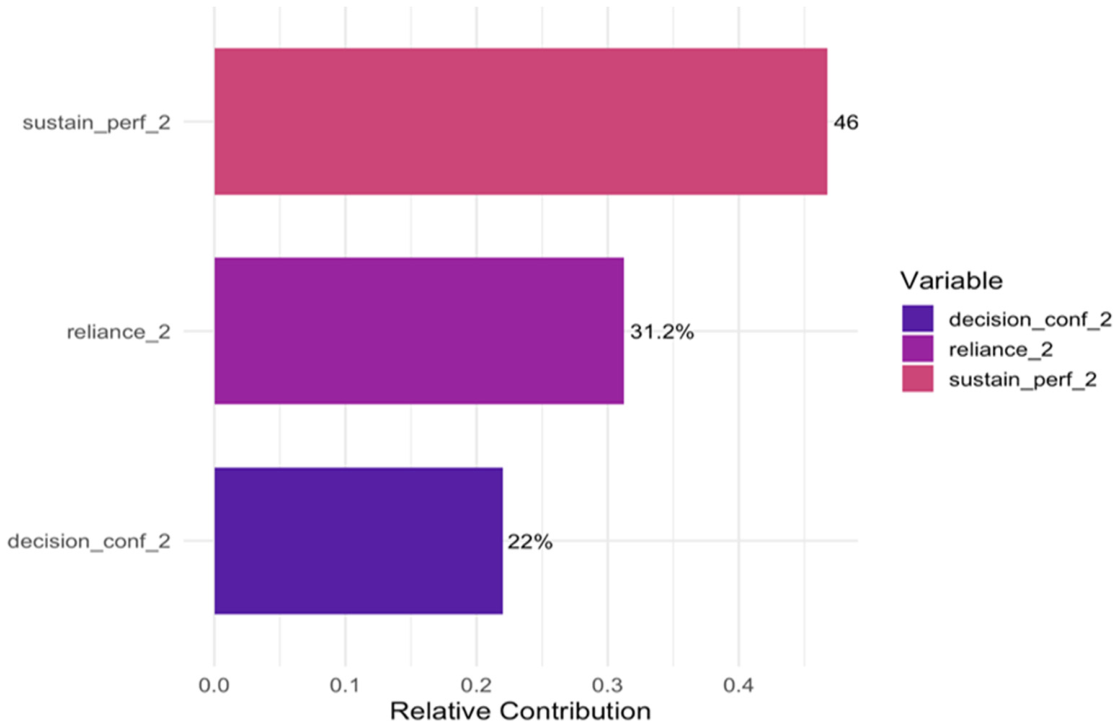
To enhance the interpretability of the model, SHapley Additive exPlanations (SHAP) values were calculated. SHAP is an explainable artificial intelligence (XAI) technique that quantifies the contribution of each predictor variable to the model’s output. Rather than focusing on prediction performance, SHAP analysis was used to examine which investor judgment variables contributed most strongly to the model’s classification outcomes presented in
Table 14.
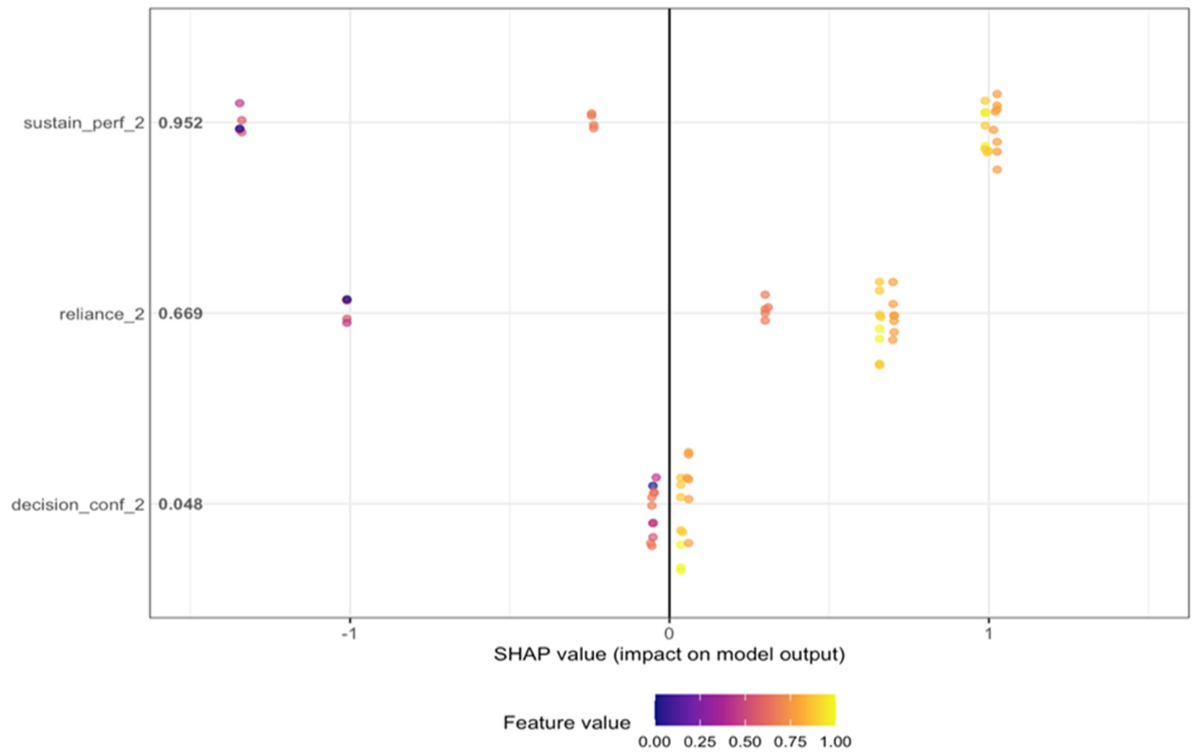
Figure 5 presents the SHAP summary plot. The results indicate that reliance on sustainability information, perceived sustainability performance, and perceived stock valuation exhibited the largest SHAP values, suggesting that these variables contributed most strongly to the model’s classifications within the observed sample. In contrast, investment intention, stock appreciation expectations, and decision confidence exhibited relatively smaller contributions.
These findings should be interpreted as supplementary evidence that helps identify potential patterns in the data and complements the primary statistical analyses. Importantly, the SHAP results do not establish causal relationships and are not intended to generalize predictions beyond the study sample. Rather, they offer an interpretable exploratory perspective on which investor judgment variables appear most influential within the context of the experimental setting.
These findings provide convergent, data-driven evidence that credibility-related perceptions are the primary mechanisms through which assurance level influences investor behavior. Consistent with their exploratory nature, these results are interpreted as supplementary to the main hypothesis tests and are not used to draw causal inferences.
Figure 6 provides a decomposition of model predictions using SHAP values, confirming that higher perceived sustainability performance and reliance systematically increase the likelihood of investment.
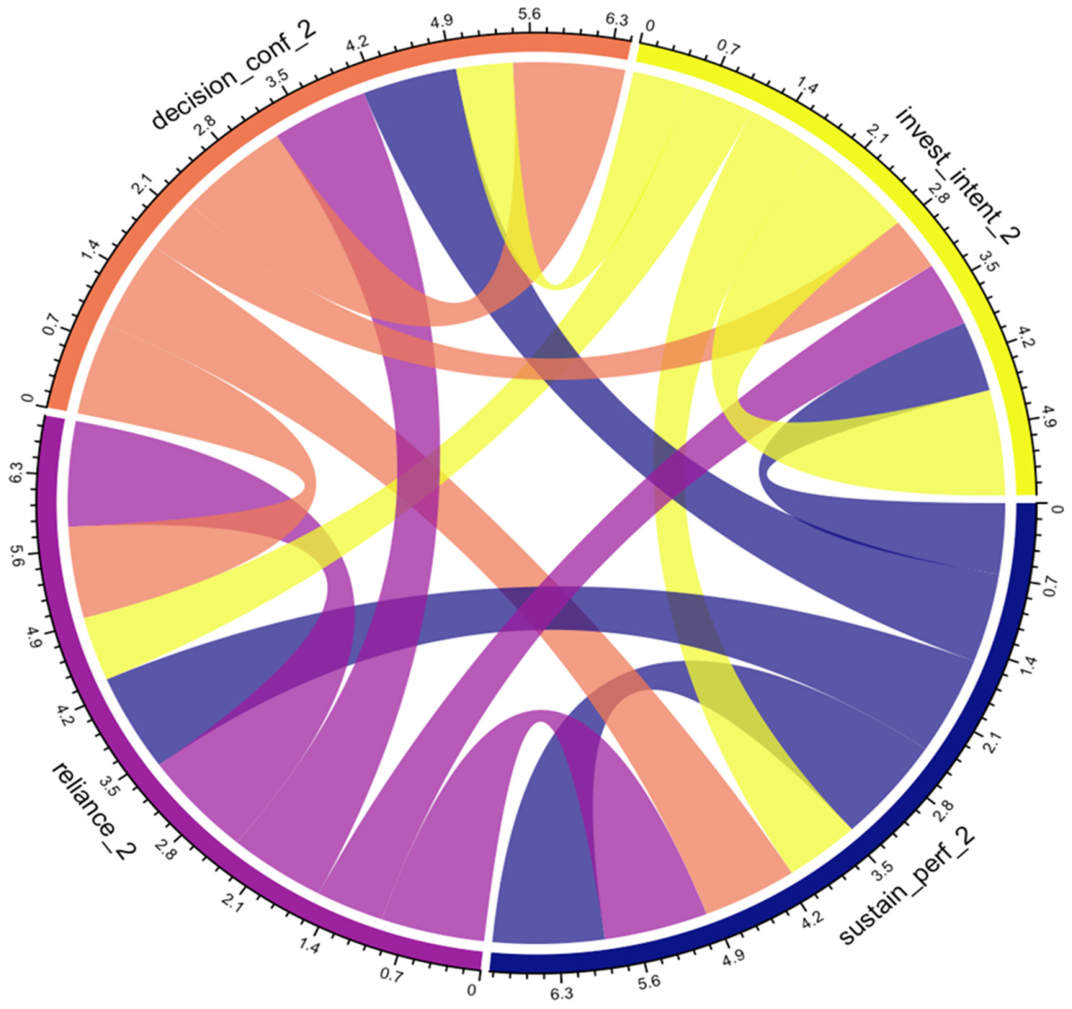
While the SHAP analysis identifies the relative importance of individual perceptual predictors, it does not capture the relational structure among these variables.
Figure 7, therefore, provides a complementary visualization of the interconnected relationships among perceived sustainability performance, reliance on sustainability information, decision confidence, and investment intention. The diagram illustrates that sustainability performance perceptions and reliance occupy central positions within the network, exhibiting stronger and more numerous connections to investment intention than decision confidence.
6. Discussion
This study examined how assurance level and assurer type jointly and independently shape non-professional investors’ reactions to sustainability disclosures in an emerging market context. Using a controlled experimental design, the findings provide clear and consistent evidence that the level of assurance plays a dominant role in influencing investor reactions, while the type of assurer exerts a weaker and context-dependent effect. This section discusses these findings, considering the existing literature and the theoretical perspectives outlined earlier, and explains how they advance current understanding of sustainability assurance.
The results broadly support H1, demonstrating that investor reactions are significantly more favorable under reasonable assurance than limited assurance across most measured dimensions. However, this effect is not uniform; item-level analyses in
Section 5.2 reveal that the dominance of assurance level is particularly pronounced for credibility and valuation-related judgments, perceived sustainability performance, reliance on sustainability information, and perceived stock valuation. At the same time, no statistically significant differences are observed for investment intention, expected stock appreciation, or decision confidence. A more precise characterization of the finding is therefore that reasonable assurance enhances credibility perceptions and valuation judgments more robustly than it influences behavioral intentions, a distinction with important implications for how assurance level effects are theorized and measured in future research.
These findings are broadly consistent with prior experimental evidence suggesting that higher assurance levels enhance the perceived credibility and reliability of non-financial disclosures (
Hasan et al., 2003;
Hoang & Trotman, 2021;
Vera-Muñoz et al., 2020). From an agency theory perspective, reasonable assurance appears to reduce perceived information asymmetry more effectively than limited assurance, thereby strengthening investors’ confidence in management disclosures (
Kamperman, 2016;
Leuz & Verrecchia, 2000). Investors seem to interpret reasonable assurance as a stronger monitoring and verification mechanism, which improves the perceived decision usefulness of sustainability information.
The results also align with cognitive load theory, which suggests that individuals rely on clear and salient cues when processing complex information (
Sweller, 2011). In this context, the label “reasonable assurance” serves as a strong heuristic signal, simplifying investors’ evaluation processes and allowing them to place greater weight on sustainability disclosures without engaging in extensive scrutiny of underlying measurement uncertainty. This mechanism may be particularly salient for non-professional investors, who often lack the expertise or resources to assess the quality of non-financial information independently.
At the same time, the findings help reconcile mixed results reported in prior studies. For instance,
Sheldon and Jenkins (
2020) find that limited assurance can, under certain wording conditions, generate higher perceived believability than reasonable assurance. The present study suggests that such contradictory outcomes are likely driven by report wording, uncertainty disclosure, and contextual framing, rather than by assurance level per se. In a setting where assurance statements are standardized and clearly differentiated by level, investors systematically favor stronger assurance.
Contrary to H2, the results indicate that assurer type does not exert a statistically significant main effect on investor reactions under either assurance level. Several complementary explanations account for this finding. First, from a cognitive processing perspective, non-professional investors may focus primarily on the strength of the assurance conclusion, the “reasonable” or “limited,” rather than on the professional identity of the assurer, as the former is a more salient and interpretable signal for those lacking expertise in assurance standards (
Sweller, 2011). Second, non-professional investors may lack sufficient knowledge to distinguish between audit and non-audit assurance providers meaningfully, rendering provider identity a weak credibility signal in this population. Third, from a legitimacy theory perspective, when assurance level is clearly communicated and well understood, it may serve as a sufficient legitimacy signal, reducing the incremental reputational value that audit firms might otherwise enjoy (
Bentley-Goode et al., 2025;
Birkey et al., 2016). Together, these mechanisms suggest that the null result on assurer type is theoretically coherent rather than anomalous and reflects the characteristics of non-professional investors processing complex non-financial information in an emerging market context.
From a legitimacy theory perspective, this result suggests that the legitimacy conferred by external assurance may depend more on the strength of the assurance engagement than on the institutional identity of the assurer. This interpretation is further supported by
Sakchuenyos and Haji (
2025), who find that ESG assurance attenuates the negative effects of selective disclosure on investor willingness to invest, reinforcing the view that assurance strength functions as a primary credibility signal regardless of disclosure context.
In other words, reasonable assurance itself may serve as a sufficient legitimacy signal, reducing the incremental value of reputational differences between audit and non-audit firms. The absence of a significant interaction effect between assurance level and assurer type in the ART ANOVA results further supports this interpretation.
However, the finding does not imply that assurer type is irrelevant in all contexts. Prior research has shown that audit firms may enjoy reputational advantages due to standardized methodologies, independence norms, and accumulated professional capital (
Hodge et al., 2009;
Pflugrath et al., 2011). The present results suggest that such advantages may be subsumed by the assurance level when investors focus primarily on the strength of the assurance signal. In emerging market settings, where assurance practices are still evolving, and non-professional investors may rely heavily on simple credibility cues, the assurance level appears to dominate professional identity considerations.
Addressing RQ4, the study provides strong evidence that the assurance level plays a more influential role than assurer type in shaping investor reactions. The finding demonstrates this dominance that reasonable assurance provided by a non-audit firm elicits significantly more favorable reactions than limited assurance provided by an audit firm. Item-level analyses further reveal that this dominance is particularly pronounced for credibility- and valuation-related judgments, such as perceived sustainability performance, reliance on information, and perceived stock valuation.
These results contribute to the sustainability assurance literature by clarifying that investors prioritize assurance strength over assurance source when forming judgments about non-financial disclosures. This finding helps reconcile inconsistencies in prior research by suggesting that earlier mixed evidence on assurer type may reflect situations in which the assurance level was either weak, ambiguous, or not clearly distinguished. When assurance strength is salient and well understood, it appears to override concerns about who provides the assurance.
The exploratory machine-learning analysis provides additional insight into the mechanisms through which assurance influences investor behavior. The SHAP results indicate that perceived sustainability performance is the most influential predictor of investment decisions, followed by reliance on sustainability information, while decision confidence plays a relatively minor role. These findings suggest that assurance primarily affects investment behavior indirectly, by shaping how investors evaluate the quality and credibility of sustainability performance rather than by directly increasing confidence or willingness to invest. This mechanism is consistent with information processing theories, which posit that investors integrate assurance cues into their evaluation and weighting of disclosed information (
Hirshleifer & Teoh, 2003;
Maines & McDaniel, 2000). By enhancing perceived sustainability performance and reliance, reasonable assurance increases the informational value of sustainability disclosures, thereby influencing investment decisions in a more nuanced and indirect manner.
7. Conclusions
This study provides experimental evidence on how assurance level and assurer type influence non-professional investors’ reactions to sustainability disclosures in an emerging market context. The findings demonstrate that reasonable assurance consistently generates more favorable investor reactions than limited assurance, regardless of whether the assurer is an audit firm or a non-audit professional service provider. In contrast, the type of assurer does not exert a significant independent effect, nor does it interact meaningfully with assurance level. Together, these results indicate that assurance level is the primary determinant of investor responses, while assurer type plays a secondary role.
By focusing on Egypt as an emerging market setting, this study extends the sustainability assurance literature beyond developed economies. It highlights the importance of assurance strength as a credibility signal for non-professional investors. The results suggest that investors rely more on the rigor of the assurance engagement than on the assurer’s professional identity when evaluating non-financial disclosures. In doing so, the study helps resolve conflicting findings in prior research and provides a clearer understanding of how assurance mechanisms operate in practice. Moreover, Egypt exhibits common features of many other emerging economies, including developing sustainability reporting infrastructure, low investor sophistication, nascent regulation of assurance activities, and excessive dependence on external legitimacy cues. Egypt thus serves as an excellent example for studying the issue of sustainability assurance in other similar emerging markets in the Middle East and North Africa (MENA), sub-Saharan Africa, South and Southeast Asia, and Latin America. Investors operating in these countries encounter the same problems when assessing non-financial information, and the heuristics regarding assurance level discussed in this paper will be relevant in such settings. Apart from emerging economies, this analysis implies that any worldwide effort at regulation would be better served by emphasizing clarity in defining assurance tier levels and communicating their value rather than primarily concentrating on assurance provider credentials. These conclusions apply not only to mature markets, which already use assurance but argue about it, but also to emerging economies.
The absence of a significant assurer-type effect suggests that investors place greater emphasis on the strength of assurance than on the identity of the assurance provider. This finding is consistent with Cognitive Load Theory and Dual-Process Theory, which predict that non-professional investors rely on salient credibility cues, such as assurance level, when evaluating complex sustainability disclosures.”
The findings have several implications that can be categorized as theoretical, practical, and managerial. First, in terms of theoretical implications, this research further develops agency theory by showing that higher levels of assurance are better able to mitigate perceived information asymmetry than lower levels, regardless of assurer identification. Legitimacy theory is expanded by illustrating that legitimacy in the context of sustainability reporting is largely driven by assurance strength rather than assurer identification, particularly in emerging market environments. This study also provides empirical evidence supporting cognitive load theory, showing that investors rely on salient assurance cues to process complex non-financial information efficiently. Second, the results have practical implications for regulators and standard setters in developing countries. There is a clear indication that, compared to limited assurance, mandatory reasonable assurance on sustainability reporting would generate more tangible benefits with respect to the confidence and quality of decision-making. The process of aligning Egyptian companies with global sustainability reporting standards, particularly SDG-related reports, would benefit greatly from increased assurance requirements. This view is corroborated by
Peng et al. (
2025), who find that stronger assurance practices more effectively address regulator concerns about greenwashing, suggesting that the credibility gains from reasonable assurance extend beyond investor confidence to broader market integrity objectives. Third, this study has several managerial implications. From the perspective of managers in business enterprises, the findings imply that decisions to attain a high level of assurance will lead to increased investor confidence and stock valuations based on sustainability reporting. It is also notable that managers do not have to limit themselves to auditing firms to pursue these benefits, since non-auditing professional service firms that provide reasonable assurance elicit similar responses from investors.
Despite its contributions, this study has several limitations. First, the use of MBA and DBA students as proxies for non-professional investors, while methodologically justified and consistent with prior experimental accounting research, may limit the generalizability of the findings to more experienced investors, professional analysts, or institutional investors, who may process assurance signals differently. Future research should replicate this study with diverse participant pools, including practicing investors and financial professionals, to assess whether the dominance of assurance level over assurer type holds across investor sophistication levels.
Second, the experimental setting necessarily simplifies real-world investment environments, where investors are exposed to multiple, sometimes conflicting, information sources. Third, the relatively small sample size constrains statistical power, particularly for detecting subtle assurer-type effects. Additionally, the exclusion of 39 participants who failed the manipulation check, representing 45% of the total sample, warrants careful consideration. If these participants differ systematically from the retained sample in financial literacy, investment experience, or engagement, the findings may reflect the responses of a more attentive or knowledgeable subset of non-professional investors, potentially limiting external validity.
Future research could address these limitations by examining professional or institutional investors, using larger and more diverse samples, and employing field experiments and archival data to validate the experimental findings. Additionally, future studies could explore how assurance wording, disclosure of uncertainty, and cultural factors interact with assurance level and assurer type to shape investor reactions. Investigating these issues across different regulatory regimes would further enhance understanding of sustainability assurance practices.
Author Contributions
Conceptualization, R.S. and Y.I.; methodology, Y.I.; software, Y.I.; validation, R.S.; formal analysis, Y.I., A.W. and R.S.; investigation, R.S.; resources, A.H. and H.M.; data curation, Y.I., A.W. and R.S.; writing—original draft preparation, Y.I., A.W. and R.S.; writing—review and editing, H.B., A.H. and H.M.; visualization, Y.I. and A.W.; supervision, H.B. and H.M. All authors have read and agreed to the published version of the manuscript.
Funding
This research received no external funding.
Institutional Review Board Statement
Ethical review and approval were waived for this study because the research involved anonymous survey/questionnaire responses, did not include any medical or psychological intervention, and no identifiable personal data were collected.
Informed Consent Statement
Informed consent was obtained from all subjects involved in the study.
Data Availability Statement
Data are available from the corresponding author upon reasonable request.
Acknowledgments
We would like to thank the Gulf University for Science and Technology (GUST), Kuwait, for its support, which facilitated the completion of this research project. During the preparation of this manuscript, the authors used Grammarly and ChatGPT 5.5 for proofreading. The authors have reviewed and edited the output and take full responsibility for the content of this publication.
Conflicts of Interest
The authors declare no conflicts of interest.
Abbreviations
The following abbreviations are used in this manuscript:
| AF | Audit Firm |
| NAF | Non-Audit Firm |
| LA | Limited Assurance |
| RA | Reasonable Assurance |
| MWU | Mann–Whitney U Test |
| SD | Standard Deviation |
| Sig. | Significance Level |
| PSP | Perceived Sustainability Performance |
| RSI | Reliance on Sustainability Information |
| II | Investment Intention |
| SA | Stock Appreciation |
| PSV | Perceived Stock Valuation |
| DC | Decision Confidence |
References
- Aly, A. W. N., & Badawy, H. A. E. S. (2024). External assurance on sustainability reporting of listed companies in the context of Egypt vision 2030. The Scientific Journal of Business and Finance, 44(2), 263–277. [Google Scholar] [CrossRef]
- Arens, A., Elder, R., Beasley, M., & Hogan, C. (2007). Auditing and assurance services: An integrated approach. Pearson. [Google Scholar]
- Barth, M. E., Cahan, S. F., Chen, L., & Venter, E. R. (2017). The economic consequences associated with integrated report quality: Capital market and real effects. Accounting, Organizations and Society, 62, 43–64. [Google Scholar] [CrossRef]
- Bentley-Goode, K. A., Simnett, R., Thompson, A., & Trotman, A. J. (2025). Choice of assurance provider and impact on quality of sustainability reporting: Evidence from sustainability reporting restatements. Accounting and Finance, 65(2), 2135–2172. [Google Scholar] [CrossRef]
- Bhasin, M. L., & Shaikh, J. M. (2013). Voluntary corporate governance disclosures in the annual reports: An empirical study. International Journal of Managerial and Financial Accounting, 5(1), 79. [Google Scholar] [CrossRef]
- Bhaskar, L. S., Hales, J., Lambert, T. A., & Sinha, R. (2024). Managing expectations: How assurance level and sustainability reporting approach affect investor and auditor confidence. SSRN Electronic Journal. [Google Scholar] [CrossRef]
- Birkey, R. N., Michelon, G., Patten, D. M., & Sankara, J. (2016). Does assurance on CSR reporting enhance environmental reputation? An examination in the U.S. context. Accounting Forum, 40(3), 143–152. [Google Scholar] [CrossRef]
- Chen, W., Humphreys, K. A., & Trotman, K. T. (2025). The effect of the level of sustainability assurance on investor judgements. Accounting and Finance, 66(1), 904–916. [Google Scholar] [CrossRef]
- Deegan, C., Rankin, M., & Tobin, J. (2002). An examination of the corporate social and environmental disclosures of BHP from 1983–1997. Accounting, Auditing & Accountability Journal, 15(3), 312–343. [Google Scholar] [CrossRef]
- Delgado Sánchez, V. P., Zorio-Grima, A., & Merello, P. (2026). Sustainability reporting assurance: Knowledge, lags, levels, and providers in leading global companies. Journal of Innovation and Knowledge, 12, 100899. [Google Scholar] [CrossRef]
- de Villiers, C., Hsiao, P.-C. K., & Maroun, W. (2017). Developing a conceptual model of influences around integrated reporting, new insights and directions for future research. Meditari Accountancy Research, 25(4), 450–460. [Google Scholar] [CrossRef]
- Donaldson, T., & Dunfee, T. W. (1995). Integrative social contracts theory. Economics and Philosophy, 11(1), 85–112. [Google Scholar] [CrossRef]
- Freeman, R. E. (1984). Strategic management: A stakeholder approach. Cambridge University Press. [Google Scholar]
- Hasan, M., Roebuck, P. J., & Simnett, R. (2003). An investigation of alternative report formats for communicating moderate levels of assurance. Auditing: A Journal of Practice & Theory, 22(2), 171–187. [Google Scholar] [CrossRef]
- Hirshleifer, D., & Teoh, S. H. (2003). Limited attention, information disclosure, and financial reporting. Journal of Accounting and Economics, 36(1–3), 337–386. [Google Scholar] [CrossRef]
- Hoang, H., & Trotman, K. T. (2021). The effect of CSR assurance and explicit assessment on investor valuation judgments. Auditing: A Journal of Practice & Theory, 40(1), 19–33. [Google Scholar] [CrossRef]
- Hodge, K., Subramaniam, N., & Stewart, J. (2009). Assurance of sustainability reports: Impact on report users’ confidence and perceptions of information credibility. Australian Accounting Review, 19(3), 178–194. [Google Scholar] [CrossRef]
- IAASB. (2024). International Standard on Sustainability Assurance (ISSA) 5000: General requirements for sustainability assurance engagements. Available online: https://www.iaasb.org/publications/international-standard-sustainability-assurance-5000-general-requirements-sustainability-assurance (accessed on 18 November 2025).
- Ibrahim, A., & Badawy, H. (2019). Effect of audit quality on non-professional investors decisions: Experimental evidence from Egypt. International Journal of Accounting Research, 6(2), 185. [Google Scholar] [CrossRef]
- International Auditing and Assurance Standards Board. (2012). Handbook of international quality control, auditing, review, other assurance, and related services pronouncements. Intl Federation of Accountants. Available online: https://www.irba.co.za/upload/2012%20IAASB%20Handbook%20Part%20II_Web.pdf (accessed on 15 February 2026).
- International Auditing and Assurance Standards Board (IAASB). (2013). International standard on assurance engagements 3000 (revised) assurance engagements other than audits or reviews of historical financial information. Available online: https://www.irba.co.za/upload/ISAE%203000%20Revised%20December%202013.pdf (accessed on 11 January 2026).
- Jensen, M. C., & Meckling, W. H. (1976). Theory of the firm: Managerial behavior, agency costs and ownership structure. Journal of Financial Economics, 3(4), 305–360. [Google Scholar] [CrossRef]
- Kachelmeier, S. J., Rimkus, D., Schmidt, J. J., & Valentine, K. (2020). The forewarning effect of critical audit matter disclosures involving measurement uncertainty. Contemporary Accounting Research, 37(4), 2186–2212. [Google Scholar] [CrossRef]
- Kahneman, D. (2011). Thinking, fast and slow. Farrar, Straus and Giroux. [Google Scholar]
- Kamperman, G. P. (2016). Investors’ valuation of assurance on sustainability reporting. Available online: https://thesis.eur.nl/pub/36134/M184-Kamperman_430597.pdf (accessed on 23 February 2026).
- Leuz, C., & Verrecchia, R. E. (2000). The economic consequences of increased disclosure. Journal of Accounting Research, 38, 91. [Google Scholar] [CrossRef] [PubMed]
- Liao, L., Lin, T., & Zhang, Y. (2018). Corporate board and corporate social responsibility assurance: Evidence from China. Journal of Business Ethics, 150(1), 211–225. [Google Scholar] [CrossRef]
- Lu, M., Simnett, R., & Zhou, S. (2023). Using the same provider for financial statement audit and assurance of extended external reports: Choices and consequences. Auditing: A Journal of Practice & Theory, 42(1), 125–154. [Google Scholar] [CrossRef]
- Lundberg, S. M., & Lee, S.-I. (2017, December 4–9). A unified approach to interpreting model predictions. 31st Conference on Neural Information Processing Systems (NIPS 2017), Long Beach, CA, USA. Available online: https://github.com/slundberg/shap (accessed on 15 February 2026).
- Maines, L. A., & McDaniel, L. S. (2000). Effects of comprehensive-income characteristics on non-professional investors’ judgments: The role of financial-statement presentation format. The Accounting Review, 75(2), 179–207. [Google Scholar] [CrossRef]
- Mortimore, A. W. (2020). Independent assurance of esg disclosures and the impact on investment decisions. Available online: https://www.researchgate.net/profile/Andrew-Mortimore/publication/371378185_INDEPENDENT_ASSURANCE_OF_ESG_DISCLOSURES_AND_THE_IMPACT_ON_INVESTMENT_DECISIONS/links/64818241d702370600da98ed/INDEPENDENT-ASSURANCE-OF-ESG-DISCLOSURES-AND-THE-IMPACT-ON-INVESTMENT-DECISIONS.pdf (accessed on 12 January 2026).
- O’Dwyer, B. (2011). The case of sustainability assurance: Constructing a new assurance service*. Contemporary Accounting Research, 28(4), 1230–1266. [Google Scholar] [CrossRef]
- O’Dwyer, B., & Owen, D. L. (2005). Assurance statement practice in environmental, social and sustainability reporting: A critical evaluation. The British Accounting Review, 37(2), 205–229. [Google Scholar] [CrossRef]
- Peng, S., Wang, R., Zhou, S., & Wu, W. (2025). Do sustainability assurance practices address the greenwashing concerns of regulators. Accounting and Finance, 66, 951–978. [Google Scholar] [CrossRef]
- Perego, P. (2009). Causes and consequences of choosing different assurance providers: An international study of sustainability reporting. International Journal of Management, 26(3), 412–425. [Google Scholar]
- Perego, P., & Kolk, A. (2012). Multinationals’ accountability on sustainability: The evolution of third-party assurance of sustainability reports. Journal of Business Ethics, 110(2), 173–190. [Google Scholar] [CrossRef]
- Pflugrath, G., Roebuck, P., & Simnett, R. (2011). Impact of assurance and assurer’s professional affiliation on financial analysts’ assessment of credibility of corporate social responsibility information. Auditing: A Journal of Practice & Theory, 30(3), 239–254. [Google Scholar] [CrossRef]
- Radhouane, I., Nekhili, M., Nagati, H., & Paché, G. (2020). Is voluntary external assurance relevant for the valuation of environmental reporting by firms in environmentally sensitive industries? Sustainability Accounting, Management and Policy Journal, 11(1), 65–98. [Google Scholar] [CrossRef]
- Sakchuenyos, P., & Haji, A. A. (2025). The effect of greenhushing and ESG disclosure assurance on investors’ judgements. Accounting and Finance, 66(1), 979–996. [Google Scholar] [CrossRef]
- Shalhoob, H., & Hussainey, K. (2022). Environmental, social and governance (ESG) disclosure and the small and medium enterprises (SMEs) sustainability performance. Sustainability, 15(1), 200. [Google Scholar] [CrossRef]
- Shawat, R., Solaiem, H., & Badawy, H. (2021). Relevance of fair value information to investors’ decisions: Experimental evidence from Egypt. SSRN Electronic Journal. [Google Scholar] [CrossRef]
- Sheldon, M. D., & Jenkins, J. G. (2020). The influence of firm performance and (level of) assurance on the believability of management’s environmental report. Accounting, Auditing & Accountability Journal, 33(3), 501–528. [Google Scholar] [CrossRef]
- Simnett, R., Huggins, A., & Green, W. (2010). Are greenhouse gas assurance engagements a natural domain of the auditing profession? SSRN Electronic Journal. [Google Scholar] [CrossRef]
- Sweller, J. (2011). Chapter two—Cognitive load theory. Psychology of Learning and Motivation, 55, 37–76. [Google Scholar] [CrossRef]
- Thanh Hai, P., Duc Toanc, L., Le Dinh Quy, N., & Thanh Tung, N. (2020). Research factors affecting professional skepticism and audit quality: Evidence in Vietnam. International Journal of Innovation, Creativity and Change, 13(1), 830–847. [Google Scholar]
- Venter, E. R., & Krasodomska, J. (2024). Research on extended external reporting assurance: An update on recent developments. Journal of International Financial Management and Accounting, 35(2), 390–428. [Google Scholar] [CrossRef]
- Vera-Muñoz, S. C., Gaynor, L. M., & Kinney, W. R. (2020). Communicating assurance using practitioner-customized procedures: An experiment and emerging research opportunities. Auditing: A Journal of Practice & Theory, 39(4), 201–222. [Google Scholar] [CrossRef]
- Wang, M.-C. (2017). The relationship between firm characteristics and the disclosure of sustainability reporting. Sustainability, 9(4), 624. [Google Scholar] [CrossRef]
Figure 1.
Experimental procedures for both experiments.
Figure 1.
Experimental procedures for both experiments.
Figure 2.
Investor reaction by assurance level and assurer type.
Figure 2.
Investor reaction by assurance level and assurer type.
Figure 3.
Distribution of investor reactions across assurance levels.
Figure 3.
Distribution of investor reactions across assurance levels.
Figure 4.
Within-subject belief revision from limited to reasonable assurance.
Figure 4.
Within-subject belief revision from limited to reasonable assurance.
Figure 5.
Relative importance of perceptual predictors of investment decisions.
Figure 5.
Relative importance of perceptual predictors of investment decisions.
Figure 6.
SHAP value distributions.
Figure 6.
SHAP value distributions.
Figure 7.
Exploratory predictive analysis.
Figure 7.
Exploratory predictive analysis.
Table 1.
Participants Responses.
Table 1.
Participants Responses.
| Responses | Case 1 | Case 2 | Responses |
|---|
| Total Received | 43 | 44 | Total Received |
| Invalid Cases | (18) | (21) | Invalid Cases |
| Final Sample | 25 Responses | 23 Responses | Final Sample |
Table 2.
Descriptive statistics.
Table 2.
Descriptive statistics.
| | Audit Firm × Limited Assurance | Audit Firm × Reasonable Assurance |
| | Mean | Median | St. Dev. | Min | Max | Mean | Median | St. Dev. | Min | Max |
| Perceived Sustainability Performance | 6.48 | 7 | 1.828 | 1 | 9 | 7.56 | 8 | 1.916 | 1 | 10 |
| Reliance on Sustainability Information | 6.04 | 6 | 2.111 | 1 | 10 | 7.56 | 8 | 1.872 | 1 | 10 |
| Investment Intention | 3.6 | 4 | 0.645 | 2 | 4 | 3.96 | 4 | 0.675 | 3 | 5 |
| Stock Appreciation | 3.64 | 4 | 0.637 | 2 | 4 | 4 | 4 | 0.645 | 3 | 5 |
| Perceived Stock Valuation | 6.24 | 6 | 1.832 | 2 | 9 | 7.2 | 8 | 2.041 | 1 | 10 |
| Decision Confidence | 6.32 | 7 | 2.076 | 0 | 10 | 7.48 | 8 | 1.981 | 1 | 10 |
| | Non-Audit Firm × Limited Assurance | Non-Audit Firm × Reasonable Assurance |
| | Mean | Median | St. Dev. | Min | Max | Mean | Median | St. Dev. | Min | Max |
| Perceived Sustainability Performance | 7 | 7 | 1.758 | 3 | 10 | 7.695 | 8 | 1.844 | 2 | 10 |
| Reliance on Sustainability Information | 6.739 | 7 | 2.049 | 2 | 10 | 7.473 | 7 | 1.620 | 4 | 10 |
| Investment Intention | 3.521 | 4 | 0.845 | 1 | 5 | 3.782 | 4 | 0.599 | 3 | 5 |
| Stock Appreciation | 3.652 | 4 | 0.714 | 2 | 5 | 3.782 | 4 | 0.6716 | 2 | 5 |
| Perceived Stock Valuation | 6.478 | 7 | 1.473 | 3 | 9 | 7.478 | 8 | 1.377 | 4 | 9 |
| Decision Confidence | 6.260 | 6 | 1.737 | 2 | 9 | 7.043 | 8 | 1.918 | 2 | 9 |
Table 3.
Cronbach’s Alpha Reliability Test.
Table 3.
Cronbach’s Alpha Reliability Test.
| | Limited Assurance | Reasonable Assurance | Overall |
|---|
| Audit Firm Assurer | 0.875 | 0.927 | 0.927 |
| Number of Items | 6 | 6 | 12 |
| Non-Audit Firm Assurer | 0.868 | 0.897 | 0.834 |
| Number of Items | 6 | 6 | 12 |
Table 4.
KMO and Bartlett’s Test.
Table 4.
KMO and Bartlett’s Test.
| Panel A |
| | Audit × L | Audit × R | Non-Audit × L | Non-Audit × R |
| Kaiser-Meyer-Olkin Measure of Sampling Adequacy | 0.820 | 0.859 | 0.710 | 0.845 | |
| Bartlett’s Test of Sphericity | Approx. Chi-Square | 89.739 | 164.909 | 75.812 | 93.098 |
| | Degrees of freedom | 15 | 15 | 15 | 15 |
| | Sig. | <0.001 | <0.001 | <0.001 | <0.001 |
| Panel B: Component Matrix |
| | Audit × L | Audit × R | Non-audit × L | Non-audit × R |
| Perceived Sustainability Performance | Based on the information presented, please indicate how well you believe GreenFuture Technologies Egypt is fulfilling its economic sustainability responsibilities (SDG 8—Decent Work and Economic Growth) | 0.892 | 0.966 | 0.813 | 0.889 |
| Reliance on Sustainability Information | Based on the disclosures provided by GreenFuture Technologies Egypt, to what extent are you willing to rely on this economic sustainability information to make an investment decision? | 0.939 | 0.945 | 0.844 | 0.896 |
| Investment Intention | If you have 200,000 EGP, how likely are you to invest a portion of your money in GreenFuture Technologies Egypt stock? | 0.702 | 0.734 | 0.655 | 0.805 |
| Stock Appreciation | Please assess the potential that the stock of GreenFuture Technologies Egypt will appreciate during the coming 12 months | | | | |
| Perceived Stock Valuation | Now that you have more information about the company, please indicate what you believe to be an appropriate common stock valuation for GreenFuture Technologies Egypt, ranging from low to high | | | | |
| Decision Confidence | I rely on the information presented in GreenFuture Technologies Egypt’s economic sustainability report to make my investment decision | | | | |
Table 5.
Effect of audit firm assurance level on investors’ reaction.
Table 5.
Effect of audit firm assurance level on investors’ reaction.
| Panel A: Ranks |
| Audit Firm (Reasonable Assurance)—Audit Firm (Limited Assurance) |
| | N | Mean Rank | Sum of Ranks |
| Negative Ranks | 7 a | 5.21 | 36.50 |
| Positive Ranks | 16 b | 14.97 | 239.50 |
| Ties | 2 c | | |
| Total | 25 | | |
a Audit Firm (Reasonable Assurance) < Audit Firm (Limited Assurance)
b Audit Firm (Reasonable Assurance) > Audit Firm (Limited Assurance)
c Audit Firm (Reasonable Assurance) = Audit Firm (Limited Assurance) |
| Panel B: Test Statistics a |
| Audit Firm (Reasonable Assurance)—Audit Firm (Limited Assurance) |
| Z | −3.091 b |
| Asymp. Sig. (2-tailed) | 0.002 |
a Wilcoxon Signed Ranks Test
b Based on negative ranks |
Table 6.
Effect of Non-audit Firm Assurance Level on Investors’ Reaction.
Table 6.
Effect of Non-audit Firm Assurance Level on Investors’ Reaction.
| Panel A: Ranks |
| Non-audit Firm (Reasonable Assurance)—Non-audit Firm (Limited Assurance) |
| | N | Mean Rank | Sum of Ranks |
| Negative Ranks | 7 a | 9.29 | 65.00 |
| Positive Ranks | 15 b | 12.53 | 188.00 |
| Ties | 1 c | | |
| Total | 23 | | |
a Non-audit Firm (Reasonable Assurance) < Non-audit Firm (Limited Assurance)
b Non-audit Firm (Reasonable Assurance) > Non-audit Firm (Limited Assurance)
c Non-audit Firm (Reasonable Assurance) = Non-audit Firm (Limited Assurance) |
| Panel B: Test Statistics a |
| Non-audit Firm (Reasonable Assurance)—Non-audit Firm (Limited Assurance) |
| Z | −1.999 b |
| Asymp. Sig. (2-tailed) | 0.046 |
a Wilcoxon Signed Ranks Test
b Based on negative ranks |
Table 7.
Mann–Whitney test results (limited assurance of audit firm vs. non-audit firm).
Table 7.
Mann–Whitney test results (limited assurance of audit firm vs. non-audit firm).
| Panel A: Ranks |
| Limited Assurance |
| Group | N | Mean Rank | Sum of Ranks |
| Audit Firm | 25 | 23.06 | 576.50 |
| Non-audit Firm | 23 | 26.07 | 599.50 |
| Total | 48 | | |
| Panel B: Test Statistic a |
| Mann–Whitney U | 251.500 |
| Wilcoxon W | 576.500 |
| Z | −0.748 |
| Asymp. Sig. (2-tailed) | 0.455 |
| a Grouping Variable: Assurer Type |
Table 8.
Mann–Whitney test results (reasonable assurance of audit firm vs. non-audit firm).
Table 8.
Mann–Whitney test results (reasonable assurance of audit firm vs. non-audit firm).
| Panel A: Ranks |
| Reasonable Assurance |
| Group | N | Mean Rank | Sum of Ranks |
| Audit Firm | 25 | 24.98 | 624.50 |
| Non-audit Firm | 23 | 23.98 | 551.50 |
| Total | 48 | | |
| Panel B: Test Statistics a |
| Mann–Whitney U | 275.500 |
| Wilcoxon W | 551.500 |
| Z | −0.249 |
| Asymp. Sig. (2-tailed) | 0.804 |
| a Grouping Variable: Assurer Type |
Table 9.
Mann–Whitney test results (audit firm limited vs. non-audit reasonable).
Table 9.
Mann–Whitney test results (audit firm limited vs. non-audit reasonable).
| Panel A: Ranks |
| Reasonable Assurance |
| Group | N | Mean Rank | Sum of Ranks |
| Audit Firm Limited | 25 | 19.56 | 489.00 |
| Non-audit Firm Reasonable | 23 | 29.87 | 687.00 |
| Total | 48 | | |
| Panel B: Test Statistics |
| Mann–Whitney U | 164.000 |
| Wilcoxon W | 489.000 |
| Z | −2.558 |
| Asymp. Sig. (2-tailed) | 0.011 |
Table 10.
Item-level Mann–Whitney U test results: audit firm (limited assurance) vs. non-audit firm (reasonable assurance).
Table 10.
Item-level Mann–Whitney U test results: audit firm (limited assurance) vs. non-audit firm (reasonable assurance).
| Investor Reaction Measure | Mean Rank (Audit Firm × Limited Assurance) | Mean Rank (Non-Audit Firm × Reasonable Assurance) | Mann–Whitney U | Z | p-Value |
|---|
| Perceived Sustainability Performance | 19.38 | 30.07 | 159.50 | −2.703 | 0.007 ** |
| Reliance on Sustainability Information | 19.70 | 29.72 | 167.50 | −2.512 | 0.012 * |
| Investment Intention | 23.36 | 25.74 | 259.00 | −0.698 | 0.485 |
| Stock Appreciation | 23.46 | 25.63 | 261.50 | −0.658 | 0.511 |
| Perceived Stock Valuation | 19.98 | 29.41 | 174.50 | −2.379 | 0.017 * |
| Decision Confidence | 21.50 | 27.76 | 212.50 | −1.572 | 0.116 |
Table 11.
Descriptive statistics for within-subject reaction change (reasonable − limited assurance).
Table 11.
Descriptive statistics for within-subject reaction change (reasonable − limited assurance).
| Statistic | Value |
|---|
| Mean | 0.91 |
| Median | 1.00 |
| Standard Deviation | 1.23 |
| Minimum | −1.00 |
| Maximum | 3.17 |
| N | 25 |
Table 12.
Wilcoxon Signed-Rank Test and Effect Size for Reaction Change.
Table 12.
Wilcoxon Signed-Rank Test and Effect Size for Reaction Change.
| Statistic | Value |
|---|
| Wilcoxon V | 240.5 |
| Z | −3.12 |
| Asymp. Sig. (2-tailed) | 0.0019 |
| Rank-Biserial correlation (r) | 0.74 |
Table 13.
Aligned rank transform (ART) ANOVA results.
Table 13.
Aligned rank transform (ART) ANOVA results.
| Effect | F | p-Value |
|---|
| Assurance Level | 6.08 | 0.018 |
| Assurer Type | 2.84 | 0.099 |
| Assurance Level × Assurer Type | 0.01 | 0.912 |
Table 14.
SHAP variable importance for binary investment decision (exploratory analysis).
Table 14.
SHAP variable importance for binary investment decision (exploratory analysis).
| Predictor | Mean Absolute SHAP Value |
|---|
| Perceived Sustainability Performance | 1.02 |
| Reliance on Sustainability Information | 0.61 |
| Decision Confidence | 0.04 |
| Disclaimer/Publisher’s Note: The statements, opinions and data contained in all publications are solely those of the individual author(s) and contributor(s) and not of MDPI and/or the editor(s). MDPI and/or the editor(s) disclaim responsibility for any injury to people or property resulting from any ideas, methods, instructions or products referred to in the content. |




 ,
,