1. Introduction
There is a large literature investigating the relationship between monetary policy and exchange rates (
Bauwens et al., 2005;
Glick & Leduc, 2013;
Neely, 2015), however, previous research has paid little attention to the relationship between monetary policy announcements and the reaction of currencies in the case of emerging markets. This paper extends understanding of this topic by focusing on the Mexican peso, an important emerging market economy currency, against the US dollar. Our study is perhaps one of the first to examine an emerging market currency at the second-by-second level. In addition, we incorporate both US monetary policy announcements as well as Mexico’s monetary policy announcements to fully examine and compare how exchange rate volatility responds to monetary policy originating from one’s own central bank in comparison to the companion country’s central bank. In other words, we investigate the potential difference between the impacts of an advanced economy’s monetary policy and that of an emerging market economy using an event-study framework with high-frequency intraday data.
In order to encourage a strong economic recovery following the global financial crisis, the Federal Reserve initiated unconventional monetary policy by making large-scale asset purchases, referred to as Quantitative Easing (QE), beginning in 2008. Through three rounds of QE, the Fed purchased substantial amounts of long-term Treasury securities and mortgage-backed securities to inject liquidity into the financial system, reduce long-term interest rates, and stimulate lending and investment activity. In contrast to conventional monetary policy, which primarily relies on adjustments to short-term interest rates, QE was employed after the federal funds rate hit the zero lower bound, constraining the effectiveness of traditional policy tools.
As QE was an unprecedented monetary policy in the US, it was not clear how and whether this policy would be successful, nor was it understood how such a program would impact other important variables in the world and the macroeconomy in general. The world has become more globalized and integrated, with faster and stronger transmissions of economic news and policy actions across borders. Therefore, while the highly accommodative monetary policy did help stimulate the US economy, it also had considerable impacts on asset prices and capital flows, potentially impacting emerging market economies. The financial sectors in emerging market economies are relatively small and less developed. Hence, it is natural to be concerned with those markets and ask, how did the emerging markets respond to large advanced countries’ monetary policy while also considering how the emerging economy’s exchange rate responds to its own monetary policy announcements? To our knowledge, this paper is among the first to compare the effects of US and Mexican monetary policy. Specifically, our sample period ranges from November 2011 to February 2014, a period when the Fed conducted unconventional monetary policy. Hence, we examine whether US monetary policy exerts a significant influence during its unconventional regime and contrast this with the effects of Mexican monetary policy, which operates under a conventional framework.
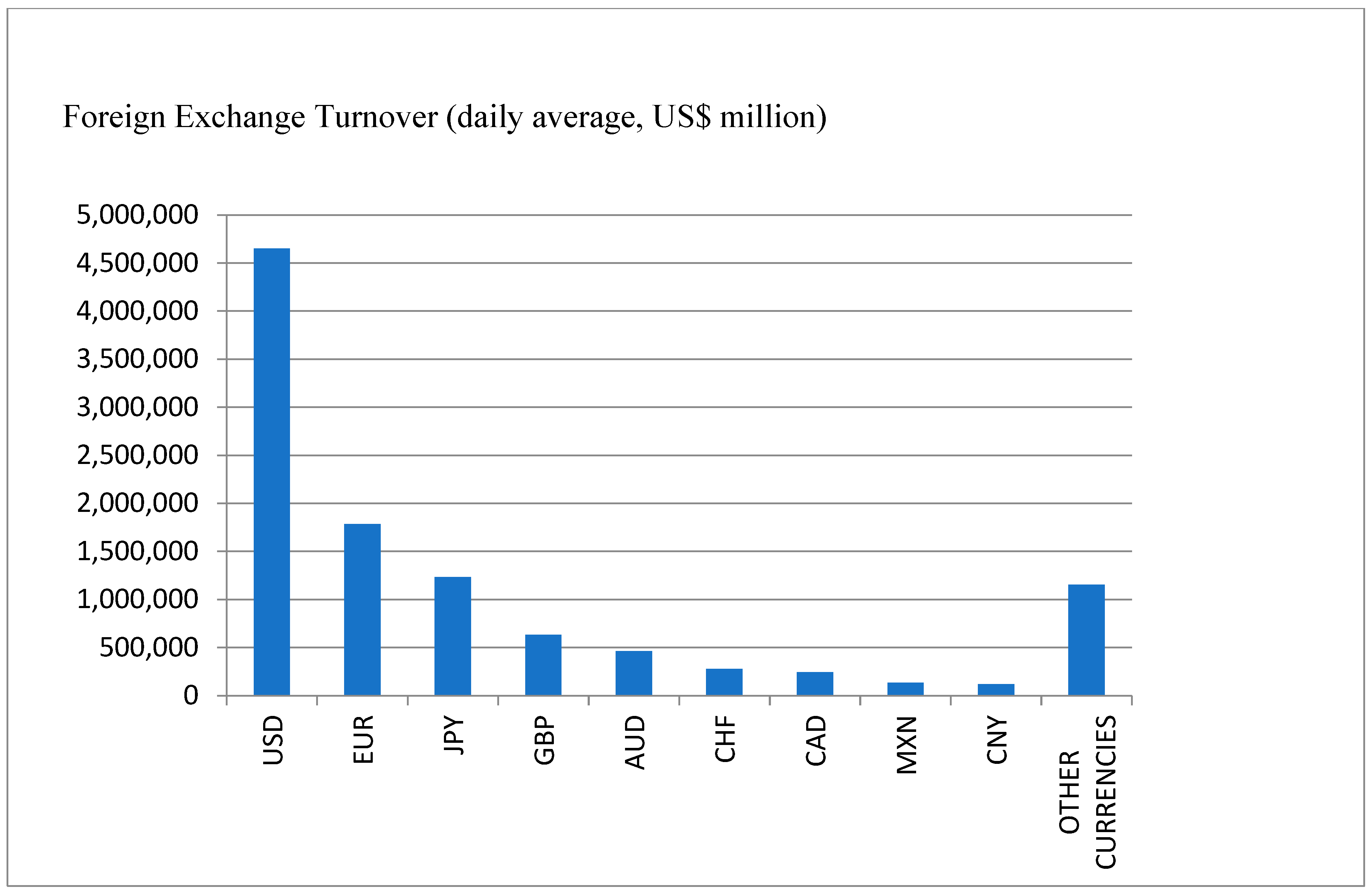
We have chosen the Mexican peso as the research focus for the following reasons. First, the peso is the most-traded emerging market currency in the sample period, according to the Triennial Central Bank Survey by the
Bank for International Settlement (
2014), as displayed in
Figure 1, which details turnover in the world’s most-traded currencies
1 and has been the most traded currency of Latin America’s currencies. The Mexican peso’s popularity may be due to its use “by investors as a proxy for less liquid emerging market currencies (
Pan Yuk, 2015).” Hence, it is a good currency to sample in the context of studying an emerging market currency. Second, Mexico, as an export-oriented country and a member country of the North American Free Trade Agreement
2 (NAFTA), has been the United States’ second-largest trading partner (total value of
$515,063 million was traded in 2014), while the US has been Mexico’s largest trading partner
3. Because Mexico is an important market for US goods and services, the peso/dollar exchange rate is important to both countries.
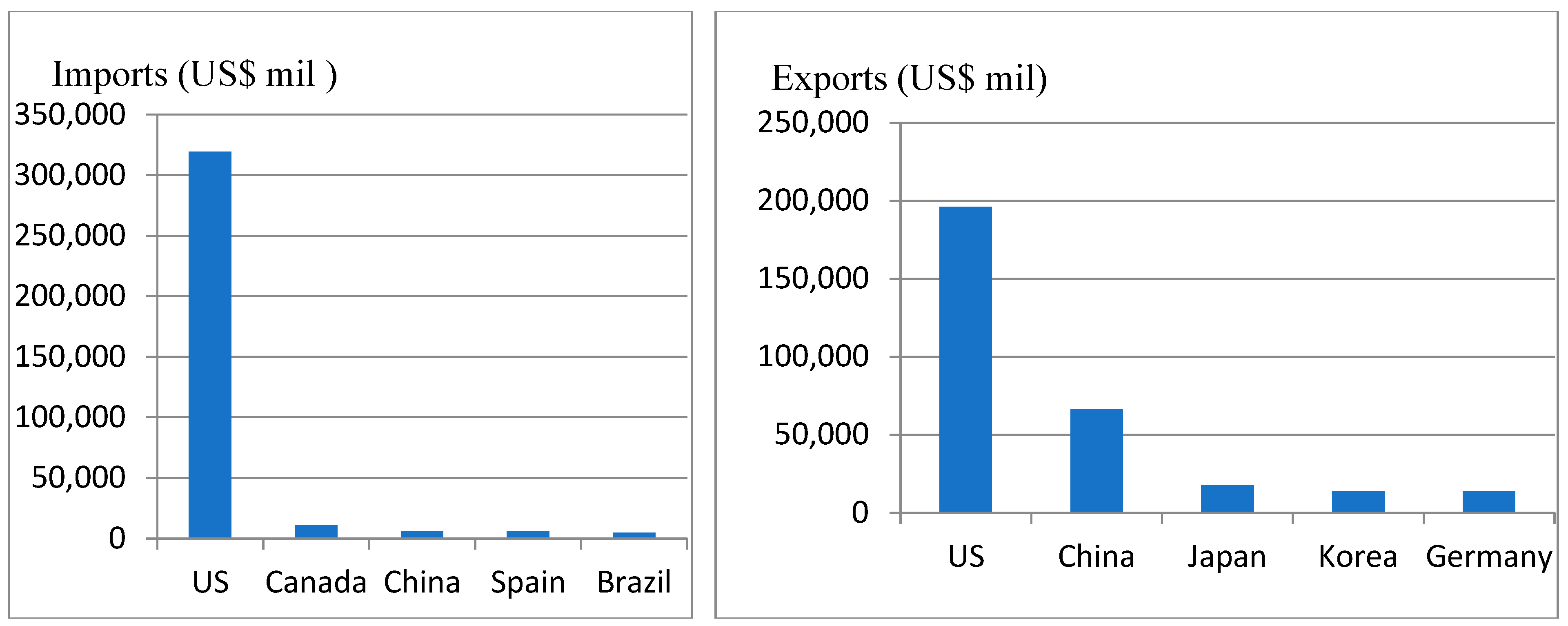
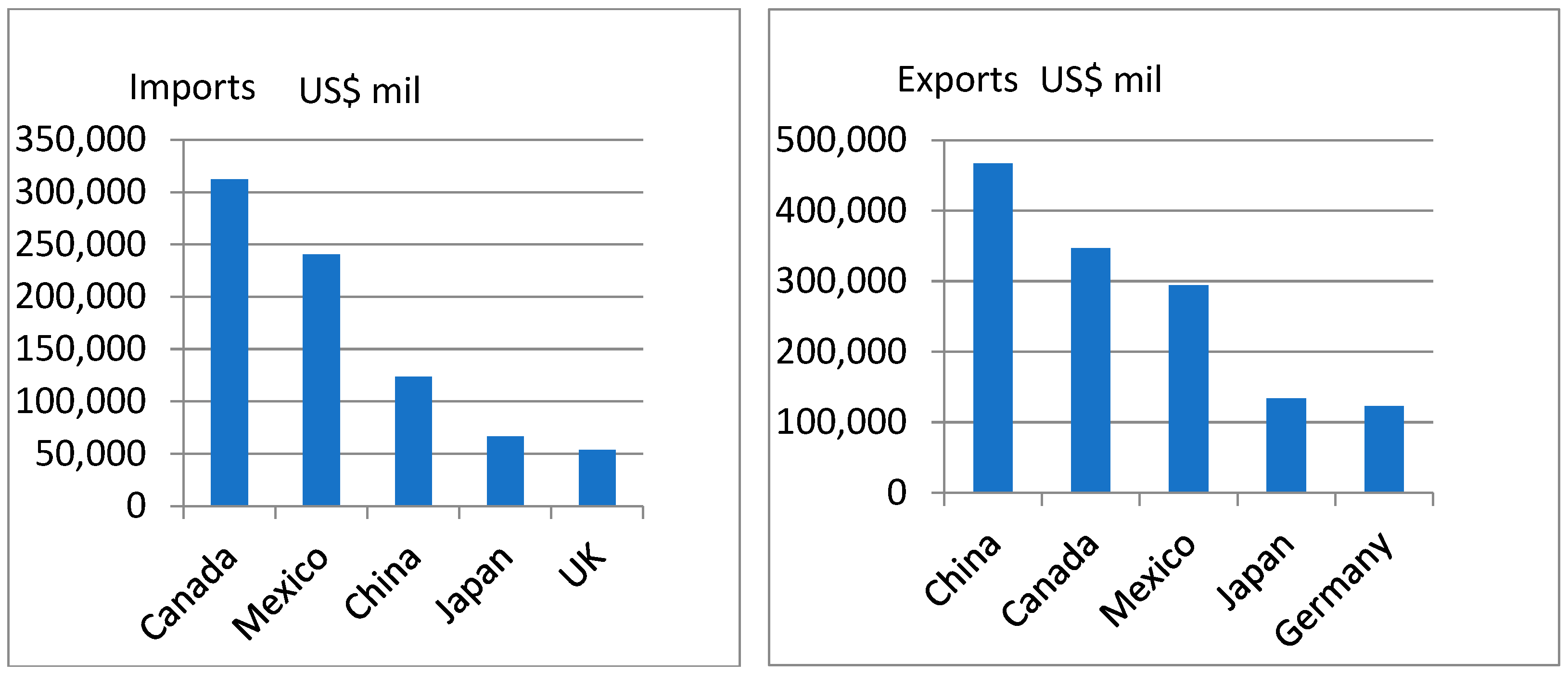
Figure 2 and
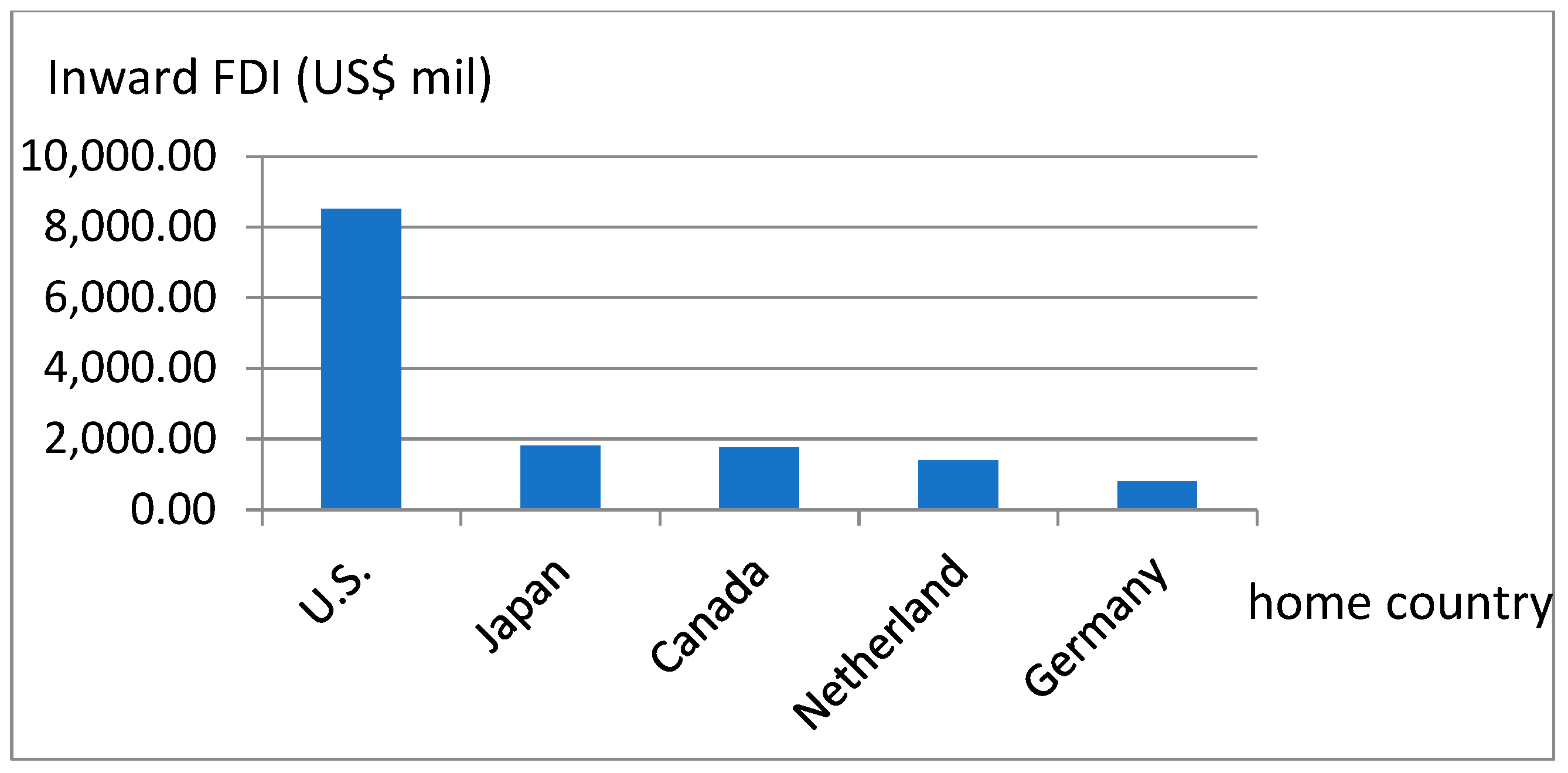
Figure 3 display the top five export and import trading partners of Mexico and the US during the sample period, respectively. Third, the United States is the largest origin of foreign direct investment (FDI) in Mexico, and Mexico is the largest recipient of US outward FDI
4. The top five home countries of inward FDI in Mexico in 2012 are reported in
Figure 4, revealing that the US is far ahead of all the other investing countries. It therefore follows that the behavior of the peso/dollar exchange rate looms large given that Mexico and the US are tightly linked by a variety of economic activities.
Mexican monetary policy actions are taken by the Banco de México, the central bank of Mexico, with the aim to influence interest rates and inflation expectations so as to affect the price level and to stabilize inflation. Similar to US monetary policy, Banco de México makes monetary policy announcements around eight times per year, and it implements monetary policy by setting a target for the overnight interest rate. It conducts open market operations to provide or withdraw liquidity and thereby hit its interest rate target.
There is no shortage of models that could be invoked to suggest that monetary policy announcements would impact exchange rate volatility. The efficient market hypothesis, interest rate parity, the signaling model, and the portfolio balance model can each provide a framework for tracing the impacts of monetary policy announcements on exchange rate volatility. The Efficient Market Hypothesis maintains that financial markets are “informationally efficient”, and the arrival and processing of all relevant new information (e.g., monetary policy announcements) will lead to price changes, potentially impacting exchange rate volatility. Uncovered Interest Rate Parity posits a relationship between interest rates and exchange rates. The change in interest rates that results from monetary policy announcements may cause changes in exchange rates due to the possible availability and carrying out of arbitrage opportunities. The signaling model suggests that the central banks can signal to market participants the “appropriate” exchange rate even though the central bank does not have enough resources to set market outcomes. For example, the quantitative easing announcements could have induced investors to revise down their expectations for future long-term interest rates. When investors have different interpretations of the information, despite facing the same signal, fluctuations in the financial markets are likely to follow. In the portfolio balance model, investors construct portfolios using both domestic bonds and foreign bonds, which are not perfect substitutes. When aggregate economic conditions change, investors adjust their portfolio accordingly to a new equilibrium. These portfolio adjustments, on the part of many investors, will lead to foreign exchange transactions to effectuate those portfolio adjustments resulting in exchange rate fluctuation.
Understanding how monetary policy announcements affect exchange rate volatility is crucial in an increasingly integrated global financial system. While a large body of literature has examined the effects of monetary policy on exchange rates, much of this work focuses on advanced economies and relies on low-frequency data, which may obscure the immediate market response to policy announcements. This limitation is particularly important for emerging market economies, where exchange rates tend to be more volatile and more sensitive to external shocks.
This paper is motivated by the need to better understand how monetary policy shocks originating from a major advanced economy transmit to an emerging market currency in real time. The Mexican peso provides an ideal case study, as it is one of the most actively traded emerging market currencies and is closely linked to the United States through trade and financial channels. Given the dominant role of the United States in global financial markets, US monetary policy announcements are likely to have significant spillover effects on emerging market exchange rates. However, the extent to which these effects differ from the emerging economy’s own monetary policy remains underexplored.
In addition, existing studies typically rely on lower-frequency data (e.g., daily or hourly), which are insufficient to capture the rapid adjustment of exchange rates around announcement times. By contrast, this paper employs second-by-second data to precisely identify the timing, magnitude, and persistence of volatility responses within narrow event windows. By jointly examining US and Mexican monetary policy announcements, this study provides new insights into the relative importance of global versus domestic policy shocks in driving exchange rate volatility, in particular for an emerging economy. More broadly, the findings contribute to understanding the transmission of monetary policy across borders and have important implications for investors, policymakers, and risk management in emerging markets.
In this paper, we examine whether exchange rate volatility responds differently to monetary policy depending on the country of origin of announcements. Specifically, this study answers the following three questions. First, does US monetary policy have a significant impact on peso/dollar exchange rate volatility? Second, does Mexican monetary policy have a significant impact on peso/dollar exchange rate volatility? Third, are the impacts of monetary policy originating from the two countries the same or not? We investigate the volatility dynamics before, during, and after monetary policy announcements and compare them to periods with no announcements. The empirical analysis is conducted using high-frequency data, specifically second-by-second peso/dollar spot exchange rates. The sample used in the empirical study ranges from November 2011 to February 2014. While the unconventional monetary policy period preceded November 2011, the second-by-second exchange rate data for the peso-US exchange rate was not available to us in that prior period. The dataset also includes the monetary policy announcements from both the US and Mexico over the entire time period.
This paper provides several key contributions to the existing international finance literature. First, by utilizing second-by-second data, we are able to study with high precision the instantaneous impact of monetary policy announcements on exchange rate volatility. This precision allows us to isolate the ultra-short-run dynamics from other market noise after an information shock. Second, it provides a novel direct comparison between the impact of US monetary policy and Mexican monetary policy on exchange rate volatility. This addresses a major gap in existing research that predominantly focuses on advanced economy monetary policy and currencies. In addition, this study compares the impact of own country monetary policy announcements with the partner country’s monetary policy announcements on exchange rate volatility, a comparison that has not been explored for emerging economies. Furthermore, this study examines the impacts of US monetary policy specifically during its unconventional policy regime, a period that has not been extensively investigated in this context. Because the federal funds rate was constrained by the zero lower bound, during our sample period, monetary policy announcements shifted away from traditional interest rate adjustments. By documenting the market reactions to the Fed’s balance sheet adjustments, we demonstrate that US announcements continued to exert a larger and more persistent impact in the foreign exchange market, even in the absence of conventional policy rate changes. Finally, we also note that we use a realized volatility measure in place of the more common GARCH-type measures. This is important in our context as we wish to understand how announcements affect volatility today, instead of using a measure that is generally contaminated with past volatility as is in the modeling of GARCH measures of volatility.
As a preview of the results, we find that the peso/dollar volatility increases before and during monetary policy announcements regardless of whether the announcement is from the US or Mexico. But of particular interest is that the increase in volatility lasts longer in response to US announcements relative to Mexican announcements. In comparing the size of the impacts, US monetary policy announcements tend to have larger influences on the volatility of the peso/dollar exchange rate.
The remainder of the paper is organized as follows. The next section provides a review of the relevant literature.
Section 3 describes the data and empirical model.
Section 4 presents the results of the empirical analysis.
Section 5 reports the robustness checks, and the final section concludes the study.
2. Literature Review
The literature on monetary policy and exchange rate volatility is extensive and spans several decades. Early work emphasizes the role of monetary policy regimes in shaping exchange rate volatility. In particular,
Lastrapes (
1989) shows that changes in policy regimes can alter both the level and persistence of volatility, highlighting the importance of structural factors in understanding exchange rate dynamics. More recent literature, however, focuses more directly on the role of information arrivals—particularly macroeconomic announcements—in driving exchange rate movements.
These perspectives are not mutually exclusive. Monetary policy regimes may influence how markets interpret and respond to news by shaping expectations, credibility, and uncertainty. In this sense, regimes provide the broader environment within which information is processed, thereby affecting both the magnitude and persistence of exchange rate volatility.
A large body of literature emphasizes the role of macroeconomic news as a primary driver of exchange rate volatility. Early contributions such as
Ito and Roley (
1987) exploit the timing of macroeconomic announcements in an event-study-type framework to show that unanticipated U.S. and Japanese macroeconomic news is rapidly incorporated into exchange rate returns, with U.S. monetary policy announcements playing a particularly important role. By focusing on narrow time windows around announcement releases, this approach allows researchers to isolate the immediate impact of news on exchange rate dynamics. This insight is further developed by
Bjørnland (
2009), who provides empirical support for Dornbusch’s overshooting hypothesis (
Dornbusch, 1976) as a mechanism underlying exchange rate volatility. In this framework, exchange rates respond rapidly to news, overshooting their long-run equilibrium as financial markets adjust more quickly than goods prices. This generates large initial movements in the exchange rate followed by partial reversals, contributing to higher observed exchange rate volatility.
Rüth (
2020) further refines this view by showing that not all monetary policy shocks are alike; differences in how shocks affect expectations about future policy paths lead to heterogeneous exchange rate responses and, consequently, differing volatility outcomes. These insights underscore the importance of precisely identifying the timing of news arrivals and the immediate adjustment of exchange rates, a task for which high-frequency data are particularly well suited.
A substantial empirical literature employs ARCH and GARCH-type models to characterize exchange rate volatility (
Baillie & Bollerslev, 1989;
Bauwens et al., 2005;
Gau & Hua, 2007;
Evans & Speight, 2010). A key development within this literature is the use of high-frequency intraday data, which allows researchers to link exchange rate volatility to the precise timing of news arrivals and market activity. While macroeconomic studies identify the sources of exchange rate movements, high-frequency studies explain the timing and transmission mechanisms through which these shocks are incorporated into asset prices. Building on this framework, more recent contributions continue to refine the empirical analysis of exchange rate volatility and its response to macroeconomic shocks (e.g.,
Wang & Wang, 2022).
One advantage of high-frequency data is that it allows researchers, through precise timing, to identify the effects of news originating from different geographic regions. This is particularly important in the context of exchange rates, which reflect the relative economic conditions of at least two countries. At lower frequencies, announcements from different countries may be bundled together, making it difficult to disentangle their individual effects. High-frequency data, by contrast, enables the researcher to isolate the impact of specific announcements and attribute exchange rate movements to their precise informational source.
Chang and Taylor (
2003),
Bauwens et al. (
2005), and
Omrane and Hafner (
2013) exploit this feature to identify the effects of geographically distinct news on exchange rate volatility. More recent work, such as
Wei and Pozo (
2021), further demonstrates the value of second-by-second data in identifying the immediate impact of macroeconomic announcements on exchange rate volatility, reinforcing the importance of high-frequency approaches for understanding the dynamics of exchange rate responses.
Building on this literature, it is also important to consider studies examining emerging market exchange rates. For example,
May et al. (
2018) analyze the response of exchange rates in an emerging market context (South Africa), highlighting the importance of monetary policy and external shocks.
Kočenda and Moravcová (
2018) examine how macroeconomic announcements and central bank communications affect the currencies of Poland, the Czech Republic and Hungary vis-à-vis both the USD and the Euro. They use minute-by-minute data and an event-study framework, finding that news affects the differing exchange rates very rapidly. Additional interesting findings include that the type of news (good, bad, neutral) and the origin of news (U.S. vs. Europe) impact abnormal returns by varying degrees. They also report potential inefficiencies given the pattern of returns during pre-announcement periods. While this paper parallels ours in a number of ways (e.g., emerging market exchange rates, intraday data, event-study framework) the authors still do not test the differential impact of own country emerging market news with an advanced economy’s news.
Given its geographic setting, of particular interest is the study by
Sosa Castro et al. (
2025), who examine how Mexican monetary policy announcements affect the level, returns, and volatility of the peso–USD exchange rate. They construct several measures of exchange rate volatility using GARCH-type models, ultimately favoring an EGARCH specification, but also considering range-based measures derived from OHLC (open, high, low, close) prices (e.g., ln(highₜ) − ln(lowₜ)). Their results indicate that monetary policy announcements are associated with decreases in exchange rate volatility when volatility is modeled using range-based measures, whereas the E-GARCH measures do not appear to respond significantly to these announcements.
Galvis Ciro et al. (
2017) also find for Colombia that own central bank monetary policy announcements reduce exchange rate volatility. These findings are contrary to the findings in the general literature, which generally find that monetary policy announcements increase volatility in the exchange rate.
It is important to note, however, that their analyses rely on daily data. As argued in the high-frequency literature, intraday data are better suited to identifying the effects of macroeconomic announcements due to the precise timing they provide. By contrast, daily data may obscure the immediate impact and subsequent dynamics of announcements. In this respect, the use of high-frequency, second-by-second data, as proposed in this study, allows for a more precise linkage between announcements and exchange rate behavior in the Mexican peso context. Furthermore, both
Sosa Castro et al. (
2025) and
Galvis Ciro et al. (
2017) focus exclusively on own economy monetary policy announcements, whereas we extend the analysis by examining both own economy and U.S. policy announcements, thereby allowing for a direct comparison of the relative contributions of domestic and foreign policy announcements to exchange rate volatility.
While GARCH-type models have been widely used to model and forecast exchange rate volatility, they rely on parametric assumptions and treat volatility as a latent process inferred from past returns. As such, they embed historical volatility into current estimates and may therefore be less well suited to our objective of comparing volatility over very short horizons—for example, in the minutes immediately before and after a policy announcement. For this purpose, a more direct, model-free measure of volatility is required.
In high-frequency settings, volatility can be measured more directly using intraday data. In this context, realized volatility—constructed from high-frequency returns—provides a nonparametric measure that fully exploits the available information (
Barndorff-Nielsen & Shephard, 2002;
Andersen et al., 2003). These measures have been shown to better capture the dynamics of volatility and often improve empirical performance relative to traditional GARCH-based approaches. This distinction is particularly relevant when compared to
Sosa Castro et al. (
2025), whose reliance on daily data limits their ability to capture the precise timing and short-run dynamics associated with announcement effects. By contrast, the use of high-frequency data and realized volatility measures in this study allows us to isolate and compare exchange rate responses to policy announcements with substantially greater precision.
4. Results
Equation (1) gauges the response of exchange rate volatility to US and Mexican monetary policy.
Table 3 reports the estimation results of Equation (1). The
coefficients are positive and statistically different from zero. This implies that US monetary policy announcements have significant impacts on the volatility during the pre-announcement period, the contemporaneous period and the post-announcement period. The exchange rate is most volatile during the contemporaneous period, with the volatility increasing by 615% compared to periods with no announcements.
Table 4 provides a straightforward comparison of the volatility during different periods responding to monetary policy announcements.
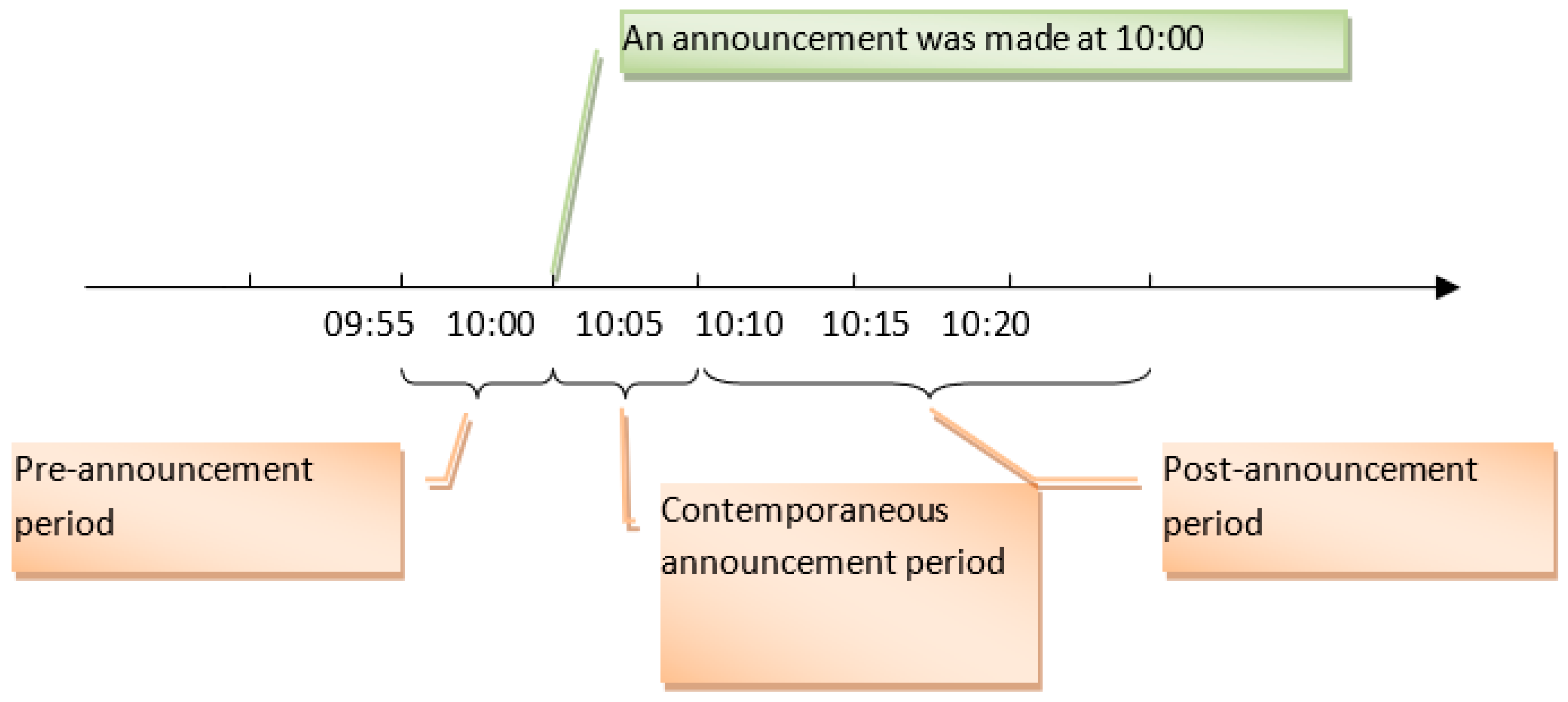
Turning to the coefficients, which capture the impacts of Mexican monetary policy announcements on exchange rate volatility, only and are significantly different from zero. This indicates that the exchange rate volatility increases significantly during the pre-announcement period and the contemporaneous period, when Mexican monetary policy announcements are made. The coefficient is not significantly different from zero, meaning that the volatility is not substantially different during the post-announcement period compared with non-announcement periods. Peso/dollar exchange rate volatility starts increasing, responding to the Mexican monetary policy announcement, five minutes before the announcement. The volatility reaches the highest level during the contemporaneous period, which is five minutes after the announcement. The increase in volatility fades away during the post-announcement period.
While both US monetary policy and Mexican monetary policy announcements lead to an increase in exchange rate volatility, the duration of the impacts is different. As described earlier, and capture the impact of US announcements and Mexican announcements during the pre-announcement period, respectively. The coefficients and show the influence during the contemporaneous period, while and indicate the influence during the post-announcement period. All the coefficients are significantly different from zero except . That is to say, the increase in the volatility due to US monetary policy announcements lasts through the post-announcement period at least, while the increase in the volatility due to Mexican monetary policy announcements only persists through the contemporaneous period, with the impact of Mexican announcements dying out during the post-announcement period. This result suggests that the influence of monetary policy announcements on peso/dollar exchange rate volatility is longer lasting with respect to the US relative to Mexican announcements.
Although the above discussion states that the duration of the impact of US announcements is longer than Mexican announcements, it does not reveal the difference in the scale of the impacts of announcements for the two countries. In order to know which monetary policy has a greater impact on exchange rate volatility, we conduct t-tests to test the coefficients for the three periods around announcements, respectively.
If we fail to reject the null, the impacts of announcements from the two countries are not significantly different. If we reject the null, it implies that the impacts of US policy announcements are greater than those of Mexican announcements. The results of the tests are reported in
Table 5. The
p-values are less than the critical value; therefore, we can reject the null. This indicates that US monetary policy has greater impacts on peso/dollar exchange rate volatility than Mexican monetary policy during all the three periods around announcements. In other words, US monetary policy announcements lead to greater increases in exchange rate volatility compared to Mexican monetary policy announcements during the pre-announcement and contemporaneous periods. The post-announcement period is excluded here because the impacts of US announcements are present while the impacts of Mexican announcements die out during the post-announcement period.
The significance of the coefficients confirms an increase in exchange rate volatility around announcement periods, consistent with the majority of findings in the existing literature. These results indicate that market participants begin adjusting their positions in anticipation of monetary policy announcements, as evidenced by the rise in volatility during the pre-announcement period. The peak in volatility during the announcement window reflects the rapid incorporation of new information into the foreign exchange market. It is noteworthy that our findings concerning own country monetary policy impacts on exchange rate volatility are contrary to the findings of
Sosa Castro et al. (
2025) and
Galvis Ciro et al. (
2017), who find reductions in exchange rate volatility in response to announcements. Their use of low-frequency data may explain this anomaly.
In addition, comparing the persistence of these effects, the increase in volatility following US announcements extends into the post-announcement period, whereas the impact of Mexican announcements dissipates more quickly. In other words, US monetary policy announcements generate longer-lasting effects on peso/dollar volatility. Moreover, the magnitude of the market reaction is more pronounced in response to US announcements when compared with Mexican announcements.
Overall, the faster decay in volatility following Mexican monetary policy announcements reflects their more localized impact, quicker information absorption, and the comparatively limited role of Mexico in shaping global financial conditions. In contrast, US announcements produce broader and more persistent effects due to the central role of the United States in the global financial system.
These results have important implications for policymakers and also market participants. First, the evidence that US monetary policy announcements generate stronger and more persistent increases in exchange rate volatility highlights the significant exposure of emerging markets to external shocks from advanced economies. This suggests that policymakers in countries such as Mexico need to closely monitor global monetary conditions when assessing risks to exchange rate stability and may need to consider foreign exchange interventions or macroprudential policies to maintain financial stability if necessary. For market participants, the peso is sensitive to US monetary policy announcements. Investors with significant peso/dollar exposure can anticipate heightened risk around announcement times and adjust their positions or strategies accordingly and may wish to avoid executing large transactions during the periods around policy announcements.
5. Robustness Check
Intraday volatility in financial markets is found to present a U-shaped pattern over the trading day (
Gau & Hua, 2007;
Andersen & Bollerslev, 1998;
Abhyankar et al., 1997). This means the volatility is comparatively high at the opening and closing of trading. To justify that the increase in volatility is due to the monetary policy announcements rather than the opening and closing behavior of the foreign exchange market, we conduct a robustness check by considering the influence of the opening and closing of trading.
In this section, the opening and closing of two foreign exchange markets are considered, namely, the US foreign exchange market and the Mexican foreign exchange market. In the US, the foreign exchange market opens at 8:00 and closes at 17:00 (EST), while the Mexican foreign exchange market opens at 7:30 and closes at 15:00 (local time), which are 8:30 and 16:00 (EST). The regression is then modified by incorporating dummy variables representing the opening and closing hours of the two markets (with the shift in time due to daylight saving time accounted for) as follows:
where
is the volatility measurement at time t, and the remaining are dummy variables with alternative meanings. The dummy variable
represents the corresponding period around announcements with respect to country j. Specifically, j = 1 if the announcement is made by the US and j = 2 if the announcement is made by Mexico. The index τ indicates a time window around each announcement: a pre-announcement period (τ = 1), a contemporaneous period (τ = 2), and a post-announcement period (τ = 3). For example, d
1,3,t represents the post-announcement period for a US monetary policy announcement.
The dummy variable is the dummy variable representing the opening hour and closing hour of a trading day. We divide the opening hour and closing hour into eight 15 min intervals. The index k takes the value 1 to 4 if it is during the opening hour, and it takes the value 5 to 8 if it is during the closing hour. The index j is to distinguish the two countries’ foreign exchange markets: 1 for the US and 2 for Mexico. For example, m2,2,t refers to the second 15 min time interval during the opening hour of the Mexican foreign exchange market.
The estimation results are reported in
Table 6. The coefficients
s imply the impact of the monetary policy announcements of the specific country on the volatility during the corresponding periods. The results are consistent with the results in the previous section: US monetary policy announcements have a significant impact on the volatility during the pre-announcement, contemporaneous, and post-announcement periods, while Mexican monetary policy announcements have considerable impacts during the first two periods, with the significance dying out during the post-announcement period.
In comparing the scale of the impacts of announcements from the two countries, a
t-test is conducted as in the previous section. Results are reported in
Table 7. The impacts of US announcements are significantly greater than the impacts of Mexican announcements during all the three periods around announcements. We notice that although U.S. announcements continue to exert a greater influence on exchange rate volatility, the differential impact during the pre-announcement and contemporaneous periods becomes less statistically significant after adding the opening and closing dummies. Specifically, the significance levels decline from 5% to 10% for the pre-announcement period and from 1% to 5% for the contemporaneous period. Nevertheless, the overall results remain consistent and continue to provide evidence that U.S. announcements have a larger impact than Mexican announcements.
6. Conclusions
Using an event-study methodology with intraday data, this paper examines the impacts of US monetary policy announcements and Mexican monetary policy announcements on peso/dollar exchange rate volatility. While analyzing whether the announcements of the two countries affect the volatility, respectively, we also compare if one is greater than the other. Results indicate that both US and Mexican monetary policy announcements have significant and positive impacts on the volatility; however, this impact lasts longer for US monetary policy announcements. Specifically, the US announcements cause an increase in exchange rate volatility over the pre-announcement, contemporaneous and post-announcement periods, while the Mexican announcements lead to an increase in the volatility over only the first two periods. One possible explanation is that in addition to the direct impact of US monetary policy on peso/dollar volatility, there might also be some indirect impact on it. For example, US monetary policy announcements might also lead to an increase in the Canadian dollar/US dollar volatility, which may contribute to the increase in peso/dollar volatility through the spillover effect at a later time. This could explain why the increase in peso/dollar volatility due to US announcements has a longer duration than the increase caused by Mexican announcements.
Moreover, the impact of the US announcements is greater than that of the Mexican announcements. In other words, the US announcements lead to a greater increase in the exchange rate volatility compared with the Mexican announcements during the periods around announcements.
Overall, peso/dollar exchange rate volatility does respond to US and Mexican monetary policy announcements, while the responses are different in scale as well as duration according to the country of origin of the announcements. These findings have economic implications. It is found that US announcements have the most important and significant impact on exchange rate volatility. Mexican monetary policy announcements appear to be less influential in driving exchange rate volatility. Therefore, as the largest and most advanced economy in the world, the US has a dominant impact on foreign exchange market volatility compared to Mexico, an emerging market economy, with respect to the influence of monetary policy announcements. The peso is even more vulnerable because of the significant increase in volatility when US monetary policy announcements are made. Moreover, as the most-traded, freely convertible currency in emerging markets, the peso is considered “an ideal hedging instrument for speculators who are betting on the direction of other developing economies
6.” Therefore, market participants and policymakers may be more sensitive to the changes in exchange rate volatility. Accordingly, both market participants as well as the policymakers need to pay attention to the systematic risk caused by the monetary policy announcements emanating from both the US and Mexico.
While this study provides new evidence on the impact of monetary policy announcements originating from different countries on exchange rate volatility, several limitations should be acknowledged. First, this analysis focuses on a single exchange rate, peso/dollar. While the Mexican peso is representative of emerging market currencies, the results may not extend to other emerging market currencies. In addition, while the paper mentioned possible spillover effects from US monetary policy, these channels are not directly modeled. Future studies could expand the analysis to a broader set of emerging market currencies and could investigate the transmission mechanisms across countries and financial markets.