Article

A Hybrid FinTech-Driven Framework for Volatility Forecasting: The Role of Digital Attention and Technical Indicators in the Dubai Financial Market

by
Nour M. Mazen Lababidi
1,2,*,
Hasan Radwan Katalo
1 and
Yahya Kamakhli
1
1
Department of Financial and Banking Sciences, Faculty of Economics, Aleppo University, Aleppo 12121, Syria
2
Department of Finance and Banking, Faculty of Economics, Damascus University, Damascus 12114, Syria
*
Author to whom correspondence should be addressed.
J. Risk Financial Manag. 2026, 19(5), 375; https://doi.org/10.3390/jrfm19050375
Submission received: 11 March 2026 / Revised: 7 May 2026 / Accepted: 11 May 2026 / Published: 21 May 2026

Abstract

Research Purpose: This study investigates the role of digital investor behavior, measured through Google Trends, alongside technical indicators such as RSI and Bollinger Bands, in forecasting volatility in the Dubai Financial Market. The aim is to develop a hybrid analytical framework that integrates behavioral and technical dimensions to enhance predictive accuracy in emerging markets. Study Methodology: Daily data from 2020 to 2025 were collected, covering both crisis and post-crisis periods. Digital attention was quantified using Google Trends search indices, while technical indicators included RSI and Bollinger Bands calculated over a 7-day horizon. Volatility was modeled using ARCH, GARCH, and EGARCH frameworks, with Max Drawdown employed as a complementary risk metric to capture extreme market movements. Findings: Digital investor attention shows a predictive association with volatility, particularly when combined with technical indicators. Models incorporating both behavioral and technical variables demonstrated superior predictive performance. The EGARCH model successfully captured the asymmetric impact of negative shocks (γ < 0, p < 0.05), while Max Drawdown provided additional insights into risk exposure during periods of heightened market stress, achieving an R2 of 95.36%. Scientific value: This study positions digital attention as a complementary variable that improves forecasting, moving beyond conventional price-based models in volatility modeling; by integrating Google Trends with technical analysis, the research introduces a hybrid forecasting framework that can be adapted to other emerging markets. Practical Implications: The findings offer practical value for policymakers and investors. Regulators can use digital attention measures as early warning signals to anticipate volatility, while investors can integrate behavioral and technical indicators to improve risk management and trading strategies. From a foresight perspective, the study contributes to building more resilient financial systems by embedding behavioral data into predictive tools.

1. Introduction and Literature Review

Financial markets are inherently volatile, and this volatility translates directly into risk and potential losses for investors. Frequent price fluctuations result in significant costs, affecting portfolio returns and market stability. Investors are increasingly interested in developing trading strategies that help them make informed investment decisions and limit losses during turbulent periods. Trading strategies typically rely on two broad approaches: technical analysis, which is based on historical price and volume data, and behavioral analysis, which seeks to understand investor sentiment and crowd psychology.
The primary aim of this research is to test whether Google Trends can serve as both a forward-looking predictor and a complementary tool for volatility forecasting in the Dubai Financial Market. Specifically, the study investigates whether integrating digital investor behavior with traditional technical indicators (RSI and Bollinger Bands) within a hybrid GARCH/EGARCH framework enhances predictive accuracy, particularly for extreme downside risk (Max Drawdown); this study empirically examines the potential of digital attention to act as a forward-looking predictor of market turbulence and sharp declines.
With the development of digital data, it has become possible to measure investor behavior online, particularly through tools such as Google Trends, which reflects collective mood and general interest in real time (Farrukh et al., 2017). At the same time, traditional tools such as technical analysis indicators (e.g., RSI and Bollinger Bands) remain widely used to measure momentum and volatility in financial markets (Keshavarz et al., 2022). However, most existing studies treat these two dimensions—technical indicators and behavioral attention—separately. A critical gap remains: there is no integrated framework that combines digital investor attention with technical analysis within a single volatility forecasting model, particularly for emerging markets where volatility is often driven by both economic shocks and collective psychology according to Tabash et al. (2025).

1.1. Theoretical Framework and Research Gap

Since the seminal work of Engle (1982) on the ARCH model, volatility modeling has evolved into a wide spectrum of advanced approaches. Bollerslev (1986) extended ARCH into the GARCH framework, allowing for more flexible lag structures in conditional variance. Nelson (1991) introduced the EGARCH model to capture asymmetries in the impact of positive and negative shocks. These extensions demonstrate that volatility is not only time-varying but also influenced by structural features such as persistence and asymmetry.
Parallel to this, the attention hypothesis (Dimpfl & Jank, 2016) suggests that investor attention, measured through search engine queries, can predict market movements because investors have limited cognitive capacity and tend to focus on salient information. However, most prior studies have treated digital attention as supplementary rather than central to volatility modeling.
Despite significant advances in volatility modeling using GARCH-family models, despite the recognized role of technical indicators (RSI, Bollinger Bands) in capturing investor sentiment and momentum, and despite the emergence of Google Trends as a tool for measuring digital attention, the existing literature lacks an integrative framework that combines all three elements—technical indicators, digital attention, and advanced volatility models—within a single predictive framework for emerging markets. The Dubai Financial Market, characterized by its sensitivity to regional geopolitical events and retail investor participation, provides an ideal context to test such a hybrid framework.

1.2. Research Objectives and Hypotheses

The primary objective of this study is to investigate the predictive power of digital investor behavior—measured through Google Trends—and technical indicators (RSI and Bollinger Bands) in forecasting market volatility and downside risk within the Dubai Financial Market. By integrating behavioral data with traditional technical analysis within GARCH and EGARCH frameworks, the research aims to develop a hybrid framework that enhances forecasting accuracy and risk assessment.
What distinguishes this study is its empirical test of whether digital attention can function as a complementary variable that improves forecasting of volatility, moving beyond conventional price-based models. This study examines whether they can serve as central components in volatility modeling when combined with technical indicators. Furthermore, the use of Max Drawdown as a risk metric adds depth to the analysis by capturing extreme market movements, offering practical insights for investors and analysts operating in volatile environments.
The objective of this research is to examine digital investor behavior by integrating technical analysis indicators, and predicting volatility using two methods: standard deviation (volatility) and maximum loss over a period of time. To achieve this goal, three research hypotheses were proposed:
H1. 
People search more online when technical indicators are overbought or oversold.
H2. 
There is effectiveness in using Google Trends data and technical analysis indicators (Bollinger RSI) in predicting volatility in the Dubai market.
H3. 
Google trends data and technical indicators are effective for helping reduce investment risks by anticipating market volatility early.

1.3. Literature Review

Financial markets experience frequent fluctuations that result in significant costs, affecting financial market indicators. Investor sentiment has been shown to significantly impact stock returns, as demonstrated by Smale (2017). Frequent price fluctuations are linked to a volatile pattern, resulting in a rise followed by a sharp decline. This is due to the interaction of a number of economic and psychological factors. Investors are increasingly interested in developing trading strategies to help them make informed investment decisions and limit losses. Trading strategies rely on technical analysis techniques based on historical price and volume data, as well as investor behavior analysis, which is a key tool used by traders to understand and analyze volatility (Celik, 2012). This is achieved by providing early signals of potential fluctuations in the market return index, through which traders can use them to manage risks, determine the size of trades, and determine appropriate stop-loss points, reducing potential losses by using technical indicators such as moving averages, price patterns, and investor sentiment patterns and their relationship to fluctuations in financial markets (Smale, 2017). With the development of digital data, it has become possible to measure investor behavior online, particularly through tools such as Google Trends, which reflects collective mood and general interest. It provides real-time data on search volume related to specific topics. There is a need for an analytical study that examines the role of these tools in understanding and analyzing patterns of volatility in financial markets, especially in light of rapidly changing economic conditions. Emerging financial markets, such as the Dubai Financial Market, are experiencing increased volatility driven by economic, political, and psychological factors. Beyond technical indicators and search engine data, a growing strand of literature has emphasized the role of textual analysis and financial contagion in understanding market dynamics. Mutlu and Garibay (2021) proposed a quantum-like contagion model to analyze how information and behavior spread through social networks with heterogeneous adoption thresholds. Their approach captures the uncertainty and irrationality in investor decision-making, which is particularly relevant to emerging markets where collective psychology often drives price movements.
Glosten et al. (1993) proposed the GJR-GARCH model to account for leverage effects. Later, Baillie et al. (1996) developed the FIGARCH model to incorporate long memory in volatility processes. These extensions demonstrate that volatility is not only time-varying but also influenced by structural features such as persistence, asymmetry, and long-term dependence. Positioning the current study within this stream of research highlights the importance of integrating behavioral and technical indicators into advanced volatility models, especially in emerging markets where shocks tend to be more pronounced and persistent. It is not yet clear whether digital search data such as Google Trends provides reliable signals that can be used to predict volatility. Methodologically, Shen et al. (2022) employed a network topology analysis based on Diebold–Yilmaz volatility spillover indices to track risk contagion across commodity markets during COVID-19. Their approach offers three insights relevant to our study. First, the use of directional spillover measures confirms that EGARCH-type models are appropriate for capturing both volatility persistence and cross-sector transmission. Second, their period-specific analysis (pre-COVID, peak, post-COVID) demonstrates the importance of evaluating forecasting models across different phases of a crisis, which we adopt by covering 2020–2025. Third, their distinction between ‘risk exporters’ and ‘risk recipients’ complements our use of Max Drawdown, as one measures propagation while the other measures severity. While our study focuses on a single equity market, these methodological insights from Yuan et al. (2022) inform our modeling choices and open directions for future multi-market extensions.
More recently, Jeaab et al. (2026) developed a hybrid actuarial model enhanced with deep learning (LSTM networks) to predict systemic risk and financial contagion. Their framework integrates traditional financial data with textual sentiment analysis from regulatory communications, achieving a 19.2% improvement in predictive accuracy over conventional models. This study demonstrates that combining quantitative indicators with narrative signals significantly enhances early warning capabilities; while the approach of Abouzaid et al. (2026) is sophisticated, it requires substantial computational resources, large-scale textual datasets, and deep learning expertise. In contrast, our study focuses on a more accessible and interpretable framework that relies on publicly available Google Trends data and standard GARCH/EGARCH models. This makes our approach easier to replicate, update, and implement by practitioners and regulators in emerging markets where advanced NLP infrastructure may not be available.
Furthermore, while Abouzaid et al. (2026) focus on systemic risk across multiple institutions, our study focuses on volatility forecasting for a single emerging market (Dubai). This narrower scope allows for a more granular analysis of market-specific dynamics, including the role of digital attention and technical indicators, which may be diluted in multi-market models.
These contributions highlight two important dimensions that complement traditional volatility forecasting models: (1) the role of textual sentiment as a leading indicator, and (2) the cross-market contagion mechanisms that amplify local shocks. Our study does not directly incorporate these dimensions, but we acknowledge them as important directions for future research. Conversely, our focus on digital attention (Google Trends) and technical indicators (RSI, Bollinger) offers a complementary perspective that is more accessible, interpretable, and applicable to emerging markets with limited data infrastructure.
The results indicated that a high volume of searches for information related to financial markets is an indicator of future price fluctuations. These results can be used to improve the models for predicting financial market volatility in our study, and Michele et al. (2021) found a relationship between the volume of search queries in Italy, Germany, France, Britain, Spain, and the United States and the stock market fluctuations. The Italian Google Trends index was found to be the main driver of the financial markets. Researchers (Ranco et al., 2015) believe there was a relationship between news sentiment and reader behavior on financial platforms (Yahoo! Finance). The analysis relied on the number of clicks and the number of views, which are useful in predicting price trends. The study noted that news alone is not sufficient for prediction, but when combined with the interest of digital readers, it becomes a powerful tool for predicting movements in financial markets. Digital behavioral tools may be insufficient for accurate forecasting, indicating a need for additional methods to improve prediction accuracy.
Ramona et al. (2024) found that Google Trends is a good indicator of public interest in the cryptocurrency market, which drives prices and affects trading volumes. This interest is particularly evident in periods of volatility, and these findings may help investors understand the dynamics of cryptocurrencies and build their trading strategies. Based on the above findings, digital behavior can be used as an early warning signal for the future. Deveikyte et al. (2022) analyzed sentiment extracted from news and tweets on Twitter to predict the future volatility of the FTSE-100 index. The results showed a relationship between positive sentiment and market volatility the following day. News articles were modeled using Latent Dirichlet Allocation. Phuong and Nhung (2021) used the technical indicator RSI (Relative Strength Index) to study the impact of investment sentiment on the returns of the Vietnamese market. They relied on analytical methods such as Generalized Least Squares (GLS) and Fama–MacBeth regression. The results showed that a high RSI reflects a degree of optimism or overbuying among investors, but this study did not rely on any variable that indicates public behavior and assumed that prices reflect these sentiments. The researchers Yuri et al. (2025) proposed a system that combines sentiment analysis of publicly available news with the RSI to identify overbought and oversold conditions for buy/sell decisions. The results demonstrated the system’s ability to adapt to different market sectors and its ability to improve trading results. The system provides a practical and executable investment strategy. Markus et al. (2024) confirmed the importance of investor sentiment in technical analysis, examining the effectiveness of technical analysis when combined with market sentiment on news derived from the US and Chinese stock markets, where the combination yields a profitable portfolio strategy. In summary, the literature demonstrates that advanced volatility models such as GARCH, EGARCH, and FIGARCH have been widely applied to capture the dynamics of financial market risk, while technical indicators like RSI and Bollinger Bands provide valuable signals of investor sentiment and momentum. At the same time, digital attention measures such as Google Trends have emerged as promising tools for forecasting volatility, yet most prior studies have treated them as supplementary rather than central variables. This gap highlights the need for a hybrid framework that combines digital investor behavior with technical analysis to improve forecasting accuracy. Building on this gap, the present study develops and tests three hypotheses regarding the role of Google Trends and technical indicators in predicting volatility and risk in the Dubai Financial Market.
In summary, the literature demonstrates that advanced volatility models such as GARCH, EGARCH, and FIGARCH have been widely applied to capture the dynamics of financial market risk, while technical indicators like RSI and Bollinger Bands provide valuable signals of investor sentiment and momentum. In this context, a recent study by Deep et al. (2025) emphasized the importance of technical indicators in risk management, suggesting that these indicators may be more useful for hedging risks than for predicting returns themselves.

2. Materials and Methods

This study does not employ textual analysis (e.g., sentiment analysis of news or social media). The term ‘digital attention’ refers exclusively to the Google Trends search volume index, which is a quantitative time series. The methodology is organized as follows: Section 2.2 describes data collection and variable construction. Section 2.3 presents the econometric models (GARCH and EGARCH) used for volatility forecasting. No textual analysis component is included.

2.1. Critique of the Theory of Financial Market Efficiency

The Efficient Market Hypothesis, as formalized by Fama (1970), posits that asset prices fully reflect all available information. Critics of market efficiency, such as Lo and Mackinlay (1999), argue that price movements are not entirely random. The random walk theory, popularized by Malkiel (2019), has been increasingly questioned in light of behavioral finance evidence. Early theoretical foundations of market efficiency can be traced back to Samuelson (1965), who argued that properly anticipated prices fluctuate randomly. The study period from 2020 to 2025 was deliberately chosen to capture a wide range of market conditions and shocks that are particularly relevant to emerging markets. This timeframe includes the outbreak of the COVID-19 pandemic, fluctuations in global oil prices, and subsequent recovery phases, all of which had significant impacts on the Dubai Financial Market. By covering both crisis and post-crisis periods, the dataset provides a robust environment to test the predictive power of digital attention and technical indicators under varying levels of volatility and uncertainty. This choice ensures that the proposed hybrid framework is evaluated in a context that reflects real-world challenges faced by investors and policymakers in emerging economies. While the methodology provides a comprehensive framework by integrating digital attention and technical indicators, several limitations should be acknowledged. First, Google Trends data may not fully capture institutional investor behavior or private information flows, which can also drive volatility. Second, technical indicators such as RSI and Bollinger Bands are sensitive to parameter choices and may generate false signals under extreme market conditions. Finally, the study focuses on a single emerging market (Dubai), which limits the generalizability of the findings to other contexts. These limitations, however, open avenues for future research to extend the framework to multiple markets and incorporate additional behavioral data sources such as social media sentiment.
The Efficient Market Hypothesis states that the price of a financial asset is random and cannot be predicted using technical analysis or other methods. This challenges the claim of effectiveness of technical analysis methods that are able to predict what will happen to the price in the future (Murphy, 1999). Many studies conducted in recent years question the validity of the efficient market theory, emphasizing that the price of a financial asset has a specific behavior that it follows, thus opposing the idea of a random walk of price movement. Opposing the idea of random walk of price movement, this study focuses on how technical analysis tools use past price changes to detect patterns that help investors predict future movements. In addition, recent studies in the field known as “Behavioral Finance” (Antony, 2019) have emerged, indicating that investment decisions made to buy or sell a financial asset are not entirely rational, and that there are a large number of investors who can influence price movement in unpredictable ways. Future price movements may be influenced based on public psychology, which ranges between panic, fear, and pessimism on the one hand, and confidence and optimism on the other. This indicates that prices do not reflect what they are actually worth, but rather what people think they are. This helps explain the rapid declines and rises in financial markets during certain periods, driven by emotions that may take time to stabilize. There are several important indicators to explain most of the behavior of financial market participants, who follow the herd behavior of rising and falling according to their psychological state. This research attempts to study the impact of digital behavior on predicting fluctuations in financial markets.

2.2. Digital Attention Hypothesis—Alternative Indicators Such as Google Trends

Recent studies, including that by Ramona et al. (2024), have shown that Google Trends can reflect public interest in financial assets, influencing prices and trading volumes. Research such as that by Ranco et al. (2015) indicates that digital reader behavior on financial platforms can enhance price trend predictions. Yang et al. (2020) studied the effect of investor attention on trading volume and returns, using search engine data as a proxy for interest. Some investors have limited cognitive capacity and cannot process all the information available in the market. This focus on high-profile news sometimes causes investors to ignore more important but less exciting or less clear data. This behavior leads to price distortions because supply and demand are influenced by the amount of attention and interest of investors more than the actual value. This explanation for why stock prices often move sharply after important news and later revert to stability. Researchers (Yang et al., 2020) studied the effect of attention on trading volume and returns in the Chinese financial market. They relied on the appearance of the stock and related financial market news in the Baidu search engine, as an increase in the number of searches is an indicator of increased investor interest (Yang et al., 2020). In our study, we use Google Trends data to capture investors’ digital behavior and apply the attention hypothesis. There is clear evidence that excessive investor attention creates temporary biases in financial markets. This supports behavioral finance theory and completely contradicts the efficiency of financial markets.
A growing body of literature has utilized Google Trends to capture investor attention and predict market dynamics. Using an empirical similarity model enhanced with Google Trends data, they found that increased investor attention significantly predicts short-term realized volatility, with the effect being more pronounced during periods of market stress. Their findings support the attention hypothesis, which posits that limited cognitive capacity leads investors to focus on attention-grabbing information, thereby influencing price dynamics and volatility. This study provides strong empirical justification for incorporating Google Trends data as a leading complementary variable that improves forecasting in volatility models, particularly in markets where retail investor behavior plays a significant role.
It is important to acknowledge that Google Trends search activity may capture multiple underlying mechanisms simultaneously, including investor curiosity, media coverage, market stress, or general economic uncertainty (Dimpfl & Jank, 2016). While our theoretical framework treats digital attention as a proxy for collective investor sentiment, we recognize that the estimated coefficients do not isolate a single behavioral channel. Rather, they reflect a composite signal of public engagement with financial markets. This limitation is inherent to aggregate search data.

2.3. Theories Related to Technical Indicators

Technical indicators are widely used in investment valuation and management, as discussed in foundational texts like Jordan and Miller (2009). Traditional tools such as technical analysis remain relevant in volatility measurement, as noted by Keshavarz et al. (2022). Both fundamental and technical analyses play complementary roles in market analysis, as discussed by Suresh (2013).

2.3.1. Relative Strength Index (RSI)

The Relative Strength Index (RSI) was developed by Wilder (1978) to measure the speed and change of price movements.
Recent empirical studies have emphasized that technical indicators such as RSI and Bollinger Bands are not only mechanical tools but also reflect underlying investor sentiment. For instance, Phuong and Nhung (2021) showed that high RSI values in the Vietnamese market are associated with investor optimism and overbought conditions, while low RSI values indicate pessimism and oversold states. Similarly, Markus et al. (2024) demonstrated that combining Bollinger Band signals with market sentiment extracted from news in the US and Chinese markets yields superior forecasting performance compared to technical analysis alone. These findings suggest that RSI and Bollinger Bands can serve as proxies for collective psychology, capturing herd behavior and emotional extremes. Integrating these indicators with digital attention measures such as Google Trends therefore provides a richer framework for understanding volatility in emerging markets like Dubai, where investor sentiment plays a critical role in driving short-term fluctuations.
The Relative Strength Index (RSI) measures the strength and speed of price change over a specific period of time. It was developed by Wilder (1978). Overbought levels are above 70, while oversold levels are below 30. These points will indicate future upward and downward movements in the financial markets. RSI is derived from the average upward price changes over a specified period, and the average downward price changes over the same period. The average loss is calculated as a positive number, ensuring that the Relative Strength Index (RSI) is always greater than or equal to zero. The RSI ranges from 0 to 100:
R S I = 100 100 1 + R S t
R S t = A V G ( G a i n s ) A V G ( L o s s e s )
The choice of a 7-day horizon was selected for calculating RSI and Bollinger Bands to enhance sensitivity to short-term fluctuations, which are characteristic of emerging markets like Dubai. These are often subject to higher volatility and shorter cycles of investor sentiment compared to developed markets. While previous studies commonly adopt 14-day or 20-day windows, these longer horizons may smooth out short-term fluctuations and fail to capture rapid reversals that are typical in highly volatile environments. By using a shorter 7-day period, the indicators become more sensitive to sudden changes in price dynamics, allowing for earlier detection of overbought and oversold conditions as well as short-term volatility spikes. This adjustment enhances the responsiveness of the technical signals and aligns the methodology with the fast-moving nature of emerging financial markets.

2.3.2. Bollinger Band Technical Analysis Tool

Bollinger Bands were developed by Bollinger (2001) as a tool to measure volatility and identify breakout signals. This tool helps in identifying saturation areas, measuring volatility, and breakout signals (breakouts). This tool is suitable for measuring volatility and identifying market breakouts by using the standard deviation with price averages in its model, while the RSI measures the strength and weakness of the price movement to identify overbought and oversold conditions. The time period of 7 days was used instead of 20 days to calculate the averages because in highly volatile markets such as emerging markets (Dubai Financial Market), long periods, such as 20 days, can mask significant short-term changes. This allows for the identification of short-term volatility spikes and the capture of short-term trend reversals. The shorter the time period, the narrower and more dynamic the bands, reflecting changes more quickly. This can be done as follows:
U p p e r   B a n d U B = M B + k . σ n
L o w e r   B a n d L B = M B k . σ n
Technical analysis tools seek to identify trading opportunities, i.e., they can explain the reasons for price movements. However, using this strategy alone is not sufficient. This analysis can be further developed by incorporating sentiment and public trends to account for external market influences and investor sentiment. This is the goal of this research, aiming to achieve the highest degree of accuracy in predicting future market trends.
Both RSI and Bollinger Bands are derived from price data, but they capture fundamentally different market dimensions. RSI measures price momentum and identifies overbought/oversold conditions, reflecting short-term investor sentiment and potential reversal points. Bollinger Bands measure volatility expansion and contraction, reflecting market stability or turbulence. These indicators are theoretically complementary rather than redundant. A market can experience high volatility (wide bands) without being overbought, and a market can be overbought without high volatility. The correlation matrix in our results confirms that RSI and Bollinger Width have a weak correlation in Table S2, justifying their joint inclusion in the volatility forecasting model.

2.4. Theories of Risk Measurement

Understanding volatility is crucial for investment decision-making, as highlighted in studies such as Dhanker (2019). Measuring volatility (standard deviation) and risk is an important method used to understand the behavior of financial markets and make investment decisions. Volatility expresses the fluctuation of stock prices around their average over a specific period of time. Theoretical and practical methods for measuring volatility vary, and these methods have been used in research:

2.4.1. Historical Volatility

It is based on calculating the standard deviation of stock or asset returns over a specified period of time, and is used to estimate past risks and actual market volatility.
V o l a t i l i t y = σ t = 1 n Σ i = 1 n R t i R ¯

2.4.2. Risk Indicator (Max Drawdown)

This definition aligns with the risk measurement framework proposed by Chekhlov et al. (2005). It is the maximum potential loss in an investment portfolio, and a risk management tool for investors. In our study, we will rely on a simple Max Drawdown equation as a dynamic measure of risk, representing the maximum decline from the peak to the trough (drawdown) of the Dubai Financial Market Index’s return over a seven-day period. It is as follows:
M D D = M a X t ϵ 1 , T ( M a X s ϵ 1 , t P s P t M a X s ϵ 1 , t P s )

2.4.3. Conditional Volatility Regression Models for GARCH/ARCH Models

These are used to estimate time-varying volatility. This type of model allows for prediction of volatility during periods of high volatility or potentially low risk, and is common in empirical studies of financial markets. This study relied on the autoregressive conditional variance (ARCH) model and its generalized extension (GARCH) to measure and analyze the dynamics of return volatility in the Dubai Financial Market.
These models are based on the hypothesis that the conditional variance of returns is not constant over time, but rather is affected by the degree of previous shocks, making them one of the most widely used statistical tools in analyzing financial market volatility.
  • ARCH(q) model: One of the early attempts to model volatility was formulated by Engle (1982) and is as follows:
r t = μ + ϵ t
Since the previous squared error terms determine the current value of the model’s error variance, the ARCH(q) model can be defined as the variance of the series σt2, as follows:
σ t 2 = α o + i = 1 p σ i ε t i 2
  • GARCH(p,q) model: It is an extension of the ARCH model, developed by Bollerslev (1986), and is as follows:
σ t 2 = α 0 + α 1 ϵ t 1 2 + β 1 σ t 1 2
Using a combination of these methods allows analysts and investors to more accurately assess risk and volatility, contributing to improved investment strategies and informed decision-making, especially when studying the impact of behavioral factors on stock prices.
In the context of volatility modeling, the choice of appropriate model specifications and error distributions is critical for accurate estimation. Samuel et al. (2023) developed a comprehensive simulation framework to evaluate the performance of GARCH-family models under different innovation distributions, including normal, Student-t, and skewed Student-t. Their findings suggest that mis-specifying the innovation distribution can lead to biased volatility persistence estimates, particularly in emerging markets characterized by fat tails and asymmetry. This highlights the importance of selecting appropriate GARCH specifications—such as the EGARCH model used in the present study—to capture asymmetric volatility dynamics and ensure robust forecasting performance (Samuel et al., 2023).

3. Data

3.1. Google Trends

Daily Google Trends data were collected from the official website for the period from November 2020 to August 2025. To ensure maximum daily granularity and avoid the loss of short-term fluctuations that occurs when extracting a single continuous five-year window, the data were extracted in separate quarterly intervals (every three months). Each quarterly extraction preserves the full daily resolution within that period. The twenty quarterly extracts were then concatenated in chronological order to form a continuous daily time series covering the entire five-year period. Therefore, data were extracted separately for each quarter (20 extractions over 5 years) and then concatenated to form a continuous daily time series. This approach preserves short-window normalization precision, making the Google Trends index more suitable for the short-term volatility forecasting models employed in this study.
The data was extracted for the keywords related to the financial markets, which are: “stock market, investment.”
The keywords “stock market” and “investment” were selected following an exploratory analysis of several finance-related search terms relevant to the Dubai Financial Market, including “trading,” “Dubai market,” “finance,” and “equities.” Each candidate keyword was tested for its correlation with the volatility series over the study period. The two selected keywords exhibited the strongest and most statistically significant positive correlation with market volatility and were therefore retained to construct the digital attention index. This data-driven keyword selection strategy follows best practices in the Google Trends literature, where empirical robustness checks are recommended to validate keyword choice rather than relying solely on a priori theoretical assumptions.
The average data for the two mentioned words was taken to obtain the Google Trends index, and the data was scored from 0 to 100 based on the audience’s interest during the time period. Keywords were selected based on their relevance to general investor attention in the Dubai financial context. As for the technical indicators, they included the Relative Strength Index (RSI), which was calculated for a period of 7 days, but in the research, a period of 7 days was used instead of 14 days to quickly capture short-term reversals, allowing the indicator to react quickly to recent changes (increasing the indicator’s sensitivity).
The sample consists of 1245 daily observations with 7 estimated parameters (observations-to-parameters ratio = 178:1), exceeding the minimum recommended threshold of 20:1 (Harrell, 2015) and confirming that overfitting is unlikely

3.2. The Bollinger Bands

This technical analysis tool was calculated for a period of seven days in line with the RSI indicator to capture fluctuations and fluctuations in the short term, while the dependent variable of volatility was calculated as the standard deviation of the Dubai Financial Market Index return for a seven-day period to help us understand the state of instability and uncertainty.

3.3. The Max Drawdown Risk

This indicator was calculated over a seven-day period based on the closing prices of the Dubai Financial Market Index to measure the true risk and collapse, and compared to periods of falling/rising RSI and Bollinger Bands, in addition to the psychological variable Google Trends, to identify periods of collapse.
Despite the comprehensive design of the methodology, several limitations should be acknowledged. First, Google Trends data may not fully capture the behavior of institutional investors or private information flows, which can also influence market volatility. Second, technical indicators such as RSI and Bollinger Bands are sensitive to parameter choices and may generate misleading signals during extreme market conditions. Third, the study focuses exclusively on the Dubai Financial Market, which limits the generalizability of the findings to other emerging or developed markets. Finally, the reliance on a single data source for digital attention may overlook complementary behavioral signals from social media platforms or news sentiment. These limitations, however, provide opportunities for future research to extend the framework by incorporating additional behavioral datasets and applying the model to a broader set of markets.

4. Results

The following section presents the empirical results derived from the models described above, beginning with descriptive statistics and proceeding to hypothesis testing.

4.1. Descriptive Statistics

Table S1 presents the descriptive statistics of all variables. The average volatility of the Dubai market was 0.8%, with a maximum of 6%, indicating relatively low volatility during the study period. The structural market risk index (maximum drawdown) ranged between −1 and −0.018 with an arithmetic mean of −0.47, while the market momentum index (RSI) ranged between 1.4 (the market is oversold) and 98 (the market is overbought) with an arithmetic mean of 56.5 (the market is relatively stable). The Bollinger Band ranged between 13.8 and 787, with an arithmetic mean of 125.
On the other hand, for the Google Trends index, the lowest index was 8.8 and the highest index was 82.8, with an average of 29.8 and a standard deviation of 8, while the Google Trends share index ranged between 0 and 100 with an arithmetic mean of 43.4 and a standard deviation of 20.7, and the Google Trends investment index ranged between 35 and 100 with an arithmetic mean of 71.6 and a standard deviation of 12.
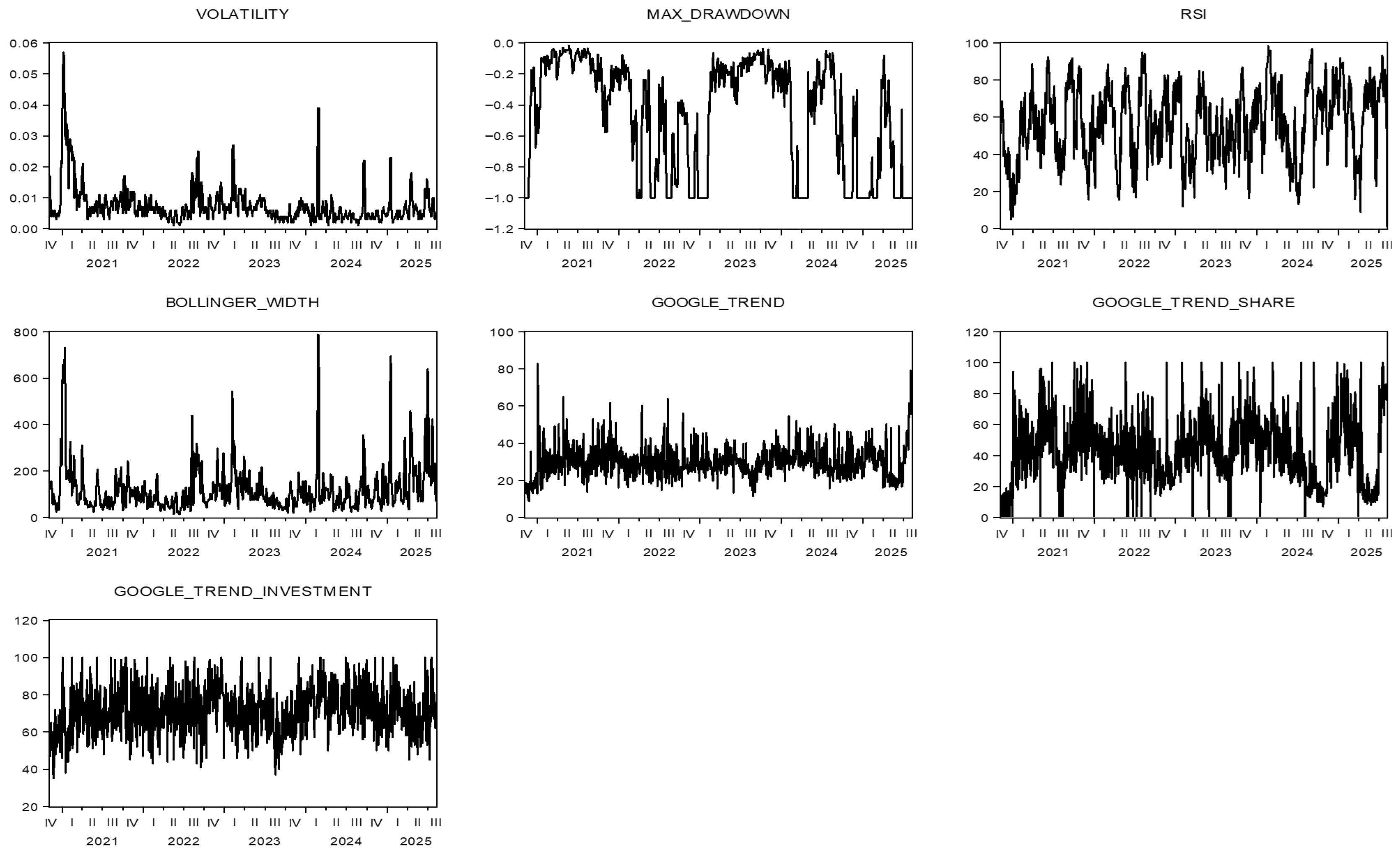
Figure 1 shows that the study period witnessed acceptable fluctuations in the Dubai Market Index, and severe fluctuations in the other variables during the study period, especially at the beginning of the study period, which coincided with the spread of the coronavirus, which indicates that selling operations took place for a limited period, leading to declines in the market, followed by buying operations leading to increases in the market.
We note from Table S1 that although the variables volatility and maximum drawdown are indicators of risk in financial markets, the relationship between them is insignificant and almost non-existent, which indicates the difference in the nature of each of them in measuring risk. We note from the table that the variable that has a significant relationship with the market volatility variable (VOLATILITY) is the RSI variable, and it is an inverse relationship, meaning that a decrease in RSI is associated with an increase in market volatility due to market tension and increased uncertainty in it, and it has a direct relationship with the BOLLINGER variable. That is, bandwidth is associated with increased market volatility. This makes sense, given that bandwidth is directly derived from the standard deviation of market prices, and is directly related to both the Google Trend SHAR and the average Google Trend share. This means that increased interest in the stock market often coincides with higher market volatility. As we note from the table, the variable that has a significant relationship with the market risk index variable (Max Drawdown) is the RSI variable, and it is an inverse relationship, meaning that a decrease in the RSI to less than 30 is associated with an increase in market risks and the occurrence of large losses, and there is an inverse relationship with the BOLLINGER variable, meaning that the width of the bands is associated with a greater market collapse, meaning that periods of high volatility may not necessarily be associated with a long-term decline. We also note from the table that the variable that has a significant relationship with the RSI variable is the BOLLINGER variable, which is a direct relationship, meaning that the width of the bands is associated with an increase in market momentum, and this means that the two indicators complement each other in prediction.

4.2. Hypothesis 1: Digital Attention and Technical Indicators

There is a direct relationship between Google Trends, volatility, and Max Drawdown. This means that the more interest in the term “stock market” in Google, the more likely the market will decline the following week. Furthermore, increased investment interest is associated with lower maximum drawdowns, meaning the market will decline less the following week. As a result, digital behavior can be used to improve the accuracy of forecasting volatility in emerging financial markets.
There is a direct relationship between Google Trends and RSI, which means people search more online when technical indicators are in overbought/oversold states, which supports early signals for predicting market volatility.
These relationships confirm that combining traditional technical indicators such as Bollinger Width and RSI with behavioral indicators extracted from Google Trends search data can enrich risk prediction models in emerging markets, by providing a more comprehensive reading of market and investor behavior.
Table S3 reports the unit root test results. All variables are stationary at level, satisfying the prerequisite for time-series modeling. The probability values are below 0.05, confirming stationarity.

4.3. Hypothesis 2: Volatility Forecasting Using GARCH/EGARCH

Arch Effect model
Arch Effect Model Terms:
The first condition: the condition of the existence of low and high volatility for short and long periods, and for that we create a regression model between the dependent variable “market volatility” and each of the variables, Google Trends data and technical analysis indicators (BOLLINGER and RSI), and Table S4 shows the results of this model.
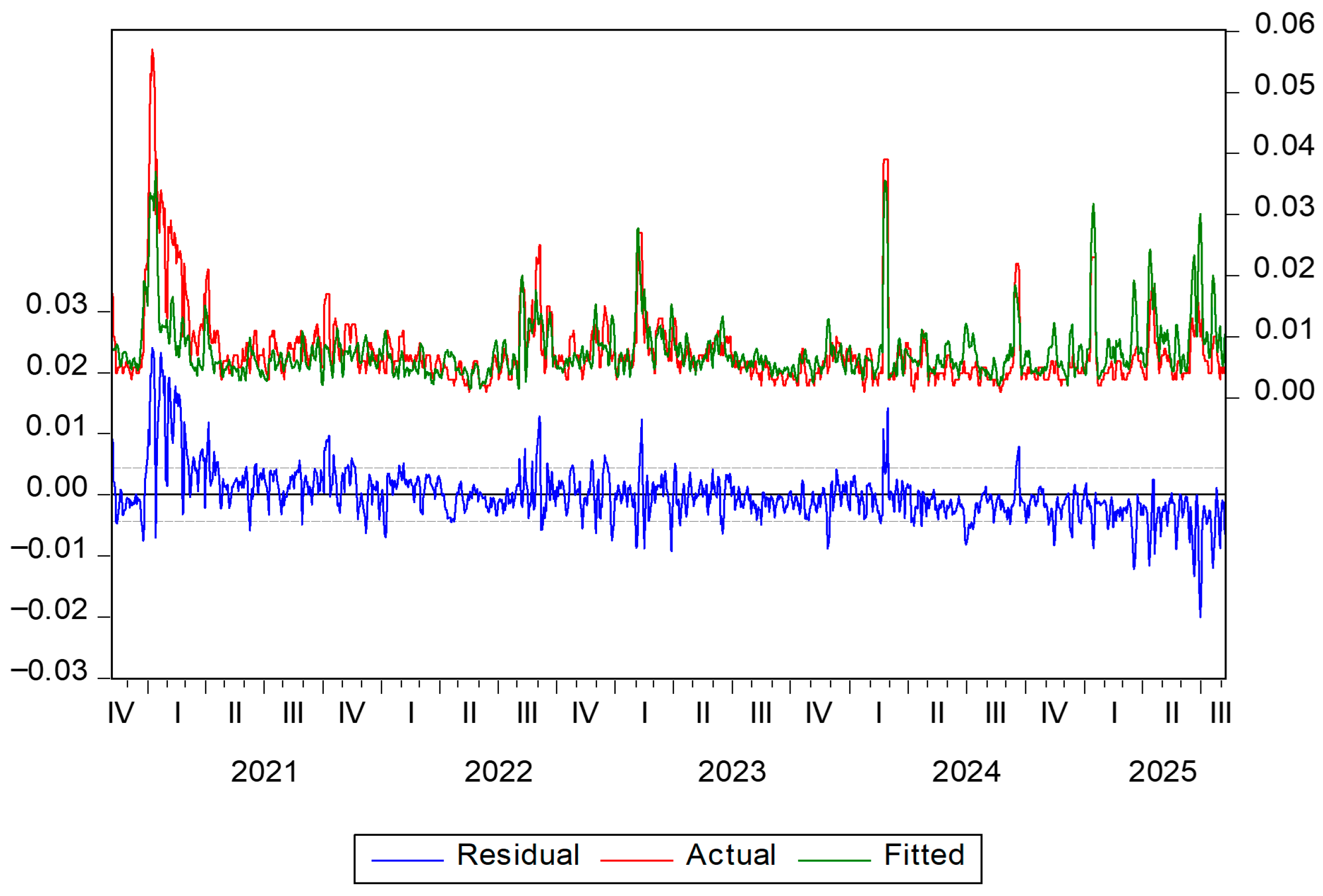
The trend of the model’s regression residuals over time is shown in Figure 2.
We notice from the figure that there are low oscillations and high oscillations for different periods, so the first condition for applying the Arch Effect model is met.
The second condition: the condition of the existence of the Arch Effect. This condition is tested through the Heteroskedasticity Test: Arch, where we obtain Table S5.
Table S5: shows the ARCH effect test results. The significant ARCH effect (p < 0.05) confirms the presence of time-varying volatility, justifying the use of GARCH-family models.
Estimation of the GARCH model
In order to study the effectiveness of Google Trends data and technical analysis indicators (Bollinger Band, RSI) in predicting volatility in the Dubai market (VOLATILITY), the researchers used the Generalized Autoregressive Conditional Variance (GARCH) model, which assumes that the variance of the residuals (random errors) is a function of the previous values of the variance and the square of the random errors according to the mean equation (after adding appropriate lag terms to the equation).
V O L A T I L T Y t = C + ϑ t   V O L A T I L T Y t 1 + e t
The GARCH model, after adding the GOOGLE TREND variable and the BOLLINGER and RSI variables, can be formed according to the following variance equation:
σ t 2 = ω + α ε t 1 2 + β σ t 1 2 + θ   G O O G L E   T R E N D + δ   B O L L I N G E R   W I D T H + φ   R S I + e t
And the following TARCH model:
σ t 2 = ω + α ε t 1 2 + β σ t 1 2 + γ ε t 1 2 I t 1 + θ   G O O G L E   T R E N D + δ   B O L L I N G E R   W I D T H + φ   R S I + e t
where I_(t − 1) is equal to one if the random error of the first lag is less than zero and zero otherwise.
According to the EGARCH model, to address the asymmetric impact of positive and negative shocks, the equation becomes the following:
ln σ t 2 = ω + α ε t 1 σ t 1 + β ln σ t 1 2 + γ ε t 1 σ t 1 + θ   G O O G L E   T R E N D + δ   B O L L I N G E R   W I D T H + φ   R S I + e t
Since the coefficient γ considers the asymmetry in the impact of shocks, if negative shocks are followed by more fluctuations, the value of the coefficient will be negative.
Tables S6–S8 present the GARCH model estimation results. The one-period lag coefficients are statistically significant and positive, indicating that volatility persists from one day to the next.
It is evident from the top part of the three tables that the one-period lag coefficients are statistically significant in all models and their positive sign indicates that any day’s volatility is positively affected by the previous day’s volatility.
It is clear from the lower part of Tables S6–S8 that the coefficient β is positive and statistically significant, meaning that the variance of the previous period has a positive effect on the variance of the current period, and that the coefficient α is statistically significant. However, in the third model (EGARCH model), it is positive and statistically significant, and the sum of the coefficients α and β in this model is less than one, which means that the shocks to which the conditional variance is exposed do not have a continuous effect.
We also note in the EGARCH model that the coefficient γ is negative and statistically significant, indicating that negative shocks are followed by more volatility (random error variance) in the Dubai market.
Table S9 summarizes the EGARCH model results. Unlike the GARCH and TARCH models, the Google Trends and technical indicator coefficients become statistically significant in this specification, explaining 83% of volatility variations. According to the three criteria (AIC, SCH, H-Q), the best model is the EGARCH model, which confirms our above result that we reached regarding the γ coefficient, and the value of the Log likelihood test also indicates that the coefficients of the independent variables combined are not equal to zero, which indicates the suitability of the tested models in terms of the number of independent variables. The value of the Durbin–Watson test close to 2 in the three models indicates the absence of autocorrelation between the residuals, and confirms the validity of the estimate of random errors and thus the statistical significance of the estimated coefficients.
We note that in Table S9, the probability value corresponding to the F and Chi-Square statistics is greater than the statistical significance level of 0.05, and therefore we accept the null hypothesis that the variance of the residuals of the estimated model is constant, and we note that in Table S10, the corresponding probability value of the Chi-Square statistic is greater than the statistical significance level of 0.05, and therefore we accept the null hypothesis that there is no serial correlation between the residuals of the estimated model.

4.4. Hypothesis 3: Risk Reduction Using Max Drawdown

Arch Effect Model
Arch Effect Model Terms:
The first condition: the condition of the presence of low and high fluctuations for short and long periods. For this, we conduct a regression model between the dependent variable “maximum drawdown” and each of the different data variables from Google Trends and technical analysis indicators (BOLLINGER and RSI). Table S11 shows the results of this model.
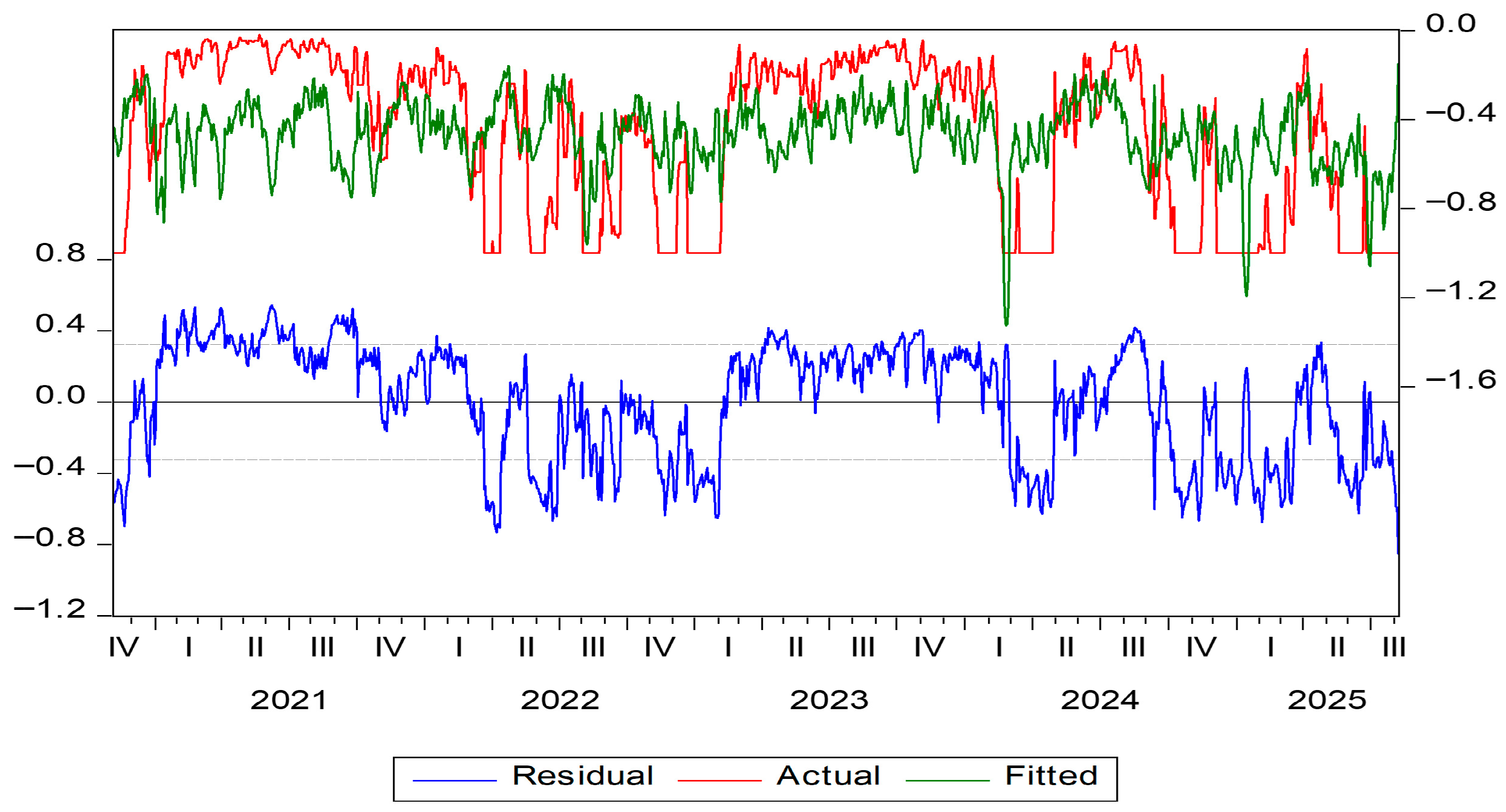
What interests us in this model is the direction of the residuals of the model’s regression over time, as the following Figure 3 illustrates this direction:
We notice from the figure that there are low oscillations and high oscillations for different periods, so the first condition for applying the Arch Effect model is met.
The second condition: the condition of the existence of the Arch Effect. This condition is tested through the Heteroskedasticity Test: Arch, where we obtain Table S12. It is clear from the table that the probability value corresponding to the F and Chi-Square statistics is less than the statistical significance level of 0.05, and thus we have verified the two conditions for applying the Arch Effect model.
Estimating the (GARCH) model:
In order to study the contribution of Google Trends data and technical analysis indicators (BOLLINGER and RSI) in reducing risks in the Dubai market (MAX DRAWDOWN), the researchers estimated the models presented above but by changing the dependent variable to MAX DRAWDOWN, as Tables S13–S15 show the results of the required regression equations.
M A X   D R A W D O N t = C + ϑ t   M A X   D R A W D O N t 1 + e t
The GARCH model after adding the Google Trend variable and the BOLLINGER and RSI variables, is formed according to the following variance equation:
σ t 2 = ω + α ε t 1 2 + β σ t 1 2 + θ   G O O G L E   T R E N D + δ   B O L L I N G E R   W I D T H + φ   R S I + e t
The TARCH model is shown in Table S14.
σ t 2 = ω + α ε t 1 2 + β σ t 1 2 + γ ε t 1 2 I t 1 + θ   G O O G L E   T R E N D + δ   B O L L I N G E R   W I D T H + φ   R S I + e t
where I_(t − 1) is equal to one if the random error of the first lag is less than zero and zero otherwise.
According to the EGARCH model, to address the asymmetric impact of positive and negative shocks, the equation becomes as shown in Table S15.
ln σ t 2 = ω + α ε t 1 σ t 1 + β ln σ t 1 2 + γ ε t 1 σ t 1 + θ   G O O G L E   T R E N D + δ   B O L L I N G E R   W I D T H + φ   R S I + e t
The following Tables S13–S15 show the results of the required regression equations.
It is clear from the upper part of Tables S13–S15 that the lag coefficients for one period and two periods are statistically significant in all models, and the sign of their coefficients indicates that the maximum decline on any day is positively affected by the maximum decline of the previous day, and turns into a negative effect after two days.
It is clear from the lower part of Tables S13–S15 that the coefficient β is positive and statistically significant, meaning that the variance of the previous period has a positive effect on the variance of the current period, and that the coefficient α is statistically significant. However, in the third model (EGARCH model), it is positive and statistically significant, and the sum of the coefficients α and β in this model is greater than one, which means that the shocks to the conditional variance have a continuous effect. We also note in the EGARCH model that the coefficient γ is positive and statistically significant, which indicates that negative shocks are followed by greater declines (maximum decline) in the Dubai market.
We note in Tables S13–S15 that the coefficients that measure the contribution of each of the independent variables GOOGLE TREND, BOLLINGER, and RSI in reducing investment risks in the Dubai market are statistically significant at a significance level of 0.05.
This indicates that increased interest in searching for market-related keywords on Google often coincides with reduced investment risk in the market, that wider BOLLINGER Bands are associated with greater market crashes, and that a lower RSI is associated with significant market losses.
We note that the adjusted coefficient of determination in the third model constitutes a large explanation percentage of 95% of the fluctuations, and according to the three criteria (AIC, SCH, H-Q), the best model is the EGARCH model, which confirms our result above that we obtained regarding the γ coefficient. The value of the Log likelihood test also indicates that the coefficients of the independent variables combined are not equal to zero. This indicates the suitability of the tested models in terms of the number of independent variables, and the Durbin–Watson test value close to 2 in the three models indicates the absence of autocorrelation between the residuals, confirming the validity of the random error estimate and thus the statistical significance of the estimated coefficients.

5. Diagnostic Tests

Variance stability test for residuals:
We note from Table S16 that the probability value corresponding to the F and Chi-Square statistics is greater than the statistical significance level of 0.05, and thus there is stability in the variance of the residuals of the estimated model, and we note from Table S17 that the corresponding probability value of the Chi-Square statistic is greater than the statistical significance level of 0.05, and therefore we accept the null hypothesis that there is no serial correlation between the residuals of the estimated model.

5.1. Result Interpretation

The findings of this study contribute to the growing literature on forecasting volatility by demonstrating the value of integrating digital attention with technical indicators in an emerging market context. Consistent with Dimpfl and Jank (2016), the results confirm that search activity captured by Google Trends provides meaningful signals of investor sentiment and market stress. Moreover, the significant role of RSI and Bollinger Bands aligns with Phuong and Nhung (2021) and Markus et al. (2024), who emphasized the importance of combining technical analysis with behavioral factors.
Beyond statistical validation, the results have important strategic implications. In markets such as Dubai, where volatility is often driven by both economic shocks and collective psychology, the hybrid framework developed here offers policymakers and regulators an early-warning system to anticipate instability. For investors, the integration of digital behavior into forecasting models enhances risk management by identifying periods of heightened uncertainty before they materialize. This aligns with the foresight perspective of designing predictive tools that support resilience in financial systems.
The following results should be interpreted as associations between digital attention and volatility, not as definitive causal evidence. While we frame Google Trends as a potential leading indicator, the direction of causality cannot be conclusively established from the GARCH framework alone. A more rigorous approach would require complementing our analysis with either (1) a Granger causality test to examine temporal precedence between search activity and volatility, or (2) an event study methodology around exogenous shocks such as major news announcements or macroeconomic releases. We leave these extensions for future research and recommend that readers interpret our findings as predictive rather than causal.
It is important to note that the high R2 (95%) corresponds to the MAX DRAWDOWN model, not the VOLATILITY model. The VOLATILITY models achieved R2 of 83.23% (GARCH) and 83.09% (EGARCH), which are within normal ranges for volatility forecasting in emerging markets.

5.2. Model Accuracy Test

Tables S18 and S19 present the out-of-sample forecasting performance of the EGARCH model for VOLATILITY and MAX DRAWDOWN, respectively, using daily data from January 2026 (testing period). The model was estimated on the training period (2020–2025) and used to generate one-step-ahead forecasts for January 2026.
For VOLATILITY (Table S18), the predicted values closely track actual volatility, with minor deviations. The model captures the general dynamics of volatility, though some daily fluctuations are not perfectly matched.
For MAX DRAWDOWN (Table S19), the model performs well during stable periods (e.g., early January). However, during periods of increased market stress (e.g., 13–16 January), the model tends to overestimate the drawdown (predicts more negative values than actual). This conservative bias is consistent with the model’s risk-averse design, as it prioritizes early warning over precision.
These out-of-sample results provide empirical support for H3, which posits that incorporating digital attention with technical indicators can help reduce investment risks by anticipating market volatility early. The model’s ability to forecast MAX DRAWDOWN—a direct measure of downside risk—demonstrates its practical value for risk management. Investors can use these predictions to adjust positions, set stop-loss levels, or reduce exposure before extreme drawdowns materialize.
Overall, the out-of-sample accuracy confirms that the EGARCH model is not overfitted and maintains reasonable predictive power on unseen data, supporting its use for both volatility forecasting and risk management.

5.3. Practical Implications

The hybrid framework developed in this study offers practical value for both policymakers and investors. For regulators, integrating digital attention into volatility models can serve as an early-warning system, enabling proactive measures to stabilize markets during periods of heightened uncertainty. For investors, the combined use of Google Trends, RSI, and Bollinger Bands provides more accurate signals to anticipate risk exposure and adjust trading strategies accordingly. In the broader foresight perspective, the model contributes to building more resilient financial systems by embedding behavioral data into predictive tools, supporting adaptive and anticipatory decision-making in emerging markets.

6. Conclusions

While our findings demonstrate a predictive association between digital attention and volatility, the direction of causality remains unresolved. Search activity may partially reflect responses to market stress rather than purely exogenous attention. Readers should interpret the results as forecasting evidence, not causal proof. It is noteworthy that some coefficients in the GARCH model were statistically insignificant. This may be attributed to potential multicollinearity among predictors, or to the fact that asymmetric effects—captured more effectively by the EGARCH model—dominate the volatility process in the Dubai market during the study period. The superiority of the EGARCH model in capturing asymmetric shocks aligns with the foundational work of Nelson (1991), who introduced EGARCH to model the differential impacts of positive and negative news on volatility.
This study demonstrates that integrating digital attention with technical indicators provides a powerful framework for forecasting volatility in emerging markets. The results confirm that combining RSI and Bollinger Bands with digital search activity improves predictive accuracy and offers practical tools for investors and policymakers to anticipate risk.
Beyond the Dubai Financial Market, the proposed hybrid approach has broader implications for foresight research, suggesting that digital behavior can be systematically incorporated into volatility models to strengthen resilience in financial systems. Future studies may extend this framework to other emerging markets or integrate additional behavioral datasets such as social media sentiment and news analytics. In doing so, the predictive capacity of financial models can be enhanced, supporting more adaptive and anticipatory strategies in the face of uncertainty.
Limitations: This study does not control for structural economic drivers such as oil price shocks, geopolitical events, or institutional trading flows, which are relevant to the Dubai market. Their exclusion limits interpretation of volatility sources but does not invalidate the forecasting framework.
While our hybrid framework focuses on the Dubai Financial Market, its application can be extended to specialized financial domains. In Islamic finance, the integration of digital attention (Google Trends) with technical indicators (RSI, Bollinger Bands) within an EGARCH framework could support Shariah-compliant volatility forecasting and real-time risk monitoring, complementing emerging AI-based Shariah auditing models (Gassouma, 2025). In green finance, similar methodologies may be adapted to forecast volatility in carbon markets, green bonds, or renewable energy indices, where investor attention reflects policy shifts and environmental uncertainty. As shown in recent studies on volatility spillovers in strategic metal assets (Sheng et al., 2022) and commodity markets under crisis regimes (Deng et al., 2026), sentiment and attention metrics are increasingly relevant for understanding risk transmission. Future research should therefore test the proposed framework in Islamic equity markets and green financial assets to enhance its generalizability and policy relevance.

7. Future Research

Future studies could extend this framework by incorporating machine learning models such as Long Short-Term Memory (LSTM) networks to compare predictive accuracy with the hybrid approach proposed here. Additionally, applying the hybrid framework to Islamic financial markets (e.g., Islamic equity indices or Sukuk) and green finance assets (e.g., carbon futures, green bonds) represents a promising direction. Such extensions would examine whether digital attention and technical indicators maintain their predictive power in contexts governed by Shariah principles or environmental policy uncertainty. Additionally, testing the model in other emerging markets would enhance its generalizability. A methodological comparison between our GARCH/EGARCH framework and machine learning models such as LSTM is beyond the scope of this study. However, future research could benchmark the predictive accuracy of both approaches using the same dataset. Furthermore, incorporating alternative behavioral data sources, such as sentiment from financial news or social media platforms, could provide a more comprehensive measure of investor attention. We acknowledge an important limitation of this study. Our framework treats volatility as a statistical phenomenon driven by technical indicators (RSI, Bollinger Bands) and behavioral attention (Google Trends). However, financial market volatility is also influenced by structural economic factors that were not included in our model, such as macroeconomic shocks (e.g., oil price changes, interest rate decisions), geopolitical events, liquidity conditions, and institutional investor activity. The Dubai Financial Market, in particular, is sensitive to regional geopolitical developments and global oil price fluctuations. Future research should extend our hybrid framework by integrating these structural variables to provide a richer and more complete interpretation of volatility dynamics in emerging markets.
Another promising direction for future research is the integration of textual analysis into the hybrid forecasting framework. While the current study focuses on quantitative digital attention measured by Google Trends search volume, textual analysis techniques can extract sentiment, tone, and forward-looking information from unstructured data sources such as corporate reports, regulatory disclosures, financial news, and social media platforms. A comprehensive review of textual analysis applications in corporate discourse and financial regulation is provided by Chakraborty and Bhattacharjee (2020). Future studies could compare the predictive power of search volume indices versus sentiment scores derived from natural language processing, or combine both sources within a multi-signal early-warning system. Such integration would add a qualitative dimension to the quantitative indicators used in this study. A key limitation of this study is the potential endogeneity between digital attention and market volatility. Search activity may be a reaction to volatility rather than a predictor of it. For example, investors may increase their online searches during periods of market stress to seek information or reassurance, rather than searches driving subsequent volatility. Our empirical framework, based on GARCH models, does not fully resolve this endogeneity concern. Future research could address this using Granger causality tests in a VAR framework, or by employing instrumental variables such as exogenous shocks to internet usage or media coverage. Until then, our results should be viewed as suggestive of a predictive relationship, not a causal one.

Supplementary Materials

The following supporting information can be downloaded at: https://www.mdpi.com/article/10.3390/jrfm19050375/s1, Table S1: Descriptive Statistics variables data; Table S2: Correlation coefficients between research variables; Table S3: shows the results of the stability test for the study variables; Table S4: Regression model between study variables; Table S5: Heteroskedasticity Test: Arch; Table S6: GARCH Model; Table S7: TARCH Model; Table S8: EGARCH Model; Table S9: Test of the stability of the variance of the model residuals; Table S10: Serial correlation test for model residuals; Table S11: Regression model between study variables; Table S12: Heteroskedasticity Test: Arch; Table S13: GARCH Model; Table S14: TARCH Model; Table S15: EGARCH Model; Table S16: Test of the stability of the variance of the model residuals; Table S17: Serial correlation test for model residuals. Table S18: Out-of-Sample Forecasting Performance—EGARCH Model (Dependent Variable: VOLATILITY). Table S19: Out-of-Sample Forecasting Performance—EGARCH Model (Dependent Variable: MAX DRAWDOWN).

Author Contributions

Conceptualization, N.M.M.L. and H.R.K.; methodology, N.M.M.L.; software, N.M.M.L.; validation, N.M.M.L., H.R.K. and Y.K.; formal analysis, N.M.M.L.; investigation, N.M.M.L.; resources, H.R.K.; data curation, N.M.M.L.; writing—original draft preparation, N.M.M.L.; writing—review and editing, H.R.K. and Y.K.; visualization, N.M.M.L.; supervision, H.R.K.; project administration, H.R.K.; funding acquisition, none. All authors have read and agreed to the published version of the manuscript.

Funding

This research received no specific grant from any funding agency in the public, commercial, or not-for-profit sectors.

Institutional Review Board Statement

Not applicable.

Informed Consent Statement

Not applicable.

Data Availability Statement

The data that support the findings of this study are available from the corresponding author upon reasonable request. The analysis was based on publicly accessible financial data and digitally derived attention metrics, specifically compiled by the author. The original public domain resources from which the data were derived are the following: 1. Dubai Financial Market (DFM) Index Prices: Historical closing prices for the DFM index were collected from the Investing.com website for the Emirate of Dubai: https://sa.investing.com/equities/dfm (accessed on 16 January 2026). 2. Digital Attention Data: Google Trends data, filtered for the Dubai region, were obtained via the public portal: https://trends.google.com/trends/ (accessed on 16 January 2026). The final, cleaned, and analyzed datasets used to reach the conclusions in this manuscript are stored by the author in Excel format and are available for verification upon direct request.

Conflicts of Interest

The author declares that there are no conflicts of interest regarding the publication of this research. No financial, personal, or institutional relationships have influenced the design, execution, or interpretation of the study.

References

  1. Abouzaid, O., & Boussedra, F. (2026). Volatility spillovers, systemic risk, and the rise of digital assets: A hybrid approach using econometrics, machine learning, and network analysis. Review of Economics and Finance, 24, 1–13. [Google Scholar] [CrossRef]
  2. Antony, A. (2019). Behavioral finance portfolio management: Review of theory and literature. Journal of Public Affairs, 20(2), e1996. [Google Scholar] [CrossRef]
  3. Baillie, R. T., Bollerslev, T., & Mikkelsen, H. O. (1996). Fractionally integrated generalized autoregressive conditional heteroskedasticity. Journal of Econometrics, 74(1), 3–30. [Google Scholar] [CrossRef]
  4. Bollerslev, T. (1986). Generalized autoregressive conditional heteroskedasticity. Journal of Econometrics, 31(31), 307–327. [Google Scholar] [CrossRef]
  5. Bollinger, J. (2001). Bollinger on Bollinger bands. McGraw-Hill. [Google Scholar]
  6. Celik, S. (2012). Theoretical and empirical review of asset pricing models: A structural synthesis. International Journal of Economics and Financial, 2(2), 141–178. [Google Scholar]
  7. Chakraborty, B., & Bhattacharjee, T. (2020). A review on textual analysis of corporate disclosure according to the evolution of different automated methods. Journal of Financial Reporting and Accounting, 18(4), 757–777. [Google Scholar] [CrossRef]
  8. Chekhlov, A., Uryasev, S., & Zabarankin, M. (2005). Drawdown measure in portfolio optimization. International Journal of Theoretical and Applied Finance, 8(01), 13–58. [Google Scholar] [CrossRef]
  9. Deep, A., Shirvani, A., Monico, C., Rachev, S., & Fabozzi, F. (2025). Risk-adjusted performance of random forest models in high-frequency trading. Journal of Risk and Financial Management, 18(3), 142. [Google Scholar] [CrossRef]
  10. Deng, X., Aruga, K., & Tang, C. (2026). Crisis-regime dynamic volatility spillovers in U.S. commodity markets: A Bayesian mixture-identified SVAR approach. Risks, 14(4), 75. [Google Scholar] [CrossRef]
  11. Deveikyte, J., Geman, H., Piccari, C., & Provetti, A. (2022). A Sentiment analysis approach to the prediction of market volatility. Frontiers in Artificial Intelligence, 5, 836809. [Google Scholar] [CrossRef]
  12. Dhanker, R. S. (2019). Stock market return volatility: Capital market and investment decision making. Springer. [Google Scholar]
  13. Dimpfl, T., & Jank, S. (2016). Can internet search queries help to predict stock market volatility? European Financial Management, 22(2), 171–192. [Google Scholar] [CrossRef]
  14. Engle, R. F. (1982). Autoregressive conditional heteroscedasticity with estimates of the variance of United Kingdom inflation. Econometrica, 50(4), 987–1007. [Google Scholar] [CrossRef]
  15. Fama, E. F. (1970). Efficient capital markets: A review of theory and empirical work. Journal of Finance, 25(2), 383–417. [Google Scholar] [CrossRef]
  16. Farrukh, A., Raheela, A., Saman, H., & Muhammad, M. (2017). Financial market prediction using Google trends. (IJACSA) International Journal of Advanced Computer Science and Applications, 8(7), 388–391. [Google Scholar]
  17. Gassouma, M. S. (2025). Investigation of Artificial Intelligence models (AI) in Shariah auditing of Islamic and conventional financing. In AI-Driven financial innovation (pp. 33–54). IGI Global. [Google Scholar] [CrossRef]
  18. Glosten, L. R., Jagannathan, R., & Runkle, D. E. (1993). On the relation between the expected value and the volatility of the nominal excess return on stocks. The Journal of Finance, 48(5), 1779–1801. [Google Scholar] [CrossRef]
  19. Harrell, F. E. (2015). Regression modeling strategies: With applications to linear models, logistic and ordinal regression, and survival analysis (2nd ed.). Springer. [Google Scholar] [CrossRef]
  20. Jeaab, K., Saoudi, Y., Ouaharahe, S., & Falloul, M. E. M. (2026). Predicting financial contagion: A deep learning-enhanced actuarial model for systemic risk assessment. Journal of Risk and Financial Management, 19(1), 72. [Google Scholar] [CrossRef]
  21. Jordan, D. B., & Miller, W. T. (2009). Fundamentals of investments: Valuation and management (5th ed.). McGraw-Hill Companies. Available online: https://www.mheducation.com (accessed on 1 January 2026).
  22. Keshavarz, S., Sarashk, M. V., Ataabadi, A. A., & Arman, H. (2022). Trading strategies based on trading systems: Evidence from the performance of technical indicators. Journal of System Management (JSM), 8(1), 37–50. [Google Scholar] [CrossRef]
  23. Lo, A. W., & Mackinlay, A. C. (1999). A non-random walk down wall street. Princeton University Press. [Google Scholar]
  24. Malkiel, B. G. (2019). A random walk down wall street (12th ed.). W. W. Norton & Company. [Google Scholar]
  25. Markus, L., Qian, W., & Min, Y. (2024). Technical patterns and news sentiment in stock markets. The Journal of Finance and Data Science, 10, 100145. [Google Scholar] [CrossRef]
  26. Michele, C., Matteo, I., & Carlo, R. M. A. S. (2021). Google search volumes and the financial markets during the COVID-19 outbreak. Finance Research Letters, 42, 101884. [Google Scholar]
  27. Murphy, J. (1999). Technical analysis of the financial markets. New York Institute of Finance. [Google Scholar]
  28. Mutlu, E. C., & Garibay, O. O. (2021). Quantum contagion: A quantum-like approach for the analysis of social contagion dynamics with heterogeneous adoption thresholds. Entropy, 23(5), 538. [Google Scholar] [CrossRef]
  29. Nelson, D. B. (1991). Conditional heteroskedasticity in asset returns: A new approach. Econometrica: Journal of the Econometric Society, 59, 347–370. [Google Scholar] [CrossRef]
  30. Phuong, L. C. M., & Nhung, V. C. (2021). Investor sentiment measurement based on technical analysis indicators affecting stock returns: Empirical evidence on VN100. Investment Management and Financial Innovations, 18(4), 297–308. [Google Scholar] [CrossRef]
  31. Ramona, O., Silvia, C. M., & Raluca, S. (2024). Exploring the relationship between Google trends and cryptocurrency metrics. Studies in Business and Economics, 19(1), 368–379. [Google Scholar] [CrossRef]
  32. Ranco, G., Aleksovski, D., Caldarelli, G., Grčar, M., & Mozetič, L. (2015). The effects of twitter sentiment on stock price returns. PLoS ONE, 10(9), e138441. [Google Scholar] [CrossRef] [PubMed]
  33. Samuel, R. T. A., Chimedza, C., & Sigauke, C. (2023). Simulation framework to determine suitable innovations for volatility persistence estimation: The GARCH approach. Journal of Risk and Financial Management, 16(9), 392. [Google Scholar] [CrossRef]
  34. Samuelson, P. A. (1965). Proof that properly anticipated prices fluctuate randomly. Industrial Management Review, 6, 41–49. [Google Scholar]
  35. Shen, H., Pan, Q., Zhao, L., & Ng, P. (2022). Risk contagion between global commodities from the perspective of volatility spillover. Energies, 15(7), 2492. [Google Scholar] [CrossRef]
  36. Sheng, D., Wang, J., & Wang, L. (2022). Volatility spillovers between China’s financial markets and strategic metal assets: Evidence from LLM knowledge distillation. Systems, 14(4), 406. [Google Scholar] [CrossRef]
  37. Smale, L. A. (2017). The importance of fear: Investor sentiment and stock market returns. Applied Economics, 49(34), 3395–3421. [Google Scholar] [CrossRef]
  38. Suresh, A. S. (2013). A Study on fundamental and technical analysis. International Journal of Marketing, Financial Services & Management Research, 2(5), 44–59. [Google Scholar]
  39. Tabash, M. I., Issa, S. S., Mansour, M., Hannoon, A., & Gherghina, Ş. C. (2025). Ripples of global fear: Transmission of investor sentiment and financial stress to GCC sectoral stock volatility. Economies, 13(11), 313. [Google Scholar] [CrossRef]
  40. Wilder, J. W. (1978). New concepts in technical trading systems. Trend Research. [Google Scholar]
  41. Yang, D., Ma, T., Wang, Y., & Wang, G. (2020). Does investor attention affect stock trading and returns? Evidence from China. Journal of Behavioral Finance, 22(4), 368–381. [Google Scholar] [CrossRef]
  42. Yuan, H., Sun, Y., Xu, L., Zhou, Y., & Cui, X. (2022). A new volatility model: GQARCH-ItÔ model. Journal of Time Series Analysis, 43, 345–370. [Google Scholar] [CrossRef]
  43. Yuri, K., Sujin, Y., & Seongbin, P. (2025). A rule-based stock trading recommendation system using sentiment analysis and technical indicators. Electronics, 14, 773. [Google Scholar] [CrossRef]
Figure 1. Time-series plot of variables. Source: Eviews statistical program outputs.
Jrfm 19 00375 g001
Figure 2. Volatility trends. Source: Eviews statistical program outputs.
Jrfm 19 00375 g002
Figure 3. Residual plot for Max Drawdown model. Source: Eviews statistical program outputs.
Jrfm 19 00375 g003
Disclaimer/Publisher’s Note: The statements, opinions and data contained in all publications are solely those of the individual author(s) and contributor(s) and not of MDPI and/or the editor(s). MDPI and/or the editor(s) disclaim responsibility for any injury to people or property resulting from any ideas, methods, instructions or products referred to in the content.