

Information Overload in Financial Reporting and Behavioral Decision-Making: Institutional Investors’ Perspectives



Abstract
1. Introduction
2. Theoretical Framework
3. Materials and Methods
3.1. Research Design and Approach
3.2. Sample and Data Collection Instrument
3.3. Data Analysis, Validity, and Reliability
4. Results
4.1. Participant Profile
Themes
4.2. Information Overload Theme
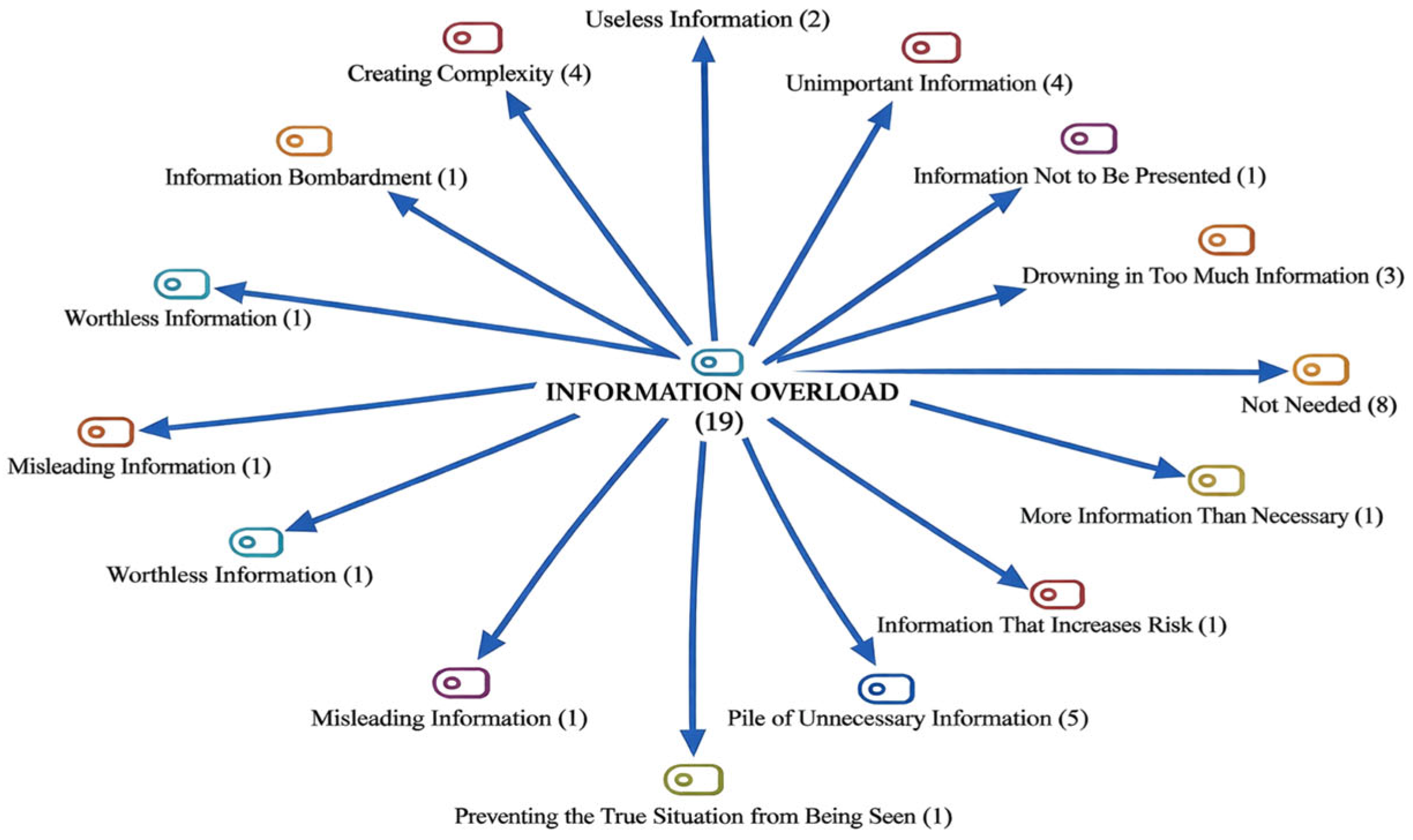
4.2.1. Category of Definitions of Information Overload
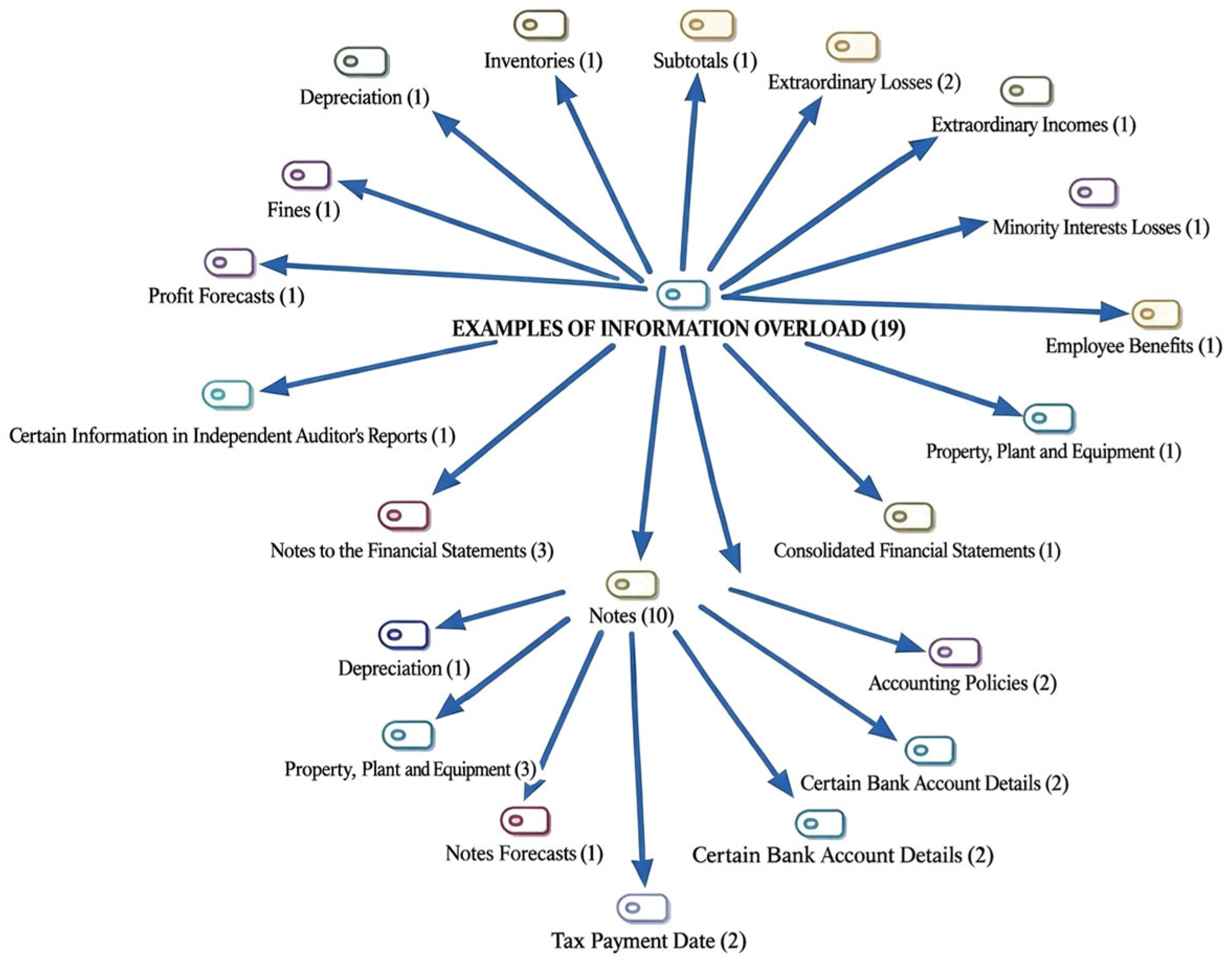
4.2.2. Category of Examples of Information Overload

4.3. Investment Decision Theme
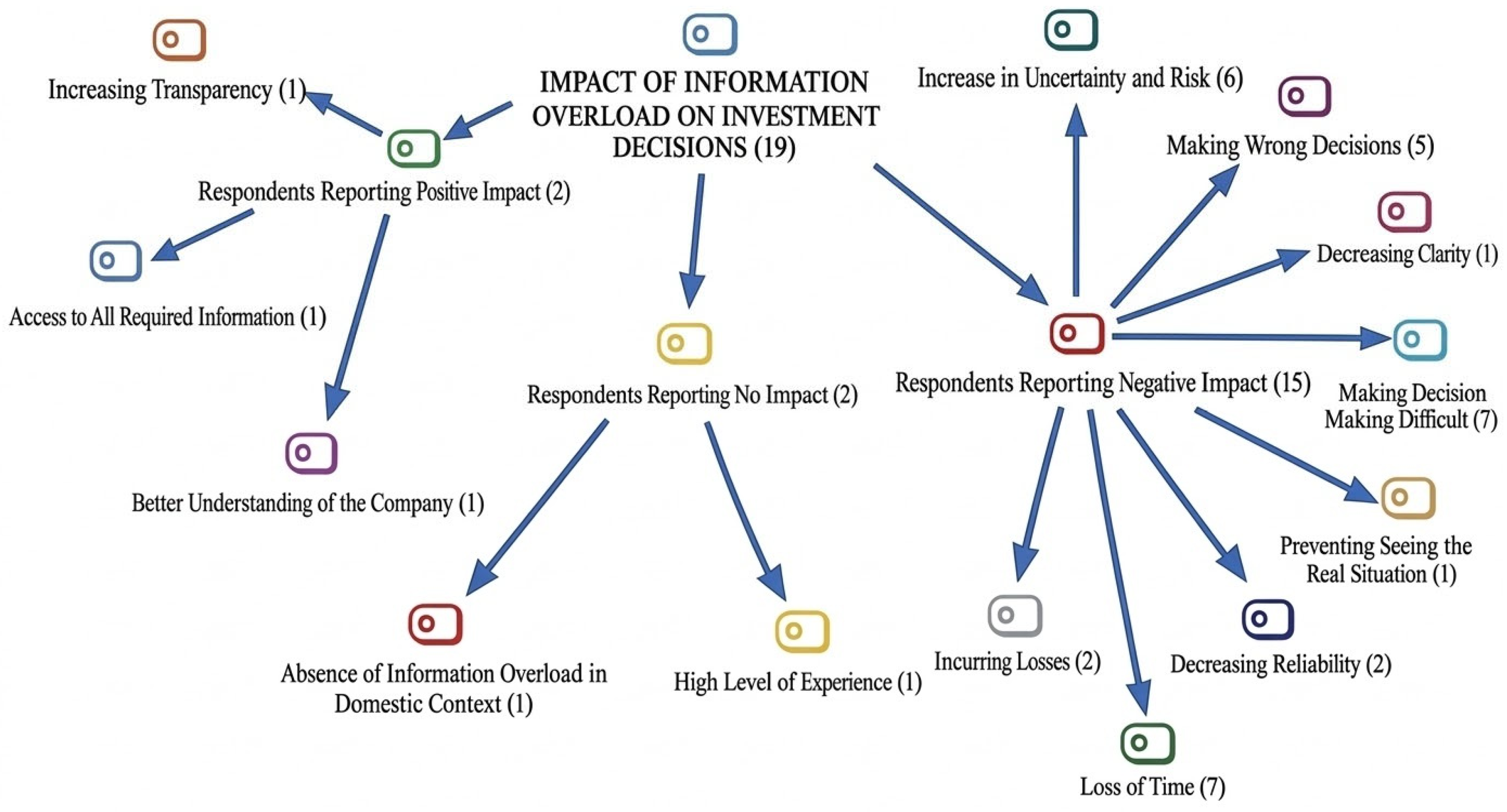
Category: The Effect of Information Overload on Investment Decisions

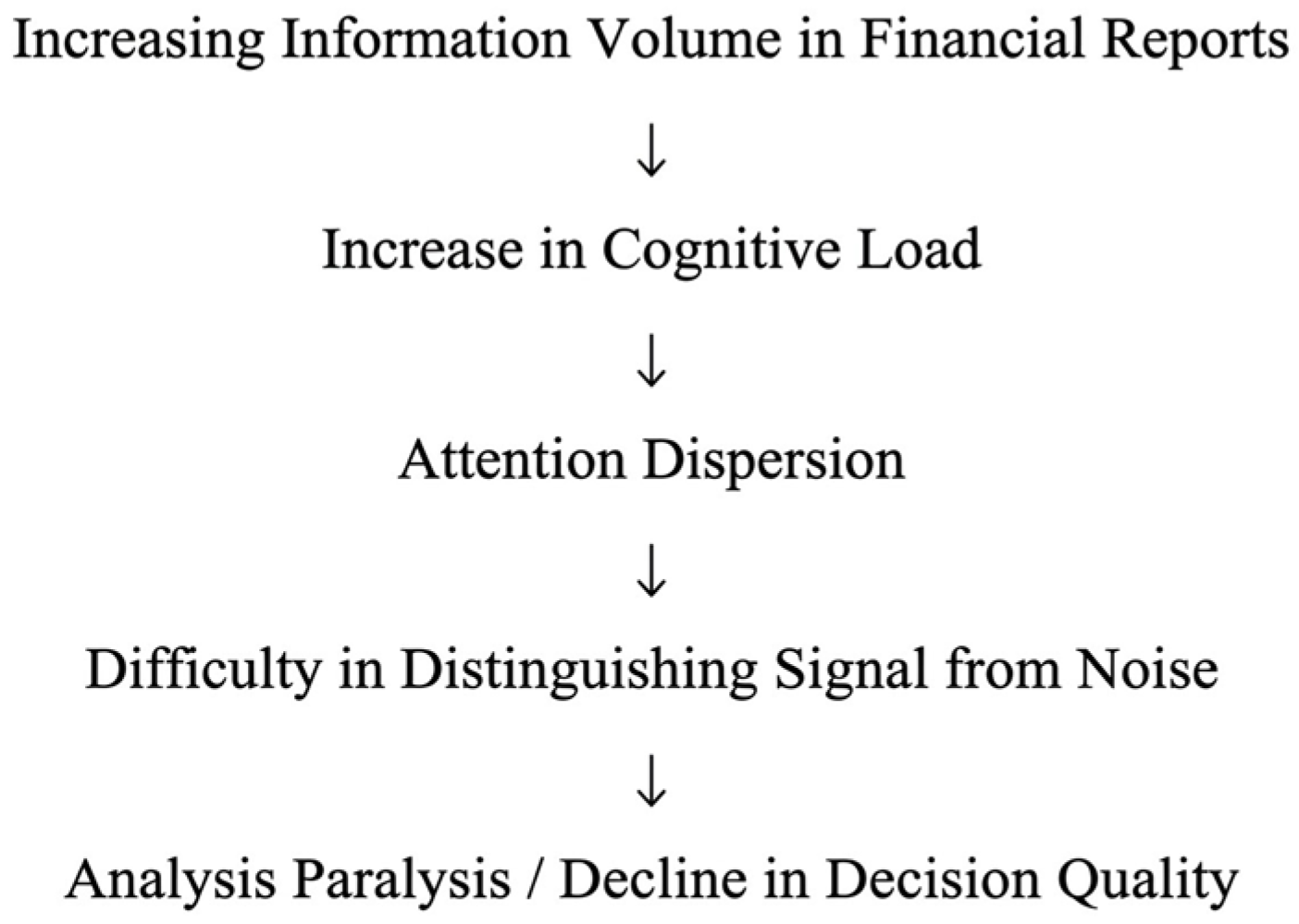
5. Discussion
6. Conclusions
Author Contributions
Funding
Institutional Review Board Statement
Informed Consent Statement
Data Availability Statement
Acknowledgments
Conflicts of Interest
Abbreviation
| IFRS 18 | International Financial Reporting Standards 18-Presentation and Disclosure in Financial Statements |
Appendix A. Semi-Structured Interview Form
- Age: _______________________________________
- Gender: ______________________________________
- Title/Position: _______________________________
- Education Level: _____________________________
- Total Professional Experience: __________________
- Tenure at Current Institution: __________________
- Interview Duration: __________________________
- What are the primary objectives of the financial statements prepared by businesses?
- What are your views on the relevance of information presented in financial statements? Which types of information do you consider relevant? Please provide examples.
- How would you evaluate the financial statements prepared in Turkey in terms of their relevance?
- What are your views on the materiality of information presented in financial statements? Which types of information do you consider material? Please provide examples.
- How would you evaluate the financial statements prepared in Turkey in terms of their materiality?
- What are your perspectives on the footnotes to financial statements?
- Do you believe that the relevance and materiality of information vary according to the type of information user (stakeholder)?
- What are the potential factors that determine the materiality of the information presented in financial statements?
- Do you believe that information failing to meet the criteria of relevance and materiality should be categorized as information overload?
- What are your thoughts regarding the presentation of excessive information in financial statements in Turkey?
- Why might businesses be providing excessive information in their financial statements? What could be their underlying objectives?
- Who holds the primary responsibility for the presentation of excessive information in financial statements?
- Do you think the perception of information overload varies depending on the type of stakeholder?
- In your opinion, does the presentation of excessive information affect the understandability or reliability of financial statements?
- Are there any existing legal regulations that prevent information overload in financial statements? If so, what are they? If not, do you believe a legal regulation should be introduced?
- Do you think that independent auditing can prevent the presentation of excessive information in financial statements?
- Which specific financial statements or financial statement items do you prioritize when making investment decisions?
- Are there any financial statements or line items that you rarely consider or completely ignore when making investment decisions? If so, which ones?
- Do you believe the information provided in financial statements is sufficient for making investment decisions?
- Does the presentation of excessive information in financial statements influence the decisions of other stakeholders? If so, how are they affected?
- Does the presentation of excessive information in financial statements have an impact on your personal investment decisions? If so, how does this situation affect your decision-making process?
References
- Aghamolla, C., & Smith, K. (2023). Strategic complexity in disclosure. Journal of Accounting and Economics, 77(2–3), 101635. [Google Scholar] [CrossRef]
- Alm El-Din, M. M. A., El-Awam, A. M., Ibrahim, F. M., & Hassanein, A. (2022). Voluntary disclosure and complexity of reporting in Egypt: The roles of profitability and earnings management. Journal of Applied Accounting Research, 23(2), 480–508. [Google Scholar] [CrossRef]
- Bawden, D., Holtham, C., & Courtney, N. (1999). Perspectives on information overload. Aslib Proceedings, 51(8), 249–255. [Google Scholar] [CrossRef]
- Bernales, A., Valenzuela, M., & Zer, I. (2023). Effects of information overload on financial markets: How much is too much? International Finance Discussion Papers (No. 1372). Board of Governors of the Federal Reserve System. [Google Scholar] [CrossRef]
- Bloomfield, R. J. (2002). The “incomplete revelation hypothesis” and financial reporting. Accounting Horizons, 16(3), 233–243. [Google Scholar] [CrossRef]
- Creswell, J. W. (2016). Nitel araştırma yöntemleri [Qualitative research methods] (M. Bütün, & S. B. Demir, Trans.). Siyasal Kitabevi. [Google Scholar]
- Dawd, I. (2018). Aggregate financial disclosure practice: Evidence from the emerging capital market of Kuwait. Journal of Applied Accounting Research, 19(4), 626–647. [Google Scholar] [CrossRef]
- Efretuei, E., & Yekini, K. (2025). Clarity and conciseness of financial narrative disclosures: Does the practice statement matter? Abacus, 61(4), 1110–1144. [Google Scholar] [CrossRef]
- Eissa, A. M., Diab, A., Almutairi, M. O., & Abdelrhman, A. N. (2024). Information overload and individual investors’ perceptions of investment risk: Evidence from Saudi Arabia. International Journal of Business and Society, 25(1), 49–67. [Google Scholar] [CrossRef]
- Eppler, M. J., & Mengis, J. (2004). The concept of information overload: A review of literature from organization science, accounting, marketing, MIS and related disciplines. The Information Society, 20(5), 325–344. [Google Scholar] [CrossRef]
- Finet, A., Kristoforidis, K., & Laznicka, J. (2025). Investor emotions and cognitive biases in a bearish market simulation: A qualitative study. Journal of Risk and Financial Management, 18(9), 493. [Google Scholar] [CrossRef]
- Fuhrmann, S. (2020). A multi-theoretical approach on drivers of integrated reporting—Uniting firm-level and country-level associations. Meditari Accountancy Research, 28(1), 168–205. [Google Scholar] [CrossRef]
- Gentles, S. J., Charles, C., Ploeg, J., & McKibbon, K. A. (2015). Sampling in qualitative research: Insights from an overview of the methods literature. The Qualitative Report, 20(11), 1772–1789. [Google Scholar] [CrossRef]
- Grohmann, A. (2018). Financial literacy and financial behavior: Evidence from the emerging Asian middle class. Pacific-Basin Finance Journal, 48, 129–143. [Google Scholar] [CrossRef]
- Handoko, B. L., Sundjaja, A. M., & Hendriana, E. (2026). Determinants of cryptocurrency investment decision: Integrating behavioural and technology perspectives. Journal of Risk and Financial Management, 19(1), 43. [Google Scholar] [CrossRef]
- Hiltz, S. R., & Turoff, M. (1985). Structuring computer-mediated communication systems to avoid information overload. Communications of the ACM, 28(7), 680–689. [Google Scholar] [CrossRef]
- Hirshleifer, D., & Teoh, S. H. (2003). Limited attention, information disclosure, and financial reporting. Journal of Accounting and Economics, 36(1–3), 337–386. [Google Scholar] [CrossRef]
- Institute of Chartered Accountants of Scotland (ICAS) & New Zealand Institute of Chartered Accountants (NZICA). (2011). Losing the excess baggage: Reducing disclosures in financial statements to make them more relevant. Available online: https://icas-com.uksouth01.umbraco.io/media/cgidj2bl/icas-losing-the-excess-baggage-2011.pdf (accessed on 1 February 2026).
- Kartini, K., & Nahda, K. (2021). Behavioral biases on investment decision: A case study in Indonesia. The Journal of Asian Finance, Economics and Business, 8(3), 1231–1240. [Google Scholar] [CrossRef]
- Klapp, O. E. (1986). Overload and boredom: Essays on the quality of life in the information society. Greenwood Press. [Google Scholar]
- Le, T. D., Hoque, A., & Le, T. (2025). Dynamic spillovers among green bond markets: The impact of investor sentiment. Journal of Risk and Financial Management, 18(8), 444. [Google Scholar] [CrossRef]
- Lowe, A., Norris, A. C., Farris, A. J., & Babbage, D. R. (2018). Quantifying thematic saturation in qualitative data analysis. Field Methods, 30(3), 191–207. [Google Scholar] [CrossRef]
- Miles, M. B., & Huberman, A. M. (1994). Qualitative data analysis: An expanded sourcebook. Sage Publications. [Google Scholar]
- Miller, G. A. (1956). The magical number seven, plus or minus two: Some limits on our capacity for processing information. Psychological Review, 63(2), 81–97. [Google Scholar] [CrossRef]
- Mishkin, F. S. (1996). Understanding financial crises: A developing country perspective (Working paper no. 5600). National Bureau of Economic Research. [Google Scholar] [CrossRef]
- Palinkas, L. A., Horwitz, S. M., Green, C. A., Wisdom, J. P., Duan, N., & Hoagwood, K. (2015). Purposeful sampling for qualitative data collection and analysis in mixed method implementation research. Administration and Policy in Mental Health and Mental Health Services Research, 42(5), 533–544. [Google Scholar] [CrossRef]
- Patton, M. Q. (2018). Nitel araştırma ve değerlendirme yöntemleri [Qualitative research and evaluation methods] (M. Bütün, & S. B. Demir, Eds. & Trans.). Pegem Akademi. [Google Scholar]
- Roetzel, P. G. (2019). Information overload in the information age: A review of the literature from business administration, business psychology, and related disciplines with a bibliometric approach and framework development. Business Research, 12(2), 479–522. [Google Scholar] [CrossRef]
- Saha, A., Morris, R. D., & Kang, H. (2019). Disclosure overload? An empirical analysis of international financial reporting standards disclosure requirements. Abacus, 55(1), 205–236. [Google Scholar] [CrossRef]
- Sattar, M. A., Toseef, M., & Sattar, M. F. (2020). Behavioral finance biases in investment decision making. International Journal of Accounting, Finance and Risk Management, 5(2), 69–75. [Google Scholar] [CrossRef]
- Schroder, H. M., Driver, M. J., & Streufert, S. (1967). Human information processing: Individuals and groups functioning in complex social situations. Holt, Rinehart and Winston. [Google Scholar]
- Simon, H. A. (1955). A behavioral model of rational choice. The Quarterly Journal of Economics, 69(1), 99–118. [Google Scholar] [CrossRef]
- Wallman, S. M. H. (1995). The future of accounting and disclosure in an evolving world: The need for dramatic change. Accounting Horizons, 9(3), 81–91. [Google Scholar]


| Characteristic | Variable | f | % |
|---|---|---|---|
| Gender | Male | 12 | 63.2 |
| Female | 7 | 36.8 | |
| Age | 21–30 | 4 | 21.1 |
| 31–40 | 8 | 42.1 | |
| 41–50 | 7 | 36.8 | |
| Years of Work Experience | 1–5 years | 7 | 36.8 |
| 6–10 years | 9 | 47.4 | |
| 11–15 years | 3 | 15.8 | |
| Years in Current Institution | 1–5 years | 14 | 73.7 |
| 6–10 years | 5 | 26.3 | |
| Educational Level | Master’s Degree | 4 | 21.1 |
| Bachelor’s Degree | 15 | 78.9 | |
| Title | Fund Manager | 2 | 10.5 |
| Financial Analysis Specialist | 3 | 15.8 | |
| Investment Advisor | 1 | 5.3 | |
| Portfolio Manager | 7 | 36.8 | |
| Assistant Portfolio Manager | 2 | 10.5 | |
| Research Director | 1 | 5.3 | |
| Marketing and Strategic Planning Officer | 1 | 5.3 | |
| Business Development and Product Management Officer | 1 | 5.3 | |
| Product Manager | 1 | 5.3 | |
| TOTAL | 19 | 100 |
| Themes | Categories | Results Derived from the Themes |
|---|---|---|
| Theme 1: Relevance | “Definitions of Relevant Information”, “Examples of Relevant Information”, “The Relevance of Information Presented in Financial Statements”, “Variation in Relevant Information by Stakeholder Type” | Participants emphasized decision-relevant elements such as profit/loss, cash flows, and debt structure, particularly in relation to forecasting and investment decision-making. Some disclosures were perceived as not contributing to the decision-making process. Perceptions of relevance were also found to vary depending on the purpose of the decision and the profile of the information user. |
| Theme 2: Materiality | “Definitions of Material Information”, “Examples of Material Information”, “The Materiality of Information Presented in Financial Statements”, “Variation in Material Information by Stakeholder Type”, “Factors Affecting the Materiality of Information” | Participants emphasized performance indicators such as gross sales profit, operating profit, net profit, cash flows, and sales as material for investment decisions. Some items were perceived as decisive, while others were considered secondary. Perceptions of materiality were also found to vary depending on stakeholder type and qualitative characteristics such as relevance, faithful representation, understandability, and timeliness. |
| Theme 3: Financial Statements and Notes | “Purpose of Preparing Financial Statements”, “Definitions of Notes”, “Presentation of Material and Relevant Information in Notes” | Participants associated financial statements with providing information and demonstrating performance. Notes were described as complementary components of financial statements. However, lengthy and highly technical note disclosures were perceived as complicating the decision-making process and, in some cases, contributing to information overload. |
| Theme 4: Information Overload | “Definitions of Information Overload”, “Examples of Information Overload”, “Information That Does Not Meet Relevance and Materiality Criteria”, “Reasons for Presenting Information Overload”, “The State of Information Overload in Türkiye”, “The Effect of Information Overload on the Understandability and Reliability of Financial Statements”, “Variation in Information Overload by Stakeholder Type”, “Legal Regulations Preventing Information Overload”, “The Role of Independent Auditing in Preventing Information Overload” | Participants described information overload as information that does not contribute to decision-making and creates unnecessary complexity. It was associated particularly with technical note disclosures and items not used in decision-making. Information that does not meet relevance and materiality criteria was also perceived as information overload. The regulatory framework and corporate image concerns were identified as key reasons for its presentation. Information overload was perceived as reducing the understandability and reliability of financial statements, with its perception varying by stakeholder type, and current regulations were considered insufficient to limit this issue. |
| Theme 5: Investment Decision | “Financial Statements and Financial Information Examined in Investment Decisions”, “Financial Statements and Financial Information Not Examined in Investment Decisions”, “Adequacy of Financial Statement Information for Investment Decisions”, “Effects of Information Overload on Investment Decisions”, “Effects of Information Overload on the Decisions of Other Stakeholders” | Participants highlighted the balance sheet, income statement, and cash flow statement as the primary financial statements used in investment decisions. Low-amount items and certain note disclosures were generally not examined. Although financial statements were considered sufficient, the growing importance of non-financial information was also emphasized. Information overload was perceived to negatively affect investment decisions by increasing decision difficulty, time costs, uncertainty, and risk perception. However, a limited number of participants indicated that higher levels of experience may mitigate these effects. |
Disclaimer/Publisher’s Note: The statements, opinions and data contained in all publications are solely those of the individual author(s) and contributor(s) and not of MDPI and/or the editor(s). MDPI and/or the editor(s) disclaim responsibility for any injury to people or property resulting from any ideas, methods, instructions or products referred to in the content. |
© 2026 by the authors. Licensee MDPI, Basel, Switzerland. This article is an open access article distributed under the terms and conditions of the Creative Commons Attribution (CC BY) license.
Share and Cite
Aktar, A.; Tekşen, Ö. Information Overload in Financial Reporting and Behavioral Decision-Making: Institutional Investors’ Perspectives. J. Risk Financial Manag. 2026, 19, 366. https://doi.org/10.3390/jrfm19050366
Aktar A, Tekşen Ö. Information Overload in Financial Reporting and Behavioral Decision-Making: Institutional Investors’ Perspectives. Journal of Risk and Financial Management. 2026; 19(5):366. https://doi.org/10.3390/jrfm19050366
Chicago/Turabian StyleAktar, Adile, and Ömer Tekşen. 2026. "Information Overload in Financial Reporting and Behavioral Decision-Making: Institutional Investors’ Perspectives" Journal of Risk and Financial Management 19, no. 5: 366. https://doi.org/10.3390/jrfm19050366
APA StyleAktar, A., & Tekşen, Ö. (2026). Information Overload in Financial Reporting and Behavioral Decision-Making: Institutional Investors’ Perspectives. Journal of Risk and Financial Management, 19(5), 366. https://doi.org/10.3390/jrfm19050366