
Artificial Intelligence in European Union Tax Administrations: A Comparative Assessment


Abstract
1. Introduction
2. Literature Review
2.1. Principal Functional Domains of AI Deployment Within Tax Administrations
2.2. Challenges in the Implementation and Use of Artificial Intelligence Within Tax Administrations
3. Data and Methodology
3.1. General Framework for Calculating the Subindices
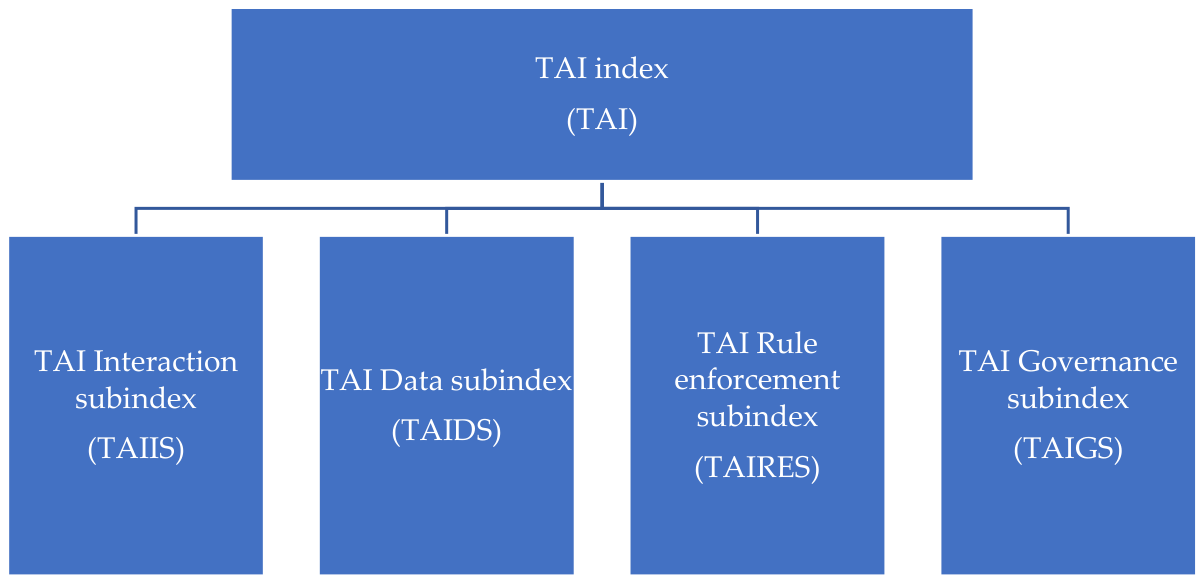
3.2. Structural Composition and Description of the Subindices
- TAI Interaction subindex
- TAI Data subindex
- TAI Rule Enforcement subindex
- TAI Governance subindex
3.3. Standardized Interpretation Framework for TAI Subindices
3.4. Internal Consistency of the Subindices
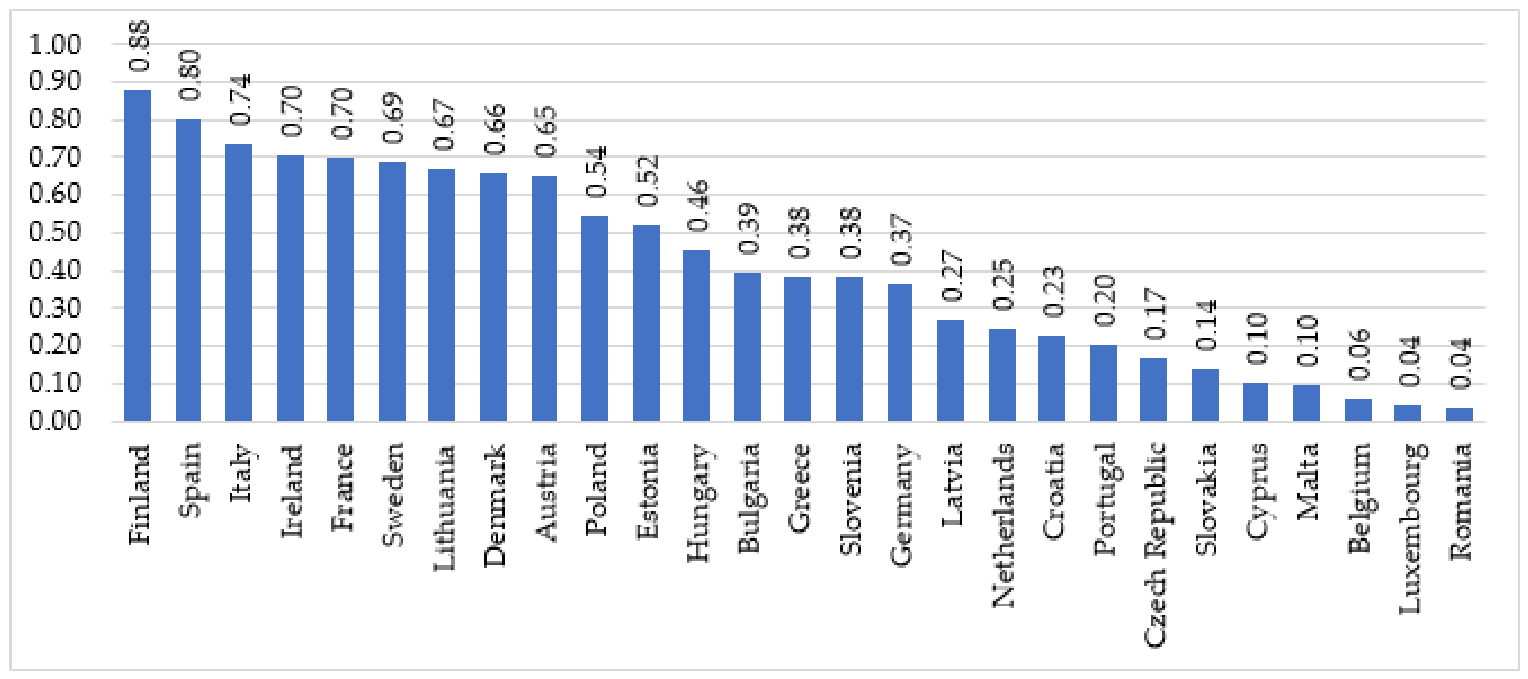
3.5. TAI
4. Results and Discussion
- Creation (establishment) of an initial framework incorporating AI;
- Consolidation, characterised by the broadening of AI applicability and the transition from process design toward practical deployment and enhancement;
- Optimization of processes and continuous improvement.
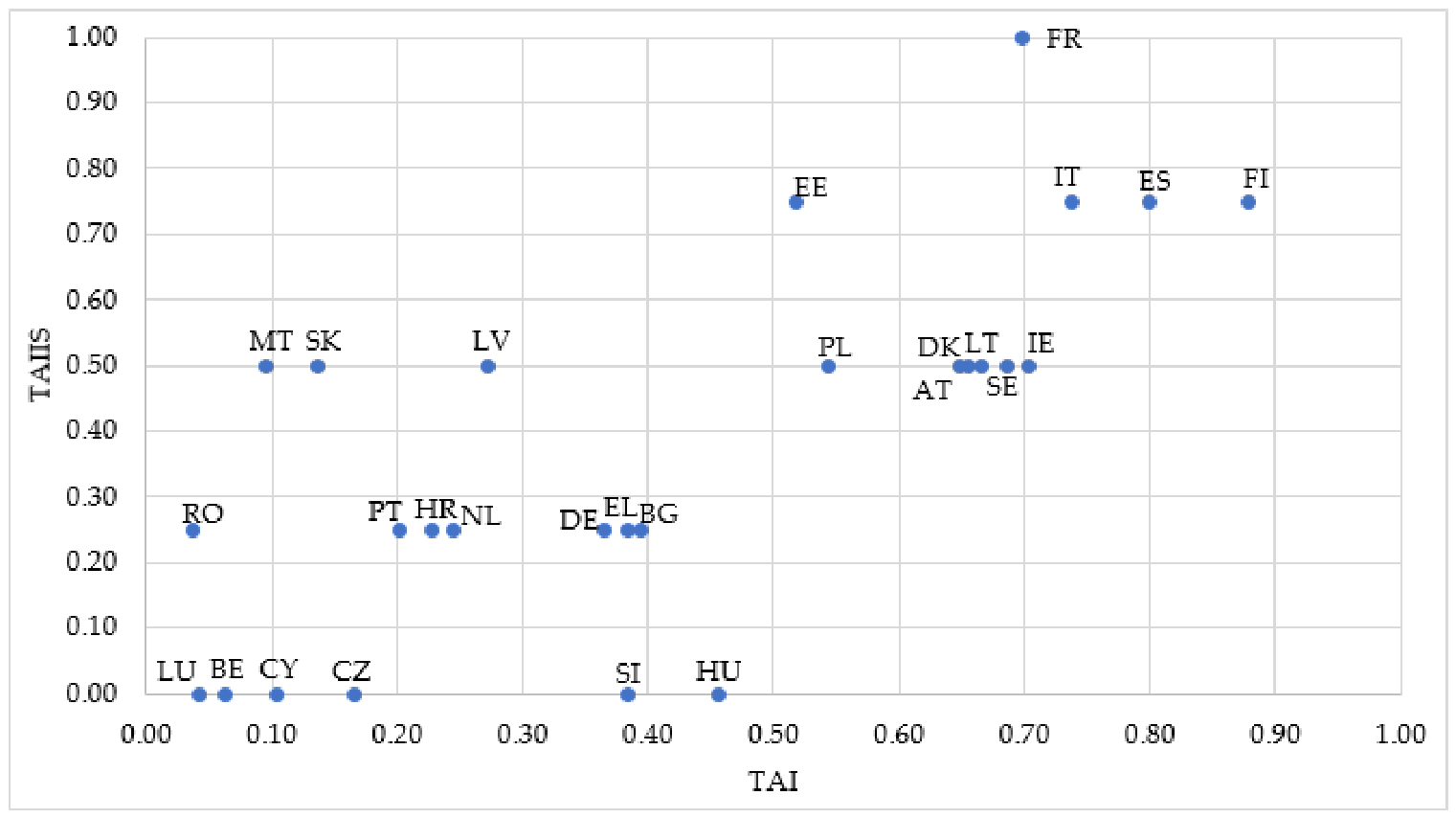
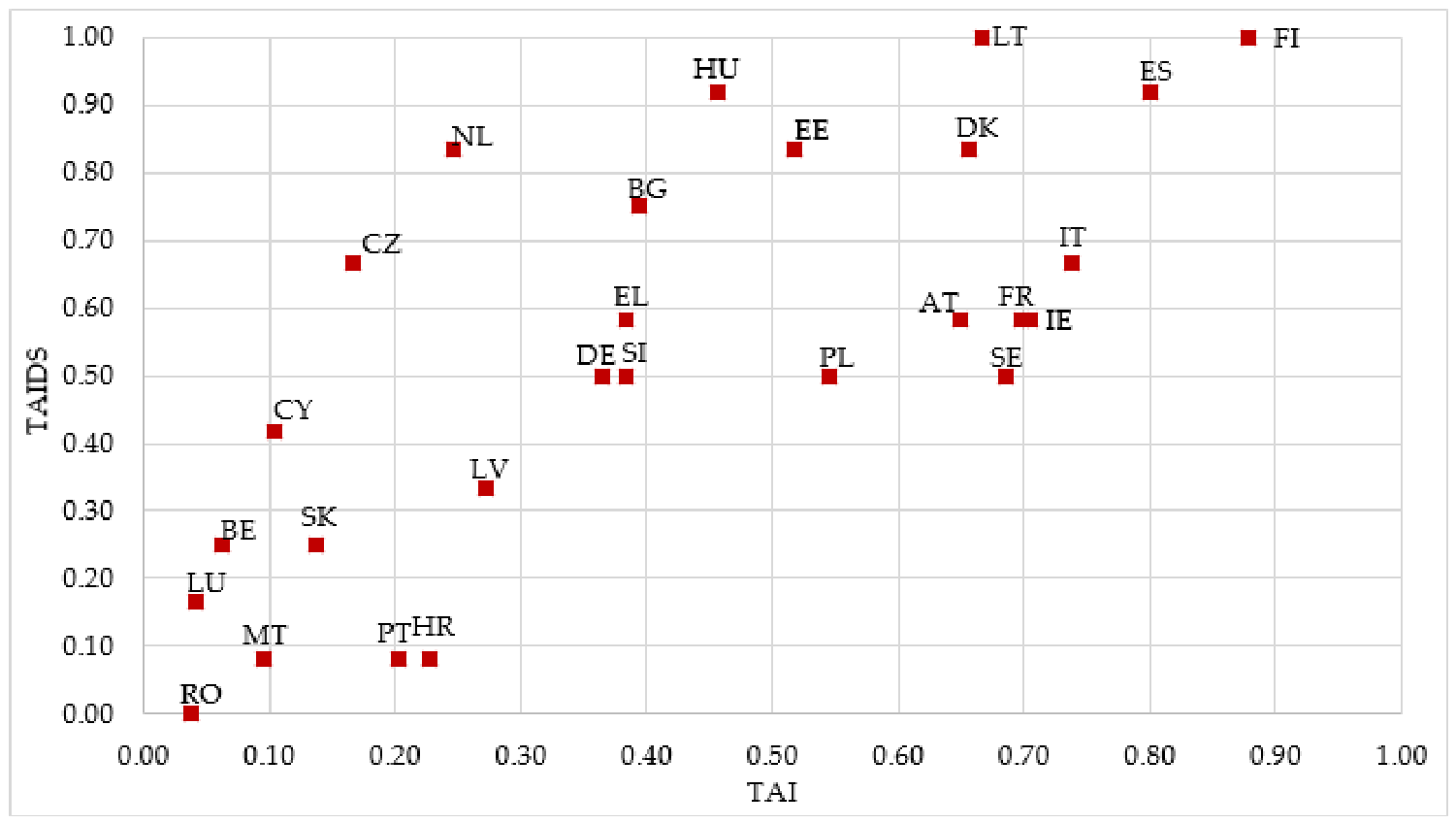
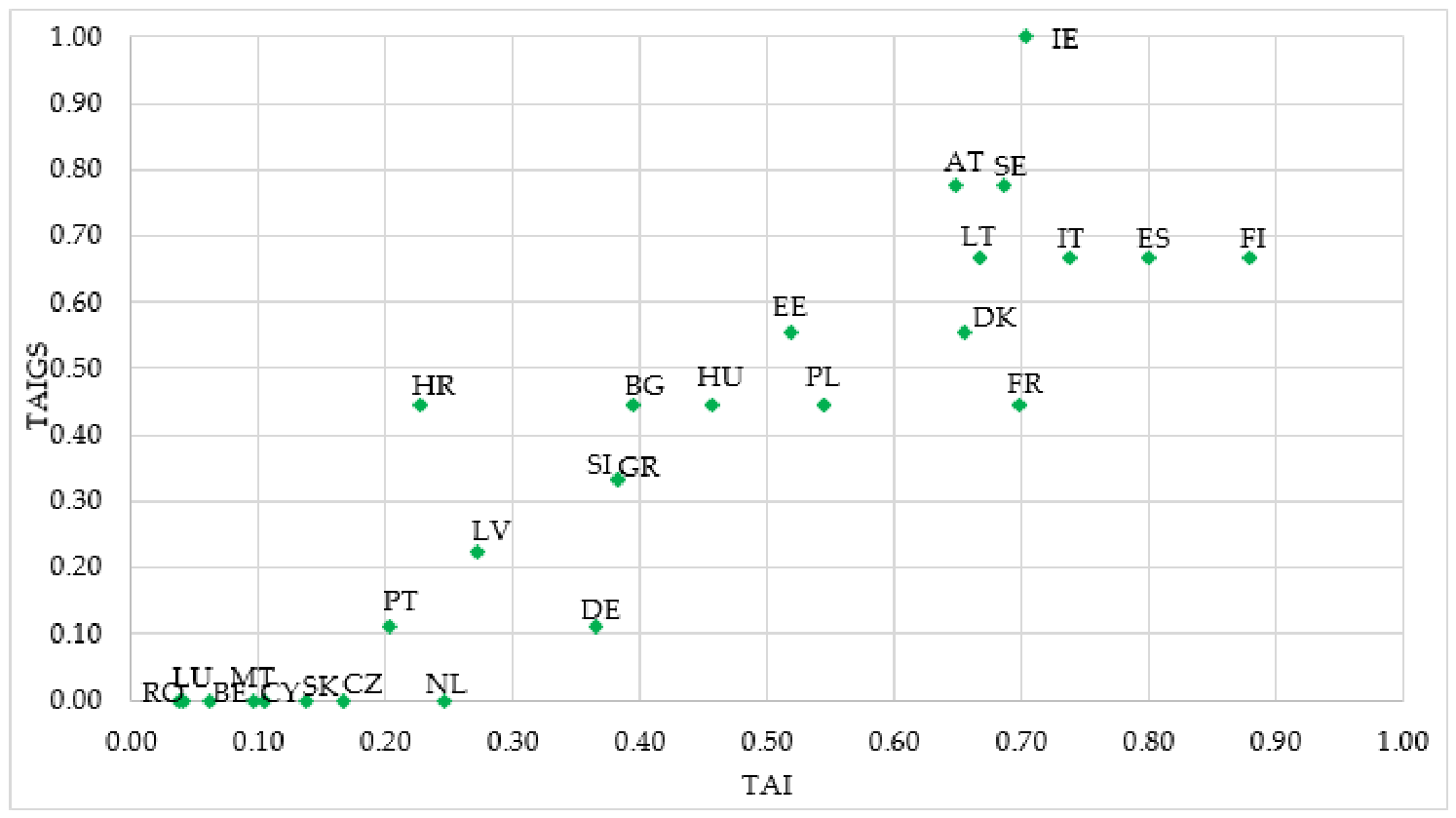
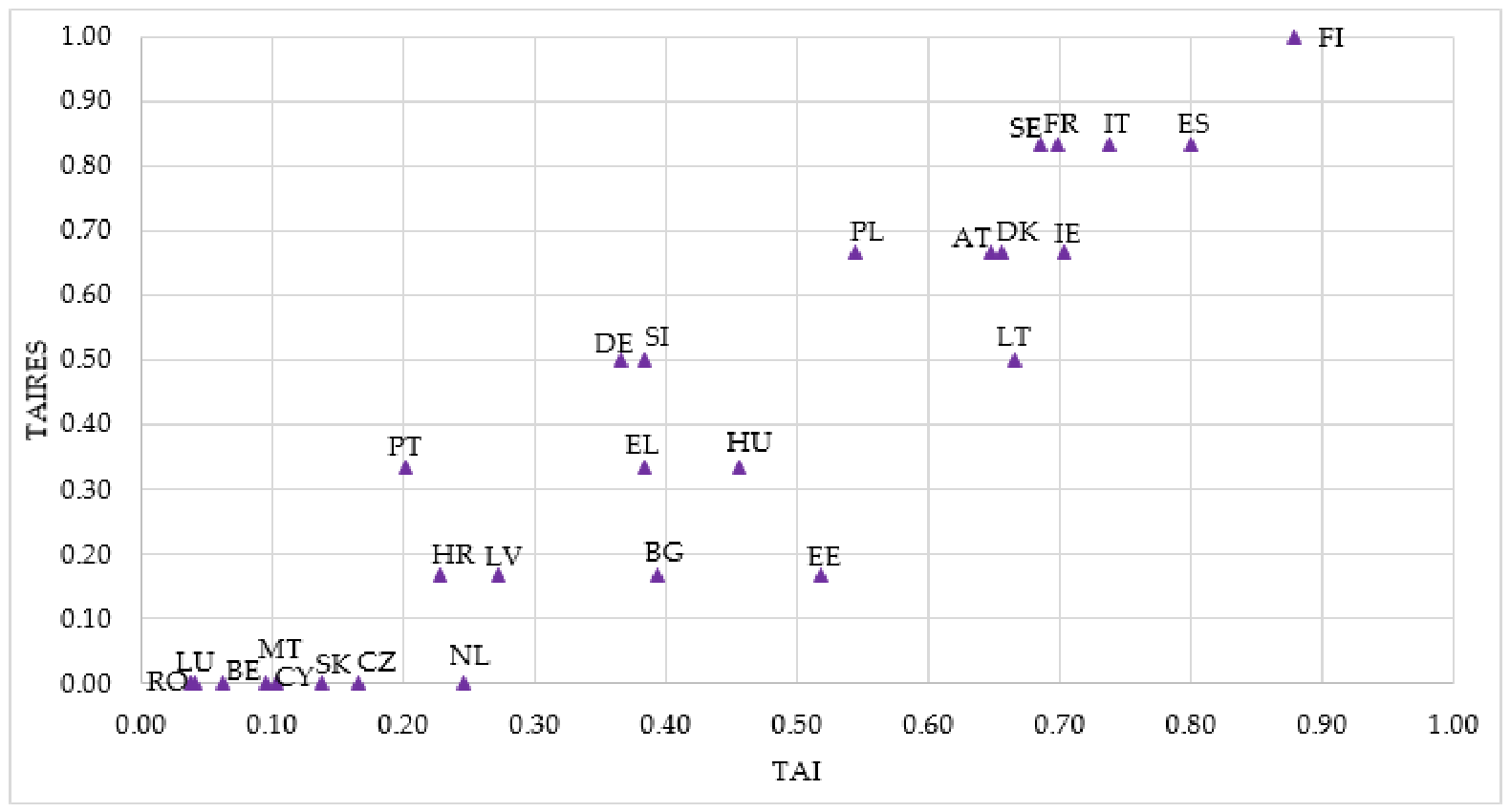
- Detailed analysis of the results by subindices
- Internal consistency of the subindices
- Robustness assessment of the composite TAI
- Contribution of the TAIIS subindex to the composite TAI
- Sensitivity of the composite TAI to subindex weighting
5. Conclusions
Funding
Institutional Review Board Statement
Informed Consent Statement
Data Availability Statement
Conflicts of Interest
Abbreviations
| AI | Artificial intelligence |
| CBA | Cost–Benefit analysis |
| DESI | Digital Economy and Society Index |
| EU | European Union |
| IOTA | Intra-European Organisation of Tax Administrations |
| ISORA | International Survey on Revenue Administration |
| OECD | Organisation for Economic Co-operation and Development |
| PACC | Predictive Analytics Competence Centre |
| TAI | Tax AI Index |
| TAIDS | TAI Data subindex |
| TAIGS | TAI Governance subindex |
| TAIIS | TAI Interaction subindex |
| TAIRES | TAI Rule enforcement subindex |
| VAT | Value-added tax |
Appendix A

| Code | Short Label of Indicators | Full Description of Indicators |
|---|---|---|
| TAIIS_1 | Rule-based virtual assistant | Virtual assistant(s) follows a set of pre-programmed rules during interactions with taxpayers |
| TAIIS_2 | AI virtual assistant (personalised) | Virtual assistant(s) uses artificial intelligence to personalise interactions with taxpayers |
| TAIIS_3 | Filing assistance | Type of interaction: To assist taxpayers during the filing of returns |
| TAIIS_4 | Other interactions | Type of interaction: Other interactions |
| TAIIS_5 | Suggested responses | Type of interaction: To suggest potential responses for incoming correspondence |
| TAIIS_6 | Live chat support (officials) | Type of interaction: To assist tax officials during live chats with taxpayers |
| TAIIS_7 | Automated service responses | Administration offers services that follow a set of pre-programmed and automated service responses during interactions with taxpayers (other than virtual assistants) |
| TAIDS_1 | AI in data governance | Administration uses artificial intelligence as part of the data governance process |
| TAIDS_2 | Real-time fraud detection | Administration uses analytics for real-time tax fraud detection and prevention |
| TAIDS_3 | AI/ML big data analysis | Administration uses artificial intelligence/machine learning as part of the big data analysis |
| TAIDS_4 | Big data for compliance | Use of big data to: Improve compliance |
| TAIDS_5 | Big data trend analysis | Use of big data to: Identify trends |
| TAIDS_6 | Policy forecasting | Use of big data to: Policy forecasting |
| TAIDS_7 | Revenue forecasting | Use of big data to: Revenue forecasting |
| TAIDS_8 | New service development | Use of big data to: Provide new services |
| TAIDS_9 | Robotic process automation | Robotic process automation |
| TAIDS_10 | Artificial intelligence use | Artificial intelligence |
| TAIDS_11 | Machine learning | Machine learning |
| TAIDS_12 | Network analysis | Network analysis |
| TAIDS_13 | DataOps approach | DataOps approach |
| TAIRES_1 | Personalised information provision | Automated provision of personalised information to stakeholders |
| TAIRES_2 | Virtual assistants (use) | Virtual assistants |
| TAIRES_3 | Risk assessment | Risk assessment processes |
| TAIRES_4 | Fraud detection | Detection of tax evasion and fraud |
| TAIRES_5 | Decision support | Assistance of tax officials in making administrative decisions |
| TAIRES_6 | Action recommendations | Making recommendations for actions |
| TAIRES_7 | Automated decisions | Making of final administrative decisions |
| TAIRES_8 | Dispute resolution | Dispute resolution |
| TAIRES_9 | System integrity | To ensure the integrity of tax administration systems/processes |
| TAIRES_10 | Other applications | Other use cases |
| TAIGS_1 | AI use limitations | Limitations exist on the use of artificial intelligence |
| TAIGS_2 | Ethical framework | Administration has an ethical framework for the application of artificial intelligence |
| TAIGS_3 | Internal code review | Administration reviews artificial intelligence source code |
| TAIGS_4 | Internal input review | Administration reviews artificial intelligence input information |
| TAIGS_5 | Internal testing | Administration probes and tests artificial intelligence responses |
| TAIGS_6 | Internal monitoring | Administration monitors artificial intelligence outputs |
| TAIGS_7 | Other internal measures | Administration takes other approaches |
| TAIGS_8 | External code review | Third party reviews artificial intelligence source code |
| TAIGS_9 | External input review | Third party reviews artificial intelligence input information |
| TAIGS_10 | External testing | Third party probes and tests artificial intelligence responses |
| TAIGS_11 | External monitoring | Third party monitors artificial intelligence outputs |
| TAIGS_12 | Other external measures | Third party takes other approaches |
Appendix B
| Country | TAIIS | TAIDS | TAIRES | TAIGS | TAI |
|---|---|---|---|---|---|
| Finland | 0.75 | 1.00 | 1.00 | 0.67 | 0.88 |
| Spain | 0.75 | 0.92 | 0.83 | 0.67 | 0.80 |
| Italy | 0.75 | 0.67 | 0.83 | 0.67 | 0.74 |
| Ireland | 0.50 | 0.58 | 0.67 | 1.00 | 0.70 |
| France | 1.00 | 0.58 | 0.83 | 0.44 | 0.70 |
| Sweden | 0.50 | 0.50 | 0.83 | 0.78 | 0.69 |
| Lithuania | 0.50 | 1.00 | 0.50 | 0.67 | 0.67 |
| Denmark | 0.50 | 0.83 | 0.67 | 0.56 | 0.66 |
| Austria | 0.50 | 0.58 | 0.67 | 0.78 | 0.65 |
| Poland | 0.50 | 0.50 | 0.67 | 0.44 | 0.54 |
| Estonia | 0.75 | 0.83 | 0.17 | 0.56 | 0.52 |
| Hungary | 0.00 | 0.92 | 0.33 | 0.44 | 0.46 |
| Bulgaria | 0.25 | 0.75 | 0.17 | 0.44 | 0.39 |
| Greece | 0.25 | 0.58 | 0.33 | 0.33 | 0.38 |
| Slovenia | 0.00 | 0.50 | 0.50 | 0.33 | 0.38 |
| Germany | 0.25 | 0.50 | 0.50 | 0.11 | 0.37 |
| Latvia | 0.50 | 0.33 | 0.17 | 0.22 | 0.27 |
| Netherlands | 0.25 | 0.83 | 0.00 | 0.00 | 0.25 |
| Croatia | 0.25 | 0.08 | 0.17 | 0.44 | 0.23 |
| Portugal | 0.25 | 0.08 | 0.33 | 0.11 | 0.20 |
| Czech Republic | 0.00 | 0.67 | 0.00 | 0.00 | 0.17 |
| Slovakia | 0.50 | 0.25 | 0.00 | 0.00 | 0.14 |
| Cyprus | 0.00 | 0.42 | 0.00 | 0.00 | 0.10 |
| Malta | 0.50 | 0.08 | 0.00 | 0.00 | 0.10 |
| Belgium | 0.00 | 0.25 | 0.00 | 0.00 | 0.06 |
| Luxembourg | 0.00 | 0.17 | 0.00 | 0.00 | 0.04 |
| Romania | 0.25 | 0.00 | 0.00 | 0.00 | 0.04 |
References
- Agencia Tributaria. (2024). Estrategia de inteligencia artificial. Available online: https://sede.agenciatributaria.gob.es/static_files/AEAT_Intranet/Gabinete/Estrategia_IA.pdf (accessed on 16 February 2026).
- Akerlof, G. (1970). The market for Lemons: Quality uncertainty and the market mechanism. Quarterly Journal of Economics, 84(3), 488–500. [Google Scholar] [CrossRef]
- Alarie, B., & McCreight, R. (2023). The ethics of generative AI in tax practice. Tax Notes Federal, 180(5), 785–793. [Google Scholar]
- Aldemir, C., & Uysal, T. U. (2025). Artificial intelligence for financial accountability and governance in the public sector: Strategic opportunities and challenges. Administrative Sciences, 15(2), 58. [Google Scholar] [CrossRef]
- Alexopoulos, A., Dellaportas, R., Gyoshev, S., Kotsogiannis, C., Olhede, S. C., & Pavkov, T. (2023). A network and machine learning approach to detect value added tax fraud. Department of Economics Athens University of Economics and Business. Working Paper no. 17-2023. Available online: https://www.dept.aueb.gr/sites/default/files/allwp-17-2023-Alex-Delap-Gyos-Kotsog-Olhe-Pavk-101023-VAT-fraud.pdf (accessed on 27 February 2026).
- AllahRakha, N. (2025). AI and corruption: Legal liability in algorithmic decision-making. Access to Justice in Eastern Europe, 8(3), 303–264. [Google Scholar] [CrossRef]
- Alm, J., & Torgler, B. (2006). Culture differences and tax morale in the United States and in Europe. Journal of Economic Psychology, 27(2), 224–246. [Google Scholar] [CrossRef]
- Anjarwi, A. W. (2026). The digital transformation of tax audits: How AI, big data, blockchain, and advanced analytics are reshaping tax evasion detection. Journal of Business Analytics, 1–12. [Google Scholar] [CrossRef]
- Ay, H. M., & Söylemez, A. (2025). Artificial Intelligence (AI) in Tax Auditing and the KURGAN application in Türkiye. Liberte Journal, 13(11), 186–204. [Google Scholar] [CrossRef]
- Ballas, P., & Kolovou, V. (2024). Leveraging artificial intelligence to enhance performance in tax administration. IOTA Paper. Intra-European Organisation of Tax Administrations. Available online: https://www.iota-tax.org/ngsite/content/download/63627/441888 (accessed on 1 March 2026).
- Bankole, A., Osamor, I., & Bamgboye, A. (2025). Effects of artificial intelligence on tax administration in Lagos state. The Journal of Accounting and Management, 15(2), 144–160. [Google Scholar]
- Battaglini, M., Guiso, L., Lacava, C., Miller, D. L., & Patacchini, E. (2025). Refining public policies with machine learning: The case of tax auditing. Journal of Econometrics, 249, 105847. [Google Scholar] [CrossRef]
- Belahouaoui, R., & Alm, J. (2025). Tax fraud detection using artificial intelligence-based technologies: Trends and implications. Journal of Risk and Financial Management, 18(9), 502. [Google Scholar] [CrossRef]
- Bensaci, N., & Knenouf, A. (2026). Challenges of artificial intelligence adoption in tax administration. Journal of Ecohumanism, 4(4), 2907–2921. [Google Scholar] [CrossRef]
- Boguski, A. (2025). Ethical, legal, and socioeconomic aspects of implementing artificial intelligence in tax administration. Acta Universitatis Lodziensis. Folia Iuridica, 110, 19–36. [Google Scholar] [CrossRef]
- Bundesministerium für Finanzen. (2025). Finanzministerium lukrierte im Vorjahr 354 Mio. Euro Steuermehreinnahmen dank KI-Methoden. Available online: https://www.bmf.gv.at/presse/pressemeldungen/2025/august/pacc-ki.html (accessed on 21 February 2026).
- Butt, J. S. (2024). A comparative study about the use of Artificial Intelligence (AI) in public administration of Nordic states with other European economic sectors. EuroEconomica, 43(1), 40–66. Available online: https://dj.univ-danubius.ro/index.php/EE/article/view/2740 (accessed on 4 April 2026).
- Campion, A., Gasco-Hernandez, M., Jankin Mikhaylov, S., & Esteve, M. (2022). Overcoming the challenges of collaboratively adopting artificial intelligence in the public sector. Social Science Computer Review, 40(2), 462–477. [Google Scholar] [CrossRef]
- Chen, J., Grimshaw, S., & Myles, G. D. (2017). Testing and implementing digital tax administration. In S. Gupta, M. Keen, A. Shah, & G. Verdier (Eds.), Digital revolutions in public Finance. International Monetary Fund. [Google Scholar] [CrossRef]
- De La Feria, R., & Grau Ruiz, M. A. (2022). The robotization of tax administration. In M. A. Grau Ruiz (Ed.), Interactive robotics: Legal, ethical, social and economic aspects: Selected contributions to the INBOTS. Conference 2021, 18–20 May 2021. Biosystems & Biorobotics (Vol. 30, pp. 115–123). Springer Nature. [Google Scholar] [CrossRef]
- Dener, C., Nii-Aponsah, H., Ghunney, L. E., & Johns, K. D. (2021). GovTech maturity index. The state of public sector digital transformation. The World Bank Group. [Google Scholar] [CrossRef]
- Direction générale des Finances publiques. (2024). Annual Report 2023—The DGFiP at the heart of government, working for all nationwide. Ministère de l’Économie, des Finances et de la Souveraineté industrielle et numérique. Available online: https://www.economie.gouv.fr/files/files/directions_services/dgfip/Rapport/2023/ra_2023_en.pdf (accessed on 19 February 2026).
- Direction générale des Finances publiques. (2025). Annual Report 2024—The DGFiP at the heart of government, working for all nationwide. Ministère de l’Économie, des Finances et de la Souveraineté industrielle et numérique. Available online: https://www.economie.gouv.fr/files/files/directions_services/dgfip/Rapport/2024/ra_2024_en.pdf (accessed on 19 February 2026).
- Directorate-General for Structural Reform Support. (2023). Revenue administration’s strategy on artificial intelligence—Final report. Available online: https://reforms-investments.ec.europa.eu/document/download/72e6479d-fe63-4b3c-846a-035a42e1479d_en?filename=Revenue%20Administration%20Strategy%20on%20Artificial%20Intelligence.pdf&prefLang=fr (accessed on 19 February 2026).
- Djellaba, A., Atrous, S. E., & Osman, A. A. M. (2024). Artificial intelligence in tax administration: Benefits and challenges. Available online: https://www.researchgate.net/publication/387585676_An_Exploration_of_Artificial_Intelligence_Techniques_for_Optimizing_Tax_Compliance_Fraud_Detection_and_Revenue_Collection_in_Modern_Tax_Administrations (accessed on 22 February 2026).
- European Commission. (2025a). Digital decade 2025: eGovernment benchmark 2025. Available online: https://digital-strategy.ec.europa.eu/en/library/digital-decade-2025-egovernment-benchmark-2025 (accessed on 13 April 2026).
- European Commission. (2025b). Mind the gap—Challenges and opportunities for tax compliance and tax expenditures in the EU—Full report. Publications Office of the European Union. Available online: https://data.europa.eu/doi/10.2778/4778590 (accessed on 15 February 2026).
- European Union. (2016). Regulation (EU) 2016/679 of the European parliament and of the council of 27 April 2016 on the protection of natural persons with regard to the processing of personal data and on the free movement of such data, and repealing Directive 95/46/EC (General Data Protection Regulation). Official Journal of the European Union, L 119, 4 May 2016. Available online: https://eur-lex.europa.eu/eli/reg/2016/679/oj (accessed on 20 February 2026).
- European Union. (2024). Regulation (EU) 2024/1689 of the European parliament and of the council of 13 June 2024 laying down harmonised rules on artificial intelligence (Artificial intelligence act). Official Journal of the European Union L 2024/1689, 12 July 2024. Available online: https://eur-lex.europa.eu/eli/reg/2024/1689/oj (accessed on 20 February 2026).
- Eurostat. (2026). Artificial intelligence by size class of enterprise. Available online: https://ec.europa.eu/eurostat/databrowser/view/isoc_eb_ai/default/table?lang=en (accessed on 4 April 2026).
- Faúndez-Ugalde, A., Mellado-Silva, R., & Aldunate-Lizana, E. (2020). Use of artificial intelligence by tax administrations: An analysis regarding taxpayers’ rights in Latin American countries. Computer Law & Security Review, 38, 105441. [Google Scholar] [CrossRef]
- Gabriel, J., Lincoln, I., & Missen, M. M. S. (2025). Integrating AI with tax policy to accelerate economic development in digital economies. Available online: https://www.researchgate.net/publication/397740976_Integrating_AI_with_Tax_Policy_to_Accelerate_Economic_Development_in_Digital_Economies?channel=doi&linkId=691d628dde81430982723618&showFulltext=true (accessed on 14 February 2026).
- Guglyuvatyy, E. (2025). Balancing innovation and integrity: AI in tax administration and taxpayer rights. Humanities and Social Sciences Communications, 12, 1818. [Google Scholar] [CrossRef]
- Gupta, K. P. (2019). Artificial intelligence for governance in India: Prioritizing the challenges using analytic hierarchy process (AHP). International Journal of Recent Technology and Engineering (IJRTE), 9(2), 3756–3762. [Google Scholar] [CrossRef]
- Han, N., Xu, W., Song, Q., Zhao, K., & Xu, Y. (2025). Application of interpretable Artificial Intelligence for sustainable tax management in the manufacturing industry. Sustainability, 17(3), 1121. [Google Scholar] [CrossRef]
- Hossain, M. Z., Hasan, L., Kumu, R. A., Bepari, M., & Sultana, S. (2025). The role of artificial intelligence in taxation and compliance: Challenges and future prospects. European Journal of Science and Modern Technologies, 1(6), 73–85. [Google Scholar] [CrossRef]
- Hristov, G. (2025, October). Artificial intelligence and tax administration in Bulgaria. In 3rd scientific conference “Innovative information technologies for economy digitalization” (IITED–2025) (pp. 262–265). UNWE. Available online: https://www.unwe.bg/doi/iited/2025/IITED.2025.33.pdf (accessed on 19 February 2026).
- International Monetary Fund. (n.d.). ISORA latest data (ISORA: ISORA_LATEST_DATA_PUB) [Data set]. IMF Data Explorer. Available online: https://data.imf.org/en/Data-Explorer?datasetUrn=ISORA:ISORA_LATEST_DATA_PUB(4.0.0) (accessed on 26 February 2026).
- Islam, M. I., Ansarullah, S. I., Nisa, K. U., Ikhlaq, S., Mufti, S., & Yousuf, T. (2025). Artificial intelligence in tax compliance: Transforming taxpayer behavior and system efficiency. In B. Alj, L. Alla, & B. Bentalha (Eds.), Modeling and profiling taxpayer behavior and compliance (pp. 251–270). IGI Global Scientific Publishing. [Google Scholar]
- Janssen, M., Brous, P., Estevez, E., Barbosa, L. S., & Janowski, T. (2020). Data governance: Organizing data for trustworthy artificial intelligence. Government Information Quarterly, 37(3), 101493. [Google Scholar] [CrossRef]
- Jiménez, A., & Mółka, M. (2025). The use of artificial intelligence tools by tax administration on the example of Poland and Spain. Teka Komisji Prawniczej PAN Oddział W Lublinie, 18(1), 255–265. [Google Scholar] [CrossRef]
- Jobin, A., Ienca, M., & Vayena, E. (2019). The global landscape of AI ethics guidelines. Nature Machine Intelligence, 1, 389–399. [Google Scholar] [CrossRef]
- Junquera, R., Krsul, I., Calderón, V., Ghaleb, J., & Lucas, C. (2025). From theory to practice: A strategic AI integration model for revenue administrations. Prosperity Insight Series. International Bank for Reconstruction and Development/The World Bank. Available online: https://documents1.worldbank.org/curated/en/099071025155040812/pdf/P505930-22d00dc3-5bb0-4f32-8adf-76e8622fbd1d.pdf (accessed on 17 February 2026).
- Kroll, J. A., Huey, J., Barocas, S., Felten, E. W., Reidenberg, J. R., Robinson, D. G., & Yu, H. (2017). Accountable algorithms. University of Pennsylvania Law Review, 165(3), 633–705. Available online: https://repository.law.upenn.edu/Documents/Detail/accountable-algorithms/155735 (accessed on 2 April 2026).
- Laffont, J.-J., & Martimort, D. (2002). The theory of incentives: The principal-agent model. Princeton University Press. [Google Scholar]
- Lin, Y., Wong, K., Wang, Y., Zhang, R., Dong, B., Qu, H., & Zheng, Q. (2021). TaxThemis: Interactive mining and exploration of suspicious tax evasion groups. IEEE Transactions on Visualization & Computer Graphics, 27(2), 849–859. [Google Scholar] [CrossRef]
- López, C. P., Rodríguez, M. J. D., & Santos, S. L. (2019). Tax fraud detection through neural networks: An application using a sample of personal income taxpayers. Future Internet, 11(4), 86. [Google Scholar] [CrossRef]
- Maragno, G., Tangi, L., Gastaldi, L., & Benedetti, M. (2023). Exploring the factors, affordances and constraints outlining the implementation of Artificial Intelligence in public sector organizations. International Journal of Information Management, 73, 102686. [Google Scholar] [CrossRef]
- Martinez, A. L. (2025). Artificial intelligence in tax administration: Enhancing compliance, transparency, and ethical governance. Available online: https://papers.ssrn.com/sol3/papers.cfm?abstract_id=5285760 (accessed on 12 February 2026).
- Mergel, I., Edelmann, N., & Haug, N. (2019). Defining digital transformation: Results from expert interviews. Government Information Quarterly, 36(4), 101385. [Google Scholar] [CrossRef]
- Min, W., & Yanting, C. (2018). The Challenges and countermeasures of tax collection and administration in China under the background of “Internet +”. In proceedings of the fifth international conference on public management: International collaboration for innovated public governance (ICPM 2018), Kumming, China (pp. 78–85). Atlantis Press. [Google Scholar] [CrossRef]
- Mökander, J., & Schroeder, R. (2024). Artificial intelligence, rationalization, and the limits of control in the public sector: The case of tax policy optimization. Social Science Computer Review, 42(6), 1359–1378. [Google Scholar] [CrossRef]
- Mpofu, F. Y. (2024). Prospects, challenges and implications of deploying artificial intelligence in tax administration in developing countries. Studia Universitatis Babes Bolyai Negotia, 69(3), 39–78. [Google Scholar] [CrossRef]
- Munjeyi, E., & Schutte, D. (2024). Examining the critical success factors influencing the diffusion of AI in tax administration in Botswana. Cogent Social Sciences, 10(1), 2419537. [Google Scholar] [CrossRef]
- Nieto Olvera, P. D. (2025). Artificial intelligence and algorithms in tax auditing by the tax administration service in Mexico: Analysis of potential biases. International Journal for Public Policy, Law and Development, 2(3), 18–33. Available online: https://ijpld.com/ijpld/article/view/42 (accessed on 20 February 2026).
- Nikolova, V. (2024). Significance of global public goods in the light of increasing global risks. The Scientific Papers of UNWE, (4), 105–118. Available online: https://www.unwe.bg/doi/researchpapers/2024.4/RP.2024.4.07.pdf (accessed on 26 February 2026).
- Nyok, D. K. A. (2025). The impact of artificial intelligence on tax compliance and fraud detection: Opportunities and challenges for revenue authorities. International Journal of Economics, Commerce and Management, 13(12), 169–178. [Google Scholar]
- OECD. (n.d.). Inventory of tax technology initiatives. Available online: https://www.oecd.org/en/data/datasets/inventory-of-tax-technology-initiatives.html (accessed on 21 January 2026).
- OECD. (2016). Advanced analytics for better tax administration: Putting data to work. OECD Publishing. [Google Scholar] [CrossRef]
- OECD. (2017). Tax administration 2017: Comparative information on OECD and other advanced and emerging economies. OECD Publishing. [Google Scholar] [CrossRef]
- OECD. (2019). Recommendation of the council on artificial intelligence. OECD/LEGAL/0449 Adopted on: 22/05/2019, Amended on: 03/05/2024. Available online: https://legalinstruments.oecd.org/en/instruments/OECD-LEGAL-0449 (accessed on 22 February 2026).
- OECD. (2020). Tax administration 3.0: The digital transformation of tax administration. OECD Publishing. [Google Scholar] [CrossRef]
- OECD. (2023). Tax administration 2023: Comparative information on OECD and other advanced and emerging economies. OECD Publishing. [Google Scholar] [CrossRef]
- OECD. (2025a). Governing with Artificial Intelligence: The state of play and way forward in core government functions. OECD Publishing. [Google Scholar] [CrossRef]
- OECD. (2025b). Tax administration 2025: Comparative information on OECD and other advanced and emerging economies. OECD Publishing. [Google Scholar] [CrossRef]
- Onet, C. (2025). The use of AI in tax administration, A security risk or an opportunity for Romania’s development? Studia Securitatis Journal, 19(2), 235–248. [Google Scholar] [CrossRef]
- Pamisetty, V. (2025). Fiscal intelligence: Harnessing artificial intelligence and analytics for modern tax governance. Deep Science Publishing. [Google Scholar] [CrossRef]
- Peeters, B. (2024). Editorial: European law restrictions on tax authorities’ use of artificial intelligence systems: Reflections on some recent developments. EC Tax Review, 33(2), 54–57. [Google Scholar] [CrossRef]
- Pica, L. M. (2021). The new challenges of artificial intelligence, profiling and big data analysis by tax administrations: Will the right to meet these new challenges be shown? In M. J. Sousa, & M. A.-Y. Oliveira (Eds.), Top 10 challenges of big data analytics (pp. 87–102). Nova Science Publishers, Inc. [Google Scholar]
- Pîrvu, D., Duţu, A., & Mogoiu, C. M. (2021). Clustering tax administrations in European Union member states. Transylvanian Review of Administrative Sciences, 63E, 110–127. [Google Scholar] [CrossRef]
- Rahman, S., Khan, R. S., Sirazy, M. R. M., & Das, R. (2024). An exploration of artificial intelligence techniques for optimizing tax compliance, fraud detection, and revenue collection in modern tax administrations. International Journal of Business Intelligence and Big Data Analytics, 7(3), 56–80. [Google Scholar]
- Rekunenko, I., Kobushko, I., Dzydzyguri, O., Balahurovska, I., Yurynets, O., & Zhuk, O. (2025). The use of artificial intelligence in public administration: Bibliometric analysis. Problems and Perspectives in Management, 23(1), 209–224. [Google Scholar] [CrossRef]
- Richmond, K. M., Muddamsetty, S. M., Gammeltoft-Hansen, T., Olsen, H. P., & Moeslund, T. B. (2023). Explainable AI and law: An evidential survey. Digital Society, 3(1), 1. [Google Scholar] [CrossRef]
- Salah, A. S., & Awwad, B. S. (2024). A theoretical review of artificial intelligence and tax compliance. In A. Hamdan (Ed.), Achieving sustainable business through AI, technology education and computer science. Studies in big data. 163. Springer. [Google Scholar] [CrossRef]
- Shakil, M. H., & Tasnia, M. (2022). Artificial intelligence and tax administration in Asia and the pacific. In N. Hendriyetty, C. Evans, C. J. Kim, & F. Taghizadeh-Hesary (Eds.), Taxation in the digital economy. New models in Asia and the pacific (1st ed., pp. 45–55). Routledge Studies in Development Economics. [Google Scholar] [CrossRef]
- Stoyanov, S. (2024). Using artificial intelligence to improve the efficiency of the market valuation method. Finance, Accounting and Business Analysis (FABA), 6(2), 217–227. [Google Scholar] [CrossRef]
- Sun, T. Q., & Medaglia, R. (2019). Mapping the challenges of Artificial Intelligence in the public sector: Evidence from public healthcare. Government Information Quarterly, 36(2), 368–383. [Google Scholar] [CrossRef]
- TaxAdmin.AI. (n.d.). Country reports. Available online: https://taxadmin.ai/country-reports/ (accessed on 23 January 2026).
- Tilaganboev, J. (2026). International legal standards for protecting taxpayer rights in the context of digital tax administration. Stanford Database Library of International Journal of Law and Criminology, 6(2), 32–41. [Google Scholar] [CrossRef]
- Ulaşan, F. (2023). The dark side of artificial intelligence on the basis of public administration. Toplum Ekonomi Ve Yönetim Dergisi, 4(Özel), 301–323. [Google Scholar] [CrossRef]
- Van Duc, N., Chau, T. T. M., Long, P. H., Nhung, L. T. C., Huy, B. Q., Bin, Z., & Yusof, A. F. B. H. (2024). Modernizing taxation, fraud detection, and revenue management in public institutions using AI-driven approaches. Available online: https://www.researchgate.net/profile/Zainuddin-Bin-Yusof/publication/387756419_Modernizing_Taxation_Fraud_Detection_and_Revenue_Management_in_Public_Institutions_Using_AI-Driven_Approaches/links/677bfe67e74ca64e1f504308/Modernizing-Taxation-Fraud-Detection-and-Revenue-Management-in-Public-Institutions-Using-AI-Driven-Approaches.pdf (accessed on 5 April 2026).
- Van Noordt, C., Misuraca, G., Mortati, M., Rizzo, F., & Timan, T. (2020). AI watch—Artificial intelligence for the public sector—Report of the “1st peer learning workshop on the use and impact of AI in public services”, Brussels 11–12 February 2020. Publications Office of the European Union. [Google Scholar] [CrossRef]
- Vatamanu, A. F., & Tofan, M. (2025). Integrating artificial intelligence into public administration: Challenges and vulnerabilities. Administrative Sciences, 15(4), 149. [Google Scholar] [CrossRef]
- Veale, M., & Brass, I. (2019). Administration by algorithm? Public Management meets public sector machine learning. Available online: https://discovery.ucl.ac.uk/id/eprint/10072507/1/VealeBrass.pdf (accessed on 4 April 2026).
- Wirtz, B. W., Weyerer, J. C., & Geyer, C. (2019). Artificial Intelligence and the public sector—Applications and challenges. International Journal of Public Administration, 42(7), 596–615. [Google Scholar] [CrossRef]
- Yalamati, S. (2023). Identify fraud detection in corporate tax using Artificial Intelligence advancements. International Journal of Machine Learning for Sustainable Development, 5(2), 1–15. Available online: https://ijsdcs.com/index.php/IJMLSD/article/view/468/188 (accessed on 5 April 2026).
- Yordanova, Z. (2024). Ethical implications of transparency and explainability of artificial intelligence for managing Value-Added Tax (VAT) in corporations. In T. Guarda, F. Portela, & J. M. Diaz-Nafria (Eds.), Advanced research in technologies, information, innovation and sustainability. ARTIIS 2023. Communications in computer and information science (Vol. 1936, pp. 344–353). Springer. [Google Scholar] [CrossRef]
- Zheng, S., Trott, A., Srinisava, S., Parkes, D. C., & Socher, R. (2022). The AI Economist: Taxation policy design via two-level deep multiagent reinforcement learning. Science Advances, 8(18), eabk2607. [Google Scholar] [CrossRef]
- Zhou, L. (2019). Opportunities and challenges of artificial intelligence in the application of taxation system. In 2019 international conference on economic management and cultural industry (ICEMCI 2019) (pp. 201–206). Atlantis Press. [Google Scholar][Green Version]
- Ziemba, E., Papaj, T., Żelazny, R., & Jadamus-Hacura, M. (2016). Factors influencing the success of E-Government. Journal of Computer Information Systems, 56(2), 156–167. [Google Scholar] [CrossRef]
- Zuiderwijk, A., Chen, Y.-C., & Salem, F. (2021). Implications of the use of artificial intelligence in public governance: A systematic literature review and a research agenda. Government Information Quarterly, 38(3), 101577. [Google Scholar] [CrossRef]



| TAIIS | TAIDS | ||
| TAIIS_1 | Rule-based virtual assistant | TAIDS_1 | AI in data governance |
| TAIIS_2 | AI virtual assistant (personalised) | TAIDS_2 | Real-time fraud detection |
| TAIIS_3 | Filing assistance | TAIDS_3 | AI/ML big data analysis |
| TAIIS_4 | Other interactions | TAIDS_4 | Big data for compliance |
| TAIIS_5 | Suggested responses | TAIDS_5 | Big data trend analysis |
| TAIIS_6 | Live chat support (officials) | TAIDS_6 | Policy forecasting |
| TAIIS_7 | Automated service responses | TAIDS_7 | Revenue forecasting |
| TAIDS_8 | New service development | ||
| TAIDS_9 | Robotic process automation | ||
| TAIDS_10 | Artificial intelligence use | ||
| TAIDS_11 | Machine learning | ||
| TAIDS_12 | Network analysis | ||
| TAIDS_13 | DataOps approach | ||
| TAIRES | TAIGS | ||
| TAIRES_1 | Personalised information provision | TAIGS_1 | AI use limitations |
| TAIRES_2 | Virtual assistants (use) | TAIGS_2 | Ethical framework |
| TAIRES_3 | Risk assessment | TAIGS_3 | Internal code review |
| TAIRES_4 | Fraud detection | TAIGS_4 | Internal input review |
| TAIRES_5 | Decision support | TAIGS_5 | Internal testing |
| TAIRES_6 | Action recommendations | TAIGS_6 | Internal monitoring |
| TAIRES_7 | Automated decisions | TAIGS_7 | Other internal measures |
| TAIRES_8 | Dispute resolution | TAIGS_8 | External code review |
| TAIRES_9 | System integrity | TAIGS_9 | External input review |
| TAIRES_10 | Other applications | TAIGS_10 | External testing |
| TAIGS_11 | External monitoring | ||
| TAIGS_12 | Other external measures | ||
| 0.00–0.20 | Very low relative positioning, indicating minimal or no systematic use of AI-based tools and practices. |
| 0.21–0.40 | Low level of development, characterised by limited and fragmented adoption of AI solutions. |
| 0.41–0.60 | Moderate relative positioning, with AI supporting selected processes in a structured but not comprehensive manner. |
| 0.61–0.80 | Relatively high level of development, with broader and more systematic integration of AI across functions. |
| 0.81–1.00 | Highest observed level within the sample, indicating a leading relative position without implying full maturity or optimality. |
| TAIIS | 15% |
| TAIDS | 25% |
| TAIRES | 35% |
| TAIGS | 25% |
| TAI | Description |
|---|---|
| 0.00–0.20 | Lower relative position within the sample. AI tools are used minimally and in few processes, most administrative and communication functions remain predominantly traditional. This reflects comparatively low digitalisation rather than absence of AI initiatives. |
| 0.21–0.40 | Early stage of integration. AI deployment is limited to isolated functions and experimental applications. Partial automation exists, while systemic coordination remains limited. The administration is below the sample average. |
| 0.41–0.60 | Moderate relative position. AI is systematically applied in selected processes, supporting communication, analytics and control functions. Subindices indicate partial institutionalisation, though AI is not fully embedded in managerial structures. |
| 0.61–0.80 | Relatively advanced position. Intelligent systems are institutionalised across multiple processes and support decision-making. Governance mechanisms are in place, with a comparatively high level of automation within the sample. |
| 0.81–1.00 | Highest observed relative position within the sample. AI is strategically embedded in core functions, automation is widespread and governance is established. This reflects leading performance among Member States, without implying absolute technological maturity. |
| Digital Government Maturity | ||||
|---|---|---|---|---|
| Lower | Medium | High | ||
| Artificial intelligence adoption in tax administrations | Lower relative position within the sample | Cyprus, Romania, Slovakia | Belgium, Czech Republic | Luxembourg, Malta, Portugal |
| Early stage of integration | Bulgaria, Croatia, Germany, Greece | Slovenia | Latvia, the Netherlands | |
| Moderate relative position | - | Hungary, Poland | Estonia | |
| Relatively advanced position | France, Italy | Denmark, Ireland, Spain, Sweden | Austria, Lithuania | |
| Highest observed relative position within the sample | - | - | Finland | |
| Subindex | KR-20 |
|---|---|
| TAIIS | 0.406681 |
| TAIDS | 0.842222 |
| TAIRES | 0.720049 |
| TAIGS | 0.849946 |
| TAIIS | TAIDS | TAIRES | TAIGS | TAI | |
|---|---|---|---|---|---|
| TAIIS | 1 | ||||
| TAIDS | 0.326737 | 1 | |||
| TAIRES | 0.636804 | 0.50573 | 1 | ||
| TAIGS | 0.571871 | 0.561908 | 0.802658 | 1 | |
| TAI | 0.705538 | 0.728384 | 0.9282 | 0.903028 | 1 |
| Country | WTAIIS = 25% WTAIDS = 25% WTAIRES = 25% WTAIGS = 25% | Rank | WTAIIS = 10% WTAIDS = 25% WTAIRES = 40% WTAIGS = 25% | Rank | WTAIIS = 15% WTAIDS = 25% WTAIRES = 35% WTAIGS = 25% | Rank |
|---|---|---|---|---|---|---|
| Finland | 0.85 | 1 | 0.89 | 1 | 0.88 | 1 |
| Spain | 0.79 | 2 | 0.8 | 2 | 0.8 | 2 |
| Italy | 0.73 | 3 | 0.74 | 3 | 0.74 | 3 |
| Ireland | 0.69 | 5 | 0.71 | 4 | 0.7 | 4 * |
| France | 0.72 | 4 | 0.69 | 6 | 0.7 | 4 * |
| Sweden | 0.65 | 7 | 0.7 | 5 | 0.69 | 6 |
| Lithuania | 0.67 | 6 | 0.67 | 7 | 0.67 | 7 |
| Denmark | 0.64 | 8 | 0.66 | 8 * | 0.66 | 8 |
| Austria | 0.63 | 9 | 0.66 | 8 * | 0.65 | 9 |
| Poland | 0.53 | 11 | 0.55 | 10 | 0.54 | 10 |
| Estonia | 0.58 | 10 | 0.49 | 11 | 0.52 | 11 |
| Hungary | 0.42 | 12 | 0.47 | 12 | 0.46 | 12 |
| Bulgaria | 0.4 | 13 | 0.39 | 14 * | 0.39 | 13 |
| Greece | 0.38 | 14 | 0.39 | 14 * | 0.38 | 14 * |
| Slovenia | 0.33 | 16 | 0.41 | 13 | 0.38 | 14 * |
| Germany | 0.34 | 15 | 0.38 | 16 | 0.37 | 16 |
| Latvia | 0.31 | 17 | 0.26 | 17 | 0.27 | 17 |
| Netherlands | 0.27 | 18 | 0.23 | 18 | 0.25 | 18 |
| Croatia | 0.24 | 19 | 0.22 | 19 | 0.23 | 19 |
| Portugal | 0.19 | 20 * | 0.21 | 20 | 0.2 | 20 |
| Czech Republic | 0.17 | 22 | 0.17 | 21 | 0.17 | 21 |
| Slovakia | 0.19 | 20 * | 0.11 | 22 | 0.14 | 22 |
| Cyprus | 0.1 | 24 | 0.1 | 23 | 0.1 | 23 * |
| Malta | 0.15 | 23 | 0.07 | 24 | 0.1 | 23 * |
| Belgium | 0.06 | 25 * | 0.06 | 25 | 0.06 | 25 |
| Luxembourg | 0.04 | 27 | 0.04 | 26 | 0.04 | 26 * |
| Romania | 0.06 | 25 * | 0.03 | 27 | 0.04 | 26 * |
Disclaimer/Publisher’s Note: The statements, opinions and data contained in all publications are solely those of the individual author(s) and contributor(s) and not of MDPI and/or the editor(s). MDPI and/or the editor(s) disclaim responsibility for any injury to people or property resulting from any ideas, methods, instructions or products referred to in the content. |
© 2026 by the author. Licensee MDPI, Basel, Switzerland. This article is an open access article distributed under the terms and conditions of the Creative Commons Attribution (CC BY) license.
Share and Cite
Angelov, A. Artificial Intelligence in European Union Tax Administrations: A Comparative Assessment. J. Risk Financial Manag. 2026, 19, 295. https://doi.org/10.3390/jrfm19040295
Angelov A. Artificial Intelligence in European Union Tax Administrations: A Comparative Assessment. Journal of Risk and Financial Management. 2026; 19(4):295. https://doi.org/10.3390/jrfm19040295
Chicago/Turabian StyleAngelov, Angel. 2026. "Artificial Intelligence in European Union Tax Administrations: A Comparative Assessment" Journal of Risk and Financial Management 19, no. 4: 295. https://doi.org/10.3390/jrfm19040295
APA StyleAngelov, A. (2026). Artificial Intelligence in European Union Tax Administrations: A Comparative Assessment. Journal of Risk and Financial Management, 19(4), 295. https://doi.org/10.3390/jrfm19040295