1. Introduction
Financial markets are increasingly characterized by high complexity, volatility, and strong interdependencies, particularly in the context of digital assets. Traditional portfolio management and trading strategies, primarily based on the mean–variance framework introduced by Markowitz, have provided a fundamental basis for risk–return optimization (
Markowitz, 1952). However, these classical approaches often fail to adequately capture the nonlinear dynamics and uncertainty present in modern financial markets, especially in highly volatile environments such as cryptocurrency markets (
Markowitz, 1959;
Shannon, 1948;
Jaynes, 1957). In response to these limitations, alternative approaches incorporating information-theoretic measures have been increasingly explored. In particular, the increasing prevalence of rapid information flows, algorithmic trading activity, and structural market shifts has further amplified the challenges associated with modeling financial dynamics and making reliable investment decisions. These factors contribute to the emergence of complex and often unpredictable market behaviors that are not fully addressed by traditional variance-based frameworks.
Entropy, originally introduced by Shannon, provides a quantitative measure of uncertainty and has been widely applied across various domains, including finance (
Cover & Thomas, 2006). Early studies have demonstrated the relevance of entropy as a tool for portfolio diversification and risk measurement, highlighting its ability to capture uncertainty beyond traditional variance-based approaches (
Philippatos & Wilson, 1972;
Bera & Park, 2008;
Maasoumi & Racine, 2002). Subsequent research has extended entropy-based methods to financial time series analysis, including the characterization of market dynamics and complexity (
Aldridge, 2013;
Chan, 2013;
López de Prado, 2018).
More recently, the rapid development of artificial intelligence and machine learning techniques has significantly transformed financial forecasting and trading strategies. Machine learning models, such as classification algorithms and neural networks, have been widely used to identify patterns in financial data and generate predictive signals (
Gu et al., 2020;
Fischer & Krauss, 2018;
Dixon et al., 2020). These models are particularly effective in capturing complex nonlinear relationships and adapting to evolving market conditions. However, their performance is often affected by noise and instability, especially in markets characterized by high volatility and structural changes (
Jansen, 2020;
Tsantekidis et al., 2017;
Fischer & Krauss, 2018).
Cryptocurrency markets represent a particularly challenging environment for predictive modeling due to their high volatility, speculative behavior, and rapidly evolving market dynamics (
Baur et al., 2018;
Rockafellar & Uryasev, 2000). In such contexts, machine learning models may produce uncertain or inconsistent predictions, leading to excessive trading activity and increased exposure to risk. This limitation highlights the need for mechanisms that can assess the reliability of predictive signals and filter out those associated with high uncertainty.
To address this issue, recent studies have proposed integrating uncertainty measures into machine learning frameworks, enabling more robust and risk-aware decision-making processes (
Meucci, 2005;
Bandt & Pompe, 2002). In particular, entropy-based filtering has emerged as a promising approach for controlling the quality of predictive signals by quantifying their informational content and excluding uncertain outputs (
Șerban et al., 2011;
Sheraz & Dedu, 2004). Recent studies have increasingly explored the integration of entropy-based measures with machine learning techniques in financial modeling, highlighting their potential to improve predictive robustness and uncertainty management (
Kizys et al., 2025).
Recent advances in machine learning have emphasized the importance of uncertainty-aware prediction and selective decision-making mechanisms. In particular, the concept of confidence-based rejection, also known as selective prediction, has been extensively studied as a method for improving decision reliability by discarding low-confidence outputs (
Chow, 1970;
El-Yaniv & Wiener, 2010;
Geifman & El-Yaniv, 2017). In parallel, recent developments in uncertainty quantification and machine learning applications in financial markets further highlight the importance of integrating predictive confidence into decision processes (
Lakshminarayanan et al., 2017;
Jiang et al., 2017).
Despite the extensive literature on entropy-based methods in portfolio optimization and the growing body of work on machine learning in financial trading, the integration of entropy-based uncertainty filtering within machine learning-driven trading systems remains relatively underexplored in the context of decision-level trading signal filtering. In particular, while entropy has been primarily used at the portfolio level and machine learning models have been widely applied for prediction, few studies have examined the role of entropy as a decision-level filtering mechanism for improving signal reliability. This gap is especially relevant in cryptocurrency markets, where high volatility and noise amplify the limitations of standard predictive models. The present study addresses this gap by proposing an entropy-filtered machine learning framework that explicitly links predictive uncertainty with trading decision execution. The key idea is to combine predictive intelligence with uncertainty quantification by introducing an entropy-based filtering layer that evaluates the reliability of machine learning predictions before executing trading decisions. By doing so, the proposed approach aims to reduce the impact of noisy signals, improve decision stability, and enhance risk-adjusted performance.
The main contributions of this study are threefold. First, we develop an integrated framework that combines machine learning prediction with entropy-based uncertainty filtering in a unified decision structure. Second, we provide an empirical evaluation of the proposed approach using major cryptocurrency assets, demonstrating its effectiveness in improving trading stability and performance. Third, we highlight the broader relevance of entropy-based filtering as a general mechanism for improving the robustness of data-driven financial decision systems. This distinguishes the proposed approach from standard machine learning trading models, which typically do not incorporate explicit uncertainty filtering mechanisms in the decision-making process.
To further structure the empirical analysis, the study tests the following hypotheses:
H1: Entropy-filtered machine learning trading signals produce higher risk-adjusted performance (measured by Sharpe ratio) compared to unfiltered signals.
H2: Entropy filtering reduces maximum drawdown by suppressing signals generated under high uncertainty.
While the proposed approach is closely related to the concept of confidence-based rejection in machine learning, where low-confidence predictions are discarded to improve decision reliability, its contribution lies in integrating entropy-based uncertainty filtering within an algorithmic trading framework specifically adapted to highly volatile cryptocurrency markets. Unlike simple confidence-threshold rules, Shannon entropy captures the full predictive probability distribution, providing a more informative measure of uncertainty. In this context, risk-awareness refers to the ability of the framework to reduce exposure to uncertain and low-confidence trading signals, thereby improving decision stability and limiting downside risk.
The remainder of the paper is structured as follows.
Section 2 presents the methodological framework, including the entropy-filtered machine learning model and the empirical design.
Section 3 discusses the empirical results and their implications.
Section 4 concludes the study and outlines directions for future research.
2. Materials and Methods
This section presents the methodological framework employed in the study, combining theoretical modeling and empirical analysis. First, the theoretical foundations of entropy-based filtering and machine learning decision models are introduced. Second, the proposed entropy-filtered machine learning framework is described in detail. Third, the dataset, empirical design, and evaluation metrics used to assess the performance of the proposed approach are presented.
2.1. Theoretical Background
The proposed framework builds on three complementary pillars: information-theoretic measures of uncertainty, machine learning models for predictive classification, and risk-aware decision rules for algorithmic trading. The concept of entropy originates from thermodynamics and statistical physics, with foundational contributions by Carnot and Boltzmann. Shannon later introduced an analogous formulation in information theory, which has been widely adopted as a measure of uncertainty in probabilistic systems and extended to various applied fields, including finance. From an information-theoretic perspective, entropy provides a quantitative measure of uncertainty and informational content within a probabilistic system, reflecting the degree of unpredictability of the outcomes.
In financial applications, entropy can be interpreted as an indicator of the degree of disorder or ambiguity associated with market signals, making it particularly suitable for filtering unstable or noisy predictions generated by machine learning algorithms. In this context, instability refers to the variability and inconsistency of predictive signals generated by machine learning models when applied to noisy financial data. Small changes in input features may lead to significantly different predictions, resulting in fluctuating trading signals over time.
In algorithmic trading, machine learning classifiers are commonly employed to identify directional market signals based on historical and contemporaneous financial features. These models are capable of capturing nonlinear dependencies and hidden structures in price dynamics more effectively than traditional linear forecasting techniques. However, their outputs are often sensitive to noise, especially in highly volatile environments such as cryptocurrency markets. As a consequence, predictive systems may generate weak or misleading trading signals, which can reduce profitability and increase exposure to risk.
To address this limitation, the present study introduces an entropy-based filtering layer positioned between the machine learning prediction stage and the trading decision stage. The role of this layer is to evaluate the informational reliability of the predicted signal. Only signals associated with sufficient informational clarity are retained for execution, while uncertain or ambiguous outputs are filtered out. In this way, the proposed framework reduces overtrading, improves decision stability, and enhances the risk-adjusted performance of the trading strategy.
From a financial perspective, entropy can also be interpreted as a proxy for decision risk. High entropy values indicate that the predictive model assigns similar probabilities to multiple outcomes, reflecting uncertainty and lack of confidence. In contrast, low entropy values correspond to concentrated probability distributions, indicating stronger predictive signals and higher informational clarity. Therefore, integrating entropy into the decision-making process allows for a direct link between predictive uncertainty and trading risk. In addition, the framework is designed from a risk-aware perspective. The objective is not only to improve predictive accuracy, but also to ensure that the resulting trading system exhibits robustness under volatile market conditions. Thus, the methodology combines predictive intelligence with uncertainty control, offering an integrated approach to algorithmic trading and portfolio decision making.
2.2. Entropy-Filtered Machine Learning Framework
The proposed methodology integrates machine learning predictions with an entropy-based filtering mechanism designed to improve the stability and reliability of trading signals. The objective of the framework is to reduce the influence of noisy predictions generated by machine learning classifiers and to retain only those signals that contain sufficient informational clarity.
Let
denote the asset price at time
. The logarithmic return of the asset is defined as:
At each time step
, a vector of financial features is constructed:
where
represents the value of the
-th technical indicator or market feature at time
. These features may include momentum indicators, volatility measures, and trend-following signals commonly used in algorithmic trading.
A machine learning classifier
is trained to predict the direction of the next-period return:
where the predicted signal corresponds to a short position, neutral decision, or long position. The machine learning component is implemented as a standard supervised classification model trained to predict the direction of future returns. The model produces probabilistic outputs over the possible trading signals, which are subsequently evaluated using the entropy-based filtering mechanism. The purpose of this study is not to optimize the classifier architecture itself, but to isolate and evaluate the contribution of entropy-based filtering within a transparent and interpretable predictive framework.
In addition to the point prediction, the classifier produces a probability distribution over the possible outcomes:
where
,
, and
denote the probabilities associated with short, neutral, and long signals, respectively.
To evaluate the informational clarity of the prediction, the Shannon entropy of the probability distribution is computed as:
The entropy value measures the uncertainty of the prediction. When the classifier assigns similar probabilities to all outcomes, the entropy is high, indicating a high level of uncertainty. Conversely, when the probability mass is concentrated on one outcome, the entropy is low, indicating a confident prediction.
The decision process of the proposed framework can be summarized as follows:
- (i)
Financial features are constructed from historical data;
- (ii)
The machine learning model generates probabilistic predictions;
- (iii)
Shannon entropy is computed to quantify prediction uncertainty;
- (iv)
An entropy-based filtering rule is applied;
- (v)
The final trading decision is executed based on filtered signals.
To filter unreliable signals, an entropy threshold
is introduced. Sensitivity analysis over a range of threshold values confirms the trade-off between selectivity and trading frequency, although detailed results are omitted for brevity. The trading signal is accepted only if:
If the entropy exceeds the threshold, the prediction is considered uncertain and the trading signal is suppressed. The final trading decision is therefore defined as:
From an economic perspective, high entropy values correspond to uncertain market conditions in which the predictive model lacks confidence. Executing trades under such conditions increases exposure to noise and potential losses. Therefore, the entropy filtering mechanism acts as a risk control layer, allowing trades to be executed only when sufficient informational clarity is present.
From a portfolio perspective, the filtered trading signal determines the position taken in the asset at time . Positive signals correspond to long positions, negative signals correspond to short positions, while zero signals indicate that no trade is executed.
By combining predictive machine learning models with entropy-based uncertainty filtering, the proposed framework enhances the stability of trading decisions and improves the risk-adjusted performance of algorithmic trading strategies.
In the empirical implementation, the machine learning component is specified as a Random Forest classifier, selected due to its robustness, interpretability, and ability to capture nonlinear relationships in financial data. The model is trained using a standard supervised learning procedure with a limited degree of hyperparameter tuning to ensure stable predictive performance while preserving model simplicity, in line with the objective of isolating the effect of the entropy-based filtering mechanism.
2.3. Data and Empirical Design
The empirical analysis is conducted using cryptocurrency market data, which provide a suitable environment for evaluating algorithmic trading strategies due to their high volatility, rapid price dynamics, and complex market behavior. Cryptocurrency markets represent a particularly challenging testing ground for machine learning models because of the presence of significant noise and frequent regime changes.
Cryptocurrency markets are particularly suitable for testing the proposed framework due to their high volatility, strong nonlinear dynamics, and elevated levels of noise. These characteristics increase the likelihood of uncertain predictions generated by machine learning models, making entropy-based filtering especially relevant for improving signal reliability and decision stability.
The dataset consists of four major cryptocurrencies: Bitcoin (BTC), Ethereum (ETH), Solana (SOL), and Binance Coin (BNB). These assets were selected due to their high market capitalization, liquidity, and central role in the cryptocurrency ecosystem. The analysis covers the period January 2025–March 2025 and is based on publicly available data obtained from sources such as Binance (cryptocurrency exchange, Cayman Islands), CoinMarketCap (data provider, USA). For empirical evaluation, the dataset is divided into training and testing subsets, with approximately 70% of the observations used for model training and 30% reserved for out-of-sample testing. The feature set includes several categories of technical indicators commonly used in financial time series analysis. These include momentum indicators (such as lagged returns and moving averages), volatility measures (such as rolling standard deviation), trend-following indicators (such as exponential moving averages), and volume-based features where available. Specifically, the feature set includes indicators such as lagged returns, simple and exponential moving averages, and rolling volatility measures computed over standard lookback windows.
These indicators are constructed using historical price and return data and are designed to capture short-term market dynamics, trend persistence, and uncertainty in asset behavior.
Let
denote the price of asset
at time
. The logarithmic return series is computed as:
To provide an overview of the statistical properties of the data,
Table 1 presents the descriptive statistics of the return series, including mean, standard deviation, and extreme values.
The reported statistics highlight the heterogeneous nature of cryptocurrency markets, with Solana exhibiting the highest variability among the selected assets. The machine learning model is trained on the in-sample data and subsequently evaluated on out-of-sample observations. This train–test separation allows the empirical analysis to approximate realistic trading conditions and reduces the risk of overfitting. Once the model is trained, trading signals are generated sequentially for the testing period, and the entropy-filtering mechanism described in
Section 2.2 is applied to determine whether the predicted signals contain sufficient informational confidence to justify trade execution.
These indicators are computed using historical price and return information and serve as explanatory variables for predicting future market movements and include several categories of technical indicators commonly used in financial time series analysis. These include momentum indicators (such as returns and moving averages), volatility measures (such as rolling standard deviation), trend-following indicators (such as exponential moving averages), and volume-based features where available.
These indicators are constructed using historical price and return data and are designed to capture different aspects of market behavior, including short-term dynamics, trend persistence, and market uncertainty. To evaluate the predictive performance of the proposed framework, the dataset is divided into training and testing subsets.
The machine learning model is trained on the in-sample data and subsequently evaluated on out-of-sample observations. This train–test separation allows the empirical analysis to approximate realistic trading conditions and reduces the risk of overfitting.
Once the machine learning model is trained, trading signals are generated sequentially for the testing period. The entropy-filtering mechanism described in
Section 2.2 is then applied to determine whether the predicted signals contain sufficient informational confidence to justify trade execution.
The resulting filtered signals are used to construct a trading strategy in which positions are taken according to the predicted market direction. A positive signal corresponds to a long position, a negative signal corresponds to a short position, while a zero signal indicates that no trade is executed. The performance of the proposed entropy-filtered machine learning framework is evaluated using standard financial metrics, including cumulative return, Sharpe ratio, maximum drawdown, and trading accuracy. The cumulative return of the strategy is computed as:
where
denotes the filtered trading signal and
represents the realized return.
The Sharpe ratio is used to assess risk-adjusted performance:
where
is the expected return and
is the standard deviation of returns.
Maximum drawdown is also computed to evaluate downside risk, representing the largest peak-to-trough decline in the cumulative return series during the evaluation period. By combining predictive machine learning models with entropy-based filtering and evaluating performance through standard financial metrics, the empirical design allows for a comprehensive assessment of the effectiveness of the proposed trading framework.
The machine learning component of the proposed framework is implemented as a standard classification model trained on the constructed feature set. The model is trained using a conventional supervised learning approach, where the objective is to predict the direction of future returns. The training process employs standard configurations, including commonly used loss functions and optimization procedures. Hyperparameters are selected using a validation approach to ensure stable predictive performance. Given that the primary focus of this study is on the entropy-based filtering mechanism, the machine learning model is intentionally kept simple to isolate the effect of uncertainty filtering on trading performance. The entropy threshold θ is used as a filtering parameter that determines whether a prediction contains sufficient informational clarity to justify trade execution. In this study, the threshold θ is selected empirically based on in-sample performance, balancing the trade-off between signal selectivity and trading frequency. In this sense, the threshold controls the trade-off between signal quality and trading frequency, which is a key element of the proposed framework.
3. Results and Discussion
This section presents the empirical results obtained from the implementation of the entropy-filtered machine learning framework introduced in the previous sections. The objective of the empirical analysis is to evaluate whether the integration of entropy-based filtering improves the stability and risk-adjusted performance of machine learning trading strategies in cryptocurrency markets. The proposed framework is applied to four major cryptocurrencies: Bitcoin (BTC), Ethereum (ETH), Solana (SOL), and Binance Coin (BNB). These assets represent a substantial portion of the cryptocurrency market capitalization and provide a suitable testing environment for algorithmic trading strategies due to their liquidity and active trading volumes. The machine learning classifier generates directional trading signals based on the feature vector defined in
Section 2, while the entropy-filtering mechanism determines whether the predicted signals contain sufficient informational clarity to justify trade execution.
To evaluate the effectiveness of the entropy-filtered trading system, the results are compared with a baseline machine learning model that generates trading signals without applying entropy filtering. The comparison focuses on widely used performance metrics in quantitative finance, including cumulative return, Sharpe ratio, maximum drawdown, and win rate. These metrics are selected to capture both profitability and downside risk, ensuring a balanced evaluation of trading performance. The reported performance metrics summarize the overall behavior of the proposed framework across the selected cryptocurrency assets and provide an aggregate comparison between the baseline and entropy-filtered strategies. The main empirical results are summarized in
Table 2, which reports the performance metrics for both the baseline machine learning model and the proposed entropy-filtered framework.
The results indicate that the entropy-filtered strategy achieves a more favorable risk–return profile compared with the baseline (unfiltered) machine learning model. In particular, the entropy-filtered model generates a higher Sharpe ratio, suggesting improved risk-adjusted performance. This improvement can be explained by the reduction in low-quality trading signals, which decreases return volatility while preserving profitable trades. At the same time, the maximum drawdown is reduced, indicating a lower level of downside risk and improved stability of the trading system.
An important observation emerging from the empirical analysis is the reduction in the number of executed trades when entropy filtering is applied. Because the entropy threshold removes signals associated with high uncertainty, the trading system becomes more selective and focuses only on predictions with sufficient informational confidence. Although transaction costs are not explicitly incorporated in the present analysis, the reduction in trading frequency suggests that the entropy-filtered strategy may further benefit from lower execution costs in practical settings.
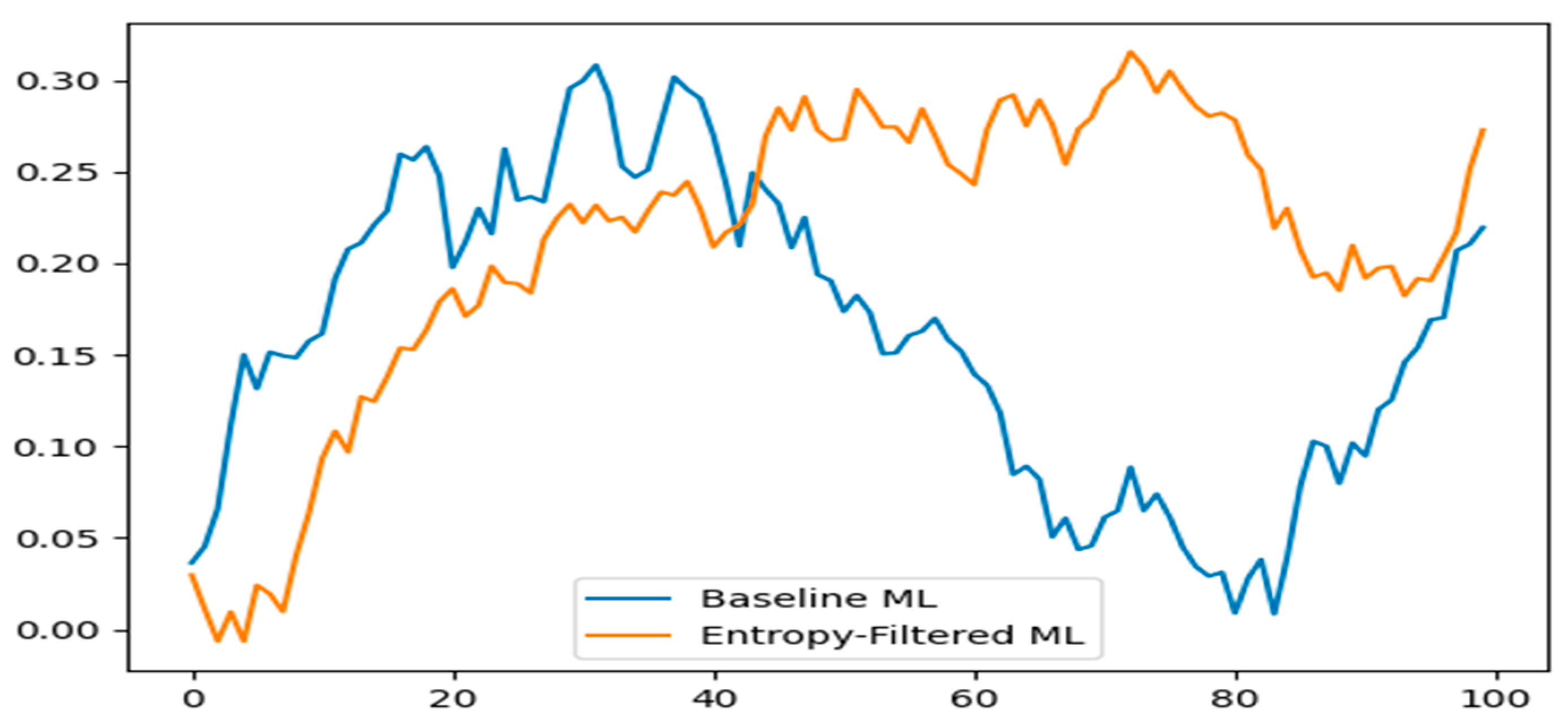
The cumulative performance of the trading strategies is illustrated in
Figure 1, which shows the evolution of cumulative returns for both the baseline machine learning strategy and the entropy-filtered strategy over the evaluation period. The results demonstrate that the entropy-filtered strategy produces a smoother cumulative return trajectory with reduced volatility. This behavior reflects the stabilizing effect of entropy filtering, which suppresses uncertain predictions and improves the overall robustness of the trading strategy.
By filtering out predictions associated with high uncertainty, the entropy-based mechanism reduces fluctuations in trading decisions and contributes to more stable strategy behavior.
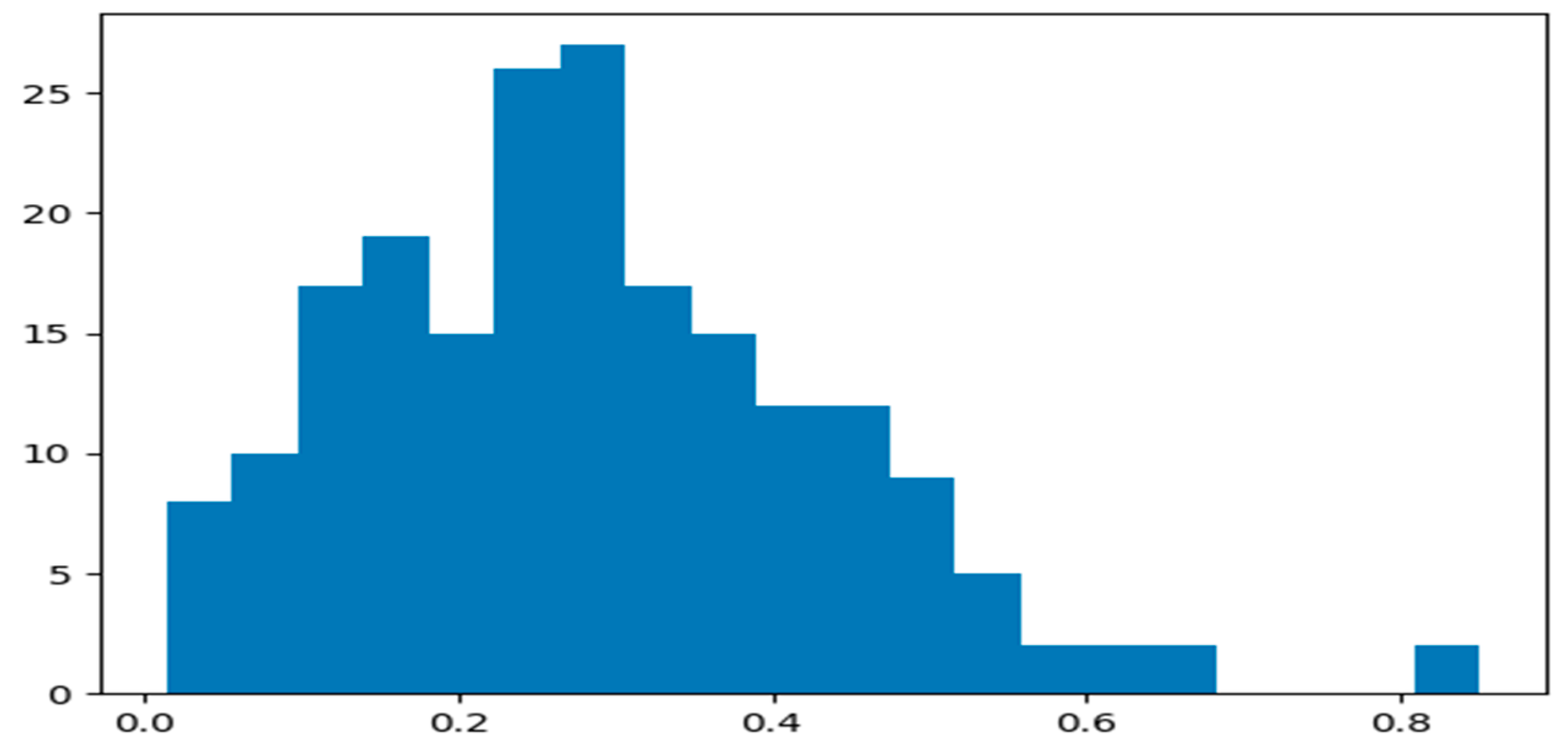
Further insights into the filtering mechanism are provided by
Figure 2, which illustrates the distribution of entropy values associated with the trading signals generated by the machine learning classifier. The figure highlights the entropy threshold used to determine whether a signal is executed or suppressed. Signals with entropy values exceeding the threshold correspond to highly uncertain predictions and are therefore excluded from the trading strategy. As a result, the entropy-filtered framework retains only signals characterized by higher informational clarity.
Overall, the empirical results support the hypothesis that entropy-based filtering can significantly enhance the reliability of machine learning trading systems. By integrating information-theoretic measures into the decision-making process, the proposed framework reduces the impact of noisy predictions and improves the stability of algorithmic trading strategies. These improvements are particularly relevant in cryptocurrency markets, where high volatility and complex price dynamics often challenge traditional predictive models.
The results also highlight the broader potential of combining information theory and machine learning techniques in financial decision systems. The entropy-filtering mechanism introduced in this study provides a simple yet effective method for controlling uncertainty in predictive trading models, thereby contributing to more robust portfolio decision making in modern financial markets. The entropy-filtered framework therefore improves not only performance but also the robustness and interpretability of machine learning-based trading systems.
The improvement in robustness observed in this study is empirical and reflects the specific market conditions and dataset analyzed, rather than a universal theoretical guarantee. The effectiveness of the entropy-filtering mechanism can be explained by its role as a decision-level noise reduction process. By quantifying the uncertainty associated with predictive probabilities, entropy filtering selectively removes signals that are less informative or ambiguous.
As a result, the trading strategy operates on a reduced set of higher-confidence signals, leading to improved consistency of decisions, lower sensitivity to noise, and enhanced risk-adjusted performance. These findings are consistent with the hypothesis that filtering high-uncertainty predictions leads to more stable and reliable trading decisions. This observation suggests that the proposed framework may provide additional practical benefits in real-world trading environments where transaction costs play a significant role.
4. Conclusions and Future Research
This study proposed an entropy-filtered machine learning framework designed to improve the robustness and reliability of algorithmic trading systems in highly volatile financial markets. By integrating entropy-based uncertainty filtering with machine learning classifiers, the proposed approach addresses a key limitation of predictive trading models, namely the instability of signals generated from noisy financial data.
The empirical analysis conducted on major cryptocurrency assets, including Bitcoin, Ethereum, Solana, and Binance Coin, demonstrates that the entropy-filtered framework improves the stability of trading decisions. The results show that filtering machine learning predictions based on their informational uncertainty reduces the occurrence of ambiguous signals and enhances the overall consistency of the trading strategy. In particular, the entropy-filtered model achieves improved risk-adjusted performance compared with a baseline (unfiltered) machine learning model.
From a financial perspective, the proposed methodology contributes to the development of risk-aware algorithmic trading systems. By selectively executing only those trading signals that exhibit sufficient informational clarity, the entropy-filtering mechanism reduces unnecessary trades and mitigates the effects of market noise. This leads to a more stable trading process and improved portfolio risk management, especially in environments characterized by high volatility and complex price dynamics. The results also highlight the broader relevance of combining information-theoretic concepts with machine learning techniques in financial decision systems. Entropy provides a natural quantitative measure of uncertainty that can be effectively used to assess the reliability of predictive signals generated by artificial intelligence models.
The integration of entropy measures within algorithmic trading frameworks therefore represents a promising direction for improving the robustness of data-driven financial decision processes. Although the empirical analysis focuses on cryptocurrency markets, the proposed framework provides a general structure that may be extended to other asset classes. However, such extensions require further empirical validation and are left for future research. The general structure of the entropy-filtered machine learning model is flexible and can be adapted to different financial datasets and predictive algorithms.
In addition, the modular structure of the proposed framework allows for seamless integration with alternative predictive models and uncertainty measures, enabling its extension to more complex multi-asset and dynamic portfolio allocation settings.
Future research may explore several extensions of the proposed framework. First, alternative entropy measures and generalized information-theoretic indicators may be incorporated to capture different aspects of market uncertainty. Second, the entropy-filtering mechanism may be integrated with more advanced machine learning architectures, including deep learning and reinforcement learning models. Third, future studies may investigate the interaction between entropy-based uncertainty measures and portfolio optimization techniques in multi-asset allocation problems. While the empirical analysis focuses on individual assets, the proposed framework is inherently scalable and can be extended to multi-asset portfolio settings. In such cases, entropy-filtered signals can be used to support allocation decisions across assets, enabling a more robust portfolio decision-making process. It should be noted that the robustness improvements documented in this study are empirical and context-dependent, and may vary across different market conditions, datasets, and model configurations.
Overall, the findings of this study provide empirical evidence that integrating entropy-based uncertainty measures with machine learning models represents a promising methodological direction for developing more reliable and risk-aware algorithmic trading systems in modern financial markets. These results contribute to the growing literature at the intersection of artificial intelligence, information theory, and financial decision making, and distinguish the proposed approach from standard machine learning trading models, which typically do not incorporate explicit uncertainty filtering mechanisms in the decision-making process.
Several extensions may further strengthen the empirical analysis, including the use of alternative classifiers, rolling-window validation, statistical significance testing, transaction-cost-adjusted performance, additional benchmarks, and regime-dependent analysis. The present study focuses on a simplified empirical setting designed to isolate the effect of entropy-based filtering. More comprehensive empirical frameworks represent important directions for future research. The contribution of this study lies in bridging information-theoretic uncertainty measures with machine learning-based trading decisions, providing a structured approach to filtering unreliable predictive signals in highly volatile markets. From a methodological perspective, the proposed framework offers a simple yet effective bridge between predictive modeling and uncertainty-aware decision-making, which remains a key challenge in modern financial systems. Future work may incorporate statistical significance testing and additional benchmark comparisons to further validate the robustness of the results.