

The Effect of Innovation on Climate Resilience in Developing Countries: Evidence from a Panel Quantile Regression Approach


Abstract
1. Introduction
2. Literature Review
2.1. Theoretical Literature
2.2. Empirical Literature
2.2.1. Studies Showing a Positive Relationship Between Innovation and Climate Resilience or Environmental Quality
Developed Countries
Developing Countries
2.2.2. Studies Reporting a Negative or Mixed Relationship Between Innovation and Environmental Outcomes
Developing Countries
2.2.3. Emerging Consensus
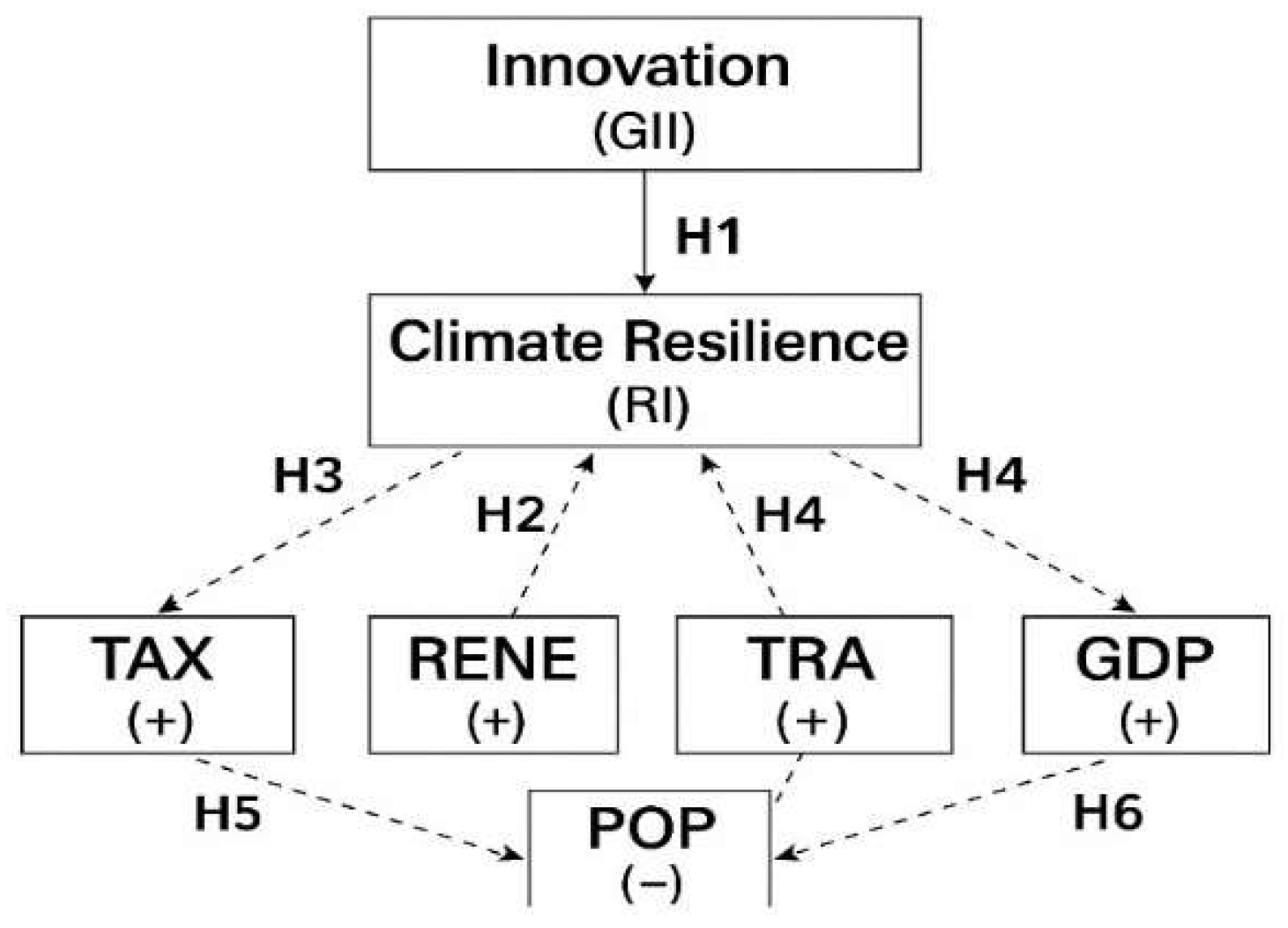
2.2.4. Hypothesis of the Study
Innovation and Climate Resilience
Renewable Energy Consumption and Climate Resilience
Environmental Taxation and Resilience Outcomes
Trade Openness and Climate Resilience
Population Growth and Climate Resilience
Economic Growth and Climate Resilience
3. Materials and Methods
3.1. Model Specification
- Resilience index, (RI) as a measure for climate resilience;
- GII measure for innovation;
- TAX measure for environmental tax;
- RENE-renewable energy;
- TRA is trade;
- POP Population;
- GDP is Gross Domestic Product (measure for economic growth);
- µit country specific effect.
3.2. Data Description and Limitations
3.3. Global Innovation Index
3.4. Climate Change Resilience Index
3.5. Estimation Technique
The Panel Quantile Regression Model
- : ND-GAIN resilience index for entity (i) at time (t);
- τ: Quantile of interest [for example, = 0.10, 0.25, 0.50, 0.75, and 0.90.];
- : Innovation measure (Global Innovation Index);
- Main explanatory variables (environmental tax, renewable energy, trade, population and GDP per capita);
- : Controls variables or additional variables (carbon emissions, urbanization index, food production index, Environmental degradation index);
- Fixed effects for unobserved heterogeneity, for example, country-specific factors;
- Quantile-specific effect of innovation on resilience;
- The “min” indicates that we are minimizing the objective function with respect to the parameters (the individual fixed effects) and , (the quantile-specific coefficients). In mathematical optimization, “min” means we are searching for the values of and that make the entire expression as small as possible;
- : This specifies the parameters over which the minimization is performed. Then, adjusting [one for each individual (i)] and (the vector of coefficients for the -th quantile)] to find the optimal values that minimize the objective function;
- To check the function” which assigns asymmetric weights to residuals:
- ✓
- Weight
- ✓
- Weight
- I (.): Indicator function;
- : Penalty parameter (cross validation);
- : is the absolute value of the individual fixed effect (i).
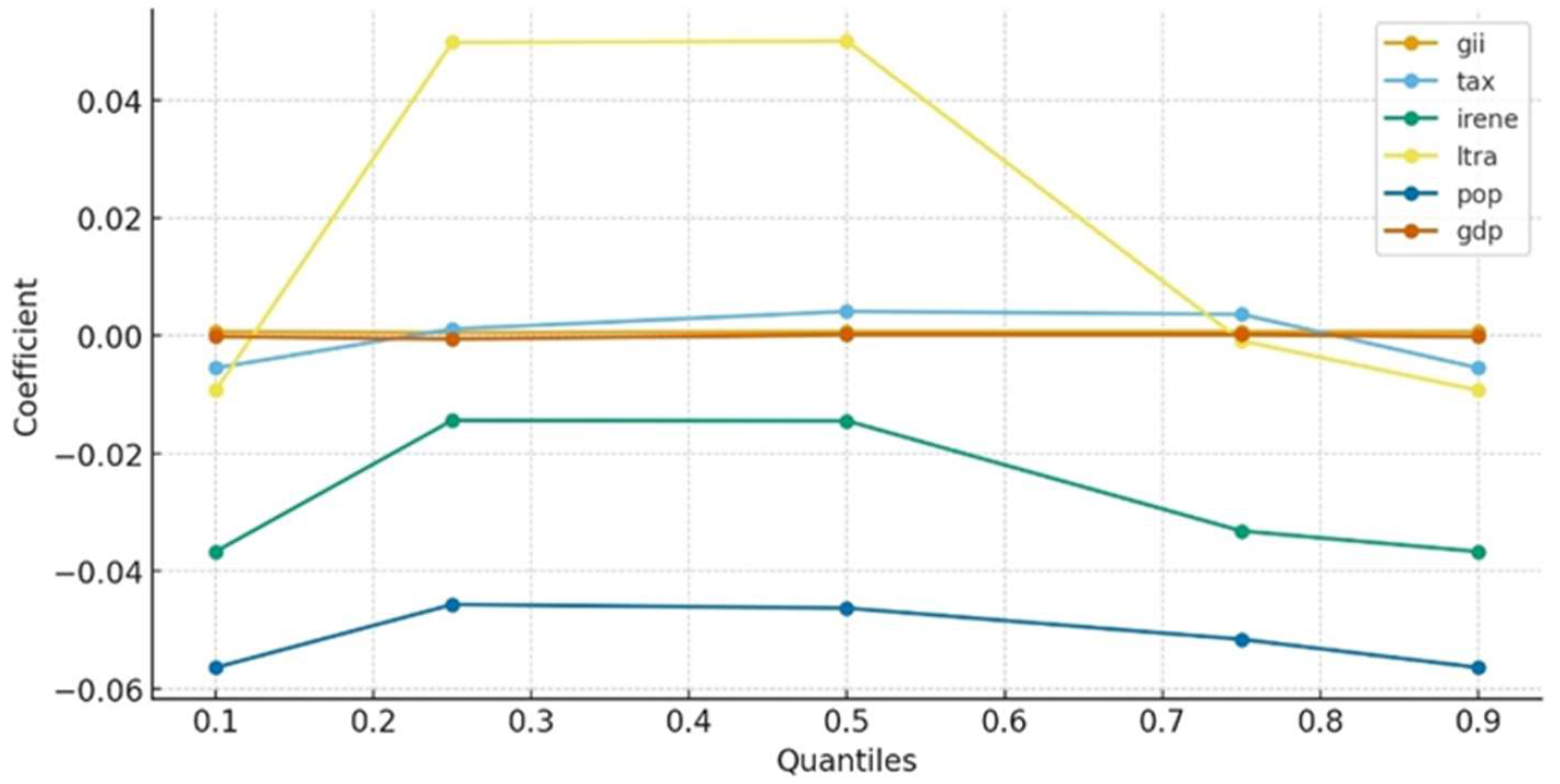
4. Results
Sensitivity Analysis
5. Discussion
6. Conclusions
Limitations and Future Research
Author Contributions
Funding
Institutional Review Board Statement
Informed Consent Statement
Data Availability Statement
Conflicts of Interest
Appendix A

| 1. | Azerbaijan |
| 2. | Brazil |
| 3. | Botswana |
| 4. | China |
| 5. | Cameroon |
| 6. | Colombia |
| 7. | Costa Rica |
| 8. | Egypt |
| 9. | Ghana |
| 10. | Kazakhstan |
| 11. | Kenya |
| 12. | Morocco |
| 13. | Madagascar |
| 14. | Mexico |
| 15. | Mali |
| 16. | Mauritius |
| 17. | Namibia |
| 18. | Panama |
| 19. | Peru |
| 20. | Senegal |
| 21. | Tunisia |
| 22. | Uganda |
| 23. | Uruguary |
| 24. | South Africa |
References
- Abid, M., Schilling, J., Scheffran, J., & Zulfiqar, F. (2016). Climate change vulnerability, adaptation and risk perceptions at farm level in Punjab, Pakistan. Science of the Total Environment, 547, 447–460. [Google Scholar] [CrossRef]
- Agan, B. (2025). Assessing the dynamic impacts of climate change adaptation and clean energy innovations on economic growth in OECD countries. Natural Resources Forum, 49(2), 1057–1080. [Google Scholar] [CrossRef]
- Aghion, P., & Howitt, P. (1992). A model of growth through creative destruction. The Econometric Society, 60(2), 323–351. [Google Scholar] [CrossRef]
- Ahmad, N., Liu, Y., Žiković, S., & Belyaeva, Z. (2023). The effects of technological innovation on sustainable development and environmental degradation: Evidence from China. Technology in Society, 72, 102184. [Google Scholar] [CrossRef]
- Ali, K., Hongbing, H., Liew, C. Y., & Jianguo, D. (2023). Governance perspective and the effect of economic policy uncertainty on financial stability: Evidence from developed and developing economies. Economic Change and Restructuring, 56(3), 1971–2002. [Google Scholar] [CrossRef]
- Al-Maamary, H. M. S., Kazem, H. A., & Chaichan, M. T. (2017). Climate change: The game changer in the Gulf Cooperation Council Region. Renewable and Sustainable Energy Reviews, 76, 555–576. [Google Scholar] [CrossRef]
- Amegavi, G. B., Langnel, Z., Jeffison, O. J. Y., & Ofori, D. R. (2021). The impact of adaptation on climate vulnerability: Is readiness relevant? Sustainable Cities and Society, 75, 103325. [Google Scholar] [CrossRef]
- Antweiler, W., Copeland, B. R., & Taylor, M. S. (2001). Is free trade good for the environment? American Economic Review, 91(4), 877–908. [Google Scholar] [CrossRef]
- Arnold, J. M., Brys, B., Heady, C., Johansson, Å., Schwellnus, C., & Vartia, L. (2011). Tax policy for economic recovery and growth. The Economic Journal, 121(550), F59–F80. [Google Scholar] [CrossRef]
- Ayyub, B. M. (2018). Climate-Resilient infrastructure–Adaptive design and risk management. In Climate-resilient infrastructure: Adaptive design and risk management (pp. 1–308). American Society of Civil Engineers (ASCE). [Google Scholar]
- Barrios, S., Bertinelli, L., & Strobl, E. (2010). Trends in rainfall and economic growth in Africa: A neglected cause of the African. The Review of Economics and Statistics, 98(2), 350–366. [Google Scholar] [CrossRef]
- Basty, N., & Ghachem, D. A. (2023). Is the relationship between carbon emissions and innovation nonlinear? Evidence from OECD countries. Borsa Istanbul Review, 23(4), 906–918. [Google Scholar] [CrossRef]
- Bhattacharya, M., Paramati, S. R., Ozturk, I., & Bhattacharya, S. (2016). The effect of renewable energy consumption on economic growth: Evidence from top 38 countries. Applied Energy, 162, 733–741. [Google Scholar] [CrossRef]
- Boitan, I. A., & Marchewka-Bartkowiak, K. (2022). Climate change and the pricing of sovereign debt: Insights from European markets. Research in International Business and Finance, 62, 101685. [Google Scholar] [CrossRef]
- Cade, B., & Noon, B. (2003). A gentle introduction to quantile regression for ecologists. Frontiers in Ecology and the Environment, 1, 412–420. [Google Scholar] [CrossRef]
- Chen, C., Noble, I., Hellmann, J., Coffee, J., Murillo, M., & Chawla, N. (2015). University of notre dame global adaptation index. University of Notre Dame. [Google Scholar]
- Chen, Y., Yao, Z., & Zhong, K. (2022). Do environmental regulations of carbon emissions and air pollution foster green technology innovation: Evidence from China’s prefecture-level cities. Journal of Cleaner Production, 350, 131537. [Google Scholar] [CrossRef]
- Coastal Resources Center—University of Rhode Island (CRC-URI) & International Resources Group (IRG). (2009). Adapting to coastal climate change: A guidebook for development planners. Available online: https://www.crc.uri.edu/download/CoastalAdaptationGuide.pdf (accessed on 31 March 2025).
- Crespo Cuaresma, J., & Feldkircher, M. (2013). Spatial filtering, model uncertainty and the speed of income convergence in Europe. Journal of Applied Econometrics, 28(4), 720–741. [Google Scholar] [CrossRef]
- Crick, F., Eskander, S. M. S. U., Fankhauser, S., & Diop, M. (2018). How do African SMEs respond to climate risks? Evidence from Kenya and Senegal. World Development, 108, 157–168. [Google Scholar] [CrossRef]
- Dasgupta, S., Laplante, B., Wang, H., & Wheeler, D. (2002). Confronting the environmental Kuznets curve. Journal of Economic Perspectives, 16(1), 147–168. [Google Scholar] [CrossRef]
- Dauda, L., Long, X., Mensah, C. N., & Salman, M. (2019). The effects of economic growth and innovation on CO2 emissions in different regions. Environmental Science and Pollution Research, 26(15), 15028–15038. [Google Scholar] [CrossRef] [PubMed]
- Dean, J. M., Lovely, M. E., & Wang, H. (2017). Are foreign investors attracted to weak environmental regulations? Evaluating the evidence from China. In International Economic Integration and Domestic Performance. World Scientific Studies in International Economics. [Google Scholar] [CrossRef]
- Dell, M., Jones, B. F., & Olken, B. A. (2012). Temperature shocks and economic growth: Evidence from the last half century. American Economic Journal: Macroeconomics, 4(3), 66–95. [Google Scholar] [CrossRef]
- Demir, C., Cergibozan, R., & Ari, A. (2020). Environmental dimension of innovation: Time series evidence from Turkey. Environment, Development & Sustainability, 22(3), 2497–2516. [Google Scholar] [CrossRef]
- Destek, M. A., & Sarkodie, S. A. (2019). Investigation of environmental Kuznets curve for ecological footprint: The role of energy and financial development. Science of the Total Environment, 650, 2483–2489. [Google Scholar] [CrossRef]
- Fankhauser, S., & McDermott, T. K. J. (2014). Understanding the adaptation deficit: Why are poor countries more vulnerable to climate events than rich countries? Global Environmental Change, 27(1), 9–18. [Google Scholar] [CrossRef]
- Fethi, S., & Rahuma, A. (2020). The impact of eco-innovation on CO2 emission reductions: Evidence from selected petroleum companies. Structural Change and Economic Dynamics, 53, 108–115. [Google Scholar] [CrossRef]
- Frankel, J. A., & Rose, A. K. (2002). An estimate of the effect of common currencies on trade and income. The Quarterly Journal of Economics, 117(2), 437–466. [Google Scholar] [CrossRef]
- Gemmell, N., Kneller, R., & Sanz, I. (2011). The timing and persistence of fiscal policy impacts on growth: Evidence from OECD countries. The Economic Journal, 121(550), F33–F58. [Google Scholar] [CrossRef]
- Grossman, G. M., & Krueger, A. B. (1991). Environmental impacts of a North American free trade agreement [Working paper No. 3914]. National Bureau of Economic Research. [Google Scholar]
- Grossman, G. M., & Krueger, A. B. (1995). Economic growth and the environment. The Quarterly Journal of Economics, 110(2), 353–377. [Google Scholar] [CrossRef]
- Guo, J., Zhou, Y., Ali, S., Shahzad, U., & Cui, L. (2021). Exploring the role of green innovation and investment in energy for environmental quality: An empirical appraisal from provincial data of China. Journal of Environmental Management, 292, 112779. [Google Scholar] [CrossRef] [PubMed]
- Hallegatte, S., Bangalore, M., Bonzanigo, L., Fay, M., Kane, T., Narloch, U., Rozenberg, J., Treguer, D., & Vogt-Schilb, A. (2016). Shock waves: Managing the impacts of climate change on poverty. World Bank. [Google Scholar] [CrossRef]
- Harvey, C. A., Rakotobe, Z. L., Rao, N. S., Dave, R., Razafimahatratra, H., Rabarijohn, R. H., Rajaofara, H., & Mackinnon, J. L. (2014). Extreme vulnerability of smallholder farmers to agricultural risks and climate change in Madagascar. Philosophical Transactions of the Royal Society B: Biological Sciences, 369(1639), 20130089. [Google Scholar] [CrossRef]
- Hashmi, R., & Alam, K. (2019). Dynamic relationship among environmental regulation, innovation, CO2 emissions, population, and economic growth in OECD countries: A panel investigation. Journal of Cleaner Production, 231, 1424–1433. [Google Scholar] [CrossRef]
- Howe, P. D. (2011). Hurricane preparedness as anticipatory adaptation: A case study of18 community businesses. Global Environmental Change, 21(2), 711–720.19. [Google Scholar] [CrossRef]
- IPCC. (2021). Climate change 2021: The physical science basis. In Contribution of working group I to the sixth assessment report of the intergovernmental panel on climate change. Cambridge University Press. [Google Scholar] [CrossRef]
- Keil, A., Zeller, M., Wida, A., Sanim, B., & Birner, R. (2008). What determines farmers’ resilience towards ENSO-related drought? An empirical assessment in central Sulawesi, Indonesia. Climatic Change, 86, 291–307. [Google Scholar] [CrossRef]
- Khan, M. K., Khan, M. I., & Rehan, M. (2020). The relationship between energy consumption, economic growth and carbon dioxide emissions in Pakistan. Financial Innovation, 6(1), 1. [Google Scholar] [CrossRef]
- Khayat, F. (2023). From climate injustice to resilience: What is the role of social and technological innovation? Environmental Justice, 16(2), 96–110. [Google Scholar] [CrossRef]
- Koenker, R., & Bassett, G., Jr. (1978). Regression quantiles. Econometrica: Journal of the Econometric Society, 46, 33–50. [Google Scholar] [CrossRef]
- Lee, K.-H., & Min, B. (2015). Green R&D for eco-innovation and its impact on carbon emissions and firm performance. Journal of Cleaner Production, 108, 503–512. [Google Scholar] [CrossRef]
- Marks, D., & Thomalla, F. (2017). Responses to the 2011 floods in Central Thailand: Perpetuating the vulnerability of small and medium enterprises? Natural Hazards, 87(2), 1147–1165. [Google Scholar] [CrossRef]
- Mensah, C. N., Long, X., Boamah, K. B., Bediako, I. A., Dauda, L., & Salman, M. (2018). The effect of innovation on CO2 emissions of OECD countries from 1990 to 2014. Environmental Science and Pollution Research, 25(29), 29678–29698. [Google Scholar] [CrossRef]
- Naifar, N. (2023). Does climate change affect sovereign credit risk? International evidence. Borsa Istanbul Review, 23, S84–S95. [Google Scholar] [CrossRef]
- ND-GAIN. (2025). Notre dame global adaptation initiative country index. University of Notre Dame. Available online: https://gain.nd.edu/our-work/country-index/ (accessed on 31 March 2025).
- Nelson, D. R., Adger, W. N., & Brown, K. (2007). Adaptation to environmental change: Contributions of a resilience framework. Annual Review of Environment and Resources, 32, 395–419. [Google Scholar] [CrossRef]
- Perez, C., Jones, E. M., Kristjanson, P., Cramer, L., Thornton, P. K., Förch, W., & Barahona, C. (2015). How resilient are farming households and communities to a changing climate in Africa? A gender-based perspective. Global Environmental Change, 34, 95–107. [Google Scholar] [CrossRef]
- Raghutla, C., & Chittedi, K. R. (2023). The effect of technological innovation and clean energy consumption on carbon neutrality in top clean energy-consuming countries: A panel estimation. Energy Strategy Reviews, 47(8), 101091. [Google Scholar] [CrossRef]
- Razzaq, A., An, H., & Delpachitra, S. (2021). Does technology gap increase FDI spillovers on productivity growth? Evidence from Chinese outward FDI in belt and road host countries. Technological Forecasting and Social Change, 172, 121050. [Google Scholar] [CrossRef]
- Romer, P. M. (1990). Endogenous technological change. Journal of Political Economy, 98(5), S71–S102. [Google Scholar] [CrossRef]
- Ryan, B., Johnston, K. A., Taylor, M., & McAndrew, R. (2020). Community engagement for disaster preparedness: A systematic literature review. International Journal of Disaster Risk Reduction, 49(1), 101655. [Google Scholar] [CrossRef]
- Santra, S. (2017). The effect of technological innovation on production-based energy and CO2 emission productivity: Evidence from BRICS countries. African Journal of Science, Technology, Innovation and Development, 9(5), 503–512. [Google Scholar] [CrossRef]
- Schumpeter, J. A. (1934). The theory of economic development. Harvard University Press. [Google Scholar]
- Shahbaz, M., Sbia, R., Hamdi, H., & Ozturk, I. (2014). Economic growth, electricity consumption, urbanization and environmental degradation relationship in United Arab Emirates. Ecological Indicators, 45, 622–631. [Google Scholar] [CrossRef]
- Smit, B., & Wandel, J. (2006). Adaptation, adaptive capacity and vulnerability. Global Environmental Change, 16(3), 282–292. [Google Scholar] [CrossRef]
- Stern, D. I. (2004). The rise and fall of the environmental Kuznets curve. World Development, 32(8), 1419–1439. [Google Scholar] [CrossRef]
- Su, H.-N., & Moaniba, I. M. (2017). Does innovation respond to climate change? Empirical evidence from patents and greenhouse gas emissions. Technological Forecasting and Social Change, 122, 49–62. [Google Scholar] [CrossRef]
- Teklu, A., Simane, B., & Bezabih, M. (2023). Effect of climate-smart agriculture innovations on climate resilience among smallholder farmers: Evidence from the choke mountain watershed, Ethiopia. Sustainability, 15(5), 4331. [Google Scholar] [CrossRef]
- Thornton, P. K., Jones, P. G., Owiyo, T., Kruska, R. L., Herrero, M., Orindi, V., Bhadwal, S., Kristjanson, P., Notenbaert, A., Bekele, N., & Omolo, A. (2008). Climate change and poverty in Africa: Mapping hotspots of vulnerability. African Journal of Agricultural and Resource Economics, 2(1), 24–44. [Google Scholar]
- Töbelmann, D., & Wendler, T. (2020). The impact of environmental innovation on carbon dioxide emissions. Journal of Cleaner Production, 244, 118787. [Google Scholar] [CrossRef]
- Tyler, S., & Moench, M. (2012). A framework for urban climate resilience. Climate and Development, 4(4), 311–326. [Google Scholar] [CrossRef]
- Udeagha, M. C., & Ngepah, N. (2022). Disaggregating the environmental effects of renewable and non-renewable energy consumption in South Africa: Fresh evidence from the novel dynamic ARDL simulations approach. Economic Change and Restructuring, 55, 1767–1814. [Google Scholar] [CrossRef]
- UNFCCC. (2015). United nations framework convention on climate change. INDC Submission. Available online: http://unfccc.int/focus/indc_portal/items/8766.php (accessed on 31 March 2025).
- US EPA. (2020). Basic information about the built environment. United States Environmental Protection Agency. Available online: https://www.epa.gov/smm/basic-information-about-built-environment (accessed on 31 March 2025).
- Usman, M., & Hammar, N. (2021). Dynamic relationship between technological innovations, financial development, renewable energy, and ecological footprint: Fresh insights based on the STIRPAT model for Asia pacific economic cooperation countries. Environmental Science and Pollution Research, 28(12), 15519–15536. [Google Scholar] [CrossRef] [PubMed]
- Villanthenkodath, M. A., & Mahalik, M. K. (2022). Technological innovation and environmental quality nexus in India: Does inward remittance matter? Journal of Public Affairs, 22(1), e2291. [Google Scholar] [CrossRef]
- Volz, U., Beirne, J., Ambrosio Preudhomme, N., Fenton, A., Mazzacurati, E., Renzhi, N., & Stampe, J. (2020). Climate change and sovereign risk. SOAS University of London. [Google Scholar] [CrossRef]
- Wang, L., Wang, Z., & Ma, Y. (2022). Does environmental regulation promote the high-quality development of manufacturing? A quasi-natural experiment based on China’s carbon emission trading pilot scheme. Socio-Economic Planning Sciences, 81, 101216. [Google Scholar] [CrossRef]
- Watson, R. T., Zinyowera, M. C., & Moss, R. H. (Eds.). (1997). Climate Change 1995: Impacts, Adaptations and Mitigation of Climate Change: Scientific-Technical Analyses (p. 517, Out of print). Cambridge University Press. Available online: https://www.ipcc.ch/report/the-regional-impacts-of-climate-change-an-assessment-of-vulnerability/ (accessed on 31 March 2025).
- World Intellectual Property Organization (WIPO). (2024). Global innovation index 2024: Unlocking the promise of social entrepreneurship. WIPO. Available online: https://www.wipo.int/web-publications/global-innovation-index-2024/assets/67729/2000%20Global%20Innovation%20Index%202024_WEB3lite.pdf (accessed on 31 March 2025).
- Wu, G., Liu, X., & Cai, Y. (2024). The impact of green finance on carbon emission efficiency. Heliyon, 10(1), e23803. [Google Scholar] [CrossRef]
- Xiao, Q., & Fei, L. (2024). How does climate vulnerability impact green innovation? A hindrance to sustainable development. Innovation and Green Development, 3(4), 100169. [Google Scholar] [CrossRef]
- Yu, Y., & Du, Y. (2019). Impact of technological innovation on CO2 emissions and emissions trend prediction on ‘New Normal’ economy in China. Atmospheric Pollution Research, 10, 152–116. [Google Scholar] [CrossRef]
- Zameer, H., Shahbaz, M., & Vo, X. V. (2020). Reinforcing poverty alleviation efficiency through technological innovation, globalization, and financial development. Technological Forecasting and Social Change, 161, 120326. [Google Scholar] [CrossRef]


| Variable Type | Variables | Variable Description | Expected Signs | Sources |
|---|---|---|---|---|
| Dependent variable | Resilience index, (RI) (measure for climate resilience) | ND-GAIN for vulnerability and Readiness | Dependent variable | ND-GAIN website https://gain.nd.edu/our-work/country-index/ (Accessed on 31 March 2025) |
| Main-independent variable | GII (measure for innovation) | Global Innovation index country’s overall innovation capacity based on input factors including institutions, human capital, infrastructure and investment and output factors, including knowledge creation, technology adoption, and creative production. | Positive | World Intellectual Property (WIPO) https://www.wipo.int/web-publications/global-innovation-index-2025/en/gii-2025-at-a-glance.html (Accessed on 31 March 2025) |
| Control variables | TAX | Environmental tax (% of GDP) | Positive | Organization for Economic Co-operation and Development (OECD) |
| RENE | Renewable energy consumption (% of total final energy consumption) | Positive | World Development Indicators (WDI) | |
| TRA | Trade (% of GDP) | Positive | World Development Indicators (WDI) | |
| POP | Population (% of total population) | Negative | World Development Indicators (WDI) | |
| GDP (measure for economic growth) | Gross Domestic Product per capita (constant US$) | Positive | World Development Indicators (WDI) |
| Variables | obs | Mean | Std. dev. | Min | Max |
|---|---|---|---|---|---|
| RI | 405 | 0.3953074 | 0.0855946 | 0.2415415 | 0.5777789 |
| GII | 405 | 26.36911 | 13.19525 | 2.02 | 55.3 |
| TAX | 405 | 1.306669 | 0.7528398 | 0.0326322 | 3.184 |
| l_RENE | 405 | 3.198254 | 0.9471312 | 0.0953102 | 4.546481 |
| l_TRA | 405 | 4.153725 | 0.4155681 | 3.095848 | 5.22182 |
| POP | 405 | 1.321495 | 1.148335 | −2.450719 | 3.490596 |
| GDP | 405 | 2.027401 | 3.988106 | −18.94217 | 15.06954 |
| Variables | (1) | (2) | (3) | (4) | (5) | (6) | (7) |
|---|---|---|---|---|---|---|---|
| (1) RI | 1.000 | ||||||
| (2) GII | 0.285 *** | 1.000 | |||||
| (3) TAX | 0.281 *** | 0.102 ** | 1.000 | ||||
| (4) l_RENE | −0.529 *** | −0.141 *** | −0.002 | 1.000 | |||
| (5) l_TRA | 0.397 *** | 0.002 | 0.230 *** | −0.275 *** | 1.000 | ||
| (6) POP | −0.806 *** | −0.248 *** | −0.354 *** | 0.365 *** | −0.286 *** | 1.000 | |
| (7) GDP | 0.170 *** | 0.077 | 0.078 | −0.071 | 0.097 * | −0.192 *** | 1.000 |
| Dependent Variable (RI) Resilience Index | Q10 | Q25 | Q50 | Q75 | Q90 |
|---|---|---|---|---|---|
| GII | 0.0006 ** | 0.0005 *** | 0.0006 ** | 0.0006 * | 0.0006 ** |
| (2.3241) | (4.2845) | (2.453) | (1.8165) | (2.3194) | |
| TAX | −0.0055 | 0.0011 | 0.0041 | 0.0036 | −0.0055 ** |
| (−1.3398) | (0.3832) | (0.8972) | (0.7248) | (−2.1273) | |
| l_RENE | −0.0367 *** | −0.0144 *** | −0.0145 *** | −0.0332 *** | −0.0367 *** |
| (−6.3932) | (−6.2109) | (−3.8175) | (−6.7849) | (−7.3563) | |
| l_TRA | −0.0093 | 0.0498 *** | 0.05 *** | −0.0009 | −0.0093 |
| (−1.0152) | (11.4283) | (6.1839) | (−0.0734) | (−1.0303) | |
| POP | −0.0564 *** | −0.0457 *** | −0.0463 *** | −0.0516 *** | −0.0564 *** |
| (−16.9309) | (−17.3665) | (−12.5194) | (−11.379) | (−22.0363) | |
| GDP | −0.0002 | −0.0006 | 0.0001 | 0.0001 | −0.0002 |
| (−0.2737) | (−0.8633) | (0.202) | (0.0723) | (−0.3733) | |
| Constant | 0.6792 *** | 0.2493 *** | 0.2672 *** | 0.5883 *** | 0.6792 *** |
| (12.5944) | (11.1076) | (6.7336) | (9.207) | (13.7122) | |
| Observations | 401 | 401 | 401 | 401 | 401 |
| Pseudo R2 | 0.5093 | 0.5382 | 0.5045 | 0.5039 | 0.5093 |
| Chi-squared | 122.16 |
| p-value | 0.000 |
| Variables | Fixed Effects | Random Effects |
|---|---|---|
| GII | 0.0002 ** | 0.0003 ** |
| (2.1351) | (2.4711) | |
| TAX | −0.003 | 0.0008 |
| (−0.7392) | (0.1967) | |
| l_RENE | 0.0032 | −0.0274 *** |
| (0.3287) | (−4.3829) | |
| l_TRA | −0.0456 *** | −0.0189 ** |
| (−4.8896) | (−2.1001) | |
| POP | −0.0005 | −0.0221 *** |
| (−0.1069) | (−5.5242) | |
| GDP | 0.0003 | −0.0002 |
| (0.8931) | (−0.6288) | |
| constant | 0.5725 *** | 0.5827 *** |
| (11.4424) | (12.8871) | |
| Observations | 401 | 401 |
Disclaimer/Publisher’s Note: The statements, opinions and data contained in all publications are solely those of the individual author(s) and contributor(s) and not of MDPI and/or the editor(s). MDPI and/or the editor(s) disclaim responsibility for any injury to people or property resulting from any ideas, methods, instructions or products referred to in the content. |
© 2026 by the authors. Licensee MDPI, Basel, Switzerland. This article is an open access article distributed under the terms and conditions of the Creative Commons Attribution (CC BY) license.
Share and Cite
Mmelesi, K.; Eita, J.H. The Effect of Innovation on Climate Resilience in Developing Countries: Evidence from a Panel Quantile Regression Approach. J. Risk Financial Manag. 2026, 19, 270. https://doi.org/10.3390/jrfm19040270
Mmelesi K, Eita JH. The Effect of Innovation on Climate Resilience in Developing Countries: Evidence from a Panel Quantile Regression Approach. Journal of Risk and Financial Management. 2026; 19(4):270. https://doi.org/10.3390/jrfm19040270
Chicago/Turabian StyleMmelesi, Kesaobaka, and Joel Hinaunye Eita. 2026. "The Effect of Innovation on Climate Resilience in Developing Countries: Evidence from a Panel Quantile Regression Approach" Journal of Risk and Financial Management 19, no. 4: 270. https://doi.org/10.3390/jrfm19040270
APA StyleMmelesi, K., & Eita, J. H. (2026). The Effect of Innovation on Climate Resilience in Developing Countries: Evidence from a Panel Quantile Regression Approach. Journal of Risk and Financial Management, 19(4), 270. https://doi.org/10.3390/jrfm19040270