Article

Investigating the Board of Commissioners’ Monitoring Intensity Effects on CSR Transparency and Cost of Debt

by
Islahuddin Islahuddin
,
Yossi Diantimala
*,
Mirna Indriani
and
Muhammad Putra Aprullah
Department of Accounting, Faculty of Economics and Business, Universitas Syiah Kuala, Banda Aceh 23111, Aceh, Indonesia
*
Author to whom correspondence should be addressed.
J. Risk Financial Manag. 2026, 19(4), 266; https://doi.org/10.3390/jrfm19040266
Submission received: 4 March 2026 / Revised: 26 March 2026 / Accepted: 2 April 2026 / Published: 7 April 2026
(This article belongs to the Section Sustainability and Finance)

Abstract

This study examines whether the board of commissioners’ monitoring intensity (BOCM) moderates the relationship between corporate social responsibility disclosure (CSRD) and the cost of debt (COD). Using an unbalanced panel dataset of 1516 firm-year observations from companies listed on the Indonesia Stock Exchange during 2018–2023, this study applies Moderated Regression Analysis (MRA) to test the proposed relationships. The results show that CSRD is negatively associated with COD, indicating that greater CSR transparency reduces borrowing costs. More importantly, BOCM significantly moderates this relationship. The interaction between BOCM and CSRD suggests that stronger board of commissioner monitoring weakens the marginal effect of CSRD on COD, implying that intensive monitoring may partly substitute for the risk-reducing role of CSR disclosure in determining COD. In addition, BOCM has a direct negative effect on COD, suggesting that creditors value the active board of commissioners’ monitoring as an internal governance mechanism that lowers perceived financing risk. These findings extend the literature by demonstrating that the effectiveness of CSRD in reducing COD depends on the strength of BOCM. This study offers practical implications for regulators and firms seeking to enhance governance quality, improve disclosure credibility, and reduce financing costs.

1. Introduction

The cost of debt (COD) is a primary topic in sustainable finance. COD reflects creditors’ perception of a company’s risk as the compensation a company must pay creditors in return for the use of borrowed funds. The amount of COD is determined based on the company’s credit risk analysis (Tanin et al., 2024). The higher the perceived credit risk, the higher the COD charged to protect against potential losses. COD directly relates to creditors’ risk-mitigation policies. Macro-economically, Indonesian companies face relatively high corporate lending rates, averaging 8.52–9.54%, compared with the Central Bank’s benchmark interest rate, which ranges from 3.52% to 5.83% (BPS, 2024; OJK, 2024). The difference between central bank interest rates and corporate lending rates directly signals how macroeconomic and structural risks translate into corporate financing costs. While this spread is often used in COD analysis as a proxy for country risk, it actually reflects a broader combination of systematic risk, financial market structure, and banking mechanisms. Bank loan rates incorporate a risk premium primarily based on borrowers’ creditworthiness (Ashraf et al., 2021), but nationwide risks, vulnerabilities in financial systems, and funding strategies can also increase corporate COD (Yilmaz et al., 2025). However, research confirms that the spread is not solely driven by country risk but is shaped by additional factors such as inflation expectations, banking market power, differences in deposit rates, loan product diversity, collateral practices, cost efficiency, capital quality, and access to funding (Horvath et al., 2018; Kleimeier & Sander, 2022; Wagenvoort et al., 2011).
In emerging markets like Indonesia, lending spreads can be influenced by monetary transmission effects and risk premiums related to inflation, intermediation costs, credit-market imperfections, sovereign risk, and general economic uncertainty. Thus, a large spread may partly indicate higher country-level risk. A larger and more persistent difference indicates that monetary policy transmission to corporate borrowing costs is not fully occurring (Bi et al., 2025; Kleimeier & Sander, 2022; Y. Lu et al., 2024). In other literature, the difference between a company’s cost of debt and the benchmark rate is used to assess pass-through strength. The deviation of the company’s debt interest rate from the industry average is often viewed as a form of financial misallocation and reflects imperfect policy transmission (Che et al., 2024; Wilberg et al., 2025). Empirical evidence suggests that pass-through from central bank policy rates to corporate lending rates is often limited. This may be due to slower adjustments in lending rates compared to deposit rates, financial stress, or crises that widen the heterogeneity of borrowing costs. It may also occur due to market uncertainty about the direction of monetary policy, causing financial actors’ responses to diverge from central bank intentions (Charoenseang & Manakit, 2007; Cho & Im, 2023; Grandi, 2019). Accordingly, elevated lending spreads not only reflect creditors’ assessment of firm-specific credit risk, but also indicate that the central bank’s policy stance is not fully transmitted into corporate financing costs.
To address this condition, Indonesian companies should provide transparent and reliable corporate disclosures, including non-financial disclosures, as an important strategy to reduce perceptions of credit risk, thereby increasing creditor confidence and reducing COD (Alves & Meneses, 2024). Corporate social responsibility disclosure (CSRD) is a crucial non-financial disclosure that addresses creditors’ concerns by offering insights into a company’s sustainability practices, particularly concerning risk management (H. Wang et al., 2022).
The relationship between CSRD and COD is typically examined from a risk perspective: CSR disclosure quality shapes creditors’ views of a firm’s risk profile. Several studies report a negative relationship between CSRD and COD, showing that greater CSR transparency lowers perceived risk and borrowing costs (De Vincentiis, 2024; Eliwa et al., 2021). The main mechanism is reduced information asymmetry. High-quality CSRD enables lenders to better assess a firm’s risk and prospects, thereby lowering transaction costs and risk premiums in debt contracts (D’Apolito et al., 2024). CSR disclosure also acts as a reputational signal of transparency, reliability, and management quality. This reputational effect reduces bankruptcy and operational risks and boosts creditor confidence (Trinh et al., 2024). CSRD enhances a company’s credibility in the eyes of creditors and reduces COD (Al-Dhamari et al., 2025; Bhuiyan & Nguyen, 2020; Duggal et al., 2025; Gupta & Das, 2024).
However, the effectiveness of CSRD in reducing COD remains a subject of debate in the literature. Some studies showed the opposite. In companies with political connections and lower quality and reputation, CSRD is actually followed by higher debt costs (Abbassi et al., 2024; AlKhouri & Suwaidan, 2023; Dhoraisingam Samuel et al., 2022; Magnanelli & Izzo, 2017). These findings indicate that the impact of CSRD on COD is not universal but is strongly influenced by the context and quality of corporate governance, particularly the board of commissioners’ supervisory function. The board of commissioners serves as the primary supervisory body, ensuring that management runs the company in a transparent and accountable manner, in line with the interests of shareholders and creditors (Susanto et al., 2024). The Board of Commissioners’ monitoring intensity (BOCM) is generally reflected in the number of meetings held per year. The frequency of supervisory board meetings plays an important role in improving oversight effectiveness, strategic decision-making quality, and the integration of sustainability issues into corporate strategy (Vafeas & Vlittis, 2024).
The supervisory board meetings serve as the main forum for aligning board members’ views on evaluating management performance, evaluating management strategy to maintain the reputation and corporate relationships with stakeholders, and ensuring adequate risks are managed (Vafeas, 1999). Several studies show that CSRD quality tends to be better in companies with strong governance, primarily when the board of commissioners actively performs its supervisory function (M. Liu et al., 2021; Mai et al., 2023; Marshall et al., 2022; Susanto et al., 2024). These findings indicate that BOCM can serve as a moderating factor in the relationship between CSRD and COD. BOCM is needed to minimize these agency problems and reduce opportunistic management behaviour (Sahasranamam et al., 2020). Intensive and high-quality oversight encourages more inclusive, strategic, and long-term, value-oriented decisions. Although some studies suggest that an excessively high frequency of board meetings can negatively impact company performance, this can create anomalies for creditors when evaluating the quality of CSRD due to potential inefficiencies (Musleh Alsartawi, 2019; Vafeas & Vlittis, 2024).
Although the relationship between corporate social responsibility CSRD and COD has been widely discussed in the international literature, empirical evidence specifically examining this relationship in the Indonesian context remains relatively limited. Most research in Indonesia focuses on the determinants of CSR and their impact on shareholder value. In contrast, the creditor perspective—particularly how CSRD affects risk perceptions and COD—has not been adequately explored. This gap is all the more relevant given that Indonesia is a developing country that is actively issuing debt. However, empirical evidence on how CSRD affects COD in Indonesia remains very limited (Nasih et al., 2024). This situation indicates a significant research gap, especially since the global literature also reports inconsistent findings regarding the relationship between CSRD and COD, which is heavily influenced by institutional characteristics, stakeholder orientation, and regulatory frameworks in each country (Chandera et al., 2021; Eliwa et al., 2021; Gracia & Siregar, 2021).
In addition to the limited empirical evidence in the Indonesian context, previous research has also been limited in examining the role of corporate governance mechanisms, particularly BOCM, in moderating the relationship between CSRD and COD. The international literature generally focuses on board structural characteristics—such as independence, diversity, and the existence of special committees—and their direct influence on CSR transparency, without explicitly examining how board oversight intensity interacts with CSRD to influence risk-based financial outcomes, such as COD (Chandera et al., 2021; Fuente et al., 2017). Yet, several studies have shown that the effectiveness of CSRD as a signal to reduce information asymmetry and non-financial risks likely depends on the quality of governance and the strength of internal oversight mechanisms, particularly in developing countries with relatively weaker law enforcement systems and external information mechanisms (Gracia & Siregar, 2021).
Based on this gap, this study offers a novel empirical test of the relationship between CSRD and COD in non-financial companies in Indonesia, while incorporating BOCM as a moderating variable. The focus on non-financial companies is critical because this sector faces high exposure to non-financial risks and sustainability pressures, yet has received relatively little attention in the literature on COD in emerging markets. By integrating internal governance mechanisms into the analysis of the CSRD–COD relationship, this study not only tests the direct effect but also seeks to explain the conditions under which CSRD serves as a credible risk signal for creditors. Furthermore, by situating the analysis within the Indonesian institutional context, this study has the potential to help explain inconsistencies in the previous literature and to enrich the understanding of the role of corporate governance and sustainability transparency in emerging markets. In practice, the findings of this study are expected to provide policy implications for regulators and market players regarding the importance of strengthening the BOCM function to enhance the credibility of the CSRD and the cost efficiency of debt-based financing. We focus on non-financial companies listed on the Indonesia Stock Exchange (IDX) during the period 2018–2023. This period was chosen to capture the current context, particularly the dynamics of CSRD and the effectiveness of BOCM following the implementation of Financial Services Authority (OJK) Regulation No. 51/POJK.03/2017 and the supplementary provision of OJK letter No. S-264/D.04/2020 dated 4 November 2020, publicly listed companies are required to prepare a sustainability report on the implementation of sustainable finance for financial services institutions, issuers, and public companies (Rahmaniati & Ekawati, 2024).
This study is expected to contribute both theoretically and practically. From a theoretical perspective, this study broadens the understanding of the relationships among CSRD, BOCM, and COD within the frameworks of stakeholder theory, signalling theory, and agency theory. By treating BOCM as a moderating variable, we provide a more comprehensive perspective on how corporate governance affects funding costs. From a practical perspective, the study’s findings are expected to benefit stakeholders. Creditors can use the results of this study as a basis for assessing corporate credit risk; regulators can use them as input in formulating policies to strengthen the governance role and CSRD obligations; and companies can use them to design more effective strategies for supervising the board of commissioners and CSR policies to reduce COD.

2. Literature Review and Hypothesis Development

2.1. CSR Disclosure and Cost of Debt

Corporate social responsibility practice, CSR performance (CSR), and CSR disclosure (CSRD) have increasingly been recognized as key elements in achieving sustainable economic development, whereby companies are expected to balance economic, social, and environmental interests (Al-Shaer et al., 2023; Velte & Stawinoga, 2020). However, CSR and CSRD are conceptually distinct. CSR refers to a firm’s actual social and environmental practices, commitments, and performance (La Rosa et al., 2018), whereas CSRD refers to the extent, quality, and transparency with which those practices are communicated to external stakeholders (Gallardo-Vázquez et al., 2019). This distinction is important because firms with strong CSR performance may provide limited disclosure, while those with weak CSR performance may issue extensive, but merely symbolic, disclosure (Font et al., 2012; Michelon et al., 2015). Therefore, in the context of debt markets, creditors do not directly observe the full substance of CSR activities, so they rely on disclosures as signals when assessing risk, information asymmetry, and borrowing conditions (Kuo et al., 2021; Nicolò et al., 2025; Xu et al., 2021). Thus, this study focuses on CSR disclosure rather than underlying CSR performance.
As a strategic communication mechanism, CSRD enables companies to demonstrate their sustainability commitment to stakeholders (N. Zhu et al., 2024). Through CSRD, companies seek to gain social legitimacy, ensuring that the wider community and other stakeholders accept their existence and business activities (Ag et al., 2012). This perspective is consistent with stakeholder theory, which emphasizes that companies bear responsibilities not only to shareholders but also to a broader range of stakeholders, including creditors (Inyang et al., 2023), thereby reducing business volatility and the probability of default (Luo et al., 2019; Trinh et al., 2024). However, a risk perspective also highlights the potential negative impact of CSRD on COD, particularly when companies face litigation and operational risks related to social and environmental issues. CSRD-related lawsuits can erode a company’s moral capital and reputation, increase operational risk, and ultimately raise the cost of capital, including debt costs (Qin et al., 2021).
CSRD may serve as a signal regarding how firms communicate their management of non-financial risks that may threaten business continuity, such as social and reputational risks (Battisti et al., 2023). These risks are often not fully captured in traditional financial statements, making CSRD a crucial complementary source of information in credit risk assessment (T. K. Liu, 2024). In this regard, signalling theory provides a practical framework to explain how CSRD influences creditors’ decisions. According to this theory, companies use CSRD to convey positive signals regarding management quality, governance effectiveness, and long-term sustainability prospects (Aleknevičienė & Stralkutė, 2023). High-quality CSRD may therefore signal effective risk management, financial stability, and a strong commitment to maintaining corporate reputation, thereby enhancing creditor confidence and ultimately reducing the cost of debt (COD) (Kuo et al., 2021). COD reflects the level of risk borne by creditors; the higher the perceived risk, the higher the CPD creditors demand (Bhuiyan & Nguyen, 2020). In addition to fundamental financial performance information, transparency under the CSRD has become an increasingly important determinant of COD. Empirical studies consistently show that companies that CSRD transparently and credibly are perceived as lower-risk borrowers and tend to obtain financing at lower COD (Dhoraisingam Samuel et al., 2022; Duggal et al., 2025; Miao et al., 2021; H. Wang et al., 2022).
This relationship is particularly relevant in emerging markets such as Indonesia, where capital markets are still developing, and information asymmetry remains relatively high (Christy et al., 2025). Therefore, creditors and investors in Indonesia have increasingly paid attention to CSRD requirements, especially following regulatory initiatives by the Financial Services Authority (OJK) that mandate sustainability reporting (Rahmaniati & Ekawati, 2024). Companies that present clear, detailed, and verifiable CSRD in accordance with the Global Reporting Initiative (GRI) standards are generally perceived as having better governance and lower operational risk (Xu et al., 2021).
However, the effectiveness of CSRD in reducing COD critically depends on its credibility. Symbolic or formalistic disclosures that merely fulfil regulatory requirements without reflecting actual CSR implementation may not be perceived as reliable signals by creditors (AlKhouri & Suwaidan, 2023). In Indonesia, the persistence of greenwashing practices remains a challenge, where some firms disclose CSR information without a substantive impact (Christy et al., 2025). Consequently, only high-quality, transparent, and accountable CSR disclosure is likely to function as a credible signal that reduces creditors’ perceived risk and, in turn, lowers debt costs. Overall, both theoretical arguments and empirical evidence suggest that CSRD plays an essential role in creditors’ risk assessment and COD decisions. In the Indonesian context, where CSRD is gaining prominence, companies that consistently disclose credible CSR information are more likely to benefit from lower COD, driven by reduced risk perception and enhanced stakeholder trust (Goss & Roberts, 2011).
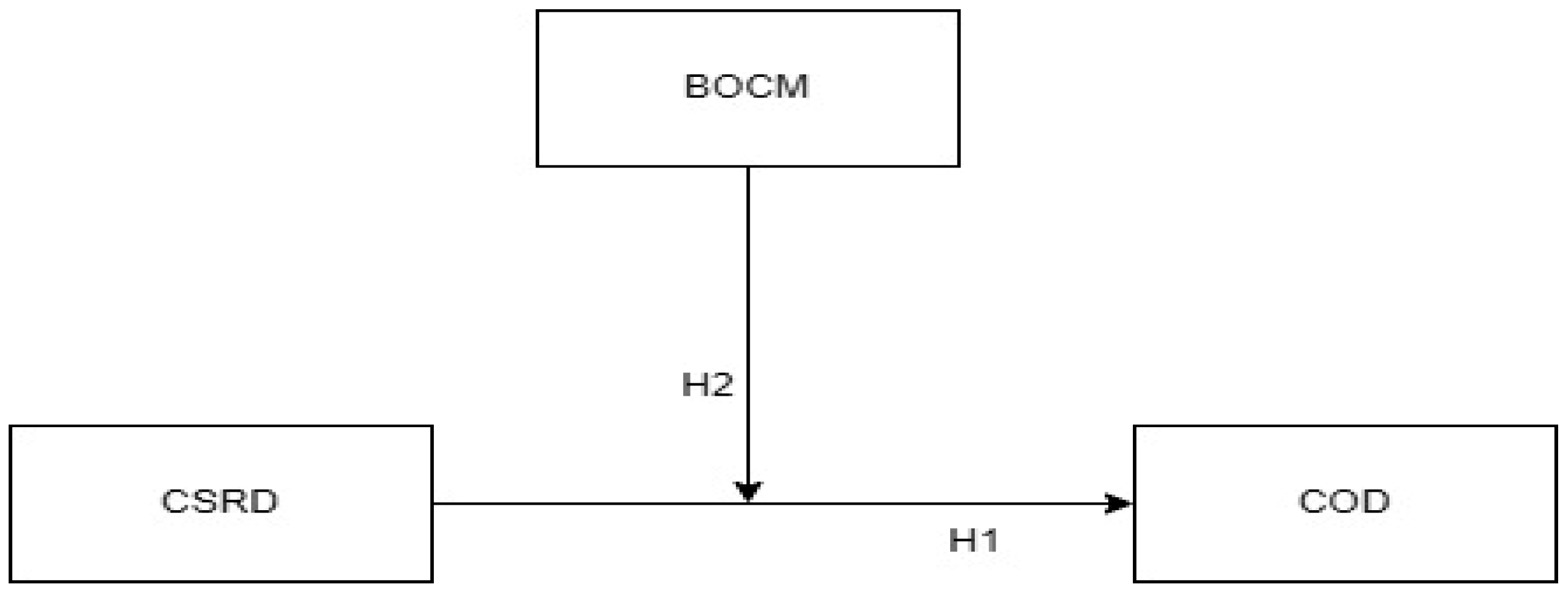
Based on this literature synthesis, it can be concluded that CSRD functions as an information instrument that can reduce information asymmetry and perceptions of creditor risk by conveying signals about management quality, governance effectiveness, and sustainable non-financial risk management. Therefore, the effectiveness of CSRD in reducing COD is more appropriately viewed as a function of the quality and context of disclosure, rather than simply of reporting compliance. Accordingly, this study formulates the following hypothesis:
H1. 
CSR disclosure is negatively associated with the cost of debt.

2.2. CSR Disclosure, the Board of Commissioners’ Monitoring Intensity, and Cost of Debt

The quality of corporate governance and the CSRD become crucial considerations for creditors when determining the COD. Board of Commissioners’ monitoring intensity (BOCM), as measured by board meeting frequency, constitutes a fundamental mechanism of effective corporate governance (Musleh Alsartawi, 2019). The integration of agency, stakeholder, and signalling theories provides a strong conceptual foundation for explaining how BOCM moderates the relationship between CSRD and COD. From an agency theory perspective, conflicts of interest between managers and owners arise from information asymmetry and the tendency toward opportunistic behaviour, necessitating effective governance mechanisms to ensure that management actions remain aligned with the interests of the company and its financiers (Giannarakis et al., 2023). Within this framework, BOCM serves as the primary oversight mechanism to reduce agency costs, improve control quality, and encourage the presentation of more credible information, including through the CSRD. As BOCM increases, the board serves not only as a symbol of governance but also ensures that CSRD is prepared in a more accurate, comprehensive, and non-symbolic manner (Bhatia & Makkar, 2019; Harjoto et al., 2022). Integrated BOCM and CSRD can reduce agency conflict between management and creditors, thereby affecting COD. The more frequent board meetings, the more actively commissioners monitor managerial performance, evaluate strategic decisions, ensure regulatory compliance, and promote transparency in corporate reporting (Abweny et al., 2025). As a result, CSR information becomes more credible to creditors, thereby reducing perceived risk and ultimately lowering COD.
From a stakeholder theory perspective, companies are responsible not only to shareholders but also to creditors, employees, the community, regulators, and other stakeholder groups (Malik & Kashiramka, 2024). In this context, CSRD is a means for companies to demonstrate their accountability, responsiveness, and commitment to stakeholder expectations (Gracia & Siregar, 2021). The better the quality of CSRD, the greater the company’s opportunity to gain social legitimacy and build better relationships with external parties, including lenders (Bhatia & Makkar, 2019). However, the effectiveness of such disclosure is largely determined by whether the information provided truly reflects the company’s concern for stakeholder interests or is simply structured for image purposes (Gracia & Siregar, 2021). Stakeholder theory holds that BOCM plays a critical role in mitigating managerial opportunism and in ensuring that corporate strategies align with stakeholders’ interests, including creditors’ interests (Christy et al., 2025). An active and diligent board in carrying out its oversight function can ensure that CSRD not only meets reporting formalities but is also relevant to stakeholders’ information needs. Thus, CSRD becomes more meaningful to creditors because it is seen as reflecting the company’s commitment to transparency, accountability, and long-term risk management, which can subsequently encourage more favourable debt terms and lower debt costs.
Meanwhile, signalling theory explains that CSRD is a voluntary signal that companies use to communicate their quality, responsibility, and sustainability orientation to external parties. In the debt market, creditors face limited information to directly assess a company’s non-financial quality (Giannarakis et al., 2023). Therefore, CSRD can serve as a signal of low non-financial risk, strong management quality, and a company’s strong commitment to responsible business practices (Eliwa et al., 2021). However, the value of this signal depends heavily on its credibility. If CSRD is perceived merely as a symbolic or impression-management strategy, creditors will not take it seriously in risk assessment. Conversely, if CSRD is closely monitored by the board of commissioners, the information provided will be viewed as a more reliable and substantive signal. In this case, BOCM increases the reliability of CSRD as a market signal, thereby strengthening its ability to reduce information asymmetry, enhance corporate creditworthiness, and lower the cost of debt (Malik & Kashiramka, 2024).
In sum, these three perspectives converge on a crucial point: CSRD will be effective only in lowering COD if it is perceived as credible, relevant, and useful information for creditors’ decision-making. Agency theory emphasizes the role of BOCM in mitigating conflicts of interest and information asymmetry; stakeholder theory emphasizes the importance of CSRD in responding to stakeholder expectations, while signalling theory emphasizes the function of CSRD as a marker of company quality for external parties. BOCM is a unifying element across the three theories because, through strong oversight, the board can ensure that CSRD is not only credible and free from corruption, but also provides the company with a means to maintain its integrity.
Nevertheless, prior empirical evidence suggests that the direct effect of BOCM on COD is not always statistically significant, as debt pricing is also shaped by market conditions, firm-specific risk, and the overall quality of information available to creditors (Alhady & Risanty, 2023). In this setting, the combination of CSRD and BOCM emerges as a key mechanism influencing COD. An active BOCM can exert pressure on management to enhance the transparency, credibility, and accountability of CSRD (Ju Ahmad et al., 2017). Signalling theory states that high-quality CSRD serves as a credible signal to creditors regarding the firm’s governance quality, commitment to sustainability, and capacity to manage social, environmental, and reputational risks (Yadav & Kumar, 2025). As creditors perceive lower non-financial risk, they are more likely to offer financing at lower interest rates, thereby reducing the firm’s cost of debt.
Furthermore, the literature shows that the relationship between CSRD and COD is not always linear and contextual. Several studies have found a non-linear or even insignificant relationship, depending on industry characteristics, the CSR dimensions disclosed, and the institutional context (Erragragui, 2018; Minnetti et al., 2025). Specifically, the environmental dimension is, in some cases, associated with an increase in the cost of debt, while strengths in governance and social aspects tend to decrease it, reflecting a paradoxical effect across CSR dimensions (Jawadi et al., 2025; Malik & Kashiramka, 2024). Furthermore, CSRD perceived as uncredible or as greenwashing can be viewed as an additional source of risk by creditors, especially for companies with high climate exposure, thereby increasing reputational and bankruptcy risks, reflected in higher COD (Trinh et al., 2024).
Despite these challenges, empirical studies indicate that BOCM provides commissioners with opportunities to scrutinize CSR initiatives, evaluate the actual impact of social and environmental programmes, and demand more comprehensive and reliable disclosures (Dienes & Velte, 2016; Mai et al., 2023; Sun et al., 2022; C. Wang et al., 2021). CSRD serves as a strategic communication tool that helps reduce creditors’ perceptions of social, environmental, and reputational risks—factors increasingly incorporated into COD decisions (Brogi et al., 2022). When CSRD is merely symbolic or compliance-driven, the board’s influence on creditors’ risk assessments becomes limited (Velte & Stawinoga, 2020). In contrast, when the board of commissioners actively monitors CSRD, the reported information gains credibility, strengthening CSR’s role as a channel with governance mechanisms that affect COD (Dienes & Velte, 2016).
Moreover, intensive BOCM plays a critical role in mitigating greenwashing practices, defined as the disclosure of CSR activities without substantive implementation (Yu et al., 2020). Through frequent meetings and active engagement, the board of commissioners can require verifiable evidence of CSR activities and assess their effectiveness. This process enhances the credibility of CSRD and reinforces its relevance in creditors’ risk evaluations (Duggal et al., 2025). In emerging markets such as Indonesia—where information asymmetry and variation in governance quality remain high—this moderating role of BOCM is essential to ensure that governance structures translate into tangible financing advantages. Based on empirical evidence, we argue that BOCM enhances CSRD quality, thereby lowering creditors’ perceived risk and reducing COD. Thus, CSRD functions not merely as a tool for social legitimacy but as a strategic instrument that links corporate governance mechanisms to financing cost efficiency, particularly in developing capital markets such as Indonesia.
However, creditors compile risk assessment portfolios from various signal sources, including financial statements, covenants, credit ratings, auditor reputation, governance structure, and CSRD (Bissoondoyal-Bheenick et al., 2023). Within this framework, CSRD and BOCM serve as two governance mechanisms that reduce information asymmetry and agency risk, but can also act as partial substitutes. When BOCM is high, creditors receive strong internal governance signals regarding management control and discipline, thereby limiting the CSRD’s informational added value in reducing COD. Conversely, under low-monitoring conditions, CSRD serves as a compensatory signal to reduce uncertainty. However, high meeting frequency does not always reflect effective oversight, as it can be reactive to risk pressures, internal conflicts, or increased leverage. Therefore, CSRD effectiveness remains dependent on the risk context and managerial motives (Chen & Bu, 2022).
Based on the description, it can be inferred that the relationship among CSRD, BOCM, and the COD is dynamic, contextual, and not purely linear. CSRD and BOCM both serve as governance signals for creditors to assess agency and non-financial risks, but they can also act as partial substitutes in the risk assessment process. When board oversight is strong, creditors tend to rely on internal governance signals, thereby limiting the CSRD’s informational added value in reducing COD. Conversely, under conditions of weak oversight, the CSRD serves as an important compensatory signal, reducing information asymmetry and increasing creditor confidence. However, the intensity of BOCM does not always reflect the effectiveness of supervision, as high meeting frequency can also reflect increased risk pressures and fundamental company issues, ultimately limiting CSRD’s ability to reduce creditor risk perceptions. Therefore, the moderating role of BOCM on the relationship between CSRD and COD should be understood as reflecting the interaction among governance quality, the credibility of sustainability signals, and the company’s underlying risk conditions. This synthesis confirms that the effectiveness of CSRD in reducing debt costs is highly dependent on the governance and risk context, so that CSRD cannot be viewed as a single mechanism, but rather as part of a broader signalling system in creditor decision-making. Based on the above theoretical arguments and empirical evidence, the following hypotheses are proposed:
H2. 
The Board of Commissioners’ monitoring intensity moderates the relationship between the CSR disclosure and the cost of debt.
The conceptual framework diagram in this study is summarized and displayed in Figure 1.

3. Research Method

3.1. Research Design and Sample Selection

This study used secondary data on corporate social responsibility (CSR) disclosure, the frequency of the board of commissioners’ meetings, total assets, net profit, interest expense, earnings before tax, and total debt for non-financial companies listed on the Indonesia Stock Exchange (IDX) between 2018 and 2023. Data collected from local databases: CEGS and TICMI. CESGS refers to the Centre for Environmental, Social, and Governance Studies, Universitas Airlangga. This source provides ESG-related data used in this research. TICMI refers to The Indonesia Capital Market Institute. It provides data on the Indonesian capital market and corporate financials. This study uses unbalanced panel data, which means not all units have observations for every time period (Kopyrina & Stepanova, 2023).
A total purposive sampling method was used to select the sample, including all companies that met the research criteria and had complete data for all required variables. From a total of 2221 company-year observations in the population, 1516 were selected as the research sample. Table 1 presents the sample selection process.

3.2. Variable Measurement

This study employs a dependent variable, an independent variable, a moderating variable, and four control variables. All variables are measured using established proxies widely adopted in prior empirical studies to ensure reliability and comparability of results. The summary of variable measurements is shown in Table 2.

3.2.1. Dependent Variable: Cost of Debt (COD)

The dependent variable in this study is the cost of debt (COD), which represents the effective interest rate a firm pays on its interest-bearing liabilities. COD reflects the compensation creditors require for providing debt financing and includes interest expenses and other debt-related costs. Consistent with prior studies, COD is measured as the ratio of a firm’s interest expense to its average total debt (Eliwa et al., 2021). Average total debt is calculated as the average of total debt at the beginning and end of the fiscal year. This measure captures the actual cost incurred by firms for using external debt financing.
COD = Interest   Expense Average   Total   Debt

3.2.2. Independent Variable: CSR Disclosure (CSRD)

The independent variable is corporate social responsibility disclosure (CSRD). CSR reflects a firm’s commitment to ethical business conduct, sustainable economic development, and the enhancement of social and environmental welfare for stakeholders (Christensen et al., 2021). CSRD is measured using a disclosure index approach, which assesses the extent to which firms disclose CSR-related information in their annual or sustainability reports. The total number of items in the CSRD index is determined by the CESGS database framework, which references GRI. This study operationalizes CSRD scoring using CESGS items. Thus, the CSRD measure in this study represents a research disclosure index constructed from CESGS data, tailored to the Indonesian sustainability-reporting context governed by OJK, and should not be interpreted as a score mechanically mandated by regulation.
Following CESGS (2025), the CSR disclosure score is calculated as the ratio of the firm’s disclosed CSR items to the total number of expected CSR items based on the disclosure checklist. A higher CSRD score indicates greater transparency and commitment to CSR activities.
CSRD = Number   of   CSR   Items   Disclosed Total   CSR   Disclosure   Items

3.2.3. Moderating Variable: Board of Commissioners’ Monitoring Intensity (BOCM)

The moderating variable in this study is the Board of Commissioners’ monitoring intensity (BOCM). Following Ju Ahmad et al. (2017), BOCM is proxied by the number of board of commissioners’ meetings held during a fiscal year. A higher number of meetings indicates more intensive monitoring, more frequent evaluation of managerial decisions, and greater opportunity to discuss strategic and risk-related issues, including sustainability-related matters. This proxy has been widely adopted in the corporate governance literature as an observable indicator of board activeness and monitoring effort, particularly in settings where direct observation of board quality is not feasible (Atalay et al., 2025).

3.2.4. Control Variables

To mitigate omitted variable bias, this study includes financial leverage (LEV), firm size (FSZ), return on assets (ROA), and the interest coverage ratio (ICR) as control variables. LEV is calculated as the ratio of total debt to total assets (Tanin et al., 2024). FSZ is measured as the natural logarithm of total assets. Larger firms generally have better access to capital markets and lower perceived default risk (Jabbouri & Naili, 2020). ROA is calculated as net income divided by total assets (Ngatno et al., 2021). ICR represents a firm’s ability to meet its interest obligations and is measured as earnings before interest and taxes (EBIT) divided by interest expense (Aprullah et al., 2025).

3.3. Model Specifications and Hypothesis Testing Procedure

This study employs moderated regression analysis (MRA) to examine whether the Board of Commissioners’ monitoring intensity (BOCM) moderates the relationship between corporate social responsibility disclosure (CSRD) and the cost of debt (COD) in non-financial firms listed on the Indonesia Stock Exchange (IDX) over the period 2018–2023. MRA is selected because it allows simultaneous estimation of direct and interaction effects between independent and dependent variables, thereby enabling identification of both strengthening and weakening moderation effects. This approach is consistent with the analytical framework proposed by S. Sharma et al. (1981) for moderation testing. The empirical analysis is conducted using EViews version 13 on unbalanced panel data, reflecting variations in firm-year observations across the sample period. Hypothesis testing is performed at a 5% significance level (α = 0.05). To determine the most appropriate panel-data estimation technique, the Chow test compares a pooled ordinary least squares (OLS) model with a fixed-effects model. In contrast, the Hausman test is used to select between fixed- and random-effects models (Herdiana et al., 2023).
The mathematical models of the study are formulated as follows:
Model (1)
C O D i t = β 0 + β 1 C S R D i t + β 2 L E V i t + β 3 F S Z i t + β 4 R O A i t + β 5 I C R i t + ε i t
Model (2)
C O D i t = β 0 + β 1 C S R D i t + β 2 B O C M i t + β 3 L E V i t + β 4 F S Z i t + β 5 R O A i t + β 6 I C R i t + ε i t
Model (3)
C O D i t = β 0 + β 1 C S R D i t + β 2 B O C M i t + β 3 L E V i t + β 4 F S Z i t + β 5 R O A i t + β 6 I C R i t + β 7 ( C S R D i t × B O C M i t ) + ε i t
where CODit is the company’s cost of debt in period t; CSRDit is the company’s CSR disclosure score in period t; BOCMit is the Board of Commissioners’ monitoring intensity (number of meetings per year) in period t; LEVit is the company’s leverage in period t; FSZit is the Company size in period t; ROAit is the return on company assets in period t; ICRit is the company’s interest coverage ratio in period t; CSRD × BOCMit is nteraction term representing the moderating effect, εit = company error term in period t.
Model (1) serves as the baseline model for the analysis. It examines the direct association between CSRD and COD, controlling for firm-level characteristics. This step clarifies the relationship between the main independent and dependent variables before introducing the moderator in subsequent models. Model (2) adds BOCM to test if board monitoring intensity directly affects COD. This assesses BOCM’s main effect. Including BOCM separately also clarifies its direct versus moderating roles and helps prevent misinterpreting the interaction. Model (3) adds the interaction term CSRD × BOCM to test the moderation hypothesis directly.
Following (S. Sharma et al., 1981), the nature of moderation is determined based on the statistical significance of the coefficients in Models (2) and (3). Pure moderation occurs when the interaction term (CSRD × BOCM) is statistically significant, while the main effect of BOCM is insignificant. Partial moderation occurs when both the interaction term and the main effect of BOCM are statistically significant. This classification enables a nuanced interpretation of how board monitoring intensity influences the relationship between CSR and the cost of debt. In addition to identifying the type of moderation, this study further interprets whether the Board of Commissioners’ monitoring intensity (BOCM) strengthens or weakens the relationship between CSR disclosure (CSRD) and the cost of debt (COD).
Following N. Sharma (2003) and standard moderated regression interpretation, the direction and magnitude of the moderating effect are determined by the sign and statistical significance of the interaction coefficient in Model (3). BOCM is considered to strengthen the relationship between CSRD and COD when the interaction term is statistically significant (p < 0.05) and has the same sign as CSRD’s primary effect. This p-value indicates that higher board monitoring intensity amplifies the impact of CSRD on COD. Then, increased board monitoring intensity further enhances COD reducing effect of CSRD. Conversely, BOCM is considered to weaken the relationship between CSRD and COD when the interaction term is statistically significant (p < 0.05) but has the opposite sign to the main effect of CSRD. This p-value suggests that BOCM dampens or offsets the effect of CSRD on COD. Then, stronger board monitoring reduces the magnitude of CSR’s cost-of-debt-lowering effect. BOCM is considered not to have a moderating effect when the interaction term is statistically insignificant (p ≥ 0.05), regardless of the sign of the coefficient.
In addition to estimating the moderated regression models, this study employs a series of supplementary statistical analyses to ensure the validity, reliability, and robustness of the empirical results. First, descriptive statistical analysis is conducted to summarize the central tendency and dispersion of all variables, including the mean, standard deviation, minimum, and maximum values. This analysis provides an initial overview of the data distribution and firm characteristics across the observation period. Second, a Pearson correlation analysis is performed to examine bivariate relationships among variables and provide preliminary insights into the direction of associations. This analysis also serves as an initial diagnostic for potential multicollinearity issues. Third, prior to hypothesis testing, the study conducts classical assumption tests to ensure the appropriateness of the regression estimations. Fourth, to address potential endogeneity concerns, particularly reverse causality and omitted variable bias, the study performs endogeneity diagnostics. Where necessary, additional model specifications and econometric adjustments are applied to mitigate bias and strengthen causal inference. Finally, the robustness of the main findings is assessed through sensitivity analyses. These include alternative model specifications, alternative variable measurements, and the use of robust standard errors to confirm that the results are not sensitive to specific estimation methods or assumptions.

4. Results

4.1. Descriptive Statistical Analysis

Table 3 presents descriptive statistics for all variables tested, including minimum, maximum, mean, and standard deviation.
Based on Table 3, the average COD was 4.64%, indicating that most companies pay relatively low interest on their debt. The minimum and maximum COD values were 1.0% and 14%, respectively, indicating significant differences in debt costs across companies. Analysis of company data shows that, for the 2018–2023 period, 54.81% of issuers listed on the Indonesia Stock Exchange (IDX) had a below-average COD. The average CSRD level was 46.9%, indicating that most companies have disclosed nearly half of the relevant CSRD requirements. The minimum CSRD score is 10%, and the maximum is 100%. This finding indicates inequality in CSRD practices in Indonesia, with some companies maximizing disclosure and others minimizing it. Analysis of company data shows that, for the 2018–2023 period, 56.19% of non-financial companies listed on the IDX had below-average CSRD. BOCM, as measured by the number of meetings held per year, is 6.45. While most companies hold regular BOCM meetings, the maximum and minimum scores are 42 and 0, respectively, indicating the presence of both highly intensive and infrequent oversight practices. Furthermore, 53.81% of non-financial companies on the IDX during that period also recorded an above-average BOCM. It is quite challenging to be good at corporate governance.
The average LEV is 41.1%, with a range of 10.1% to 79.7%. This finding suggests that some companies use debt moderately, while others utilize debt financing more aggressively. Firm size (FSZ), measured as the natural logarithm of total assets, has an average of 28.76 and a median of 28.87, ranging from a minimum of 22.08 to a maximum of 33.73. It suggests that most companies are of medium to large size, with moderate variation in size. ROA averages 4.08%. Some companies experienced significant losses, with the lowest ROA at −3.54%, whereas the most profitable companies had ROAs as high as 58.52%. The average ICR is 14.25, indicating a highly skewed distribution driven by outliers. Some companies had a negative ICR (−52.23) due to negative EBIT, while the healthiest companies had an extremely high ICR of 522.76. This descriptive statistical analysis indicates that the sample of Indonesian non-financial companies exhibits heterogeneous characteristics across COD, CSRD, BOCM, LEV, FSZ, ROA, and ICR.
Table 4 presents the Pearson correlation results, showing that CSRD is strongly negatively correlated with COD (r = −0.159), significant at the 1% level. This indicates that the higher the level of CSRD, the lower the COD. The BOCM is negatively correlated with COD (−0.101), indicating that companies with more intense BOCM are more likely to have lower COD. Leverage is strongly positively associated with COD (0.113), indicating that higher leverage is associated with higher COD. FSZ (−0.138), ROA (−0.082), and ICR (−0.097) are negatively correlated with COD, suggesting that small firms, lower profitability, and lower ICR are associated with higher COD. A strong relationship among variables does not necessarily indicate multicollinearity. The correlation among variables is relatively low, with values below 0.8, indicating no multicollinearity in the models.
Based on the Pearson correlation test results in Table 4, the correlation between the independent variables remains within acceptable limits. To strengthen the multicollinearity test, further analysis was conducted using the pairwise correlation approach, in which multicollinearity is indicated if the correlation between independent variables exceeds 0.80. The test results are presented in Table 5.
Panel model selection was conducted using the Chow test, the Hausman test, and the Breusch–Pagan Lagrange Multiplier (LM) test, as shown in Table 6. The Chow test results for all three models showed a p-value of 0.000, indicating that the pooled OLS model was inadequate and that a panel model was more appropriate. The Breusch–Pagan LM test, which was also significant (p-value = 0.000) for all models, thus confirmed the presence of a panel effect (a component of variance between firms) relevant to the estimation. Furthermore, the choice between Fixed Effects and Random Effects was determined based on the Hausman test. The Hausman p-values for Model 1 (0.162), Model 2 (0.256), and Model 3 (0.559) were all greater than 0.05. Therefore, the null hypothesis was not rejected, and the Random Effects estimator was deemed consistent and more efficient than the Fixed Effects estimator for all three tested specifications. Based on these tests, this study employs the Cross-Section Random Effects Model (REM) as the primary estimation model for Models 1–3.

4.2. Classical Assumption Test

Multicollinearity testing was also conducted by using the pairwise correlation matrix in Table 5. All correlation coefficients between independent variables were below the general threshold of 0.80, with the highest correlation value being approximately 0.476 (between CSRD and FSZ). These results indicate no serious multicollinearity; thus, the estimated regression coefficients are relatively stable and do not exhibit significant distortion due to strong linear relationships among predictors. To ensure the validity of statistical inferences, this study accounts for potential heteroscedasticity and residual dependence in the panel structure by using White cross-section standard errors clustered by period, with degrees-of-freedom correction (d.f. corrected). The use of robust/clustered standard errors aims to maintain the reliability of coefficient significance tests despite non-constant residual variances or specific patterns of dependence in the time dimension. With this approach, conclusions regarding parameter significance do not rely solely on strict classical assumptions. Furthermore, a brief evaluation of autocorrelation indications is performed using the Durbin–Watson statistic, which ranges from 1.674 to 1.684 (in Table 6). This value does not indicate a severe autocorrelation problem in all three specifications. In the context of a company-year panel, the primary emphasis remains on controlling individual heterogeneity (through the REM structure) and applying robust/clustered standard errors to maintain inference accuracy. Therefore, autocorrelation evaluation is positioned as a supplementary check.
Table 5. Multicollinearity testing.
CSRDBOCMLEVFSZROAICR
CSRD10.2000.0950.4760.1150.054
BOCM0.20010.1180.205−0.023−0.001
LEV0.0950.11810.162−0.145−0.235
FSZ0.4760.2050.16210.1900.006
ROA0.115−0.023−0.1450.19010.201
ICR0.054−0.001−0.2350.0060.2011
Finally, residual normality tests are not reported because normality is not a primary prerequisite for estimator consistency in panel regression, especially when inference is based on robust/clustered standard errors and the number of observations is relatively large. Therefore, the testing focuses on selecting an appropriate panel model, assessing multicollinearity, and employing robust procedures to address heteroscedasticity and ensure that the estimation results are reliably interpretable.
Table 6. Panel model testing.
Modelp-ValueSelected Model
ChowHausmanLM (Breuch-Pagan)
Model 10.0000.16150.000REM
Model 20.0000.25580.000REM
Model 30.0000.55910.000REM

4.3. Research Results

Based on Table 7, the estimation results indicate that all three panel regression models using the cross-section random-effects approach are jointly significant (Prob(F) = 0.000). The Adjusted R-squared value increases from 0.328 in Model 1 to 0.371 in Model 2 and 0.375 in Model 3. This increase indicates that the addition of the board of commissioners’ monitoring intensity (BOCM) variable and the moderating interaction term CSRD × BOCM provides additional explanatory power for variation in the cost of debt (COD), although the increase is relatively modest. The model has sufficient explanatory power for the research context of non-financial companies for the 2018–2023 period, with a total of 1.516 company-year observations. Furthermore, the primary variable CSRD shows a consistently negative and significant coefficient across all models (Model 1: −0.010; Model 2: −0.009; Model 3: −0.012), with p-values < 0.01. Hypothesis (H1) is accepted. These findings indicate that the higher the level of corporate social responsibility disclosure, the lower the COD. The BOCM variable, measured by the number of board of commissioners meetings per year, also shows a negative and significant coefficient in Models 2 and 3 (Model 2: −0.0004; Model 3: −0.001) with p-values < 0.01. In Model 3, the interaction term (CSRD × BOCM) has a positive, significant coefficient (Model 3: 0.0097; p-value < 0.01). The second hypothesis (H2) is accepted, indicating that BOCM moderates the relationship between CSRD and COD. Because BOCM has a significant direct effect on COD, and the interaction coefficient between BOCM and CSRD on COD is also significant and positive, BOCM can be categorized as a partial moderator variable. The positive interaction coefficient indicates that BOCM weakens the negative relationship between CSRD and COD.
The results for the control variables are consistent with the concept of financial accounting. Leverage (LEV) has a positive and significant coefficient across all models (coefficient 0.013, p-value < 0.01). Firm size (FSZ) has a negative and statistically significant coefficient (0.001, p-value < 0.01). Furthermore, profitability (ROA) has a negative and statistically significant coefficient (0.004, p-value < 0.01). The interest coverage ratio (ICR) also has a negative and significant coefficient (0.00001, p-value < 0.01).
Based on the result, this study has statistical and economic significance. In terms of statistical significance, the focal variables in Table 6 are all significant at the 1% level. In Model 3, the coefficient on CSRD is negative and significant (β = −0.012, p < 0.01), BOCM is also significant (β = −0.0010, p < 0.01), and the interaction term CSRD × BOCM is positive and significant (β = 0.00097, p < 0.01). This indicates that the moderating effect is statistically robust. In addition, the inclusion of the interaction term slightly improves model fit, as the R-squared increases from 0.374 in Model 2 to 0.378 in Model 3.
In terms of economic significance, the marginal effect of CSRD on COD in the moderated model can be expressed as: ∂COD/∂CSRD = −0.012 + 0.00097 × BOCM. This means that each additional board meeting (an increase of 1 in BOCM) increases the marginal effect of CSRD on COD by 0.00097. This means that the effect of CSRD on COD depends on the level of board monitoring intensity. A 0.10 increase in CSRD is associated with a 0.12 percentage-point reduction in COD only when BOCM equals zero. However, each additional board meeting reduces this borrowing-cost benefit by about 0.0097 percentage points (or 0.97 basis points) for the same 0.10 increase in CSRD. For illustration, if BOCM equals 5 meetings, a 0.10 increase in CSRD is associated with approximately a 0.0715 percentage-point decline in COD; if BOCM equals 10 meetings, the decline becomes only about 0.023 percentage points. The marginal effect becomes zero at around 12.37 meetings per year.

4.4. Endogeneity Test

To address potential endogeneity concerns arising from reverse causality and omitted-variable bias in the relationship between CSR disclosure and the cost of debt, we implement an instrumental-variable approach using lagged CSR disclosure as an instrument and estimate the model within a panel GMM/DPD framework with random effects. This specification preserves sufficient cross-sectional and temporal variation to ensure instrument relevance while mitigating the simultaneity concerns inherent in firm-level CSR decisions. To ensure robust inference, we employ White-period cross-sectionally clustered standard errors, which account for heteroskedasticity and within-firm time-series correlation. The results remain negative and statistically significant, indicating that CSR disclosure continues to reduce the cost of debt after correcting for potential endogeneity. Importantly, using a parsimonious instrument set avoids instrument proliferation and ensures estimator stability. Overall, these findings confirm that the study’s main conclusions are robust to endogeneity concerns, reinforcing the interpretation that CSR disclosure plays a meaningful role in shaping creditors’ pricing decisions.

4.5. Heterogeneity

The combined evidence from cross-sectional heterogeneity tests, interaction-based regressions, and quantile analyses demonstrates that the relationship between CSRD and COD is systematically heterogeneous rather than uniform across firms. The cross-sectional analysis, which partitions firms into high and low BOCM (HIGH_BOCM), shows that companies with more frequent board of commissioners’ meetings consistently exhibit lower borrowing costs, confirming that monitoring intensity constitutes an important firm-level source of heterogeneity in debt pricing. The interaction-based approach further reinforces this conclusion by revealing a positive, statistically significant interaction between CSRD and BOCM, indicating that, while CSRD and BOCM independently reduce COD, their joint effect reflects a substitution mechanism in which intensive monitoring weakens the marginal debt-reducing impact of CSRD. Consistent with these results, quantile regression estimates across the 0.25, 0.50, and 0.75 quantiles show that the negative effect of CSRD is strongest at lower and median levels of COD and gradually diminishes at higher quantiles, while the interaction effect remains positive and significant throughout the distribution. Taken together, these findings provide robust evidence that creditors assess CSRD in a context-dependent manner, conditioned by both the firm’s governance environment and its position within the credit-risk distribution, thereby confirming the presence of cross-sectional and distributional heterogeneity in the CSR–cost of debt relationship as shown in Table 8.

4.6. Robustness

Robustness testing was conducted to ensure that the relationship between CSR disclosure (CSRD) and the cost of debt (COD), as well as the moderating role of Board of Commissioners’ Monitoring Intensity (BOCM), was independent of a single estimation method or model specification. To achieve this, the study developed five model modifications. Modification 1 used the Random Effects Model (RE) as the baseline model without a cluster correction/robust standard error. Modification 2 retained RE but added robust White standard-error correction using a cross-sectional clustering approach, making the inference results more robust to potential heteroscedasticity and within-entity correlation. Modification 3 applied an OLS model with fixed time periods (time-fixed effects) to control for time effects that could systematically influence COD. Modification 4 used RE but omitted the control variables (LEV, FSZ, ROA, and ICR) as a sensitivity test to determine whether the main effects persisted when the model specification was simplified. Finally, Modification 5 used a Fixed Effects Model (FEM) to address the possibility of unobserved heterogeneity that persists within each company.
The estimation results showed strong consistency across all modifications, as shown in Table 9. The CSRD coefficient remains negative and significant across all models (ranging from −0.0114 to −0.0136), indicating that increased CSR disclosure tends to lower the cost of debt. The BOCM variable is consistently negative and significant across all specifications, indicating that the intensity of board monitoring is negatively correlated with COD. Meanwhile, the CSRD × BOCM interaction coefficient is consistently positive and significant across all modifications (ranging from 0.0004 to 0.0005), confirming a moderating effect: BOCM monitoring strengthens the relationship between CSRD and COD. Thus, although the direct effect of CSRD is to reduce COD, the presence of board monitoring changes the relationship (weakening the magnitude of the COD decrease or leading to a smaller effect), consistent with the positive sign of the interaction coefficient.
The stability of the coefficient signs, their relatively unchanged magnitudes, and their persistent significance when (i) REM is estimated without clustered standard errors, (ii) the standard errors are made White Period, cross-section clustered), (iii) the time effect is controlled, (iv) the control variables are removed, and (v) the estimator is changed from REM to FEM, indicate that the main findings of this study are robust and not sensitive to the choice of method or variations in model specifications.

5. Discussions

5.1. The Effect of CSR Disclosure on the Cost of Debt

The results in Table 7 show that CSRD has a negative and significant effect on COD across all model specifications, which can be interpreted as evidence that non-financial information—particularly CSRD—is processed by creditors as relevant input in risk assessment. For creditors, COD is essentially the ‘price’ of two main components: (1) probability of default and (2) loss given default, both of which are influenced by cash flow uncertainty and risk management quality (Abbassi et al., 2024; Yadav & Kumar, 2025). When CSRD increases and is deemed credible, creditors tend to lower their assessment of both components, thereby reducing COD. This finding is consistent with signalling theory, which suggests that management sends signals to reduce information asymmetry between companies and fund providers (Shaw & Duggal, 2023). Creditors not only look at financial statements, but also seek ‘clues’ about how companies manage risks that are not immediately apparent in accounting figures—for example, environmental risks, social risks, supply chain risks, and compliance risks (Priyadi et al., 2021). A more comprehensive CSRD can signal that the company has more mature processes, policies, and control systems. When this signal is believed, creditors revise their risk perceptions: future cash-flow variance is viewed as lower, operational risk volatility decreases, and the probability of payment disruptions declines. Consequently, creditors lower their risk premiums, and COD decreases. Frequently cited empirical findings (e.g., Aleknevičienė & Stralkutė, 2023; H. Wang et al., 2022; Xu et al., 2021) support the idea that CSRD can lower COD, especially when stakeholder orientation and corporate transparency are high, meaning that the financing market responds not only to the ‘presence or absence’ of CSR, but also to the quality of the signal and its credibility.
However, signals are only effective if they meet credibility requirements. In practice, creditors will assess whether CSRD is substantive (containing metrics, targets, achievements, and explanations of material risks) or merely symbolic (general narratives that are difficult to verify) (Velte & Stawinoga, 2020). If the disclosure is symbolic, the signal may be discounted due to the potential for greenwashing (Yu et al., 2020). Therefore, the negative significance of CSRD–COD is more appropriately framed as an average effect: in general, increased CSR disclosure among non-financial companies on the IDX during the 2018–2023 period is associated with lower perceived credit risk, although the strength of the effect is likely to vary based on disclosure quality, issue materiality, and governance conditions.
From the perspective of disclosure literature, the mechanism of COD reduction through disclosure operates through two interrelated channels. First, the information channel: high-quality disclosure reduces creditors’ uncertainty about the company’s cash flow prospects and risk profile (Tsang et al., 2023). Creditors are more confident in their ability to project repayment, so they demand lower spreads. Alves and Meneses (2024) show that disclosure quality can reduce COD by reducing perceptions of default risk and by improving market risk estimates. Second, the monitoring channel: better disclosure often correlates with higher internal discipline—for example, the existence of reporting, auditing, and control systems—which makes it easier for creditors to monitor and reduces agency costs in debt contracts (e.g., the need for stricter covenants or more expensive monitoring) (Velte, 2022).
Meanwhile, stakeholder theory provides a complementary explanation: CSR is not just ‘communication,’ but also a reflection of how companies manage their relationships with regulators, workers, suppliers, communities, and consumers (Hernández-Pajares, 2023). Adequate CSR disclosure can be an indicator that a company is reducing non-financial risks that often trigger tail events—extreme but high-impact events—such as compliance fines, social conflicts, production disruptions, consumer boycotts, or workplace safety incidents (B. Zhu & Wang, 2024). Creditors are naturally very sensitive to tail risk because such events can suddenly cut cash flow and damage payment capacity. When companies demonstrate more transparent CSR practices, creditors can assess that the company has better ‘risk buffers’ policies that reduce the risk of major accidents, environmental management that reduces the risk of sanctions, or supply chain governance that reduces the risk of operational disruptions (Harymawan et al., 2021). In financial economics terms, well-managed CSR can reduce cash flow at risk and downside volatility, ultimately lowering COD (Srivisal et al., 2021).
The research by Khan et al. (2024) and Malik and Kashiramka (2025), which found a correlation between CSR and better access to funding, can be understood through the logic of reduced information friction and capital constraints. Companies with better CSR tend to face lower funding barriers because investors and creditors have more confidence in the quality of their management and the sustainability of their business model. Conceptually, better access to funding and lower COD are two manifestations of the same mechanism: reduced risk assessment and increased trust among fund providers. Furthermore, Eliwa et al. (2021) findings on the relationship between better social performance and higher credit ratings also support this ‘risk reduction’ channel—better ratings will logically be reflected in lower debt costs.
Beyond its theoretical implications, this study also offers important economic implications. More extensive CSRD can help reduce information asymmetry between firms and creditors. By providing broader non-financial information on social responsibility, stakeholder engagement, and risk management practices, firms may signal greater transparency and lower uncertainty, thereby improving creditors’ confidence in the firm’s long-term stability and repayment capacity. From an economic perspective, this suggests that CSRD is not merely a symbolic reporting practice, but may also function as a financing-relevant governance signal that helps firms obtain debt capital at lower cost.
This study offers a broader literature by distinguishing between evidence from developed markets and emerging markets. In developed economies, prior studies generally find that sustainability disclosure and broader ESG transparency are associated with lower financing costs because creditors operate in more mature information environments and are more accustomed to integrating non-financial disclosures into risk assessments (Arcidiacono et al., 2026; Bhatia & Makkar, 2019; Eliwa et al., 2021). Our findings are broadly consistent with this stream of literature. At the same time, we highlight that the evidence from emerging markets remains less consistent due to differences in institutional quality, regulatory enforcement, disclosure standards, and creditor reliance on non-financial information (J. Lu & Wang, 2021; Samarawickrama et al., 2025; Xue et al., 2024). Therefore, our result provides important evidence from Indonesia, showing that, even in an emerging market context where sustainability reporting practices are still evolving, creditors appear to respond positively to more extensive CSR disclosure (Gracia & Siregar, 2021). In emerging markets characterized by greater information opacity and weaker external monitoring mechanisms, CSRD may add incremental value to creditors by helping fill informational gaps not fully captured by traditional financial indicators. As such, the negative effect of CSR disclosure on the cost of debt may reflect transparency’s role in mitigating perceived firm risk in settings where formal governance and disclosure infrastructures are still developing.
In addition, the control variables strengthen the internal validity of the main results, as the coefficient signs are consistent with the financial literature. The positive and significant LEV coefficient indicates that, as leverage increases, the fixed obligation burden grows and the buffer narrows when income declines, so creditors demand higher premiums. In the credit spread literature, leverage is indeed one of the most ‘fundamental’ determinants because it directly shifts the probability of distress (Dalci, 2018; Suranta et al., 2023). The negative FSZ coefficient can be explained by diversification and stability: large companies generally have more diverse product and market portfolios, broader access to funding, and greater market information, thereby reducing information friction and lowering spreads (Tanin et al., 2024). A negative ROA coefficient is consistent with the logic of payment capacity: higher profitability strengthens the ability to pay interest and principal, reduces the risk of default, and lowers COD (Shaw & Duggal, 2023). Finally, a negative ICR is the most direct channel—this ratio is often used in synthetic rating mapping and default spread estimation—so when the ICR improves, creditors have a strong basis for lowering risk premiums (Eliwa et al., 2021). The consistency of the signs and the significance of the controls signal that your model does not ‘simply’ capture spurious correlations, but also incorporates common credit risk determinants. Furthermore, the quality and consistency of CSR reporting are key factors, as more transparent and regular disclosure has been shown to provide greater benefits in lowering COD (Guo et al., 2024).
Thus, the strongest narrative is that higher CSRD tends to mitigate COD by reducing information asymmetry and suppressing material non-financial risk for creditors. The contribution of this study lies in the context of emerging markets, where external information and enforcement mechanisms may not be as robust as in advanced markets, making credible CSR disclosure a valuable ‘uncertainty-reducing tool’ for creditors—although its effect remains contingent on the quality, materiality, and governance of the company.

5.2. The Effect of Board of Commissioners’ Monitoring Intensity as a Moderator on the Relationship Between CSRD and COD

The Board of Commissioners’ monitoring intensity (BOCM) has a negative and significant coefficient on COD in Models 2 and 3. Theoretically, this finding is in line with agency theory. The more often the board of commissioners meets, the more intense management’s monitoring function, the more active the policy evaluation, and the greater the opportunity for oversight of decisions that are risky for creditors. In debt relationships, agency conflicts are not only ‘owners vs. managers’, but also creditors vs. shareholders/managers (Jensen & Meckling, 1976). Management may be encouraged to take opportunistic actions that harm creditors—for example, asset substitution (taking on high-risk projects after obtaining funds), underinvestment (withholding investments that are actually profitable but whose benefits are mostly enjoyed by creditors), or reporting manipulation that conceals risks (Subramaniam, 2016). The intensity of board meetings can be seen as an indicator that internal control mechanisms are more active, thereby reducing agency costs, better controlling risk shifting, and lowering creditors’ risk premiums (Vafeas & Vlittis, 2024). From a credit market perspective, BOCM can also serve as a governance signal: a higher meeting frequency signals stronger oversight discipline, which, in turn, enhances the company’s credibility in the eyes of lenders (Vafeas, 1999).
However, the most crucial contribution lies in the positive, significant CSRD × BOCM interaction coefficient. Since the main CSRD coefficient is negative, a positive interaction indicates that, as BOCM increases, the effect of CSRD on reducing COD becomes weaker (less negative). Economically, this pattern is more accurately interpreted as the diminishing marginal benefit of CSRD when internal oversight mechanisms are already strong. Creditors compile risk assessments from various sources of signals—financial reports, covenants, ratings, auditor reputation, governance structure, and CSRD (Bissoondoyal-Bheenick et al., 2023). When BOCM is high, creditors have obtained strong ‘governance signals’ about management control and discipline. As a result, additional information from CSRD no longer provides as much incremental informativeness as it did when internal monitoring was weak. In other words, CSRD and BOCM appear to work as a partial substitution mechanism: both reduce information asymmetry and agency risk, but the marginal effect of CSRD decreases when BOCM increases. The risk perspective also emphasizes the role of managerial motives and agency risk in the relationship between CSRD and COD. CSRD can be exploited by management to conceal operational problems or strengthen their position (managerial entrenchment), thereby increasing creditors’ perceived risk and COD (Chen & Bu, 2022).
This interpretation of partial substitution is strong if we view creditors as rational parties in optimizing signals. In conditions of low internal monitoring, creditors face greater uncertainty: earnings management risk, unmonitored project risk, and unclear compliance risk. In this context, CSRD—especially when detailed, metric-based, and material—can be an additional signal that helps creditors assess the quality of non-financial risk management and cash flow stability. Conversely, when internal monitoring is high (as indicated by more frequent meetings), creditors may assume that many risks are already ‘addressed’ through governance processes; thus, the CSRD remains relevant, but its added value in reducing debt spreads diminishes.
However, there is an equally important and more ‘critical’ alternative interpretation: meeting frequency is not always synonymous with effective oversight. More frequent meetings can be reactive rather than proactive. That is, companies increase meeting frequency because they face complex problems, risk pressures, internal conflicts, or financial/operational conditions that demand greater attention. In such situations, creditors may interpret high BOCM as a signal of trouble or an increased risk environment: ‘if meetings are becoming more frequent, there may be serious issues.’ If so, creditors may discount CSRD as less effective at mitigating risk perceptions, because perceived risk is already high and primarily determined by the fundamental conditions and events faced. This finding does not invalidate the main results, but it does require caution in stating that purely positive moderation means signal substitution—because what is measured by BOCM is the intensity, not the quality of meetings (e.g., agenda, depth of risk discussion, independence of commissioners, attendance of audit/risk committees, follow-up on decisions, and effectiveness of implementation).
If the increase in BOCM is triggered by an increase in risk (e.g., increased leverage, volatility, decline in profitability, or litigation exposure), then the moderation coefficient may reflect a combination of (i) strengthened monitoring and (ii) risk conditions that trigger more frequent meetings. Within the framework of stakeholder theory, positive moderation can be explained as a change in creditors’ requirements for ‘evidence’ of stakeholder risk management. When board monitoring is high, creditors may assess that stakeholder risks (regulators, communities, workers, consumers) are more effectively managed through internal governance mechanisms—for example, compliance policies, internal reporting systems, and committee oversight. Consequently, CSRD is no longer a key determinant of COD reduction in companies with low monitoring. Conversely, in companies with low monitoring, CSRD acts as a more important compensatory signal: creditors require additional evidence that the company has the commitment and capacity to manage stakeholder risks and maintain social legitimacy, thereby reducing COD.
The practical implications are crucial. Companies can position CSR disclosure as a strategic financial instrument to reduce funding costs—not merely a moral or regulatory obligation. However, the benefits are not universal and linear. In practice, BOCM can be understood as a moderating mechanism that attenuates the negative relationship between CSR disclosure and the cost of debt. This occurs because strong BOCM, in essence, also serves to reduce information asymmetry and agency conflicts, which are the main channels through which CSRD can lower COD (Ghouma et al., 2018; Jara et al., 2019; Khaw et al., 2019). When board monitoring intensity is high, the additional benefit of CSRD in reducing information asymmetry becomes less pronounced, as effective board monitoring already provides creditors with confidence in the firm’s managerial behaviour and financial transparency (Ghouma et al., 2018). This situation suggests a substitution effect: strong board monitoring and high-quality CSR disclosure both lower the cost of debt, but the presence of one may reduce the marginal effect of the other. Therefore, firms with strong board monitoring may not achieve as significant a reduction in their COD as firms with weaker governance when disclosing CSR (Jara et al., 2019). Conversely, in companies with low board monitoring intensity, CSRD plays a more important role in reducing information asymmetry and lowering COD (Bui et al., 2018). This finding synthesis suggests that both BOCM and CSRD can lower the cost of debt by reducing agency problems and information asymmetry, but their effects can overlap. Therefore, in companies with strong governance structures, the additional effect of CSRD on reducing COD tends to be weakened, whereas in weak governance environments, CSRD becomes more valuable to creditors.

6. Conclusions, Implications, Limitations, and Recommendations

This study shows a consistent relationship between Corporate Social Responsibility Disclosure (CSRD), board oversight intensity (BOCM), and cost of debt (COD). Empirically, CSRD lowers COD. Companies with higher CSR disclosure tend to obtain lower borrowing costs because creditors perceive lower default risk and cash-flow uncertainty. BOCM also lowers COD, indicating that more intense board oversight strengthens internal controls, limits opportunistic management behaviour, and reduces agency costs—all of which enhance credit market confidence. The most important finding is the significant interaction between CSRD and BOCM. Since the main effect of CSRD is negative and the interaction is positive, the moderation is partial and weakening. When BOCM is high, the effect of CSRD on reducing COD is smaller. The most compelling interpretation is diminishing marginal benefits. Creditors rely on various risk signals; when internal governance is already strong (high BOCM), additional signals from CSRD become less ‘incremental’ in reducing debt spreads. In other words, CSRD and BOCM serve as partial substitutes for reducing information asymmetry and agency risk.
This conclusion is also supported by the signalling/information perspective. CSR disclosure is a signal of management quality and risk management capabilities, as well as stakeholder relations. However, weakening moderation also opens up critical interpretations: the frequency of board meetings can be reactive to risk pressures (e.g., complexity of issues or deteriorating company conditions), so creditors tend to ‘discount’ the strength of CSRD signals. This does not invalidate the results, but it does call for caution: BOCM measures the intensity, not the quality of meetings (agenda, independence, competence, follow-up, supervisory effectiveness).
The implications affect corporate strategy and policy. First, companies need to strengthen the supervisory capacity of the board of commissioners—not just by increasing the frequency of meetings, but by ensuring quality: governance and sustainability competence, independence, effective audit/risk committees, and follow-up on decisions. Second, CSRD should be treated as a strategic instrument for funding cost efficiency: creditors respond to credibility (accuracy, consistency, measurability, and focus on material issues), not just the length of the report. Third, the greatest value emerges when CSR, governance, and risk management are integrated: disclosures aligned with the oversight process will be more credible and more effective in reducing perceptions of credit risk.
The limitations of this study need to be critically emphasized. The model’s relatively low explanatory power suggests the presence of omitted variables (macro conditions, industry characteristics, credit reputation, bank-debtor relations, capital structure dynamics, managerial culture). The use of secondary data limits the capture of qualitative aspects (commissioner competence, meeting discussion quality, creditor perceptions). The 2018–2023 period, without sector differentiation, may limit generalization. Furthermore, the quantitative measure of CSRD does not always reflect the quality of CSR implementation, leaving the risk of symbolic disclosure. The measurement of board monitoring intensity based on the frequency of board of commissioner meetings only reflects the intensity of supervision, not the effectiveness or the quality of supervision itself, so it does not fully capture the substance of discussions, the depth of risk evaluation, the independence of decision-making, and the follow-up to the meeting results. The frequency of board of commissioners’ meetings is widely used in the corporate governance literature as an observable proxy for board activeness; it may not fully capture the quality, effectiveness, or substance of board oversight. A higher number of meetings does not necessarily imply more effective monitoring, as meeting outcomes may also depend on factors such as the quality of deliberation, the expertise and independence of board members, attendance levels, agenda relevance, and the extent to which the board’s recommendations are implemented by management. We therefore acknowledge more possible omitted governance variables. We now state that other governance characteristics may also affect the link between CSR disclosure and financing costs. These include board independence, board size, gender diversity, financial expertise, ownership structure, audit committee effectiveness, and institutional monitoring mechanisms. Such dimensions may shape both the credibility of CSR disclosures and creditors’ perceptions of risk. Their exclusion may limit our model’s comprehensiveness. Therefore, we now emphasize that our findings are based on the specific governance proxy used in this study, not the broader governance environment.
Recommendations for further research: include credit rating/credit reputation, macroeconomic indicators, industry risk, dimensions of governance quality (independence, expertise, committee structure), and additional multidimensional proxies of CSRD quality. A mixed-methods approach (creditor/commissioner interviews and case studies) is also important for explaining how CSRD signals are interpreted in credit decisions. For regulators, strengthening reporting standards and governance guidelines will enhance comparability and reduce the scope for greenwashing, thereby making the benefits of CSRD for COD more tangible and stable. Future research may combine meeting frequency with indicators such as board independence, attendance, expertise, committee structure, or qualitative assessments of board effectiveness. In addition, future studies may employ alternative empirical approaches or richer governance datasets to mitigate the risk of omitted-variable bias and provide a more refined understanding of how governance mechanisms shape the relationship between CSR disclosure and the cost of debt.

Author Contributions

Conceptualisation, I.I. and Y.D.; methodology, M.I.; software, M.P.A.; validation I.I. and Y.D.; formal analysis, I.I.; investigation, M.I.; resources, I.I. and Y.D.; data curation, M.P.A.; writing—original draft preparation, M.P.A.; writing—review and editing, Y.D.; visualisation, M.P.A.; supervision, M.I.; project administration, Y.D. and M.I.; funding acquisition, I.I and Y.D. All authors have read and agreed to the published version of the manuscript.

Funding

Universitas Syiah Kuala, which provided funding for this research under research contract number: 348/UN11.L1/PG.01.03/14601.-PTNBH/2025 dated 15 July 2025.

Institutional Review Board Statement

Not applicable.

Informed Consent Statement

Not applicable.

Data Availability Statement

The original contributions presented in this study are included in the article. Further inquiries can be directed to the corresponding author.

Acknowledgments

The authors acknowledge the Center for Environmental, Social, and Governance Studies (CESGS), Universitas Airlangga, and the Indonesia Capital Market Institute (TICMI) for providing access to the data used in this study.

Conflicts of Interest

All authors declare no conflicts of interest in this paper.

Abbreviations

The following abbreviations are used in this manuscript:
CODCost of Debt
CSRDCorporate Social Responsibility Disclosure
BOCMBoard of Commissioners’ monitoring intensity
LEVLeverage
FSZFirm Size
ROAReturn on Asset
ICRInterest Coverage Rate
IDXIndonesia Stock Exchange

References

  1. Abbassi, W., Boubaker, S., & Louhichi, W. (2024). Why do corporate social responsibility-oriented companies opt for bond debt? Evidence from crisis periods. International Journal of Finance and Economics, 29(2), 1534–1568. [Google Scholar] [CrossRef]
  2. Abweny, M., Afrifa, G. A., & Iqbal, A. (2025). The complementarity and substitution effects of CSR-focused governance mechanisms on CSR decoupling. Corporate Governance: An International Review, 33(1), 153–175. [Google Scholar] [CrossRef]
  3. Ag, P. L., Author, B., & Lang, P. (2012). Corporate social responsibility (CSR). In Between creed, rhetoric façade, and disregard: Dissemination and theorization of corporate social responsibility in Austria. Peter Lang International Academic Publishers. [Google Scholar]
  4. Al-Dhamari, R., Badru, B. O., & Mohamad Nor, M. N. (2025). Do female directors and their foreign experience complement or substitute for CSR performance? Evidence from the cost of debt financing. Asian Review of Accounting, 33(4), 752–787. [Google Scholar] [CrossRef]
  5. Aleknevičienė, V., & Stralkutė, S. (2023). Impact of corporate social responsibility on cost of debt in Scandinavian public companies. Oeconomia Copernicana, 14(2), 585–608. [Google Scholar] [CrossRef]
  6. Alhady, M. A., & Risanty. (2023). Effect of good corporate governance, company size, and voluntary disclosure on cost of debt in healthcare companies listed on the Indonesia stock exchange (period 2017–2021). IOP Conference Series: Earth and Environmental Science, 1188(1), 012030. [Google Scholar] [CrossRef]
  7. AlKhouri, R., & Suwaidan, M. S. (2023). The impact of CSR on the financing cost of Jordanian firms. Social Responsibility Journal, 19(3), 460–473. [Google Scholar] [CrossRef]
  8. Al-Shaer, H., Albitar, K., & Liu, J. (2023). CEO power and CSR-linked compensation for corporate environmental responsibility: UK evidence. Review of Quantitative Finance and Accounting, 60(3), 1025–1063. [Google Scholar] [CrossRef]
  9. Alves, C. F., & Meneses, L. L. (2024). ESG scores and debt costs: Exploring indebtedness, agency costs, and financial system impact. International Review of Financial Analysis, 94, 103240. [Google Scholar] [CrossRef]
  10. Aprullah, M. P., Diantimala, Y., Arfan, M., & Irsyadillah, I. (2025). The role of ESG committee on Indonesian companies in promoting sustainable practice to creditors: Symbolic or substantive? International Journal of Financial Studies, 13(4), 180. [Google Scholar] [CrossRef]
  11. Arcidiacono, D., Fraccalvieri, G., Caragnano, A., & Frascati, D. (2026). ESG controversies and the cost of debt and equity: Evidence from Europe. Finance Research Letters, 93, 109657. [Google Scholar] [CrossRef]
  12. Ashraf, B. N., Qian, N., & Shen, Y. (2021). The impact of trade and financial openness on bank loan pricing: Evidence from emerging economies. Emerging Markets Review, 47, 100793. [Google Scholar] [CrossRef]
  13. Atalay, M. O., Altin, M., & Al Ani, M. K. (2025). From diversity to sustainability: How board meeting frequency, financial performance and foreign members enhance the board gender diversity—ESG performance link. Borsa Istanbul Review, 25(3), 552–567. [Google Scholar] [CrossRef]
  14. Battisti, E., Nirino, N., Leonidou, E., & Salvi, A. (2023). Corporate social responsibility in family firms: Can corporate communication affect CSR performance? Journal of Business Research, 162, 113865. [Google Scholar] [CrossRef]
  15. Bhatia, A., & Makkar, B. (2019). Extent and drivers of CSR disclosure: Evidence from Russia. Transnational Corporations Review, 11(3), 190–207. [Google Scholar] [CrossRef]
  16. Bhuiyan, M. B. U., & Nguyen, T. H. N. (2020). Impact of CSR on cost of debt and cost of capital: Australian evidence. Social Responsibility Journal, 16(3), 419–430. [Google Scholar] [CrossRef]
  17. Bi, S., Wei, N., Du, A. M., & Zhou, T. (2025). Mitigating financing constraints under economic uncertainty: The role of implicit government guarantees in China. Research in International Business and Finance, 76, 102819. [Google Scholar] [CrossRef]
  18. Bissoondoyal-Bheenick, E., Brooks, R., & Do, H. X. (2023). ESG and firm performance: The role of size and media channels. Economic Modelling, 121, 106203. [Google Scholar] [CrossRef]
  19. BPS. (2024). BI rate 2024. Available online: https://www.bps.go.id/id/statistics-table/2/mzc5izi=/bi-rate.html (accessed on 10 October 2025).
  20. Brogi, M., Lagasio, V., & Porretta, P. (2022). Be good to be wise: Environmental, social, and governance awareness as a potential credit risk mitigation factor. Journal of International Financial Management and Accounting, 33(3), 522–547. [Google Scholar] [CrossRef]
  21. Bui, D. G., Chen, Y.-S., Hasan, I., & Lin, C.-Y. (2018). Can lenders discern managerial ability from luck? Evidence from bank loan contracts. Journal of Banking & Finance, 87, 187–201. [Google Scholar] [CrossRef]
  22. CESGS. (2025). Aiming sustainability for Indonesia’s business sector by 2030. Available online: https://cesgs.unair.ac.id/ (accessed on 5 January 2026).
  23. Chandera, Y., Setia-Atmaja, L., Utama, C. A., & Husodo, Z. A. (2021). Ownership dispersion across large shareholders and loan-syndicate structure. Research in International Business and Finance, 55, 101334. [Google Scholar] [CrossRef]
  24. Charoenseang, J., & Manakit, P. (2007). Thai monetary policy transmission in an inflation targeting era. Journal of Asian Economics, 18(1), 144–157. [Google Scholar] [CrossRef]
  25. Che, S., Tao, M., Silva, E., Sheng, M. S., Zhao, C., & Wang, J. (2024). Financial misallocation and green innovation efficiency: China’s firm-level evidence. Energy Economics, 136, 107697. [Google Scholar] [CrossRef]
  26. Chen, L., & Bu, X. (2022). Enhance or inhibit? Unveiling the influence of chairman’s hometown attachment on the corporate philanthropy–Corporate financial performance relationship. Frontiers in Psychology, 13, 956689. [Google Scholar] [CrossRef] [PubMed]
  27. Cho, D., & Im, P. (2023). Effects of monetary policy uncertainty on debt financing: Evidence from Korean heterogeneous firms. Journal of International Money and Finance, 139, 102960. [Google Scholar] [CrossRef]
  28. Christensen, H. B., Hail, L., & Leuz, C. (2021). Mandatory CSR and sustainability reporting: Economic analysis and literature review. Review of Accounting Studies, 26(3), 1176–1248. [Google Scholar] [CrossRef]
  29. Christy, Y., Setiana, S., Kuang, T. M., Oktavianti, O., Natalia, M., Prayogo, E., Angela, A., & Joni, J. (2025). CSR disclosure, politically connected supervisory board (PC-SVB) and cost of debt financing: Evidence from Indonesia. International Journal of Business and Emerging Markets, 1(1), 326–338. [Google Scholar] [CrossRef]
  30. Dalci, I. (2018). Impact of financial leverage on profitability of listed manufacturing firms in China. Pacific Accounting Review, 30(4), 410–432. [Google Scholar] [CrossRef]
  31. D’Apolito, E., Galletta, S., Iannuzzi, A. P., & Labini, S. S. (2024). Sustainability and bank credit access: New evidence from Italian SMEs. Research in International Business and Finance, 69, 102242. [Google Scholar] [CrossRef]
  32. De Vincentiis, P. (2024). ESG news, stock volatility and tactical disclosure. Research in International Business and Finance, 68, 102187. [Google Scholar] [CrossRef]
  33. Dhoraisingam Samuel, S., Mahenthiran, S., & Ramasamy, R. (2022). CSR disclosures, CSR awards and corporate governance as determinants of the cost of debt: Evidence from Malaysia. International Journal of Financial Studies, 10(4), 87. [Google Scholar] [CrossRef]
  34. Dienes, D., & Velte, P. (2016). The impact of supervisory board composition on CSR reporting. Evidence from the German two-tier system. Sustainability, 8(1), 63. [Google Scholar] [CrossRef]
  35. Duggal, N., He, L., & Shaw, T. S. (2025). Mandatory corporate social responsibility spending, family control, and the cost of debt. The British Accounting Review, 57(4), 101356. [Google Scholar] [CrossRef]
  36. Eliwa, Y., Aboud, A., & Saleh, A. (2021). ESG practices and the cost of debt: Evidence from EU countries. Critical Perspectives on Accounting, 79, 102097. [Google Scholar] [CrossRef]
  37. Erragragui, E. (2018). Do creditors price firms’ environmental, social and governance risks? Research in International Business and Finance, 45, 197–207. [Google Scholar] [CrossRef]
  38. Font, X., Walmsley, A., Cogotti, S., McCombes, L., & Häusler, N. (2012). Corporate social responsibility: The disclosure–performance gap. Tourism Management, 33(6), 1544–1553. [Google Scholar] [CrossRef]
  39. Fuente, J. A., García-Sánchez, I. M., & Lozano, M. B. (2017). The role of the board of directors in the adoption of GRI guidelines for the disclosure of CSR information. Journal of Cleaner Production, 141, 737–750. [Google Scholar] [CrossRef]
  40. Gallardo-Vázquez, D., Barroso-Méndez, M. J., Pajuelo-Moreno, M. L., & Sánchez-Meca, J. (2019). Corporate social responsibility disclosure and performance: A meta-analytic approach. Sustainability, 11(4), 1115. [Google Scholar] [CrossRef]
  41. Ghouma, H., Ben-Nasr, H., & Yan, R. (2018). Corporate governance and cost of debt financing: Empirical evidence from Canada. The Quarterly Review of Economics and Finance, 67, 138–148. [Google Scholar] [CrossRef]
  42. Giannarakis, G., Andronikidis, A., Zopounidis, C., Sariannidis, N., & Tsagarakis, K. P. (2023). Determinants of global reporting initiative report: A comparative study between USA and European companies. Sustainable Production and Consumption, 35, 376–387. [Google Scholar] [CrossRef]
  43. Goss, A., & Roberts, G. S. (2011). The impact of corporate social responsibility on the cost of bank loans. Journal of Banking & Finance, 35(7), 1794–1810. [Google Scholar] [CrossRef]
  44. Gracia, O., & Siregar, S. V. (2021). Sustainability practices and the cost of debt: Evidence from ASEAN countries. Journal of Cleaner Production, 300, 126942. [Google Scholar] [CrossRef]
  45. Grandi, P. (2019). Sovereign stress and heterogeneous monetary transmission to bank lending in the euro area. European Economic Review, 119, 251–273. [Google Scholar] [CrossRef]
  46. Guo, K., Bian, Y., Zhang, D., & Ji, Q. (2024). ESG performance and corporate external financing in China: The role of rating disagreement. Research in International Business and Finance, 69, 102236. [Google Scholar] [CrossRef]
  47. Gupta, J., & Das, N. (2024). Navigating the trade-off between corporate social responsibility disclosure and the cost of financing: Evidence from BRICS economies. Managerial and Decision Economics, 45(4), 1927–1943. [Google Scholar] [CrossRef]
  48. Harjoto, M. A., Hoepner, A. G. F., & Li, Q. (2022). A stakeholder resource-based view of corporate social irresponsibility: Evidence from China. Journal of Business Research, 144, 830–843. [Google Scholar] [CrossRef]
  49. Harymawan, I., Putra, F. K. G., Fianto, B. A., & Wan Ismail, W. A. (2021). Financially distressed firms: Environmental, social, and governance reporting in Indonesia. Sustainability, 13(18), 10156. [Google Scholar] [CrossRef]
  50. Herdiana, S. C., Rahmawati, I. Y., Tubastuvi, N., & Utami, R. F. (2023). Analysis of corporate financial performance in Indonesia’s transportation and logistic sector. Asian Journal of Economics, Business and Accounting, 23(24), 155–167. [Google Scholar] [CrossRef]
  51. Hernández-Pajares, J. (2023). Exploring the research on sustainability reporting: A comprehensive bibliometric and literature review in the Latin American context. Revista de Gestao Ambiental e Sustentabilidade, 12(1), e22801. [Google Scholar] [CrossRef]
  52. Horvath, R., Kotlebova, J., & Siranova, M. (2018). Interest rate pass-through in the euro area: Financial fragmentation, balance sheet policies and negative rates. Journal of Financial Stability, 36, 12–21. [Google Scholar] [CrossRef]
  53. Inyang, W. S., Joel, E. E., Obeten, O. I., Orok, A. B., Ubi, I. U., & Mbu-Ogar, G. B. (2023). Corporate social responsibility and shareholders’ wealth of industrial goods producing companies listed on the exchange group PLC of Nigeria. International Journal of Professional Business Review, 8(6), 42. [Google Scholar] [CrossRef]
  54. Jabbouri, I., & Naili, M. (2020). Does ownership concentration affect cost of debt? Evidence from an emerging market. Review of Behavioral Finance, 12(3), 282–296. [Google Scholar] [CrossRef]
  55. Jara, M., López-Iturriaga, F., San Martín, P., Saona, P., & Tenderini, G. (2019). Chilean pension fund managers and corporate governance: The impact on corporate debt. The North American Journal of Economics and Finance, 48, 321–337. [Google Scholar] [CrossRef]
  56. Jawadi, F., Rozin, P., & Cheffou, A. I. (2025). Climate change uncertainty and corporate debt relationship: A quantile panel data analysis. Journal of International Money and Finance, 154, 103320. [Google Scholar] [CrossRef]
  57. Jensen, M. C., & Meckling, W. H. (1976). Theory of the firm: Managerial behavior, agency costs and ownership structure. Journal of Financial Economics, 3(4), 305–360. [Google Scholar] [CrossRef]
  58. Ju Ahmad, N. B., Rashid, A., & Gow, J. (2017). Board meeting frequency and corporate social responsibility (CSR) reporting: Evidence from Malaysia. Corporate Board Role Duties and Composition, 13(1), 87–99. [Google Scholar] [CrossRef]
  59. Khan, M. A., Hassan, M. K., Maraghini, M. P., Paolo, B., & Valentinuz, G. (2024). Valuation effect of ESG and its impact on capital structure: Evidence from Europe. International Review of Economics and Finance, 91, 19–35. [Google Scholar] [CrossRef]
  60. Khaw, K. L.-H., Zainudin, R., & Rashid, R. M. (2019). Cost of debt financing: Does political connection matter? Emerging Markets Review, 41, 100632. [Google Scholar] [CrossRef]
  61. Kleimeier, S., & Sander, H. (2022). Twenty years with the euro: Eurozone banking market integration revisited. Economic Modelling, 114, 105940. [Google Scholar] [CrossRef]
  62. Kopyrina, O., & Stepanova, A. (2023). The influence of ownership structure and board independence on the cost of debt in BRIC countries. Economic Systems, 47(2), 101097. [Google Scholar] [CrossRef]
  63. Kuo, L., Kuo, P. W., & Chen, C. C. (2021). Mandatory CSR disclosure, CSR assurance, and the cost of debt capital: Evidence from Taiwan. Sustainability, 13(4), 1768. [Google Scholar] [CrossRef]
  64. La Rosa, F., Liberatore, G., Mazzi, F., & Terzani, S. (2018). The impact of corporate social performance on the cost of debt and access to debt financing for listed European non-financial firms. European Management Journal, 36(4), 519–529. [Google Scholar] [CrossRef]
  65. Liu, M., Marshall, A., & McColgan, P. (2021). Foreign direct investments: The role of corporate social responsibility. Journal of Multinational Financial Management, 59, 100663. [Google Scholar] [CrossRef]
  66. Liu, T. K. (2024). ESG, corporate social responsibility and business effectiveness in Taiwan’s banking industry: Cost and risk perspectives. Asian Economic and Financial Review, 14(1), 12–28. [Google Scholar] [CrossRef]
  67. Lu, J., & Wang, J. (2021). Corporate governance, law, culture, environmental performance and CSR disclosure: A global perspective. Journal of International Financial Markets, Institutions and Money, 70, 101264. [Google Scholar] [CrossRef]
  68. Lu, Y., Zhan, S., & Zhan, M. (2024). Has FinTech changed the sensitivity of corporate investment to interest rates?—Evidence from China. Research in International Business and Finance, 68, 102168. [Google Scholar] [CrossRef]
  69. Luo, W., Guo, X., Zhong, S., & Wang, J. (2019). Environmental information disclosure quality, media attention and debt financing costs: Evidence from Chinese heavy polluting listed companies. Journal of Cleaner Production, 231, 268–277. [Google Scholar] [CrossRef]
  70. Magnanelli, B. S., & Izzo, M. F. (2017). Corporate social performance and cost of debt: The relationship. Social Responsibility Journal, 13(2), 250–265. [Google Scholar] [CrossRef]
  71. Mai, M. U., Sudradjat, & Sembiring, E. E. (2023). Board characteristics, state ownership, and corporate social responsibility: Evidence from Indonesian Islamic banks. Cogent Economics and Finance, 11(2), 2266323. [Google Scholar] [CrossRef]
  72. Malik, N., & Kashiramka, S. (2024). Impact of ESG disclosure on firm performance and cost of debt: Empirical evidence from India. Journal of Cleaner Production, 448, 141582. [Google Scholar] [CrossRef]
  73. Malik, N., & Kashiramka, S. (2025). ESG disclosure and its impact on firm leverage: Moderating role of quality of financial reporting and financial constraints. Global Finance Journal, 65, 101099. [Google Scholar] [CrossRef]
  74. Marshall, A., Rao, S., Roy, P. P., & Thapa, C. (2022). Mandatory corporate social responsibility and foreign institutional investor preferences. Journal of Corporate Finance, 76, 102261. [Google Scholar] [CrossRef]
  75. Miao, Y., Zhou, X., & Dai, X. (2021). Corporate social responsibility disclosure, debt financing costs, and innovation capacity. Discrete Dynamics in Nature and Society, 2021, 4692383. [Google Scholar] [CrossRef]
  76. Michelon, G., Pilonato, S., & Ricceri, F. (2015). CSR reporting practices and the quality of disclosure: An empirical analysis. Critical Perspectives on Accounting, 33, 59–78. [Google Scholar] [CrossRef]
  77. Minnetti, F., Cuozzo, B., Di Nallo, L., & Zaccarella, P. (2025). Unlocking finance through sustainability: Evidence from Italian-listed companies. International Review of Economics & Finance, 103, 104571. [Google Scholar] [CrossRef]
  78. Musleh Alsartawi, A. (2019). Board independence, frequency of meetings and performance. Journal of Islamic Marketing, 10(1), 290–303. [Google Scholar] [CrossRef]
  79. Nasih, M., Puspitasari, A., Harymawan, I., Putra, F. K. G., & Djajadikerta, H. G. (2024). The relationship of carbon emission disclosure on the cost of debt. SAGE Open, 14, 21582440241292134. [Google Scholar] [CrossRef]
  80. Ngatno, Apriatni, E. P., & Youlianto, A. (2021). Moderating effects of corporate governance mechanism on the relation between capital structure and firm performance. Cogent Business and Management, 8(1), 1866822. [Google Scholar] [CrossRef]
  81. Nicolò, G., Raimo, N., Rella, A., & Vitolla, F. (2025). Visualizing environmental, social, and governance disclosure in non-financial reports: Does it matter for lenders? A machine-supported approach. VINE Journal of Information and Knowledge Management Systems. Advance online publication. [Google Scholar] [CrossRef]
  82. Otoritas Jasa Keuangan. (2024). Suku bunga dasar kredit. Available online: https://ojk.go.id/id/kanal/perbankan/pages/suku-bunga-dasar.aspx (accessed on 5 September 2025).
  83. Priyadi, U., Utami, K. D. S., Muhammad, R., & Nugraheni, P. (2021). Determinants of credit risk of Indonesian Sharīʿah rural banks. ISRA International Journal of Islamic Finance, 13(3), 284–301. [Google Scholar] [CrossRef]
  84. Qin, J., Yang, X., He, Q., & Sun, L. (2021). Litigation risk and cost of capital: Evidence from China. Pacific-Basin Finance Journal, 68, 101393. [Google Scholar] [CrossRef]
  85. Rahmaniati, N. P. G., & Ekawati, E. (2024). The role of Indonesian regulators on the effectiveness of ESG implementation in improving firms’ non-financial performance. Cogent Business and Management, 11(1), 2293302. [Google Scholar] [CrossRef]
  86. Sahasranamam, S., Arya, B., & Sud, M. (2020). Ownership structure and corporate social responsibility in an emerging market. Asia Pacific Journal of Management, 37(4), 1165–1192. [Google Scholar] [CrossRef]
  87. Samarawickrama, D., Biswas, P. K., & Roberts, H. (2025). CSR disclosure, business groups and firm risk. Emerging Markets Review, 69, 101364. [Google Scholar] [CrossRef]
  88. Sharma, N. (2003). The role of pure and quasi-moderators in services: An empirical investigation of ongoing customer-service-provider relationships. Journal of Retailing and Consumer Services, 10(4), 253–262. [Google Scholar] [CrossRef]
  89. Sharma, S., Durand, R. M., & Gur-Arie, O. (1981). Identification and analysis of moderator variables. Journal of Marketing Research, 18(3), 291–300. [Google Scholar] [CrossRef]
  90. Shaw, T. S., & Duggal, N. (2023). Impact of mandatory CSR compliance on the cost of debt. Academy of Management Proceedings, 2023(1), 17522. [Google Scholar] [CrossRef]
  91. Srivisal, N., Jamprasert, N., Sthienchoak, J., & Kuwalairat, P. (2021). Environmental, social and governance and creditworthiness: Two contrary evidence from major Asian markets. Asian Academy of Management Journal of Accounting and Finance, 17(2), 161–187. [Google Scholar] [CrossRef]
  92. Subramaniam, N. (2016). Agency theory and accounting research: An overview of some conceptual and emperical issues (Z. Haque, Ed.). Spiramus. [Google Scholar]
  93. Sun, Y., Xu, C., Li, H., & Cao, Y. (2022). What drives the innovation in corporate social responsibility (CSR) disclosures? An integrated reporting perspective from China. Journal of Innovation and Knowledge, 7(4), 100267. [Google Scholar] [CrossRef]
  94. Suranta, E., Satrio, M. A. B., & Midiastuty, P. P. (2023). Effect of investment, free cash flow, earnings management, interest coverage ratio, liquidity, and leverage on financial distress. Ilomata International Journal of Tax and Accounting, 4(2), 283–295. [Google Scholar] [CrossRef]
  95. Susanto, H., Suryadnyana, N. A., Rusmin, R., & Astami, E. (2024). The impact of family firms and supervisory boards on corporate environmental quality. Journal of Risk and Financial Management, 17(7), 263. [Google Scholar] [CrossRef]
  96. Tanin, T. I., Sarker, A., Hammoudeh, S., & Batten, J. A. (2024). The determinants of corporate cost of debt during a financial crisis. British Accounting Review, 56(6), 101390. [Google Scholar] [CrossRef]
  97. Trinh, V. Q., Trinh, H. H., Li, T., & Vo, X. V. (2024). Climate change exposure, financial development, and the cost of debt: Evidence from EU countries. Journal of Financial Stability, 74, 101315. [Google Scholar] [CrossRef]
  98. Tsang, A., Frost, T., & Cao, H. (2023). Environmental, social, and governance (ESG) disclosure: A literature review. British Accounting Review, 55(1), 101149. [Google Scholar] [CrossRef]
  99. Vafeas, N. (1999). Board meeting frequency and firm performance. Journal of Financial Economics, 53(1), 113–142. [Google Scholar] [CrossRef]
  100. Vafeas, N., & Vlittis, A. (2024). Earnings quality and board meeting frequency. Review of Quantitative Finance and Accounting, 62(3), 1037–1067. [Google Scholar] [CrossRef]
  101. Velte, P. (2022). Does sustainable corporate governance have an impact on materiality disclosure quality in integrated reporting? International evidence. Sustainable Development, 30(6), 1655–1670. [Google Scholar] [CrossRef]
  102. Velte, P., & Stawinoga, M. (2020). Do chief sustainability officers and CSR committees influence CSR-related outcomes? A structured literature review based on empirical-quantitative research findings. Journal of Management Control, 31(4), 333–377. [Google Scholar] [CrossRef]
  103. Wagenvoort, R. J. L. M., Ebner, A., & Morgese Borys, M. (2011). A factor analysis approach to measuring European loan and bond market integration. Journal of Banking & Finance, 35(4), 1011–1025. [Google Scholar] [CrossRef]
  104. Wang, C., Deng, X., Álvarez-Otero, S., Sial, M. S., Comite, U., Cherian, J., & Oláh, J. (2021). Impact of women and independent directors on corporate social responsibility and financial performance: Empirical evidence from an emerging economy. Sustainability, 13(11), 6053. [Google Scholar] [CrossRef]
  105. Wang, H., Wu, H., & Humphreys, P. (2022). Chinese merchant group culture, corporate social responsibility, and cost of debt: Evidence from private listed firms in China. Sustainability, 14(5), 2630. [Google Scholar] [CrossRef]
  106. Wilberg, S., Kjellevoll, V., Holz, F., & Neumann, A. (2025). Impact of ESG performance on the cost of capital in the energy, utilities, and basic materials sectors. Utilities Policy, 97, 102016. [Google Scholar] [CrossRef]
  107. Xu, H., Xu, X., & Yu, J. (2021). The impact of mandatory CSR disclosure on the cost of debt financing: Evidence from China. Emerging Markets Finance and Trade, 57(8), 2191–2205. [Google Scholar] [CrossRef]
  108. Xue, S., Wu, H., Ling, Y., & Lu, Y. (2024). Mandatory CSR disclosure and stock liquidity: Evidence from Chinese listed firms. Finance Research Letters, 59, 104817. [Google Scholar] [CrossRef]
  109. Yadav, N., & Kumar, S. (2025). Mandatory CSR expenditure regulation and credit ratings: Evidence from India. Finance Research Letters, 75, 106811. [Google Scholar] [CrossRef]
  110. Yilmaz, S. D., Ben-Nasr, S., Mantes, A., Ben-Khalifa, N., & Daghari, I. (2025). Climate change, loss of agricultural output and the macroeconomy: The case of Tunisia. Ecological Economics, 231, 108512. [Google Scholar] [CrossRef]
  111. Yu, E. P.-y., Van Luu, B., & Chen, C. H. (2020). Greenwashing in environmental, social and governance disclosures. Research in International Business and Finance, 52, 101192. [Google Scholar] [CrossRef]
  112. Zhu, B., & Wang, Y. (2024). Does social trust affect firms’ ESG performance? International Review of Financial Analysis, 93, 103153. [Google Scholar] [CrossRef]
  113. Zhu, N., Khan, T. M., & Khan, T. (2024). The influential ambit of optimal corporate social responsibility investments on the cost of capital in Chinese private firms. Sustainable Development, 32(5), 5090–5103. [Google Scholar] [CrossRef]
Figure 1. The conceptual framework diagram.
Jrfm 19 00266 g001
Table 1. Sample selection procedure.
Sample Selection CriteriaNumber of Observations
Non-financial firms listed on the Indonesia Stock Exchange (IDX) that published sustainability reports during 2018–20232221
Less: observations with incomplete data for the key variables(575)
Less: Outlier(130)
Final sample1516
Table 2. Summary of variable measurement.
VariableSymbolMeasurement
Cost of debtCODInterest expense/average total debt (Eliwa et al., 2021)
CSR disclosureCSRDNumber of CSR items disclosed/total CSR disclosure items (CESGS, 2025)
Board of Commissioners’ monitoring intensityBOCMNumber of board of commissioners’ meetings per year (Ju Ahmad et al., 2017)
Financial leverageLEVTotal debt/total assets (Tanin et al., 2024)
Firm sizeFSZNatural logarithm of total assets (Jabbouri & Naili, 2020)
ProfitabilityROANet income/total assets (Ngatno et al., 2021)
Interest coverage ratioICREBIT/interest expense (Aprullah et al., 2025)
Table 3. Descriptive statistics.
VariableObs.MinimumMaximumMeanStd. Deviation
COD15160.0100.1400.0460.024
CSRD15160.1001.0000.4690.193
BOCM15160.00042.0006.4513.293
LEV15160.1010.7970.4110.183
FSZ151622.08133.73028.7581.896
ROA1516−3.5400.5850.0410.129
ICR1516−52.233522.75714.25045.035
Table 4. Pearson Correlation.
CODCSRDBOCMLEVFSZROAICR
COD1
CSRD−0.159 (**)1
BOCM−0.101 (**)0.200 (**)1
LEV0.113 (**)0.0950 (**)0.118 (**)1
FSZ−0.138 (**)0.476 (**)0.205 (**)0.162 (**)1
ROA−0.082 (**)0.115 (**)−0.023−0.145 (**)0.190 (**)1
ICR−0.097 (**)0.054 (*)−0.001−0.235 (**)0.0060.201 (**)1
Note: ** indicates significance at the 1% level, and * indicates significance at the 5% level. The data covers a sample of non-financial companies listed on the Indonesia Stock Exchange between 2018 and 2023. It contains 1.518 company-year observations in total.
Table 7. Random-effects panel regression results (Dependent variable: COD).
VariablesModel 1Model 2Model 3
CSRD−0.010 **−0.009 **−0.012 **
(−14.254)(−13.393)(−27.665)
BOCM −0.0004 **−0.0010 **
(−11.554)(−7.950)
CSRD × BOCM 0.00097 **
(4.836)
LEV0.013 **0.013 **0.013 **
(13.257)(15.042)(15.172)
FSZ−0.0010 **−0.0010 **−0.0010 **
(−10.863)(−12.104)(−12.796)
ROA−0.004 **−0.004 **−0.004 **
(−5.073)(−5.192)(−5.164)
ICR−0.00001 **−0.00001 **−0.00001 **
(−4.323)(−4.322)(−4.303)
Constant0.069 **0.069 **0.071 **
(28.899)(32.334)(29.983)
Observations (firm-year)1.5161.5161.516
Years666
R-squared0.3300.3740.378
Adjusted R-squared0.3280.3710.375
F-statistic148.632149.598130.286
Prob(F-statistic)0.0000.0000.000
Durbin–Watson1.6841.6741.675
Notes: Entries are coefficient estimates with t-statistics in parentheses. The model is a cross-sectional random effects model. Standard errors are White cross-section, clustered by period (d.f. corrected). ** p < 0.01.
Table 8. Summary of Heterogeneity Test Results on the Cost of Debt.
VariableCross-SectionInteractionQuantile 0.25Quantile 0.50Quantile 0.75
CSRD−0.009510 **−0.009971 **−0.012813 **−0.013836 **−0.012529 **
BOCM/HIGH_BOCM−0.001672 **−0.002775 **−0.000778 **−0.000721 **−0.000572 **
CSRD × HIGH_BOCM-0.002108---
CSRD × BOCM--0.000578 **0.000489 **0.000270 **
LEV0.012964 **0.012995 **0.013438 **0.014751 **0.014706 **
FSZ−0.000771 **−0.000767 **−0.000647 **−0.000712 **−0.000922 **
ROA−0.003468 **−0.003476 **−0.003806 **−0.004791−0.005172
ICR−0.000014 **−0.000014 **−0.000027 **−0.000018 **−0.000018 **
Note: This table reports coefficient estimates from cross-sectional random-effects models, interaction-based specifications, and quantile regressions (τ = 0.25, 0.50, and 0.75). ** denotes statistical significance at the 1%. All models include firm-level controls and use robust standard errors.
Table 9. Robustness test.
VariableModif1Modif2Modif 3Modif 4Modif5
C0.0707 **0.0707 **0.0729 **0.0560 **0.0639 **
CSRD−0.0123 **−0.0123 **−0.0129 **−0.0136 **−0.0114 **
BOCM−0.0007 **−0.0007 **−0.0007 **−0.0007 **−0.0007 **
LEV0.0132 **0.0132 **0.0139 ** 0.0130 **
FSZ−0.0007 **−0.0007 **−0.0008 ** −0.0005 **
ROA−0.0038 **−0.0038 **−0.0040 ** −0.0041 *
ICR−0.00001 **−0.00001 **−0.00002 ** −0.00001 **
CSRDxBOCM0.0005 **0.0005 **0.0004 **0.0005 **0.0005 **
Note: ** denotes p < 0.01, * denotes p < 0.05.
Disclaimer/Publisher’s Note: The statements, opinions and data contained in all publications are solely those of the individual author(s) and contributor(s) and not of MDPI and/or the editor(s). MDPI and/or the editor(s) disclaim responsibility for any injury to people or property resulting from any ideas, methods, instructions or products referred to in the content.