3. The Original Intention and Practical Dilemma of Corporate Governance Design for Small- and Medium-Sized Commercial Banks
The modern enterprise system is the most popular governance system in the world today. As the goal and means of restructuring, small- and medium-sized commercial banks are designed to completely inherit the governance structure and thinking of the SBSS.
3.1. Design Original Intention
Effective asset constraints. The main or final decision-maker of SBSS is the shareholders’ meeting. As the investor, the shareholders’ meeting is the ultimate decision-maker of commercial banks, and they are the people with ultimate business responsibility. Because of this, all shareholders are most concerned about the effectiveness of the company. Since shareholders are investors, they have a high degree of concern about the companies they invest in. Therefore, the shareholders’ meeting will pay attention to the company’s operating behavior in various forms.
Scientific decision-making team. The board of directors in SBSS is the daily operating organization of the shareholders’ general meeting and is responsible for the disposal and decision-making of matters authorized by the daily general meeting. The board of directors is recommended by the general meeting of shareholders, and the chairman is elected from the board of directors and approved at the general meeting of shareholders. The board of directors and the chairman are responsible for the shareholders’ meeting. This is the daily workings of a corporation are completely under the leadership of the shareholders’ general meeting.
Strict supervision system. The supervisory board in SBSS is the organization responsible for the daily operation and supervision of the shareholders’ meeting. It is responsible for the supervision of the board of directors, the chairman of the board of directors, and all management operations of the management. The chairman of the board of supervisors is recommended by the shareholders’ meeting, and is elected by the members of the board of supervisors and approved by the shareholders’ meeting. The supervisory board and the chairman of the board of supervisors are only responsible to the shareholders’ general meeting. They are the daily oversight bodies of the shareholders’ meeting. They are fully under the leadership of the shareholders’ meeting.
Effective execution system. The management of SBSS is determined by the chairman according to the development goals and according to the needs of the general manager, who is nominated by the chairman and approved by the board of directors. The management is only responsible to the chairman and the board of directors. They independently exercise business management within the scope authorized by the chairman and accept the rewards and punishments of the board of directors. They are generally professional managers. This group operates only for personal interests. And they strictly implement the decisions of the board of directors.
Independent professional team. In order to effectively protect the interests of shareholders of small- and medium-sized banks and improve the professional standard of decision-making and supervision capabilities, the company will also establish a certain number of independent directors and supervisors. As professionals, they will only issue independent decision-making and supervision opinions based on the state of the business situation and according to the company’s development goals.
Judging from the design of SBSS, the proof is impeccable, but the effectiveness of any governance system comes with certain assumptions and limitations. The design shareholders of SBSS are mainly private enterprises. Therefore, there is a high degree of concern over assets, a reasonable shareholding structure, and effective checks and balances. It also comes with independent directors and supervisors. The management is professional and dutiful. Its powerful supervision system is supported by a powerful inspection team and advanced inspection tools (
Hopt, 2013). The economic environment in which it is located is highly market-oriented, and enterprises are free to advance and retreat. From the current situation of small- and medium-sized commercial banks, these preconditions or assumptions are either not established or incomplete, so the current corporate governance of small- and medium-sized commercial banks is more difficult.
3.2. Dilemma of Reality
The first part is regarding the problems existing in small- and medium-sized commercial banks.
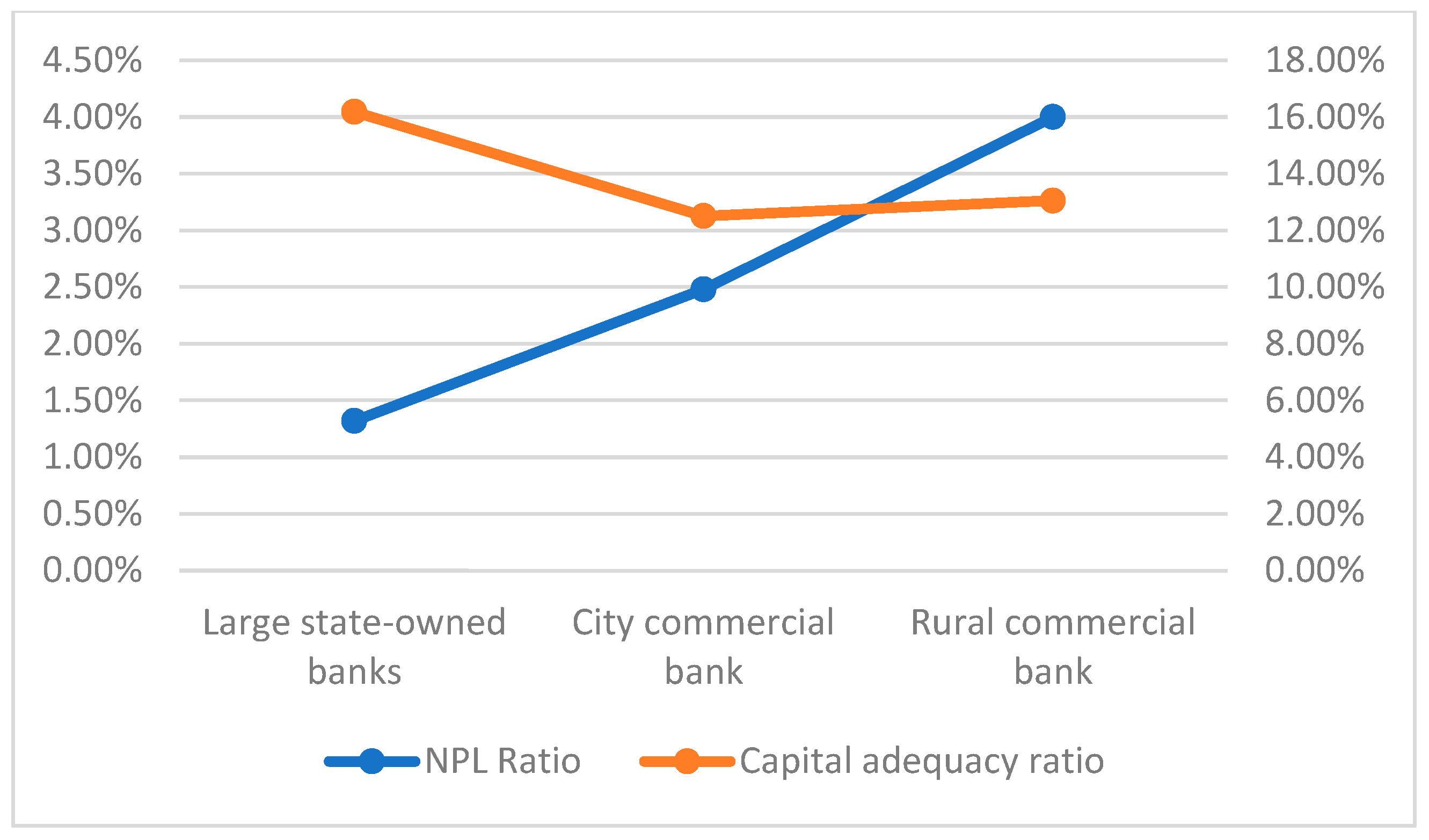
Credit asset quality and capital adequacy ratio continue to be under pressure. In the context of continued downward economic development trends domestically and abroad and increasing uncertainties, problems with the asset quality of small- and medium-sized commercial banks also continue to emerge. According to the China Banking and Insurance Regulatory Commission’s non-performing assets status of commercial banks as of the end of September 2024, the asset quality of small- and medium-sized commercial banks is significantly worse than that of their peers. The balance of non-performing loans of large commercial banks totaled 848.4 billion yuan, with an NPL ratio of 1.32% and a capital adequacy ratio of 16.18%; city commercial banks’ non-performing loans in the same period was 421.4 billion yuan, the NPL ratio was 2.48%, and the capital adequacy ratio was lower than that of large commercial banks and rural commercial banks by 12.51%; rural commercial banks’ non-performing loans in the same period was 614.6 billion yuan, with an NPL ratio of 4%. The capital adequacy ratio was higher than that of the city commercial banks but lower than that of large commercial banks by 13.05% (see
Figure 1 for a comparison of asset quality and capital adequacy ratios of large state-owned banks, city commercial banks, and rural commercial banks). In addition, it is inferred from the statement that the National Audit Office disclosed in the third quarter of 2024 that individual financial institutions in five provinces covered up bad loans. At present, the true level of non-performing loans in some small and medium banks may be much higher than the disclosed book figures.
This Table (
Table 1) illustrates the population dominance of small- and medium-sized banking institutions in China, which explains their disproportionate relevance for local financial stability and systemic risk prevention.
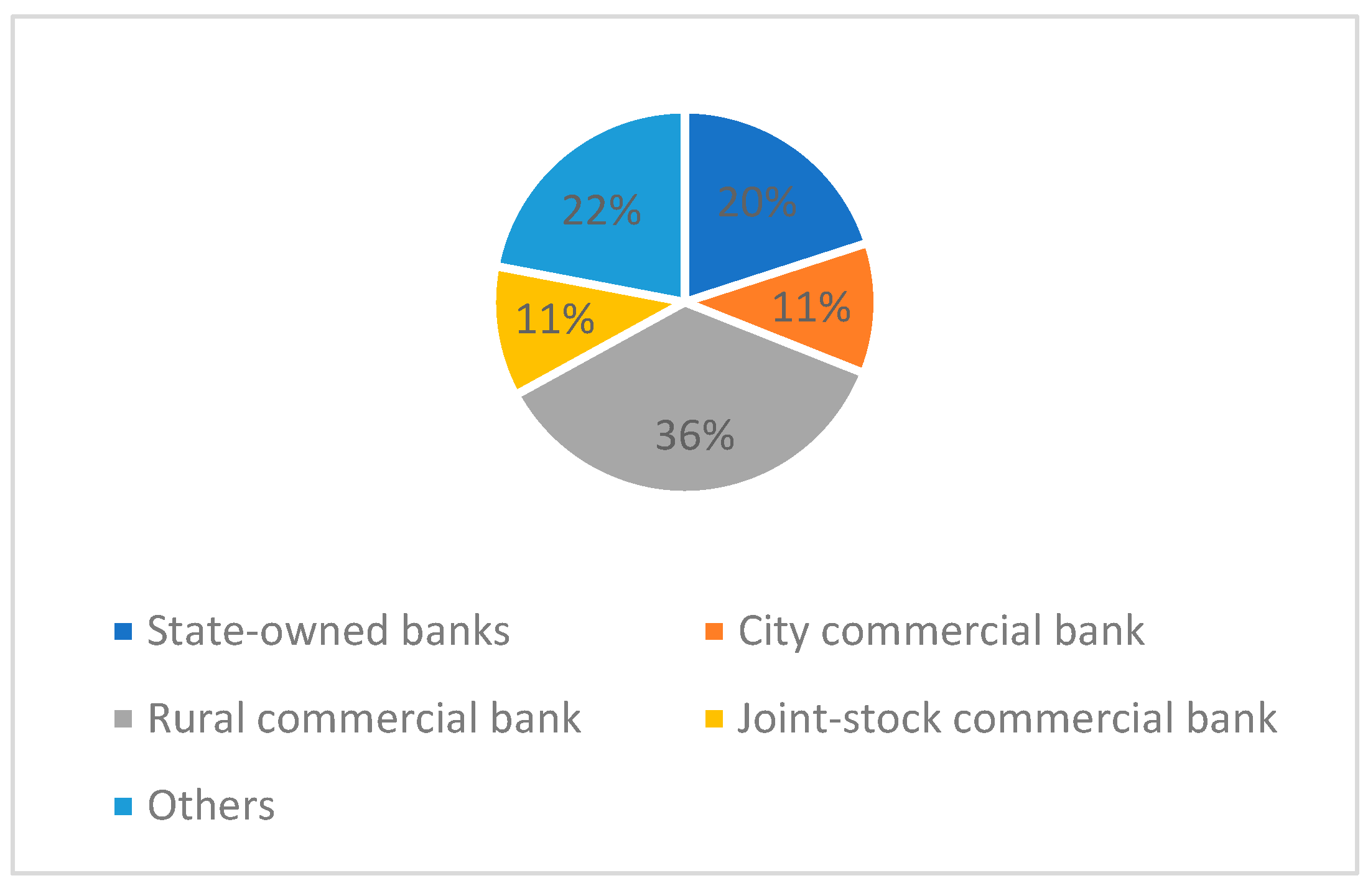
Frequent operational risk issues. From the perspective of supervision in 2019, strong supervision and strict supervision had always been implemented. According to incomplete statistics, as of 31 December 2024, the China Banking and Insurance Regulatory Commission, the Banking and Insurance Regulatory Bureaus of various provinces, and the Banking and Insurance Regulatory Sub-bureaus of various regions had imposed on commercial banks and other financial institutions and employees in the financial industry, strictly enforcing the current laws and regulations and executing administrative enforcement based on the inspection results. A total of 3418 fines were issued throughout the year. On average, more than nine fines are issued every day, and the total amount of fines is about 949 million yuan. Among them, rural financial institutions (including rural commercial banks, rural credit cooperatives, and village and town banks) have accumulated 840 tickets, accounting for 42%. There were 424 city commercial bank tickets, accounting for 12.4%, and rural commercial banks and urban commercial banks together accounted for 54.4% (see
Figure 2: Summary of fines issued by the CBIRC in 2024). From the statistics on the fines in the third quarter of 2024, credit businesses and employee behavior management are the hardest hit areas for supervision and punishment, with the fines accounting for 52.85% and 17.29% of the total.
Frequent cases of bank executives. Commercial bank executives should have been the main promoters and leaders of corporate governance. However, in 2024 alone, more than 30 small- and medium-sized commercial bank executives face criminal charges for crimes involving their jobs (see
Table 2: List of executive cases of small- and medium-sized commercial banks in 2024). Judging from the information disclosed by the media, the violations of laws and regulations that were committed are appalling and almost unbelievable. Some executives, while emphasizing corporate governance, have engaged in ‘dictatorial rule’ and monopoly power, which makes the checks and balances mechanism useless and ineffective for supervisory regulation. These executives are not afraid of risks and have a strong subjective awareness of business decisions. They use the resources of small- and medium-sized banks as personal resources. They place their personal interests above the internal control mechanism, and they use their positions to facilitate illegal interests for individuals and relatives, intervening in the normal operation of banks.
Hidden liquidity risks continue to surface. Liquidity risk is one of the most important risks faced by small- and medium-sized commercial banks, and it is generally divided into three types. One is endogenous liquidity risk. This is mainly due to the irrational business structure of small- and medium-sized commercial banks, which are mainly caused by short-term liabilities and long-term assets, forming a term mismatch and a hard liquidity gap. Another type is sudden liquidity risk. Liquidity risk is actually the ultimate reflection of various types of risks. Numerous cases of liquidity risk have shown that financial institutions that encounter liquidity risks usually do not have problems with liquidity themselves, but are affected by other risks that ultimately affect liquidity. Another type is exogenous liquidity risk. This is mainly due to changes in external policies or markets, which lead to firm liquidity in small- and medium-sized commercial banks. Although in recent years, after more than two years of strong supervision and strict supervision, such as regulatory arbitrage and new asset management regulations, some small- and medium-sized commercial banks still rely on their peers to expand their scale. As a result, after the market credit was stratified, the difficulty of interbank financing for small- and medium-sized banks rose sharply. Some small- and medium-sized commercial banks could not continue to make deposit certificates when they expired, and their interbank funds were broken. For example, at the end of September 2018, Baoshang Bank’s interbank liabilities were 221.1 billion yuan, accounting for about 44% of total liabilities. The data shows that as of the end of 2018, the total interbank liabilities of Longjiang Bank and Guiyang Bank were about 76 billion yuan and 145 billion yuan, respectively, and their proportions in liabilities also reached 34% and 31%, respectively. The interbank liabilities under the regulation must not exceed one-third of the total liabilities, and these two small- and medium-sized banks had already approached the regulatory red line. The reorganization of Jinzhou Bank also shows that its liquidity has encountered an insurmountable obstacle.
Although there are many reasons for the problems of small- and medium-sized commercial banks, the existence of these problems has a very important relationship with the dilemma of the corporate governance system and governance capabilities of small- and medium-sized commercial banks.
The second part is difficulties in the governance system and governance capacity of small- and medium-sized commercial banks. The asset owner is absent. The shareholders of Western commercial banks are basically private. There is no direct relationship between shareholders. The effectiveness and sensitivity of corporate governance formed by them are very high. The shareholders pay great attention to the assets of commercial banks. In China, the majority of small- and medium-sized commercial banks’ shareholders are local financial institutions, state-owned enterprises, or a small number of private enterprises. Although the company’s shareholders are in the form of several units, in fact, there is only one beneficiary: the country. As a result, almost none of the shareholders, shareholder representatives, the chairman of the board of directors, the chairman of the board of supervisors, and the management of small- and medium-sized commercial banks are true shareholders. They are entirely generated by the process nominated by local party committees and governments, regulated by the company law. Obviously, the team formed by this is completely the product of a state-owned asset agent, and it is the same agent. This has formed a standard insider control system, and all senior management operations are not responsible to shareholders. State-owned platforms can be used for the transmission of benefits, and huge amounts of non-performing assets can be legally formed without bearing any legal liability (
John et al., 2016). For some shareholder companies, because their investment sources are directly or indirectly derived from the connected transactions of the commercial banks they invest in, plus the high dividends of commercial banks, all investments are returned in the short term. Therefore, they are not very concerned about the operating behavior and business process of commercial banks, and equity is obviously weaker in the company’s senior management.
Unclear responsibility for decision-making power. First, the decision-making ability is weak. Most of the members of the board of directors are representatives appointed by shareholder units. They are basically the chief financial officer or the head of the finance department. They are not very familiar with the professional business of commercial banks. Due to the low level of concern for assets, they often solve their own company problems and are not very serious about the business strategy and management of commercial banks. The second is the intersection of decision-making power and the formation of an alienated power structure. For example, the party committee and the board of directors have unclear responsibilities, and they often make decisions from the perspective of their own organizational system. As a result, everyone makes decisions, and no one is responsible. The third is to implement authorization management for branches. Due to the lack of strict pre-supervision mechanisms for branches, despite the fact that there are various leadership groups and approval groups for branches, final decisions are made by one person. As a result, many wrong and illegal decisions are still made. Although accountability is pursued, individuals cannot actually receive huge amounts of funds or suffer financial losses. In the end, they are still the mistakes of individuals that are paid for by the company (
Krause et al., 2014). There is a huge amount of non-performing assets that are formed by small- and medium-sized commercial banks over the years, and although some of them are due to market reasons, more are caused by corporate governance defects.
The supervisory team has no power. Originally, the chairman of the board of supervisors had the right to independently initiate a shareholders’ meeting to review or impeach the board of directors, the chairman, the management, and others who violated laws and regulations or infringed on the interests of the shareholders. So far, although there have been major illegal acts in many banks, there has not yet been the first domestic case handled by the chairman of the board of supervisors or the board of supervisors. Therefore, there are many companies conducting illegal or other bad behaviors. Some of the supervisory committees are not unaware, and some are supporters of, or acquiescent toward, these behaviors. First, this is because the chairman of the board of supervisors is generally a resettlement officer. Many people on the board of supervisors are pensionable and non-professional, and they do not have a strong passion and tenacity for work. The second reason is that the chairman of the board of supervisors generally ranks under the party committee secretary and chairman of the board in the company’s internal ranking arrangements. They are generally members of the party committee, and so they have a substantial leadership role and a relationship with the chairman. Third, the supervisory board of each commercial bank has a very small staff, and so it is not capable of appointing supervisors. Fourth, the salary of the chairman of the board of supervisors and the members of the supervisory office is tied to the company, so the independence of the supervisors cannot be reflected. Fifth, the chairman of the board of supervisors has no right to directly deal with executives and employees. Without punishment tools, it is naturally difficult to establish authority. In addition, the lack of strong support for the work of the board of supervisors and supervisors is also one of the important reasons.
Independent directors (supervisors) are not independent. In order to take into account the interests of small and medium shareholders, the SBSS corporate governance structure has independent directors (supervisors) on the board of directors and the board of supervisors. They are all professional and authoritative people in the industry, who independently express opinions and influence the decisions of the board of directors (supervisory board). However, most of China’s small- and medium-sized commercial banks have not yet established independent directors (supervisors). From the perspective of the establishment, this role is not internally feasible, which means most of the people who serve as independent directors (supervisors) come from universities or research institutions. This part of the group may be an authority or expert in a certain field, but not necessarily a master of commercial banking and regulatory policies (
La Porta et al., 2000). Second, because these groups are not necessarily specialized in commercial banks, it is also difficult for them to have professional opinions. They often attend meetings and express some principled views. Third, the independent directors (supervisors) of small- and medium-sized commercial banks do not have uniform access standards, and accountability is not in place. Non-listed companies will not express their opinions independently. Since they are employed by the board of directors and the board of supervisors, actively supporting the employer’s opinion may be the first standard for continued employment; otherwise, they will leave the next year. It is questionable whether independent directors (supervisors) can express their opinions independently in this environment.
The management team is too administrative. In the SBSS corporate governance structure, the management layer belongs to the group with the strongest marketability. The management layer of Western commercial banks is entirely generated by marketization. It is employed by shareholders and is responsible to shareholders. The management of small- and medium-sized commercial banks in China is basically regarded as the management of cadres, such as the chairman and the party committee secretary. Their work is entirely inspected by the organization department of the commercial bank’s location, determined by the local party committee, and then nominated by the government. Then, in accordance with the company law process, the bank completes the board appointment process. In the final form, they are nominated by the company’s chairman, and the board decides who to hire, which is essentially entirely administrative. As a result, the management is not particularly concerned about business behavior and results, but is more concerned about how to be loyal to the people who nominate them and devote more energy to maintaining all aspects of interpersonal relationships. Even if the operating results are not satisfactory, the board cannot dismiss them, which is in accordance with the charter.
The compensation system deviates from value contribution. The salary limit system is an important measure for the party and the government to balance the unequal pay of managers in the government and of state-owned enterprises, and it is also a strategic action to establish the party’s prestige. However, the problem lies in the small- and medium-sized commercial banks that are also state-owned. The imbalances and unfair contradictions among the banks are too prominent. Executives, especially those at the more responsible institutions with larger assets, have lower salaries. On the other hand, there is a gap of dozens of times between the income of the executives of a national bank and that of a local bank. The salary market competitiveness of the small- and medium-sized commercial banks cannot be formed.
It is not easy to exit, and it is difficult to enter the industry. Western developed countries have a high degree of marketization. People’s market awareness, risk awareness, and financial awareness are relatively strong. Enterprises, including financial enterprises, are free to advance and retreat in the market, which will not cause greater social instability. China has a large number of small- and medium-sized commercial banks, and because of their high leverage ratio, they are also different from general industrial and commercial enterprises. Their bankruptcy has a huge impact on society, and because Chinese investors’ market awareness, especially financial awareness, is not strong, they never affect investment security. In the context that social stability is an overriding task, it is not easy for small- and medium-sized commercial banks to exit, and it is difficult for them to enter (
Shleifer & Vishny, 1997).
Overall, the risk issues will continue to expand with the accumulation of time, and eventually, the accumulation of risks will form a systemic financial risk.
3.3. Illustrative Empirical Evidence and Descriptive Analysis
To complement the institutional analysis with indicative empirical observations, this study provides a simplified descriptive comparison based on selected small- and medium-sized commercial banks. Given data limitations and the conceptual focus of the study, the objective is not to establish causal inference, but to explore whether observable patterns in risk indicators are broadly consistent with the governance arguments developed above. This approach allows for a limited time-based and cross-group comparison, which partially addresses the empirical dimension of governance effectiveness.
The analysis draws on publicly disclosed regulatory information, annual reports, and enforcement data, focusing on the period from 2020 to 2024. Specifically, the sample includes a selected group of small- and medium-sized commercial banks for which consistent regulatory disclosure and enforcement data are available over the period of 2020–2024. The selection criteria focus on data availability, representativeness of governance characteristics, and comparability across institutional types. Data sources include publicly available annual reports, regulatory penalty disclosures issued by the China Banking and Insurance Regulatory Commission, and official financial statistics.
It should be noted that the sample is not intended to be statistically representative of the entire banking sector. Instead, it serves as an illustrative subset designed to capture variation in governance structures and supervisory intensity. Therefore, the empirical observations should be interpreted within the boundary conditions of descriptive institutional analysis rather than causal inference. Three representative categories of banks are considered: (i) institutions with relatively centralized governance structures and stronger external supervisory coordination; (ii) institutions with more fragmented governance arrangements; and (iii) institutions characterized by weaker internal control and supervisory effectiveness. As shown in
Table 3, a comparative descriptive pattern can be observed. Banks with more coordinated governance structures and stronger supervisory mechanisms tend to exhibit a gradual improvement or stabilization in key risk indicators, including non-performing loan (NPL) ratios and capital adequacy ratios (CAR). In addition, these institutions are associated with relatively lower frequencies of regulatory penalties. By contrast, banks with fragmented governance structures or weaker supervision tend to display greater volatility in asset quality, declining or unstable capital adequacy, and more frequent regulatory enforcement actions. More specifically, the observed differences in risk outcomes can be linked to variations in governance mechanisms, such as the degree of supervisory coordination, the effectiveness of internal audit, and the clarity of accountability structures. These governance features influence risk control through their impact on monitoring intensity and decision-making discipline.
To further enhance the robustness of the descriptive analysis, the observed patterns were cross-checked against multiple regulatory indicators, including non-performing loan ratios, capital adequacy ratios, and regulatory enforcement frequency. While the analysis remains non-causal, the consistency of these indicators across different bank categories strengthens the internal validity of the descriptive findings.
Moreover, sensitivity checks were conducted by comparing alternative group classifications based on governance characteristics and supervisory intensity. The overall patterns remain stable under different classification schemes, suggesting that the observed relationships are not driven by arbitrary grouping but reflect underlying institutional differences in governance effectiveness.
These patterns are consistent with prior studies suggesting that governance effectiveness is closely related to risk control and institutional stability in banking systems. While the evidence presented here is descriptive in nature and does not establish causality, it provides preliminary empirical support for the argument that governance structure and supervisory effectiveness are systematically associated with observed risk outcomes in small- and medium-sized commercial banks.
More importantly, these findings extend the existing literature in several aspects. Prior studies have primarily focused on the role of board structure, ownership concentration, and incentive alignment in shaping governance effectiveness (
La Porta et al., 2000;
Bushman & Smith, 2001). The present analysis complements this perspective by highlighting the importance of supervisory coordination and institutional embeddedness in environments characterized by state ownership and administrative involvement.
In contrast to conventional shareholder-centered governance models, where independence and market discipline are regarded as primary governance mechanisms, the findings of this study suggest that in state-dominated banking systems, governance effectiveness may also depend on the interaction between internal supervision, regulatory oversight, and information transparency. This observation is broadly consistent with the literature on institutionally embedded governance in continental European banking systems, particularly in France, where public accountability and regulatory coordination play a significant role.
At the same time, the results partially diverge from studies that emphasize the risks of authority concentration. While CEO duality has been associated with weaker monitoring and higher agency risks in prior research (
Krause et al., 2014), the evidence presented here indicates that such risks may be mitigated under conditions of strong external supervision and institutional constraints. This suggests that governance outcomes are contingent not only on organizational structure but also on the broader institutional environment in which governance mechanisms operate.
Importantly, the findings should be interpreted as indicative rather than conclusive. However, when considered alongside the institutional analysis developed in previous sections, they reinforce the plausibility of the proposed governance framework and its potential relevance for improving risk management and governance effectiveness. In this sense, the SBSS framework can be interpreted as an institutional configuration that strengthens supervisory coordination and accountability, which are empirically associated with improved risk stability and reduced regulatory violations.
4. The Way to Break Through the Corporate Governance System and Capacity Modernization of Small- and Medium-Sized Commercial Banks
Overall, if these corporate governance issues of small- and medium-sized commercial banks are not resolved, the risk issues will continue to expand with the accumulation of time, and eventually the accumulation of risks will form a systemic financial risk.
The corporate governance of small- and medium-sized commercial banks must break through from the current environment. The focus of the breakthrough is to strengthen the party’s overall leadership of small- and medium-sized commercial banks. The way to break through is to innovate and transform the governance structure based on the SBSS structure. The general idea of breakout: In order to maintain the consistency of the management rules between small- and medium-sized commercial banks and international financial enterprises, and at the same time combine the essential characteristics of socialism with Chinese characteristics, based on the current SBSS structure, implement double responsibility of the party committee and the board of directors. The party committee secretary and chairman use one person to work for two positions. Strengthen the construction of the intra-party supervision system and administrative supervision system, vigorously improve the professionalism of the management layer, and build a corporate governance information-management platform with modern decision-making technological content that can cover a variety of information from the company and outside of it. A new “three pillars, one platform” governance system of scientific decision-making, efficient implementation, strict supervision, and technical support should be formed. At the same time, the platform must incorporate cybersecurity protection and data access control, and audit traceability mechanisms to prevent potential risks such as unauthorized data manipulation, system vulnerabilities, or insider misuse of sensitive governance information.
The key points of the breakout: implement the dual responsibility system of the party committee and the board of directors. The party’s absolute leadership over small- and medium-sized commercial banks is the most practical and effective way to resolve the current lack of management of state-owned enterprise owners. The party’s absolute leadership over commercial banks does not completely deny the role and existence of SBSS, but builds a decision-making system centered on party committee decisions. After nearly a century of tempering, especially since the reform and opening up, party building has become more standardized and powerful. Organizational construction and decision-making processes have formed scientific and standardized mechanisms. Various working principles and methods, such as democratic centralism in the party, decision-making on major issues, appointment and removal of important cadres, investment decisions on major projects, the use of large amounts of funds, and democratic supervision, are effects that the SBSS cannot achieve. The overall leadership of small- and medium-sized commercial banks is a concrete embodiment of socialism with Chinese characteristics in commercial banks. From the nature of the shareholders of small- and medium-sized commercial banks, they are basically funded by local finance or invested in by local state-owned enterprises. In essence, the ultimate beneficiaries are the state. At this time, although the shareholders were nominally SBSS, they were essentially serving one shareholder. The so-called SBSS, on this basis, is essentially the distribution of administrative power among different groups of people. It is a ritual of a modern enterprise system without substantial content. In recent years, many small- and medium-sized commercial banks have encountered many risk issues. The ultimate reason is that they have not strengthened the party’s absolute leadership over commercial banks, or the leadership has not been in place. After implementing the party’s absolute leadership over commercial banks, decision-making groups can be resolved through joint meetings between the party committee and the board of directors. Non-party directors can attend meetings and have corresponding voting rights. In order to ensure that the behavior of the joint meeting is standardized and streamlined, the company must formulate the rules of procedure of the joint meeting, taking into account the relevant provisions of the party constitution, party committee, and board of directors.
The key to breaking through is the practice of one person being responsible for the two jobs of the party committee secretary and chairman. Under the governance structure of SBSS, the party committee secretary and the chairman have separate models, and there is a model that combines with the president. Under these two models, most of the party committee secretaries are mainly responsible for the party affairs of their commercial banks. However, in recent years, with the emphasis on the political core position of the party committee, some major matters of the company have also been implemented with pre-research on the party committee. The problem is that some decisions are led by the secretary of the party committee, but the ultimate responsibility for the operation is the responsibility of the chairman, which increases the contradictions in the work. Combining the two functions of party secretary and chairman into one, that is, “one person, two positions”, not only makes sense in theory, but also works in practice.
However, the concentration of decision-making authority in the dual role of party secretary and board chairman raises concerns that are consistent with the literature on CEO duality, which emphasizes potential risks related to reduced monitoring effectiveness and increased agency problems (
Krause et al., 2014).
From the perspective of international corporate governance standards, such role concentration may appear inconsistent with the principle of board independence and checks and balances. However, the proposed framework does not rely solely on internal board structures to ensure governance effectiveness. Instead, it introduces a set of institutional substitutes, including strengthened regulatory supervision, disciplinary inspection mechanisms, external auditing systems, and mandatory information disclosure.
These mechanisms function as externalized governance constraints that compensate for the potential weakening of internal board independence. In this sense, governance effectiveness is achieved not through structural separation alone, but through the interaction between authority concentration and multi-layered supervisory oversight within a specific institutional context.
To mitigate these risks, the proposed framework incorporates a set of substitute governance safeguards. These include strengthened vertical regulatory supervision, independent disciplinary inspection mechanisms, enhanced internal audit authority, and mandatory information disclosure requirements. These mechanisms function as institutional substitutes for traditional board independence by introducing external and system-level constraints on managerial power. Compared with international governance practices, where independence is achieved through structural separation, the proposed model relies more on multi-layered external oversight and institutional accountability to preserve checks and balances.
Of course, another problem brought by this is how to strengthen the supervision and management of the company’s main person in charge. Judging by the current risk issues and cases of small- and medium-sized commercial banks, a considerable number of them are regarding the party secretary, who is also the chairman. Therefore, the implementation of this model also requires some prerequisites and guarantee measures. First of all, banks should choose the right person, and they should choose from a wide range of qualifications, ages, specialties, and comprehensive qualities; secondly, there must be someone to manage. Local banks belong to the sequence of enterprises directly under the government. They are generally managed by the deputy mayor in charge of finance. In reality, local administrative leaders pay more attention to the lending indicators of commercial banks and their contribution to the local economy, but rarely manage individuals. This creates a management vacuum for a few main people responsible for the management, providing them with political space to do whatever they want with commercial banks. Jiang Xiyun and Cai Guohua, the former chairman and party secretary of Hengfeng Bank, are typical examples. Therefore, the deputy leaders and even the main local leaders must clearly clarify the management responsibility for the heads of small- and medium-sized commercial banks. They should be managed regularly and irregularly by other subordinates, and more attention should be paid to issues reflected by the people. Third, the main responsible people must be strictly authorized. Decentralization is conditional. Decentralization is not laissez-faire. Activation of the grassroots is not without rules. It is necessary to strengthen the overall management of the people mainly responsible for small- and medium-sized commercial banks by higher-level party organizations. Fourth, there must be a strict internal control mechanism for the organization, and internal control measures such as regular rotations, compulsory vacations, and compulsory communication should also be implemented for the main responsible people.
At the same time, the existing corporate governance literature has cautioned that role concentration may weaken monitoring effectiveness and increase agency risks. To address these concerns, the proposed framework incorporates strengthened disciplinary supervision, vertical auditing mechanisms, and external regulatory oversight to preserve effective checks and balances.
Breakout protection: Establish a centralized and unified vertical supervision system, and build a supervision team with party discipline and administrative supervision as the main body and other supervisory forces as subsidiary bodies. That means that they must: 1. Strengthen the supervision within the party, implement the system of local party discipline inspection commissions (supervisory commissions), participate in all activities of the company, and directly receive and handle all kinds of illegal and disorderly information of all management personnel. 2. The company’s chairman of the board of supervisors shall be appointed by a higher-level audit department, and the supervisory system shall be centrally and uniformly managed. The staff of the supervisory office shall be directly organized by the local audit department, or it may entrust the participation of qualified third-party agencies. 3. Accept public supervision, regardless of whether it is a listed company or not, publicly disclose operating information to society on an annual and quarterly basis, and accept all-around supervision by shareholders and investors; at the same time, they will also be subject to supervision by securities dealers and experts. 4. Actively accept social supervision, which will bring a strong social binding force to commercial banks. External supervision includes but is not limited to media and professional supervision. 5. Strengthen the supervision of the supervisory authority. The supervisory authority is not just a policy oversight. The bank is a public company with high leverage. The problem must be eliminated before it appears, so that it will not turn the problem into a risk or even a crisis, and it must be monitored before and during the event. 6. Strict access criteria for independent directors and supervisors to promote their independence. 7. Improve the effectiveness and authority of supervision. The first step is to insist that supervisors and managers be independent of small- and medium-sized commercial banks. Second, the economic benefits of the regulatory authorities cannot be restricted to small- and medium-sized commercial banks (a certain amount of regulatory fees can be collected each year and distributed by the management unit). Third, the rewards and punishments of personnel have no relationship with the supervision target. The fourth step is to compact supervision and inspection responsibilities. Fifth, the supervisory authority should have direct power to deal with staff who violate regulations and discipline. In addition to establishing a centralized and unified vertical supervision system, a corporate governance management platform needs to be established: 1. Actively integrate fintech into the entire process of corporate governance, and collect all companies’ information by building a corporate governance information-management platform. 2. Through the construction of the platform, all decision-making participants, supervisors, and executors can enjoy the same information source and improve the transparency of decision-making. Obviously, the decisions made based on the information provided by the same platform by using the same principles and methods should also have the same decision results or a few choices, which facilitates efficient unified thinking and improves decision-making efficiency. 3. Give full play to the role of artificial intelligence and big data analysis in decision-making, improve the objectivity of decision-making, and reduce the proportion of people’s subjective decision-making. Reduce rent-seeking loopholes and improve decision-making efficiency and execution efficiency. 4. Further improve the transparency of the company’s information; further standardize the operational process, and improve the technical defense level. There must be effective checks and balances between each other, inside and outside, and up and down. As long as anyone violates the existing laws and regulations, the whole bank’s system does not support the establishment of transactions. Moreover, the comprehensive literacy of executives needs to be improved. 1. Strict implementation of senior management qualification standards: the main person in charge must have financial experience, not economic work experience; 2. senior management must be de-administered. Those who have had financial experience but have long been out of the financial industry may not be the main person in charge of commercial banks; and 3. actively promote the professional manager system of senior executives, continuously improve the professionalism of shareholders and shareholder representatives, strictly control the proportion of non-professionals in the leadership team, and stipulate the required level of education and professional accomplishment. In the era of business, everyone pays attention to science and technology, and the necessary educational experience is a prerequisite.
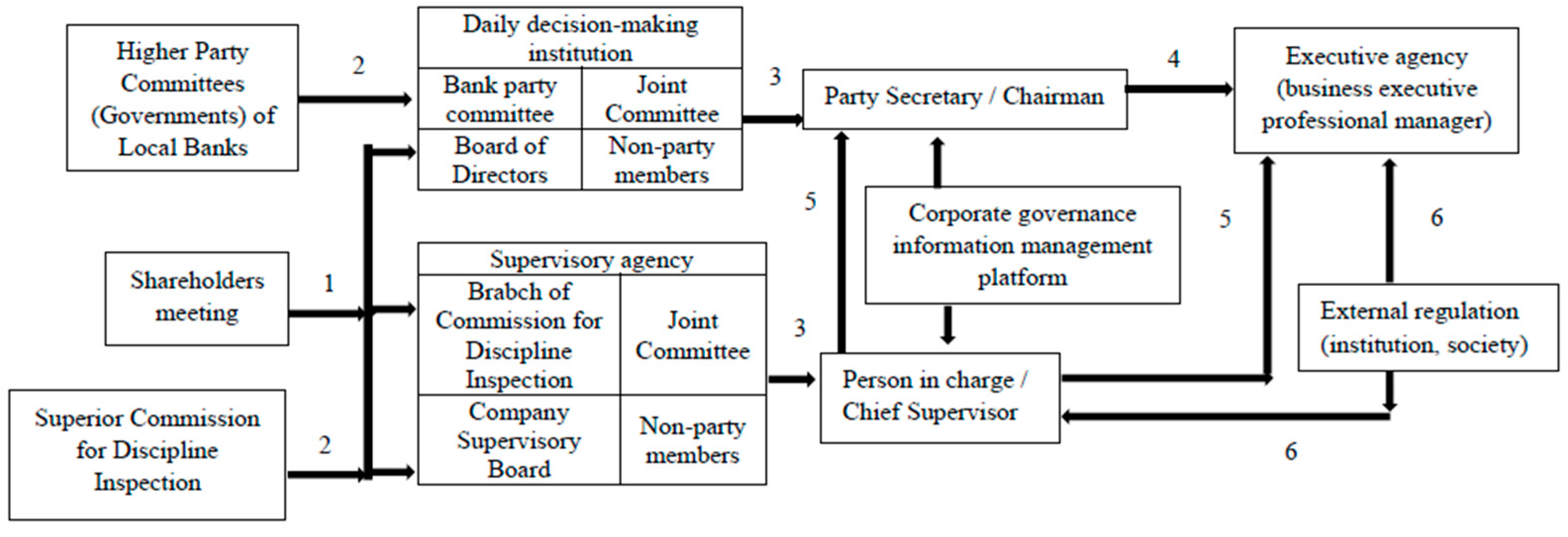
Breakthrough sequence: Constructing a new corporate governance process with Chinese characteristics. The corporate governance structure of the SBSS also has a corresponding process sequence and logical relationship. The innovative new governance system of the ‘three pillars and one platform’ can be represented by the following Figure (see
Figure 3: The new corporate governance structure of small- and medium-sized commercial banks).
The advantages of the new governance system of “three pillars and one platform” are as follows: First, the main responsible person is clear. In the past system, the party committee secretary and the chairman were separately responsible for decision-making, and the responsibility was difficult to define. From a management perspective, a group cannot have two main persons in charge, as it is otherwise difficult for subordinates to carry out the work, and one person works as the party secretary and as the chairman of the board of directors, having a clear body of responsibility. The second is fast decision-making. Through joint meetings, it fully reflects the intentions of the party organization and the board of directors, and reduces processes and unnecessary elements. The third is that the supervision system is independent, authoritative, and has strong binding power. It forms a strict and mutually restrictive audit logic, and everything must operate under the rules of conduct. Fourth, the professional operation team will drive them to accelerate the financial track under the guidance of the company’s strategic planning, work plan, and development goals, because the market will be ruthlessly eliminated if they do not advance. Fifth, the decision-making is more scientific and evidence-based, the objective credibility is improved, and the empirical decision-making and managerial decision-making flexibility are reduced. The high-tech “corporate governance information management platform”, with big data, the blockchain, artificial intelligence, etc., will collect all kinds of information to the maximum. At the same time, artificial intelligence will propose decision-making schemes according to rules, and these schemes are feasible, reliable, and open, which will replace artificial operating costs, reduce opportunities for rent-seeking, and promote personal freedom. In operational terms, the governance platform is designed with functional separation between data generation, system operation, and supervisory access. Data input is standardized and recorded through automated processes, while system operation is subject to independent technical management. Regulatory authorities and internal audit bodies are granted direct access to system logs to ensure audit traceability and prevent data manipulation. To address potential risks such as insider manipulation or cyber threats, the platform incorporates multi-layer access control, encryption mechanisms, and independent audit verification. These design features ensure that the platform does not become a centralized source of informational power, but rather a tool for transparent and accountable governance.
In addition, the platform incorporates role-based access control to ensure that decision-making, execution, and supervisory functions remain institutionally separated. Different user groups, including management, internal auditors, and external regulators, are granted differentiated access rights to prevent information monopolization. All data operations are recorded through immutable system logs, enabling full audit traceability.
To further mitigate risks associated with insider manipulation or excessive concentration of informational power, the platform is subject to periodic independent audits and regulatory inspections. These mechanisms ensure that the platform functions not as a tool for centralizing authority, but as an infrastructure for enhancing transparency, accountability, and real-time supervision.
5. Conclusions and Recommendations
5.1. Basic Conclusions
The corporate governance of small- and medium-sized commercial banks has become a critical institutional issue that extends beyond the internal behavior of individual banks. Under current conditions, governance effectiveness in these institutions is closely linked to regional financial stability and the broader resilience of the national financial system. These conclusions are consistent with the empirical observations presented in the preceding sections. The analysis of asset quality pressure, liquidity risks, and governance failures in small- and medium-sized commercial banks demonstrates that many operational risks originate not only from market fluctuations but also from structural governance deficiencies. The evidence from regulatory statistics and documented governance cases, therefore, supports the argument that improving governance structures is essential for strengthening institutional stability in this sector. From an institutional governance perspective, this elevates corporate governance from a firm-level arrangement to a systemic governance concern embedded within the state-dominated banking structure. Because the study adopts an institutional analytical approach rather than a causal econometric design, the findings should be interpreted as descriptive institutional insights rather than statistically verified causal relationships.
The proposed framework does not reject internationally recognized corporate governance principles, including independence, accountability, and checks and balances. Instead, it reinterprets these principles within China’s institutional context, where state ownership, administrative delegation, and public responsibility play a more prominent role in shaping governance objectives. This approach is conceptually consistent with governance practices observed in state-led banking traditions, such as those found in France, where market mechanisms are embedded within broader frameworks of public accountability and supervisory coordination.
The Shareholders–Board–Supervisory System has become an internationally recognized governance model and serves as the standard framework for listed companies in China. However, commercial banks differ fundamentally from general industrial enterprises in terms of risk exposure, externalities, and regulatory intensity. In particular, small- and medium-sized commercial banks often lack the ownership structure, market discipline, and information transparency required for the effective operation of a purely SBSS-based governance model. Under these conditions, mechanical replication of the SBSS may weaken, rather than strengthen, governance effectiveness.
Against this background, it is institutionally feasible to construct a governance model in which the party organization functions as a central coordinating axis, while remaining structurally integrated with the SBSS framework. Such an arrangement does not negate the role of the board of directors or supervisory mechanisms but seeks to enhance governance coherence by addressing coordination failures, fragmented accountability, and weakened oversight capacity. From an international governance perspective, the concentration of the roles of party secretary and board chairman may appear inconsistent with conventional models of board independence. However, governance effectiveness in state-dominated banking systems depends not only on board structure but also on the broader supervisory framework. In the Chinese banking context, regulatory oversight, disciplinary inspection mechanisms, and external auditing institutions provide additional layers of monitoring that function as institutional checks and balances on executive authority. Importantly, this integration is designed to complement, rather than replace, existing governance structures.
At the same time, the existing corporate governance literature has cautioned that excessive role concentration may undermine monitoring effectiveness and increase agency risks. To mitigate these concerns, the proposed framework emphasizes strengthened disciplinary supervision, vertical auditing mechanisms, and external regulatory oversight to preserve effective checks and balances. In this sense, governance effectiveness is not derived from organizational form alone, but from the interaction between decision-making authority, execution efficiency, and supervisory effectiveness within a clearly defined institutional framework.
Overall, the governance challenge faced by small- and medium-sized commercial banks is not whether to adopt or abandon established governance models, but how to adapt them to institutional realities. By reconfiguring governance functions around effectiveness, accountability, and supervision, the proposed framework offers an institutionally embedded pathway for improving governance performance without departing from internationally recognized governance principles.
The French governance experience further illustrates that strong public involvement in banking governance does not necessarily weaken market discipline when effective supervisory coordination and institutional accountability mechanisms are maintained. This comparative reference supports the argument that governance models should be evaluated within their institutional contexts rather than judged solely by the standards of shareholder-centered governance systems. The French governance model provides several concrete institutional insights relevant to the proposed framework. These include the role of the state as a stabilizing shareholder, the separation between political oversight and managerial execution, and the strong regulatory coordination framework that ensures accountability. These elements suggest that effective governance under strong public involvement requires not only a concentration of authority but also robust supervisory mechanisms and market discipline. This comparative perspective supports the design logic of the “three pillars and one platform” framework while highlighting the importance of maintaining institutional balance. In particular, the French experience suggests that strong state involvement can coexist with effective governance only when accompanied by clear functional separation, regulatory discipline, and market-based accountability mechanisms. These elements provide concrete institutional benchmarks for the proposed framework.
5.2. Research Recommendations
Further improve the current legal system. The modern corporate governance system is stipulated by relevant laws such as the company law and the commercial bank law. Various conflicts in actual operation can be understood as internal constraints, but there is indeed a contradiction between strengthening the party’s leadership over commercial banks and the chairman’s legal liability to the company. In some cases, there are problems with party committee decisions and board responsibility. Therefore, the “one person dual post” practice of the party committee secretary and chairman should be fixed in the form of law, and one person with dual posts and two responsibilities should be implemented, as only then is there a legal basis. Small- and medium-sized commercial banks should express the “one person, two positions” in the form of the company’s highest legal text through amendments and improvements to the articles of association.
Strengthen the guidance of corporate governance of non-public small- and medium-sized commercial banks. Although non-public small- and medium-sized commercial banks are private in nature, they are banks in the first place. Since banks must implement corporate governance in accordance with the standards of commercial banks, they have higher requirements. Although the party cannot provide direct and absolute leadership over private banks, it can strengthen its supervision and management, third-party inspections, and other aspects to ensure that the bottom line of risk management is maintained. Strict management of the highest standards for non-public commercial banks. Strict implementation of the same standard management rules to create a level playing field. And they must be managed beforehand, not afterward.
Attach great importance to the main role of the allocation of market rules. Emphasizing that the party’s absolute leadership over small- and medium-sized commercial banks is not to deny the fundamental role of market rules, but to pay more attention to market laws, and the party organizations are more adept at using “invisible hands” to operate commercial banks. Therefore, it is necessary to carry out reform and innovation based on market orientation.
Establish a talent pool and professional standards for independent directors (supervisors).
The China Banking Association can issue professional standards for independent directors (supervisors) of small- and medium-sized commercial banks. Through a comprehensive evaluation, examination, and assessment, a national talent pool of independent directors (supervisors) of small- and medium-sized commercial banks can be established. Small- and medium-sized commercial banks can choose and use the talent pool, continuously improve their professional quality, implement licensed entry, and continuously improve the level of professionalism. At the same time, the accounting system, law firms, auditors, etc., are implemented using a list system.
Actively promote the professional manager system. Continuously improve the professional standards of commercial bank operators through the establishment of a professional manager system and the use of market mechanisms to screen, store, and clearly price professional professionals in commercial banks at home and abroad; on the one hand, this can encourage more outstanding business talents to stand out, and on the other hand, commercial banks can select the most satisfactory and excellent managers from a wider range.
All in all, small- and medium-sized commercial banks have a special status, and the role of corporate governance is outstanding. To improve the level of corporate governance of small- and medium-sized commercial banks, we must not only absorb the experience of successful SBSS governance structures, but also combine the actual situation of small- and medium-sized commercial banks in China. In the new era of quality development, it is even more necessary to use the spirit of innovation, stress the principle of effectiveness, and have the courage to venture forward and try to keep pace with the times. We must establish a corporate governance system for small- and medium-sized commercial banks in the new era with socialism with Chinese characteristics, and continue to adhere to and improve China’s financial governance system and governance modernization.