

From Compliance to Adoption: A Theory-Building Study of Technology Implementation Gaps in Tax Administration

Abstract
1. Introduction
2. Theoretical Foundations and Their Limitations
2.1. Institutional Logics: Explanatory Strengths and Assumptive Limits
2.2. New Institutional Economics: Explanatory Strengths and Assumptive Limits
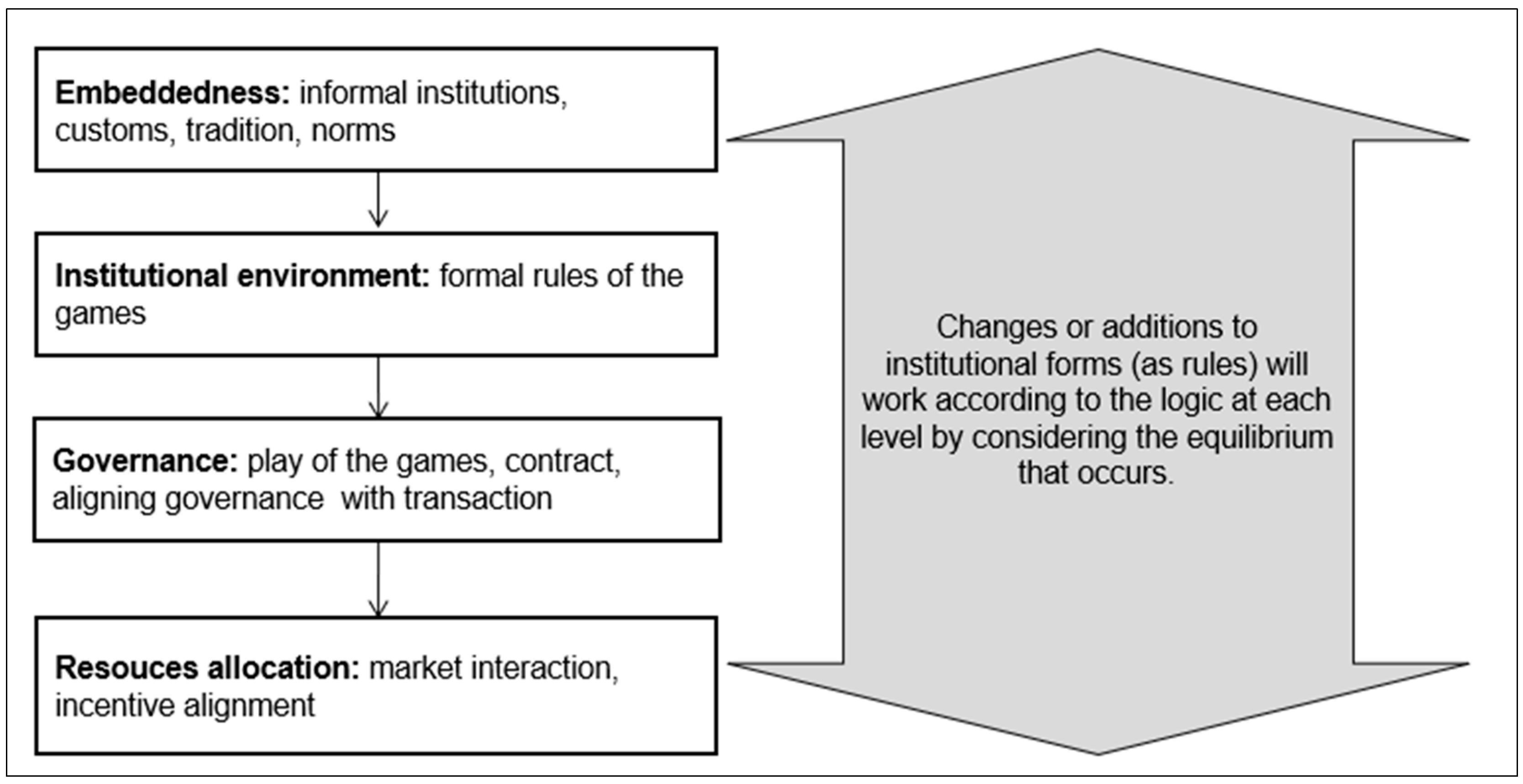
2.3. Integrating Institutional Logics and NIE: Alignment, Equilibria, and Tensions in Technology Adoption
3. Research Context and Methodology
3.1. CAATTs in Audit Technology Landscape1
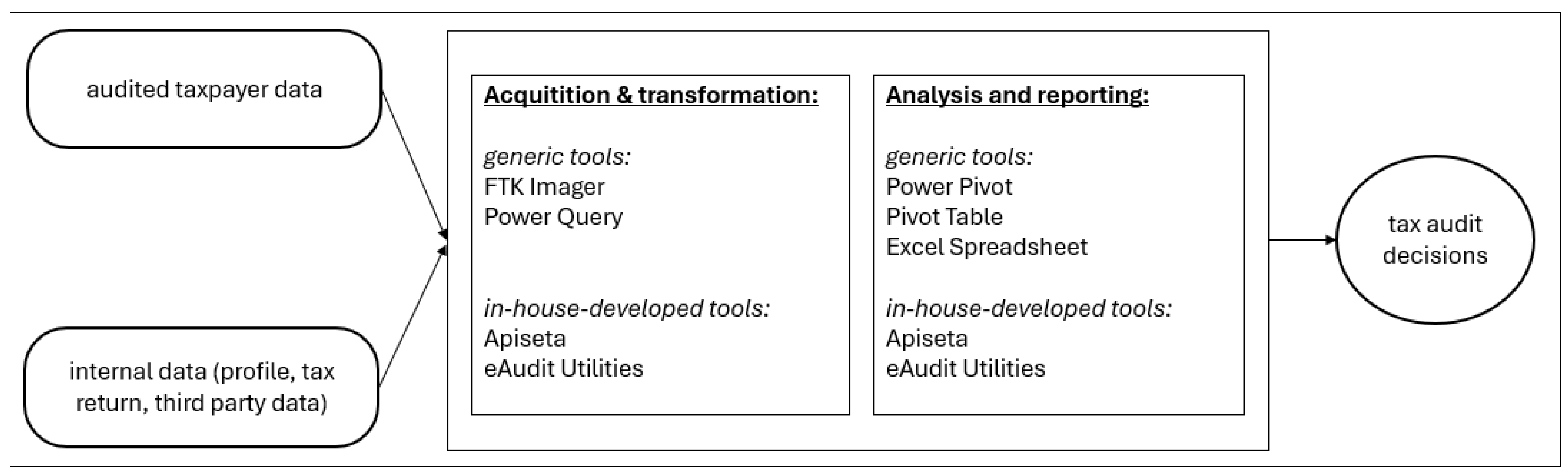
3.2. CAATT Implementation in Indonesian Tax Administration
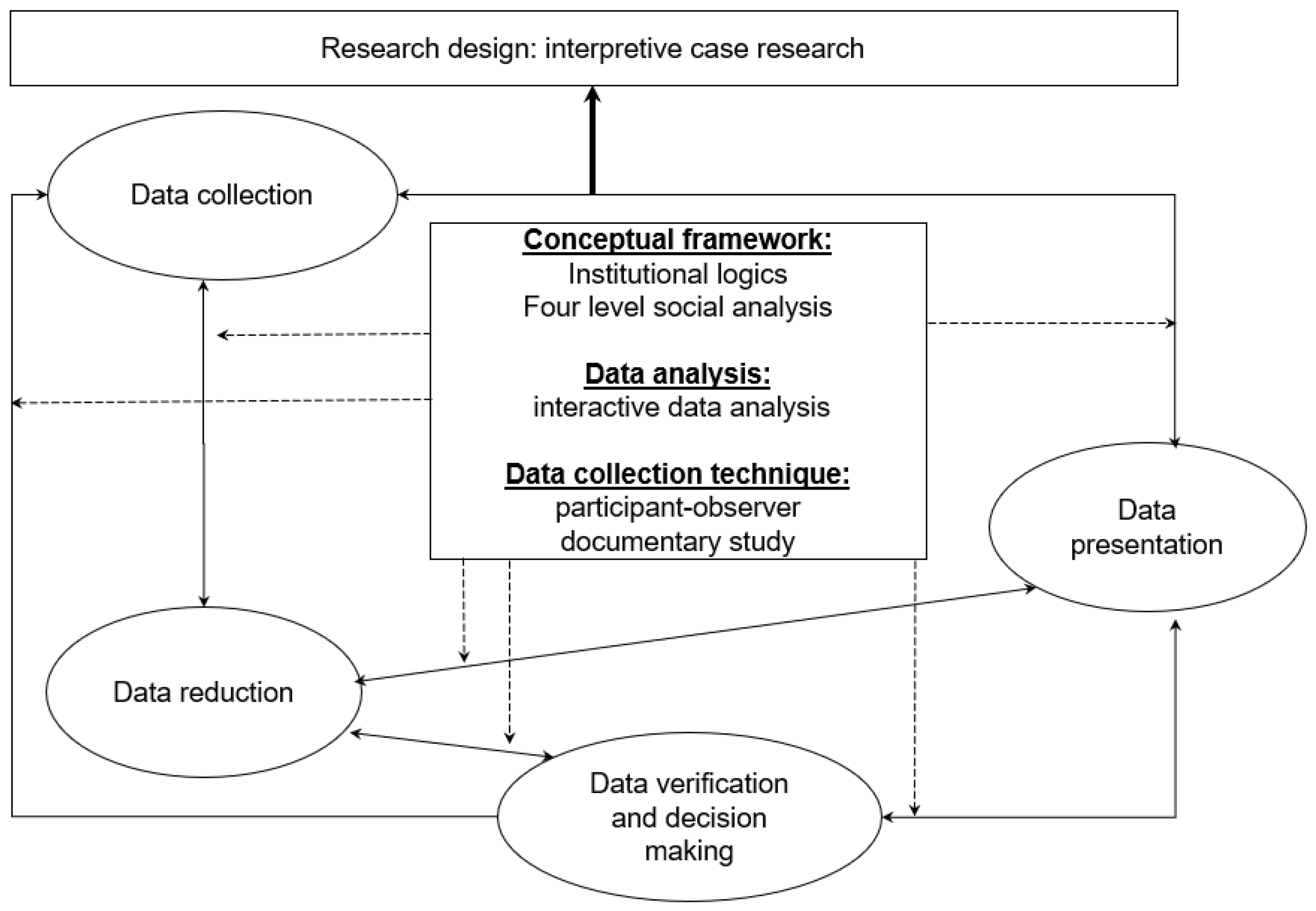
3.3. Research Design
3.4. Data Collection
3.4.1. Document Analysis
3.4.2. Focus Group Discussion
3.4.3. Observational Data
3.5. Analytical Process
4. Integrating Institutional Logics and NIE: A Proposition-Based Analysis of CAATT Implementation at DGT
4.1. Collaborative Logic as Informal Governance Under Regulatory Absence
4.2. Competing Logic Triggered by Regulatory Formalization
4.3. Decoupling as Transaction Cost Management
4.4. Logic Transitions and Simultaneity
4.5. What the Analysis Demonstrates
5. Conclusions, Limitations, and Future Research
5.1. Conclusions
5.2. Limitations and Boundary Conditions
5.3. Future Research
Author Contributions
Funding
Institutional Review Board Statement
Informed Consent Statement
Data Availability Statement
Acknowledgments
Conflicts of Interest
| 1 | According to AICPA (2017), Audit Data Analytics (ADAs) share similarities with Computer-Assisted Audit Techniques (CAATTs). While ADAs could theoretically be performed manually to discover patterns and identify anomalies in data, they typically require computer implementation. ADAs can be viewed as an evolutionary advancement of CAATTs, enhancing auditors’ capabilities through data visualization techniques and supporting broader audit objectives. Recent studies have further examined the maturity levels and utilization factors of Generalized Audit Software in various contexts (Ahmi & Kent, 2012; Kartikasary et al., 2021; Smidt et al., 2019). |
| 2 | The self-assessment tax system in Indonesia, implemented after the tax reform of 1983, is a collection system that gives taxpayers the responsibility and trust to calculate, pay, and report their own tax obligations independently based on applicable tax laws and regulations. This system is primarily applied to central taxes such as Income Tax (PPh) and Value Added Tax (VAT), with the government acting only in a supervisory capacity through tax audits and investigations (Law Number 16 of 2009 concerning General Provisions and Tax Procedures). |
References
- Ahmi, A., & Kent, S. (2012). The utilisation of generalized audit software (GAS) by external auditors. Managerial Auditing Journal, 28(2), 88–113. [Google Scholar] [CrossRef] [Scilit]
- AICPA. (2017). AICPA guide to audit data analytics. AICPA. [Google Scholar]
- Alsharari, N. (2017). Institutional logics and ERP implementation in public sector agency. The Journal of Developing Areas, 51, 417–425. [Google Scholar] [CrossRef] [Scilit]
- Arens, A. A., Loebbecke, J. K., Elder, R. J., & Beasley, M. S. (2000). Auditing and assurance services (8th ed.). Prentice Hall. [Google Scholar]
- Ashworth, R., Boyne, G., & Delbridge, R. (2009). Escape from the iron cage? Organizational change and isomorphic pressures in the public sector. Journal of Public Administration Research and Theory, 19(1), 165–187. [Google Scholar] [CrossRef] [Scilit]
- Berg Johansen, C., & Waldorff, S. B. (2017). What are institutional logics—And where is the perspective taking us? Academy of Management Proceedings, 2015(1), 14380. [Google Scholar] [CrossRef] [Scilit]
- Bierstaker, J., Janvrin, D., & Lowe, D. J. (2014). What factors influence auditors’ use of computer-assisted audit techniques? Advances in Accounting, 30(1), 67–74. [Google Scholar] [CrossRef] [Scilit]
- Bowen, G. A. (2009). Document analysis as a qualitative research method. Qualitative Research Journal, 9(2), 27–40. [Google Scholar] [CrossRef] [Scilit]
- Campbell, D. T. (1986). Relabeling internal and external validity for applied social scientists. New Directions for Program Evaluation, 1986(31), 67–77. [Google Scholar] [CrossRef] [Scilit]
- Canhilal, S. K., Lepori, B., & Seeber, M. (2016). Decision-making power and institutional logic in higher education institutions: A comparative analysis of European universities. In Towards a comparative institutionalism: Forms, dynamics and logics across the organizational fields of health care and higher education (Vol. 45, pp. 169–194). Emerald Group Publishing Limited. [Google Scholar] [CrossRef] [Scilit]
- Coderre, D. G. (2009). Internal audit efficiency through automation. John Wiley & Sons, Inc. [Google Scholar]
- Collins, T., & Mulligan, E. (2014). Ireland’s introduction of transfer pricing: A new institutional theory perspective. In Accounting, finance and governance review, special issue on taxation. Irish Accounting and Finance Association. [Google Scholar]
- Colquitt, J. A., & Zapata-Phelan, C. P. (2007). Trends in theory building and theory testing: A five-decade study of the academy of management journal. Academy of Management Journal, 50(6), 1281–1303. [Google Scholar] [CrossRef] [Scilit]
- Cortes Ferreira, L. (2017). Using institutional logics as cultural resources: A micro-perspective on organizational hybridity [Ph.D. thesis, University of Nottingham]. Available online: http://eprints.nottingham.ac.uk/40568/ (accessed on 5 May 2025).
- Creswell, J. W. (2018). Research design: Qualitative, quantitative, and mixed methods approaches (5th ed.). SAGE Publications. [Google Scholar]
- Currie, W. L., & Swanson, E. B. (2009). Special issue on institutional theory in information systems research: Contextualizing the IT artefact. Journal of Information Technology, 24(4), 283–285. [Google Scholar] [CrossRef] [Scilit]
- Damayanthi, S., & Gooneratne, T. (2017). Institutional logics perspective in management control research. Journal of Accounting & Organizational Change, 13, 520–547. [Google Scholar] [CrossRef] [Scilit]
- Davis, F. D. (1989). Perceived usefulness, perceived ease of use, and user acceptance of information technology. MIS Quarterly, 13(3), 319. [Google Scholar] [CrossRef] [Scilit]
- Denzin, N. K. (2012). Triangulation 2.0. Journal of Mixed Methods Research, 6(2), 80–88. [Google Scholar] [CrossRef] [Scilit]
- DiMaggio, P. J., & Powell, W. W. (1983). The iron cage revisited: Institutional isomorphism and collective rationality in organizational fields. American Sociological Review, 48(2), 147–160. [Google Scholar] [CrossRef] [Scilit]
- Dubois, A., & Gadde, L.-E. (2002). Systematic combining: An abductive approach to case research. Journal of Business Research, Markets as Networks, 55(7), 553–560. [Google Scholar] [CrossRef] [Scilit]
- Eisenhardt, K. M. (1989). Building theories from case study research. Academy of Management Review, 14(4), 532–550. [Google Scholar] [CrossRef] [Scilit]
- Eisenhardt, K. M., & Graebner, M. E. (2007). Theory building from cases: Opportunities and challenges. Academy of Management Journal, 50(1), 25–32. [Google Scholar] [CrossRef] [Scilit]
- Eulerich, M., & Kalinichenko, A. (2018). The current state and future directions of continuous auditing research: An analysis of the existing literature. Journal of Information Systems, 32(3), 31–51. [Google Scholar] [CrossRef] [Scilit]
- Eulerich, M., Masli, A., Pickerd, J., & Wood, D. A. (2023). The impact of audit technology on audit task outcomes: Evidence for technology-based audit techniques. Contemporary Accounting Research, 40(2), 981–1012. [Google Scholar] [CrossRef] [Scilit]
- Fligstein, N. (2001). Institutional entrepreneurs and cultural frames—The case of the European Union’s single market program. European Societies, 3(3), 261–287. [Google Scholar] [CrossRef] [Scilit]
- Flyvbjerg, B. (2006). Five misunderstandings about case-study research. Qualitative Inquiry, 12(2), 219–245. [Google Scholar] [CrossRef] [Scilit]
- Friedland, R., & Alford, R. (1991). Bringing society back in: Symbols, practices and institutional contradictions. In W. Powell, & P. Dimaggio (Eds.), The new institutionalism in organizational analysis (pp. 232–263). University of Chicago Press. [Google Scholar]
- Giannopoulos, V., Vlachakou, M., Kariofyllas, S., & Makris, I. (2025). Corporate governance and tax avoidance: Evidence from Greek service-sector firms. Journal of Risk and Financial Management, 18(10), 538. [Google Scholar] [CrossRef] [Scilit]
- Greenwood, R., Oliver, C., Suddaby, R., & Sahlin-Andersson, K. (2008). The SAGE handbook of organizational institutionalism. SAGE. [Google Scholar]
- Greif, A., & Kingston, C. (2011). Institutions: Rules or equilibria? In Political economy of institutions, democracy and voting (pp. 13–43). Springer. [Google Scholar] [CrossRef] [Scilit]
- Henderson, D. L., III, Bradford, M., & Kotb, A. (2016). Inhibitors and enablers of GAS usage: Testing the dual factor theory. Journal of Information Systems, 30(3), 135–155. [Google Scholar] [CrossRef] [Scilit]
- Hinkley. (2023). Technology in the public sector and the future of government work. UC Berkeley Labor Center. Available online: https://laborcenter.berkeley.edu/wp-content/uploads/2023/01/Technology-in-the-public-sector-and-the-future-of-government-work.pdf (accessed on 17 April 2025).
- Hunton, J. E., Bryant, S. M., & Bagranoff, N. (2004). Core concepts of information technology auditing. John Wiley & Sons, Inc. [Google Scholar]
- IOTA. (2010). Audit procedures—EDP audit. IOTA Report for Tax Administrations. Intra-European Organisation of Tax Administrations. [Google Scholar]
- Kartikasary, M., Laurens, S., & Sitinjak, M. (2021). Factors affecting the use of generalized audit software in audit process in Indonesia. Accounting, 7, 819–824. [Google Scholar] [CrossRef] [Scilit]
- Kitzinger, J. (1995). Qualitative research: Introducing focus groups. BMJ, 311(7000), 299–302. [Google Scholar] [CrossRef] [Scilit]
- Krieger, F., Drews, P., & Velte, P. (2021). Explaining the (non-)adoption of advanced data analytics in auditing. A process theory. International Journal of Accounting Information Systems, 41, 100511. [Google Scholar] [CrossRef] [Scilit]
- Lai, P. C. (2017). The literature review of technology adoption models and theories for the novelty technology. Journal of Information Systems and Technology Management: JISTEM, 14(1), 21–38. [Google Scholar] [CrossRef] [Scilit]
- Lim, W. M. (2026). Theory and theory development: Guidelines for establishing theoretical gaps, foundations, contributions, and implications. Journal of Business Research, 202, 115745. [Google Scholar] [CrossRef] [Scilit]
- Meyer, J. W., & Rowan, B. (1977). Institutionalized organizations: Formal structure as myth and ceremony. American Journal of Sociology, 83(2), 340–363. [Google Scholar] [CrossRef] [Scilit]
- Miles, M. B., Huberman, A. M., & Saldaña, J. (2019). Qualitative data analysis—A methods sourcebook (4th ed.). SAGE Publications. [Google Scholar]
- Morgan, D. L., Krueger, R. A., & King, J. A. (1998). The focus group guidebook. Sage. Available online: https://books.google.com/books?hl=en&lr=&id=YzjzGJd-OtoC&oi=fnd&pg=PR9&dq=The+Focus+Group+Guidebook&ots=C_OPh9Dzqa&sig=vVvcYfje04nX4vYF3myvK-We1aI (accessed on 6 May 2025).
- Natsvaladze, M. (2024). The new institutional economics and digitalization. In R. C. Geibel, & S. Machavariani (Eds.), Digital management to shape the future (pp. 31–40). Springer Nature Switzerland. [Google Scholar] [CrossRef] [Scilit]
- Nielsen, J. A., & Jensen, T. B. (2011, July 6–9). Translating dominant institutional logics in practice: A case study of mobile technology institutionalization in home care. 27th EGOS Colloquium, Gothenburg, Sweden. [Google Scholar]
- OECD. (2010). Tax compliance and tax accounting systems. In Forum on tax administration. OECD. [Google Scholar]
- Okhuysen, G., & Bonardi, J.-P. (2011). The challenges of building theory by combining lenses. Academy of Management Review, 36(1), 6–11. [Google Scholar] [CrossRef] [Scilit]
- Orlikowski, W. J., & Barley, S. R. (2001). Technology and institutions: What can research on information technology and research on organizations learn from each other? MIS Quarterly, 25(2), 145–165. [Google Scholar] [CrossRef] [Scilit]
- Orlikowski, W. J., & Scott, S. V. (2008). Sociomateriality: Challenging the separation of technology, work and organization. The Academy of Management Annals, 2(1), 433–474. [Google Scholar] [CrossRef]
- Pache, A.-C., & Santos, F. (2013). Embedded in hybrid contexts: How individuals in organizations respond to competing institutional logics. In Institutional logics in action (Vol. 39, part B, pp. 3–35). Emerald Group Publishing Limited. [Google Scholar] [CrossRef] [Scilit]
- Patton, M. Q. (1999). Enhancing the quality and credibility of qualitative analysis. Health Services Research, 34(5), 1189–1189. [Google Scholar] [PubMed]
- Pedrosa, I., & Costa, C. J. (2012). Computer assisted audit tools and techniques in real world: CAATT’s applications and approaches in context. International Journal of Computer Information Systems and Industrial Management Applications, 4, 161–168. [Google Scholar]
- Pol, R. F. (2020). Anti-money laundering: The world’s least effective policy experiment? Together, we can fix it. Policy Design and Practice, 3(1), 73–94. [Google Scholar] [CrossRef] [Scilit]
- Power, M. (2007). Organized uncertainty: Designing a world of risk management. Oxford University Press. [Google Scholar]
- Reay, T., & Hinings, C. R. (2009). Managing the rivalry of competing institutional logics. Organization Studies, 30(6), 629–652. [Google Scholar] [CrossRef] [Scilit]
- Rekunenko, I., Koldovskyi, A., Hordiienko, V., Yurynets, O., Khalaf, B. A., & Ktit, M. (2025). Technology adoption in government management: Public sector transformation analysis. Journal of Governance and Regulation, 14(1), 150. [Google Scholar] [CrossRef] [Scilit]
- Sætre, A. S., & Ven, A. V. d. (2021). Generating theory by abduction. Academy of Management Review, 46, 684–701. [Google Scholar] [CrossRef] [Scilit]
- Scapens, R. W. (1994). Never mind the gap: Towards an institutional perspective on management accounting practice. Management Accounting Research, 5(3–4), 301–321. [Google Scholar] [CrossRef] [Scilit]
- Scapens, R. W. (2006). Understanding management accounting practices: A personal journey. The British Accounting Review, 38(1), 1–30. [Google Scholar] [CrossRef] [Scilit]
- Schiavi, G. S., Behr, A., & Marcolin, C. B. (2024). Institutional theory in accounting information systems research: Shedding light on digital transformation and institutional change. International Journal of Accounting Information Systems, 52, 100662. [Google Scholar] [CrossRef] [Scilit]
- Scott, W. R. (2014). Institutions and organizations: Ideas and interests (4th ed.). Sage. [Google Scholar]
- Siggelkow, N. (2007). Persuasion with case studies. Academy of Management Journal, 50(1), 20–24. [Google Scholar] [CrossRef] [Scilit]
- Smidt, L., Ahmi, A., Steenkamp, L., van der Nest, D. P., & Lubbe, D. (2019). A maturity-level assessment of generalised audit software: Internal audit functions in Australia. Australian Accounting Review, 29(3), 516–531. [Google Scholar] [CrossRef] [Scilit]
- Taherdoost, H. (2018). A review of technology acceptance and adoption models and theories. In Procedia manufacturing, 11th International Conference Interdisciplinarity in Engineering, INTER-ENG 2017, 5–6 October 2017, Tirgu Mures, Romania (Vol. 22, pp. 960–967). Elsevier. [Google Scholar] [CrossRef] [Scilit]
- Thornton, P. H., & Ocasio, W. (1999). Institutional logics and the historical contingency of power in organizations: Executive succession in the higher education publishing industry, 1958–1990. American Journal of Sociology, 105(3), 801–843. [Google Scholar] [CrossRef] [Scilit]
- Thornton, P. H., & Ocasio, W. (2008). Institutional logics. In The Sage handbook of organizational institutionalism (Vol. 840, pp. 99–128). Sage. [Google Scholar]
- Thornton, P. H., Ocasio, W., & Lounsbury, M. (2012). Introduction to the institutional logics perspective. In The institutional logics perspective: A new approach to culture, structure and process. Oxford University Press. [Google Scholar] [CrossRef] [Scilit]
- van Helden, J., & Uddin, S. (2016). Public sector management accounting in emerging economies: A literature review. Critical Perspectives on Accounting, Public Sector Accounting in Emerging Economies—Part 2, 41, 34–62. [Google Scholar] [CrossRef] [Scilit]
- Venkatesh, V., Morris, M. G., Davis, G. B., & Davis, F. D. (2003). User acceptance of information technology: Toward a unified view. MIS Quarterly, 27(3), 425. [Google Scholar] [CrossRef] [Scilit]
- Walsham, G. (1995). Interpretive case studies in IS research: Nature and method. European Journal of Information Systems, 4(2), 74–81. [Google Scholar] [CrossRef] [Scilit]
- Walsham, G. (2006). Doing interpretive research. European Journal of Information Systems, 15, 320–330. [Google Scholar] [CrossRef] [Scilit]
- Whetten, D. A. (1989). What constitutes a theoretical contribution? Academy of Management Review, 14(4), 490–495. [Google Scholar] [CrossRef] [Scilit]
- Williamson, O. E. (1979). Transaction-cost economics: The governance of contractual relations. The Journal of Law & Economics, 22(2), 233–261. [Google Scholar]
- Williamson, O. E. (1981). The economics of organization: The transaction cost approach. American Journal of Sociology, 87(3), 548–577. [Google Scholar] [CrossRef] [Scilit]
- Williamson, O. E. (1998). Transaction cost economics: How it works; where it is headed. De Economist, 146(1), 23–58. [Google Scholar] [CrossRef] [Scilit]
- Williamson, O. E. (2000). The new institutional economics: Taking stock, looking ahead. Journal of Economic Literature, 38(3), 595–613. [Google Scholar] [CrossRef] [Scilit]
- Yin, R. K. (2018). Case study research and applications: Design and methods. Sage Books. [Google Scholar]



| Regulative | Normative | Cultural–Cognitive | |
|---|---|---|---|
| Basis of compliance | Expedience | Social obligation | Taken-for-granted shared understanding |
| Basis of order | Regulative rules | Binding expectations | Constitutive schema |
| Mechanisms | Coercive | Normative | Mimetic |
| Logic | Instrumentality | Appropriateness | Orthodoxy |
| Indicators | Rules Laws Sanctions | Certification Accreditation | Common beliefs Shared logic of action |
| Basis of legitimacy | Legally sanctioned | Morally governed | Comprehensible Recognizable Culturally supported |
| NIE Level | Description | Corresponding IL Concepts | Key NIE Concepts |
|---|---|---|---|
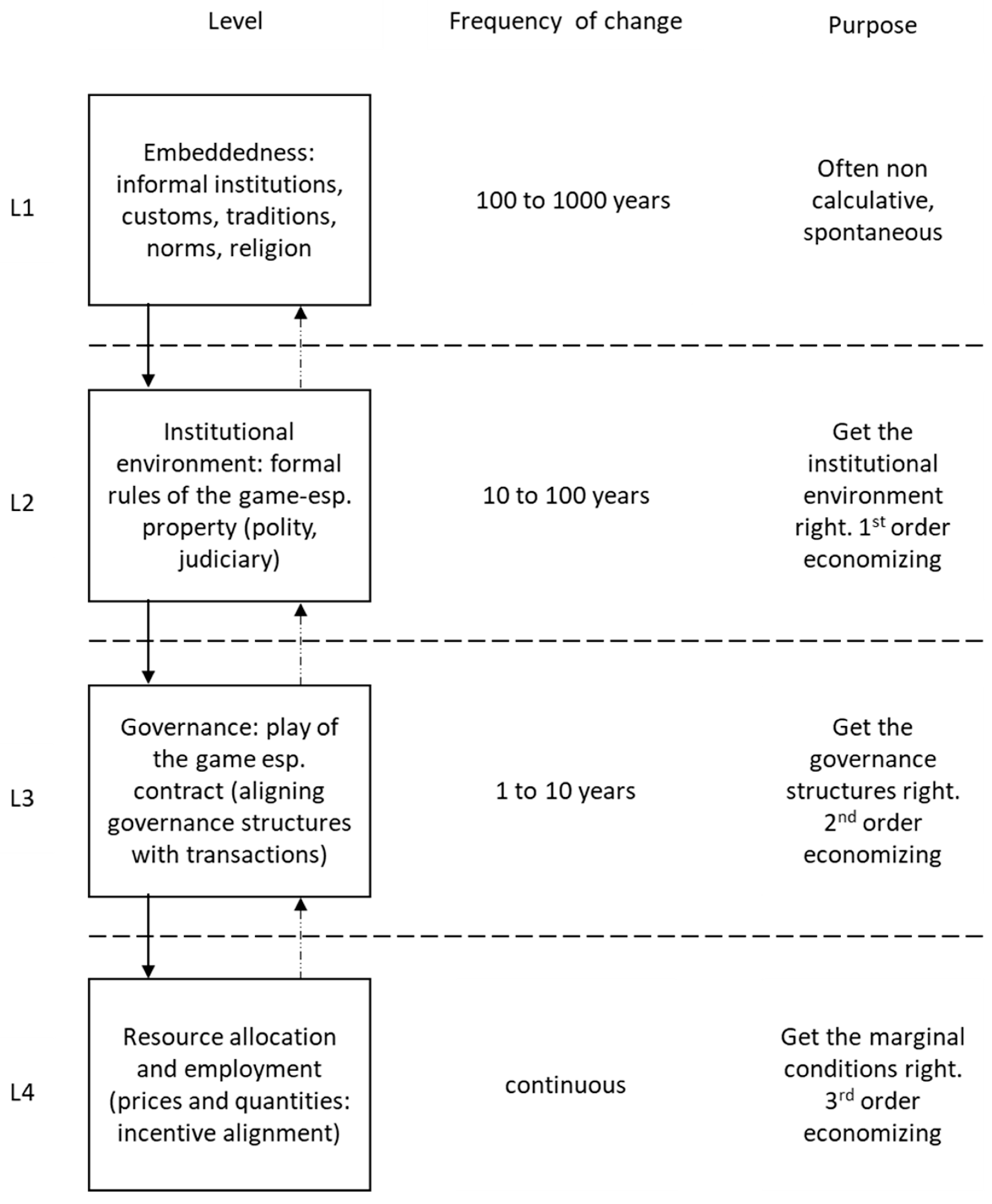
| Level 1: Social Embeddedness | Informal institutions, customs, traditions, norms | Cultural–cognitive elements, shared beliefs, taken-for-granted practices | Bounded rationality, trust, informal safeguards |
| Level 2: Institutional Environment | Formal rules of the game (constitutions, laws, property rights) | Regulative pillars, legitimacy mechanisms, institutional pressures | Incomplete contracts, legal frameworks, compliance |
| Level 3: Governance Structures | Governance mechanisms that shape interactions (contracts, enforcement, conflict resolution, coordination) | Organizational practices, material enactments, field-level logics | Transaction costs, negotiation, enforcement costs |
| Level 4: Resource Allocation | Economic activities, resource use, prices, outputs | Agency of actors, strategic actions, adoption practices | Adaptation, efficiency, market dynamics |
| Number | Regarding | Access Link |
|---|---|---|
| Law Number 6 of 1983 and Amendments | General Provisions and Tax Procedures (amended by Law Number 7 of 2021) | https://www.pajak.go.id/id/undang-undang-nomor-6-tahun-1983 (accessed on 5 May 2025) |
| Law Number 11 of 2008 and Amendments | Electronic Information and Transactions | https://peraturan.bpk.go.id/details/274494/uu-no-1-tahun-2024 (accessed on 5 May 2025) |
| 15 of 2025 (PMK-15) | Tax Audit | https://datacenter.ortax.org/ortax/aturan/show/26118 (accessed on 5 May 2025) |
| 17/PMK.03/2013 and Amendments | Tax Audit Procedures | https://datacenter.ortax.org/ortax/aturan/show/15207 (accessed on 5 May 2025) |
| 199/PMK.03/2007 | Tax Audit Procedures | https://datacenter.ortax.org/ortax/aturan/show/13050 (accessed on 5 May 2025) |
| 545/KMK.04/2000 | Tax Audit Procedures | https://datacenter.ortax.org/ortax/aturan/show/271 (accessed on 5 May 2025) |
| 625/KMK.04/1994 | Tax Audit Procedures | https://datacenter.ortax.org/ortax/aturan/show/578 (accessed on 5 May 2025) |
| SE-10/PJ/2017 | Technical Guidelines for Field Audits for Testing Tax Compliance | https://datacenter.ortax.org/ortax/aturan/show/16271 (accessed on 5 May 2025) |
| SE-25/PJ/2013 | E-Audit Guidelines | https://datacenter.ortax.org/ortax/aturan/show/15307 (accessed on 5 May 2025) |
| Timeframe | Situation | Related Institutional Logics (IL) | Level of NIE Analysis | Pivotal Logics | Causal Relationships (NIE Principles) |
|---|---|---|---|---|---|
| 1990s | GAS introduction (IDEA, ACL). No legal recognition of electronic evidence. No procedural guidelines for CAATT use. Adoption based on individual auditor initiative. | Field-level logics: prevailing belief that existing manual tools sufficed; informal norms and auditor-driven experimentation. | Level 2: Institutional Environment; Level 3: Governance Structures | Collaborative | Contractual incompleteness (absent rules) generated high individual search and negotiation costs. Practitioner communities emerged as informal governance, pooling search costs and establishing shared standards. Enforcement remained fragmented. |
| 2000–2007 | Continued GAS use with incremental innovations (e.g., printer-emulators). Dependent on individual auditor capacity. No formal legal framework for electronic evidence. | Field-level logics: growing recognition of technology’s potential, constrained by persistent regulatory absence and insufficient informal standards. | Level 2: Institutional Environment; Level 3: Governance Structures | Competing | Technological complexity exceeded collaborative governance capacity. Search costs remained high; enforcement costs increased as practice diversity created coordination problems. Informal consensus fragmented under demands that exceeded informal mechanisms. |
| 2007–2013 | KUP Law amendment recognized electronic evidence. PMK-199, PMK-17 established procedural requirements. SE-25 formalized e-Audit guidelines. | Organizational-level logics: institutionalization of CAATTs as essential to audit processes. Tension between new formal standards and established professional routines. | Level 3: Governance Structures | Collaborative and Competing | Regulatory formalization reduced search and negotiation costs (standards now existed) but enforcement costs rose sharply as the organization reconciled formal requirements with entrenched informal practices. Collaborative and competing logics operated concurrently: collaboration at the standard-setting level, competition at the practice level. |
| 2013–2017 | SE-10 Technical Guidelines formalized field audit procedures. Full regulatory framework in place. Infrastructure and training gaps persisted across audit units. | Field-level logics: formal guidelines aligned with operational needs in principle but outpaced organizational capacity for implementation. | Level 3: Governance Structures; Level 4: Resource Allocation | Decoupling | Transaction costs of substantive implementation (training, infrastructure, workflow redesign) exceeded costs of symbolic compliance. Decoupling emerged as a cost-structure equilibrium. Gap persisted because governance investments needed to reduce the cost gap had not been made. |
| 2017–2025 | Institutional environment stabilized. Technology integration advanced in daily audit workflows. Human capital gaps (cultural resistance, uneven skill levels) persisted in capability development. | Organizational-level logics: domain-level differentiation; technology integration formalized and routinized; capability development lagged due to human capital constraints. | Level 3: Governance Structures; Level 4: Resource Allocation | Collaborative (technology integration); Decoupling (capability development) | Domain-level cost heterogeneity produced simultaneous logics. In technology integration, transaction costs of substantive compliance fell below costs of alternatives. In capability development, costs of closing human capital gaps remained high, decoupling persisted. Logic transition driven by economic feasibility, not institutional pressure change. |
| 2025 | PMK-15 reinforced electronic data definition referencing KUP Law rather than broader ITE Law. E-Audit training program launched targeting all tax audit units. | Field-level logics: adjustment to mitigate litigation risks through domain-specific regulation. Organizational-level logics: governance investment to close capability gaps. | Level 3: Governance Structures; Level 4: Resource Allocation | Collaborative and Institutional Differentiation | PMK-15 created tax-specific legal framework (institutional differentiation to reduce litigation risk), distinct from decoupling. E-Audit training constituted governance investment at Level 4 designed to reduce the marginal cost of substantive compliance, addressing the cost gap that sustained decoupling. |
| P1: Collaborative Logic | P2: Competing Logic | P3: Decoupling | P4: Domain-Level Coexistence | P5: Logic Transitions | |
|---|---|---|---|---|---|
| Period | 1990s | Early 2000s (partial); 2007–2013 (full) | 2013–2017; recurring 2017–2025 | 2017–2025 | 2017–2025; 2025 ongoing |
| Condition | Formal regulatory frameworks for organizationally expected technology are absent or underdeveloped | Formal regulatory frameworks for mandated technology are introduced | Transaction costs of substantive implementation exceed costs of symbolic compliance | Different organizational domains face different transaction cost structures | Relative transaction costs of maintaining versus abandoning a configuration shift |
| Causal Mechanism | High individual search and negotiation costs create economic incentives for informal coordination among practitioners | Formalization simultaneously legitimizes new practices and delegitimizes entrenched informal arrangements, shifting costs from search/negotiation to enforcement | Cost gap makes symbolic compliance the lower-cost strategy; no governance mechanism exists to reduce the cost of substantive implementation | Each domain adopts the logic configuration that minimizes its domain-specific costs | Declining cost of substantive compliance crosses below cost of maintaining workarounds or symbolic compliance |
| Expected Outcome | Collaborative logics emerge through practitioner-driven knowledge sharing that functions as informal governance | Competing logics emerge as organizations reconcile formal requirements with established routines | Decoupling between formal policy and operational practice | Multiple logic configurations operate simultaneously within the same organization | Logic transition from one dominant configuration to another |
| Boundary Conditions | Enforcement remains fragmented; mechanism operates under organizational expectation, not only formal mandates | Competition intensifies with regulatory delegitimization; can also emerge from technological complexity alone (early 2000s) | Persists until governance investments reduce cost gap; regulatory clarity alone does not resolve it | Aggregate compliance metrics can mask domain-level variation in operational capability | Institutional pressures set background conditions but do not trigger transitions alone |
| Evidence Base | FGD accounts of practitioner communities; documentary absence of regulatory frameworks pre-2007 | KUP Law amendment (2007); PMK-199, PMK-17, PMK-15; SE-25 e-Audit Manual; FGD accounts of workflow friction | SE-10 Technical Guidelines; FGD accounts of infrastructure gaps, workarounds; internal survey data on low implementation | FGD accounts of technology integration vs. capability gaps; domain-level analysis of cost structures | Cross-period comparison of logic configurations within the technology integration domain; PMK-15 (2025); FGD accounts of the e-Audit training initiative. |
Disclaimer/Publisher’s Note: The statements, opinions and data contained in all publications are solely those of the individual author(s) and contributor(s) and not of MDPI and/or the editor(s). MDPI and/or the editor(s) disclaim responsibility for any injury to people or property resulting from any ideas, methods, instructions or products referred to in the content. |
© 2026 by the authors. Licensee MDPI, Basel, Switzerland. This article is an open access article distributed under the terms and conditions of the Creative Commons Attribution (CC BY) license.
Share and Cite
Darono, A.; Panggabean, T. From Compliance to Adoption: A Theory-Building Study of Technology Implementation Gaps in Tax Administration. J. Risk Financ. Manag. 2026, 19, 237. https://doi.org/10.3390/jrfm19040237
Darono A, Panggabean T. From Compliance to Adoption: A Theory-Building Study of Technology Implementation Gaps in Tax Administration. Journal of Risk and Financial Management. 2026; 19(4):237. https://doi.org/10.3390/jrfm19040237
Chicago/Turabian StyleDarono, Agung, and Tota Panggabean. 2026. "From Compliance to Adoption: A Theory-Building Study of Technology Implementation Gaps in Tax Administration" Journal of Risk and Financial Management 19, no. 4: 237. https://doi.org/10.3390/jrfm19040237
APA StyleDarono, A., & Panggabean, T. (2026). From Compliance to Adoption: A Theory-Building Study of Technology Implementation Gaps in Tax Administration. Journal of Risk and Financial Management, 19(4), 237. https://doi.org/10.3390/jrfm19040237