Review

Financial-Market Forecasting and Modelling from Econometrics to AI: An Integrated Systematic and Bibliometric Review with Content Synthesis (1990–2024)


1
Seminar of Financial Econometrics, Institute of Statistics, Ludwig-Maximilians-Universität München (LMU Munich), Akademiestr. 1/I, 80799 München, Germany
2
Department of Finance, Stat, & Data Analysis, EU Business School, Munich Campus, Theresienhöhe 28, 80339 Munich, Germany
3
Department of Business Administration, Finance Division, Faculty of Commerce, Cairo University, Giza 12613, Egypt
4
Department of Accounting & Finance, College of Business Administration, Ajman University, University Street, Al-Jerf 1, Ajman 346, United Arab Emirates
5
Department of Accounting, Helwan University, Ain Helwan, Cairo 11790, Egypt
6
Department of Finance, Accounting & Economics, School of Management, University College London, London WC1E 6BT, UK
*
Authors to whom correspondence should be addressed.
J. Risk Financial Manag. 2026, 19(3), 228; https://doi.org/10.3390/jrfm19030228
Submission received: 17 January 2026 / Revised: 23 February 2026 / Accepted: 6 March 2026 / Published: 19 March 2026
(This article belongs to the Section Financial Markets)

Abstract

This study offers a comprehensive assessment of financial market modeling through a PRISMA-based systematic review, bibliometric analysis, and content synthesis. We examined 67 review articles (1990–2024) from Web of Science to build a conceptual framework, and 4982 articles (1990–2024) were analyzed with Biblioshiny. Five main clusters emerge: AI and deep learning for prediction; hybrid models that combine traditional and computational approaches; theoretical foundations, including the Efficient Market Hypothesis and critiques; high-frequency prediction and volatility analysis; and modeling of cryptocurrencies and digital assets. Temporal patterns show a shift from traditional econometrics to hybrid and deep learning methods, heightened attention to uncertainty and volatility during crises, rapid growth in crypto-focused modeling, and increased use of sentiment/news data after 2017. The content analysis highlights key gaps and future directions: standardized open benchmarks and reproducible frameworks; regime-sensitive validation; interpretable hybrid models that merge econometric structure with machine-learning flexibility; and wider applicability across assets, markets, and data types. The study provides a structured guide to intellectual and applied modeling, supporting future advances in forecasting, risk management, and policy design.

1. Introduction

Forecasting financial market trends is a critical focus in both academia and investment practice. As global economies grow more complex and financial instruments become more volatile, the need for precise, robust, and flexible predictive models has intensified. From traditional econometrics to modern machine learning (ML), artificial intelligence (AI), and deep learning (DL), researchers and practitioners seek models that can reliably predict price movements in assets such as stocks, bonds, and commodities (Henrique et al., 2019; Sezer et al., 2020). Forecasts underpin portfolio optimization, risk management, and algorithmic trading, and also inform economic policy, corporate finance, and the study of market bubbles, making this field essential to academia, the financial industry, and policymakers. For terminological consistency, this study uses “forecasting” for predictive modeling in financial markets and “Financial Market Modeling (FMM)” as the overarching term.
Advances in modeling techniques have greatly expanded research on financial forecasting across markets and horizons, but a comprehensive, multi-dimensional, and systematically organized review of FMM is still missing. Existing reviews remain fragmented, often focusing on single model families, specific asset classes, or isolated markets, with limited integration across modelling paradigms, evaluation practices, and market regimes. They usually address a single modeling technique (e.g., support vector machines, deep neural networks) or market (e.g., cryptocurrencies, stocks) and rarely consider interactions among models, market environments, and forecasting horizons. To address these gaps and motivate further research, we conducted an SLR as a first step. Using a PRISMA-based screening process, 67 review articles were selected for subsequent bibliometric analysis and CA.
This study formulates research questions to address gaps in the literature and to systematically map and synthesize research on financial market modeling. These questions guide the process from a systematic literature review to a bibliometric analysis of 4982 Web of Science–indexed studies, and then to thematic content interpretation. In line with its review focus, the manuscript’s main aim is to classify, synthesize, and critically assess methodological developments in econometric, machine-learning, and hybrid modeling, rather than conduct new empirical forecasting comparisons. The questions are:
RQ1. What are the main publication trends, most influential articles, and leading journals and platforms on forecasting models in financial markets? RQ2. Who are the key, most cited authors in this field, and how is academic collaboration evolving? RQ3. What are the dominant and emerging themes in forecasting models, and what do studies suggest about the future direction of this research? RQ4. Which areas should future research examine to deepen theoretical and practical understanding of forecasting models, and which forecasting subfields remain under-studied across markets and methods? RQ5. What major challenges and methodological weaknesses characterize current forecasting research? RQ6. What are the dominant forecasting trends across asset classes, how do they evolve over time, and how is model performance reported and evaluated across different markets and forecast horizons in the literature? RQ7. What current applications are attracting researchers, and how does the recent literature position the Efficient Market Hypothesis relative to developments in artificial intelligence and machine learning approaches?
This study adopts a three-stage integrative review design comprising: (1) a PRISMA-guided systematic review of 67 review articles; (2) large-scale bibliometric mapping of 4982 Web of Science–indexed publications conducted via Biblioshiny; and (3) a structured thematic content analysis of the principal bibliometric clusters. Collectively, these stages delineate the intellectual trajectory of financial market modeling, spanning econometric, machine learning, and hybrid methodological paradigms.
This study does not introduce new econometric models or forecasting competitions. Instead, it systematically reviews and synthesizes the literature to trace the evolution of financial market modeling—from traditional ARCH/GARCH to modern AI-based and hybrid methods—while developing a methodological taxonomy and outlining future research directions. In contrast to many prior reviews, which target specific model classes, market segments, or narrow traditions, this study offers an integrated framework that combines systematic reviews, large-scale bibliometric mapping, and thematic synthesis across multiple markets and modeling paradigms. The framework captures both the temporal evolution of methods and the cross-market diffusion of ideas over 35 years, providing a structured, comparative view of financial market modeling.
The paper is structured as follows: Section 2 reviews the literature on Models in Financial Markets. Section 3 presents the methodological framework and the design and implementation of the tri-phasic process. Section 4 reports the SLR findings, bibliometric visualizations, and content synthesis. Section 5 discusses these results in light of the research questions, highlighting key challenges, modeling trends, and future research directions. Section 6 concludes with the main contributions, implications, and limitations.
To address the research questions, the next section reviews the existing literature on financial market modeling by market domain, establishing the conceptual basis for the bibliometric and thematic analyses.

2. Models in Financial Markets

This study uses a three-stage sequential design: a systematic literature review, a bibliometric analysis, and a qualitative thematic synthesis. As detailed in Section 2.1, the systematic literature review (SLR) of 67 review studies defines the conceptual scope of financial market modeling and highlights methodological gaps in prior work. The bibliometric analysis (BA) then examines 4982 Web of Science–indexed publications from 1990 to 2024, mapping the intellectual structure and thematic development of forecasting models across diverse financial asset classes. Finally, content analysis (CA) interprets the most salient, coherent clusters from the bibliometric results, converting network structures into insights on modeling techniques, application domains, and future research directions. Together, these stages form an integrated framework linking prior review evidence, large-scale domain mapping, and interpretive synthesis.

2.1. Modeling Approaches in Financial Markets

Academic discourse on financial market modeling (FMM) reflects a shift from purely statistical approaches toward hybrid and intelligent systems. Traditional models remain important—Poon and Granger’s (2003) review of 93 volatility studies emphasized HISVOL and ARCH-class models, and Baillie (1996) confirmed the usefulness of autoregressive frameworks for long-memory processes in financial time series. However, these methods struggle with nonlinear dynamics and high-frequency noise, prompting growing interest in AI and machine learning. Bahrammirzaee (2010) showed that neural networks, fuzzy systems, and hybrid models outperform classical techniques in forecasting, and B. S. Kumar and Ravi’s (2016) review of 89 studies found that AI-based classifiers, especially when combined with optimization and data preprocessing, significantly improve accuracy.
A key methodological innovation is the use of hybrid models. Henrique et al. (2019) used bibliometric mapping to show that combining statistical models with machine learning (e.g., wavelet-ARIMA, SVM with news sentiment) improves robustness and predictive accuracy. Cavalcante et al. (2016) noted that hybrid models handle the complex, non-stationary nature of financial data. Several reviews applied bibliometric and meta-analytic methods to track the evolution of the literature. J. Chen and Yang (2021) examined 189 Web of Science papers, analyzing citation patterns and thematic shifts in volatility spillover research. Maiti (2020) critically reviewed Fama-French model extensions, arguing for adding behavioral and ESG factors to enhance empirical accuracy.
A key advancement in this field is incorporating news sentiment, economic indicators, and technical analysis into modeling frameworks. Nassirtoussi et al. (2014) reviewed 70 studies and found that combining structured financial data with unstructured news and social media text significantly improves forecasting models. Kristjanpoller and Minutolo (2016, 2018) and Zou et al. (2015) highlighted wavelet- and entropy-based features for better performance under volatility clustering. The literature varies widely in data periods, sources, and evaluation methods: some work uses benchmark datasets over long histories (e.g., 1976–2002 in Poon & Granger, 2003), while others rely on real-time or big-data sources, indicating a shift toward more dynamic and adaptive modeling (e.g., Nosratabadi et al., 2020; Tang et al., 2022; Nazareth & Reddy, 2023).

2.2. Search Strategy and Protocol

In order to guarantee academic rigor, replicability, and methodological transparency, this research employs the PRISMA framework to guide the SLR process during Stage 1. The objective is to identify prior review-based studies focusing on modeling and prediction within financial markets, thereby establishing a strong theoretical foundation for the subsequent BA and CA.

2.2.1. Database Selection

The WoS Core Collection was chosen as the sole data source over Scopus and Google Scholar for several reasons: (1) Historical coverage: WoS includes records back to 1900, versus 1960 for Scopus, offering a broader temporal scope (Mongeon & Paul-Hus, 2016). (2) Output volume: A search for “FMM” in WoS retrieved more relevant articles (8644 records since 1931) than Scopus (4837 records since 1969). (3) Quality and indexing: WoS restricts coverage to peer-reviewed journals from major publishers (e.g., Elsevier, Wiley, Springer Nature, Taylor & Francis, Oxford University Press), ensuring methodological rigor and rich citation data (K. Li et al., 2018).
Standardization and Software Integration: The platform provides well-structured metadata compatible with Bibliometrix/Biblioshiny and EndNote, enabling accurate data exports and high replicability (Aria & Cuccurullo, 2017; Prado et al., 2016). Disciplinary Fit: Web of Science (WoS) covers a wide range of fields—finance, business, computer science, and economics—making it suitable for this interdisciplinary study. Prior Precedent: Many bibliometric and SLR studies confirm WoS as a reliable standalone source for finance and modeling research (e.g., Prado et al., 2016). Although Scopus is widely used for bibliometric analyses (Donthu et al., 2021; Paul et al., 2021), WoS is preferred here for its broader topic-specific coverage and greater bibliometric precision.

2.2.2. Search Strategy and Filtering Criteria

We developed a Boolean search strategy by combining three keyword sets (review, modelling, and financial market terms) to maximize recall and precision. Review terms were limited to the Title field (TI=) so retrieved records were explicitly review-focused, while modelling and financial market terms were searched in the Topic field (TS=), covering titles, abstracts, author keywords, and Keywords Plus. The full Boolean search string is provided in the Supplementary Materials for transparency and reproducibility.
The search was limited to review articles and articles using bibliometric methods in the Web of Science Core Collection, excluding the Preprint Citation Index. It covered the fields of Business Economics, Engineering, Computer Science, Energy & Fuels, Mathematics, Environmental Sciences & Ecology, Physics, and Science & Technology. Only English-language publications from 1990 to 2024 were included.

2.2.3. PRISMA Protocol Implementation

A four-phase review procedure based on Page et al. (2021) was applied: (1) Identification: the initial query yielded 928 documents. (2) Screening: titles and abstracts were examined to remove irrelevant items, including preprints, purely empirical studies, and off-topic research. (3) Eligibility: 444 full-text articles were assessed for thematic and methodological fit; studies without substantive financial modeling or focused solely on non-financial sectors were excluded. (4) Inclusion: 67 high-quality, review-oriented papers on financial market modeling or forecasting were retained (e.g., systematic reviews, meta-analyses, bibliometric reviews) that met criteria on publication type, language, and subject. This targeted strategy grounded Stage 1 in high-quality secondary literature in line with PRISMA guidelines, validated and contextualized the research design, and provided a conceptual framework for Stages 2 and 3, with key insights detailed in the Market-Specific Reviews and Key Findings sections and summarized in the Supplementary Materials.

2.3. Market-Specific Reviews and Key Findings

Much of the surveyed literature focuses on specific financial market sectors, especially the stock market, while bonds, cryptocurrencies, and derivatives receive less attention. Methodology and model choices vary by market type, reflecting distinct data characteristics and forecasting challenges.

2.3.1. Stock Markets

Stock market forecasting is the most developed and methodologically diverse area in financial market modeling. Early surveys emphasized econometric benchmarks—especially ARCH/GARCH models, stochastic volatility, and long-memory processes—as rigorous, coherent tools for modeling volatility clustering and return dependence (Poon & Granger, 2003; Baillie, 1996). Later reviews highlighted the need to extend these models with factor-based frameworks and to incorporate behavioral variables and macro-financial indicators to improve explanatory and predictive performance (Maiti, 2020).
As computational power has grown, the literature has increasingly adopted machine learning methods. Surveys show the rising dominance of neural networks, support vector machines, decision trees, and fuzzy inference systems for modeling nonlinear returns, often using technical indicators and advanced feature engineering to boost predictive accuracy and generalization (Bahrammirzaee, 2010; Henrique et al., 2019; Nti et al., 2020). More recent reviews highlight a rapid shift to deep learning—especially LSTM-based models—and to hybrid and ensemble approaches that fuse heterogeneous data and optimization schemes, improving robustness and stability under high market volatility (A. W. Li & Bastos, 2020; Kumbure et al., 2022; Thakkar & Chaudhari, 2021).
Stock market forecasting methods have evolved from econometric models to machine learning and, more recently, to hybrid AI-based architectures. Despite this progress, the field remains fragmented across model types, input representations, and evaluation protocols, and there are few systematic comparisons across data modalities and prediction horizons (Nazareth & Reddy, 2023). This fragmentation motivates the comprehensive bibliometric and thematic synthesis in this study.

2.3.2. Energy and Commodity Markets

Energy market forecasting has shifted from conventional econometric benchmarks to hybrid and AI-driven models. Earlier surveys mainly used ARIMA, VAR, and GARCH as baselines for crude oil and electricity price prediction, highlighting their strengths in modeling volatility persistence and short-term price dynamics (Chiroma et al., 2013; Chiroma et al., 2016). However, their rigid statistical structure and limited ability to capture strong nonlinearities, structural breaks, and regime shifts have prompted a move beyond purely linear time-series methods.
Recent surveys show that hybrid models combining wavelet-based signal decomposition, neural networks, and evolutionary optimization now dominate because they better capture multiscale temporal patterns and nonlinear volatility in energy markets (Ghoddusi et al., 2019; Lu et al., 2021). At the same time, studies using entropy-based complexity metrics and behavioral efficiency indicators add a crisis-sensitive lens, highlighting the need for adaptive validation and high-dimensional inputs under geopolitical and macroeconomic stress (Kristjanpoller & Minutolo, 2016, 2018; Zou et al., 2015). Bibliometric analyses confirm a growing focus on short-term electricity price forecasting and integrated hybrid designs (Zema & Sulich, 2022). Overall, the literature shows a clear move away from standalone econometric models toward hybrid, preprocessing-heavy, crisis-responsive systems, where the degree of integration and data transformation increasingly determines predictive robustness.

2.3.3. Foreign Exchange (Forex) Markets

The literature on currency forecasting divides into two related but distinct areas: traditional foreign exchange (FOREX) markets and decentralized cryptocurrency markets. Both study exchange rate dynamics, but their methods differ significantly due to contrasting institutional development, data-generating processes, regulatory contexts, and market microstructures.
In the foreign exchange market, which has received less systematic scrutiny than equity markets, exchange rate forecasting is highly volatile and sensitive to macroeconomic shocks. Recent work shows growing use of AI-based models that integrate textual sentiment and real-time news to better capture abrupt rate movements (Nassirtoussi et al., 2015). Combining technical indicators with evolutionary optimization also improves short-term forecasts, especially in unstable markets (Patel et al., 2015). Together, these advances mark a shift from purely econometric models to hybrid, data-intensive forecasting approaches.
The cryptocurrency market is a relatively new but rapidly developing area of forecasting research. Early work focused mainly on Bitcoin volatility, often using fractal and complexity-based methods (Wątorek et al., 2021; Blackledge & Lamphiere, 2022). Recent surveys show a clear shift toward machine learning, deep learning, and hybrid models, especially for high-frequency trading and speculative settings (Fang et al., 2023). Bibliometric studies further indicate that research is heavily concentrated on trading strategies and algorithmic prediction, while broader token ecosystems, regulation, and cross-market linkages remain comparatively neglected (Bariviera & Merediz-Solà, 2021).
Scholarship on currencies follows two parallel paths: a steadily hybridizing evolution in foreign exchange (FOREX) forecasting and a rapid, experiment-heavy expansion of cryptocurrency modeling. Together, they signal an emerging methodological convergence on AI-based approaches, despite ongoing structural fragmentation across currency subfields.

2.3.4. Mutual Funds and Portfolio Evaluation

The performance of mutual funds and the construction of portfolios constitute a specialized and noteworthy domain of study. Elton and Gruber (2020) conducted an analysis of active fund performance, revealing that a significant portion of actively managed portfolios do not surpass passive benchmarks when adjusted for risk. This discovery corroborates the weak-form Efficient Market Hypothesis (EMH) and coincides with the escalating interest in algorithmic and data-driven allocation models. Ban et al. (2018) observed a methodological shift towards AI-driven asset selection, particularly in scenarios that involve high-dimensional data and non-normal return distributions.

2.3.5. Underserved and Emerging Markets

Notably, the literature concerning bond markets is underrepresented in almost all examined reviews. There is an absence of comprehensive reviews that forecast bond yields, delve into term structure models, or scrutinize credit spread dynamics utilizing either conventional methods or machine learning techniques. This deficiency underscores a significant research opportunity, given the global economic significance of fixed-income markets. Similarly, extensive review studies on cryptocurrency markets, real estate, and derivatives remain limited. Although certain studies comparatively test models using Bitcoin or Ethereum, there is no existing systematic or thematic review that consolidates forecasting approaches across these digital asset categories.

2.4. Thematic Insights and Gaps in the Literature

2.4.1. Thematic Trends and Methodological Shifts

Many studies highlight a shift from traditional statistical models to flexible, non-linear learning approaches. Cavalcante et al. (2016) and B. S. Kumar and Ravi (2016) note growing use of hybrid models combining neural networks, fuzzy systems, and optimization techniques, which better capture the complexity and instability of financial markets. Henrique et al. (2019) show via bibliometric mapping that machine learning has overtaken conventional methods in research activity and practical relevance, especially for stock market prediction. A related trend is the rising use of bibliometrics to synthesize the modeling literature: J. Chen and Yang (2021) and Ban et al. (2018) map publications, co-authorship networks, and keyword trends, outlining the knowledge landscape in financial forecasting.
A key issue is integrating alternative data sources. Nassirtoussi et al. (2014) show that adding sentiment analysis, financial news, and social media content improves a model’s responsiveness to market dynamics. Kristjanpoller and Minutolo (2016, 2018) and Zou et al. (2015) recommend including entropy and behavioral finance efficiency indicators to extend evaluation beyond traditional metrics. Despite these advances, evaluation methods in the literature remain inconsistent: some studies stress out-of-sample predictive accuracy, others focus on in-sample fit or model interpretability. Few provide standardized benchmarks across model types or assets, limiting the generalizability of their findings.

2.4.2. Structural Gaps in the Literature

The review exposes uneven market coverage. Research centers on stock markets, while bond markets—core to the financial system—are largely ignored. There is no comprehensive review that unifies term structure models, interest rate forecasting, and credit risk prediction for bonds. Other assets—cryptocurrencies, real estate, derivatives—are also underrepresented despite their growing role in diversified portfolios, leaving major gaps in assessing advanced forecasting models in these asset classes. Comparative cross-market and cross-model analyses are rare: existing reviews usually focus on a single market or narrow model set and do not systematically compare traditional, AI-based, and hybrid models under common validation protocols. Model behavior in crises is also understudied; only a few works (e.g., Kristjanpoller & Minutolo, 2016, 2018; Zou et al., 2015) examine performance during crises or regime shifts. Given events such as the Global Financial Crisis, COVID-19, and post-2020 inflation, evaluating model resilience in atypical conditions is crucial. Finally, many AI and hybrid studies lack transparency and reproducibility, with limited sharing of code, data, or methods, hindering practical use and comparability.
The SLR found substantial fragmentation and methodological weaknesses in existing FMM review literature. Most reviews are either overly descriptive or methodologically narrow. Over 70% use narrative approaches that lack transparency, reproducibility, and theoretical integration (Fang et al., 2023), typically focusing on single model families or specific markets without cross-model comparisons, domain interactions, or longitudinal themes. Even bibliometric studies, such as Bal and Mishra (2025), did not effectively link structural results to qualitative insights. The SLR therefore highlights an urgent need for a study that integrates systematic, bibliometric, and CA methods to examine the development, application, and comparison of forecasting models across financial domains.
The systematic literature review (SLR) revealed existing gaps and informed the design of the bibliometric framework. Prior reviews often searched multiple databases without explaining their choices. In contrast, this study used only Web of Science (WoS) for bibliometric analysis (BA) due to its reliability, citation-tracking effectiveness, compatibility with advanced tools, and prominence in high-impact financial research (Aria & Cuccurullo, 2017). Addressing the limited scope of earlier reviews, the BA expanded the corpus to 4982 papers, enabling statistically robust co-citation, co-authorship, keyword co-occurrence, and thematic mapping analyses. This offers a comprehensive view of the intellectual and conceptual evolution of FMM. The SLR also noted that few reviews employed advanced bibliometric software. Biblioshiny for Bibliometrix (version 4.2.0) (RStudio version 4.3.3) supports detailed analysis of productivity, influence, collaboration networks, and thematic trends, thereby addressing the research questions identified in the SLR (G. Kumar et al., 2021; Gandhmal & Kumar, 2019).
To enhance transparency and reproducibility, we report the main parameter settings used in the bibliometric analysis. We set keyword frequency thresholds to maintain a dense, interpretable network that reveals coherent thematic clusters while limiting fragmentation. Association strength normalization was applied to reduce the influence of highly frequent generic terms and better capture the conceptual strength of keyword co-occurrences. Community detection in Bibliometrix/Biblioshiny used the Louvain algorithm (Aria & Cuccurullo, 2017). The temporal window covers the evolution of financial-market modeling from the dominance of ARCH/GARCH methods in financial econometrics (Bollerslev, 1986, 1990; R. F. Engle, 1982) to the recent spread of machine and deep learning in asset pricing and forecasting (H. Chen et al., 2021). The Supplementary Materials present alternative thresholds and robustness checks, confirming the stability of the thematic structures.
The Systematic Literature Review (SLR) showed the need for a detailed micro-level interpretive approach to complement macro-level structural patterns. Consequently, a Content Analysis (CA) was conducted on highly cited articles selected via citation and thematic clusters from stage 2. Earlier reviews rarely interpreted models in relation to applied contexts or market conditions, so CA examined methodologies, data types, market domains, and application frameworks in these key papers. The SLR also found that prior reviews lacked an integrated three-dimensional analysis of model type, market type, and time-horizon effectiveness. CA was therefore designed to detect patterns within this matrix, focusing on neural models, hybrid AI approaches, and statistical benchmarks (C. Zhang et al., 2023). The SLR further identified inconsistent model evaluation criteria—some studies emphasized accuracy, others profitability or volatility forecasts—prompting the development of a comparative framework in stages 2 and 3. It also highlighted the neglect of alternative markets: stock and cryptocurrency markets dominated recent reviews, while ESG-related markets and macroeconomic indices were underexplored. The keyword strategy in stage 2 and content selection in stage 3 were designed to correct this imbalance. To connect structural trends with practical applications, the study adopted a triangulated approach in which bibliometric data enrich content analysis within a systematic framework.
While Section 2 consolidates existing review-based research across different markets, the following section sets out the methodological framework used to systematically build on this foundation via large-scale bibliometric mapping and structured content analysis.

3. Research Methodology

This study adopts a three-stage sequential research design to ensure both conceptual coherence and analytical rigor. Stage 1 (Systematic Literature Review, SLR), presented in Section 2, synthesizes 67 review-oriented publications to delineate the conceptual scope of financial-market modelling and to identify key theoretical and methodological limitations. This phase also generates a refined keyword taxonomy and coding framework that form the foundation for the subsequent bibliometric analysis. Building on these delineated boundaries, Stage 2 (Bibliometric Analysis, BA)—which constitutes the core component of the methodological approach—expands the empirical basis to 4982 Web of Science–indexed records and systematically maps the field’s intellectual and conceptual structure through co-occurrence, co-citation, and thematic network analyses. Subsequently, Stage 3 (Content Analysis, CA) offers an in-depth qualitative examination of the most central and structurally cohesive clusters identified in Stage 2, thereby translating network-level regularities into substantive insights concerning modelling paradigms, application domains, and prospective directions for future research. Collectively, the three stages establish a logically integrated progression from conceptual boundary specification (Section 2), through structural field-level mapping, to interpretive synthesis.

3.1. Bibliometric Analysis (BA)

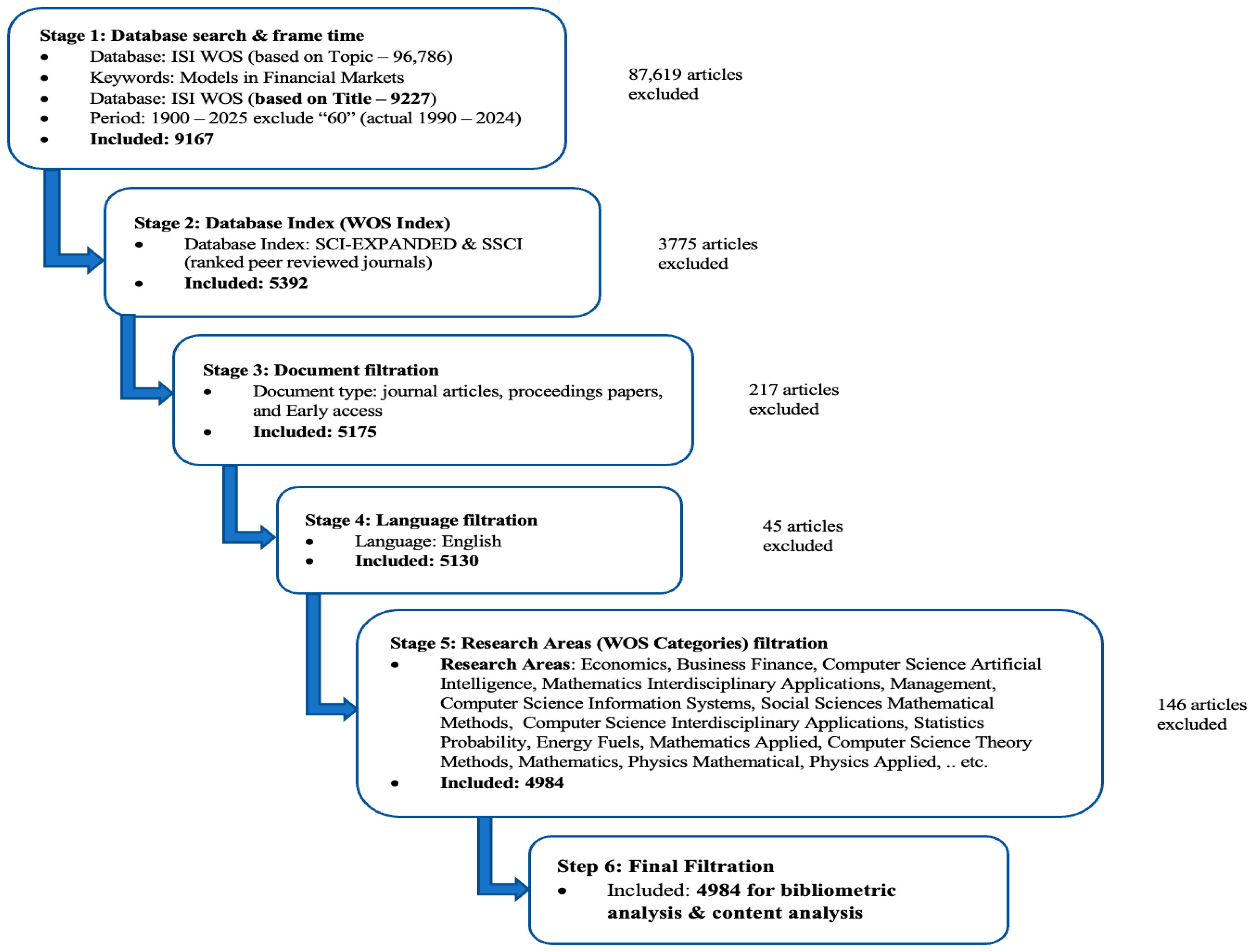
We conducted BA using scholarly articles from Thomson Reuters’ WoS citation index, classifying them into descriptive and quantitative methodologies (Singh et al., 2020; Costa et al., 2019). BA comprised two main methods: scientific mapping and the evaluation of scientific productivity, performance, and assessment (Cobo et al., 2012). Keywords were the unit of analysis (Paule-Vianez et al., 2020). We implemented BA with Biblioshiny in R-Studio (Aria & Cuccurullo, 2017). The methodology is shown in Figure 1.

3.1.1. Selection of Database

The bibliometric and CA dataset was obtained from the Web of Science (WoS) database, which offers a broader collection of scientific articles dating back to 1900, compared with Scopus, whose records start in 1960. Following Jain et al. (2022), the authors queried both WoS and Scopus to ensure comprehensive coverage. Scopus identified about 60,000 publications from a 1969 article onward, whereas WoS returned 96,786 papers from a 1929 article. Because Scopus contained few FMM-related papers, WoS was chosen for its extensive coverage of research from major publishers such as Elsevier, Wiley, Taylor & Francis, Springer Nature, IEEE, and Oxford University Press. This study reviewed all FMM-related literature published from 1971 to 2024, with particular focus on 1990–2024.
The bibliometric dataset was compiled from the Web of Science (WoS) Core Collection. WoS constitutes a standard data source in bibliometric research due to its systematic indexing procedures, reliable citation tracking, standardized metadata structures, and interoperability with advanced analytical software (Alshater et al., 2020; Goyal & Kumar, 2021). Its rigorously curated journal coverage enhances methodological consistency and facilitates reproducible large-scale science mapping (K. Li et al., 2018; Prado et al., 2016). The exclusive reliance on a single database increases data homogeneity and reduces the likelihood of duplicate records, a factor that is particularly critical for network-based analyses (Hsu & Chiang, 2015). Moreover, WoS integrates efficiently with bibliometric tools such as Bibliometrix/Biblioshiny (Aria & Cuccurullo, 2017), thereby enabling transparent, systematic, and replicable analytical workflows.

3.1.2. Keywords Selection Strategy

In Stage 1, an initial keyword set— (“Model*” OR “Predict*”) AND (“Financial Market*”)—was developed from the authors’ understanding and prior FMM review studies. Based on insights from the literature, the search strategy was refined to improve precision and coverage. The expanded keyword set was built from recurrent market- and model-related terms identified in Stage 1 and refined through iterative pilot searches to maximize recall and preserve precision, thereby limiting subjectivity in term selection. The final search string was: (“Model*” OR “Predict*” OR “Forecast*”) AND (“Financial Market*” OR “Stock Market*” OR “Bond Market*” OR “Capital Market*” OR “Commodit* Market*” OR “Foreign Exchange” OR “Derivatives Market*” OR “Energy Market*” OR “$currenc*” OR “Security Market*”). These keywords were applied in the WoS Core Collection using Boolean operators “AND” and “OR” to build topic-specific queries. Following Jain et al. (2022), this approach improves the retrieval of relevant documents and, as noted by Donthu et al. (2021), reduces the subjectivity of traditional reviews by enabling structured analysis of large bibliographic datasets. Only peer-reviewed publications indexed in WoS were included, ensuring a robust and reproducible basis for this systematic literature review (SLR).

3.1.3. Refinement Process and Search Results

To finalize paper selection, we followed the six-step process of X. Xu et al. (2018). We began with broad queries, then refined them iteratively (e.g., (“Model*” OR “Predict*”) AND (“Financial Market*”)). Table 1 reports the final queries and search structure. The initial search returned 96,783 results; limiting the search to titles reduced this to 9224. To ensure substantial coverage of FMM reviews (Alshater et al., 2020), we expanded the keywords: one “model” group and one “financial markets” group, each combined with OR within “Keywords,” and then merged with OR within “Topic.” This yielded 9227 WoS documents, and, after restricting the time frame, 9167 documents (1900–2024). The data span 1929–2025, with 1 paper per year up to 1989 and 2 papers in 2025. After screening 60 articles and excluding insignificant ones, the final dataset comprised 9167 articles. In the second step, we restricted the sample to SCI-EXPANDED and SSCI peer-reviewed journals (Budler et al., 2021), excluding 3775 articles and retaining 5392.
Step 3: We restricted our analysis to journal articles, conference papers, and early access publications, due to their emphasis on innovation and rigorous peer review, consistent with Paul et al. (2021). This excluded 217 articles, leaving 5175 documents. Step 4: Following Donthu et al. (2021), we included only English-language articles, leading to the exclusion of 45 more and reducing the total to 5130. Step 5: Our search covered all FMM-related scientific domains, using WoS Categories identified as most suitable for an FMM review (Costa et al., 2019), such as Economics, Business Finance, Computer Science AI, Engineering Electrical Electronic, Mathematics Interdisciplinary Applications, and Social Sciences Mathematical Methods. A rapid review (Paul et al., 2021) excluded a further 146 documents, yielding 4984. Step 6: This number (4984) was confirmed for BA after a careful title and abstract screening of previous articles. In total, 91,802 articles were excluded for not meeting criteria on scholarly status, database source, title, time frame, language, or research area. The remaining 4984 articles will undergo a comprehensive bibliometric review.
  • The search string and Keywords
Table 1 presents the finalized keyword taxonomy employed for the construction of the bibliometric corpus. The Stage 1 review-of-reviews informed the development of this taxonomy, which was subsequently structured to encompass modeling paradigms (econometric, machine learning, hybrid), market and asset contexts, as well as terminology frequently associated with forecasting. This table operationalizes the previously defined conceptual boundaries and ensures that the bibliometric search strategy is both transparent and reproducible.
The size of the bibliometric corpus reflects the study’s deliberately broad conceptual scope rather than an indiscriminate use of search terms. Previous bibliometric studies in related areas have also relied on large datasets—for instance, Fang et al. (2023) analyzed 4999 Web of Science articles on exchange rate forecasting, and Ferreira et al. (2021) examined 2326 Scopus publications on AI-based financial applications. These works, however, largely targeted specific asset classes or narrow modelling domains. By contrast, this study maps forecasting and modelling techniques across a wide range of financial markets and methodological paradigms over a long period (1990–2024). The search taxonomy was therefore designed to cover traditional econometric models, machine learning methods, hybrid architectures, sentiment-based frameworks, and models for emerging digital assets within a single analytical framework. Exclusive use of the Web of Science database ensures consistent citation data, reliable indexing, and methodological comparability. The resulting corpus of 4984 publications is thus appropriate to the study’s field-level aims and consistent with standards in large-scale bibliometric research.

3.1.4. Analytical Dimensions and Link to Research Questions

Consistent with Aria and Cuccurullo (2017), this study used citation count, h-index, g-index, publication frequency, and productivity over time as performance metrics. It identified leading contributors to the FMM literature by ranking authors by total publications, total citations, and average citations per paper. The top 10 authors produced about 12% of all publications, indicating concentrated authorship (Donthu et al., 2021). Journals were assessed using total citations and impact factor (IF), with “Expert Systems with Applications,” “Journal of Forecasting,” and “Applied Soft Computing” emerging as top-tier outlets (G. Kumar et al., 2021). The dataset showed institutional dominance by universities in China, the US, and India; the Chinese Academy of Sciences, University of Tehran, and Indian Institute of Technology were among the most productive. China led country-wise contributions with over 25% of publications, followed by the US and India, consistent with Goyal and Kumar (2021).
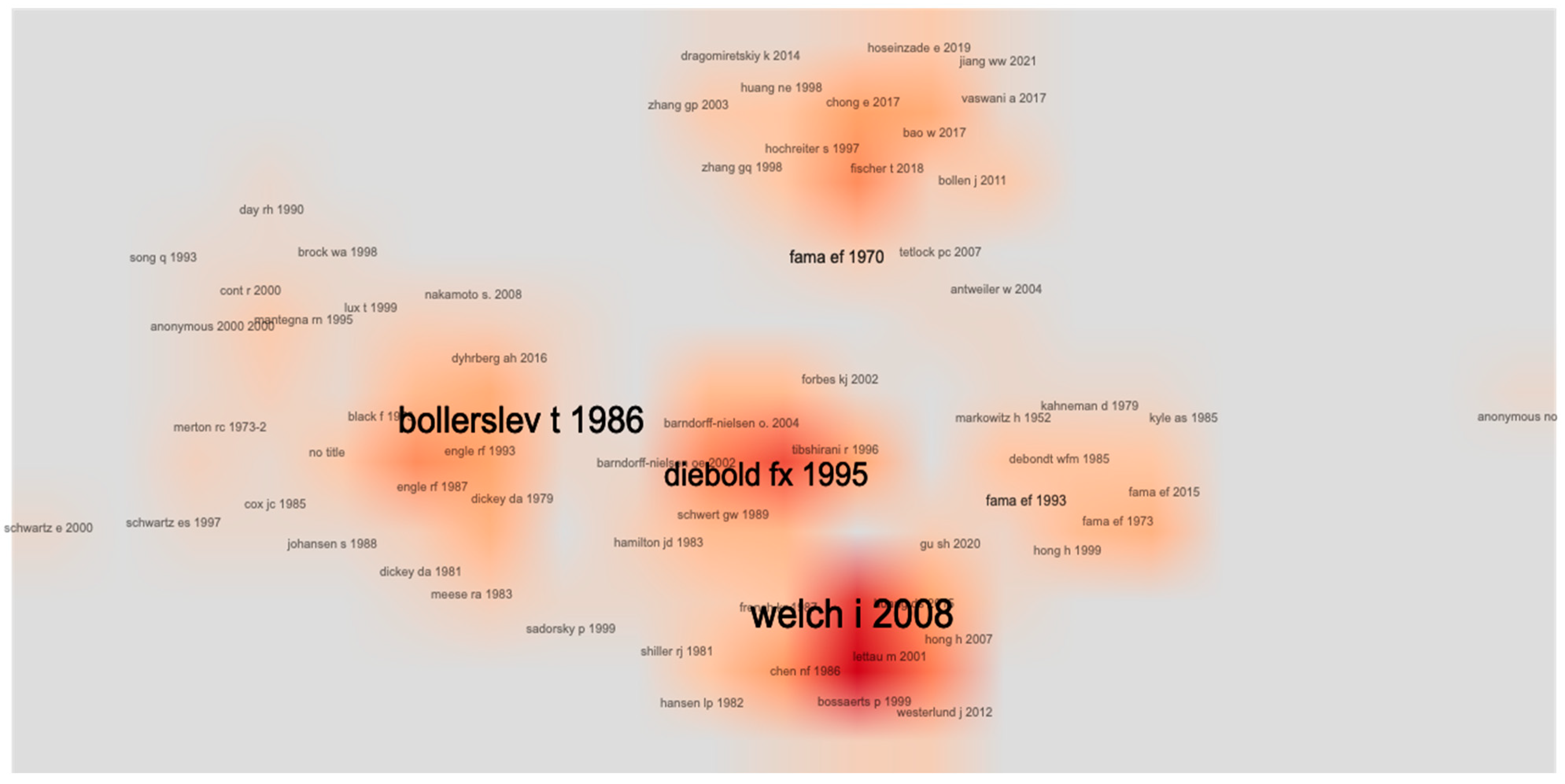
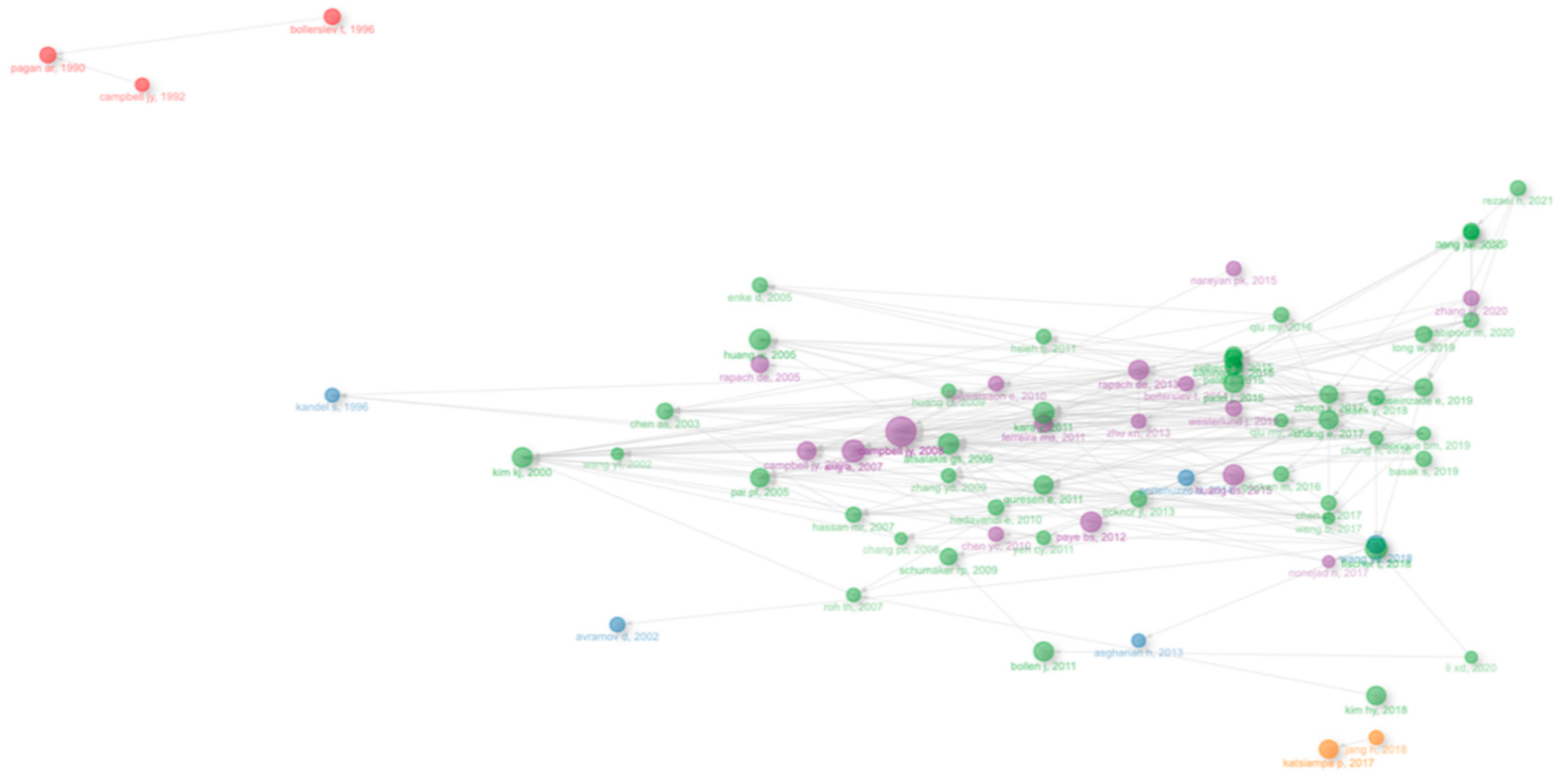
Science mapping visualizes the structure and evolution of scholarly domains. Using Biblioshiny, three methods were applied: co-authorship networks, keyword co-occurrence, and co-citation analysis. The co-authorship map shows fragmented collaboration, supporting Bal and Mishra’s (2025) call for stronger global partnerships. Author networks form a few tight clusters, and institutional and national networks remain mostly localized. Keyword co-occurrence highlights dominant terms such as “forecasting,” “ML,” “stock market,” “volatility,” and “DL.” Co-citation analysis identifies core works—Fama (1970), Box et al. (2015), and recent studies on hybrid and DL models—defining three interconnected areas: traditional econometrics, AI/ML, and hybrid forecasting. Trend analysis shows the FMM field moving from ARIMA and GARCH in the early 2000s to ML and hybrid models after 2015, with growing use of “neural networks,” “LSTM,” and “support vector machines.” The initial focus on “stock price/return/volatility prediction” has expanded to “cryptocurrency forecasting” and “sentiment analysis.” Studies increasingly combine econometrics and AI, positioning integrated approaches as central to complex time-series forecasting (Goyal & Kumar, 2021; Nti et al., 2020).

3.2. Content Analysis (CA)

The third stage uses qualitative CA to interpret, synthesize, and extend the quantitative BA findings. It conducts a deep dive into selected thematic clusters from co-citation and thematic mapping analyses to identify nuanced themes, research gaps, and emerging patterns requiring further study (Snyder, 2019). The CA structure follows thematic clusters from the bibliometric analysis, representing key research areas: traditional econometric models, AI/ML-based forecasting, hybrid techniques, market efficiency debates, and applications across financial asset classes. We select clusters for CA based on: (1) high density and centrality on the thematic map (Cobo et al., 2011), (2) intellectual cohesiveness in co-citation networks, and (3) the presence of highly cited review and empirical papers.
This methodology synthesizes content from clustered papers without a pre-existing coding framework, using Braun and Clarke’s (2006) six-step thematic analysis: (1) Data Familiarization: thoroughly reading selected texts to identify recurring themes, frameworks, and methods. (2) Initial Coding: open coding to identify themes, concepts, and patterns related to FMM, including model types, data frequencies, financial applications, and geographic areas. (3) Theme Development: grouping codes into key themes based on recurrence, relevance, and coherence. (4) Theme Review: checking each theme against other papers to ensure comprehensive, non-redundant coverage. (5) Definition and Labeling: clearly defining and naming themes for interpretive clarity and consistency. (6) Narrative Construction: developing thematic narratives for each cluster to present key findings, theoretical perspectives, and research gaps. Manual coding ensured transparency and rigor, with multiple reviewers cross-validating the process. Inter-coder agreement and discussion were used to resolve discrepancies and maintain consistency.
Through systematic coding and deductive reasoning, five main thematic clusters were defined for analysis: (1) AI and Deep Learning Models for Prediction: development and use of advanced AI methods such as LSTM, CNN, and BiLSTM for financial forecasting. (2) Integrative Models Combining Conventional and Computational Strategies: studies that integrate econometric models like GARCH with machine learning, underscoring the growing synergy between statistical and AI-based forecasting. (3) Theoretical Foundations: EMH and Its Challenges: examination of the enduring relevance and limitations of the Efficient Market Hypothesis and how modeling strategies support its assumptions. (4) High-Frequency Forecasting and Volatility Analysis: work on volatility dynamics, high-frequency trading, multiscale volatility, and cross-asset and cross-country spillovers. (5) Cryptocurrency and Digital Asset Modeling: research on modeling cryptocurrencies and blockchain-related assets with predictive models while addressing their specific data issues. Within each cluster, 10–15 studies were selected for in-depth thematic analysis based on citation impact, recency, and their ability to exemplify cluster themes. By systematically examining each cluster, this phase connects structural patterns with interpretive insights, providing the basis for the study’s final synthesis. Further information on cluster selection, parameter configurations, and supporting outputs is presented in the Supplementary Materials to improve transparency and enable replication.

4. Result and Discussion of Bibliometric Review

4.1. Descriptive Analysis

4.1.1. Sample Description

This study spans 35 years (1990–2024), enabling a robust examination of the evolution of FMM. The dataset includes 49821 documents from 758 sources, reflecting the field’s multidisciplinary relevance. These publications contain 3495 plus-words and 10,205 author keywords, with an average of 26.72 citations per paper. The annual growth rate of 9.5% confirms FMM’s rising academic prominence. A total of 9468 unique authors contributed, including 637 single-authored papers, while 26.82% of co-authorships involved international collaboration.

4.1.2. Characteristics of Scientific Output

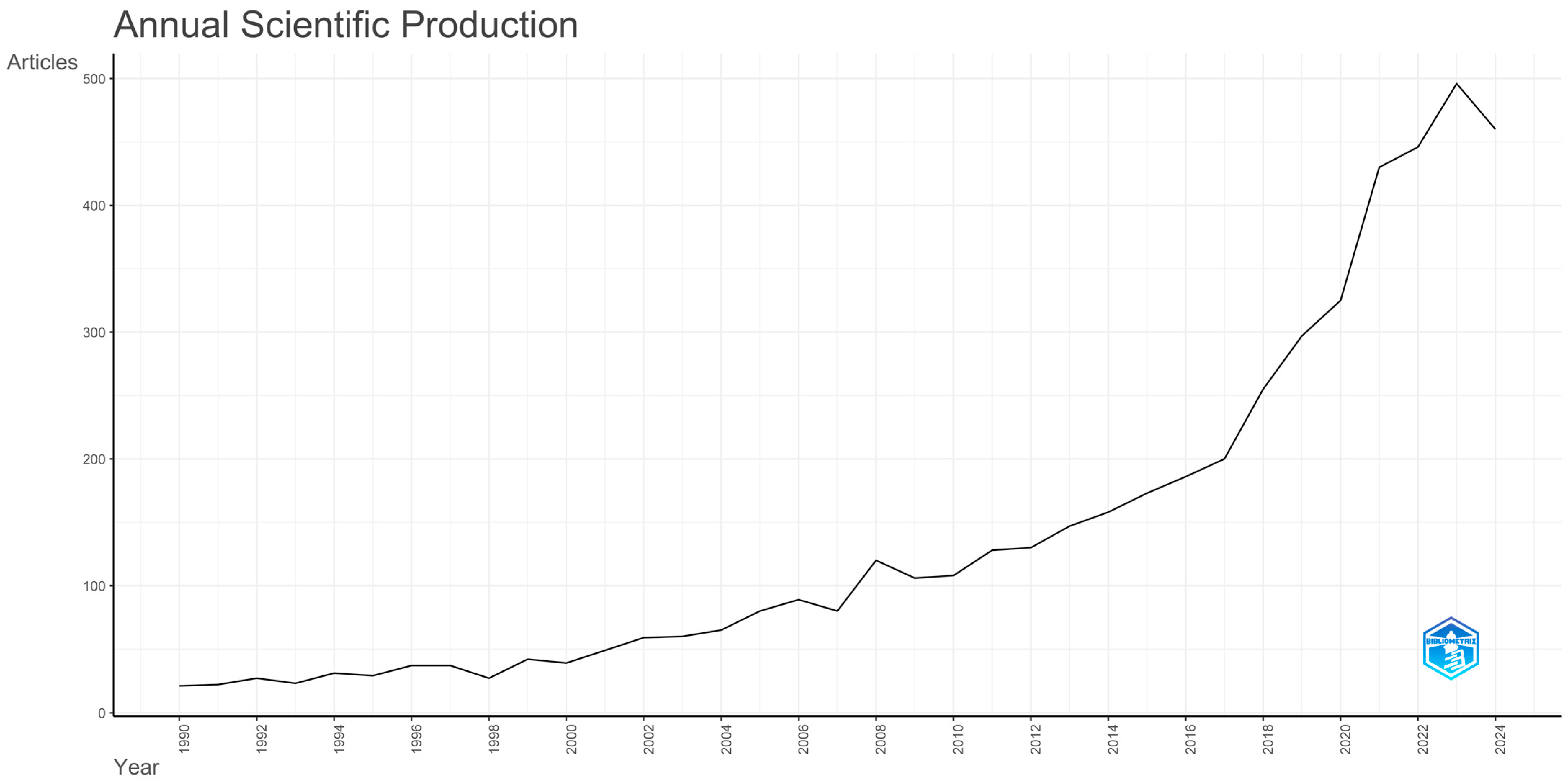
Figure 2 and Table 2 show the publication trajectory in Financial Market Modeling (FMM). The field began with 296 publications in the 1990s, reflecting its early development. Publications rose to 747 in the 2000s, aided by better data access and computing power, and then to 1782 in the 2010s, indicating growing interest in predictive analytics and machine learning in finance. The slight decline after 2022 in the 2020s likely reflects shifting academic interests rather than the reduced importance of the field.

4.1.3. Authors’ Contributions

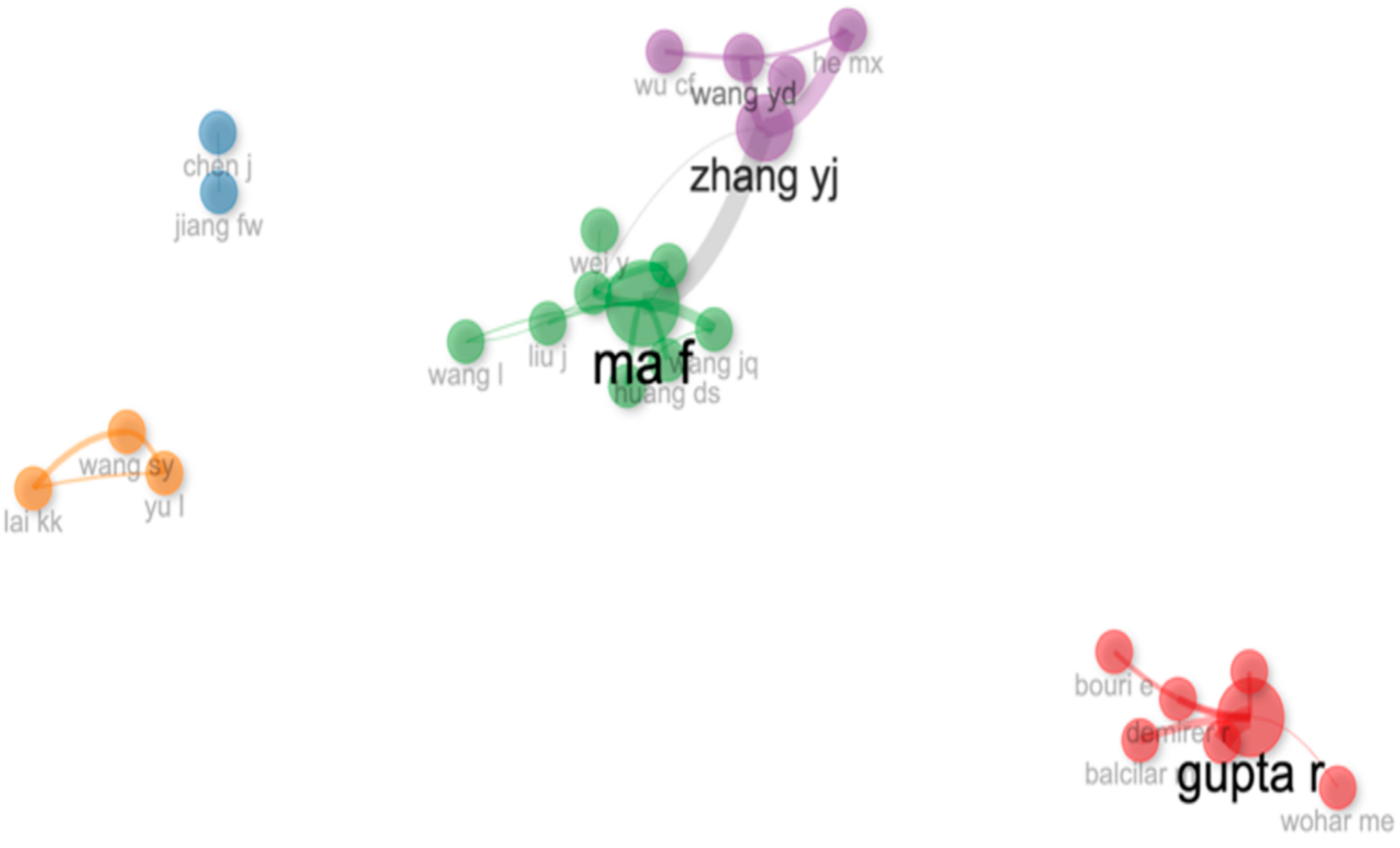
Our analysis elucidates the foremost contributors to research in Financial Market Modeling (FMM), identifying Gupta, Ma, Zhang, and two scholars named Wang as the principal authors. Collectively, they contribute to approximately 40% of the publications, totaling over 200 co-authored papers. Gupta distinguishes himself with 63 papers and the most significant citations, whereas Ma is notable for authoring 60 articles and achieving a considerable fractionalized score, reflecting his substantial influence. Zhang has made 47 contributions, and the two Wangs jointly contribute 69 papers, underscoring their active engagement in financial market modeling.
Based on scanning the literature, we enumerate the most frequently cited and influential authors within FMM research. The leading quintet of authors accounts for over 32% of all local citations. Ma emerges as the foremost author with 549 citations (9.3%), succeeded by Campbell with 433 citations (7.3%), noted for their contributions to asset pricing and macro-finance. Zhang ranks third with 338 citations (5.8%), specializing in energy finance and sustainability. Thompson and Gupta follow with 313 (5.3%) and 255 (4.3%) citations, respectively. Authors such as Kotecha and Narayan concentrate on region-specific modeling and applications within machine learning.
A notable increase in activities among prominent academics is observed post-2015, corresponding with the enhanced focus on FMM. Gupta exhibited a stable scholarly output, peaking during the period 2018–2023. Concurrently, Ma and Zhang have persistently provided significant contributions in recent years. The presence of darker citation bubbles signifies an elevated level of influence, particularly in well-regarded domains such as sustainability. The scholarly work of Wang and Wang is characterized by a more concentrated focus, with their major contributions predominantly occurring between 2018 and 2021. In terms of H-index, Ma ranks first (26), followed by Gupta (23), with Wang, Zhang, and Narayan close behind (H = 19 each). While Ma is the most prolific in publication count, Gupta holds the highest total citations, underscoring his broader scholarly impact.

4.1.4. Top Contributing Journals and Publications

Our analysis identifies the top 30 journals contributing to FMM, encompassing 2183 articles, which account for approximately 43.8% of the total sample, thereby highlighting their essential role in advancing the field. The variety of journals underscores FMM’s interdisciplinary nature, encompassing finance, computational modeling, and emerging technologies. Physica A and Expert Systems with Applications are prominent due to their interdisciplinary scope. Emerging Markets Finance and Trade underscores the growing interest in global and emerging markets. Journals such as the Journal of Forecasting and the International Journal of Forecasting underscore the enduring significance of predictive analytics, while Applied Soft Computing and IEEE Access reflect the increasing influence of AI and machine learning in financial modeling.
After reviewing the previous 30 journals, we revealed that the top five account for over 40% of all citations. Dominating this list is the Journal of Finance with 8546 citations (12%), followed by the Journal of Financial Economics with 6102 citations (8.6%), Expert Systems with Applications with 4880 citations (13.4%), the Review of Financial Studies with 4743 citations (6.8%), and Energy Economics with 4293 citations (11.8%). This highlights the crucial roles afforded by both core finance publications and emerging interdisciplinary platforms. The distinction between the most cited and most productive journals suggests that researchers often prefer domain-specific outlets such as the Journal of Finance for citations, whereas interdisciplinary journals are generally leveraged more for their methodological insights rather than as primary sources for citations.
For the top 30 journals, the leading trio—Expert Systems with Applications, Energy Economics, and Physica A—have collectively produced 490 articles and accrued over 22,000 citations, constituting 32% of the total. Expert Systems with Applications occupies the leading position with 179 articles and 13,297 citations, underscoring its cross-disciplinary influence. Energy Economics is ranked second with 5590 citations, highlighting its significance in energy-centric financial modeling. Physica A, with 4086 citations, demonstrates its role in statistical modeling within financial contexts.
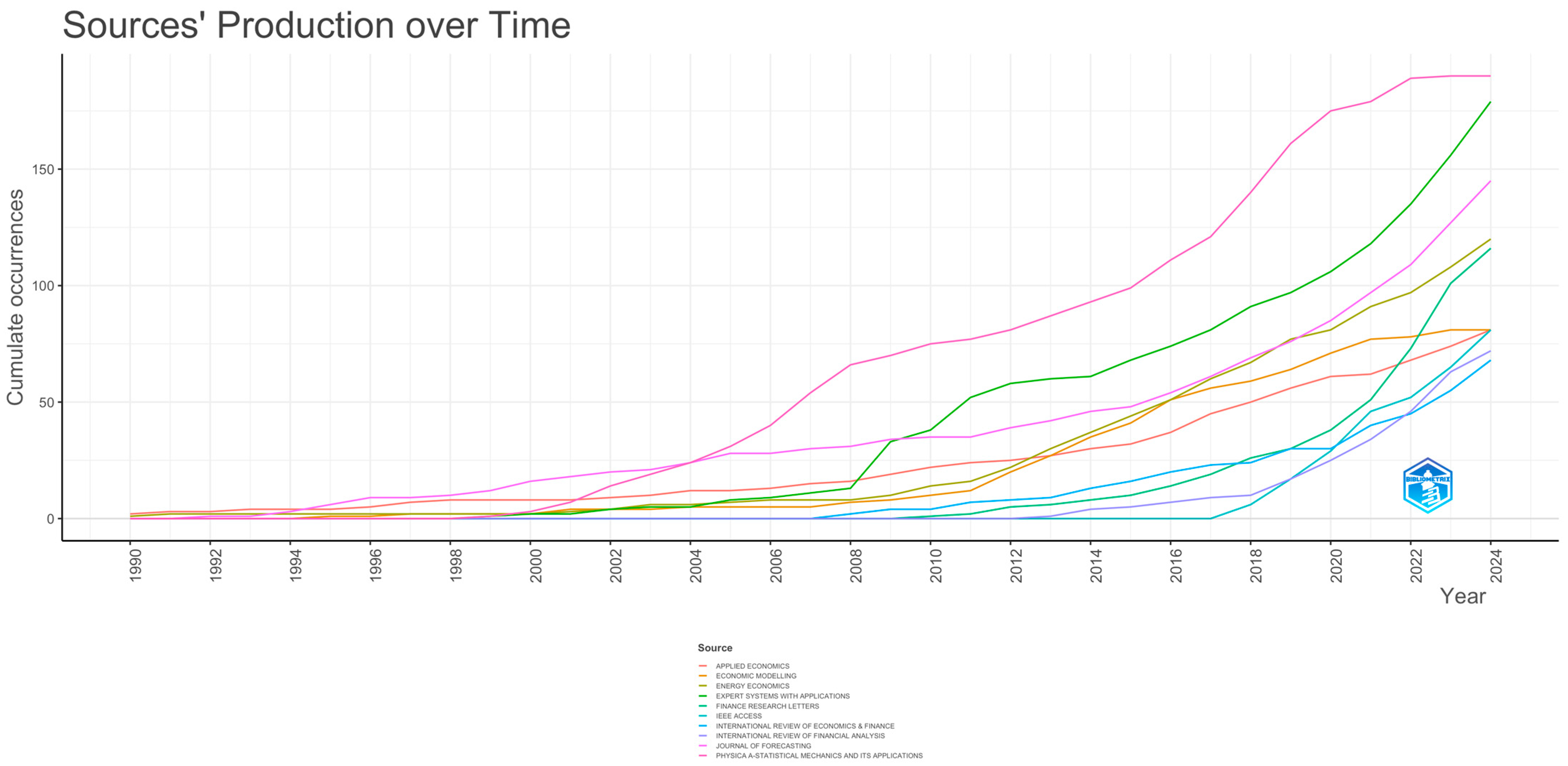
Figure 3 shows the cumulative output of the top 10 Financial Market Modelling (FMM) journals, which together published 8297 papers by 2024. The leading titles are *Physica A* with 190 articles and the *International Review of Financial Analysis* with 72. *Physica A*, *Expert Systems with Applications*, and the *Journal of Forecasting* account for 38% of all publications; the other journals provide the remaining 62%, indicating broad interdisciplinary engagement. The journals fall into four groups: (1) Rapid Expansion in AI Journals (e.g., *Expert Systems with Applications*, *IEEE Access*), reflecting the rising role of Machine Learning in FMM; (2) Steady Contributors (e.g., *Journal of Forecasting*, *Applied Economics*); (3) Energy and Sustainability Emphasis (e.g., *Energy Economics*), driven by ESG-related growth; and (4) Diverse Specializations, including newer outlets on computational finance and energy volatility.
Regarding the most frequently cited papers in FMM, Bollen et al. (2011) leading at 1401 citations. Following are Campbell and Thompson (2008) with 1388 citations, Lux (1995) with 997 citations, and Fischer and Krauss (2018) with 976 citations. These significant studies, published in notable journals such as the Journal of Finance and Review of Financial Studies, have had a substantial impact on the field. The years of their publication, ranging from 1990 to 2018, exemplify foundational contributions and contemporary advancements.

4.1.5. Geographic and Institutional Dissemination of Publications

The analysis additionally highlights the most productive university affiliations in FMM research, reflecting its global scope. The Chinese Academy of Sciences leads with 140 publications, followed by Southwest Jiaotong University (123) and the University of London (74). Several Chinese institutions show strong contributions, including Nanjing University of Science and Technology (73), Xiamen University (59), and Central University of Finance and Economics (58). Global engagement is evident through notable outputs from the University of Pretoria (67), the University of California System (66), Deakin University (44), Islamic Azad University (43), and IPAG Business School (37).
Related to the leading 20 nations contributing to FMM research, China occupies the primary position with over 1400 publications, signifying substantial domestic output, though its international partnerships remain constrained. The United States holds the second position with 1000 publications and exhibits a noteworthy MCP proportion, signifying its leadership in global research. The United Kingdom (UK) ranks third with 700 publications, preserving a balanced SCP-MCP distribution. Germany, South Korea, and Australia each contribute between 400 and 600 publications, whereas India, Brazil, Iran, and Turkey each contribute within the 200–400 range. Countries such as Australia, the United States, and Switzerland display significant international collaboration. China emerges as the leading contributor, driven by strong academic infrastructures and fintech investment. Nonetheless, the concentration in specific regions highlights disparities in research accessibility. Enhancing partnerships with underrepresented regions, notably in Latin America and Africa, may foster global inclusivity. Regarding citations, the United States leads with 36,694, followed by China with 27,554, the UK with 5999, and Germany with 5505.
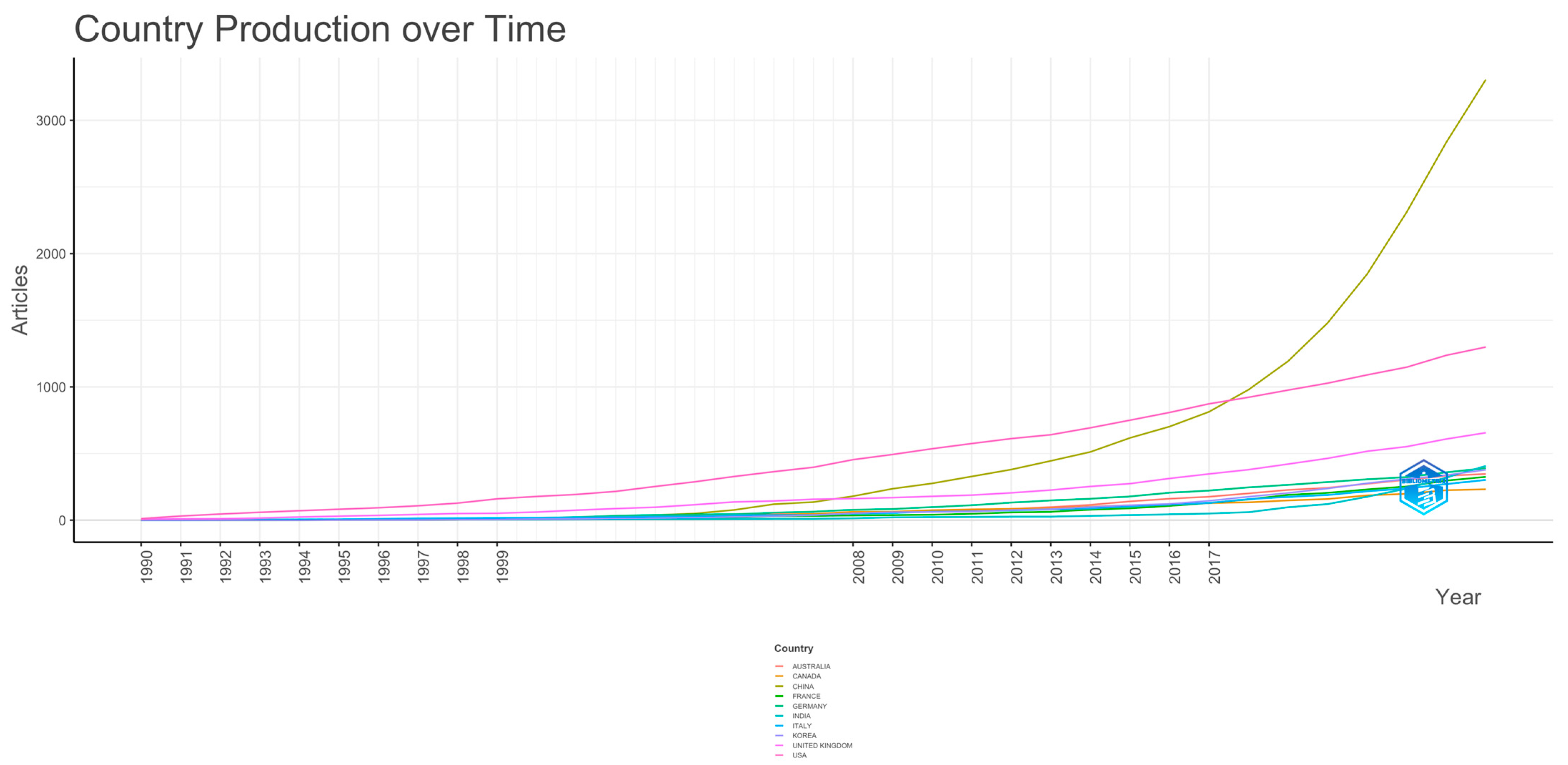
Figure 4 illustrates the cumulative increase in scientific output on a national scale within the field of FMM. Contributions from China experienced a marked rise post-2005, exceeding 3000 publications by 2024. This trend underscores substantial research investments and signifies its emergence as a leading figure globally. The United States demonstrates consistent growth, nearing 1500 publications, and maintaining its position as the primary contributor until China’s rapid ascent. The United Kingdom holds the lead in Europe with 800 publications. During the 1990s, the United States, the United Kingdom, and Germany were the predominant leaders; however, there was a shift towards exponential growth from China and India post-2005, attributed to their strategic investments in academic infrastructure.
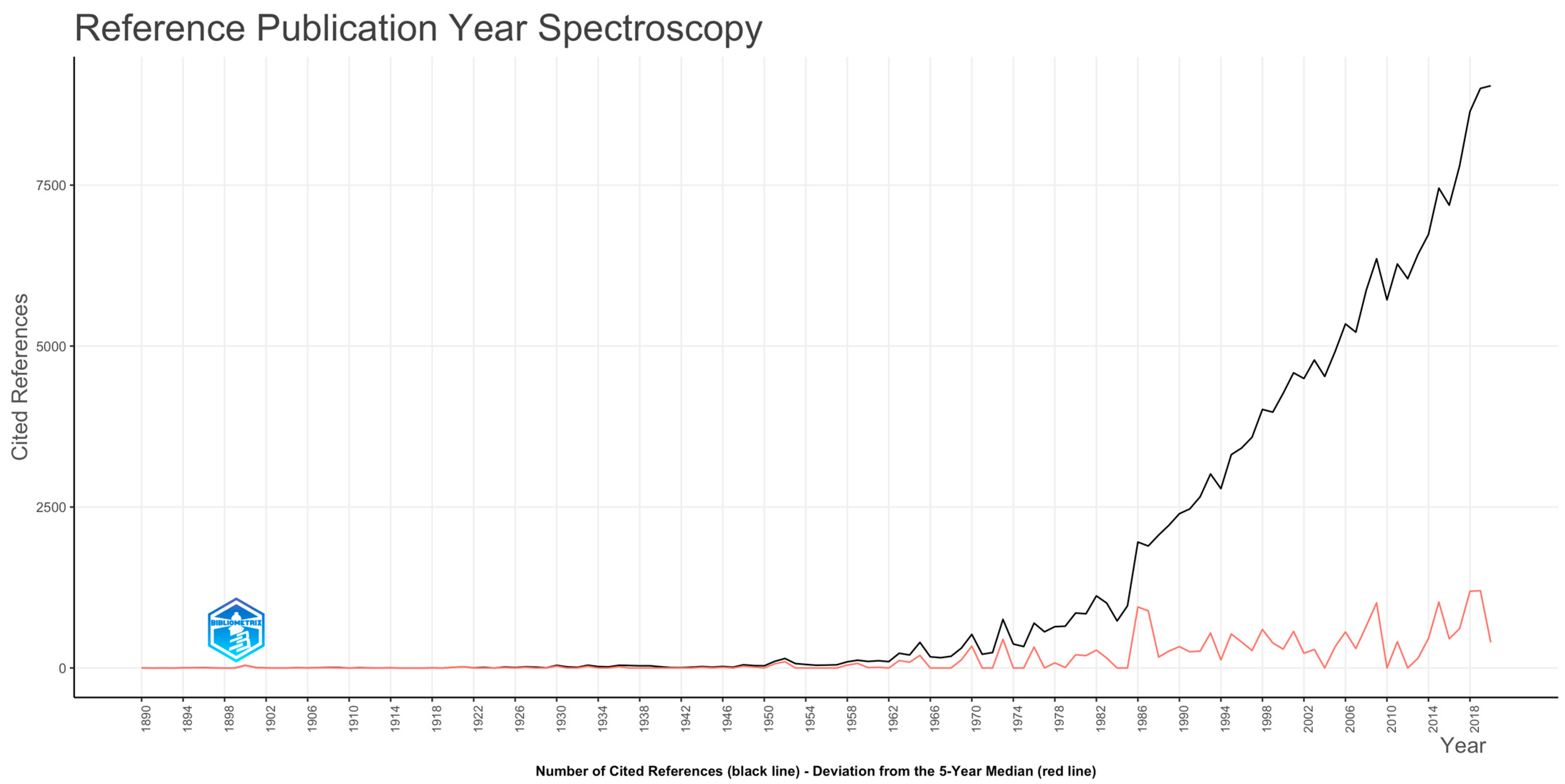
Figure 5 delineates the progression of cited references within the field of FMM. During the period from 1900 to 1950, there was an incremental increase in citations, signifying the formative establishment of foundational concepts. Following 1970, a sustained growth was observed, attributed to enhancements in methodology and broader application. Post-2000, the field experienced a marked increase in citations, indicative of its integration across various disciplines. Consequently, three distinct eras may be discerned: the Historic Foundations (pre-1950)—characterized by the development of theoretical underpinnings; the Growth Era (1970–2000)—marked by advancements through experimentation; and the Modern Era (2000–2018)—noted for its rapid interdisciplinary expansion.
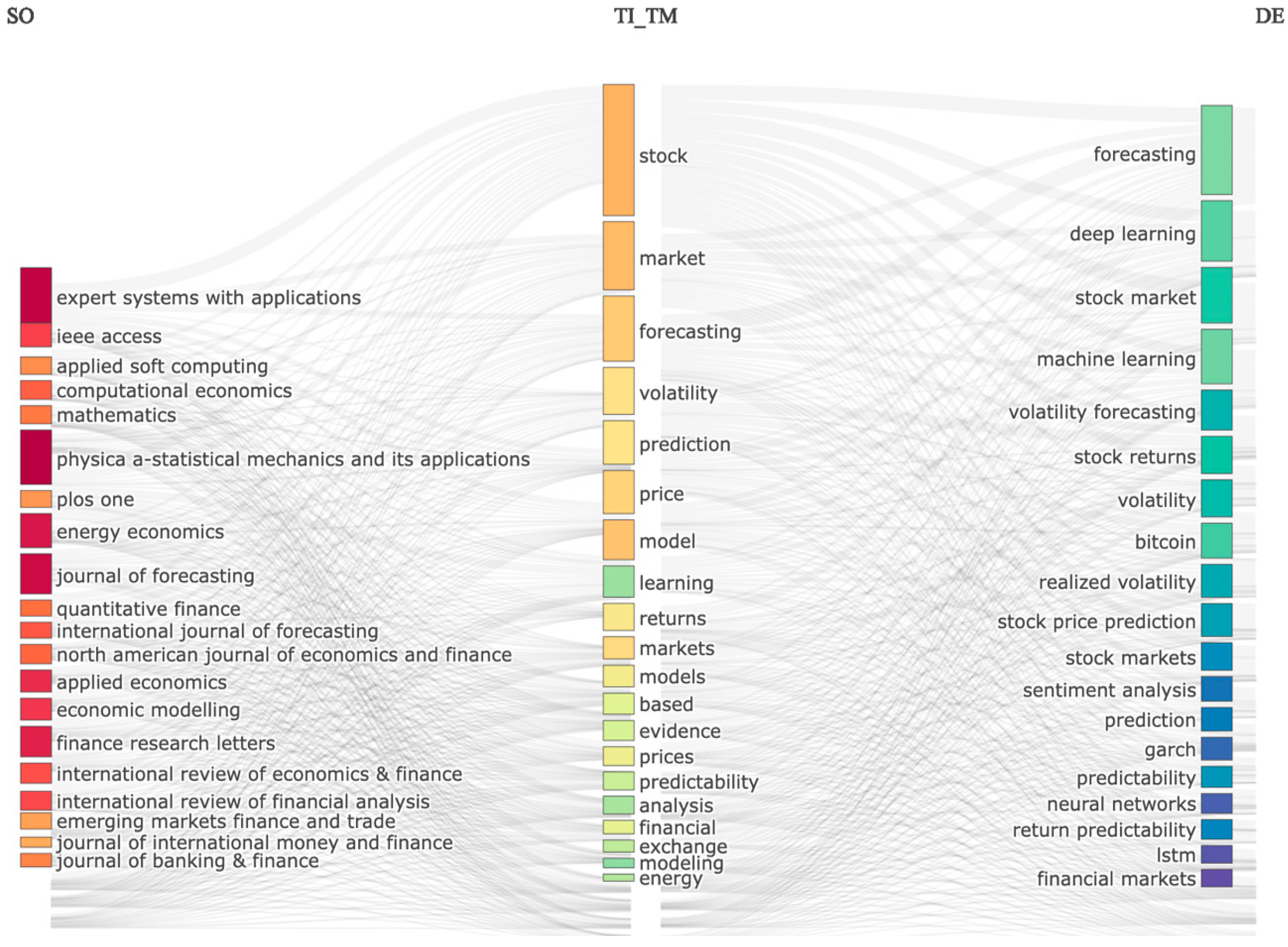
Figure 6 illustrates a triadic chart that interconnects the leading 20 Sources, Topics, and Keywords within FMM. Distinguished journals such as Expert Systems with Applications, IEEE Access, Quantitative Finance, and Journal of Forecasting emerge as pivotal publication venues, highlighting the interdisciplinary essence of finance, computation, and data science. Core subjects encompass forecasting, stock market models, and machine learning. The reference to “Bitcoin” signifies a burgeoning interest in cryptocurrency markets. Frequently utilized keywords, such as forecasting, volatility, GARCH, LSTM, and sentiment analysis, reveal a transition from traditional econometric models to modern, data-driven methodologies.

4.2. Conceptual Structure

This section facilitates an understanding of the interrelatedness of subjects within FMM literature to inform future research directions. It encompasses three fundamental analyses: co-occurrence networks, thematic evolution mapping, and factorial analysis.

4.2.1. Overview of Conceptual Structure of FMM’s Literature

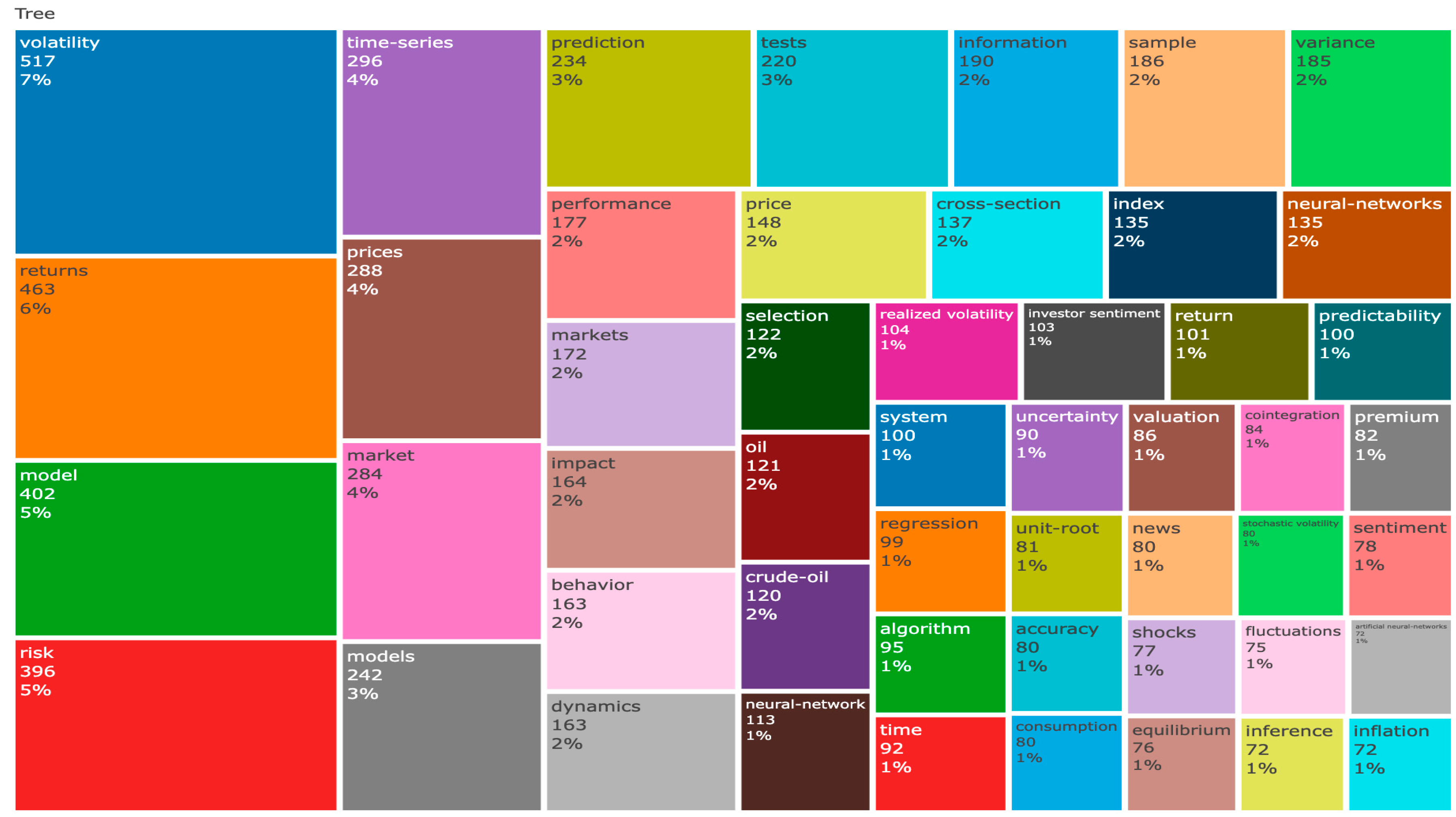
The FMM conceptual framework was examined using two methods: a keyword tree map and a coupling-based network map. Figure 7 shows the most frequent keywords, including volatility (517), returns (463), model (402), and risk (396), which reflect core themes in financial forecasting, market behavior, and risk assessment. The presence of neural networks (135) and machine learning indicates growing use of AI methods. From 1990–2000, research focused on econometric and theoretical models such as market efficiency and AR models. Between 2000 and 2015, it shifted to volatility forecasting and asset pricing, paralleling advances in econometrics. Since 2015, deep learning, cryptocurrency markets, and predictive analytics have become increasingly prominent.
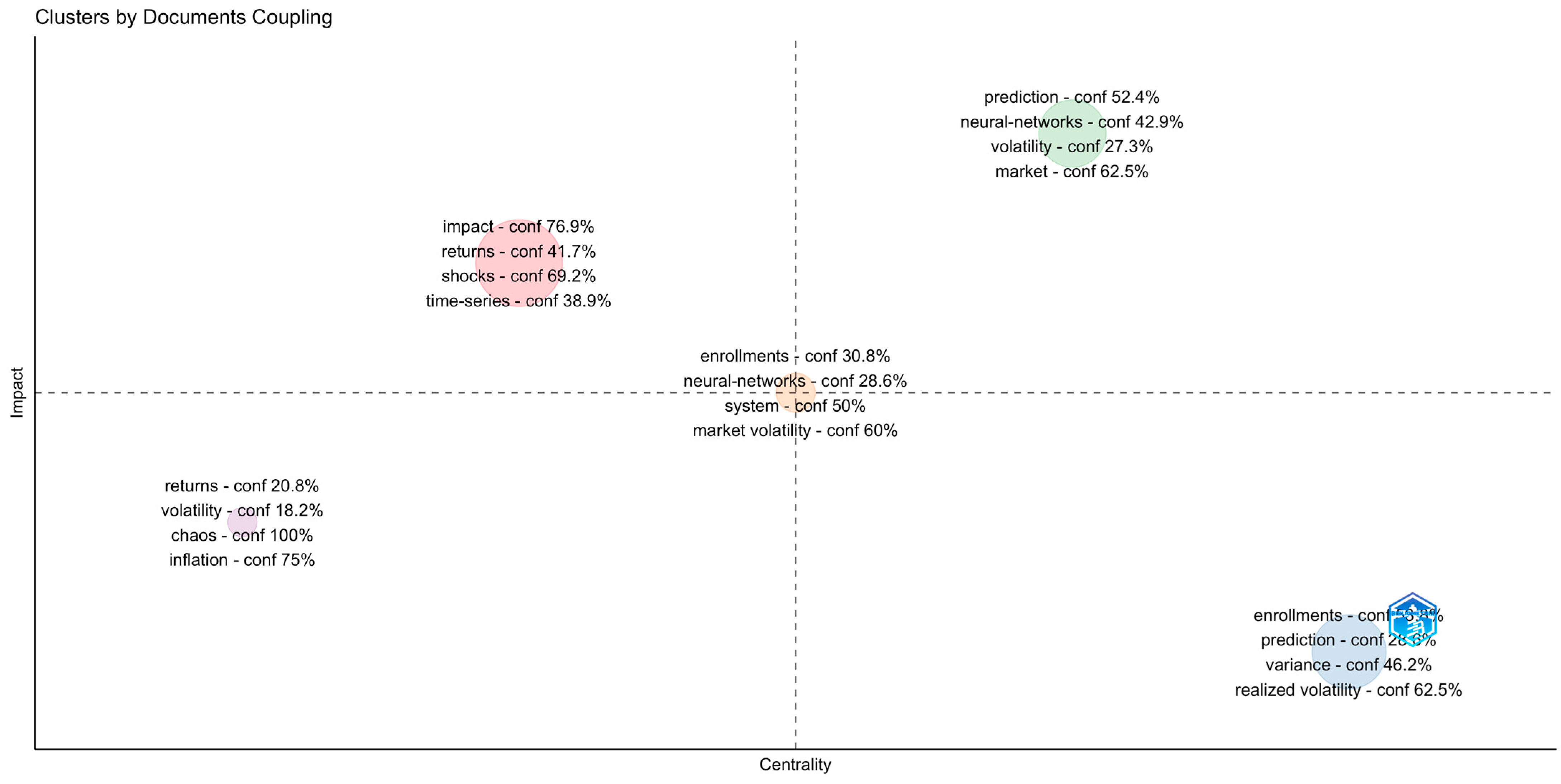
The thematic mapping of FMM research (Figure 8) shows four clusters: (1) The upper-left quadrant focuses on specialized themes—impact, returns, shocks, and time-series—linked to systemic risk. (2) The upper-right quadrant centers on core themes—neural networks, prediction, volatility, and market—covering AI-based forecasting, risk assessment, and market behavior. (3) The lower-left quadrant addresses chaos, volatility, returns, and inflation, indicating interest in complex systems and underexplored issues like inflation in developing markets. (4) The lower-right quadrant covers operational themes—market volatility, variance, and system—supporting interdisciplinary technical modeling.
Figure 7 shows how authors describe their contributions to financial market modeling. The prominence of terms such as volatility, forecasting, GARCH, machine learning, and sentiment indicates that research remains centered on volatility and return prediction, while increasingly adopting data-driven and text-based methods. This descriptive evidence complements the network analysis by revealing the shared vocabulary linking traditional econometrics with AI-oriented approaches. The tree map further extends the network analysis by highlighting the most frequent terms in the literature. The importance of volatility, forecasting, machine learning, and sentiment directly relates to RQ6 and RQ7 on dominant methodological emphases and the evolution of application-driven research.
While Figure 7 highlights the most frequent terms used by authors, Figure 8 provides a structural perspective by grouping publications according to shared reference patterns. The coupling map highlights the structural organization of research themes in financial market modeling by grouping publications that share similar reference patterns. The identified clusters reveal how related studies are intellectually connected through shared references, illustrating the major knowledge structures underlying the field. (1) Growing Impact of Machine Learning (ML) and Artificial Intelligence (AI)—Clusters on neural networks, prediction, and volatility forecasting reflect ML’s role in handling complex financial datasets. (2) Ongoing Focus on Market Risk and Dynamics—Volatility, returns, and shocks remain central, especially during crises like the Global Financial Crisis (GFC) and COVID-19. (3) Integration of Behavioral and Sentiment Analysis—Rising interest in investor behavior and uncertainty highlights efforts to include psychological and sociological factors, supported by social media–based sentiment data. (4) Emergence of Specialized Topics—Themes such as inflation, chaos, and crude oil signal a re-examination of core concepts using modern tools. (5) Systemic Risk and Uncertainty—Clusters on impact, systems, and shocks indicate advances in modeling interconnected risks and macro-financial volatility. (6) Growth of Applied and Interdisciplinary Approaches—The convergence of AI and traditional finance is driving research in cryptocurrency, algorithmic trading, and blockchain. (7) Emphasis on Sustainability and ESG—Increasing discussion of uncertainty and impact reflects greater ESG integration driven by regulatory and social pressures. (8) Shifts in Research Themes Over Time—Longstanding topics like volatility and time series remain important, while new clusters (e.g., prediction, neural networks) showcase progress in big data and analytics.
Future research should focus on: (a) linking lesser-known but important topics, such as shocks, to core areas like prediction; (b) integrating interdisciplinary perspectives, including behavioral finance, artificial intelligence, and macroeconomic methods; and (c) examining fast-evolving fields such as cryptocurrency volatility, ESG modeling, and algorithmic trading. Overall, the thematic clusters reflect the dynamic, interdisciplinary nature of FMM research, from AI integration to ESG issues, and provide the basis for the co-occurrence network analysis of key conceptual relationships in the literature.

4.2.2. Co-Occurrence Networks

The co-occurrence network analysis contributes to answering RQ3 and RQ6 by identifying the principal thematic structures within the financial market modelling literature. By examining the relationships among frequently occurring keywords, the analysis reveals both established research areas and emerging methodological directions. The resulting thematic clusters and their corresponding research focuses are summarized in Table 3, which provides an overview of the dominant conceptual domains shaping research in this field.
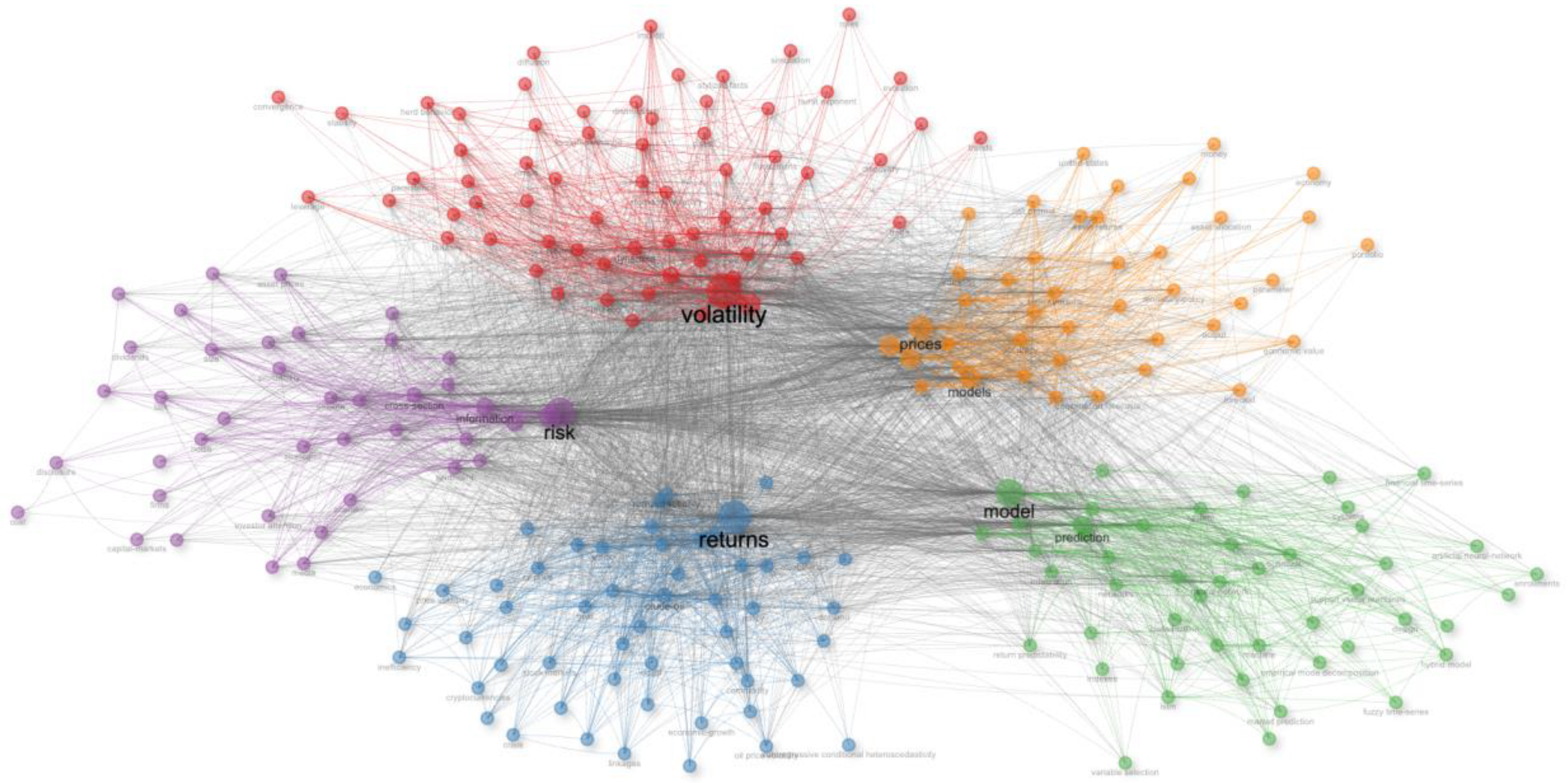
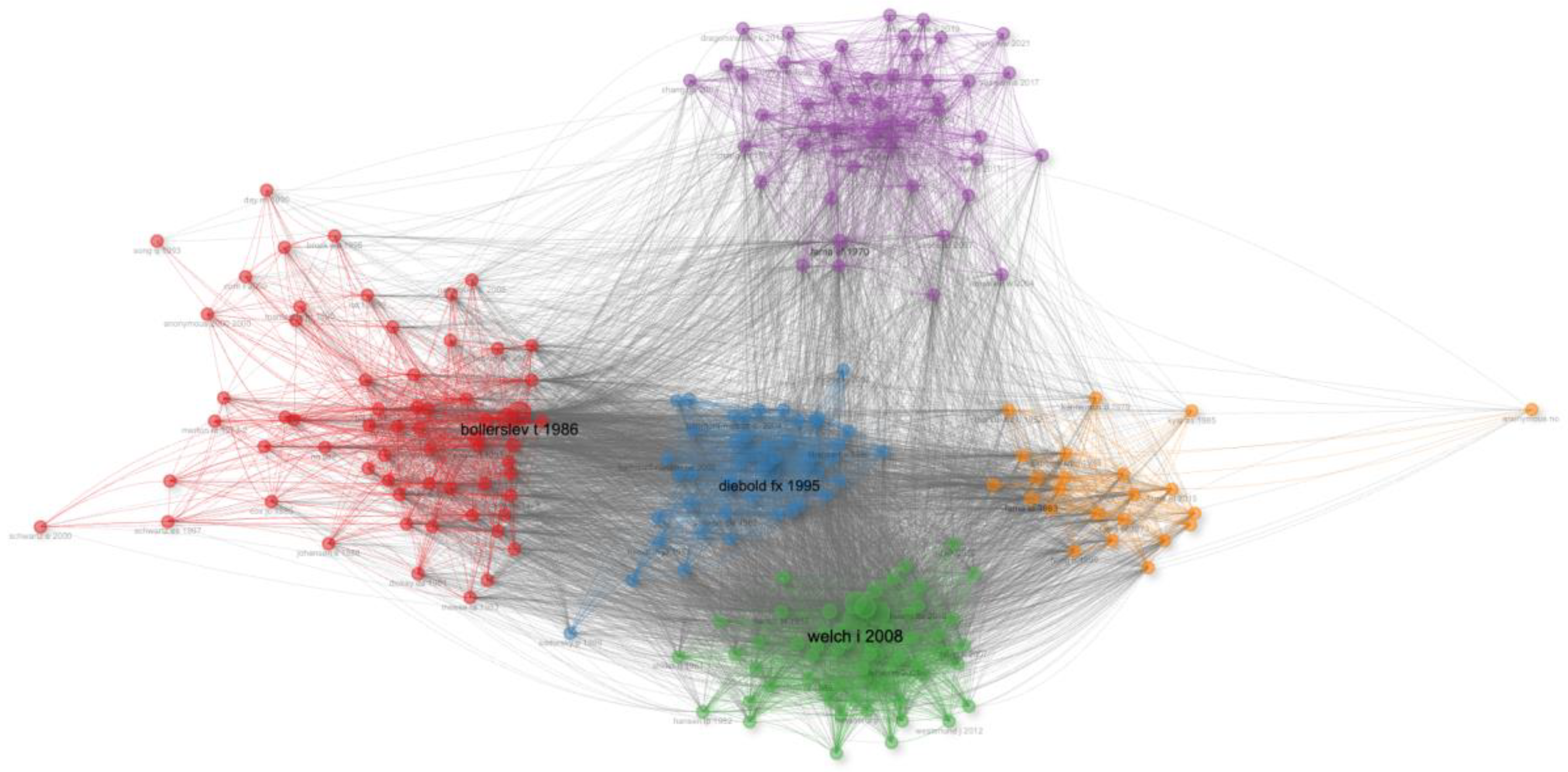
Figure 9 visualizes the co-occurrence network of keywords, illustrating the relationships among the identified thematic clusters and highlighting the structural connections between dominant research topics.
Figure 9 visualizes the keyword co-occurrence network and illustrates the structural relationships among the thematic clusters identified in Table 3. The network highlights the central role of key concepts such as volatility, returns, and modelling approaches, while the connections among nodes reflect the integration of traditional econometric techniques with emerging data-driven and artificial intelligence–based forecasting methods. The spatial arrangement of clusters further reveals how different research streams interact and evolve within the broader landscape of financial market modelling.
Cluster A, highlighted in red, centers on “volatility” and is the most structurally important theme, with a betweenness of 5617.464 and a PageRank of 0.039, underscoring its centrality in financial econometrics. It covers ARCH/GARCH models (R. F. Engle, 1982; Bollerslev, 1990) and their asymmetric and long-memory extensions such as EGARCH, GJR-GARCH, and FIGARCH (Nelson, 1991; Glosten et al., 1993; Baillie, 1996). It also incorporates advances in stochastic volatility (Taylor, 1994; C. J. Kim et al., 1998), jump-diffusion (Chan & Maheu, 2002), and Markov-switching models (Hamilton & Susmel, 1994). Keywords like “time series,” “realized volatility,” and “herd behavior” indicate a synthesis of traditional and behavioral approaches (Cont, 2001; Lux & Marchesi, 1999). Innovations such as Realized GARCH (Hansen et al., 2012), DCC-GARCH (R. Engle, 2002), and BEKK (Caporin & McAleer, 2012) have enhanced crisis forecasting (Diebold & Yilmaz, 2012; Gabauer & Gupta, 2018). Recent extensions draw on machine learning (L. Chen et al., 2024; Gu et al., 2020) and climate uncertainty (H.-D. Jiang et al., 2022; Campiglio et al., 2023). The literature also examines volatility in emerging markets (Choudhry, 2005), linking this cluster to pricing, efficiency, and systemic risk.
Cluster B, the second-largest cluster shown in blue, centers on “return” and is a key node (betweenness: 4320.891; PageRank: 0.030), underscoring its importance for financial market analysis. It covers asset pricing, return predictability, and performance evaluation across models and horizons. Terms such as “risk,” “performance,” “efficiency,” “CAPM,” “portfolio,” “momentum,” and “event study” trace the field’s evolution from basic theory to applications. Foundational models (CAPM, APT; Sharpe, 1964; Lintner, 1965; Ross, 1976) are extended by the Fama–French three- and five-factor models and Carhart’s four-factor model (Fama & French, 1993, 2015; Carhart, 1997), which address return anomalies and firm-level differences. Concepts like “alpha,” “beta,” and “firm characteristics” stress risk-adjusted performance, while “abnormal return” and “efficiency” link to EMH tests (Jegadeesh & Titman, 1993; Lo, 2004). The cluster also emphasizes liquidity and idiosyncratic risk (Amihud, 2002; Ang et al., 2006) and uses methods such as time-series and panel regressions, Fama–MacBeth estimators, sorting, and event studies. Links to volatility (Cluster A) and hybrid modeling (Cluster C) arise via shared risk concepts and machine learning (Gu et al., 2020; Krauss et al., 2017). Behavioral notions such as “bias” and “asymmetry” challenge rationality assumptions (Barberis et al., 1998; M. Baker & Wurgler, 2006). Overall, Cluster B forms the empirical and theoretical core of return modeling research.
The third-largest cluster, Cluster (C) in green, examines artificial intelligence (AI), machine learning (ML), and neural networks in financial modeling. It reflects a shift from traditional statistics to data-driven, non-linear methods for forecasting prices, returns, and volatility. Core techniques include neural networks, deep learning, support vector machines (SVMs), fuzzy logic, and genetic algorithms. Foundational studies use multilayer perceptrons (MLPs), recurrent neural networks (RNNs), and long short-term memory networks (LSTMs) for time series prediction (Patel et al., 2015; Fischer & Krauss, 2018). Hybrid models that combine AI with autoregressive integrated moving average (ARIMA) and generalized autoregressive conditional heteroskedasticity (GARCH) are now standard (G. P. Zhang, 2003; Chong et al., 2017; H. Y. Kim & Won, 2018; K. Xu & Niu, 2023), and random forests and decision trees support classification and high-frequency trading (HFT) (Atsalakis & Valavanis, 2009). Deep learning architectures such as convolutional neural networks (CNNs) and LSTMs capture temporal patterns (Fischer & Krauss, 2018; Gu et al., 2020), while reinforcement learning enables adaptive trading strategies (Deng et al., 2016). Natural language processing (NLP) and social media–based sentiment analysis further expand predictive inputs (Bollen et al., 2011; Nassirtoussi et al., 2014). This cluster links to return modeling (Cluster B) and sentiment/media analysis (Cluster D) through shared concerns with behavior, efficiency, and complexity. Recent work extends AI models to environmental, social, and governance (ESG) variables, macroeconomic data, and climate risks (Campiglio et al., 2023; L. Chen et al., 2024), underscoring AI’s growing role in financial econometrics.
Cluster D (the fourth-largest, in brown and orange) examines how sentiment, media, and investor behavior shape markets. It centers on “sentiment analysis,” “news,” “emotion,” “Google Trends,” and “text mining,” reflecting a move beyond purely rational market theories. Unstructured data from social media, news, and search trends have proven predictive (Bollen et al., 2011). NLP methods extract sentiment from financial texts, affecting asset values and volatility, especially in crises (Tetlock, 2007; Nassirtoussi et al., 2014). News-based sentiment scores help forecast trading activity, abnormal returns, and volatility spikes (Schumaker & Chen, 2009). Media bias and misinformed investor reactions can trigger herding and noise trading (Engelberg & Parsons, 2011; Siganos et al., 2017). Machine and deep learning increasingly automate the use of sentiment information (Schumaker & Chen, 2009; Xing et al., 2018). Structurally, Cluster D links to AI-driven modeling (Cluster C) and volatility research (Cluster A) through shared behavioral elements. Recent work ties sentiment to ESG and sustainability narratives (Stoll et al., 2019; Kyriazis et al., 2023), indicating a shift toward more behaviorally rich, multidimensional financial paradigms.
Cluster E, outlined in purple, focuses on oil prices, energy markets, and realized volatility, representing a specialized but growing area of financial forecasting. Terms such as “crude oil,” “spillover,” “uncertainty,” and “forecasting” emphasize how energy prices behave and affect other markets. Core studies use VAR, SVAR, and GARCH models to analyze oil shocks (Kilian & Park, 2009). Realized volatility (Andersen et al., 2003) strengthened high-frequency market analysis. DCC-GARCH and BEKK multivariate GARCH models assess volatility spillovers with equity indexes (Aloui et al., 2013; Bouri et al., 2022), and asymmetric responses to oil shocks are well documented (Ciner, 2001; Reboredo, 2012). Macroeconomic uncertainty indices such as GPR, CPU, and EPU increasingly capture geopolitical and climate risks (S. R. Baker et al., 2016; Campiglio et al., 2023). Recent work adopts LSTM and wavelet-based machine learning models to improve forecasts (Yu et al., 2008; D. Zhang et al., 2019). This cluster is closely linked to volatility modeling (Cluster A) and AI forecasting (Cluster C), and remains central to financial modeling, energy risk management, and policy design amid rising sustainability and geopolitical challenges.

4.2.3. Thematic Map

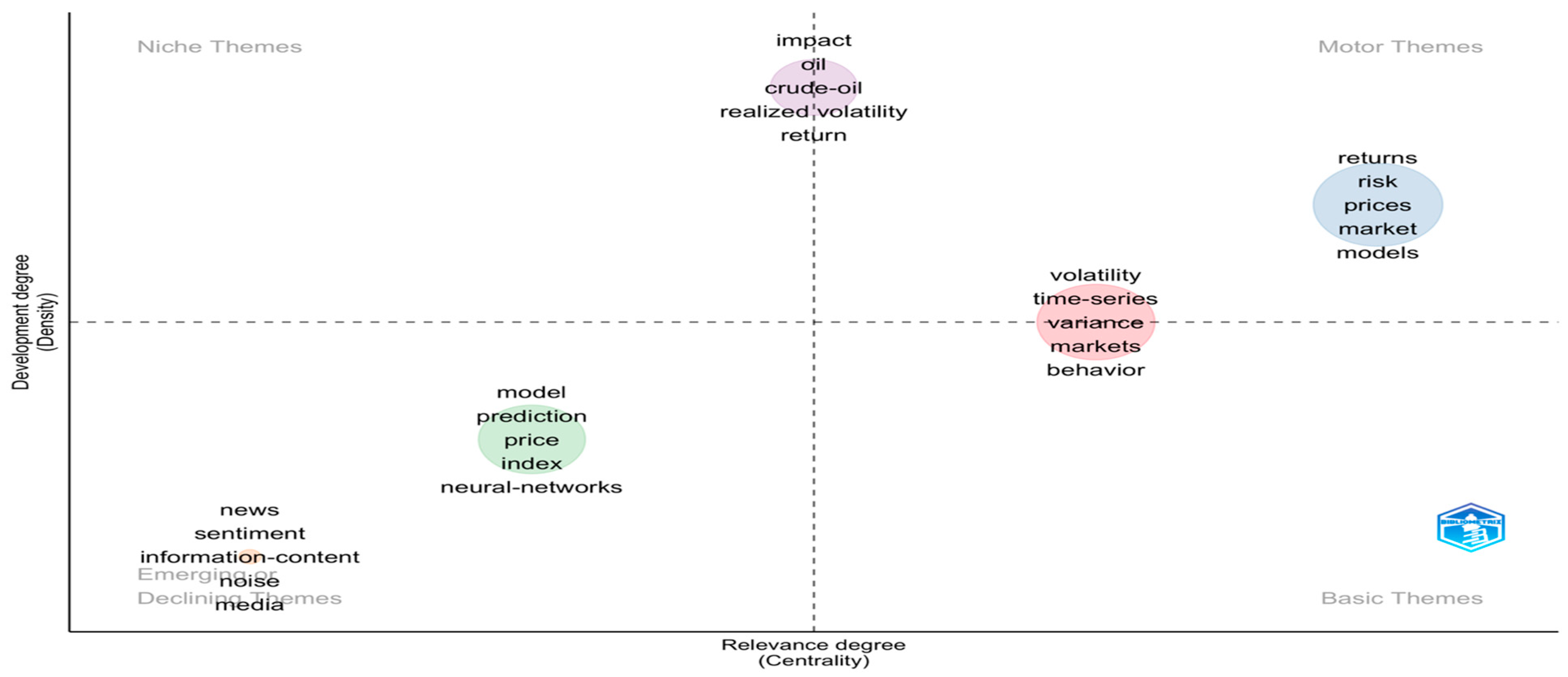
Figure 10 and Table 4 present the thematic map of financial market modeling (FMM), providing a systematic view of the field’s conceptual structure. Using co-word analysis and the Callon centrality–density framework, the map highlights both established and emerging themes. Centrality measures a theme’s connections to others (relevance), while density reflects its internal development (maturity). Themes fall into four groups: motor, basic, niche, and emerging/declining. Analysis of keyword co-occurrences in 4982 peer-reviewed papers identifies five thematic clusters, each representing a core research theme in FMM. The following sections summarize these clusters, focusing on key terms, main metrics, and thematic significance.
Cluster A—Return, Risk, and Price Modeling (Blue, Motor Theme)—has the highest frequency (4516) and strong metrics (Centrality: 0.599; Density: 3.318), making it the core of financial economics. It focuses on returns, risk, and prices, and incorporates key asset pricing models such as CAPM (Sharpe, 1964; Lintner, 1965), APT (Ross, 1976), Fama and French (1993, 2015). Core methods include time-series regressions, portfolio sorting, and event studies. Its high centrality highlights close links to market efficiency (Fama, 1970); concepts like abnormal returns and momentum (Jegadeesh & Titman, 1993) illustrate ongoing debates over the Efficient Market Hypothesis (EMH).
Cluster B—Volatility and Behavioral Market Dynamics (Red, Motor Theme) is highly influential (Centrality 0.519, Density 3.113, Frequency 3373). It centers on volatility, including ARCH–GARCH, realized volatility, persistence, and herd behavior. Key models are ARCH/GARCH (R. F. Engle, 1982; Bollerslev, 1990), stochastic volatility (Taylor, 1994), Markov-switching GARCH (Hamilton & Susmel, 1994), and realized volatility (Andersen et al., 2003). The cluster also integrates behavioral approaches (Lux & Marchesi, 1999), challenging standard rationality. Volatility functions as a core methodological tool and thematic link, often examined with returns, risk, and contagion in crises (Ghosh & Jana, 2024; Diebold & Yilmaz, 2012).
Cluster C—AI and Predictive Modeling (Green, Motor Theme) is a key research domain (Centrality: 0.297, Density: 2.957, Frequency: 2562) focused on model development, predictive analytics, machine learning, and optimization to enhance AI-based forecasting. Core methods include support vector machines (Suykens & Vandewalle, 1999), artificial neural networks (G. P. Zhang et al., 1998), and deep learning models such as LSTM and CNN (Gu et al., 2020; Krauss et al., 2017). Optimization techniques such as genetic algorithms and particle swarm optimization are also central. Cluster C is closely linked to volatility (Cluster B) and return modeling (Cluster A), reflecting a shift from traditional explanatory models to more accurate predictive approaches.
Cluster D, centered on Sentiment, News, and Media Influence (Brown, Niche/Emerging Theme), shows low Centrality (0.062) and Density (2.822) but plays a key role by integrating behavioral and unstructured data into financial models. Emphasis on terms such as news, sentiment, media, and information-content reflects growing interest in market psychology (Umar et al., 2021). Foundational work by Tetlock (2007) and Bollen et al. (2011), combined with advances in natural language processing, supports sentiment incorporation. Machine learning classifiers such as SVM and Naïve Bayes extract sentiment from news and social media (X. Zhang et al., 2011). Though still emerging, this theme broadens the behavioral dimension of high-frequency modeling and links it to volatility and cryptocurrency research.
Cluster E, covering studies on oil, crude oil, and realized volatility (Purple, Developed but Peripheral), lies in the upper-left quadrant with high density (3.414) and moderate centrality (0.388), indicating maturity but limited integration. It focuses on energy market modeling using methods such as Realized GARCH (Hansen et al., 2012), SVJ, and multivariate GARCH (Caporin & McAleer, 2012). These studies link oil price fluctuations to macroeconomic shocks, geopolitical risks, and climate uncertainties (Campiglio et al., 2023), and emphasize structural differences from equity market volatility. Together, these clusters illustrate the scope and structure of scholarly inquiry in financial market modeling. The next section traces how these themes have evolved over time.

4.2.4. Thematic Evolution of Financial Market Modeling Research (1990–2024)

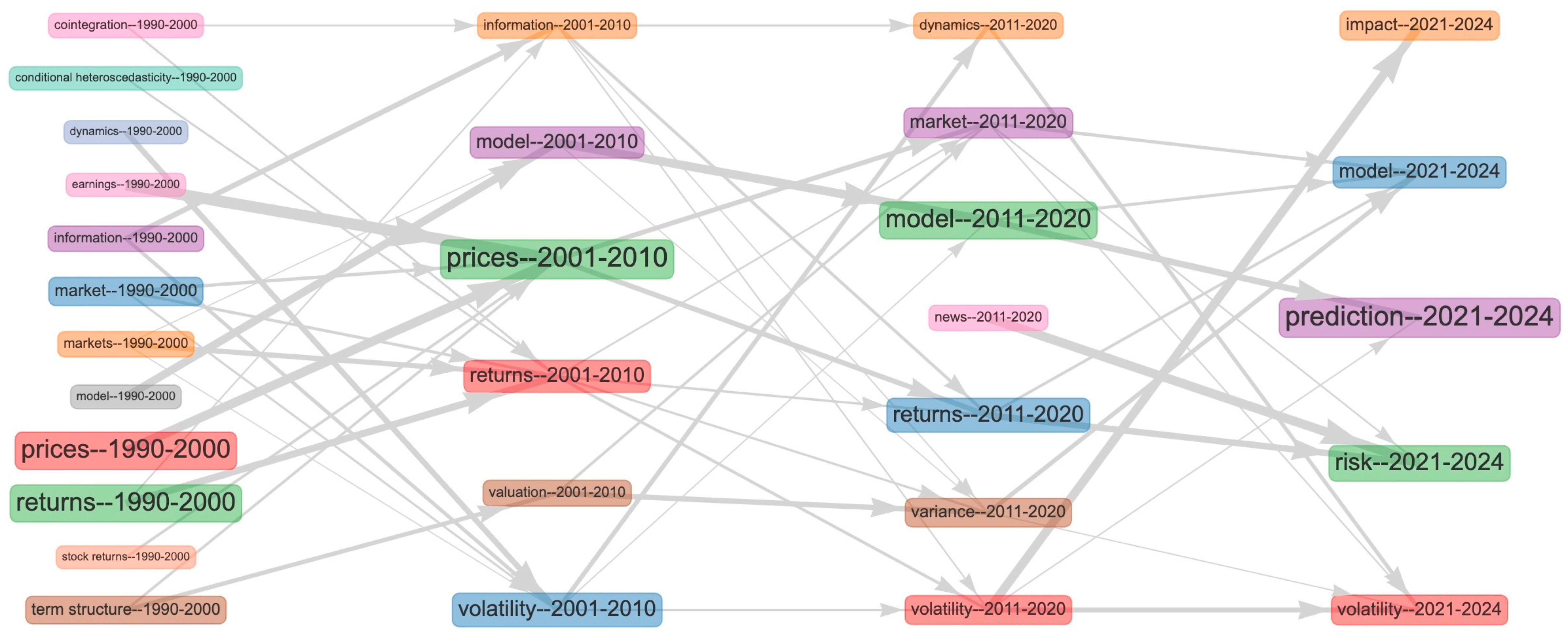
The thematic evolution analysis traces the main research themes in financial market modeling over the past three decades. Split into four periods—1990–2000, 2001–2010, 2011–2020, and 2021–2024 (Figure 11) & summarized in Table 5—the map shows changes in key terms and conceptual links. Arrows indicate how themes evolve, highlighting a shift from traditional models to artificial intelligence, behavioral finance, and real-time forecasting (Kraus et al., 2023).
The thematic map provides structured evidence for RQ3 and RQ6 by distinguishing motor themes, emerging research fronts, and declining areas within financial market modelling. The spatial positioning of hybrid and machine learning clusters suggests a progressive consolidation of data-driven methodologies, which are increasingly integrated with, rather than replacing, conventional econometric techniques. Complementing this view, the temporal trend analysis documents longitudinal shifts in publication intensity and methodological orientation, indicating a pronounced acceleration of AI-oriented research after 2015 and signaling a structural transformation in forecasting scholarship.
1990–2000: Statistical Foundations and Econometric Roots. This period formalized financial market modeling, emphasizing cointegration, ARCH/GARCH models, asset returns, and the term structure. Research centered on time-series econometrics (Bollerslev, 1990; R. F. Engle & Granger, 1987), with early work on information and earnings (inclusion indexes: 1.00 and 0.25), indicating strong interest in fundamentals and market efficiency. This phase also established initial links to macroeconomic dynamics, providing the statistical basis for later developments.
2001–2010: Diversification into Multi-Asset and Behavioral Models. This period saw rising model complexity focused on returns, volatility, pricing, and valuation. Returns built on earlier GARCH-based models (weighted inclusion: 0.19), while volatility evolved from prior “market” and “dynamics” themes, adding stochastic and behavioral elements (Taylor, 1994; Barberis et al., 1998). The addition of valuation indicates attention to risk pricing, anomalies, and multi-asset modeling.
2011–2020, advances in artificial intelligence, sentiment analysis, and nonlinear forecasting drove a shift toward machine learning, neural networks, and predictive analytics in computational finance (Tan et al., 2014; Sensoy & Tabak, 2015; Gu et al., 2020). Traditional models evolved into nonlinear, real-time forecasting frameworks. The use of news sources underscored the growing importance of sentiment analysis and text-based data (Tetlock, 2007). Volatility remained a central theme, shaped by the Global Financial Crisis and oil market disruptions (Ghosh & Jana, 2024).
2021–2024: Focus on Real-Time Implementation and Policy. This period marks a shift from forecasting to application, emphasizing modeling, prediction, risk, impact, and volatility as AI tools improve market analysis and policy support (Bal & Mishra, 2025; Y. Zhang et al., 2023). The prominence of “impact” reflects growing attention to macro-prudential and climate-related forecasts (Campiglio et al., 2023). Continued alignment with earlier themes shows fundamental models are being refined for data-intensive, real-time use.
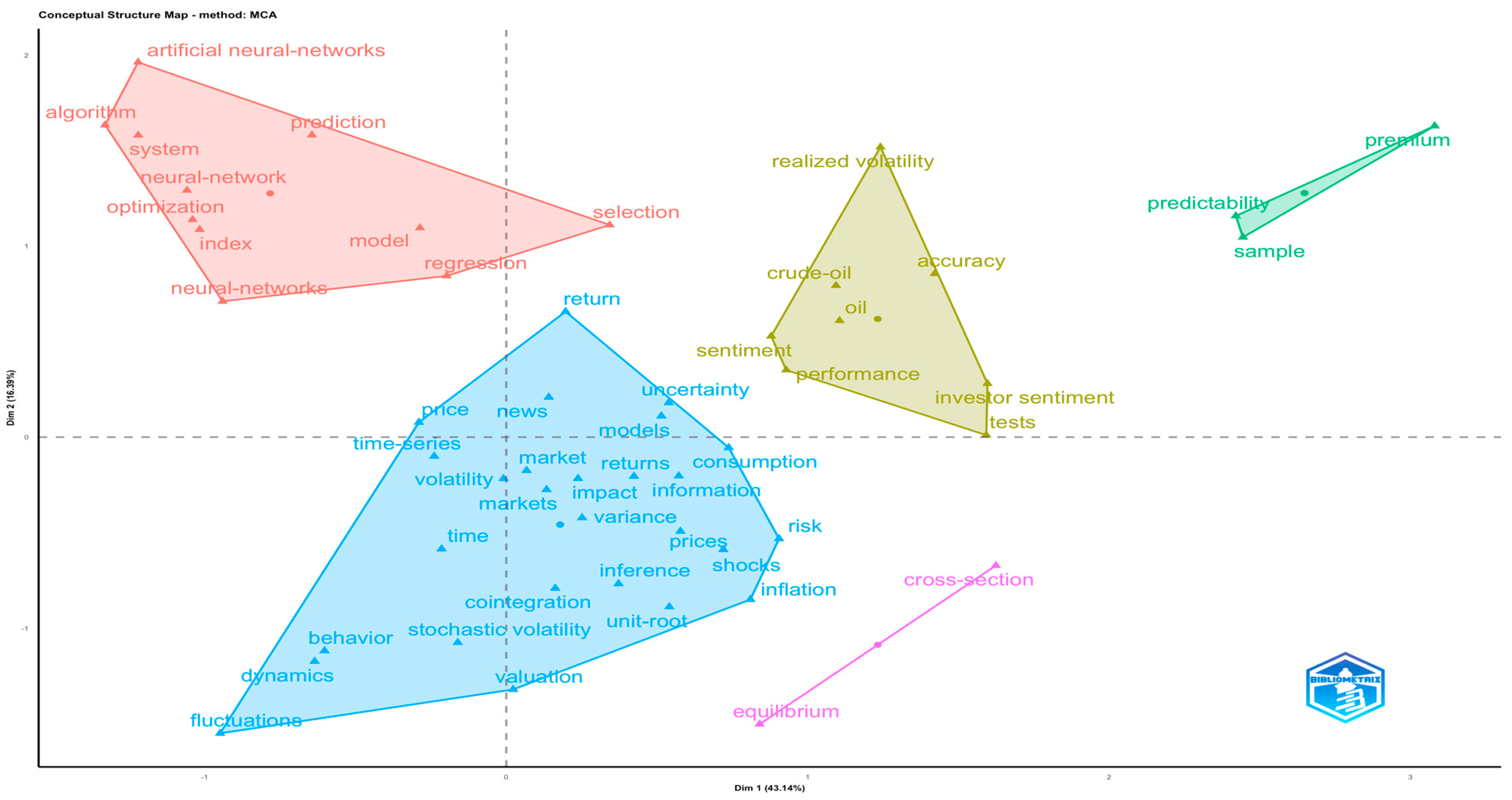
The thematic progression marks a shift from basic econometric principles to AI-driven models and faster policy implementation (Kraus et al., 2023). Core concepts such as returns and volatility remain vital but are now combined with advanced tools and interdisciplinary methods, forming the basis for the following analysis. Factorial Analysis offers a multidimensional view, revealing how research themes are distributed and grouped within the conceptual framework (Kraus et al., 2023).

4.2.5. Factorial Analysis

Using Multiple Correspondence Analysis (MCA) in Biblioshiny (Figure 12), this study maps complex keyword relationships in a two-dimensional space. The first axis (43.15% of variance) contrasts traditional econometric methods with newer machine learning approaches, while the second axis (16.93%) separates theoretical pricing studies from empirical forecasting work. Combined with a dendrogram and clustering, the visualization identifies five thematic domains and highlights where scholarly concepts converge or diverge.
The factorial structure represents conceptual proximities among modelling paradigms and addresses RQ3 by elucidating the interrelations between traditional and AI-based approaches. The observed clustering pattern suggests thematic convergence rather than a complete displacement of existing paradigms.
Cluster 1—Volatility, Time Series, and Crisis Modeling (Red) focuses on financial instability and econometric techniques for modeling volatility, contagion, spillovers, and crises. It centers on ARCH/GARCH models (R. F. Engle, 1982; Bollerslev, 1990) and extensions such as EGARCH, GJR-GARCH, and FIGARCH (Nelson, 1991; Glosten et al., 1993; Baillie, 1996). More advanced approaches, including Realized GARCH and DCC-GARCH, capture dynamic correlations during crises (Hansen et al., 2012). Crisis detection is further enhanced with Markov-switching models (Hamilton & Susmel, 1994) and wavelet models (Rua & Nunes, 2009), incorporating descriptors like “2008 crisis” and “COVID-19” to highlight empirical relevance (Diebold & Yilmaz, 2012; Ghosh & Jana, 2024).
Cluster 2, Return Modeling, Asset Pricing, and Liquidity (Blue), centers on return prediction and asset pricing models. Core concepts include return, CAPM, Fama–French, liquidity, and portfolios. It builds on CAPM (Sharpe, 1964; Lintner, 1965), APT (Ross, 1976), Fama–French factor models (1993, 2015), and Carhart’s momentum model (Carhart, 1997). The cluster studies liquidity risk (Amihud, 2002), idiosyncratic volatility (Ang et al., 2006), and market efficiency (Lo, 2005), using portfolio sorting, Fama–MacBeth regressions, and event studies (Jegadeesh & Titman, 1993; Hou et al., 2015). Recent work incorporates behavioral elements such as sentiment and investor bias (Barberis et al., 1998; M. Baker & Wurgler, 2006).
Cluster 3—Machine Learning, Hybrid Forecasting, and Optimization (Green)—highlights the integration of AI methods with financial modeling. Key terms include neural networks, SVM, hybrid models, forecasting, and optimization. This cluster reflects a shift from traditional econometrics to predictive, data-driven methods (Atsalakis & Valavanis, 2009; Chong et al., 2017). Hybrid models that combine LSTM, CNN, or SVM with ARIMA, GARCH, or wavelets prioritize performance over theory (Gu et al., 2020; L. Chen et al., 2024). Optimization methods such as genetic algorithms and particle swarm techniques improve model calibration in nonlinear, high-frequency settings (Ghosh & Jana, 2024; Manickavasagam et al., 2020; K. Xu & Niu, 2023).
Cluster 4—Cryptocurrency, Blockchain, and Speculative Assets (Olive Drab) examines digital finance and decentralized trading. It addresses cryptocurrency, Bitcoin, blockchain, mining, and speculation. This field applies GARCH models to crypto market volatility (Katsiampa, 2017), cointegration tests, and sentiment analysis using NLP (Tan et al., 2014; Sensoy & Tabak, 2015; Gaies et al., 2021). Research also covers bubble detection with regime-switching and log-periodic models (Philippas et al., 2013), and the environmental and economic impacts of mining (Stoll et al., 2019; Okorie & Lin, 2020). Originally centered on Bitcoin, it now extends to DeFi, NFTs, and CBDCs.
Cluster 5—Market Microstructure, Behavioral Finance, and Sentiment (Purple) examines how liquidity, asymmetric information, and investor sentiment shape market dynamics. It extends classic work on informed trading and price discovery (Glosten & Milgrom, 1985) by incorporating behavioral economics and noise trading (Barberis et al., 1998; Tetlock, 2007). Agent-based and experimental methods model bounded rationality (LeBaron, 2006). Recent studies integrate social media sentiment from platforms like Twitter and Reddit into predictive models that fuse textual data with price forecasts (Umar et al., 2021; Mai et al., 2019), highlighting the cluster’s interdisciplinary nature.
Factorial analysis categorizes financial market modeling research into core domains: econometrics, artificial intelligence, crypto-finance, and behavioral insights. These categories support the next step—examining the field’s intellectual foundations using co-citation and author network analysis.

4.3. Intellectual Structure

4.3.1. Co-Citation Analysis

The co-citation analysis clarifies the intellectual foundations of financial market modeling by examining joint citation frequencies among key authors to identify academic communities and ideologies (White & Griffith, 1981). Using the 250 most frequently co-cited authors, a network was constructed with force-directed algorithms and modularity-based clustering, complemented by Betweenness, Closeness, and PageRank centrality measures. This network (Figure 13) shows five main clusters in econometrics, behavioral finance, and machine learning. Reflecting scale-free citation patterns (Barabási & Albert, 1999), it is centered on seminal works such as Bollerslev (1990), Fama and French (1993), and Welch and Goyal (2008), underscoring their unifying influence.
The co-citation structure directly informs RQ2 and RQ3 by revealing the field’s pioneering authors, main intellectual trajectories, and the temporal convergence of themes. The simultaneous presence of econometric and AI-oriented clusters signals a shift in forecasting paradigms from traditional volatility models to hybrid, computationally intensive methods.
Cluster 1—Volatility Modeling and Time-Series Econometrics (Red) provides the core methods for volatility research. It covers key ARCH and GARCH models (R. F. Engle, 1982; Bollerslev, 1990), extensions such as EGARCH and GJR-GARCH (Nelson, 1991; Glosten et al., 1993), and long-memory models (Ding et al., 1993; Baillie, 1996). Mandelbrot (1963) introduces fractal volatility, and Black (1986) links it to option pricing. Work by R. F. Engle and Granger (1987) and Baillie (1996) further advances understanding of multivariate and persistent volatility, underscoring this cluster’s role in risk management and empirical finance.
Cluster 2—Macroeconomic Forecasting and Structural Empirics (Blue) links macroeconomics and financial econometrics, focusing on volatility forecasting with real-time and high-frequency data. Key works include Andersen et al. (2003) on realized volatility, Corsi (2009) on HAR-RV models, and Hansen et al. (2012) on forecast combinations. Macro-financial dynamics are examined by Diebold and Rudebusch (1996), with additional contributions from Paye (2012) and Wang (2018). Together, these studies underscore the importance of economic shocks and policy variables for market prediction.
Cluster 3—Behavioral Finance and Return Anomalies (in green) is the largest and most central theme, critiquing the Efficient Market Hypothesis via sentiment- and anomaly-based return models. Key contributions include Welch and Goyal (2008) on forecast instability, Campbell and Thompson (2008) on model precision, and Rapach et al. (2010) on macroeconomic predictors. Foundational behavioral work comes from Fama and French (1988), Barberis et al. (1998), and Neely et al. (2014), with further support from Stambaugh (1999), Ang et al. (2006), and Clark and West (2007). The cluster highlights bounded rationality, time-varying risk premia, and sentiment-driven forecasting (Gaies et al., 2021).
Cluster 4—Artificial Intelligence and Deep Learning (Purple) focuses on computational methods for financial forecasting. Key works include Hochreiter and Schmidhuber (1997) on LSTM, Fischer and Krauss (2018) on deep learning for stock prediction, and Patel et al. (2015) on ensemble methods. C.-J. Kim (2003) and Atsalakis and Valavanis (2009) further demonstrate Artificial Neural Networks, Support Vector Machines, and hybrid models. Although this cluster has lower betweenness, its high closeness and PageRank underscore its growing role in integrating machine learning with traditional financial theories (e.g., Fama, 1970).
Cluster 5—Asset Pricing and Factor Models (Orange) provides the theoretical basis for pricing models, centered on Fama and French’s (1992, 1993, 2015) multifactor frameworks. Key extensions include Carhart (1997) on momentum, Amihud (2002) on liquidity risk, M. Baker and Wurgler (2006) on behavioral finance, and the foundational CAPM of Sharpe (1964) and Lintner (1965). Although the smallest cluster, its high betweenness and closeness highlight its central role in linking rational and behavioral asset pricing theories.
The co-citation density visualization (Figure 14) highlights the scholarly impact of key authors—Bollerslev (1990), Diebold and Rudebusch (1996), Welch and Goyal (2008), and Fama and French (1993)—which appear as high-density nodes in the network, indicating concentrated academic influence. This visualization complements the cluster interpretation by revealing areas where citations accumulate around seminal contributions. The results suggest that financial market modeling is driven by a relatively small but influential group of scholars, forming five interconnected schools of thought. This structural insight underpins the next phase—historiographic analysis—which traces the field’s chronological development and identifies major inflection points in financial modeling paradigms.

4.3.2. Historiograph Network Tracing the Intellectual Trajectory of FMM

Unlike the keyword-focused thematic map, the historiographic analysis in Figure 15 tracks the chronological development of academic influence through direct citation paths. Using Bibliometrix’s historiograph tool, it places the 72 most locally significant, high-impact documents on a timeline. Nodes represent key studies, arrows show how later work builds on earlier research, and five color-coded clusters highlight the field’s shift from early volatility and asset pricing theories to recent work on AI, sentiment analysis, and cryptocurrency forecasting.
Cluster 1—Volatility and Econometric Foundations (1990–1996) (Red) forms the historiograph’s core, highlighting early work in volatility modeling and time-series econometrics. Pagan (1996) analyzed conditional heteroskedasticity models, and Campbell and Hentschel (1992) studied asymmetric volatility, foreshadowing EGARCH and GJR-GARCH. Bollerslev and Mikkelsen (1996) advanced long-memory modeling, paving the way for FIGARCH (Baillie, 1996) and stochastic volatility (Taylor, 1994). This cluster anchors later developments, including multivariate GARCH (R. F. Engle & Kroner, 1995), DCC models (R. Engle, 2002), volatility spillovers (Diebold & Yilmaz, 2012), and high-frequency modeling (Andersen et al., 2003).
Cluster 2—Asset Pricing Models and Bayesian Forecasting (1996–2014) (Blue) emphasizes uncertainty, model risk, and adaptive pricing strategies. Kandel and Stambaugh (1996) applied Bayesian learning to return predictions, and Avramov (2002) used Bayesian model averaging to improve robustness. Pettenuzzo et al. (2014) added economic constraints so models better reflect investor behavior. Asgharian et al. (2013) examined global equity integration with regime-switching, while Wang (2018) studied oil-driven macroeconomic shocks. This cluster links traditional models, such as Fama and French (1993) and Carhart (1997), to more flexible, empirically grounded forecasting methods.
Cluster 3—Macroeconomic Predictability and Forecast Combinations (2003–2015) (Green) is the largest group and focuses on predicting returns using macroeconomic information and improving models. Campbell and Thompson (2008) showed that imposing economic constraints can raise forecast accuracy, while Welch and Goyal (2008) questioned the predictive power of macro variables. Rapach et al. (2010) improved forecast combination methods, and Bollerslev et al. (2013) and Tauchen and Zhou (2011) examined structural breaks. Other key studies include Paye’s (2012) work on model instability, Lettau and Ludvigson’s (2001) on consumption-wealth ratios, Ang and Bekaert’s (2007) on inflation and yield curves, and Neely et al.’s (2014) on monetary policy shocks. Overall, this cluster supports a dynamic, multifaceted approach to empirical modeling.
Cluster 4—Behavioral Finance, Media Sentiment, and Nonlinear Dynamics (2011–2020) (Purple) reflects a shift toward behavioral perspectives in financial modeling. Bollen et al. (2011) showed that Twitter sentiment can predict market movements, while X. Zhang et al. (2011) applied machine learning to media-based sentiment. Lux and Marchesi (1999) developed agent-based models of herding and bubbles, and Barberis et al. (1998) and M. Baker and Wurgler (2006) challenged the Efficient Market Hypothesis by incorporating investor psychology. Other key studies include Da et al. (2011) on Google Trends, Tetlock (2007) and Umar et al. (2021) on media pessimism, and Asgharian et al. (2013) on links between sentiment and macroeconomic risk, highlighting the role of unconventional data and nonlinear dynamics.
Cluster 5—Cryptocurrencies, AI, and High-Frequency Forecasting (2017–2021) (Orange) highlights the rise of innovative financial assets and data-driven modeling. Katsiampa (2017) examined Bitcoin volatility with GARCH models, while García-Medina and Aguayo-Moreno (2024) used Bayesian methods and LSTM networks to forecast cryptocurrency trends. Atsalakis et al. (2019) applied hybrid fuzzy systems, and L. Chen et al. (2024) and Gu et al. (2020) compared machine learning models with traditional econometric approaches. Overall, this cluster signals a shift toward AI-based, fast-paced forecasting in speculative markets.
The historiographic analysis tracks financial market modeling from econometric origins to advanced frameworks that incorporate macroeconomic factors, behavior, sentiment analysis, and AI. Each research phase builds on prior work, revealing steady progress. The next phase—examining social structures—explores how collaborations among scholars, institutions, and countries shape the development and diffusion of financial modeling research.

4.4. Social Structure: Author Collaboration Network

Figure 16’s Collaboration Network Map represents authors as nodes and joint publications as links; node size indicates centrality, and colors show community clusters. Key metrics—PageRank, Betweenness, and Closeness—capture influence, connectivity, and structural roles. National-level analysis is omitted to preserve thematic focus and clarity.
The collaboration map addresses RQ2 by depicting systematic patterns of scholarly cooperation and the spatial diffusion of forecasting research. The observed increase in cross-regional co-authorship is indicative of both the maturation of the research domain and its progressive internationalization.
Cluster 1—Behavioral, Energy, and Environmental Finance (Purple) has high centrality and density, with Gupta R as the key researcher, leading in PageRank (0.127), Betweenness (15.00), and Closeness (0.167). Gupta collaborates with Bouri E, Salisu A.A., and Pierdzioch C. on energy volatility, macroeconomic uncertainty, and climate policy risk (Okorie & Lin, 2020; Salisu & Gupta, 2021; Bouri et al., 2017; Salisu et al., 2022). The cluster reflects strong cross-regional collaborations across East Asia, MENA, and Europe, focusing on high-frequency, behavioral, and crisis-informed modeling.
Cluster 2—Machine Learning and Portfolio Models (China) (Blue) is an advanced dyadic cluster led by Chen J. and Jiang F.W., recognized for applying artificial intelligence to portfolio optimization. Chen has a PageRank of 0.038 and the highest Closeness Centrality (1.000), indicating highly effective internal collaboration. Although the cluster’s Betweenness is zero, it is thematically strong, focusing on SVM, XGBoost, and deep learning for forecasting in Chinese markets (D. Wu et al., 2009; H. Wu et al., 2021; W. Jiang, 2021).
Cluster 3, in green and led by Ma F, focuses on volatility and systemic risk modeling in China. Ma F is highly central in the network (PageRank 0.123; Betweenness 48.58; Closeness 0.050), indicating broad collaboration and influence. Key collaborators include Liang C (PageRank 0.060; Betweenness 15.42) and Wei Y. The group studies volatility, systemic risk, and spillovers using DCC-GARCH, GVAR, and connectedness indices (Zhong & Liu, 2021), covering stock, bond, and currency markets.
Cluster 4—Crypto-Macroeconomic Nexus and Spillover Studies (South Asia & China) (Red), led by Zhang Y.J., shows strong influence and a key bridging role, with PageRank 0.076, Betweenness 36.00, and Closeness 0.045. Another major contributor, Wang Y.D., has Betweenness 23.00 and PageRank 0.058. Their work examines how cryptocurrency volatility relates to macroeconomic factors—policy uncertainty, inflation, and market sentiment—using frequency-domain and GARCH-MIDAS models (C. Zhang et al., 2022; Okorie & Lin, 2020; Poon & Granger, 2003).
Cluster 5, labeled AI and Fuzzy Forecasting Systems (Taiwan & East Asia) and shown in orange, is led by Wang S.Y. (PageRank 0.042, Closeness 0.500). Despite a Betweenness of 0.00, the cluster is highly effective due to strong internal links. Key collaborators Yu L. (PageRank 0.038) and Lai K.K. (0.035) are central to developing hybrid models that combine fuzzy logic, LSTM, SVR, and other soft computing methods for forecasting in East Asian financial markets (Weng et al., 2018; Lai et al., 2006).
The collaboration network shows a hierarchical, geographically segmented research landscape, with key scholars such as Gupta R, Ma F, and Zhang Y.J. linking regions and topics. Variations in cluster centrality reveal both tightly connected communities and isolated collaborations, indicating uneven knowledge distribution. This concludes the bibliometric analysis of the conceptual, intellectual, and social structures of financial market modeling and introduces the next phase: a qualitative content analysis of the main themes, methods, and contributions in this field.
While the bibliometric analysis elucidates structural patterns, key contributors, and thematic clusters, a more in-depth qualitative interpretation is necessary to clarify how these trends are reflected in concrete methodological advancements. Accordingly, the subsequent section presents a focused content analysis of the most central clusters.

5. Content Analysis

This content analysis complements the preceding quantitative bibliometric study, focusing on the thematic co-occurrence map that identified five main clusters in financial market modeling. Whereas the bibliometric analysis provided a structural overview, this section qualitatively examines the key models, research themes, and methodologies in each cluster. As shown in Table 6, it analyzes the theoretical foundations, practical applications, and significance of each cluster, clarifying their contributions to the broader financial modeling literature.
Cluster selection for qualitative interpretation was guided by predefined criteria to maintain analytical consistency. Clusters were prioritized based on: (i) centrality and density indicators obtained from the thematic map, (ii) intellectual coherence as evidenced by co-citation structures, and (iii) their substantive alignment with the overarching research questions. Because this study is grounded in a structured thematic examination of bibliometric outputs rather than manual coding of primary empirical material, standard inter-coder reliability statistics are not applicable.
Cluster 1—Modelling of Returns, Risks, and Pricing. This cluster provides the core theoretical framework of financial market modeling, focusing on risk–return trade-offs, market efficiency, and pricing anomalies. It builds on key models such as CAPM (Sharpe, 1964; Lintner, 1965), APT (Ross, 1976), and the Fama–French multifactor models (Fama & French, 1993, 2015). Return modeling is enriched by time-series methods like GARCH and stochastic volatility (Cochrane, 2011). Research examines time-varying risk premia and macro-financial predictors via predictive regressions (Campbell & Thompson, 2008), as well as behavioral perspectives (Barberis & Thaler, 2003). More recently, ESG-integrated models extend asset pricing to sustainability and climate risks (Friede et al., 2015; Fatemi et al., 2018; Gu et al., 2020), making this cluster both foundational and forward-looking.
Cluster 2—Volatility and Behavioral Market Dynamics: This segment centers on modeling volatility and the behavioral factors driving market fluctuations. It uses GARCH models and variants such as EGARCH and TGARCH to capture volatility clustering and asymmetric shocks (Lux, 1995; Diebold & Yilmaz, 2009, 2012), and applies TVP-VAR to assess changing market interdependence (Gabauer & Gupta, 2020; Bouri et al., 2022). Drawing on Shiller (2000), it highlights how sentiment, noise trading, and herding amplify volatility. Recent work incorporates policy uncertainty indices—EPU and CPU—into extended volatility models (Al-Thaqeb & Algharabali, 2019; Gabauer & Gupta, 2018), with Salisu and Gupta (2021) focusing on climate and macroeconomic risks. Overall, this cluster combines econometric rigor and behavioral insights to explain volatility in complex, uncertain markets.
Cluster 3—AI and Deep Learning Models for Forecasting. This section highlights the shift to AI-driven forecasting, using models such as LSTM, CNN, SVM, and hybrid AI–econometric systems (Bao et al., 2017; Gu et al., 2020; Krauss et al., 2017). These methods improve predictions of returns and volatility by capturing nonlinear patterns in large financial datasets. Early work on ANN and SVM (G. P. Zhang et al., 1998; Atsalakis & Valavanis, 2009) enabled the development of advanced models now applied in high-frequency trading, anomaly detection, and ensemble forecasting (S.-H. Chen et al., 2008; L. Zhang et al., 2017; Rohrbeck & Kum, 2018). This cluster reflects a methodological shift in which AI increasingly supplements or replaces traditional models.
Cluster 4—The Influence of Sentiment, News, and Media on Market Dynamics. This segment examines how textual content and sentiment affect financial behavior using tools such as sentiment-enhanced GARCH models, NLP frameworks, and transformer systems like BERT. Foundational work (Tetlock, 2007; Bollen et al., 2011) shows that investor sentiment and news interpretation can signal market movements. Studies draw on social media, news, and financial documents to quantify sentiment and feed it into predictive models (Shynkevich et al., 2017; Nguyen et al., 2015; García et al., 2017). Machine learning and NLP advances enable extracting predictive signals from unstructured data (H. Chen et al., 2021; Costola et al., 2022). This cluster highlights how behavioral patterns and information flows shape price formation and volatility, especially in uncertain periods.
Cluster 5—Cryptocurrency and Digital Asset Modeling examines the distinctive features of cryptocurrency markets, focusing on volatility patterns, spillovers, and regime shifts. It uses models such as GARCH-MIDAS, HAR-RV, Markov Switching, and quantile regression to capture non-linear dynamics and extreme tail risks (Diebold & Yilmaz, 2009, 2012; Aloui et al., 2013; Barunik & Krehlik, 2018). The analysis covers price contagion, policy uncertainty, and cross-asset linkages during crises and speculative episodes (Pastor et al., 2022; Y. Zhang et al., 2023). Techniques like spillover indices and wavelet coherence reveal time-frequency interactions under market stress (Kristjanpoller, 2024; Okorie & Lin, 2020). Overall, this cluster views digital assets as both indicators of systemic vulnerability and a frontier area in financial econometrics.
This study does not introduce new econometric estimations, but its content analysis reveals substantial heterogeneity in how prior research evaluates forecasting performance. Across econometric and AI-based studies, commonly reported performance measures include MSE, MAE, QLIKE, and directional accuracy, often alongside Diebold–Mariano and conditional predictive ability (CPA) tests (Diebold & Mariano, 1995; Diebold, 2015). However, validation practices differ markedly across markets and model classes, especially regarding regime dependence, structural breaks, and out-of-sample evaluation design. By systematically synthesizing these evaluation frameworks, this review clarifies the methodological standards used to justify forecasting performance claims and highlights the need for more harmonized forecast comparison and validation procedures across modeling paradigms.

6. Implications, Evaluation and Future Research Directions

Building on the literature review, bibliometric mapping, and content synthesis, this section integrates empirical evidence and methodological perspectives to address the research questions and assess recent advances in financial market modeling. The framework is distinctive in its sequential integration of review-of-reviews evidence, large-scale bibliometric structures, and thematic content synthesis across heterogeneous markets and modeling paradigms, offering a multi-layered perspective that overcomes the limits of single-method reviews.
The findings indicate a shift from traditional econometrics to machine learning–based and hybrid frameworks, with increasing model complexity. Future work should systematically compare econometric and AI-driven models using explicit loss functions and rigorous validation, including out-of-sample tests and robustness checks. Although hybrid and deep learning models seem effective at capturing nonlinearities and complex market dynamics, stricter statistical evaluation is needed to confirm their robustness across asset classes, horizons, and market regimes. Further progress will require integrating econometric theory with computational innovations to enhance model interpretability and the reliability of empirical inference.

6.1. Practical and Theoretical Implications

This study offers theoretical and practical contributions by tracing the evolution of financial market modeling. It moves from traditional asset pricing theories, such as the CAPM (Sharpe, 1964; Lintner, 1965) and Fama–French factor models (Fama & French, 1993, 2015), to hybrid models that combine econometrics with AI, behavioral finance, and sentiment analysis (Gu et al., 2020; L. Chen et al., 2024). The paper highlights a shift from assumptions of market efficiency and stationarity toward more data-driven, complex, and context-sensitive approaches. Previously separate areas—volatility modeling (Bollerslev, 1990), sentiment analysis (Tetlock, 2007; Kraaijeveld & De Smedt, 2020), and ESG integration (Al-Thaqeb & Algharabali, 2019)—are now combined in interdisciplinary frameworks.
The results offer key guidance on model selection for financial professionals: LSTM networks suit high-frequency settings (Fischer & Krauss, 2018), while GARCH-MIDAS models fit macro-level volatility integration (Pastor et al., 2022). Policymakers should address risks from behavioral and uncertainty factors (Gabauer & Gupta, 2020), and educators should design curricula that integrate econometrics, machine learning, and sustainability. Overall, these implications highlight the need for a methodologically diverse, internationally oriented, and socially aware modeling framework.

6.2. Critical Evaluation of Methodological Weaknesses in Financial Market Modelling

The Stage 1 review of 67 survey-based studies shows that existing surveys typically focus on specific model families or single asset classes. Equity-market surveys mainly trace the shift from traditional econometric benchmarks to machine learning methods (Henrique et al., 2019; B. S. Kumar & Ravi, 2016), energy-market reviews highlight growing use of hybrid models (Ghoddusi et al., 2019; Lu et al., 2021), and exchange-rate surveys emphasize AI-driven models and sentiment indicators (Nassirtoussi et al., 2015). Although these studies generally report performance gains from advanced techniques, they rarely conduct systematic cross-market comparisons or examine whether evaluation criteria are applied consistently across asset classes and forecast horizons.
The bibliometric analysis of 4982 Web of Science–indexed publications (Stage 2) confirms this pattern at the disciplinary level. Thematic and co-occurrence mappings show that, after 2015, keywords on artificial intelligence, deep learning, and hybrid approaches increasingly dominate, indicating rapid methodological diversification. In contrast, concepts such as reproducibility, data transparency, regime stability, and structural breaks remain peripheral in the thematic network. Core clusters center on predictive improvement and model innovation rather than on robust, standardized validation practices, indicating that methodological sophistication has advanced faster than evaluation standards.
The co-citation network reveals a split intellectual landscape: one path rooted in stringent econometric methods (e.g., volatility modeling and return predictability) and another focused on expanding machine and deep learning approaches. Econometric work has emphasized rigorous diagnostics and theoretical coherence (Poon & Granger, 2003), whereas many ML-oriented surveys and applications prioritize predictive performance, often neglecting issues such as overfitting, hyperparameter instability, and data-snooping bias. The bibliometric centrality patterns therefore indicate the coexistence of these paradigms rather than full methodological convergence.
Stage 3’s content analysis qualitatively supports these empirical patterns. In equity, energy, and foreign exchange markets, hybrid and deep learning forecasting models are often reported to outperform conventional benchmarks (Cavalcante et al., 2016; Thakkar & Chaudhari, 2021). Yet evaluation protocols vary widely in loss functions, forecast horizons, and sample-partitioning strategies. Few studies systematically test robustness and stability across crisis vs. non-crisis regimes or multiple asset classes, so reported performance gains remain highly context-specific and hard to generalize.
Taken together, the convergent evidence derived from the SLR, bibliometric mapping, and thematic synthesis suggests that research on financial market forecasting has attained a high degree of methodological sophistication, yet continues to display four persistent limitations: (1) constrained cross-market comparability, (2) heterogeneity in validation procedures and reporting standards, (3) heightened risks of overfitting associated with increasingly complex AI architectures, and (4) inadequate integration of econometric theoretical foundations with data-driven optimization frameworks. Mitigating these shortcomings necessitates the adoption of more transparent and reproducible evaluation protocols, the standardized reporting of forecasting performance metrics, the use of regime-sensitive validation designs, and the development of explicit cross-asset benchmarking schemes.

6.3. Suggested Avenues for Future Research

This research identifies key directions for advancing financial market modeling. First, models should more fully integrate ESG factors, CPU, and economic policy uncertainty (EPU) into return and volatility frameworks. While prior studies (Friede et al., 2015; Al-Thaqeb & Algharabali, 2019) have introduced these concepts, further work should examine their interactions with risk premia and volatility spillovers, especially during crises and in vulnerable markets. Second, AI models such as LSTM, XGBoost, and CNN should be more closely combined with macro-financial and behavioral indicators (Bao et al., 2017; Fischer & Krauss, 2018; Gu et al., 2020). Research should focus on improving AI interpretability through SHAP values or attention mechanisms to increase transparency. Finally, integrating machine learning with causal inference is necessary to strengthen explanatory power (Rohrbeck & Kum, 2018).
Third, cryptocurrency research should use advanced models that capture regime shifts, contagion, and cross-asset linkages, such as GARCH-MIDAS and quantile regressions (Pastor et al., 2022; Y. Zhang et al., 2023), and examine how traditional and digital markets interact during crises. Fourth, sentiment analysis should extend beyond news and Twitter to Reddit, ESG reports, and video content (H. Chen et al., 2021; Costola et al., 2022), while also analyzing how sentiment effects differ by investor type and market structure.
Future research should apply comprehensive validation, use rolling-window forecasts, and compare ensembles to ensure model reliability (Gabauer & Gupta, 2020). Developing multimodal models that combine text, numerical, and image data is also increasingly important (Nguyen et al., 2015; L. Zhang et al., 2017). Finally, future work should assess hybrid models under stress by using crisis-focused samples and regime-switching techniques (Okorie & Lin, 2020; Gabauer & Gupta, 2020) to deepen academic understanding and strengthen practical forecast robustness. To consolidate these directions, Table 7 synthesizes the proposed future research agenda by linking the identified thematic clusters of financial market modeling (FMM) with key research questions and representative references.

7. Conclusions and Limitations

This study offers a comprehensive, multi-dimensional analysis of financial market modeling using three methods: Systematic Literature Review (SLR), bibliometric analysis, and content analysis. The SLR synthesizes 67 review papers, clarifying key theoretical and empirical paradigms. The bibliometric analysis covers 4984 Web of Science articles from 1990 to 2024 and identifies five main thematic clusters: (1) Return, Risk, and Price Modeling; (2) Volatility and Behavioral Dynamics; (3) AI and Deep Learning Models; (4) Sentiment and Media Influence; and (5) Cryptocurrency and Digital Asset Modeling.
Building on this foundation, the content analysis provided qualitative insights into the models, tools, and discussions shaping each theme. Together, these elements trace the field’s shift from traditional asset pricing to advanced forecasting models that incorporate behavioral insights and machine learning. This approach highlights the value of mixed-method bibliometric research for synthesizing existing knowledge, identifying future research directions, and emphasizing the rising importance of interdisciplinary, data-driven strategies in financial modeling.
Despite the meticulous design of this study’s three-stage process, it has several limitations. Reliance solely on Web of Science (1990–2024) excludes research indexed in Scopus, SSRN, and grey literature. Restricting sources to English may overlook contributions in other languages. The keyword strategy, though carefully developed, still involves subjective choices. Biblioshiny’s clustering methods and fixed thresholds may reduce network sensitivity and omit niche topics. Finally, the content analysis, derived from earlier bibliometric stages, inherits their limitations.
Despite these constraints, the study offers a solid and reproducible framework. Subsequent research could build on it by incorporating multilingual datasets, employing dynamic citation analyses, and adopting mixed-method approaches to more effectively detect emerging trends in financial market modeling. The value of this work lies in its structured synthesis and methodological integration, rather than in performing new empirical forecasting experiments.

Supplementary Materials

The following supporting information can be downloaded at: https://www.mdpi.com/article/10.3390/jrfm19030228/s1, Supplementary File S1: Detailed research structure and additional documentation (PDF). The datasets, bibliometric outputs, and analysis codes used in this study are publicly available at: https://github.com/Wafi-Finance/Financial-Market-Forecasting-and-Modeling-Bibliometric-Data-and-Analysis.git (accessed on 23 February 2026).

Author Contributions

Conceptualization, A.S.W. and S.E.-H.; methodology, A.S.W.; software, A.S.W.; validation, A.S.W.; formal analysis, A.S.W.; investigation, A.S.W. and H.A.; resources, A.S.W.; data curation, A.S.W.; writing—original draft preparation, A.S.W. and S.E.-H.; writing—review and editing, A.S.W., S.E.-H. and H.A.; visualization, A.S.W. and S.E.-H.; supervision, A.S.W.; project administration, A.S.W. and S.E.-H.; funding acquisition, S.E.-H. All authors have read and agreed to the published version of the manuscript.

Funding

This research received no external funding. The article processing charge (APC) was funded by the Deanship of Research and Graduate Studies (DRG), Ajman University, United Arab Emirates.

Institutional Review Board Statement

Not applicable. This study is based exclusively on published literature and bibliometric data and does not involve human participants or animals.

Informed Consent Statement

Not applicable.

Data Availability Statement

The data supporting the findings of this study are publicly available in the project repository at: https://github.com/Wafi-Finance/financial-market-forecasting-bibliometric-review (accessed on 23 February 2026). The repository includes the raw data, bibliometric outputs, charts, and Excel files. It also contains additional analyses that are not fully reported in the paper and may serve as practical examples for researchers interested in applying different bibliometric algorithms.

Acknowledgments

The authors gratefully acknowledge the support of the Deanship of Research and Graduate Studies (DRG), Ajman University, for covering the article processing charge (APC) associated with the publication of this paper.

Conflicts of Interest

The authors declare no conflicts of interest.

Note

1
Two articles out of the 4984 were excluded as they were classified as early access publications from 2025, whereas the review strictly focuses on literature published up to the end of 2024.

References

  1. Aloui, R., Ben Aïssa, M. S., & Nguyen, D. K. (2013). Conditional dependence structure between oil prices and exchange rates: A copula-GARCH approach. Journal of International Money and Finance, 31(3), 719–738. [Google Scholar] [CrossRef]
  2. Alshater, M. M., Hassan, M. K., Khan, A., & Saba, I. (2020). Influential and intellectual structure of Islamic finance: A bibliometric review. International Journal of Islamic and Middle Eastern Finance and Management, 14(2), 339–365. [Google Scholar] [CrossRef]
  3. Al-Thaqeb, S. A., & Algharabali, B. G. (2019). Economic policy uncertainty: A literature review. Journal of Economic Asymmetries, 20, e00133. [Google Scholar] [CrossRef]
  4. Amihud, Y. (2002). Illiquidity and stock returns: Cross-section and time-series effects. Journal of Financial Markets, 5(1), 31–56. [Google Scholar] [CrossRef]
  5. Andersen, T. G., Bollerslev, T., Diebold, F. X., & Labys, P. (2003). Modeling and forecasting realized volatility. Econometrica, 71(2), 579–625. [Google Scholar] [CrossRef]
  6. Ang, A., & Bekaert, G. (2007). Stock return predictability: Is it there? The Review of Financial Studies, 20(3), 651–707. [Google Scholar] [CrossRef]
  7. Ang, A., Hodrick, R. J., Xing, Y., & Zhang, X. (2006). The cross-section of volatility and expected returns. Journal of Finance, 61(1), 259–299. [Google Scholar] [CrossRef]
  8. Aria, M., & Cuccurullo, C. (2017). Bibliometrix: An R-tool for comprehensive science mapping analysis. Journal of Informetrics, 11(4), 959–975. [Google Scholar] [CrossRef]
  9. Asgharian, H., Hou, A. J., & Javed, F. (2013). The importance of macroeconomic variables for variance prediction: A GARCH-MIDAS approach. Journal of Forecasting, 32(7), 600–612. [Google Scholar] [CrossRef]
  10. Atsalakis, G. S., Atsalaki, I. G., Pasiouras, F., & Zopounidis, C. (2019). Bitcoin price forecasting with neuro-fuzzy techniques. European Journal of Operational Research, 276(2), 770–780. [Google Scholar] [CrossRef]
  11. Atsalakis, G. S., & Valavanis, K. P. (2009). Surveying stock market forecasting techniques–Part II: Soft computing methods. Expert Systems with Applications, 36(3), 5932–5941. [Google Scholar] [CrossRef]
  12. Avramov, D. (2002). Stock return predictability and model uncertainty. Journal of Financial Economics, 64(3), 423–458. [Google Scholar] [CrossRef]
  13. Bahrammirzaee, A. (2010). A comparative survey of artificial intelligence applications in finance: Artificial neural networks, expert system and hybrid intelligent systems. Neural Computing and Applications, 19(8), 1165–1195. [Google Scholar] [CrossRef]
  14. Baillie, R. T. (1996). Long memory processes and fractional integration in econometrics. Journal of Econometrics, 73(1), 5–59. [Google Scholar] [CrossRef]
  15. Baker, M., & Wurgler, J. (2006). Investor sentiment and the cross-section of stock returns. The Journal of Finance, 61(4), 1645–1680. [Google Scholar] [CrossRef]
  16. Baker, S. R., Bloom, N., & Davis, S. J. (2016). Measuring economic policy uncertainty. Quarterly Journal of Economics, 131(4), 1593–1636. [Google Scholar] [CrossRef]
  17. Bal, C. K., & Mishra, R. K. (2025). Stock market analysis and prediction: A bibliometric analysis. Journal of Scientometric Research, 14(1), 221–238. [Google Scholar] [CrossRef]
  18. Ban, G.-Y., El Karoui, N., & Lim, A. E. B. (2018). Machine learning and portfolio optimization. Management Science, 64(3), 1136–1154. [Google Scholar] [CrossRef]
  19. Bao, W., Yue, J., & Rao, Y. (2017). A deep learning framework for financial time series using stacked autoencoders and long–short term memory. PLoS ONE, 12(7), e0180944. [Google Scholar] [CrossRef] [PubMed]
  20. Barabási, A. L., & Albert, R. (1999). Emergence of scaling in random networks. Science, 286(5439), 509–512. [Google Scholar] [CrossRef]
  21. Barberis, N., Shleifer, A., & Vishny, R. (1998). A model of investor sentiment. Journal of Financial Economics, 49(3), 307–343. [Google Scholar] [CrossRef]
  22. Barberis, N., & Thaler, R. (2003). A survey of behavioral finance. In G. M. Constantinides, M. Harris, & R. Stulz (Eds.), Handbook of the economics of finance (Vol. 1B, pp. 1053–1128). Elsevier. [Google Scholar] [CrossRef]
  23. Bariviera, A. F., & Merediz-Solà, I. (2021). Where do we stand in cryptocurrencies economic research? A survey based on hybrid analysis. Journal of Economic Surveys, 35(2), 377–407. [Google Scholar] [CrossRef]
  24. Barunik, J., & Krehlik, T. (2018). Measuring the frequency dynamics of financial and macroeconomic connectedness. Journal of Financial Econometrics, 16(2), 271–296. [Google Scholar] [CrossRef]
  25. Black, F. (1986). Noise. Journal of Finance, 41(3), 528–543. [Google Scholar] [CrossRef]
  26. Blackledge, J., & Lamphiere, M. (2022). A review of the fractal market hypothesis for trading and market price prediction. Mathematics, 10(1), 117. [Google Scholar] [CrossRef]
  27. Bollen, J., Mao, H., & Zeng, X. (2011). Twitter mood predicts the stock market. Journal of Computational Science, 2(1), 1–8. [Google Scholar] [CrossRef]
  28. Bollerslev, T. (1986). Generalized autoregressive conditional heteroskedasticity. Journal of Econometrics, 31(3), 307–327. [Google Scholar] [CrossRef]
  29. Bollerslev, T. (1990). Modelling the Coherence in short-run nominal exchange rates: A multivariate generalized ARCH model. The Review of Economics and Statistics, 72(3), 498–505. [Google Scholar] [CrossRef]
  30. Bollerslev, T., & Mikkelsen, H. O. (1996). Modeling and pricing long memory in stock market volatility. Journal of Econometrics, 73(1), 151–184. [Google Scholar] [CrossRef]
  31. Bollerslev, T., Todorov, V., & Li, S. Z. (2013). Jump tails, extreme dependencies, and the distribution of stock returns. Journal of Econometrics, 172(2), 307–324. [Google Scholar] [CrossRef]
  32. Bouri, E., Balcilar, M., Gupta, R., & Roubaud, D. (2017). Can bitcoin hedge global uncertainty? Evidence from quantile-in-quantile regressions. Finance Research Letters, 23, 87–95. [Google Scholar] [CrossRef]
  33. Bouri, E., Demirer, R., Gabauer, D., & Gupta, R. (2022). Financial market connectedness: The role of investors’ happiness. Finance Research Letters, 44, 102075. [Google Scholar] [CrossRef]
  34. Box, G. E. P., Jenkins, G. M., Reinsel, G. C., & Ljung, G. M. (2015). Time series analysis: Forecasting and control (5th ed.). John Wiley & Sons. ISBN 9781118675021. [Google Scholar]
  35. Braun, V., & Clarke, V. (2006). Using thematic analysis in psychology. Qualitative Research in Psychology, 3(2), 77–101. [Google Scholar] [CrossRef]
  36. Budler, M., Župič, I., & Trkman, P. (2021). The development of business model research: A bibliometric review. Journal of Business Research, 135, 480–495. [Google Scholar] [CrossRef]
  37. Campbell, J. Y., & Hentschel, L. (1992). No news is good news: An asymmetric model of changing volatility in stock returns. Journal of Financial Economics, 31(3), 281–318. [Google Scholar] [CrossRef]
  38. Campbell, J. Y., & Thompson, S. B. (2008). Predicting excess stock returns out of sample: Can anything beat the historical average? The Review of Financial Studies, 21(4), 1509–1531. [Google Scholar] [CrossRef]
  39. Campiglio, E., Daumas, L., Monnin, P., & von Jagow, A. (2023). Climate-related risks in financial assets. Journal of Economic Surveys, 37(3), 950–992. [Google Scholar] [CrossRef]
  40. Caporin, M., & McAleer, M. (2012). Do we really need both BEKK and DCC? A tale of two multivariate GARCH models. Journal of Economic Surveys, 26(4), 736–751. [Google Scholar] [CrossRef]
  41. Carhart, M. M. (1997). On persistence in mutual fund performance. Journal of Finance, 52(1), 57–82. [Google Scholar] [CrossRef]
  42. Cavalcante, R. C., Brasileiro, R. C., Souza, V. L., Nobrega, J. P., & Oliveira, A. L. (2016). Computational intelligence and financial markets: A survey and future directions. Expert Systems with Applications, 55, 194–211. [Google Scholar] [CrossRef]
  43. Chan, K. F., & Maheu, J. M. (2002). Conditional jump dynamics in stock market returns. Journal of Business & Economic Statistics, 20(3), 377–389. [Google Scholar] [CrossRef]
  44. Chen, H., De, P., Hu, Y. J., & Hwang, B. H. (2021). Wisdom of crowds: The value of stock opinions transmitted through social media. Review of Financial Studies, 27(5), 1367–1403. [Google Scholar] [CrossRef]
  45. Chen, J., & Yang, L. (2021). A bibliometric review of volatility spillovers in financial markets: Knowledge bases and research fronts. Emerging Markets Finance and Trade, 57(5), 1358–1379. [Google Scholar] [CrossRef]
  46. Chen, L., Pelger, M., & Zhu, J. (2024). Deep learning in asset pricing. Management Science, 70(2), 714–750. [Google Scholar] [CrossRef]
  47. Chen, S.-H., Kuo, T.-W., & Hoi, K.-M. (2008). Genetic programming and financial trading: How much about “what we know”. In C. Zopounidis, M. Doumpos, & P. M. Pardalos (Eds.), Handbook of financial engineering (Vol. 18, pp. 99–154). Springer optimization and its applications. Springer. [Google Scholar] [CrossRef]
  48. Chiroma, H., Abdulkareem, S., Abubakar, A., & Usman, M. J. (2013). Computational intelligence techniques with application to crude oil price projection: A literature survey from 2001–2012. Neural Network World, 23(6), 523–551. [Google Scholar] [CrossRef]
  49. Chiroma, H., Abdul-Kareem, S., Shukri Mohd Noor, A., Abubakar, A. I., Sohrabi Safa, N., Shuib, L., Fatihu Hamza, M., Ya’u Gital, A., & Herawan, T. (2016). A review on artificial intelligence methodologies for the forecasting of crude oil price. Intelligent Automation & Soft Computing, 22(3), 449–462. [Google Scholar]
  50. Chong, E., Han, C., & Park, F. C. (2017). Deep learning networks for stock market analysis and prediction: Methodology, data representations, and case studies. Expert Systems with Applications, 83, 187–205. [Google Scholar] [CrossRef]
  51. Choudhry, T. (2005). Time-varying beta and the Asian financial crisis: Evidence from Malaysian and Taiwanese firms. Pacific-Basin Finance Journal, 13(1), 93–118. [Google Scholar] [CrossRef]
  52. Ciner, C. (2001). Energy shocks and financial markets: Nonlinear linkages. Studies in Nonlinear Dynamics & Econometrics, 5(3), 203–212. [Google Scholar] [CrossRef]
  53. Clark, T. E., & West, K. D. (2007). Approximately normal tests for equal predictive accuracy in nested models. Journal of Econometrics, 138(1), 291–311. [Google Scholar] [CrossRef]
  54. Cobo, M. J., López-Herrera, A. G., Herrera-Viedma, E., & Herrera, F. (2011). An approach for detecting, quantifying, and visualizing the evolution of a research field: A practical application to the fuzzy sets theory field. Journal of Informetrics, 5(1), 146–166. [Google Scholar] [CrossRef]
  55. Cobo, M. J., López-Herrera, A. G., Herrera-Viedma, E., & Herrera, F. (2012). SciMAT: A new science mapping analysis software tool. Journal of the American Society for Information Science and Technology, 63(8), 1609–1630. [Google Scholar] [CrossRef]
  56. Cochrane, J. H. (2011). Presidential address: Discount rates. Journal of Finance, 66(4), 1047–1108. [Google Scholar] [CrossRef]
  57. Cont, R. (2001). Empirical properties of asset returns: Stylized facts and statistical issues. Quantitative Finance, 1(2), 223–236. [Google Scholar] [CrossRef]
  58. Corsi, F. (2009). A simple approximate long-memory model of realized volatility. Journal of Financial Econometrics, 7(2), 174–196. [Google Scholar] [CrossRef]
  59. Costa, D. F., Carvalho, F. D. M., & Moreira, B. C. D. M. (2019). Behavioral economics and behavioral finance: A bibliometric analysis of the scientific fields. Journal of Economic Surveys, 33(1), 3–24. [Google Scholar] [CrossRef]
  60. Costola, M., Gheno, A., Gianfrate, G., Mazzù, S., & Pozzoli, M. (2022). Global risks, the macroeconomy, and asset prices. Empirical Economics, 63, 2701–2727. [Google Scholar] [CrossRef] [PubMed]
  61. Da, Z., Engelberg, J., & Gao, P. (2011). In search of attention. Journal of Finance, 66(4), 1461–1499. [Google Scholar] [CrossRef]
  62. Deng, Y., Bao, F., Kong, Y., Ren, Z., & Dai, Q. (2016). Deep direct reinforcement learning for financial signal representation and trading. IEEE Transactions on Neural Networks and Learning Systems, 28(3), 653–664. [Google Scholar] [CrossRef]
  63. Diebold, F. X. (2015). Comparing predictive accuracy, twenty years later: A personal perspective on the use and abuse of Diebold–Mariano tests. Journal of Business & Economic Statistics, 33(1), 1. [Google Scholar] [CrossRef]
  64. Diebold, F. X., & Mariano, R. S. (1995). Comparing predictive accuracy. Journal of Business & Economic Statistics, 13(3), 253–263. [Google Scholar] [CrossRef] [PubMed]
  65. Diebold, F. X., & Rudebusch, G. D. (1996). Measuring business cycles: A modern perspective. The Review of Economics and Statistics, 78(1), 67–77. [Google Scholar] [CrossRef]
  66. Diebold, F. X., & Yilmaz, K. (2009). Measuring financial asset return and volatility spillovers, with application to global equity markets. Economic Journal, 119(534), 158–171. [Google Scholar] [CrossRef]
  67. Diebold, F. X., & Yilmaz, K. (2012). Better to give than to receive: Predictive directional measurement of volatility spillovers. International Journal of Forecasting, 28(1), 57–66. [Google Scholar] [CrossRef]
  68. Ding, Z., Granger, C. W. J., & Engle, R. F. (1993). A long memory property of stock market returns and a new model. Journal of Empirical Finance, 1(1), 83–106. [Google Scholar] [CrossRef]
  69. Donthu, N., Kumar, S., Mukherjee, D., Pandey, N., & Lim, W. M. (2021). How to conduct a bibliometric analysis: An overview and guidelines. Journal of Business Research, 133, 285–296. [Google Scholar] [CrossRef]
  70. Elton, E. J., & Gruber, M. J. (2020). A review of the performance measurement of long-term mutual funds. Financial Analysts Journal, 76(3), 22–37. [Google Scholar] [CrossRef]
  71. Engelberg, J., & Parsons, C. A. (2011). The causal impact of media in financial markets. Journal of Finance, 66(1), 67–97. [Google Scholar] [CrossRef]
  72. Engle, R. (2002). Dynamic conditional correlation: A simple class of multivariate GARCH models. Journal of Business & Economic Statistics, 20(3), 339–350. [Google Scholar] [CrossRef]
  73. Engle, R. F. (1982). Autoregressive conditional heteroscedasticity with estimates of the variance of United Kingdom inflation. Econometrica, 50(4), 987–1007. [Google Scholar] [CrossRef]
  74. Engle, R. F., & Granger, C. W. J. (1987). Co-integration and error correction: Representation, estimation, and testing. Econometrica, 55(2), 251–276. [Google Scholar] [CrossRef]
  75. Engle, R. F., & Kroner, K. F. (1995). Multivariate simultaneous generalized ARCH. Econometric Theory, 11(1), 122–150. [Google Scholar] [CrossRef]
  76. Fama, E. F. (1970). Efficient capital markets: A review of theory and empirical work. Journal of Finance, 25(2), 383–417. [Google Scholar] [CrossRef]
  77. Fama, E. F., & French, K. R. (1988). Permanent and temporary components of stock prices. Journal of Political Economy, 96(2), 246–273. [Google Scholar] [CrossRef]
  78. Fama, E. F., & French, K. R. (1992). The cross-section of expected stock returns. Journal of Finance, 47(2), 427–465. [Google Scholar] [CrossRef]
  79. Fama, E. F., & French, K. R. (1993). Common risk factors in the returns on stocks and bonds. Journal of Financial Economics, 33(1), 3–56. [Google Scholar] [CrossRef]
  80. Fama, E. F., & French, K. R. (2015). A five-factor asset pricing model. Journal of Financial Economics, 116(1), 1–22. [Google Scholar] [CrossRef]
  81. Fang, S., Wei, Y., & Wang, S. (2023). 30 years of exchange rate analysis and forecasting: A bibliometric review. Journal of Economic Surveys, 38(3), 973–1007. [Google Scholar] [CrossRef]
  82. Fatemi, A. M., Glaum, M., & Kaiser, S. (2018). ESG performance and firm value: The moderating role of disclosure. Global Finance Journal, 38, 45–64. [Google Scholar] [CrossRef]
  83. Ferreira, F. G. D. C., Gandomi, A. H., & Cardoso, R. T. N. (2021). Artificial intelligence applied to stock market trading: A review. IEEE Access, 9, 1–31. [Google Scholar] [CrossRef]
  84. Fischer, T., & Krauss, C. (2018). Deep learning with long short-term memory networks for financial market predictions. European Journal of Operational Research, 270(2), 654–669. [Google Scholar] [CrossRef]
  85. Friede, G., Busch, T., & Bassen, A. (2015). ESG and financial performance: Aggregated evidence from more than 2000 empirical studies. Journal of Sustainable Finance & Investment, 5(4), 210–233. [Google Scholar] [CrossRef]
  86. Gabauer, D., & Gupta, R. (2018). On the transmission mechanism of country-specific and international economic uncertainty spillovers: Evidence from a TVP-VAR connectedness decomposition approach. Economics Letters, 171, 63–71. [Google Scholar] [CrossRef]
  87. Gabauer, D., & Gupta, R. (2020). Spillovers across macroeconomic, financial and real estate uncertainties: A time-varying approach. Structural Change and Economic Dynamics, 52, 167–173. [Google Scholar] [CrossRef]
  88. Gaies, B., Nakhli, M. S., Sahut, J. M., & Guesmi, K. (2021). Is Bitcoin rooted in confidence?—Unraveling the determinants of globalized digital currencies. Technological Forecasting and Social Change, 172, 121038. [Google Scholar] [CrossRef]
  89. Gandhmal, D. P., & Kumar, K. (2019). Systematic analysis and review of stock market prediction techniques. Computer Science Review, 34, 100190. [Google Scholar] [CrossRef]
  90. García, A. S., Mendes-Da-Silva, W., & Orsato, R. J. (2017). Sensitive industries produce better ESG performance: Evidence from emerging markets. Journal of Cleaner Production, 286, 124956. [Google Scholar] [CrossRef]
  91. García-Medina, A., & Aguayo-Moreno, E. (2024). LSTM–GARCH Hybrid model for the prediction of volatility in cryptocurrency portfolios. Computational Economics, 63, 1511–1542. [Google Scholar] [CrossRef] [PubMed]
  92. Ghoddusi, H., Creamer, G. G., & Rafizadeh, N. (2019). Machine learning in energy economics and finance: A review. Energy Economics, 81, 709–727. [Google Scholar] [CrossRef]
  93. Ghosh, I., & Jana, R. K. (2024). A granular machine learning framework for forecasting high-frequency financial market variables during the recent black swan event. Technological Forecasting and Social Change, 194, 122719. [Google Scholar] [CrossRef]
  94. Glosten, L. R., Jagannathan, R., & Runkle, D. E. (1993). On the relation between the expected value and the volatility of the nominal excess return on stocks. The Journal of Finance, 48(5), 1779–1801. [Google Scholar] [CrossRef]
  95. Glosten, L. R., & Milgrom, P. R. (1985). Bid, ask and transaction prices in a specialist market with heterogeneously informed traders. Journal of Financial Economics, 14(1), 71–100. [Google Scholar] [CrossRef]
  96. Goyal, K., & Kumar, S. (2021). Financial literacy: A systematic review and bibliometric analysis. International Journal of Consumer Studies, 45(1), 80–105. [Google Scholar] [CrossRef]
  97. Gu, S., Kelly, B., & Xiu, D. (2020). Empirical asset pricing via machine learning. Review of Financial Studies, 33(5), 2223–2273. [Google Scholar] [CrossRef]
  98. Hamilton, J. D., & Susmel, R. (1994). Autoregressive conditional heteroskedasticity and changes in regime. Journal of Econometrics, 64(1–2), 307–333. [Google Scholar] [CrossRef]
  99. Hansen, P. R., Huang, Z., & Shek, H. H. (2012). Realized GARCH: A joint model for returns and realized measures of volatility. Journal of Applied Econometrics, 27(6), 877–906. [Google Scholar] [CrossRef]
  100. Henrique, B. M., Sobreiro, V. A., & Kimura, H. (2019). Literature review: Machine learning techniques applied to financial market prediction. Expert Systems with Applications, 124, 226–251. [Google Scholar] [CrossRef]
  101. Hochreiter, S., & Schmidhuber, J. (1997). Long short-term memory. Neural Computation, 9(8), 1735–1780. [Google Scholar] [CrossRef] [PubMed]
  102. Hou, K., Xue, C., & Zhang, L. (2015). Digesting anomalies: An investment approach. Review of Financial Studies, 28(3), 650–705. [Google Scholar] [CrossRef]
  103. Hsu, C. L., & Chiang, C. H. (2015). A bibliometric study of SSME in information systems research. Scientometrics, 102(1), 1835–1865. [Google Scholar] [CrossRef]
  104. Jain, D., Dash, M. K., & Thakur, K. S. (2022). Development of research agenda on demonetization based on bibliometric visualization. International Journal of Emerging Markets, 17(10), 2584–2604. [Google Scholar] [CrossRef]
  105. Jegadeesh, N., & Titman, S. (1993). Returns to buying winners and selling losers: Implications for stock market efficiency. The Journal of Finance, 48(1), 65–91. [Google Scholar] [CrossRef]
  106. Jiang, H.-D., Liu, L.-J., Dong, K., & Fu, Y.-W. (2022). How will sectoral coverage in the carbon trading system affect the total oil consumption in China? A CGE-based analysis. Energy Economics, 110, 105996. [Google Scholar] [CrossRef]
  107. Jiang, W. (2021). Applications of deep learning in stock market prediction: Recent progress. Expert Systems with Applications, 184, 115537. [Google Scholar] [CrossRef]
  108. Kandel, S., & Stambaugh, R. F. (1996). On the predictability of stock returns: An asset-allocation perspective. Journal of Finance, 51(2), 385–424. [Google Scholar] [CrossRef]
  109. Katsiampa, P. (2017). Volatility estimation for Bitcoin: A comparison of GARCH models. Economics Letters, 158, 3–6. [Google Scholar] [CrossRef]
  110. Kilian, L., & Park, C. (2009). The impact of oil price shocks on the U.S. stock market. International Economic Review, 50(4), 1267–1287. [Google Scholar] [CrossRef]
  111. Kim, C.-J. (2003). Unobserved-component time series models with Markov-switching heteroskedasticity: Changes in regime and the link between inflation rates and inflation uncertainty. Journal of Business & Economic Statistics, 21(1), 24–36. [Google Scholar] [CrossRef]
  112. Kim, C. J., Nelson, C. R., & Startz, R. (1998). Testing for mean reversion in heteroskedastic data based on Gibbs-sampling-augmented randomization. Journal of Empirical Finance, 5(2), 131–154. [Google Scholar] [CrossRef]
  113. Kim, H. Y., & Won, C. H. (2018). Forecasting the volatility of stock price index: A hybrid model integrating LSTM with multiple GARCH-type models. Expert Systems with Applications, 103, 25–37. [Google Scholar] [CrossRef]
  114. Kraaijeveld, O., & De Smedt, J. (2020). The predictive power of public Twitter sentiment for forecasting cryptocurrency prices. Journal of International Financial Markets, Institutions and Money, 65, 101188. [Google Scholar] [CrossRef]
  115. Kraus, S., Kumar, S., Lim, W. M., Kaur, J., Sharma, A., & Schiavone, F. (2023). From moon landing to metaverse: Tracing the evolution of Technological Forecasting and Social Change. Technological Forecasting and Social Change, 189, 122381. [Google Scholar] [CrossRef]
  116. Krauss, C., Do, X. A., & Huck, N. (2017). Deep neural networks, gradient-boosted trees, random forests: Statistical arbitrage on the S&P 500. European Journal of Operational Research, 259(2), 689–702. [Google Scholar] [CrossRef]
  117. Kristjanpoller, W. (2024). A hybrid econometrics and machine learning based modeling of realized volatility of natural gas. Financial Innovation, 10, 45. [Google Scholar] [CrossRef]
  118. Kristjanpoller, W., & Minutolo, M. C. (2016). Forecasting volatility of oil price using an artificial neural network–GARCH model. Expert Systems with Applications, 65, 233–241. [Google Scholar] [CrossRef]
  119. Kristjanpoller, W., & Minutolo, M. C. (2018). A hybrid volatility forecasting framework integrating GARCH, artificial neural network, technical analysis and principal components analysis. Expert Systems with Applications, 109, 1–11. [Google Scholar] [CrossRef]
  120. Kumar, B. S., & Ravi, V. (2016). A survey of the applications of text mining in financial domain. Knowledge-Based Systems, 114, 128–147. [Google Scholar] [CrossRef]
  121. Kumar, G., Jain, S., & Singh, U. P. (2021). Stock market forecasting using computational intelligence: A survey. Archives of Computational Methods in Engineering, 28, 1069–1101. [Google Scholar] [CrossRef]
  122. Kumbure, M. M., Lohrmann, C., Luukka, P., & Porras, J. (2022). Machine learning techniques and data for stock market forecasting: A literature review. Expert Systems with Applications, 197, 116659. [Google Scholar] [CrossRef]
  123. Kyriazis, N., Papadamou, S., Tzeremes, P. G., & Corbet, S. (2023). The differential influence of social media sentiment on cryptocurrency returns and volatility during COVID-19. Quarterly Review of Economics and Finance, 89, 307–317. [Google Scholar] [CrossRef]
  124. Lai, K. K., Yu, L., Wang, S., & Wei, H. (2006). A novel nonlinear neural network ensemble model for financial time series forecasting. In Computational science—ICCS 2006 (Vol. 3991, pp. 790–793). Lecture notes in computer science. Springer. [Google Scholar] [CrossRef]
  125. LeBaron, B. (2006). Agent-based computational finance. In Handbook of computational economics (Vol. 2, pp. 1187–1233). Elsevier. [Google Scholar] [CrossRef]
  126. Lettau, M., & Ludvigson, S. (2001). Consumption, aggregate wealth, and expected stock returns. Journal of Finance, 56(3), 815–849. [Google Scholar] [CrossRef]
  127. Li, A. W., & Bastos, G. S. (2020). Stock market forecasting using deep learning and technical analysis: A systematic review. IEEE Access, 8, 185232–185242. [Google Scholar] [CrossRef]
  128. Li, K., Rollins, J., & Yan, E. (2018). Web of Science use in published research and review papers 1997–2017: A selective, dynamic, cross-domain, content-based analysis. Scientometrics, 115(1), 1–20. [Google Scholar] [CrossRef] [PubMed]
  129. Lintner, J. (1965). The valuation of risk assets and the selection of risky investments in stock portfolios and capital budgets. Review of Economics and Statistics, 47(1), 13–37. [Google Scholar] [CrossRef]
  130. Lo, A. W. (2004). The adaptive markets hypothesis: Market efficiency from an evolutionary perspective. The Journal of Portfolio Management, 30(5), 15–29. [Google Scholar] [CrossRef]
  131. Lo, A. W. (2005). Reconciling efficient markets with behavioral finance: The adaptive markets hypothesis. Journal of Investment Consulting, 7(2), 21–44. [Google Scholar]
  132. Lu, H., Ma, X., Ma, M., & Zhu, S. (2021). Energy price prediction using data-driven models: A decade review. Computer Science Review, 39, 100356. [Google Scholar] [CrossRef]
  133. Lux, T. (1995). Herd behaviour, bubbles and crashes. Economic Journal, 105(431), 881–896. [Google Scholar] [CrossRef]
  134. Lux, T., & Marchesi, M. (1999). Scaling and criticality in a stochastic multi-agent model of a financial market. Nature, 397(6719), 498–500. [Google Scholar] [CrossRef]
  135. Mai, F., Tian, S., Lee, C., & Ma, L. (2019). Deep learning models for bankruptcy prediction using textual disclosures. European Journal of Operational Research, 274(2), 743–758. [Google Scholar] [CrossRef]
  136. Maiti, M. (2020). A critical review on evolution of risk factors and factor models. Journal of Economic Surveys, 34(1), 175–184. [Google Scholar] [CrossRef]
  137. Mandelbrot, B. (1963). The variation of certain speculative prices. The Journal of Business, 36(4), 394–419. [Google Scholar] [CrossRef]
  138. Manickavasagam, J., Visalakshmi, S., & Apergis, N. (2020). A novel hybrid approach to forecast crude oil futures using intraday data. Technological Forecasting and Social Change, 158, 120126. [Google Scholar] [CrossRef]
  139. Mongeon, P., & Paul-Hus, A. (2016). The journal coverage of Web of Science and Scopus: A comparative analysis. Scientometrics, 106(1), 213–228. [Google Scholar] [CrossRef]
  140. Nassirtoussi, A. K., Aghabozorgi, S., Wah, T. Y., & Ngo, D. C. L. (2014). Text mining for market prediction: A systematic review. Expert Systems with Applications, 41(16), 7653–7670. [Google Scholar] [CrossRef]
  141. Nassirtoussi, A. K., Aghabozorgi, S., Wah, T. Y., & Ngo, D. C. L. (2015). Text mining of news-headlines for FOREX market prediction: A multi-layer dimension reduction algorithm with semantics and sentiment. Expert Systems with Applications, 42(1), 306–324. [Google Scholar] [CrossRef]
  142. Nazareth, N., & Reddy, Y. Y. R. (2023). Financial applications of machine learning: A literature review. Expert Systems with Applications, 219, 119640. [Google Scholar] [CrossRef]
  143. Neely, C. J., Rapach, D. E., Tu, J., & Zhou, G. (2014). Forecasting the equity risk premium: The role of technical indicators. Management Science, 60(7), 1772–1791. [Google Scholar] [CrossRef]
  144. Nelson, D. B. (1991). Conditional heteroskedasticity in asset returns: A new approach. Econometrica, 59(2), 347–370. [Google Scholar] [CrossRef]
  145. Nguyen, T. H., Shirai, K., & Velcin, J. (2015). Sentiment analysis on social media for stock movement prediction. Expert Systems with Applications, 42(24), 9603–9611. [Google Scholar] [CrossRef]
  146. Nosratabadi, S., Mosavi, A., Duan, P., Ghamisi, P., Filip, F., Band, S. S., Reuter, U., Gama, J., & Gandomi, A. H. (2020). Data science in economics: Comprehensive review of advanced machine learning and deep learning methods. Mathematics, 8(10), 1799. [Google Scholar] [CrossRef]
  147. Nti, I. K., Adekoya, A. F., & Weyori, B. A. (2020). A systematic review of fundamental and technical analysis of stock market predictions. Artificial Intelligence Review, 53(4), 3007–3057. [Google Scholar] [CrossRef]
  148. Okorie, D. I., & Lin, B. (2020). Crude oil price and cryptocurrencies: Evidence of volatility connectedness and hedging strategy. Energy Economics, 87, 104703. [Google Scholar] [CrossRef]
  149. Pagan, A. R. (1996). The econometrics of financial markets. Journal of Empirical Finance, 3(1), 15–102. [Google Scholar] [CrossRef]
  150. Page, M. J., McKenzie, J. E., Bossuyt, P. M., Boutron, I., Hoffmann, T. C., Mulrow, C. D., Shamseer, L., Tetzlaff, J. M., Akl, E. A., Brennan, S. E., Chou, R., Glanville, J., Grimshaw, J. M., Hróbjartsson, A., Lalu, M. M., Li, T., Loder, E. W., Mayo-Wilson, E., McDonald, S., … Moher, D. (2021). The PRISMA 2020 statement: An updated guideline for reporting systematic reviews. BMJ, 372, n71. [Google Scholar] [CrossRef]
  151. Pastor, L., Stambaugh, R. F., & Taylor, L. A. (2022). Dissecting green returns. Journal of Financial Economics, 146(2), 403–424. [Google Scholar] [CrossRef]
  152. Patel, J., Shah, S., Thakkar, P., & Kotecha, K. (2015). Predicting stock and stock price index movement using trend deterministic data preparation and machine learning techniques. Expert Systems with Applications, 42(1), 259–268. [Google Scholar] [CrossRef]
  153. Paul, J., Lim, W. M., O’Cass, A., Hao, A. W., & Bresciani, S. (2021). Scientific procedures and rationales for systematic literature reviews (SPAR-4-SLR). International Journal of Consumer Studies, 45(4), 1–16. [Google Scholar] [CrossRef]
  154. Paule-Vianez, J., Gómez-Martínez, R., & Prado-Román, C. (2020). A bibliometric analysis of behavioral finance with mapping analysis tools. European Research on Management and Business Economics, 26(2), 71–77. [Google Scholar] [CrossRef]
  155. Paye, B. S. (2012). Déjà vol: Predictive regressions for aggregate stock market volatility. Journal of Financial Economics, 106(3), 527–546. [Google Scholar] [CrossRef]
  156. Pettenuzzo, D., Timmermann, A., & Valkanov, R. (2014). Forecasting stock returns under economic constraints. Journal of Financial Economics, 114(3), 517–553. [Google Scholar] [CrossRef]
  157. Philippas, N., Economou, F., Babalos, V., & Kostakis, A. (2013). Herding behavior in REITs: Novel tests and the role of financial crisis. International Review of Financial Analysis, 29, 166–174. [Google Scholar] [CrossRef]
  158. Poon, S. H., & Granger, C. W. J. (2003). Forecasting volatility in financial markets: A review. Journal of Economic Literature, 41(2), 478–539. [Google Scholar] [CrossRef]
  159. Prado, J., Castro Alcântara, V., Melo Carvalho, F., Vieira, K., Machado, L., & Tonelli, D. (2016). Multivariate analysis of credit risk and bankruptcy research data: A bibliometric study involving different knowledge fields (1968–2014). Scientometrics, 106(3), 1007–1029. [Google Scholar] [CrossRef]
  160. Rapach, D. E., Strauss, J. K., & Zhou, G. (2010). Out-of-sample equity premium prediction: Combination forecasts and links to the real economy. Review of Financial Studies, 23(2), 821–862. [Google Scholar] [CrossRef]
  161. Reboredo, J. C. (2012). Modelling oil price and exchange rate co-movements. Journal of Policy Modeling, 34(3), 419–440. [Google Scholar] [CrossRef]
  162. Rohrbeck, R., & Kum, M. E. (2018). Corporate foresight and its impact on firm performance: A longitudinal analysis. Technological Forecasting and Social Change, 129(4), 105–116. [Google Scholar] [CrossRef]
  163. Ross, S. A. (1976). The arbitrage theory of capital asset pricing. Journal of Economic Theory, 13(3), 341–360. [Google Scholar] [CrossRef]
  164. Rua, A., & Nunes, L. C. (2009). International comovement of stock market returns: A wavelet analysis. Journal of Empirical Finance, 16(4), 632–639. [Google Scholar] [CrossRef]
  165. Salisu, A. A., & Gupta, R. (2021). Oil shocks and stock market volatility of the BRICS: A GARCH-MIDAS approach. Global Finance Journal, 48, 100546. [Google Scholar] [CrossRef]
  166. Salisu, A. A., Gupta, R., & Demirer, R. (2022). Oil price uncertainty shocks and global equity markets: Evidence from a GVAR model. Journal of Risk and Financial Management, 15(8), 355. [Google Scholar] [CrossRef]
  167. Schumaker, R. P., & Chen, H. (2009). Textual analysis of stock market prediction using breaking financial news: The AZFin text system. ACM Transactions on Information Systems (TOIS), 27(2), 1–19. [Google Scholar] [CrossRef]
  168. Sensoy, A., & Tabak, B. M. (2015). Time-varying long-term memory in the European Union stock markets. Physica A: Statistical Mechanics and Its Applications, 436, 147–158. [Google Scholar] [CrossRef]
  169. Sezer, O. B., Gudelek, M. U., & Ozbayoglu, A. M. (2020). Financial time series forecasting with deep learning: A systematic literature review: 2005–2019. Applied Soft Computing, 90, 106181. [Google Scholar] [CrossRef]
  170. Sharpe, W. F. (1964). Capital asset prices: A theory of market equilibrium under conditions of risk. Journal of Finance, 19(3), 425–442. [Google Scholar] [CrossRef]
  171. Shiller, R. J. (2000). Irrational exuberance. Princeton University Press. [Google Scholar] [CrossRef]
  172. Shynkevich, Y., McGinnity, T. M., Coleman, S. A., & Belatreche, A. (2017). Forecasting price movements using technical indicators: Investigating the impact of varying input window length. Neurocomputing, 168, 336–348. [Google Scholar] [CrossRef]
  173. Siganos, A., Vagenas-Nanos, E., & Verwijmeren, P. (2017). Divergence of sentiment and stock market trading. Journal of Banking & Finance, 78, 130–141. [Google Scholar] [CrossRef]
  174. Singh, S., Dhir, S., Das, V. M., & Sharma, A. (2020). Bibliometric overview of the Technological Forecasting and Social Change journal: Analysis from 1970 to 2018. Technological Forecasting and Social Change, 154, 119963. [Google Scholar] [CrossRef]
  175. Snyder, H. (2019). Literature review as a research methodology: An overview and guidelines. Journal of Business Research, 104, 333–339. [Google Scholar] [CrossRef]
  176. Stambaugh, R. F. (1999). Predictive regressions. Journal of Financial Economics, 54(3), 375–421. [Google Scholar] [CrossRef]
  177. Stoll, C., Klaaßen, L., & Gallersdörfer, U. (2019). The carbon footprint of bitcoin. Joule, 3(7), 1647–1661. [Google Scholar] [CrossRef]
  178. Suykens, J. A. K., & Vandewalle, J. (1999). Least squares support vector machine classifiers. Neural Processing Letters, 9, 293–300. [Google Scholar] [CrossRef]
  179. Tan, P. P., Chin, W. C., & Galagedera, D. U. A. (2014). A wavelet-based evaluation of time-varying long memory of equity markets: A paradigm in crisis. Physica A: Statistical Mechanics and Its Applications, 410, 345–358. [Google Scholar] [CrossRef]
  180. Tang, Y., Song, Z., Zhu, Y., Yuan, H., Hou, M., Ji, J., Tang, C., & Li, J. (2022). A survey on machine learning models for financial time series forecasting. Neurocomputing, 512, 363–380. [Google Scholar] [CrossRef]
  181. Tauchen, G., & Zhou, H. (2011). Realized jumps on financial markets and predicting credit spreads. Journal of Econometrics, 160(1), 102–118. [Google Scholar] [CrossRef]
  182. Taylor, S. J. (1994). Modelling stochastic volatility: A review and comparative study. Mathematical Finance, 4(2), 183–204. [Google Scholar] [CrossRef]
  183. Tetlock, P. C. (2007). Giving content to investor sentiment: The role of media in the stock market. Journal of Finance, 62(3), 1139–1168. [Google Scholar] [CrossRef]
  184. Thakkar, A., & Chaudhari, K. (2021). A comprehensive survey on deep neural networks for stock market: The need, challenges, and future directions. Expert Systems with Applications, 177, 114800. [Google Scholar] [CrossRef]
  185. Umar, Z., Jareño, F., & de la O González, M. (2021). The impact of COVID-19-related media coverage on the return and volatility connectedness of cryptocurrencies and fiat currencies. Technological Forecasting and Social Change, 172, 121025. [Google Scholar] [CrossRef]
  186. Wang, Y. D. (2018). Oil and the short-term predictability of stock returns in G7 markets. Journal of Empirical Finance, 45, 94–109. [Google Scholar] [CrossRef]
  187. Wątorek, M., Drożdż, S., Kwapień, J., Minati, L., Oświęcimka, P., & Stanuszek, M. (2021). Multiscale characteristics of the emerging global cryptocurrency market. Physics Reports, 901, 1–82. [Google Scholar] [CrossRef]
  188. Welch, I., & Goyal, A. (2008). A Comprehensive Look at the Empirical Performance of Equity Premium Prediction. Review of Financial Studies, 21(4), 1455–1508. [Google Scholar] [CrossRef]
  189. Weng, B., Lu, L., Wang, X., Megahed, F. M., & Martinez, W. (2018). Predicting short-term stock prices using ensemble methods and online data sources. Expert Systems with Applications, 112, 258–273. [Google Scholar] [CrossRef]
  190. White, H. D., & Griffith, B. C. (1981). Author cocitation: A literature measure of intellectual structure. Journal of the American Society for Information Science, 32(3), 163–171. [Google Scholar] [CrossRef]
  191. Wu, D., Fung, G. P. C., Yu, J. X., & Pan, Q. (2009). Stock prediction: An event-driven approach based on bursty keywords. Frontiers of Computer Science in China, 3(2), 145–157. [Google Scholar] [CrossRef]
  192. Wu, H., Long, H., Wang, Y., & Wang, Y. (2021). Stock index forecasting: A new fuzzy time series forecasting method. Journal of Forecasting, 40(4), 653–666. [Google Scholar] [CrossRef]
  193. Xing, F. Z., Cambria, E., & Welsch, R. E. (2018). Natural language based financial forecasting: A survey. Artificial Intelligence Review, 50(1), 49–73. [Google Scholar] [CrossRef]
  194. Xu, K., & Niu, H. (2023). Denoising or distortion: Does the decomposition–reconstruction modelling paradigm provide reliable prediction for crude oil price time series? Energy Economics, 128, 107129. [Google Scholar] [CrossRef]
  195. Xu, X., Chen, X., Jia, F., Brown, S., Gong, Y., & Xu, Y. (2018). Supply chain finance: A systematic literature review and bibliometric analysis. International Journal of Production Economics, 204, 160–173. [Google Scholar] [CrossRef]
  196. Yu, L., Wang, S., & Lai, K. K. (2008). Forecasting crude oil price with an EMD-based neural network ensemble learning paradigm. Energy Economics, 30(5), 2623–2635. [Google Scholar] [CrossRef]
  197. Zema, T., & Sulich, A. (2022). Models of electricity price forecasting: Bibliometric research. Energies, 15(15), 5642. [Google Scholar] [CrossRef]
  198. Zhang, C., Sjarif, N. N. A., & Ibrahim, R. (2023). Deep learning models for price forecasting of financial time series: A review of recent advancements: 2020–2022. arXiv, arXiv:2305.04811. [Google Scholar] [CrossRef]
  199. Zhang, C., Sjarif, N. N. A., & Ibrahim, R. B. (2022). Decision fusion for stock market prediction: A systematic review. IEEE Access, 10, 81364–81379. [Google Scholar] [CrossRef]
  200. Zhang, D., Zhang, Z., & Managi, S. (2019). A bibliometric analysis on green finance: Current status, development, and future directions. Finance Research Letters, 29, 425–430. [Google Scholar] [CrossRef]
  201. Zhang, G. P. (2003). Time series forecasting using a hybrid ARIMA and neural network model. Neurocomputing, 50, 159–175. [Google Scholar] [CrossRef]
  202. Zhang, G. P., Eddy Patuwo, B., & Hu, M. Y. (1998). Forecasting with artificial neural networks: The state of the art. International Journal of Forecasting, 14(1), 35–62. [Google Scholar] [CrossRef]
  203. Zhang, L., Aggarwal, C. C., & Qi, G.-J. (2017, August 13–17). Stock price prediction via discovering multi-frequency trading patterns. 23rd ACM SIGKDD International Conference on Knowledge Discovery and Data Mining (KDD ’17), Halifax, NS, Canada. [Google Scholar] [CrossRef]
  204. Zhang, X., Fuehres, H., & Gloor, P. A. (2011). Predicting stock market indicators through Twitter “I hope it is not as bad as I fear”. Procedia—Social and Behavioral Sciences, 26, 55–62. [Google Scholar] [CrossRef]
  205. Zhang, Y., Wahab, M. I. M., & Wang, Y. (2023). Forecasting crude oil market volatility using variable selection and common factor. International Journal of Forecasting, 39, 2440–2458. [Google Scholar] [CrossRef]
  206. Zhong, Y., & Liu, J. (2021). Correlations and volatility spillovers between China and Southeast Asian stock markets. The Quarterly Review of Economics and Finance, 81, 57–69. [Google Scholar] [CrossRef]
  207. Zou, Y., Yu, L., & He, K. (2015). Wavelet entropy based analysis and forecasting of crude oil price dynamics. Entropy, 17(10), 7167–7187. [Google Scholar] [CrossRef]
Figure 1. Stages of the bibliometric analysis.
Jrfm 19 00228 g001
Figure 2. Annual Scientific Production.
Jrfm 19 00228 g002
Figure 3. Top 10 Sources of Production Over Time.
Jrfm 19 00228 g003
Figure 4. Countries’ Production Over Time.
Jrfm 19 00228 g004
Figure 5. Reference Publication Year Spectroscopy. Note: The black line shows the number of cited references per publication year, while the red line shows the deviation from the five-year median, indicating peaks of influential publications.
Jrfm 19 00228 g005
Figure 6. Three Field Plot.
Jrfm 19 00228 g006
Figure 7. Most frequent words by authors for the tree map.
Jrfm 19 00228 g007
Figure 8. Coupling Map “Network” Clustering by Coupling.
Jrfm 19 00228 g008
Figure 9. Co-occurrence Network visualization map. For easier access to the results, please view this link: https://github.com/Wafi-Finance/financial-market-forecasting-bibliometric-review (accessed on 23 February 2026).
Jrfm 19 00228 g009
Figure 10. Thematic map of financial market research.
Jrfm 19 00228 g010
Figure 11. Thematic Evolution (Trends) in financial models and markets.
Jrfm 19 00228 g011
Figure 12. Conceptual FMM’s Structure from Factorial Keyword Mapping.
Jrfm 19 00228 g012
Figure 13. Author Co-Citation Network in Financial Market Modeling. For easier access to the results, please view this link: https://github.com/Wafi-Finance/financial-market-forecasting-bibliometric-review (accessed on 23 February 2026).
Jrfm 19 00228 g013
Figure 14. Co-Citation Density Map Highlighting Intellectual Hotspots.
Jrfm 19 00228 g014
Figure 15. Citation Chronology of Key Contributions to Financial Market Modeling. For easier access to the results, please view this link: https://github.com/Wafi-Finance/financial-market-forecasting-bibliometric-review (accessed on 23 February 2026).
Jrfm 19 00228 g015
Figure 16. Modular Structure of Co-Authorship in FMM.
Jrfm 19 00228 g016
Table 1. Keywords of Models in Financial Markets.
Models—related keywords: (“Model*” OR “Predict*” OR “forecast*”) AND
Financial Markets—related keywords: (“Financial Market*” OR “Capital market*” OR “Stock* Market*” OR “Stock* Price*” OR “Stock* Return*” OR “Stock* Volati*” OR “Stock Exchange” OR “Equity* Market*” OR “Bond* market*” OR “Commodit* Market*” OR “Commodity* Price*” OR “Energy Market*” OR “Energy Price*” OR “Option* Price*” OR “Future* Price*” OR “Future* Return*” OR “Future* volati*” OR “Spot* Price*” OR “Foreign exchange*” OR “$currency*” OR “Bitcoin*”)
In the search query, the symbol “*” was used as a wildcard operator to capture multiple lexical variants sharing the same word root (e.g., Model retrieves model, models, modeling, and modelling), thereby ensuring comprehensive retrieval of relevant studies. In addition, the symbol “$” preceding currency was used to capture possible variations of the term with or without preceding characters, allowing broader identification of currency-related expressions in the database search (Aria & Cuccurullo, 2017; Donthu et al., 2021).
Table 2. Annual Production.
PeriodDescriptionArticlesTrend
1990sEarly Stage296Low
2000sModerate Growth747Gradual Increase
2010sSharp Rise1782Rapid Growth
2020sPeak and Slight Decline2157Peaked followed by a slight decline
Table 3. Thematic Clusters and Focus Areas (Co-word Map).
ClusterThematic FocusColor in Figure 9
Cluster AVolatility and Risk Modeling🔴 Red
Cluster BReturn and Risk Modeling🔵 Blue
Cluster CHybrid Modeling and Predictive Integration🟢 Green
Cluster DCryptocurrency and Digital Asset Modeling🟠 Orange
Cluster EMarket Microstructure, Information, and Behavioral Biases🟣 Purple
Table 4. Thematic Map Cluster Summary.
ClusterColorCallon CentralityCallon DensityKeyword FrequencyTop KeywordsThematic Position
ABlue0.5993.3184516.0returns, risk, prices, market, abnormal returns, CAPMMotor
BRed0.5193.1133373.0volatility, ARCH-GARCH, persistence, realized volatilityMotor
CGreen0.2972.9572562.0model, prediction, machine learning, optimizationMotor
DBrown0.0622.82245news, sentiment, media, noise, information-contentEmerging/Niche
EPurple0.3883.41429oil, crude oil, realized volatility, impactDeveloped but Peripheral
Table 5. Summary and Observed Patterns Across Periods.
PeriodDominant ThemesTransitions Observed
1990–2000Cointegration, Heteroskedasticity, ReturnsFoundational econometrics, time-series modeling
2001–2010Volatility, Information, Prices, ReturnsBehavioral extensions, valuation focus, risk modeling
2011–2020Neural Networks, Prediction, NewsShift to AI and computational finance
2021–2024Risk, Impact, Real-Time ModelsIntegration of ML, policy relevance, ESG and systemic risk modeling
Table 6. Mapping the Content Structure: Summary of Key Clusters in FMM Research.
Cluster No.Suggested Cluster NameModels in Financial MarketsKey TopicsRQsKey References
1Return, Risk, and Price ModelingCAPM, APT, Fama-French, GARCH, ESG-Augmented ModelsThe trade-offs between risk and return, the efficiency of markets, pricing anomalies, and returns integrated with Environmental, Social, and Governance (ESG) criteria.RQ1,3,4,7Fama and French (1993, 2015); Campbell and Thompson (2008); Sharpe (1964); Gu et al. (2020); Friede et al. (2015); Fatemi et al. (2018)
2Volatility and Behavioral Market DynamicsGARCH-family, Spillover Models, TVP-VAR, Behavioral GARCH, CPU/EPU-Augmented ModelsThe balance between risk and return, market efficiency, the presence of pricing anomalies, and the integration of ESG factors into returns.RQ3,4,5,6Lux (1995); Shiller (2000); Kraaijeveld and De Smedt (2020); Bouri et al. (2022); Salisu and Gupta (2021); Diebold and Yilmaz (2009, 2012)
3AI and DL Models for ForecastingLSTM, CNN, ANN, SVM, XGBoost, Hybrid AI-EconometricsForecasting trends, employing advanced neural network models, detecting anomalous patterns, integrating diverse methodologies, rapid execution of tradesRQ3,4,5,6,7Rohrbeck and Kum (2018); Fischer and Krauss (2018); Bao et al. (2017); Gu et al. (2020); G. P. Zhang et al. (1998); Krauss et al. (2017)
4Sentiment, News, and Media ImpactSentiment-Augmented GARCH, NLP Models, BERT, Text-Driven ForecastingInvestor sentiment, media attention, mood evaluation, sentiment analysis, behavioral indicatorsRQ3,4,5,6Tetlock (2007); Bollen et al. (2011); Shynkevich et al. (2017); Engelberg and Parsons (2011); Costola et al. (2022)
5Cryptocurrency and Digital Asset ModelingGARCH-MIDAS, HAR-RV, Spillover Indices, Markov Switching, Quantile RegressionsVolatility within the cryptocurrency sector, valuation of digital assets, transmission effects, unpredictability, and inter-asset contagion.RQ3,4,5,6Diebold and Yilmaz (2009, 2012); Barunik and Krehlik (2018); Kraaijeveld and De Smedt (2020); Okorie and Lin (2020); C. Zhang et al. (2022); Katsiampa (2017)
Table 7. Future Research Agenda by Thematic Cluster of FMM.
Research StreamSuggested Future Research QuestionsKey References
Return, Risk, and Price Modeling-In what manner can Environmental, Social, and Governance (ESG) and sustainability elements be systematically integrated into both traditional and multi-factor asset pricing models?
-To what extent do ESG signals enhance the predictive accuracy of returns and risk premiums in an out-of-sample context across different market regimes?
-How do climate-related disruptions engage with fundamental factors to affect return dynamics in both developed and emerging markets?
Friede et al. (2015); Fatemi et al. (2018); Author Synthesis
Volatility and Behavioral Market Dynamics-How do climate policy and macroeconomic uncertainty shocks affect volatility spillovers in emerging and fragile markets?
-In what manner can volatility models be enhanced by integrating behavioral indicators such as noise trading, adaptive learning, and investor herding during crises?
-How effectively do hybrid volatility models capture the synergistic effect of policy uncertainty, technical signals, and market sentiment in the context of systemic events?
Al-Thaqeb and Algharabali (2019); Gabauer and Gupta (2018); Author Synthesis
AI and Deep Learning Models for Forecasting-To what degree can the frameworks of explainable AI augment transparency and reliability within the realm of financial forecasting? Moreover,
-What methodologies may be utilized to optimize hybrid AI-econometric models in accurately capturing return and volatility patterns contingent on varying regimes? Additionally,
-Which techniques are most efficacious in attaining a balance between prediction accuracy and interpretability in deep learning applications within financial contexts?
Rohrbeck and Kum (2018); Fischer and Krauss (2018); Gu et al. (2020); Author Synthesis
Sentiment, News, and Media Impact on Market Dynamics-How do varied linguistic frameworks and cultural narratives influence sentiment-based prognostication within global markets?
-To what extent can sentiment data extracted from unconventional sources such as ESG reports, central bank communications, or multimedia content enhance the predictive modeling of asset price fluctuations?
-How do sentiment indicators significantly integrate with traditional signals to refine predictions of volatility or returns amidst heightened uncertainty?
Bollen et al. (2011); H. Chen et al. (2021); García et al. (2017); Author Synthesis
Cryptocurrency and Digital Asset Modeling-In what ways do institutional frameworks and macroeconomic uncertainty influence the management of contagion within crypto markets during global financial crises?
-How can volatility models for digital assets incorporate blockchain analytics, sentiment dynamics, and technical indicators under extreme conditions?
-What methodologies are most effective for detecting nonlinear dependencies and spillovers between cryptocurrencies and traditional financial assets?
Barunik and Krehlik (2018); Kraaijeveld and De Smedt (2020); Okorie and Lin (2020); C. Zhang et al. (2022); Author Synthesis
Disclaimer/Publisher’s Note: The statements, opinions and data contained in all publications are solely those of the individual author(s) and contributor(s) and not of MDPI and/or the editor(s). MDPI and/or the editor(s) disclaim responsibility for any injury to people or property resulting from any ideas, methods, instructions or products referred to in the content.