Financial-Market Forecasting and Modelling from Econometrics to AI: An Integrated Systematic and Bibliometric Review with Content Synthesis (1990–2024)


Abstract
1. Introduction
2. Models in Financial Markets
2.1. Modeling Approaches in Financial Markets
2.2. Search Strategy and Protocol
2.2.1. Database Selection
2.2.2. Search Strategy and Filtering Criteria
2.2.3. PRISMA Protocol Implementation
2.3. Market-Specific Reviews and Key Findings
2.3.1. Stock Markets
2.3.2. Energy and Commodity Markets
2.3.3. Foreign Exchange (Forex) Markets
2.3.4. Mutual Funds and Portfolio Evaluation
2.3.5. Underserved and Emerging Markets
2.4. Thematic Insights and Gaps in the Literature
2.4.1. Thematic Trends and Methodological Shifts
2.4.2. Structural Gaps in the Literature
3. Research Methodology
3.1. Bibliometric Analysis (BA)
3.1.1. Selection of Database
3.1.2. Keywords Selection Strategy
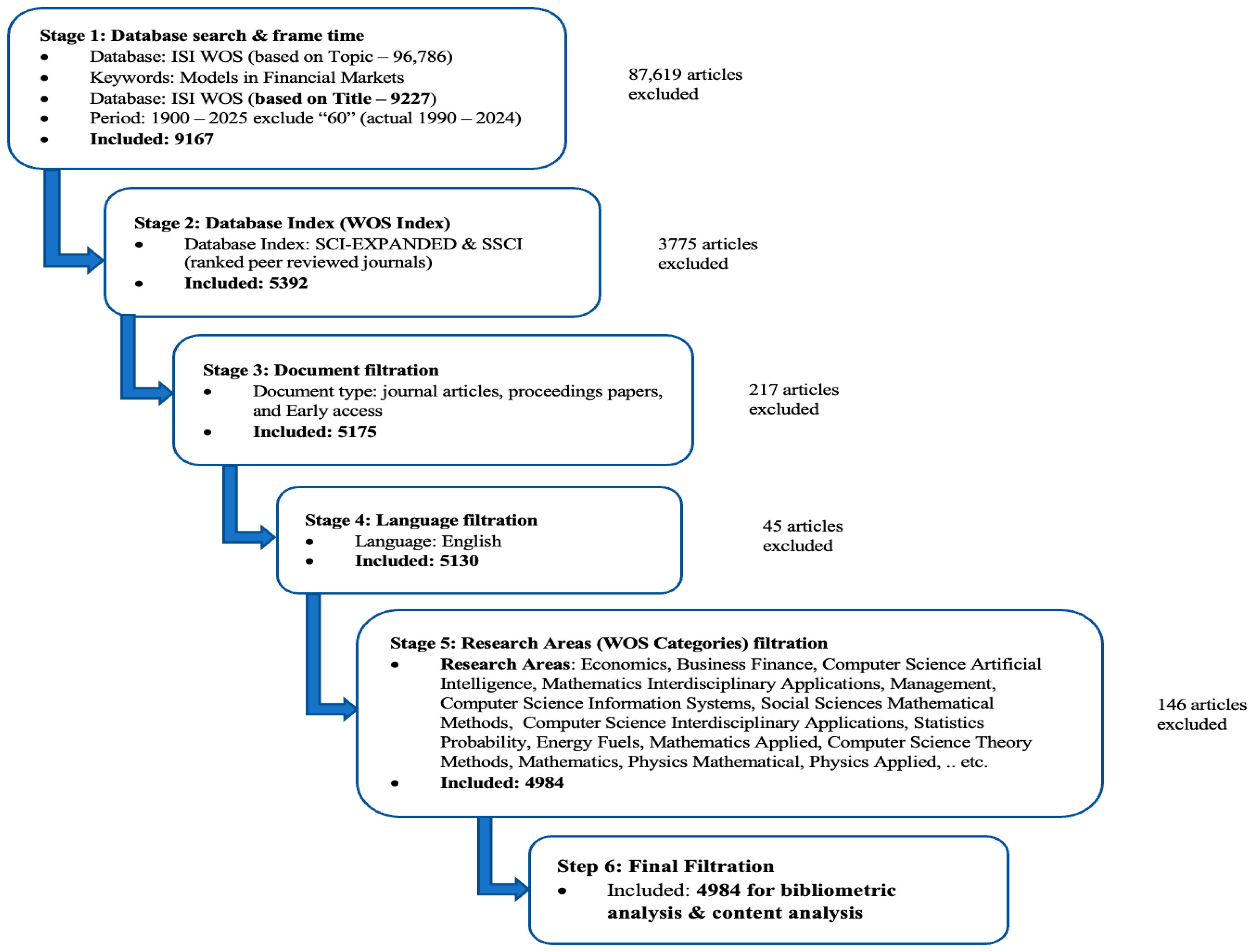
3.1.3. Refinement Process and Search Results
- The search string and Keywords
3.1.4. Analytical Dimensions and Link to Research Questions
3.2. Content Analysis (CA)
4. Result and Discussion of Bibliometric Review
4.1. Descriptive Analysis
4.1.1. Sample Description
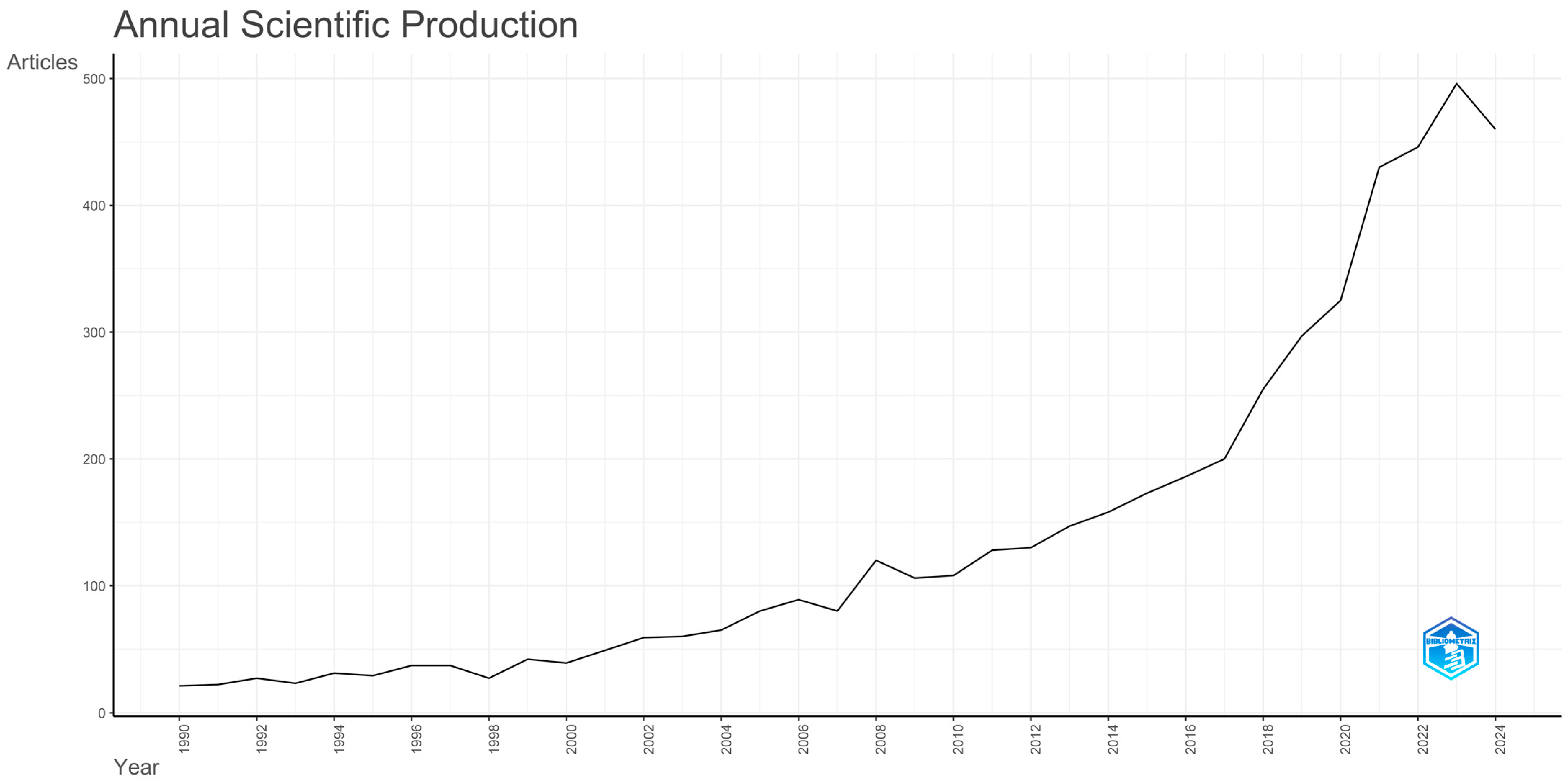
4.1.2. Characteristics of Scientific Output
4.1.3. Authors’ Contributions
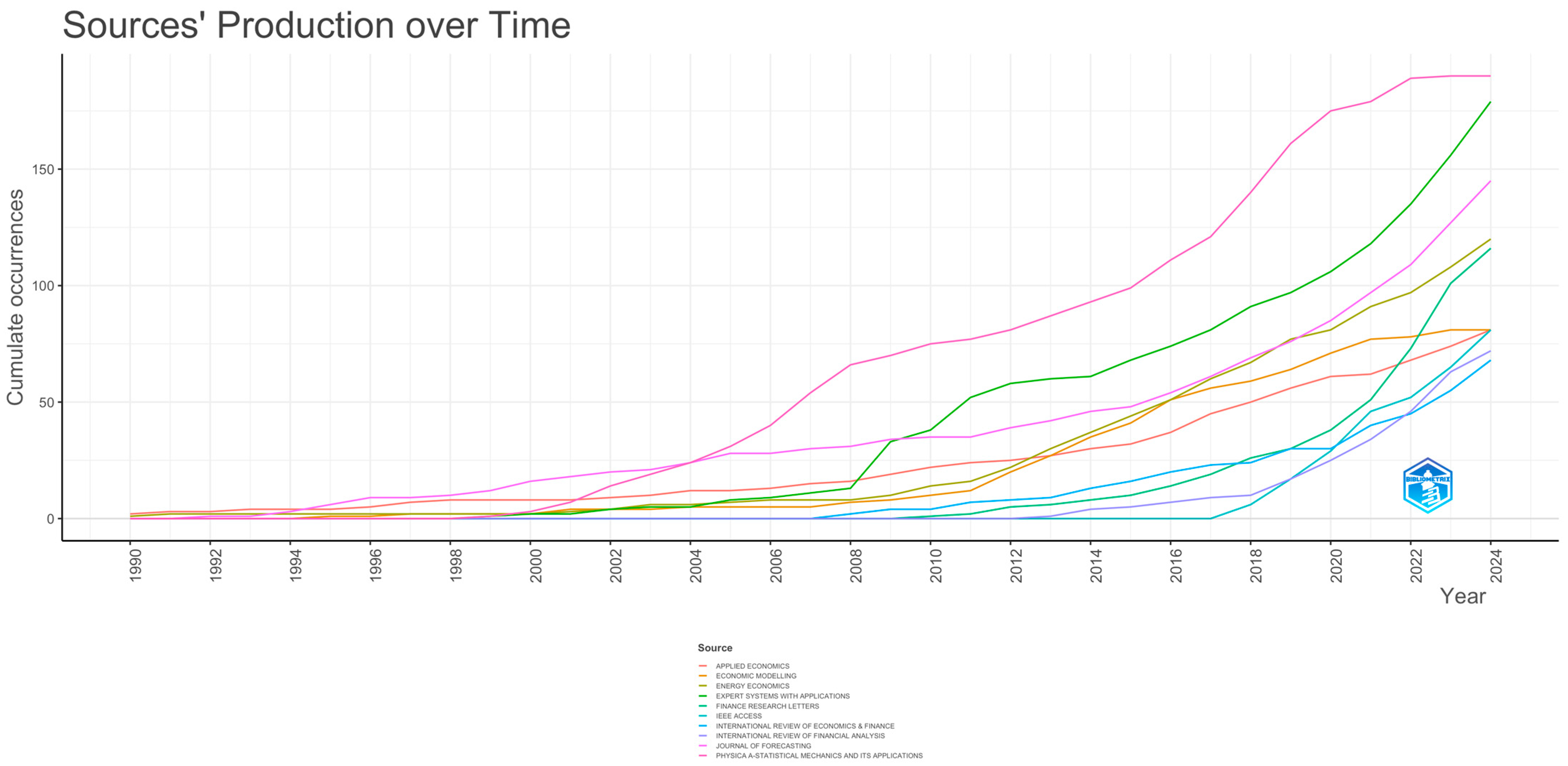
4.1.4. Top Contributing Journals and Publications
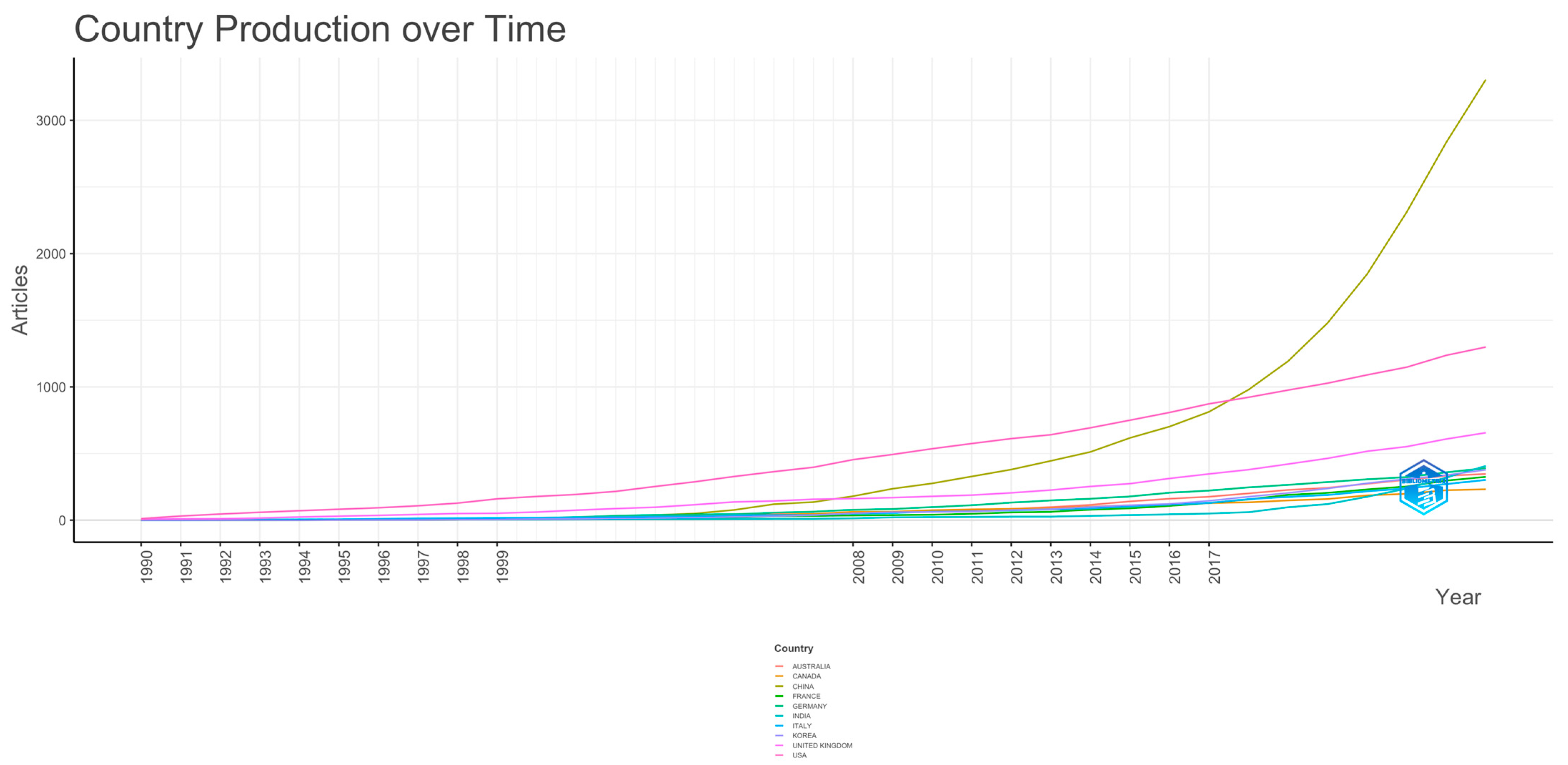
4.1.5. Geographic and Institutional Dissemination of Publications
4.2. Conceptual Structure
4.2.1. Overview of Conceptual Structure of FMM’s Literature
4.2.2. Co-Occurrence Networks
4.2.3. Thematic Map
4.2.4. Thematic Evolution of Financial Market Modeling Research (1990–2024)
4.2.5. Factorial Analysis
4.3. Intellectual Structure
4.3.1. Co-Citation Analysis
4.3.2. Historiograph Network Tracing the Intellectual Trajectory of FMM
4.4. Social Structure: Author Collaboration Network
5. Content Analysis
6. Implications, Evaluation and Future Research Directions
6.1. Practical and Theoretical Implications
6.2. Critical Evaluation of Methodological Weaknesses in Financial Market Modelling
6.3. Suggested Avenues for Future Research
7. Conclusions and Limitations
Supplementary Materials
Author Contributions
Funding
Institutional Review Board Statement
Informed Consent Statement
Data Availability Statement
Acknowledgments
Conflicts of Interest
| 1 | Two articles out of the 4984 were excluded as they were classified as early access publications from 2025, whereas the review strictly focuses on literature published up to the end of 2024. |
References
- Aloui, R., Ben Aïssa, M. S., & Nguyen, D. K. (2013). Conditional dependence structure between oil prices and exchange rates: A copula-GARCH approach. Journal of International Money and Finance, 31(3), 719–738. [Google Scholar] [CrossRef]
- Alshater, M. M., Hassan, M. K., Khan, A., & Saba, I. (2020). Influential and intellectual structure of Islamic finance: A bibliometric review. International Journal of Islamic and Middle Eastern Finance and Management, 14(2), 339–365. [Google Scholar] [CrossRef]
- Al-Thaqeb, S. A., & Algharabali, B. G. (2019). Economic policy uncertainty: A literature review. Journal of Economic Asymmetries, 20, e00133. [Google Scholar] [CrossRef]
- Amihud, Y. (2002). Illiquidity and stock returns: Cross-section and time-series effects. Journal of Financial Markets, 5(1), 31–56. [Google Scholar] [CrossRef]
- Andersen, T. G., Bollerslev, T., Diebold, F. X., & Labys, P. (2003). Modeling and forecasting realized volatility. Econometrica, 71(2), 579–625. [Google Scholar] [CrossRef]
- Ang, A., & Bekaert, G. (2007). Stock return predictability: Is it there? The Review of Financial Studies, 20(3), 651–707. [Google Scholar] [CrossRef]
- Ang, A., Hodrick, R. J., Xing, Y., & Zhang, X. (2006). The cross-section of volatility and expected returns. Journal of Finance, 61(1), 259–299. [Google Scholar] [CrossRef]
- Aria, M., & Cuccurullo, C. (2017). Bibliometrix: An R-tool for comprehensive science mapping analysis. Journal of Informetrics, 11(4), 959–975. [Google Scholar] [CrossRef]
- Asgharian, H., Hou, A. J., & Javed, F. (2013). The importance of macroeconomic variables for variance prediction: A GARCH-MIDAS approach. Journal of Forecasting, 32(7), 600–612. [Google Scholar] [CrossRef]
- Atsalakis, G. S., Atsalaki, I. G., Pasiouras, F., & Zopounidis, C. (2019). Bitcoin price forecasting with neuro-fuzzy techniques. European Journal of Operational Research, 276(2), 770–780. [Google Scholar] [CrossRef]
- Atsalakis, G. S., & Valavanis, K. P. (2009). Surveying stock market forecasting techniques–Part II: Soft computing methods. Expert Systems with Applications, 36(3), 5932–5941. [Google Scholar] [CrossRef]
- Avramov, D. (2002). Stock return predictability and model uncertainty. Journal of Financial Economics, 64(3), 423–458. [Google Scholar] [CrossRef]
- Bahrammirzaee, A. (2010). A comparative survey of artificial intelligence applications in finance: Artificial neural networks, expert system and hybrid intelligent systems. Neural Computing and Applications, 19(8), 1165–1195. [Google Scholar] [CrossRef]
- Baillie, R. T. (1996). Long memory processes and fractional integration in econometrics. Journal of Econometrics, 73(1), 5–59. [Google Scholar] [CrossRef]
- Baker, M., & Wurgler, J. (2006). Investor sentiment and the cross-section of stock returns. The Journal of Finance, 61(4), 1645–1680. [Google Scholar] [CrossRef]
- Baker, S. R., Bloom, N., & Davis, S. J. (2016). Measuring economic policy uncertainty. Quarterly Journal of Economics, 131(4), 1593–1636. [Google Scholar] [CrossRef]
- Bal, C. K., & Mishra, R. K. (2025). Stock market analysis and prediction: A bibliometric analysis. Journal of Scientometric Research, 14(1), 221–238. [Google Scholar] [CrossRef]
- Ban, G.-Y., El Karoui, N., & Lim, A. E. B. (2018). Machine learning and portfolio optimization. Management Science, 64(3), 1136–1154. [Google Scholar] [CrossRef]
- Bao, W., Yue, J., & Rao, Y. (2017). A deep learning framework for financial time series using stacked autoencoders and long–short term memory. PLoS ONE, 12(7), e0180944. [Google Scholar] [CrossRef] [PubMed]
- Barabási, A. L., & Albert, R. (1999). Emergence of scaling in random networks. Science, 286(5439), 509–512. [Google Scholar] [CrossRef]
- Barberis, N., Shleifer, A., & Vishny, R. (1998). A model of investor sentiment. Journal of Financial Economics, 49(3), 307–343. [Google Scholar] [CrossRef]
- Barberis, N., & Thaler, R. (2003). A survey of behavioral finance. In G. M. Constantinides, M. Harris, & R. Stulz (Eds.), Handbook of the economics of finance (Vol. 1B, pp. 1053–1128). Elsevier. [Google Scholar] [CrossRef]
- Bariviera, A. F., & Merediz-Solà, I. (2021). Where do we stand in cryptocurrencies economic research? A survey based on hybrid analysis. Journal of Economic Surveys, 35(2), 377–407. [Google Scholar] [CrossRef]
- Barunik, J., & Krehlik, T. (2018). Measuring the frequency dynamics of financial and macroeconomic connectedness. Journal of Financial Econometrics, 16(2), 271–296. [Google Scholar] [CrossRef]
- Black, F. (1986). Noise. Journal of Finance, 41(3), 528–543. [Google Scholar] [CrossRef]
- Blackledge, J., & Lamphiere, M. (2022). A review of the fractal market hypothesis for trading and market price prediction. Mathematics, 10(1), 117. [Google Scholar] [CrossRef]
- Bollen, J., Mao, H., & Zeng, X. (2011). Twitter mood predicts the stock market. Journal of Computational Science, 2(1), 1–8. [Google Scholar] [CrossRef]
- Bollerslev, T. (1986). Generalized autoregressive conditional heteroskedasticity. Journal of Econometrics, 31(3), 307–327. [Google Scholar] [CrossRef]
- Bollerslev, T. (1990). Modelling the Coherence in short-run nominal exchange rates: A multivariate generalized ARCH model. The Review of Economics and Statistics, 72(3), 498–505. [Google Scholar] [CrossRef]
- Bollerslev, T., & Mikkelsen, H. O. (1996). Modeling and pricing long memory in stock market volatility. Journal of Econometrics, 73(1), 151–184. [Google Scholar] [CrossRef]
- Bollerslev, T., Todorov, V., & Li, S. Z. (2013). Jump tails, extreme dependencies, and the distribution of stock returns. Journal of Econometrics, 172(2), 307–324. [Google Scholar] [CrossRef]
- Bouri, E., Balcilar, M., Gupta, R., & Roubaud, D. (2017). Can bitcoin hedge global uncertainty? Evidence from quantile-in-quantile regressions. Finance Research Letters, 23, 87–95. [Google Scholar] [CrossRef]
- Bouri, E., Demirer, R., Gabauer, D., & Gupta, R. (2022). Financial market connectedness: The role of investors’ happiness. Finance Research Letters, 44, 102075. [Google Scholar] [CrossRef]
- Box, G. E. P., Jenkins, G. M., Reinsel, G. C., & Ljung, G. M. (2015). Time series analysis: Forecasting and control (5th ed.). John Wiley & Sons. ISBN 9781118675021. [Google Scholar]
- Braun, V., & Clarke, V. (2006). Using thematic analysis in psychology. Qualitative Research in Psychology, 3(2), 77–101. [Google Scholar] [CrossRef]
- Budler, M., Župič, I., & Trkman, P. (2021). The development of business model research: A bibliometric review. Journal of Business Research, 135, 480–495. [Google Scholar] [CrossRef]
- Campbell, J. Y., & Hentschel, L. (1992). No news is good news: An asymmetric model of changing volatility in stock returns. Journal of Financial Economics, 31(3), 281–318. [Google Scholar] [CrossRef]
- Campbell, J. Y., & Thompson, S. B. (2008). Predicting excess stock returns out of sample: Can anything beat the historical average? The Review of Financial Studies, 21(4), 1509–1531. [Google Scholar] [CrossRef]
- Campiglio, E., Daumas, L., Monnin, P., & von Jagow, A. (2023). Climate-related risks in financial assets. Journal of Economic Surveys, 37(3), 950–992. [Google Scholar] [CrossRef]
- Caporin, M., & McAleer, M. (2012). Do we really need both BEKK and DCC? A tale of two multivariate GARCH models. Journal of Economic Surveys, 26(4), 736–751. [Google Scholar] [CrossRef]
- Carhart, M. M. (1997). On persistence in mutual fund performance. Journal of Finance, 52(1), 57–82. [Google Scholar] [CrossRef]
- Cavalcante, R. C., Brasileiro, R. C., Souza, V. L., Nobrega, J. P., & Oliveira, A. L. (2016). Computational intelligence and financial markets: A survey and future directions. Expert Systems with Applications, 55, 194–211. [Google Scholar] [CrossRef]
- Chan, K. F., & Maheu, J. M. (2002). Conditional jump dynamics in stock market returns. Journal of Business & Economic Statistics, 20(3), 377–389. [Google Scholar] [CrossRef]
- Chen, H., De, P., Hu, Y. J., & Hwang, B. H. (2021). Wisdom of crowds: The value of stock opinions transmitted through social media. Review of Financial Studies, 27(5), 1367–1403. [Google Scholar] [CrossRef]
- Chen, J., & Yang, L. (2021). A bibliometric review of volatility spillovers in financial markets: Knowledge bases and research fronts. Emerging Markets Finance and Trade, 57(5), 1358–1379. [Google Scholar] [CrossRef]
- Chen, L., Pelger, M., & Zhu, J. (2024). Deep learning in asset pricing. Management Science, 70(2), 714–750. [Google Scholar] [CrossRef]
- Chen, S.-H., Kuo, T.-W., & Hoi, K.-M. (2008). Genetic programming and financial trading: How much about “what we know”. In C. Zopounidis, M. Doumpos, & P. M. Pardalos (Eds.), Handbook of financial engineering (Vol. 18, pp. 99–154). Springer optimization and its applications. Springer. [Google Scholar] [CrossRef]
- Chiroma, H., Abdulkareem, S., Abubakar, A., & Usman, M. J. (2013). Computational intelligence techniques with application to crude oil price projection: A literature survey from 2001–2012. Neural Network World, 23(6), 523–551. [Google Scholar] [CrossRef]
- Chiroma, H., Abdul-Kareem, S., Shukri Mohd Noor, A., Abubakar, A. I., Sohrabi Safa, N., Shuib, L., Fatihu Hamza, M., Ya’u Gital, A., & Herawan, T. (2016). A review on artificial intelligence methodologies for the forecasting of crude oil price. Intelligent Automation & Soft Computing, 22(3), 449–462. [Google Scholar]
- Chong, E., Han, C., & Park, F. C. (2017). Deep learning networks for stock market analysis and prediction: Methodology, data representations, and case studies. Expert Systems with Applications, 83, 187–205. [Google Scholar] [CrossRef]
- Choudhry, T. (2005). Time-varying beta and the Asian financial crisis: Evidence from Malaysian and Taiwanese firms. Pacific-Basin Finance Journal, 13(1), 93–118. [Google Scholar] [CrossRef]
- Ciner, C. (2001). Energy shocks and financial markets: Nonlinear linkages. Studies in Nonlinear Dynamics & Econometrics, 5(3), 203–212. [Google Scholar] [CrossRef]
- Clark, T. E., & West, K. D. (2007). Approximately normal tests for equal predictive accuracy in nested models. Journal of Econometrics, 138(1), 291–311. [Google Scholar] [CrossRef]
- Cobo, M. J., López-Herrera, A. G., Herrera-Viedma, E., & Herrera, F. (2011). An approach for detecting, quantifying, and visualizing the evolution of a research field: A practical application to the fuzzy sets theory field. Journal of Informetrics, 5(1), 146–166. [Google Scholar] [CrossRef]
- Cobo, M. J., López-Herrera, A. G., Herrera-Viedma, E., & Herrera, F. (2012). SciMAT: A new science mapping analysis software tool. Journal of the American Society for Information Science and Technology, 63(8), 1609–1630. [Google Scholar] [CrossRef]
- Cochrane, J. H. (2011). Presidential address: Discount rates. Journal of Finance, 66(4), 1047–1108. [Google Scholar] [CrossRef]
- Cont, R. (2001). Empirical properties of asset returns: Stylized facts and statistical issues. Quantitative Finance, 1(2), 223–236. [Google Scholar] [CrossRef]
- Corsi, F. (2009). A simple approximate long-memory model of realized volatility. Journal of Financial Econometrics, 7(2), 174–196. [Google Scholar] [CrossRef]
- Costa, D. F., Carvalho, F. D. M., & Moreira, B. C. D. M. (2019). Behavioral economics and behavioral finance: A bibliometric analysis of the scientific fields. Journal of Economic Surveys, 33(1), 3–24. [Google Scholar] [CrossRef]
- Costola, M., Gheno, A., Gianfrate, G., Mazzù, S., & Pozzoli, M. (2022). Global risks, the macroeconomy, and asset prices. Empirical Economics, 63, 2701–2727. [Google Scholar] [CrossRef] [PubMed]
- Da, Z., Engelberg, J., & Gao, P. (2011). In search of attention. Journal of Finance, 66(4), 1461–1499. [Google Scholar] [CrossRef]
- Deng, Y., Bao, F., Kong, Y., Ren, Z., & Dai, Q. (2016). Deep direct reinforcement learning for financial signal representation and trading. IEEE Transactions on Neural Networks and Learning Systems, 28(3), 653–664. [Google Scholar] [CrossRef]
- Diebold, F. X. (2015). Comparing predictive accuracy, twenty years later: A personal perspective on the use and abuse of Diebold–Mariano tests. Journal of Business & Economic Statistics, 33(1), 1. [Google Scholar] [CrossRef]
- Diebold, F. X., & Mariano, R. S. (1995). Comparing predictive accuracy. Journal of Business & Economic Statistics, 13(3), 253–263. [Google Scholar] [CrossRef] [PubMed]
- Diebold, F. X., & Rudebusch, G. D. (1996). Measuring business cycles: A modern perspective. The Review of Economics and Statistics, 78(1), 67–77. [Google Scholar] [CrossRef]
- Diebold, F. X., & Yilmaz, K. (2009). Measuring financial asset return and volatility spillovers, with application to global equity markets. Economic Journal, 119(534), 158–171. [Google Scholar] [CrossRef]
- Diebold, F. X., & Yilmaz, K. (2012). Better to give than to receive: Predictive directional measurement of volatility spillovers. International Journal of Forecasting, 28(1), 57–66. [Google Scholar] [CrossRef]
- Ding, Z., Granger, C. W. J., & Engle, R. F. (1993). A long memory property of stock market returns and a new model. Journal of Empirical Finance, 1(1), 83–106. [Google Scholar] [CrossRef]
- Donthu, N., Kumar, S., Mukherjee, D., Pandey, N., & Lim, W. M. (2021). How to conduct a bibliometric analysis: An overview and guidelines. Journal of Business Research, 133, 285–296. [Google Scholar] [CrossRef]
- Elton, E. J., & Gruber, M. J. (2020). A review of the performance measurement of long-term mutual funds. Financial Analysts Journal, 76(3), 22–37. [Google Scholar] [CrossRef]
- Engelberg, J., & Parsons, C. A. (2011). The causal impact of media in financial markets. Journal of Finance, 66(1), 67–97. [Google Scholar] [CrossRef]
- Engle, R. (2002). Dynamic conditional correlation: A simple class of multivariate GARCH models. Journal of Business & Economic Statistics, 20(3), 339–350. [Google Scholar] [CrossRef]
- Engle, R. F. (1982). Autoregressive conditional heteroscedasticity with estimates of the variance of United Kingdom inflation. Econometrica, 50(4), 987–1007. [Google Scholar] [CrossRef]
- Engle, R. F., & Granger, C. W. J. (1987). Co-integration and error correction: Representation, estimation, and testing. Econometrica, 55(2), 251–276. [Google Scholar] [CrossRef]
- Engle, R. F., & Kroner, K. F. (1995). Multivariate simultaneous generalized ARCH. Econometric Theory, 11(1), 122–150. [Google Scholar] [CrossRef]
- Fama, E. F. (1970). Efficient capital markets: A review of theory and empirical work. Journal of Finance, 25(2), 383–417. [Google Scholar] [CrossRef]
- Fama, E. F., & French, K. R. (1988). Permanent and temporary components of stock prices. Journal of Political Economy, 96(2), 246–273. [Google Scholar] [CrossRef]
- Fama, E. F., & French, K. R. (1992). The cross-section of expected stock returns. Journal of Finance, 47(2), 427–465. [Google Scholar] [CrossRef]
- Fama, E. F., & French, K. R. (1993). Common risk factors in the returns on stocks and bonds. Journal of Financial Economics, 33(1), 3–56. [Google Scholar] [CrossRef]
- Fama, E. F., & French, K. R. (2015). A five-factor asset pricing model. Journal of Financial Economics, 116(1), 1–22. [Google Scholar] [CrossRef]
- Fang, S., Wei, Y., & Wang, S. (2023). 30 years of exchange rate analysis and forecasting: A bibliometric review. Journal of Economic Surveys, 38(3), 973–1007. [Google Scholar] [CrossRef]
- Fatemi, A. M., Glaum, M., & Kaiser, S. (2018). ESG performance and firm value: The moderating role of disclosure. Global Finance Journal, 38, 45–64. [Google Scholar] [CrossRef]
- Ferreira, F. G. D. C., Gandomi, A. H., & Cardoso, R. T. N. (2021). Artificial intelligence applied to stock market trading: A review. IEEE Access, 9, 1–31. [Google Scholar] [CrossRef]
- Fischer, T., & Krauss, C. (2018). Deep learning with long short-term memory networks for financial market predictions. European Journal of Operational Research, 270(2), 654–669. [Google Scholar] [CrossRef]
- Friede, G., Busch, T., & Bassen, A. (2015). ESG and financial performance: Aggregated evidence from more than 2000 empirical studies. Journal of Sustainable Finance & Investment, 5(4), 210–233. [Google Scholar] [CrossRef]
- Gabauer, D., & Gupta, R. (2018). On the transmission mechanism of country-specific and international economic uncertainty spillovers: Evidence from a TVP-VAR connectedness decomposition approach. Economics Letters, 171, 63–71. [Google Scholar] [CrossRef]
- Gabauer, D., & Gupta, R. (2020). Spillovers across macroeconomic, financial and real estate uncertainties: A time-varying approach. Structural Change and Economic Dynamics, 52, 167–173. [Google Scholar] [CrossRef]
- Gaies, B., Nakhli, M. S., Sahut, J. M., & Guesmi, K. (2021). Is Bitcoin rooted in confidence?—Unraveling the determinants of globalized digital currencies. Technological Forecasting and Social Change, 172, 121038. [Google Scholar] [CrossRef]
- Gandhmal, D. P., & Kumar, K. (2019). Systematic analysis and review of stock market prediction techniques. Computer Science Review, 34, 100190. [Google Scholar] [CrossRef]
- García, A. S., Mendes-Da-Silva, W., & Orsato, R. J. (2017). Sensitive industries produce better ESG performance: Evidence from emerging markets. Journal of Cleaner Production, 286, 124956. [Google Scholar] [CrossRef]
- García-Medina, A., & Aguayo-Moreno, E. (2024). LSTM–GARCH Hybrid model for the prediction of volatility in cryptocurrency portfolios. Computational Economics, 63, 1511–1542. [Google Scholar] [CrossRef] [PubMed]
- Ghoddusi, H., Creamer, G. G., & Rafizadeh, N. (2019). Machine learning in energy economics and finance: A review. Energy Economics, 81, 709–727. [Google Scholar] [CrossRef]
- Ghosh, I., & Jana, R. K. (2024). A granular machine learning framework for forecasting high-frequency financial market variables during the recent black swan event. Technological Forecasting and Social Change, 194, 122719. [Google Scholar] [CrossRef]
- Glosten, L. R., Jagannathan, R., & Runkle, D. E. (1993). On the relation between the expected value and the volatility of the nominal excess return on stocks. The Journal of Finance, 48(5), 1779–1801. [Google Scholar] [CrossRef]
- Glosten, L. R., & Milgrom, P. R. (1985). Bid, ask and transaction prices in a specialist market with heterogeneously informed traders. Journal of Financial Economics, 14(1), 71–100. [Google Scholar] [CrossRef]
- Goyal, K., & Kumar, S. (2021). Financial literacy: A systematic review and bibliometric analysis. International Journal of Consumer Studies, 45(1), 80–105. [Google Scholar] [CrossRef]
- Gu, S., Kelly, B., & Xiu, D. (2020). Empirical asset pricing via machine learning. Review of Financial Studies, 33(5), 2223–2273. [Google Scholar] [CrossRef]
- Hamilton, J. D., & Susmel, R. (1994). Autoregressive conditional heteroskedasticity and changes in regime. Journal of Econometrics, 64(1–2), 307–333. [Google Scholar] [CrossRef]
- Hansen, P. R., Huang, Z., & Shek, H. H. (2012). Realized GARCH: A joint model for returns and realized measures of volatility. Journal of Applied Econometrics, 27(6), 877–906. [Google Scholar] [CrossRef]
- Henrique, B. M., Sobreiro, V. A., & Kimura, H. (2019). Literature review: Machine learning techniques applied to financial market prediction. Expert Systems with Applications, 124, 226–251. [Google Scholar] [CrossRef]
- Hochreiter, S., & Schmidhuber, J. (1997). Long short-term memory. Neural Computation, 9(8), 1735–1780. [Google Scholar] [CrossRef] [PubMed]
- Hou, K., Xue, C., & Zhang, L. (2015). Digesting anomalies: An investment approach. Review of Financial Studies, 28(3), 650–705. [Google Scholar] [CrossRef]
- Hsu, C. L., & Chiang, C. H. (2015). A bibliometric study of SSME in information systems research. Scientometrics, 102(1), 1835–1865. [Google Scholar] [CrossRef]
- Jain, D., Dash, M. K., & Thakur, K. S. (2022). Development of research agenda on demonetization based on bibliometric visualization. International Journal of Emerging Markets, 17(10), 2584–2604. [Google Scholar] [CrossRef]
- Jegadeesh, N., & Titman, S. (1993). Returns to buying winners and selling losers: Implications for stock market efficiency. The Journal of Finance, 48(1), 65–91. [Google Scholar] [CrossRef]
- Jiang, H.-D., Liu, L.-J., Dong, K., & Fu, Y.-W. (2022). How will sectoral coverage in the carbon trading system affect the total oil consumption in China? A CGE-based analysis. Energy Economics, 110, 105996. [Google Scholar] [CrossRef]
- Jiang, W. (2021). Applications of deep learning in stock market prediction: Recent progress. Expert Systems with Applications, 184, 115537. [Google Scholar] [CrossRef]
- Kandel, S., & Stambaugh, R. F. (1996). On the predictability of stock returns: An asset-allocation perspective. Journal of Finance, 51(2), 385–424. [Google Scholar] [CrossRef]
- Katsiampa, P. (2017). Volatility estimation for Bitcoin: A comparison of GARCH models. Economics Letters, 158, 3–6. [Google Scholar] [CrossRef]
- Kilian, L., & Park, C. (2009). The impact of oil price shocks on the U.S. stock market. International Economic Review, 50(4), 1267–1287. [Google Scholar] [CrossRef]
- Kim, C.-J. (2003). Unobserved-component time series models with Markov-switching heteroskedasticity: Changes in regime and the link between inflation rates and inflation uncertainty. Journal of Business & Economic Statistics, 21(1), 24–36. [Google Scholar] [CrossRef]
- Kim, C. J., Nelson, C. R., & Startz, R. (1998). Testing for mean reversion in heteroskedastic data based on Gibbs-sampling-augmented randomization. Journal of Empirical Finance, 5(2), 131–154. [Google Scholar] [CrossRef]
- Kim, H. Y., & Won, C. H. (2018). Forecasting the volatility of stock price index: A hybrid model integrating LSTM with multiple GARCH-type models. Expert Systems with Applications, 103, 25–37. [Google Scholar] [CrossRef]
- Kraaijeveld, O., & De Smedt, J. (2020). The predictive power of public Twitter sentiment for forecasting cryptocurrency prices. Journal of International Financial Markets, Institutions and Money, 65, 101188. [Google Scholar] [CrossRef]
- Kraus, S., Kumar, S., Lim, W. M., Kaur, J., Sharma, A., & Schiavone, F. (2023). From moon landing to metaverse: Tracing the evolution of Technological Forecasting and Social Change. Technological Forecasting and Social Change, 189, 122381. [Google Scholar] [CrossRef]
- Krauss, C., Do, X. A., & Huck, N. (2017). Deep neural networks, gradient-boosted trees, random forests: Statistical arbitrage on the S&P 500. European Journal of Operational Research, 259(2), 689–702. [Google Scholar] [CrossRef]
- Kristjanpoller, W. (2024). A hybrid econometrics and machine learning based modeling of realized volatility of natural gas. Financial Innovation, 10, 45. [Google Scholar] [CrossRef]
- Kristjanpoller, W., & Minutolo, M. C. (2016). Forecasting volatility of oil price using an artificial neural network–GARCH model. Expert Systems with Applications, 65, 233–241. [Google Scholar] [CrossRef]
- Kristjanpoller, W., & Minutolo, M. C. (2018). A hybrid volatility forecasting framework integrating GARCH, artificial neural network, technical analysis and principal components analysis. Expert Systems with Applications, 109, 1–11. [Google Scholar] [CrossRef]
- Kumar, B. S., & Ravi, V. (2016). A survey of the applications of text mining in financial domain. Knowledge-Based Systems, 114, 128–147. [Google Scholar] [CrossRef]
- Kumar, G., Jain, S., & Singh, U. P. (2021). Stock market forecasting using computational intelligence: A survey. Archives of Computational Methods in Engineering, 28, 1069–1101. [Google Scholar] [CrossRef]
- Kumbure, M. M., Lohrmann, C., Luukka, P., & Porras, J. (2022). Machine learning techniques and data for stock market forecasting: A literature review. Expert Systems with Applications, 197, 116659. [Google Scholar] [CrossRef]
- Kyriazis, N., Papadamou, S., Tzeremes, P. G., & Corbet, S. (2023). The differential influence of social media sentiment on cryptocurrency returns and volatility during COVID-19. Quarterly Review of Economics and Finance, 89, 307–317. [Google Scholar] [CrossRef]
- Lai, K. K., Yu, L., Wang, S., & Wei, H. (2006). A novel nonlinear neural network ensemble model for financial time series forecasting. In Computational science—ICCS 2006 (Vol. 3991, pp. 790–793). Lecture notes in computer science. Springer. [Google Scholar] [CrossRef]
- LeBaron, B. (2006). Agent-based computational finance. In Handbook of computational economics (Vol. 2, pp. 1187–1233). Elsevier. [Google Scholar] [CrossRef]
- Lettau, M., & Ludvigson, S. (2001). Consumption, aggregate wealth, and expected stock returns. Journal of Finance, 56(3), 815–849. [Google Scholar] [CrossRef]
- Li, A. W., & Bastos, G. S. (2020). Stock market forecasting using deep learning and technical analysis: A systematic review. IEEE Access, 8, 185232–185242. [Google Scholar] [CrossRef]
- Li, K., Rollins, J., & Yan, E. (2018). Web of Science use in published research and review papers 1997–2017: A selective, dynamic, cross-domain, content-based analysis. Scientometrics, 115(1), 1–20. [Google Scholar] [CrossRef] [PubMed]
- Lintner, J. (1965). The valuation of risk assets and the selection of risky investments in stock portfolios and capital budgets. Review of Economics and Statistics, 47(1), 13–37. [Google Scholar] [CrossRef]
- Lo, A. W. (2004). The adaptive markets hypothesis: Market efficiency from an evolutionary perspective. The Journal of Portfolio Management, 30(5), 15–29. [Google Scholar] [CrossRef]
- Lo, A. W. (2005). Reconciling efficient markets with behavioral finance: The adaptive markets hypothesis. Journal of Investment Consulting, 7(2), 21–44. [Google Scholar]
- Lu, H., Ma, X., Ma, M., & Zhu, S. (2021). Energy price prediction using data-driven models: A decade review. Computer Science Review, 39, 100356. [Google Scholar] [CrossRef]
- Lux, T. (1995). Herd behaviour, bubbles and crashes. Economic Journal, 105(431), 881–896. [Google Scholar] [CrossRef]
- Lux, T., & Marchesi, M. (1999). Scaling and criticality in a stochastic multi-agent model of a financial market. Nature, 397(6719), 498–500. [Google Scholar] [CrossRef]
- Mai, F., Tian, S., Lee, C., & Ma, L. (2019). Deep learning models for bankruptcy prediction using textual disclosures. European Journal of Operational Research, 274(2), 743–758. [Google Scholar] [CrossRef]
- Maiti, M. (2020). A critical review on evolution of risk factors and factor models. Journal of Economic Surveys, 34(1), 175–184. [Google Scholar] [CrossRef]
- Mandelbrot, B. (1963). The variation of certain speculative prices. The Journal of Business, 36(4), 394–419. [Google Scholar] [CrossRef]
- Manickavasagam, J., Visalakshmi, S., & Apergis, N. (2020). A novel hybrid approach to forecast crude oil futures using intraday data. Technological Forecasting and Social Change, 158, 120126. [Google Scholar] [CrossRef]
- Mongeon, P., & Paul-Hus, A. (2016). The journal coverage of Web of Science and Scopus: A comparative analysis. Scientometrics, 106(1), 213–228. [Google Scholar] [CrossRef]
- Nassirtoussi, A. K., Aghabozorgi, S., Wah, T. Y., & Ngo, D. C. L. (2014). Text mining for market prediction: A systematic review. Expert Systems with Applications, 41(16), 7653–7670. [Google Scholar] [CrossRef]
- Nassirtoussi, A. K., Aghabozorgi, S., Wah, T. Y., & Ngo, D. C. L. (2015). Text mining of news-headlines for FOREX market prediction: A multi-layer dimension reduction algorithm with semantics and sentiment. Expert Systems with Applications, 42(1), 306–324. [Google Scholar] [CrossRef]
- Nazareth, N., & Reddy, Y. Y. R. (2023). Financial applications of machine learning: A literature review. Expert Systems with Applications, 219, 119640. [Google Scholar] [CrossRef]
- Neely, C. J., Rapach, D. E., Tu, J., & Zhou, G. (2014). Forecasting the equity risk premium: The role of technical indicators. Management Science, 60(7), 1772–1791. [Google Scholar] [CrossRef]
- Nelson, D. B. (1991). Conditional heteroskedasticity in asset returns: A new approach. Econometrica, 59(2), 347–370. [Google Scholar] [CrossRef]
- Nguyen, T. H., Shirai, K., & Velcin, J. (2015). Sentiment analysis on social media for stock movement prediction. Expert Systems with Applications, 42(24), 9603–9611. [Google Scholar] [CrossRef]
- Nosratabadi, S., Mosavi, A., Duan, P., Ghamisi, P., Filip, F., Band, S. S., Reuter, U., Gama, J., & Gandomi, A. H. (2020). Data science in economics: Comprehensive review of advanced machine learning and deep learning methods. Mathematics, 8(10), 1799. [Google Scholar] [CrossRef]
- Nti, I. K., Adekoya, A. F., & Weyori, B. A. (2020). A systematic review of fundamental and technical analysis of stock market predictions. Artificial Intelligence Review, 53(4), 3007–3057. [Google Scholar] [CrossRef]
- Okorie, D. I., & Lin, B. (2020). Crude oil price and cryptocurrencies: Evidence of volatility connectedness and hedging strategy. Energy Economics, 87, 104703. [Google Scholar] [CrossRef]
- Pagan, A. R. (1996). The econometrics of financial markets. Journal of Empirical Finance, 3(1), 15–102. [Google Scholar] [CrossRef]
- Page, M. J., McKenzie, J. E., Bossuyt, P. M., Boutron, I., Hoffmann, T. C., Mulrow, C. D., Shamseer, L., Tetzlaff, J. M., Akl, E. A., Brennan, S. E., Chou, R., Glanville, J., Grimshaw, J. M., Hróbjartsson, A., Lalu, M. M., Li, T., Loder, E. W., Mayo-Wilson, E., McDonald, S., … Moher, D. (2021). The PRISMA 2020 statement: An updated guideline for reporting systematic reviews. BMJ, 372, n71. [Google Scholar] [CrossRef]
- Pastor, L., Stambaugh, R. F., & Taylor, L. A. (2022). Dissecting green returns. Journal of Financial Economics, 146(2), 403–424. [Google Scholar] [CrossRef]
- Patel, J., Shah, S., Thakkar, P., & Kotecha, K. (2015). Predicting stock and stock price index movement using trend deterministic data preparation and machine learning techniques. Expert Systems with Applications, 42(1), 259–268. [Google Scholar] [CrossRef]
- Paul, J., Lim, W. M., O’Cass, A., Hao, A. W., & Bresciani, S. (2021). Scientific procedures and rationales for systematic literature reviews (SPAR-4-SLR). International Journal of Consumer Studies, 45(4), 1–16. [Google Scholar] [CrossRef]
- Paule-Vianez, J., Gómez-Martínez, R., & Prado-Román, C. (2020). A bibliometric analysis of behavioral finance with mapping analysis tools. European Research on Management and Business Economics, 26(2), 71–77. [Google Scholar] [CrossRef]
- Paye, B. S. (2012). Déjà vol: Predictive regressions for aggregate stock market volatility. Journal of Financial Economics, 106(3), 527–546. [Google Scholar] [CrossRef]
- Pettenuzzo, D., Timmermann, A., & Valkanov, R. (2014). Forecasting stock returns under economic constraints. Journal of Financial Economics, 114(3), 517–553. [Google Scholar] [CrossRef]
- Philippas, N., Economou, F., Babalos, V., & Kostakis, A. (2013). Herding behavior in REITs: Novel tests and the role of financial crisis. International Review of Financial Analysis, 29, 166–174. [Google Scholar] [CrossRef]
- Poon, S. H., & Granger, C. W. J. (2003). Forecasting volatility in financial markets: A review. Journal of Economic Literature, 41(2), 478–539. [Google Scholar] [CrossRef]
- Prado, J., Castro Alcântara, V., Melo Carvalho, F., Vieira, K., Machado, L., & Tonelli, D. (2016). Multivariate analysis of credit risk and bankruptcy research data: A bibliometric study involving different knowledge fields (1968–2014). Scientometrics, 106(3), 1007–1029. [Google Scholar] [CrossRef]
- Rapach, D. E., Strauss, J. K., & Zhou, G. (2010). Out-of-sample equity premium prediction: Combination forecasts and links to the real economy. Review of Financial Studies, 23(2), 821–862. [Google Scholar] [CrossRef]
- Reboredo, J. C. (2012). Modelling oil price and exchange rate co-movements. Journal of Policy Modeling, 34(3), 419–440. [Google Scholar] [CrossRef]
- Rohrbeck, R., & Kum, M. E. (2018). Corporate foresight and its impact on firm performance: A longitudinal analysis. Technological Forecasting and Social Change, 129(4), 105–116. [Google Scholar] [CrossRef]
- Ross, S. A. (1976). The arbitrage theory of capital asset pricing. Journal of Economic Theory, 13(3), 341–360. [Google Scholar] [CrossRef]
- Rua, A., & Nunes, L. C. (2009). International comovement of stock market returns: A wavelet analysis. Journal of Empirical Finance, 16(4), 632–639. [Google Scholar] [CrossRef]
- Salisu, A. A., & Gupta, R. (2021). Oil shocks and stock market volatility of the BRICS: A GARCH-MIDAS approach. Global Finance Journal, 48, 100546. [Google Scholar] [CrossRef]
- Salisu, A. A., Gupta, R., & Demirer, R. (2022). Oil price uncertainty shocks and global equity markets: Evidence from a GVAR model. Journal of Risk and Financial Management, 15(8), 355. [Google Scholar] [CrossRef]
- Schumaker, R. P., & Chen, H. (2009). Textual analysis of stock market prediction using breaking financial news: The AZFin text system. ACM Transactions on Information Systems (TOIS), 27(2), 1–19. [Google Scholar] [CrossRef]
- Sensoy, A., & Tabak, B. M. (2015). Time-varying long-term memory in the European Union stock markets. Physica A: Statistical Mechanics and Its Applications, 436, 147–158. [Google Scholar] [CrossRef]
- Sezer, O. B., Gudelek, M. U., & Ozbayoglu, A. M. (2020). Financial time series forecasting with deep learning: A systematic literature review: 2005–2019. Applied Soft Computing, 90, 106181. [Google Scholar] [CrossRef]
- Sharpe, W. F. (1964). Capital asset prices: A theory of market equilibrium under conditions of risk. Journal of Finance, 19(3), 425–442. [Google Scholar] [CrossRef]
- Shiller, R. J. (2000). Irrational exuberance. Princeton University Press. [Google Scholar] [CrossRef]
- Shynkevich, Y., McGinnity, T. M., Coleman, S. A., & Belatreche, A. (2017). Forecasting price movements using technical indicators: Investigating the impact of varying input window length. Neurocomputing, 168, 336–348. [Google Scholar] [CrossRef]
- Siganos, A., Vagenas-Nanos, E., & Verwijmeren, P. (2017). Divergence of sentiment and stock market trading. Journal of Banking & Finance, 78, 130–141. [Google Scholar] [CrossRef]
- Singh, S., Dhir, S., Das, V. M., & Sharma, A. (2020). Bibliometric overview of the Technological Forecasting and Social Change journal: Analysis from 1970 to 2018. Technological Forecasting and Social Change, 154, 119963. [Google Scholar] [CrossRef]
- Snyder, H. (2019). Literature review as a research methodology: An overview and guidelines. Journal of Business Research, 104, 333–339. [Google Scholar] [CrossRef]
- Stambaugh, R. F. (1999). Predictive regressions. Journal of Financial Economics, 54(3), 375–421. [Google Scholar] [CrossRef]
- Stoll, C., Klaaßen, L., & Gallersdörfer, U. (2019). The carbon footprint of bitcoin. Joule, 3(7), 1647–1661. [Google Scholar] [CrossRef]
- Suykens, J. A. K., & Vandewalle, J. (1999). Least squares support vector machine classifiers. Neural Processing Letters, 9, 293–300. [Google Scholar] [CrossRef]
- Tan, P. P., Chin, W. C., & Galagedera, D. U. A. (2014). A wavelet-based evaluation of time-varying long memory of equity markets: A paradigm in crisis. Physica A: Statistical Mechanics and Its Applications, 410, 345–358. [Google Scholar] [CrossRef]
- Tang, Y., Song, Z., Zhu, Y., Yuan, H., Hou, M., Ji, J., Tang, C., & Li, J. (2022). A survey on machine learning models for financial time series forecasting. Neurocomputing, 512, 363–380. [Google Scholar] [CrossRef]
- Tauchen, G., & Zhou, H. (2011). Realized jumps on financial markets and predicting credit spreads. Journal of Econometrics, 160(1), 102–118. [Google Scholar] [CrossRef]
- Taylor, S. J. (1994). Modelling stochastic volatility: A review and comparative study. Mathematical Finance, 4(2), 183–204. [Google Scholar] [CrossRef]
- Tetlock, P. C. (2007). Giving content to investor sentiment: The role of media in the stock market. Journal of Finance, 62(3), 1139–1168. [Google Scholar] [CrossRef]
- Thakkar, A., & Chaudhari, K. (2021). A comprehensive survey on deep neural networks for stock market: The need, challenges, and future directions. Expert Systems with Applications, 177, 114800. [Google Scholar] [CrossRef]
- Umar, Z., Jareño, F., & de la O González, M. (2021). The impact of COVID-19-related media coverage on the return and volatility connectedness of cryptocurrencies and fiat currencies. Technological Forecasting and Social Change, 172, 121025. [Google Scholar] [CrossRef]
- Wang, Y. D. (2018). Oil and the short-term predictability of stock returns in G7 markets. Journal of Empirical Finance, 45, 94–109. [Google Scholar] [CrossRef]
- Wątorek, M., Drożdż, S., Kwapień, J., Minati, L., Oświęcimka, P., & Stanuszek, M. (2021). Multiscale characteristics of the emerging global cryptocurrency market. Physics Reports, 901, 1–82. [Google Scholar] [CrossRef]
- Welch, I., & Goyal, A. (2008). A Comprehensive Look at the Empirical Performance of Equity Premium Prediction. Review of Financial Studies, 21(4), 1455–1508. [Google Scholar] [CrossRef]
- Weng, B., Lu, L., Wang, X., Megahed, F. M., & Martinez, W. (2018). Predicting short-term stock prices using ensemble methods and online data sources. Expert Systems with Applications, 112, 258–273. [Google Scholar] [CrossRef]
- White, H. D., & Griffith, B. C. (1981). Author cocitation: A literature measure of intellectual structure. Journal of the American Society for Information Science, 32(3), 163–171. [Google Scholar] [CrossRef]
- Wu, D., Fung, G. P. C., Yu, J. X., & Pan, Q. (2009). Stock prediction: An event-driven approach based on bursty keywords. Frontiers of Computer Science in China, 3(2), 145–157. [Google Scholar] [CrossRef]
- Wu, H., Long, H., Wang, Y., & Wang, Y. (2021). Stock index forecasting: A new fuzzy time series forecasting method. Journal of Forecasting, 40(4), 653–666. [Google Scholar] [CrossRef]
- Xing, F. Z., Cambria, E., & Welsch, R. E. (2018). Natural language based financial forecasting: A survey. Artificial Intelligence Review, 50(1), 49–73. [Google Scholar] [CrossRef]
- Xu, K., & Niu, H. (2023). Denoising or distortion: Does the decomposition–reconstruction modelling paradigm provide reliable prediction for crude oil price time series? Energy Economics, 128, 107129. [Google Scholar] [CrossRef]
- Xu, X., Chen, X., Jia, F., Brown, S., Gong, Y., & Xu, Y. (2018). Supply chain finance: A systematic literature review and bibliometric analysis. International Journal of Production Economics, 204, 160–173. [Google Scholar] [CrossRef]
- Yu, L., Wang, S., & Lai, K. K. (2008). Forecasting crude oil price with an EMD-based neural network ensemble learning paradigm. Energy Economics, 30(5), 2623–2635. [Google Scholar] [CrossRef]
- Zema, T., & Sulich, A. (2022). Models of electricity price forecasting: Bibliometric research. Energies, 15(15), 5642. [Google Scholar] [CrossRef]
- Zhang, C., Sjarif, N. N. A., & Ibrahim, R. (2023). Deep learning models for price forecasting of financial time series: A review of recent advancements: 2020–2022. arXiv, arXiv:2305.04811. [Google Scholar] [CrossRef]
- Zhang, C., Sjarif, N. N. A., & Ibrahim, R. B. (2022). Decision fusion for stock market prediction: A systematic review. IEEE Access, 10, 81364–81379. [Google Scholar] [CrossRef]
- Zhang, D., Zhang, Z., & Managi, S. (2019). A bibliometric analysis on green finance: Current status, development, and future directions. Finance Research Letters, 29, 425–430. [Google Scholar] [CrossRef]
- Zhang, G. P. (2003). Time series forecasting using a hybrid ARIMA and neural network model. Neurocomputing, 50, 159–175. [Google Scholar] [CrossRef]
- Zhang, G. P., Eddy Patuwo, B., & Hu, M. Y. (1998). Forecasting with artificial neural networks: The state of the art. International Journal of Forecasting, 14(1), 35–62. [Google Scholar] [CrossRef]
- Zhang, L., Aggarwal, C. C., & Qi, G.-J. (2017, August 13–17). Stock price prediction via discovering multi-frequency trading patterns. 23rd ACM SIGKDD International Conference on Knowledge Discovery and Data Mining (KDD ’17), Halifax, NS, Canada. [Google Scholar] [CrossRef]
- Zhang, X., Fuehres, H., & Gloor, P. A. (2011). Predicting stock market indicators through Twitter “I hope it is not as bad as I fear”. Procedia—Social and Behavioral Sciences, 26, 55–62. [Google Scholar] [CrossRef]
- Zhang, Y., Wahab, M. I. M., & Wang, Y. (2023). Forecasting crude oil market volatility using variable selection and common factor. International Journal of Forecasting, 39, 2440–2458. [Google Scholar] [CrossRef]
- Zhong, Y., & Liu, J. (2021). Correlations and volatility spillovers between China and Southeast Asian stock markets. The Quarterly Review of Economics and Finance, 81, 57–69. [Google Scholar] [CrossRef]
- Zou, Y., Yu, L., & He, K. (2015). Wavelet entropy based analysis and forecasting of crude oil price dynamics. Entropy, 17(10), 7167–7187. [Google Scholar] [CrossRef]



| Models—related keywords: (“Model*” OR “Predict*” OR “forecast*”) AND |
| Financial Markets—related keywords: (“Financial Market*” OR “Capital market*” OR “Stock* Market*” OR “Stock* Price*” OR “Stock* Return*” OR “Stock* Volati*” OR “Stock Exchange” OR “Equity* Market*” OR “Bond* market*” OR “Commodit* Market*” OR “Commodity* Price*” OR “Energy Market*” OR “Energy Price*” OR “Option* Price*” OR “Future* Price*” OR “Future* Return*” OR “Future* volati*” OR “Spot* Price*” OR “Foreign exchange*” OR “$currency*” OR “Bitcoin*”) |
| Period | Description | Articles | Trend |
|---|---|---|---|
| 1990s | Early Stage | 296 | Low |
| 2000s | Moderate Growth | 747 | Gradual Increase |
| 2010s | Sharp Rise | 1782 | Rapid Growth |
| 2020s | Peak and Slight Decline | 2157 | Peaked followed by a slight decline |
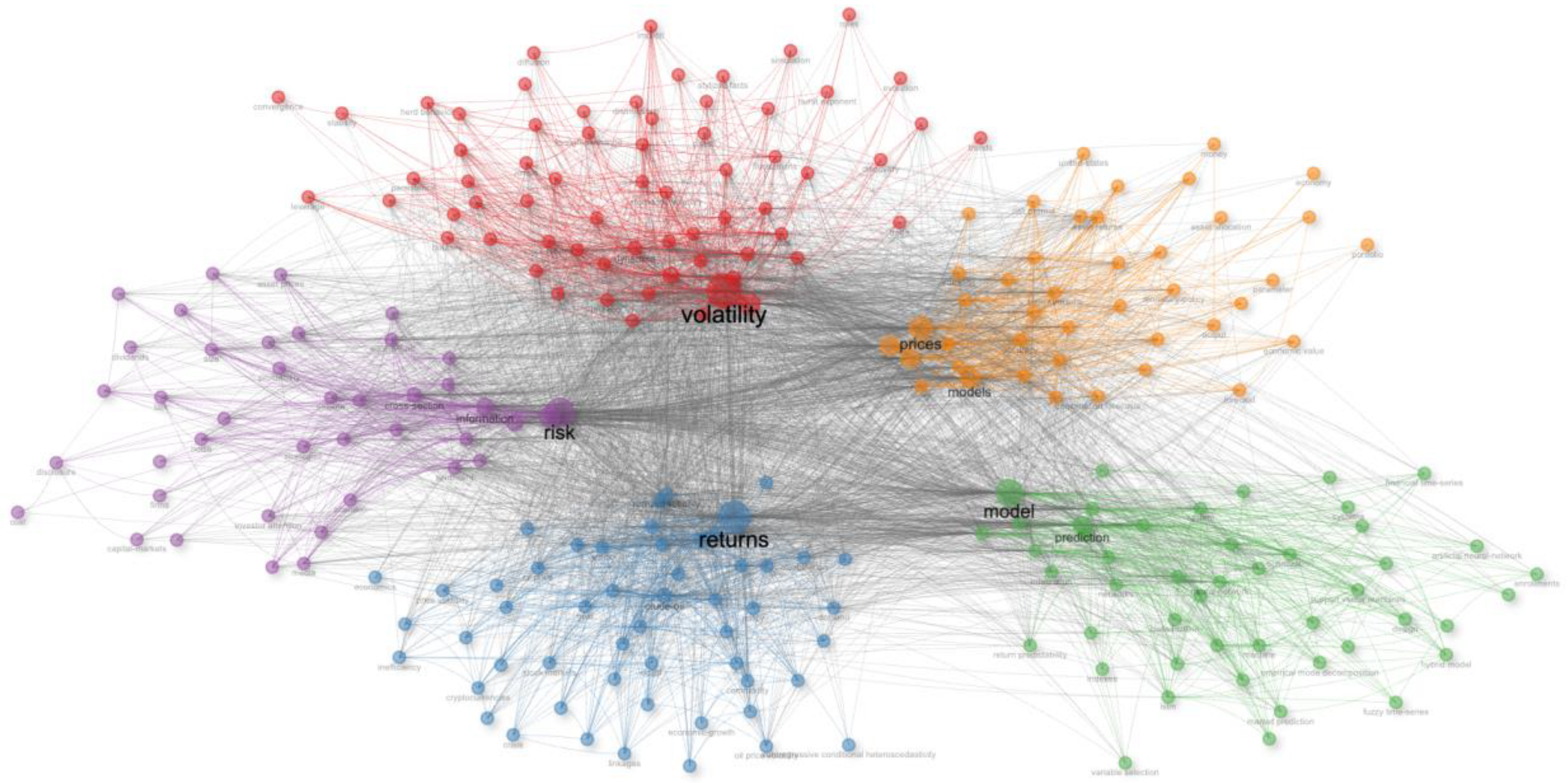
| Cluster | Thematic Focus | Color in Figure 9 |
|---|---|---|
| Cluster A | Volatility and Risk Modeling | 🔴 Red |
| Cluster B | Return and Risk Modeling | 🔵 Blue |
| Cluster C | Hybrid Modeling and Predictive Integration | 🟢 Green |
| Cluster D | Cryptocurrency and Digital Asset Modeling | 🟠 Orange |
| Cluster E | Market Microstructure, Information, and Behavioral Biases | 🟣 Purple |
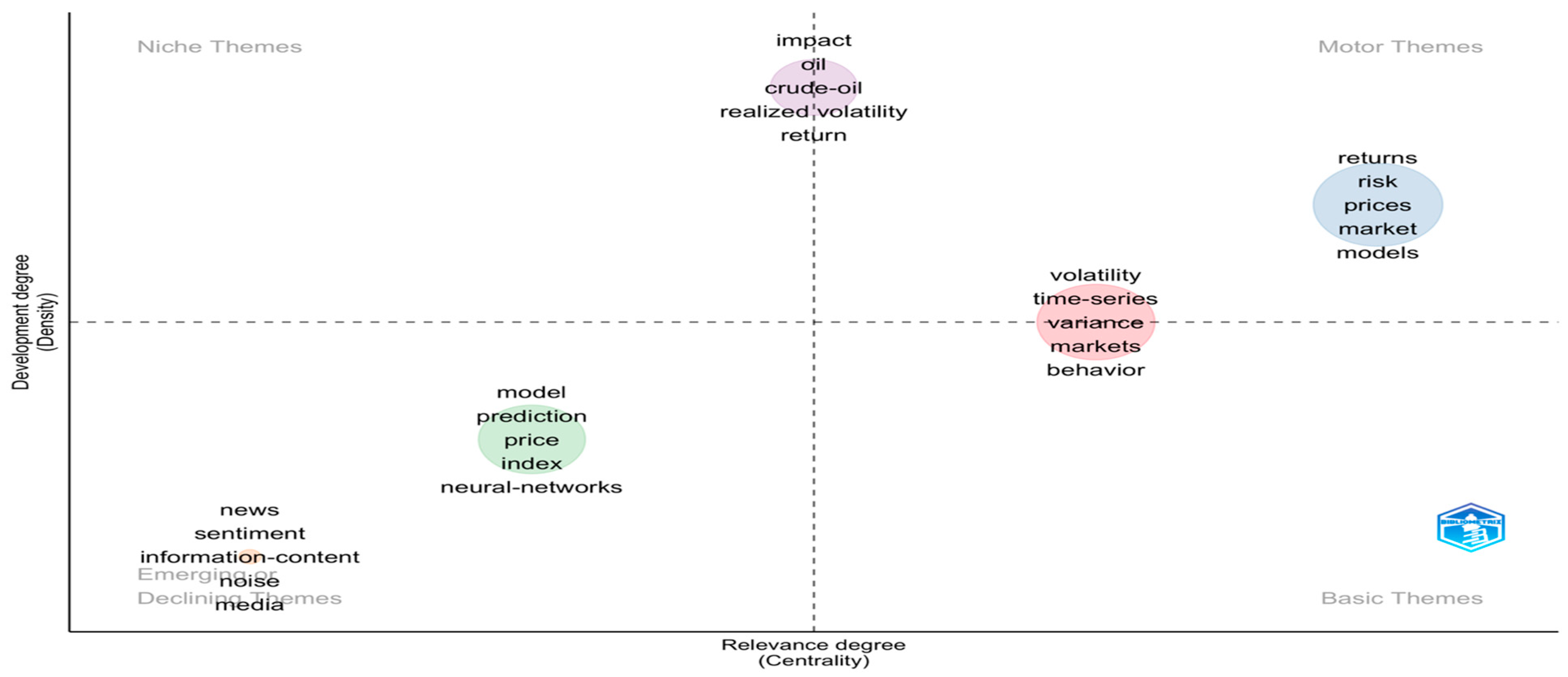
| Cluster | Color | Callon Centrality | Callon Density | Keyword Frequency | Top Keywords | Thematic Position |
|---|---|---|---|---|---|---|
| A | Blue | 0.599 | 3.318 | 4516.0 | returns, risk, prices, market, abnormal returns, CAPM | Motor |
| B | Red | 0.519 | 3.113 | 3373.0 | volatility, ARCH-GARCH, persistence, realized volatility | Motor |
| C | Green | 0.297 | 2.957 | 2562.0 | model, prediction, machine learning, optimization | Motor |
| D | Brown | 0.062 | 2.822 | 45 | news, sentiment, media, noise, information-content | Emerging/Niche |
| E | Purple | 0.388 | 3.414 | 29 | oil, crude oil, realized volatility, impact | Developed but Peripheral |
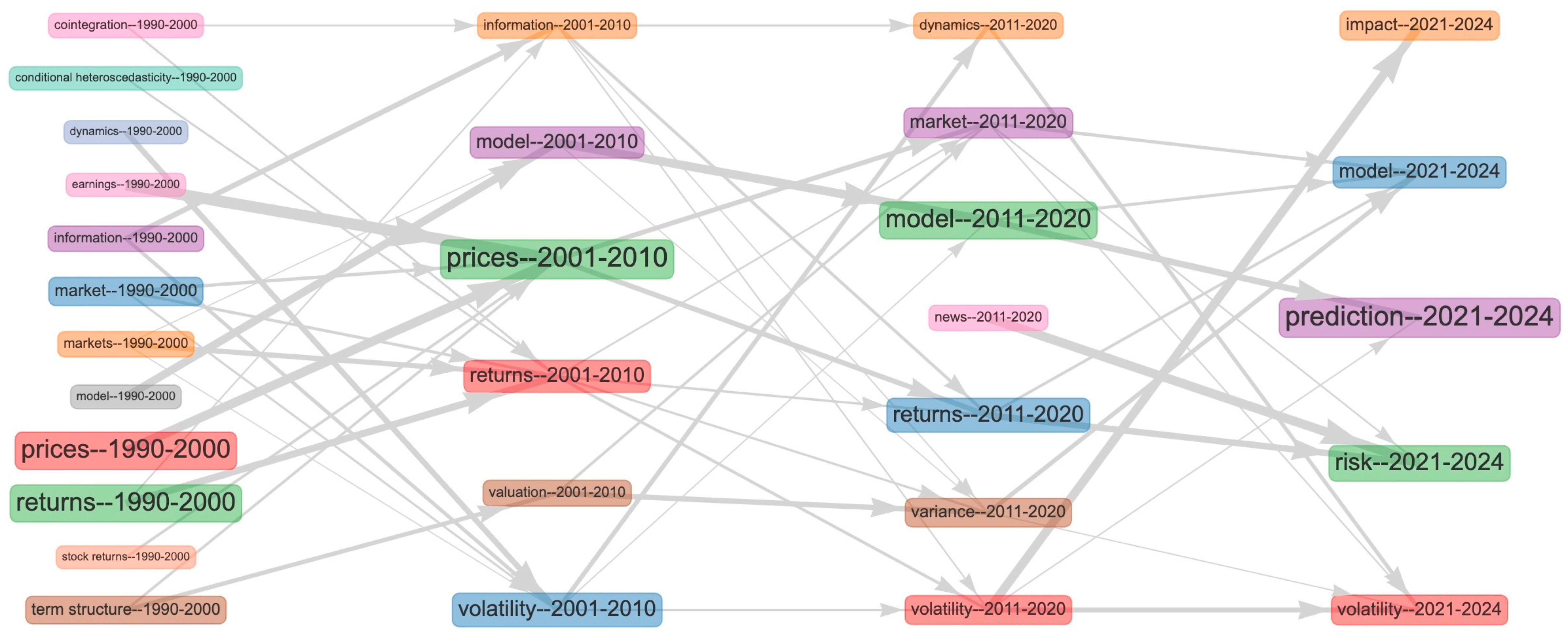
| Period | Dominant Themes | Transitions Observed |
|---|---|---|
| 1990–2000 | Cointegration, Heteroskedasticity, Returns | Foundational econometrics, time-series modeling |
| 2001–2010 | Volatility, Information, Prices, Returns | Behavioral extensions, valuation focus, risk modeling |
| 2011–2020 | Neural Networks, Prediction, News | Shift to AI and computational finance |
| 2021–2024 | Risk, Impact, Real-Time Models | Integration of ML, policy relevance, ESG and systemic risk modeling |
| Cluster No. | Suggested Cluster Name | Models in Financial Markets | Key Topics | RQs | Key References |
|---|---|---|---|---|---|
| 1 | Return, Risk, and Price Modeling | CAPM, APT, Fama-French, GARCH, ESG-Augmented Models | The trade-offs between risk and return, the efficiency of markets, pricing anomalies, and returns integrated with Environmental, Social, and Governance (ESG) criteria. | RQ1,3,4,7 | Fama and French (1993, 2015); Campbell and Thompson (2008); Sharpe (1964); Gu et al. (2020); Friede et al. (2015); Fatemi et al. (2018) |
| 2 | Volatility and Behavioral Market Dynamics | GARCH-family, Spillover Models, TVP-VAR, Behavioral GARCH, CPU/EPU-Augmented Models | The balance between risk and return, market efficiency, the presence of pricing anomalies, and the integration of ESG factors into returns. | RQ3,4,5,6 | Lux (1995); Shiller (2000); Kraaijeveld and De Smedt (2020); Bouri et al. (2022); Salisu and Gupta (2021); Diebold and Yilmaz (2009, 2012) |
| 3 | AI and DL Models for Forecasting | LSTM, CNN, ANN, SVM, XGBoost, Hybrid AI-Econometrics | Forecasting trends, employing advanced neural network models, detecting anomalous patterns, integrating diverse methodologies, rapid execution of trades | RQ3,4,5,6,7 | Rohrbeck and Kum (2018); Fischer and Krauss (2018); Bao et al. (2017); Gu et al. (2020); G. P. Zhang et al. (1998); Krauss et al. (2017) |
| 4 | Sentiment, News, and Media Impact | Sentiment-Augmented GARCH, NLP Models, BERT, Text-Driven Forecasting | Investor sentiment, media attention, mood evaluation, sentiment analysis, behavioral indicators | RQ3,4,5,6 | Tetlock (2007); Bollen et al. (2011); Shynkevich et al. (2017); Engelberg and Parsons (2011); Costola et al. (2022) |
| 5 | Cryptocurrency and Digital Asset Modeling | GARCH-MIDAS, HAR-RV, Spillover Indices, Markov Switching, Quantile Regressions | Volatility within the cryptocurrency sector, valuation of digital assets, transmission effects, unpredictability, and inter-asset contagion. | RQ3,4,5,6 | Diebold and Yilmaz (2009, 2012); Barunik and Krehlik (2018); Kraaijeveld and De Smedt (2020); Okorie and Lin (2020); C. Zhang et al. (2022); Katsiampa (2017) |
| Research Stream | Suggested Future Research Questions | Key References |
|---|---|---|
| Return, Risk, and Price Modeling | -In what manner can Environmental, Social, and Governance (ESG) and sustainability elements be systematically integrated into both traditional and multi-factor asset pricing models? -To what extent do ESG signals enhance the predictive accuracy of returns and risk premiums in an out-of-sample context across different market regimes? -How do climate-related disruptions engage with fundamental factors to affect return dynamics in both developed and emerging markets? | Friede et al. (2015); Fatemi et al. (2018); Author Synthesis |
| Volatility and Behavioral Market Dynamics | -How do climate policy and macroeconomic uncertainty shocks affect volatility spillovers in emerging and fragile markets? -In what manner can volatility models be enhanced by integrating behavioral indicators such as noise trading, adaptive learning, and investor herding during crises? -How effectively do hybrid volatility models capture the synergistic effect of policy uncertainty, technical signals, and market sentiment in the context of systemic events? | Al-Thaqeb and Algharabali (2019); Gabauer and Gupta (2018); Author Synthesis |
| AI and Deep Learning Models for Forecasting | -To what degree can the frameworks of explainable AI augment transparency and reliability within the realm of financial forecasting? Moreover, -What methodologies may be utilized to optimize hybrid AI-econometric models in accurately capturing return and volatility patterns contingent on varying regimes? Additionally, -Which techniques are most efficacious in attaining a balance between prediction accuracy and interpretability in deep learning applications within financial contexts? | Rohrbeck and Kum (2018); Fischer and Krauss (2018); Gu et al. (2020); Author Synthesis |
| Sentiment, News, and Media Impact on Market Dynamics | -How do varied linguistic frameworks and cultural narratives influence sentiment-based prognostication within global markets? -To what extent can sentiment data extracted from unconventional sources such as ESG reports, central bank communications, or multimedia content enhance the predictive modeling of asset price fluctuations? -How do sentiment indicators significantly integrate with traditional signals to refine predictions of volatility or returns amidst heightened uncertainty? | Bollen et al. (2011); H. Chen et al. (2021); García et al. (2017); Author Synthesis |
| Cryptocurrency and Digital Asset Modeling | -In what ways do institutional frameworks and macroeconomic uncertainty influence the management of contagion within crypto markets during global financial crises? -How can volatility models for digital assets incorporate blockchain analytics, sentiment dynamics, and technical indicators under extreme conditions? -What methodologies are most effective for detecting nonlinear dependencies and spillovers between cryptocurrencies and traditional financial assets? | Barunik and Krehlik (2018); Kraaijeveld and De Smedt (2020); Okorie and Lin (2020); C. Zhang et al. (2022); Author Synthesis |
Disclaimer/Publisher’s Note: The statements, opinions and data contained in all publications are solely those of the individual author(s) and contributor(s) and not of MDPI and/or the editor(s). MDPI and/or the editor(s) disclaim responsibility for any injury to people or property resulting from any ideas, methods, instructions or products referred to in the content. |
© 2026 by the authors. Licensee MDPI, Basel, Switzerland. This article is an open access article distributed under the terms and conditions of the Creative Commons Attribution (CC BY) license.
Share and Cite
Wafi, A.S.; El-Halaby, S.; Ahmed, H. Financial-Market Forecasting and Modelling from Econometrics to AI: An Integrated Systematic and Bibliometric Review with Content Synthesis (1990–2024). J. Risk Financial Manag. 2026, 19, 228. https://doi.org/10.3390/jrfm19030228
Wafi AS, El-Halaby S, Ahmed H. Financial-Market Forecasting and Modelling from Econometrics to AI: An Integrated Systematic and Bibliometric Review with Content Synthesis (1990–2024). Journal of Risk and Financial Management. 2026; 19(3):228. https://doi.org/10.3390/jrfm19030228
Chicago/Turabian StyleWafi, Ahmed S., Sherif El-Halaby, and Hussien Ahmed. 2026. "Financial-Market Forecasting and Modelling from Econometrics to AI: An Integrated Systematic and Bibliometric Review with Content Synthesis (1990–2024)" Journal of Risk and Financial Management 19, no. 3: 228. https://doi.org/10.3390/jrfm19030228
APA StyleWafi, A. S., El-Halaby, S., & Ahmed, H. (2026). Financial-Market Forecasting and Modelling from Econometrics to AI: An Integrated Systematic and Bibliometric Review with Content Synthesis (1990–2024). Journal of Risk and Financial Management, 19(3), 228. https://doi.org/10.3390/jrfm19030228