1. Introduction
The shrimp sector has been one of the main drivers of economic growth for Ecuador over the last decade. Between 2014 and 2022, fishing and aquaculture recorded an average annual growth of 11.9%, according to data from the Central Bank of Ecuador (BCE). Its production and marketing dynamics are structurally complex, shaped by the interaction of biological cycles, seasonality, trade conditions, and financial constraints that jointly affect available volumes and international prices. Under these conditions, timely identification of market regimes and early signals of regime change are critical for designing hedging strategies, guiding capacity-planning decisions, and informing public policy responses.
Conventional time-series approaches—such as ARIMA specifications or classical structural models—often rely on linearity and parameter stability over time. These assumptions become restrictive when the market alternates between distinct operating conditions or undergoes shifts that are not directly observable in real time. In this setting, Hidden Markov Models (HMMs) provide a natural framework for capturing latent structures in economic and financial series: they represent the observed process as being driven by an unobserved state sequence, enabling automatic segmentation into regimes with regime-specific statistical properties and probabilistic transition dynamics (
Hamilton, 1989;
Christoffersen, 2001).
This study applies a multivariate HMM to the Ecuadorian shrimp market using a monthly series from January 2017 to May 2025, jointly modeling pounds produced, dollars invoiced, and the average price per pound. This approach makes it possible to recover recurring patterns in the sector’s evolution, quantify the expected duration of each regime, and anticipate transitions between higher- and lower-margin conditions. Moreover, Gaussian emissions specified in logarithmically transformed space support a more stable and economically interpretable representation of the joint dynamics.
The results indicate a four-state structure with strong internal persistence, where a dominant high-price regime behaves as a gravitational center, while the remaining states capture transitory phases associated with orderly expansion, oversupply, or demand-driven rallies. Beyond improving the empirical understanding of the sector’s historical behavior, the proposed framework yields operational value for prospective management through probabilistic regime forecasting and scenario-based simulation to support risk analysis, planning, and decision-making.
Theoretical Framework
The sustainability of contemporary shrimp farming requires the integration of bio-economic and technological approaches that simultaneously address climate pressure, ecosystem resilience, and resource efficiency. Dynamic models that optimize Maximum Economic Yield demonstrate that, under ocean-warming scenarios, adaptive strategies reduce collapse risk and maximize long-term net benefits (
Diop et al., 2018a). In parallel, mangrove preservation increases the resilience of shrimp fisheries to rising sea-surface temperatures, underscoring the importance of coastal ecosystem services as a natural defense and economic buffer (
Diop et al., 2018b;
Scemama et al., 2022). From a supply chain perspective, dual-channel circular-economy models reveal that the simultaneous maximization of profits and social effects while minimizing environmental impacts is feasible through robust mathematical programming under market uncertainty (
Fasihi et al., 2023;
Sojoudi et al., 2025). Subsequently, the integration of membrane-based recirculating aquaculture systems (MRAS) shows potential for ensuring water quality and reducing consumption, positioning itself as a technologically sound solution for the environmental–economic sustainability of shrimp aquaculture (
Widiasa et al., 2024).
Efficient market functioning and productive risk management depend on econometric tools that describe both price dynamics and extreme climatic variability. Time-series models with random-walk priors have shown encouraging predictive power for U.S. shrimp prices, providing probabilistic bases for investment and policy decisions (
Bessler & Hopkins, 1986;
Newlands et al., 2014). Complementarily, bio-economic analyses that incorporate hurricane hazards show that partial-harvest and early-seeding strategies can maximize return per unit of risk in cyclone-prone zones, highlighting the need for resilient production calendars (
González-Romero et al., 2018;
Marcillo-Yepez et al., 2025). Internationally, studies of price cointegration and asymmetric transmission reveal that integration among India, the U.S., and Japan features rapid adjustments but imbalances stemming from infrastructure gaps and information asymmetries, underlining the urgency of improving trade transparency (
Singh et al., 2022). Likewise, the dominance of farmed shrimp over wild catch in European price formation confirms that aquaculture can act as a market leader, shaping positioning and differentiation strategies for extractive producers (
Béné et al., 2000).
Operational and sanitary dimensions intensified by external shocks such as the pandemic define additional challenges. Comparisons of farms certified by the Aquaculture Stewardship Council with non-certified units show significant improvements in energy efficiency and water use, demonstrating the effect of eco-labels on sector professionalization (
Davis & Boyd, 2021). In parallel, alternative therapies from probiotics to CRISPR emerge as promising strategies for health management and the reduction in chemical externalities, strengthening productive sustainability (
Citarasu et al., 2022). At the market level, export disruptions during COVID-19 spurred a reorientation toward domestic demand, showing that institutional flexibility can turn a crisis into an opportunity for India’s shrimp sector (
Krishnan & Babu, 2022). However, the differentiated impact on developing countries—evidenced by falling prices and rising logistical costs in Bangladesh—highlights the need for recovery plans that combine technical measures and long-term policies to safeguard rural livelihoods (
Islam et al., 2021).
The progressive globalization of the aquaculture value chain has driven convergence among capture fisheries, farming, processing, and trade, forcing managers to rethink internationalization strategies and resource control. Recent studies show that cross-border mergers have blurred the boundaries between production links, allowing large corporations to dominate the integrated supply and worldwide distribution of seafood (
Einarsson & Óladóttir, 2020). This phenomenon coexists with strong interconnections between aquaculture and fisheries in the markets for inputs and feed, where demand for fishmeal and fish oil introduces indirect effects on the sustainability of pelagic populations (
Natale et al., 2013;
Clavelle et al., 2019). At the same time, projections on the future of shrimp farming warn that competitiveness will depend on sectoral planning policies that mitigate market failures and reconcile profitability with growing environmental demands (
Fast & Lester, 1992). A critical component for sustaining these dynamics is specialized market research, which provides intelligence on consumer preferences, segmentation, and price–income elasticities, strengthening corporate and governmental decision-making (
Engle et al., 2016).
Long-term competitiveness also requires strategic-planning tools and predictive models capable of handling the volatility inherent to shrimp systems. The Goal–Objective–Strategy (GOS) approach has proven useful for prioritizing decisions under expert consensus through Fuzzy-Delphi processes, improving coherence between tactical objectives and high-level goals in the Indian industry (
Prusty et al., 2010;
Khorshidikia et al., 2025). Meta-analytical comparisons of econometric methods, meanwhile, underscore that forecast combinations offer greater accuracy than univariate or VAR models, establishing a benchmark for price and production prediction in the agri-aquaculture sector (
Allen, 1994;
Lukyanova et al., 2020). To complement planning, integrated system models have been applied to shrimp management in the Gulf of Mexico, showing how the simulation of different fishery policies can enhance decision support and actor resilience (
Tse & Khilnani, 1989;
Craig & Link, 2023). Such tools become critical when disruptive events such as the COVID-19 lockdown introduce demand shocks and logistical constraints that can generate losses exceeding USD 1.5 billion, forcing mitigation measures and production-calendar reconfiguration (
Kumaran et al., 2021).
Ecosystem and social sustainability also require valuing coastal environmental services and food security associated with fisheries. Evaluations of silvo-aquaculture in Bangladeshi mangroves demonstrate that restoration through integrated systems (IMS, INS, MBF, and IMC) can double social returns compared with unforested uses, provided community participation and political support are ensured (
Rahman & Mahmud, 2018). Nationally, strengthening the link between fish consumption and child nutrition in India reinforces the premise that well-designed fishery policies are essential for combating malnutrition and improving public health (
Ordoñez-Araque et al., 2023). In arid environments, shrimp farming is emerging as a viable alternative if brackish-water systems and temperature-management technologies are leveraged, expanding production frontiers under water-efficiency criteria (
Emerenciano et al., 2022;
Naser et al., 2022). However, the stability of marine trophic networks modeled in the northeastern Atlantic reveals that overfishing and climatic variability reduce sardine and anchovy populations, affecting top predators and highlighting the need for integrated ecosystem management (
Kaplan et al., 2017).
Building on this global evidence base, the Ecuadorian shrimp industry provides a particularly informative setting for studying regime dynamics because its development has been shaped by successive waves of productive expansion, technological upgrading, and export consolidation. Early accounts document how the rapid growth of semi-intensive pond farming positioned Ecuador as a leading producer since the 1980s (
Hirono, 1983), while subsequent analyses describe the emergence of export-oriented agro-industrial districts that reorganized production, processing, and commercial coordination around international demand (
Mañay, 2024). Sector-focused research further indicates that these trajectories have been conditioned by constraints in seed availability, the scope and enforcement of state regulation, and territorial control mechanisms, which jointly influence the stability of supply over time (
Perez et al., 1987).
From an export-dynamics perspective, recent projections suggest sustained growth in international demand for Ecuadorian shrimp, consistent with the country’s strengthening position in global markets (
Jiménez Novillo et al., 2021). Nevertheless, historical evidence shows that disruptions in strategic inputs—particularly postlarvae—have generated marked declines in both production and exports (
Viera-Romero et al., 2024), reinforcing the interpretation of the sector as structurally exposed to supply-side shocks. This vulnerability is compounded by climate variability. Longitudinal evidence from semi-intensive ponds reports significant differences in survival and yield across El Niño/La Niña phases, with El Niño associated with improved outcomes under specific thermal and salinity conditions (
Retamales, 2002). Relatedly, the prevalence of IHHNV has been linked to oceanographic anomalies during the 1997–98 El Niño event (
Jiménez et al., 1999), illustrating how climatic perturbations can amplify sanitary risk and contribute to nonlinear shifts in performance.
Disease outbreaks have also been repeatedly identified as major drivers of crisis-like episodes in Ecuadorian shrimp farming. Empirical studies document the severe mortality and histopathological effects associated with White Spot Syndrome Virus (WSSV) in
Penaeus vannamei (
Rodríguez et al., 2003), while more recent contributions discuss technological responses—such as vaccine development—as potential strategies to mitigate economic losses (
Proaño et al., 2023). In parallel, integrated assessments of intensive
Litopenaeus vannamei systems highlight that physical–chemical conditions and management practices are key determinants of productivity (
Ramos-Mendieta et al., 2025), implying that technical efficiency can partially buffer external disturbances, yet cannot eliminate exposure to systemic shocks. Finally, competitiveness in export markets is tightly coupled with logistics and trade infrastructure: analyses of Ecuador’s export chains indicate that maritime and air transport organization, together with logistics costs, directly affect margins and international positioning (
Kurganov & Morales, 2016). Because shrimp is highly perishable, any disruption in ports or transport can rapidly propagate into price and revenue instability. These dynamics intersect with evolving food safety governance, where “food scares” and sanitary risk perceptions shape public policy and international controls, functioning both as barriers and as incentives for upgrading standards in export-dependent value chains (
Grace & McDermott, 2015).
2. Materials and Methods
A monthly time-series for the Ecuadorian shrimp sector covering January 2017 to May 2025 ( observations) was selected because it corresponds to the full validated and certified dataset made available to the authors for this study, with consistent definitions and no reported methodological breaks in the source over the covered window; accordingly, the sample endpoints are determined by data availability and quality assurance rather than arbitrary cutoff choices while still spanning major sector-relevant shocks such as the COVID-19 disruption period and subsequent market adjustments. It is available with the following variables:
: pounds produced.
: dollars invoiced.
: average price per pound.
To ensure homoscedasticity and an approximate Gaussian distribution, the observed vector is defined as follows:
Let the hidden chain con states. The model is characterized by:
Initial distribution: , .
Transition matrix: , .
Gaussian emissions: .
The log-likelihood is:
with
.
Maximization of is performed with the Baum–Welch algorithm:
E-step (forward–backward):
M-step (closed-form updates):
Iterations stop when or after iterations.
Models with
are evaluated using:
where
is the total number of parameters. For
the criteria reach simultaneous minima,
y
, min; so, this specification is adopted.
Validation and diagnostics include in-sample multivariate Royston normality tests by state, estimation stability checks over 20 random-seed replicates (relative deviation in in . and visual inspection via 2-D/3-D clusters), a heat-map of .
Operational applications are: online classification
to trigger hedging or inventory adjustments; regime forecasting
for
months to conduct financial stress testing; expected duration
as the mean persistence of each regime; and Monte Carlo simulation of
paths to assess cash-flow risk under price or volume shocks (
Haro et al., 2025;
Duan et al., 2020;
Chakrabarti & Ghosh, 2011).
Baum–Welch was used to estimate the Gaussian HMM because the regime sequence is unobserved (latent); so, direct likelihood maximization with fully observed states is not feasible. In this setting, Baum–Welch implements the Expectation–Maximization (EM) procedure to obtain maximum-likelihood estimates of the model parameters by iteratively computing posterior state/transition responsibilities (E-step) and updating the initial distribution, transition probabilities, and emission parameters (M-step) to increase the data log-likelihood. In this study, the fitted model is subsequently used to decode the most likely sequence of hidden regimes via Viterbi decoding, as implemented by model. (X) is predicted in hmmlearn, which supports the regime labeling and downstream interpretation of persistence and switching dynamics.
Regarding initialization, the parameters were not manually preset; instead, the default initialization strategy in hmmlearn was used and made reproducible by fixing random_state = 42. Specifically, the initial state probabilities (π) and transition matrix (A) are initialized internally in a stochastic but valid-probability manner (row-normalized random initialization), while the Gaussian emission parameters (means and full covariance matrices) are initialized from the data in the feature space . The EM optimization was run with full covariance structure (covariance_type = “full”) and up to 1000 iterations (n_iter = 1000), with convergence governed by the default tolerance criterion on the improvement in the log-likelihood across iterations, ensuring stable parameter estimation under a fixed random seed.
Before adopting HMMs, economic and commodity time-series are commonly modeled using classical approaches such as ARIMA or VAR to capture linear temporal dependence, and GARCH-type specifications to represent conditional heteroskedasticity and volatility dynamics. Likewise, structural break frameworks (e.g., Chow tests or Bai–Perron procedures) can detect parameter changes when shifts occur as relatively well-defined breakpoints. However, these approaches become restrictive when the market alternates across unobserved regimes that switch in a probabilistic manner, exhibit state persistence, and recur through transition dynamics rather than through single deterministic break dates. In such settings, imposing a single linear process or relying on pointwise break detection may underrepresent the true regime-dependent behavior of the system. In contrast, a Hidden Markov Model is well-suited to this context because it explicitly models latent-state persistence and estimates transition probabilities across regimes, enabling a more realistic characterization of recurring expansion phases, oversupply conditions, and demand-driven rallies. For the reproducibility of the study, the supporting files are uploaded to a Github link, the same one detailed in the
supplementary materials section.
3. Results
Table 1 reports model-selection results for Gaussian HMM specifications with
K = {2, 3, 4, 5} states under two estimation strategies: an initial single-run fit and a robust multi-start procedure with stability screening. In the initial estimation, the four-state model achieved a comparatively high log-likelihood (LogLik = 480.887) with 51 parameters and favorable information criteria (AIC = −859.773; BIC = −729.526); however, it exhibited a near-degenerate regime with extremely low occupancy (MinStateShare ≈ 1.05%), indicating sensitivity to initialization and raising concerns about numerical stability and interpretability. To address this, the model was re-estimated using multiple random initializations and a minimum state-occupancy constraint, retaining the best-fitting solution for each
K. Under this robust strategy, the four-state specification clearly dominated the alternatives, achieving the highest log-likelihood (LogLik = 503.774) and the lowest AIC and BIC (AIC = −905.548; BIC = −775.300), while maintaining non-trivial regime occupancy (minimum share ≈ 16.84%, i.e., 16 observations). By contrast, K = 2 remains parsimonious but collapses heterogeneous market conditions into broad regimes, whereas K = 5 increases complexity without improving information criteria and yields a more fragmented partition. Overall, these results support the selection of K = 4 as the most reliable and interpretable segmentation of shrimp market regimes for subsequent characterization and forecasting.
State 2 emerges as the dominant regime: its stationary probability approaches 1, meaning the system tends to remain in—or quickly return to—this mode. Economically, this state combines intermediate production (~121 million lb) with the highest average price (≈USD 2.97/lb) and, simultaneously, the greatest variance in volumes. We interpret this pattern as a market in which demand absorbs supply variations while preserving high margins, albeit with significant fluctuations in tonnage and revenue. For the industry, this finding suggests gross margins are maintained even under moderate production shocks, but it also calls for careful inventory management owing to elevated volatility.
The remaining regimes behave as transient episodes. State 1 represents oversupply phases with depressed prices (≈USD 2.32/lb) but the highest absolute volume (~222 million lb) and very low variances; it is the classic “commodity” mode, where producers compete on quantity and the market discounts price. State 3, by contrast, reflects a demand rally: high volumes and mid-to-high prices (≈USD 2.63/lb) with minimal dispersion. State 0 follows, combining a relatively low price (≈USD 2.54/lb) with medium-to-high production; it constitutes a slack market period that, nevertheless, does not reach the oversupply of State 1. The near-zero stationary probability of these three states confirms their episodic nature: the system visits them only in response to specific shocks and then returns to the stable regime (State 2).
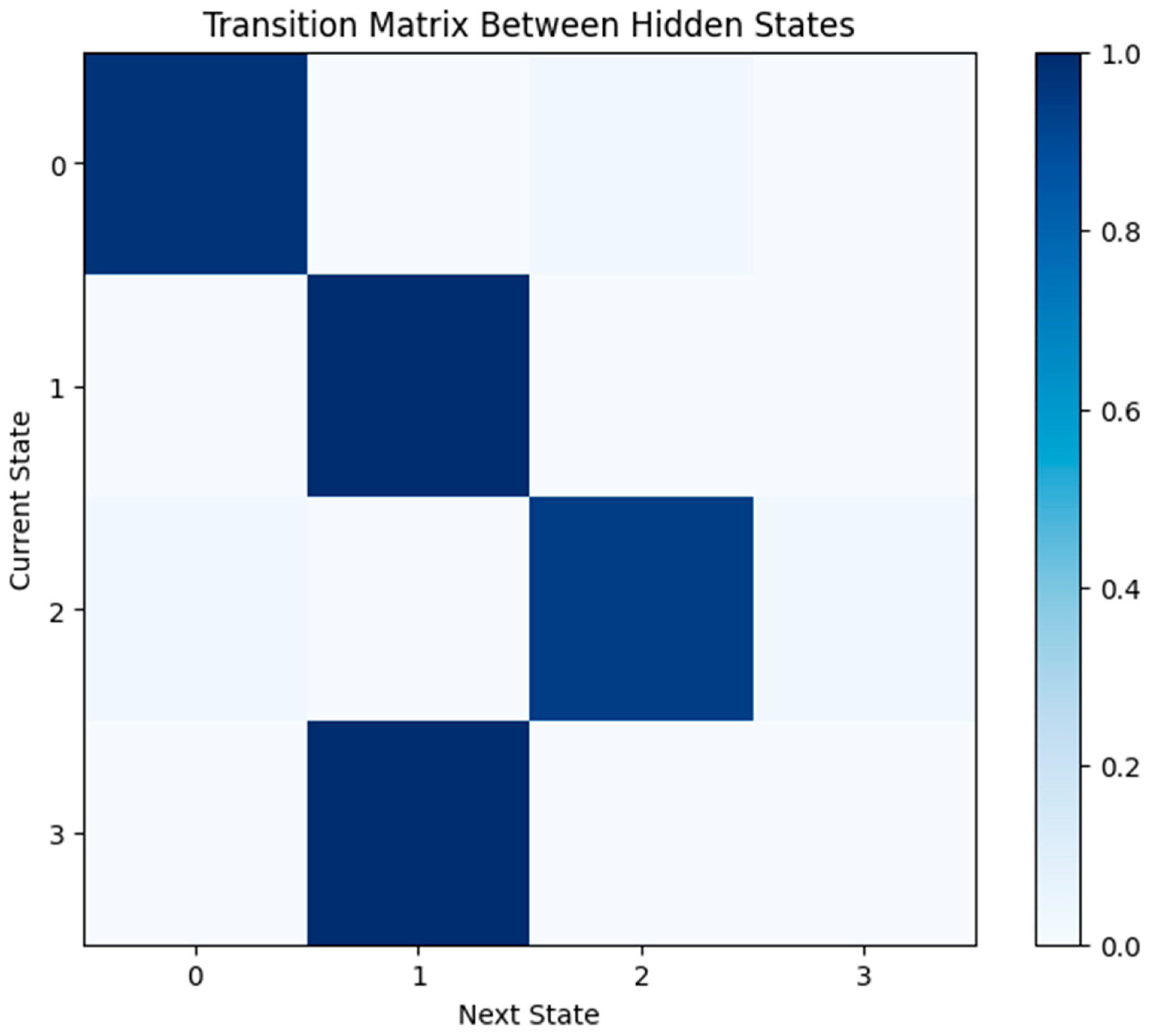
Transition dynamics—visualized in the probability matrix—show that the most likely movements depart from and return to State 2, reinforcing the idea of a gravitational equilibrium around the “high-price market.” Transitions to State 1 suggest production pulses that temporarily depress quotations, whereas jumps to State 3 are usually due to demand surges that absorb greater volumes without sacrificing price. This behavior is consistent with markets in which the price elasticity of demand varies seasonally or in response to exchange-rate shifts and changes in substitute costs; the detailed analyses correspond to
Table 2.
From a risk-management standpoint, the model enables probabilistic regime forecasts several months ahead simply by propagating the transition matrix—so that low-price scenarios or demand rallies can be anticipated. Producers, for instance, could activate hedges if the probability of entering State 1 crosses a given threshold, or schedule capacity expansions only when the path toward State 3 is plausible. Moreover, identifying a dominant high-price regime suggests that product innovations (value-added offerings) would yield more stable margins than strategies focused purely on volume.
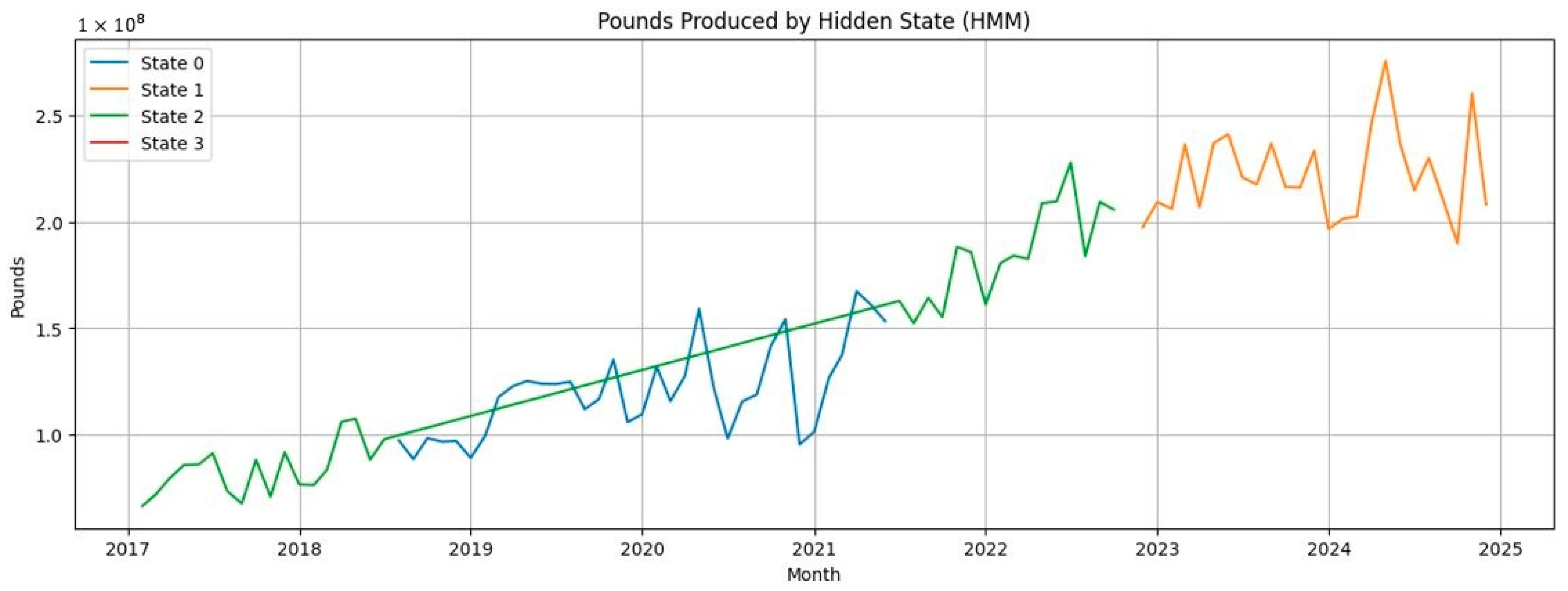
Figure 1 shows the monthly production trajectory (pounds) from 2017 to 2025 overlaid with the regime classification provided by the HMM. Each color represents a hidden state: blue (State 0), orange (State 1), green (State 2) and red (State 3). The continuous green diagonal running through the series corresponds to State 2 itself and simultaneously makes the secular growth trend visible: productive capacity rises from about 7 × 10
7 lb in 2017 to peaks above 2.7 × 10
8 lb by 2024, implying a compound annual growth rate close to 16%.
During 2017–2018, State 2 predominates—the regime previously characterized by high prices and volume volatility. This is a ramp-up period in which supply grows in spurts: small peaks and troughs indicate that the market is still adjusting inventories without sacrificing price. From mid-2018 to early 2022, the series fragments into long blue stretches (State 0). This regime keeps prices relatively contained and displays moderate oscillations; the upward slope suggests a “staggered” pattern of investments that expand output pro-cyclically yet without triggering volatility. In other words, State 0 acts as an orderly expansion phase: output increases while the market—likely due to forward contracts—absorbs the growth.
The return to green, State 2, around 2021–2022 coincides with a visible jump in the curve: volumes hover near 1.8 × 10⁸ lb and peaks approach 2.2 × 10⁸ lb. This episode confirms the “attractor” nature of State 2: when demand increases, the system reverts to its high-margin regime, albeit at a new level of installed capacity. The model nevertheless detects a sudden shift: in early 2023, the series migrates to orange State 1, characterized by record-high production and, per the mean table, the lowest prices in the set. The vertical swings peaks above 2.6 × 10⁸ lb, followed by sharp drops betray oversupply episodes and inventory adjustments; the nearly two-year stay in orange suggests the market is still working off that surplus.
It is striking that red, State 3, appears scarcely in the figure: the HMM identifies it as a theoretical but rare regime; when it arises, it lasts only a few months and its statistical weight is marginal, hence its near absence in the graph. Its scarcity reinforces the interpretation that only three patterns (0, 1, 2) dominate shrimp dynamics, with State 2 as the gravitational center. Taken together, the graph visually confirms the numerical metrics: production grows nonlinearly, alternating phases of orderly expansion, demand spikes, and oversupply episodes. This temporal segmentation provides an operational framework for hedging programs, capacity planning, and policy design aimed at smoothing the sector’s production cycles.
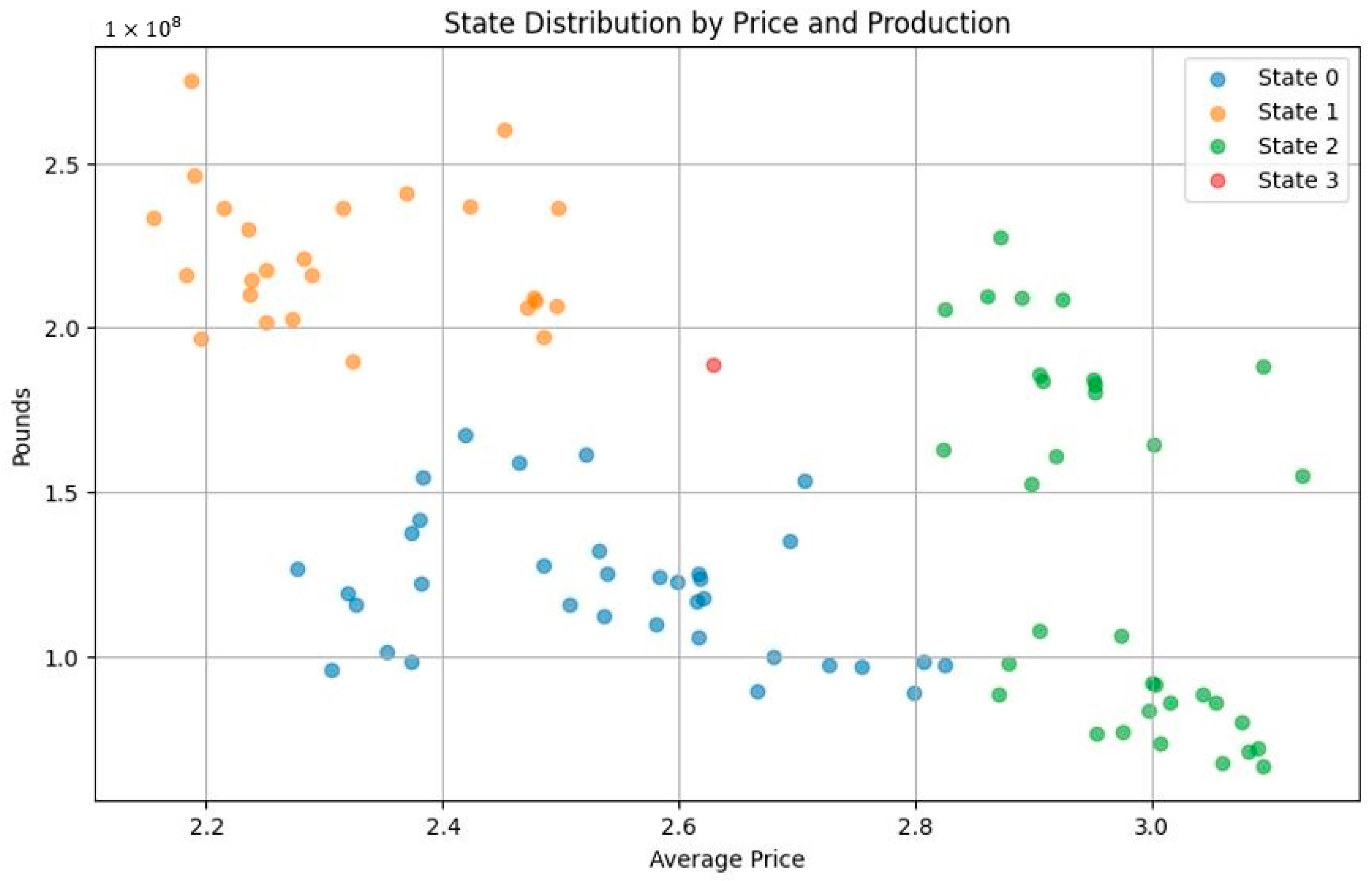
Figure 2 details the price–production scatter plot and empirically confirms the HMM regimes: State 1 (orange) concentrates oversupply months, with volumes above 2 × 10
8 lb and depressed prices (≈USD 2.2–2.5/lb); State 0 (blue) occupies an intermediate corridor where production rises to 1.6 × 10
8 lb without eroding prices (≈USD 2.35–2.6/lb), reflecting an “orderly” expansion; State 2 (green), the dominant regime, sits at the right-hand edge with high prices (USD 2.8–3.1/lb) and the greatest vertical dispersion—evidence that the market absorbs both low and high volumes without punishing the quotation; and the isolated State 3 (red) underscores its anecdotal character by appearing as a single point of high production and mid-high price. Thus, the graph reveals three mutually exclusive zones that can serve as practical thresholds for anticipating tight-margin environments or favorable conditions.
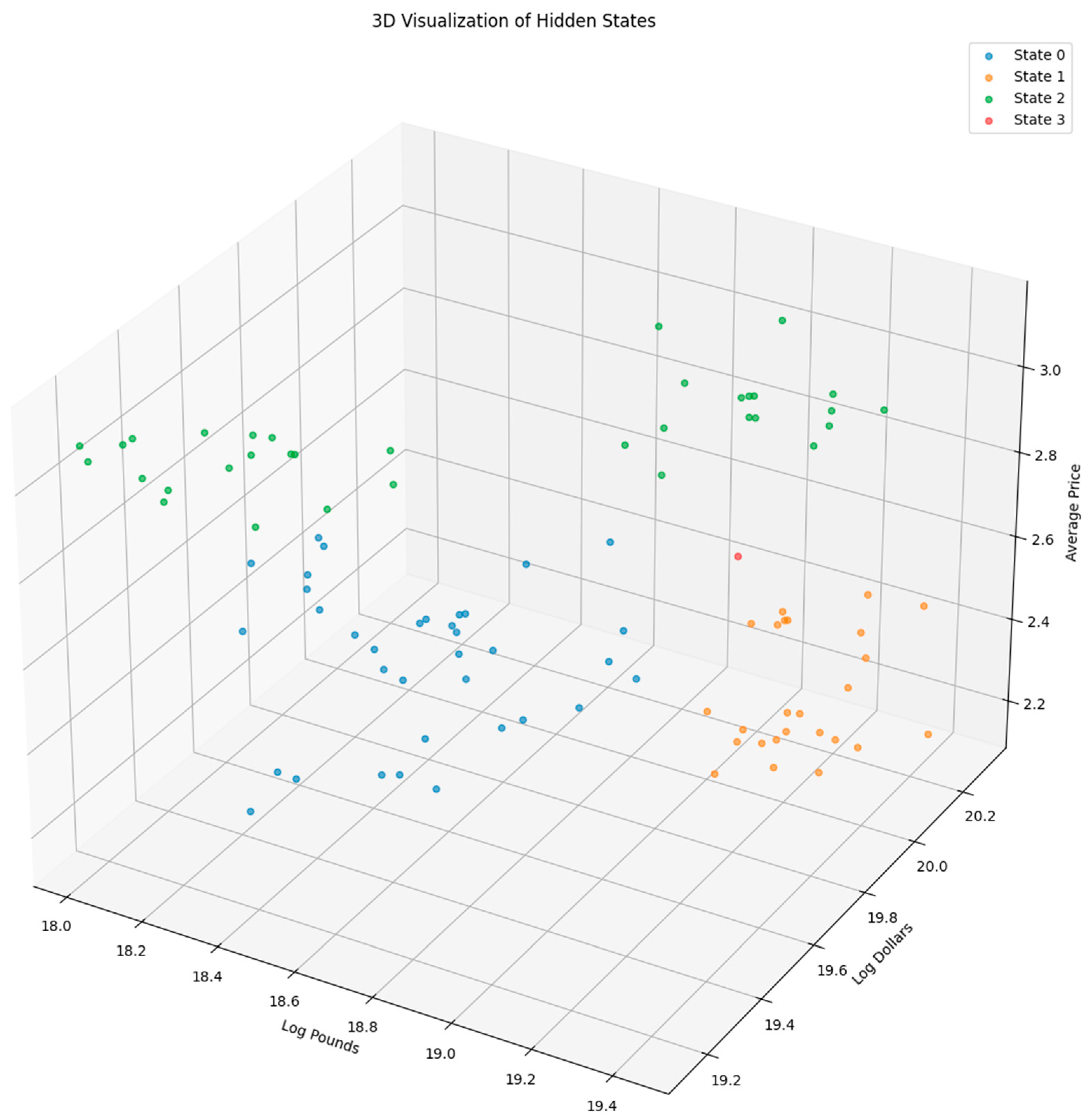
Figure 3—the three-dimensional projection of the states (axes: log-pounds, log-dollars, and average price)—shows that the points not only cluster into color-coded clouds but also align along a curved surface revealing the nonlinear volume–revenue–price relationship. Moving from the orange cloud (State 1), which combines the highest volume and lowest prices, toward the green cloud (State 2), the data trace an upward trajectory in both price and the dollars-per-pound ratio, illustrating how a slight price increase produces a multiplicative effect on logarithmic revenue. The blue cluster (State 0) nests between the two extremes and acts as a bridge, whereas the isolated red point (State 3) occupies the upper-right corner of the price-revenue plane, highlighting its status as a profitable outlier. This curvilinear pattern, hidden in previous two-dimensional plots, suggests the market operates with different cross-elasticities depending on the regime: in State 2, revenue grows more than proportionally to volume, opening the door to premium segmentation strategies; in State 1, by contrast, the slope flattens, confirming that the only path to growth lies in increasing tonnage.
Figure 4’s transition matrix exhibits a quasi-absorbing behavior in each regime—the diagonal elements are close to one yet it introduces a new strategic nuance: the most visible off-diagonal probability is the shift from the tight-margin states (0 or 1) into the profitable regime (2), while the reverse flow and any direct access to the anecdotal state (3) are virtually nil. Statistically, this means oversupply or slack-market episodes tend to resolve by “climbing” into the high-price state before drifting elsewhere. Consequently, the expected duration of an adverse phase can be approximated by
—around 6–8 months for States 0 and 1 and the market’s natural recovery occurs via absorption into State 2 without the need for an external shock. This is a key insight for designing stabilization policies that act on inventories rather than price subsidies.
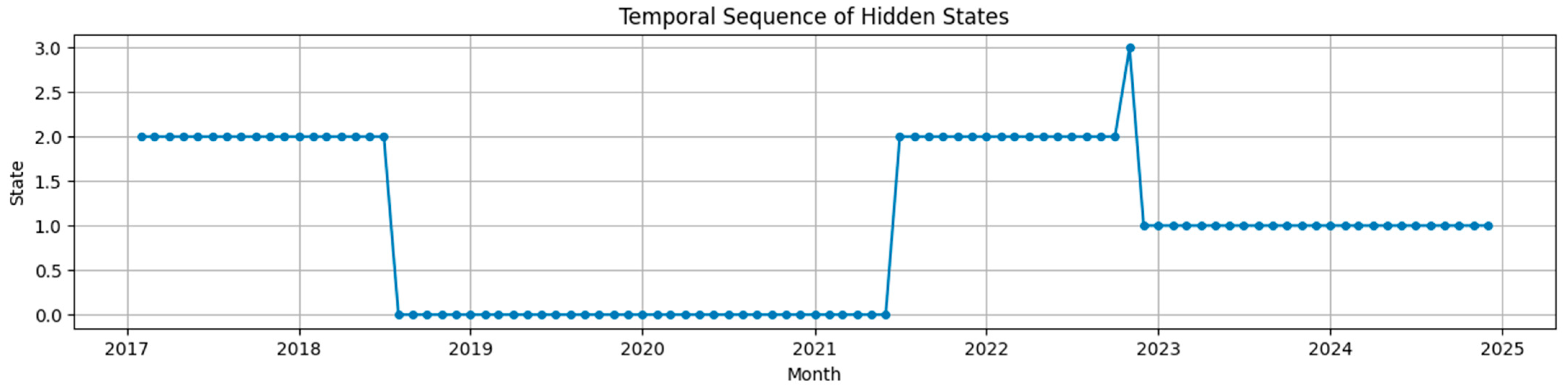
Figure 5’s temporal sequence of states shows that the shrimp market behaves like a system of long plateaus interrupted by abrupt jumps: after an initial two-year period in the high-price regime (State 2), the sector fell into a prolonged phase of orderly expansion (State 0) that lasted over 30 months. By mid-2021, a single shock pushed it back to State 2 and, almost immediately, triggered the exceptional peak of State 3 before settling into the oversupply regime (State 1), where it has remained since 2023. This pattern of “turning points” is consistent with a heavy-tailed duration distribution, suggesting that the probability of exiting a state does not increase linearly with elapsed time (long memory). Consequently, early-warning models should focus on exogenous indicators—such as exchange-rate fluctuations or feed-cost variations rather than on simple temporal thresholds.
The estimated four-regime structure and the associated transition dynamics provide actionable guidance for market participants and regulators. First, exporters, traders, and financial intermediaries can operationalize the model as an early-warning device: when filtered or smoothed probabilities signal a rising likelihood of entering the oversupply regime (State 1, low prices and high volumes), hedging intensity can be increased through forward contracts, options, or structured price floors, while inventory and shipment timing can be adjusted to protect margins. Because the transition structure indicates that adverse phases tend to resolve by “climbing” back into the dominant high-price regime (State 2) and the expected duration of unfavorable states is on the order of 6–8 months, hedging horizons and liquidity buffers can be aligned to that window to support cash-flow stress testing and working-capital planning.
At the producer level, regime-specific decisions follow directly from the state characterization. In commodity-like oversupply months (State 1), the priority shifts to cost containment, staggered stocking, and operational flexibility in processing and cold-chain logistics, avoiding irreversible capacity expansions while prices remain depressed. In orderly expansion phases (State 0), incremental investments and productivity improvements are more defensible because production can grow without fully eroding prices, whereas in the high-price but high-variance regime (State 2), managers should emphasize inventory management, contractual discipline, and flexible procurement to absorb volume swings without sacrificing realized margins. Finally, although demand rallies (State 3) appear episodic, their identification provides a practical signal for premium-market allocation, opportunistic sales strategies, and short-term capacity re-optimization when higher-price conditions coexist with elevated volumes.
For policymakers and regulators, the regime framework suggests that stabilization instruments should target information and logistics frictions rather than blunt price interventions. A market-monitoring dashboard reporting regime probabilities can support early alerts and coordinated responses (e.g., storage management, port and cold-chain capacity, and transparent market reporting) when the system drifts toward low-margin states. Given the estimated persistence patterns, temporary credit lines, insurance triggers, or contingency logistics measures can be calibrated to the expected 6–8 month adverse window, improving resilience without distorting long-run incentives. Overall, translating latent regimes into operational thresholds strengthens preparedness, improves risk-sharing mechanisms, and enhances the sector’s capacity to manage recurrent volatility.





 ,
,