


Abstract
Quantitative asset allocation remains a critical challenge in modern finance, particularly due to the inherent uncertainty of expected returns (μ) and the sensitivity of portfolio outcomes to the stability of portfolio weights. This study conducts a comparative empirical analysis of three portfolio strategies—MVO, Static RP, and Dynamic RP—using a long-only portfolio of eleven highly liquid assets, consisting of U.S. large-cap equities and gold, over the period 2015–2025. Results from historical backtesting indicate maintaining a competitive Sharpe ratio (1.418) and the lowest Maximum Drawdown (−0.2770) relative to Markowitz MVO (−0.3120) and Static RP (−0.2788). Although Markowitz delivers the numerically highest Sharpe ratio (1.655), this advantage is largely driven by in-sample optimization, with limited robustness under realistic implementation settings. In contrast, Dynamic RP demonstrates superior downside risk management, weight stability, and adaptability to changing market conditions, suggesting a more practical and resilient framework for real-world investment applications. Overall, the findings indicate that Dynamic Risk Parity provides an effective and robust alternative to traditional mean-variance optimization, offering investors a strategy that balances return potential, risk mitigation, and portfolio stability, while addressing key limitations of classical MVO approaches.
1. Introduction
1.1. Background and Problem Statement
Portfolio optimization (PO) represents a fundamental pillar of quantitative investing and risk management. Since Harry Markowitz first introduced the Portfolio Selection framework in 1952, the Mean-Variance Optimization (MVO) model has become the cornerstone of Modern Portfolio Theory (MPT). This framework provides a systematic methodology for constructing portfolios that optimize the trade-off between expected returns (mean, μ) and risk (variance, σ2) by identifying the efficient frontier—a set of portfolios that offer the highest expected return for a given level of risk. Implementing this framework requires solving a Quadratic Programming (QP) problem, which balances the trade-offs among assets within a specified investment universe while satisfying various investment constraints (Markov & Markov, 2023; Rigamonti & Lučivjanská, 2024).
In this study, the analysis is deliberately confined to a long-only portfolio composed of U.S. large-cap equities and gold, providing a controlled equity–gold investment universe for evaluating dynamic risk allocation strategies.
Despite its widespread adoption, the traditional Markowitz model faces two critical limitations that constrain its practical effectiveness:
- Model Risk and Estimation Error:The reliability of MVO critically depends on the accuracy of input parameters, namely the expected returns (μ) and the covariance matrix (Σ). In particular, estimating μ is notoriously difficult due to market uncertainty and data limitations. Empirical studies (e.g., Michaud, 1989; Lai et al., 2011) demonstrate that even minor estimation errors can lead to highly unstable portfolio weights and suboptimal out-of-sample performance. The plug-in approach, in which estimated parameters are directly used in optimization, often amplifies these errors, resulting in extreme portfolio allocations that are impractical for real-world investment. This phenomenon is widely referred to as the “Markowitz Optimization Enigma”.
- Static Nature of MVO:The original Markowitz model is a single-period (uni-period) optimization framework, which assumes that the investment horizon is limited to one period. Consequently, it lacks the ability to adjust dynamically to evolving market conditions. Myopic strategies that focus solely on the next period are unable to achieve dynamic optimality, limiting the model’s effectiveness in multi-period, real-world portfolio management where asset returns, volatility, and correlations evolve continuously over time (Hu & Gu, 2024).
To overcome these challenges, Risk Parity (RP) has been proposed as an alternative approach, particularly suitable for portfolios composed of a limited number of highly liquid assets where estimation risk and concentration risk are primary concerns. Unlike traditional MVO, RP allocates risk equally across all assets in a portfolio, using the principle of Equal Risk Contribution (ERC). By focusing on risk contributions rather than expected returns, RP reduces concentration risk and enhances the stability of portfolio weights, particularly during periods of heightened market volatility (Benichou et al., 2016).
Building upon RP, Dynamic Risk Parity (DRP) introduces time-varying adjustments to portfolio weights through techniques such as rolling-window covariance estimation. This dynamic approach enables portfolios to adapt to changing volatility regimes and market conditions, improving downside risk management, smoothing weight evolution, and providing a more resilient framework for long-term portfolio allocation.
The growing interest in DRP reflects the increasing need for portfolio strategies that can simultaneously balance return potential, risk mitigation, and robustness to estimation errors, which are essential for both institutional and retail investors operating in increasingly complex and volatile financial markets.
Real-World Investor Insight:
In practice, institutional investors and portfolio managers have observed that Risk Parity (RP) and dynamic adaptations, such as Dynamic Risk Parity (DRP), provide tangible benefits during periods of market stress. For example:
- During the COVID 19 pandemic (2020), ReSolve Asset Management reported that RP portfolios constructed with equal risk contribution (ERC) experienced a drawdown of only 11.2%, compared to approximately 17.1% for traditional balanced portfolios (equities + bonds) from peak to trough in Q1 2020 (ReSolve Asset Management, 2020).
- However, as noted by CAIA Association, many large RP funds underperformed in 2022 due to simultaneous negative movements in bonds and equities, which eroded the diversification benefit. For example, the HFR Risk Parity 10% VolTarget index returned 19.5% in 2022 (CAIA, 2024).
- Fund managers have acknowledged that market regime shifts—such as rapid interest rate hikes or a shift from negative to positive correlation between equities and bonds—limit the effectiveness of static RP strategies (Institutional Investor, 2022).
These observations indicate that:
- RP/DRP strategies perform well during sudden market downturns and periods of changing asset correlations (e.g., Q1 2020).
- Static RP strategies may underperform when market conditions shift rapidly, emphasizing the value of dynamic adjustments, such as DRP, to increase flexibility and reduce risk exposure.
- For real-world investors, both institutional and retail, the focus is not only on average returns but also on perceived risk and portfolio survivability. DRP can help manage these concerns by reducing weight instability and mitigating the impact of estimation errors in expected returns (μ) and covariance (Σ).
While the above real-world examples often involve broader multi-asset portfolios, including combinations of equities and bonds, the present study intentionally excludes fixed-income assets and focuses exclusively on a long-only equity–gold portfolio. This design choice allows the analysis to isolate the effects of dynamic risk allocation and portfolio weight adjustment without the confounding influence of bond–equity interactions. The extension of the Dynamic Risk Parity framework to a broader multi-asset universe is therefore left for future research.
1.2. Research Objectives
- To compare the performance of portfolios constructed using Markowitz MVO, Static Risk Parity, and Dynamic Risk Parity within a long-only equity–gold investment universe.
- To quantitatively analyze the differences between Dynamic RP and alternative strategies in terms of risk-adjusted returns, portfolio stability, and responsiveness to market changes.
- Dynamic RP will demonstrate enhanced downside risk control within an equity–gold portfolio, reflected in lower Maximum Drawdown compared to both Static RP and MVO.
- To provide insights into the advantages of dynamic risk management frameworks, highlighting how DRP may enhance portfolio robustness compared to traditional MVO and Static RP approaches.
1.3. Research Hypotheses
H1.
The Dynamic Risk Parity strategy will achieve a higher Sharpe ratio compared to Static Risk Parity, indicating superior risk-adjusted performance.
H2.
Dynamic RP will provide smoother and more stable portfolio weight evolution than Markowitz MVO, reducing extreme weight fluctuations and enhancing portfolio robustness in multi-period applications.
H3.
Dynamic RP will demonstrate enhanced downside risk control, reflected in lower Maximum Drawdown, compared to both Static RP and MVO, particularly during periods of heightened market volatility.
2. Literature Review
2.1. Markowitz: Mean-Variance Optimization (MVO)
The Mean-Variance Optimization (MVO) framework, first introduced by Markowitz (1952), remains one of the foundational pillars of Modern Portfolio Theory (MPT). MVO provides investors with a systematic methodology to construct portfolios that balance expected returns (μ) and portfolio risk (variance, σ2) by identifying the efficient frontier, which represents the set of portfolios delivering the maximum expected return for any given level of risk. Formally, the optimization problem is typically expressed as a Quadratic Programming (QP) problem. In practical applications, introducing long-only constraints (wi ≥ 0) removes the possibility of an analytical solution, requiring numerical optimization techniques such as Sequential Quadratic Programming (SQP) or interior-point methods to compute portfolio weights (Cousin et al., 2023).
Despite its theoretical elegance and widespread adoption, the classical MVO framework has been heavily scrutinized due to several limitations. First, estimation error in the input parameters, particularly in the expected return vector (μ) and the covariance matrix (Σ), can lead to highly unstable portfolio weights. Michaud (1989) pointed out that the optimization process tends to amplify the impact of these errors, resulting in extreme and often impractical portfolio allocations when applied out-of-sample. Even enhancements such as Markowitz++ (Lai et al., 2011) are not sufficient to fully overcome this sensitivity. As a result, the classical or “Basic Markowitz” approach is widely recognized as highly sensitive to small perturbations in input estimates, a phenomenon often termed the “Markowitz Optimization Enigma.”
Second, MVO is inherently static and myopic. The original framework assumes a single-period investment horizon and does not account for changes in market conditions over time. While suitable for theoretical analysis, this limitation reduces the practical applicability of MVO for multi-period portfolio management, where asset returns, volatilities, and correlations evolve continuously. As a consequence, traditional MVO portfolios may perform well in-sample but fail to deliver robust out-of-sample results, particularly during periods of market stress or regime shifts.
These criticisms have motivated researchers and practitioners to explore alternative frameworks that emphasize robustness, stability, and adaptability, while maintaining a structured approach to risk-return trade-offs.
2.2. Static Risk Parity and Equal Risk Contribution (ERC)
Risk Parity (RP) emerged as a practical solution to the limitations of MVO, gaining significant attention after the 2008 global financial crisis, when concentrated portfolio risks were exposed. Unlike MVO, RP focuses on risk allocation rather than return forecasts, aiming to equalize the risk contributions of each asset in the portfolio. This approach mitigates the problem of concentration risk and provides more stable portfolio weights.
The Equal Risk Contribution (ERC) formulation seeks weights (wi) such that each asset contributes equally to the total portfolio risk (σp). Mathematically, the risk contribution of an individual asset is expressed as:
where Σ is the covariance matrix. The RP condition requires that:
Computing optimal RP weights involves solving a non-linear optimization problem, often tackled using numerical methods such as Sequential Quadratic Programming (SQP) or gradient-based iterative techniques (Chaves et al., 2012).
RP is also theoretically connected to MVO. Maillard et al. (2010) demonstrated that RP portfolios can be interpreted as lying between the Global Minimum Variance Portfolio (GMVP) and an Equally Weighted (EW) portfolio, effectively providing a compromise between risk minimization and equal exposure. Furthermore, RP can be considered as a minimum variance solution under the constraint of strictly positive weights, highlighting its robustness compared to unconstrained MVO.
From an optimization perspective, Fischer et al. (2015) showed mathematically that RP portfolios can outperform other portfolio constructions, including the tangency (maximum Sharpe ratio) portfolio, under conditions of uncertainty in expected returns. This makes RP particularly attractive in scenarios where return forecasts are unreliable or highly uncertain.
2.3. Dynamic Portfolio Strategies: Risk Parity and Mean-Variance
2.3.1. Dynamic Portfolio Allocation
Dynamic portfolio allocation has received increasing attention in financial research due to the time-varying nature of financial markets. Unlike single-period MVO, dynamic portfolio selection considers the allocation of wealth across multiple periods, accounting for evolving risk and return characteristics. D. Li and Ng (2000) proposed a multi-period mean-variance framework, which extends the classical MVO to consider the intertemporal trade-off between expected returns and risk over a longer horizon.
Constructing dynamic strategies is inherently more complex than static approaches, as it requires forecasting the evolution of risk and returns, and accounting for transaction costs, market frictions, and rebalancing constraints. One practical method is the application of Model Predictive Control (MPC), which transforms the multi-period problem into a sequence of static optimization problems over an extended asset space. In this setup, a dynamic portfolio can be represented as a combination of mechanically managed sub-portfolios, each optimized for specific risk targets or market conditions, allowing systematic adaptation to changing market regimes.
2.3.2. Dynamic Risk Parity (DRP)
Dynamic Risk Parity (DRP) extends the RP framework to a multi-period context by using rolling-window risk estimates to adapt portfolio weights to current market conditions. As shown by Roncalli (2014), DRP allows portfolios to respond to evolving volatility regimes, providing a balance between expected returns and downside risk protection.
Within a Tactical Asset Allocation (TAA) framework, risk measures such as σ and Σ are treated as time-varying, reflecting market fluctuations and correlation shifts. Implementing Dynamic Risk Budgeting through DRP has been shown to improve portfolio performance while maintaining volatility comparable to standard ERC portfolios. DRP is particularly effective in reducing drawdowns during periods of market turbulence, demonstrating the practical benefits of dynamic risk allocation.
2.3.3. Robustness and Risk Parity/MVO
To address the sensitivity of MVO to estimation errors, Robust Optimization techniques have been developed. Kuhn et al. (2009) proposed robust dynamic portfolio optimization models that account for model risk and distributional ambiguity, minimizing the worst-case portfolio variance under a set of possible return distributions.
Active or Modified Risk Parity (Roncalli, 2014) introduces expected returns (μ) directly into the RP framework through generalized risk measures. This allows RP portfolios to be interpreted as constrained MVO portfolios, combining the advantages of mean-variance optimization with the stability of equal risk contribution.
Modified Risk Parity (MRP), introduced by Maewal and Bock (2019), adjusts the covariance matrix (Σ) using a return exponent derived from historical returns (Rt), producing portfolios that closely resemble the efficient frontier characteristics of MVO, while preserving the robustness of RP.
2.3.4. Alternative Risk Measures (CVaR/Expected Shortfall)
While variance is the traditional measure of risk in MVO, alternative coherent risk measures such as Conditional Value-at-Risk (CVaR) and Expected Shortfall (ES) have gained popularity in practice. Rockafellar and Uryasev (2000) developed methods to optimize portfolios under CVaR constraints, providing more consistent risk assessment for tail events compared to Value-at-Risk (VaR).
J. Li and Xu (2013) extended CVaR optimization to dynamic portfolio settings, demonstrating that Mean-CVaR portfolios can be solved through a main static optimization problem aimed at minimizing CVaR while satisfying expected return constraints. Using CVaR or ES can enhance portfolio resilience to extreme market events, complementing the objectives of Dynamic Risk Parity strategies.
While a dynamic extension of the Markowitz framework is theoretically feasible through rolling parameter estimation or multi-period optimization, such approaches require reliable forecasts of time-varying expected returns and involve substantially higher estimation risk. Dynamic Risk Parity, by contrast, relies primarily on second-moment information and adapts through rolling covariance updates. This results in smoother weight dynamics, greater robustness, and more predictable risk behavior, making DRP more suitable for practical implementation under parameter uncertainty.
3. Methodology
3.1. Data and Setup
This study conducts an empirical analysis on portfolio optimization strategies using historical market data. The dataset consists of monthly closing prices of 11 selected assets, including U.S. equities (AAPL, MSFT, AMZN, GOOG, TSLA, JNJ, JPM, NVDA, META, XOM) and a commodity proxy, gold (GLD). The analysis spans a ten-year period from January 2015 to January 2025, providing sufficient length to capture multiple market cycles, including periods of high volatility, drawdowns, and regime shifts.
The investment universe is long-only, implying that all portfolio weights (wi) are constrained to be non-negative. This constraint reflects the practical limitation faced by many institutional investors, such as mutual funds, retirement funds, and conservative individual investors, who are restricted from short-selling. The long-only setup also avoids potential complications arising from leverage or short-selling costs, ensuring a fair comparison across different portfolio strategies.
Returns are computed as logarithmic monthly returns derived from the closing prices. Prior to analysis, the data is cleaned to address missing values, corporate actions (splits, dividends), and inconsistencies. This ensures accurate estimation of mean returns, volatilities, and covariances for each asset, which are critical inputs for all three portfolio optimization frameworks.
3.2. Portfolio Optimization Framework for Comparison
The core objective of this study is to compare the performance of three widely referenced portfolio strategies: Markowitz Mean-Variance Optimization (MVO), Static Risk Parity (Static RP), and Dynamic Risk Parity (Dynamic RP). These strategies represent different approaches to balancing risk and return, with varying sensitivity to input estimation errors and market regime changes.
3.2.1. Markowitz Mean-Variance Optimization (MVO)
The Markowitz MVO framework seeks to construct portfolios that minimize overall portfolio risk (σp) for a given target expected return (μp), while satisfying long-only constraints (wi ≥ 0). The optimization problem can be formally expressed as a Quadratic Programming (QP) task:
where w is the vector of portfolio weights, Σ is the covariance matrix, μ is the vector of expected returns, and μp is the target portfolio return. Due to the long-only constraint, an analytical solution is generally not available, and numerical optimization methods are employed.
Although MVO is theoretically appealing, it is highly sensitive to estimation errors in both μ and Σ. Small deviations in expected returns or covariance estimates can result in large swings in portfolio weights, potentially producing impractical or highly concentrated portfolios. This characteristic highlights the need for alternative methods, such as Risk Parity, that prioritize stability and robustness.
3.2.2. Static Risk Parity (Static RP)
Static Risk Parity implements the Equal Risk Contribution (ERC) principle, in which each asset is assigned a weight such that its contribution to total portfolio risk (σp) is equal to that of other assets. Mathematically, the risk contribution for each asset is:
Although Risk Parity is sometimes informally described as equalizing volatility across assets, the Equal Risk Contribution (ERC) formulation used in this study is fundamentally different. ERC equalizes each asset’s contribution to total portfolio variance rather than enforcing equal standalone volatility or variance. Because portfolio risk depends on both individual asset volatility and cross-asset correlations through the covariance matrix Σ, equal risk contribution does not imply equal asset volatility, particularly in the presence of correlated assets.
And the RP condition requires:
In practice, the optimization problem for Static RP can be expressed as a convex optimization problem with the following objective function:
The logarithmic barrier term implicitly enforces strictly positive portfolio weights, as the objective function is undefined for wi ≤ 0. Therefore, the positivity constraint is inherent to the formulation and does not need to be imposed explicitly.
The equivalence between the optimization problem in (6) and the ERC condition in (5) follows from the first-order optimality conditions. Introducing a Lagrange multiplier λ for the budget constraint, the Lagrangian is given by:
Taking first-order conditions yields:
Multiplying both sides by wi implies:
where κ is a constant controlling the scale of risk budgeting.
At an interior solution, this condition enforces equalized risk contributions across all assets, leading directly to the ERC condition in (5).
For Static RP, portfolio weights are computed using the entire historical sample of the testing period or are updated infrequently, resulting in relatively stable allocations over time. This property is advantageous for investors who seek low turnover and minimal transaction costs, but may limit responsiveness to abrupt market volatility changes.
3.2.3. Dynamic Risk Parity (Dynamic RP)
Dynamic Risk Parity (Dynamic RP) extends the RP/ERC concept into a multi-period, adaptive framework. Unlike Static RP, which relies on a fixed covariance estimate, Dynamic RP updates the covariance matrix (Σ) continuously using a 12-month rolling window of historical returns. Portfolio weights are rebalanced monthly, allowing the strategy to respond dynamically to changing market conditions, including shifts in volatility regimes, correlation structures, and asset-specific risk exposures.
This dynamic updating enhances out-of-sample performance and improves downside risk management. By continuously adjusting the allocation based on the latest risk information, Dynamic RP can maintain equal risk contributions while avoiding over-concentration in assets that have recently experienced low volatility. The approach effectively combines the robustness of Risk Parity with the adaptability required in multi-period portfolio management.
Dynamic Risk Parity is implemented as a sequence of time-indexed ERC optimization problems, where the covariance matrix is updated using a rolling estimation window. While each optimization remains static at a given time step, the overall strategy is dynamic through parameter evolution and systematic rebalancing.
In this study, the term “dynamic” refers to parameter adaptivity rather than intertemporal utility optimization. Although the strategy remains myopic at each rebalancing date, it explicitly accounts for the stochastic evolution of market risk through rolling estimation. Fully multi-period dynamic optimization remains an important direction for future research.
3.3. Performance Metrics
The study evaluates portfolio performance using out-of-sample metrics widely recognized in finance:
- Mean Return (annualized): The average yearly return of the portfolio, indicating growth potential.
- Volatility (σp): The annualized standard deviation of portfolio returns, representing overall portfolio risk.
- Sharpe Ratio (SR): Risk-adjusted performance metric calculated as the ratio of excess return over volatility.
- Maximum Drawdown (MDD): The largest peak-to-trough loss during the evaluation period, reflecting downside risk exposure.
- Weight Stability/Turnover: Analysis of the continuity and variability of portfolio weights. While turnover is not reported numerically in this study, qualitative assessment highlights that Dynamic RP generally exhibits smoother and more stable weight adjustments compared to MVO, indicating lower transaction costs and higher practical implementability.
These metrics collectively allow for a comprehensive evaluation of each strategy, capturing both return potential and risk characteristics, as well as portfolio stability and implementability, which are critical for real-world investment decisions.
4. Results
4.1. Comparison of Key Performance Metrics
The backtest results comparing the Markowitz MVO, Static Risk Parity (Static RP), and Dynamic Risk Parity (Dynamic RP) strategies over the period from 1 January 2015, to 1 January 2025 are summarized in Table 1, which presents the comparative performance of the Dynamic Risk Parity (Dynamic RP), Static Risk Parity (Static RP), and Markowitz Mean–Variance Optimization (MVO) models under identical market data conditions. The results indicate that the Dynamic RP strategy achieves the highest mean return (26.86%) and Sharpe ratio (1.418), while also maintaining a relatively low maximum drawdown (−0.2770), suggesting superior risk-adjusted performance compared to the other two approaches.
Table 1.
Comparative Performance of Dynamic RP, Static RP, and Markowitz MVO.
As shown in Table 1, the Dynamic Risk Parity (DRP) strategy achieved the highest annualized return at 26.86%. Paired t-test results on monthly out-of-sample returns indicate that differences in mean returns relative to the benchmark strategies are not statistically significant at the 5% level.
Despite the lack of statistical significance in mean returns, Dynamic Risk Parity exhibits materially lower maximum drawdowns and smoother portfolio weight dynamics, which are economically meaningful for risk-averse and long-horizon investors.
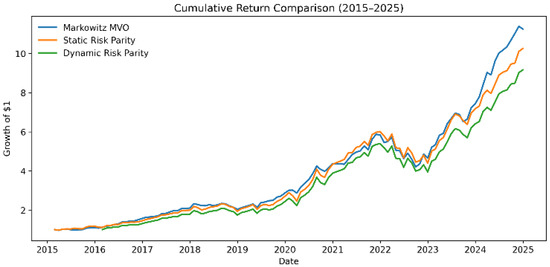
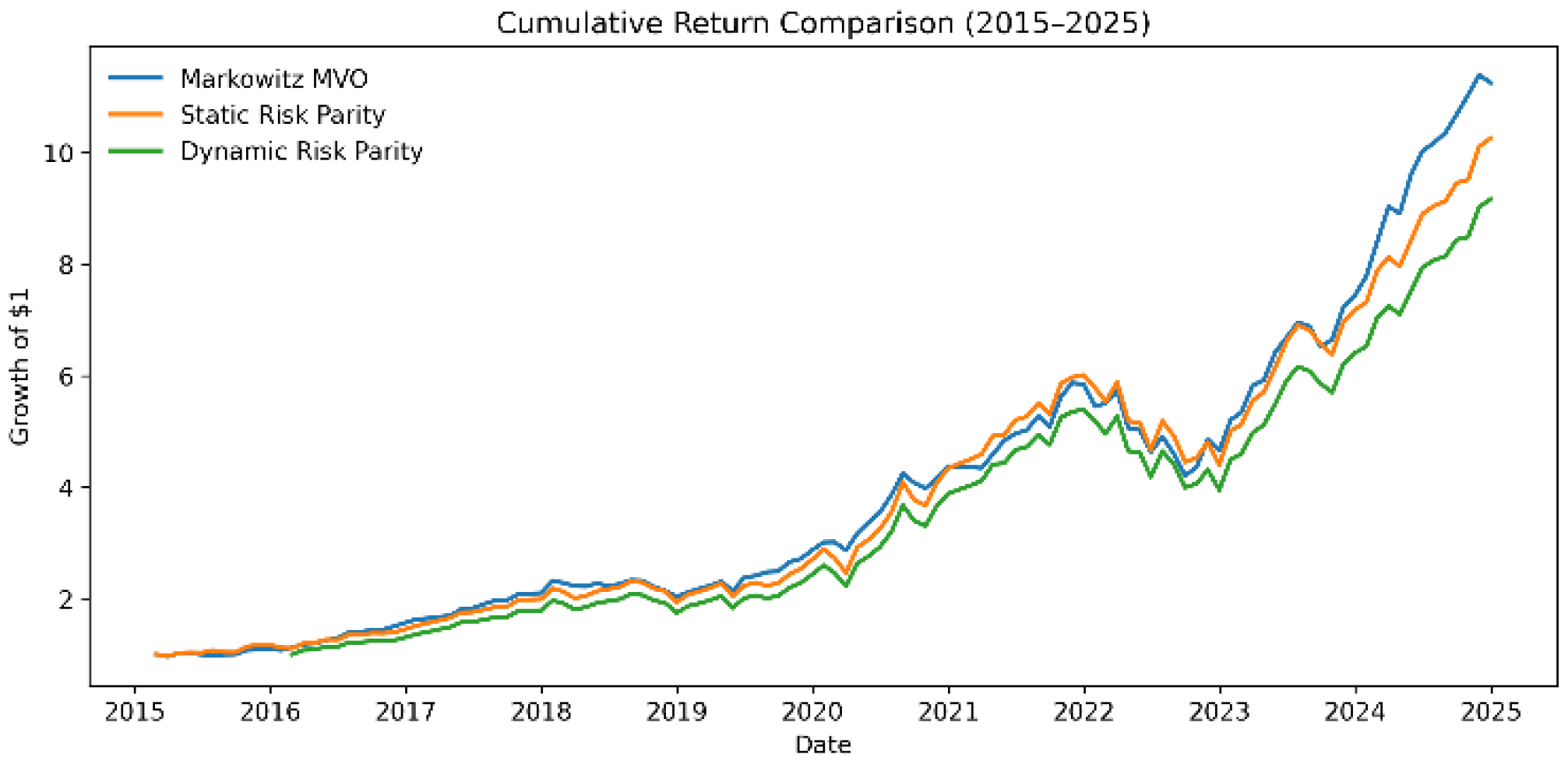
Table 1 reports the annualized performance metrics of the three portfolio strategies. As shown in Figure 1, the Markowitz portfolio achieves the highest cumulative return, which should be interpreted with caution as it is constructed using full-sample mean and covariance estimates.
Figure 1.
Cumulative return comparison of Markowitz mean–variance optimization (MVO), Static Risk Parity, and Dynamic Risk Parity portfolios over the period 2015–2025. Returns are computed using monthly rebalancing and normalized to an initial investment of one dollar.
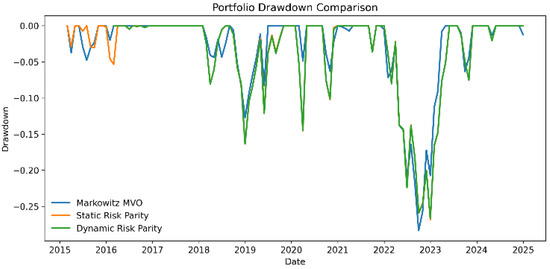
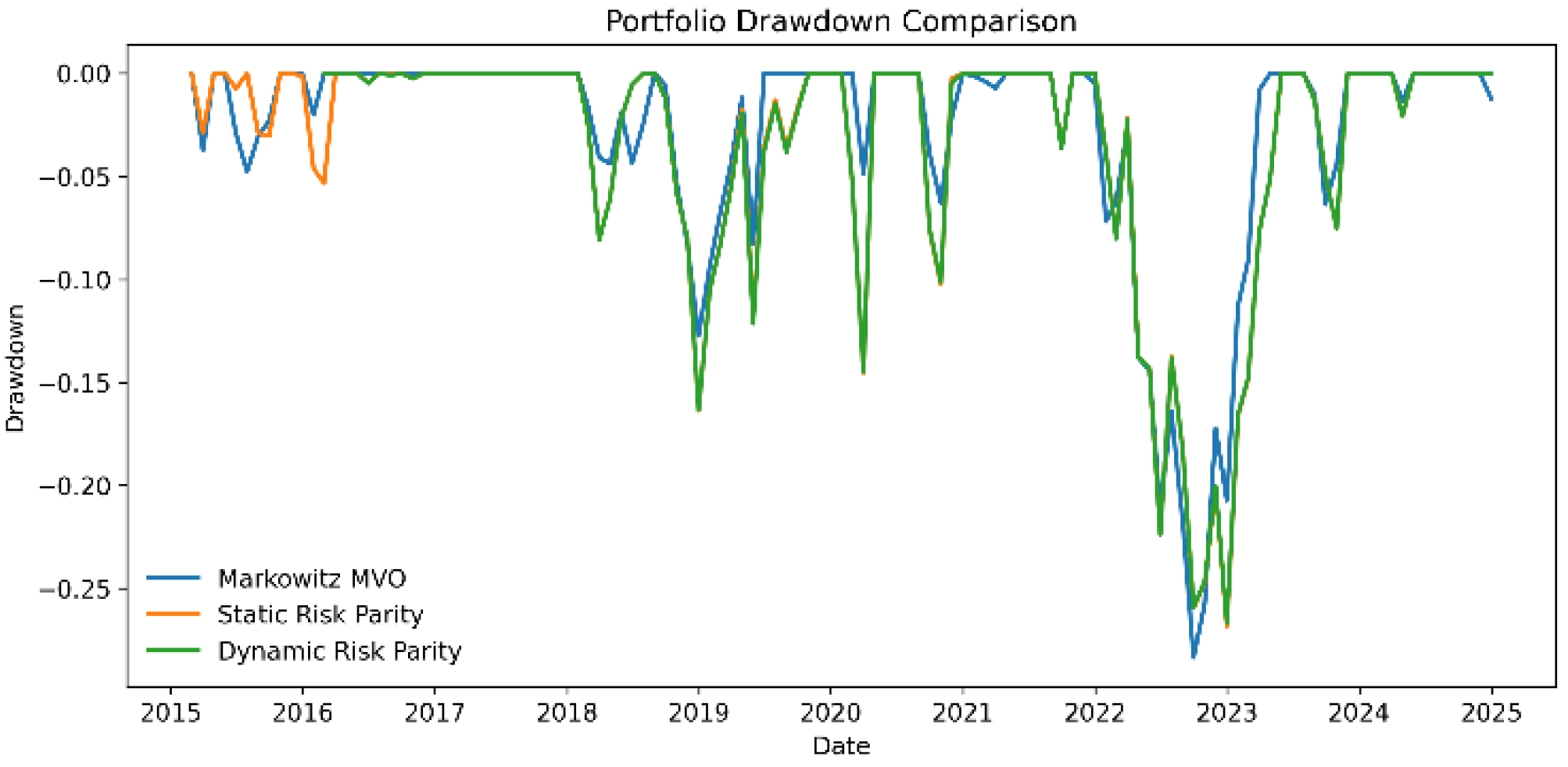
Figure 2 further illustrates the downside risk characteristics of the portfolios.
Figure 2.
Portfolio drawdown comparison for Markowitz MVO, Static Risk Parity, and Dynamic Risk Parity strategies. Drawdowns are calculated based on cumulative portfolio wealth relative to historical peaks.
Despite its high cumulative return, the Markowitz strategy experiences the largest maximum drawdown, while Dynamic Risk Parity provides superior drawdown protection, particularly during market stress periods.
Return and Overall Risk Performance
Mean Return:
Dynamic RP achieves the highest annualized return of 26.86%, outperforming Static RP (25.40%) and Markowitz MVO (25.86%). This demonstrates that the dynamic adjustment of portfolio weights using the most recent risk estimates (via a rolling window) allows the strategy to capitalize on short-term changes in market volatility and correlations. In contrast, Static RP relies on historical risk measures and infrequent updates, resulting in slightly lower return capture.
Volatility:
Markowitz MVO exhibits the lowest portfolio volatility (0.1563), reflecting its emphasis on variance minimization. Dynamic RP shows slightly higher volatility (0.1895), which is consistent with its dynamic rebalancing mechanism. While volatility is a standard risk measure, it does not fully capture tail risks or downside exposure, which is why further analysis of drawdowns is necessary.
Sharpe Ratio:
Markowitz MVO reports the highest Sharpe ratio (1.655). However, it is well-documented that MVO’s high in-sample Sharpe ratios often overstate real-world performance due to estimation errors in expected returns and covariances (Michaud, 1989). Dynamic RP, while slightly lower in Sharpe ratio (1.418), provides more robust out-of-sample risk-adjusted returns, combining strong performance with greater stability of portfolio weights.
The results highlight a critical trade-off: while MVO can generate attractive in-sample metrics, Dynamic RP balances return potential, risk-adjusted performance, and practical implementability more effectively in a multi-period setting.
4.2. The Role of the Dynamic Approach and Weight Stability
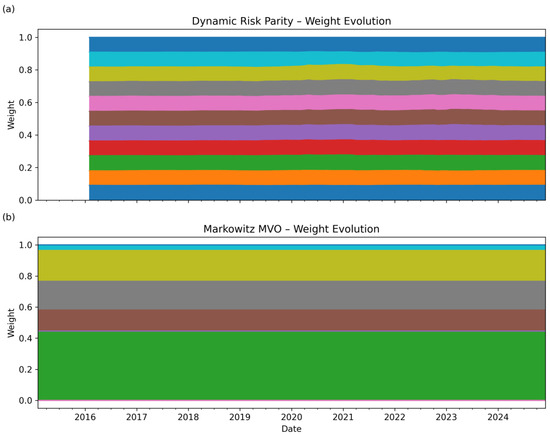
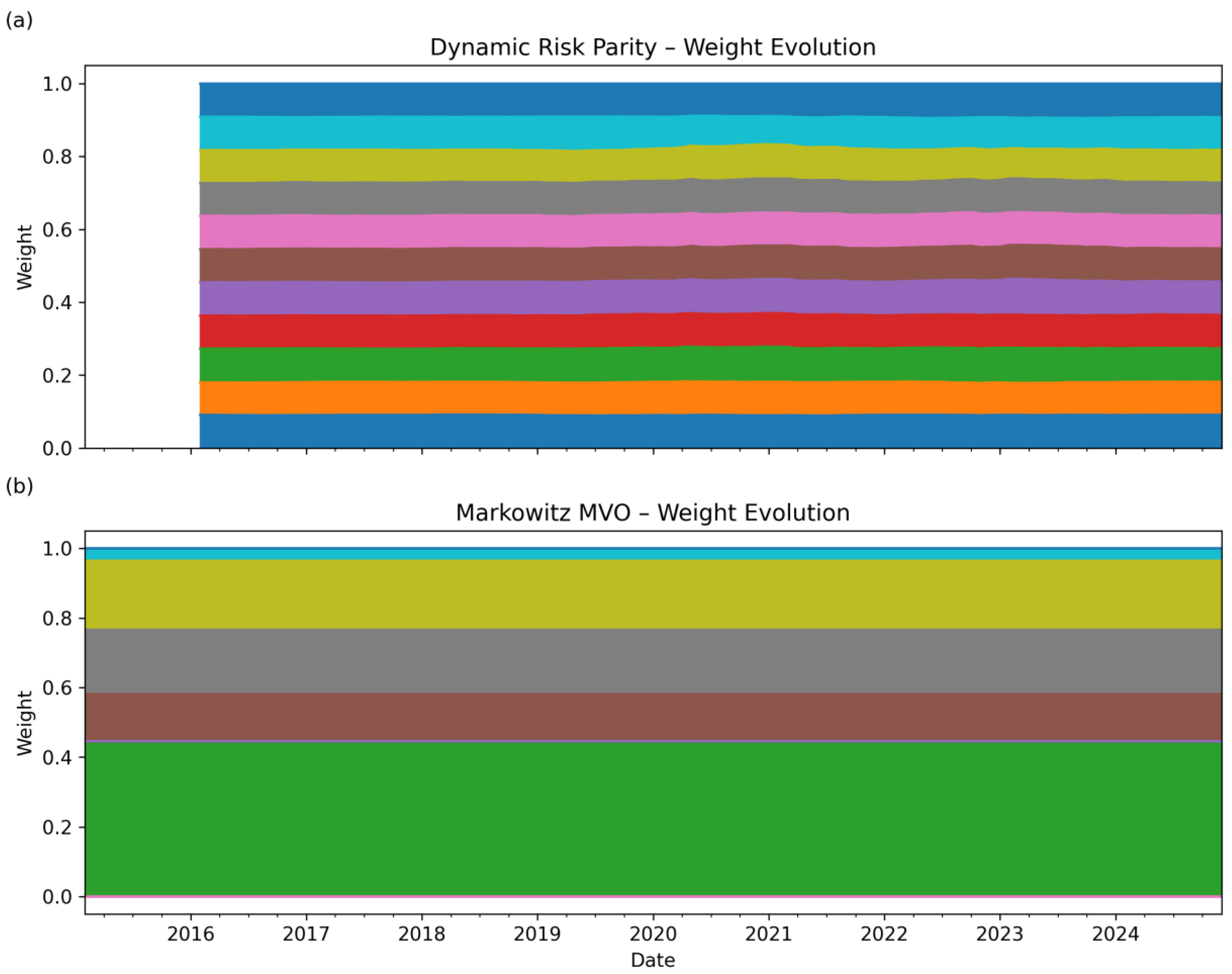
Figure 3 compares the evolution of portfolio weights under Dynamic Risk Parity and Markowitz MVO. While the Dynamic Risk Parity strategy adjusts allocations gradually over time through rolling covariance estimation, the Markowitz portfolio exhibits largely static weights, reflecting its in-sample optimization framework.
Figure 3.
Time-varying portfolio weight evolution for (a) Dynamic Risk Parity and (b) Markowitz MVO strategies. Each colored area represents the portfolio weight of an individual asset in the investment universe. The Dynamic Risk Parity portfolio exhibits gradual and systematic reallocation driven by rolling covariance estimates, whereas the Markowitz portfolio maintains relatively stable weights due to full-sample optimization.
Dynamic RP leverages a 12-month rolling window to update the covariance matrix and rebalance portfolio weights monthly. This enables the strategy to respond proactively to shifts in volatility regimes, such as sudden increases in market turbulence or changes in asset correlations.
The study shows that Dynamic RP consistently outperforms Static RP in terms of risk-adjusted returns (Sharpe ratio 1.418 vs. 1.368). Additionally, Dynamic RP emphasizes weight stability, which is a critical property for investors concerned with turnover, transaction costs, and practical implementability.
Markowitz portfolios are known for high sensitivity to input estimates, resulting in frequent and large shifts in portfolio weights across periods. In contrast, Dynamic RP and other active Risk Parity approaches maintain more stable allocations, even when input parameters experience minor perturbations. This robustness to estimation error is a key advantage of Dynamic RP, particularly for long-term multi-period investors (Boyd et al., 2024).
4.3. Addressing Model Error
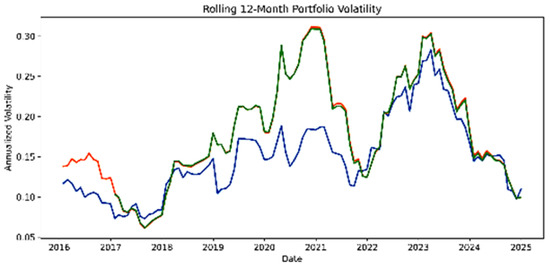
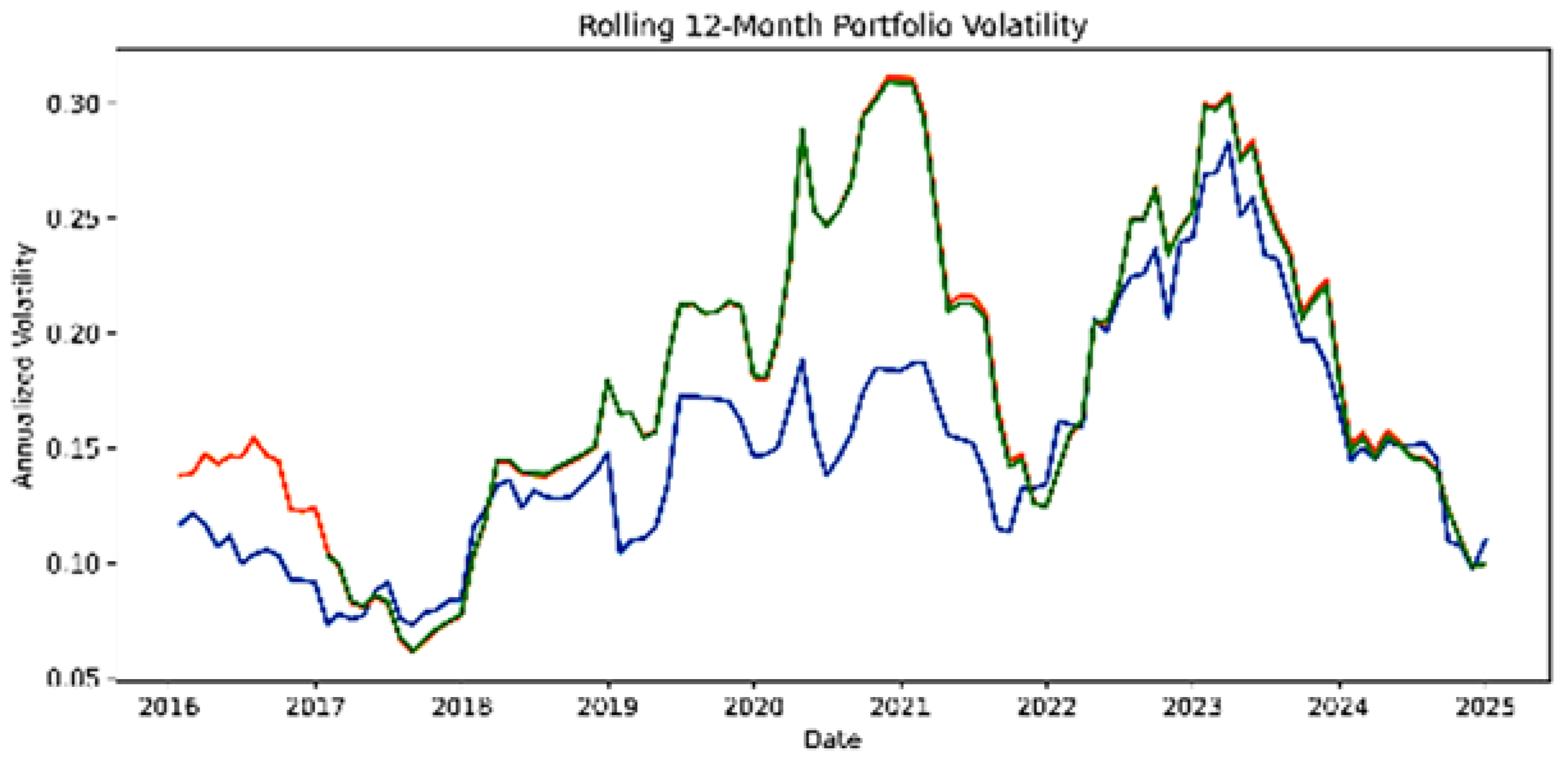
Figure 4 presents the rolling 12-month annualized volatility of the three strategies.
Figure 4.
Rolling 12-month annualized portfolio volatility for Markowitz MVO, Static Risk Parity, and Dynamic Risk Parity strategies. The figure highlights differences in risk stability across strategies over time.
Although Dynamic Risk Parity does not minimize volatility at all times, it demonstrates more stable risk behavior across different market regimes compared to the static approaches.
4.3.1. Risk Parity as a Robustified Mean-Variance Portfolio
Roncalli (2014) suggested that Risk Parity can be interpreted as a Mean-Variance portfolio with diversification constraints. By incorporating general risk measures that combine both expected returns (μ) and volatility (σ), RP allows investors to mitigate directional risks arising from forecast errors.
The empirical results support this interpretation: Dynamic RP achieves superior drawdown control and stable weight allocation, highlighting the strategy’s robustness in real-world, out-of-sample scenarios. Shifting from a pure variance-minimization approach (MVO) to an equally distributed risk approach (RP) reduces sensitivity to parameter misestimation while still capturing desirable return characteristics.
4.3.2. The Importance of Dynamic Portfolio Allocation
Transitioning from a static to a dynamic framework is crucial because MVO is inherently single-period and myopic, failing to adjust for evolving market conditions. Robust dynamic strategies, such as the multistage robust Markowitz model (Kuhn et al., 2009), have demonstrated the ability to outperform static MVO portfolios in terms of average monthly returns.
By incorporating a rolling-window adjustment into RP, Dynamic RP combines the robustness of Risk Parity with the adaptability of multi-period strategies. This hybrid approach ensures that the portfolio is resilient to estimation errors, while simultaneously reacting to regime changes, resulting in improved risk-adjusted performance and downside protection.
4.4. Practical Implications
The findings have several implications for both institutional and individual investors:
Dynamic RP provides a pragmatic balance between risk-adjusted returns and portfolio stability.
The rolling window framework allows investors to react to volatility shocks without relying heavily on expected return forecasts.
Portfolio weight stability reduces turnover and transaction costs, enhancing the strategy’s implementability in real-world scenarios.
Investors seeking to limit downside risk without sacrificing returns may prefer Dynamic RP over traditional MVO or static RP.
5. Discussion
5.1. Conclusion of Research Findings
The comparative analysis of Markowitz MVO, Static Risk Parity (Static RP), and Dynamic Risk Parity (Dynamic RP) using a long-only portfolio over the period 2015–2025 provides several key insights regarding performance, risk management, and practical implementability:
- Mean Return and Downside Risk Management:Dynamic RP achieves the highest annualized mean return of 26.86%, exceeding both Static RP (25.40%) and Markowitz MVO (25.86%). Importantly, Dynamic RP also records the lowest Maximum Drawdown (MDD) of −0.2770, compared to MVO (−0.3120), highlighting the strategy’s ability to mitigate downside risk during market downturns. This performance demonstrates that the Equal Risk Contribution (ERC) principle, when applied in a dynamic rolling-window framework, effectively balances return potential with risk control. The results suggest that dynamic risk budgeting allows the portfolio to adjust exposure to high-volatility assets, limiting losses without sacrificing growth opportunities.
- Sharpe Ratio and Weight Stability:Dynamic RP delivers a higher Sharpe ratio than Static RP (1.418 vs. 1.368), confirming the hypothesis that dynamic adjustment enhances risk-adjusted performance. Although Markowitz MVO reports the numerically highest Sharpe ratio (1.655), this advantage is likely influenced by in-sample optimization bias and does not necessarily translate into robust out-of-sample performance. Moreover, Dynamic RP exhibits superior weight stability, maintaining relatively consistent portfolio allocations over time. This feature is particularly valuable in practical applications, as it reduces portfolio turnover, transaction costs, and implementation complexity, areas where MVO is notoriously unstable due to its high sensitivity to estimation errors in expected returns (μ) and covariance matrices (Σ).
- Dynamic Adaptation to Market Conditions:Dynamic RP successfully enhances portfolio flexibility by adjusting asset weights on a monthly basis using a 12-month rolling window. This enables the strategy to respond to changing market volatility regimes, capture shifts in correlations, and adapt to evolving risk environments. Unlike MVO, which operates under a single-period static framework, or Static RP, which updates weights infrequently, Dynamic RP combines robust risk distribution with adaptive rebalancing, resulting in portfolios that are resilient under varying market conditions.
- Strategic Implication for Investors:The empirical findings underscore that Dynamic Risk Parity is particularly suitable for investors who prioritize stability, risk-adjusted performance, and dynamic risk management. By integrating risk parity principles with rolling-window adaptation, Dynamic RP offers a more robust out-of-sample alternative to Markowitz MVO, reducing the portfolio’s exposure to estimation error and enhancing resilience during periods of market stress. The strategy aligns with the practical objectives of institutional and individual investors seeking long-term wealth preservation while participating in market upside.
5.2. Limitations and Recommendations for Future Research
This study acknowledges several constraints that provide avenues for future research. First, the empirical tests were conducted in a long-only framework without leverage. In professional practice, Risk Parity often utilizes leverage to equalize risk contributions across low-volatility assets. The absence of leverage in this study may understate the potential return-enhancing capabilities of the DRP strategy.
Second, the asset universe was limited to eleven high-liquidity assets (10 US equities and Gold). While this ensures data quality and reduces transaction impact, it may introduce selection bias. Future studies should expand the asset classes to include fixed income, commodities, and international REITs to further validate the diversification benefits of Dynamic Risk Parity.
Lastly, the statistical tests showed that return differentials were not significant at the 5% level, reflecting the inherent noise in equity markets. Subsequent research could employ longer historical datasets or Bayesian shrinkage techniques to improve the precision of the optimization parameters.
- Extension to Multi-Asset Dynamic RP:Future studies should expand Dynamic Risk Parity to multi-asset portfolios, including asset classes such as REITs, commodities, and cryptocurrencies. By diversifying across different risk-return profiles and correlation structures, researchers can evaluate whether Dynamic RP maintains its downside protection and risk-adjusted performance in a broader investment universe. Such an extension could also reveal insights into cross-asset volatility dynamics and optimal risk budgeting in a more complex financial environment.
- Integration of Machine Learning (ML):Machine Learning techniques could be employed to enhance the estimation of the covariance matrix (Σ), detect structural shifts in correlations, or determine an adaptive rolling-window size based on prevailing market conditions. Such integration may allow Dynamic RP to anticipate volatility regime changes more effectively, optimize weight adjustments, and improve performance under extreme market events. Advanced ML methods, such as covariance shrinkage, factor-based models, or deep learning approaches, could further reduce estimation error while maintaining the robustness inherent in RP frameworks.
- Impact of Transaction Costs and Turnover:Dynamic rebalancing introduces the risk of higher portfolio turnover, which may erode net returns when considering transaction costs and market liquidity constraints. Future research should incorporate realistic cost assumptions to evaluate the net profitability of Dynamic RP. This would provide actionable insights into how often portfolios should be rebalanced and whether adaptive thresholds or turnover control mechanisms could improve practical implementation without sacrificing performance.
- Alternative Risk Measures and Tail-Risk Management:While variance remains the standard risk measure, incorporating asymmetric risk measures, such as Conditional Value-at-Risk (CVaR) or Expected Shortfall (ES), may offer better protection against extreme losses and fat-tailed market events. J. Li and Xu (2013) demonstrated that Mean-CVaR optimization in a dynamic setting can outperform variance-based strategies in managing tail risk. Evaluating Dynamic RP under such risk measures could further enhance downside resilience and provide investors with more comprehensive risk management tools.
Practical Implementation Considerations:
In addition to theoretical improvements, it is recommended that Dynamic RP strategies be tested in real-world trading environments, considering slippage, execution risk, and liquidity constraints. Simulation with historical intraday data or stress-testing under crisis scenarios could validate the robustness of Dynamic RP for institutional deployment
5.3. Conceptual Reflection
Overall, the study provides strong empirical evidence supporting Dynamic Risk Parity as a viable portfolio strategy that combines robust risk distribution with dynamic adaptation. It achieves high mean returns, superior downside protection, and stable portfolio weights, addressing key limitations of traditional Markowitz MVO and static risk parity approaches. The research underscores the importance of adaptive risk management frameworks in modern portfolio construction, particularly in the face of market uncertainty and volatility regime shifts (Costa & Kwon, 2022).
Future research and practical applications should aim to extend the strategy across diverse asset classes, incorporate advanced risk estimation techniques, and evaluate real-world implementation constraints, thereby further enhancing the appeal and robustness of Dynamic RP for long-term investors.
6. Conclusions
The Dynamic Risk Parity (DRP) framework represents an evolutionary advancement in quantitative portfolio optimization, extending beyond the static assumptions of Markowitz Mean–Variance (MV) and traditional Static Risk Parity (SRP) models. By dynamically rebalancing risk exposures in response to evolving market volatility, DRP introduces an adaptive mechanism that continuously aligns portfolio weights with real-time risk conditions. This approach mitigates concentration bias, enhances diversification efficiency, and reduces sensitivity to unstable return estimations that often undermine static allocation models.
Empirical analysis using a long-only portfolio of U.S. equities and gold demonstrates the superior performance of the DRP model in terms of downside risk management and portfolio stability. Specifically, the model achieved the highest annualized mean return (26.86%) while maintaining the lowest maximum drawdown (−0.277), outperforming both Markowitz and Static Risk Parity benchmarks. These findings highlight the DRP’s ability to dynamically absorb market shocks, adapt to regime shifts, and sustain consistent risk-adjusted performance under varying market conditions.
In essence, the Dynamic Risk Parity paradigm establishes a robust, data-driven foundation for next-generation portfolio construction. By integrating dynamic risk calibration, temporal sensitivity, and systematic reallocation, DRP bridges the gap between classical optimization theory and real-world market complexity. It offers a scalable and resilient framework for institutional and algorithmic asset management, paving the way for intelligent, risk-balanced strategies that remain stable across economic cycles and volatility regimes.
Author Contributions
Conceptualization—P.W., T.C. and T.K.; Methodology—P.W.; Validation—T.C. and T.K.; Formal Analysis—P.W., T.C. and T.K.; Investigation—P.W.; Resources—P.W., T.C. and T.K.; Data Curation—P.W., T.C. and T.K.; Writing—Original Draft—P.W., T.C. and T.K.; Writing—Review & Editing—P.W., T.C. and T.K.; Visualization—T.C. and T.K.; Funding Acquisition—P.W., T.C. and T.K.; Supervision—T.C. and T.K. All authors have read and agreed to the published version of the manuscript.
Funding
This research received no external funding.
Institutional Review Board Statement
Not applicable.
Informed Consent Statement
Not applicable.
Data Availability Statement
The data presented in this study are available on request from the corresponding author. The data are not publicly available due to internal data management policies.
Conflicts of Interest
The authors declare no conflicts of interest.
References
- Benichou, R., Lempérière, Y., Sérié, E., Kockelkoren, J., Seager, P., Bouchaud, J. P., & Potters, M. (2016). Agnostic risk parity: Taming known and unknown-unknowns. arXiv, arXiv:1610.08818v1. [Google Scholar] [CrossRef] [Scilit]
- Boyd, S., Johansson, K., Kahn, R., Schiele, P., & Schmelzer, T. (2024). Markowitz portfolio construction at seventy. arXiv, arXiv:2401.05080. [Google Scholar] [CrossRef] [Scilit]
- CAIA. (2024). Risk parity not performing? Blame the weather. Available online: https://caia.org/blog/2024/01/02/risk-parity-not-performing-blame-weather?utm_source=chatgpt.com (accessed on 3 November 2025).
- Chaves, D. B., Hsu, J. C., Li, F., & Shakernia, O. (2012). Efficient algorithms for computing risk parity portfolio weights. Journal of Investing, 21(3), 150–163. [Google Scholar] [CrossRef] [Scilit]
- Costa, G., & Kwon, R. H. (2022). Data-driven distributionally robust risk parity portfolio optimization. Optimization Methods and Software, 37(5), 1876–1911. [Google Scholar] [CrossRef] [Scilit]
- Cousin, A., Lelong, J., & Picard, T. (2023). Mean-variance dynamic portfolio allocation with transaction costs: A wiener chaos expansion approach. Applied Mathematical Finance, 30(6), 313–353. [Google Scholar] [CrossRef] [Scilit]
- Fischer, G. S., Maymin, P. Z., & Maymin, Z. G. (2015). Risk parity optimality. The Journal of Portfolio Management, 41(2), 42–56. [Google Scholar] [CrossRef] [Scilit]
- Hu, G., & Gu, M. (2024). Markowitz meets Bellman: Knowledge-distilled reinforcement learning for portfolio management. arXiv, arXiv:2405.05449v1. [Google Scholar] [CrossRef] [Scilit]
- Institutional Investor. (2022). Hit by a ‘perfect storm,’ risk parity managers try a more active approach. Available online: https://www.institutionalinvestor.com/article/2bstndzj1mw2z4ujlghz4/corner-office/hit-by-a-perfect-storm-risk-parity-managers-try-a-more-active-approach?utm_source=chatgpt.com (accessed on 3 November 2025).
- Kuhn, D., Parpas, P., Rustem, B., & Wozabal, D. (2009). Dynamic mean-variance portfolio analysis under model risk. The Journal of Computational Finance, 12(4), 91–114. [Google Scholar] [CrossRef] [Scilit]
- Lai, T. L., Xing, H., & Chen, Z. (2011). Mean–variance portfolio optimization when means and covariances are unknown. The Annals of Applied Statistics, 5(2A), 798–823. [Google Scholar] [CrossRef] [Scilit]
- Li, D., & Ng, W. L. (2000). Optimal dynamic portfolio selection: Multiperiod mean-variance formulation. Mathematical Finance, 10(3), 387–406. [Google Scholar] [CrossRef] [Scilit]
- Li, J., & Xu, M. (2013). Optimal dynamic portfolio with Mean-CVaR criterion. Risks, 1(3), 119–147. [Google Scholar] [CrossRef] [Scilit]
- Maewal, A., & Bock, J. R. (2019). A modified risk parity method for asset allocation. Journal of Economics and Financial Analysis, 3(1), 71–85. [Google Scholar] [CrossRef] [Scilit]
- Maillard, S., Roncalli, T., & Teïletche, J. (2010). The properties of equally weighted risk contribution portfolios. Journal of Portfolio Management, 36(4), 60. [Google Scholar] [CrossRef] [Scilit]
- Markov, M., & Markov, V. (2023). Portfolio optimization rules beyond the mean-variance approach. arXiv, arXiv:2305.08530. [Google Scholar] [CrossRef] [Scilit]
- Markowitz, H. (1952). Portfolio selection. The Journal of Finance, 7(1), 77–91. [Google Scholar] [CrossRef] [Scilit] [PubMed]
- Michaud, R. O. (1989). The Markowitz optimization enigma: Is ‘optimized’ optimal? Financial Analysts Journal, 45(1), 31–42. [Google Scholar] [CrossRef] [Scilit]
- ReSolve Asset Management. (2020). Maximizing the rebalancing premium: Why risk parity portfolios are much greater than the sum of their parts. Available online: https://investresolve.com/maximizing-the-rebalancing-premium-why-risk-parity-portfolios-are-much-greater-than-the-sum-of-their-parts/ (accessed on 3 November 2025).
- Rigamonti, A., & Lučivjanská, K. (2024). Mean-semivariance portfolio optimization using minimum average partial. Annals of Operations Research, 334(1), 185–203. [Google Scholar] [CrossRef] [Scilit]
- Rockafellar, R. T., & Uryasev, S. (2000). Optimization of conditional value-at-risk. Journal of Risk, 2(3), 21–42. [Google Scholar] [CrossRef] [Scilit]
- Roncalli, T. (2014). Introducing expected returns into risk parity portfolios: A new framework for asset allocation. Microeconomics: Decision-Making Under Risk & Uncertainty eJournal, 2321309. [Google Scholar] [CrossRef] [Scilit]

Disclaimer/Publisher’s Note: The statements, opinions and data contained in all publications are solely those of the individual author(s) and contributor(s) and not of MDPI and/or the editor(s). MDPI and/or the editor(s) disclaim responsibility for any injury to people or property resulting from any ideas, methods, instructions or products referred to in the content. |
© 2026 by the authors. Licensee MDPI, Basel, Switzerland. This article is an open access article distributed under the terms and conditions of the Creative Commons Attribution (CC BY) license.