A Cointegrated Ising Spin Model for Asynchronously Traded Futures Contracts: Spread Trading with Crude Oil Futures


Abstract
1. Introduction
1.1. Statistical Arbitrage and Futures Spread Trading
1.2. Summary of Contributions
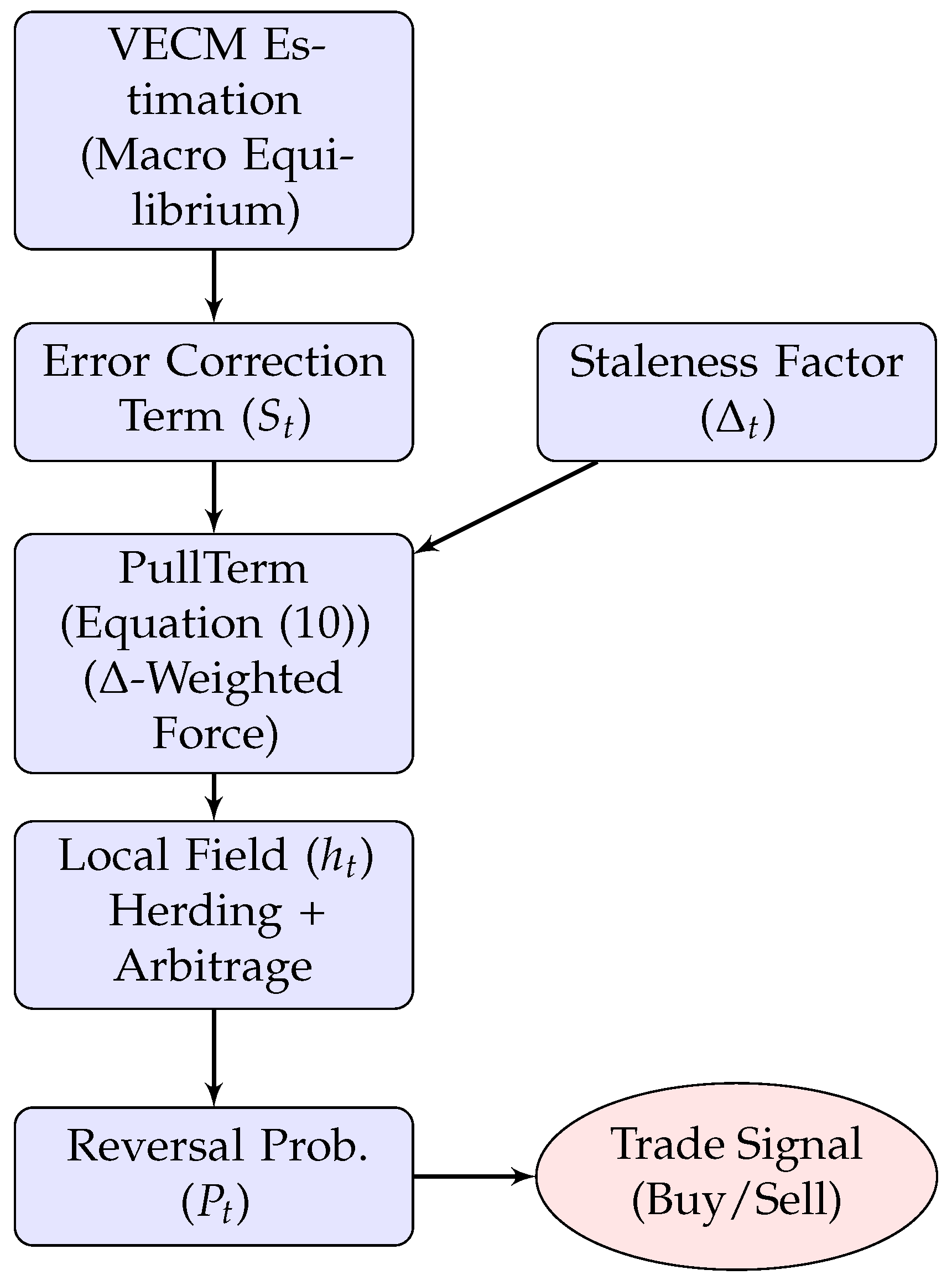
- The Cointegrated Ising Architecture: While the Ising framework is an established tool (Bornholdt, 2001; Campajola et al., 2020), this study is the first to anchor micro-level agent transitions (buy/sell decisions) to a macro-level Vector Error Correction Model (VECM) equilibrium.
- Information Staleness as an Economic Variable: We introduce a novel -weighted arbitrage force. Unlike traditional models that assume synchronous time steps, this mechanism operationalizes asynchronicity () as an active measure of latent information pressure.
2. Literature Review
2.1. Statistical Arbitrage, Pairs Trading, and Cointegrated Models
2.2. Asynchronous Trading and High-Frequency Dynamics
2.3. Ising Models in Finance
- Neighbor Interactions (): A ferromagnetic coupling () encourages agents to align with their neighbors, representing herding behavior or imitation (Callen & Shapero, 1974; Dvořák, 2012).
- Global Field/External Influence (): An external field, often related to the general state of the market (e.g., magnetization ), can influence individual spins. In many financial Ising models, such as Bornholdt’s, this term often induces an anti-ferromagnetic tendency (minority game characteristic), where agents are incentivized to take positions contrary to the majority if they believe profits lie in being contrarian (Bornholdt, 2001; Dvořák, 2012). This component is crucial for generating complex dynamics such as “expectation bubbles” and intermittency. Note: this is distinct from the ECM adjustment speeds .
- Idiosyncratic Preferences/Strategy Spin (): Some models introduce heterogeneous agent types, such as fundamentalists (who might believe in a “true” value) versus chartists or noise traders. This can be incorporated through strategy spins that modify how an agent reacts to the global field (Bornholdt, 2001; Dvořák, 2012).
- Stochasticity/Temperature (): The probability of a spin flip is often a logistic function of the local field, , where (inverse temperature) controls the randomness of agent decisions. High (low temperature) implies more deterministic behavior based on the local field (Dvořák, 2012). This can be seen as analogous to the concept of “social temperature”, where higher randomness equals higher social temperature (Callen & Shapero, 1974).
3. A Vector Logistic Autoregressive Approach: The Cointegrated Ising Model
3.1. Conceptual Intuition and the McFadden Bridge
3.2. Theoretical Foundation and Empirical Implementation
3.3. The Agent-Based Ising Spin Model
3.4. Microfoundations of Agent Behavior and Local Field Specification
3.4.1. Modeling Agent Influences
3.4.2. Agent Decision Probabilities
3.4.3. Market-Level Aggregation and Reversal Probability
3.5. Parameter Estimation via Trading Simulation
3.5.1. Trading Signal Generation
- Sell Signal Generation: A signal to sell the spread is generated at time t if and the reversal probability exceeds a sell threshold ().
- Buy Signal Generation: A signal to buy the spread is generated at time t if and the reversal probability exceeds a buy threshold ().
3.5.2. Defining a Successful Trade
- A sell trade is successful if the spread decreases at (i.e., ).
- A buy trade is successful if the spread increases at (i.e., ).
3.5.3. Hybrid Objective Function for Optimization
4. Empirical Implementation and Calibration of the Cointegrated Ising Spin Model
4.1. Agent-Based Model Calibration and Trading Performance
4.2. Model Diagnostics and Dynamics
4.3. Robustness and Sensitivity Analysis
- 1.
- Staleness Weight (): Reducing the calibrated value () by an order of magnitude materially decreased both trade signals and success rate, providing strong evidence that the -weighted arbitrage force is a primary source of predictive edge.
- 2.
- Agent Determinism (): Systematically lowering compressed the predictive distribution of toward 0.5, eroding signal clarity and reducing performance. This validates that strategy success depends on identifying high-conviction moments requiring agent rationality.
- 3.
- Relative Balance of Forces (): Altering the near-equal ratio of momentum to contrarian strength induced regime shifts. Higher ratios created trend-dominated markets with lower success rates; lower ratios led to passive markets with insufficient trades. This demonstrates critical sensitivity to the precise competitive balance between opposing market forces.
5. Discussion
5.1. Model Novelty and Strategic Value
- 1.
- Endogenous, Econometrically-Grounded Arbitrage Force: Traditional agent-based and Ising models (e.g., Bornholdt (2001); Kaizoji et al. (2002)) often rely on abstract or exogenous fundamental values, deriving agent decisions from forces like local herding and a global contrarian field. In contrast, the model’s primary driver is the novel ‘PullTerm’. This term is an endogenous force derived directly from an empirically estimated, macro-level econometric relationship–the cointegration vector. This elegantly anchors micro-level agent behavior to an observable, mean-reverting macro-level equilibrium, bridging the gap between econometrics and econophysics and providing a theoretically sound foundation for the trading signals.
- 2.
- Explicit Modeling and Exploitation of Asynchronous Time: Standard time-series models and Ising models struggle with asynchronous data, often assuming synchronous time steps . The model’s key innovation is how it operationalizes a -weighted arbitrage force. By explicitly incorporating the real-world time elapsed since the last trade () for each asset, this framework introduces a state-dependent, time-varying ECM where adjustment speeds scale with (see Appendix A). This provides a micro-founded mechanism for delayed error correction. This dynamic weighting of the corrective force yields a more accurate, real-time response to market disequilibrium that is uniquely suited for generating signals from tick-level data.
- 3.
- A Prescriptive, Probabilistic Output: The output of many quantitative models is a latent state (e.g., aggregate magnetization) or a binary signal. The model’s primary output is a prescriptive, conditional probability of mean reversion. By aggregating agent decisions, the model directly calculates an instantaneous, actionable probability that the spread will converge. This transforms the model from a purely descriptive tool into a sophisticated, probabilistic signal generator, allowing for the construction of more nuanced, risk-aware strategies that move beyond static threshold rules.
5.2. Limitations and Future Research
6. Conclusions
Funding
Institutional Review Board Statement
Informed Consent Statement
Data Availability Statement
Acknowledgments
Conflicts of Interest
Appendix A. Formal Derivation and Econometric Foundations of the Δ-Weighted Arbitrage Force
- an econometric foundation based on a state-dependent, time-varying ECM;
- a micro-founded Random Utility/Ising decision framework;
- a probability-gradient analysis demonstrating distributional implications.
Appendix A.1. Cointegration and Classical Error-Correction Adjustment
Appendix A.2. Asynchronous Event Time and Information Staleness
Appendix A.3. Staleness-Weighted Adjustment as a State-Dependent ECM
Limiting and Nesting Properties
Appendix A.4. Microfoundations: Random Utility and Ising Representation
Appendix A.5. Probability-Gradient and Distributional Implications
- Reversal probability rises monotonically with staleness;
- The model exhibits asymptotic conviction in disequilibrium states;
- The mechanism filters high-frequency noise by requiring stronger latent signals.
Appendix A.6. Relation to Existing Models
- (i)
- Adjustment speed is endogenous and state-dependent, rather than constant as in classical ECMs;
- (ii)
- Asynchronous event time is modelled directly on discrete tick data;
- (iii)
- The Ising/agent-based layer is explicitly anchored to a cointegrating equilibrium;
- (iv)
- Unlike an arbitrary scaling factor, the -weighting arises from micro-founded assumptions about latent information accumulation and is consistent with state-dependent adjustment models.
References
- Aït-Sahalia, Y., Fan, J., & Xiu, D. (2010). High-frequency covariance estimates with noisy and asynchronous financial data. Journal of the American Statistical Association, 105(492), 1504–1517. [Google Scholar] [CrossRef] [Scilit]
- Alsayed, H., & McGroarty, F. (2014). Ultra-high-frequency algorithmic arbitrage across international index futures. Journal of Forecasting, 33(5), 391–408. [Google Scholar] [CrossRef] [Scilit]
- Bajgrowicz, P., & Scaillet, O. (2012). Technical trading revisited: False discoveries, persistence tests, and transaction costs. Journal of Financial Economics, 106(3), 473–491. [Google Scholar] [CrossRef] [Scilit]
- Bornholdt, S. (2001). Expectation bubbles in a spin model of markets: Intermittency from frustration across scales. International Journal of Modern Physics C, 12(05), 667–674. [Google Scholar] [CrossRef] [Scilit]
- Brock, W. A., & Hommes, C. H. (1998). Heterogeneous beliefs and routes to chaos in a simple asset pricing model. Journal of Economic Dynamics and Control, 22(8–9), 1235–1274. [Google Scholar] [CrossRef] [Scilit]
- Callen, E., & Shapero, D. (1974). A theory of social imitation. Physics Today, 27(7), 23–28. [Google Scholar] [CrossRef] [Scilit]
- Campajola, C., Lillo, F., & Tantari, D. (2020). Unveiling the relation between herding and liquidity with trader lead–lag networks. Quantitative Finance, 20(8), 1253–1271. [Google Scholar] [CrossRef] [Scilit]
- Cividino, D., Westphal, R., & Sornette, D. (2023). Multiasset financial bubbles in an agent-based model with noise traders. Physical Review Research, 5(1), 013009. [Google Scholar] [CrossRef] [Scilit]
- Cont, R. (2001). Empirical properties of asset returns: Stylized facts and statistical issues. Quantitative Finance, 1(2), 223–236. [Google Scholar] [CrossRef]
- Dvořák, P. (2012). From microscopic rules to macroscopic phenomena: Ising model in finance [Unpublished bachelor thesis, Charles University in Prague]. [Google Scholar]
- Enders, W. (1995). Applied econometric time series. John Wiley & Sons, Inc. [Google Scholar]
- Engle, R. F., & Granger, C. W. (1987). Co-integration and error correction: Representation, estimation and testing. Econometrica, 55(2), 251–276. [Google Scholar] [CrossRef] [Scilit]
- Gatev, E., Goetzmann, W. N., & Rouwenhorst, K. G. (1999). Pairs trading: Performance of a relative value arbitrage rule (NBER Working Papers 7032). National Bureau of Economic Research Inc. [Google Scholar]
- He, C., Wang, T., Liu, X., & Huang, K. (2023). An innovative high-frequency statistical arbitrage in Chinese futures market. Journal of Innovation & Knowledge, 8(2023), 100429. [Google Scholar]
- Hommes, C. H. (2006). Heterogeneous agent models in economics and finance. In L. Tesfatsion, & K. L. Judd (Eds.), Handbook of computational economics (Vol. 2, Chapter 23, pp. 1109–1186). Elsevier. [Google Scholar]
- Kaizoji, T., Bornholdt, S., & Fujiwara, Y. (2002). Dynamics of price and trading volume in a spin model of stock markets with heterogeneous agents. Physica A: Statistical Mechanics and Its Applications, 316(1–4), 441–452. [Google Scholar] [CrossRef] [Scilit]
- Kristoufek, L., & Vosvrda, M. (2018). Herding, minority game, market clearing and efficient markets. Communications in Nonlinear Science and Numerical Simulation, 54, 148–155. [Google Scholar] [CrossRef] [Scilit]
- Kukacka, J., & Kristoufek, L. (2020). Do ‘complex’ financial models really lead to complex dynamics? Agent-based models and multifractality. Journal of Economic Dynamics and Control, 113, 103855. [Google Scholar] [CrossRef] [Scilit]
- Lazzarino, M., Berrill, J., & Šević, A. (2018). What is statistical arbitrage? Theoretical Economics Letters, 8, 888–908. [Google Scholar] [CrossRef]
- McFadden, D. (1974). Conditional logit analysis of qualitative choice behavior. In P. Zarembka (Ed.), Frontiers in econometrics (pp. 105–142). Academic Press. [Google Scholar]
- Sornette, D. (2014). Physics and financial economics (1776–2014): Puzzles, Ising and agent-based models. Reports on Progress in Physics, 77(6), 062001. [Google Scholar] [CrossRef] [Scilit]
- Stock, J. H., & Watson, M. W. (1988). Testing for common trends. Journal of the American Statistical Association, 83(404), 1097–1107. [Google Scholar] [CrossRef]
- Vidyamurthy, G. (2004). Pairs trading: Quantitative methods and analysis. John Wiley & Sons. [Google Scholar]
- Yan, T., Chiu, M. C., & Wong, H. Y. (2022). Pairs trading under delayed cointegration. Quantitative Finance, 22(9), 1627–1648. [Google Scholar] [CrossRef] [Scilit]
- Zhang, L., & Hua, L. (2025). Major issues in high-frequency financial data analysis: A survey of solutions. Mathematics, 13(3), 347. [Google Scholar] [CrossRef] [Scilit]



| Series | Observations | Mean ($) | Std. Dev. | Minimum ($) | Maximum ($) |
|---|---|---|---|---|---|
| (LCOc1) | 16,318 | 76.78 | 0.359 | 75.61 | 77.50 |
| (LCOc2) | 16,318 | 75.24 | 0.327 | 74.09 | 75.86 |
| Variable | Coefficient | Std. Error | T-Statistic | p-Value |
|---|---|---|---|---|
| Adjustment Speeds | ||||
| −0.02574 | 0.00214 | −12.01 | 0.0000 | |
| 0.02011 | 0.00225 | 8.93 | 0.0000 | |
| Cointegrating Parameter | ||||
| 1.02045 | 0.00005 | 20,596.37 | 0.0000 | |
| Short-Run Dynamics | ||||
| 0.41446 | 0.00257 | 161.15 | 0.0000 | |
| 0.33730 | 0.00210 | 160.28 | 0.0000 | |
| Parameter | Value | Economic Interpretation |
|---|---|---|
| Prop. Contrarians () | 78 | Market composition (Equation (18)) |
| Rationality () | 5.387 | Noise level in decisions (Equation (6)) |
| Momentum () | 34.225 | Chartist trend-following (Equation (9)) |
| Arb. Strength () | 34.888 | Response to price divergence (Equation (10)) |
| Staleness Weight () | 25.282 | Amplification by time lag (Equation (10)) |
| Sell Thresh. () | 0.504 | Signal trigger level (Equation (21)) |
| Buy Thresh. () | 0.454 | Signal trigger level (Equation (21)) |
| Trade Execution Summary | Performance Summary | ||
|---|---|---|---|
| Sell Trades | 80 | Overall Success Rate | 74.65% |
| Successful Sells | 63 | Sell Success Rate | 78.75% |
| Buy Trades | 137 | Buy Success Rate | 72.26% |
| Successful Buys | 99 | Total Trades | 217 |
| Metric | ECT (Spread) | Prob (Reversal) |
|---|---|---|
| Summary Statistics | ||
| Mean | 0.0002 | 0.3943 |
| Std. Dev. | 0.0525 | 0.2905 |
| Skewness | 0.5127 | 0.2411 |
| Kurtosis (excess) | 0.3251 | −1.3260 |
| Minimum | −0.2815 | 0.0000 |
| Maximum | 0.2238 | 0.9489 |
| Percentiles | ||
| 1st | −0.0946 | 0.0003 |
| 5th | −0.0767 | 0.0109 |
| 25th | −0.0377 | 0.1170 |
| 50th (Median) | −0.0036 | 0.3682 |
| 75th | 0.0293 | 0.6823 |
| 95th | 0.0874 | 0.8645 |
| 99th | 0.1510 | 0.8934 |
| Stationarity Test | ||
| Runs Test (Z-Score) | −45.72 *** | – |
Disclaimer/Publisher’s Note: The statements, opinions and data contained in all publications are solely those of the individual author(s) and contributor(s) and not of MDPI and/or the editor(s). MDPI and/or the editor(s) disclaim responsibility for any injury to people or property resulting from any ideas, methods, instructions or products referred to in the content. |
© 2026 by the author. Licensee MDPI, Basel, Switzerland. This article is an open access article distributed under the terms and conditions of the Creative Commons Attribution (CC BY) license.
Share and Cite
Giannopoulos, K. A Cointegrated Ising Spin Model for Asynchronously Traded Futures Contracts: Spread Trading with Crude Oil Futures. J. Risk Financ. Manag. 2026, 19, 79. https://doi.org/10.3390/jrfm19010079
Giannopoulos K. A Cointegrated Ising Spin Model for Asynchronously Traded Futures Contracts: Spread Trading with Crude Oil Futures. Journal of Risk and Financial Management. 2026; 19(1):79. https://doi.org/10.3390/jrfm19010079
Chicago/Turabian StyleGiannopoulos, Kostas. 2026. "A Cointegrated Ising Spin Model for Asynchronously Traded Futures Contracts: Spread Trading with Crude Oil Futures" Journal of Risk and Financial Management 19, no. 1: 79. https://doi.org/10.3390/jrfm19010079
APA StyleGiannopoulos, K. (2026). A Cointegrated Ising Spin Model for Asynchronously Traded Futures Contracts: Spread Trading with Crude Oil Futures. Journal of Risk and Financial Management, 19(1), 79. https://doi.org/10.3390/jrfm19010079