


Abstract
We examine whether and how book-tax differences (BTDs) may affect investors’ perception of information risk. Using bid-ask spreads as a proxy for information risk, we document a positive association between bid-ask spreads around 10-K filing dates and positive temporary BTDs for firms with low analyst following or institutional ownership, consistent with larger positive temporary BTDs exacerbating information asymmetry for firms with poor information environments. Furthermore, this positive association is less pronounced for firms with higher analyst following or institutional ownership, suggesting that financial analysts and institutional investors mitigate information risk from positive temporary BTDs through their monitoring and information intermediary roles. We find similar results using positive permanent BTDs. Overall, our findings suggest that investors factor BTDs into their assessments of information risk, highlighting the importance of considering information risk in the valuation of BTDs.
1. Introduction
This study examines the implications of book-tax differences (BTDs) for information risk in the stock market. Prior research (Hanlon & Heitzman, 2010) suggests that higher BTDs may indicate lower earnings quality or higher agency costs, as firms with large BTDs are likely to manipulate income for book or tax purposes. An important question that follows is how the market may interpret BTDs. Although several studies have explored the impact of BTDs on firm value or stock returns, investors’ perceptions of BTDs remain unclear due to conflicting findings in the literature. Hanlon (2005) and Blaylock et al. (2012) find no association between future stock returns and temporary BTDs, suggesting that investors seem to fully understand the lower earnings persistence associated with larger positive temporary BTDs. In contrast, Weber (2009) and Chi et al. (2014) suggest that the market has difficulty understanding the implications of temporary BTDs for future earnings. In addition, using BTDs as a proxy for tax avoidance, Desai and Dharmapala (2009) show that larger BTDs are associated with higher firm value especially for firms with better corporate governance, while Hanlon and Slemrod (2009) demonstrate that the market views firms’ tax sheltering activities as value-destroying.
Motivated by these mixed findings, our study aims to provide additional insights into the market’s interpretation of BTDs from the perspective of information risk instead of firm value. Given that information risk is linked to the cost of equity capital (e.g., Amihud & Mendelson, 1986), this inquiry allows us to isolate the effect of BTDs on information asymmetry and hence the cost of capital from their impacts on future earnings and cash flows in the valuation of BTDs. Following Hanlon (2005) and Blaylock et al. (2012), we focus on positive temporary BTDs in our main analysis due to potential concerns about the measurement of permanent BTDs. Larger positive temporary BTDs may indicate greater earnings management and lower information transparency (e.g., J. Phillips et al., 2003; Hanlon, 2005). This creates an opportunity for informed investors to make profits by extracting private information and detecting potential earnings management underlying temporary BTDs, which in turn exacerbates information asymmetry. We thus expect a positive association between positive temporary BTDs and information risk.
We use bid-ask spreads to measure information risk (e.g., Bushee et al., 2010) and employ an event study approach to investigate whether temporary BTDs are associated with both abnormal and total bid-ask spreads around the release date of 10-K filings (Bhattacharya et al., 2013). This approach helps mitigate the endogeneity concern that the association between temporary BTDs and future returns documented in prior research may be due to omitted firm characteristics (Hanlon & Heitzman, 2010). We control for the magnitudes of discretionary accruals in all the regressions to ensure that our results are not driven by discretionary accruals. We find that when considering the market as a whole, bid-ask spreads around 10-K filing dates are not significantly associated with positive temporary BTDs.
Next, we explore the potential moderating roles of financial analysts and institutional investors in the bid-ask spread reaction to temporary BTDs. We hypothesize that the monitoring and information roles of financial analysts and institutional investors mitigate the information asymmetry induced by positive temporary BTDs such that the effect of positive temporary BTDs on information risk is more pronounced for firms with lower analyst following and institutional ownership. In line with this argument, we find that both abnormal and total bid-ask spreads around 10-K filing dates are positively associated with positive temporary BTDs for firms with low analyst following or institutional ownership. More importantly, higher analyst following or institutional ownership weakens the positive association between positive temporary BTDs and bid-ask spreads, which is consistent with better information environments mitigating the information risk arising from positive temporary BTDs.
We conduct two additional tests to check the robustness of our results. First, we employ Regulation Fair Disclosure (Reg FD) as an exogenous shock to firms’ information environments to address the endogeneity concern that the moderating effects of analyst following and institutional ownership may be driven by the underlying firm characteristics that are correlated with analyst following or institutional ownership. We find that the association between bid-ask spreads and positive temporary BTDs becomes less pronounced after Reg FD, supporting the view that Reg FD reduces the information advantages of financial analysts and institutional investors. This suggests that our main findings are unlikely to be driven by firm characteristics correlated with analyst following or institutional ownership. Second, we use the propensity score matching (PSM) approach to address the endogeneity concern about functional form misspecification (Shipman et al., 2017). We construct two subsamples of firms with poor and rich information environments, matched based on firm fundamentals. Consistent with our main findings, we observe higher abnormal bid-ask spreads for firms with larger positive temporary BTDs in the poor information environment subsample. In contrast, there is no significant difference in abnormal bid-ask spreads between firms with large and small positive temporary BTDs in the rich information environment subsample.
To provide a more complete assessment of how investors perceive BTDs, we turn to negative temporary BTDs as well as permanent BTDs in the additional analysis. We find some weak evidence that firms with more negative temporary BTDs exhibit higher abnormal bid-ask spreads around 10-K filing dates, suggesting that investors are somewhat concerned with downward earnings management as indicated by more negative temporary BTDs. The results based on permanent BTDs are in line with the agency perspective on tax avoidance. We show that larger positive permanent BTDs are associated with higher information asymmetry for firms with poor information environment, and that the positive association between positive permanent BTDs and information risk is attenuated for firms with higher analyst following or institutional ownership. Finally, we explore the implications of bid-ask spreads for the mispricing of temporary BTDs. We argue that larger total bid-ask spreads amplify the mispricing of positive temporary BTDs by increasing transaction costs and constraining the short-selling ability of arbitrageurs. Consistent with this argument, we find that the mispricing of positive temporary BTDs is more pronounced for firms with larger total bid-ask spreads.
This paper contributes to the literature on investors’ perception of BTDs by highlighting the importance of considering information risk in the valuation of BTDs. Prior research (e.g., Hanlon, 2005; Weber, 2009) has largely focused on the impact of BTDs on future returns and provided inconsistent evidence about whether the market misprices temporary BTDs. Our analysis reveals a nuanced role of information risk in valuing positive temporary BTDs, offering a possible explanation for these mixed findings. To the extent that larger bid-ask spreads reduce liquidity and increase the cost of equity capital, the increase in bid-ask spreads for firms with large positive temporary BTDs may reduce stock prices, thus mitigating the potential overvaluation of these firms even if investors overestimate the persistence of their earnings. However, larger bid-ask spreads may also increase transaction costs and constrain the ability of arbitrageurs to exploit the potential BTD mispricing.
Furthermore, we complement the growing literature on capital market consequences of BTDs by providing additional evidence consistent with the agency perspective of book-tax gaps. Prior studies argue that book-tax nonconformity reduces the transparency of financial reporting and increases information uncertainty, leading to an increase in stock price cash risk and synchronicity (e.g., J. B. Kim et al., 2011; Feng et al., 2019) as well as credit risk (e.g., Ayers et al., 2010; Moore & Xu, 2018). Using bid-ask spreads as a proxy for information asymmetry, our study provides more direct evidence that large temporary or permanent BTDs may facilitate earnings manipulation and exacerbate information asymmetry in the market, especially for firms with poor information environments. Our results provide an alternative explanation for why tax avoidance may not increase firm value for firms with poor governance (Desai & Dharmapala, 2009). That is, large BTDs may increase information risk and the cost of capital, thereby offsetting the benefits of resource transfer from the state to shareholders.
Finally, this study extends prior research on the effects of earnings quality and earnings management on information asymmetry (e.g., Bhattacharya et al., 2013; Ascioglu et al., 2012; Abad et al., 2018). While prior research has provided evidence that earnings management and earnings quality affect information asymmetry, it remains unclear whether and how investors incorporate BTDs when assessing information risk. Our study addresses this gap by examining the implications of both temporary and permanent BTDs for bid-ask spreads and by analyzing the moderating roles of analyst following and institutional ownership in shaping the association between BTDs and bid-ask spreads. We provide evidence supporting the view that the market uses information embedded in BTDs above and beyond traditional earnings management proxies to assess firms’ information risk. Our results reinforce the view that financial analysts and institutional investors help mitigate agency conflicts (e.g., Moore, 2012; Ramalingegowda & Yu, 2012; Irani & Oesch, 2013) and decrease information asymmetry (e.g., El-Gazzar, 1998; D’Souza et al., 2010; Boone & White, 2015), highlighting their roles in improving information environments.
The remainder of the paper is organized as follows. Section 2 reviews the previous literature and develops the hypotheses. Section 3 outlines the research methodology. The sample selection and the descriptive statistics are described in Section 4. We present our main empirical results in Section 5 and additional analyses in Section 6. Section 7 summarizes the paper and provides concluding remarks.
2. The Prior Literature and Hypothesis Development
Temporary BTDs may reflect discretion in non-tax accounting accruals and thus capture the extent of earnings management (see Hanlon & Heitzman, 2010 for a review). Consistent with this view, Hanlon (2005) and Blaylock et al. (2012) find that larger positive temporary BTDs are associated with lower persistence of earnings and accruals. The literature has examined whether investors could understand the implications of BTDs from the perspective of earnings persistence but provided mixed results. On one hand, Hanlon (2005) and Blaylock et al. (2012) find no evidence that larger positive temporary BTDs are associated with lower future returns, suggesting that the market can fully understand the implications of positive temporary BTDs for future earnings. On the other hand, Weber (2009) suggests that both financial analysts and investors do not fully understand the transitory feature of total BTDs, leading to an overvaluation of firms with large BTDs. Chi et al. (2014) further decompose total BTDs into temporary and permanent BTDs and show that the mispricing of total BTDs is driven by temporary BTDs but not permanent BTDs. In addition, Luo (2019) finds that tax services provided by auditors can improve earnings quality and thus reduce the return predictability of temporary BTDs.
We intend to provide additional insights into the pricing of BTDs by investigating the implications of BTDs for information asymmetry rather than future returns. We focus on positive temporary BTDs in our main analysis, as investors may be more concerned with income-increasing earnings management (Palmrose et al., 2004). Hanlon (2005) indicates that large positive temporary BTDs arise primarily from differences between financial and tax reporting in depreciation expense, bad debt expense, and expenses related to pensions and post-retirement benefits. Consistent with the view that upward earnings management is a predominant source of positive temporary BTDs (Blaylock et al., 2012), prior research (e.g., J. Phillips et al., 2003) finds that temporary BTDs are positively associated with financial reporting incentives that drive earnings management, such as meeting or beating earnings benchmarks and bonus thresholds. Furthermore, temporary BTDs can be economically large and reflect managerial discretion (e.g., Desai, 2005; Hanlon, 2005). These discretionary components, such as those related to revenue recognition timing and accounting allowances, can be adjusted to increase book income and meet earnings benchmarks without triggering immediate tax consequences, making them an attractive channel for earnings management.
Following Bhattacharya et al. (2013), we examine whether and how positive temporary BTDs are associated with information risk, as measured by bid-ask spreads, around 10-K filing dates. This event study design could mitigate the endogeneity concern that the association between BTDs and information asymmetry is due to omitted firm characteristics, since each firm serves as its own control. Prior studies (e.g., Ascioglu et al., 2012; Abad et al., 2018) find that lower earnings quality or more severe earnings management is generally associated with higher information asymmetry. Larger positive temporary BTDs may indicate more severe upward earnings management and lower accruals quality, which in turn should increase information asymmetry as well as the probability and profitability of informed trades around the release date of 10-K filings (Bhattacharya et al., 2013). As a result, market makers are likely to protect themselves by widening bid-ask spreads (O. Kim & Verrecchia, 1994), and we should observe a positive association between bid-ask spreads around 10-K filing dates and positive temporary BTDs. However, to the extent that investors can fully understand the implications of positive temporary BTDs for future earnings or if positive temporary BTDs do not convey incremental information above and beyond earnings management proxies to investors, the market may not be concerned with positive temporary BTDs. This suggests no association between positive temporary BTDs and bid-ask spreads. We state our first hypothesis in the alternative form as follows.
H1.
Bid-ask spreads around 10-K filing dates are positively associated with positive temporary BTDs.
Our empirical analysis found no significant association between bid-ask spreads and positive temporary BTDs at the aggregate level. One possible explanation is that investors may not respond to positive temporary BTDs in the same way across firms. This motivates us to examine cross-sectional differences in bid-ask spread reactions to positive temporary BTDs. In particular, we entertain the moderating role of information environment, as measured by analyst following and institutional ownership, in shaping the association between bid-ask spreads and positive temporary BTDs.
Institutional investors and financial analysts can mitigate the adverse selection problem and improve information environments through their monitoring and information roles (Shleifer & Vishny, 1986). Prior studies have provided evidence consistent with the monitoring roles of financial analysts (e.g., F. F. Yu, 2008; Irani & Oesch, 2013) and institutional investors (e.g., Healy & Palepu, 2001; Bushee, 1998, 2001; Ramalingegowda & Yu, 2012; Moore, 2012). Financial analysts and institutional investors not only have a strong motivation to act as external monitors of managers but also possess the required expertise and resources to constrain managerial opportunistic behaviors. To the extent that financial analysts and institutional investors can reduce earnings management and improve information quality, investors may be less concerned with positive temporary BTDs, and the perceived information asymmetry problem should be less severe for firms with higher analyst following or institutional ownership.
In addition to the monitoring benefits, financial analysts and institutional investors may also increase information efficiency and reduce information asymmetry by acquiring private information (e.g., El-Gazzar, 1998; Balsam et al., 2002; Frankel & Li, 2004) and increasing information production (Boone & White, 2015) and dissemination (e.g., Hong et al., 2000; D’Souza et al., 2010). Bhattacharya et al. (2013) find that the negative effect of accruals quality on information asymmetry is stronger for firms with poorer information environments, which is consistent with the view that information environments moderate the association between earnings quality and information asymmetry. If better information environments help reduce the information asymmetry attributable to positive temporary BTDs among market participants, uninformed investors are less likely to demand higher bid-ask spreads to protect themselves (Duarte et al., 2008). This suggests a less positive association between bid-ask spreads and positive temporary BTDs for firms with higher analyst following or institutional ownership.
Taken together, we expect that the positive association between positive temporary BTDs and bid-ask spreads is the strongest for firms with low analyst following or institutional ownership, and that this association becomes less pronounced for firms with higher analyst following or institutional ownership. Therefore, we have the following two hypotheses stated in the alternative form.
H2.
Positive temporary BTDs are positively associated with bid-ask spreads for firms with low analyst following or institutional ownership.
H3.
The positive association between positive temporary BTDs and bid-ask spreads is less pronounced for firms with higher analyst following or institutional ownership.
3. Research Methodology
3.1. Measures of Bid-Ask Spreads and Book-Tax Differences
We use abnormal bid-ask spreads (ABSPD) to measure the change in information risk around 10-K filing dates and the total bid-ask spreads (TOTSPD) to measure the level of information risk around 10-K filing dates (e.g., Bushee et al., 2010; Blankespoor et al., 2014). Bid-ask spreads are calculated as the difference between the ask price and the bid price, scaled by the average of the ask price and the bid price. ABSPD is then defined as the cumulative daily abnormal bid-ask spreads during the event window, from 5 days before to 5 days after 10-K filing dates, where daily abnormal bid-ask spreads are calculated as the bid-ask spread for the event day minus the mean bid-ask spread during the 30-day estimation window ending 12 days before the event period. TOTSPD is the cumulative daily total bid-ask spreads during the 11-day event window (−5, 5).1 PRESPD is the expected cumulative daily total bid-ask spreads during the event window, calculated as 11 times the mean bid-ask spread during the 30-day estimation window. By construction, TOTSPD is the sum of ABSPD and PRESPD.
Following Chi et al. (2014), we estimate temporary BTDs (TDIF) as follows:
Deferred tax expense is computed as the sum of deferred federal and foreign tax expense, if these two amounts are not missing, and as the deferred portion of the income tax expense otherwise. Tax rate is the statutory tax rate, equal to 35% from 1994 to 2017 and 21% for the year 2018.2 Book income is defined as income before extraordinary items.
3.2. Empirical Models
We start with the following baseline regression to examine the effect of temporary BTDs on the abnormal bid-ask spreads around 10-K filing dates.
ABSPDt is the cumulative daily abnormal bid-ask spreads during the event window (−5, 5) around the filing date of the 10-K report for year t. TDIFt is temporary BTDs for year t as defined earlier. ABSDACt is the absolute value of discretionary accruals for year t based on the modified Jones model. We include ABSDACt to control for the effect of discretionary accruals on information asymmetry identified in prior studies (e.g., Ascioglu et al., 2012; Abad et al., 2018). A significant coefficient on TDIFt would suggest that temporary BTDs provide incremental information above and beyond discretionary accruals to explain the change in information risk around 10-K filing dates. ABSCARt captures the information content of 10-K filings and is defined as the absolute value of the cumulative abnormal returns from 5 days before to 5 days after the filing date of the 10-K report for year t. Prior research (Lee et al., 1993; Affleck-Graves et al., 2002) suggests a positive association between bid-ask spreads and ABSCARt.
We control for the levels of and the changes in firm fundamentals, such as firm size as well as firm profitability and risk, to address the concern that the abnormal bid-ask spreads around 10-K filing dates may be driven by the changes in underlying firm characteristics (K. Yu et al., 2018). SIZEt is firm size, calculated as the natural logarithm of total assets at the end of year t. ROAt is the return on assets for year t, calculated as income before extraordinary items divided by total assets. BTMt is the book-to-market ratio at the end of year t, calculated as the book value of equity divided by the market value of equity. CURRt is the current ratio at the end of year t, calculated as current assets divided by current liabilities. DTARt is the debt-to-assets ratio at the end of year t, calculated as total debt divided by total assets. Δ represents the change in the following variable from year t − 1 to year t.
We add the expected cumulative bid-ask spreads (PRESPDt) as an additional control variable into model (2) to examine the effect of temporary BTDs on the total bid-ask spreads around 10-K filing dates (TOTSPDt).
H2 and H3 suggest that the effect of positive temporary BTDs on bid-ask spreads depends on analyst following and institutional ownership. The following two models are used to examine the moderating roles of financial analysts and institutional investors.
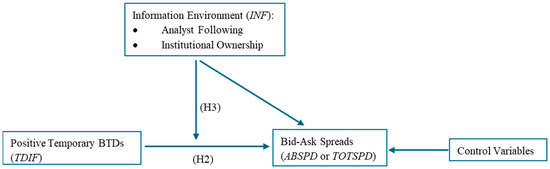
INFt is either analyst following (AFt) or institutional ownership (INSTt). AFt is measured as the natural logarithm of one plus the number of analysts following a firm prior to the 10-K filing for year t. INSTt is defined as the percentage of common shares held by institutions at the end of the calendar quarter prior to the 10-K filing for year t.3 The other variables are as defined in models (2) and (3). The variables of interest are TDIFt and INFt × TDIFt. A positive coefficient on TDIFt and a negative coefficient on INFt × TDIFt would be consistent with H2 and H3, respectively. Figure 1 summarizes the conceptual framework underlying our model development. H2 tests the main effect of positive temporary BTDs (TDIF) on abnormal or total bid-ask spreads, while H3 examines the moderating role of information environment (INF), as measured by analyst following and institutional ownership, in shaping the association between TDIF and bid-ask spreads. Industry and year fixed effects are included in all the models but not reported. Appendix A provides detailed definitions of all the variables.
Figure 1.
Conceptual framework for hypothesis tests.
4. Sample Selection and Descriptive Statistics
The initial sample consists of all the firm-year observations in the merged Compustat and CSRP database from 1994 to 2018. Our sample period begins with 1994, since SFAS No. 109, effective in 1993, significantly changed accounting for income taxes. The sample period ends in 2018 to eliminate the potential confounding effect of COVID-19 starting from 2019 on the market. We extract the filing dates of 10-Ks from Loughran and McDonald 10X File Summaries.4 Bid-ask spreads and cumulative abnormal returns around 10-K filing dates are calculated using relevant information from CRSP. Following prior research (Hanlon, 2005; Chi et al., 2014), we eliminate non-US firms and observations with pretax accounting losses, negative book income, net operating losses, or negative current tax expense to tease out the confounding effect of loss carryforwards on temporary BTDs. We delete financial firms (SIC codes 6000–6999) and utility firms (SIC codes 4900–4999), since additional regulation for these firms may affect investors’ perception of firm risk. Observations with a year-end closing price less than USD 2, negative book-to-market ratios, or missing values for the regression variables are also deleted. The final full sample includes 20,308 observations with 10,911 observations with positive temporary BTDs and 9397 observations with negative temporary BTDs. All the continuous variables are winsorized at the 1st and 99th percentiles to mitigate the effect of outliers.
Pane A of Table 1 presents the descriptive statistics for the two subsamples with positive vs. negative temporary BTDs. ABSPDt is negative for both subsamples, suggesting a significant decrease in total bid-ask spreads around 10-K filing dates. This is consistent with the view that 10-K filings reduce information asymmetry by disseminating value-relevant information to the market (Diamond, 1985; Fu et al., 2012). Furthermore, while firms with positive temporary BTDs generally have lower total bid-ask spreads during the estimation period and the event period (PRESPDt and TOTSPDt), they also experience a smaller decrease in bid-ask spreads around 10-K filing dates (mean of ABSPDt = −0.196) relative to those firms with negative temporary BTDs (mean of ABSPDt = −0.373). This suggests that 10-K filings reduce information asymmetry to a lesser extent for firms with positive TDIF than negative TDIF.
Table 1.
The sample.
In addition, both analyst following and institutional ownership are significantly higher for firms with positive TDIF (means of AFt and INSTt = 1.637 and 0.564, respectively) than negative TDIF (means of AFt and INSTt = 1.572 and 0.540, respectively). One possible explanation for this result is that the market is more concerned with positive temporary BTDs and thus demands higher analyst following and institutional ownership to mitigate the potential information risk. The other firm characteristics also exhibit significant differences between the two subsamples, highlighting the importance of separating firms with positive TDIF from those with negative TDIF in the regression analyses.
Panel B of Table 1 presents industry distribution based on 1-digit SIC codes for the two subsamples. The Durable Manufacturing industry (SIC codes = 3000–3999) contains the largest number of firms (3603 and 3721), accounting for 33.02% and 39.6%, respectively, of all the firms in the two subsamples with positive and negative temporary BTDs. The Non-Durable Manufacturing industry (SIC codes = 2000–2999) has the second largest number of firms (2155 and 1775), accounting for 19.75% and 18.89%, respectively, of all the firms in the two subsamples. The Agriculture industry (SIC codes < 1000) and the Public Administration industry (SIC codes > 8999) have the smallest number of firms for both subsamples.
Table 2 presents the correlations of the main variables for the full sample. Not surprisingly, ABSPDt is positively correlated with TOTSPDt (correlation = 0.17), but negatively correlated with PRESPDt (correlation = −0.18). While ABSPDt is not correlated with TDIFt, both TOTSPDt and PRESPDt are negatively correlated with TDIFt (correlation = −0.02). Untabulated results indicate that TOTSPDt is positively correlated with TDIFt (correlation = 0.08) for the subsample with positive temporary BTDs but negatively correlated with TDIFt (correlation = −0.06) for the subsample with negative temporary BTDs. This provides preliminary evidence that larger positive or negative temporary BTDs are associated with wider total bid-ask spreads around 10-K filing dates. In addition, consistent with the view that larger magnitudes of discretionary accruals indicate more severe earnings management and higher information risk, ABSDACt is positively associated with TOTSPDt (correlation = 0.11).
Table 2.
Correlations for the full sample.
5. Empirical Results
5.1. Main Results
H1 examines the effect of positive temporary BTDs on bid-ask spreads around 10-K filing dates. Columns I and II of Table 3 report the results based on models (2) and (3) with abnormal and total bid-ask spreads as the dependent variables, respectively. The coefficient on TDIFt is not significant in both columns, suggesting that the market is not concerned with positive temporary BTDs on average. In addition, the coefficient on ABSDACt is positive in both columns I and II, indicating higher information risk for firms with larger magnitudes of abnormal accruals (Bhattacharya et al., 2013).
Table 3.
The association between bid-ask spreads and positive temporary BTDs.
H2 and H3 predict that the bid-ask spread reaction to positive temporary BTDs is conditional on analyst following and institutional ownership. We examine the moderating roles of analyst following and institutional ownership in Table 4. Panel A reports the effect of analyst following on the association between positive temporary BTDs and bid-ask spreads. Columns I and II present the results based on models (4) and (5), respectively. Consistent with H2, TDIFt is positively associated with both ABSPDt (coeff. = 1.187 and t-stat = 2.68) and TOTSPDt (coeff. = 0.809 and t-stat = 2.28), suggesting that larger positive temporary BTDs indicate higher information asymmetry around 10-K filing dates for firms with low analyst following. Furthermore, the coefficient on AFt × TDIFt is negative in both columns I (coeff. = −0.587 and t-stat = −2.74) and II (coeff. = −0.480 and t-stat = −2.99). The results support H3 that financial analysts help reduce information asymmetry arising from positive temporary BTDs.
Table 4.
The effect of positive temporary BTDs on bid-ask spreads conditional on analyst following and institutional ownership.
In columns III and IV, we allow the coefficient on ABSDACt to differ across different levels of analyst following by adding the interaction term AFt × ABSDACt. We find no evidence that analyst following moderates the association between ABSDACt and bid-ask spreads. More importantly, controlling for AFt × ABSDACt does not change our main results documented in columns I and II. The results suggest that positive temporary BTDs provide incremental information over the magnitudes of abnormal accruals in the market’s assessment of information risk. Therefore, the lack of association between positive temporary BTDs and bid-ask spreads as documented in Table 3 is unlikely due to the alternative explanation that positive temporary BTDs do not convey incrementally useful information.
Panel B reports the effect of positive temporary BTDs on bid-ask spreads conditional on institutional ownership. Consistent with the findings in Panel A, bid-ask spreads are positively associated with TDIFt but negatively associated with INSTt × TDIFt in all the columns. The results indicate that more positive temporary BTDs are associated with higher bid-ask spreads around 10-K filing dates for firms with low institutional ownership and that institutional investors reduce the information risk attributable to positive temporary BTDs. In summary, the results reported in Table 4 are in line with H2 and H3, suggesting that investors perceive firms with larger positive temporary BTDs as riskier, and that financial analysts and institutional investors help mitigate the information risk due to positive temporary BTDs.
5.2. Robustness Check
We take advantage of Reg FD as an exogenous shock to firms’ information environments to address the endogeneity concern that the moderating effects of analyst following and institutional ownership as hypothesized in H3 may be driven by the underlying firm characteristics that are correlated with analyst following and institutional ownership (Petacchi, 2015; Borochin & Yang, 2017). Reg FD limits the information advantages of financial analysts (Bailey et al., 2003; Gintschel & Markov, 2004; Francis et al., 2006) and institutional investors (Ke et al., 2008), constraining their ability to reduce information asymmetry arising from positive temporary BTDs. If the results in Table 4 are indeed driven by information environments as captured by analyst following and institutional ownership, the moderating effects of analyst following and institutional ownership should be attenuated after Reg FD. On the other hand, Reg FD should not affect the underlying firm characteristics that are correlated with analyst following or institutional ownership. If the moderating effects of analyst following and institutional ownership in Table 4 are driven by correlated firm characteristics, we should not observe any changes in these moderating effects in the post- vs. pre-Reg FD period.
To investigate whether Reg FD weakens the moderating roles of analyst following and institutional ownership, we expand models (4) and (5) by including POSTt and its interactions with TDIFt, INFt, and INFt × TDIFt. POSTt is a dummy variable, equal to one for fiscal years after 2000 and zero otherwise, as Reg FD was implemented on 23 October 2000. If Reg FD reduces the moderating effects of analyst following and institutional ownership, the coefficient on INFt × TDIFt should be negative, while the coefficient on POSTt*INFt*TDIFt should be positive.
In columns I and II of Table 5, we examine whether Reg FD influences the moderating effect of analyst following. We continue to observe a positive coefficient on TDIFt and a negative coefficient on INFt × TDIFt. More importantly, the coefficient on POSTt × INFt × TDIFt is positive in both columns, indicating that the moderating effect of analyst following on the association between bid-ask spreads and positive temporary BTDs becomes less pronounced after Reg FD. Using institutional ownership to measure INF in columns III and IV yields similar results. The findings suggest that our main results are unlikely to be driven by the underlying firm characteristics that are correlated with analyst following and institutional ownership.
Table 5.
The effect of regulation FD on the association between positive temporary BTDs and bid-ask spreads.
An alternative explanation for the results in Table 5 is that POSTt may capture the effect of the Sarbanes-Oxley Act (SOX) of 2002 rather than Reg FD on information risk, given that the post-Reg FD period largely overlaps with the period after SOX. Prior research (e.g., Cohen et al., 2008) has provided evidence that the SOX significantly reduces accruals management, suggesting that investors may be less concerned with the information risk attributable to positive temporary BTDs after the implementation of the SOX. If this is the case, the association between bid-ask spreads and positive temporary BTDs for firms with low analyst following or institutional ownership should be attenuated in the post-SOX period. In other words, we should observe a negative coefficient on POSTt × TDIFt in Table 5. However, the results indicate that the coefficient on POSTt × TDIFt is generally not significant except for a weak negative association between ABSPDt and POSTt × TIDFt in column I. Overall, while we cannot fully rule out the possibility that the SOX may affect the association between bid-ask spreads and positive temporary BTDs, the results documented in Table 5 are more consistent with the view that Reg FD constrains the ability of financial analysts and institutional investors to reduce information risk arising from positive temporary BTDs.
Next, we use the propensity score matching (PSM) technique to further address the concern that the change in bid-ask spreads around 10-K filing dates may be driven by the changes in firm fundamentals. We begin with all the firms with positive temporary BTDs and construct two subsamples based on the firms’ information environments. In particular, the subsample of firms with poor (rich) information environments includes firms with both analyst following and institutional ownership below (above) their median values. For each subsample, we sort the observations into terciles by TDIF and then employ the PSM algorithm to identify matches between the bottom and top terciles. More specifically, the following logistic regression is estimated based on the 2500 (2214) firm-year observations in the bottom and top terciles of TDIF for the subsample of firms with poor (rich) information environments.
PSMDt is an indicator variable, equal to zero for the observations in the bottom tercile of TDIF, and one for those in the top tercile of TDIF. We include FEDt and FOt to control for the effects of current federal and foreign tax expense on positive temporary BTDs.5 FEDt is the scaled current federal income tax expense for year t, calculated as current federal tax expense deflated by income before extraordinary items. FOt is the scaled current foreign income tax expense for year t, calculated as current foreign tax expense deflated by income before extraordinary items. Analyst following (AFt) and institutional ownership (INSTt) are added to control for firms’ information environments. DACt is the discretionary accruals for year t based on the modified Jones model. The other control variables are taken from model (3).
Columns I and II of Table 6 report the results from model (6) for the subsamples of firms with poor and rich information environments, respectively. In both columns, PSMDt is positively associated with INSTt and DACt but negatively associated with FEDt, FOt, SIZEt, and ROAt. In addition, model (6) explains a significant amount of variation in PSMDt for both subsamples (Pseudo R2 = 0.536 and 0.543). Based on the propensity scores obtained from model (6), we identify 608 (592) matched firms for the subsample of firms with poor (rich) information environments. The matching sample design ensures that any difference in abnormal bid-ask spreads between the firms in the bottom tercile of TDIF and those in the top tercile of TDIF should not be attributed to the differences in the firm fundamentals.
Table 6.
The results based on propensity score matching.
Panel B of Table 6 shows the difference in abnormal bid-ask spreads between firms with low TDIF (PSMD = 0) and those with high TDIF (PSMD = 1) based on the two PSM-matched samples. For the matched sample of firms with poor information environments, abnormal bid-ask spreads are significantly higher for firms with high TDIF than those with low TDIF (p-value = 0.019). In contrast, we find no significant difference in abnormal bid-ask spreads between firms with high and low TDIF for the matched sample of firms with rich information environments. The results confirm H2 and H3; the positive association between positive temporary BTDs and bid-ask spreads is less pronounced for firms with better information environments as characterized by higher levels of analyst following and institutional ownership.
6. Additional Analysis
6.1. Negative Temporary BTDs
In this section, we turn to negative temporary BTDs and examine their effect on bid-ask spreads around 10-K filing dates. Columns I and II of Table 7 report the results based on models (2) and (3) for the subsample of firms with negative temporary BTDs. There is a weak negative association between ABSPDt and TDIFt, indicating higher information risk for firms with more negative temporary BTDs. However, we find no evidence that TDIFt is significantly associated with TOTSPDt. Columns III and IV present the effect of negative temporary BTDs on bid-ask spreads conditional on analyst following based on models (4) and (5). The results indicate that bid-ask spreads are generally not associated with TDIFt or AFt × TDIFt except for a weak negative association between abnormal bid-ask spreads and TDIFt in column III. We replace analyst following with institutional ownership in columns V and VI. Both ABSPDt and TOTSPDt are negatively associated with TDIFt, which is consistent with the view that investors are concerned with income-decreasing earnings management as captured by large negative temporary BTDs. In addition, TOTSPDt is positively associated with INSTt × TDIFt in column VI, suggesting that institutional investors mitigate the information risk around 10-K filing dates associated with negative temporary BTDs. Overall, Table 7 provides mixed results regarding the effects of negative temporary BTDs on abnormal and total bid-ask spreads. The association between negative temporary BTDs and bid-ask spreads appears to depend on model specifications.
Table 7.
The effect of negative temporary BTDs on bid-ask spreads.
Several factors may help explain the weak and mixed effect of negative temporary BTDs on bid-ask spreads. First, negative temporary BTDs do not necessarily indicate downward earnings management, as firms generally lack incentives to report lower earnings and downward manipulation is relatively rare. As a result, negative temporary BTDs may have little impact on perceived information asymmetry. Second, investors may be less concerned about downward earnings management, as it may be consistent with accounting conservatism or income smoothing, which does not raise the same adverse selection concerns as upward manipulation.
6.2. Bid-Ask Spreads and the Mispricing of Temporary BTDs
Hirshleifer et al. (2011) suggest that short-selling constraints limit arbitragers from correcting firm overvaluation. Consistent with this view, Chi et al. (2014) document significant return asymmetry for firms with temporary BTDs such that the mispricing of positive temporary BTDs is more pronounced than negative temporary BTDs. In this section, we intend to shed some light on why the mispricing of positive temporary BTDs cannot be arbitraged away by examining the implications of bid-ask spreads for the mispricing of positive temporary BTDs. We argue that larger total bid-ask spreads for firms with more positive temporary BTDs may increase transaction costs and constrain the ability of arbitrageurs to exploit the BTD overpricing by short selling the stocks of these firms. Therefore, the mispricing of positive temporary BTDs should be more pronounced for firms with larger total bid-ask spreads.
We estimate the following model to investigate the effect of total bid-ask spreads on the mispricing of positive temporary BTDs.
SARt+1 is size-adjusted buy and hold returns for the twelve-month period beginning in the fourth month after the fiscal year-end of year t. The coefficient on TOTSPDt × TDIFt captures the effect of total bid-ask spreads on the mispricing of positive temporary BTDs. If the mispricing of positive temporary BTDs is more pronounced for firms with larger total bid-ask spreads, we should observe a negative coefficient on TOTSPDt × TDIFt. The control variables are largely taken from prior research on the mispricing of temporary BTDs (Hanlon, 2005; Chi et al., 2014). LOGMVt is the natural logarithm of the market value of equity at the end of year t, where the market value of equity is calculated as the number of shares outstanding times the year-end closing price. LOGBTMt is the natural logarithm of the book-to-market ratio at the end of year t, where the book-to-market ratio is defined as the book value of common equity divided by the market value of equity. CAPDt and BETADt are size and beta deciles, respectively, at the end of year t from CSRP. DACt is abnormal accruals estimated from the modified Jones model for year t. EPt is the earnings-to-price ratio at the end of year t, calculated as earnings per share divided by the year-end closing price. LEVt is financial leverage at the end of year t, calculated as total liabilities divided by total assets.
Panel A of Table 8 reports the predictability of temporary BTDs for future stock returns based on the reduced form of model (7) without considering total bid-ask spreads. Column I presents the results for the full sample. The coefficient on TDIFt is not significant, suggesting that temporary BTDs are not mispriced for the full sample. However, when we partition the sample into the two subsamples with positive vs. negative temporary BTDs in columns II and III, we find that investors misprice positive temporary BTDs, but not negative temporary BTDs. The results are consistent with short-selling constraints limiting arbitragers from correcting the overvaluation of firms with positive temporary BTDs.
Table 8.
The mispricing of temporary BTDs.
Column I of Panel B reports the effect of total bid-ask spreads on the mispricing of positive temporary BTDs based on model (7). The coefficient on TOTSPDt × TDIFt is negative, consistent with the view that larger total bid-ask spreads increase transaction costs and constrain the ability of arbitrageurs to arbitrage away the mispricing of positive temporary BTDs. We obtain similar results when we decompose TOTSPDt into PRESPDt and ABSPDt in column II. Both PRESPDt × TDIFt and ABSPDt × TDIFt are negatively associated with one-year-ahead stock returns. In columns III and IV, we further control for the effect of information environments on the mispricing of positive temporary BTDs by adding INFt as well as its interaction with TDIFt and TOTSPDt × TDIFt. We continue to find a negative association between SARt+1 and TOTSPDt × TDIFt, indicating that the mispricing of positive temporary BTDs is more severe for firms with larger bid-ask spreads operating in poor information environments. Furthermore, the coefficient on INFt × TOTSPDt × TDIFt is positive, consistent with the view that financial analysts and institutional investors help mitigate the mispricing of positive temporary BTDs.
Overall, Table 8 highlights the important role of total bid-ask spreads in the mispricing of temporary BTDs and provides a possible explanation for why the mispricing of temporary BTDs cannot be arbitraged away. The results are consistent with the view that larger total bid-ask spreads for firms with more positive temporary BTDs may increase transaction costs and constrain the ability of arbitrageurs to exploit the mispricing of positive temporary BTDs.
6.3. Bid-Ask Spreads and Permanent BTDs
In this section, we investigate whether permanent BTDs are related to abnormal bid-ask spreads around 10-K filing dates to obtain a more complete assessment of how investors may perceive BTDs. Prior research (Wilson, 2009; Frank et al., 2009) suggests permanent BTDs may capture tax reporting aggressiveness or tax avoidance. The association between bid-ask spreads and permanent BTDs is not clear ex ante. One stream of the literature (e.g., J. D. Phillips, 2003) views tax avoidance as a value-enhancing strategy, as it transfers wealth from the government to shareholders. If this is the case, permanent BTDs are not expected to affect bid-ask spreads. In contrast, the agency perspective on tax avoidance (e.g., Desai & Dharmapala, 2006; J. B. Kim et al., 2011) suggests that tax avoidance may facilitate managerial opportunism, such as earnings management or other resource diversion. Therefore, larger permanent BTDs may indicate greater agency conflicts and information opacity, thereby increasing information asymmetry among market participants. We use the following model to examine whether permanent BTDs are associated with abnormal bid-ask spreads around 10-K filing dates and whether analyst following or institutional ownership could moderate this association.
Columns I-III of Table 9 report the results for the subsample with positive permanent BTDs. Column I presents the results without considering the effects of analyst following and institutional ownership. The coefficient on PDIF is not significant, suggesting that investors are not concerned with positive permanent BTDs on average. Columns II and III present the results based on model (8). The coefficient on PDIF is positive in both columns, indicating that larger positive permanent BTDs are associated with higher information risk for firms with low analyst following or institutional ownership. Furthermore, the coefficient on INF × PDIF is negative in columns II and III, suggesting that financial analysts and institutional investors help mitigate information asymmetry associated with positive permanent BTDs. Columns IV-VI report the results for the subsample with negative permanent BTDs. We find no evidence that ABSPD is associated with PDIF or INS × PDIF, suggesting that investors are generally not concerned with negative permanent BTDs. Overall, the results in Table 9 are consistent with the agency perspective that larger positive permanent BTDs indicate greater tax avoidance and managerial opportunism, leading to an increase in information asymmetry for firms with poor information environments, and that the positive association between positive permanent BTDs and information risk is attenuated for firms with higher analyst following or institutional ownership.
Table 9.
Permanent book-tax difference and bid-ask spreads.
7. Summary and Concluding Remarks
This study explores investors’ perception of BTDs from the perspective of information risk by examining the bid-ask spread reaction to BTDs around 10-K filing dates. The results indicate that bid-ask spreads are not associated with positive temporary BTDs on average. However, after considering the moderating roles of analyst following and institutional ownership, we find that positive temporary BTDs are positively associated with both abnormal and total bid-ask spreads around 10-K filing dates for firms with low analyst following or institutional ownership. The results support the view that in less informed information environments, investors are concerned about potential earnings management embedded in positive temporary BTDs and thus perceive higher information risk for firms with larger positive temporary BTDs. In contrast, in more informed environments, financial analysts and institutional investors are likely to mitigate the information risk arising from positive temporary BTDs through their monitoring or information intermediary activities, which reduces investors’ concerns about positive temporary BTDs. Consistent with this argument, we demonstrate that the positive association between bid-ask spreads and positive temporary BTDs is less pronounced for firms with higher levels of analyst following or institutional ownership.
Furthermore, we show that Reg FD reduces the moderating roles of analyst following and institutional ownership in the bid-ask spread reaction to positive temporary BTDs by lessening the information advantages of financial analysts and institutional investors. This finding provides further support that the effect of positive temporary BTDs on information risk is influenced by firms’ information environments rather than firm characteristics correlated with analyst following or institutional ownership. In addition, our main results are robust to using the matched sample based on the PSM approach. Additional analyses indicate that the mispricing of positive temporary BTDs is more pronounced for firms with larger total bid-ask spreads, supporting the argument that larger total bid-ask spreads increase transaction costs and constrain the short-selling ability of arbitrageurs.
Finally, we extend our main analysis by examining the effects of negative temporary BTDs and permanent BTDs on information risk. We find a weak negative association between negative temporary BTDs and abnormal bid-ask spreads around 10-K filing dates, suggesting that investors are somewhat concerned about income-decreasing earnings management as indicated by more negative temporary BTDs. Similarly to positive temporary BTDs, larger positive permanent BTDs are associated with higher bid-ask spreads around the release of 10-K filings, and this positive association is less pronounced for firms with higher analyst following or institutional ownership. The results are consistent with the view that larger positive permanent BTDs may indicate greater tax avoidance and agency conflicts, leading to an increase in information asymmetry for firms with poor information environments.
Our findings provide a unified perspective on how different components of BTDs may influence investors’ assessment of information risk and firm value. Although positive temporary and permanent BTDs arise from distinct underlying factors, both can increase information asymmetry in environments characterized by low analyst coverage or limited institutional ownership. This heightened asymmetry, in turn, amplifies market frictions and constrains arbitrage, thereby exacerbating the BTD mispricing. Overall, this paper highlights the significant valuation implications of BTDs and underscores the crucial role of financial analysts and institutional investors in mitigating the information risk and mispricing associated with large positive BTDs.
Our study offers several theoretical implications. First, we provide evidence that the market incorporates both temporary and permanent BTDs when assessing firms’ information risk, thereby reinforcing theoretical predictions that BTDs convey information beyond what is captured in accrual-based measures or in financial statements alone. Second, our findings highlight the monitoring and information-intermediary roles of financial analysts and institutional investors emphasized in agency theory and capital-market information theory. For firms with low analyst following or institutional ownership, larger positive BTDs trigger stronger market concerns about opportunistic behavior and agency conflicts. Third, by showing that the mispricing of temporary BTDs is more pronounced among firms with larger bid-ask spreads, we provide further support for the theoretical mispricing explanation related to the limits to arbitrage. Higher information risk and transaction costs constrain arbitrage activity, thereby preventing market participants from fully correcting valuation errors associated with temporary BTDs.
This study also has important practical implications for firms, investors, and investment practitioners, such as investment managers and financial analysts. Our results suggest that temporary BTDs convey incrementally useful information above and beyond discretionary accruals for investors to access information risk of firms, especially those with poor information environments. Investment managers and financial analysts should be aware of the underlying information risk when making investments and stock recommendations for firms with large positive temporary or permanent BTDs. Furthermore, managers should carefully consider how their tax strategies and reporting practices might influence investors’ perception of firm risk and overall firm value. Given the crucial roles of financial analysts and institutional investors in reducing information asymmetry arising from BTDs, it is important for firms with large positive BTDs to improve their information environments by increasing analyst following and institutional ownership.
We caution that our results may not be generalizable to other countries, as our study focuses on U.S. firms. The effects of BTDs on information risk may differ in countries with alternative tax regimes, financial reporting standards, or institutional settings. In addition, it remains unclear which specific circumstances giving rise to temporary or permanent BTDs drive our results. We encourage future research to further explore these issues.
Author Contributions
Conceptualization, M.H.; methodology, K.Y.; formal analysis, K.Y.; resources, M.H.; writing—original draft preparation, M.H. and K.Y.; writing—review and editing, K.Y. All authors have read and agreed to the published version of the manuscript.
Funding
This research received no external funding.
Institutional Review Board Statement
Not applicable.
Informed Consent Statement
Not applicable.
Data Availability Statement
Data supporting the findings of this study are available from the corresponding author upon reasonable request.
Conflicts of Interest
The authors declare no conflict of interest.
Appendix A. Variable Definitions
| Measures of bid-ask spreads | |
| ABSPDt | Cumulative daily abnormal bid-ask spreads from 5 days before to 5 days after the filing date of the 10-K report for year t, where daily abnormal bid-ask spreads are calculated as the bid-ask spread for the event day minus the mean bid-ask spread during the 30-day estimation window ending 12 days before the event period. |
| TOTSPDt | Cumulative daily total bid-ask spreads from 5 days before to 5 days after the filing date of the 10-K report for year t. |
| PRESPDt | The expected cumulative total bid-ask spreads during the event window (−5, 5) around the filing date of the 10-K report for year t, calculated as 11 times the mean daily bid-ask spreads during the 30-day estimation window ending 12 days before the event period. |
| Main variables | |
| TDIFt | Temporary book-tax differences for year t, equal to . Deferred tax expense is computed as the sum of deferred federal and foreign tax expense, if these two amounts are not missing, and as the deferred portion of the income tax expense otherwise. Tax rate is the statutory tax rate, equal to 35% for the period of 1994 to 2017 and 21% for the year 2018. Book income is defined as income before extraordinary items. |
| PDIFt | Permanent book-tax differences for year t, calculated as total book-tax differences (TBTD) minus temporary book-tax differences (TDIF). We estimate TBTD as book income (i.e., income before extraordinary items) minus after-tax taxable income and then scaled by book income, where after-tax taxable income is computed as current income tax expense multiplied by 1 minus the tax rate and then divided by the tax rate. |
| INFt | Either analyst following (AFt) or institutional ownership (INSTt). |
| AFt | Analyst following, measured as the natural logarithm of one plus the number of analysts following a firm prior to the 10-K filing for year t. |
| INSTt | Institutional ownership, defined as the percentage of common shares held by institutions at the end of the calendar quarter prior to the 10-K filing for year t. |
| POSTt | An indicator variable, equal to 1 for fiscal years after 2000 and zero otherwise. |
| PSMDt | An indicator variable, equal to 0 for the firms in the bottom tercile of TDIF, and 1 for the firms in the top tercile of TDIF. |
| SARt+1 | Size-adjusted buy and hold returns for the twelve-month period beginning in the fourth month after the fiscal year-end of year t. |
| Control variables | |
| DACt | Discretionary accruals for year t based on the modified Jones model. |
| ABSDACt | The absolute value of discretionary accruals for year t based on the modified Jones model. |
| ABSCARt | The absolute value of the cumulative abnormal returns from 5 days before to 5 days after 10-K filings for year t. |
| SIZEt | Firm size, calculated as the natural logarithm of total assets at the end of year t. |
| ROAt | The return on assets for year t, calculated as income before extraordinary items divided by total assets. |
| BTMt | The book-to-market ratio at the end of year t calculated as the book value of equity divided by the market value of equity. |
| CURRt | The current ratio at the end of year t, calculated as current assets divided by current liabilities. |
| DTARt | The debt-to-assets ratio at the end of year t, calculated as total debt divided by total assets. |
| ΔSIZEt | The change in SIZE from year t − 1 to year t. |
| ΔROAt | The change in ROA from year t − 1 to year t. |
| ΔBTMt | The change in BTM from year t − 1 to year t. |
| ΔCURRt | The change in CURR from year t − 1 to year t. |
| ΔDTARt | The change in DTAR from year t − 1 to year t. |
| FEDt | Scaled current federal income tax expense for year t, calculated as current federal tax expense deflated by income before extraordinary items. |
| FOt | Scaled current foreign income tax expense for year t, calculated as current foreign tax expense deflated by income before extraordinary items. |
| LOGMVt | The natural logarithm of the market value of equity at the end of year t, where the market value of equity is calculated as the number of shares outstanding times the year-end closing price. |
| LOGBTMt | The natural logarithm of the book-to-market ratio at the end of year t, where the book-to-market ratio is defined as the book value of common equity divided by the market value of equity. |
| CAPDt | Size deciles at the end of year t from CSRP. |
| BETADt | Beta deciles at the end of year t from CSRP. |
| EPt | The earnings-to-price ratio at the end of year t, calculated as earnings per share divided by the year-end closing price. |
| LEVt | Financial leverage at the end of year t, calculated as total liabilities divided by total assets. |
| SARt | Size-adjusted buy and hold returns for the twelve-month period beginning in the fourth month after the fiscal year-end of year t − 1. |
Notes
| 1 | Using the 5-day event window (−2, 2) to measure abnormal and total bid-ask spreads yields qualitatively similar results. |
| 2 | Deleting the observations for year 2018 from the full sample does not change any of our inferences. |
| 3 | Our results are robust to using the decile ranks of analyst following and institutional ownership to measure INFt. |
| 4 | See https://sraf.nd.edu/sec-edgar-data/lm_10x_summaries (accessed on 10 March 2024). |
| 5 | The results are qualitatively similar if FEDt and FOt are not included in model (6). |
References
- Abad, D., Cutillas-Gomariz, M. F., Sánchez-Ballesta, J. P., & Yagüe, J. (2018). Real earnings management and information asymmetry in the equity market. European Accounting Review, 27(2), 209–235. [Google Scholar] [CrossRef] [Scilit]
- Affleck-Graves, J., Callahan, C. M., & Chipalkatti, N. (2002). Earnings predictability, information asymmetry, and market liquidity. Journal of Accounting Research, 40(3), 561–583. [Google Scholar] [CrossRef] [Scilit]
- Amihud, Y., & Mendelson, H. (1986). Liquidity and stock returns. Financial Analysts Journal, 42(3), 43–48. [Google Scholar] [CrossRef] [Scilit]
- Ascioglu, A., Hegde, S. P., Krishnan, G. V., & McDermott, J. B. (2012). Earnings management and market liquidity. Review of Quantitative Finance and Accounting, 38(2), 257–274. [Google Scholar] [CrossRef] [Scilit]
- Ayers, B. C., Laplante, S. K., & McGuire, S. T. (2010). Credit ratings and taxes: The effect of book–tax differences on ratings changes. Contemporary Accounting Research, 27(2), 359–402. [Google Scholar] [CrossRef] [Scilit]
- Bailey, W., Li, H., Mao, C. X., & Zhong, R. (2003). Regulation fair disclosure and earnings information: Market, analyst, and corporate responses. The Journal of Finance, 58(6), 2487–2514. [Google Scholar] [CrossRef] [Scilit]
- Balsam, S., Bartov, E., & Marquardt, C. (2002). Accruals management, investor sophistication, and equity valuation: Evidence from 10–Q filings. Journal of Accounting Research, 40(4), 987–1012. [Google Scholar] [CrossRef] [Scilit]
- Bhattacharya, N., Desai, H., & Venkataraman, K. (2013). Does earnings quality affect information asymmetry? Evidence from trading costs. Contemporary Accounting Research, 30(2), 482–516. [Google Scholar] [CrossRef] [Scilit]
- Blankespoor, E., Miller, G. S., & White, H. D. (2014). The role of dissemination in market liquidity: Evidence from firms’ use of Twitter™. The Accounting Review, 89(1), 79–112. [Google Scholar] [CrossRef] [Scilit]
- Blaylock, B., Shevlin, T., & Wilson, R. J. (2012). Tax avoidance, large positive temporary book-tax differences, and earnings persistence. The Accounting Review, 87(1), 91–120. [Google Scholar] [CrossRef] [Scilit]
- Boone, A. L., & White, J. T. (2015). The effect of institutional ownership on firm transparency and information production. Journal of Financial Economics, 117(3), 508–533. [Google Scholar] [CrossRef] [Scilit]
- Borochin, P., & Yang, J. (2017). The effects of institutional investor objectives on firm valuation and governance. Journal of Financial Economics, 126(1), 171–199. [Google Scholar] [CrossRef] [Scilit]
- Bushee, B. J. (1998). The influence of institutional investors on myopic R&D investment behavior. The Accounting Review, 73(3), 305–333. [Google Scholar]
- Bushee, B. J. (2001). Do institutional investors prefer near-term earnings over long-run value? Contemporary Accounting Research, 18(2), 207–246. [Google Scholar]
- Bushee, B. J., Core, J. E., Guay, W., & Hamm, S. J. (2010). The role of the business press as an information intermediary. Journal of Accounting Research, 48(1), 1–19. [Google Scholar] [CrossRef] [Scilit]
- Chi, S. S., Pincus, M., & Teoh, S. H. (2014). Mispricing of book-tax differences and the trading behavior of short sellers and insiders. The Accounting Review, 89(2), 511–543. [Google Scholar] [CrossRef] [Scilit]
- Cohen, D. A., Dey, A., & Lys, T. Z. (2008). Real and accrual-based earnings management in the pre-and post-Sarbanes-Oxley periods. The Accounting Review, 83(3), 757–787. [Google Scholar] [CrossRef] [Scilit]
- Desai, M. A. (2005). The degradation of reported corporate profits. Journal of Economic Perspectives, 19(4), 171–192. [Google Scholar] [CrossRef] [Scilit]
- Desai, M. A., & Dharmapala, D. (2006). Corporate tax avoidance and high-powered incentives. Journal of Financial Economics, 79(1), 145–179. [Google Scholar] [CrossRef] [Scilit]
- Desai, M. A., & Dharmapala, D. (2009). Corporate tax avoidance and firm value. The Review of Economics and Statistics, 91(3), 537–546. [Google Scholar] [CrossRef] [Scilit]
- Diamond, D. W. (1985). Optimal release of information by firms. The Journal of Finance, 40(4), 1071–1094. [Google Scholar] [CrossRef]
- D’Souza, J. M., Ramesh, K., & Shen, M. (2010). The interdependence between institutional ownership and information dissemination by data aggregators. The Accounting Review, 85(1), 159–193. [Google Scholar] [CrossRef] [Scilit]
- Duarte, J., Han, X., Harford, J., & Young, L. (2008). Information asymmetry, information dissemination and the effect of regulation FD on the cost of capital. Journal of Financial Economics, 87(1), 24–44. [Google Scholar] [CrossRef] [Scilit]
- El-Gazzar, S. M. (1998). Predisclosure information and institutional ownership: A cross-sectional examination of market revaluations during earnings announcement periods. The Accounting Review, 73(1), 119–129. [Google Scholar]
- Feng, H., Habib, A., & Tian, G. L. (2019). Aggressive tax planning and stock price synchronicity: Evidence from China. International Journal of Managerial Finance, 15(5), 829–857. [Google Scholar] [CrossRef] [Scilit]
- Francis, J., Nanda, D., & Wang, X. (2006). Re-examining the effects of regulation fair disclosure using foreign listed firms to control for concurrent shocks. Journal of Accounting and Economics, 41(3), 271–292. [Google Scholar] [CrossRef] [Scilit]
- Frank, M. M., Lynch, L. J., & Rego, S. O. (2009). Tax reporting aggressiveness and its relation to aggressive financial reporting. The Accounting Review, 84(2), 467–496. [Google Scholar] [CrossRef] [Scilit]
- Frankel, R., & Li, X. (2004). Characteristics of a firm’s information environment and the information asymmetry between insiders and outsiders. Journal of Accounting and Economics, 37(2), 229–259. [Google Scholar] [CrossRef]
- Fu, R., Kraft, A., & Zhang, H. (2012). Financial reporting frequency, information asymmetry, and the cost of equity. Journal of Accounting and Economics, 54(2–3), 132–149. [Google Scholar] [CrossRef] [Scilit]
- Gintschel, A., & Markov, S. (2004). The effectiveness of Regulation FD. Journal of Accounting and Economics, 37(3), 293–314. [Google Scholar] [CrossRef] [Scilit]
- Hanlon, M. (2005). The persistence and pricing of earnings, accruals, and cash flows when firms have large book-tax differences. The Accounting Review, 80(1), 137–166. [Google Scholar] [CrossRef] [Scilit]
- Hanlon, M., & Heitzman, S. (2010). A review of tax research. Journal of Accounting and Economics, 50(2–3), 127–178. [Google Scholar] [CrossRef] [Scilit]
- Hanlon, M., & Slemrod, J. (2009). What does tax aggressiveness signal? Evidence from stock price reactions to news about tax shelter involvement. Journal of Public Economics, 93(1–2), 126–141. [Google Scholar] [CrossRef] [Scilit]
- Healy, P. M., & Palepu, K. G. (2001). Information asymmetry, corporate disclosure, and the capital markets: A review of the empirical disclosure literature. Journal of Accounting and Economics, 31(1–3), 405–440. [Google Scholar] [CrossRef] [Scilit]
- Hirshleifer, D., Teoh, S. H., & Yu, J. J. (2011). Short arbitrage, return asymmetry, and the accrual anomaly. The Review of Financial Studies, 24(7), 2429–2461. [Google Scholar] [CrossRef] [Scilit]
- Hong, H., Lim, T., & Stein, J. C. (2000). Bad news travels slowly: Size, analyst coverage, and the profitability of momentum strategies. The Journal of Finance, 55(1), 265–295. [Google Scholar] [CrossRef] [Scilit]
- Irani, R. M., & Oesch, D. (2013). Monitoring and corporate disclosure: Evidence from a natural experiment. Journal of Financial Economics, 109(2), 398–418. [Google Scholar] [CrossRef] [Scilit]
- Ke, B., Petroni, K. R., & Yu, Y. (2008). The effect of Regulation FD on transient institutional investors’ trading behavior. Journal of Accounting Research, 46(4), 853–883. [Google Scholar] [CrossRef] [Scilit]
- Kim, J. B., Li, Y., & Zhang, L. (2011). Corporate tax avoidance and stock price crash risk: Firm-level analysis. Journal of Financial Economics, 100(3), 639–662. [Google Scholar] [CrossRef] [Scilit]
- Kim, O., & Verrecchia, R. E. (1994). Market liquidity and volume around earnings announcements. Journal of Accounting and Economics, 17(1–2), 41–67. [Google Scholar] [CrossRef] [Scilit]
- Lee, C. M., Mucklow, B., & Ready, M. J. (1993). Spreads, depths, and the impact of earnings information: An intraday analysis. The Review of Financial Studies, 6(2), 345–374. [Google Scholar] [CrossRef] [Scilit]
- Luo, B. (2019). Effects of auditor-provided tax services on book-tax differences and on investors’ mispricing of book-tax differences. Advances in Accounting, 47, 100434. [Google Scholar] [CrossRef] [Scilit]
- Moore, J. A. (2012). Empirical evidence on the impact of external monitoring on book–tax differences. Advances in Accounting, 28(2), 254–269. [Google Scholar] [CrossRef] [Scilit]
- Moore, J. A., & Xu, L. (2018). Book-tax differences and costs of private debt. Advances in Accounting, 42, 70–82. [Google Scholar] [CrossRef] [Scilit]
- Palmrose, Z. V., Richardson, V. J., & Scholz, S. (2004). Determinants of market reactions to restatement announcements. Journal of Accounting and Economics, 37(1), 59–89. [Google Scholar] [CrossRef] [Scilit]
- Petacchi, R. (2015). Information asymmetry and capital structure: Evidence from regulation FD. Journal of Accounting and Economics, 59(2–3), 143–162. [Google Scholar] [CrossRef] [Scilit]
- Phillips, J., Pincus, M., & Rego, S. O. (2003). Earnings management: New evidence based on deferred tax expense. The Accounting Review, 78(2), 491–521. [Google Scholar] [CrossRef] [Scilit]
- Phillips, J. D. (2003). Corporate tax-planning effectiveness: The role of compensation-based incentives. The Accounting Review, 78(3), 847–874. [Google Scholar] [CrossRef] [Scilit]
- Ramalingegowda, S., & Yu, Y. (2012). Institutional ownership and conservatism. Journal of Accounting and Economics, 53(1–2), 98–114. [Google Scholar] [CrossRef] [Scilit]
- Shipman, J. E., Swanquist, Q. T., & Whited, R. L. (2017). Propensity score matching in accounting research. The Accounting Review, 92(1), 213–244. [Google Scholar] [CrossRef] [Scilit]
- Shleifer, A., & Vishny, R. W. (1986). Large shareholders and corporate control. Journal of Political Economy, 94(3), 461–488. [Google Scholar] [CrossRef] [Scilit]
- Weber, D. P. (2009). Do analysts and investors fully appreciate the implications of book-tax differences for future earnings? Contemporary Accounting Research, 26(4), 1175–1206. [Google Scholar] [CrossRef] [Scilit]
- Wilson, R. J. (2009). An examination of corporate tax shelter participants. The Accounting Review, 84(3), 969–999. [Google Scholar] [CrossRef] [Scilit]
- Yu, F. F. (2008). Analyst coverage and earnings management. Journal of Financial Economics, 88(2), 245–271. [Google Scholar] [CrossRef] [Scilit]
- Yu, K., Hagigi, M., & Stewart, S. D. (2018). Income smoothing may result in increased perceived riskiness: Evidence from bid-ask spreads around loss announcements. Journal of Corporate Finance, 48, 442–459. [Google Scholar] [CrossRef] [Scilit]

Disclaimer/Publisher’s Note: The statements, opinions and data contained in all publications are solely those of the individual author(s) and contributor(s) and not of MDPI and/or the editor(s). MDPI and/or the editor(s) disclaim responsibility for any injury to people or property resulting from any ideas, methods, instructions or products referred to in the content. |
© 2025 by the authors. Licensee MDPI, Basel, Switzerland. This article is an open access article distributed under the terms and conditions of the Creative Commons Attribution (CC BY) license.