The findings shed light on some of the more significant results in relation to the revenue forecast errors of the countries in question. While forecast bias has manifested excessively only in the United States, this affects both two-year and three-year forecasts. The panel regression analysis pointed to a positive correlation between increases in inflation and GDP and forecast errors, while the existence of budget balance regulations contributed more to discrepancies. It appears now that inflation, GDP growth, and balance rules have higher values that yield high errors in forecasting, while rising values of unemployment, population growth, and the number of fiscal rules diminish forecast errors. Unlike the former two, crisis periods, government spending, and current account balances are very insignificant in both models. Population increase has further ceased to be statistically tactful in predicting three-year forecasts.
The assessment indicates that while developing revenue forecasts is an arduous task, bias evaluation does spell an end for them in the United States. It directly asks for improved approaches, as issues hardly ever find a solution without being addressed; on the contrary, the burgeoning influences of inflation, GDP growth, and rules concerning balanced budgets call for such vigilance by policymakers that no changes can escape their attention.
In short, the negative influences of unemployment, population growth, and the number of numerical rules on forecast errors are expressive of the need for a more detailed understanding of these variables to aid in enhancing forecasting models. Statistics denote that in times of emerging crises, government expenditures and current account balances come together in their non-existing significant effects on revenue predictions. In this sense, the outcome strongly urges one to adopt a trickier approach as far as the scope is concerned, which meanwhile produces a number of economic indicators classified into different categories for revenue forecasting, thereby enabling policymakers to see them in the light of various categories. As a result, the accuracy of these forecasts turns out to be a decisive factor not just for developed countries’ good fiscal planning but also for their sustainable economic growth.
1.1. Theoretical Rationale for Medium-Term Budgeting
Public budgeting constitutes one of the core stages of the public policy cycle—alongside planning and programming—because it allocates resources according to policy priorities and directly influences service quality, macroeconomic outcomes, and overall welfare (
Schick, 1998;
Atiyas & Sayın, 1997;
Çetinkaya et al., 2011). Although budgets are prepared annually in most countries, their economic effects extend beyond a single fiscal year, making the assessment of fiscal policy through one-year horizons inherently limited (
Lazăr & Andrei, 2006;
Filc & Scartascini, 2009). Since expenditure decisions often have multi-year implications, aligning spending with available resources over the medium term has become essential (
PEFA, 2011). Consequently, many governments began transitioning from traditional annual budgeting to medium-term budgeting (MTB) frameworks beginning in the mid-20th century.
Providing multi-year revenue and expenditure projections alongside the annual budget constitutes a fundamental form of MTB (
Harris et al., 2013). Although initially adopted mainly in developed economies, the conceptual roots of MTB date back to the development-planning efforts of the 1950s, when the limitations of annual budgets in responding to economic shocks became evident (
Schiavo-Campo, 2009;
Kesik, 2005). These constraints, combined with the economic crises of the period and the shifting views on government roles, motivated OECD countries to adopt MTB practices more widely from the early 1970s onward (
Diamond, 2006;
Allen & Tommasi, 2001).
Multi-year expenditure forecasts enable governments to estimate the cost of maintaining service levels and link spending decisions with available resources, thereby improving the prioritization of public projects and ensuring a feasible medium-term horizon (
Schroeder, 2007;
Jena, 2006). In this context, medium-term revenue forecasts are particularly critical. The literature consistently shows that forecast errors increase as the horizon lengthens (
Penner, 2001), intensifying fiscal uncertainty and the risk of resource misallocation. Accurate medium-term forecasts support fiscal discipline, enhance the continuity of public services, and allow for more informed timing and compositions of expenditures.
Significant forecast deviations may disrupt the balance between expected and actual revenues, forcing governments to cut spending or borrow unexpectedly, with potential consequences for service quality and social welfare. As global economic uncertainty has intensified, both developed and developing countries have increasingly emphasized research on improving revenue forecasting methods and enhancing the reliability of fiscal projections. Such efforts provide valuable information for decision-makers by incorporating not only historical patterns but also real-time economic indicators.
The economic literature continues to debate the broader implications of MTB. Some authors argue that MTB better incorporates intergenerational concerns and offers a more political representation of the future (
White, 2018), while others view it as an instrument for reconciling short- and long-term fiscal needs (
Schack, 2009). Nonetheless, there is broad consensus that MTB offers several key advantages: It strengthens long-term planning and protects against inefficient spending (
Muzychenko et al., 2017), links annual budgets to strategic priorities, and helps policymakers anticipate policy lags. It also improves managerial flexibility and the early identification of emerging fiscal issues (
Harris et al., 2013). Furthermore, MTB enhances accountability through regular reviews of commitments and the integration of medium-term audit mechanisms (
Boex et al., 2000).
International organizations—including the OECD, IMF, World Bank, and European Union—have extensively studied MTB, documenting its contribution to fiscal sustainability, economic stability, and improved public financial management. Growing empirical evidence suggests that the adoption of MTB can strengthen efficiency and support the broader realization of economic and social policy objectives.
1.2. Literature Review and Hypotheses
Research in the field has pointed out that the accuracy and objectivity of public budget forecasts depend on the interval of time. Examples of such studies include
Gentry (
1989),
Larkey and Smith (
1989),
Mayper et al. (
1991),
Reddick (
2008),
Voorhees (
2006),
Calabrese and Williams (
2019),
Lago-Peñas and Lago-Peñas (
2008),
Benito et al. (
2015),
Ríos et al. (
2018),
Geys et al. (
2008),
Sedmihradská and Čabla (
2013),
Boukari and Veiga (
2018),
Lee and Kwak (
2020),
McShea and Cordes (
2019),
Bischoff and Gohout (
2006),
Buettner and Kauder (
2015),
Kauder et al. (
2017),
Jochimsen and Lehmann (
2017),
ElBerry and Goeminne (
2020), and
Picchio and Santolini (
2020). The vast majority of the studies scrutinize yearly budget forecast errors, while the studies solely dedicated to the exploration of the causes of medium-term budget forecast errors continue to be few in number. Examples of such studies include
Plesko (
1988),
Heinemann (
2006),
Frankel (
2011),
Breuer (
2015),
Harris et al. (
2013),
Allen et al. (
2017), and
Yılmaz (
2019).
Most of these studies have found that revenue forecasts exhibit a negative bias, meaning that the actual revenues fall short of the forecasted figures. This study analyzes inaccuracy and bias by calculating the Forecasting Error (FE), Mean Percentage Error (MPE), Mean Absolute Percentage Error (MAPE), Number of Negative Error Periods (NoNEP), and Number of Positive Error Periods (NoPEP) and by conducting the
Holden and Peel (
1990) test.
Hypothesis 1. The medium-term budgets are forecasted inaccurately.
Hypothesis 2. The medium-term budget forecast errors are predominantly negative, indicating a systematic downward bias.
Brogan (
2012),
Buettner and Kauder (
2015),
Sedmihradská and Čabla (
2013),
Merola and Pérez (
2013),
Boukari and Veiga (
2018), and
Kara (
2024b) found a significant connection between GDP and forecast errors.
Bağdigen (
2002) has partly verified this correlation. On the contrary,
Ríos et al. (
2018) did not observe such a link. Drawing on these studies, we hypothesize actual GDP levels as a major factor causing the budget forecast errors of developed countries. After all, the GDP is a direct determinant of revenue collection and economic activity; thus, the variances in the actual GDP during the specified period have a huge impact on the sizes of the errors in budget forecasts.
Gentry (
1989),
Mayper et al. (
1991),
Lago-Peñas and Lago-Peñas (
2008),
Benito et al. (
2015), and
Deus and de Mendonça (
2017) have identified a connection between population size and forecast errors. Therefore, we predict that the rates of population growth will have a major impact on budget forecasting errors. Since population growth is a factor that affects both economic demand and government spending, non-conformities in the actual population growth rate are going to be the reason behind the discrepancies in budget forecasts.
Hypothesis 3. Macroeconomic conditions systematically influence medium-term revenue forecast errors.
We incorporate two structural fiscal indicators, the current account balance as a percentage of the GDP and the general government final consumption expenditure as a percentage of the GDP, into a unified hypothesis, as both variables capture fundamental aspects of a country’s fiscal and macroeconomic position. The current account balance reflects the scale of external imbalances arising from trade and financial flows, which can transmit volatility to fiscal aggregates and complicate revenue projections. Significant deviations in this indicator may therefore contribute to forecast inaccuracies by altering the external environment in which fiscal policy operates.
Similarly, the general government final consumption expenditure measures the level of spending on goods and services relative to the size of the economy. Shifts in this expenditure ratio can affect budget forecasts by influencing the trajectory of fiscal outcomes, particularly when changes in government consumption modify the demand structure of the economy or alter the composition of public spending. Taken together, these two indicators reflect core elements of fiscal structure and institutional capacity that are expected to influence the accuracy of medium-term revenue forecasts.
Hypothesis 4. Fiscal structure and institutional capacity affect the accuracy of medium-term revenue forecasts.
Fiscal rules limit government borrowing, spending, and debt, potentially improving fiscal discipline, thereby reducing forecast errors. In particular, those budget balance rules aiming to contain deficits focus on ensuring fiscal discipline so that public finances remain stable. Fiscal rules may lower forecast errors by ensuring conservative fiscal management but could also lead to divergence when conditions evolve in an unexpected way, thus limiting the space for possible adjustments in budgets. Several studies are known to have established a significant relationship between fiscal rules and budget forecast errors, including
Smith (
2007),
Beetsma et al. (
2009,
2011,
2013),
Pina and Venes (
2011),
Chatagny (
2015),
Afonso and Silva (
2012),
Hagen (
2010),
Frankel (
2011),
Holm-Hadulla et al. (
2012),
Baldi (
2016),
Heinemann (
2006),
Strauch et al. (
2004),
Chakraborty and Sinha (
2008), and
Picchio and Santolini (
2020). Therefore, based on these findings, we hypothesize that the adoption of fiscal rules has a prudent influence on budget forecast errors.
Hypothesis 5. Fiscal rules influence budget forecast errors.
In times of economic crisis, the level of uncertainty becomes very high, and this, in turn, leads to the volatility of the main economic indicators. The instability caused by this situation may be one of the reasons that forecast errors may increase, since governments will probably have a hard time revising their budgetary projections in a much quicker manner to adapt to rapidly changing situations. A number of different researchers have established a close link between crisis periods and government budget forecast errors, as seen in the works of
Pew Center on the States and The Nelson A. Rockefeller Institute of Government (
2011),
Calitz et al. (
2013),
Boukari and Veiga (
2018), and
Kara (
2024b), among others. In light of these conclusions, we put forward the hypothesis that crisis periods undermine the accuracy of budget forecasts.
Hypothesis 6. Economic crisis periods influence budget forecast errors.
1.3. Dataset and Methodology
The research covers the medium-term budget projections of eight advanced countries (Australia, Canada, Germany, Hong Kong, Ireland, New Zealand, the UK, and the USA), with a special emphasis on two- to three-year budget projections. More precisely, when the budget for the year (t) is made in the year (t − 1), forecasts for the next year (t + 1) and the following year (t + 2) are also prepared. As far as this analysis is concerned, the forecasting for the year (t + 1) is called the “out-year,” and the forecasting for the year (t + 2) is called the “outer-year.” The reviewed period is from 2009 to 2023. However, if we take into account the period when the forecasts were actually prepared, the pertinent period is 2007 to 2021.
The decision to include the eight selected countries was grounded in their long-term transition to medium-term budgeting (MTB) practices, which enabled the performance of a thorough analysis. In addition, the forecasts for their medium-term budgets were calculated according to the same basic methods, which made the study comparison possible (
Harris et al., 2013;
Kara, 2024a;
Moretti et al., 2023;
Beetsma et al., 2013;
Beetsma et al., 2011;
Bischoff & Gohout, 2006;
Boukari & Veiga, 2018;
Breuer, 2015;
Calitz et al., 2013).
It is very necessary to specify the extent and limits of this research. This study will not evaluate the particular methods, structural components, or institutional frameworks that are the basis for the budget forecasting in each country. While these factors are relevant, their analysis is not included in this study, which is rather ongoing research that is already complementary to this one. This study’s main objective is the identification and analysis of forecast errors in a group of comparable countries that were selected because of their similarity in MTB practices.
This intentional option makes it so that differences in the production of forecasts do not spoil the comparability of the results, since the countries that were chosen have very similar methodologies. This study thus escapes the introduction of biases or confounding variables due to the use of vastly different forecasting methods by completely isolating these factors in the analysis. Furthermore, the period that was chosen represents all countries’ common intersection period and thus allows the assessment of their budget forecasts and outcomes to be performed uniformly. The limits set here have been clearly stated to make it easier to conduct an investigation into forecast errors without having to undertake wider methodological or institutional analyses, which are beyond the intended scope of this study.
The FE refers to the measurement of the deviation between the predicted and actual figures represented in terms of the percentage of the forecasted figure, which gives the user a direct measure of the magnitude of the error in relation to the actual values. Nonetheless, the FE may lead to incorrect conclusions when actual values are low, since the percentage error could become very high as a result of being out of proportion. The MPE finds the mean of all the percent errors of a particular forecast, thereby giving the user a picture of the overall bias of the predictions. Still, the MPE might be influenced by the sign of the errors, which might lead to the positive and negative errors being canceled out and to a view that is not very accurate given that the errors are not evenly distributed. The MAPE finds the average of the absolute values of percent errors, thereby giving a measure of the forecast accuracy that is not affected by the direction of the errors. The MAPE’s interpretability and simplicity are the main reasons behind its widespread adoption. However, it is still the case that its application in cases of zero or very low actual values suffers from the problem of generating disproportionately high errors. In the cases of advanced countries, forecast errors frequently result in values that are almost zero, whether they are positive or negative. Hence, the preference for using the MPE instead of the MAPE is justified for this study.
While the MPE provided insights into the possible bias in the forecasts, it was not able to tell whether the errors were constant and systematic over time or whether the bias was statistically significant. In order to solve this, the
Holden and Peel (
1990) test was used to detect the forecast bias. First, the MPE was linearly transformed to obtain the ME value. After that, a regression analysis according to Equation (4) below was conducted. A
t-test (H0:
λ = 0) was then used to test for the existence of bias in the forecasts at this point:
The bias coefficient (λ) in the equation is similar to the magnitude of the ME, but it enables the investigation of whether the over- or underestimation of revenues is statistically significant. A positive and significant λ means that budget revenues are regularly underestimated, whereas a negative and significant λ posits the opposite.
Later, taking into account their existence and mutual correlations, the literature on forecast errors, and the theoretical framework, the economic variables were grouped. Below, the table presents comprehensive details about the data in terms of the variable acronyms and their sources (
Table 1).
The variables shown in the
Table 1 were picked taking into account their importance in revealing the drivers of medium-term budget revenue forecast errors in advanced economies. We used normal values to capture the directionality of these errors, thereby permitting the examination of negative errors, which is the opposite of what studies usually perform when they concentrate on absolute forecast errors. This process makes the picture clearer as to whether revenue forecasts are always over- or under-forecasted. For the forecasts, the source is the medium-term budgets that are part and parcel of national budget laws instead of supplementary documents like medium-term programs or fiscal plans. This means that the forecasts that directly affect the fiscal policy are the ones being used.
As for all the other variables, the used values are for the years to be forecasted and not for the years when the forecasts were made. For example, in the analysis of the out-year forecast error, which is year (t + 1), the economic variables in the model also refer to (t + 1). This choice of methodology guarantees consistency because it links the forecast errors directly to the economic conditions present during the forecast year. Thus, the analysis captures the effect of the macroeconomic conditions that were realized during the target year on the precision of the forecasts.
The main idea of this method is to find out the answer to the following question: how much do forecasts reflect the economic situation of the target year accurately or, alternatively, are they only based on the data that was available at the time? This study assumes that the differences between the forecasted and actual macroeconomic variables (e.g., GDP) are one of the main factors that influence the results, but it still captures the economic situation in the target year itself (e.g., t + 1 or t + 2) as the main source of influence.
This study’s design supports its goal of specifying the interplay between the actual circumstances and the correctness of the forecast during the target time, rather than mixing this analysis with the different but related issue of the conditions of forecast preparation. The inclusion of realized economic variables in this study grants a deeper examination of the forecast performance in the light of reality, thereby providing an idea of their responsiveness and robustness.
To make it clear, although the conditions of the time of preparation are taken into account and acknowledged as a significant area of inquiry, they are not a concern of the current study. Future research might be based on this study by bringing these factors into a larger framework; but, for now, the current study is intentionally limited to the specific question of how the macroeconomic realities in the forecasted year affect the errors of the forecasts.
To sum up, the addition of these variables is based on both theoretical and empirical reasoning. Inflation and GDP growth will be the two main factors contributing positively to forecast errors because revenue estimation is likely to become more difficult with higher nominal activity and price volatility, a result corroborated by
Aizenman and Hausmann (
2000) and
Frankel (
2011). Unemployment and the quantity of fiscal rules are, however, expected to have a different impact, namely, a negative effect, since economic downturns usually go along with conservative revenue forecasts, and stronger fiscal frameworks promote discipline and prudence (
Afonso & Silva, 2012;
Beetsma et al., 2013). The population growth rate is likely to have a weakly negative or neutral impact, in that demographic changes may enhance the predictability of the tax base over a short period but lose their influence of clarification over a longer time span. Budget balance rules, although aimed at promoting fiscal discipline, might inadvertently lead to increased forecast errors when governments pursue excessive optimistic targets to comply with balance constraints (
Chatagny, 2015;
Baldi, 2016). The current account balance and expenditure ratio, together with crisis dummies, were also added as control variables, where their expected effects are not clear—external imbalances or crises may result in either under- or overestimation, depending on policy responses and institutional strength. The assumptions on directionality were formed on the basis of fiscal forecasting theory and previous empirical findings and thus provide a consistent rationale for the model specification.
The reasons for including each economic variable are explained below:
Inflation: Inflation has been included in the analysis because it has a direct effect on nominal revenue. If not correctly considered, higher inflation may result in the overestimation of revenue, since it enlarges the base on which forecasts are made. However, low-inflation periods can cause revenue to be underestimated. This economic factor is usually discussed in the literature, where it is exclusively related to forecast volatility and uncertainty.
Gross Domestic Product: The GDP is the best measure of a country’s economic activities and its main indicator of fiscal health. A poor GDP performance might result in the overly optimistic forecasting of revenues, while the opposite situation might lead to underestimation in times of economic growth. We selected the current GDP rather than GDP expectations because it more accurately depicts the actual impact of economic conditions on budget forecast errors.
Unemployment: Unemployment figures provide an indication of the labor market’s condition. A rise in unemployment usually means a fall in revenue from personal income tax and consumption-based taxes, increasing the possibility of an overly optimistic situation in revenue forecasting. One reason for including the unemployment variable is to gauge how much labor market conditions contribute to forecasting errors.
Population Growth: This variable was incorporated to account for demographic characteristics that influence the revenue generation and spending needs of the population. Countries with rapidly increasing populations may face considerable difficulties in forecasting revenues accurately due to shifting patterns of consumption and tax bases. There have also been contradictory findings from previous studies on the role of changes in population in forecasting errors, which makes it pertinent to study this variable further.
Current Account Balance: This is a new variable in the investigation of budget forecast errors, and we incorporated it to see whether any external imbalances, trade deficits for instance, might influence the prediction. Countries with persistent current account deficits may wish to see more volatility in revenues, leading to oversized errors in reporting economic or historical estimates.
Expenditure: The general government final consumption expenditure as a ratio of the GDP was chosen to help understand how priorities in government spending align with revenue forecasts. Changes in patterns of government expenditure, particularly in response to unforeseen, large, external economic shocks or changes in fiscal policy, can adversely affect the accuracy of forecasted revenues.
Budget Balance Rule: This dummy variable, reflecting whether or not there is a binding budget balance rule, was included because fiscal rules are intended to provide discipline to budget forecasts. Countries with strong fiscal rules are expected to behave with more caution in their revenue forecasts, given their concern with adhering to legal constraints.
Number of Numerical Rules: Similar to the budget balance rule, this variable captures the extent of fiscal constraints in place. The numerical rules that are higher in number might be indicative of greater fiscal discipline, which, in turn, could lead to less errors in forecasting.
Economic Crisis: Economic crises are taken into account because they usually result in huge forecast errors due to their unpredictable nature. Revenue falling short of expectation usually brings about significant discrepancies between original forecasts and actual revenue amounts. Thus, this variable is very important in recognizing extreme situations when forecasts may fail.
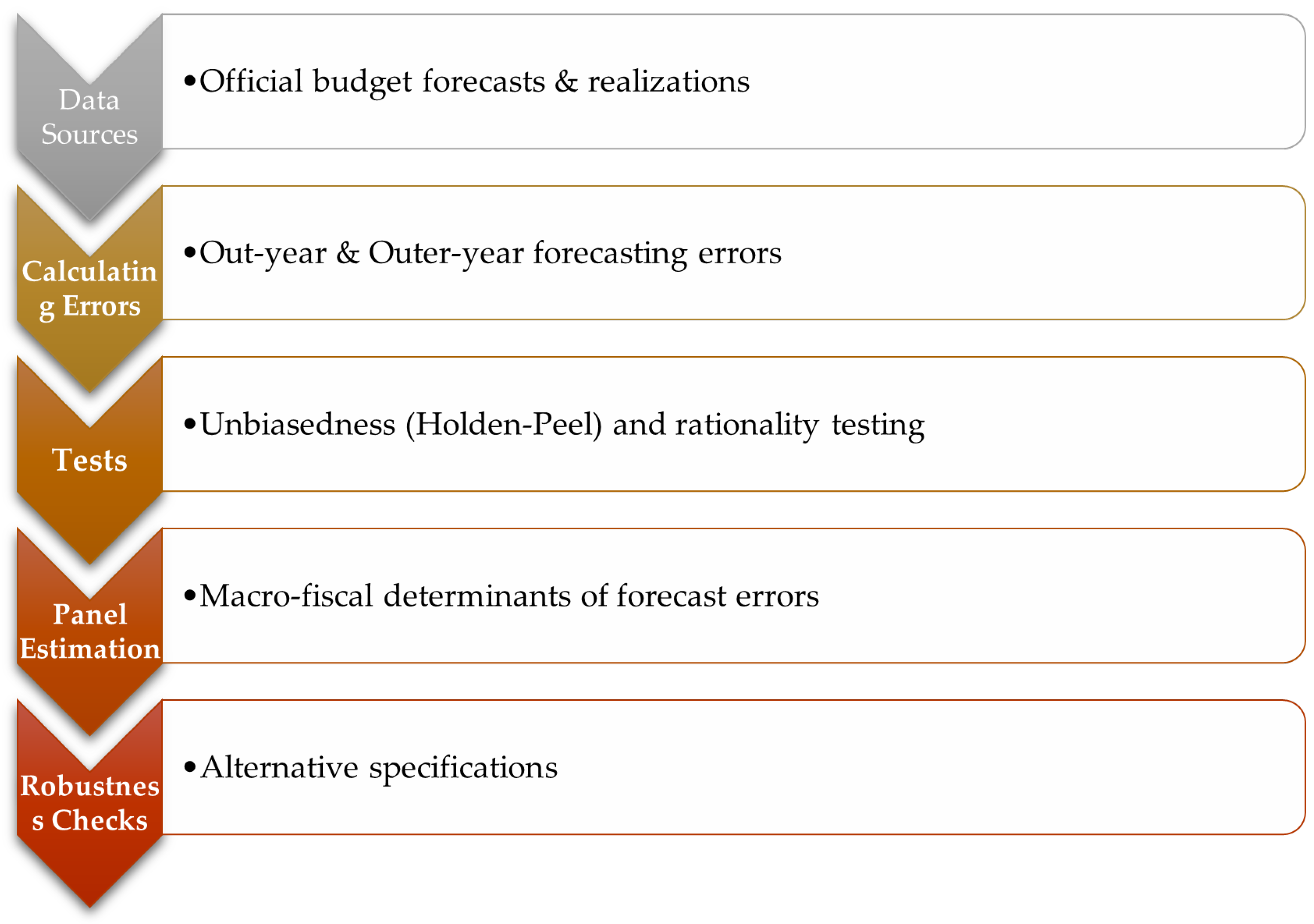
This study primarily aims to reveal the main economic factors in advanced economies that lead to budget forecast errors by concentrating on medium-term budget forecasts and introducing both already-known and new variables
using the workflow shown in Figure 1. The application of real-time variables guarantees that the analysis corresponds to the actual circumstances under which the forecasts are made, thereby giving insights into the difficulties of keeping fiscal projections accurate.
The potential endogeneity issues, like the interrelation of unobserved country-specific effects with the independent variables, were meticulously investigated. The
Hausman (
1978) test was carried out on both models to determine whether fixed or random effects were applicable. The outcomes (
p = 0.1402 for out-year and
p = 0.2330 for outer-year) show that the hypothesis of no systematic correlation cannot be rejected, proving the random-effect specification to be correct. This implies that the endogeneity due to the non-inclusion of country-specific factors does not influence the estimators. In addition, to further cement the robustness,
Driscoll and Kraay (
1998) standard errors were used to lessen the impact of the biases caused by cross-sectional dependence and heteroskedasticity. These methods, while making our estimates more reliable, still allow for some forms of endogeneity, like reverse causation, to exist. Future studies could rely on the use of instrumental variables or the exploitation of natural experiments for more solid causal inferences.
While we were performing the estimation, we spotted the issue of heteroskedasticity in the data (Prob > chi
2 = 0.0000) (refer to
Table A6). These econometric problems can have an impact on the outcome, as heteroskedasticity makes the estimates inefficient, while cross-sectional dependence can result in the standard errors being underestimated, thereby increasing the risk of obtaining false positives.
We resolved these problems through the application of the standard error method of
Driscoll and Kraay (
1998). The method involved the adjusting of the standard errors with respect to both heteroskedasticity and cross-sectional dependence; this is what made it suitable for the panel data that covered several countries and periods of time. Traditional estimators, which assume that there is no cross-sectional correlation, are not similar to the
Driscoll and Kraay (
1998) method, which is still applicable to any form of cross-sectional dependence. It employs non-parametric techniques to cope with time and unit correlations, ensuring that the estimates are not only consistent but also reliable. The method also lessens the biases caused by heteroskedasticity, thereby allowing one to make stronger statistical inferences when comparing the budget forecast errors of different countries and periods repeatedly.
Here are the equations that were applied in the panel models for the out-year and outer-year:
In both models, the constant term
is the one that has the universal effect when the independent variables are zero. The coefficients
β0,
β1,
β2, …,
β9 show how big the effect of an independent variable is on the dependent variable, and in which direction it goes. The error term (
) represents the unobserved factors and random deviations from the model and was adjusted using Driscoll and Kraay standard errors (
Hoechle, 2007).
The main reason for employing panel analysis in this research is to point out the structural similarities that cause medium-term revenue forecast errors in advanced economies, thereby providing hints that are relevant for developing countries that are in the process of adopting similar budgeting practices. It is true that country-specific studies might produce results that are only applicable to the corresponding institutional or fiscal context of that specific nation. Nevertheless, the panel approach helps to identify the shared dynamics and prove statistically significant relationships among countries with similar fiscal frameworks. Consequently, the countries chosen were Australia, Canada, Germany, Hong Kong, Ireland, New Zealand, the United Kingdom, and the United States due to their long histories of using medium-term budgeting systems, the presence of consistent and trustworthy data, and the application of forecasting methodologies that are at least somewhat similar. The joint analysis of these countries not only provides a clearer comprehension of the factors causing forecast errors in mature fiscal systems but also reveals structural patterns and challenges that developing economies might face as they move up to similar fiscal sophistication levels. Thus, the panel methodology enhances the comparative aspect of the research and permits a systematic study of the universal factors affecting revenue forecast accuracy in distinct institutional settings.