1. Introduction
Economic growth is largely driven by technological advancements. In the second half of the 1990s, U.S. labor productivity experienced a significant improvement after nearly a quarter century of sluggish gains. As noted in
Oliner and Sichel (
2000), the rise in high-tech innovations in the U.S. business sector played a major role in this improvement. While the high-tech revolution of the 1990s is widely recognized, its transmission to the macroeconomy, particularly to the dynamics of money demand, remains imperfectly understood. As they are often focused on financial innovation among buyers, standard monetary models provide an incomplete narrative. This paper moves beyond this buyer-centric view by incorporating technological heterogeneity on the seller side into a micro-founded model of money á la
Lagos and Wright (
2005). We demonstrate that the distribution of production efficiency across sellers is a first-order determinant of the incentive to hold money, thereby establishing a novel, supply-side channel through which this approach can help to explain the recent dynamics of the empirical money demand curve.
Our assumption of technological heterogeneity among sellers is empirically grounded, being manifested in multiple dimensions of firm behavior. For instance,
Kumar et al. (
2021) provide robust evidence of substantial variation in the adoption of platform-based mobile payments across firms, even within the same national market. This observed divergence in technology adoption directly aligns with our modeling approach, which involves distinguishing sellers by technological capability. Furthermore, technological heterogeneity extends to supply chain management, as demonstrated by
Lee et al. (
2015), who provide firm-level evidence that IT investment is a significant driver of inventory turnover performance. The documented variation in such operational metrics across firms strongly corresponds to our core assumption of there being a distribution of seller technologies.
In our paper, we study a similar environment to that of
Marchesiani and Senesi (
2009), having both presented work on a micro-founded model of money á la
Lagos and Wright (
2005). However, these two papers have two important differences: First,
Marchesiani and Senesi (
2009) study an economy with ex post heterogeneity and nominal bonds, while we rely on heterogeneity in technology. Second, their study is theoretical, while we conduct a calibration to obtain results.
There are already many studies that research technology and do not have a micro-founded model:
Hötte et al. (
2023) systematically review the empirical literature on the past four decades of technological change.
Oliner and Sichel (
2000) assess the contribution of information technology to the U.S. labor productivity growth rebound in the second half of the 1990s, following nearly a quarter century of sluggish gains. Importantly, the impact of technology was not limited to the US; evidence shows that it also contributed to the growth of the EU, as documented by
Daveri (
2000).
Mundlak et al. (
2012) analyze the implications of the economic growth process, which involves reallocating resources from traditional to new techniques, by employing a technological heterogeneity framework, where implemented technology is chosen jointly with inputs to interpret information obtained from the empirical analysis of panel data.
Malikov et al. (
2018) document strong evidence of persistent technological heterogeneity among credit unions offering different financial service mixes.
We review papers that study money demand (e.g.,
Attanasio et al., 2002;
Berentsen et al., 2011;
Faig & Jerez, 2007); in particular,
Lucas and Nicolini (
2015) form the aggregate NewM1 by simply adding Retail Money Market Funds to M1, demonstrating that the model matches the aggregate NewM1 behavior remarkably well for the entire period. In our study, we use NewM1, which is now considered the standard for calibration (e.g., see
Ait Lahcen et al., 2022,
2023). Some other related papers study issues such as the welfare cost of inflation (
Berentsen et al., 2015;
Craig & Rocheteau, 2008) and centralized and decentralized markets (
Khanlarzade et al., 2021).
We show that technological heterogeneity explains the observed U.S. money demand dynamic well when the time period is divided. First, we calibrate the model to the U.S. data for the period from 1990 to 2020. To achieve a better fit, we split the sample period into two phases, 1990–2007 and 2008–2020, based on the observed shift in the relationship between money demand and interest rates: before 2008, there was a positive relationship between the two; however, from 2008 to 2020, this relationship shifted to become stable and negative. The results show that the model improves the fit between the model-implied money demand and the observed data after dividing the time period.
2. Environment
This model is based on
Lagos and Wright (
2005). Within it, time is discrete and indexed by
; in each period
t, two markets open and close sequentially. There is a
continuum of infinitely lived agents, with the total population assumed to be one, and there is one perishable good that can be produced and consumed by all agents in these markets.
At the beginning of the first market, which is decentralized, each agent receives a preference shock that determines whether they are a producer or consumer in this market. Agents can consume or produce perishable goods in this market: they can produce but cannot consume with the probability , and can consume but cannot produce with the probability . In this market, agents who can consume are referred to as buyers, and those who can produce are referred to as sellers.
This model incorporates a technological parameter , where for each seller. Following a technology shock, high-type sellers may have more advanced or efficient technologies relative to low-type sellers. Using the share parameter , high-type sellers are assumed to have a high technological level, denoted as . In parallel, the low-type sellers with a low technological level, , are determined by , and it is defined that . To facilitate notation, we omit the state index j in the value functions, i.e., , and reintroduce it at the end. Buyers do not have a technological parameter as they are not directly engaged in production. Instead, their utility depends on the consumption of goods. In our model, a buyer’s decision to hold money is shaped by the expected value of their future trades; if there are more high-type, technologically advanced sellers in the market, the potential gains from trade are higher. As a result, a buyer will naturally want to hold more money in preparation for these more valuable opportunities.
A consumer enjoys utility from q consumption, where has standard properties, i.e., , and . We assume that producers incur a utility cost in the market. The technology shock captures the elasticity of the production function, defined as .
It is assumed that a central bank exists and controls the money supply at time t, . We will omit time t from now on and index previous period variables by −1 and next period variables by +1. Money supply evolves according to the law of motion , where denotes the gross growth rate of money supply and M is the stock of money in period t. The new money is injected when is constant, or withdrawn if , as the lump-sum money transfer to all agents , where is the per-unit money transfer to an agent. Letting be the units of money trading in the first market and assuming , the lump-sum money transfer is denoted as .
In the second market, which is centralized, all agents can consume and produce. They enjoy utility
from consuming
x units of goods, where
,
,
, and
. Let
be the solution to
. Here,
represents the discount factor between market 2 and market 1 in the next period. Agents do not apply any discount between the two markets, which is not restrictive because all that matters is the total discounting between one period and the next, as in
Rocheteau and Wright (
2005).
Letting
be the real price of money and
P be the price of goods in market 2, we focus on a steady-state equilibrium, and the aggregate real money balances are constant. The law of motion of the real money supply between two periods is
which implies that
.
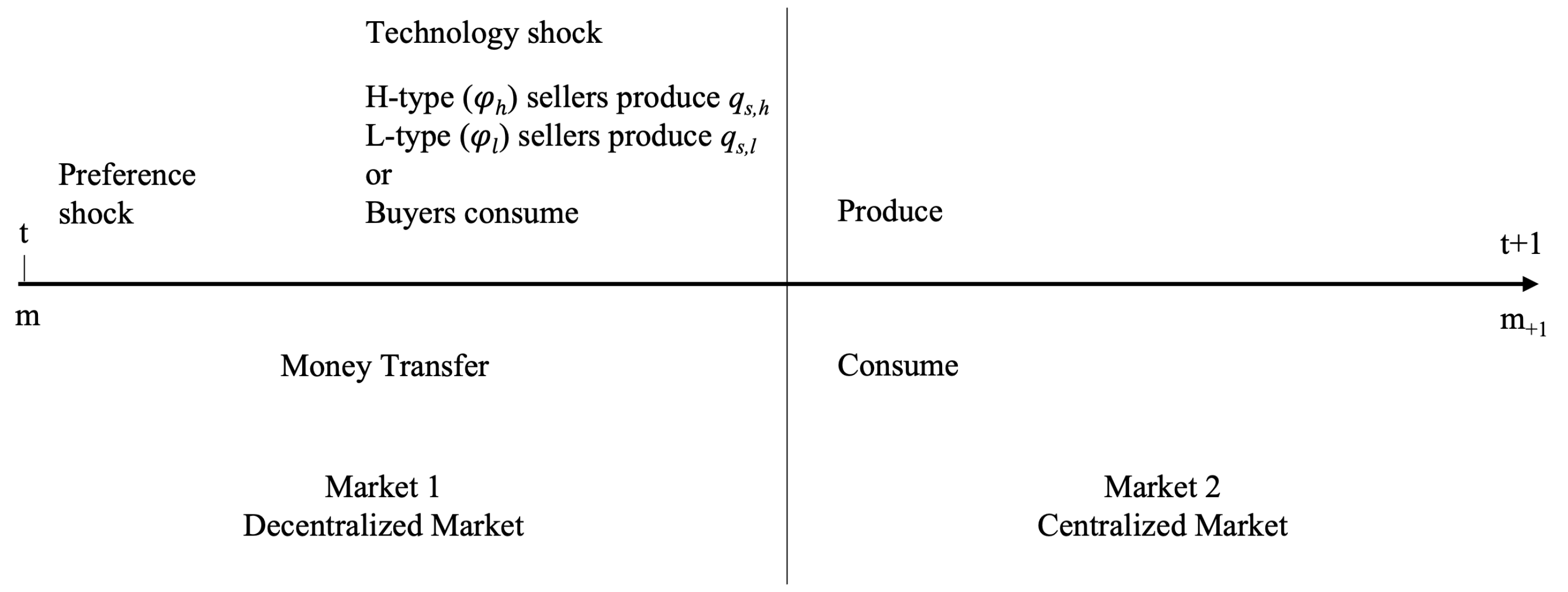
The timeline of events is shown in
Figure 1. At the beginning of the first market, agents observe their preference shock, which determines whether they become producers or consumers in this market. Sellers receive a heterogeneity shock, which determines the different elasticity of the production function. In the second market, all agents can consume and produce.
3. Equilibrium
An agent’s decision is formalized within representative period t, moving backwards from the second market to the first market.
In the second market, agents invest
h units of time to produce
h units of goods. The term
is the money taken into the next period. Let
be the value function from trading in the first market with
units of money, and define
as the value function from entering the second market with
units of money. The agents’ problem is
such that
The first-order conditions with respect to
x and
are
where
is the marginal cost of holding money. The quantity
x of goods consumed by an agent is equal to the efficiency level
, where
.
The envelope condition is
Let denote the quantities consumed by a buyer in the first market and be the quantity produced by a seller in the first market, which is dependent on the technological level. We assume that . Let p be the price of goods in the first market.
If the agent becomes a producer, referred to as a seller, their problem is
The first-order condition is
The amount of goods produced by sellers is independent of the amount of money they hold.
The envelope condition for sellers is
If an agent becomes a consumer, referred to as a buyer, their problem is
subject to
The constraint means that buyers are unable to exceed their initial money holdings (
) in the first market when making expenditures. Using the envelope condition (
7), the buyer’s first-order condition is
From rearranging the above equation, we then obtain
where
is the multiplier on the cash constraint.
The envelope condition for buyers is
Using (
9) and (
14) to rearrange the envelope condition (
15), we obtain
If the constraint (
12) is not binding, i.e.,
, the condition (
14) reduces to
; hence, trade is efficient. On the contrary, if the constraint (
12) is binding, i.e.,
, then
.
Hence, the market-clearing condition implies
The expected lifetime utility of an agent who holds
money at the beginning of the first market is
Differentiating the function (
18) with respect to
yields
where
is the marginal value of money.
We use (
10) and (
16) to rearrange Equation (
19) to
We use Equation (
6) lagged one period to rewrite Equation (
20) as
We rearrange the above equation by taking the steady state. The equilibrium condition implies
4. Welfare Analysis
Welfare
can be written as follows:
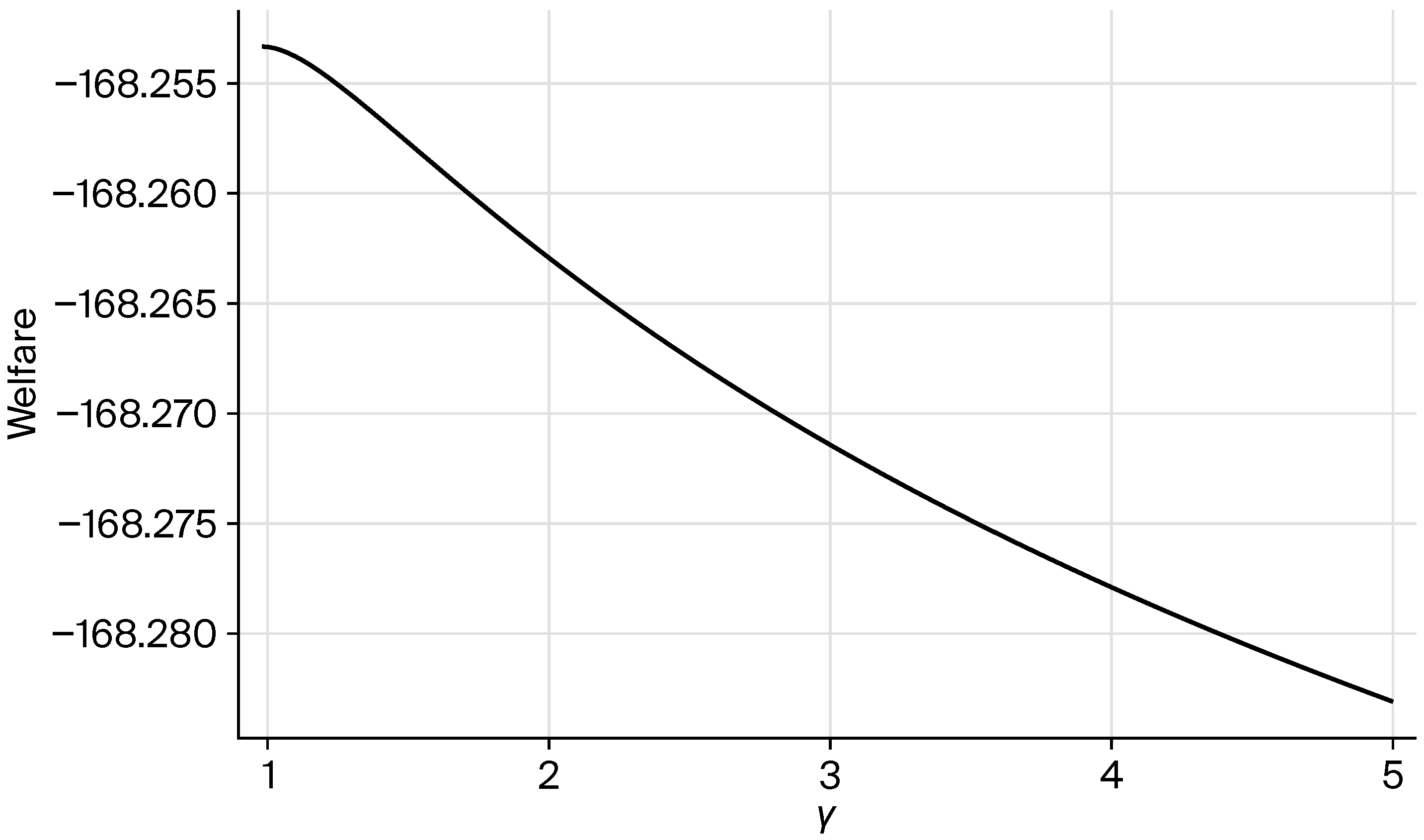
Figure 21 shows a negative relationship between the welfare and gross growth rate of money supply
, which is consistent with the findings of
Lagos and Wright (
2005).
2 Aruoba et al. (
2011) demonstrate that higher money growth, which leads to inflation, negatively impacts welfare. Their model shows that inflation reduces consumption in decentralized markets, directly affecting welfare. Furthermore, they find that inflation requires compensatory increases in consumption to offset welfare losses.
5. Quantitative Analysis
In the following section, we undertake the calibration of the model using US data spanning from 1990 to 2020, aiming to analyze whether adding technological heterogeneity can improve the model and make it more realistic.
We chose a model period of one year. The functions , , and have the form , where , , and . The following parameters were identified:
- (i)
Technology parameters: the probability of whether an individual is the buyer or seller , and the share of sellers with a high technological level ;
- (ii)
Preference parameters: discount factor , high technological level , low technological level , utility weight , and relative risk aversion ;
- (iii)
Policy parameter: gross growth rate of the money supply .
To identify these parameters, we used data from the first quarter of 1990 to the first quarter of 2020 downloaded from the Federal Reserve Bank of St. Louis (FRBSL), the US Department of the Treasury: Financial Management Service (FMS), and Bloomberg.
The data sources for the US are detailed in
Table 1.
As suggested by
Lucas and Nicolini (
2015), NewM1 data are used when calibrating the model to the U.S., which is calculated by adding M1 to Retail Money Market Funds. It corrects for the instability in traditional M1 caused by late-20th-century regulatory and financial changes and is now standard in the literature (e.g.,
Ait Lahcen et al., 2022,
2023). Compared to the calibration results with M1, we find that NewM1 can reach a more accurate result.
The two parameters
and
are set to be equal to the average variables in the data, while the parameters
n and
are set by hand. The gross growth rate of the money supply,
, is set to match the average quarterly changes in the consumer price index, while the discount factor,
, is set to match the real interest rate in the model with that observed in the data, following the methodology of
Aruoba et al. (
2011). This involves calculating the real interest rate,
r, as the difference between the long-term government bond yield
3 and the average quarterly change in the consumer price index. We assume symmetric buyers and sellers by setting
, ensuring that all buyers and sellers in the search and matching process can be successfully matched, which provides the best fit of the model to the data. Additionally, the high-type and low-type agents are assumed to be symmetric with an equal share; therefore, we set
. We conduct robustness checks by recalibrating this share parameter and find that the model’s key results are not significantly affected by its value; therefore, the symmetric share of 0.5 is adopted for simplicity.
The parameter
A is determined by matching the velocity of money demand in the model with the average in the data. The velocity of money in the model is written as
We can interpret the technology difference,
, as the heterogeneity in high-
and low-type agents
, and therefore
. The parameters
,
, and
are jointly selected by minimizing the sum of squared differences between the model-implied and observed money demand. The former is given by the inverse of the velocity of money, referred to as
. The empirical money demand reads as
where the subscript
t refers to the time-series dimension of the data.
We calibrate (
,
,
) by solving
The calibrated parameters thus minimize the sum of squared differences between the model-implied and observed money demand.
The calibration targets and the target values are shown in
Table 2.
The parameters are calibrated to match the empirical targets outlined in
Table 2. In the US, the velocity of money stands at a value of
; in the data, the average real interest rate is
the average inflation rate is
.
6. Results
Table 3 displays the calibration results for the US.
The above table presents the calibrated values for the key parameters (
,
) and the welfare cost of inflation, denoted as
, which amounts to approximately 0.006% and is calculated as the percentage of total consumption that agents would be willing to give up in a steady state with a nominal interest rate of 3% instead of 13%.
4 The technology difference
is 4.01, which suggests that heterogeneity in the technological level plays an important role.
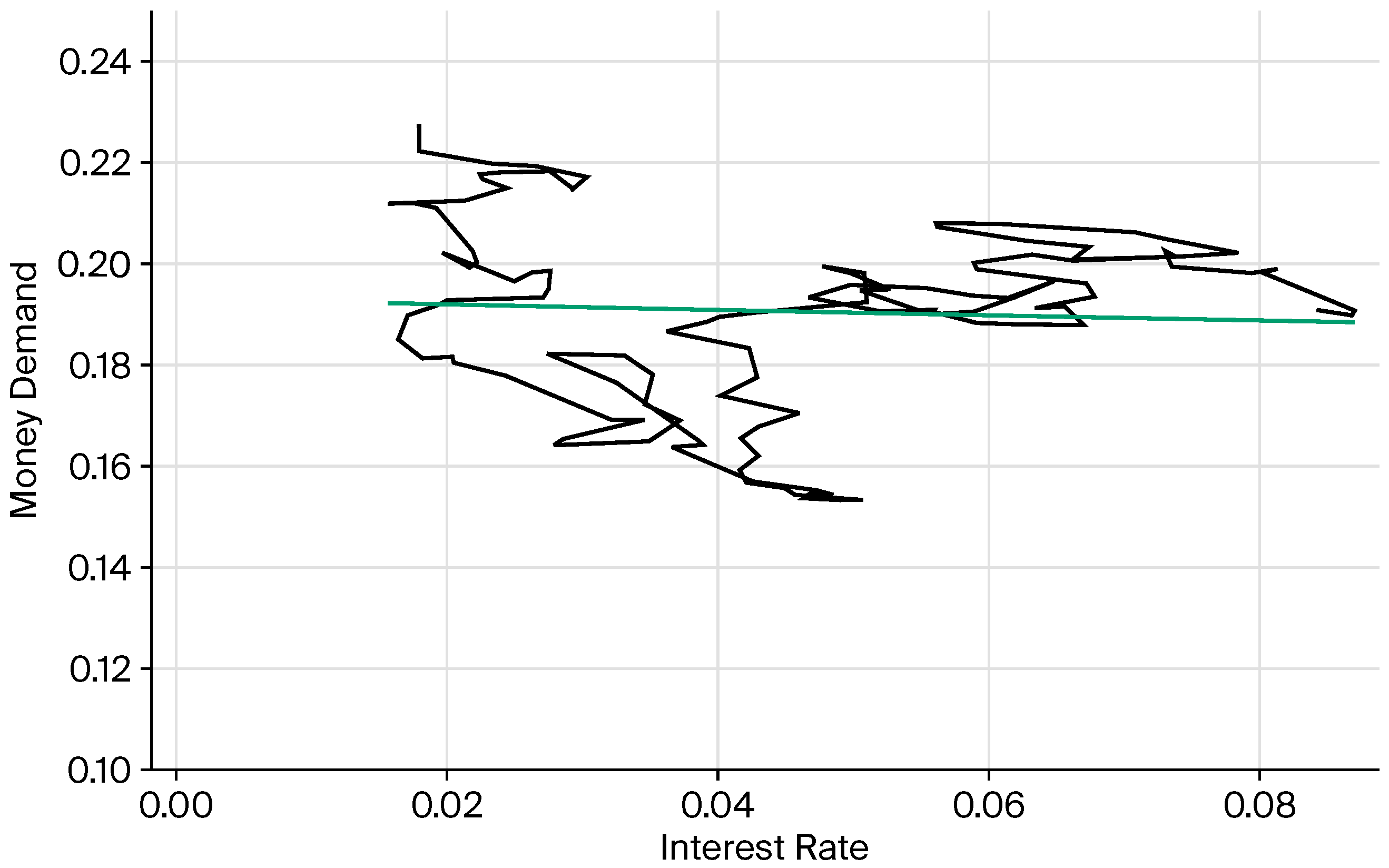
Figure 3 is the fit curve for the US for the period from 1990 to 2020. The squared difference of 0.0409 indicates the strong fit of the model with the green fit line in the graph.
Distinct Phases
Before 2008, there was a positive relationship between money demand and interest rates. However, there was a notable shift from 2008 to 2020, resulting in a stable negative relationship between money demand and interest rates, which was affected by the global financial crisis in 2008 (
Bernanke et al., 2020), called the Great Recession (
Wigmore, 2021), which led to the greatest economic downturn in recent history.
We obtained the calibration results and achieved a more accurate fit by dividing the sample period into two distinct phases: 1990–2007 and 2008–2020.
The calibration targets for the US (1990–2007) are shown in
Table 4.
The calibration targets for the US (2008–2020) are shown in
Table 5.
The parameters are calibrated to match the empirical targets presented in
Table 4 and
Table 5. The velocity of money was 5.38 before 2008 and decreased to 5.2 after 2008. In the pre-2008 period, the average value for inflation was
, which decreased to
in the post-2008 period. Finally, the real interest rate was
between 1990 and 2007 and sharply declined thereafter, with a real interest rate of
in the post-2008 period.
Table 6 provides a comprehensive summary of the calibration results for the United States.
The table above provides calibrated values for key parameters. Specifically, it presents the values of
and
A, which are estimated as
and
, respectively, for the period from 1990 to 2007, while from 2008 to 2020, these parameters are
and
. Before the 2008 financial crisis,
A is close to zero and
is high. Since
A and
move in opposite directions, they can offset each other; a reduction in
A lowers monetary activities, but
compensates for this reduction and increases them. The decrease in
observed in our model after 2008 contrasts with the findings in the previous literature, e.g., the study by
Guiso et al. (
2013), which reported an increase in risk aversion following the 2008 financial crisis.
This table also sets out the welfare cost of inflation, denoted as
, which is a negative value (
) before 2008; post-2008, it increases to 0.013%. This measure quantifies the percentage of total consumption that agents would be willing to forgo in a steady state characterized by a nominal interest rate of 3% rather than 13%, following the methodology in
Craig and Rocheteau (
2008). Note that low technological levels,
, remain at 0.5 for each period. We restrict our attention to the technology differences, where
before 2008 and reduces to 0.01 after 2008, which suggests that heterogeneity in the technological level plays a big role before 2008.
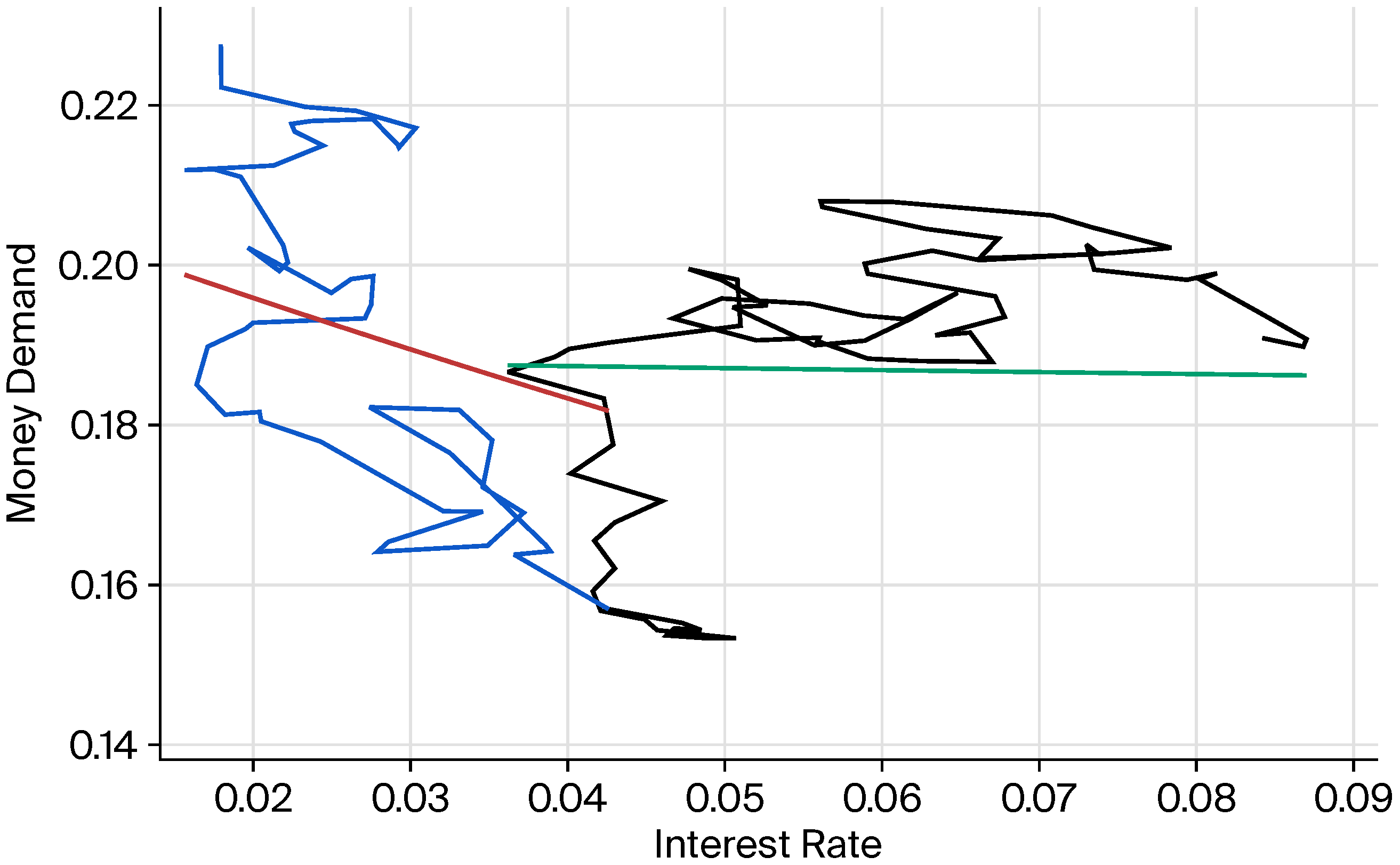
Figure 4 presents the model’s fit with the observed data. The green line represents the fit from 1990 to 2007, while the red line shows the fit from 2008 to 2020. When considering the entire period from 1990 to 2020, the squared difference is measured at 0.0409. Specifically, it is 0.0207 from 1990 to 2007 and 0.0166 from 2008 to 2020. Notably, both of these squared differences are smaller than the previous result, indicating an improved fit of the model to the data.
Our results show a clear structural break around 2008. To make sense of this shift, we need to consider the broader economic changes that occurred at that time.
Before the 2008 financial crisis, a positive relationship between interest rates and money demand is shown in the U.S. data—as interest rates decrease, money demand also decreases. Our model helps to explain this pattern by focusing on changes in the real economy. The high-tech boom of the late 1990s created more technologically advanced firms. While these more efficient producers increased potential transaction values, this effect was outweighed by other factors during periods of economic moderation, leading to the observed positive correlation where money demand moved together with interest rates.
After 2008, the relationship reversed to a conventional negative pattern—as interest rates decreased, money demand increased. The financial crisis created new forces that fundamentally altered this relationship: interest rates fell to historic lows and remained there for years, reducing the opportunity cost of holding money; digital payments and fintech apps became commonplace, changing how people managed liquidity; and central banks injected substantial liquidity through quantitative easing. The stable negative relationship we observed after 2008 thus reflected our seller-side channel working within this new financial environment.
7. Conclusions
In the second half of the 1990s, U.S. labor productivity surged after nearly 25 years of sluggish growth, largely due to the rise in high-tech innovations in the U.S. business sector (
Oliner & Sichel, 2000). In our study, we explore this high-tech revolution by incorporating technological heterogeneity into a micro-founded model of money. We calibrate the model using U.S. data from 1990 to 2020 and then divide the period into two phases: 1990–2007 and 2008–2020. This approach improves the model’s fit with the observed money demand, highlighting that incorporating the seller-side technological heterogeneity into the model can better explain the dynamics of the empirical U.S. money demand, suggesting that the production side of the economy actively shapes monetary dynamics. It points to the ‘quality’ of the seller network, as captured by this heterogeneity, not as a passive background element, but as a central force driving the demand for money. The seller-side channel we identify offers a new perspective for interpreting past episodes of technological change and for considering the monetary implications of future innovations in production.
From a policy perspective, our findings highlight that the stability of money demand depends heavily on the structural composition of the production sector. In an era of ongoing technological innovation, the persistent reallocation of resources toward more efficient producers is likely to generate repeated shifts in money demand. This implies that the predictive power of standard money demand equations may become less reliable during times of rapid technological adoption. A deeper grasp of this seller-side channel is therefore essential—not only for making sense of past data but also for building more resilient monetary policy frameworks capable of navigating future industrial transformations.
While we treat the share of high-type sellers () as constant for simplicity and clarity in this paper, our framework naturally invites dynamic extensions. A promising direction for future work would be to model as a time-varying parameter, perhaps tracked through aggregate indicators of technological adoption such as ICT investment shares or the penetration rate of digital payment platforms. This evolution would allow the model to more fully capture the transitional dynamics between technological regimes, offering even deeper insights into how prolonged technological diffusion shapes monetary relationships.