Review

Neural Network Models for Empirical Finance †

Department of Economics, Highfield Campus, University of Southampton, Southampton SO17 1BJ, UK
*
Author to whom correspondence should be addressed.
Tullio Mancini acknowledges financial support from the University of Southampton Presidential Scholarship and Jose Olmo from ‘Fundación Agencia Aragonesa para la Investigación y el Desarrollo’.
J. Risk Financ. Manag. 2020, 13(11), 265; https://doi.org/10.3390/jrfm13110265
Submission received: 27 September 2020 / Revised: 17 October 2020 / Accepted: 26 October 2020 / Published: 30 October 2020
(This article belongs to the Special Issue Machine Learning for Empirical Finance)

Abstract

This paper presents an overview of the procedures that are involved in prediction with machine learning models with special emphasis on deep learning. We study suitable objective functions for prediction in high-dimensional settings and discuss the role of regularization methods in order to alleviate the problem of overfitting. We also review other features of machine learning methods, such as the selection of hyperparameters, the role of the architecture of a deep neural network for model prediction, or the importance of using different optimization routines for model selection. The review also considers the issue of model uncertainty and presents state-of-the-art methods for constructing prediction intervals using ensemble methods, such as bootstrap and Monte Carlo dropout. These methods are illustrated in an out-of-sample empirical forecasting exercise that compares the performance of machine learning methods against conventional time series models for different financial indices. These results are confirmed in an asset allocation context.
Keywords: machine learning; neural networks; dropout methods; LASSO techniques; financial modeling machine learning; neural networks; dropout methods; LASSO techniques; financial modeling
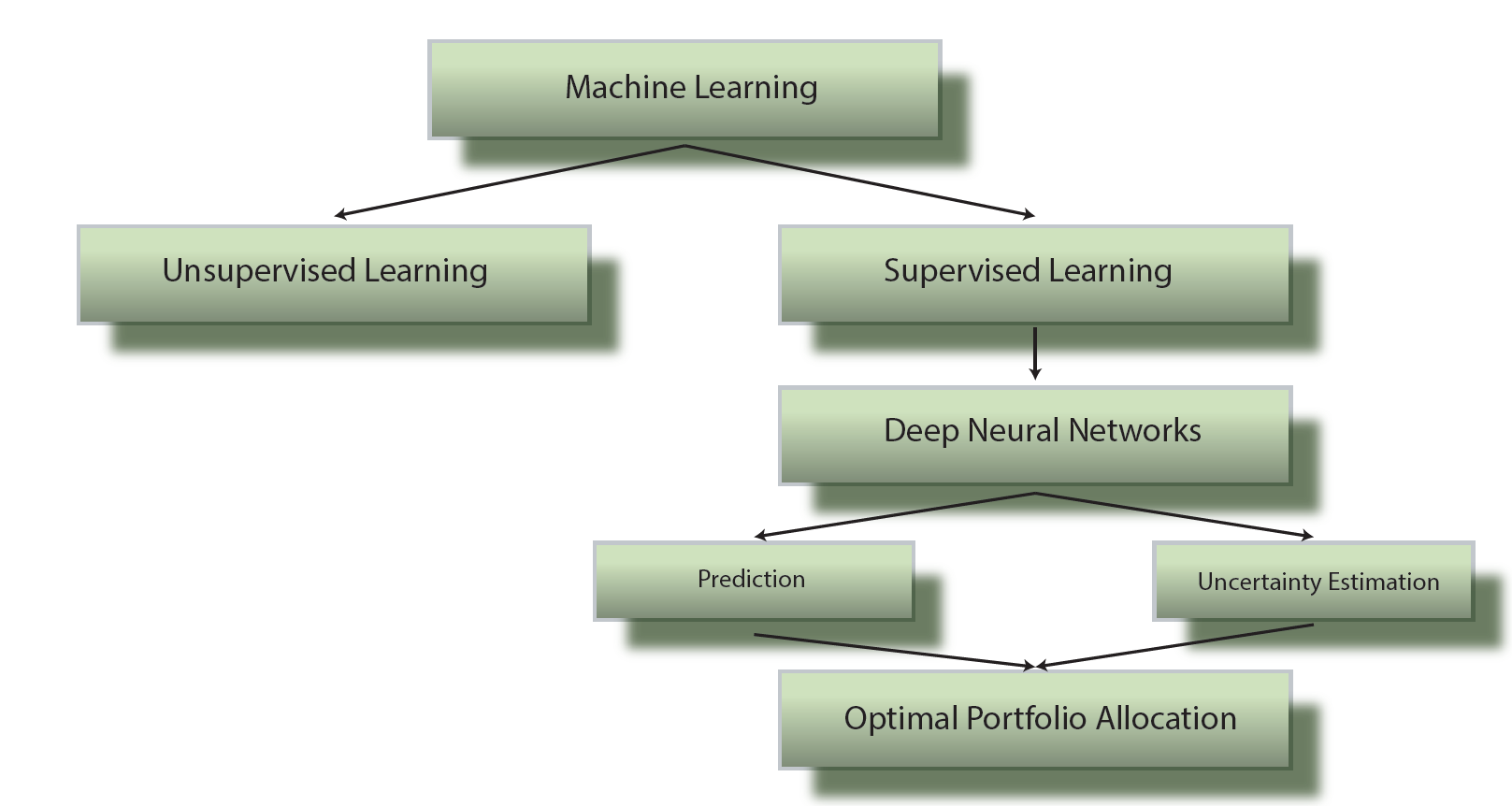
Graphical Abstract