Case History
A 25-year-old woman presented at our out-patient clinic for exclusion of cardiac disease as Steinert muscular dystrophy was part of her family history. She was asymptomatic and did not take medication. On physical examination, no patterns of Steinert disease were noted. A slight pectus excavatum was present. Blood pressure was 110/60 and pulse 62 bpm. Jugular pulse was normal. A 2⁄6 grade systolic ejection murmur was audible at the second left intercostal space. Pulmonary and abdominal examination were both normal. Neurological status was normal.
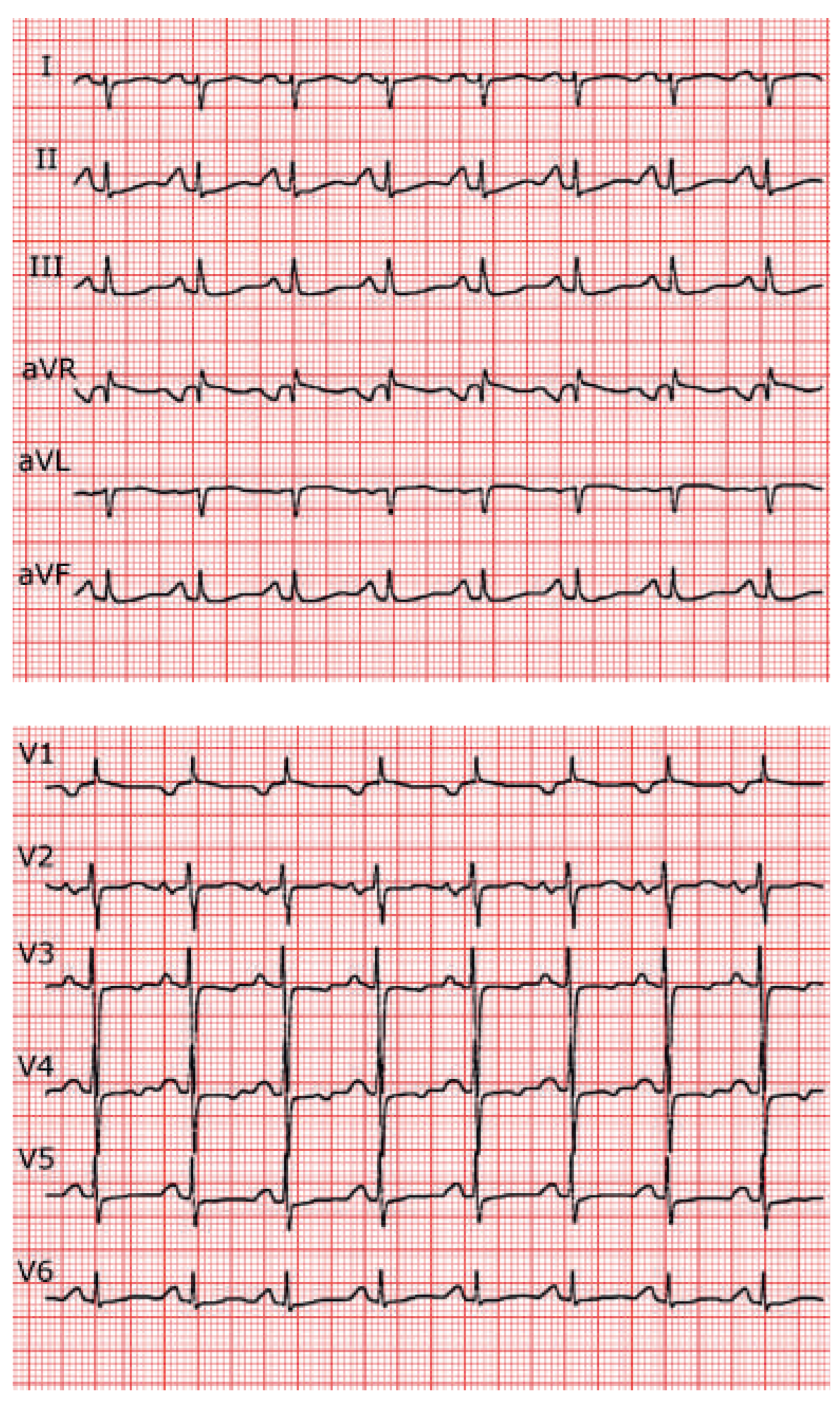
Twelve-lead ECG (Figure 1) showed normal sinus rhythm with right axis deviation, prominent P waves in lead II, III and aVF, negative P waves in V1, rS pattern in I, qR pattern in V1, and inverted T-waves from V1 to V4.
Figure 1.
Twelve-lead ECG showed normal sinus rhythm with right axis deviation, prominent P waves in lead II, III and aVF, negative P waves in V1, rS pattern in I, qR pattern in V1, and inverted T-waves from V1 to V4. (Reprint with kind permission from Jens Roggenbach.).
Transthoracic echocardiography was normal.
Questions
Which clinical condition explains the electrocardio- graphic findings?
Does QRS complex morphology reflect a conduction defect or right chamber enlargement?
Commentary
Pectus excavatum, present in this patient, is a chest wall deformity with a backward shift of the sternum and costal cartilages that reduce the chest anteroposterior diameter, leading to a clockwise or counter-clockwise rotation of the heart in the frontal and sagittal planes. Funnel chest may be present as an isolated deformity or associated with other malformations [1] (i.e., Marfan disease, Ehlers-Danlos syndrome, myotonic dystrophia, etc.). Most patients are asymptomatic, but may present auscultatory, electrocardiographical and radiological findings suggesting heart disease [2].
A systolic 2⁄6 to 3⁄6 murmur, located predominantly at the upper left sternal border, may be present, consecutive to the abnormal proximity of the main pulmonary artery and the chest wall. Cardiomegaly on chest X-ray reflects compression of the heart in a reduced sagittal length, giving a so-called “pancake appearance” [2].
Electrocardiographic patterns, notably qr, qR or rsR’ in V1, negative P waves in V1, prominent P waves in II, III and aVF may be noted. These findings do not reflect right ventricular conduction delay or right car- diac chamber enlargement but are due to abnormal cardiac position in the frontal and sagittal planes [1,3].
Electrocardiographic changes seen in asymptomatic, healthy patients with funnel chest may also mimic myocardial ischaemia [4]. Left posterior hemiblock can be ruled out because of the absence of a q wave in lead III, a deep S wave in lead I and tall R waves in lead II, III and aVF. Classical right bundle branch block can also be ruled out because of the normal duration of the QRS complex.
This simple case reminds us that the electrocardiogram should always be interpreted in the light of the clinical situation. Obviously, benign clinical findings may impact the results of paraclinical tests, sometimes leading to wrong diagnosis and unnecessary examinations.
Conflicts of Interest
No financial support and no other potential conflict of interest relevant to this article were reported.
References
- Martins de Oliveira, J.; Sambhi, M.P.; Zimmerman, H.A. The electrocardiogram in pectus excavatum. Br Heart J. 1958, 20, 495–501. [Google Scholar] [CrossRef] [PubMed]
- Guller, B.; Hable, K. Cardiac findings in pectus excavatum in children: review and differential diagnosis. Chest 1974, 66, 165–171. [Google Scholar] [CrossRef] [PubMed]
- Gahrton, G. ECG changes in pectus excavatum (funnel chest). A pre- and postoperative study. Acta Med Scand. 1961, 170, 431–438. [Google Scholar] [CrossRef] [PubMed]
- Ruskin, J.; Whalen, R.E.; Orgain, E.S. Electrocardiogram and vectorcardiogram simulating myocardial infarction in patient with pectus excavatum and straight back. Am J Cardiol. 1968, 21, 446–449. [Google Scholar] [CrossRef] [PubMed]
© 2012 by the author. Attribution-Non-Commercial-NoDerivatives 4.0.