Next Article in Journal
Programmation Optimale des Stimulateurs Multisites et Suivi des Patients Après Thérapie de Resynchronisation Cardiaque
Previous Article in Journal
Die Nichtinvasive Beatmung als Therapie der Akut Respiratorischen Insuffizienz
 
 
Cardiovascular Medicine is published by MDPI from Volume 28 Issue 1 (2025). Previous articles were published by another publisher in Open Access under a CC-BY (or CC-BY-NC-ND) licence, and they are hosted by MDPI on mdpi.com as a courtesy and upon agreement with Editores Medicorum Helveticorum (EMH).
Interesting Images

'Torsades de Pointes' in a Patient with History of Epilepsy"

by
Dagmar I. Keller
1,*,
Peter Rickenbacher
2 and
Stefan Osswald
1
1
Cardiology Department, University Hospital, Basel, Switzerland
2
Cardiology Department, Bruderholzspital, Bruderholz, Basel, Switzerland
*
Author to whom correspondence should be addressed.
Cardiovasc. Med. 2007, 10(1), 34; https://doi.org/10.4414/cvm.2007.01220
Submission received: 26 October 2006 / Revised: 26 November 2006 / Accepted: 26 December 2006 / Published: 26 January 2007

Case Report

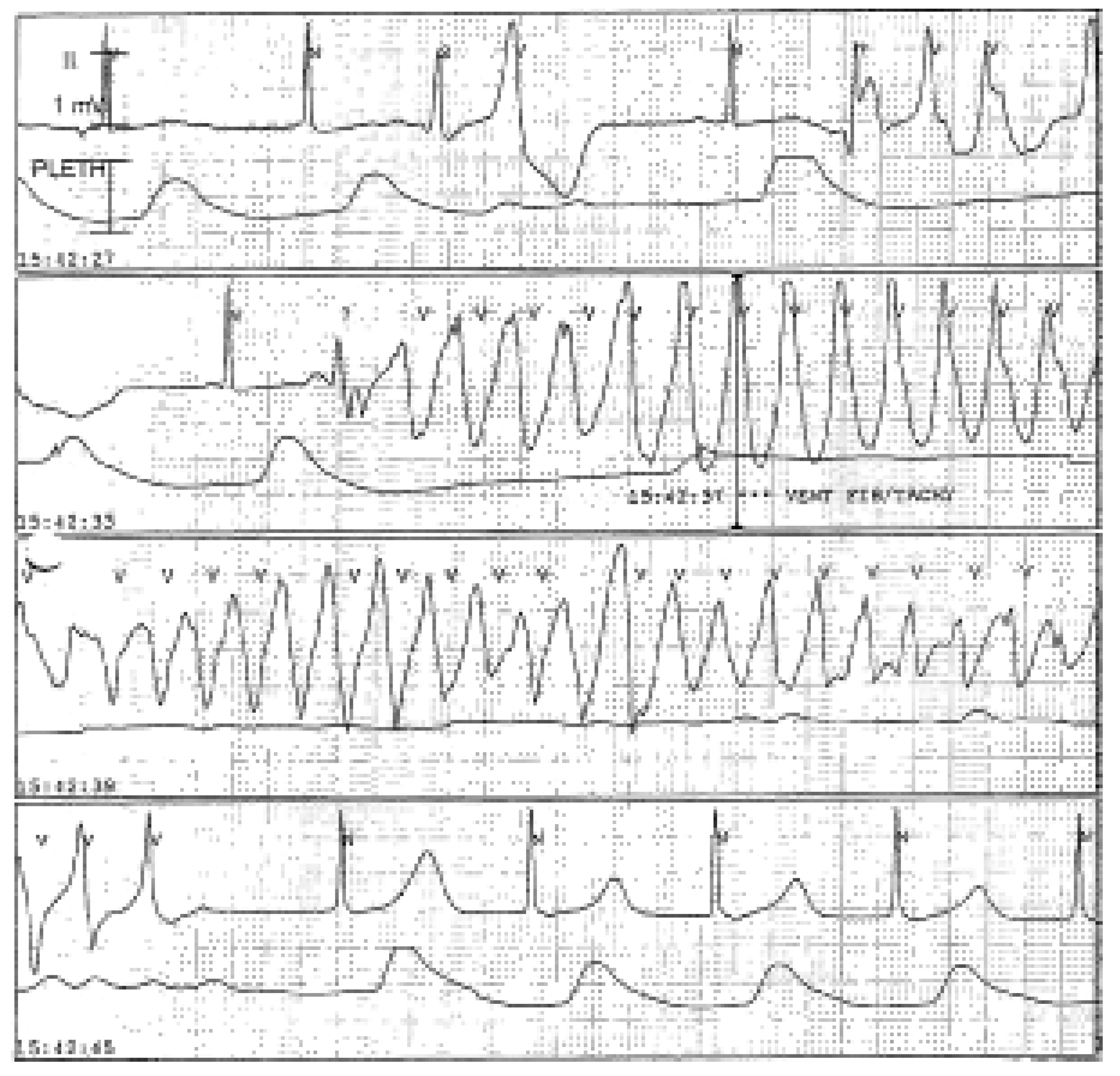
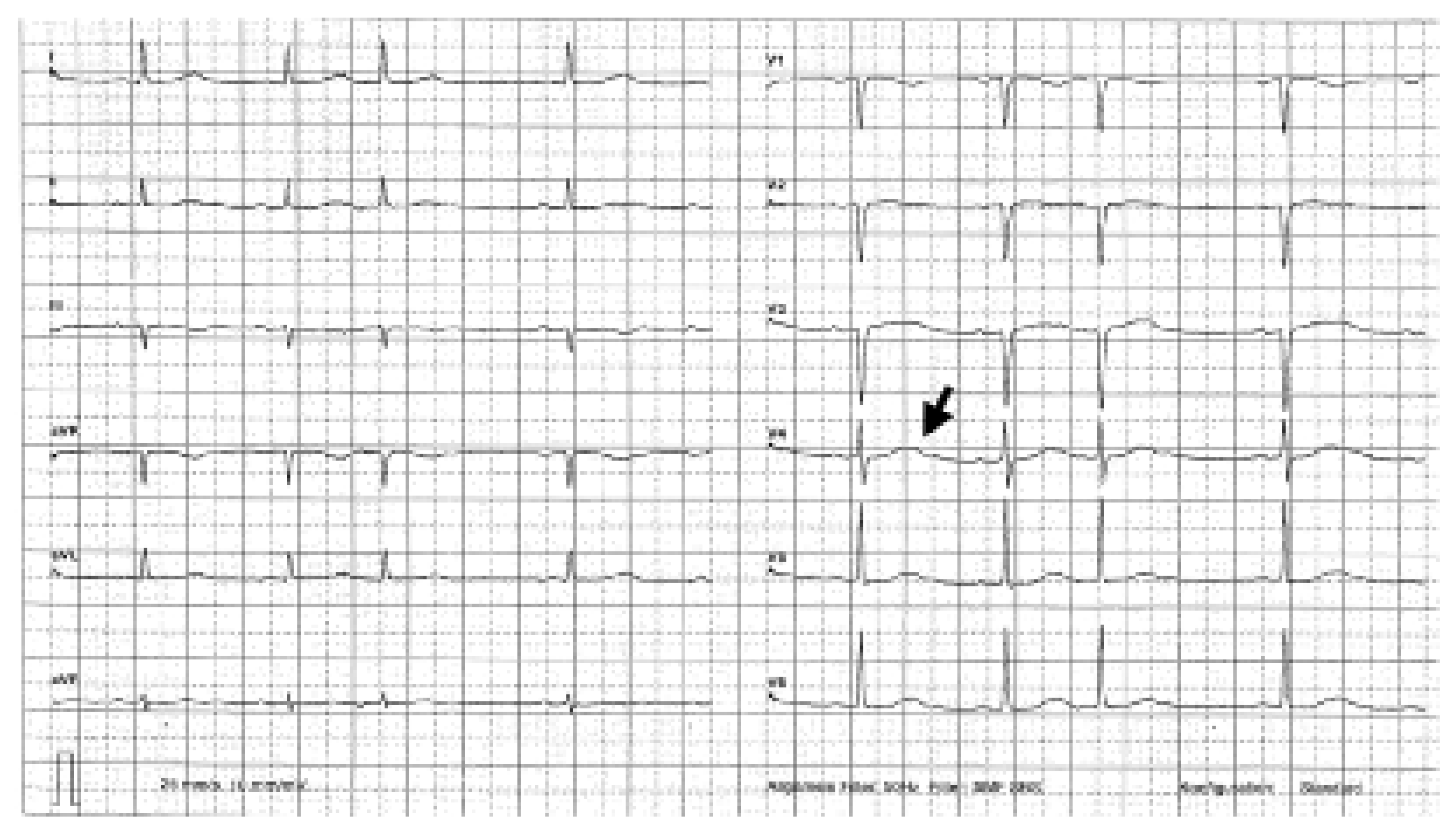
A female Caucasian patient, born 1930, was admitted to hospital for reposition of a broken arm. During anaesthesia she developed “torsades de pointes” (Figure 1) and was successfully defibrillated. The 12-lead ECG after defibrillation is shown in Figure 2.
(1.) What is your diagnosis? (2.) Do you suggest further steps, and if yes, which ones?

Explanatory Answers

(1.) The 12-lead ECG shows bradycard sinus rhythm with left axis deviation, one SVES, borderline PQ interal and QTc prolongation of 508 ms. The T-wave is of low amplitude and double notch appearance. The ECG phenotype and the history of “torsades de pointes” are consistent with the long QT syndrome (LQTS) type 2 phenotype [1]. Subsequent ECG’s confirmed the LQTS type 2 phenotype.
(2.) The patient was treated for epilepsy for more than 30 years. She reported that she suffered from witnessed (husband) syncope’s usually in the morning, still lying in the bed, when the telephone rang, which is a typical trigger for ventricular arrhythmias in LQTS type 2 patients [2]. With the background of LQTS “epilepsy” must be considered as haemodynamically relevant ventricular arrhythmia, eg “torsades de pointes” in the context of LQTS. As a consequence phenytoine was stopped, beta-blocker therapy was started and the implantation of an ICD was discussed with the patient. Gene testing was performed and a heterozygous mutation was identified in the KCNH2 gene.
Congenital long QT syndrome is an inherited disease characterised by prolonged ventricular repolarisation and a high risk for sudden cardiac death (SCD) due to complex ventricular arrhythmias and “torsades de pointes”. Today eight LQTS phenotypes are known. The most common forms are type 1 and 2, caused by mutations in the potassium channel genes KCNQ1 and KCNH2, respectively, and type 3, caused by mutations in the SCN5A gene encoding the cardiac sodium channel. These types can be distinguished on the surface ECG [1]. LQTS type 1 is characterised by the broadest T-wave, whereas type 2 shows low T-wave amplitude with a double notch appearance as shown in Figure 2. Type 3 reveals the most delayed onset of a narrowly peaked Twave which also can be biphasic, depending onthe preceding RR-interval. Triggers for ventricular arrhythmias are sports eg swimming in LQTS type 1, loud noise in LQTS type 2 and sleep/rest in LQTS type 3. The only tool to prevent LQTS patients from SCD is ICD implantation. Family screening (phenotype and genotype) in patients with LQTS is always indicated.

References

  1. Roden, D.M.; Lazzara, R.; Rosen, M.; Schwartz, P.J.; Towbin, J.; Vincent, G.M. Multiple mechanisms in the long-QT syndrome. Current knowledge, gaps, and future directions. The SADS Foundation Task Force on LQTS. Circulation. 1996, 94, 1996–2012. [Google Scholar] [CrossRef] [PubMed]
  2. Schwartz, P.J.; Priori, S.G.; Spazzolini, C.; Moss, A.J.; Vincent, G.M.; Napolitano, C.; et al. Genotype-phenotype correlation in the long-QT syndrome: gene-specific triggers for life-threatening arrhythmias. Circulation. 2001, 103, 89–95. [Google Scholar] [CrossRef] [PubMed]
Figure 1. Intraoperative ECG monitoring with non-sustained “torsades de pointes”.
Cardiovascmed 10 00034 g001
Figure 2. 12-lead ECG showing QTc prolongation of 508 ms and a T-wave with low amplitude and double notch (arrow).
Cardiovascmed 10 00034 g002