Zusammenfassung
Zweck: NT-proBNP hat seit kurzem einen wichtigen Stellenwert zur Diagnose der Herzinsuffizienz. Das Ziel unserer Studie war, NTproBNP als Marker für die chronische Herzinsuffizienz in einer grossen unselektierten Population zu evaluieren. Ebenfalls wollten wir den Zusammenhang zwischen NT-proBNP und verschiedenen klinischen Parametern, wie Alter, Geschlecht, Body Mass Index (BMI), körperliches Training, Thoraxschmerzen, Blutdruck, Herzfrequenz, Komorbiditäten und Therapie untersuchen.
Methoden: Die Studienpopulation bestand aus 432 Personen, die während einer 7tägigen Reise auf einem grossen, mit einem medizinischen Zentrum ausgerüsteten Kreuzfahrtschiff, kardiologisch untersucht wurden (im Mai 2003 und Mai 2004). In dieser Querschnittstudie füllten die Teilnehmer einen medizinischen Fragebogen aus und wurden klinisch untersucht. Die NT-proBNP Werte wurden bestimmt und ein ergometrischer Fahrradtest wurde durchgeführt. Eine Untergruppe von 88 Personen wurde zusätzlich echokardiographisch untersucht.
Resultate: Von 432 Personen (mittleres Alter 66 ± 10 Jahre; 48,8% Männer) waren 8,3% klinisch gesund, 71,2% hatten eine arterielle Hypertonie und 46,8% hatten klinische Symptome einer Herzinsuffizienz. Die medianen NT-proBNP-Plasmaspiegel stiegen von 78,8 ng/l bei Personen ohne Herzinsuffizienz auf 87,1 ng/l bei Personen mit Herzinsuffizienz NYHA I, 121,6 ng/l bei NYHA II und 157,2 ng/l bei NYHA III. Die Assoziation der NT-proBNP-Spiegel mit den NYHA-Klassen war hoch signifikant (p = 0,0001). Ausserdem war NT-proBNP ein unabhängiger Vorhersagewert für die Herzinsuffizienz-Klasse NYHA II (p = 0,02). Es konnte eine signifikante positive Korrelation des natürlichen Logarithmus von NT-proBNP mit dem Alter und dem Pulsdruck sowie eine inverse Korrelation mit dem BMI, dem maximal erreichten Belastungsniveau, der linksventrikulären Auswurffraktion, der Herzfrequenz und dem diastolischen Blutdruck gefunden werden. Starke unabhängige Vorhersagewerte für die NT-proBNP-Werte waren: Alter (p <0,0001), Betablocker-Therapie (p = 0,02), Geschlecht (p <0,0001), ACE-Hemmer-Therapie (p = 0,02), Herzfrequenz (p = 0,006) und Thoraxschmerzen (p = 0,02). Schlussfolgerung: Diese Studie bestätigt die ausgezeichnete diagnostische Wertigheit von NT-proBNP für das Vorliegen einer chronischen Herzinsuffizienz in einer unselektionierten Population. Mehrere physiologische und klinische Parameter waren mit den NT-proBNP-Werten signifikant korreliert, am stärksten Alter, Betablocker-Therapie, Geschlecht und ACE-Hemmer-Therapie.
Schlüsselwörter: N-terminal pro-Brain Natriuretic Peptide (NT-proBNP); chronische Herzinsuffizienz; kardialer Marker
Introduction
Brain natriuretic peptide (BNP), also called B-type natriuretic peptide, is a member of a family of structurally related hormones, the natriuretic peptides. Currently, four members of the family of natriuretic peptides are known: atrial natriuretic peptide (ANP), brain natriuretic peptide (BNP), C-type natriuretic peptide (CNP) and D-type natriuretic peptide (DNP) [
1]. They all have a characteristic 17-amino-acid residue ring structure formed by an intramolecular disulfide bridge between two cysteine residues. The aminoand carboxy-terminal tails varies between the different peptides leading to polypeptides of 28 amino acids (ANP), 32 amino acids (BNP), 53 amino acids (CNP) and 38 amino acids (DNP) [
1,
2].
Brain natriuretic peptide (BNP) was first described in 1988 by Sudoh, who isolated from porcine brain a peptide with similar biological activity to atrial natriuretic peptide (ANP) [
3]. The peptide was named “brain natriuretic peptide” (BNP), although the cardiac ventricles were subsequently found to be the major source of circulating BNP [
4]. BNP is secreted mainly from cardiomyocytes of the left ventricle, in response to elevated wall tension [
5]. BNP is derived from preproBNP, which is first converted to pro-brain natriuretic peptide (pro-BNP) and a signal peptide. During release into circulation, proBNP (108-amino acid peptide) is further cleaved by furin, a proprotein-processing endoprotease, into the active hormone BNP (32-amino acid peptide) and the inactive metabolite NT-proBNP (76-amino acid peptide) [
1,
4].
A test for NT-proBNP, which is secreted in equimolar amounts to BNP but with a greater stability and a longer half-life, was recently introduced as a simple tool in the diagnosis of congestive heart failure [
6]. Plasma levels of NT-proBNP are significantly increased in patients with left ventricular dysfunction [
7].
In clinical practice, NT-proBNP testing was found to be useful in screening for asymptomatic left ventricular dysfunction, risk stratification and prognostication for patients with known heart failure, as well as treatment monitoring [
6].
Patients and Methods
The studied population consisted of 432 subjects aged 28 to 91 years, undergoing a cardiological investigation in a large cruise ship’s medical center, during a 7-day sea voyage in May 2003 and in May 2004. All subjects worked and/or lived in Switzerland. There were no limitations on participant selection even if the subjects had any history of heart disease and were receiving ongoing medications. All subjects were in a clinically stable condition, which was the only inclusion criterion. Exclusion criterion was inability to cooperate.
Designed as a cross sectional study, the subjects filled in a medical questionnaire, underwent a physical examination, laboratory assessment of cardiovascular diseases risk factors (including plasma NT-proBNP, plasma glucose, plasma glycosylated haemoglobin HbA1c), electrocardiogram and a bicycle exercise test. Furthermore, in a subgroup of 88 subjects an echocardiographic examination was performed.
The study was approved by the local Medical Ethics Committee. Before the study, written informed consent to participate was obtained from all subjects.
Medical Questionnaire and Physical Examinations
A self-designed health questionnaire was used to assess the clinical status and cardiological risk factors and all the subjects underwent a physical examination by a cardiologist. Congestive heart failure (CHF) functional status was assessed using the New York Heart Association (NYHA) classification I–IV. The diagnosis was done with no knowledge of plasma NT-proBNP concentrations. Blood pressure and heart rate measurement were performed after at least 20 min of supine rest. Body weight and height were also measured, in light clothing without shoes, to the nearest 0.5 kg and 0.5 cm, before the cycling test. All the subjects underwent an exercise tolerance testing and a rest echocardiography.
Laboratory Methods
Venous blood sampling was performed after 15 min of rest, before exercise testing, between 8 AM and 9 AM. NT-proBNP was measured by electrochemiluminescence using the automated assay of Roche Diagnostics, Basel, Switzerland—Elecsys NT-proBNP 2010®. The plasma level of NT-proBNP is expressed in ng/l and as recommended by Roche Diagnostics, increased NT-proBNP values were >88 ng/l for men <50 years, >227 ng/l for men ≥50 years, >153 ng/l for females <50 years and >334 ng/l for females ≥50 years.
Statistical Analysis
Categorical data are presented as percentages. Normal distribution of continuous data was verified using histograms. Normally distributed continuous variables are presented as mean value ± standard deviation (SD). Not normally distributed continuous variables (eg NT-proBNP) are presented as median value with the minimum and the maximum value (range). We evaluated the relationship of NT-proBNP with several clinical parameters, using association tests (Mann Whitney U test, Kruskal-Wallis test, correlation tests, as well as simple regression, multiple regression, stepwise forward regression and logistic regression.
Since the plasma concentrations of NT-proBNP were not normally distributed (skewed distribution of NT-proBNP in the population), differences in NT-proBNP values between subgroups were compared by means of the nonparametric Mann Whitney U test (rank-sum test for unpaired data) and respectively Kruskal-Wallis test if there were more than two subgroups.
Relationships between continuous variables were determined by simple regression analysis. For regression analysis we used the natural logarithm (ln), in order to normalise the distribution of NT-proBNP. Ln(NTproBNP) constituted the dependent variable in our model.
Multiple regression analysis and stepwise forward regression with ln(NT-proBNP) as dependent variable has also been performed, in order to assess the contribution and, respectively, the importance of each independent variable to the ln(NT-proBNP) value. We performed coding of dichotomous variables: 0 for absence of condition; 1 for presence of condition, as well as gender coding (0 female, 1 male). Logistic regression was used in a multivariate approach to combine the clinical variables with NT-proBNP information in the prediction of congestive heart failure. Values of p <0.05 were considered to be statistically significant.
The computer used for the statistical analysis was an AppleMacintosh OS 9.1®. Statistical analysis was performed using Microsoft Excel 98® and the Statistical Analysis System—StatView, version 5.0.® (SAS Institute Inc., Cary, North Carolina).
Results
The study included 432 subjects (211 males and 221 females) aged 28 to 91 years.
Characteristics of the subjects in the whole study group are presented in
Table 1. The values of NT-proBNP were not normally distributed, ranging from 5 to 6095 ng/l, with a median value of 94,2 ng/l. Mann Whitney U tests were performed in order to assess the associations of NT-proBNP values with several different clinical parameters in the whole study group (
Table 2).
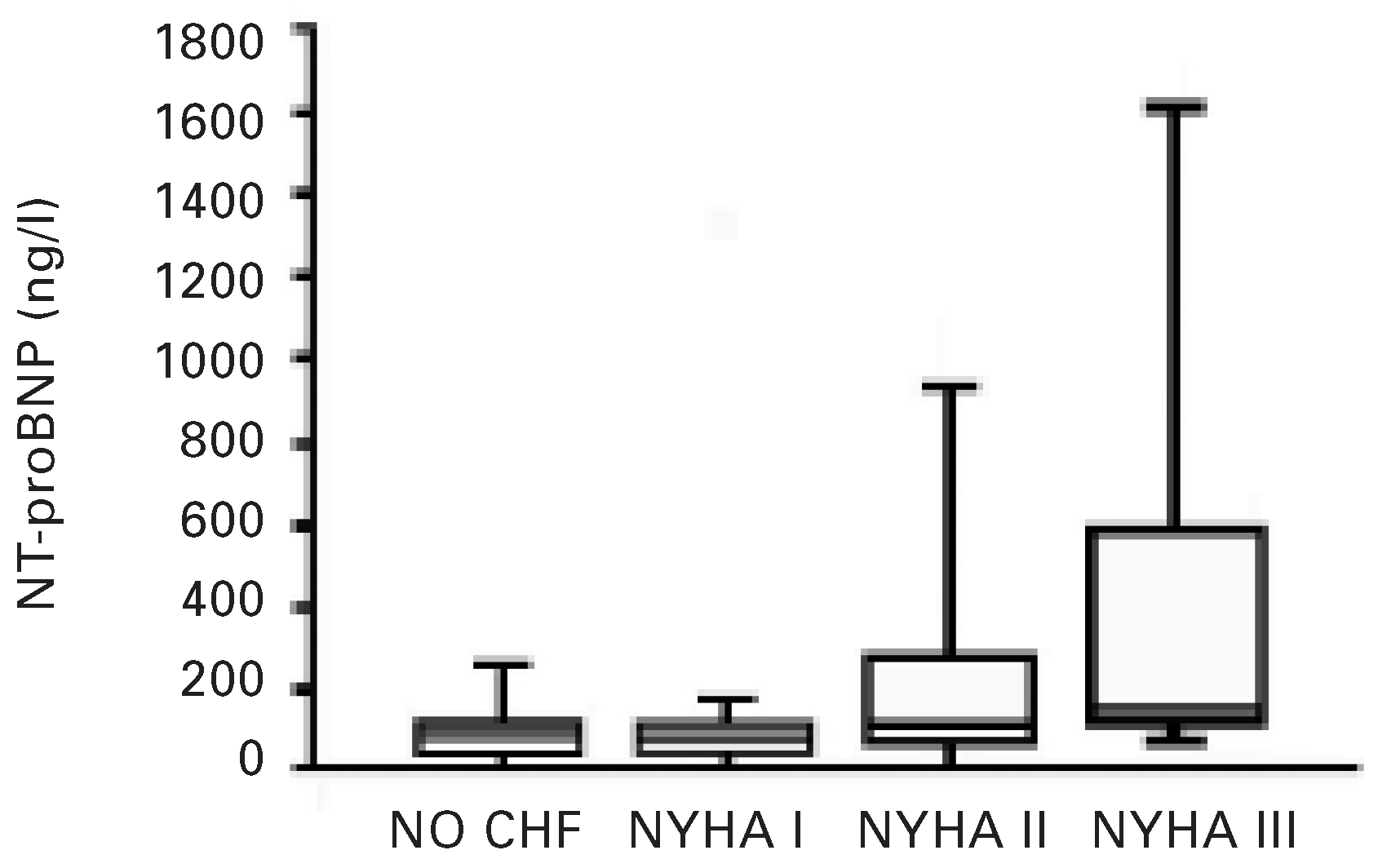
Median NT-proBNP levels increase with increasing NYHA-class: from 78.8 ng/l in subjects without heart failure to 87.1 ng/l in subjects with NYHA-class I, to 121,6 ng/l in subjects with NYHA-class II and to 157.2 ng/l in subjects with NYHA-class III (
Figure 1). Our study group did not include subjects in NYHA class IV. Differences in NT-proBNP levels in NYHA classes were analysed by the Kruskal-Wallis nonparametric test, demonstrating a highly significant association (p = 0.0001) of NT-proBNP with NYHA functional classes. Distribution of NT-proBNP values according to NYHA class are also presented as box plot in
Figure 1.
Vice-versa, logistic regression was used in a multivariate approach in order to combine the clinical variables with NT-proBNP information in the prediction of congestive heart failure. We found that NT-proBNP was an independent predictor of NYHA class II congestive heart failure (p = 0,0273), whereas p values for NYHA classes I and III were not significant.
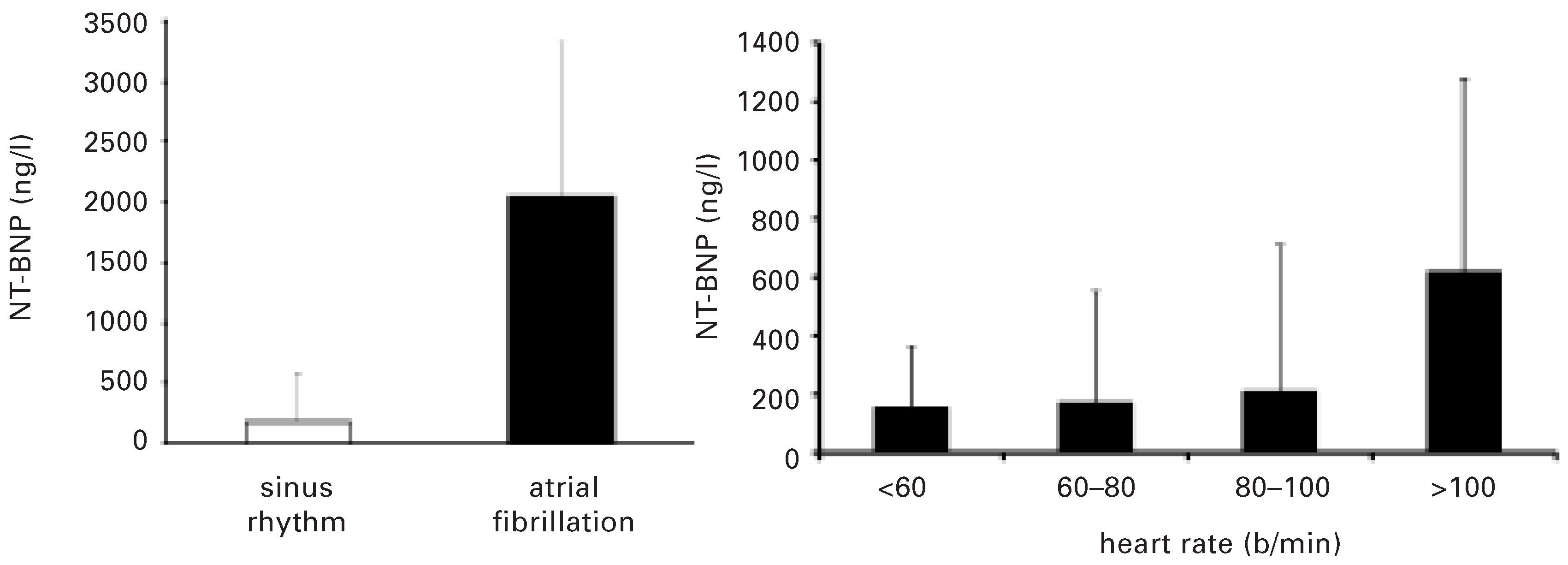
We also performed correlation tests between natural logarithm (ln) of NT-proBNP values and several different clinical parameters. We found significant positive correlations of ln(NT-proBNP) with age (r = 0.479, p <0.0001) and with pulse pressure (r = 0.109, p = 0.0279) and significant inverse correlations with Body Mass Index (BMI) (r = –0.118, p = 0.0149), with maximum exercise level (r = –0.413, p <0.0001), with heart rate at rest (r = –0.188, p = 0.0001;
Figure 2) and with diastolic blood pressure (r = –0.122, p = 0.0137).
In order to eliminate the influence of betablocker therapy on the heart rate, we repeated the linear regression analysis of ln(NT-proBNP) on heart rate in subjects receiving no betablockers (n = 304) and the significant inverse correlation was preserved.
Multiple regression analysis and stepwise forward regression with ln(NT-proBNP) as dependent variable have also been performed in a model including 15 clinical parameters (
Table 3), in order to assess the contribution and, respectively, the importance of each independent variable to the ln(NT-proBNP) value.
NT-proBNP Values and left Ventricular Ejection Fraction (LVEF)
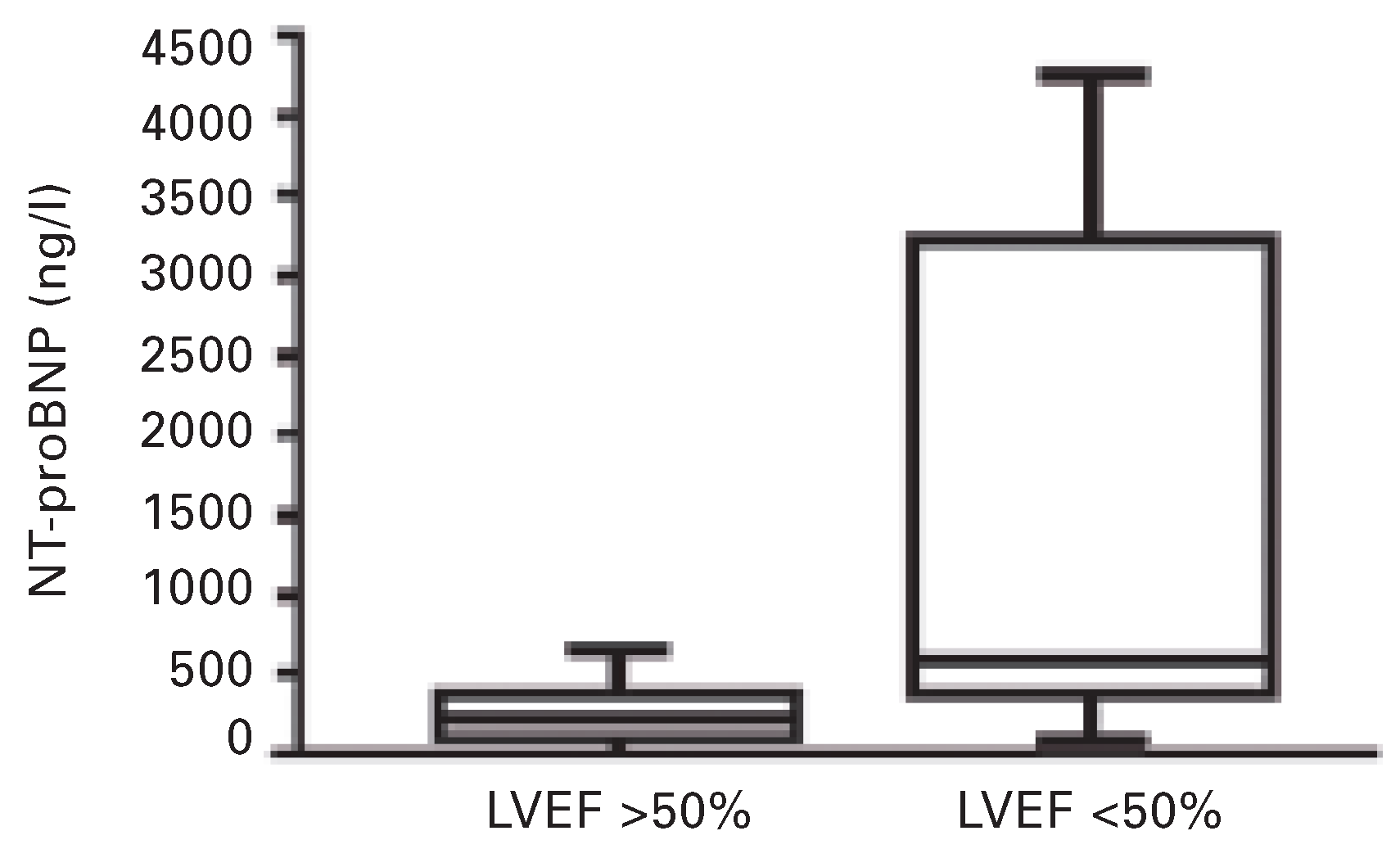
An echocardiographic examination was also performed in a subgroup of 88 subjects. Mean value of LVEF was 55.5 ± 9. LVEF was in the normal range (>50%) in 69 subjects (78.4%). Mann Whitney U test was performed in order to assess the association of NT-proBNP values with left ventricular ejection fraction (LVEF). Higher values of NT-proBNP were associated with lower LVEF (LVEF <50%) (p <0.0001). Distribution of NT-proBNP levels according to LVEF are also presented as box plot in
Figure 3. We also found a significant inverse correlation of ln (NT-proBNP) with LVEF (r = –0.625, p <0.0001).
Discussion
Few studies have examined the determinants of plasma natriuretic peptide levels in a nonselected population including healthy subjects as wells as patients with different cardiovascular diseases. The current study adds to the available information data about the correlation between NT-proBNP and clinical characteristic as well as therapy in a general, nonselected, swiss population. The present study shows that arterial hypertension, atrial fibrillation, higher heart rate, higher Body Mass Index (BMI), higher NYHA class, and lower LVEF were associated with higher level of NT-proBNP in our study population. On the contrary, physical exercise and regular moderate alcohol consume were associated with a lower level of this parameter. Moreover, confirming previous data, age [
2,
8,
9,
10,
11,
12] and female gender [
8,
9,
10,
13] were found to be important determinants of plasma NT-proBNP levels, while we found no association between NT-proBNP and diabetes mellitus and smoking habits. Concerning drug therapy we found that betablockers, ACE-inhibitors and diuretics treatment were significantly associated with NT-proBNP. This last data can be explained because the patients receiving those drugs were more likely to have cardiovascular diseases or a more severe grade of cardiac diseases.
Several studies found that patients with hypertension have slightly or moderately elevated BNP/NT-proBNP plasma levels compared with ageand sex matched volunteers without hypertension [
14]. Recent studies also described a positive correlation of both systolic blood pressure and pulse pressure with NTproBNP [
13,
15] and a negative association of NT-proBNP with diastolic blood pressure has also been reported [
13]. Other similar studies found no correlation of NT-proBNP levels with systolic, diastolic or mean blood pressure [
16]. Our results confirms that arterial hypertension as well as pulse pressure are associated with higher values of NT-proBNP, while a significant inverse correlation exist between NTproBNP and diastolic blood pressure. Hypertension, which is derived mainly from increased systemic vascular resistance and/or expanded intravascular volume, causes a sustained increase in left ventricular afterload that decreases cardiac output or ejection fraction, and therefore leads to an increased NT-proBNP. Data about the inverse correlation of diastolic blood pressure and NT-proBNP is still unclear and remains to be elucidated by further studies.
In our study population subjects with atrial fibrillation had higher levels of NTproBNP than those in sinus rhythm (
Figure 2) confirming previous data indicating that BNP [
17] and NT-proBNP [
18] are increased in atrial fibrillation. Therefore the presence of atrial fibrillation needs to be considered when NT-proBNP values are used for diagnostic purposes.
Moreover, we found heart rate to be an independent predictor of NT-proBNP values. It has been speculated that, at least in the healthy individual, synthesis or secretion of natriuretic peptides may be dependent upon diastolic duration or filling pressure [
12,
15]. This relation could gain in relevance if alterations in the heart rate would result in significant intra-individual fluctuations in plasma natriuretic peptide levels. Because a large body of evidence indicates that a persistent high heart rate is associated with a significant risk for higher mortality and sudden death in individuals with a variety cardiovascular disorders, as well as in the general population more studies are necessary in the next future to evaluate details of this relationship between heart rate and natriuretic peptide.
Like most of the previous reports [
19,
20], we also found a significant inverse correlation of NT-proBNP with BMI. The natriuretic peptide system and adiposity are closely linked. Natriuretic peptide clearance receptors are abundant in adipose tissue, suggesting that adipocytes participate in the removal of natriuretic peptides from the circulation. Since adipose cells express the natriuretic peptide clearance receptor [
19,
21] in obese patients a state of reduced plasma NT-proBNP levels could occur, explaining the increased sodium retention and volume expansion characteristic of obesity-related hypertension [
20].
Clinical informations and measurement of NT-proBNP together, are used in establishing or excluding the diagnosis of congestive heart failure in patients with dyspnoea [
22]. Previous studies demonstrated that NT-proBNP levels correlate well with clinical severity of congestive heart failure expressed by the New York Heart Association (NYHA) classes and are directly related to filling pressure, left ventricular function and exercise performance [
5,
11,
22].
Our study also shows that higher NT-proBNP values are associated with the presence of shortness of breath and increased significantly with increasing NYHA functional class in congestive heart failure subjects. Furthermore, we found that NT-proBNP was an independent predictor of congestive heart failure NYHA class II. Moreover, in the subgroup of subjects who underwent an echocardiographic examination (88 cases), we found that NT-proBNP values are inversely correlated with left ventricular ejection fraction (LVEF) in a moderate fashion. Similar results were also obtained in several previous studies [
5,
10], showing a significant but not strong inverse correlation between plasma NT-proBNP levels and LVEF. Our data suggests that NT-proBNP represents a valuable indicator for left ventricular dysfunction also in a non-selected population.
Guillaume et al. have shown that chronic moderate ethanol consumption delays or even prevents the age-dependent increase in blood pressure and in the same time significantly decreases plasma BNP levels [
23]. In contrast, Kanda et al. demonstrated that alcohol consumption was positively associated with NT-proBNP levels in a general Japanese population [
24]. In our general Swiss cohort regular moderate (8 glasses of wine per week) alcohol consumption was associated with significantly lower NT-proBNP values.
Krüger et al. found that NT-proBNP levels are strongly inversly related to exercise [
25]. The results of our study confirm that higher maximum exercise levels are associated with significantly lower NT-proBNP values.
Study Limitations
We studied only white Caucasian patients and the findings cannot be applied with confidence to ethnic minority groups. Similarly our results can be considered appropriate to the studied population, men and women with mean age of 49 years (range 28–91).
Conclusion
In a non-selected general swiss cohort of 432 subjects several physiological and clinical parameters were found to be significantly related to NT-proBNP levels, the strongest being age, gender, betablocker and ACE-inhibitor therapy. Heart rate, blood pressure, BMI are directly correlated with NT-proBNP level while alcohol consumption and physical exercise showed an inverse correlation.