1. Introduction
Knee osteoarthritis (OA) is a multifactorial disease characterized by articular cartilage degradation, the formation of bone osteophytes, subchondral bone sclerosis, and, in advanced stages, the development of subchondral cysts [
1]. The most common clinical manifestation of knee OA is persistent or intermittent chronic pain lasting more than three months, which typically correlates with the extent of joint destruction [
2,
3].
Pharmacological treatments, such as non-steroidal anti-inflammatory drugs (NSAIDs) [
4], with or without topical compounds (e.g., corticosteroids or hyaluronic acid) [
5,
6,
7], are commonly used but may be associated with adverse drug reactions (ADRs) or drug–drug interactions [
8,
9]. Advances in molecular medicine suggest that targeting specific cellular pathways may modify the course of chronic diseases. In this context, compounds with antioxidant and anti-inflammatory properties hold potential as therapeutic agents for various pathological conditions [
10,
11,
12].
International guidelines suggest that dietary supplements may represent a first-line treatment option for patients with mild to moderate knee OA; however, their safety must be carefully evaluated, particularly in patients receiving multiple medications [
13]. Several nutrients used in knee OA management exhibit anti-inflammatory and antioxidant effects. Among these, chondroitin sulfate and alpha-lipoic acid have been shown to play a significant role in controlling symptoms. Two systematic reviews demonstrated the efficacy of glucosamine and chondroitin compared to active controls and placebo [
14,
15]. Additionally, alpha-lipoic acid has been proposed as a therapeutic agent due to its antioxidant activity [
16].
This pilot study serves as a proof of concept for a fixed combination of chondroitin sulfate, alpha-lipoic acid, astaxanthin, lycopene, escin, and omega-3 fatty acids (including eicosapentaenoic acid (EPA) and docosahexaenoic acid (DHA), aiming to evaluate its effects on symptoms of mild to moderate knee pain in patients with knee OA. Effective symptom reduction may significantly improve knee mobility and overall quality of life in these patients. Therefore, the primary aim of this study was to assess the effect of this new formulation with respect to patients’ self-perceived disease progression and treatment effectiveness.
2. Materials and Methods
2.1. Study Design
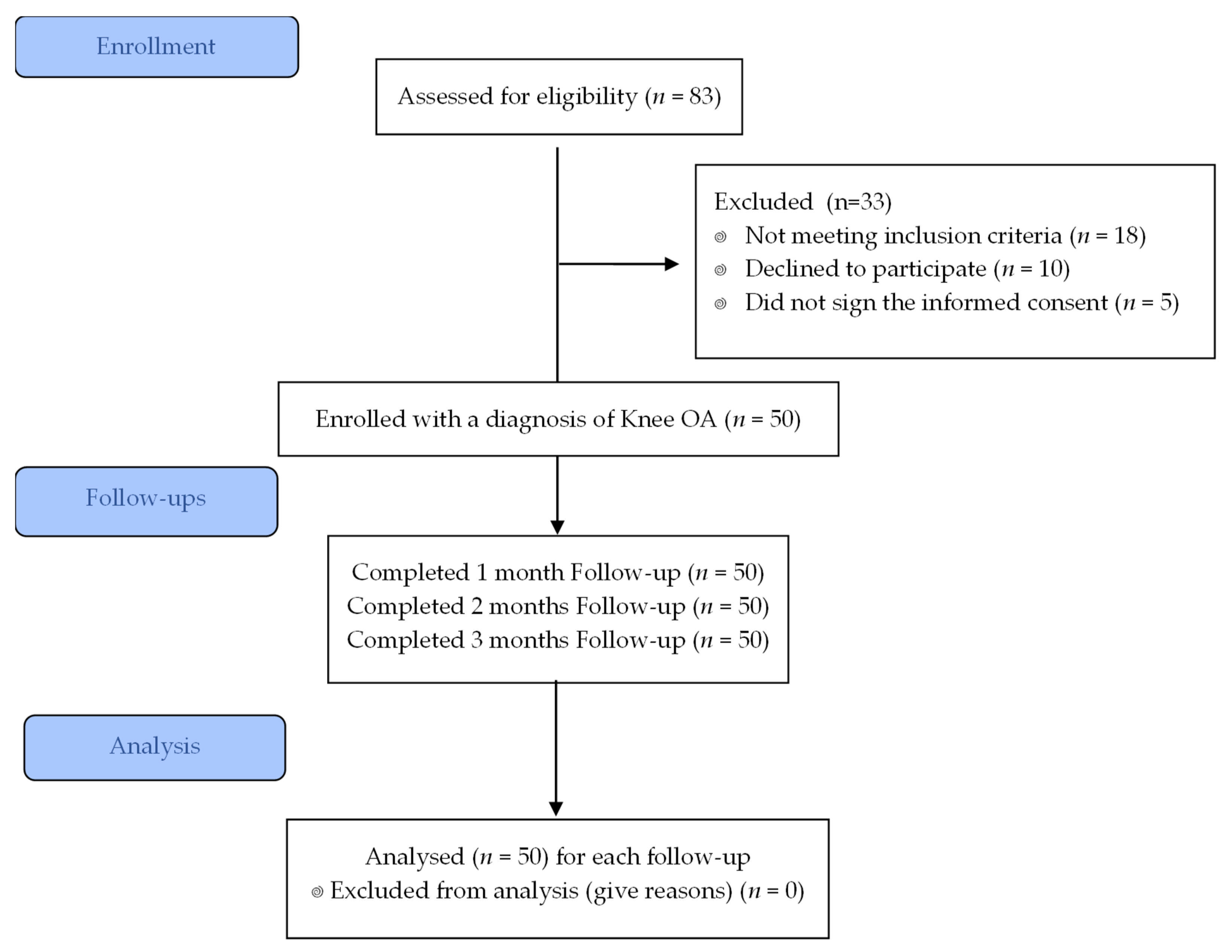
This observational, single-center, open-label study enrolled patients of both sexes diagnosed with knee OA who were referred to the Pain Unit of the Clinical Pharmacology and Pharmacovigilance Department at “R. Dulbecco” University Hospital of Catanzaro from January 2025 to September 2025. During this period, patients received a fixed combination of a new nutraceutical (1 tablet daily for 3 months) supplied by the manufacture Diaco Biofarmaceutici (Trieste, Italy), in addition to their usual therapy. At study initiation, participants were instructed not to change their dietary habits or any medications for comorbidities.
2.2. Ethical Considerations
Each participant was assigned a unique numerical code generated by a physician not involved in the study to ensure privacy. All participants provided written informed consent after being fully informed about the study’s purpose and procedures. The study was conducted in accordance with Good Clinical Practice and the Declaration of Helsinki and complied with Italian privacy regulations. Ethical approval was obtained from the Institutional Ethics Committee (Authorization No. 120/2018; Clinical trial registration: NCT05509075).
2.3. Inclusion and Exclusion Criteria
Age ≥ 18 years, of either sex.
Diagnosis of knee osteoarthritis (OA).
An ability to comply with the study protocol and provision of written informed consent.
Age < 18 years.
Pregnancy or breastfeeding, or women of childbearing potential not using adequate contraception.
Known allergy or hypersensitivity to the study treatment or rescue medications.
Advanced-stage malignancies.
Moderate to severe renal impairment (glomerular filtration rate < 30 mL/min).
Severe hepatic or cardiac dysfunction.
Severe asthma.
History of drug or alcohol abuse.
Any condition or comorbidity that, in the investigator’s judgment, could pose a risk to the participant or interfere with the evaluation of efficacy and safety.
Participation in another clinical trial or receipt of an investigational drug within 30 days before screening.
2.4. Experimental Protocol
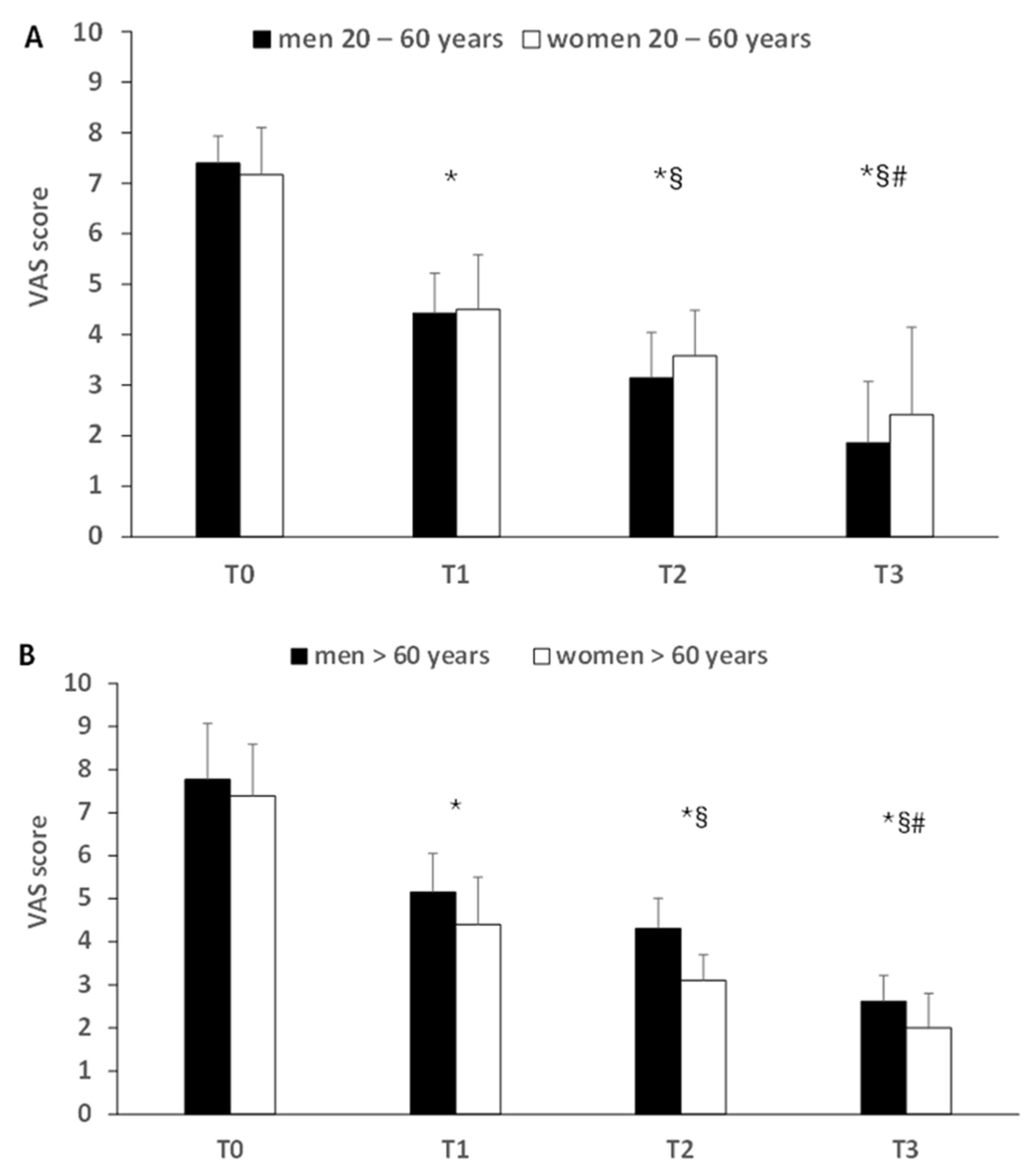
Clinical data were collected at enrollment (T0, prior to treatment initiation) and at 1 month (T1), 2 months (T2), and 3 months (T3, end of the study) after T0. All patients presented with chronic pain and were receiving NSAIDs as needed; therefore, baseline data at T0 served as the control condition.
Questionnaires were administered by the study’s medical staff. Given the open-label design, patient confidentiality was maintained through the assignment of unique numerical codes by a physician not involved in the study. This ensured privacy while enabling accurate data analysis in compliance with ethical research standards.
At enrollment (T0) and during the follow-up period (T1–T3), detailed medical history was collected, physical examinations were performed, and standardized questionnaires were completed. Pain intensity and functional status were assessed using the Visual Analogue Scale (VAS) and the Knee Injury and Osteoarthritis Outcome Score (KOOS). Throughout the study, any systemic or local adverse drug reactions (ADRs) were monitored and evaluated using the Naranjo scale to determine causality.
Treatment adherence was assessed through pill counts in combination with patient self-reporting. Participants were instructed to maintain a daily log of tablet intake, which was reviewed at each follow-up visit to ensure compliance. Specifically, each patient received one bottle containing 30 tablets at T0 and was asked to return the bottle after one month during the follow-up visit, at which time a new bottle was provided following clinical evaluation.
Prior to enrolling in this study, all patients had received systemic treatment with NSAIDs, without achieving any clinical improvement. Consequently, the pretreatment period (T0) was used as the control for comparison with follow-up assessments.
2.4.1. Questionnaires
Validated instruments were employed, consistent with previous studies:
36-Item Short Form Health Survey (SF-36): Assesses health-related quality of life across eight domains. Higher scores indicate better perceived health status, whereas lower scores reflect poorer quality of life [
17,
18].
Zung Self-Rating Anxiety Scale (Zung SAS): A 20-item questionnaire assessing anxiety, categorized as normal, score 0–44; moderate, 45–59; or severe, 60–80 [
19].
Zung Self-Rating Depression Scale (Zung SDS): A 20-item instrument measuring depressive symptoms, classified as normal, score 20–49; mild, 50–59; moderate, 60–69; or severe, 70–80 [
20].
Adverse Drug Reaction Probability Scale (Naranjo Scale): A 10-item tool used to standardize the assessment of ADR causality. Scores classify ADRs as doubtful (≤0), possible (1–4), probable (5–8), or definite (≥9) [
21,
22].
Knee Injury and Osteoarthritis Outcome Score (KOOS): Evaluates knee pain, symptoms (e.g., swelling, range of motion), activities of daily living, sport/recreation function, and knee-related quality of life. Scores range from 0 (extreme problems) to 100 (no problems) [
23].
2.5. Efficacy End Points
The primary endpoint was as follows:
Statistically significant improvement (p < 0.01) in KOOSs at follow-up visits (T1–T3) compared with baseline (T0).
The secondary endpoints included the following:
Statistically significant improvement (p < 0.01) in VAS scores at T1–T3 compared with T0.
Statistically significant improvement (p < 0.01) in overall SF-36 scores at T1–T3 compared with T0.
Statistically significant changes (p < 0.01) in mood disorder scores (Zung SAS and SDS) between T1–T3 and T0.
2.6. Safety End-Points
ADRs related to the nutraceutical were recorded using the Naranjo scale. ADRs leading to withdrawal were documented.
2.7. Nutraceutical Formulation
Each tablet containing a fixed combination of chondroitin sulfate, α-lipoic acid, astaxanthin, lycopene, escin, omega-3 fatty acids, eicosapentaenoic acid (EPA), and docosahexaenoic acid (DHA) was supplied by Diaco Biofarmaceutici, (Trieste, Italy) (
Table 1).
2.8. Statistical Analysis
Continuous variables with a Gaussian distribution were described as the mean ± standard deviation (SD), whereas categorical variables were summarized as counts and percentages. The normality of continuous variables was assessed using the Shapiro–Wilk test. Comparisons of continuous variables were performed using Student’s t-test or one-way analysis of variance (ANOVA), as appropriate. Categorical variables were compared using the chi-square test or Fisher’s test according to cell count.
Multivariate analyses were adjusted for potential confounders, including age, sex, smoking status, alcohol consumption, physical activity, educational level, body mass index (BMI), comorbidities, and concomitant drug use. Correlations between continuous variables were assessed using Pearson’s correlation coefficient.
For repeated measures, the nonparametric Friedman test was used, followed by post hoc pairwise comparisons with the Wilcoxon signed-rank test. Data are presented as the mean ± SD unless otherwise specified. Tests were performed according to variables normal distribution or skewness. Statistical significance was set at p < 0.01 (applying Bonferroni’s correction due to the high number of tests performed). All analyses were conducted using SPSS software, version 22.0 (IBM Corp., Armonk, NY, USA).
Because no prior data were available for this novel compound, a formal power calculation could not be performed; therefore, this investigation was designed as a pilot study.
4. Discussion
In this study, we evaluated the safety and efficacy of a fixed nutraceutical combination in patients with knee OA. Our findings demonstrate that a three-month daily administration of this combination resulted in significant improvements in pain, physical function, and quality of life, without any reported adverse drug reactions.
Knee OA is a chronic, multifactorial disease with limited pharmacological treatment options, which aim to control symptoms rather than modify disease progression. Conventional therapies, including NSAIDs, acetaminophen, and opioids, are often associated with adverse effects, particularly in older adults or individuals with comorbidities, and may be insufficient for sustained symptom relief [
13,
25,
26,
27].
Over the past decade, nutraceutical supplementation for OA management has attracted increasing attention due to its potential to alleviate pain, inflammation, oxidative stress, and joint discomfort, while also supporting cartilage metabolism [
28].
Recently, in a randomized, double-blind, placebo-controlled trial involving 139 participants with knee OA, Thanawala and colleagues demonstrated that a three-month treatment with curcumin reduced inflammation and improved pain (VAS and KOOS), functional status, and quality of life [
29].
In our study, a three-month treatment with a fixed combination of chondroitin sulfate, α-lipoic acid, astaxanthin, lycopene, escin, omega-3 fatty acids (EPA and DHA) significantly improved OA symptoms in patients previously treated with NSAIDs. This suggests potential synergistic effects of the nutraceutical blend, targeting multiple pathogenic mechanisms implicated in OA [
30,
31,
32,
33,
34,
35,
36]. Each component exhibits anti-inflammatory and/or antioxidant activity (e.g., α-lipoic acid, lycopene, astaxanthin) [
37,
38,
39]; omega-3 fatty acids modulate inflammatory pathways and support cartilage repair [
40], while escin demonstrates glucocorticoid-like anti-inflammatory activity through hyaluronidase inhibition and NF-κB modulation [
41,
42].
Experimental and clinical data therefore support the biological plausibility of this formulation.
Animal studies indicate that lycopene attenuates IL-1β-induced chondrocyte inflammation by inhibiting NF-κB signaling [
37], while clinical evidence suggests that omega-3 supplementation reduces pain and improves function in OA [
38]. Although lycopene is not commonly prescribed in OA, it may contribute to symptom improvement via COX-2, Nrf-2, and nitric oxide pathway modulation [
43], and lower serum lycopene levels have been associated with greater OA severity [
44].
Consistent with this, a cross-sectional study using National Health and Nutrition Examination Survey data demonstrated a relationship between serum carotenoids and osteoarthritis or degenerative arthritis [
45].
Escin, widely used in blunt trauma, exhibits strong anti-inflammatory activity mediated through glucocorticoid receptors and NF-κB modulation [
41]. However, the anti-inflammatory action of escin in osteoarthritis has been observed only in experimental models. Other authors reported that escin reduced inflammatory cytokine levels and inhibited both COX-2 and NO pathways in experimental models of osteoarthritis [
46].
Astaxanthin may confer additional clinical benefits in patients undergoing polypharmacy through hepatoprotective properties, which are particularly relevant in elderly populations. Astaxanthin exerts multiple mechanisms of action that may improve osteoarthritis symptoms and inflammation, including modulation of Nrf-2, NF-κB, and MAPK pathways. Furthermore, it inhibits ferroptosis and promotes mitochondrial protection. Its action on metalloproteinases may also contribute to the overall therapeutic effect [
39]. A clinical trial by Hill et al. [
47] demonstrated improved clinical scores in 75 patients treated with a formulation containing krill oil, astaxanthin, and oral hyaluronic acid, without increase in adverse events.
Similar findings were reported by Stonehouse and colleagues in a large trial involving 235 OA patients supplemented with krill oil containing astaxanthin and omega-3 fatty acids, which showed statistically significant improvements in pain and physical function [
48].
Dietary supplements, including glucosamine and chondroitin, have demonstrated clinical benefits in OA patients [
14,
15].
Wilson et al. [
49] reported that glucosamine and chondroitin are safe therapeutic options for patients with OA; however, careful evaluation of their symptomatic efficacy remains necessary.
Consistent with this, Fladerer-Grollitsch et al. [
50] found that a 12-week treatment with a fixed combination containing collagen type II, glucosamine hydrochloride, and chondroitin sulfate improved function and quality of life in patients with mild to moderate knee pain.
In agreement with these data, our formulation produced time-dependent improvements in pain, KOOSs, and quality of life. Moreover, using the Zung depression and anxiety questionnaires, we observed reductions in mood symptoms, suggesting an indirect relationship between pain reduction and psychological well-being. A recent systematic review and meta-analysis by Panigrahi et al. [
51] highlighted that depression and elevated pain levels contribute substantially to sleep disturbances in knee OA.
Finally, Aghamohammadi et al. [
52], reviewing literature data, reported that nutraceuticals, when combined with symptomatic treatments (NSAIDs, COX-2 inhibitors, and analgesics), can improve pain and physical function in knee OA patients. The greatest benefits were seen with 10–20 months of supplementation, especially in those with mild to severe OA.
Importantly, our three-month regimen improved mild-to-moderate symptoms without adverse drug reactions, despite concomitant medications for comorbid conditions. This favorable safety profile was reinforced by monthly monitoring and the use of the Naranjo scale.
Omega-3 fatty acids are generally associated with cardiovascular benefit and anti-inflammatory effects, although higher doses have been linked to increased atrial fibrillation risk [
53,
54,
55].
Escin, astaxanthin, and omega-3 fatty acids may also increase bleeding risk, particularly in patients receiving antiplatelet or anticoagulant therapy, underscoring the need for vigilance and further investigation [
56,
57,
58].
From a clinical standpoint, these findings suggest that a fixed nutraceutical combination targeting multiple pathophysiologic pathways may provide meaningful symptomatic benefit in patients with knee OA, particularly those with persistent discomfort despite conventional therapy or those at increased risk of NSAID-related adverse events. The early onset of improvement, coupled with sustained benefit over three months and the absence of reported adverse drug reactions, supports its potential role as an adjunctive treatment rather than a replacement for standard care.
Importantly, the favorable tolerability profile observed in patients with polypharmacy is clinically relevant, given that multimorbidity is common among individuals with OA. The observed improvements in mood and quality of life underscore the broader impact of pain modulation on psychological well-being, highlighting the value of therapeutic strategies that address both symptom burden and patient-reported outcomes.
In practice, such a nutraceutical strategy may be considered for patients seeking conservative, non-pharmacologic options, for those requiring NSAID dose minimization, or as part of a multimodal management plan that includes exercise, weight optimization, and physical therapy. However, clinicians should remain attentive to potential bleeding risks and drug–supplement interactions, particularly in individuals receiving antiplatelet or anticoagulant therapy.
Ultimately, integrating this formulation into clinical care should be guided by individualized risk–benefit assessment and by the recognition that robust, randomized, placebo-controlled data are still needed to define optimal patient selection, dosing duration, and comparative effectiveness versus other adjunctive interventions.
Despite encouraging results, several limitations must be acknowledged. First, the sample size was relatively small, and the observational, open-label design may introduce bias. Second, the absence of placebo control limits causal inference. Third, follow-up was restricted to three months; therefore, long-term efficacy and safety remain uncertain. Fourth, biological markers such as C-reactive protein and cytokines were not measured, limiting mechanistic interpretation. Future randomized, placebo-controlled trials with larger cohorts, extended follow-up, and biomarker assessments are warranted to confirm these findings and further elucidate mechanisms.




 ,
,