1. Introduction
Hypertension is one of the leading global risk factors for cardiovascular disease and premature mortality [
1,
2]. Despite the availability of effective treatments, control rates remain suboptimal in many low- and middle-income settings, particularly within disadvantaged communities where socioeconomic constraints and health system limitations complicate chronic disease management [
3,
4,
5]. Rural populations often face barriers, including long travel distances to clinics, limited financial resources, and inconsistent access to medications and follow-up care [
6,
7,
8]. In many contexts, public health interventions have focused primarily on increasing awareness of hypertension and promoting lifestyle modification. However, growing evidence suggests that awareness alone is insufficient to ensure sustained behavioural change [
9,
10]. Patients may possess adequate knowledge of hypertension but struggle to translate this knowledge into consistent practices such as dietary modification, physical activity, and medication adherence [
11,
12]. This phenomenon, often referred to as the knowledge–practice gap, highlights the importance of understanding how structural and relational factors influence chronic disease management.
Hypertension is a significant and growing public health burden in South Africa and across Sub-Saharan Africa. According to recent estimates, roughly 30–45% of individuals in South Africa suffer from hypertension, with prevalence increasing dramatically with age and disproportionately affecting socioeconomically disadvantaged populations. Despite this significant burden, awareness, treatment, and control rates remain low, resulting in a huge number of people with uncontrolled blood pressure [
3,
4].
Hypertension is a major cause of cardiovascular problems, such as stroke, myocardial infarction, heart failure, and chronic renal disease. Cardiovascular illnesses are a major cause of non-communicable disease morbidity and mortality in South Africa, with hypertension highlighted as a major modifiable risk factor. Stroke, in particular, remains one of the leading causes of mortality and disability, with high blood pressure accounting for a large proportion of occurrences [
2].
The burden is similar in Sub-Saharan Africa, where hypertension prevalence is increasing at one of the fastest rates globally. More than 80% of people with hypertension live in low- and middle-income countries, especially Sub-Saharan Africa, where health-care system restrictions and socioeconomic inequities make effective disease control difficult [
5]. As a result, hypertension contributes considerably to premature morbidity and mortality, with cardiovascular illnesses accounting for a growing share of deaths in the area. In South Africa, hypertension-related consequences contribute significantly to morbidity and mortality, with poor blood pressure control linked to more hospitalisations, a lower quality of life, and early death [
4]. These findings highlight the critical need for stronger primary health care systems, better preventative efforts, and context-specific treatments that target both clinical management and the broader structural drivers of hypertension.
Rural and low-income neighborhoods face a variety of interconnected structural impediments that have a direct impact on hypertension management and serve as the foundation for this study’s measured predictors. Socioeconomic restrictions, notably low household income, impede people’s capacity to pay for transportation, access healthcare services, and follow suggested dietary practices, weakening continuity of care. Evidence suggests that financial constraints and a lack of insurance coverage are significant barriers to getting chronic disease care in low-resource settings [
13,
14]. Geographic limitations, such as significant distances to health facilities and insufficient transportation infrastructure, further limit access to routine follow-up and medication refills, sometimes deterring timely care-seeking behavior [
15].
At the household level, conflicting activities such as caregiving and domestic duties may restrict time available for clinic attendance and treatment adherence, especially in resource-constrained contexts where individuals prioritise household requirements above personal health. Environmental and food system constraints in rural areas also limit access to healthy and inexpensive nutritional options, which contribute to poor adherence to lifestyle guidelines [
16]. Health system problems such as inadequate healthcare infrastructure, workforce shortages, prolonged wait times, and uneven availability of medication and diagnostic services all contribute to poor continuity and quality of care [
14,
17]. Furthermore, these structural and systemic disadvantages are not only contextual barriers but also crucial variables in this study, such as household income, distance to clinic, carer position, health-care system access, and lifestyle choices. This alignment reflects a systems-oriented understanding of hypertension management, in which individual behaviours are shaped by broader socioeconomic, environmental, and health system determinants, particularly in rural and low- and middle-income settings where the burden of hypertension continues to rise [
18].
Recent health systems research has emphasized the importance of community-engaged approaches to health promotion, particularly in settings characterized by socioeconomic disadvantage [
19,
20,
21]. Community engagement involves collaborative partnerships between communities, health workers, and institutions to co-produce knowledge and develop locally relevant solutions to health challenges [
22]. Such approaches align with broader frameworks of primary health care strengthening and participatory health promotion [
23]. Within the African context, community engagement in health systems is often grounded in the philosophy of Ubuntu, which emphasizes relational interdependence and collective responsibility for wellbeing [
24]. The Ubuntu ethic
umuntu ngumuntu ngabantu (“a person is a person through others”) recognizes that health behaviours are shaped not only by individual choices but also by social relationships, community networks, and institutional structures [
25]. Similarly, the concept of the reparative university highlights the responsibility of universities to engage collaboratively with communities in addressing social and health inequalities through participatory research and knowledge co-production [
26,
27,
28]. Addressing hypertension in low-resource settings requires integrated approaches that combine behavioural, structural, and health system interventions.
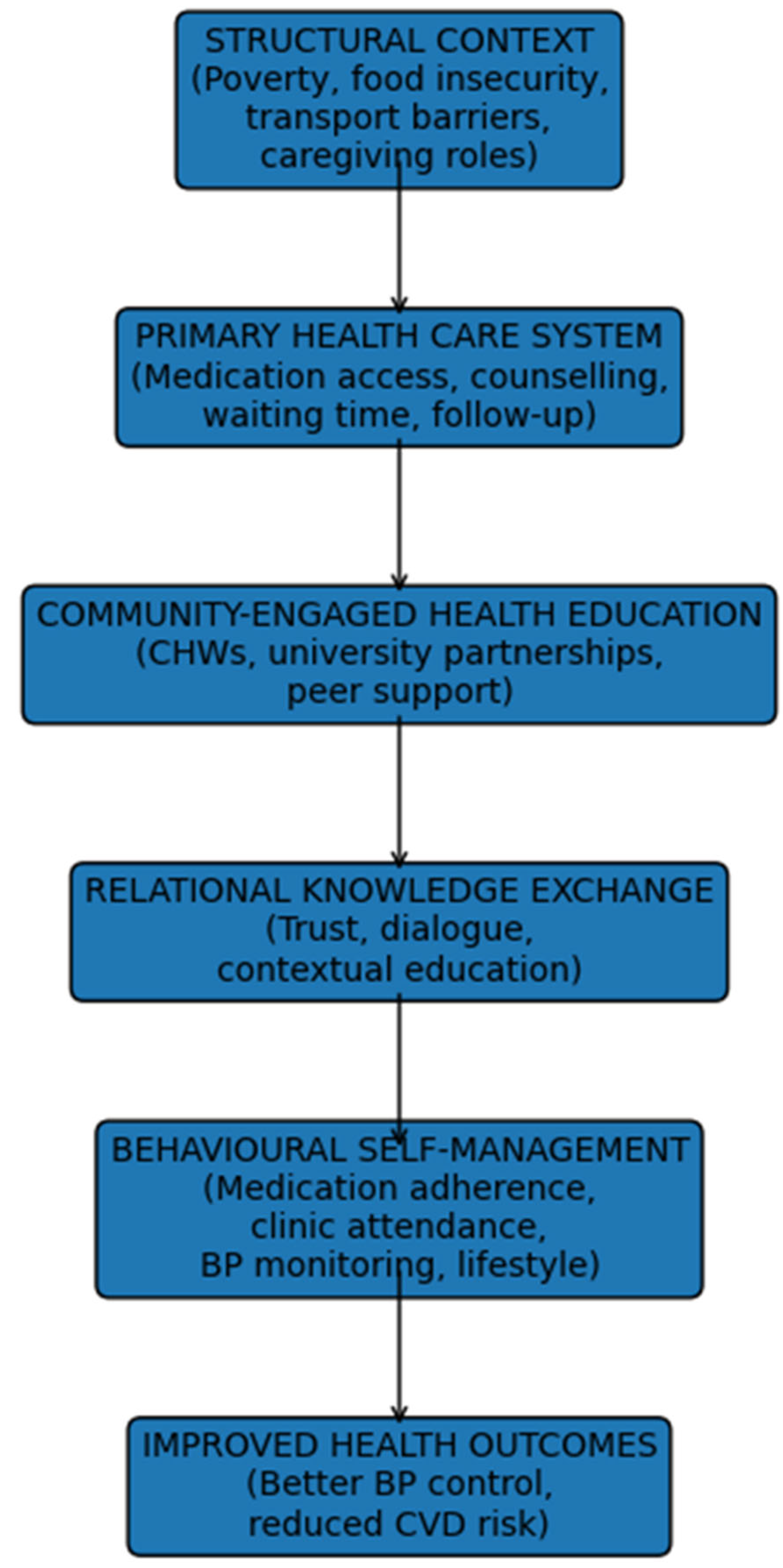
This study examined barriers to hypertension management in disadvantaged communities while exploring the potential role of community-engaged health education in strengthening lifestyle practices and patient self-management. Specifically, the study aimed to identify socioeconomic and health system barriers associated with hypertension care, assess knowledge, attitudes, and practices related to hypertension treatment and lifestyle modification, evaluate predictors of hypertension self-management using multivariable statistical models, and develop a community-engaged conceptual framework to inform improved hypertension education and self-management within rural primary health care systems.
2. Materials and Methods
2.1. Study Design
A prospective cross-sectional descriptive study was conducted to investigate barriers to hypertension management in disadvantaged communities served by public primary healthcare facilities. Primary data were collected directly from participants using structured, self-administered questionnaires.
2.2. Study Population
The study included 107 adults diagnosed with hypertension who were receiving care through public primary health care services. Participants were recruited through community-based health engagement activities linked to primary health care clinics. Individuals aged 18 and older with a verified diagnosis of hypertension and active participation or linkage to care at participating primary health care clinics were eligible to participate.
Individuals who were unable to provide informed consent, had insufficient clinical or questionnaire data, or were not already receiving hypertension care at the time of data collection were excluded.
A non-probability convenience sampling method was utilised. Participants were recruited through community-based health engagement events and routine clinic visits, during which eligible persons were encouraged to participate in the study. This strategy was acceptable given the exploratory character of the study and the emphasis on obtaining information from people who are actively involved in primary health care services.
2.3. Variable Definitions and Operationalization
All variables (
Table 1) included in the analysis were derived from structured questionnaire items and categorized based on study objectives. Variables were defined, operationalized, and classified according to their role in the analysis as either dependent (outcome) or independent (predictor) variables.
2.4. Data Collection and Sample Size Calculation
Data were collected prospectively from adult patients attending the clinic during the study period using a structured questionnaire covering five key domains: socio-demographic characteristics, health system access and service delivery, medication adherence and clinic attendance, lifestyle practices, and knowledge and attitudes regarding hypertension. A sample size (n) of the study population will be calculated taking into account the following aspects:
Unkown proportion: P = 50%
Confidence level: 95%
e: The maximum error admitted by the researcher: e = 10%
n = (Z_∝2 × P (100 − P))/e2
n = ([(1.96)]2 × 50 (100 − 50))/100 = (3.84 × 2500)/100 = 96
All dimensional measurements were standardized and are reported using SI units, with units specified for each dimension (e.g., m × m for area and m × m for volume).
This sample size of 96 patients with hypertension is representative of the study population. To accommodate errors and confounding effects, 10% was added and rounded off to 106, with a minimum of 10% less calculated to be 86.
2.5. Ethical Consideration
This study was conducted in accordance with the principles of the Declaration of Helsinki. Ethical approval was obtained from the Walter Sisulu University Human Research Ethics Committee (HREC) (Protocol No.: WSU.HREC 150/2025), and permission to conduct the study was granted by the Eastern Cape Department of Health (Ref: EC_202510_023).
Written informed consent was obtained from all participants prior to data collection. The study involved direct participant engagement through prospective data collection, and no retrospective patient records were used.
Participants were assured of their right to withdraw from the study at any time without any consequences to their access to healthcare services. Confidentiality and anonymity were strictly maintained throughout the study. No personally identifiable information was collected, and all data were securely stored and accessible only to the research team. Data were analysed and reported in aggregate form to ensure that individual participants could not be identified.
2.6. Statistical Analysis
Data were analysed using IBM SPSS version 29. Chi-square tests were used to assess associations between categorical variables. Logistic regression analysis was performed to identify predictors of missed clinic appointments. Prior to conducting logistic regression analyses, key model assumptions were assessed. Multicollinearity among independent variables was evaluated using variance inflation factors (VIF), with no evidence of significant multicollinearity observed. The independence of observations was ensured by the study design. Model fit was assessed using the Hosmer–Lemeshow goodness-of-fit test. Additionally, confidence intervals were examined to assess the precision of estimates. All assumptions were considered adequately met. Multivariable logistic regression models were subsequently constructed to identify predictors of missed clinic appointments, examine factors associated with adherence to a hypertension-specific diet, evaluate the knowledge–practice gap in lifestyle adherence, and model integrated hypertension self-management behaviours. Effect sizes were reported as odds ratios (OR) with 95% confidence intervals (CI). Model performance and goodness-of-fit were assessed using likelihood ratio tests and pseudo-R2 statistics.
Two additional multivariable logistic regression models were fitted to strengthen analytical inference. First, a knowledge–practice gap model evaluated whether knowledge that hypertension can be managed through lifestyle modification predicted a composite lifestyle adherence outcome (dietary modification, regular physical activity, and salt monitoring). Second, an integrated self-management model predicted a composite optimal hypertension self-management outcome incorporating medication-taking behavior, clinic attendance, blood pressure monitoring, and lifestyle adherence. Effect sizes are reported as odds ratios (OR) with 95% CI. Monetary values were converted from South African Rand (ZAR) to United States Dollars (USD) using an average exchange rate to facilitate international interpretation.
Although bivariate associations assessed using chi-square tests did not demonstrate statistically significant relationships for some variables, multivariable logistic regression analyses were conducted to account for potential confounding and to examine the independent effects of multiple predictors on hypertension management outcomes. This approach allows for a more comprehensive assessment of relationships within complex health systems, where interactions between variables may not be evident in unadjusted analyses.
3. Results
3.1. Participant Characteristics
A total of 107 participants were included in the analysis (
Table 2). The sample was predominantly female (75.7%, n = 81), with males accounting for 24.3% (n = 26). Nearly half of respondents were employed (48.6%, n = 52), while 32.7% (n = 35) were unemployed and 17.8% (n = 19) self-employed. Household income varied, although a substantial proportion reported low income: 22.4% (n = 24) earned < R1 000 per month, and 16.8% (n = 18) earned R1 000–R2 999. Physical access to care was constrained for many respondents, with 46.7% (n = 50) living ≥5 km from the nearest clinic.
3.2. Socioeconomic, Cultural, and Systemic Barriers to Hypertension Management Socioeconomic Barriers
Economic constraints were frequently reported. More than one-third of participants were either unemployed or self-employed in low-income contexts (50.5%, n = 54), limiting their ability to afford transport, nutritious food, and time for clinic attendance. Low household income (<R3 000/month) was reported by 39.3% (n = 42) of participants.
While few respondents reported explicit cultural or religious barriers to clinic attendance, household roles and caregiving responsibilities were common. 38.3% (n = 41) identified as primary caregivers, reporting that caregiving duties often interfered with medication routines and clinic visits.
3.3. Systemic Barriers
System-level challenges were prominent. Many participants reported long waiting times, medication stock-outs, and infrequent blood pressure monitoring during clinic visits. These systemic constraints contributed to treatment interruptions and delayed follow-up, even among participants motivated to adhere to care.
Table 3 briefly highlights the contrast between high awareness/trust and lower lifestyle adherence, reinforcing the knowledge–practice gap described in the text.
Table 4A,B highlights a clear knowledge–practice gap, where high levels of awareness and positive attitudes toward hypertension management do not consistently translate into sustained lifestyle modification. Most participants reported having heard of hypertension (86.9%, n = 93) and understood its long-term health implications. A large proportion also recognized that hypertension could be managed through lifestyle modification (79.4%, n = 85), although 17.8% (n = 19) remained uncertain, indicating some gaps in health education. Attitudes toward treatment were largely positive, with nearly all participants expressing trust in clinic treatment recommendations (91.6%, n = 98), reflecting strong confidence in primary health care services despite reported system constraints.
In contrast, self-reported practices revealed notable challenges in maintaining recommended lifestyle behaviors. While the majority of participants reported not missing clinic appointments (87.9%, n = 94), 12.1% (n = 13) had missed at least one appointment in the preceding six months. Regular physical activity was reported by 69.2% (n = 74) of respondents; however, adherence to dietary recommendations was considerably lower, with fewer than half (45.8%, n = 49) following a low-salt or hypertension-specific diet. Additionally, 18.7% (n = 20) reported being unaware of appropriate dietary modifications.
To further examine structural influences on care continuity, a multivariable logistic regression model was conducted to evaluate whether socioeconomic and household factors were associated with missed clinic appointments among individuals receiving hypertension care (N = 107). The predictors included low household income (<R3 000), distance to the clinic (≥5 km), and primary caregiver status. Participants with low household income showed higher odds of missing clinic appointments compared with higher-income participants with low household income showed higher odds of missing clinic appointments compared with higher-income participants (OR = 0.22, 95% CI: 0.05–1.09, p = 0.064); however, this association did not reach statistical significance and should be interpreted cautiously. Distance to the nearest clinic was also not significantly associated with missed appointments (OR = 0.54, 95% CI: 0.14–1.99, p = 0.350). Similarly, participants who identified as primary caregivers demonstrated higher likelihood of missing clinic visits compared with non-caregivers, though the association was not statistically significant (OR = 0.36, 95% CI: 0.10–1.33, p = 0.125).
Overall, the model explained a modest proportion of the variance in clinic attendance (Pseudo R2 = 0.07), suggesting that continuity of hypertension care in disadvantaged communities is influenced by a broader set of structural, behavioral, and health system factors beyond those included in the model.
Although chi-square analyses did not show statistically significant associations between structural variables and missed clinic attendance, these variables were included in multivariable models based on theoretical relevance and prior evidence. The regression analysis was therefore conducted to explore adjusted relationships and should be interpreted with caution, particularly where statistical significance was not achieved. These estimates should be interpreted with caution due to the relatively small sample size and the presence of wide confidence intervals, which may indicate reduced precision and potential model instability.
Chi-square analyses in
Table 5 were conducted to explore associations between selected structural determinants and missed clinic appointments. No statistically significant association was observed between household income and missed clinic appointments (χ
2 = 4.48,
p = 0.345). Similarly, distance to the nearest clinic was not significantly associated with missed appointments (χ
2 = 2.68,
p = 0.261). Although these associations were not statistically significant, descriptive patterns suggested that participants residing farther from health facilities and those with lower income reported slightly higher proportions of missed appointments.
A multivariable logistic regression analysis in
Table 6 was conducted to identify structural predictors of missed clinic appointments. The overall model demonstrated modest explanatory power (pseudo R
2 = 0.07) and approached statistical significance (
p = 0.052). Participants with low household income (<R3 000/month) showed a higher likelihood of missing clinic appointments compared with higher-income participants (β = −1.48,
p = 0.066), although this association did not reach conventional levels of statistical significance. Distance from the clinic (≥5 km) was not significantly associated with missed appointments (β = −0.87,
p = 0.179).
3.4. Knowledge, Attitudes, and Practices Regarding Hypertension
Overall, the findings demonstrate a clear knowledge–practice gap, where high levels of awareness and generally positive attitudes toward treatment do not consistently translate into sustained lifestyle modification. Most participants had heard of hypertension (86.9%, n = 93) and recognized it as a chronic condition requiring ongoing management. A substantial proportion understood that hypertension can be controlled through both medication and lifestyle modification (79.4%, n = 85). However, 17.8% (n = 19) remained uncertain about lifestyle management, indicating residual gaps in health education. Attitudes toward treatment were largely positive. Nearly all respondents expressed trust in clinic treatment recommendations (91.6%, n = 98) and reported willingness to take prescribed medication. Nevertheless, frustrations related to health service challenges such as long waiting times and medication availability occasionally undermined confidence in long-term disease control.
Despite adequate knowledge and favorable attitudes, reported practices were often suboptimal. While most participants indicated that they had not missed clinic appointments (87.9%, n = 94), 12.1% (n = 13) reported missing at least one appointment in the previous six months. Regular physical activity was reported by 69.2% (n = 74), but adherence to dietary recommendations was considerably lower, with only 45.8% (n = 49) following a low-salt or hypertension-specific diet. Additionally, 18.7% (n = 20) reported being unaware of appropriate dietary modifications. Financial constraints and environmental barriers, including limited access to healthier food options and safe opportunities for physical activity, further constrained lifestyle practices.
Table 7 briefly describes the knowledge,, attitudes, and practices regarding hypertension.
3.5. Logistic Regression Analysis
A multivariable logistic regression analysis (
Table 8) was conducted to examine factors associated with adherence to a hypertension-specific diet (low-salt or recommended dietary modification). Predictor variables included knowledge that hypertension can be managed with lifestyle changes, trust in clinic treatment recommendations, receipt of health worker advice on blood pressure control, and engagement in regular physical activity. Receiving advice from a health worker was strongly associated with adherence to a hypertension diet (OR = 6.36, 95% CI: 2.10–19.28,
p = 0.001). Participants who engaged in regular physical activity were more likely to follow a recommended diet (OR = 2.79, 95% CI: 0.85–9.11,
p = 0.089), although the association did not reach statistical significance. Trust in clinic treatment recommendations was also positively associated with dietary adherence (OR = 7.25, 95% CI: 0.69–75.87,
p = 0.098). Knowledge that hypertension can be managed through lifestyle modification was not significantly associated with diet adherence (OR = 0.58, 95% CI: 0.03–10.83,
p = 0.712).
3.6. Knowledge–Practice Gap Model
The analysis in
Table 9 tested whether knowledge that hypertension can be managed with lifestyle change translated into actual lifestyle practice. The outcome was a composite lifestyle adherence index (following a hypertension diet + engaging in regular physical activity + monitoring salt intake). Predictors included knowledge, receipt of health worker advice, and key structural barriers. In the adjusted model, receiving advice from a health worker was independently associated with higher odds of lifestyle adherence (OR = 4.24, 95% CI: 1.51–11.86,
p = 0.006). Knowledge alone was not significantly associated with lifestyle adherence after adjustment (OR = 2.27, 95% CI: 0.61–8.45,
p = 0.221), supporting a measurable knowledge–practice gap. Living ≥5 km from the clinic was associated with lower odds of lifestyle adherence (OR = 0.37, 95% CI: 0.15–0.94,
p = 0.036).
3.7. Integrated Multivariable Model Predicting Hypertension Self-Management
An integrated logistic regression model in
Table 10 was constructed to predict optimal hypertension self-management. The outcome combined four essential self-management behaviors: (i) not reporting ‘never’ taking medication, (ii) not missing clinic appointments in the last six months, (iii) any blood pressure monitoring (excluding ‘not often’/‘not sure’), and (iv) lifestyle adherence (diet + physical activity + salt monitoring). Predictors included knowledge and counselling variables, structural barriers, and selected health system service delivery indicators. Receiving advice from a health worker remained the strongest independent predictor of optimal self-management (OR = 12.46, 95% CI: 1.38–112.07,
p = 0.024). Knowledge of lifestyle management showed a positive but borderline association (OR = 9.27, 95% CI: 0.81–106.29,
p = 0.074). Caregiving responsibilities and perceived reasonable waiting times also demonstrated borderline positive associations with self-management (caregiver OR = 3.39,
p = 0.068; waiting time reasonable OR = 3.28,
p = 0.064). Other structural and medicine access indicators did not show statistically significant associations in this sample.
5. Conclusions
This study achieved its aim of identifying key socioeconomic and health system barriers to hypertension care, while also assessing knowledge, attitudes, and practices related to treatment adherence and lifestyle modification in a rural primary healthcare setting. The findings highlight that, despite relatively high levels of awareness, significant gaps persist between knowledge and effective self-management practices, driven by structural constraints such as financial limitations, healthcare access challenges, and inconsistent follow-up.
Multivariable analysis further demonstrated that these factors, although not always statistically significant, show consistent directional influence on hypertension self-management, underscoring the complexity of care within resource-limited settings. Importantly, the study advances a community-engaged conceptual framework that integrates behavioural, structural, and health system dimensions, providing a practical foundation for strengthening hypertension education and self-management interventions.
Overall, the findings emphasise that improving hypertension outcomes requires a shift beyond individual-level interventions toward integrated, context-specific strategies that address systemic barriers and actively involve communities in care processes.
The findings suggest that knowledge alone may be insufficient to support effective self-management in resource-constrained settings. Instead, engagement with health workers, particularly through counselling and ongoing patient–provider interaction, was strongly associated with improved adherence to recommended practices. These results underscore the potential importance of relational and context-sensitive approaches to health education within primary health care systems. Structural challenges, including low income, caregiving responsibilities, and geographic barriers to care, were also identified as important contextual factors that may influence hypertension management behaviours. These findings highlight the need to consider broader social determinants of health when designing interventions aimed at improving chronic disease management in underserved populations. While causal inferences cannot be drawn due to the cross-sectional design, this study provides important insights into factors associated with hypertension self-management in disadvantaged settings. The findings may inform the development of integrated, community-engaged strategies that strengthen primary health care delivery, enhance patient support, and address structural barriers to care.
Future research is warranted to explore these associations in larger and longitudinal studies and to evaluate the implementation of contextually appropriate interventions, including community-based and health system strengthening approaches, to support sustained hypertension control.