1. Introduction
It is well established that needle fear (NF) may delay or lead to the avoidance of preventive healthcare measures, such as vaccination, as well as necessary treatments for a range of acute and chronic conditions [
1,
2]. In addition, statistically significant positive associations have been reported between NF, vaccination fear (VF), and vaccine-related conspiracy beliefs (CB), while all three constructs have been found to be negatively associated with vaccination intention (VI) [
3].
Nevertheless, to date, no studies have been identified that examine the pathways linking NF, VF, CB, and VI. Given that NF is negatively associated with VI but positively associated with both VF and CB, which in turn are negatively associated with VI, it is plausible that the association between NF and VI may involve both direct and indirect pathways through VF and CB.
Fear can be conceptualised as a negative emotional response that arises when a threat is perceived [
4]. In this way, NF has been described as a common and adaptive emotional response to invasive procedures, characterised by anticipatory anxiety or distress [
1,
2,
5]. Needle phobia is characterised by an intense, disproportionate, and persistent form of NF, accompanied by active avoidance of needle-related situations and a significant functional impact on the individual’s life. It is included within the blood–injection–injury subtype of specific phobia in the DSM-5-TR [
6]. Therefore, NF is understood as a negative emotional response, whereas phobia represents a pathological extreme of that response, in which fear becomes disproportionate and clinically impairing. Studies conducted in patients with diabetes [
7], individuals undergoing dialysis [
8], and patients receiving dental care [
9,
10] have reported treatment avoidance rates associated with NF ranging from 8% to 55.3%, depending on the population studied and the clinical context. With regard to vaccination, several studies have identified avoidance behaviours ranging from 8% to 27% for the influenza vaccine [
5], 19% for the pneumococcal vaccine [
11], and between 20% and 30.8% for the tetanus vaccine [
2,
11]. Furthermore, both the prevalence of NF and treatment avoidance motivated by this factor appear to be influenced by sociodemographic variables, particularly age and sex. In this respect, several studies have reported higher prevalence rates among younger individuals and women, e.g., [
2,
5,
12,
13]. This brief review of the literature highlights the relevance of NF for the success or failure of vaccination programmes.
In the same way, VF is an emotional fear response that is associated with vaccine hesitancy or refusal to be vaccinated [
14,
15]. Previous studies suggest that VF is the most consistent statistical predictor of VI [
15,
16,
17]. This fear is associated with a range of cognitive and emotional factors, from the perception of side effects to misconceptions about the risks and benefits of vaccines [
18], and it also shows a clear correlation with CB [
19].
With regard to CB, available evidence suggests that a substantial proportion of the global population (between 50% and 85%) endorses at least one conspiracy belief [
20,
21]. According to this and other researchers, these beliefs include concerns about vaccine side effects and lack of efficacy (Safety–Efficacy Beliefs: SEB), as well as distrust in governments, manufacturers, and healthcare institutions (Distrust Beliefs: DB). Both SEB and DB show positive correlations with NF and negative correlations with VI, although stronger associations have been observed for SEB [
3].
On the other hand, it has been suggested that many individuals tend to deny their NF [
22,
23], although in clinical settings they often express comments that suggest its presence [
24], and their physiological responses, such as changes in heart rate and blood pressure, are consistent with this fear [
25]. This body of evidence suggests a possible dissociation between subjective emotional experience and its verbal or conscious expression. From a theoretical perspective, this discrepancy could be explained in terms of the cognitive dissonance theory [
26] and emotion regulation processes [
27], through which individuals attempt to reduce the distress generated by an emotion perceived as threatening or irrational. In this context, the expression of CB may constitute a form of cognitive rationalisation, through which external or structural explanations are attributed to the distress associated with NF and VF, thereby reducing the psychological tension arising from the fear experience itself.
In this context, the present study seeks to examine the underlying structure of the relationships between NF, VF, CB and VI, aiming to test how these variables are interrelated within an integrated structural model in order to better understand the pathways through which NF is associated with VI, with VF and CB conceptualised as potential mediating variables given their established relevance in shaping vaccine-related decision-making. To empirically test this model, data collection was conducted in Pakistan, a context characterised by a moderately high prevalence of vaccine hesitancy, largely driven by concerns about vaccine safety and efficacy [
28,
29], as well as documented levels of conspiracy beliefs ranging from 9.3% to 28.4% [
30]. Moreover, although evidence on NF remains scarce, available data suggest that its levels may also be elevated in this setting [
31].
2. Materials and Methods
2.1. Participants
The study included 777 adults recruited from different academic units of Quaid-i-Azam University, Islamabad (Pakistan), who were part of the educational community. The sample comprised 27.4% male and 72.6% female participants, with ages ranging from 18 to 68 years (M = 23.39; SD = 6.83). Regarding academic and occupational status, participants were distributed across several groups, including college students (14.2%), undergraduate students (68.5%), master’s students (5.1%), academic and research personnel (4.5%), and administrative, support staff, and other categories (7.7%).
2.2. Procedure and Ethics
A cross-sectional survey design was employed, with data collection taking place in April 2026. Data were gathered through an online questionnaire. Participants were recruited via an invitation link shared through institutional email lists targeting students, academic staff, and other members of the educational community. Eligibility criteria for participation included being 18 years of age or older, belonging to the university community, and having sufficient proficiency in Urdu to understand and complete the questionnaire. Individuals who did not meet these criteria were not eligible to participate. As the questionnaire was administered via Microsoft Forms with the required response fields, incomplete submissions were not allowed; consequently, no missing data were recorded.
All survey items were configured as mandatory to prevent missing data and ensure complete responses for scale scoring and subsequent analyses. Although forced responses may theoretically increase the likelihood of random responding, this approach was adopted to obtain complete datasets for the planned analyses.
Participation was completely voluntary, and no form of compensation was provided. Individuals who accessed the survey link were first presented with an information page describing the study and its aims. This page also specified that all data would be recorded anonymously and handled confidentially and informed participants of their right to withdraw from the study at any time without penalty. Participants provided informed consent digitally by selecting the option to proceed with the survey. Therefore, continuation to the questionnaire section was only possible after explicit agreement with the study conditions.
To ensure data quality, responses were screened after data collection for potential duplicate submissions by examining response patterns, timestamps, and sociodemographic information. No duplicate responses were identified.
The study was conducted in accordance with the Declaration of Helsinki, and the protocol was approved by the Ethics Committee of the National Institute of Psychology at Quaid-i-Azam, University of Islamabad (Pakistan) in 12 March 2026.
2.3. Measures
The questionnaire included questions on sociodemographic data and measures assessing NF, VF, CB, and VI. The development and adaptation procedures of the instruments differed depending on whether the measure was previously available or was specifically developed for the present study. The Vaccination Fear Scale (VFS-6) was adapted from the original English version following a translation and back-translation procedure to ensure semantic and conceptual equivalence. The scale was translated into Urdu by bilingual translators and subsequently back-translated by independent translators. Any discrepancies were reviewed and resolved to preserve the meaning of the original items. A pilot assessment with seven university students was conducted to evaluate clarity and comprehensibility, leading to minor refinements. The NF and CB measures, as well as the VI item, were developed specifically for the present study within the Pakistani context. The items were originally developed in Urdu and were subsequently translated into English for reporting purposes in the present manuscript.
2.3.1. Sociodemographic Questionnaire
Participants were asked about their age, sex, and position within the university community (students, academic and research staff, among others).
2.3.2. Needle Fear (NF)
An instrument of four items was developed (see full items in the
Supplementary Materials). Item selection was based on an analysis of instruments used in previous research [
32,
33,
34]. Two independent researchers identified and compiled the items employed across these studies. Duplicates and items considered less relevant or unlikely were subsequently removed. The final selection of items was agreed upon through consensus between both researchers. Seventeen items were initially selected. The items were then presented to seven undergraduate students, who rated the perceived importance of each item. Taking this feedback into consideration, the authors of the present study selected the final set of items (e.g., “I feel anxious before getting an injection”). The statements were rated using a five-point Likert scale ranging from 1 (strongly disagree) to 5 (strongly agree). Scores ranged from 4 to 20, with higher scores indicating stronger endorsement of NF. Although the instrument was developed specifically for the purposes of the present study and was not intended as a fully validated scale, its measurement properties were examined to provide evidence that the selected items adequately captured the intended constructs.
The four-item NF measure showed acceptable internal consistency and a satisfactory one-factor structure in confirmatory factor analysis (fit indices and factor loadings are reported in the
Supplementary Materials). In addition, internal consistency was satisfactory (α = 0.82; ω = 0.79), supporting the reliability of the scores derived from these items.
2.3.3. Vaccination Fear Scale (VFS-6: [15])
It is a six-item measure used to assess overall fear related to vaccination (items can be seen in the
Supplementary Materials). The scale includes two related components: a cognitive dimension, which reflects fear-related thoughts and beliefs (items 1, 2 and 4; e.g., “You feel uncomfortable when thinking about getting vaccinated”), and a somatic dimension, which captures physical manifestations of fear (items 3, 5 and 6; e.g., “Your heart races or pounds when you think about having to get vaccinated”). Each item is rated on a five-point Likert scale ranging from 1 (strongly disagree) to 5 (strongly agree), with the total scores ranging from 6 to 30. Higher scores indicate higher levels of vaccination-related fear.
In this sample, the VFS-6 measure showed an acceptable two-factor structure in confirmatory factor analysis (fit indices and factor loadings are reported in the
Supplementary Materials). Also, internal consistency was acceptable for both factors (Factor 1: ω = 0.712, α = 0.707; Factor 2: ω = 0.810, α = 0.811).
2.3.4. Conspiracy Belief
An instrument of six items was developed (items can be seen in the
Supplementary Materials). The instrument comprised items designed to capture the intended theoretical domains of SEB and DB (as two factors correlated). Item selection was based on an analysis of instruments used in previous research [
3,
21,
35,
36,
37,
38,
39,
40]. The same procedure described for the selection of the NF items was followed for SEB/DB item selection. Of the final selected items, 3 referred to SEB (e.g., “The risks of vaccines outweigh their benefits”) and 3 to DB (e.g., “I do not fully trust information provided by health institutions”). The statements were rated using a five-point Likert scale ranging from 1 (strongly disagree) to 5 (strongly agree). Scores ranged from 3 to 15 for both the SEB and DB measure, with higher scores indicating stronger endorsement of these beliefs. Although the instrument was developed for the purposes of the present study and was not intended as a fully validated scale, the factor structure was examined to ensure that the selected items adequately represented the two factors targeted.
The CB measure showed an acceptable two-factor structure in confirmatory factor analysis (fit indices and factor loadings are reported in the
Supplementary Materials). On the other hand, taking into account the limited number of items per factor, the internal consistency was considered acceptable for both factors (Factor 1: ω = 0.672, α = 0.670; Factor 2: ω = 0.717, α = 0.714).
2.3.5. Vaccination Intention (VI)
Following the approach used by Malas and Tolsa [
3] and Bertin et al. [
35], behavioural intention to be vaccinated was assessed by asking participants what they would do if “a new pandemic was to arise and a vaccine were recommended”. The item was answered using a dichotomous response format (yes/no).
2.4. Statistical Analysis
The preliminary analyses included descriptive statistics and correlation analyses. Descriptive analyses were conducted for the study variables (NF, VF, and CB), including means, standard deviations, skewness, and kurtosis. In addition, prevalence analysis was conducted for sex and the VI variable. Parametric statistical procedures were applied for the subsequent analyses (see the rationale provided in the Preliminary Analyses
Section 3.1 of the Results).
Subsequently, mean comparisons were performed to examine potential differences between sex groups and VI groups (No/Yes). Following this, correlation analyses were conducted in order to examine the strength and direction of the relationships between NF, VF, CB, and VI. This step allowed for an initial assessment of the associations among constructs and provided evidence of potential linear relationships. The preliminary analyses provided no evidence of a significative relationship between NF and VI. Nevertheless, the pattern of relationships among the study variables suggested that NF may be associated with VI through VF and CB.
Accordingly, structural equation modelling (SEM) was conducted to examine alternative mediation models and to evaluate the indirect effects of NF on VI. Based on both the preliminary findings and the theoretical framework, three competing models were proposed:
- ▪
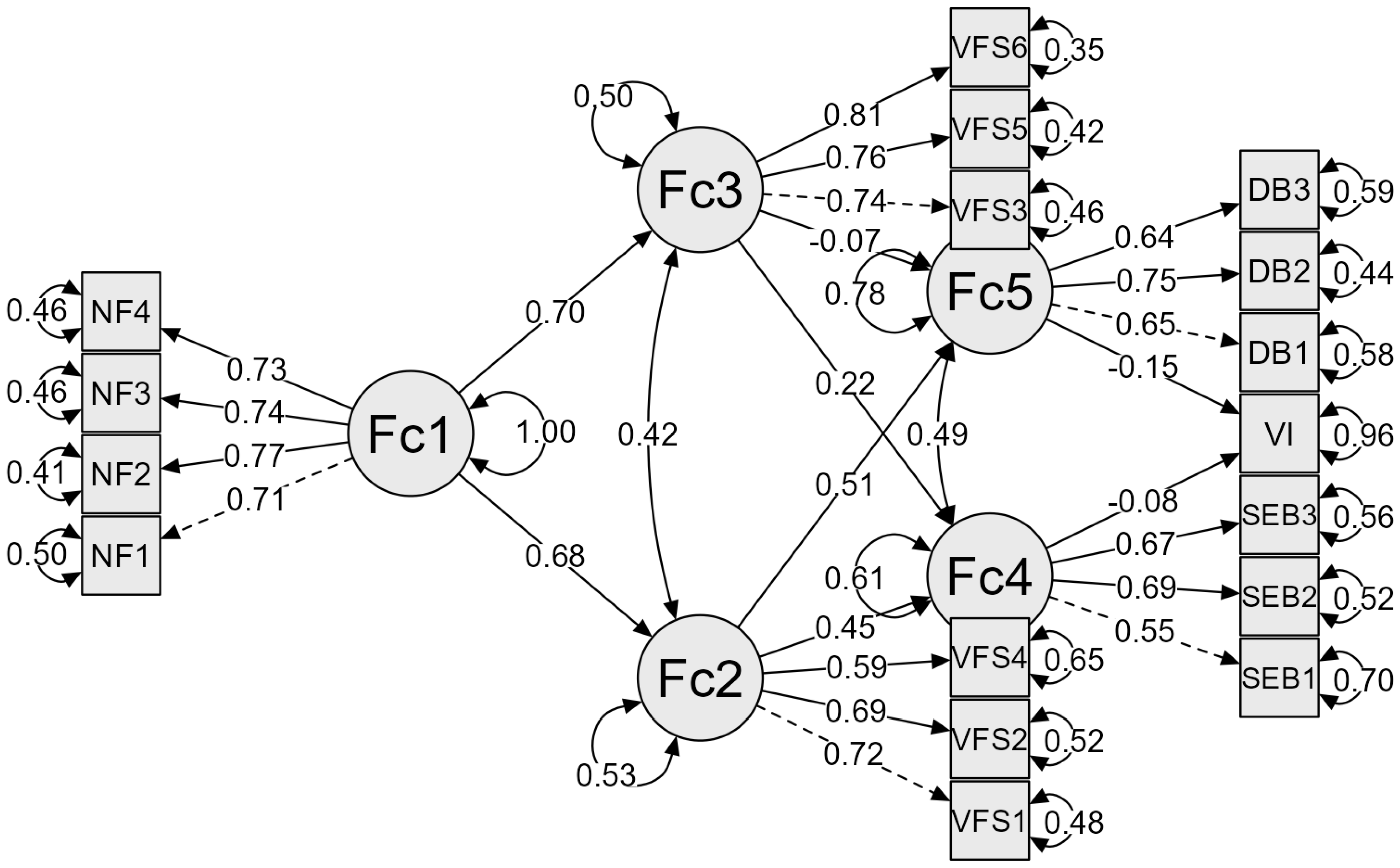
Model 1: Parallel Indirect Effects Model (NF → VF/CB → VI). In this model, NF (Factor 1) is directly associated with VF through its two correlated dimensions (Factor 2: Cognitive, and Factor 3: Somatic) and CB through its two correlated dimensions (Factor 4: SEB, and Factor 5: DB). VF and CB factors, in turn, are independently associated with VI.
- ▪
Model 2: Mediation through Vaccination Fear (NF → VF → CB → VI). In this model, NF is associated with VF (Factors 2 and 3), VF is associated with CB (Factors 4 and 5), and CB is subsequently associated with VI.
- ▪
Model 3: Mediation through Conspiracy Beliefs (NF → CB → VF → VI). In this model, NF is associated with CB (Factors 4 and 5), CB is associated with VF (Factors 2 and 3), and VF is subsequently associated with VI.
Confirmatory factor analyses (CFA) were conducted separately for each scale to evaluate their factor structure and fit indices. Subsequently, structural equation modelling (SEM) analyses were performed to examine the hypothesised relationships among latent constructs. Both CFA and SEM analyses were conducted using the same sample (N = 777). The analyses were conducted using JASP version 0.98.1, based on the lavaan package.
For SEM, given that VI was a dichotomous variable, the models were estimated using the robust Weighted Least Squares Mean-adjusted estimator (WLSM). Model fit was assessed using several goodness-of-fit indices, including the chi-square statistic (χ
2), the Comparative Fit Index (CFI), the Tucker–Lewis Index (TLI), the root mean square error of approximation (RMSEA), and the standardised root mean square residual (SRMR). Model fit was assessed following Hu and Bentler [
41]: CFI and TLI > 0.95 (>0.90 acceptable), RMSEA < 0.06 (<0.08 acceptable), and SRMR < 0.08. In addition, standardised path coefficients, the significance of direct and indirect effects, and the proportion of explained variance in the dependent variable were examined. Evidence of discriminant validity between constructs was assessed using the heterotrait–monotrait ratio (HTMT).
3. Results
3.1. Preliminary Analyses
The results for descriptive analyses and group differences are presented in
Table 1. For the three variables analysed, the means are relatively close to the midpoint of their respective scales, with slight deviations towards lower values, although without marked departures indicating extreme tendencies. The skewness values are low and close to zero, indicating that the distributions are approximately symmetrical, with no evidence of meaningful bias towards higher or lower values. Consistently, the kurtosis values are also close to zero, suggesting approximately mesokurtic distributions, with minor variations but no substantial deviations from normality.
Given the ordinal nature of the data (Likert-type scales), the use of non-parametric statistics could be considered from a strictly methodological perspective. However, the observed distributional properties, reflected in the skewness and kurtosis values, together with the large sample size (N = 777), indicated that the variables approximated normality to a reasonable extent. Therefore, parametric statistics were considered appropriate and were used as the main analytical approach for the subsequent analyses.
In this way, independent samples t-tests were conducted to compare between sex groups (male/female) and between participants with and without VI (No/Yes). Overall, significant group differences were observed across sex and VI. Sex differences were present in NF and VF, with females scoring higher. Regarding VI, significant differences emerged for VF and CB, with higher scores observed in the no-intention group. No significant differences were found for NF in relation to VI or for CB in relation to sex.
Overall, the results do not support a direct effect of NF on VI. However, VF and CB are significantly associated with VI, suggesting that any relationship between NF and VI may be indirect and may be mediated by these factors.
The correlation analysis (see
Table 1) indicates that VI was significantly associated with VF and CB but not with NF. In addition, significant moderate positive associations were found between NF, VF, and CB, with the relationship between NF and VF being particularly strong. These findings may support the possibility that NF may be indirectly associated with VI through VF and CB.
3.2. Structural Equation Modelling Results
Table 2 presents the results for the three models examined. Model 2 demonstrated the best overall fit, showing the highest values on the incremental fit indices (CFI, TLI, RMSEA) and the lowest values on the error indices (SRMR). In addition, it yielded the lowest information criterion values (AIC and BIC), indicating a more favourable balance between model fit and parsimony. Model 1 also showed an adequate fit to the data, although its performance was slightly inferior to that of Model 2. Although Model 3 produced acceptable fit indices, it exhibited the least satisfactory fit of the three models, indicating weaker empirical support.
Detailed psychometric results for the three structural equation models, including reliability coefficients, average variance extracted (AVE), heterotrait–monotrait ratio (HTMT), factor loadings, regression paths, indirect effects, total effects, and structural diagrams are presented in the
Supplementary Materials.
Evidence of discriminant validity assessed using the heterotrait–monotrait ratio (HTMT) supported adequate discriminant validity among the latent constructs included in the analyses (see
Supplementary Materials).
Regarding the measurement properties, Models 1 and 2 showed comparable and generally adequate levels of reliability and convergent validity. Internal consistency estimates were acceptable across all factors, with most omega coefficients exceeding the recommended threshold of 0.70. Similarly, AVE values were satisfactory for Factors 1 and 3 and approached acceptable levels for the remaining constructs. In contrast, Model 3 showed weaker psychometric performance, particularly for Factor 4, which exhibited reduced convergent validity and lower reliability.
Inspection of the factor loadings revealed that all indicators loaded significantly on their respective latent variables across the three models (all p < 0.001). Factor loadings were generally moderate to high, providing evidence for the adequacy of the proposed measurement structure.
Examination of the structural parameters showed that the paths involving Factor 1 were consistently positive and statistically significant across models, indicating a consistent association between this construct and the remaining latent variables. However, Model 2 (see
Figure 1) showed a more coherent and theoretically interpretable pattern, with the association between Factor 1 and the outcome variable accounted for by the inclusion of VF and CB in the model. Several indirect associations were statistically significant. In contrast, Model 3 yielded a less satisfactory pattern of results, characterised by weaker psychometric properties, several non-significant structural paths, and less stable parameter estimates, raising concerns regarding model stability and interpretability. Taken together, the supplementary analyses indicated that Model 2 showed the most favourable overall model fit among the tested alternatives. This model also maintained adequate reliability and convergent validity across all factors and showed a theoretically coherent and parsimonious structural pattern. However, these findings should be interpreted in light of the limitations associated with the use of ad hoc measures and a single dichotomous item to assess vaccination intention.
In conclusion, the results suggest that the association between NF and VI is fully indirect and involves VF and CB. NF is associated with VF, which in turn is related to CB, and both constructs are associated with VI.
3.3. Sample Size Adequacy
The adequacy of the sample size was evaluated in relation to the complexity of the structural models. The final SEM included 16 observed indicators, five latent factors, and 43 free parameters (see
Supplementary Materials). Given the sample size (
N = 777), the model provided a ratio of approximately 18 participants per estimated parameter, which falls within commonly recommended ranges (10–20 participants per free parameter) for covariance-based SEM [
42].
4. Discussion
The objectives of the study were addressed. The analyses allowed the examination of the relationships among NF, VF, CB, and VI within an integrated structural framework and identified a fully indirect association between NF and VI. Among the alternative models tested, the model in which the relationship between NF and VI operates through vaccination fear and conspiracy beliefs showed the best fit to the data, providing a coherent explanation of the pathways linking these constructs in the Pakistani context.
In line with Malas and Tolsá [
3], the results of the present study show significant positive associations between NF, VF and CB, as well as significant negative associations of both VF and CB with VI. However, while these authors found a significant negative association between NF and VI, this relationship was negative but not significant in the present study. This difference may be attributed to contextual factors. These researchers conducted their study in a Spanish sample, whereas the present study was carried out in a Pakistani sample. According to Butt et al. [
28] and Qazi et al. [
29], vaccine hesitancy in Pakistan shows higher levels than in other contexts. In addition, Arshad et al. [
30] report that between 9.3% and 28.4% of the population endorses some form of conspiracy belief. These contextual and methodological differences may influence how fear-related emotions are expressed and processed. Methodological differences may also account for this divergence. While Malas and Tolsá [
3] assessed NF using a dichotomous format, the present study employed a Likert-type scale, which may have captured greater variability in NF.
The sequence proposed in Model 2 showed the most favourable statistical fit among the evaluated alternatives. In this model, NF appears to function as an initial affective response that is positively associated with VF, which in turn is positively associated with the endorsement of CB, ultimately being associated with VI.
This pattern is consistent with evidence suggesting that individuals do not always accurately report or fully recognise their NF. As noted by Cook [
25], NF is often subject to denial, even when physiological responses indicate its presence. Similarly, Syed and Don [
24] reported cases in which NF is expressed indirectly through related comments or attitudes. Earlier work by Hamilton [
22] and Fisk [
23] likewise suggests a dissociation between negative emotional experience and its conscious verbal expression.
From a theoretical perspective, this dissociation can be understood in terms of the cognitive dissonance theory proposed by Festinger [
26] and the emotion regulation processes described by Gross [
27]. Individuals may attempt to reduce the psychological discomfort associated with fear-related experiences by reinterpreting or cognitively restructuring the source of that discomfort. In this sense, VF may represent a more conscious and explicit manifestation of underlying NF, functioning as a more proximal emotional response in the decision-making process. Within this framework, CB may reflect a cognitive rationalisation strategy associated with fear-based emotional responses. Rather than being solely independent cognitive biases, CB may serve to externalise and structure the emotional discomfort associated with NF and VF, attributing it to perceived external threats, institutional distrust or hidden motives. This interpretation is consistent with the observed pattern, in which CB exerts a stronger and more proximal effect on VI, acting as the final cognitive pathway through which emotional responses influence behavioural intentions.
Taken together, this emotional–cognitive association pattern provides a coherent explanation for the most favourable fit of Model 2, suggesting that the association between NF and VI is not direct, but rather involves progressively more elaborated affective and cognitive processes associated with CB. However, given the cross-sectional nature of this study, this structure, although theoretically plausible, does not allow conclusions about the temporal directionality of the associations to be drawn, and alternative explanations remain possible. For example, conspiracy beliefs may be associated with greater vaccination fear, or pre-existing vaccine distrust may influence reported fear among participants.
4.1. Future Implications
These findings have several relevant implications for the design of public health interventions aimed at improving vaccine acceptance.
First, the evidence obtained suggests that CB do not necessarily constitute an independent starting point for vaccine refusal but may represent an intermediate cognitive construct within a broader pattern of emotional and cognitive associations. In this sense, strategies focused exclusively on correcting misinformation or directly refuting conspiracy theories may be insufficient if underlying emotional factors are not addressed beforehand.
Second, the results suggest that NF may be associated with a pattern of emotional and cognitive responses that are linked to VI through its associations with VF and CB. This suggests that more effective interventions should include components aimed at regulating the emotional distress associated with invasive vaccination procedures.
Future longitudinal studies are needed to clarify the temporal ordering of the associations among NF, VF, CB, and VI. In addition, qualitative or mixed-methods approaches may help explore how individuals interpret and experience these constructs, providing complementary evidence for the refinement of theoretical models explaining vaccine-related decision-making.
Furthermore, the observed pattern reinforces the need to conceptualise vaccination as a process in which emotional and cognitive factors interact sequentially, rather than as a purely rational phenomenon based solely on information transmission. Consequently, public health campaigns should adopt multi-component approaches that integrate fear reduction, management of vaccination-related anxiety, and addressing of maladaptive cognitive beliefs within a unified intervention framework.
Finally, these findings highlight the importance of the sociocultural context in the effectiveness of vaccination strategies. In settings characterised by high levels of vaccine hesitancy and a high prevalence of CB, such as the one studied, emotional factors may play a particularly relevant role in shaping attitudes towards vaccination. Therefore, interventions should be adapted to these specific conditions, incorporating not only health information but also psychological and cultural components that jointly address the different stages of the decision-making process.
4.2. Limitations
Several limitations should be acknowledged when interpreting the findings of the present study. First, the cross-sectional design precludes any causal inferences regarding the relationships between needle fear, vaccination fear, conspiracy beliefs, and vaccination intention. Although the proposed structural model is theoretically grounded, the directionality of effects cannot be definitively established, and longitudinal designs would be required to confirm the sequential pathways suggested by the results.
Second, all variables were assessed using self-report measures, which may be subject to common method bias, social desirability, and potential underreporting of emotionally sensitive constructs such as needle fear. This is particularly relevant given evidence suggesting that individuals may not always accurately report their fear responses, even when physiological indicators suggest their presence.
The third limitation concerns the ad hoc measures used to assess NF and CB. Although the items were selected based on the previous literature and preliminary evaluation, a formal expert-based content validity assessment was not conducted. Additionally, CFA and SEM analyses were conducted in the same sample, which may increase the risk of overfitting. Future studies should replicate these models in independent samples.
Fourth, although the CB measure included items assessing distrust-related beliefs regarding pharmaceutical companies, governmental decisions, and health institutions, other relevant trust-related factors, such as trust in healthcare professionals (e.g., physicians and nurses) and broader dimensions of institutional trust, were not assessed as independent constructs in the present study. These factors may represent additional explanations for the associations observed and should be considered in future research. Furthermore, vaccination intention was assessed using a single yes/no question referring to a future, unspecified pandemic and an unspecified vaccine. Therefore, this item does not assess actual vaccination behaviour, current vaccine acceptance, or responses towards specific vaccine types. In addition, dichotomising intention substantially reduces the amount of available information and does not capture the strength of individual intentions. Consequently, the findings should not be generalised to vaccination uptake or vaccine refusal.
Fifth, the sample was drawn from an educational community in Pakistan, which may limit the generalisability of the results to the broader population. The overrepresentation of young and highly educated individuals may have influenced the levels and relationships observed among the study variables.
Finally, although the proposed model showed adequate fit and theoretical coherence, alternative models may also explain the observed associations. Therefore, the findings should be interpreted within a comparative modelling framework rather than as definitive evidence of a single causal structure.