Article

Occurrence and Co-Occurrence of Regulated and Emerging Mycotoxins in Foods Marketed to U.S. Toddlers


by
Susan Gonya
1,*,
Julie Brunkhorst
2 and
Michael Laviolette
3,*
1
Clean Food Solutions Research Institute, East Kingston, NH 03827, USA
2
Trilogy Analytical Laboratory, Washington, MO 63090, USA
3
Independent Researcher, Boston, MA 02115, USA
*
Authors to whom correspondence should be addressed.
Int. J. Environ. Res. Public Health 2026, 23(8), 949; https://doi.org/10.3390/ijerph23080949
Submission received: 30 April 2026 / Revised: 7 July 2026 / Accepted: 11 July 2026 / Published: 23 July 2026

Highlights

Public health relevance—How does this work relate to a public health issue?
  • Mycotoxin contamination in foods marketed to U.S. toddlers appears to be highly prevalent, indicating routine early-life exposure to foodborne toxicants with the potential to adversely affect child health.
  • Early childhood is a critical window of vulnerability in which small body size and immature metabolic and immune systems may increase susceptibility to mycotoxin exposure arising from food production, storage conditions, and climate-related factors.
Public health significance—Why is this work of significance to public health?
  • This study presents novel U.S.-based data on the occurrence and co-occurrence of 34 regulated and emerging mycotoxins in toddler foods, addressing a significant data gap in North America that has contributed to their under-recognition in public health sectors.
  • The findings highlight systemic limitations of single-toxin regulatory frameworks, particularly in the context of complex, real-world exposures that may disproportionately impact vulnerable populations, such as young children.
Public health implications—What are the key implications or messages for practitioners, policy makers, and/or researchers in public health?
  • Public health frameworks should integrate the assessment of multi-toxin exposures and environmental drivers into surveillance programs to enhance food safety and promote health equity.
  • Policies and interventions should prioritize enhanced surveillance, updated regulatory standards, and child-specific food safety measures to reduce dietary mycotoxin exposure and improve equitable access to safer food systems.

Abstract

Foodborne mycotoxins are toxic secondary metabolites produced by filamentous fungi. At sufficient concentrations, ingested mycotoxins have been found to disrupt the microbiome and exert toxic effects on gastrointestinal, hepatic, renal, and other tissues. Toddlers are particularly vulnerable to ill effects due to increased intake relative to lower body weight and immature detoxification, metabolic, and immune function. Despite this susceptibility, their adverse health effects remain under-recognized in public health sectors, and data on mycotoxin contamination in foods marketed to young children in North America remain sparse. To investigate this, 118 food products, including cereals, snacks, pasta, first foods, juices, and staple ingredients, were purchased at retail and analyzed for 34 mycotoxins using liquid chromatography–tandem mass spectrometry. The results were compared with the United States Food and Drug Administration (FDA) regulatory thresholds and European tolerable daily intake (TDI) limits. Of the 34 analytes, 32 were detected, and 25 were quantified. At least one mycotoxin was quantified in 87 percent of products, with a mean of 3.7 per item and a maximum of 13. Multi-toxin contamination was common; many products exceeded the FDA and TDI limits, and many remain unregulated. These findings highlight regulatory gaps in food safety and underscore the need for stronger child-focused oversight, particularly regarding emerging mycotoxins and multi-toxin contamination.

1. Introduction

Mycotoxins are low-molecular-weight secondary metabolites produced by filamentous fungi under favorable environmental and storage conditions [1,2]. Since the 1960s, hundreds of mycotoxins have been identified, with dietary ingestion being the primary route of human exposure [1]. Inhalation and dermal contact may also occur in mold-contaminated indoor environments, such as water-damaged buildings, and in occupational settings, including bakeries and breweries, making complete avoidance difficult [2,3,4].
Historically, outbreaks of mycotoxin-related foodborne illnesses were often regionally confined before the expansion of global trade [2,5]. However, mycotoxin contamination is now widespread, with an estimated 60–80% of cereal grains and nut crops affected worldwide, posing risks to both human and animal health [1]. As a result, humans are continuously exposed to low and, at times, high levels of dietary mycotoxins, with infants and young children among the most disproportionately affected due to their lower body weight and higher relative toxin exposure [6,7,8].
The primary mycotoxin-producing genera affecting the human food supply include Aspergillus, Penicillium, Fusarium, and Alternaria species [2]. These fungi produce a chemically diverse range of toxic compounds, including aflatoxins, ochratoxins, trichothecenes (e.g., deoxynivalenol, nivalenol, HT-2 toxin, and T-2 toxin), zearalenone, fumonisins, enniatins, beauvericin, alternariol monomethyl ether, and alternariol [2]. Many of these metabolites have been shown to adversely affect multiple organ systems, including the gastrointestinal tract, liver, kidneys, nervous system, reproductive organs, and epithelial and immune tissues [3,4,9,10].
Within the context of organ-specific toxicities, many mycotoxins have acute and chronic health effects. For example, at low but chronic doses, the commonly occurring trichothecene mycotoxin deoxynivalenol (DON) may stimulate immune activation, inhibit protein synthesis, compromise the intestinal mucus barrier, increase intestinal permeability, and suppress appetite, thereby potentially contributing to growth stunting in children [11,12,13,14,15,16,17,18]. Higher, more acute exposures to DON have been linked to immune suppression, nausea, vomiting, abdominal pain, diarrhea, intestinal hemorrhage, and fever in both animal models and human outbreaks [5,9,11,12,13,16,19,20,21]. These effects have led some researchers to hypothesize that chronic trichothecene ingestion may contribute to inflammatory GI disorders, including inflammatory bowel disease (IBD) [3,13,19,20,21].
Some mycotoxins have been found to cross the blood–brain barrier following their systemic absorption. DON and ochratoxin A (OTA) can cross the blood–brain barrier and have been shown to damage astrocytes and glial cells in animal and in vitro models [15,22]. Detoxification differences between developmentally typical children and their siblings with autism spectrum disorder (ASD) have raised concerns about their potential role in ASD [14,15,22,23,24,25].
Other mycotoxins also exhibit distinct organ-specific effects. Cyclopiazonic acid, an unregulated mycotoxin, has been linked to gastrointestinal (GI) and neurological toxicity, including human Kodua poisoning [26,27,28,29,30]. Aflatoxins are well-established hepatotoxins and hepatocarcinogens, while enniatins and Alternaria toxins, including alternariol (AOH) and alternariol monomethyl ether (AME), may also contribute to liver pathology, although their roles remain less well-defined [31,32,33,34,35,36,37,38]. Zearalenone (ZEA), AOH, and AME exhibit hormone-disruptive activity, and ZEA has been associated with reproductive abnormalities, including polycystic ovarian syndrome in animal models [2,37,39,40,41,42,43,44]. Fumonisin exposure has been implicated in the development of neural tube defects in infants and possibly esophageal cancer in humans [2,45,46]. Aflatoxin B1, fumonisins, and DON have recently been under investigation for their potential role in growth stunting in children [47,48].
In addition to direct toxicity, many mycotoxins disrupt intestinal microbial communities in a manner similar to that of antibiotics. DON alters the relative abundance of Bacteroides and Firmicutes, resembling microbial shifts reported in IBD and ASD [49,50,51,52,53]. Aflatoxins reduce the number of lactic acid-producing bacteria, and OTA targets lactobacilli, including Lactobacillus reuteri [54]. Beauvericin exhibits broad antimicrobial activity against Gram-positive and Gram-negative organisms, potentially contributing to dysbiosis [55].
Collectively, these findings highlight the potential negative impact of foodborne mycotoxins on the human microbiome and overall health. Despite decades of research and the identification of many foodborne mycotoxins with known toxicity, numerous fungal metabolites remain under-recognized in clinical and public health fields [9,30,56,57].
Exposure can start in utero, as mycotoxins have been found in amniotic fluid and are linked to impaired fetal growth [58]. In a prospective cohort study, Tan et al. [59] reported that mothers in the highest tertile of DON intake were more likely to deliver infants with lower birth weights and reduced birth lengths relative to gestational age (all p-trends < 0.05). Postnatally, exposure may continue through contaminated breast milk, infant formula, and cow’s milk, with additional increases as solid foods are introduced [6,8,59,60,61,62].
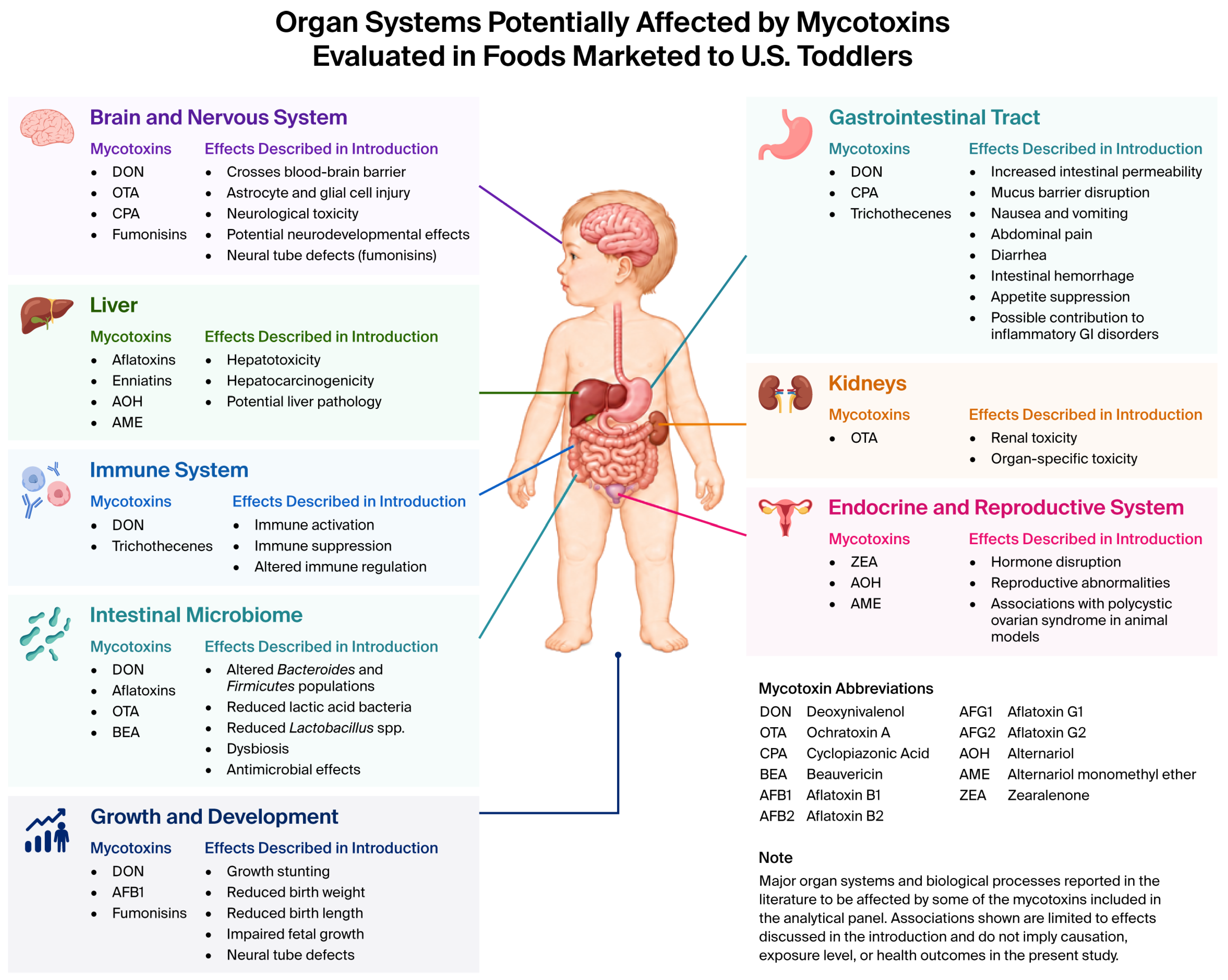
Following weaning, toddlers consume a broader range of solid foods, many of which are grain-based products, such as cereals, crackers, breads, and snack foods. Grains are common sources of mycotoxins and are consumed more frequently relative to body size; this transition may further increase exposure compared to that in infancy [7,63]. These risks may be amplified by developmental vulnerabilities, including immature and less resilient microbiomes, underdeveloped metabolic and immune systems, reduced detoxification capacity, and lower body weight [8,64]. Figure 1 provides an overview of the major organ systems and biological processes reported in the literature for the mycotoxins summarized herein.
Compounding this concern, mycotoxins are imperceptible to humans by taste, odor, or visual inspection, rendering avoidance difficult without advanced analytical methods, such as liquid chromatography–tandem mass spectrometry (LC-MS/MS) [65]. Historically, most surveillance efforts have focused on a limited subset of regulated mycotoxins, partly because of the methods and standard materials available for quantification. The primary mycotoxin detection methods were High-Performance Liquid Chromatography with Fluorescence Detection (HPLC-FLD), High-Performance Liquid Chromatography with Ultraviolet Detection (HPLC-UV), and Gas Chromatography (GC). These methods can primarily identify single mycotoxins or groups of mycotoxins, but not to the extent that LC-MS/MS allows. Moreover, with more analytical standards becoming available each year, this instrumentation has evolved to allow the quantification of previously undetected and emerging mycotoxins. Libraries of hundreds of mycotoxins have been produced, enabling screening using LC-MS/MS and other time-of-flight instruments [66]. Thus, previous technological limitations may explain why only a small number of mycotoxins are currently subject to regulatory limits in the United States (U.S.). Currently, only limited data are available on the occurrence and co-occurrence of regulated and emerging mycotoxins in the U.S. food supply.
To address these gaps, the present study evaluated the occurrence and co-occurrence of 34 regulated and emerging mycotoxins in processed foods marketed for U.S. toddlers, providing a snapshot of potential early life dietary exposure. Specifically, this investigation seeks to address the following questions: (1) which of the 34 mycotoxins tested U.S. toddlers are likely to be exposed to through commonly available processed foods, and (2) whether observed contamination levels exceed established European tolerable daily intake (TDI) values when adjusted for toddler body weight, thereby potentially increasing risks to child health. European TDI values were used where available, as no established pediatric TDI values are available in the U.S.

2. Materials and Methods

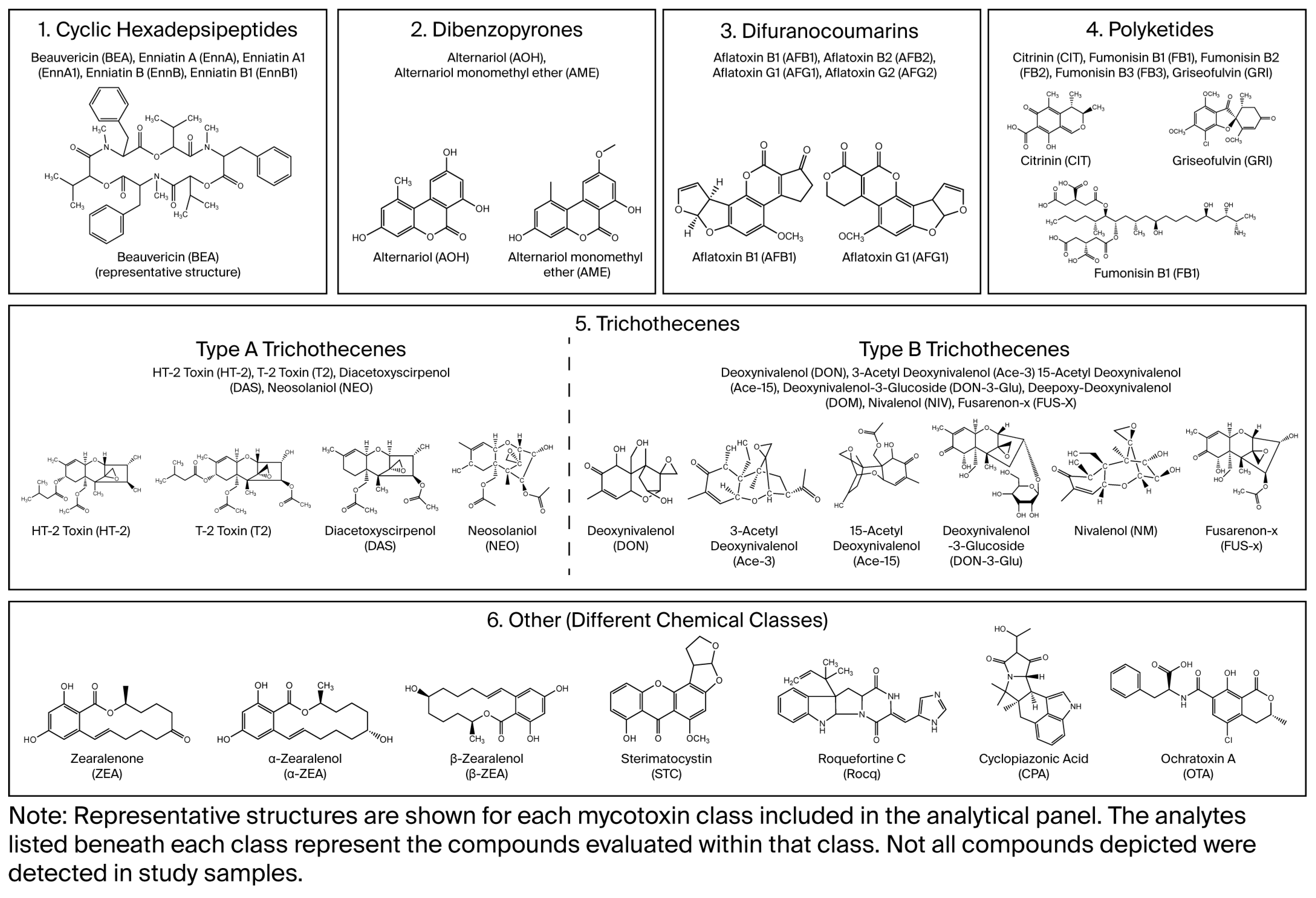
A total of 118 food products were screened for 34 mycotoxins using LC–MS/MS to assess multi-mycotoxin contamination. Figure 2 shows the representative structures of each mycotoxin class included in the analytical panel. The analytes pictured beneath each structure represent the compounds evaluated within that chemical class (see Appendix A for additional information on the analytes tested). A validated multi-analyte method was applied for sample preparation and quantification, as described by Kresse et al. [65]. Quality control measures were implemented throughout the analytical process.

2.1. Sample Selection and Procurement

Food products specifically marketed for toddler consumption, including cereals, snacks, pasta products, first foods, juices, and selected cooking ingredients commonly used in foods prepared for young children, were selected for analysis. Toddlers were defined as children aged at least 12 months but less than 36 months. Only vegetable-based, non-dairy items were included, as defined a priori by the study team. Cereal grain-based foods and some non-cereal grain ingredients were selected for testing. Non-cereal-based ingredients included chocolate powder, soy-based formula, almond flour, coconut flour, arrowroot, tapioca starch, and other miscellaneous products (e.g., first food beans and apple juice).
Products were purchased at retail locations and by mail order in the Midwestern United States (Missouri) and Northeastern United States (Massachusetts, New Hampshire, and Maine) between 1 June 2024 and 1 October 2025. In the absence of a formal randomization protocol, a standardized systematic sampling approach was implemented to reduce selection bias when purchasing directly from individual stores. Specifically, the second item in each product row was selected, provided that its packaging was intact. Additionally, only one product was selected from each product category (e.g., cornflakes) on the shelf, regardless of the brand. However, because two separate persons procured the food items, duplicate products from different geographic regions and lots were sometimes selected.
To supplement retail sampling and expand geographic coverage, a mail-order procurement strategy was also implemented to obtain commercially available food products for mycotoxin analysis. Products marketed for infant and toddler consumption, along with some basic cooking ingredients, were identified through major online retailers and manufacturers’ websites via Google search and purchased using a standardized selection approach. Within each product category, one item from every other available brand was selected to reduce selection bias.
Prior to laboratory submission, all products were inspected to confirm package integrity, the absence of visible damage (e.g., rips or tears), and the validity of expiration dates to ensure sample quality. Details for each product were also noted, including manufacturer lot numbers and storage facility numbers, when available. However, such details were not available for all the products procured.

2.2. Sample Shipment and Laboratory Analysis

After procurement, samples were sent via U.S. Postal Service Priority Mail to Trilogy Analytical Laboratory (Washington, MO, USA) for the analysis of 34 foodborne mycotoxins using LC-MS/MS procedures. Once received by the laboratory, samples were stored in their original, unopened packaging in a dehumidified refrigeration unit. This was carried out to minimize potential contamination or degradation prior to analysis. All samples were logged with the receipt date, product type, brand, lot number (if available), and country of origin, if disclosed on the label. Samples were stored for no more than two weeks in their original sealed packaging and were not opened before extraction and analysis. Prior to sampling, the products were inspected for damage and visible signs of mold and discarded if found damaged. Samples were tested in groups by matrix (e.g., packaged cereals). Each sample was ground and homogenized using a Retsch GM200 knife mill (Retch GMBH, Dusseldorf, Germany) with serrated blades for approximately one minute at 10,000 min−1. They were then weighed (25 g) into 250 mL Erlenmeyer flasks, and 100 mL of 80% acetonitrile/water was added. The flasks were placed on a platform shaker (Eberbach, Van Buren Charter Township, MI, USA) and shaken for 1.5 h. Any remaining samples were placed in Ziploc bags and stored under refrigeration.

2.3. Reagents and Standards

To test for 34 mycotoxins, reference standards for all targeted mycotoxins (≥98% purity) were manufactured by Trilogy Analytical Laboratory (Washington, MO, USA) or purchased from Romer Labs (Union, MO, USA). Stock solutions were prepared at a concentration of 1 mg/mL. These stock standards were then prepared at working standard concentrations (µg/mL) for use in the analysis in LC–MS-grade acetonitrile, methanol, and water. LC–MS-grade acetonitrile, methanol, and water were obtained from Honeywell. Formic acid (≥99% purity, LC–MS-grade) was purchased from Millipore Sigma (Burlington, MA, USA).

2.4. Sample Preparation

Diverse food subsets require varying methods of preparation. For products prone to heterogeneity (e.g., cereals and mixed snacks), incremental portions were taken from multiple locations within the homogenized matrix to ensure representativeness. Liquid products were mixed thoroughly prior to aliquoting.
Samples were then prepared for testing using the following methods: Samples were ground using a Retsch GM200 mill or homogenized using a high-speed blender (Osterizer, Sunbeam Products Inc., Atlanta, GA, USA) until a uniform particle size was achieved. Then, 25 g samples were weighed in an extraction flask, and 100 mL of acetonitrile–water (80:20, v/v) was added.
Extraction was performed on an orbital shaker (6000, Eberbach) for 90 min at room temperature (20–22 °C). The samples were then filtered using a Whatman No. 1 filter (Jade Scientific, Westland, MI, USA). The filtered extract was purified using QP1100 SPE (Trilogy Analytical Laboratory, Washington, MO, USA). The purified extracts were diluted with water–acetic acid (2% v/v) and injected into the LC-MS/MS system.

2.5. LC–MS/MS Instrumentation and Parameters

For LC-MS/MS analysis, the Shimadzu SIL-40 series system (Columbia, MD, USA) was configured with a near-zero refrigerated autosampler (temperature maintained at 8 °C), gradient pump, and column oven. This was combined with the SCIEX 7500 mass spectrometry system using an Electrospray Ionization Interface (ESI). The preinstalled 6-port valve on the MS-MS instrument was configured to direct the analyte flow to the waste. The SCIEX OS acquisition software (Version 4.0) was used to control all systems, and the SCIEX OS software was used to evaluate the data [67].

2.5.1. Chromatographic Separation

Separation was performed using a Phenomenex Kinetex column (3 mm × 100 mm; 2.6 μm; 100 Å) (Torrance, CA, USA), which was then stored in a column oven. The temperature was set to 40 °C, and the injection volume was 5 μL.
The mobile phases for the analysis were A: water–0.1% Formic Acid–4 mM Ammonium Formate, and B: Methanol–0.1% Formic Acid–4 mM Ammonium Formate. The flow rate was 0.5 mL/min.
A gradient program was used for separation. The gradient profile started at 5% B, was held for 1.0 min, and then increased linearly to 50% B within 6.0 min. This was maintained for 12.0 min before being returned to 5% B in 4.0 min. The starting conditions were maintained for 4.0 min before the next injection.

2.5.2. Mass Spectrometry Conditions

The parameters for MS/MS were as follows: ESI positive with an interface temperature of 350 °C, an ion spray voltage of 1700 V, curtain gas at 40 psi, collision gas at 9 psi, ion source gas 1 set at 40 psi, and gas 2 set at 60 psi. Mass spectrometry was performed using scheduled multiple reaction monitoring (sMRM), and the two most intensive transitions were measured when the relevant substance eluted to the MS/MS. The dwell times were optimized automatically by Sciex OS Software.
Analyses were performed in scheduled multiple reaction monitoring (sMRM) mode. For each analyte, the two most intense precursor–product ion transitions were monitored within a 1.2 min retention window. The dwell times were automatically optimized using Sciex OS software (4.0, Sciex) (Marlboro, MA, USA) [67] to ensure adequate data points across each peak. The window of one MSM signal was 1.2 min, and the total cycle time was 1.1 s [67].
The analytes required both positive and negative ionization polarities. The complete MS/MS operating settings are provided in Table 1 [65].

2.5.3. Method Validation

The method’s performance was evaluated in accordance with FDA guidelines. Linearity was assessed using matrix-matched calibration curves prepared in triplicate across a range. The coefficients of determination (R2) exceeded 0.99 for all analytes (see the Supplementary Materials—supplemental verification data).
The limits of detection (LOD) and quantification (LOQ) were determined using signal-to-noise ratios of 3:1 and 10:1, respectively, in spiked blank matrices (samples previously analyzed and containing no mycotoxins). The recoveries were assessed by fortifying additional blank matrices. The mean recoveries ranged from 70% to 120%, with relative standard deviations (RSD) ≤15%. Matrix effects were evaluated by comparing the slopes of calibration curves prepared in solvent versus matrix extracts. If mycotoxins were detected but were below the typical LOQ, the data were considered non-quantifiable and discarded from the overall statistical dataset. The obtained LOQs were below the regulatory limits for mycotoxins in cereal-based products, as set in Commission Regulation 2023/915, whereas the more stringent limits for grain-based baby food were in the range of, or slightly below, the respective LOQs for aflatoxins [68].

2.6. Statistical Analysis and Comparison to Established Tolerable Intake Levels

For each sample, data were entered into a Microsoft Excel (Version 2601 Build 16.0.19628.20132) spreadsheet and evaluated using descriptive statistics [69]. The data were then converted to micrograms per kilogram (µg/kg) for ease of clinical interpretation and comparison with the TDI and current regulatory guidance levels. The mean number of samples in which at least one mycotoxin was detected was calculated for each tested category. R statistical software (version 4.5.2) running under RStudio (version 2026.06.0 build 242) [70] and add-on packages were used to further evaluate the data [71,72,73,74]. A simulated Pearson’s chi-squared test was performed to determine the distribution of mycotoxins across all groups.
The median and maximum detection levels were computed for mycotoxin contamination levels, and the mean rates were calculated for the number of positive samples. The median detection levels, rather than mean values, for mycotoxin contamination were chosen because the median more accurately represents the central tendency when contamination data are highly variable, skewed, and influenced by extreme values. These are typical characteristics of mycotoxin datasets, especially when many analytes are measured simultaneously. The median is robust to outliers and therefore provides a more stable, representative estimate of the “typical” contamination level in the food supply.
The maximum and median detection levels were then evaluated against body weight (bw) to assess pediatric risk using pediatric portion sizes and with current TDI recommendations using an algorithm [75]. This equation was developed by the Italian National Institute of Health, Department of Innovation in Biology, at the University of Tuscia, Italy, and an Italian food company to produce processed wheat-based products with child-safe DON levels [75]. This equation provides a method for comparing the median and maximum mycotoxin levels in food samples with established TDIs.
Exposure ng/kg bw/day = Mycotoxin Contamination level (µg/kg) × Consumption data (g)/bw (kg)
For consistency, the mean toddler weights-for-age for a 24-month-old were obtained from the Centers for Disease Control and Prevention (CDC) growth charts. The 50th percentile for girls and boys combined (12.5 kg) was input into the equation [76].
Representative serving sizes for toddlers were derived from the nationally representative dietary intake data reported in the Feeding Infants and Toddlers Study (FITS) 2016 and the What We Eat in America/National Health and Nutrition Examination Survey (WWEIA/NHANES). USDA Food Pattern recommendations were used to verify the age-appropriate portion sizes. Serving sizes were selected to reflect typical consumption by children approximately 24 months of age [77,78].
Estimated mycotoxin intakes were initially calculated in nanograms and subsequently converted to micrograms by dividing by 1000. Final exposure estimates are expressed as µg/kg bw/day and compared with the corresponding tolerable daily intake (TDI) values for each mycotoxin. TDI limits have not been established for all the mycotoxins tested. When TDI values were unavailable, the Threshold of Toxicological Concern (TTC) was used to evaluate whether food levels may represent hazard flags warranting further investigation. Given the uncertainty in TTC values, this was done only for screening purposes.
Microsoft Excel was used to evaluate whether toddlers exceeded the TDI and TTC exposure limits using the following equation [69]:
Toddler Exposure = TDI (µg/kg bw/day)/Actual intake (µg/kg bw/day)
This method allows for the easy comparison of mycotoxin exposure levels in food with established TDI limits. Pediatric exposure estimates exceeding established TDI values were considered potential hazard flags, indicating the need for further risk evaluation, particularly given the increased dietary intake per unit of body weight among young children. Quantifiable maximum and median levels were also compared with the FDA, Chinese, and European regulatory levels for small children. See Appendix B for the regulatory guidance levels.

3. Results

One hundred and eighteen (118) processed foods and ingredients were analyzed. A broad range of foods was sourced for testing, including snack foods, first foods and formulas, packaged cereals, and pasta (n = 72 samples), as well as raw ingredients used in food preparation (n = 46 samples). Contamination rates differed across commodities. The categories of food samples tested are shown in Table 2.
Among the 118 samples of food and basic ingredients analyzed, 112 samples (95%) reached the limit of detection (LOD) for at least one mycotoxin, and 103 samples reached the limit of quantification (LOQ). In the quantifiable sample set, 87% (95% CI = (81.1, 92.8)) of the samples contained at least one mycotoxin. The median number of quantifiable mycotoxins was 4.0, with a mean of 3.7 and a maximum of 13. Overall, a total of 4012 analyte evaluations were conducted (118 samples × 34 toxins), 706 (17.6%) reached the LOD for at least one mycotoxin, and 428 (10.7%) reached the LOQ.
Of the 34 mycotoxins examined, 32 were detected, with 25 quantifiable at varying concentrations across the sample set. The following mycotoxins were detected in trace amounts but not quantifiable beyond a detection signal: Roquefortine C, Griseofulvin, Aflatoxin G2, Neosolaniol, Citrinin, α-Zearalenol, and β-Zearalenol. Additional information on detected but non-quantifiable mycotoxins is provided in Appendix A. Diacetoxyscirpenol and Fusarenon-X were not detected in any product. Mycotoxins that could not be quantified were treated as dichotomous variables and excluded from further statistical evaluation owing to the uncertainty and imprecision associated with their numerical values.
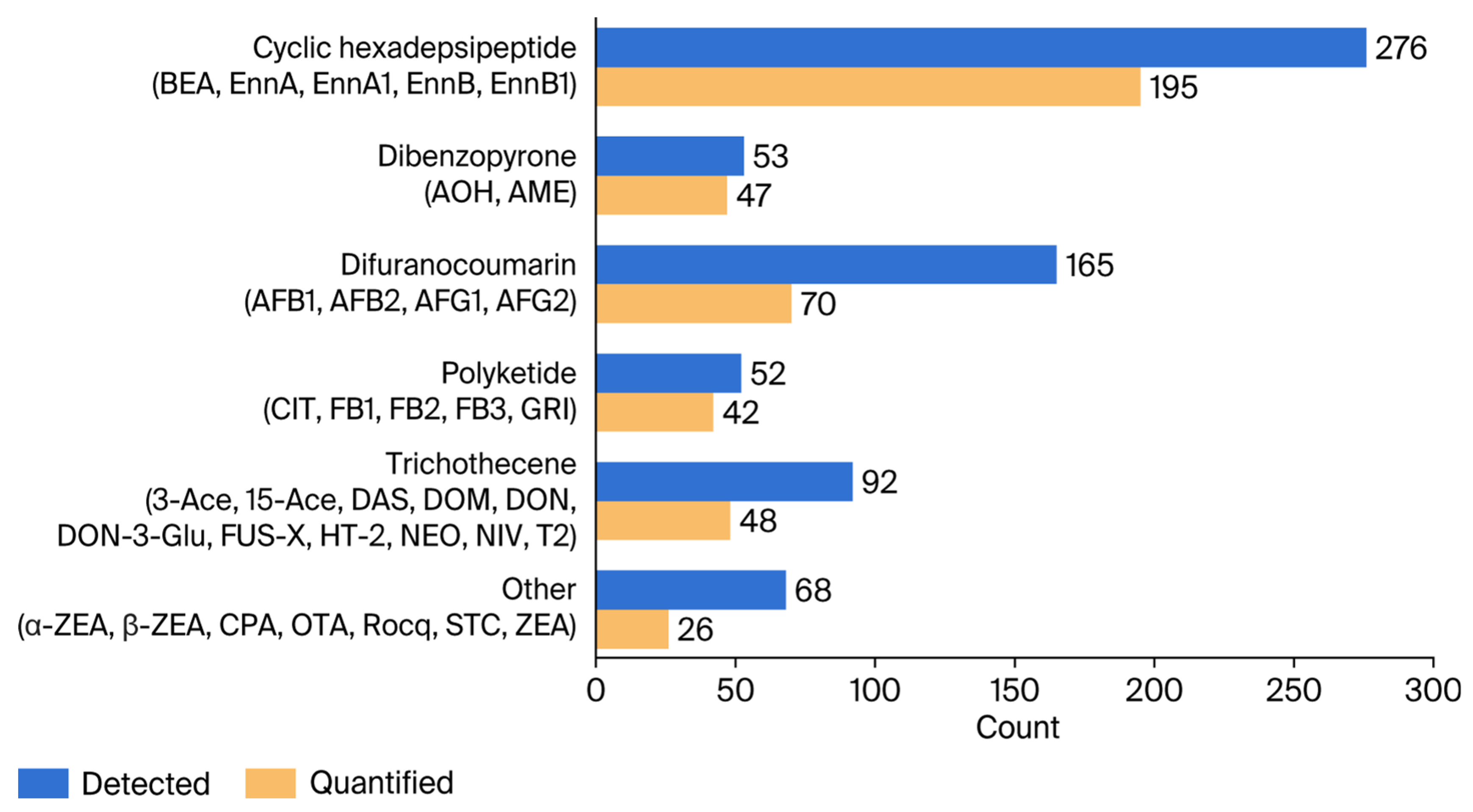
A simulated Pearson’s chi-squared test indicated that the proportions of products with at least one quantifiable mycotoxin were approximately equal across all food types (p = 0.66). However, the types of mycotoxins found differed by commodity. Figure 3 presents the distributions of detected and quantified mycotoxins in foods, categorized by chemical structure.
Table 3 presents the number of samples contaminated within each mycotoxin category, the LOD and LOQ in micrograms per kilogram (µg/kg), the highest and median amounts found for each mycotoxin, and the type of food in which the highest amount was detected.
Table 4 shows the distribution of mycotoxins by chemical structure across food types. Cyclic hexadepsipeptides (e.g., ENNs and BEA) were the most abundant across all food categories, followed by difuranocoumarins (e.g., aflatoxins) and trichothecene mycotoxins (e.g., DON, T-2, and HT-2). Because the levels and types of mycotoxins detected varied by commodity, the results are broken down into food category subgroups for ease of interpretation.
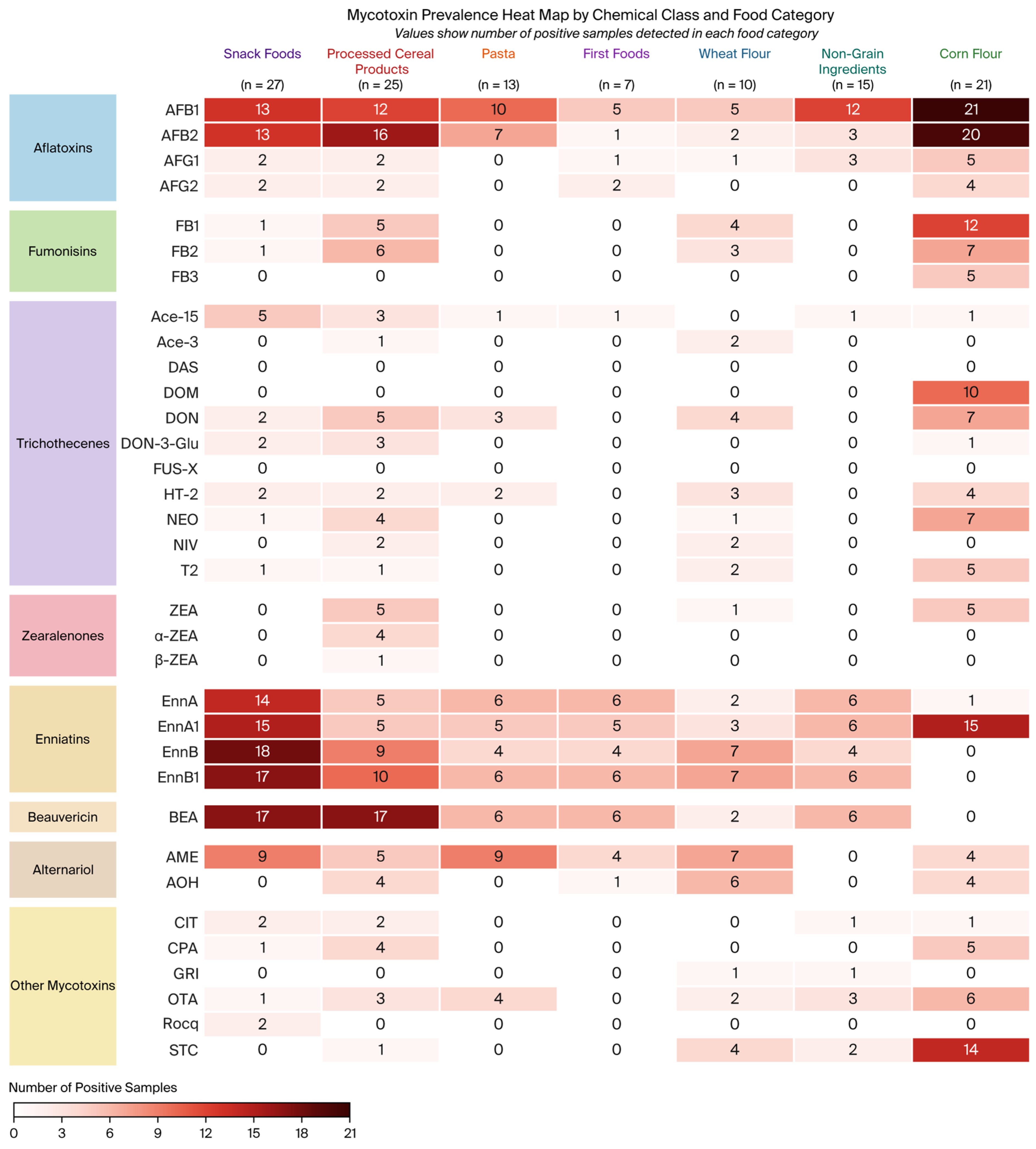
Figure 4 presents a heat map illustrating the most frequently detected mycotoxins across various food categories. Notably, only aflatoxins, DON, and fumonisins are subject to regulation in the U.S.

3.1. Snack Foods (n = 27)

Eighty-five percent of the snack foods, which were all grain-based, were contaminated with at least one mycotoxin. The mean number of mycotoxins per sample was 4, with a maximum of 6. Figure 4 illustrates that the most prevalent co-occurrences of mycotoxins were ENNs, BEA, AME, and AFB. Among the quantifiable samples, 59% were contaminated with at least one ENN mycotoxin, 56% with BEA, 33% with AME, and 26% with AFB1. Furthermore, five of the 27 snack samples were contaminated with either type A or type B trichothecene mycotoxins. The trichothecene mycotoxins identified in these samples comprised 15-Ace, DON, T-2, and HT-2 toxins. Lastly, FB1, FB2, and CPA were detected together in a single corn-based vegetable stick snack.

3.2. Toddler First Foods (n = 7)

The toddler’s first food category consisted of three soy-based formulas, legumes, fruit puree, and fruit juice. Six samples contained at least two mycotoxins (86%), with a maximum of 8. Similar to snack foods, AFB1, the ENNs, BEA, and AME most frequently co-occurred in these samples. Apple juice marketed for infants and toddlers contained the highest levels of the emerging mycotoxins EnnA1, EnnA, and EnnB1 recorded in this study (100.7 ppb, 95.6 ppb, and 82.5 ppb, respectively). Eighty-six percent contained at least one ENN, 71% had detectable levels of AFB1, and 57% contained the emerging mycotoxin AME. One fruit puree sample contained both AOH and AME.
Figure 4. Heat map of detected mycotoxins by food category. Note: The values represent the number of samples in which each mycotoxin was detected within each food category. n = total number of samples analyzed for each food category. Sample sizes: Snack Foods (n = 27), Processed Cereal Products (n = 25), Pasta (n = 13), First Foods (n = 7), Wheat Flour (n = 10), Non-Grain Ingredients (n = 15), Corn Flour (n = 21).
Ijerph 23 00949 g004

3.3. Processed Cereal Products (n = 25)

At least one mycotoxin was present and quantified in 84% of processed, packaged cereals. Moreover, packaged cereals were often contaminated with multiple mycotoxins from various mold species, with a mean of 3 and a maximum of 7. Co-occurrence was frequently observed among AFB1, AFB2, ENNs, BEA, and trichothecene mycotoxins (e.g., 21 detections). ZEA, DON, CPA, and BEA were detected in a single cereal sample.
In this category, 28% of the samples were contaminated with at least one quantifiable ENN, while 60% contained BEA. Aflatoxins were also detected in cereals, albeit at very low concentrations, significantly below the FDA limit of 20 μg/kg. CPA was identified in 16% of the samples, all of which were derived from corn. Additionally, 33% of the samples exhibited contamination with trichothecene mycotoxins. Notably, HT-2 toxin, a type A trichothecene, was detected at a concentration of 45.44 μg/kg in one of the packaged cereals. Additionally, the highest levels of the type B trichothecene DON and its two acetylated derivatives, 3-acetyl and 15-acetyl DON, were found in packaged cereal, totaling 3199 μg/kg, which exceeded the FDA pediatric limits and was 7.7 times the TDI.
Only two packaged cereals contained either AOH or AME, with AOH at 6.0 μg/kg and AME at 3.6 μg/kg. AOH, AME, ENNs, BEA, and CPA are not currently monitored in the U.S., China, or Europe.

3.4. Pasta Samples (n = 13)

The pastas tested were wheat-based, with 92% of the samples containing at least one mycotoxin. In the analyzed samples, the emerging mycotoxins ENNs, BEA, and AME were the most commonly co-occurring compounds. Specifically, 72% of the samples contained at least one of the ENNs; AME was quantified in 62% of samples, and BEA was present in 38%. Additionally, HT-2 toxin and DON were identified in two separate samples, and AFB1 was found in one sample. Lastly, OTA was quantified in three samples, representing 23% of the total.

3.5. Raw Ingredients (n = 46)

Raw ingredients are often considered minimally processed because they typically undergo fewer food-processing steps than ultra-processed foods. A total of 46 ingredients were tested in this study. The tested ingredients included wheat flour, corn flour, almond flour, coconut flour, arrowroot, tapioca starch, and chocolate powder.

3.5.1. Grain-Based Ingredients

Wheat flour (n = 10) was contaminated with two or more mycotoxins in 90% of the samples, with a maximum of 13 quantifiable mycotoxins in one sample. Furthermore, 30% of the samples were contaminated with one or more trichothecene mycotoxins, including DON and HT-2 toxin, which co-occurred in two of the three samples. Fifty percent of the samples contained low levels of aflatoxins, and 70% contained at least one ENN and one or more Alternaria species mold toxins. EnnB, EnnB1, AOH, and AME were the most frequently co-occurring compounds in these samples. BEA was detected in only one sample. Additionally, fumonisins were detected at low levels in 40% of the samples, and OTA and ZEA were detected in one sample each.
Corn flour was found to be more contaminated than wheat flour. Corn flour samples (n = 21) were 100% contaminated with three or more mycotoxins. In addition, 100% of the samples were contaminated with AFB1, 71% with AFB2, and 19% with AFG1 at quantifiable levels, with 43% exceeding the FDA guidance levels, raising concerns about hepatotoxicity. The highest detected concentration of combined AFB1, AFB2, and AFG1 in corn flour was 273.8 μg/kg, whereas the median concentrations among the samples were 11.9, 1.7, and 2.2 μg/kg, respectively.
The aflatoxin precursor, STC, was detected in 21 samples but was quantifiable only in one corn flour sample. CPA, a mycotoxin that frequently co-occurs with aflatoxin, was detected in 24% of the samples, with the highest concentration being 3804 μg/kg. Additionally, 57% of the samples contained at least one type A or type B trichothecene mycotoxin, or both. One sample contained the trichothecene mycotoxins DON, T-2, and HT-2 toxins (at 900, 71.2, and 49.6 μg/kg, respectively), along with aflatoxins, AME, AOH, and EnnA1. Fumonisins were quantified in 57% of the samples, EnnA1 in 71%, and AOH and AME in 19% of the samples. The most common co-occurrences were between EnnA1, AFB1, AFB2, fumonisins, and DON and its masked derivatives. All but EnnA1 have been studied for their relationship with growth stunting in children [79,80].
Corn-based flour emerged as the commodity with the most significant contamination. This study identified corn flour as containing the highest concentrations of AFB1, AFB2, T-2, HT-2, ZEA, fumonisins, CPA, DOM, and DON-3-glucoside. Notably, the AFB1 and AFB2 levels occasionally exceeded the regulatory limits set by the FDA and European authorities. Furthermore, all corn flour samples exceeded the regulatory limits established for pediatric use in China.

3.5.2. Non-Grain Ingredients

All almond flour samples (n = 4) exhibited trace amounts of aflatoxins, which were significantly lower than the levels detected in corn flour and remained well below the FDA regulatory thresholds. One sample contained all four ENNs, BEA, and AFB1. In the analysis of coconut flour (n = 3), one sample was devoid of mycotoxins, while the remaining two samples exhibited contamination with all four ENNs and BEA.
Arrowroot and tapioca starch (n = 4) were contaminated in 50% of the samples. One tapioca sample was contaminated with all four ENNs, BEA, and AFB1, and arrowroot was contaminated with low levels of 15-ace (100 µg/kg). Two samples were found to be free of mold toxins.
Chocolate powder (n = 4) was also tested because of its popularity as an ingredient. Four samples were tested, and all of them (100%) contained trace amounts of various contaminants. All samples contained at least one quantifiable mycotoxin, typically trace amounts of AFB1 or AFG1, but were within FDA and European limits. Only one sample conformed to the Chinese guidance levels for AFB1 in children. Another sample contained six mycotoxins, encompassing all four ENNs, BEA, and AFB1.

3.6. Comparative Mycotoxin Detection Across Heterogeneous Sample Matrices

In general, ENNs were present in only 27% of the non-grain-based samples, and BEA was present in 33% of the non-grain-based samples. Trace amounts of aflatoxins were detected in 60% of non-grain ingredient samples, but all levels were well below the FDA and European safety guidance levels. However, all non-grain ingredients contaminated with AFB1 exceeded the Chinese limit of 0.5 μg/kg for foods marketed for pediatric consumption. The most common co-occurrences in non-grain-based flours were AFB1, ENNs, and BEA. However, non-grain flours and other ingredients were not significantly contaminated with trichothecene mycotoxins compared to grain-based foods. Only one sample contained 100 µg/kg of 15-ace, which is below the FDA, Chinese, and European pediatric guidance levels, and no other trichothecene mycotoxins, fumonisins, or ZEA were detected in the non-grain ingredients. Finally, Alternaria spp. mold toxins AOH and AME were not found in any of the non-grain ingredients. They were only detected in processed grain-based ingredients and ultra-processed foods.
In total, corn-based products had the highest contamination rates for trichothecene mycotoxins, ZEA, fumonisins, aflatoxins, and CPA. OTA was most frequently detected in wheat-based foods, with only one chocolate sample containing trace amounts. ENNs and BEA were detected across all categories but were most prevalent in processed cereals, snack foods, and apple juice. AOH and AME were most frequently found in wheat flour, pasta, and toddler foods (i.e., with prevalences of 70%, 62%, and 57%, respectively), relative to sample size, and are currently not regulated in the US, China, or Europe. Table 5 illustrates the extent to which regulated mycotoxins surpassed the European TDI limits at both the highest and median quantifiable levels in a single toddler-sized serving. Values below the LOQ were excluded from the quantitative calculations in Table 5 because their concentrations could not be measured with sufficient accuracy and precision, resulting in substantial uncertainty. Additionally, the calculated exposure estimates may underestimate potential health risks because they do not account for synergistic toxicity from co-occurring mycotoxins in the same sample, which may amplify adverse biological effects.

4. Discussion

Based on the findings of this survey, pediatric exposure to mycotoxins through processed foods in the U.S. appears to be common rather than incidental. Through the routine consumption of processed foods, toddlers are likely to be exposed to a broad spectrum of toxins. Notably, both regulated and emerging mycotoxins frequently co-occurred in the same food products, which raises concerns about the potential for simultaneous exposure to increase overall toxicity and health risks, particularly in young children [13,87,88]. Many mycotoxins share biological targets and mechanisms of toxicity, including mitochondrial dysfunction, inhibition of protein synthesis, oxidative stress, immune dysregulation, disruption of intestinal barrier function, and activation of apoptotic and ferroptotic pathways [36,41,89,90,91]. This raises concerns that co-exposure could lead to additive or synergistic toxic effects.
Recent surveys of cereal-based foods intended for infants and children from other countries have also reported the frequent detection of Fusarium-produced mycotoxins, including DON, fumonisins, ZEA, ENNs, and BEA, often occurring simultaneously in the same products [80]. In a 2025 Portuguese survey of 148 cereal-based foods for infants and children, 43% of samples contained at least one mycotoxin, with co-occurrence most commonly involving fumonisins, BEA, and ENNs. Hazard index calculations suggested that combined exposures may pose a greater concern than individual toxins considered separately [80]. Similarly, biomonitoring studies in UK children have demonstrated frequent dietary exposure to multiple mycotoxins (e.g., DON, NIV, T-2/HT-2 toxins, ZEA, OTA, and aflatoxins), with co-exposure to three or more mycotoxins observed in 66% of urine samples and frequent exceedances of health-based TDI guidance values for several Fusarium toxins [92].
Surveys of naturally contaminated foods worldwide further indicate that co-occurrence is the rule rather than the exception in cereals and cereal-derived products [93]. Recent cohort studies have documented widespread simultaneous exposure to aflatoxins, fumonisins, DON, and OTA in young children and have suggested that these contaminants may independently contribute to growth impairment and environmental enteric dysfunction [47,79,94]. Collectively, these studies support the present findings and suggest that dietary exposure assessments focusing on individual mycotoxins may underestimate the complexity of real-world exposure among young children.
While major mycotoxins are routinely monitored in the U.S, China, and Europe, many regulatory limits and health-based guidance values are generally derived from studies evaluating individual compounds and do not routinely account for multi-mycotoxin exposure. Furthermore, the unique vulnerabilities of toddlers, whose dietary intake relative to body weight is substantially greater than that of older children and adults, are not always considered within regulatory guidelines (see Appendix B). Thus, while few data are available on the combined effects of co-occurring mycotoxins, multi-mycotoxin effects may be of paramount importance to child health. Considering this, while the major mycotoxins are discussed here within the context of TDI limits, the overlapping effects of multiple mycotoxins will be addressed where possible.

4.1. Aflatoxins and Sterigmatocystin (STC)

Aflatoxins and STC are structurally related difuranocoumarin mycotoxins produced by Aspergillus species (spp.), with STC being aflatoxin’s xanthone precursor. Aflatoxins can contaminate most major crop plants and are well-established group 1 human hepatocellular carcinogens [7,31,95]. However, interindividual susceptibility to aflatoxin-induced carcinogenesis is believed to be influenced by host factors, including genetic polymorphisms in DNA repair pathways and co-existing hepatitis infections, which are difficult to ascertain in risk assessments [32,33,81]. Aflatoxins may also contribute to growth stunting in children by inhibiting protein synthesis, among other mechanisms [48].
Increasing evidence also indicates that aflatoxins, particularly AFB1 and aflatoxin M1 (AFM1), adversely affect intestinal and immune health. Animal and human cell line studies have demonstrated that aflatoxins disrupt intestinal epithelial integrity by promoting inflammation, compromising tight junctions, and increasing intestinal permeability [96,97,98,99]. When aflatoxins co-occur with other mycotoxins, such as trichothecenes, their deleterious effects on gut barrier function may be amplified, potentially contributing to immune suppression, abdominal pain, vomiting, and GI distress [88,98,100].
Mechanistically, aflatoxins have also been shown to induce ferroptosis, a regulated form of cell death distinct from apoptosis, necrosis, and autophagy [89]. Ferroptosis is driven by iron-dependent lipid peroxidation and requires intracellular ferrous iron (Fe2+), which catalyzes the formation of ROS via Fenton chemistry [89]. This process leads to the peroxidation of polyunsaturated fatty acids in cell membranes, cellular and mitochondrial injury, and depletion of intracellular glutathione reserves [89]. Dietary exposure to AFB1 may therefore promote early cellular death, hepatic injury, and disruption of iron homeostasis at sufficiently high exposure levels. Notably, DON, ENNs, and OTA, among other mycotoxins, have been shown to induce ferroptosis in mammalian cells, suggesting a shared mechanism of toxicity that potentially affects iron homeostasis among these co-occurring contaminants [89,101]. All were well represented in these samples.
Regulatory limits for aflatoxins have been established in the U.S., China, and Europe. In the U.S., the FDA permits up to 20 μg/kg total aflatoxins in foods, while Europe permits 2–12 μg/kg AFB1 and 4–15 μg/kg total [102,103]. China monitors foods for AFB1 only and has stringent guidance of 0.5 μg/kg in foods for infants and children [104]. The Joint FAO/WHO Expert Committee on Food Additives (JECFA) has evaluated aflatoxins on multiple occasions (e.g., 1997, 2001, 2017) and concluded that a TDI or provisional maximum tolerable daily intake (PMTDI) cannot be established for aflatoxins due to their genotoxic and carcinogenic properties [81]. Nonetheless, a proposed intake range of 0.017–0.082 μg/kg bw/day for total aflatoxins has been suggested based on two earlier animal studies in 1987 and 1989 that evaluated immune system effects in mice and observed significant reductions in white blood cell counts at these levels [32,81]. For risk characterization, the lower bound of 0.017 μg/kg bw/day was considered a more conservative and protective estimate for young children and was applied in the present TDI analysis.
Using the maximum observed contamination level of 273.8 μg/kg combined aflatoxins, a toddler consuming just a 1-ounce (30 g) sample of the affected product could ingest 0.66 μg/kg bw/day—nearly 38.7-fold higher than the proposed limit value of 0.017 μg/kg bw/day. At median combined contamination levels of AFB1, AFB2, and AFG1 (e.g., 5.1 μg/kg), which are significantly below the FDA regulatory thresholds, exposure constituted approximately 72% of the proposed limit for a small child. These exposures may accumulate over the course of a day. Notably, the median levels exceeded the Chinese guidance levels for infants and small children. These findings underscore the need for improved surveillance, more robust exposure data, and stronger regulatory oversight to protect young children from potentially harmful aflatoxin exposure.
STC and aflatoxins share a common xanthone–difuran core structure. STC is a biosynthetic precursor of aflatoxins and often coexists with them in samples, potentially increasing the toxicity of both. The International Agency for Research on Cancer has classified STC as a possible human carcinogen (Group 2B) and has recognized its immunotoxic properties [105]. Experimental studies have shown that STC induces hepatic and renal toxicity and causes chromosomal damage in both in vitro and in vivo models [86,105]. However, due to limited occurrence and exposure data in humans and animals, the EFSA CONTAM Panel has been unable to fully characterize the associated human health risks [86]. In this survey, STC was detected in 21 samples but was quantifiable in only 1 corn flour sample at 5.7 μg/kg (LOQ 0.5 μg/kg). There is a need for larger and more representative datasets to support meaningful exposure assessments and risk characterization.

4.2. Trichothecene Mycotoxins

Foodborne trichothecenes are primarily produced by Fusarium spp. fungi. Trichothecene mycotoxins possess a tricyclic 12,13-epoxytrichothec-9-ene (EPT) nucleus, which is the principal determinant of toxicity [31]. Multiple trichothecene mycotoxins were detected in the samples analyzed. Globally, trichothecenes most commonly infect wheat, corn, barley, rye, oats, millet, triticale, rice, sorghum, grain-derived alcoholic beverages, soy, tea, and dried spices [106,107].
Trichothecene mycotoxins are well known for their adverse effects in animals and humans, including gastroenteritis, nausea, vomiting, anorexia, impaired immune function, fever, headache, and growth retardation [9,11,12,13,14,16,19,20,21,49,52,53]. Chronic exposure to DON, a highly prevalent mycotoxin in food, has been demonstrated to compromise gut barrier integrity, disrupt intestinal mucosal immunity, alter gut microbiota homeostasis, impair mitochondrial function, and promote inflammation through an increase in reactive oxygen species (ROS) and oxidative stress [6,89,108]. Owing to their harmful effects on intestinal structures and immune regulation, trichothecenes are believed to play a role in IBD and related GI disorders [6,16,31,88,103,109,110].
Although trichothecenes, such as DON and its acetylated derivatives, were detected less frequently in this study than in previous surveys, their presence was notable and often occurred alongside other mycotoxins [6]. The highest concentration of DON, a type B trichothecene, was 2499 μg/kg in a processed cereal. This is five times the FDA limit, approximately 12 times the Chinese limit, and 12 times the European limit for infants and children. Several DON-related metabolites and modified forms, including 15-Ace, 3-Ace, DON-3-Glu, and DOM, were detected in varying amounts. Most of these have effects similar to those of the parent compound DON, except for DOM, which may be less toxic [111,112].
To better conceptualize the risk of toxicity, a toddler consuming a 1-ounce (30 g) serving of a cereal product contaminated with 2499 μg/kg DON would exceed the TDI by 6-fold [83,113]. At a median DON level of 300 μg/kg in a single 1-ounce serving, the intake would be approximately 72% of the TDI, with exposure potentially increasing throughout the day. The occurrence of 3- and 15-acetylated and 3-glucoside derivatives of DON in the same packaged cereal may intensify the situation. These derivatives are expected to produce inflammatory effects on gastrointestinal and immune system tissues, similar to those of DON [17,114,115,116,117,118].
Potentially exacerbating this, the type B trichothecene NIV was detected in four samples, none of which reached the LOQ. NIV’s mode of action is similar to that of DON’s; however, the FDA has not set limits for this toxin. While NIV is not routinely regulated in the U.S. or China, the European Union has established a TDI of 1.2 μg/kg bw/day [119]. In a recent study on multi-mycotoxin exposure in UK children, although NIV exposure from food was below the LOQ, 4.39% of urine samples exceeded the TDI [92]. The occurrence of NIV alongside other group B and A trichothecenes raises concerns due to their potential additive or synergistic effects on the human gastrointestinal tract, as well as the immune and nervous systems. Although exposure studies have confirmed the presence of multiple trichothecenes in children, there is a paucity of research examining their additive, synergistic, or antagonistic interactions with multiple mycotoxins in children, beyond the context of growth stunting [47,79,92].
DON and other trichothecene mycotoxins, including T-2 and HT-2 toxins, have also been observed to induce ferroptosis in both intestinal and other organ tissues in animals and in vitro. This process potentially disrupts redox reactions and iron metabolism [89,120]. Such disruptions could be particularly harmful to developing children when these mycotoxins occur together as a “mycotoxin cocktail”.
Furthermore, type A trichothecenes, T-2 and HT-2 toxins, are considered more potent than many type B trichothecenes and were well represented in samples. Both have been found to target the GI, epidermal, immune, and hematopoietic systems [84]. Neosolaniol (NEO), another type A trichothecene, was also detected in 13 samples, although the concentrations were below the LOQ, further indicating the presence of multiple type A trichothecenes in toddler foods and ingredients. These toxins are readily absorbed by the GI tract, skin, and lungs [56]. At high exposure levels, T-2 and HT-2 toxins have been shown to be lethal. This was evidenced during outbreaks of alimentary toxic aleukia (ATA) in the Orenburg region of the former Soviet Union during World War II, where the mortality rates among children under 10 years of age consuming contaminated grains approached 50% [5].
T-2 toxin is rapidly metabolized to HT-2 toxin following ingestion; therefore, these two compounds are considered together in risk assessments [84]. Considering the toxicity of these compounds, the European Food Safety Authority (EFSA) has established a TDI of 0.02 μg/kg bw/day for the combined intake of T-2 and HT-2 toxins [84]. HT-2 toxin was detected in 13 samples, while T-2 toxin was present in 9 samples. The maximum concentration of T-2 toxin, measured at 49.6 μg/kg, was observed in corn flour. Similarly, the highest HT-2 toxin level, 71.2 μg/kg, was detected in corn flour, which contained at least three mycotoxins per sample. The median concentrations of T-2 and HT-2 toxins were 34.7 μg/kg and 9.5 μg/kg, respectively, and these were identified in various processed foods.
Based on a 1-ounce (30 g) serving size, the estimated exposure for a toddler would exceed the TDI by approximately 6-fold and 8.5-fold at the highest detection levels for T-2 and HT-2 toxins, respectively, and by 4-fold and 1.1-fold at the median detection levels. T-2 and HT-2 toxins co-occurred in a single corn flour sample, exceeding the TDI by 14.5-fold. They were detected alongside other mycotoxins in wheat flour, snack, and cereal samples. Kimanya et al. [94] also reported that children in Tanzania were exposed to multiple mycotoxins through the consumption of corn.
Despite their documented toxicity, NIV, T-2, and HT-2 toxins, as well as acetylated derivatives and masked forms of DON, are not currently regulated or routinely monitored in foods in the U.S. or China, in contrast to European regulatory frameworks, raising serious concerns regarding child safety [83,104,113].

4.3. Fumonisins (FB1, FB2, and FB3)

Fumonisins are a family of water-soluble mycotoxins primarily produced by Fusarium fungi and are characterized by a long-chain amino polyol structure (i.e., polyketide). Fumonisins are typically detected alongside other Fusarium-produced mycotoxins in cereal grains, as observed in this study [45].
The International Agency for Research on Cancer has identified FB1 as a potential carcinogen [9]. Studies have shown that FB1, one of the three fumonisins believed to affect human health, significantly increases the risk of esophageal cancer in humans [45]. It has also been found to interfere with folic acid and sphingolipid metabolism, potentially increasing the risk of neural tube defects in infants [30].
Eating foods with high concentrations has also been demonstrated to affect intestinal health, leading to abdominal pain, borborygmi, and diarrhea in humans, and to increase the number of lymphocytes and monocytes in the ileum and cecum of the intestines [45]. Fumonisins have also been found to increase intestinal permeability (i.e., leaky gut) and the growth of harmful bacteria, such as pathogenic E. coli, in various parts of the intestines (e.g., ileum, cecum, and colon) [46]. Furthermore, Ayeni et al. [121] found that fumonisins, along with aflatoxins, AME, and CIT, have been implicated in disrupting the infant microbiome, potentially increasing the abundance of Klebsiella and Clostridium difficile taxa.
Twenty-one samples contained quantifiable levels of FB1, with the highest at 2000 μg/kg and a median of 500 μg/kg in corn flour for FB1, FB2, and FB3 combined. FB1 was the most prevalent of the three. In 2018, the EFSA established a tolerable TDI for fumonisins of 1.0 µg/kg bw/day [82]. Using a 30 g serving to calculate risk showed that a toddler would consume approximately 4.7 times the TDI at the maximum and 1.2 times the median amount, demonstrating that exposure can add up quickly in a small child, even when levels are within federal regulatory limits.
Fumonisins are regulated in the U.S., China, and Europe, but were frequently detected alongside other mycotoxins produced by Fusarium spp., such as DON, T-2, and HT-2 toxins, as well as toxins from Aspergillus molds, including aflatoxins and CPA, in this study. This co-occurrence raises concerns about the combined and additive effects of these toxins on various organ systems, including the intestinal, immune, and nervous systems, as well as the microbiota [45,46,121].
To date, most research has concentrated on pediatric growth stunting and enteric function within this context. For instance, the Sanitation Hygiene Infant Nutrition Efficacy (SHINE) trial is examining the effects of fumonisins, DON, and aflatoxins on enteric dysfunction and growth stunting in infants and children [47]. Similarly, in the AflaCohort study in Nepal, Andrews-Trevino et al. [79] observed that aflatoxin exposure negatively impacted linear growth, with serum aflatoxin and fumonisin levels correlating with underweight, and urinary DON levels associating with reduced head circumference in toddlers, independent of enteric dysfunction. Given these findings, examining the combined impact of these and other mycotoxins on child health is crucial.

4.4. Ochratoxin A (OTA)

OTA is a chlorinated, low-molecular-weight mycotoxin with a distinctive isocoumarin–amino acid hybrid structure produced by Aspergillus and Penicillium fungal species [30]. Chronic exposure to OTA has been shown to damage renal tubular cells and impair kidney function, and has been historically implicated in Balkan endemic nephropathy, a fatal chronic kidney disease affecting populations in Bulgaria and surrounding regions [9,30]. Subsequent studies have linked OTA exposure to testicular cancer, urinary tract tumors, and potential neurotoxicity, including a proposed contributory role in ASD [8,9,23,24,25,122]. De Santis et al. [23] studied differences in the metabolism of DON, aflatoxin M1, FB1, and OTA between children with ASD and non-ASD controls; they found differences in the detoxification and metabolism of these mycotoxins [23]. More research on the influence of combined mycotoxin exposure on neurodegenerative diseases is needed, as such co-exposure may be common.
OTA was detected in six samples, with a maximum concentration of 2.1 μg/kg in wheat flour and a median concentration of 1.2 μg/kg in wheat-based pasta. The EFSA has established a tolerable weekly intake (TWI) of 0.120 μg/kg bw/week, corresponding to an average daily intake of approximately 0.017 μg/kg bw/day when averaged over a week. Based on this benchmark, the estimated exposure derived from the maximum quantifiable OTA sample (wheat pasta), a single 70 g serving, was approximately 0.0118 μg/kg bw/day, or 69% of the daily-equivalent limit, and 39% of the median level. This suggests that intake from individual food items may fall below current safety thresholds [85].
However, these risk estimates do not account for the cumulative exposure from multiple foods consumed over the course of a day or week. Nor do they consider OTAs’ limited metabolic clearance in humans. OTA is frequently detected in human biomonitoring studies, a finding likely attributable to its prolonged biological half-life and resistance to enzymatic degradation [123]. Compared with the structurally related ochratoxin B, OTA persists longer in the body, in part due to the presence of a chlorine atom at the 5-position of the isocoumarin ring, which increases its chemical stability and reduces its metabolic breakdown, possibly increasing the risk to child health [123].
Despite its persistence, nephrotoxicity, carcinogenicity, and possible neurotoxicity, OTA is not regulated in U.S. foods, highlighting a critical gap in food safety oversight for this widely encountered mycotoxin. OTA is regulated in China and the European Union.

4.5. Zearalenone (ZEA)

ZEA is a fungal resorcyclic acid lactone produced by Fusarium fungi whose chemical structure closely mimics endogenous estrogens. ZEA is a potent mycoestrogen with greater estrogenic activity than many other foodborne endocrine disruptors, including genistein, bisphenol A, and phthalates [44]. ZEA has been extensively studied for its adverse reproductive effects in humans and wildlife and has historically been used in pharmaceutical applications due to its estrogenic properties [2]. Kincade et al. [44] conducted a U.S. pregnancy cohort study pertaining to socioeconomic and dietary predictors and found that women who ate more processed diets had higher placental levels of hormone-disrupting ZEA.
In addition to its endocrine-disrupting effects, ZEA has been shown to affect GI health. At low doses, it increases the intestinal expression of inflammatory cytokines and may suppress tumor suppressor gene activity [42]. In line with this, Abassi et al. [124] found that ZEA promoted the growth of human colon cancer cells in vitro. Furthermore, its metabolites, α- and β-zearalenol, have been reported to increase intestinal permeability, potentially enhancing susceptibility to infection [43]. Both α- and β-zearalenol were detected in 4 and 1 samples, respectively, but at such low levels that they could not be quantified in this study. While such low exposures may reduce their potential to cause adverse effects in humans, this has not been definitively proven, particularly when mixed with other mycotoxins. ZEA was also detected alongside other Fusarium mycotoxins (e.g., DON) known for their adverse effects on the GI tract, as well as aflatoxins and CPA.
Although ZEA has potential adverse effects on humans, it is not routinely regulated in U.S. foods. This omission constitutes a considerable oversight regarding this biologically active mycotoxin, which may have implications for children’s health. However, ZEA is regulated in Europe and China, and a European TDI of 0.25 μg/kg bw/day has been established [44].
ZEA was quantified in 9 samples, with the highest concentration observed in corn flour at 126.6 μg/kg. It was also detected in processed cereal products and wheat flour, with a median level of 32.2 µg/kg. Using the tolerable daily intake (TDI) as a reference, a toddler ingesting a 30 g portion of corn flour contaminated at the highest recorded level would surpass the TDI by approximately 1.2 times. The same portion at the median contamination level in processed cereal would constitute about 31% of the TDI in a single serving. This exposure can add up rapidly throughout the day, highlighting a substantial oversight gap.

4.6. Emerging Mycotoxins

Emerging mycotoxins were among the most frequently detected toxins in this study. These fungal secondary metabolites are increasingly being detected in food and feed but are not yet routinely regulated or comprehensively risk-assessed, despite evidence of biological activity and potential health concerns. Consequently, they lack established maximum limits or guidance values in most countries. Furthermore, data on chronic toxicity, particularly in vulnerable populations such as children, remain sparse. TDIs for AOH, AME, BEA, the ENNs, and CPA mycotoxins detected here have not been established.
In the absence of compound-specific TDIs, the Threshold of Toxicological Concern (TTC) approach was employed here as a screening tool. Nevertheless, the uncertainty associated with these estimates can be substantial. TTC estimates are based on generalized chemical structure classes rather than specific toxicity data for individual compounds, which may not adequately consider developmental susceptibility or the combined effects of co-exposure to multiple mycotoxins. Consequently, they may either underestimate or overestimate a compound’s toxicity and should be interpreted with this consideration in mind [125,126].

4.6.1. Alternariol (AOH) and Alternariol Mono-Ethyl Ether (AME)

AOH and AME are structurally related dibenzopyranone mycotoxins—AME being the O-methylated, more lipophilic form of AOH—produced mainly by Alternaria spp. [127]. Among Alternaria spp. mycotoxins, AOH, AME, and tenuazonic acid are the most extensively studied due to their cytotoxic and genotoxic properties, with AOH and AME considered among the most toxic [41,127].
Mechanistic studies have shown that both toxins exhibit endocrine-disrupting effects; are genotoxic and cytotoxic in vitro; and can induce liver, kidney, intestinal, and splenic toxicity, as well as immune dysfunction at repeated low µg/kg bw/day exposures [37,40,41]. These effects are partly initiated by DNA strand breaks, oxidative stress from increased ROS generation, and the inhibition of topoisomerases I and II, enzymes critical for DNA replication and repair [41].
In addition, co-exposure to AOH and AME, frequently observed in this study, has been shown to potentiate cytotoxic effects in human intestinal and hepatic cell lines compared to exposure to either compound alone [37]. Both have also been found to increase pro-inflammatory signaling by influencing the NF-κB signaling pathway and to accumulate in the gut, possibly disrupting the gut pH balance and microbiota diversity [41]. Evidence also suggests that these toxins exhibit greater cytotoxic, genotoxic, and estrogenic effects when they occur together or with other mycotoxins, such as DON and ZEA [41].
Occurrence data for AOH and AME in the U.S. are limited. Most analytical surveys have been conducted in Europe, Asia, and Africa, but only limited occurrence data are available from North America, primarily Canada [41,127]. However, based on the findings of this survey, chronic low-level dietary exposure to AOH and AME may be a concern in the U.S., given their potential toxic effects. Worldwide, AOH and AME have been detected in fruits, vegetables, cereals, oilseeds, and processed products such as juices and tomato-based foods, with the highest prevalence reported in cereal grains and tomato products [41]. In this study, AOH and AME were among the most prevalent contaminants detected in grain-based snacks, pasta, and processed wheat flour, but were not detected in non-grain flours or chocolate powder.
The EFSA has identified significant data gaps regarding the long-term health effects of AOH and AME and noted that, despite their frequent co-occurrence with other mycotoxins, these compounds remain unregulated worldwide [127]. Of particular concern is the potential exposure among infants and young children, for whom the EFSA has proposed a conservative TTC of 0.0025 μg/kg bw/day [127]. Given a 30 g serving of a wheat-based snack food at the maximum and median AOH concentrations of 28.4 μg/kg and 6.4 μg/kg, respectively, a toddler would exceed the TTC by 27.3- and 6.1-fold, respectively. Similarly, given the maximum and median AME concentrations of 36.4 μg/kg and 3.8 μg/kg, a toddler would exceed the proposed TTC by factors of 34.9 and 3.6, respectively. Collectively, these findings underscore the need for expanded toxicological research, improved exposure surveillance, and enhanced regulatory oversight by U.S. food safety authorities to better characterize risk and protect vulnerable pediatric populations. Although no legally binding maximum levels have been established for Alternaria toxins in the European Union, Commission Recommendation (EU) 2022/553 recommends monitoring AOH and AME and allowing no more than 2 μg/kg in cereal-based foods intended for infants and young children [128].

4.6.2. Cyclopiazonic Acid (CPA)

CPA is an indole-tetramic acid mycotoxin produced by several Aspergillus and Penicillium species, including Aspergillus flavus, a common foodborne fungus capable of simultaneously producing aflatoxins and CPA [26,27]. Cereal grains, nuts, oil seeds, dried figs, milk, cheese, and processed meats are the foods found to be most contaminated with CPA [26].
Although CPA has been extensively studied in animal models—including rats, pigs, guinea pigs, poultry, and dogs—human toxicological data remain limited. Experimental animal studies have indicated that even low-dose exposure can induce inflammation of the GI tract, liver, and kidneys, as well as neurological disturbances [27,28]. Reported toxic effects include severe GI necrosis similar to necrotizing enterocolitis, tremors, and other neurological manifestations [27]. In addition, CPA has been shown to impair immune function in human cell lines and has been implicated as a possible causative agent in Kodo (Kodua) poisoning outbreaks associated with mold-contaminated millet in northern India [26].
Mechanistically, CPA is of particular concern because it acts as a potent and specific inhibitor of endoplasmic reticulum Ca2+-ATPase and exhibits strong metal-chelating activity, thereby disrupting calcium homeostasis and potentially impairing mineral absorption and sufficiency in children [27].
Burdock and Flamm [29] and DeWaal [28] discussed establishing a safe CPA TDI limit for humans at the turn of this century. DeWaal proposed that a safe TDI limit would be 0.1 μg/kg bw/day [27,28,29]. However, due to the scarcity of in vitro and animal data on chronic toxicity, a TDI has never been established. Regardless, using the proposed number may provide general information about the level of toxicity that a toddler may experience.
In the present survey, CPA was detected in contaminated corn flour and corn-based products at high and median concentrations of 3804 µg/kg and 134.8 µg/kg, respectively. Using DeWaal’s proposed conservative intake level, a toddler consuming a 30 g serving would exceed the suggested safety threshold by 91-fold at high levels and 3.2-fold at the median level. Given the documented toxic effects of CPA in animal models, including GI injury and, in some cases, necrotizing enterocolitis-like pathology, this level of exposure is concerning [27,28,29].
In addition, other mycotoxins, including fumonisins, ENNs, BEA, AFB1, DON, and ZEA, were detected in corn flour, packaged cereals, and snack foods. The toxicological implications of these combined exposures are yet to be determined. A study conducted in Portugal, which assessed 20 mycotoxins in 148 cereal-based foods for infants and children, also identified frequent co-occurrence of these toxins, albeit at a lower frequency than observed in the present study [80]. These findings highlight the pressing need for further research to more accurately characterize the human health risks associated with CPA and the physiological effects of multi-mycotoxin exposure, particularly in infants and young children. Such research is essential to inform evidence-based worldwide regulatory guidance.

4.6.3. Enniatins A, A1, B, and B1 (ENNs) and Beauvercin (BEA)

ENNs and BEA are emerging cyclic hexadepsipeptide mycotoxins primarily produced by Fusarium spp. and Beauveria bassiana [129]. These toxins are more commonly synthesized in milder climates by species such as Fusarium avenaceum and can proliferate during post-harvest transport and under suboptimal storage conditions [130]. ENNs and BEA are lipophilic ionophores that readily integrate into cellular membranes and form cation-selective pores, thereby disrupting ionic homeostasis [34,36,129,131]. By facilitating the transmembrane movement of mono- and divalent cations, these toxins induce mitochondrial membrane depolarization and dysfunction—effects demonstrated in vitro in human cell lines and in vivo in animal models [34,36,132].
Toxicological studies have indicated that ENNs and BEA exhibit a broad range of adverse biological effects, including cytotoxicity, mitochondrial damage, antimicrobial activity, intestinal toxicity, and hepatotoxicity [34,35,63,90,101,108,129,133]. Proteomic analyses of acute EnnB and BEA exposure in the rat liver have demonstrated hepatotoxic potential, with altered expression of proteins involved in metabolic regulation, oxidative stress reactions, mitochondrial function, and acetylation pathways, leading to metabolic disturbances [34]. Complementing these findings, Wang et al. [131] reported that exposure to ENNs and BEA in 3D HepaRG human hepatic cell models disrupted glycerophospholipid and sphingolipid metabolism, promoting hepatic lipid accumulation, oxidative stress, and chronic inflammatory signaling. Similar metabolic derangements have been described in the development of liver diseases, such as non-alcoholic fatty liver disease (NAFLD), steatohepatitis, and potentially hepatocellular carcinoma [131,134].
Experimental evidence further suggests that ENNs and BEA may induce ferroptosis as a mechanism of liver injury [36,89,131]. Söderdam et al. [101] demonstrated that EnnB and BEA were cytotoxic to salmon hepatocytes at low concentrations and disrupted glutathione metabolism while enriching ferroptosis-associated pathways. Although human exposure data remain limited, these findings warrant further investigation into the potential links between ENNs and BEA exposure, iron dysregulation, liver disease, and anemia, particularly in pediatric populations. Furthermore, both toxin groups have been linked to disruptions in the microbiome and immunomodulatory effects. Given the frequent co-occurrence of ENNs and BEA, their combined exposure may result in synergistic toxic effects, potentially increasing health risks in young children [55,108,129,133].
In this study, ENNs and BEA were frequently detected and quantified, occurring in 42% and 44% of samples, respectively. Worldwide, ENNs have been reported in grain surveys, with occurrences ranging from 12% to 100% [129]. BEA has been similarly reported in cereal grains, including wheat, rye, oats, barley, and rice, at prevalence rates ranging from 40% to 90% globally [55,129,132].
At present, insufficient toxicological data are available to establish substance-specific TDIs for the ENNs or BEA. Consequently, the EFSA has applied a TTC of 1.5 μg/kg bw/day for ENNs, while cautioning that tolerable exposure levels for BEA may be substantially lower due to its genotoxic potential, and has suggested a TTC of 0.0025 μg/kg bw/day [135]. Notably, the highest levels of ENNs and BEA in this survey were 308.1 μg/kg of combined ENNs in baby apple juice and 190.3 μg/kg of BEA in processed cereals. A 70 g serving of juice at this level of ENNs would correspond to approximately a 1.2-fold exceedance of the TTC, and a 1-ounce (30 g) serving of cereal would correspond to a 182.7-fold exceedance for BEA. The median concentrations across all samples were 41.6 μg/kg for ENNs and 8.3 μg/kg for BEA, corresponding to approximately 16% of the TTC for ENNs and an 8-fold exceedance for BEA. ENNs and BEA often occurred alongside DON, fumonisins, ZEA, AFB, and CPA in this study, creating a mycotoxin mix in foods with uncertain effects. Overall, the concentrations and detection frequencies observed here underscore the need for expanded surveillance, refined exposure assessments, and targeted toxicological research in the U.S., particularly to evaluate the risks to infants and toddlers [136].

4.7. Public Health and Policy Implications

Mycotoxins have contaminated human food supplies for millennia, and mycotoxin-associated illnesses have been documented across diverse geographic regions [5,9,30,56,57]. In modern globalized food systems characterized by large-scale sourcing, prolonged storage, extensive processing, and long-distance transport, this longstanding problem is increasingly transboundary—particularly in settings with inadequate Hazard Analysis and Critical Control Point (HACCP) controls [41]. Climate change further amplifies these risks, as temperature shifts, drought, and excessive rainfall create conditions that favor fungal infection and mycotoxin production in crops, which may then be distributed across regional and international markets [137,138,139]. Even crops that appear unaffected at harvest may become contaminated during transport, storage, or processing if hygiene and climate controls are insufficient, increasing the likelihood of mycotoxin entry into the food supply [137,140,141].
Many foodborne contaminants—including several emerging mycotoxins such as AOH, AME, CPA, ENNs, and BEA—are not routinely monitored or regulated in many regions (including the U.S.), largely due to limited human toxicological and epidemiological data. Consequently, these compounds remain understudied, despite growing evidence of their widespread occurrence in commonly consumed foods and their frequent detection in this study.
Furthermore, contamination may arise from multiple ingredients in a single product, including primary components such as cereal flours and minor additives such as spices and flavorings. This complexity allows multiple fungal species to contaminate the same food matrix, resulting in co-occurring mycotoxins with potentially additive, synergistic, or even antagonistic effects with unknown consequences. The growing recognition of these cumulative exposures and the need for more research have prompted the Food and Agriculture Organization of the United Nations and the World Health Organization to re-examine global agricultural and food-processing practices related to mycotoxin contamination [11].
Several interrelated agricultural factors are believed to contribute to increasing fungal infections in crops, including climate change, suboptimal crop rotation practices, the heavy use of agrochemicals that disrupt soil ecosystems, and insect damage, among other agronomic variables [110,140,142,143,144,145,146,147,148]. Although good agricultural practices remain crucial for prevention, evidence suggests that they may become increasingly inadequate as climatic conditions evolve. In a 15-year longitudinal study in Croatia and Serbia, Kos et al. [139] demonstrated that shifts in temperature, precipitation, and humidity were associated with increased DON contamination across multiple cereal commodities.
Amidst climate-driven and agronomic pressures that promote fungal growth and mycotoxin formation, chemical control methods have shown limited success. Pesticides and fungicides have not reliably suppressed mycotoxin production and may contribute to human toxicity, promote azole-resistant fungal species, and increase CO2 emissions by disrupting soil ecosystems, thereby exacerbating climate-related pressures on fungal growth [110,149,150,151,152,153]. Moreover, metal-chelating herbicides, such as glyphosate, may paradoxically promote the growth of fungal pathogens (e.g., Fusarium spp.) in human food crops by killing off competing microbes and weakening plant immune defenses by making various chelated metals, such as manganese, unavailable for mounting an immune response [144,154,155]. Kremer and Means [146] demonstrated that the rates of infection by three mycotoxin-producing Fusarium spp. were increased by two- to five-fold in glyphosate-treated soybeans at recommended application rates. Potentially exacerbating this problem, certain fungicides may paradoxically enhance mycotoxin biosynthesis in pathogenic fungi. For instance, strobilurin fungicides have been shown to increase DON concentrations in harvested grains by approximately 6–18% following application [148,156,157]. In contrast, biological approaches, including mycotoxin-degrading microorganisms and the restoration of soil microbial ecosystems, represent promising alternatives for long-term mitigation [100,158,159,160,161,162]. Adsorbent materials, such as clay-based products, activated charcoal, and seaweed-derived biopolymers, have also shown efficacy in protecting animals fed with contaminated feed [163].
In addition to crop management, post-harvest handling further influences the risk of mycotoxin contamination. Global trade facilitates the transboundary movement of fungal spores, with the country of origin strongly influencing both fungal species distribution and contamination levels [150,151]. Fungal spores can also persist on agricultural and food-processing equipment and within storage facilities despite routine cleaning, and their germination is strongly influenced by temperature and humidity [110,141]. In large-scale storage systems with limited climate control, maintaining conditions unfavorable to mold growth is often impractical, particularly for fungi that require humidity levels below 20% for suppression [164]. Extended storage periods prior to processing, driven by food and food processing needs across regions, further increase the likelihood of contaminated commodities entering the global food supply [110].
Once present in food, many mycotoxins are difficult, if not impossible, to eliminate due to their heat stability and resistance to pH extremes, making prevention the most effective mitigation strategy [106,165,166]. Furthermore, the industrial use of preservatives to prevent or mitigate toxigenic fungi and mycotoxins may be less effective than previously thought. Although many fungi can be killed by chemical preservatives, their use may induce stress responses that trigger mycotoxin release. Zhelifonova et al. [167] found that a 0.015% sodium nitrate solution did not impair CPA production. They also found that a 0.015% sodium benzoate and 0.02% potassium sorbate solution caused a 1.5-fold increase in CIT, CPA, and mycophenolic acids, and a 1.7-fold and 2.6-fold increase in CPA and mycophenolic acids, respectively [167]. Lee et al. [168] found that the use of preservatives as food additives may pose additional health risks, as they may disrupt the human microbiome and have been linked to the development of IBD in pediatric populations. Accordingly, robust agricultural practices must be complemented by effective post-harvest controls, including storage and transport management and HACCP-based food safety systems that protect the public [41].
While some argue that completely preventing mycotoxin exposure from processed foods may be impossible, especially for vulnerable groups such as children, significant reductions in exposure can still be achieved [110,164]. Indeed, promoting increased consumption of fresh, whole, locally harvested, organically farmed foods rather than processed foods may reduce the likelihood that children will eat foods contaminated during transit, production, and storage. These practices could help keep such infections contained within a region [8].
Protecting vulnerable pediatric populations will likely require more protective regulatory thresholds, the inclusion of emerging mycotoxins in monitoring frameworks, and strengthened oversight of food manufacturing and processing practices. Enhanced agricultural surveillance, including oversight of crop rotation, pest management strategies, harvest timing, and on-farm storage, may enable earlier detection and prevent highly contaminated commodities from entering food-processing streams.
Finally, research on foodborne mycotoxins has historically remained largely siloed away from clinical and public health practice, limiting the translation of scientific findings into prevention and risk-reduction strategies. Consequently, healthcare professionals often receive little formal education on dietary mycotoxin exposure or its potential relevance to pediatric health issues. This gap is increasingly concerning in light of the rising rates of chronic pediatric conditions—including IBD, IBS, ASD, and certain liver diseases, among others—whose etiologies remain incompletely understood and may overlap with the biological effects observed in chronic mycotoxin exposure. To address these issues, it is necessary to establish coordinated cross-sector collaborations among healthcare providers, researchers, agricultural scientists, food producers, and policymakers. This collaboration should focus on developing and implementing comprehensive, long-term strategies to reduce exposure and safeguard child health.

4.8. Limitations and Future Research Implications

This study identified multiple regulated, unregulated, and emerging mycotoxins in foods commonly consumed by U.S. children, suggesting the potential for chronic, low- to high-dose dietary exposure during a sensitive developmental period. The frequent co-occurrence of mycotoxins suggests that toddlers may experience daily combined exposures, with cumulative intake increasing throughout the day. However, the interpretation of these findings must account for several limitations within the established EFSA risk assessment frameworks [135,169].
First, this cross-sectional survey of commercially available processed and ultra-processed foods was not representative of the broader U.S. food supply. Regional, seasonal, and supply chain variability, recognized by the EFSA as critical determinants of exposure, were not captured, underscoring the need for larger, randomized, and nationally representative studies to improve the generalizability and accuracy of risk assessments [169]. This initial screening assessment indicates the need for a significantly larger study.
Second, although 34 mycotoxins, including masked or modified forms, were quantified using LC-MS/MS, the analytical panel did not cover the full range of fungal secondary metabolites, and additional compounds may have contributed to additive exposure.
Third, the toxicological significance of several emerging mycotoxins detected, including AOH, AME, ENNs, BEA, and CPA, remains uncertain because tolerable daily intake values have not been established due to data gaps that should be addressed in future studies [1,127,135,169]. Furthermore, the additive and interactive effects of these and other mycotoxins detected in this study may be relevant in the context of chronic, possibly synergistic, exposure. However, evaluating mixture toxicity was beyond the scope of this study given the current limitations.
Fourth, estimated intakes were compared with available TDIs using a mean toddler body weight derived from U.S. growth charts to improve population relevance. However, this approach does not capture inter-individual variability arising from the cumulative effects of culturally specific dietary patterns, body weight differences, or differences in detoxification and metabolic systems. Therefore, it represents a conservative screening-level assessment rather than a comprehensive probabilistic exposure assessment, as defined by the EFSA [169].
Future research in the U.S. should focus on examining contamination rates in foods frequently consumed by children using more nationally representative surveillance, broader analytical coverage, and multistage stratified random sampling methods to ensure that the results can be generalized to U.S. children at large. Packaged cereals, pasta, pizza, dairy products, and even drinking water should be assessed to gauge the prevalence of mycotoxins in these commodities and to inform the development of a mitigation plan to protect vulnerable youth. Additionally, future research should compare infection rates between sustainably and organically grown foods and industrially farmed foods to better inform future mitigation efforts. Emerging interventions, such as the use of food- and human-safe microorganisms capable of degrading mycotoxins in agricultural and processing environments, warrant further investigation [162].
Finally, because dietary exposure typically involves mixtures, in vitro studies using human cell lines and relevant mycotoxin combinations may help clarify the synergistic, additive, and antagonistic effects of mycotoxins [36]. Direct exposure studies involving children are ethically impermissible. Nevertheless, mechanistic and dietary intervention studies aimed at reducing mycotoxin intake are viable. These studies would involve monitoring clinical and developmental outcomes, validated urinary and blood mycotoxin markers, and microbiome-related variables. Investigating these factors may also facilitate the evaluation of individual differences that more accurately represent real-world conditions and exposures, thereby elucidating their relationship with the development of chronic diseases. Collectively, these efforts are crucial for informing science-based risk assessments and regulatory decision-making aimed at protecting infants and young children from dietary mycotoxin exposure.

5. Conclusions

Although the global documentation of mycotoxin contamination in the food supply has increased, significant gaps persist in understanding dietary exposure and its potential public health implications in the U.S. This study identified a broad spectrum of both regulated and emerging mycotoxins in foods commonly consumed by children during a critical developmental period, such as grains, snack foods, pasta, first foods, and processed ingredients. Furthermore, some children may routinely exceed safe intake levels for multiple mycotoxins concurrently, potentially leading to adverse health effects.
We found that 95% of the foods tested contained at least one detected mycotoxin, and 87% contained at least one quantifiable mycotoxin. These findings highlight critical gaps in surveillance, toxicological characterization, and risk assessment in the pediatric population. Improved mitigation strategies across agricultural production, storage, and food processing are needed to reduce contamination at the source and throughout the supply chain. Expanded monitoring of foods marketed to infants and young children, refinement of regulatory frameworks, and greater integration of emerging mycotoxins into risk assessment processes are warranted. Addressing these challenges requires coordinated efforts among healthcare providers, scientists, public health professionals, farmers, food manufacturers, and policymakers to develop evidence-based strategies that more effectively protect infants and children from dietary mycotoxin exposure.

Supplementary Materials

The following supporting information can be downloaded at: https://www.mdpi.com/article/10.3390/ijerph23080949/s1, File S1: Mycotoxin LCMSMS Method Validation, File S2: LC-MSMS method uncertainty budget, File S3: Toddler foods PT data.

Author Contributions

Three authors contributed to this study. The specific contributions of each author are as follows: The principal investigator and first author was S.G. The project was conceptualized, and an experimental design was established by S.G. and J.B. The methodology was developed collaboratively by S.G., J.B. and M.L. The laboratory work was conducted by J.B. and S.G., and M.L. selected the statistical methods and conducted all statistical operations. Documents were shared among the authors via Microsoft 365. An iterative review of results and validation was carried out by the three authors, S.G., J.B. and M.L. Investigation, data curation, and analysis of data were carried out by S.G., J.B. and M.L., S.G. and J.B. prepared the original draft, with review, editing, and writing performed by S.G., J.B. and M.L. All tables were completed by S.G. and M.L. using the journal’s author guidelines. The primary responsibility for supervising the project was fulfilled by S.G. No funds were obtained for this research. All authors have read and agreed to the published version of the manuscript.

Funding

This research received no external funding.

Institutional Review Board Statement

Ethical review and approval were waived (i.e., not applicable) because this research did not directly involve human or animal subjects.

Informed Consent Statement

Not applicable.

Data Availability Statement

The majority of data obtained for this study are included in tables within the body of the paper. Raw data and supplemental data supporting the validation of the LC-MS/MS methods are available at: https://github.com/mlaviolet/mycotoxin (accessed date 10 July 2026).

Acknowledgments

This project would not have been possible without the technical support of the team at Trilogy—Emilee Easter, Violet Brunkhorst, and Michelle Gerdes—as well as the team at Sciex: Holly Lee, Karl Oetjen, Toyosi Akanji, and Craig Butt.

Conflicts of Interest

The authors declare no relevant conflicts of interest with the subject matter or materials discussed in the manuscript. This includes consultancies, honoraria, and stock ownership or options, expert testimony, grants or patents received or pending, or royalties.

Abbreviations

The following abbreviations are used in this manuscript:
AFB1Aflatoxin B1
AFB2Aflatoxin B2
AFG1Aflatoxin G1
AFG2Aflatoxin G2
AOHAlternariol
AMEAlternariol monomethyl ether
ASDAutism spectrum disorder
BEABeauvericin
bwBody weight
CDCCenters for Disease Control and Prevention
CPACyclopiazonic acid
CITCitrinin
DASDiacetoxyscirpenol
DONDeoxynivalenol
DON-3-GluDeoxynivalenol-3-glucoside
DOMDeepoxy-deoxynivalenol
ENNEnniatin
EnnAEnniatin A
EnnA1Enniatin A1
EnnBEnniatin B
EnnB1Enniatin B1
ESIElectrospray ionization
FDAFood and Drug Administration
FB1Fumonisin B1
FB2Fumonisin B2
FB3Fumonisin B3
FUS-XFusarenon-X
GIGastrointestinal
GRIGriseofulvin
HT-2HT-2 toxin
IBDInflammatory bowel disease
LC–MS/MSLiquid chromatography–tandem mass spectrometry
LODLimit of detection
LOQLimit of quantification
MRMMultiple reaction monitoring
NEONeosolaniol
NIVNivalenol
OTAOchratoxin A
ppmParts per million
ROSReactive oxygen species
RSDRelative standard deviation
sMRMScheduled multiple reaction monitoring
STCSterigmatocystin
T2T-2 toxin
TDITolerable daily intake
TTCThreshold of Toxicological Concern
TWITolerable weekly intake
ZEAZearalenone
α-ZEAAlpha-zearalenol
β-ZEABeta-zearalenol

Appendix A

Table A1. Foodborne mycotoxins tested.
MycotoxinChemical Class/StructureFoods Detected In and Producing FungiKnown Human Effects and US FDA Monitoring in µg/kgReferences
15-Acetyl DeoxynivalenolType B trichothecene
(acetylated DON)
Cereals (wheat, barley, maize, oats);
Fusarium spp.
GI upset and toxicity, nausea, vomiting, immunotoxicity, microbiome shifts, and possibly neurotoxicity.
No US guidance or direct monitoring.
[13,15,17,114,115,116,117,170,171]
3-Acetyl DeoxynivalenolType B trichotheceneCereals; Fusarium spp.Similar to DON but lower toxicity; GI toxicity and gut barrier effects, microbiome shifts, and possibly neurotoxicity.
No US guidance or direct monitoring.
[13,15,17,114,115,116,117,170,171]
Deoxynivalenol-3-GlucosideMasked trichothecene
(DON conjugate)
Processed cereals; Fusarium spp.Hydrolyzed in the gut → DON exposure; GI toxicity, microbiome shifts.
No US guidance or direct monitoring.
[13,15,17,114,115,116,117,170,171]
Deepoxy-DeoxynivalenolReduced trichothecene
metabolite
Formed in ruminants and microbiota;
cereals with Fusarium spp.
Less toxic metabolite of DON; lower GI toxicity.
No US guidance or direct monitoring.
[172]
Deoxynivalenol (Vomitoxin)Type B trichotheceneWheat, maize, barley, oats; Fusarium spp.Targets actively dividing cells, such as those lining the GI tract, skin, lymphoid, and erythroid cells. Causes immune system dysregulation. Categorized as a “ribotoxin” and protein synthesis inhibitor. Symptoms include anorexia, vomiting, abdominal pain, intestinal bleeding, fever, headache, immune modulation, microbiome shifts, and possibly neurotoxicity.
Monitored in the US: 1000 µg/kg for adults in finished wheat products like flour, bran, and germ for adults, and 500 µg/kg in cereal-based foods for infants and children.
[13,15,17,106,113,114,115,116,117,170,171]
NivalenolType B trichotheceneBarley, maize, wheat, rice; Fusarium spp.GI toxicity, hematotoxicity, immunosuppression.
No US guidance or direct monitoring.
[20,173,174,175,176]
T-2 ToxinType A trichotheceneCereals, oats, maize; Fusarium spp.Severe cytotoxicity. Targets actively dividing cells, such as those lining the GI tract, skin, lymphoid, and erythroid cells. Causes immune system dysregulation. Categorized as a “ribotoxin” and protein synthesis inhibitor. Symptoms include anorexia, vomiting, abdominal pain, intestinal bleeding, fever, headache, oral ulcers, petechia, hepatotoxicity, hematotoxicity, and bleeding.
No US guidance or direct monitoring.
[14,20,56,82,103,176,177,178,179,180]
HT-2 ToxinType A trichothecene
(T-2 metabolite)
Oats, wheat, maize; Fusarium spp.Similar to T-2, GI toxicity, immunotoxicity, and hematotoxicity.
No US guidance or direct monitoring.
[14,20,56,107,174,175,176,177,178,179]
DiacetoxyscirpenolType A trichotheceneMaize, barley; Fusarium spp.GI toxicity, leukopenia, immunosuppression.
No US guidance or direct monitoring.
[91]
Fusarenon-XType B trichotheceneWheat, barley, maize; Fusarium spp.GI effects, immunotoxicity, cytotoxicity.
No US guidance or direct monitoring.
[91]
NeosolaniolType A trichotheceneWheat, maize, barley; Fusarium spp.Less toxic than T-2, GI toxicity, and immunotoxicity.
No US guidance or direct monitoring.
[91]
ZearalenoneResorcyclic acid lactoneMaize, wheat, barley; Fusarium spp.An estrogenic hormone disruptor in some animals and possibly humans. Linked to hyperestrogenism, reproductive disorders, infertility, and perhaps early puberty in animals.
No US guidance or direct monitoring.
[7,8,42,124,141,179,180]
α-ZearalenolReduced metabolite of ZEAFormed in animals;
cereals with Fusarium spp.
Similar to zearalenone, but with stronger estrogenic activity.
No US guidance or direct monitoring.
[7,8,42,124,180]
β-ZearalenolReduced metabolite of ZEASame as aboveWeaker estrogenic activity than the α-isomer.
No US guidance or direct monitoring.
[7,8,42,124,180]
Fumonisin B1PolyketideMaize and other cereals, sorghum;
Fusarium spp.
Disrupts sphingolipid metabolism in cell membranes and may be a causal factor in esophageal cancer and neural tube defects. Monitored in the US: 2000–4000 for FB1, FB2, and FB3 combined in foods consumed by humans.[2,9,30,45,46,82,179]
Fumonisin B2PolyketideMaize and other cereals, sorghum;
Fusarium spp.
Similar to FB1, possibly hepatotoxic.
Monitored in the US: 2000–4000 for FB1, FB2, and FB3 combined in foods consumed by humans.
[2,9,30,45,46,82,179]
Fumonisin B3PolyketideMaize and other cereals;
Fusarium spp.
Less potent than FB1, but with the same toxic profile.
Monitored in the US: 2000–4000 for FB1, FB2, and FB3 combined in foods consumed by humans.
[2,9,30,45,46,82,179]
Enniatin ACyclic hexadepsipeptideGrains, stored commodities,
and dairy products; Fusarium spp.
Ionophoric, cytotoxic, adverse mitochondrial effects, and possibly hepatotoxic.
No US guidance or direct monitoring.
[34,35,55,101,129,132]
Enniatin A1Cyclic hexadepsipeptideGrains, stored commodities,
and dairy products; Fusarium spp.
Similar to Enniatin A and Enniatin B; it induces apoptosis, has mitochondrial effects, and may also exhibit hepatotoxicity.
No US guidance or direct monitoring.
[34,35,63,90,101,129,133]
Enniatin BCyclic hexadepsipeptideGrains, stored commodities,
and dairy products; Fusarium spp.
Most abundant; cytotoxic, antimicrobial, mitochondrial effects, possibly hepatotoxic.
No US guidance or direct monitoring.
[34,35,63,90,101,129,133]
Enniatin B1Cyclic hexadepsipeptideGrains, stored commodities,
and dairy products; Fusarium spp.
Similar to Enniatin B; cytotoxic, antimicrobial, mitochondrial effects, possibly hepatotoxic.
No US guidance or direct monitoring.
[34,35,63,90,101,129,133]
BeauvericinCyclic hexadepsipeptideCereals, maize, rice, stored commodities;
Fusarium spp., Bassiana beauveria
Ionophoric, induces apoptosis, cardiotoxic in vitro, antimicrobial, and has mitochondrial effects.
No US guidance or direct monitoring.
[35,63,90,101,129,132,133]
Ochratoxin AIsocoumarin + phenylalanineCereals, coffee, dried fruit, cacao, wine;
Aspergillus spp., Penicillium spp.
Nephrotoxic, immunotoxic, neurotoxic, and possibly carcinogenic.
No US guidance or direct monitoring.
[9,25,30,122,179,181]
CitrininPolyketideCereals, rice, cheese, cacao;
Penicillium spp., Aspergillus spp.
Nephrotoxic, mitochondrial dysfunction.
No US guidance or direct monitoring.
[2,182]
Aflatoxin B1DifuranocoumarinCereals, maize, peanuts, tree nuts;
Aspergillus spp.
Hepatotoxic and hepatocarcinogenic (Group 1), immunosuppressive, and GI toxicity.
Monitored in the US: 20 for total (AB1, AB2, AG1, and AG2 combined).
[2,31,32,33,81,96,97,98,99,141,183]
Aflatoxin B2DifuranocoumarinSame foods; Aspergillus spp.Similar to B1, less potent.
Monitored in the US: 20 for total (AB1, AB2, AG1, and AG2 combined).
[2,31,32,33,81,96,97,98,99,141,183]
Aflatoxin G1DifuranocoumarinMaize, nuts; Aspergillus spp.Carcinogenic and hepatotoxic.
Monitored in the US: 20 for total (AB1, AB2, AG1, and AG2 combined).
[2,31,32,33,81,96,97,98,99,141,183]
Aflatoxin G2DifuranocoumarinSame foods; Aspergillus spp.Lower toxicity than G1, carcinogenic, and hepatotoxic.
Monitored in the US: 20 for total (AB1, AB2, AG1, and AG2 combined).
[2,31,32,33,81,96,97,98,99,141,183]
SterigmatocystinXanthone precursor of aflatoxinCereals, cheese; Aspergillus spp.Hepatotoxic, probable carcinogen 2B.
No US guidance or direct monitoring.
[105]
Cyclopiazonic AcidIndole-tetramic acidMaize, peanuts, milk, cheese, meat
products, and eggs; Aspergillus spp.,
Penicillium spp.
Muscle tremors, neurotoxin, and GI toxicity. Possibly responsible for Kodua poisoning in humans.
No US guidance or direct monitoring.
[26,27]
AlternariolDibenzopyroneTomatoes, citrus, cereals; Alternaria spp.Carcinogenic, nephrotoxic, hepatotoxic, and immunotoxic in animals at low µg/kg/day in repeated doses.
Has demonstrated antibiotic/antibacterial activity (e.g., against Staphylococcus aureus and Candida albicans), cholinesterase inhibition, and some antioxidant activity in specific assays.
No US guidance or direct monitoring.
[37,40,41]
Alternariol-Monomethyl EtherDibenzopyroneTomatoes, cereals; Alternaria spp.Genotoxic in vitro and shows toxicity to liver, kidney, spleen, and immune function in animals at low µg/kg/day in repeated doses.
No US guidance or direct monitoring.
[37,40,41]
Roquefortine CIndole alkaloidCheese, cereals; Penicillium spp.Neurotoxic, with increased generation of reactive oxygen species (ROS), and convulsant activity in animals.
No US guidance or direct monitoring.
[184]
GriseofulvinPolyketide secondary metaboliteCereals, chocolate; Penicillium spp.Hepatocarcinogen, GI disturbances, and allergic reactions. Used in medicine as an antifungal medication.
No US guidance or direct monitoring.
[185,186]

Appendix B

Table A2. Exposure limits set in Europe, China, and the U.S. FDA for Mycotoxins.
MycotoxinFood CommodityU.S. FDA
(µg/kg)
Europe
(µg/kg)
China
(µg/kg)
Aflatoxin B1, B2, G1, G2Maize (corn), wheat, rice, peanut, sorghum, pistachio, almond, ground nuts, tree nuts, figs, dried fruit, cottonseed, spices, cocoa20 for total2–12 for B1;
4–15 for total
5–20 for B1;
0.5 in foods intended for infants
Aflatoxin M1Milk, milk products, cheeses0.5 in milk0.05 in milk;
0.025 in infant formula and infant milk
0.2–0.5 in milk;
0.5 in infant formula
Ochratoxin ACereals, dried vine fruit, wine, grapes, coffee, cocoa, cheeseNot set;
monitored by FDA
2–10;
0.5 in products for infants
5–10
CitrininFood supplements based on rice fermented with Monascus purpureus (red yeast rice)Not set100Not set
Fumonisins B1, B2, and B3Maize and maize products, cereal grains, sorghum, and asparagus2000–4000200–10001000–4000 for adults;
200 for infants and small children
ZearalenoneCereals, cereal products, maize, wheat, barley, milk, corn oilNot set;
monitored by FDA.
20–10060
DeoxynivalenolCereals, cereal products, maize, wheat, barley, rye, buckwheat, oats, millet, triticale, rice, sorghum, alcoholic beverages from cereal grains1000 in finished wheat products like flour, bran, and germ;
500 in cereal-based foods for infants and children
200–500 in processed grains;
200 in products for infants and young children
750–2000 in processed grains and adult foods;
200 in products for infants and young children
NivalenolCereals, cereal products, maize, wheat, barley, rye, buckwheat, oats, millet, triticale, rice, sorghum, alcoholic beverages from cereal grainsNot setNo harmonized EU maximum level is established.
Monitoring and risk assessment continue
Not set
T-2 and HT-2 ToxinCereals, cereal products, bakery products, maize, wheat, barley, rye, buckwheat, oats, millet, triticale, riceNot set;
monitored by FDA
Adults 20–100;
infants and children 10
Not set
PatulinApples (rotten), apple juice, and concentrate (can also occur in other fruits, dried fruits, and juices)5010 for infants;
up to 50 for adults
50
References: Regulatory limits were compiled from U.S. Food and Drug Administration (FDA) action levels, advisory levels, and guidance documents, Commission Regulation (EU) 2023/915 and related European Commission contaminant legislation, and the Chinese National Food Safety Standard GB 2761-2017 and associated government notifications [68,104,128,187,188,189].

References

  1. Eskola, M.; Kos, G.; Elliott, C.T.; Hajslova, J.; Mayar, S.; Krska, R. Worldwide Contamination of Food-Crops with Mycotoxins: Validity of the Widely Cited ‘FAO Estimate’ of 25. Crit. Rev. Food Sci. Nutr. 2020, 60, 2773–2789. [Google Scholar] [CrossRef] [Scilit] [PubMed]
  2. Bennett, J.W.; Klich, M. Mycotoxins. Clin. Microbiol. Rev. 2003, 16, 497–516. [Google Scholar] [CrossRef] [Scilit] [PubMed]
  3. Maresca, M.; Mahfoud, R.; Garmy, N.; Fantini, J. The Mycotoxin Deoxynivalenol Affects Nutrient Absorption in Human Intestinal Epithelial Cells. J. Nutr. 2002, 132, 2723–2731. [Google Scholar] [CrossRef] [Scilit] [PubMed]
  4. Milicevic, D.; Nastasijevic, I.; Petrovic, Z. Mycotoxin in the Food Supply Chain-Implications for Public Health Program. J. Environ. Sci. Health C Environ. Carcinog. Ecotoxicol. Rev. 2016, 34, 293–319. [Google Scholar] [CrossRef] [Scilit] [PubMed]
  5. Meggs, W.J. Epidemics of Mold Poisoning Past and Present. Toxicol. Ind. Health 2009, 25, 571–576. [Google Scholar] [CrossRef] [Scilit] [PubMed]
  6. Gonya, S.; Kallmerten, P.; Dinapoli, P. Are Infants and Children at Risk of Adverse Health Effects from Dietary Deoxynivalenol Exposure? An Integrative Review. Int. J. Environ. Res. Public Health 2024, 21, 808. [Google Scholar] [CrossRef] [Scilit] [PubMed]
  7. Foerster, C.; Monsalve, L.; Rios-Gajardo, G. Mycotoxin Exposure in Children through Breakfast Cereal Consumption in Chile. Toxins 2022, 14, 324. [Google Scholar] [CrossRef] [Scilit] [PubMed]
  8. Foerster, C.; Monsalve, L.; Rios-Gajardo, G. Infant Exposure to Ochratoxin A, Zearalenone, and Deoxynivalenol from the Consumption of Milk Formula and Baby Cereal in Chile. Food Res. Int. 2024, 187, 114389. [Google Scholar] [CrossRef] [Scilit] [PubMed]
  9. Altomare, C.; Logrieco, A.F.; Galio, A. Mycotoxins and mycotoxigenic fungi: Risk Management. A challenge for future global food safety. In Encyclopedia of Mycology; National Research Council, Ed.; Elsevier Inc.: Bari, Italy, 2021; Volume 1, pp. 64–73. [Google Scholar]
  10. Zain, M.Z. Impact of Mycotoxins on Humans and Animals. J. Saudi Chem. Soc. 2010, 15, 139. [Google Scholar] [CrossRef] [Scilit]
  11. Food and Agriculture Organization of the United Nations; World Health Organization. Code of Practice for the Prevention and Reduction of Mycotoxin Contamination in Cereals. 2014. Available online: https://www.fao.org/input/download/standards/406/CXP_051e_2014.pdf (accessed on 4 January 2023).
  12. Flannery, B.M.; Clark, E.S.; Pestka, J.J. Anorexia Induction by the Trichothecene Deoxynivalenol (Vomitoxin) is Mediated by the Release of the Gut Satiety Hormone Peptide YY. Toxicol. Sci. 2012, 130, 289–297. [Google Scholar] [CrossRef] [Scilit] [PubMed]
  13. Pestka, J.J. Mechanisms of Deoxynivalenol-Induced Gene Expression and Apoptosis. Food Addit. Contam. Part A Chem. Anal. Control. Expo. Risk Assess. 2008, 25, 1128–1140. [Google Scholar] [CrossRef] [Scilit] [PubMed]
  14. Zhang, J.; You, L.; Wu, W.; Wang, X.; Chrienova, Z.; Nepovimova, E.; Wu, Q.; Kuca, K. The Neurotoxicity of Trichothecenes T-2 Toxin and Deoxynivalenol (DON): Current Status and Future Perspectives. Food Chem. Toxicol. 2020, 145, 111676. [Google Scholar] [CrossRef] [Scilit] [PubMed]
  15. Razafimanjato, H.; Benzaria, A.; Taieb, N.; Guo, X.; Vidal, N.; Di Scala, C.; Varini, K.; Maresca, M. The Ribotoxin Deoxynivalenol Affects the Viability and Functions of Glial Cells. Glia 2011, 59, 1672–1683. [Google Scholar] [CrossRef] [Scilit] [PubMed]
  16. Bracarense, A.P.; Lucioli, J.; Grenier, B.; Drociunas Pacheco, G.; Moll, W.D.; Schatzmayr, G.; Oswald, I.P. Chronic Ingestion of Deoxynivalenol and Fumonisin, Alone or in Interaction, Induces Morphological and Immunological Changes in the Intestine of Piglets. Br. J. Nutr. 2012, 107, 1776–1786. [Google Scholar] [CrossRef] [Scilit] [PubMed]
  17. Pestka, J.J. Deoxynivalenol: Mechanisms of Action, Human Exposure, and Toxicological Relevance. Arch. Toxicol. 2010, 84, 663–679. [Google Scholar] [CrossRef] [Scilit] [PubMed]
  18. Li, F.; Duan, X.; Zhang, L.; Jiang, D.; Zhao, X.; Meng, E.; Yi, R.; Liu, C.; Li, Y.; Wang, J.; et al. Mycotoxin Surveillance on Wheats in Shandong Province, China, Reveals Non-Negligible Probabilistic Health Risk of Chronic Gastrointestinal Diseases Posed by Deoxynivalenol. Environ. Sci. Pollut. Res. Int. 2022, 29, 71826–71839. [Google Scholar] [CrossRef] [Scilit] [PubMed]
  19. Cano, P.M.; Seeboth, J.; Meurens, F.; Cognie, J.; Abrami, R.; Oswald, I.P.; Guzylack-Piriou, L. Deoxynivalenol as a New Factor in the Persistence of Intestinal Inflammatory Diseases: An Emerging Hypothesis through Possible Modulation of Th17-Mediated Response. PLoS ONE 2013, 8, e53647. [Google Scholar] [CrossRef] [Scilit] [PubMed]
  20. Pestka, J.J.; Uzarski, R.L.; Islam, Z. Induction of Apoptosis and Cytokine Production in the Jurkat Human T Cells by Deoxynivalenol: Role of Mitogen-Activated Protein Kinases and Comparison to Other 8-Ketotrichothecenes. Toxicology 2005, 206, 207–219. [Google Scholar] [CrossRef] [Scilit] [PubMed]
  21. Yang, H.; Chung, D.H.; Kim, Y.B.; Choi, Y.H.; Moon, Y. Ribotoxic Mycotoxin Deoxynivalenol Induces G2/M Cell Cycle Arrest Via p21Cip/WAF1 mRNA Stabilization in Human Epithelial Cells. Toxicology 2008, 243, 145–154. [Google Scholar] [CrossRef] [Scilit] [PubMed]
  22. Rissato, D.F.; de Santi Rampazzo, A.P.; Borges, S.C.; Sousa, F.C.; Busso, C.; Buttow, N.C.; Natali, M.R.M. Chronic Ingestion of Deoxynivalenol-Contaminated Diet Dose-Dependently Decreases the Area of Myenteric Neurons and Gliocytes of Rats. Neurogastroenterol. Motil. 2020, 32, e13770. [Google Scholar] [CrossRef] [Scilit] [PubMed]
  23. De Santis, B.; Raggi, M.E.; Moretti, G.; Facchiano, F.; Mezzelani, A.; Villa, L.; Bonfanti, A.; Campioni, A.; Rossi, S.; Camposeo, S.; et al. Study on the Association among Mycotoxins and Other Variables in Children with Autism. Toxins 2017, 9, 203. [Google Scholar] [CrossRef] [Scilit] [PubMed]
  24. De Santis, B.; Brera, C.; Mezzelani, A.; Soricelli, S.; Ciceri, F.; Moretti, G.; Debegnach, F.; Bonaglia, M.C.; Villa, L.; Molteni, M.; et al. Role of Mycotoxins in the Pathobiology of Autism: A First Evidence. Nutr. Neurosci. 2019, 22, 132–144. [Google Scholar] [CrossRef] [Scilit] [PubMed]
  25. Park, S.; Lim, W.; You, S.; Song, G. Ochratoxin A Exerts Neurotoxicity in Human Astrocytes through Mitochondria-Dependent Apoptosis and Intracellular Calcium Overload. Toxicol. Lett. 2019, 313, 42–49. [Google Scholar] [CrossRef] [Scilit] [PubMed]
  26. Ls, M.B.; Kumari, M.P. Potential Risk of Cyclopiazonic Acid Toxicity in Kodua Poisoning. Biomed. J. Sci. Tech. Res. 2023, 50, 42067–42072. [Google Scholar] [CrossRef] [Scilit]
  27. Ostry, V.; Toman, J.; Grosse, Y.; Malir, F. Cyclospiazonic Acid: 50th Anniversary of its Discovery. World Mycotoxin J. 2018, 11, 135–148. [Google Scholar] [CrossRef] [Scilit]
  28. De Waal, E.J. Safety Assessment of Cyclopiazonic Acid. Int. J. Toxicol. 2002, 21, 425–427; discussion 429, 431. [Google Scholar] [CrossRef] [Scilit] [PubMed]
  29. Burdock, G.A.; Flamm, W.G. Safety Assessment of the Mycotoxin Cyclopiazonic Acid. Int. J. Toxicol. 2000, 19, 195–218. [Google Scholar] [CrossRef] [Scilit]
  30. Anukul, N.; Vangnai, K.; Mahakarnchanakul, W. Significance of Regulation Limits in Mycotoxin Contamination in Asia and Risk Management Programs at the National Level. J. Food Drug Anal. 2013, 21, 227. [Google Scholar] [CrossRef] [Scilit]
  31. Keller, N.P.; Turner, G.; Bennett, J.W. Fungal Secondary Metabolism—From Biochemistry to Genomics. Nat. Rev. Microbiol. 2005, 3, 937–947. [Google Scholar] [CrossRef] [Scilit] [PubMed]
  32. Benkerroum, N. Chronic and Acute Toxicities of Aflatoxins: Mechanisms of Action. Int. J. Environ. Res. Public Health 2020, 17, 423. [Google Scholar] [CrossRef] [Scilit] [PubMed]
  33. Azziz-Baumgartner, E.; Lindblade, K.; Gieseker, K.; Rogers, H.S.; Kieszak, S.; Njapau, H.; Schleicher, R.; McCoy, L.F.; Misore, A.; DeCock, K.; et al. Case-Control Study of an Acute Aflatoxicosis Outbreak, Kenya, 2004. Environ. Health Perspect. 2005, 113, 1779–1783. [Google Scholar] [CrossRef] [Scilit] [PubMed]
  34. Cimbalo, A.; Frangiamone, M.; Juan, C.; Font, G.; Lozano, M.; Manyes, L. Proteomics Evaluation of Enniatins Acute Toxicity in Rat Liver. Food Chem. Toxicol. 2021, 151, 112130. [Google Scholar] [CrossRef] [Scilit] [PubMed]
  35. Pietruszka, K.; Panasiuk, L.; Jedziniak, P. Survey of the Enniatins and Beauvericin in Raw and UHT Cow’s Milk in Poland. J. Vet. Res. 2023, 67, 259–266. [Google Scholar] [CrossRef] [Scilit] [PubMed]
  36. Coulet, F.; Hymery, N.; Coton, E.; Coton, M. Enniatin Mycotoxins in Food: A Systematic Review of Global Occurrence, Biosynthesis, and Toxicological Impacts on in Vitro Human Cell Models. Compr. Rev. Food Sci. Food Saf. 2025, 24, e70270. [Google Scholar] [CrossRef] [Scilit] [PubMed]
  37. den Hollander, D.; Holvoet, C.; Demeyere, K.; De Zutter, N.; Audenaert, K.; Meyer, E.; Croubels, S. Cytotoxic Effects of Alternariol, Alternariol Monomethyl-Ether, and Tenuazonic Acid and their Relevant Combined Mixtures on Human Enterocytes and Hepatocytes. Front. Microbiol. 2022, 13, 849243. [Google Scholar] [CrossRef] [Scilit] [PubMed]
  38. Lemoinne, S.; Kemgang, A.; Ben Belkacem, K.; Straube, M.; Jegou, S.; Corpechot, C.; Saint-Antoine IBD Network; Chazouilleres, O.; Housset, C.; Sokol, H. Fungi Participate in the Dysbiosis of Gut Microbiota in Patients with Primary Sclerosing Cholangitis. Gut 2020, 69, 92–102. [Google Scholar] [CrossRef] [Scilit] [PubMed]
  39. Hidy, P.H.; Baldwin, R.S.; Greasham, R.L.; Keith, C.L.; McMullen, J.R. Zearalenone and some Derivatives: Production and Biological Activities. Adv. Appl. Microbiol. 1977, 22, 59–82. [Google Scholar] [CrossRef] [Scilit] [PubMed]
  40. Arcella, D.; Eskola, M.; Gómez Ruiz, J.A. Dietary Exposure Assessment to Alternaria Toxins in the European Population. EFSA J. 2016, 14, e04654. [Google Scholar] [CrossRef] [Scilit] [PubMed]
  41. Zhang, Y.; Liu, C.; van der Fels-Klerx, H.J. Occurrence, Toxicity, Dietary Exposure, and Management of Alternaria Mycotoxins in Food and Feed: A Systematic Literature Review. Compr. Rev. Food Sci. Food Saf. 2025, 24, e70085. [Google Scholar] [CrossRef] [Scilit] [PubMed]
  42. Taranu, I.; Braicu, C.; Marin, D.E.; Pistol, G.C.; Motiu, M.; Balacescu, L.; Beridan Neagoe, I.; Burlacu, R. Exposure to Zearalenone Mycotoxin Alters in Vitro Porcine Intestinal Epithelial Cells by Differential Gene Expression. Toxicol. Lett. 2015, 232, 310–325. [Google Scholar] [CrossRef] [Scilit] [PubMed]
  43. Marin, D.E.; Motiu, M.; Taranu, I. Food Contaminant Zearalenone and its Metabolites Affect Cytokine Synthesis and Intestinal Epithelial Integrity of Porcine Cells. Toxins 2015, 7, 1979–1988. [Google Scholar] [CrossRef] [Scilit] [PubMed]
  44. Kinkade, C.W.; Brinker, A.; Buckley, B.; Waysack, O.; Fernandez, I.D.; Kautz, A.; Meng, Y.; Shi, H.; Brunner, J.; Ohman-Strickland, P.; et al. Sociodemographic and Dietary Predictors of Maternal and Placental Mycoestrogen Concentrations in a US Pregnancy Cohort. J. Expo. Sci. Environ. Epidemiol. 2024, 35, 382–392. [Google Scholar] [CrossRef] [Scilit] [PubMed]
  45. Kouzi, S.A.; Wright, N.J.; Dirks-Naylor, A.J.; Uddin, M.N. Fumonisins: Effects on Human and Animal Health and Mechanisms of Toxicity. EC. Pharmacol. Toxicol. 2018, 6.4, 187–208. [Google Scholar]
  46. Bouhet, S.; Oswald, I.P. The Intestine as a Possible Target for Fumonisin Toxicity. Mol. Nutr. Food Res. 2007, 51, 925–931. [Google Scholar] [CrossRef] [Scilit] [PubMed]
  47. Smith, L.E.; Prendergast, A.J.; Turner, P.C.; Mbuya, M.N.N.; Mutasa, K.; Kembo, G.; Stoltzfus, R.J.; Sanitation Hygiene Infant Nutrition Efficacy (SHINE) Trial Team. The Potential Role of Mycotoxins as a Contributor to Stunting in the SHINE Trial. Clin. Infect. Dis. 2015, 61, 733. [Google Scholar] [CrossRef] [Scilit] [PubMed]
  48. Nejad, B.G.; Mostafaei, Z.; Rezaabad, A.B.; Mehravar, F.; Zarei, M.; Dehghani, A.; Estabragh, M.A.R.; Karami-Mohajeri, S.; Alizadeh, H. A Systematic Review with Meta-Analysis of the Relation of Aflatoxin B1 to Growth Impairment in Infants/Children. BMC Pediatr. 2023, 23, 614–619. [Google Scholar] [CrossRef] [Scilit] [PubMed]
  49. Saint-Cyr, M.J.; Perrin-Guyomard, A.; Houee, P.; Rolland, J.G.; Laurentie, M. Evaluation of an Oral Subchronic Exposure of Deoxynivalenol on the Composition of Human Gut Microbiota in a Model of Human Microbiota-Associated Rats. PLoS ONE 2013, 8, e80578. [Google Scholar] [CrossRef] [Scilit] [PubMed]
  50. Becker, H.E.F.; Jamin, C.; Bervoets, L.; Boleij, A.; Xu, P.; Pierik, M.J.; Stassen, F.R.M.; Savelkoul, P.H.M.; Penders, J.; Jonkers, D.M.A.E. Higher Prevalence of Bacteroides Fragilis in Crohn’s Disease Exacerbations and Strain-Dependent Increase of Epithelial Resistance. Front. Microbiol. 2021, 12, 598232. [Google Scholar] [CrossRef] [Scilit] [PubMed]
  51. Carmel, J.; Ghanayem, N.; Mayouf, R.; Saleev, N.; Chaterjee, I.; Getselter, D.; Tikhonov, E.; Turjeman, S.; Shaalan, M.; Khateeb, S.; et al. Bacteroides is Increased in an Autism Cohort and Induces Autism-Relevant Behavioral Changes in Mice in a Sex-Dependent Manner. NPJ Biofilms Microbiomes 2023, 9, 103. [Google Scholar] [CrossRef] [Scilit] [PubMed]
  52. Jin, J.; Zhang, C.; Ren, X.; Tai, B.; Xing, F. Metagenome Analysis Identifies Microbial Shifts upon Deoxynivalenol Exposure and Post-Exposure Recovery in the Mouse Gut. Toxins 2023, 15, 243. [Google Scholar] [CrossRef] [Scilit] [PubMed]
  53. Wang, J.; Zhang, R.; Zhai, Q.; Liu, J.; Li, N.; Liu, W.; Li, L.; Shen, W. Metagenomic Analysis of Gut Microbiota Alteration in a Mouse Model Exposed to Mycotoxin Deoxynivalenol. Toxicol. Appl. Pharmacol. 2019, 372, 47–56. [Google Scholar] [CrossRef] [Scilit] [PubMed]
  54. Liew, W.; Mohd-Redzwan, S. Mycotoxin: Its Impact on Gut Health and Microbiota. Front. Cell. Infect. Microbiol. 2018, 8, 60. [Google Scholar] [CrossRef] [Scilit] [PubMed]
  55. Wu, Q.; Patocka, J.; Nepovimova, E.; Kuca, K. A Review on the Synthesis and Bioactivity Aspects of Beauvericin, a Fusarium Mycotoxin. Front. Pharmacol. 2018, 9, 1338. [Google Scholar] [CrossRef] [Scilit] [PubMed]
  56. Meneely, J.; Greer, B.; Kolawole, O.; Elliott, C. T-2 and HT-2 Toxins: Toxicity, Occurrence and Analysis: A Review. Toxins 2023, 15, 481. [Google Scholar] [CrossRef] [Scilit] [PubMed]
  57. Yagen, B.; Joffe, A.Z. Screening of Toxic Isolates of Fusarium Poae and Fusarium Sporotrichiodes Involved in Causing Alimentary Toxic Aleukia. Appl. Environ. Microbiol. 1976, 32, 423–427. [Google Scholar] [CrossRef] [Scilit] [PubMed]
  58. Gromadzka, K.; Pankiewicz, J.; Beszterda, M.; Paczkowska, M.; Nowakowska, B.; Kocylowski, R. The Presence of Mycotoxins in Human Amniotic Fluid. Toxins 2021, 13, 409. [Google Scholar] [CrossRef] [Scilit] [PubMed]
  59. Tan, T.; Chen, T.; Zhu, W.; Gong, L.; Yan, Y.; Li, Q.; Chen, L.; Li, Y.; Liu, J.; Li, Y.; et al. Adverse Associations between Maternal Deoxynivalenol Exposure and Birth Outcomes: A Prospective Cohort Study in China. BMC Med. 2023, 21, 328. [Google Scholar] [CrossRef] [Scilit] [PubMed]
  60. Flores-Flores, M.E.; Gonzalez-Penas, E. Short Communication: Analysis of Mycotoxins in Spanish Milk. J. Dairy Sci. 2018, 101, 113–117. [Google Scholar] [CrossRef] [Scilit] [PubMed]
  61. Winkler, J.; Kersten, S.; Valenta, H.; Meyer, U.; Engelhardt, U.H.; Danicke, S. Development of a Multi-Toxin Method for Investigating the Carryover of Zearalenone, Deoxynivalenol and their Metabolites into Milk of Dairy Cows. Food Addit. Contam. Part A Chem. Anal. Control. Expo. Risk Assess. 2015, 32, 371–380. [Google Scholar] [CrossRef] [Scilit] [PubMed]
  62. Signorini, M.L.; Gaggiotti, M.; Molineri, A.; Chiericatti, C.A.; Zapata de Basilico, M.L.; Basilico, J.C.; Pisani, M. Exposure Assessment of Mycotoxins in Cow’s Milk in Argentina. Food Chem. Toxicol. 2012, 50, 250–257. [Google Scholar] [CrossRef] [Scilit] [PubMed]
  63. Sa, S.V.M.d.; Faria, M.A.; Fernandes, J.O.; Cunha, S.C. In Vitro Digestion and Intestinal Absorption of Mycotoxins due to Exposure from Breakfast Cereals: Implications for Children’s Health. Toxins 2024, 16, 205. [Google Scholar] [CrossRef] [Scilit] [PubMed]
  64. Papageorgiou, M.; Wells, L.; Williams, C.; White, K.; De Santis, B.; Liu, Y.; Debegnach, F.; Miano, B.; Moretti, G.; Greetham, S.; et al. Assessment of Urinary Deoxynivalenol Biomarkers in UK Children and Adolescents. Toxins 2018, 10, 50. [Google Scholar] [CrossRef] [Scilit] [PubMed]
  65. Kresse, M.; Drinda, H.; Romanotto, A.; Speer, K. Simultaneous Determination of Pesticides, Mycotoxins, and Metabolites as Well as Other Contaminants in Cereals by LC-LC-MS/MS. J. Chromatogr. B 2019, 1117, 86–102. [Google Scholar] [CrossRef] [Scilit] [PubMed]
  66. Sulyok, M.; Suman, M.; Krska, R. Quantification of 700 Mycotoxins and Other Secondary Metabolites of Fungi and Plants in Grain Products. npj Sci. Food 2024, 8, 49. [Google Scholar] [CrossRef] [Scilit] [PubMed]
  67. SCIEX. Quantitative Data Processing Using SCIEX OS Software. 2026. Available online: https://sciex.com/products/software/biologics-explorer-software?campaign=22082152030&content=728171959390&keyword=research%20software%20solutions&device=c&matchtype=p&adgroupid=172347551239&adplacement=&utm_medium=cpc&utm_source=adwords&utm_term=R-S-U-global-us-adwords-account&gad_source=1&gad_campaignid=22082152030&gclid=EAIaIQobChMI7tapj97JlQMVqs1EBx09Wy0WEAAYASAAEgJF8PD_BwE (accessed on 19 March 2026).
  68. European Commission. Commission Regulation (EU) 2023/915 of 25 April 2023 on Maximum Levels for Certain Contaminants in Food and Repealing Regulation (EC) no 1881/2006. 2023. Available online: http://data.europa.eu/eli/reg/2023/915/oj (accessed on 19 January 2026).
  69. Microsoft®. Microsoft® Excel® for Microsoft 365 MSO 64-Bit, Microsoft®: Redmond, WA, USA, 2025. Available online: https://www.catalog.update.microsoft.com/ScopedViewInline.aspx?updateid=33e563aa-b7fa-45aa-826d-7083ac000b61#LanguageSelection (accessed on 19 January 2026).
  70. Posit Team. RStudio: Integrated Development Environment for R. Posit Software. 2026. Available online: http://www.posit.co/ (accessed on 4 April 2026).
  71. R Core Team. R: A Language and Environment for Statistical Computing. R Foundation for Statistical Computing. 2026. Available online: https://www.R-project.org (accessed on 12 February 2026).
  72. Wickham, H.; Averick, M.; Bryan, J.; Winston, C.; McGowan, L.D.; Francois, R.; Grolemund, G.; Hayes, A.; Henry, L.; Hester, J.; et al. Welcome to the Tidyverse. J. Open Source Softw. 2019, 4, 1686. [Google Scholar] [CrossRef] [Scilit]
  73. Aragon, T. Epitools: Epidemiology Tools. 2020. Available online: https://cran.r-project.org/web/packages/epitools/index.html (accessed on 20 February 2026).
  74. Gohel, D.; Skintzos, P. Flextable: Functions for Tabular Reporting. 2026. Available online: https://cran.r-project.org/web/packages/flextable/index.html (accessed on 20 February 2026).
  75. Brera, C.; De Santis, C.; Marzona, S.; Gregori, E.; Prisco, S.S.; Monti, M.; Chilosi, G.; Pantanali, A. Exposure Assessment to Deoxynivalenol of Children Over 3 Years Deriving from the Consumption of Processed Wheat-Based Products Produced from a Dedicated Flour. Toxins 2023, 15, 615. [Google Scholar] [CrossRef] [Scilit] [PubMed]
  76. Centers for Disease Control and Prevention. CDC Growth Charts: United States. 2009. Available online: https://www.cdc.gov/growthcharts/background.htm (accessed on 25 May 2026).
  77. U.S. Department of Agriculture, A.R.S.; U.S. Department of Health and Human Services, Centers for Disease Control and Prevention. What We Eat in America (WWEIA), National Health and Nutrition Examination Survey (NHANES): Dietary Intake Data. 2024. Available online: https://www.ars.usda.gov/northeast-area/beltsville-md-bhnrc/beltsville-human-nutrition-research-center/food-surveys-research-group/docs/fndds/ (accessed on 5 June 2026).
  78. Roess, A.A.; Jacquier, E.F.; Catellier, D.J.; Carvalho, R.; Lutes, A.C.; Anater, A.S.; Dietz, W.H. Food Consumption Patterns of Infants and Toddlers: Findings from the Feeding Infants and Toddlers Study (FITS) 2016. J. Nutr. 2018, 148, 1525S–1535S. [Google Scholar] [CrossRef] [Scilit] [PubMed]
  79. Andrews-trevino, J.; Webb, P.; Shrestha, R.; Pokharel, A.; Acharya, S.; Chandyo, R.; Davis, D.; Baral, K.; Wang, J.; Xue, K.; et al. Exposure to Multiple Mycotoxins, Environmental Enteric Dysfunction and Child Growth: Results from the AflaCohort Study in Banke, Nepal. Matern. Child Nutr. 2022, 18, e13315. [Google Scholar] [CrossRef] [Scilit] [PubMed]
  80. De Sá, S.V.M.; Fernandes, J.O.; Faria, M.A.; Cunha, S.C. Assessment of Mycotoxins in Infants and Children Cereal-Based Foods: Dietary Exposure and Potential Health Risks. Expo. Health 2024, 17, 425. [Google Scholar] [CrossRef] [Scilit]
  81. Saha Turna, N.; Wu, F. Estimation of Tolerable Daily Intake (TDI) for Immunological Effects of Aflatoxin. Risk Anal. 2022, 42, 431–438. [Google Scholar] [CrossRef] [Scilit] [PubMed]
  82. Knutsen, H.; Barregård, L.; Bignami, M.; Brüschweiler, B.; Ceccatelli, S.; Cottrill, B.; Dinovi, M.; Edler, L.; Grasl-kraupp, B.; Hogstrand, C.; et al. Appropriateness to Set a Group Health-based Guidance Value for Fumonisins and their Modified Forms. EFSA J. 2018, 16, e05172. [Google Scholar] [CrossRef] [Scilit] [PubMed]
  83. EFSA Panel on Contaminants in the Food Chain (CONTAM). Risks to Human and Animal Health Related to the Presence of Deoxynivalenol and its Acetylated and Modified Forms in Food and Feed. EFSA J. 2017, 15, e04718. [CrossRef] [Scilit] [PubMed]
  84. EFSA Panel on Contaminants in the Food Chain (CONTAM). Appropriateness to Set a Group Health Based Guidance Value for T2 and HT2 Toxin and its Modified Forms. EFSA J. 2017, 15, e04655. [CrossRef] [Scilit] [PubMed]
  85. Schrenk, D.; Bodin, L.; Chipman, J.K.; Del Mazo, J.; Grasl-kraupp, B.; Hogstrand, C.; Hoogenboom, L.; Leblanc, J.; Nebbia, C.S.; Nielsen, E.; et al. Risk Assessment of Ochratoxin A in Food. EFSA J. 2020, 18, e06113. [Google Scholar] [CrossRef] [Scilit] [PubMed]
  86. Benford, D.; Ceccatelli, S.; Cottrill, B.; Dinovi, M.; Dogliotti, E.; Farmer, P.; Fürst, P.; Hoogenboom, R.; Knutsen, K.; Lundebye Haldorsen, A.; et al. Scientific Opinion on the Risk for Public and Animal Health Related to the Presence of Sterigmatocystin in Food and Feed. EFSA J. 2013, 11, 3254. [Google Scholar] [CrossRef] [Scilit]
  87. Maresca, M.; Fantini, J. Some Food-Associated Mycotoxins as Potential Risk Factors in Humans Predisposed to Chronic Intestinal Inflammatory Diseases. Toxicon 2010, 56, 282–294. [Google Scholar] [CrossRef] [Scilit] [PubMed]
  88. Grenier, B.; Applegate, T.J. Modulation of Intestinal Functions Following Mycotoxin Ingestion: Meta-Analysis of Published Experiments in Animals. Toxins 2013, 5, 396–430. [Google Scholar] [CrossRef] [Scilit] [PubMed]
  89. Li, K.; Zhou, R.; Yin, Z.; Ren, D.; Fan, S. Role of Ferroptosis in the Redox Biology of Mycotoxins. FASEB J. 2025, 39, e70916. [Google Scholar] [CrossRef] [Scilit] [PubMed]
  90. Lazaro, A.; Vila-Donat, P.; Manyes, L. Emerging Mycotoxins and Preventive Strategies Related to Gut Microbiota Changes: Probiotics, Prebiotics, and Postbiotics—A Systematic Review. Food Funct. 2024, 15, 8998–9023. [Google Scholar] [CrossRef] [Scilit] [PubMed]
  91. Wu, Q.; Dohnal, V.; Huang, L.; Kuca, K.; Yuan, Z. Metabolic Pathways of Trichothecenes. Drug Metab. Rev. 2010, 422, 250–267. [Google Scholar] [CrossRef] [Scilit]
  92. Charusalaipong, P.; Gordon, M.; Cantlay, L.; De Souza, N.; Horgan, G.W.; Bates, R.; Gratz, S.W. Frequent Dietary Multi-Mycotoxin Exposure in UK Children and its Association with Dietary Intake. Toxins 2024, 16, 251. [Google Scholar] [CrossRef] [Scilit] [PubMed]
  93. Smith, M.; Madec, S.; Coton, E.; Hymery, N. Natural Co-Occurrence of Mycotoxins in Foods and Feeds and their in Vitro Combined Toxicological Effects. Toxins 2016, 8, 94. [Google Scholar] [CrossRef] [Scilit] [PubMed]
  94. Kimanya, M.E.; Shirima, C.P.; Magoha, H.; Shewiyo, D.H.; De Meulenaer, B.; Kolsteren, P.; Gong, Y.Y. Co-Exposures of Aflatoxins with Deoxynivalenol and Fumonisins from Maize Based Complementary Foods in Rombo, Northern Tanzania. Food Control. 2014, 41, 76–81. [Google Scholar] [CrossRef] [Scilit]
  95. Acar, Y.; Akbulut, G. Evaluation of Aflatoxins Occurrence and Exposure in Cereal-Based Baby Foods: An Update Review. Curr. Nutr. Rep. 2024, 13, 59–68. [Google Scholar] [CrossRef] [Scilit] [PubMed]
  96. Gao, Y.; Bao, X.; Meng, L.; Liu, H.; Wang, J.; Zheng, N. Aflatoxin B1 and Aflatoxin M1 Induce Compromised Intestinal Integrity through Clathrin-Mediated Endocytosis. Toxins 2021, 13, 184. [Google Scholar] [CrossRef] [Scilit] [PubMed]
  97. Zhang, J.; Zheng, N.; Liu, J.; Li, F.D.; Li, S.L.; Wang, J.Q. Aflatoxin B1 and Aflatoxin M1 Induced Cytotoxicity and DNA Damage in Differentiated and Undifferentiated Caco-2 Cells. Food Chem. Toxicol. 2015, 83, 54–60. [Google Scholar] [CrossRef] [Scilit] [PubMed]
  98. Gao, Y.; Li, S.; Bao, X.; Luo, C.; Yang, H.; Wang, J.; Zhao, S.; Zheng, N. Transcriptional and Proteomic Analysis Revealed a Synergistic Effect of Aflatoxin M1 and Ochratoxin A Mycotoxins on the Intestinal Epithelial Integrity of Differentiated Human Caco-2 Cells. J. Proteome Res. 2018, 17, 3128–3142. [Google Scholar] [CrossRef] [Scilit] [PubMed]
  99. Akinrinmade, F.J.; Akinrinde, A.S.; Amid, A. Changes in Serum Cytokine Levels, Hepatic and Intestinal Morphology in Aflatoxin B1-Induced Injury: Modulatory Roles of Melatonin and Flavonoid-Rich Fractions from Chromolena Odorata. Mycotoxin Res. 2016, 32, 53–60. [Google Scholar] [CrossRef] [Scilit] [PubMed]
  100. Liu, L.; Xie, M.; Wei, D. Biological Detoxification of Mycotoxins: Current Status and Future Advances. Int. J. Mol. Sci. 2022, 23, 1064. [Google Scholar] [CrossRef] [Scilit] [PubMed]
  101. Soderstrom, S.; Lie, K.K.; Lundebye, A.; Softeland, L. Beauvericin (BEA) and Enniatin B (ENNB)-Induced Impairment of Mitochondria and Lysosomes—Potential Sources of Intracellular Reactive Iron Triggering Ferroptosis in Atlantic Salmon Primary Hepatocytes. Food Chem. Toxicol. 2022, 161, 112819. [Google Scholar] [CrossRef] [Scilit] [PubMed]
  102. Food and Drug Administration. Guidance for Industry: Action Levels for Poisonous or Deleterious Substances in Human Food and Animal Feed. 2000. Available online: https://www.fda.gov/regulatory-information/search-fda-guidance-documents/guidance-industry-action-levels-poisonous-or-deleterious-substances-human-food-and-animal-feed?utm_source=chatgpt.com#afla (accessed on 12 January 2026).
  103. Gonya, S. Do We Really Know What’s in Our Food: The Relationship between Pediatric Crohn’s Disease and Mycotoxin Exposure. 2023. Available online: https://www.proquest.com/openview/58fed7091af08de16c40c28da74d0b23/1?pq-origsite=gscholar&cbl=18750&diss=y (accessed on 7 November 2024).
  104. GB 2761-2017; China Notifies Draft National Food Safety Standard for Maximum Levels of Mycotoxins in Foods—SPS 1146 Addendum 1. USDA: Beijing, China, 2020. Available online: https://apps.fas.usda.gov/newgainapi/api/Report/DownloadReportByFileName?fileName=China%20Notifies%20Draft%20National%20Food%20Safety%20Standard%20for%20Maximum%20Levels%20of%20Mycotoxins%20in%20Foods%20-%20SPS%201146%20Addendum%201_Beijing_China%20-%20Peoples%20Republic%20of_06-05-2020 (accessed on 5 June 2026).
  105. Viegas, C.; Nurme, J.; Pieckova, E.; Viegas, S. Sterigmatocystin in Foodstuffs and Feed: Aspects to Consider. Mycology 2018, 11, 91–104. [Google Scholar] [CrossRef] [Scilit] [PubMed]
  106. Mishra, S.; Srivastava, S.; Dewangan, J.; Divakar, A.; Kumar Rath, S. Global Occurrence of Deoxynivalenol in Food Commodities and Exposure Risk Assessment in Humans in the Last Decade: A Survey. Crit. Rev. Food Sci. Nutr. 2019, 60, 1346–1374. [Google Scholar] [CrossRef] [Scilit] [PubMed]
  107. Janik, E.; Niemcewicz, M.; Podogrocki, M.; Ceremuga, M.; Stela, M.; Bijak, M. T-2 Toxin-the most Toxic Trichothecene Mycotoxin: Metabolism, Toxicity, and Decontamination Strategies. Molecules 2021, 26, 6868. [Google Scholar] [CrossRef] [Scilit] [PubMed]
  108. Dabrowski, M.; Olleik, H.; Di Maio, A.; Kadri, A.; Camps, V.; Perrier, J.; Ajandouz, E.H.; Pinton, P.; Santos, R.R.; Oswald, I.P.; et al. Impact of Regulated and Non-Regulated Food-Associated Mycotoxins on the Viability and Proliferation of Enteric Glial Cells. Toxins 2025, 17, 587. [Google Scholar] [CrossRef] [Scilit] [PubMed]
  109. Mukhopadhya, I.; Hansen, R.; Meharg, C.; Thomson, J.M.; Russell, R.K.; Berry, S.H.; El-Omar, E.M.; Hold, G.L. The Fungal Microbiota of De-Novo Paediatric Inflammatory Bowel Disease. Microbes Infect. 2015, 17, 304–310. [Google Scholar] [CrossRef] [Scilit] [PubMed]
  110. CXC 51-2003; Code of Practice for the Prevention and Reduction of Mycotoxin Contamination in Cereals. Food and Agriculture Organization of the United Nations: Rome, Italy; World Health Organization: Rome, Italy, 2016. Available online: http://www.fao.org/fao-who-codexalimentarius/codex-texts/codes-of-practice/en (accessed on 4 January 2023).
  111. Turner, P.C.; Taylor, E.F.; White, K.L.; Cade, J.E.; Wild, C.P. A Comparison of 24 H Urinary Deoxynivalenol with Recent V. Average Cereal Consumption for UK Adults. Br. J. Nutr. 2009, 102, 1276–1279. [Google Scholar] [CrossRef] [Scilit] [PubMed]
  112. Alizadeh, A.; Braber, S.; Akbari, P.; Kraneveld, A.; Garssen, J.; Fink-Gremmels, J. Deoxynivalenol and its Modified Forms: Are there Major Differences? Toxins 2016, 8, 334. [Google Scholar] [CrossRef] [Scilit] [PubMed]
  113. FDA-2013-S-0610; Guidance for Industry and FDA: Advisory Levels for Deoxynivalenol (DON) in Finished Wheat Products for Human Consumption and Grains and Grain by-Products used for Animal Feed. Food and Drug Administration: Rockville, MD, USA, 2020. Available online: https://www.fda.gov/regulatory-information/search-fda-guidance-documents/guidance-industry-and-fda-advisory-levels-deoxynivalenol-don-finished-wheat-products-human (accessed on 4 January 2023).
  114. Maresca, M.; Yahi, N.; Younes-Sakr, L.; Boyron, M.; Caporiccio, B.; Fantini, J. Both Direct and Indirect Effects Account for the Pro-Inflammatory Activity of Enteropathogenic Mycotoxins on the Human Intestinal Epithelium: Stimulation of Interleukin-8 Secretion, Potentiation of Interleukin-1beta Effect and Increase in the Transepithelial Passage of Commensal Bacteria. Toxicol. Appl. Pharmacol. 2008, 228, 84–92. [Google Scholar] [CrossRef] [Scilit] [PubMed]
  115. Robert, H.; Payros, D.; Pinton, P.; Theodorou, V.; Mercier-Bonin, M.; Oswald, I.P. Impact of Mycotoxins on the Intestine: Are Mucus and Microbiota New Targets? J. Toxicol. Environ. Health B Crit. Rev. 2017, 20, 249–275. [Google Scholar] [CrossRef] [Scilit] [PubMed]
  116. Pinton, P.; Tsybulskyy, D.; Lucioli, J.; Laffitte, J.; Callu, P.; Lyazhri, F.; Grosjean, F.; Bracarense, A.P.; Kolf-Clauw, M.; Oswald, I.P. Toxicity of Deoxynivalenol and its Acetylated Derivatives on the Intestine: Differential Effects on Morphology, Barrier Function, Tight Junction Proteins, and Mitogen-Activated Protein Kinases. Toxicol. Sci. 2012, 130, 180–190. [Google Scholar] [CrossRef] [Scilit] [PubMed]
  117. Garcia, G.R.; Payros, D.; Pinton, P.; Dogi, C.A.; Laffitte, J.; Neves, M.; Gonzalez Pereyra, M.L.; Cavaglieri, L.R.; Oswald, I.P. Intestinal Toxicity of Deoxynivalenol is Limited by Lactobacillus Rhamnosus RC007 in Pig Jejunum Explants. Arch. Toxicol. 2018, 92, 983–993. [Google Scholar] [CrossRef] [Scilit] [PubMed]
  118. Gan, F.; Lin, Z.; Tang, J.; Chen, X.; Huang, K. Deoxynivalenol at No-Observed Adverse-Effect Levels Aggravates DSS-Induced Colitis through the JAK2/STAT3 Signaling Pathway in Mice. J. Agric. Food Chem. 2023, 71, 4144–4152. [Google Scholar] [CrossRef] [Scilit] [PubMed]
  119. EFSA Panel on Contaminants in the Food Chain (CONTAM). Scientific Opinion on Risks for Animal and Public Health Related to the Presence of Nivalenol in Food and Feed. EFSA J. 2013, 11, 119. [CrossRef] [Scilit]
  120. Dixon, S.J.; Lemberg, K.M.; Lamprecht, M.R.; Skouta, R.; Zaitsev, E.M.; Gleason, C.E.; Patel, D.N.; Bauer, A.J.; Cantley, A.M.; Yang, W.S.; et al. Ferroptosis: An Iron-Dependent Form of Nonapoptotic Cell Death. Cell 2012, 149, 1060–1072. [Google Scholar] [CrossRef] [Scilit] [PubMed]
  121. Ayeni, K.I.; Seki, D.; Pjevac, P.; Hausmann, B.; Krausova, M.; Braun, D.; Wisgrill, L.; Berry, D.; Warth, B.; Ezekiel, C.N. Biomonitoring of Dietary Mycotoxin Exposure and Associated Impact on the Gut Microbiome in Nigerian Infants. Environ. Sci. Technol. 2024, 58, 2236–2246. [Google Scholar] [CrossRef] [Scilit] [PubMed]
  122. Razafimanjato, H.; Garmy, N.; Guo, X.; Varini, K.; Di Scala, C.; Di Pasquale, E.; Taieb, N.; Maresca, M. The Food-Associated Fungal Neurotoxin Ochratoxin A Inhibits the Absorption of Glutamate by Astrocytes through a Decrease in Cell Surface Expression of the Excitatory Amino-Acid Transporters GLAST and GLT-1. Neurotoxicology 2010, 31, 475–484. [Google Scholar] [CrossRef] [Scilit] [PubMed]
  123. Kőszegi, T.; Poór, M. Ochratoxin A: Molecular Interactions, Mechanisms of Toxicity and Prevention at the Molecular Level. Toxins 2016, 8, 111. [Google Scholar] [CrossRef] [Scilit] [PubMed]
  124. Abassi, H.; Ayed-Boussema, I.; Shirley, S.; Abid, S.; Bacha, H.; Micheau, O. The Mycotoxin Zearalenone Enhances Cell Proliferation, Colony Formation and Promotes Cell Migration in the Human Colon Carcinoma Cell Line HCT116. Toxicol. Lett. 2016, 254, 1–7. [Google Scholar] [CrossRef] [Scilit] [PubMed]
  125. Serafimova, R.; Coja, T.; Kass, G.E.N. Application of the Threshold of Toxicological Concern (TTC) in Food Safety: Challenges and Opportunities. Front. Toxicol. 2021, 3, 655951. [Google Scholar] [CrossRef] [Scilit] [PubMed]
  126. EFSA Scientific Committee; More, S.J.; Bampidis, V.; Benford, D.; Bragard, C.; Halldorsson, T.I.; Hernandez-Jerez, A.F.; Hougaard Bennekou, S.; Koutsoumanis, K.P.; Machera, K.; et al. Guidance on the use of the Threshold of Toxicological Concern Approach in Food Safety Assessment. EFSA J. 2019, 17, e05708. [Google Scholar] [CrossRef] [Scilit] [PubMed]
  127. EFSA Panel on Contaminants in the Food Chain (CONTAM). Scientific Opinion on the Risks for Animal and Public Health Related to the Presence of Alternaria Toxins in Feed and Food. EFSA J. 2011, 9, 2407. [CrossRef] [Scilit]
  128. European Commission. Commission Recommendation (EU) 2022/553 of 5 April 2022 on Monitoring the Presence of Alternaria Toxins in Food. 2022. Available online: http://data.europa.eu/eli/reco/2022/553/oj (accessed on 6 June 2026).
  129. Hasuda, A.L.; Bracarense, A.P.F.R.L. Toxicity of the Emerging Mycotoxins Beauvericin and Enniatins: A Mini-Review. Toxicon 2024, 239, 107534. [Google Scholar] [CrossRef] [Scilit] [PubMed]
  130. Valenti, I.; Tini, F.; Sevarika, M.; Agazzi, A.; Beccari, G.; Bellezza, I.; Ederli, L.; Grottelli, S.; Pasquali, M.; Romani, R.; et al. Impact of Enniatin and Deoxynivalenol Co-Occurrence on Plant, Microbial, Insect, Animal and Human Systems: Current Knowledge and Future Perspectives. Toxins 2023, 15, 271. [Google Scholar] [CrossRef] [Scilit] [PubMed]
  131. Wang, Q.; Li, Y.; Hu, P.; Zhang, Y.; Liu, Y.; Yang, Q.; Xu, L.; Gong, Z.; Yang, J.; Sun, W.; et al. Impact of Enniatins and Beauvericin on Lipid Metabolism: Insights from a 3D HepaRG Spheroid Model. Environ. Int. 2024, 191, 108969. [Google Scholar] [CrossRef] [Scilit] [PubMed]
  132. Escriva, L.; Alonso-Garrido, M.; Font, G.; Manyes, L. Transcriptional Study After Beauvericin and Enniatin B Combined Exposure in Jurkat T Cells. Food Chem. Toxicol. 2019, 130, 122–129. [Google Scholar] [CrossRef] [Scilit] [PubMed]
  133. Roig, M.; Meca, G.; Marin, R.; Ferrer, E.; Manes, J. Antibacterial Activity of the Emerging Fusarium Mycotoxins Enniatins A, A(1), A(2), B, B(1), and B(4) on Probiotic Microorganisms. Toxicon 2014, 85, 1–4. [Google Scholar] [CrossRef] [Scilit] [PubMed]
  134. Loomba, R.; Friedman, S.L.; Shulman, G.I. Mechanisms and Disease Consequences of Nonalcoholic Fatty Liver Disease. Cell 2021, 184, 2537–2564. [Google Scholar] [CrossRef] [Scilit] [PubMed]
  135. European Food Safety Authority. EFSA CONTAM Panel (EFSA Panel on Contaminants in the Food Chain). Eur. Food Saf. Auth. 2014, 12, 3802. [Google Scholar] [CrossRef] [Scilit]
  136. Annunziata, L.; Campana, G.; De Massis, M.R.; Colagrande, M.N.; Scortichini, G.; Visciano, P. Occurrence of Mycotoxins of the Beauvericin and Enniatin Groups in Infant Foods and Risk Assessment Study. Food Control. 2024, 168, 110982. [Google Scholar] [CrossRef] [Scilit]
  137. Miraglia, M.; Marvin, H.J.P.; Kleter, G.A.; Battilani, P.; Brera, C.; Coni, E.; Cubadda, F.; Croci, L.; De Santis, B.; Dekkers, S.; et al. Climate Change and Food Safety: An Emerging Issue with Special Focus on Europe. Food Chem. Toxicol. 2009, 47, 1009–1021. [Google Scholar] [CrossRef] [Scilit] [PubMed]
  138. Milicevic, D.; Petronijevic, R.; Petrovic, Z.; Djinovic-Stojanovic, J.; Jovanovic, J.; Baltic, T.; Jankovic, S. Impact of Climate Change on Aflatoxin M1 Contamination of Raw Milk with Special Focus on Climate Conditions in Serbia. J. Sci. Food Agric. 2019, 99, 5202–5210. [Google Scholar] [CrossRef] [Scilit] [PubMed]
  139. Kos, J.; Radic, B.; Lesic, T.; Anic, M.; Jovanov, P.; Saric, B.; Pleadin, J. Climate Change and Mycotoxins Trends in Serbia and Croatia: A 15-Year Review. Foods 2024, 13, 1391. [Google Scholar] [CrossRef] [Scilit] [PubMed]
  140. CXS 193-1995; Codex Alimentarius International Food Standards. Food and Agricultural Organization of the United Nations: Rome, Italy; World Health Organization: Rome, Italy, 1995. Available online: https://www.fao.org/fao-who-codexalimentarius/sh-proxy/en/?lnk=1&url=https%253A%252F%252Fworkspace.fao.org%252Fsites%252Fcodex%252FStandards%252FCXS%2B193-1995%252FCXS_193e.pdf (accessed on 23 May 2024).
  141. Alshannaq, A.; Yu, J.H. Occurrence, Toxicity, and Analysis of Major Mycotoxins in Food. Int. J. Environ. Res. Public Health 2017, 14, 632. [Google Scholar] [CrossRef] [Scilit] [PubMed]
  142. Castro, J.V.J.; Peralba, M.C.R.; Ayub, M.A.Z. Biodegradation of the Herbicide Glyphosate by Filamentous Fungi in Platform Shaker and Batch Bioreactor. J. Environ. Sci. Health B 2007, 42, 883–886. [Google Scholar] [CrossRef] [Scilit] [PubMed]
  143. Krzysko-Lupicka, T.; Sudol, T. Interactions between Glyphosate and Autochthonous Soil Fungi Surviving in Aqueous Solution of Glyphosate. Chemosphere 2008, 71, 1386–1391. [Google Scholar] [CrossRef] [Scilit] [PubMed]
  144. Mertens, M.; Hoss, S.; Neumann, G.; Afzal, J.; Reichenbecher, W. Glyphosate, a Chelating Agent-Relevant for Ecological Risk Assessment? Environ. Sci. Pollut. Res. Int. 2018, 25, 5298–5317. [Google Scholar] [CrossRef] [Scilit] [PubMed]
  145. Carranza, C.S.; Barberis, C.L.; Chiacchiera, S.M.; Magnoli, C.E. Assessment of Growth of Aspergillus spp. from Agricultural Soils in the Presence of Glyphosate. Rev. Argent. Microbiol. 2017, 49, 384–393. [Google Scholar] [CrossRef] [Scilit] [PubMed]
  146. Kremer, R.J.; Means, N.E. Glyphosate and Glyphosate-Resistant Crop Interactions with Rhizosphere Microorganisms. Eur. J. Agron. 2009, 31, 153–161. [Google Scholar] [CrossRef] [Scilit]
  147. Carranza, C.S.; Aluffi, M.E.; Benito, N.; Magnoli, K.; Barberis, C.L.; Magnoli, C.E. Effect of in Vitro Glyphosate on Fusarium spp. Growth and Disease Severity in Maize. J. Sci. Food Agric. 2019, 99, 5064–5072. [Google Scholar] [CrossRef] [Scilit] [PubMed]
  148. Bernhoft, A.; Wang, J.; Leifert, C. Effect of Organic and Conventional Cereal Production Methods on Fusarium Head Blight and Mycotoxin Contamination Levels. Agronomy 2022, 12, 797. [Google Scholar] [CrossRef] [Scilit]
  149. Batista, B.G.; Chaves, M.A.d.; Reginatto, P.; Saraiva, O.J.; Fuentefria, A.M. Human Fusariosis: An Emerging Infection that is Difficult to Treat. Rev. Soc. Bras. Med. Trop. 2020, 53, e20200013. [Google Scholar] [CrossRef] [Scilit] [PubMed]
  150. Saleh, I.; Goktepe, I. The Characteristics, Occurrence, and Toxicological Effects of Patulin. Food Chem. Toxicol. 2019, 129, 301–311. [Google Scholar] [CrossRef] [Scilit] [PubMed]
  151. Saleh, I.; Zeidan, R.; Abu-Dieyeh, M. The Characteristics, Occurrence, and Toxicological Effects of Alternariol: A Mycotoxin. Arch. Toxicol. 2024, 98, 1659–1683. [Google Scholar] [CrossRef] [Scilit] [PubMed]
  152. Sharma, A.; Reeves, M.; Washburn, C. Pesticides and Climate Change: A Vicious Cycle. 2023. Available online: https://www.panna.org/wp-content/uploads/2025/05/202308ClimateChangeEng-Aug23-.pdf?utm_source=chatgpt.com (accessed on 10 January 2026).
  153. Cornish, C.M.; Johnson, O.F.; Bansal, S.; Meier, J.A.; Harris, T.D.; Sweetman, J.N. Common use Herbicides Increase Wetland Greenhouse Gas Emissions. Sci. Total Environ. 2024, 933, 172881. [Google Scholar] [CrossRef] [Scilit] [PubMed]
  154. Martínez, D.A.; Loening, U.E.; Graham, M.C. Impacts of Glyphosate-Based Herbicides on Plant Disease Resistance and Soil Microbial Ecology. Environ. Sci. Eur. 2018, 302, 1–14. [Google Scholar]
  155. Samsel, A.; Seneff, S. Glyphosate, Pathways to Modern Diseases II: Celiac Sprue and Gluten Intolerance. Interdiscip. Toxicol. 2013, 6, 159–184. [Google Scholar] [CrossRef] [Scilit] [PubMed]
  156. Furlong, E.B.; Buffon, J.G.; Cerqueira, M.B.; Kupski, L. Mitigation of Mycotoxins in Food-is it Possible? Foods 2024, 13, 1112. [Google Scholar] [CrossRef] [Scilit] [PubMed]
  157. Sydenham, S.; De Villiers, C. Fusarium Head Blight Incidence is on the Rise, Globally. 2016. Available online: https://www.grainsa.co.za/fusarium-head-blight-incidence-is-on-the-rise,-globally (accessed on 4 January 2023).
  158. Prates Junior, P.; Moreira, B.C.; da Silva, M.d.C.S.; Veloso, T.G.R.; Sturmer, S.L.; Fernandes, R.B.A.; Mendonca, E.d.S.; Kasuya, M.C.M. Agroecological Coffee Management Increases Arbuscular Mycorrhizal Fungi Diversity. PLoS ONE 2019, 14, e0209093. [Google Scholar] [CrossRef] [Scilit] [PubMed]
  159. Baffoni, L.; Gaggia, F.; Dalanaj, N.; Prodi, A.; Nipoti, P.; Pisi, A.; Biavati, B.; Di Gioia, D. Microbial Inoculants for the Biocontrol of Fusarium spp. in Durum Wheat. BMC Microbiol. 2015, 15, 242–247. [Google Scholar] [CrossRef] [Scilit] [PubMed]
  160. Wu, J.; Wang, Z.; An, W.; Gao, B.; Li, C.; Han, B.; Tao, H.; Wang, J.; Wang, X.; Li, H. Bacillus Subtilis Simultaneously Detoxified Aflatoxin B1 and Zearalenone. Appl. Sci. 2024, 14, 1589. [Google Scholar] [CrossRef] [Scilit]
  161. Maidana, L.; de Souza, M.; Bracarense, A.P.F.R.L. Lactobacillus Plantarum and Deoxynivalenol Detoxification: A Concise Review. J. Food Prot. 2022, 85, 1815–1823. [Google Scholar] [CrossRef] [Scilit] [PubMed]
  162. Mischler, S.; Andre, A.; Chetschik, I.; Miescher Schwenninger, S. Potential for the Bio-Detoxification of the Mycotoxins Enniatin B and Deoxynivalenol by Lactic Acid Bacteria and Bacillus spp. Microorganisms 2024, 12, 1892. [Google Scholar] [CrossRef] [Scilit] [PubMed]
  163. Bhatti, S.A.; Khan, M.Z.; Hassan, Z.U.; Saleemi, M.K.; Saqib, M.; Khatoon, A.; Akhter, M. Comparative Efficacy of Bentonite Clay, Activated Charcoal and Trichosporon Mycotoxinivorans in Regulating the Feed-to-Tissue Transfer of Mycotoxins. J. Sci. Food Agric. 2018, 98, 884–890. [Google Scholar] [CrossRef] [Scilit] [PubMed]
  164. United States Department of Agriculture. Grain Fungal Diseases and Mycotoxin Reference. 2017. Available online: https://www.ams.usda.gov/sites/default/files/media/FungalDiseaseandMycotoxinReference2017.pdf?utm_source=chatgpt.com (accessed on 3 March 2020).
  165. Karlovsky, P.; Suman, M.; Berthiller, F.; De Meester, J.; Eisenbrand, G.; Perrin, I.; Oswald, I.P.; Speijers, G.; Chiodini, A.; Recker, T.; et al. Impact of Food Processing and Detoxification Treatments on Mycotoxin Contamination. Mycotoxin Res. 2016, 32, 179–205. [Google Scholar] [CrossRef] [Scilit] [PubMed]
  166. Zhang, K.; Wong, J.W.; Jia, Z.; Vaclavikova, M.; Trucksess, M.W.; Begley, T.H. Screening Multimycotoxins in Food-Grade Gums by Stable Isotope Dilution and Liquid Chromatography/Tandem Mass Spectrometry. J. AOAC Int. 2014, 97, 889–895. [Google Scholar] [CrossRef] [Scilit] [PubMed]
  167. Zhelifonova, V.P.; Antipova, T.V.; Kozlovskii, A.G. Effect of Potassium Sorbate, Sodium Benzoate, and Sodium Nitrate on Biosynthesis of Cyclopiazonic and Mycophenolic Acids and Citrinin by Fungi of the Penicillium Genus. Appl. Biochem. Microbiol. 2017, 53, 711–714. [Google Scholar] [CrossRef] [Scilit]
  168. Lee, D.; Swan, C.K.; Suskind, D.; Wahbeh, G.; Vanamala, J.; Baldassano, R.N.; Leonard, M.B.; Lampe, J.W. Children with Crohn’s Disease Frequently Consume Select Food Additives. Dig. Dis. Sci. 2018, 63, 2722–2728. [Google Scholar] [CrossRef] [Scilit] [PubMed]
  169. Cattaneo, I.; Kalian, A.D.; Di Nicola, M.R.; Dujardin, B.; Levorato, S.; Mohimont, L.; Nathanail, A.V.; Carnessechi, E.; Astuto, M.C.; Tarazona, J.V.; et al. Risk Assessment of Combined Exposure to Multiple Chemicals at the European Food Safety Authority: Principles, Guidance Documents, Applications and Future Challenges. Toxins 2023, 15, 40. [Google Scholar] [CrossRef] [Scilit] [PubMed]
  170. Pestka, J.J. Deoxynivalenol-Induced Proinflammatory Gene Expression: Mechanisms and Pathological Sequelae. Toxins 2010, 2, 1300–1317. [Google Scholar] [CrossRef] [Scilit] [PubMed]
  171. Pinton, P.; Graziani, F.; Pujol, A.; Nicoletti, C.; Paris, O.; Ernouf, P.; Di Pasquale, E.; Perrier, J.; Oswald, I.P.; Maresca, M. Deoxynivalenol Inhibits the Expression by Goblet Cells of Intestinal Mucins through a PKR and MAP Kinase Dependent Repression of the Resistin-Like Molecule Beta. Mol. Nutr. Food Res. 2015, 59, 1076–1087. [Google Scholar] [CrossRef] [Scilit] [PubMed]
  172. Pierron, A.; Bracarense, A.P.F.L.; Cossalter, A.M.; Laffitte, J.; Schwartz-Zimmermann, H.E.; Schatzmayr, G.; Pinton, P.; Moll, W.D.; Oswald, I.P. Deepoxy-Deoxynivalenol Retains some Immune-Modulatory Properties of the Parent Molecule Deoxynivalenol in Piglets. Arch. Toxicol. 2018, 92, 3381–3389. [Google Scholar] [CrossRef] [Scilit] [PubMed]
  173. Adesso, S.; Autore, G.; Quaroni, A.; Popolo, A.; Severino, L.; Marzocco, S. The Food Contaminants Nivalenol and Deoxynivalenol Induce Inflammation in Intestinal Epithelial Cells by Regulating Reactive Oxygen Species Release. Nutrients 2017, 9, 1343. [Google Scholar] [CrossRef] [Scilit] [PubMed]
  174. Bhat, R.V.; Beedu, S.R.; Ramakrishna, Y.; Munshi, K.L. Outbreak of Trichothecene Mycotoxicosis Associated with Consumption of Mould-Damaged Wheat Production in Kashmir Valley, India. Lancet 1989, 333, 35–37. [Google Scholar] [CrossRef] [Scilit] [PubMed]
  175. Khatibi, P.A.; McMaster, N.J.; Musser, R.; Schmale, D.G., III. Survey of Mycotoxins in Corn Distillers’ Dried Grains with Solubles from Seventy-Eight Ethanol Plants in Twelve States in the U.S. in 2011. Toxins 2014, 6, 1155–1168. [Google Scholar] [CrossRef] [Scilit] [PubMed]
  176. Lee, T.; Lee, S.H.; Lee, S.H.; Shin, J.Y.; Yun, J.C.; Lee, Y.W.; Ryu, J.G. Occurrence of Fusarium Mycotoxins in Rice and its Milling by-Products in Korea. J. Food Prot. 2011, 74, 1169–1174. [Google Scholar] [CrossRef] [Scilit] [PubMed]
  177. Watson, S.A.; Mirocha, C.J.; Hayes, A.W. Analysis for Trichothecenes in Samples from Southeast Asia Associated with “Yellow Rain”. Fundam. Appl. Toxicol. 1984, 4, 700–717. [Google Scholar] [CrossRef] [Scilit] [PubMed]
  178. Kankkunen, P.; Rintahaka, J.; Aalto, A.; Leino, M.; Majuri, M.; Alenius, H.; Wolff, H.; Matikainen, S. Trichothecene Mycotoxins Activate Inflammatory Response in Human Macrophages. J. Immunol. 2009, 182, 6418–6425. [Google Scholar] [CrossRef] [Scilit] [PubMed]
  179. Food and Drug Administration. Updated Pages Summarizing FDA Focus & Guidance. Available online: https://www.fda.gov/food/chemical-contaminants-pesticides/natural-toxins-food (accessed on 7 October 2025).
  180. Hsu, T.; Yi, P.; Lee, T.; Liu, J. Probiotic Characteristics and Zearalenone-Removal Ability of a Bacillus Licheniformis Strain. PLoS ONE 2018, 13, e0194866. [Google Scholar] [CrossRef] [Scilit] [PubMed]
  181. Bhat, P.V.; Pandareesh, M.d.; Khanum, F.; Tamatam, A. Cytotoxic Effects of Ochratoxin A in Neuro-2a Cells: Role of Oxidative Stress Evidenced by N-Acetylcysteine. Front. Microbiol. 2016, 7, 1142. [Google Scholar] [CrossRef] [Scilit] [PubMed]
  182. Zargar, S.; Wani, T.A. Food Toxicity of Mycotoxin Citrinin and Molecular Mechanisms of its Potential Toxicity Effects through the Implicated Targets Predicted by Computer-Aided Multidimensional Data Analysis. Life 2023, 13, 880. [Google Scholar] [CrossRef] [Scilit] [PubMed]
  183. Food and Drug Administration. Compliance Policy Guide (CPG) Sec. 555.4000—Aflatoxins in Human Food. Available online: http://www.fda.gov/media/149666/download (accessed on 7 October 2025).
  184. Malekinejad, H.; Aghazadeh-Attari, J.; Rezabakhsh, A.; Sattari, M.; Ghasemsoltani-Momtaz, B. Neurotoxicity of Mycotoxins Produced in Vitro by Penicillium Roqueforti Isolated from Maize and Grass Silage. Hum. Exp. Toxicol. 2015, 34, 997–1005. [Google Scholar] [CrossRef] [Scilit] [PubMed]
  185. Aris, P.; Wei, Y.; Mohamadzadeh, M.; Xia, X. Griseofulvin: An Updated Overview of Old and Current Knowledge. Molecules 2022, 27, 7034. [Google Scholar] [CrossRef] [Scilit] [PubMed]
  186. Yu, N.; Fu, Y.; Fan, Q.; Lin, L.; Ning, Z.; Leng, D.; Hu, M.; She, T. Antitumor Properties of Griseofulvin and its Toxicity. Front. Pharmacol. 2024, 15, 1459539. [Google Scholar] [CrossRef] [Scilit] [PubMed]
  187. European Commission. Commission Regulation (EU) 2024/1038 of 9 April 2024 Amending Regulation (EU) 2023/915 as Regards Maximum Levels of T-2 and HT-2 Toxins in Food. 2024. Available online: http://data.europa.eu/eli/reg/2024/1038/oj (accessed on 7 June 2026).
  188. Food and Drug Administration (FDA). Guidance for Industry: Fumonisin Levels in Human Foods and Animal Feeds. 2018. Available online: https://www.fda.gov/regulatory-information/search-fda-guidance-documents/guidance-industry-fumonisin-levels-human-foods-and-animal-feeds (accessed on 7 June 2026).
  189. Food and Drug Administration (FDA). Mycotoxins. 2024. Available online: https://www.fda.gov/food/natural-toxins-food/mycotoxins (accessed on 7 June 2026).
Figure 1. Organ systems potentially affected by mycotoxins.
Ijerph 23 00949 g001
Figure 2. Representative chemical structures of analytical panel mycotoxin classes.
Ijerph 23 00949 g002
Figure 3. Numbers of detected and quantified mycotoxins by chemical structure. Notes: Cyclic hexadepsipeptides include beauvericin (BEA), enniatin A (EnnA), enniatin A1 (EnnA1), enniatin B (EnnB), and enniatin B1 (EnnB1). Dibenzopyrones include alternariol (AOH) and alternariol monomethyl ether (AME). Difuranocoumarins include aflatoxin B1 (AFB1), aflatoxin B2 (AFB2), aflatoxin G1 (AFG1), and aflatoxin G2 (AFG2). Polyketides include citrinin (CIT), fumonisin B1 (FB1), fumonisin B2 (FB2), fumonisin B3 (FB3), and griseofulvin (GRI). Trichothecenes include the following: Type A: HT-2 toxin (HT-2), T-2 toxin (T2), diacetoxyscirpenol (DAS), and neosolaniol (NEO); Type B: Deoxynivalenol (DON), 3-acetyl deoxynivalenol (Ace-3), 15-acetyl deoxynivalenol (Ace-15), deoxynivalenol-3-glucoside (DON-3-Glu), deepoxy-deoxynivalenol (DOM), nivalenol (NIV), and fusarenon-x (FUS-X); Other includes zearalenone (ZEA); α-zearalenone (α-ZEA) and β-zearalenone (β-ZEA); sterigmatocystin (STC); Rocquefortine C (Rocq); cyclopiazonic acid (CPA); and ochratoxin A (OTA).
Ijerph 23 00949 g003
Table 1. Set-up of the LC-MS/MS method and MS/MS parameters.
ESI ParametersValue
Ion sourceTurbo spray
Ionization modePositive and Negative
Acquisition modesMRM
Ion spray voltage1700 V
Interface temperature350 °C
Time27 min
Curtain gas (CUR)40 psi
Collision gas (CAD)9 psi
Ion source gas 1 (GS 1)40 psi
Ion source gas 2 (GS 2)60 psi
Pause between mass ranges5 ms
Table 2. Categories of foods sampled (n = 118).
Foods TestedNumber of Samples
Snack puffs, crackers, and biscuits (wheat, corn, oats, rice, and barley)27
Processed cereal products (wheat, corn, oats, rice, and barley)25
Pasta (wheat-based)13
Misc. foods (plant-based formulas, beans, juice, fruit puree)7
Wheat flour10
Non-grain ingredients (almond flour, tapioca starch, arrowroot, coconut flour, chocolate powder)15
Corn flour21
Table 3. Numbers of samples contaminated with each mycotoxin.
Chemical Class/StructureAnalyte and AbbreviationLOD
(µg/kg)
Number
of Detections
LOQ (µg/kg)Number
of Quantifications
Highest Amount (µg/kg)Food Type with the Highest AmountMedian Amount (µg/kg)
Cyclic
hexadepsipeptide
Beauvericin (BEA)0.660244190.3Breakfast cereals8.2
Enniatin A (EnnA)0.64522395.6Baby apple juice14.9
Enniatin A1 (EnnA1)0.661242100.7Baby apple juice8.8
Enniatin B (EnnB)0.65224585.6Pasta10.4
Enniatin B1 (EnnB1)0.65824182.5Baby apple juice9.4
DibenzopyroneAlternariol (AOH)0.61521328.4Wheat flour6.4
Alternariol-Monomethyl Ether (AME)0.63823536.4Corn flour3.8
DifuranocoumarinAflatoxin B1 (AFB1)0.15790.549246.0Corn flour1.3
Aflatoxin B2 (AFB2)0.15620.51625.2Corn flour1.8
Aflatoxin G1 (AFG1)0.15140.552.6Corn flour2.0
Aflatoxin G2 (AFG2)0.15100.50N/AN/AN/A
Difuranocoumarin xanthone precursor to aflatoxinSterigmatocystin (STC)0.1521515.7Corn flour5.7
Indole alkaloidRocquefortine C (Rocq)0.3220N/AN/AN/A
Indole-tetramic acidCyclopiazonic Acid (CPA)0.15102103804.0Corn flour134.8
Isocoumarin +
phenylalanine
Ochratoxin A (OTA)0.319162.5Corn flour1.2
PolyketideCitrinin (CIT)156500N/AN/AN/A
Fumonisin B1 (FB1)2022100211300.0Corn flour300.0
Fumonisin B2 (FB2)101710015500.0Corn flour100.0
Fumonisin B3 (FB3)1051005200.0Corn flour100.0
Griseofulvin (GRI)0.6220N/ANon-grainN/A
Resorcyclic acidZearalenone (ZEA)21112.59126.6Corn flour32.2
Resorcyclic acid
reduced
a-Zearalenone (a-ZEA)154500N/AN/AN/A
b-Zearalenone (b-ZEA)51500N/AN/AN/A
Trichothecene
Type A
Diacetoxyscirpenol (DAS)201000N/AN/AN/A
HT-2 Toxin (HT-2)0.8135871.2Corn flour9.5
Neosolaniol (NEO)0.113200N/AN/AN/A
T-2 Toxin (T2)0.195449.6Corn flour34.7
Trichothecene
Type B
15-Acetyl Deoxynivalenol (Ace-15)2131005700.0Breakfast cereals100.0
3-Acetyl Deoxynivalenol (Ace-3)331001100.0Breakfast cereals100.0
Deepoxy-Deoxynivalenol (DOM)410201093.4Corn flour48.8
Deoxynivalenol (DON)1021100172500.0Breakfast cereals300.0
Deoxynivalenol-3-Glucoside (DON-3-Glu)56203585.3Corn flour24.6
Fusarenon-x (FUS-X)12505000N/AN/AN/A
Nivalenol (NIV)15045000N/ACorn flourN/A
Note: N/A = No Data. The limits of detection (LOD) could not be validated due to insufficient analytical precision at concentrations below the LOQ. Based on the conventional LC-MS/MS performance characteristics, the estimated LODs are expected to range between approximately one-third and one-fifth of the LOQ. The LOQ is below the guidance levels for detection. Although the LOD indicates that a toxin has been detected, the amount detected is unquantifiable. Therefore, it cannot be used in statistical risk assessments with any accuracy and was excluded from this type of evaluation.
Table 4. Number of mycotoxins quantified per food type by chemical structure.
Toxin/Food CategoryProcessed CerealsCorn FlourNon-GrainPastaSnack FoodsWheat FlourFirst FoodsTotal
Number of products tested2521151327107118
Products with one or more mycotoxins quantified212112112396103
Cyclic hexadepsipeptide35162125661913195
Dibenzopyrone7608813547
Difuranocoumarin54010175270
Polyketide8240028042
Trichothecene11221266048
Other9110312026
Total751193239905320428
Number of mycotoxins quantified per food type by chemical structure across 118 tested products. Mycotoxins are grouped as follows: cyclic hexadepsipeptides (beauvericin [BEA], enniatin A [EnnA], enniatin A1 [EnnA1], enniatin B [EnnB], enniatin B1 [EnnB1]); dibenzopyrones (alternariol [AOH], alternariol monomethyl ether [AME]); difuranocoumarins (aflatoxin B1 [AFB1], aflatoxin B2 [AFB2], aflatoxin G1 [AFG1], aflatoxin G2 [AFG2]); polyketides (citrinin [CIT], fumonisin B1 [FB1], fumonisin B2 [FB2], fumonisin B3 [FB3], griseofulvin [GRI]); trichothecenes (type A: HT-2 toxin [HT-2], T-2 toxin [T2], diacetoxyscirpenol [DAS], neosolaniol [NEO]; type B: deoxynivalenol [DON], 3-acetyl deoxynivalenol [Ace-3], 15-acetyl deoxynivalenol [Ace-15], deoxynivalenol-3-glucoside [DON-3-Glu], deepoxy-deoxynivalenol [DOM], nivalenol [NIV], fusarenon-x [FUS-X]); and other (zearalenone [ZEA], α-zearalenone [α-ZEA], β-zearalenone [β-ZEA], sterigmatocystin [STC], Rocquefortine C [Rocq], cyclopiazonic acid [CPA], ochratoxin A [OTA]).
Table 5. Tolerable daily intake (TDI) toddler assessment by mycotoxin detected.
MycotoxinTDIHighest Level and Fold
Exceedance of TDI
Median Level and Fold
Exceedance of TDI
* Aflatoxins (total AFB1, AFB2, AFG1, AFG2)0.017 μg/kg bw/day273.8 μg/kg = 38.7-fold higher5.1 μg/kg = 0.72 of the TDI
Deoxynivalenol plus acetylated derivatives
and masked forms
1 μg/kg bw/day3199 μg/kg = 7.7-fold higher300 μg/kg = 0.72 of the TDI
Nivalenol1.2 μg/kg bw/dayN/AN/A
Fumonisins (total FB1, FB2, and FB3)1 μg/kg bw/day1966 μg/kg = 4.7-fold higher500 μg/kg = 1.2-fold higher
Ochratoxin A0.120 μg/kg bw/week
or 0.017/day
2.5 μg/kg = 0.69 of the TDI1.2 μg/kg = 0.39 of the TDI
** T-2 Toxin and HT-2 Toxin combined0.02 μg/kg bw/day121.2 μg/kg = 14.5-fold higherNA ***
T-2 Toxin0.02 μg/kg bw/day49.6 μg/kg = 6-fold higher13.7 μg/kg = 1.6-fold higher
HT-2 Toxin0.02 μg/kg bw/day71.2 μg/kg = 8.5-fold higher9.5 μg/kg = 1.1-fold higher
Zearalenone0.25 μg/kg bw/day126.6 μg/kg = 1.2-fold higher32.2 μg/kg = 0.31 of the TDI
Note: Emerging mycotoxins without regulatory guidance and mycotoxin detections that were not quantifiable were not included in the table. Serving sizes for calculations were derived from the Feeding Infants and Toddlers Study (FITS) 2016 and the What We Eat in America/National Health and Nutrition Examination Survey (WWEIA/NHANES), with USDA Food Pattern recommendations. Calculations were based on using a 30 g serving size for all categories except OTA, which utilized a 70 g sample of wheat pasta; 12.5 kg body weight for toddler assessment using the following equations: Exposure ng/kg bw/day = Mycotoxin Contamination level (µg/kg) × Consumption data (g)/bw (kg) divided by 1000 for μg/kg bw/day, and Toddler Exposure = TDI (µg/kg bw day)/Actual intake (µg/kg bw day). * There is no established TDI for Aflatoxins, only a proposed value. ** T-2 and HT-2 Toxins are usually considered together in risk assessments but are separated here because they did not always occur together in samples. *** There was no median data available for T-2 and HT-2 toxins combined. Citations: [32,44,81,82,83,84,85,86].
Disclaimer/Publisher’s Note: The statements, opinions and data contained in all publications are solely those of the individual author(s) and contributor(s) and not of MDPI and/or the editor(s). MDPI and/or the editor(s) disclaim responsibility for any injury to people or property resulting from any ideas, methods, instructions or products referred to in the content.