
Integrated Education Models for Addressing Substance Use Among Schoolchildren: A Scoping Review of School-Based Educational Interventions
 ,
,  ,
,  , , and
Highlights
- Substance use among school-going children remains a significant global public health concern, with an estimated 37 million adolescents aged 13–15 years using tobacco and over 50% of 15-year-olds reporting alcohol use worldwide.
- Early substance uses increases risk of substance use disorders, unsafe sexual behaviour, and drug-related injury, posing serious physical and mental health risks.
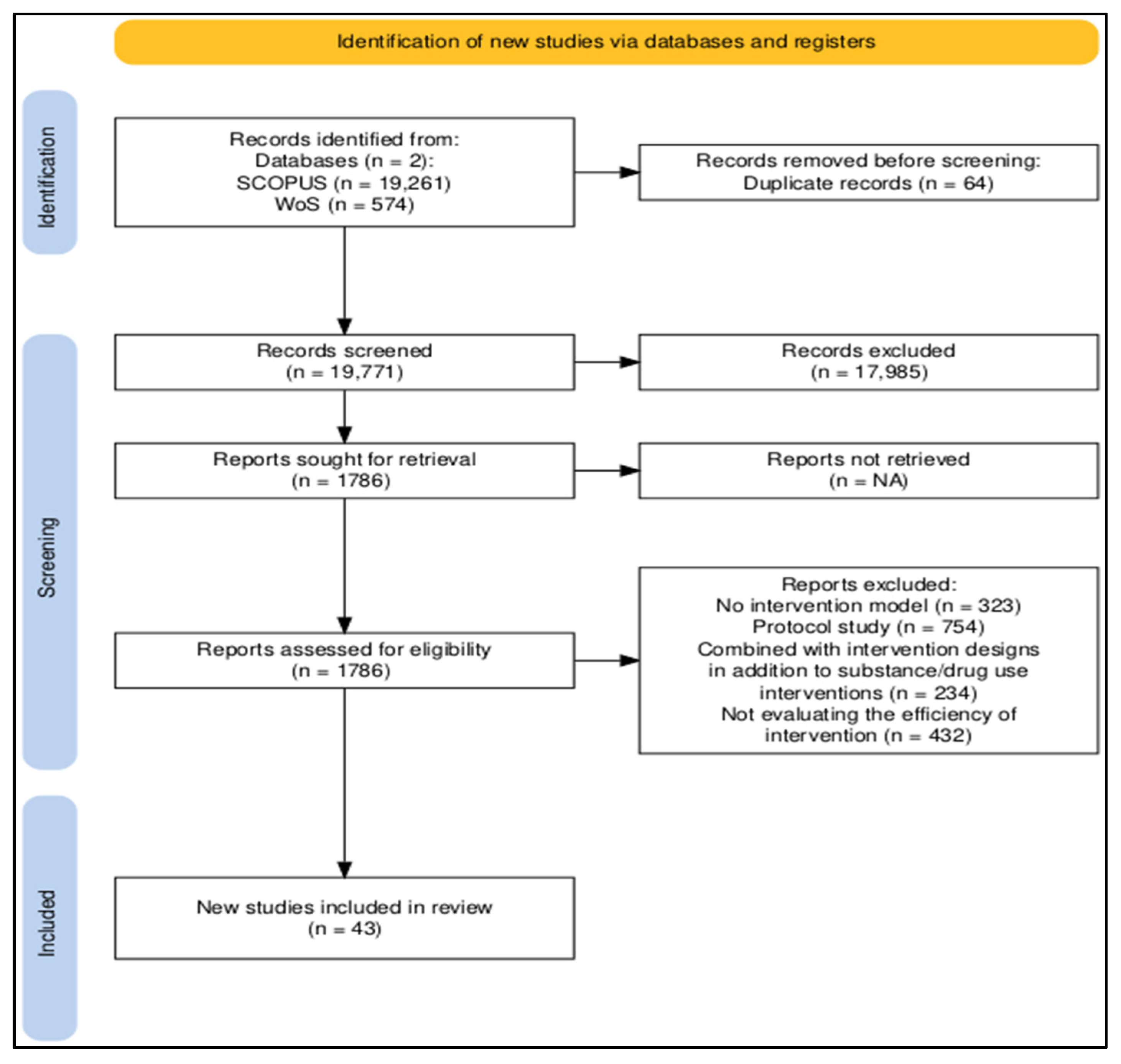
- This scoping review synthesises evidence from 43 studies and 33 distinct intervention models, addressing a gap in the literature by thoroughly mapping the design features that make school-based substance use prevention effective.
- The findings show that interventions grounded in explicit theory and involving multiple stakeholders (parents, community, and experts) produce more consistent and sustained reduction in substance use.
- Practitioners and policymakers should design interventions combining theoretical grounding, multi-stakeholder involvement, and dosage calibrated to children’s developmental stage, rather than relying on content volume alone.
- No corrective intervention model currently exists for schoolchildren already using substances. Researchers and policymakers should prioritise developing non-stigmatising, therapeutic school-based alternatives to punitive responses.
Abstract
1. Introduction
Research Questions
- Do explicit theoretical underpinned intervention models of substance use produce better and more sustained outcomes than atheorised interventions?
- What is the impact of specific stakeholder combinations in school-based substance use interventions on behavioural outcomes?
- Which specific psychosocial skill sets most strongly predict reduced substance use initiation?
2. Material and Methods
2.1. Search Strategy
2.2. Eligibility Criteria
2.3. Data Charting
2.4. Data Items
3. Results
3.1. Overview of Intervention Models
3.2. Synthesis of Findings
3.2.1. Theoretical Grounding and Outcomes

| Study ID | Name of Intervention | Country | Underlying Theories | Approach | Participants | Composition of Intervention | Skills Targeted |
|---|---|---|---|---|---|---|---|
| [77] | Across Ages’ | U.S.A. | NS 1 | P&P 2 | School administration, students, parents, community, seniors | Senior-mentoring; community service; youth development curriculum; parent workshop | Self-esteem; coping; substance knowledge |
| [74] | ALF (Allgemeine Lebenskompetenzen und Fertigkeiten) | Germany | NS 1 | P&P 2 | School administration, students | 12 teacher-led sessions (8 life skills + 4 substance-focused) | Communication; coping; critical thinking |
| [78] | All Stars | U.S.A. | NS 1 | P&P 2 | School administration, students, peers, parents | 13 classroom sessions + peer-leader small groups; Symbolic rewards | Social binding; norm-setting; commitment |
| [80] | CAP (CLIMATE & Preventure) | Australia | NS 1 | P&P 2 | School administration, students, experts |
| Social–interpersonal, cognitive, and autonomy/emotion-management life skills; bonding; inclusion |
| [90,91] | CATCH My Breath | U.S.A. | Social Cognitive Theory | P&P 2 | School administration, students, experts | 4 classroom sessions; peer-led (small groups) activities | Refusal, resilience, critical thinking |
| [95] | Click City | U.S.A. | Theory of Planned Behaviour | P&P 2 | School administration, students | 4 interactive classroom modules (25 min); peer-leader facilitation; posters; PE companion activities | E-cigarette knowledge; refusal; identification of social/environmental influences |
| [79] | CLIMATE Schools | Australia | NS 1 | P&P 2 | School administration, students, parents | Classroom lessons including 15–20 min computer-based lesson & class activities | Cannabis/alcohol-related knowledge, harm minimization information, personality-specific coping strategies |
| [82] | Coping Power Program | U.S.A. | Social Cognitive; Social Learning; & Developmental Theory | P&P 2 | School administration, students, parents, experts | 33 boys’ group sessions + 16 parent sessions (15 months) | Social–cognitive processes; social problem-solving; pressure handling; parenting skills |
| [81] | Creciendo Juntos | Mexico | Health Promotion Theory; Sociology of Modernity, Positive Youth Development | P&P 2 | School administration, students, parents, counsellors | 400+ activity compendium + tailored group-based activities; monthly meeting; observational visits | Bonding, communication, conflict resolution, critical thinking, decision-making, competence development |
| [75] | D.A.R.E. | U.S.A. | NS 1 | P&P 2 | School administration, students, experts | Sessions (1 hr/week) by uniformed police officers Activities: Role play, homework assignment. | Pressure resistance, decision-making, self-esteem, critical thinking |
| [72] | D.A.R.E.’s EkiR | U.S.A. | Social Emotional Learning Theory | P&P 2 | School administration, students, peers, experts | 10 D.A.R.E. officer-led lessons; 5 videos; comic book | Decision-making; self-management; relationship and communication skills |
| [83] | DEVS (Drug Education in Victorian Schools Program) | Australia | Social Learning; Post-Structural Subjectivity; & Cognitive dissonance Theory | P&P 2 | School administration, students, parents | 18 lessons over 2 years; teacher training; workbooks | Drug knowledge; communication; critical disposition |
| [85] | DST (Drug Story Theatre) | U.S.A. | Strategic Prevention Framework (SPF) | P&P 2 | School administration, students, peers | Live theatre performance + talk-back sessions | For students: Risk perception and prevention awareness For performers: Recovery and personal development skills |
| [86] | Fresh Start | Netherlands | Health Belief Model; Theory of Planned Behaviour; Transtheoretical Model; Social-Cognitive Theory. | P&P 2 | School administration, students, parents | 4 weekly lessons; peer pressure video; parents’ conference | Attitude towards smoking, alcohol use and cannabis use |
| [93] | HeadOn (Computer-based intervention) | U.S.A. | NS 1 | P&P 2 | School administration, students | Computer-based module [10]; “Skill Challenge” card games | Drug refusal & resistance; social skills; self-management skills |
| [89] | Healthy School & Drugs Project | Netherlands | Theory of Planned Behaviour; Social-Cognitive Theory. | P&P 2 | School administration, students | Educational lessons over 3 years; school regulations on drug use; parental involvement; early detection & support system | Refusal skills; decision-making skills; self-esteem development |
| [108] | Ho’ouna Pono | U.S.A. | Social Influence Model | P&P 2 | School administration, students, community members | Nine video-based lessons; interactive activities | Resistance & refusal |
| [67] | kiR REAL Group Model | U.S.A. | NS 1 | P&P 2 | School administration, students, peers, experts | 10 classroom lessons; 5 videos; mutual-aid group component | Resistance; critical thinking |
| [73] | kiR 3 | U.S.A. | NS 1 | P&P 2 | School administration, students | 10 classroom lessons; 5 videos; booster activities; media campaign | Decision-making; resistance; risk assessment |
| [68] | kiR 3 (acculturation version) | U.S.A. | NS 1 | P&P 2 | School administration, students | 10 classroom lessons; 5 videos; Latino/non-Latino/multicultural versions | Acculturation-linked; refusal confidence |
| [69] | kiR 3 (kiR-plus & kiR-AE) | U.S.A. | Communication Competence Theory | P&P 2 | School administration, students | 10 classroom lessons + 2 new lessons added in each version (kiR-Plus & kiR AE 4) | Resistance; anti-drug expectancies; refusal self-efficacy |
| [70] | kiR 3 (Entertainment–Education Videos | U.S.A. | Social Cognitive Theory; Narrative Engagement Theory | P&P 2 | School administration, students | “urban” & “rural” video versions of original kiR | Drug offers resistance; refusal self-efficacy |
| [71] | kiR MREAL (Mantente REAL) | Mexico | Ecological Risk and Resiliency Theory; Communication Competence Theory; Narrative Theory. | P&P 2 | School administration, students | 2-day teacher training; 12 weekly lessons | Drug resistance; non-permissive substance use norms and attitudes |
| [92] | OurFutures Vaping | Australia | NS 1 | P&P 2 | School administration, students, experts | Web-based cartoon lessons; quizzes, class discussion or role plays | Refusal, decision-making, social competence, critical thinking |
| [96,97] | Project ALERT | U.S.A. | NS 1 | P&P 2 | School administration, students, experts | 10 classroom sessions; class discussions; small group activities, role-playing exercises. | Drug identification; resistance |
| [98] | Project SUCCESS | U.S.A. | Theory of Reasoned Action, Social Learning Theory, Cognitive Behaviour Theory | P&P 2 | School administration, students. | 11 classroom lessons (6th grade) + 3 booster lessons (7th grade) | Resistance, self-efficacy, refusal |
| [99] | Project Northland Chicago (PNC) | U.S.A. | Theory of Triadic Influence; Perry’s planning model for adolescent health promotion | P&P 2 | School administration, students, parents, community | 6–10 peer-led classroom sessions per year; 4 home-based sessions per year Planned community service projects | Resistance, Self-efficacy, parenting |
| [87] | PULSAR | U.S.A. | NS 1 | P&P 2 | School administration, students, peers, experts | “At-risk” student identification; two-day retreat; post-retreat interviews | Communication and interpersonal; leadership and social competence; problem-solving skills; resistance and refusal skills; conflict resolution skills |
| [109] | R+ (Rehearsal Plus) | U.S.A. | NS 1 | P&P 2 | School administration, students, experts | Drug knowledge + assertiveness + behavioural + rehearsal Components | Assertiveness; decision-making |
| [105] | RHC (Raising Healthy Children) | U.S.A. | Social Development Model | P&P 2 | School administration, students, parents | Teacher + child + parents training | Social, emotional & cognitive |
| [107] | RRR (Refuse, Remove, Reasons) | NS 1 | Social Learning Theory; Mutual Aid Model | P&P 2 | School administration, students, peers, experts | 5-week curriculum; videos; homework | Risk perceptions |
| [84] | SHAHRP (School Health & Alcohol Harm Reduction Project) | Australia | Harm Reduction Theory | P&P 2 | School administration, students, experts | Phase 1: Eight activity-based lessons Phase 2: Five booster lessons Includes student workbooks and videos | High-risk identification, alcohol-related management and planning |
| [104] | S.S.D.P. (Seattle Social Development Project) | U.S.A. | Social Control Theory; Social Development Model | P&P 2 | School administration, students, peers, parents | Teacher + child + parents training | Social/family bonding; refusal skills |
| [103] | SAFEChildren | U.S.A. | NS 1 | P&P 2 | School administration, students | 16-session tutoring; parent workshops; booster family sessions | Reading; interaction; parental |
| [88] | SUPEP (Substance Use Prevention Education Program) | Nigeria | HBM (Health Belief Model) | P&P 2 | School administration, students | Teacher-delivered 12 weekly sessions + Q&A | Self-control and self-efficacy; drug resistance and resilience |
| [100,101,102] | TND (Project Towards No Drug Abuse) | U.S.A. | NS 1 | Preventive | School administration, students, experts | 12-session classroom curriculum; MI booster sessions (in-person/telephone) | Decision-making; motivation and behaviour change. |
| [94] | TGFD (Too Good for Drugs) | U.S.A. | Social Development Model; Social Learning; Social and Emotional Learning | P&P 2 | School administration, students, parents, experts | 10 weekly sessions; workbooks; homework | Goal setting; decision-making; interaction & bonding; self-management skills; drug resistance skills |
| [76] | TCYL (Take Charge of Your Life) | U.S.A. | Constructive Learning Theory | Preventive | School administration, students, experts | Lessons on substances and skills (specific for 7th and 9th grade level) | Communication, decision-making, assertiveness, refusal |
| [106] | EU-Dap “Unplugged” | 7-EU Nations | Comprehensive Social Influence Model | Preventive | School administration, students. | 12 classroom sessions | Resistance, peer pressure management, alcohol knowledge, decision-making |
3.2.2. Multi-Stakeholder Involvement and Intervention Effectiveness
3.2.3. Cultural Adaptation as a Moderating Factor
| Study ID | Name of Intervention | Covered Substances | Study Design | Population | Significant Outcome | ||||
|---|---|---|---|---|---|---|---|---|---|
| Method | N | Design | Duration | Age | Grade | ||||
| [77] | Across Ages’ | ATOD 5 | Mixed Method | 729 (Pretest); 562 (Post-test) | Pretest–post-test control group design | 3 years | NR 2 | 6th |
|
| [74] | ALF (Allgemeine Lebenskompetenzen und Fertigkeiten) | Alcohol & Tobacco | Quantitative | 256 IG 3 192 CG 4 | Quasi-experimental prevention study | 1 year | 10–11 | 5th |
|
| [78] | All Stars | ATOD 5 | Mixed Method | Enrolled—102; Completed—96 | Quasi-experimental study | 4–5 months | NR 2 | 7th |
|
| [80] | CAP (CLIMATE & Preventure) | Cannabis, Alcohol | Quantitative | 1712 | 4-arm cluster RCT 1 | 3 years | 13–14 | 8th |
|
| [90] | CATCH My Breath | Vaping | Quantitative | Enrolled—74 Follow-up—69 | Cross-sectional Study | 5 months | NR 2 | 6th–8th |
|
| [91] | CATCH My Breath | Vaping, cigarette | Quantitative | 12 schools 6 IG 3 6 CG 4 | Quasi-experimental | 16 months | NR 2 | 6th–7th |
|
| [95] | Click City: Tobacco | E-cigarette, Cigarette | Quantitative | 2673 (1327 IG 3 1346 CG 4) | Cluster RCT 1 | 1 week | NR 2 | 5th |
|
| [79] | CLIMATE Schools | Alcohol | Mixed Method | 764 397 IG 3 367 CG 4 | Cluster RCT 1 | 6 months | 13–14 | 8th |
|
| [82] | Coping Power Program | ATOD 5 | Quantitative | 60 (Children Group); 60 (Child & Parent Group) 63 (CG 4) | Pre–Post Comparison Group Design | 2 years | NR 2 | 4th–7th (Boys) |
|
| [81] | Creciendo Juntos | Alcohol, Tobacco, Marijuana | Mixed Method | 285 | Mixed-methods trend study with epidemiological comparison data | 4 years | NR 2 | 9th–10th |
|
| [75] | D.A.R.E. | Alcohol, Tobacco, Marijuana | Quantitative | 2071 | RCT 1 | 5 years | 11–16 | 6th–10th |
|
| [72] | D.A.R.E.’s EkiR | Cigarette | Quantitative | 359 IG 3 584 CG 4 | Quasi-experimental pretest–post-test matched group design | NR 2 | NR 2 | 6th |
|
| [83] | DEVS (Drug Education in Victorian School Program) | ATOD 5 | Quantitative | 1161 IG 3 585 CG 4 | Cluster RCT 1 | 2 years | 13–16 | 8th–10th |
|
| [85] | DST (Drug Story Theatre) | ATOD 5 | Mixed Method | 871 | Pre–post survey design & focus interviews | 2 years | NR 2 | 6th–11th |
|
| [86] | Fresh Start | Alcohol, Cigarette, Cannabis | Quantitative | 478 IG 3 548 CG 4 | Cluster RCT 1 | 10 months | 12–13 | NR 2 |
|
| [93] | HeadOn (Computer-based intervention) | ATOD 5 | Quantitative | 113 (HeadOn group); 159 (Life-skill group) | School-based controlled trial | 1 year | 12–13 | 7th |
|
| [89] | Healthy School & Drugs Project | Alcohol, Tobacco, Marijuana | Quantitative | 1156 students—IG 3 774 students—CG 4 | Quasi-experimental design | 3 years | 12–18 | NR 2 |
|
| [108] | Ho’ouna Pono | ATOD | Quantitative | 486 | Dynamic wait-listed control group design | 2 years | 11–14 | 6th–8th |
|
| [67] | kiR REAL Group Model | ATOD 5 | Quantitative | Total sample—421; 115 IG 3; 306 CG 4 | Longitudinal randomised control trial | 6–7 months | 10–11 | 5th |
|
| [73] | kiR 3 | Alcohol, Cigarette, Marijuana | Quantitative | 4622 | RCT 1 | 2 years | NR 2 | 7th |
|
| [68] | kiR 3 (acculturation version) | Alcohol, Cigarette, Marijuana | Quantitative | 2146 | Pretest–post-test experimental design | 14 months | NR 2 | 7th–8th |
|
| [69] | kiR 3 (kiR-plus & kiR-AE) | Alcohol, Cigarette, Marijuana | Quantitative | 1984 | RCT 1 | 4 years | NR 2 | 5th–8th |
|
| [70] | kiR 3 (Entertainment–Education Videos | Alcohol | Quantitative | 1464 (501—urban students; 963—rural students) | RCT 1 | 1 year | 13–14 | 7th |
|
| [71] | kiR MREAL (Mantente REAL) | ATOD 5 | Quantitative | 1418 | Cluster RCT 1 | 7 months | NR 2 | 7th |
|
| [92] | OurFutures Vaping | Vaping | Quantitative | 2449 IG 3 2708 CG 4 Follow-up—4956 | Cluster RCT 1 | 12 months | 12–14 | 7th–8th |
|
| [97] | Project ALERT | Alcohol, Cigarette, Marijuana | Quantitative | 5782 (participated initially); 4940 (completed all three waves) | RCT 1 | 2 years | NR 2 | 6th–8th |
|
| [96] | Project ALERT | Alcohol, cigarette, Marijuana | Quantitative | 4276 2553 IG 3 1723 CG 4 | Cluster RCT 1 | 18 months | NR 2 | 7th–8th |
|
| [98] | Project SUCCESS | ATOD | Quantitative | 2249 | Cluster RCT 1 | 2 years | 14–18 | 9th 12th |
|
| [99] | Project Northland Chicago (PNC) | ATOD | Quantitative | 4259 | Group RCT 1 | 3 years | 11–14 | 6th–8th |
|
| [87] | PULSAR 6 | Drugs & Alcohol | Qualitative | 05 | Experiential study design | 6 weeks | NR 2 | 7th |
|
| [109] | R+ (Rehearsal Plus) | Alcohol, Tobacco, Marijuana | Mixed Method | 14 students—R+ 12 students—general information 8 students—CG 4 | Pretest–post-test control group | 8 weeks | 8–10 | 3rd |
|
| [105] | RHC (Raising Healthy Children) | ATOD 5 | Quantitative | 156 (full intervention); 141 (parent training only); 220 (CG 4) | Non-randomised controlled trial | 33 years | 6–39 | From 1st |
|
| [107] | RRR (Refuse, Remove, Reasons) | ATOD 5 | Quantitative | 678 IG 3; 674 CG 4 | Quasi-experimental design | 3 Months | 15 | NR 2 |
|
| [84] | SHAHRP (School Health & Alcohol Harm Reduction Project) | Alcohol | Quantitative | 2300 | Quasi-experimental | 32 months | 12–17 | NR 2 |
|
| [104] | S.S.D.P. (Seattle Social Development Project) | Alcohol, Tobacco, Marijuana | Quantitative | 177 (initially) −102 CG 4; 75 IG 3 106 (completed) −62 CG 4; 44 IG 3 | Self-report survey and longitudinal study | 6 years | NR 2 | 1st–6th |
|
| [103] | SAFEChildren | Alcohol, Tobacco, Marijuana | Mixed Method | 424 (consenting families); 375 (completed) | RCT 1 | 13 years | 5–18 | K.G.-12th |
|
| [88] | SUPEP (Substance Use Prevention Education Program) | ATOD 5 | Quantitative | 200 (initially) 126 (completed): 75 (IG 3) & 51 (CG 4) | Quasi-experimental pre-post test design | 5 months | 14–20 | NR 2 |
|
| [100] | TND (Project Towards No Drug Abuse) | ATOD 5 | Quantitative | 1074 | Randomised treatment-control design | 1 year | 14–19 | 9th–12th |
|
| [101] | TND (Project Towards No Drug Abuse) | ATOD 5 | Quantitative | 1186 | RCT 1 | 1 year | 14–18 | 9th–12th |
|
| [102] | TND (Project Towards No Drug Abuse) | ATOD 5 | Quantitative | 1867 | RCT 1 | 5 years | 14–19 | 9th–12th |
|
| [94] | TGFD (Too Good for Drugs) | ATOD 5 | Quantitative | Pre-survey stage (10,762) | Stratified randomised treatment-control design | 6 months | 11–14 | K-12th |
|
| [76] | TCYL (Take Charge of Your Life) | Alcohol, Tobacco, Marijuana | Quantitative | 17,320 (baseline); 10,434 (11th-grade completers) | Cluster RCT 1 | 5 years | NR 2 | 7th–11th |
|
| [106] | EU-Dap “Unplugged” | ATOD 5 | Quantitative | 5541 | Cluster RCT 1 | 18 months | 12–14 | 7th 8th |
|
3.2.4. Dosage, Duration and Developmental Targeting
3.2.5. Null, Partial and Iatrogenic Findings
3.3. Key Outcome
3.4. Critical Appraisal of Included Studies
4. Discussion
5. Conclusions
6. Limitations
- This review includes literature published only in the English language, thereby excluding models which could be analysed in any other language.
- The majority of the relevant intervention models were applied from the US (30 of 43). This substantially limits the generalizability of findings to non-Western countries. Future reviews will be conducted as soon as relevant interventions are studied in low- and middle-income countries like Sub-Saharan Africa and Southeast Asia.
- The review must be interpreted cautiously as the heterogeneity in the study design and the iatrogenic and null findings in some models complicate direct comparisons of the models.
- This review’s protocol was not formally pre-registered; readers may wish to bear this in mind alongside the review’s other transparency measures.
- The search drew on two databases, SCOPUS and Web of Science; readers should note that the evidence base reflects this scope, alongside the English-language restriction already noted, rather than a broader multi-database or grey-literature search.
- Formal inter-rater reliability (κ = 0.75) is reported for title/abstract screening; full-text screening and data charting were carried out jointly by the review team, and readers may wish to keep this collaborative process in mind when weighing these stages of the review.
Supplementary Materials
Author Contributions
Funding
Institutional Review Board Statement
Informed Consent Statement
Data Availability Statement
Conflicts of Interest
References
- Nath, A.; Choudhari, S.G.; Dakhode, S.U.; Rannaware, A.; Gaidhane, A.M. Substance Abuse Amongst Adolescents: An Issue of Public Health Significance. Cureus 2022, 14, e31193. [Google Scholar] [CrossRef] [Scilit] [PubMed]
- Belfiore, C.I.; Galofaro, V.; Cotroneo, D.; Lopis, A.; Tringali, I.; Denaro, V.; Casu, M. A Multi-Level Analysis of Biological, Social, and Psychological Determinants of Substance Use Disorder and Co-Occurring Mental Health Outcomes. Psychoactives 2024, 3, 194–214. [Google Scholar] [CrossRef] [Scilit]
- Maina, G.; Mclean, M.; Mcharo, S.; Kennedy, M.; Djiometio, J.; King, A. A scoping review of school-based indigenous substance use prevention in preteens (7–13 years). Subst. Abus. Treat. Prev. Policy 2020, 15, 74. [Google Scholar] [CrossRef] [Scilit] [PubMed]
- Bröning, S.; Kumpfer, K.; Kruse, K.; Sack, P.M.; Schaunig-Busch, I.; Ruths, S.; Moesgen, D.; Pflug, E.; Klein, M.; Thomasius, R. Selective prevention programs for children from substance-affected families: A comprehensive systematic review. Subst. Abus. Treat. Prev. Policy 2012, 7, 23. [Google Scholar] [CrossRef] [Scilit] [PubMed]
- Dixon, L.; Mcnary, S.; Lehman, A. One-Year Follow-Up of Secondary Versus Primary Mental Disorder in Persons With Comorbid Substance Use Disorders. Am. J. Psychiatry 1997, 154, 1610–1612. [Google Scholar] [CrossRef] [Scilit] [PubMed]
- Richert, T.; Anderberg, M.; Dahlberg, M. Mental health problems among young people in substance abuse treatment in Sweden. Subst. Abus. Treat. Prev. Policy 2020, 15, 43. [Google Scholar] [CrossRef] [Scilit] [PubMed]
- Nowak, M.; Papiernik, M.; Mikulska, A.; Czarkowska-Paczek, B. Smoking, alcohol consumption, and illicit substances use among adolescents in Poland. Subst. Abus. Treat. Prev. Policy 2018, 13, 42. [Google Scholar] [CrossRef] [Scilit] [PubMed]
- Mak, Y.W.; Leung, D.; Loke, A.Y. The vulnerability to alcohol, tobacco, and drug use of adolescents in Hong Kong: A phenomenological study. BMC Pediatr. 2019, 19, 303. [Google Scholar] [CrossRef] [Scilit] [PubMed]
- WHO. WHO Global Report on Trends in Prevalence of Tobacco Use 2000–2030. 2024. Available online: https://iris.who.int/ (accessed on 20 March 2026).
- Charrier, L.; Van Dorsselaer, S.; Canale, N.; Baska, T.; Kilibarda, B.; Comoretto, R.I.; Galeotti, T.; Brown, J.; Vieno, A. A Focus on Adolescent Substance Use in Europe, Central Asia and Canada: Health Behaviour in School-Aged Children International Report from the 2021/2022 Survey; World Health Organization: Geneva, Switzerland, 2024; Available online: https://iris.who.int/handle/10665/376573 (accessed on 13 March 2026).
- UNODC. World Drug Report, 2025. 2025. Available online: https://www.unodc.org/unodc/en/data-and-analysis/world-drug-report-2025-annex.html (accessed on 20 March 2026).
- Keyzers, A.; Lee, S.K.; Dworkin, J. Peer Pressure and Substance Use in Emerging Adulthood: A Latent Profile Analysis. Subst. Use Misuse 2020, 55, 1716–1723. [Google Scholar] [CrossRef] [Scilit] [PubMed]
- Valente, T.W.; Ritt-Olson, A.; Stacy, A.; Unger, J.B.; Okamoto, J.; Sussman, S. Peer acceleration: Effects of a social network tailored substance abuse prevention program among high-risk adolescents. Addiction 2007, 102, 1804–1815. [Google Scholar] [CrossRef] [Scilit] [PubMed]
- Feldstein, S.W.; Miller, W.R. Substance use and risk-taking among adolescents. J. Ment. Health 2006, 15, 633–643. [Google Scholar] [CrossRef] [Scilit]
- Belcher, H.M.; Shinitzky, H.E. Substance abuse in children: Prediction, protection and prevention. Arch. Pediatr. Adolesc. Med. 1998, 152, 952–960. [Google Scholar] [CrossRef] [Scilit] [PubMed]
- Samuels, D.J.; Samuels, M. Low self concept as a cause of drug abuse. J. Drug Educ. 1974, 4, 421–438. [Google Scholar] [CrossRef] [Scilit]
- Nebhinani, N.; Nebhinani, M.; Misra, A.K.; Kaur, M. Knowledge & attitude towards drug use in school students. Indian J. Soc. Psychiatry 2013, 29, 114–118. [Google Scholar]
- Hogarth, L.; Martin, L.; Seedat, S. Relationship between childhood abuse and substance misuse problems is mediated by substance use coping motives, in school attending South African adolescents. Drug Alcohol. Depend. 2019, 194, 69–74. [Google Scholar] [CrossRef] [Scilit] [PubMed]
- Breyer, J.L.; Lee, S.; Winters, K.C.; August, G.J.; Realmuto, G.M. A longitudinal study of childhood ADHD and substance dependence disorders in early adulthood. Psychol. Addctv. Behav. 2014, 28, 238–246. [Google Scholar] [CrossRef] [Scilit] [PubMed]
- Quinn, P.D.; Harden, K.P. Differential changes in impulsivity and sensation seeking and the escalation of substance use from adolescence to early adulthood. Dev. Psychopathol. 2013, 25, 223–239. [Google Scholar] [CrossRef] [Scilit] [PubMed]
- Brown, S.A.; Tate, S.R.; Vik, P.W.; Haas, A.L.; Aarons, G.A. Modeling of alcohol use mediates the effect of family history of alcoholism on adolescent alcohol expectancies. Exp. Clin. Psychopharmacol. 1999, 7, 20–27. [Google Scholar] [CrossRef] [PubMed]
- Osborne, C.; Berger, L.M. Parental substance abuse and child well-being: A consideration of parents’ gender and coresidence. J. Fam. Issues 2009, 30, 341–370. [Google Scholar] [CrossRef] [Scilit]
- Cambron, C.; Kosterman, R.; Rhew, I.C.; Catalano, R.F.; Guttmannova, K.; Hawkins, J.D. Neighborhood Structural Factors and Proximal Risk for Youth Substance Use. Prev. Sci. 2020, 21, 508–518. [Google Scholar] [CrossRef] [Scilit] [PubMed]
- Petruzzi, L.J.; Pullen, S.J.; Lange, B.C.; Parnarouskis, L.; Dominguez, S.; Harris, B.; Quiterio, N.; Lekpeh, G.; Manobah, B.; Henderson, D.C.; et al. Contributing Risk Factors for Substance Use Among Youth in Postconflict Liberia. Qual. Health Res. 2018, 28, 1827–1838. [Google Scholar] [CrossRef] [Scilit] [PubMed]
- Zimmerman, G.M.; Farrell, C. Parents, Peers, Perceived Risk of Harm, and the Neighborhood: Contextualizing Key Influences on Adolescent Substance Use. J. Youth Adolesc. 2017, 46, 228–247. [Google Scholar] [CrossRef] [Scilit] [PubMed]
- Whitesell, M.; Bachand, A.; Peel, J.; Brown, M. Familial, Social, and Individual Factors Contributing to Risk for Adolescent Substance Use. J. Addict. 2013, 2013, 579310. [Google Scholar] [CrossRef] [Scilit] [PubMed]
- Aschengrau, A.; Grippo, A.; Winter, M.R. Influence of Family and Community Socioeconomic Status on the Risk of Adolescent Drug Use. Subst. Use Misuse 2021, 56, 577–587. [Google Scholar] [CrossRef] [Scilit] [PubMed]
- Busch, V.; Loyen, A.; Lodder, M.; Schrijvers, A.J.P.; van Yperen, T.A.; de Leeuw, J.R.J. The Effects of Adolescent Health-Related Behavior on Academic Performance: A Systematic Review of the Longitudinal Evidence. Rev. Educ. Res. 2014, 84, 245–274. [Google Scholar] [CrossRef] [Scilit]
- Engberg, J.; Morral, A.R. Reducing substance use improves adolescents’ school attendance. Addiction 2006, 101, 1741–1751. [Google Scholar] [CrossRef] [Scilit] [PubMed]
- Sanchez, Z.M.; Nappo, S.A.; Cruz, J.I.; Carlini, E.A.; Carlini, C.M.; Martins, S.S. Sexual behavior among high school students in Brazil: Alcohol consumption and legal and illegal drug use associated with unprotected sex. Clinics 2013, 68, 489–494. [Google Scholar] [CrossRef] [Scilit] [PubMed]
- Shrier, L.A.; Jean Emans, S.; Woods, E.R.; Durant, R.H. The Association of Sexual Risk Behaviors and Problem Drug Behaviors in High School Students. J. Adolesc. Health 1996, 20, 377–383. [Google Scholar] [CrossRef] [Scilit] [PubMed]
- Howard, D.E.; Wang, M.Q. The relationship between substance use and STD/HIV-related sexual risk behaviors among US adolescents. J. HIV/AIDS Prev. Child. Youth 2004, 6, 65–82. [Google Scholar] [CrossRef] [Scilit]
- Otero-Lopez, J.M.; Luengo-Martin, A.; Miron-Redondo, L.; Carillo-De, M.T.; Romero-Trinanes, E. Empirical Study of the Relations between Drug and Delinquency among Adolescents. Br. J. Criminol. 1994, 34, 459–478. [Google Scholar] [CrossRef] [Scilit]
- Katas, K.U.; Nwankwo, E.I.; Igwama, G.T.; Olaboye, J.A.; Anyanwu, E.C. Evaluating the impact of early intervention programs on substance abuse prevention in adolescents: A comprehensive review. Int. J. Appl. Res. Soc. Sci. 2023, 5, 768–785. [Google Scholar] [CrossRef] [Scilit]
- Afuseh, E.; Pike, C.A.; Oruche, U.M. Individualized approach to primary prevention of substance use disorder: Age-related risks. Subst. Abus. Treat. Prev. Policy 2020, 15, 58. [Google Scholar] [CrossRef] [Scilit] [PubMed]
- Tinner, L.; Palmer, J.C.; Lloyd, E.C.; Caldwell, D.M.; MacArthur, G.J.; Dias, K.; Langford, R.; Redmore, J.; Wittkop, L.; Watkins, S.H.; et al. Individual-, family- and school-based interventions to prevent multiple risk behaviours relating to alcohol, tobacco and drug use in young people aged 8-25 years: A systematic review and meta-analysis. BMC Public Health 2022, 22, 1111. [Google Scholar] [CrossRef] [Scilit] [PubMed]
- Edalati, H.; Conrod, P.J. A review of personality-targeted interventions for prevention of substance misuse and related harm in community samples of adolescents. Front. Psychiatry 2019, 9, 770. [Google Scholar] [CrossRef] [Scilit] [PubMed]
- Stockings, E.; Hall, W.D.; Lynskey, M.; Morley, K.I.; Reavley, N.; Strang, J.; Patton, G.; Degenhardt, L. Prevention, early intervention, harm reduction, and treatment of substance use in young people. Lancet Psychiatry 2016, 3, 280–296. [Google Scholar] [CrossRef] [Scilit] [PubMed]
- Lochman, J.E.; Van Den Steenhoven, A. Family-Based Approaches to Substance Abuse Prevention. J. Prim. Prev. 2002, 23, 49–114. [Google Scholar] [CrossRef] [Scilit]
- Liu, X.Q.; Guo, Y.X.; Wang, X. Delivering substance use prevention interventions for adolescents in educational settings: A scoping review. World J. Psychiatry 2023, 13, 409–422. [Google Scholar] [CrossRef] [Scilit] [PubMed]
- Lalongo, N.S.; Werthamer, L.; Kellam, S.G.; Hendricks Brown, C.; Wang, S.; Lin, Y. Proximal Impact of Two First-Grade Preventive Interventions on the Early Risk Behaviors for Later Substance Abuse, Depression, and Antisocial Behavior. Am. J. Community Psychol. 1999, 27, 599–641. [Google Scholar] [CrossRef] [Scilit] [PubMed]
- Bisset, S.; Markham, W.A.; Aveyard, P. School culture as an influencing factor on youth substance use. J. Epidemiol. Community Health 2007, 61, 485–490. [Google Scholar] [CrossRef] [Scilit] [PubMed]
- Nawi, A.M.; Ismail, R.; Ibrahim, F.; Hassan, M.R.; Manaf, M.R.; Amit, N.; Ibrahim, N.; Shafurdin, N.S. Risk and protective factors of drug abuse among adolescents: A systematic review. BMC Public Health 2021, 21, 2088. [Google Scholar] [CrossRef] [Scilit] [PubMed]
- Arthur, M.W.; Hawkins, J.D.; Pollard, J.A.; Catalano, R.F.; Baglioni, A.J. Measuring Risk and Protective Factors for Use, Delinquency, and Other Adolescent Problem Behaviors. Eval. Rev. 2002, 26, 575–601. [Google Scholar] [CrossRef] [Scilit] [PubMed]
- Hogue, A.; Liddle, H.A.; Becker, D.; Johnson-Leckrone, J. Family-based adolescent counselling for high-risk young adolescents: Immediate outcomes. J. Community Psychol. 1998, 30, 1–22. [Google Scholar]
- Kim, S.; Crutchfield, C.; Williams, C.; Hepler, N. Toward a New Paradigm in Substance Abuse and other Problem Behavior Prevention for Youth: Youth Development and Empowerment Approach. J. Drug Educ. 1998, 28, 1–17. [Google Scholar] [CrossRef] [Scilit] [PubMed]
- Harachi, T.W.; Ayers, C.D.; Hawkins, J.D.; Catalano, R.F.; Cushing, J. Empowering communities to prevent adolescent substance abuse: Process evaluation results from a risk- and protection-focused community mobilization efforts. J. Prim. Prev. 1996, 16, 233–254. [Google Scholar] [CrossRef] [Scilit] [PubMed]
- Schinke, S.P.; Moncher, M.S.; Palleja, J.; Zayas, L.H.; Schilling, R.F. Hispanic Youth, Substance Abuse, and Stress: Implications for Prevention Research. Int. J. Addctn. 1988, 23, 9–26. [Google Scholar] [CrossRef] [Scilit] [PubMed]
- Dishion, T.J.; Kavanagh, K.; Schneiger, A.; Nelson, S.; Kaufman, N.K. Preventing early adolescent substance use: A family-centered strategy for the public middle school. Prev. Sci. 2002, 3, 191–201. [Google Scholar] [CrossRef] [Scilit] [PubMed]
- Demarsh, J.; Kumpfer, K.L. Family-Oriented Interventions for the Prevention of Chemical Dependency in Children and Adolescents. J. Child. Contemp. Soc. 1986, 18, 117–151. [Google Scholar] [CrossRef] [Scilit]
- Henderson, J.L.; Brownlie, E.B.; McMain, S.; Chaim, G.; Wolfe, D.A.; Rush, B.; Boritz, T.; Beitchman, J.H. Enhancing prevention and intervention for youth concurrent mental health and substance use disorders: The Research and Action for Teens study. Early Interv. Psychiatry 2019, 13, 110–119. [Google Scholar] [CrossRef] [Scilit] [PubMed]
- Donovan, D. Healing of the canoe: Preliminary results of a culturally tailored intervention to prevent substance abuse and promote tribal identity for Native youth in two Pacific Northwest tribes. Am. Indian Alsk. Nativ. Ment. Health Res. 2015, 22, 42–76. [Google Scholar] [CrossRef] [Scilit] [PubMed]
- Whitesell, N.R.; Mousseau, A.C.; Keane, E.M.; Asdigian, N.L.; Tuitt, N.; Morse, B.; Zacher, T.; Dick, R.; Mitchell, C.M.; Kaufman, C.E. Integrating Community-Engagement and a Multiphase Optimization Strategy Framework: Adapting Substance Use Prevention for American Indian Families. Prev. Sci. 2019, 20, 1136–1146. [Google Scholar] [CrossRef] [Scilit] [PubMed]
- Botvin, G.J.; Lori, W.K. Preventing Alcohol and Tobacco Use Through Life Skills Training Theory, Methods, and Empirical Findings. Alcohol Res. Health 2000, 24, 250–257. [Google Scholar] [PubMed]
- Chirimwami, V.; Van Ryzin, M.J. Universal School-Based Substance Use Prevention Using Technology-Supported Cooperative Learning. Prev. Sci. 2024, 25, 488–497. [Google Scholar] [CrossRef] [Scilit] [PubMed]
- Botvin, G.J. Substance Abuse Prevention: Theory, Practice, and Effectiveness. Crime Justice 1990, 13, 461–519. [Google Scholar] [CrossRef] [Scilit]
- Hecht, M.L.; Krieger, J.L.R. The principle of cultural grounding in school-based substance abuse prevention: The drug resistance strategies project. J. Lang. Soc. Psychol. 2006, 25, 301–319. [Google Scholar] [CrossRef] [Scilit]
- Gilchrist, L.D.; Schinke, S.P.; Trimble, J.E.; Cvetkovich, G.T. Skills enhancement to prevent substance abuse among american indian adolescents. Int. J. Addctn. 1987, 22, 869–879. [Google Scholar] [CrossRef] [Scilit] [PubMed]
- Fishbein, D.H.; Sloboda, Z. A National Strategy for Preventing Substance and Opioid Use Disorders Through Evidence-Based Prevention Programming that Fosters Healthy Outcomes in Our Youth. Clin. Child. Fam. Psychol. Rev. 2023, 26, 1–16. [Google Scholar] [CrossRef] [Scilit] [PubMed]
- Sloboda, Z.; Johnson, K.A.; Fishbein, D.H.; Brown, C.H.; Coatsworth, J.D.; Fixsen, D.L.; Kandel, D.; Paschall, M.J.; Silva, F.S.; Sumnall, H.; et al. Normalization of Prevention Principles and Practices to Reduce Substance Use Disorders Through an Integrated Dissemination and Implementation Framework. Prev. Sci. 2023, 24, 1078–1090. [Google Scholar] [CrossRef] [Scilit] [PubMed]
- Faggiano, F.; Minozzi, S.; Versino, E.; Buscemi, D. Universal school-based prevention for illicit drug use. Cochrane Database Syst. Rev. 2014, 12, CD003020. [Google Scholar] [CrossRef] [Scilit] [PubMed]
- Botvin, G.J.; Baker, E.; Dusenbury, L.; Botvin, E.M.; Diaz, T. Long-term Follow-up Results of a Randomized Drug Abuse Prevention Trial in a White Middle-class Population. JAMA 1995, 273, 1106–1112. [Google Scholar] [CrossRef] [Scilit]
- Griffin, K.W.; Botvin, G.J.; Nichols, T.R.; Doyle, M.M. Effectiveness of a universal drug abuse prevention approach for youth at high risk for substance use initiation. Prev. Med. 2003, 36, 1–7. [Google Scholar] [CrossRef] [Scilit] [PubMed]
- Onrust, S.A.; Otten, R.; Lammers, J.; Smit, F. School-based programmes to reduce and prevent substance use in different age groups: What works for whom? Systematic review and meta-regression analysis. Clin. Psychol. Rev. 2016, 44, 45–59. [Google Scholar] [CrossRef] [Scilit] [PubMed]
- Munn, Z.; Pollock, D.; Khalil, H.; Alexander, L.; McLnerney, P.; Godfrey, C.M.; Peters, M.; Tricco, A.C. What are scoping reviews? Providing a formal definition of scoping reviews as a type of evidence synthesis. JBI Evid. Synth. 2022, 20, 950–952. [Google Scholar] [CrossRef] [Scilit] [PubMed]
- Landis, J.R.; Koch, G.G. The Measurement of Observer Agreement for Categorical Data. Biometrics 1977, 33, 159–174. [Google Scholar] [CrossRef] [Scilit]
- Marsiglia, F.F.; Peña, V.; Nieri, T.; Nagoshi, J.L. Real Groups: The design and immediate effects of a prevention intervention for Latino children. Soc. Work Groups 2010, 33, 103–121. [Google Scholar] [CrossRef] [Scilit] [PubMed][Green Version]
- Marsiglia, F.F.; Kulis, S.; Wagstaff, D.A.; Elek, E.; Dran, D. Acculturation status and substance use prevention with mexican and mexican-american youth. J. Soc. Work Pract. Addict. 2005, 5, 85–111. [Google Scholar] [CrossRef] [Scilit] [PubMed]
- Elek, E.; Wagstaff, D.A.; Hecht, M.L. Effects of the 5th and 7th grade enhanced versions of the keepin’ it real substance use prevention curriculum. J. Drug Educ. 2010, 40, 61–79. [Google Scholar] [CrossRef] [Scilit] [PubMed]
- Shin, Y.J.; Miller-Day, M.; Hecht, M.L.; Krieger, J.L. Entertainment–Education Videos as a Persuasive Tool in the Substance Use Prevention Intervention “keepin’ it REAL”. Health Commun. 2018, 33, 896–906. [Google Scholar] [CrossRef] [Scilit] [PubMed]
- Kulis, S.S.; Garcia-Perez, H.; Marsiglia, F.F.; Ayers, S.L. Testing a Culturally Adapted Youth Substance Use Prevention Program in a Mexican Border City: Mantente REAL. Subst. Use Misuse 2020, 56, 245–257. [Google Scholar] [CrossRef] [Scilit] [PubMed]
- Day, L.E.; Miller-Day, M.; Hecht, M.L.; Fehmie, D. Coming to the new DARE: A preliminary test. of the officer-taught elementary keepin’ it REAL curriculum. Addctv. Behav. 2017, 74, 67–73. [Google Scholar] [CrossRef] [Scilit] [PubMed]
- Kulis, S.; Yabiku, S.T.; Marsiglia, F.F.; Nieri, T.; Crossman, A. Differences by Gender, Ethinicity, and Acculturation in the efficacy of the keepin’ it REAL Model Prevention Program. J. Drug Educ. 2007, 37, 123–144. [Google Scholar] [CrossRef] [Scilit] [PubMed]
- Bühler, A.; Schröder, E.; Silbereisen, R.K. The role of life skills promotion in substance abuse prevention: A mediation analysis. Health Educ. Res. 2008, 23, 621–632. [Google Scholar] [CrossRef] [Scilit] [PubMed]
- Clayton, R.R.; Cattarello, A.M.; Johnstone, B.M. The Effectiveness of Drug Abuse Resistance Education (Project DARE): 5-Year Follow-Up Results. Prev. Med. 1996, 25, 307–318. [Google Scholar] [CrossRef] [Scilit] [PubMed]
- Sloboda, Z.; Stephens, R.C.; Stephens, P.C.; Grey, S.F.; Teasdale, B.; Hawthorne, R.D.; Williams, J.; Marquette, J.F. The Adolescent Substance Abuse Prevention Study: A randomized field trial of a universal substance abuse prevention program. Drug Alcohol Depend. 2009, 102, 1–10. [Google Scholar] [CrossRef] [Scilit] [PubMed]
- LoSciuto, L.; Rajala, A.K.; Townsend, T.N.; Taylor, A.S. An Outcome Evaluation of Across Ages: An Intergenerational Mentoring Approach to Drug Prevention. J. Adolesc. Res. 1996, 11, 116–129. [Google Scholar]
- Hansen, W.B. Pilot Test Results Comparing the All Stars Program with Seventh Grade DARE: Program. Integrity and Mediating Variable Analysis. Subst. Use Misuse 1996, 31, 1359–1377. [Google Scholar] [CrossRef] [Scilit] [PubMed]
- Newton, N.C.; Vogl, L.E.; Teesson, M.; Andrews, G. CLIMATE Schools: Alcohol module: Cross-validation of a school-based prevention programme for alcohol misuse. Aust. N. Z. J. Psychiatry 2009, 43, 201–207. [Google Scholar] [CrossRef] [Scilit] [PubMed]
- Newton, N.C.; Teesson, M.; Mather, M.; Champion, K.E.; Barrett, E.L.; Stapinski, L.; Carragher, N.; Kelly, E.; Conrod, P.J.; Slade, T. Universal cannabis outcomes from the Climate and Preventure (CAP) study: A cluster randomised controlled trial. Subst. Abus. Treat. Prev. Policy 2018, 13, 34. [Google Scholar] [CrossRef] [Scilit] [PubMed]
- Millé, C.; Juárez, A.; Jiménez, A. From Model to Case: Implementation, Follow-Up, and Evaluation of a Permanent School Prevention Program. Int. J. Ment. Health Addict. 2020, 18, 443–458. [Google Scholar] [CrossRef] [Scilit]
- Lochman, J.E.; Wells, K.C. Contextual social-cognitive mediators and child outcome: A test of the theoretical model in the Coping Power program. Dev. Psychopathol. 2002, 14, 945–967. [Google Scholar] [CrossRef] [Scilit] [PubMed]
- Midford, R.; Ramsden, R.; Lester, L.; Cahill, H.; Mitchell, J.; Foxcroft, D.R.; Venning, L. Alcohol prevention and school students: Findings from an Australian 2-year trial of integrated harm minimization school drug education. J. Drug Educ. 2014, 44, 71–94. [Google Scholar] [CrossRef] [Scilit] [PubMed]
- Mcbride, N.; Farringdon, F.; Midford, R.; Meuleners, L.; Phillips, M. Early unsupervised drinking—Reducing the risks. The School Health and Alcohol Harm Reduction Project. Drug Alcohol Rev. 2003, 22, 263–276. [Google Scholar] [CrossRef] [Scilit] [PubMed]
- Shrand, J.; Digiovanni, M.; Lee, D.; Kishore, A.; Martin, A. Drug story theater: A mixed-methods study of a peer-to-peer approach to substance abuse education. Health Behav. Policy Rev. 2021, 8, 281–293. [Google Scholar] [CrossRef] [Scilit]
- Onrust, S.A.; van der Heijden, A.; Zschämisch, A.L.; Speetjens, P.A.M. Effectiveness of Fresh Start: A Randomized Study of a School-Based Program to Retain a Negative Attitude Toward Substance Use in Secondary School Freshmen. Subst. Use Misuse 2018, 53, 921–930. [Google Scholar] [CrossRef] [Scilit] [PubMed]
- Martino-Mcallister, J.M. PULSAR: A qualitative study of a substance abuse prevention program. J. Drug Educ. 2004, 34, 89–103. [Google Scholar] [CrossRef] [Scilit] [PubMed]
- Onuorah, S.I.; Agbaje, O.S.; Ene, O.C.; Ugwueze, F.C. Effects of a school-based substance use prevention education on psychoactive substance knowledge, attitudes and behaviours among young people. Health Educ. J. 2024, 83, 664–680. [Google Scholar] [CrossRef] [Scilit]
- Cuijpers, P.; Jonkers, R.; De Weerdt, I.; De Jong, A. The effects of drug abuse prevention at school: The “Healthy School and Drugs” project. Addiction 2002, 97, 67–73. [Google Scholar] [CrossRef] [Scilit] [PubMed]
- Baker, K.A.; Campbell, N.J.; Noonan, D.; Thompson, J.A.; Derouin, A. Vaping Prevention in a Middle School Population Using CATCH My Breath. J. Pediatr. Health Care 2022, 36, 90–98. [Google Scholar] [CrossRef] [Scilit] [PubMed]
- Kelder, S.H.; Mantey, D.S.; Van Dusen, D.; Case, K.; Haas, A.; Springer, A.E. A Middle School Program. to Prevent E-Cigarette Use: A Pilot. Study of “CATCH. My Breath”. Public Health Rep. 2020, 135, 220–229. [Google Scholar] [CrossRef] [Scilit] [PubMed]
- Gardner, L.A.; Newton, N.C.; Rowe, A.L.; O’Dean, S.; Teesson, M.; Hides, L.; McBride, N.; Sunderland, M.; Freeman, B.; Egan, L.; et al. The OurFutures Vaping eHealth intervention to prevent e-cigarette use among adolescent students in Australia: A cluster randomised controlled trial. Lancet Public Health 2025, 10, e682–e692. [Google Scholar] [CrossRef] [Scilit] [PubMed]
- Marsch, L.A.; Bickel, W.K.; Badger, G.J. Applying computer technology to substance abuse prevention science results of a preliminary examination. J. Child Adolesc. Subst. Abus. 2007, 16, 69–94. [Google Scholar] [CrossRef] [Scilit]
- Hall, B.; BaCon, T.; Ferron, J. Randomized controlled evaluation of the too good for drugs prevention program: Impact on adolescents at different risk levels for drug use. J. Drug Educ. 2013, 43, 277–300. [Google Scholar] [CrossRef] [Scilit] [PubMed]
- Andrews, J.A.; Gordon, J.S.; Westling, E.; Smith, D. Assessing the Pragmatic Effectiveness and Implementation of Click City: Tobacco: A School-Based Prevention Program Targeting Youth Cigarette and E-cigarette Use. Nicotine Tob. Res. 2024, 26, 861–869. [Google Scholar] [CrossRef] [Scilit] [PubMed]
- Clark, H.K.; Ringwalt, C.L.; Shamblen, S.R.; Hanley, S.M.; Flewelling, R.L. Are substance use prevention programs more effective in schools making adequate yearly progress? A study of project ALERT. J. Drug Educ. 2011, 41, 271–288. [Google Scholar] [CrossRef] [Scilit] [PubMed]
- Ringwalt, C.L.; Clark, H.K.; Hanley, S.; Shamblen, S.R.; Flewelling, R.L. The effects of project ALERT one year past curriculum completion. Prev. Sci. 2010, 11, 172–184. [Google Scholar] [CrossRef] [Scilit] [PubMed]
- Clark, H.; Ringwalt, C.; Shamblen, S.; Hanley, S. Project success’ effects on substance use-related attitudes and behaviors: A randomized controlled trial in alternative high schools. J. Drug Educ. 2011, 41, 17–44. [Google Scholar] [CrossRef] [Scilit] [PubMed]
- Komro, K.A.; Perry, C.L.; Veblen-Mortenson, S.; Farbakhsh, K.; Toomey, T.L.; Stigler, M.H.; Jones-Webb, R.; Kugler, K.C.; Pasch, K.E.; Williams, C.L. Outcomes from a randomized controlled trial of a multi-component alcohol use preventive intervention for urban youth: Project Northland Chicago. Addiction 2008, 103, 606–618. [Google Scholar] [CrossRef] [Scilit] [PubMed]
- Sussman, S.; Dent, C.W.; Stacy, A.W.; Craig, S. One-Year Outcomes of Project Towards No Drug Abuse. Prev. Med. 1998, 27, 632–642. [Google Scholar] [CrossRef] [Scilit] [PubMed]
- Sussman, S.; Sun, P.; Rohrbach, L.A.; Spruijt-Metz, D. One-year outcomes of a drug abuse prevention program for older teens and emerging adults: Evaluating a motivational interviewing booster component. Health Psychol. 2012, 31, 476–485. [Google Scholar] [CrossRef] [Scilit] [PubMed]
- Sun, W.; Skara, S.; Sun, P.; Dent, C.W.; Sussman, S. Project Towards No Drug Abuse: Long-term substance use outcomes evaluation. Prev. Med. 2006, 42, 188–192. [Google Scholar] [CrossRef] [Scilit] [PubMed]
- Tolan, P.; Schoeny, M.; Gorman-Smith, D.; Henry, D. Family Support. and Connection Groups: Long-Term. Benefits for Inner-City Children? Prev. Sci. 2020, 21, 109–119. [Google Scholar] [CrossRef] [Scilit] [PubMed]
- O’Donnell, J.; Hawkins, J.D.; Catalano, R.F.; Abbott, R.D.; Day, L.E. Preventive School Failure, Drug Use, and delinquency among low-income children: Long-term Intervention in Elementary Schools. Am. J. Orthopsychiatry 1995, 65, 87–100. [Google Scholar] [CrossRef] [Scilit] [PubMed]
- Catalano, R.F.; Hawkins, J.D.; Kosterman, R.; Bailey, J.A.; Oesterle, S.; Cambron, C.; Farrington, D.P. Applying the Social Development Model in Middle Childhood to Promote Healthy Development: Effects from Primary School Through the 30s and Across Generations. J. Dev. Life Course Criminol. 2021, 7, 66–86. [Google Scholar] [CrossRef] [Scilit] [PubMed]
- Caria, M.P.; Faggiano, F.; Bellocco, R.; Galanti, M.R.; EU-Dap Study Group. Effects of a school-based prevention program on European adolescents’ patterns of alcohol use. J. Adolesc. Health 2011, 48, 182–188. [Google Scholar] [CrossRef] [Scilit] [PubMed]
- Mogro-Wilson, C.; Allen, E.; Cavallucci, C. A brief high school prevention program to decrease alcohol usage and change social norms. Soc. Work Res. 2017, 41, 53–62. [Google Scholar] [CrossRef] [Scilit]
- Okamoto, S.K.; Kulis, S.S.; Helm, S.; Chin, S.K.; Hata, J.; Hata, E.; Lee, A. An Efficacy Trial of the Ho‘ouna Pono Drug Prevention Curriculum: An Evaluation of a Culturally Grounded Substance Abuse Prevention Program in Rural Hawai‘i. Asian Am. J. Psychol. 2019, 10, 239–248. [Google Scholar] [CrossRef] [Scilit] [PubMed]
- Jones, R.T.; Corbin, S.K.T.; Sheehy, L.; Bruce, S. Substance Refusal: More Than “Just Say No”. J. Child Adolesc. Subst. Abus. 1995, 4, 1–26. [Google Scholar] [CrossRef] [Scilit]
- Barrera, M.; Castro, F.G.; Strycker, L.A.; Toobert, D.J. Cultural adaptations of behavioral health interventions: A progress report. J. Consult. Clin. Psychol. 2013, 81, 196–205. [Google Scholar] [CrossRef] [Scilit] [PubMed]
- Tobler, N.S.; Stratton, H.H. Effectiveness of School-Based Drug Prevention Programs: A Meta-Analysis of the Research. J. Prim. Prev. 1997, 18, 71–128. [Google Scholar] [CrossRef] [Scilit]
- Kerry, M.; Julie, N.; Sarah, L. Effectiveness of School-Based Life-Skills and Alcohol Education Programmes: A Review of the Literature; National Foundation for Educational Research: Berkshire, UK, 2013. [Google Scholar]
- Evans-Whipp, T.; Beyers, J.M.; Lloyd, S.; Lafazia, A.N.; Toumbourou, J.W.; Arthur, M.W.; Catalano, R.F. A review of school drug policies and their impact on youth substance use. Health Promot. Int. 2004, 19, 227–234. [Google Scholar] [CrossRef] [Scilit] [PubMed]
- Gage, N.A.; Grasley-Boy, N.; Peshak George, H.; Childs, K.; Kincaid, D. A Quasi-Experimental Design Analysis of the Effects of School-Wide Positive Behavior Interventions and Supports on Discipline in Florida. J. Posit. Behav. Interv. 2019, 21, 50–61. [Google Scholar] [CrossRef] [Scilit]
- Fadus, M.C.; Squeglia, L.M.; Valadez, E.A.; Tomko, R.L.; Bryant, B.E.; Gray, K.M. Adolescent Substance Use Disorder Treatment: An Update on Evidence-Based Strategies. Curr. Psychiatry Rep. 2019, 21, 96. [Google Scholar] [CrossRef] [Scilit] [PubMed]
- Bogdan, R.; Taylor, S. Toward a Sociology of Acceptance: The Other Side of the Study of Deviance. Soc. Policy 1987, 18, 34–39. [Google Scholar]
- Tricco, A.C.; Lillie, E.; Zarin, W.; O’Brien, K.K.; Colquhoun, H.; Levac, D.; Moher, D.; Peters, M.D.; Horsley, T.; Weeks, L.; et al. PRISMA Extension for Scoping Reviews (PRISMAScR): Checklist and Explanation. Ann. Intern. Med. 2018, 169, 467–473. [Google Scholar] [CrossRef] [Scilit] [PubMed]

| Criteria | Determinants |
|---|---|
| (P) Population | School-Going Children |
| (C) Concept | Intervention models for substance use: Preventive, protective, and corrective |
| (C) Context | Curriculum (English only) across the world, including school administration, parents, community and peer groups. |
| Database | Search String | Limit | No. of Records |
|---|---|---|---|
| SCOPUS | (“Drug use” OR “Substance use” OR “Drug abuse” OR “Substance abuse” OR “Alcohol” OR “Vaping” OR “e-cigarette” OR “Cigarette”) AND (“Children” OR “School-going” OR “Adolescent” OR “Youth” OR “Students” OR “Young”) AND (“Education” OR “Prevention” OR “Protection” OR “Rehabilitation” OR “Counselling” OR “Integrated” OR “Corrective” OR “Evaluation”) AND (“Model” OR “Strategy” OR “Approach” OR “Intervention” OR “Framework” OR “Project” OR “RCT”) | English Only Journal Articles Published | 19,261 |
| Web of Science | (“Drug use” OR “Substance use” OR “Drug abuse” OR “Substance abuse” OR “Alcohol” OR “Vaping” OR “e-cigarette” OR “Cigarette”) AND (“Children” OR “School-going” OR “Adolescent” OR “Youth” OR “Students” OR “Young”) AND (“Education” OR “Prevention” OR “Protection” OR “Rehabilitation” OR “Counselling” OR “Integrated” OR “Corrective” OR “Evaluation”) AND (“Model” OR “Strategy” OR “Approach” OR “Intervention” OR “Framework” OR “Project” OR “RCT”) | English Only Journal Articles Published | 574 |
| Total | 19,835 |
Disclaimer/Publisher’s Note: The statements, opinions and data contained in all publications are solely those of the individual author(s) and contributor(s) and not of MDPI and/or the editor(s). MDPI and/or the editor(s) disclaim responsibility for any injury to people or property resulting from any ideas, methods, instructions or products referred to in the content. |
© 2026 by the authors. Licensee MDPI, Basel, Switzerland. This article is an open access article distributed under the terms and conditions of the Creative Commons Attribution (CC BY) license.
Share and Cite
Bajpai Tewari, D.; Gautam, U.; Jaiswal, V.; Pooja; Mishra, A.; Das, P. Integrated Education Models for Addressing Substance Use Among Schoolchildren: A Scoping Review of School-Based Educational Interventions. Int. J. Environ. Res. Public Health 2026, 23, 1073. https://doi.org/10.3390/ijerph23081073
Bajpai Tewari D, Gautam U, Jaiswal V, Pooja, Mishra A, Das P. Integrated Education Models for Addressing Substance Use Among Schoolchildren: A Scoping Review of School-Based Educational Interventions. International Journal of Environmental Research and Public Health. 2026; 23(8):1073. https://doi.org/10.3390/ijerph23081073
Chicago/Turabian StyleBajpai Tewari, Deeksha, Upma Gautam, Vaishnavi Jaiswal, Pooja, Ankita Mishra, and Priya Das. 2026. "Integrated Education Models for Addressing Substance Use Among Schoolchildren: A Scoping Review of School-Based Educational Interventions" International Journal of Environmental Research and Public Health 23, no. 8: 1073. https://doi.org/10.3390/ijerph23081073
APA StyleBajpai Tewari, D., Gautam, U., Jaiswal, V., Pooja, Mishra, A., & Das, P. (2026). Integrated Education Models for Addressing Substance Use Among Schoolchildren: A Scoping Review of School-Based Educational Interventions. International Journal of Environmental Research and Public Health, 23(8), 1073. https://doi.org/10.3390/ijerph23081073