Breast Cancer Knowledge and Screening Barriers Among Female University Students of Pakistan

 , , , , and
Highlights
- Breast cancer tends to increase the global burden of cancer and risk of mortality in women of all ages.
- South Asia, and especially Pakistan, faces the challenge of increasing breast cancer incidence and mortality.
- Low screening coverage, delayed diagnosis, and gaps in provision of cancer treatment appear to be responsible for this situation in Pakistan.
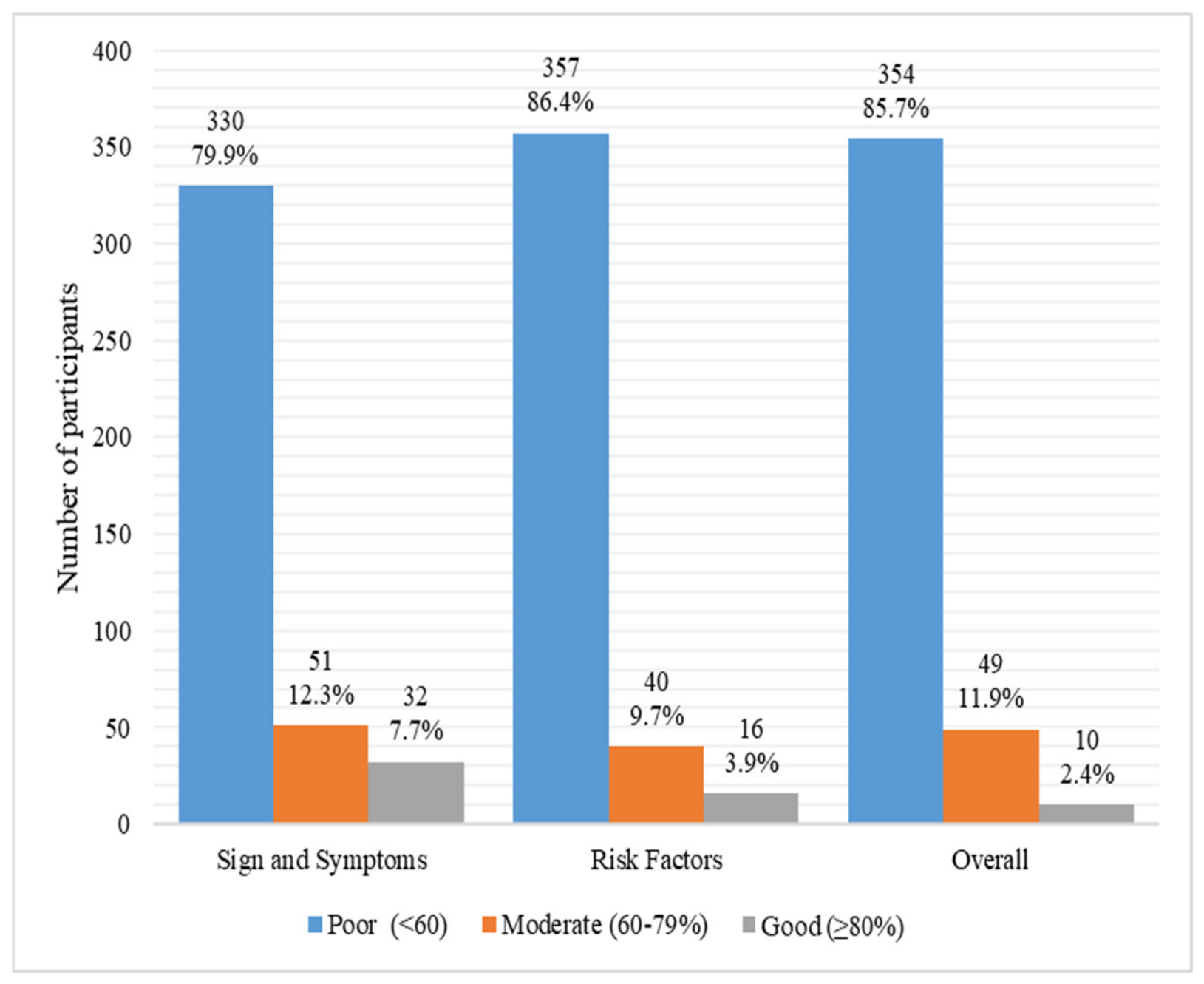
- We found poor knowledge about breast cancer symptoms and risk factors among female university students, indicating even lower awareness among the general public, which could be a major obstacle for appropriate health-seeking behavior and early detection.
- This study will help to target educational activities, overcome knowledge barriers and increase health-seeking behavior in women.
- Socio-cultural taboos, psychological fears, and misconceptions have to be addressed in shaping breast cancer awareness programs in Pakistan.
Abstract
1. Introduction
2. Materials and Methods
2.1. Study Design and Target Population
2.2. Eligibility Criterion for Study Participants
2.3. Data Collection and Ethical Considerations
2.4. Statistical Analysis
3. Results
- Socio-demographic characteristics of the study participants:
- Knowledge about breast cancer signs, symptoms and risk factors
- Awareness and attitudes about breast cancer screening
- Knowledge about breast cancer barriers
4. Discussion
Study Limitations
5. Conclusions
Author Contributions
Funding
Institutional Review Board Statement
Informed Consent Statement
Data Availability Statement
Acknowledgments
Conflicts of Interest
Abbreviations
| BC-AM | Breast Cancer Awareness Measure |
| BSE | Breast Self-Examination |
| GLOBOCAN | Global Cancer Observatory |
| HICs | High-Income Countries |
| LMICs | Low- and Middle-Income Countries |
| HRT | Hormone Replacement Therapy |
| OR | Odds Ratio |
| CI | Confidence Interval |
| IRB | Institutional Review Board |
References
- Zhang, Y.; Ji, Y.; Liu, S.; Li, J.; Wu, J.; Jin, Q.; Liu, X.; Duan, H.; Feng, Z.; Liu, Y.; et al. Global burden of female breast cancer: New estimates in 2022, temporal trend and future projections up to 2050 based on the latest release from GLOBOCAN. J. Natl. Cancer Cent. 2025, 5, 287–296. [Google Scholar] [CrossRef] [Scilit] [PubMed]
- Iqbal, S.; Inayat, A. Dietary trace element intake and risk of breast cancer: A mini review. Biol. Trace Elem. Res. 2022, 200, 4936–4948. [Google Scholar] [CrossRef] [Scilit] [PubMed]
- Sung, H.; Ferlay, J.; Siegel, R.L.; Laversanne, M.; Soerjomataram, I.; Jemal, A.; Bray, F. Global Cancer Statistics 2020: GLOBOCAN Estimates of incidence and mortality worldwide for 36 cancers in 185 countries. CA Cancer J. Clin. 2021, 71, 209–249. [Google Scholar] [CrossRef] [Scilit] [PubMed]
- Arnold, M.; Morgan, E.; Rumgay, H.; Mafra, A.; Singh, D.; Laversanne, M.; Vignat, J.; Gralow, J.R.; Cardoso, F.; Siesling, S.; et al. Current and future burden of breast cancer: Global statistics for 2020 and 2040. Breast 2022, 66, 15–23. [Google Scholar] [CrossRef] [Scilit] [PubMed]
- Al-Hejri, A.M.; Al-Tam, R.M.; Sable, A.H.; Almuhaya, B.; Alshamrani, S.S.; Alshmrany, K.M. A Hybrid vision transformer with ensemble CNN framework for cervical cancer diagnosis. BMC Med. Inform. Decis. Mak. 2025, 25, 411. [Google Scholar] [CrossRef] [Scilit] [PubMed]
- Al-Hejri, A.M.; Al-Tam, R.M.; Fazea, M.; Sable, A.H.; Lee, S.; Al-antari, M.A. ETECADx: Ensemble self-attention transformer encoder for breast cancer diagnosis using full-field digital X-ray breast images. Diagnostics 2023, 13, 89. [Google Scholar] [CrossRef] [Scilit] [PubMed]
- International Agency for Research on Cancer. IARC Monographs on the Identification of Carcinogenic Hazards to Humans; International Agency for Research on Cancer: Lyon, France, 2019; pp. 326–327. Available online: https://www.ncbi.nlm.nih.gov/books/NBK294452/ (accessed on 19 September 2025).
- Fu, M.; Peng, Z.; Wu, M.; Lv, D.; Li, Y.; Lyu, S. Current and future burden of breast cancer in Asia: A GLOBOCAN data analysis for 2022 and 2050. Breast 2025, 79, 103835. [Google Scholar] [CrossRef] [Scilit] [PubMed]
- International Agency for Research on Cancer. Statistics at a Glance, 2022 Top 5 Most Frequent Cancers Number of New Cases 185 748. Available online: https://gco.iarc.who.int/media/globocan/factsheets/populations/586-pakistan-fact-sheet.pdf (accessed on 19 September 2025).
- International Agency for Research on Cancer. Global Cancer Observatory 2022. Available online: https://gco.iarc.who.int/en (accessed on 19 September 2025).
- Shamsi, U.; Khan, S.; Azam, I.; Usman, S.; Maqbool, A.; Gill, T.; Iqbal, R.; Callen, D. Patient delay in breast cancer diagnosis in two hospitals in Karachi, Pakistan: Preventive and life-saving measures needed. JCO Glob. Oncol. 2020, 6, 873–883. [Google Scholar] [CrossRef] [Scilit] [PubMed]
- Hussain, I.; Majeed, A.; Masood, I.; Ashraf, W.; Imran, I.; Saeed, H.; Ur Rehman, A.; Hashmi, F.K.; Saleem, F.; Akbar, M.; et al. A national survey to assess breast cancer awareness among the female university students of Pakistan. PLoS ONE 2022, 17, e0262030. [Google Scholar] [CrossRef] [Scilit] [PubMed]
- Shoukat, Z.; Shah, A.J. Breast cancer awareness and associated factors among women in Pakistan: A cross-sectional descriptive study. Asian Pac. J. Cancer Prev. 2023, 24, 1561–1570. [Google Scholar] [CrossRef] [Scilit] [PubMed]
- Linsell, L.; Forbes, L.; Burgess, C.; Kapari, M.; Thurnham, A. Validation of a measurement tool to assess awareness of breast cancer. Eur. J. Cancer 2010, 46, 1374–1381. [Google Scholar] [CrossRef] [Scilit] [PubMed]
- Kandasamy, G.; Almaghaslah, D.; Almanasef, M. Knowledge, Attitude and Practice towards Tuberculosis among Healthcare and Non-Healthcare Students at a Public University in Saudi Arabia. Front. Public Health 2024, 12, 1348975. [Google Scholar] [CrossRef] [Scilit] [PubMed]
- Ullah, Z.; Khan, M.N.; Din, Z.U.; Afaq, S. Breast cancer awareness and associated factors amongst women in Peshawar, Pakistan: A cross-sectional study. Breast Cancer 2021, 15, 1–9. [Google Scholar] [CrossRef] [Scilit] [PubMed]
- Dinegde, N.G.; Li, X. Awareness of breast cancer among female care givers in tertiary cancer hospital, China. Asian Pac. J. Cancer Prev. 2017, 18, 1977–1983. [Google Scholar] [CrossRef] [Scilit] [PubMed]
- Osei-Afriyie, S.; Addae, A.K.; Oppong, S.; Amu, H.; Ampofo, E.; Osei, E. Breast cancer awareness, risk factors and screening practices among future health professionals in Ghana: A cross-sectional study. PLoS ONE 2021, 16, e0253373. [Google Scholar] [CrossRef] [Scilit] [PubMed]
- Abo Al-Shiekh, S.S.; Ibrahim, M.A.; Alajerami, Y.S. Breast cancer knowledge and practice of breast self-examination among female university students, Gaza. Sci. World J. 2021, 2021, 6640324. [Google Scholar] [CrossRef] [Scilit] [PubMed]
- Faridi, H.; Farahani, F.K.; Lamyian, M.; Ahmadi, F.; Montazeri, A. The sociocultural context of sexual and reproductive health literacy among women living in Sanandaj, western Iran: A qualitative study. Reprod. Health 2025, 22, 200. [Google Scholar] [CrossRef] [Scilit] [PubMed]
- Obeagu, E.I.; Obeagu, G.U. Breast cancer: A review of risk factors and diagnosis. Medicine 2024, 103, E36905. [Google Scholar] [CrossRef] [Scilit] [PubMed]
- Tavakoli, B.; Feizi, A.; Zamani-Alavijeh, F.; Shahnazi, H. Factors influencing breast cancer screening practices among women worldwide: A systematic review of observational and qualitative studies. BMC Womens Health 2024, 24, 268. [Google Scholar] [CrossRef] [Scilit] [PubMed]
- Luleci, D.; Kilic, B. Factors affecting women’s participation in breast cancer screening in Turkey. Asian Pac. J. Cancer Prev. 2022, 23, 1627–1634. [Google Scholar] [CrossRef] [Scilit] [PubMed]
- Srinath, A.; Van Merode, F.; Rao, S.V.; Pavlova, M. Barriers to cervical cancer and breast cancer screening uptake in low- and middle-income countries: A systematic review. Health Policy Plan 2023, 38, 509–527. [Google Scholar] [CrossRef] [Scilit] [PubMed]
- Ren, W.; Chen, M.; Qiao, Y.; Zhao, F. Global guidelines for breast cancer screening: A systematic review. Breast 2022, 64, 85–99. [Google Scholar] [CrossRef] [Scilit] [PubMed]
- Wilkinson, L.; Gathani, T. Understanding breast cancer as a global health concern. Br. J. Radiol. 2022, 95, 20211033. [Google Scholar] [CrossRef] [Scilit] [PubMed]
- Rehman, M.A.; Tahir, E.; Hussain, H.G.; Khalid, A.; Taqi, S.M.; Meenai, E.A. Awareness regarding breast cancer amongst women in Pakistan: A systematic review and meta-analysis. PLoS ONE 2024, 19, e0298275. [Google Scholar] [CrossRef] [Scilit] [PubMed]
- Saeed, S.; Asim, M.; Sohail, M.M. Fears and barriers: Problems in breast cancer diagnosis and treatment in Pakistan. BMC Womens Health 2021, 21, 151. [Google Scholar] [CrossRef] [Scilit] [PubMed]
- Siddiqui, R.; Mehmood, M.H.; Khan, N.A. An overview of breast cancer in Pakistan. Discov. Med. 2024, 1, 82. [Google Scholar] [CrossRef] [Scilit]
- Alam, N.E.; Islam, M.S.; Ullah, H.; Molla, M.T.; Shifat, S.K.; Akter, S.; Aktar, S.; Khatun, M.; Ali, R.; Sen, T.C.; et al. Evaluation of knowledge, awareness and attitudes towards breast cancer risk factors and early detection among females in Bangladesh: A hospital based cross-sectional study. PLoS ONE 2021, 16, e0257271. [Google Scholar] [CrossRef] [Scilit] [PubMed]
- Rasool, S.; Iqbal, M.; Siddiqui, A.; Ahsan, R.; Mukhtar, S.; Naqvi, S. Knowledge, attitude, practice towards breast cancer and breast self-examination among female undergraduate students in Karachi, Pakistan. J. Adv. Med. Med. Res. 2019, 29, 1–11. [Google Scholar] [CrossRef] [Scilit]
- Sarker, R.; Islam, M.S.; Moonajilin, M.S.; Rahman, M.; Gesesew, H.A.; Ward, P.R. Effectiveness of educational intervention on breast cancer knowledge and breast self-examination among female university students in Bangladesh: A pre-post quasi-experimental study. BMC Cancer 2022, 22, 199. [Google Scholar] [CrossRef] [Scilit] [PubMed]


| Variables | Frequency (%) |
|---|---|
| Age | |
| 18–22 years | 307 (74.3) |
| 22–26 years | 89 (21.5) |
| 26–30 years | 9 (2.2) |
| >30 years | 8 (2.0) |
| Marital status | |
| Ever Married | 39 (9.4) |
| Single | 374 (90.6) |
| Education level | |
| Undergraduate Student | 353 (85.5) |
| Postgraduate student | 45 (10.9) |
| PhD student | 7 (1.7) |
| Other | 8 (1.9) |
| Family income | |
| Below 50,000 Pak Rupee | 69 (16.7) |
| 50,000 to 100,000 Pak Rupee | 133 (32.2) |
| 100,000 to 150,000 Pak Rupee | 72 (17.4) |
| 150,000–200,000 Pak Rupee | 64 (15.5) |
| More than 200,000 Pak Rupee | 75 (18.2) |
| Breast cancer in family | |
| Yes | 119 (28.8) |
| No | 294 (71.2) |
| Breast Cancer Knowledge Questions | Frequency (%) |
|---|---|
| Signs and symptoms (Knowledge score = 4.00 ± 2.86 1, 36.4% ± 26.0% of maximum, Cronbach Alpha = 0.803) | |
| Discharge or bleeding from nipple | 160 (38.7) |
| Lump or thickening in breast | 270 (65.4) |
| Lump or thickening under armpit | 185 (44.8) |
| Pain in breasts or armpit | 264 (63.9) |
| Changes in shape of breast or nipple | 194 (47.0) |
| Changes in size of breast or nipple | 164 (39.7) |
| Redness of breast skin | 66 (16.0) |
| Pulling in of nipple | 144 (34.9) |
| Change in the position of nipple | 62 (15.0) |
| Nipple rash | 66 (16.0) |
| Puckering or dimpling of breast skin | 78 (18.9) |
| Risk factors (Knowledge score = 6.51 ± 3.51 1, 38.3% ± 20.7% of maximum, Cronbach Alpha = 0.730) | |
| Past history of breast cancer | 244 (59.1) |
| Longterm use of HRT (Hormone Replacement Therapy) | 163 (39.5) |
| Having one or more close relatives with breast cancer | 163 (39.5) |
| High radiation to the chest or breast in childhood or adolescence | 236 (57.1) |
| Having used oral contraceptive pills more than 5 years | 228 (55.2) |
| Given birth for the first time after age 30 | 140 (33.9) |
| Not having a childbirth experience | 85 (20.6) |
| Started menstruating before age 12 | 88 (21.3) |
| Entering menopause after age 55 | 87 (21.1) |
| Low physical activity | 158 (38.3) |
| Overweight and obesity | 196 (47.5) |
| Not having breastfed | 139 (33.7) |
| Smoking or alcohol consumption in the past or present | 179 (43.3) |
| Stress and anxiety | 151 (36.6) |
| High consumption of red meat | 66 (16.0) |
| Low consumption of vegetables and fruits | 80 (19.4) |
| High consumption of fatty foods/Unhealthy eating | 110 (26.6) |
| Overall (Knowledge score = 10.51 ± 5.84 1, 37.5% ± 20.9% of maximum, Cronbach Alpha = 0.852) | |
| Question | Answer | Frequency (%) |
|---|---|---|
| As much as you know, at which age women are most likely to have breast cancer | Less than 30-year-old woman | 145 (35.1) |
| at 50 years or above | 189 (45.8) | |
| at 70 years or above | 1 (0.2) | |
| Do not know | 78 (18.9) | |
| In your opinion, breast self-examination should be done… | Rarely or never | 25 (6.1) |
| At least once every 6 months | 187 (45.3) | |
| At least once a month | 146 (35.4) | |
| At least once a week | 55 (13.3) | |
| * Clinical breast cancer screening should be done by … | trained health professional every year | 319 (77.2) |
| mammogram every 2 years | 141 (34.1) | |
| mammogram or breast examination by trained health professionals | 42 (10.2) | |
| Breast cancer screening is a useful tool for early detection of breast cancer | Surely yes | 294 (71.2) |
| Likely yes | 106 (25.7) | |
| Likely no | 8 (1.9) | |
| Surely no | 5 (1.2) | |
| The best time to first go to breast examination for breast cancer is | At 20 years | 208 (50.4) |
| At 30 years | 143 (34.6) | |
| At 40 years | 47 (11.4) | |
| At 50 years | 13 (3.1) | |
| At 60 years or later | 2 (0.5) | |
| Best time to start mammography is | At 20 years | 121 (29.3) |
| At 30 years | 187 (45.3) | |
| At 40 years | 80 (19.4) | |
| At 50 years | 22 (5.3) | |
| At 60 years or later | 3 (0.7) | |
| During the menstrual cycle, the best time to do a self-breast exam is | One week after the onset of menstruation | 164 (39.7) |
| Two weeks after the onset of menstruation | 102 (24.7) | |
| Three weeks after the onset of menstruation | 40 (9.7) | |
| Shortly before onset of menstruation | 63 (15.3) | |
| During menstruation | 44 (10.7) |
| Barriers for Breast Cancer Screening | Frequency (%) |
|---|---|
| Worrying about what the doctor might find | 186 (45) |
| Too many other things to do | 86 (20.8) |
| Too scared | 168 (40.7) |
| Too embarrassed | 243 (58.8) |
| Too busy to find time to go to the doctor | 137 (33.2) |
| Difficulty to make an appointment with doctor | 62 (15) |
| Not feeling confident talking about my symptom with the doctor | 209 (50.6) |
| Difficulty to arrange transport to the clinic | 38 (9.2) |
| Having difficulties to talk to the doctor | 152 (36.8) |
| Worried about wasting the doctor’s time | 37 (9) |
| Methods to increase awareness and understanding of the importance of breast screening | |
| Encourage participation in breast self-examination by the doctor | 212 (51.3) |
| Each woman how to perform breast self-examination | 280 (67.8) |
| Have free screening available at basic health units | 196 (47.5) |
| Hold classes or lectures on breast cancer | 196 (47.5) |
| Establish awareness programs in the community | 220 (53.3) |
| Conduct screening programs in shopping malls and shopping areas | 95 (23) |
| Making screening compulsory when women are coming for regular checkups | 159 (38.5) |
| Predictors | Poor Knowledge About Breast Cancer | |||
|---|---|---|---|---|
| Frequency (%) | p-Value 1 | OR (95% CI) | p-Value 2 | |
| Age | ||||
| 18–22 years | 269 (87.6%) | 0.059 | 1.749 (0.973–3.143) | 0.062 |
| 22–26 years | 85 (80.2%) | Ref | ||
| Marital status | ||||
| Ever Married | 35 (89.7%) | 0.450 | 1.509 (0.516–4.413) | 0.453 |
| Single | 319 (85.3%) | Ref | ||
| Education level | ||||
| Other | 8 (100.0%) | 0.050 | NA | NA |
| Undergraduate | 307 (87.0%) | 2.225 (1.105–4.480) | 0.025 | |
| Postgraduate or above | 39 (75.0%) | Ref | ||
| Family income | ||||
| Below 50.000 Pak Rupee | 64 (92.8%) | 0.146 | 3.471 (1.197–10.066) | 0.022 |
| 50.000 to 100.000 Pak Rupee | 117 (88.0%) | 1.983 (0.927–4.242) | 0.078 | |
| 100.000 to 150.000 Pak Rupee | 60 (83.3%) | 1.356 (0.591–3.110) | 0.472 | |
| 150.000–200.000 Pak Rupee | 54 (84.4%) | 1.464 (0.612–3.503) | 0.391 | |
| More than 200.000 Pak Rupee | 59 (78.7%) | Ref | ||
| Breast cancer in family | ||||
| Yes | 96 (80.7%) | 0.062 | 0.582 (0.328–1.033) | 0.065 |
| No | 258 (87.8%) | Ref | ||
Disclaimer/Publisher’s Note: The statements, opinions and data contained in all publications are solely those of the individual author(s) and contributor(s) and not of MDPI and/or the editor(s). MDPI and/or the editor(s) disclaim responsibility for any injury to people or property resulting from any ideas, methods, instructions or products referred to in the content. |
© 2026 by the authors. Licensee MDPI, Basel, Switzerland. This article is an open access article distributed under the terms and conditions of the Creative Commons Attribution (CC BY) license.
Share and Cite
Iqbal, S.; Ahmad, A.M.R.; Malik, Z.I.; Irfan, M.; Qudah, T.; Kundi, M. Breast Cancer Knowledge and Screening Barriers Among Female University Students of Pakistan. Int. J. Environ. Res. Public Health 2026, 23, 1068. https://doi.org/10.3390/ijerph23081068
Iqbal S, Ahmad AMR, Malik ZI, Irfan M, Qudah T, Kundi M. Breast Cancer Knowledge and Screening Barriers Among Female University Students of Pakistan. International Journal of Environmental Research and Public Health. 2026; 23(8):1068. https://doi.org/10.3390/ijerph23081068
Chicago/Turabian StyleIqbal, Sehar, Abdul Momin Rizwan Ahmad, Zoha Imtiaz Malik, Muhammad Irfan, Taima Qudah, and Michael Kundi. 2026. "Breast Cancer Knowledge and Screening Barriers Among Female University Students of Pakistan" International Journal of Environmental Research and Public Health 23, no. 8: 1068. https://doi.org/10.3390/ijerph23081068
APA StyleIqbal, S., Ahmad, A. M. R., Malik, Z. I., Irfan, M., Qudah, T., & Kundi, M. (2026). Breast Cancer Knowledge and Screening Barriers Among Female University Students of Pakistan. International Journal of Environmental Research and Public Health, 23(8), 1068. https://doi.org/10.3390/ijerph23081068