Racial Differences in Social Capital Volunteer Activities: A Mixed-Methods Longitudinal Study of How Race and Place Influence Opportunities

 , , ,
, , ,
Highlights
- Volunteering, an important dimension of social capital, showed racial and educational differences across three waves of U.S. data.
- These differences matter for public health because volunteering is linked to social connectedness and broader health-related resources.
- The study shows that people do not always define volunteering in the same way, especially when distinguishing formal volunteer roles from informal helping.
- Mixed-methods findings suggest that commonly used survey measures may not fully capture community-based forms of engagement across groups.
- Public health research should use more inclusive measures of volunteering that better reflect both formal and informal community engagement.
- Efforts to promote civic engagement should recognize culturally and contextually different ways people contribute to their communities.
Abstract
1. Introduction
1.1. Volunteering as a Protective Factor for Health Outcomes
1.2. Structural Racism and the Impact on Volunteer Activities
1.3. The Need for Qualitative Research to Evaluate Racial Differences in Indicators Assessing Volunteer Activities
1.4. Prior Studies That Assess Racial Differences in Social Capital Items
1.5. The Present Study
2. Methods
2.1. Data and Sample
2.2. Measures
2.3. Sociodemographic Characteristics
2.4. Statistical Analysis
3. Results
Sensitivity Analysis
4. Item Interpretation Substudy
4.1. Study Sample
4.2. Data Collection
Interview Protocol
4.3. Data Analysis
4.4. Qualitative Findings
4.5. Demographic Characteristics
4.6. Qualitative Interviews
5. Discussion
6. Conclusions
Author Contributions
Funding
Institutional Review Board Statement
Informed Consent Statement
Data Availability Statement
Acknowledgments
Conflicts of Interest
References
- Dekker, P.; Halman, L. Volunteering and values. In The Values of Volunteering: Cross-Cultural Perspectives; Dekker, P., Halman, L., Eds.; Springer: Boston, MA, USA, 2003; pp. 1–17. [Google Scholar] [CrossRef]
- International Labour Organization. Manual on the Measurement of Volunteer Work; ILO: Geneva, Switzerland, 2011; Available online: https://www.ilo.org/global/statistics-and-databases/publications/WCMS_162119/lang--en/index.htm (accessed on 28 June 2021).
- Villalonga-Olives, E.; Almansa, J.; Shaya, F.; Kawachi, I. Perceived social capital and binge drinking in older adults: The Health and Retirement Study, US data from 2006–2014. Drug Alcohol Depend. 2020, 214, 108099. [Google Scholar] [CrossRef] [PubMed]
- Bonham, C. Building an inclusive community through social capital: The role of volunteering in reaching those on the edge of community. In Social Determinants of Health: An Interdisciplinary Approach to Social Inequality and Wellbeing; Bonner, A., Ed.; Policy Press: Bristol, UK, 2017. [Google Scholar] [CrossRef]
- Chetty, R.; Jackson, M.O.; Kuchler, T.; Stroebel, J.; Hendren, N.; Fluegge, R.B.; Gong, S.; Gonzalez, F.; Grondin, A.; Jacob, M.; et al. Social capital I: Measurement and associations with economic mobility. Nature 2022, 608, 108–121. [Google Scholar] [CrossRef] [PubMed]
- Jenkinson, C.E.; Dickens, A.P.; Jones, K.; Thompson-Coon, J.; Taylor, R.S.; Rogers, M.; Bambra, C.L.; Lang, I.; Richards, S.H. Is volunteering a public health intervention? A systematic review and meta-analysis of the health and survival of volunteers. BMC Public Health 2013, 13, 773. [Google Scholar] [CrossRef] [PubMed]
- Kim, E.S.; Whillans, A.V.; Lee, M.T.; Chen, Y.; VanderWeele, T.J. Volunteering and subsequent health and well-being in older adults: An outcome-wide longitudinal approach. Am. J. Prev. Med. 2020, 59, 176–186. [Google Scholar] [CrossRef] [PubMed]
- Yeung, J.W.K.; Zhang, Z.; Kim, T.Y. Volunteering and health benefits in general adults: Cumulative effects and forms. BMC Public Health 2017, 18, 8. [Google Scholar] [CrossRef] [PubMed]
- Office of the Surgeon General. Our Epidemic of Loneliness and Isolation: The US Surgeon General’s Advisory on the Healing Effects of Social Connection and Community; US Department of Health and Human Services: Washington, DC, USA, 2023. Available online: http://www.ncbi.nlm.nih.gov/books/NBK595227/ (accessed on 23 September 2024).
- Putnam, R.D. Bowling alone: America’s declining social capital. In Culture and Politics: A Reader; Crothers, L., Lockhart, C., Eds.; Palgrave Macmillan: New York, NY, USA, 2000; pp. 223–234. [Google Scholar] [CrossRef]
- Coleman, J.S. Social capital in the creation of human capital. Am. J. Sociol. 1988, 94, S95–S120. [Google Scholar] [CrossRef] [PubMed]
- Portes, A. Social capital: Its origins and applications in modern sociology. In New Critical Writings in Political Sociology; Routledge: London, UK, 2009. [Google Scholar]
- Bailey, Z.D.; Krieger, N.; Agénor, M.; Graves, J.; Linos, N.; Bassett, M.T. Structural racism and health inequities in the USA: Evidence and interventions. Lancet 2017, 389, 1453–1463. [Google Scholar] [CrossRef] [PubMed]
- Kapadia, F.; Borrell, L.N. Structural racism and public health. Am. J. Public Health 2023, 113, S4. [Google Scholar] [CrossRef] [PubMed]
- Williams, D.R.; Lawrence, J.A.; Davis, B.A. Racism and health: Evidence and needed research. Annu. Rev. Public Health 2019, 40, 105–125. [Google Scholar] [CrossRef] [PubMed]
- Bonilla-Silva, E. Rethinking racism: Toward a structural interpretation. Am. Sociol. Rev. 1997, 62, 465–480. [Google Scholar] [CrossRef] [PubMed]
- Feagin, J.R. Systemic Racism: A Theory of Oppression; Routledge: New York, NY, USA, 2006; Available online: https://www.scirp.org/reference/referencespapers?referenceid=1679439 (accessed on 3 August 2025).
- Musick, M.A.; Wilson, J. Volunteers: A Social Profile; Indiana University Press: Bloomington, IN, USA, 2007; Available online: https://www.scirp.org/reference/referencespapers?referenceid=1221320 (accessed on 3 August 2025).
- Tang, F.; Copeland, V.C.; Wexler, S. Racial differences in volunteer engagement by older adults: An empowerment perspective. Soc. Work Res. 2012, 36, 89–100. [Google Scholar] [CrossRef]
- Tavares, J.L.; Burr, J.A.; Mutchler, J.E. Race differences in the relationship between formal volunteering and hypertension. J. Gerontol. B Psychol. Sci. Soc. Sci. 2013, 68, 310–319. [Google Scholar] [CrossRef] [PubMed]
- Pew Research Center. Americans with Higher Education and Income Are More Likely to Be Involved in Community Groups. 2019. Available online: https://www.pewresearch.org/short-reads/2019/02/22/americans-with-higher-education-and-income-are-more-likely-to-be-involved-in-community-groups/ (accessed on 23 September 2024).
- Musick, M.A.; Wilson, J.; Bynum, W.B. Race and formal volunteering: The differential effects of class and religion. Soc. Forces 2000, 78, 1539–1570. [Google Scholar] [CrossRef]
- Mattis, J.S.; Jagers, R.J. A Relational Framework for the Study of Religiosity and Spirituality in the Lives of African Americans. J. Community Psychol. 2001, 29, 519–539. [Google Scholar] [CrossRef]
- Villalonga-Olives, E.; Majercak, K.R.; Wang, W.; Dean, L.T. Black people and White people respond differently to social capital: What racial differential item functioning reveals for racial health equity. Am. J. Epidemiol. 2023, 192, 1264–1273. [Google Scholar] [CrossRef] [PubMed]
- Teresi, J.A.; Ramirez, M.; Jones, R.N.; Choi, S.; Crane, P.K. Modifying measures based on differential item functioning (DIF) impact analyses. J. Aging Health 2012, 24, 1044–1076. [Google Scholar] [CrossRef] [PubMed]
- Radler, B.T. The Midlife in the United States (MIDUS) series: A national longitudinal study of health and well-being. Open Health Data 2014, 2, e3. [Google Scholar] [CrossRef] [PubMed]
- Ryff, C.D.; Krueger, R.F. (Eds.) The Oxford Handbook of Integrative Health Science; Oxford University Press: Oxford, UK, 2018. [Google Scholar]
- Gioia, C.J.; Sobell, L.C.; Sobell, M.B.; Agrawal, S. Craigslist versus print newspaper advertising for recruiting research participants for alcohol studies: Cost and participant characteristics. Addict. Behav. 2016, 54, 24–32. [Google Scholar] [CrossRef] [PubMed]
- LeCompte, M.D.; Schensul, J.J. Designing and Conducting Ethnographic Research: An Introduction, 2nd ed.; AltaMira Press: Lanham, MD, USA, 2010. [Google Scholar]
- Saldana, J. The Coding Manual for Qualitative Researchers; SAGE: Thousand Oaks, CA, USA, 2015. [Google Scholar]
- ATLAS.ti Scientific Software Development GmbH. ATLAS.ti Qualitative Data Analysis Software; ATLAS.ti: Berlin, Germany, 2020; Available online: https://atlasti.com (accessed on 2 September 2024).
- Mattis, J.S.; Jagers, R.J.; Hatcher, C.A.; Lawhon, G.D.; Murphy, E.J.; Murray, Y.F. Religiosity, volunteerism, and community involvement among African American men: An exploratory analysis. J. Community Psychol. 2000, 28, 391–406. [Google Scholar] [CrossRef]
- Gallup. Postsecondary Education Linked to Volunteerism, Better Health. 2023. Available online: https://news.gallup.com/poll/510254/postsecondary-education-linked-volunteerism-better-health.aspx (accessed on 3 August 2025).
- Gesthuizen, M.; Scheepers, P. Educational differences in volunteering in cross-national perspective. Nonprofit Volunt. Sect. Q. 2012, 41, 58–81. [Google Scholar] [CrossRef]
- Ejegi-Memeh, S.; Berkeley, R.; Bussue, D.; Mafoti, W.; Mohamad, A.; Myrie, U.; Samuels, S. The role of Black-led community organisations in supporting Black mental health: A Black emancipatory action research project. Ethn. Health 2025, 30, 432–451. [Google Scholar] [CrossRef] [PubMed]
- Gilbert, K.L.; Ransome, Y.; Dean, L.T.; DeCaille, J.; Kawachi, I. Social capital, Black social mobility, and health disparities. Annu. Rev. Public Health 2022, 43, 173–191. [Google Scholar] [CrossRef] [PubMed]



| Analytic Sample (n = 5921) | ||
|---|---|---|
| Variable | White | Black |
| Race | 5600 (94.6%) | 321 (5.4%) |
| Age (years), mean (SD) | 47.3 (12.9) | 44.5 (12.5) |
| Sex | ||
| Male | 2683 (47.9%) | 121 (37.7%) |
| Female | 2917 (52.1%) | 200 (62.3%) |
| Education | ||
| Low (≤High School) | 2082 (37.2%) | 141 (43.9%) |
| High (College+) | 3508 (62.8%) | 180 (56.1%) |
| Missing | 10 (0.2%) | 0 (0.0%) |
| Predictor | B | SE | p | Interpretation |
|---|---|---|---|---|
| Race (Reference: White) | ||||
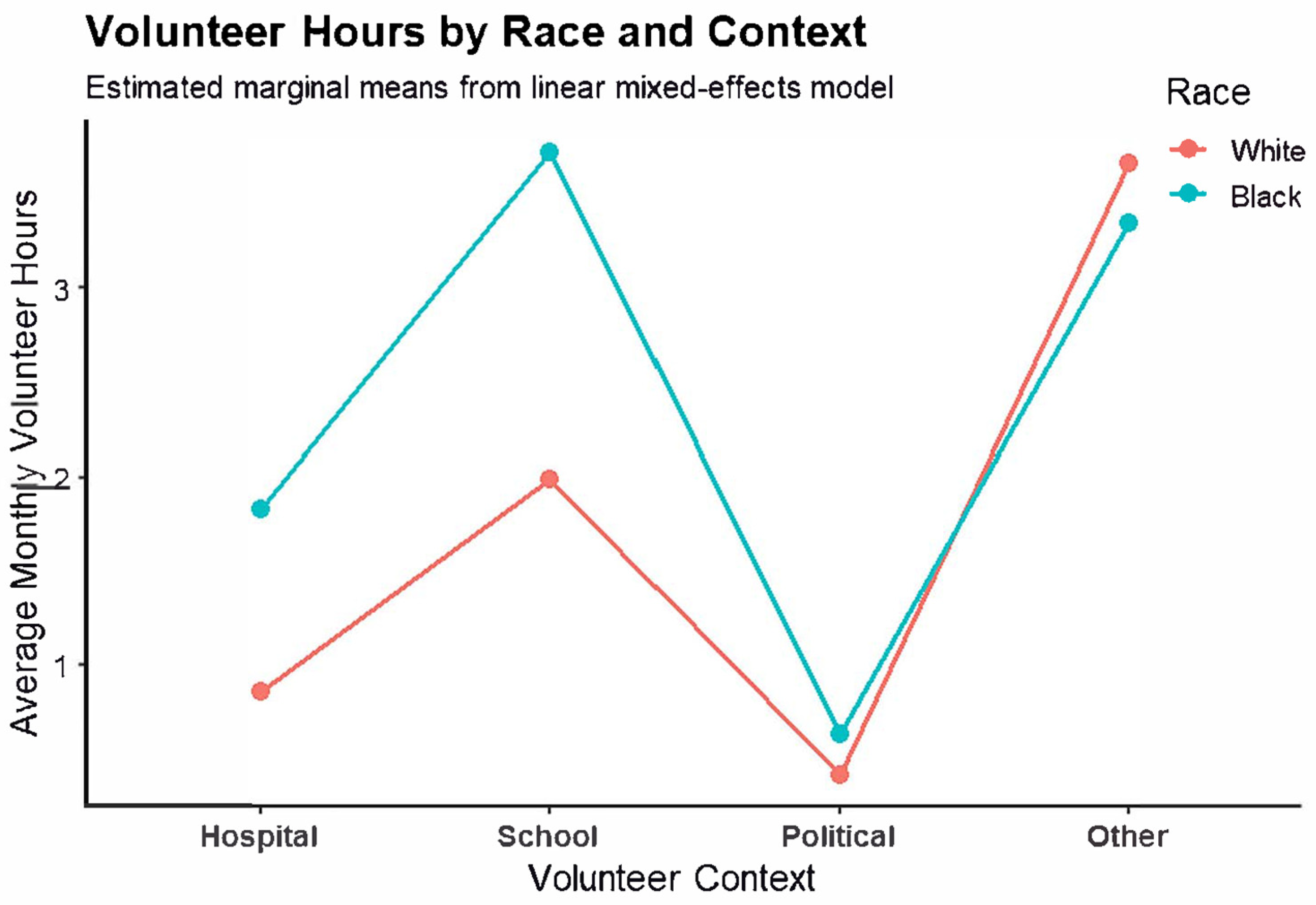
| Black | 0.97 | 0.36 | 0.007 | Black participants reported higher volunteering hours |
| Volunteer Context (Reference: Hospital) | ||||
| School | 1.12 | 0.10 | <0.001 | Higher volunteering in school-related activities |
| Political | −0.45 | 0.10 | <0.001 | Lower volunteering in political activities |
| Other | 2.80 | 0.10 | <0.001 | Highest volunteering in other organizations |
| Time (Reference: MIDUS Wave 1) | ||||
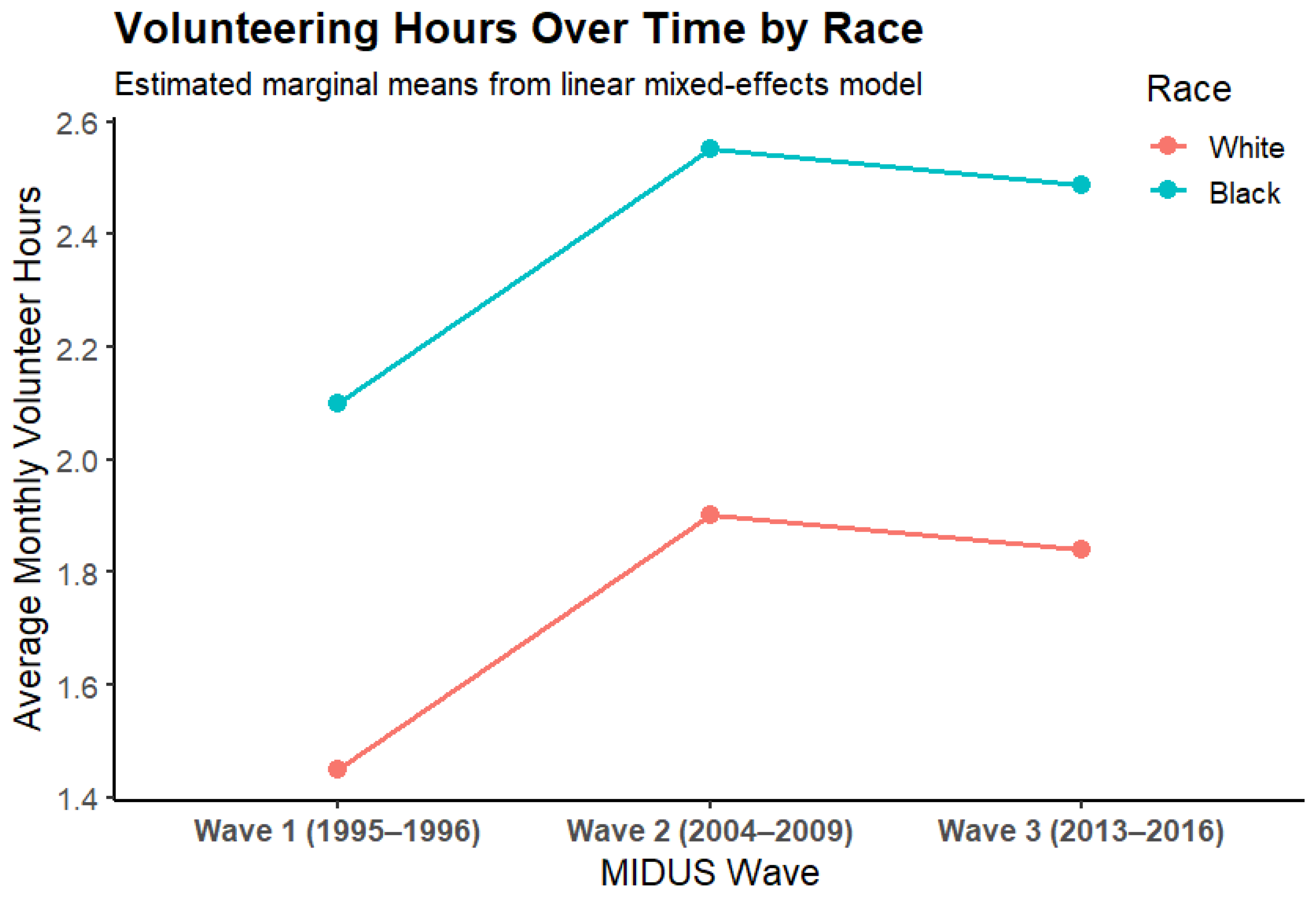
| MIDUS Wave 2 | 0.45 | 0.09 | <0.001 | Slight increase over time |
| MIDUS Wave 3 | 0.39 | 0.11 | <0.001 | Sustained increase over time |
| Age | 0.017 | 0.004 | <0.001 | Older individuals volunteer slightly more |
| Education (Reference: High education) | ||||
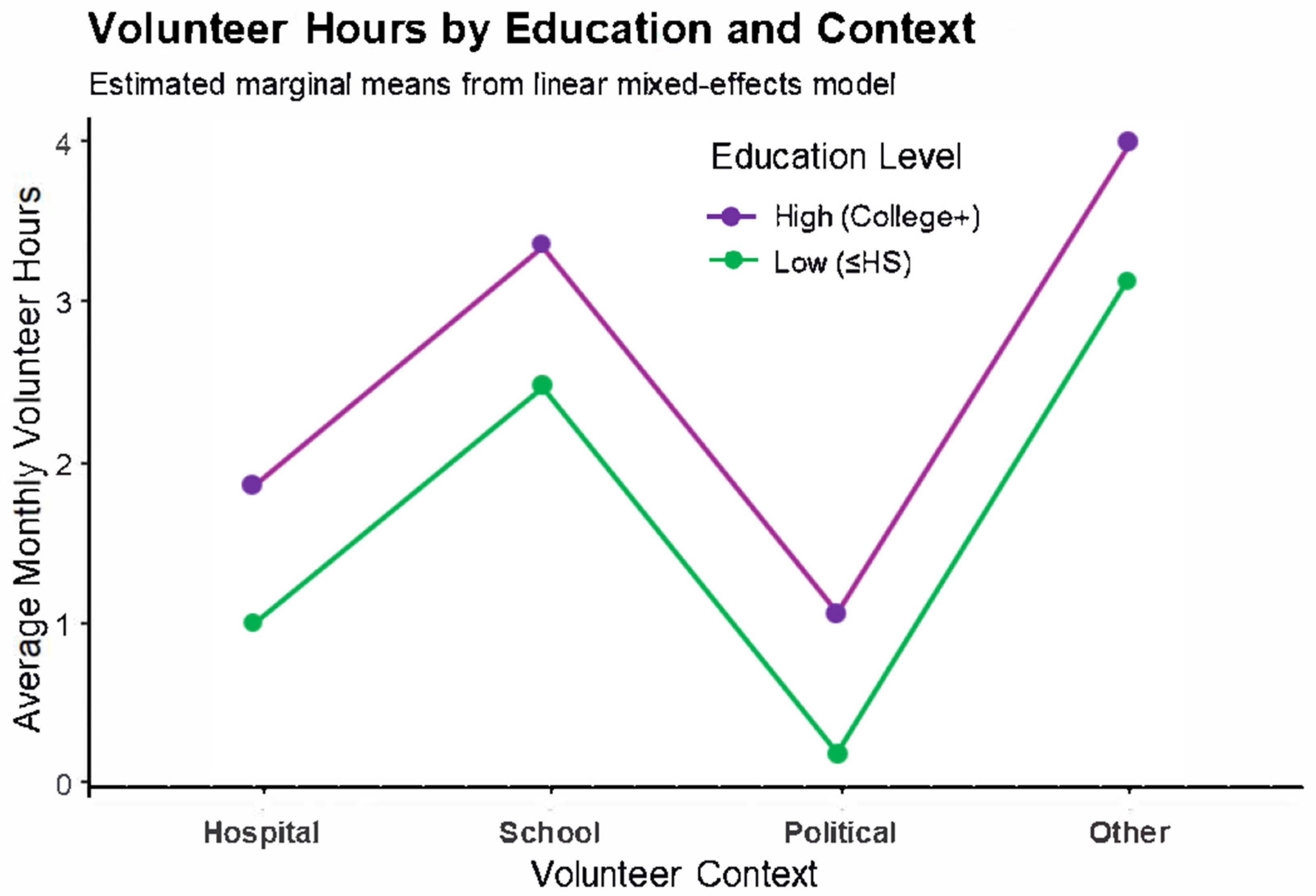
| Low education | −0.90 | 0.09 | <0.001 | Lower education associated with less volunteering |
| Gender (Reference: Male) | ||||
| Female | 0.29 | 0.09 | 0.0017 | Females volunteered more |
| Volunteer Context (Reference: Hospital) | Mean Volunteer Hours | |||||
|---|---|---|---|---|---|---|
| White | Black | Difference | B | p | Interpretation | |
| Hospital | 0.86 | 1.83 | +0.97 | 0.97 | 0.007 | Higher among Blacks |
| School | 1.99 | 3.72 | +1.73 | 0.77 | 0.102 | No statistically significant difference |
| Political | 0.42 | 0.63 | +0.21 | −0.75 | 0.109 | No statistically significant difference |
| Other | 3.66 | 3.34 | −0.32 | −1.29 | 0.006 | Smaller increase among Blacks |
| Demographic Characteristics | N (%) | |
|---|---|---|
| Age | 18–24 years old | 2 (4) |
| 25–34 years old | 8 (17) | |
| 35–44 years old | 18 (39) | |
| 45–54 years old | 9 (19) | |
| 55–64 years old | 6 (13) | |
| Greater than 65 years old | 2 (4) | |
| Missing | 2 (4) | |
| Gender | Female | 26 (55) |
| Male | 18 (39) | |
| Non-Binary | 2 (4) | |
| Transgender | 1 (2) | |
| Race | White, Non-Hispanic | 25 (53) |
| Black, Non-Hispanic | 22 (47) | |
| Population Density | Urban | 31 (66) |
| Suburban | 15 (32) | |
| Rural | 1 (2) | |
| Number of Persons Living in Household | 1–3 persons | 37 (79) |
| 4–6 persons | 2 (4) | |
| Missing | 8 (17) | |
| Household Income | Less than $30,000 | 7 (15) |
| $30,000 to $39,999 | 8 (17) | |
| $40,000 to $49,999 | 2 (4) | |
| $50,000 to $59,999 | 4 (9) | |
| $60,000 to $69,999 | 2 (4) | |
| $70,000 to $79,999 | 5 (10) | |
| $80,000 to $89,999 | 2 (4) | |
| $90,000 to $99,999 | 4 (9) | |
| Greater than $100,000 | 4 (9) | |
| Missing | 9 (19) | |
| Racial differences volunteer work vs. unpaid work | I just felt like that (providing free English lessons) was something that was more on an individual basis and it wouldn’t really enter into volunteer work. It’s more like something that I do out of my heart to help new immigrants to the country. (White female talking about volunteer work) As of right now, I have not done any real volunteer work in a few years… Now, I guess, being an advisor with the department in church, that is not seen as volunteer, but I guess that would be considered because I don’t get paid to do that. I would consider that to be my volunteer, but actually volunteering for something like for Red Cross or something like that, no… I guess, when I think about volunteer work, I think about volunteering for something like the Red Cross or the hospital. I never really thought about work at church as volunteer. I don’t know why and I’ve been doing it for years, but I never thought about it as volunteer work. (Black female talking about doing unpaid activities at the church that she did not consider volunteer work) I’m thinking about my clients. They’ll give their friends my number and be like, “Oh, she can help you with this, this, and that.” I feel bad when they call because I’m like, “You’re not on my caseload. I can’t really service you the way I need to,” but I try to give them the resources I can. I’ll say probably about like 10 h of the month. (Black female talking about unpaid labor she did not consider volunteer work) |
| Urban–suburban differences | In Las Vegas specifically, we have a lot of homeless individuals and so my husband and I like to spend time every month helping out. Whether it’s with handing out meals or spending time handing out clothes and things like that at one of the shelters, which I actually found out about through my job. We’ll go and spend time there and specifically with some of the adolescents and things like that, so that’s usually what we’ll do every month. (Suburban Black female) We have these Backpack Buddies where we get food and stuff and send them to kids that might not have food or whatever. I volunteered for Relay for Life, that’s a cancer thing. My mom had breast cancer, my dad had pancreatic and prostate cancer, so I’m very involved in cancer things. My daughter, my youngest just had a 5k run about three weeks ago, and we were out there volunteering for her school too, so there’s a lot. (Suburban Black female) I like to volunteer at soup kitchens and food banks. (Suburban Black female) I do clean up around my neighborhood. I just walk around and pick up a lot of litter on my own. (Urban White female) I may take people places who need a ride someplace, take them to a doctor visit. If someone needs to go to a food shop, I’d pick up their food for them. (Urban White female) |
Disclaimer/Publisher’s Note: The statements, opinions and data contained in all publications are solely those of the individual author(s) and contributor(s) and not of MDPI and/or the editor(s). MDPI and/or the editor(s) disclaim responsibility for any injury to people or property resulting from any ideas, methods, instructions or products referred to in the content. |
© 2026 by the authors. Licensee MDPI, Basel, Switzerland. This article is an open access article distributed under the terms and conditions of the Creative Commons Attribution (CC BY) license.
Share and Cite
Villalonga-Olives, E.; Khademi, A.; Crump, A.A.; Amissah, C.M.; Adams, I.; Hall, C.; Pan, Y.-Y.; Ransome, Y. Racial Differences in Social Capital Volunteer Activities: A Mixed-Methods Longitudinal Study of How Race and Place Influence Opportunities. Int. J. Environ. Res. Public Health 2026, 23, 1024. https://doi.org/10.3390/ijerph23081024
Villalonga-Olives E, Khademi A, Crump AA, Amissah CM, Adams I, Hall C, Pan Y-Y, Ransome Y. Racial Differences in Social Capital Volunteer Activities: A Mixed-Methods Longitudinal Study of How Race and Place Influence Opportunities. International Journal of Environmental Research and Public Health. 2026; 23(8):1024. https://doi.org/10.3390/ijerph23081024
Chicago/Turabian StyleVillalonga-Olives, Ester, Abdolvahab Khademi, Alisha A. Crump, Christopher M. Amissah, Inez Adams, Candace Hall, Yun-Yi Pan, and Yusuf Ransome. 2026. "Racial Differences in Social Capital Volunteer Activities: A Mixed-Methods Longitudinal Study of How Race and Place Influence Opportunities" International Journal of Environmental Research and Public Health 23, no. 8: 1024. https://doi.org/10.3390/ijerph23081024
APA StyleVillalonga-Olives, E., Khademi, A., Crump, A. A., Amissah, C. M., Adams, I., Hall, C., Pan, Y.-Y., & Ransome, Y. (2026). Racial Differences in Social Capital Volunteer Activities: A Mixed-Methods Longitudinal Study of How Race and Place Influence Opportunities. International Journal of Environmental Research and Public Health, 23(8), 1024. https://doi.org/10.3390/ijerph23081024