Changes in Bone Parameters and Serum Zinc Levels Following Oral Zinc Supplementation in Duchenne Muscular Dystrophy: A Quasi-Experimental Study

 ,
,  , ,
, ,
Highlights
- Individuals living with Duchenne muscular dystrophy (DMD) are vulnerable to nutritional imbalances that may compromise bone health and long-term health outcomes.
- Monitoring micronutrient status is important for the comprehensive clinical and nutritional care of populations affected by rare neuromuscular diseases.
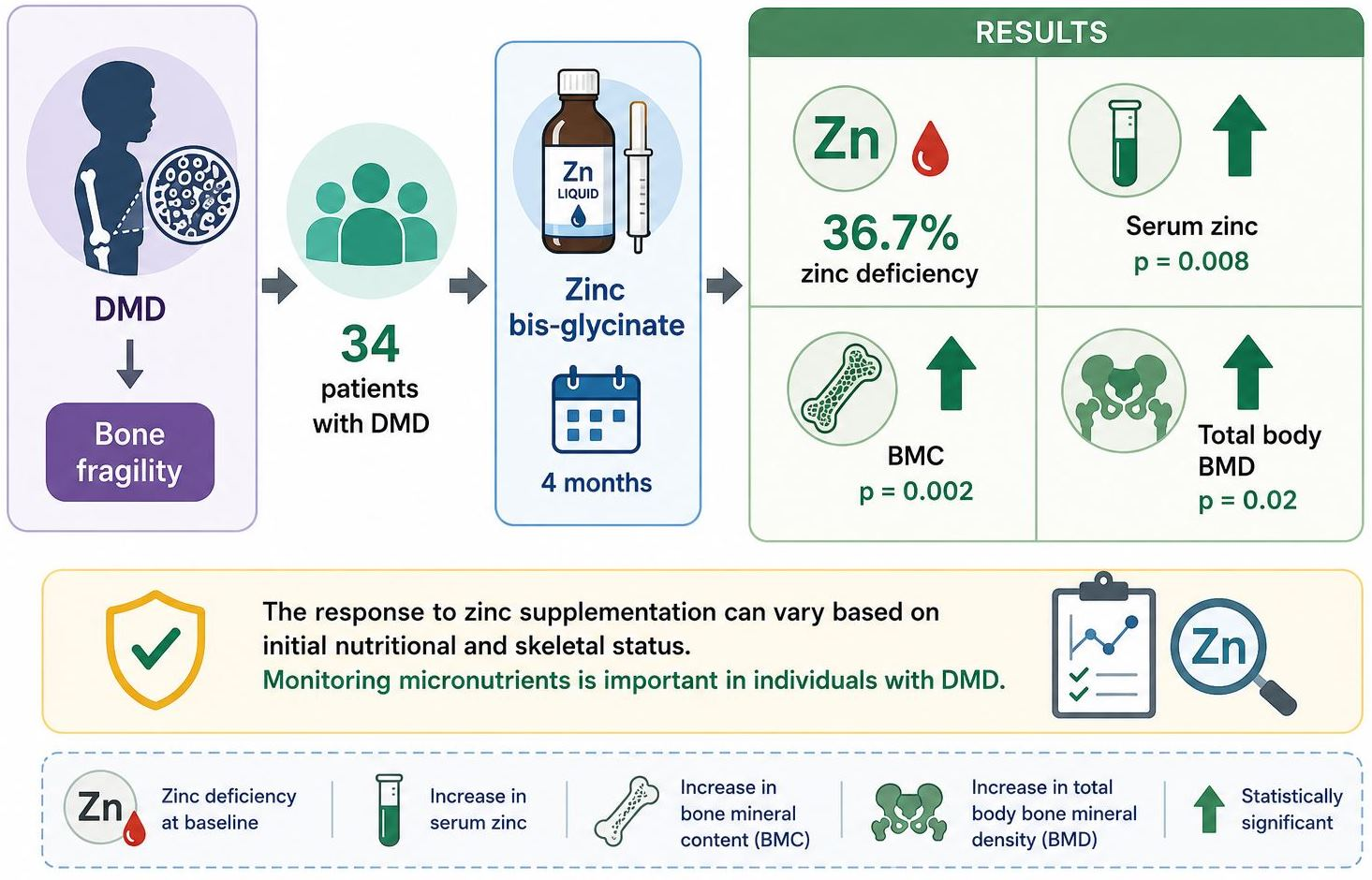
- Zinc deficiency was identified in a substantial proportion of individuals with DMD, indicating a potential nutritional vulnerability in this population.
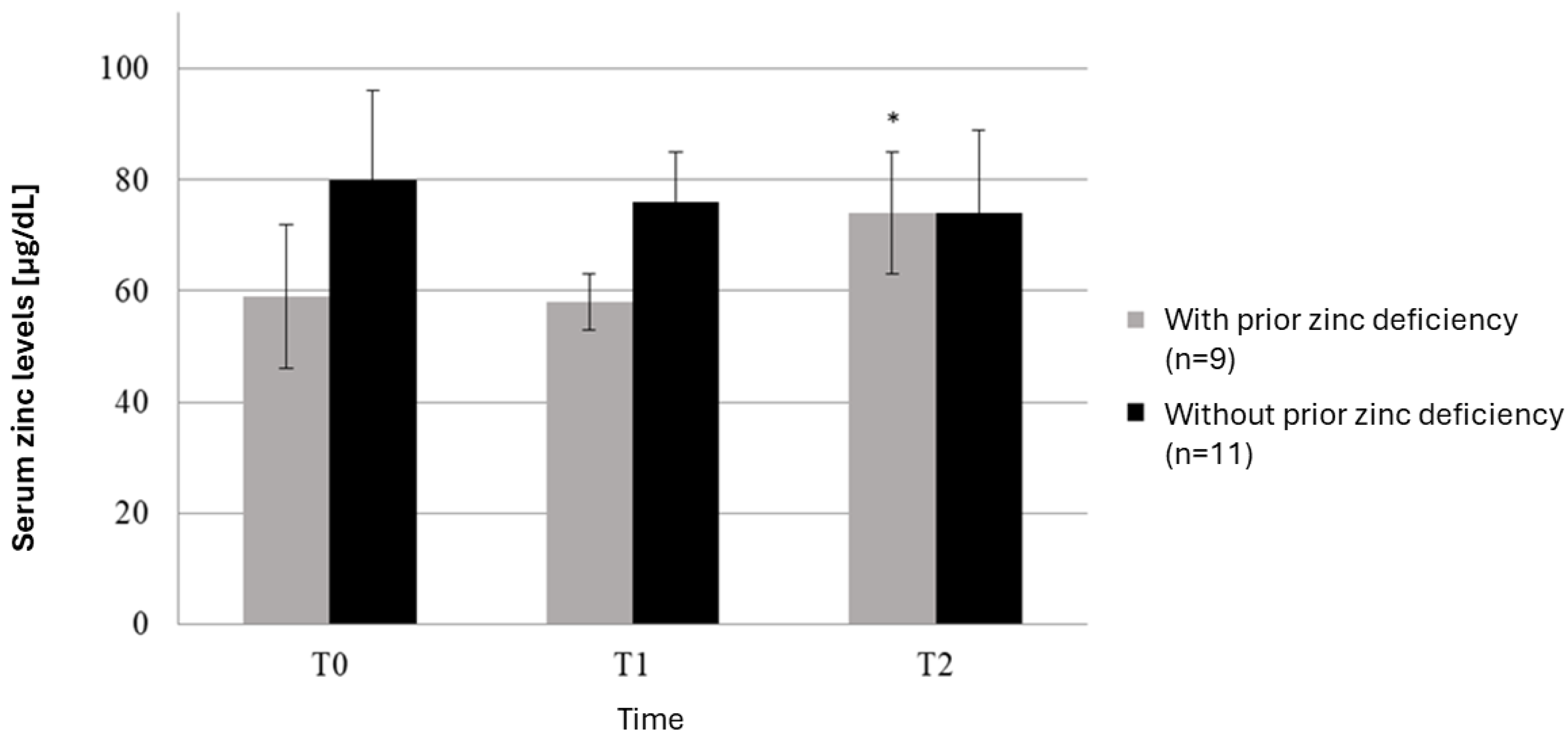
- Oral zinc supplementation increased serum zinc concentrations among participants with baseline zinc deficiency and was associated with modest improvements in bone parameters in a subgroup of participants.
- Monitoring serum zinc concentrations may contribute to the nutritional assessment of individuals with DMD.
- Nutritional strategies addressing micronutrient status may support broader bone health management in individuals living with chronic neuromuscular diseases.
Abstract
1. Introduction
2. Materials and Methods
2.1. Study Design and Ethical Considerations
2.2. Participants and Eligibility Criteria
2.3. Interventions
2.4. Anthropometric Assessment
2.5. Assessment of Bone Mineral Density and Bone Mineral Content
2.6. Assessment of Serum Zinc
2.7. Dietary Assessment
2.8. Statistical Analyses
3. Results
3.1. Baseline Characterization of Participants (T0)
3.2. Anthropometric Variables Before and After Zinc Supplementation
3.3. Bone Parameters Before and After Zinc Supplementation
3.4. Serum Zinc Concentrations Before and After Zinc Supplementation
4. Discussion
5. Conclusions
Supplementary Materials
Author Contributions
Funding
Institutional Review Board Statement
Informed Consent Statement
Data Availability Statement
Acknowledgments
Conflicts of Interest
Abbreviations
| DMD | Duchenne Muscular Dystrophy |
| BMD | Bone Mineral Density |
| BMC | Bone Mineral Content |
| BMI | Body Mass Index |
References
- Salari, N.; Fatahi, B.; Valipour, E.; Kazeminia, M.; Fatahian, R.; Kiaei, A.; Shohaimi, S.; Mohammadi, M. Global prevalence of Duchenne and Becker muscular dystrophy: A systematic review and meta-analysis. J. Orthop. Surg. 2022, 17, 96. [Google Scholar] [CrossRef] [PubMed]
- MacKintosh, E.W.; Chen, M.L.; Benditt, J.O. Lifetime Care of Duchenne Muscular Dystrophy. Sleep Med. Clin. 2020, 15, 485–495. [Google Scholar] [CrossRef] [PubMed]
- Grounds, M.D.; Terrill, J.R.; Al-Mshhdani, B.A.; Duong, M.N.; Radley-Crabb, H.G.; Arthur, P.G. Biomarkers for Duchenne muscular dystrophy: Myonecrosis, inflammation and oxidative stress. Dis. Model Mech. 2020, 13, dmm043638. [Google Scholar] [CrossRef] [PubMed]
- Bell, J.M.; Shields, M.D.; Watters, J.; Hamilton, A.; Beringer, T.; Elliott, M.; Quinlivan, R.; Tirupathi, S.; Blackwood, B. Interventions to prevent and treat corticosteroid-induced osteoporosis and prevent osteoporotic fractures in Duchenne muscular dystrophy. Cochrane Database Syst. Rev. 2017, 2017, CD010899. [Google Scholar] [CrossRef] [PubMed]
- Wood, C.L.; Hollingsworth, K.G.; Hughes, E.; Punniyakodi, S.; Muni-Lofra, R.; Mayhew, A.; Mitchell, R.T.; Guglieri, M.; Cheetham, T.D.; Straub, V. Pubertal induction in adolescents with DMD is associated with high satisfaction, gonadotropin release and increased muscle contractile surface area. Eur. J. Endocrinol. 2021, 184, 67–79. [Google Scholar] [CrossRef] [PubMed]
- Gaffney-Stomberg, E. The Impact of Trace Minerals on Bone Metabolism. Biol. Trace Elem. Res. 2019, 188, 26–34. [Google Scholar] [CrossRef] [PubMed]
- Yamaguchi, M. Role of nutritional zinc in the prevention of osteoporosis. Mol. Cell. Biochem. 2010, 338, 241–254. [Google Scholar] [CrossRef] [PubMed]
- Stiles, L.I.; Ferrao, K.; Mehta, K.J. Role of zinc in health and disease. Clin. Exp. Med. 2024, 24, 38. [Google Scholar] [CrossRef] [PubMed]
- Des Jarlais, D.C.; Lyles, C.; Crepaz, N.; the Trend Group. Improving the reporting quality of nonrandomized evaluations of behavioral and public health interventions: The TREND statement. Am. J. Public Health 2004, 94, 361–366. [Google Scholar] [CrossRef] [PubMed]
- Alves, C.X.; Brito, N.J.N.D.; Vermeulen, K.M.; Lopes, M.M.G.D.; França, M.C.; Bruno, S.S.; Almeida, M.d.G.; Brandão-Neto, J. Serum zinc reference intervals and its relationship with dietary, functional, and biochemical indicators in 6- to 9-year-old healthy children. Food Nutr. Res. 2016, 60, 30157. [Google Scholar] [CrossRef] [PubMed]
- Institute of Medicine (US) Panel on Micronutrients. Dietary Reference Intakes for Vitamin A, Vitamin K, Arsenic, Boron, Chromium, Copper, Iodine, Iron, Manganese, Molybdenum, Nickel, Silicon, Vanadium, and Zinc; National Academies Press (US): Washington, DC, USA, 2001. Available online: http://www.ncbi.nlm.nih.gov/books/NBK222310/ (accessed on 2 February 2026).
- Body Mass Index (BMI). 2026. Available online: https://www.who.int/data/gho/data/themes/topics/topic-details/GHO/body-mass-index (accessed on 2 February 2026).
- Centers for Disease Control and Prevention (CDC). National Health and Nutrition Examination Survey (NHANES). Dual Energy X-Ray Absorptiometry (DXA) Procedures Manual; Centers for Disease Control and Prevention (CDC): Atlanta, GA, USA, 2007. Available online: https://wwwn.cdc.gov/nchs/data/nhanes/public/2007/manuals/manual_dexa.pdf (accessed on 2 February 2026).
- International Society for Clinical Densintometry (ISCD). Skeletal Health Assessment in Children from Infancy to Adolescence; International Society for Clinical Densintometry (ISCD): Middletown, CT, USA, 2019; Available online: https://iscd.org/wp-content/uploads/2024/03/2019-ISCD-Pediatric-Postions.pdf (accessed on 2 February 2026).
- International Zinc Nutrition Collaborative Group (IZiNCG). Assessing Population Zinc Status with Serum Zinc Concentration. 2012. Available online: https://www.izincg.org/technical-briefs (accessed on 2 February 2026).
- Institute of Medicine (US) Subcommittee on Interpretation and Uses of Dietary Reference Intakes; Institute of Medicine (US) Standing Committee on the Scientific Evaluation of Dietary Reference Intakes. DRI Dietary Reference Intakes: Applications in Dietary Assessment; National Academies Press (US): Washington, DC, USA, 2000. Available online: http://www.ncbi.nlm.nih.gov/books/NBK222890/ (accessed on 2 February 2026).
- Institute of Medicine (US) Committee to Review Dietary Reference Intakes for Vitamin D and Calcium. Dietary Reference Intakes for Calcium and Vitamin D; Ross, A.C., Taylor, C.L., Yaktine, A.L., Del Valle, H.B., Eds.; The National Academies Collection: Reports Funded by National Institutes of Health; National Academies Press (US): Washington, DC, USA, 2011. Available online: http://www.ncbi.nlm.nih.gov/books/NBK56070/ (accessed on 2 February 2026).
- Tian, C.; Wong, B.L.; Hornung, L.; Khoury, J.C.; Miller, L.; Bange, J.; Rybalsky, I.; Rutter, M.M. Bone health measures in glucocorticoid-treated ambulatory boys with Duchenne muscular dystrophy. Neuromuscul. Disord. 2016, 26, 760–767. [Google Scholar] [CrossRef] [PubMed]
- Salera, S.; Menni, F.; Moggio, M.; Guez, S.; Sciacco, M.; Esposito, S. Nutritional Challenges in Duchenne Muscular Dystrophy. Nutrients 2017, 9, 594. [Google Scholar] [CrossRef] [PubMed]
- Mayo, A.L.; Craven, B.C.; McAdam, L.C.; Biggar, W.D. Bone health in boys with Duchenne Muscular Dystrophy on long-term daily deflazacort therapy. Neuromuscul. Disord. 2012, 22, 1040–1045. [Google Scholar] [CrossRef] [PubMed]
- LoCascio, V.; Ballanti, P.; Milani, S.; Bertoldo, F.; LoCascio, C.; Zanolin, E.M.; Bonucci, E. A Histomorphometric Long-Term Longitudinal Study of Trabecular Bone Loss in Glucocorticoid-Treated Patients: Prednisone Versus Deflazacort. Calcif. Tissue Int. 1998, 62, 199–204. [Google Scholar] [CrossRef] [PubMed]
- Bianchi, M.L.; Morandi, L.; Andreucci, E.; Vai, S.; Frasunkiewicz, J.; Cottafava, R. Low bone density and bone metabolism alterations in Duchenne muscular dystrophy: Response to calcium and vitamin D treatment. Osteoporos. Int. 2011, 22, 529–539. [Google Scholar] [CrossRef] [PubMed]
- Morgenroth, V.H.; Hache, L.P.; Clemens, P.R. Insights into bone health in Duchenne muscular dystrophy. BoneKEy Rep. 2012, 1, 9. [Google Scholar] [CrossRef] [PubMed]
- Roohani, N.; Hurrell, R.; Kelishadi, R.; Schulin, R. Zinc and its importance for human health: An integrative review. J. Res. Med. Sci. 2013, 18, 144–157. [Google Scholar] [PubMed]
- Cittadini, A. A preliminary randomized study of growth hormone administration in Becker and Duchenne muscular dystrophies. Eur. Heart J. 2003, 24, 664–672. [Google Scholar] [CrossRef] [PubMed]
- Wood, C.L.; Straub, V.; Guglieri, M.; Bushby, K.; Cheetham, T. Short stature and pubertal delay in Duchenne muscular dystrophy. Arch. Dis. Child. 2016, 101, 101–106. [Google Scholar] [CrossRef] [PubMed]
- Ward, L.M.; Weber, D.R. Growth, pubertal development, and skeletal health in boys with Duchenne Muscular Dystrophy. Curr. Opin. Endocrinol. Diabetes Obes. 2019, 26, 39–48. [Google Scholar] [CrossRef] [PubMed]
- Weber, D.R.; Hadjiyannakis, S.; McMillan, H.J.; Noritz, G.; Ward, L.M. Obesity and Endocrine Management of the Patient with Duchenne Muscular Dystrophy. Pediatrics 2018, 142, S43–S52. [Google Scholar] [CrossRef] [PubMed]



| Variables | Descriptive Statistics ⁋ |
|---|---|
| Age (years) | 12.6 ± 5.0 |
| Body weight (kg) | 37.3 ± 15.7 |
| Weight-for-age (z-score) † | −0.34 ± 0.89 |
| Height (m) | 1.37 ± 0.16 |
| Height-for-age (z-score) ‡ | −1.39 ± 1.40 |
| BMI (kg/m2) | 19.37 ± 5.56 |
| BMI-for-age (z-score) ‡ | 0.10 ± 2.56 |
| Serum zinc (µg/dL) | 72.2 ± 18.3 |
| Lumbar spine BMD (g/cm2) | 0.69 ± 0.18 |
| Lumbar spine BMD (z-score) | −1.66 ± 1.57 |
| Total body BMD (g/cm2) | 0.85 ± 0.08 |
| Total body BMD (z-score) | −1.39 ± 1.18 |
| Use of glucocorticoids [n; (%)] | 30; (88.2) |
| Use of calcium supplementation [n; (%)] | 25; (73.5) |
| Use of vitamin D supplementation [n; (%)] | 28; (82.4) |
| Micronutrient | EAR | Mean ± SD * | % Inadequacy |
|---|---|---|---|
| Calcium (mg) | |||
| 4–8 years (n = 8) | 800 | 612.9 ± 204.0 | 88.1 |
| 9–13 years (n = 16) | 1100 | 484.2 ± 108.8 | 99.5 |
| 14–18 years (n = 4) | 1100 | 720.3 ± 361.7 | 99.5 |
| 19–30 years (n = 6) | 800 | 424.0 ± 117.1 | 88.1 |
| Vitamin D (µg) | |||
| 4–8 years (n = 8) | 10.0 | 2.5 ± 1.3 | 100.0 |
| 9–13 years (n = 16) | 10.0 | 1.5 ± 0.7 | 100.0 |
| 14–18 years (n = 4) | 10.0 | 2.3 ± 0.7 | 100.0 |
| 19–30 years (n = 6) | 10.0 | 1.5 ± 0.4 | 100.0 |
| Zinc (mg) | |||
| 4–8 years (n = 8) | 4.0 | 9.3 ± 2.2 | 0.8 |
| 9–13 years (n = 16) | 7.0 | 10.1 ± 2.1 | 11.9 |
| 14–18 years (n = 4) | 8.5 | 10.7 ± 3.0 | 28.4 |
| 19–30 years (n = 6) | 9.4 | 9.5 ± 3.3 | 41.7 |
| Variables | Classification of Total Body Bone Mineral Density | |||||||
|---|---|---|---|---|---|---|---|---|
| Adequate BMD (n = 20) | p-Value | Inadequate BMD (n = 14) | p-Value | |||||
| T0 | T1 | T2 | T0 | T1 | T2 | |||
| Weight (kg) | 32.4 ± 15.7 a | 34.3 ± 16.2 b | 37.4 ± 16.6 c | <0.001 | 43.4 ± 13.9 a | 43.7 ± 14.0 a | 44.1 ± 14.2 a | 0.400 |
| Height (m) | 1.28 ± 0.16 a | 1.30 ± 0.17 b | 1.33 ± 0.17 c | <0.001 | 1.47 ± 0.08 a | 1.48 ± 0.08 a | 1.48 ± 0.07 a | 0.075 |
| BMI (kg/m2) | 18.9 ± 5.5 a | 19.6 ± 5.6 b | 20.5 ± 6.0 b | 0.002 | 19.9 ± 6.0 a | 20.0 ± 6.1 a | 20.1 ± 6.3 a | 0.825 |
| Bone Parameters | Classification of Total Body Bone Mineral Density | |||||||
|---|---|---|---|---|---|---|---|---|
| Adequate BMD (n = 20) | p-Value | Inadequate BMD (n = 14) | p-Value | |||||
| T0 | T1 | T2 | T0 | T1 | T2 | |||
| Lumbar spine BMD (g/cm2) | 0.66 ± 0.15 a | 0.66 ± 0.16 a | 0.65 ± 0.15 a | 0.379 | 0.71 ± 0.19 a | 0.71 ± 0.17 a | 0.71 ± 0.16 a | 0.879 |
| Lumbar spine BMD (z-score) | −0.81 ± 1.23 a | −0.79 ± 1.3 a | −1.05 ± 1.26 a | 0.136 | −2.54 ± 0.97 a | −2.68 ± 0.77 a | −2.83 ± 0.67 a | 0.226 |
| Total body BMD (g/cm2) | 0.83 ± 0.05 a | 0.83 ± 0.05 a | 0.84 ± 0.04 b | 0.020 | 0.87 ± 0.08 a | 0.87 ± 0.09 a | 0.87 ± 0.08 a | 0.980 |
| Total body BMD (z-score) | −0.63 ± 0.92 a | −0.67 ± 0.72 a | −0.62 ± 0.77 a | 0.137 | −2.47 ± 0.55 a | −2.63 ± 0.58 a | −2.75 ± 0.68 a | 0.996 |
| BMC | 1.98 ± 0.61 a | 2.08 ± 0.62 b | 2.11 ± 0.64 b | 0.002 | 2.34 ± 0.60 a | 2.33 ± 0.53 a | 2.40 ± 0.58 a | 0.457 |
Disclaimer/Publisher’s Note: The statements, opinions and data contained in all publications are solely those of the individual author(s) and contributor(s) and not of MDPI and/or the editor(s). MDPI and/or the editor(s) disclaim responsibility for any injury to people or property resulting from any ideas, methods, instructions or products referred to in the content. |
© 2026 by the authors. Licensee MDPI, Basel, Switzerland. This article is an open access article distributed under the terms and conditions of the Creative Commons Attribution (CC BY) license.
Share and Cite
Borges, T.; Grilo, E.; Cunha, T.A.; Lima, L.; Vermeulen-Serpa, K.; Dourado-Júnior, M.; Lopes, M.; Torres, N.; Bezerra, B.; Brandão-Neto, J.; et al. Changes in Bone Parameters and Serum Zinc Levels Following Oral Zinc Supplementation in Duchenne Muscular Dystrophy: A Quasi-Experimental Study. Int. J. Environ. Res. Public Health 2026, 23, 812. https://doi.org/10.3390/ijerph23060812
Borges T, Grilo E, Cunha TA, Lima L, Vermeulen-Serpa K, Dourado-Júnior M, Lopes M, Torres N, Bezerra B, Brandão-Neto J, et al. Changes in Bone Parameters and Serum Zinc Levels Following Oral Zinc Supplementation in Duchenne Muscular Dystrophy: A Quasi-Experimental Study. International Journal of Environmental Research and Public Health. 2026; 23(6):812. https://doi.org/10.3390/ijerph23060812
Chicago/Turabian StyleBorges, Thaís, Evellyn Grilo, Thais Alves Cunha, Luana Lima, Karina Vermeulen-Serpa, Mário Dourado-Júnior, Marília Lopes, Núbia Torres, Breno Bezerra, José Brandão-Neto, and et al. 2026. "Changes in Bone Parameters and Serum Zinc Levels Following Oral Zinc Supplementation in Duchenne Muscular Dystrophy: A Quasi-Experimental Study" International Journal of Environmental Research and Public Health 23, no. 6: 812. https://doi.org/10.3390/ijerph23060812
APA StyleBorges, T., Grilo, E., Cunha, T. A., Lima, L., Vermeulen-Serpa, K., Dourado-Júnior, M., Lopes, M., Torres, N., Bezerra, B., Brandão-Neto, J., & Vale, S. (2026). Changes in Bone Parameters and Serum Zinc Levels Following Oral Zinc Supplementation in Duchenne Muscular Dystrophy: A Quasi-Experimental Study. International Journal of Environmental Research and Public Health, 23(6), 812. https://doi.org/10.3390/ijerph23060812