Factors Influencing Water and Sweet Beverage Purchasing Decisions and Behaviours Among Low-Income Households in Four Peri-Urban Communities in Accra: An Exploratory Study

 , ,
, ,
Highlights
- This study addresses an important public health concern by examining the factors influencing water and sweet beverage purchasing decisions and consumption behaviours among low-income households in four peri-urban communities in Accra, Ghana.
- It provides evidence on how beverage choices are shaped following the introduction of a beverage tax that includes bottled water and fruit juices, particularly in settings with limited access to potable water and among low-income populations.
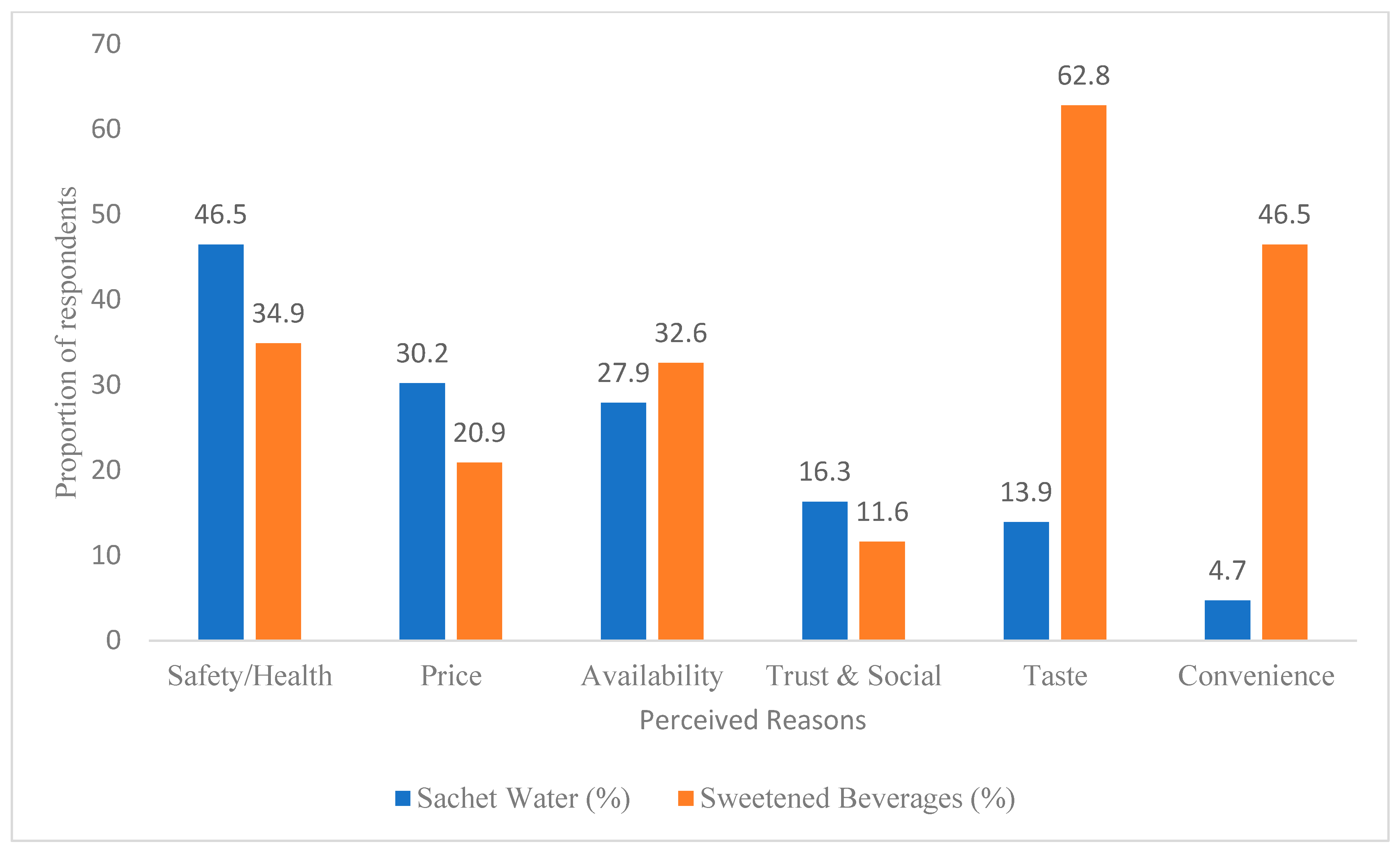
- The findings show that a majority of low-income households experience water insecurity, with sachet water serving as the primary source of drinking water. Beverage choices are influenced by factors such as taste, convenience, perceived safety, and availability, while sachet water purchases are primarily driven by perceived safety, price, and availability, highlighting the structural determinants of consumption.
- The study further shows that although awareness of the beverage tax was moderate, many participants perceived the taxation of bottled water as unfair and reported substituting taxed sweet beverages with cheaper local alternatives, underscoring potential unintended consequences for health outcomes and health equity.
- Limited tax awareness, perceived inequities, and substitution with cheaper sweet beverages highlight the need to refine policy design and strengthen communication to better align fiscal measures with public health goals.
- To strengthen health and equity outcomes, policy makers should consider increasing taxes on sweet beverages to create a clearer price differential between these products and bottled water, while earmarking tax revenues to improve potable water infrastructure and services.
Abstract
1. Introduction
2. Materials and Methods
2.1. Study Design and Setting
2.2. Study Participants
Sampling and Recruitment
2.3. Data Collection
2.3.1. Quantitative Data Collection
2.3.2. Variables Definitions
2.3.3. Focus Group Discussions and Data Collection
Guide Development
FGD Participants
Procedure
2.4. Data Management and Analysis
3. Results
3.1. Socio-Demographic Characteristics of Participants
3.2. Household Water Insecurity Experiences
“The pipe water is not available all the time. Sometimes, when they open the pipe water twice in a month. If it were consistent, the pipe water would come more often, and if we do not have the money to buy sachet water, we could just drink pipe water. I think that would be better for us than relying on borehole water.” (Person 7, Female, Danfa).
“…the cost of water has really gone up. For over a year now, the pipe has not been flowing. The polytank water we buy is from people who set their own prices based on how much they paid. That’s why it’s so expensive now” (Person 3, Female, Oyarifa).
“…If your household is large and you need to buy four or five bags of sachet water, sometimes you simply can’t afford it. The price is scary, so if your family is big, you can’t buy [sachet water] often.” (Person 9, Female, Teiman).
“One bucket of water costs GHS 1.00…not enough for my young daughter and me to bathe. But we use a lot of water, and not just for bathing but also for cooking and other things, and that’s why the cost is high.” (Person 10, Female, Teiman).
3.3. Water and Sweet Beverage Purchasing Behaviour and Consumption
“For me, I buy Bel-Cola. They sell it for GHS 4.00 at the store. I take three bottles in a day.” (Person 1, Female, Danfa).
“For me, I buy asana (traditional beverage) from a street vendor, it costs GHS 2.00. If you have GHS 2.00, you can get one to drink, so for me when they are passing, I buy it.” (Person 3, Female, Danfa).
“For me too, sometimes I buy rice to make a traditional beverage …called ‘zomkom’…I make zomkom for myself and my children to drink.” (Person 9, Female, Danfa).
3.4. Factors Influencing Water and SB Purchasing Decisions and Consumption
3.4.1. Factors Influencing Water Purchasing and Consumption
“I check the cleanliness of the water, whether the water is clear before I buy.” (P1, Female, Teiman).
“At first, when I got very thirsty, I would drink any water I found. Later, I fell sick…and I was diagnosed with typhoid. The doctor advised me to stop drinking random sachet… So now, I drink Clean Pack (sachet water brand).” (Person 6, Female, Oyarifa).
“My child fell ill…the doctors advised us to drink only one type of water and not mix [brand], since then, we’ve all been careful.” (P2, Male, Kweiman).
“I check the expiry date. For water, the label usually says it expires in three months.” (Person 5, Female, Teiman).
“Do you know something?… Dede and Korkor are both Ga children” (Person 5, Male, Danfa).
“I would love to buy five bottles every day, but instead, I can buy a whole pack of sachet water for my children and myself. Bottled water is of better quality than sachet water, but the price is too high.” (Person 9, Female, Teiman).
“With sachet water, a bag/pack costs GHS 6.00 when purchased wholesale, but individually (retail price) it is GHS 10.00. Bottled water is far more expensive. Personally, if I’m using my money, I hardly ever choose the bottle unless it’s absolutely necessary.” (Person 2, Male, Kweiman).
“Sachet water is everywhere. You can get it on any street corner. But with bottled water, you usually only see it at events like weddings, naming ceremonies, or funerals.” (Person 4, Male, Teiman).
“…Some vendors bring it [sachet water] to us using motor tricycles” (Person 8, Male, Oyarifa).
“Here [in this community], wherever we buy our water, it’s sachet water that we buy… wholesale…It’s loaded onto a tricycle [“aboboyaa”]…” (Person 2, Male, Danfa).
“There are a lot of places that sell sachet water…in my area here. I prefer to buy from my sister-in-law; she is a family member, that is why I buy from her or I buy from someone I am in good terms with. I don’t buy from just anyone.” (Person 9, Female, Kweiman).
“I buy mine from nearby shops because it’s close to home” (Person 10, Female, Teiman).
“As for me, my wife’s father sells water and drinks, so sometimes when there is none at home, I just call him and he brings some for me” (Person 4, Male, Oyarifa).
“…At times, sachet water is stored directly on the floor, and I believe this can also affect the water. Water can become bad because of how it is stored…” (Person 2, Male, Kweiman).
“…it tasted like normal water like actual water. But… now, when you drink it, it tastes more like well water…if it’s not chilled, you can’t drink it. But even if it’s slightly chilled, you can manage to drink a little because of the chemicals or substances they’ve put in it, it doesn’t taste good anymore” (Person 4, Male, Kweiman).
“If you buy and store it, it doesn’t change taste or smell, it stays the same. Even if you store four bags/packs, you know it will remain clean and fresh with no scent change. That is why we buy it. Even if you store it, the scent does not change…so that is what is good” (Person 6 Female, Oyarifa).
“If you’re a parent moving (traveling) with a child, it’s better to use bottled water. With sachet water, I can drink all at a go, but my child might not be able to drink all at once, and the rest might spill. You can’t keep it in your bag neither because it’ll spill and wet your stuff, but with bottled water, they can drink some and close it for later. So, for such situations, bottled water is the better choice.” (Person 2, Male, Kweiman).
“Although, pouring sachet water into the bottle will fill it up, there’s still a difference… But when my child is going to school and I don’t have enough money to buy bottled water, since my child has a bottle, I’d rather fill the bottle with sachet water.” (Person 6, Female, Kweiman).
3.4.2. Factors Influencing SB Purchasing Decisions and Consumption
“It depends on the taste you prefer in your drink. That’s why I say I don’t think the price change has really affected the consumption.” (Person 2, Male, Kweiman).
“Some people drink it simply because it tastes good to them.” (Person 9, Female, Teiman).
“Have you seen…mostly the thing we look at is the sweetness…everyone with their own tongue (taste buds/preferences)…and so when you drink and taste the sweetness…” (Person 5, Male, Kweiman).
“We buy from the car or the store, but mostly the aboboyaa comes to the house.” (Person 1, Female, Teiman).
“If the sun is scorching, you have to watch and see whose fridge is working, so you can buy chilled water or drinks that can cool your heart. That’s why we buy from where we like.” (Person 7, Female, Kweiman).
“Around 1 or 2 in the afternoon when the sun is really hot and I’m feeling warm, I just reach home and I’m sweating, I call my child “child please take ‘Bel Cola’ from the fridge. I like the ones that are a bit chilled…and cool my heart.” (Person 10, Female, Kweiman).
“Nowadays, commercial SBs are for those who can afford them. If you can’t, you make your own sobolo at home” (Person 8, Female, Danfa).
“Oh, in the past when I had money, I used to drink ‘Malt’. But these days, since I don’t have money, I go for ‘Bigoo’ or ‘Bel Cola’.” (Person 9, Female, Teiman).
“…In the evening after eating when you feel thirsty, you can take some and pour it over ice. So, we should have some drinks at home” (Person 1, Female, Danfa).
“…sometimes you are just craving it and need something to drink. You may end up buying two or even more without planning to…” (Person 1, Male, Oyarifa).
“One, they are affordable. Two, they are easily accessible. Three, sometimes you just crave them” (Person 5, Male, Oyarifa).
“Because of the children, there should be some drinks at home…” (Person 1, Female, Danfa).
“Before, it was ‘Squeeze’ that we used to buy for the children, but now, we buy drinks like Bel-Cola and Coke for them…Now it’s only Bel-Cola. We go for the cheaper one” (Person 2, Male, Danfa).
“For the children, when they go to school, we sometimes buy them sobolo or other local drinks, because the bottled ones are too expensive” (Person 5, Male, Oyarifa).
“If the drink is expensive, we don’t buy it for our children. What we look for is what the children like” (Person 5, Male, Oyarifa).
“You can’t dictate to the children what to drink. Maybe you will buy Bel Cola but the child will say he/she prefers Puka, you must buy what each prefers so whatever each person prefers, that’s what you end up buying and drinking throughout the week” (Person 3, Female, Oyarifa).
“Before, when you bought Coke, you could taste the cola in it. But now when you buy Coke, everything tastes like sugar, you don’t taste the cola…So I plead that they should reduce the sugar in these drinks because it’s not good for us!” (Person 2, Male, Danfa).
“I don’t really buy any (drinks). I believe they are just made of sugar and coloring…I prefer to buy sobolo leaves and make it at home.” (Person 2, Female, Teiman).
“If you ask me, the local drinks are better. The commercial ones (SBs) are full of chemicals.” (Person 5, Male, Oyarifa).
“Some of the street drinks can be risky, but what choice do we have?” (Person 4, Male, Oyarifa).
3.5. Knowledge, Attitudes, and Practices (KAPs) Related to SB Consumption and Health Risks
3.6. Awareness and Perceptions of the Beverage Tax and Its Benefits
“Sometimes you’ll go to buy it and it’s GHS 3.00, but they’ll tell you GHS 5.00 next time and it’s because of the added charges (taxes), so we want to know how much exactly has been added.” (P3, Female, Oyarifa).
“The tax is two ooh, they [government] tax the producer and then me…the consumer too, why tax me?” (Person 5, Male, Oyarifa).
“Water is life, so they [government] should do something about it for us…Because sometimes, when you’re very thirsty and you have only 50 pesewas, you can’t even buy water. That’s a big problem.” (Person 10, Female, Oyarifa).
“For me, water is essential to life. So, if they could reduce the price, it would help us. Because sometimes, if we don’t even have food…water alone can help us survive” (Person 2, Female, Teiman).
“Water is like air. Just as we need air to live, we also need water. In past years, we used to buy a sachet for 10 pesewas and a pack for GHC 2.00 or 3.00. But…now, a pack costs around GHC 6.00 or even more” (Person 1, Female, Teiman).
“There are many other important things we could use taxes for. If there is a tax on water, I won’t support it, because water is essential and we already pay too much. There are better things to tax” (Person 1, Female, Teiman).
3.7. Perceived Impact of the Beverage Tax on Purchasing of Cheaper SBs
“The price of drinks keeps going up, so we just buy the local ones now. Even for the kids.” (Person 2, Male, Danfa).
“If you can’t [afford commercial SBs], you make your own sobolo at home.” (Person 8, Female, Kweiman).
“Everything depends on the person’s pocket. If someone has enough [money], they’ll still buy the ones they used to buy. But if not, they’ll switch to the local ones…so, we will buy the local ones more” (Person 3, Female, Oyarifa).
“…Maybe today, I won’t even have GHS 4.00 to buy the drink [commercial SB]. But maybe I have GHS 2.00 and I buy my sobolo [traditional SB]…that’s okay with me” (Person 6, Female, Oyarifa).
“Even if they sell it at GHS 1000, we will still buy it” (Person 8, Female, Teiman).
“You can still buy the taxed ones if you want…it’s only GHS 4.00. Local drinks [traditional SBs] are better, though they take time to prepare” (Person 5, Male, Oyarifa).
“Sometimes you just crave a drink. If you have GHS 4.00, Bel Cola becomes an easier option.” (Person 5, Male, Oyarifa).
“The price has indeed gone up. Before, if you had GHS 5.00, you could even get two, but now one is GHS 3.50 or GHS 4.00. So, we just buy one once in a while” (Person 6, Female, Kweiman).
“The price has changed…at first if you had GHS 2.50 pesewas, or GHS2.00, you could get one Coke and drink to calm your heart. But now its not like that…they have increased it, so we don’t often buy it, it’s now expensive” (Person 7, Female, Kweiman).
4. Discussion
4.1. Water Insecurity and Sachet Water Dependence
4.2. Drivers of SB Consumption
4.3. Children’s Preferences and Household SB Consumption
4.4. Nutritional Implications of Substitution with Local Beverages
4.5. Tax Awareness, Perceptions and Health Risk Perceptions
4.6. Integrating the Findings
4.7. Policy Implications
4.8. Methodological Considerations
5. Conclusions
Supplementary Materials
Author Contributions
Funding
Institutional Review Board Statement
Informed Consent Statement
Data Availability Statement
Acknowledgments
Conflicts of Interest
Abbreviations
| SBs | Sweet Beverages |
| NCDs | Non-Communicable Diseases |
| WHO | World Health Organization |
| IMF | International Monetary Fund |
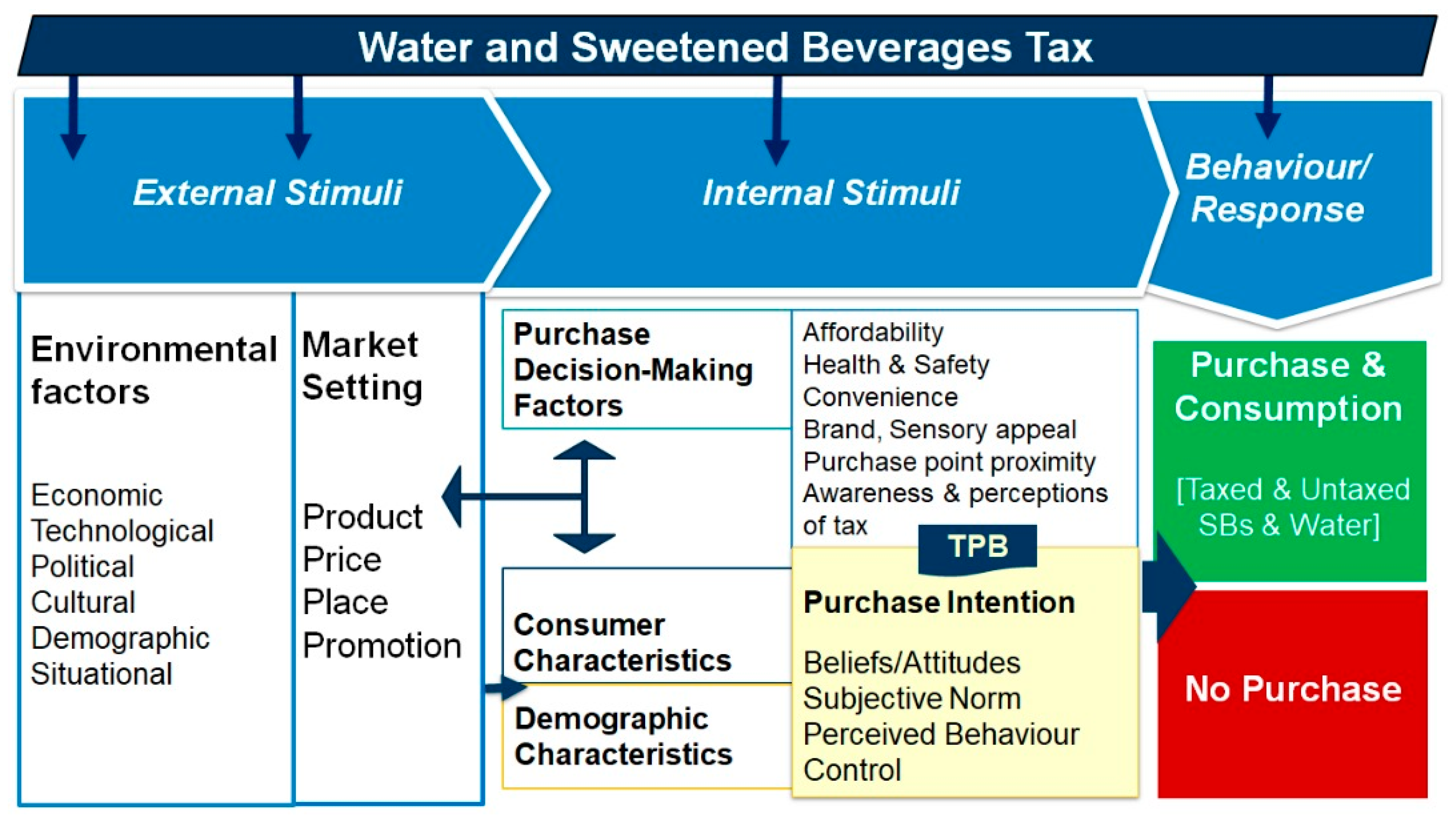
| TPB | Theory of Planned Behaviour |
| FGD | Focus Group Discussion |
| ECBAS | Ethics Committee for Basic and Applied Sciences |
| HWISE | Household Water Insecurity Experiences |
| MPI | Multidimensional Poverty Index |
| COREQ | Consolidated Criteria for Reporting Qualitative Research |
| PCA | Principal Component Analysis |
References
- Malik, V.S.; Popkin, B.M.; Bray, G.A.; Després, J.-P.; Willett, W.C.; Hu, F.B. Sugar-Sweetened Beverages and Risk of Metabolic Syndrome and Type 2 Diabetes: A meta-analysis. Diabetes Care 2010, 33, 2477–2483. [Google Scholar] [CrossRef] [Scilit]
- Lane, M.M.; Gamage, E.; Du, S.; Ashtree, D.N.; McGuinness, A.J.; Gauci, S.; Baker, P.; Lawrence, M.; Rebholz, C.M.; Srour, B.; et al. Ultra-processed food exposure and adverse health outcomes: Umbrella review of epidemiological meta-analyses. BMJ 2024, 384, e077310. [Google Scholar] [CrossRef] [Scilit] [PubMed]
- World Health Organization Regional Office for Africa. Noncommunicable Diseases Factsheet. Available online: https://www.afro.who.int/health-topics/noncommunicable-diseases (accessed on 3 May 2026).
- WHO African Region. Country Disease Outlook Ghana. Available online: https://www.afro.who.int/sites/default/files/2023-08/Ghana.pdf (accessed on 27 August 2024).
- Lara-Castor, L.; Micha, R.; Cudhea, F.; Miller, V.; Shi, P.; Zhang, J.; Sharib, J.R.; Erndt-Marino, J.; Cash, S.B.; Mozaffarian, D. Sugar-sweetened beverage intakes among adults between 1990 and 2018 in 185 countries. Nat. Commun. 2023, 14, 5957. [Google Scholar] [CrossRef] [Scilit]
- Karugu, C.H.; Asiki, G.; Mthembu, S.; Iddi, S.; Kaberia, P.M.; Mohamed, S.F.; Sanya, R.E.; Kiwuwa-Muyingo, S.; Vandevijvere, S.; Agyemang, C. Trends in sales of sugar-sweetened beverages and associated type 2 diabetes burden in nine African countries: An ecological time-series analysis. Glob. Health Action 2025, 18, 2568283. [Google Scholar] [CrossRef] [Scilit] [PubMed]
- Asamoah-Boaheng, M.; Sarfo-Kantanka, O.; Tuffour, A.B.; Eghan, B.; Mbanya, J.C. Prevalence and risk factors for diabetes mellitus among adults in Ghana: A systematic review and meta-analysis. Int. Health 2019, 11, 83–92. [Google Scholar] [CrossRef] [Scilit]
- Ghana Statistical Service (GSS) and ICF. Ghana Demographic and Health Survey; GSS: Accra, Ghana; ICF: Rockville, MD, USA, 2022.
- World Health Organization. Fiscal Policies for DIET and Prevention of Noncommunicable Diseases: Technical Meeting Report; World Health Organization: Geneva, Switzerland, 2016. [Google Scholar]
- World Health Organization. WHO Manual on Sugar-Sweetened Beverage Taxation Policies to Promote Healthy Diets; World Health Organization: Geneva, Switzerland, 2022; Available online: https://www.who.int/publications/i/item/9789240056299 (accessed on 27 April 2024).
- Republic of Ghana. Excise Duty Act, 2014 (Act 878). Available online: https://ghalii.org/akn/gh/act/2014/878/eng@2014-11-12/publication (accessed on 23 April 2026).
- International Monetary Fund. Ghana: Staff Report for the 2014 Article IV Consultation. IMF Country Report No. 14/129; International Monetary Fund: Washington, DC, USA, 2014; Available online: https://www.imf.org/external/pubs/ft/scr/2014/cr14129.pdf (accessed on 28 March 2024).
- Ng, S.W.; Rivera, J.A.; Popkin, B.M.; Colchero, M.A. Did high sugar-sweetened beverage purchasers respond differently to the excise tax on sugar-sweetened beverages in Mexico? Public Health Nutr. 2019, 22, 750–756. [Google Scholar] [CrossRef] [Scilit]
- Colchero, M.A.; Rivera-Dommarco, J.; Popkin, B.M.; Ng, S.W. In Mexico, Evidence of Sustained Consumer Response Two Years After Implementing A Sugar-Sweetened Beverage Tax. Health Aff. 2017, 36, 564–571. [Google Scholar] [CrossRef] [Scilit]
- Essman, M.; Taillie, L.S.; Frank, T.; Ng, S.W.; Popkin, B.M.; Swart, E.C. Taxed and untaxed beverage intake by South African young adults after a national sugar-sweetened beverage tax: A before-and-after study. PLoS Med. 2021, 18, e1003574. [Google Scholar] [CrossRef] [Scilit]
- Wrottesley, S.V.; Stacey, N.; Mukoma, G.; Hofman, K.J.; Norris, S.A. Assessing sugar-sweetened beverage intakes, added sugar intakes and BMI before and after the implementation of a sugar-sweetened beverage tax in South Africa. Public Health Nutr. 2021, 24, 2900–2910. [Google Scholar] [CrossRef] [Scilit]
- Ghana Statistical Service. Ghana 2021 Population and Housing Census, General Report. 2021. Available online: https://census2021.statsghana.gov.gh/gssmain/fileUpload/reportthemelist/Volume%203%20Highlights.pdf (accessed on 23 April 2026).
- Perry, C.; Dimitropoulos, Y.; Skinner, J.; Bourke, C.; Miranda, K.; Cain, E.; Beaufils, D.; Christie, V.; Rambaldini, B.; Gwynne, K. Availability of drinking water in rural and remote communities in New South Wales, Australia. Aust. J. Prim. Health 2022, 28, 125–130. [Google Scholar] [CrossRef] [Scilit] [PubMed]
- Engel, J.F.; Kollat, D.T.; Blackwell, R.D. Consumer Behavior, 2nd ed.; Holt, Rinehart & Winston: Oxford, UK, 1973; 698p. [Google Scholar]
- Ajzen, I. The theory of planned behaviour: Reactions and reflections. Psychol. Health 2011, 26, 1113–1127. [Google Scholar] [CrossRef] [Scilit] [PubMed]
- Creswell, J.W.; Clark, V.L.P. Designing and Conducting Mixed Methods Research; SAGE Publications: Thousand Oaks, CA, USA, 2017. [Google Scholar]
- Oduro, C.Y.; Adamtey, R.; Ocloo, K.J.E.; Research, N.R. Urban growth and livelihood transformations on the fringes of African cities: A case study of changing livelihoods in peri-urban Accra. Environ. Nat. Resour. Res. 2015, 5, 81. [Google Scholar] [CrossRef] [Scilit]
- Bennett, S.; Woods, T.; Liyanage, W.M.; Smith, D.L. A simplified general method for cluster-sample surveys of health in developing countries. World Health Stat. Q. 1991, 44, 98–106. [Google Scholar]
- Milligan, P.; Njie, A.; Bennett, S. Comparison of two cluster sampling methods for health surveys in developing countries. Int. J. Epidemiol. 2004, 33, 469–476. [Google Scholar] [CrossRef] [Scilit]
- UN-HABITAT. Ghana Housing Profile. United Nations Human Settlements Programme (UN-HABITAT); UN-HABITAT: Nairobi, Kenya, 2024; Available online: https://unhabitat.org/ghana-housing-profile (accessed on 23 April 2026).
- Montgomery, M.R.; Gragnolati, M.; Burke, K.A.; Paredes, E. Measuring living standards with proxy variables. Demography 2000, 37, 155–174. [Google Scholar] [CrossRef] [Scilit]
- Boadi, K.O.; Kuitunen, M. Environment, wealth, inequality and the burden of disease in the Accra metropolitan area, Ghana. Int. J. Environ. Health Res. 2005, 15, 193–206. [Google Scholar] [CrossRef] [Scilit] [PubMed]
- UN-Habitat. The Challenge of Slums: Global Report on Human Settlements Programme. 2003. Available online: https://unhabitat.org/the-challenge-of-slums-global-report-on-human-settlements-2003 (accessed on 23 April 2026).
- Young, S.; Boateng, G.; Rosinger, A.; Jamaluddine, Z.; Miller, J.; Frongillo, E.; Neilands, T.; Collins, S.; Wutich, A.; Jepson, W.; et al. The Household Water InSecurity Experiences (HWISE) Scale: Development and validation of a household water insecurity measure for low-income and middle-income countries. BMJ Glob. Health 2019, 4, e001750. [Google Scholar] [CrossRef] [Scilit]
- Rutstein, S.O.; Staveteig, S. Making the Demographic and Health Surveys Wealth Index Comparable; ICF International: Rockville, MD, USA, 2014; Volume 9. [Google Scholar]
- Alkire, S.; Foster, J. Counting and multidimensional poverty measurement. J. Public Econ. 2011, 95, 476–487. [Google Scholar] [CrossRef] [Scilit]
- Young, S.L.; Bose, I.; Miller, J.D.; Pascavis, K.; Alzarez, K.; Barstow, C.; Yeye, V. The Water Insecurity Experiences (WISE) Scales: A Manual for Implementation and Analysis of People’s Experiences with Water; Institute for Policy Research, Northwestern University: Evanston, IL, USA, 2024. [Google Scholar] [CrossRef]
- Mocănașu, D.R. Determining the sample size in qualitative research. In Proceedings of the International Multidisciplinary Scientific Conference on the Dialogue between Sciences & Arts, Religion & Education, Târgoviște, Romania, 26–27 October 2020; Ideas Forum International Academic and Scientific Association: Târgoviște, Romania, 2020; pp. 181–187. [Google Scholar]
- Hennink, M.; Kaiser, B.N. Sample sizes for saturation in qualitative research: A systematic review of empirical tests. Soc. Sci. Med. 2022, 292, 114523. [Google Scholar] [CrossRef] [Scilit]
- Fereday, J.; Muir-Cochrane, E. Demonstrating rigor using thematic analysis: A hybrid approach of inductive and deductive coding and theme development. Int. J. Qual. Methods 2006, 5, 80–92. [Google Scholar] [CrossRef] [Scilit]
- Correa, T.; Fierro, C.; Reyes, M.; Dillman Carpentier, F.R.; Taillie, L.S.; Corvalan, C. Responses to the Chilean law of food labeling and advertising: Exploring knowledge, perceptions and behaviors of mothers of young children. Int. J. Behav. Nutr. Phys. Act. 2019, 16, 21. [Google Scholar] [CrossRef] [Scilit]
- Elo, S.; Kyngäs, H. The qualitative content analysis process. J. Adv. Nurs. 2008, 62, 107–115. [Google Scholar] [CrossRef] [Scilit] [PubMed]
- Peloso, M.; Morinville, C. ‘Chasing for Water’: Everyday Practices of Water Access in Peri-Urban Ashaiman, Ghana. Water Altern. 2014, 7, 140–159. [Google Scholar]
- Boakye-Ansah, A.S.; Schwartz, K.; Zwarteveen, M. Service differentiation as an improvement strategy for access to water in urban low-income areas: Evidence from three Kenyan cities. Int. J. Water Resour. Dev. 2022, 38, 766–782. [Google Scholar] [CrossRef] [Scilit]
- Ampofo, J.A. A survey of microbial pollution of rural domestic water supply in Ghana. Int. J. Environ. Health Res. 1997, 7, 121–130. [Google Scholar] [CrossRef] [Scilit]
- Moulds, S.; Chan, A.C.; Tetteh, J.D.; Bixby, H.; Owusu, G.; Agyei-Mensah, S.; Ezzati, M.; Buytaert, W.; Templeton, M.R. Sachet water in Ghana: A spatiotemporal analysis of the recent upward trend in consumption and its relationship with changing household characteristics, 2010–2017. PLoS ONE 2022, 17, e0265167. [Google Scholar] [CrossRef] [Scilit]
- Addo, H.O.; Amegah, K.E.; Xonam, T.A.; Kabenlah, E.; Ameyaw, C.; Graham, L.O.; Tobigah, T.; Hammond, B.; Maxwell, D.; Bimi, L. Consumer preference and quality of sachet water sold and consumed in the Sunyani Municipality of Ghana. BioMed Res. Int. 2020, 2020, 3865895. [Google Scholar] [CrossRef] [Scilit]
- Guzmán, D.; Stoler, J. An evolving choice in a diverse water market: A quality comparison of sachet water with community and household water sources in Ghana. Am. J. Trop. Med. Hyg. 2018, 99, 526. [Google Scholar] [CrossRef] [Scilit]
- Stoler, J.; Tutu, R.A.; Winslow, K. Piped water flows but sachet consumption grows: The paradoxical drinking water landscape of an urban slum in Ashaiman, Ghana. Habitat Int. 2015, 47, 52–60. [Google Scholar] [CrossRef] [Scilit]
- Colchero, M.A.; Popkin, B.M.; Rivera, J.A.; Ng, S.W. Beverage purchases from stores in Mexico under the excise tax on sugar sweetened beverages: Observational study. BMJ 2016, 352, h6704. [Google Scholar] [CrossRef] [Scilit]
- Andreyeva, T.; Long, M.W.; Brownell, K.D. The impact of food prices on consumption: A systematic review of research on the price elasticity of demand for food. Am. J. Public Health 2010, 100, 216–222. [Google Scholar] [CrossRef] [Scilit] [PubMed]
- Dipalma, G.; Inchingolo, A.M.; Fiore, A.; Chieppa, S.; Carone, C.; Tartaglia, F.C.; Palermo, A.; Inchingolo, A.D.; Inchingolo, F. Role of nutrition in prevention of dental caries in children and adolescents: A systematic review. BMC Oral Health 2026, 26, 495. [Google Scholar] [CrossRef] [Scilit]
- Urugo, M.M.; Kidane, B.; Firew, S.; Hunde, W.; Endere, S.D.; Semu, A.; Getachew, S.; Yirga, Y. Comprehensive review of carbonated soft drink consumption rates and their public health importance. BMC Public Health 2026, 26, 509. [Google Scholar] [CrossRef] [Scilit]
- Bleich, D.; Biggs, M.L.; Gardin, J.M.; Lyles, M.; Siscovick, D.S.; Mukamal, K.J. Phenotyping lipid profiles in type 2 diabetes: Risk association and outcomes from the Cardiovascular Health Study. Am. J. Prev. Cardiol. 2024, 19, 100725. [Google Scholar] [CrossRef] [Scilit] [PubMed]
- Choi, J.H.; Song, S.; Kim, S.K.; Cho, J.W.; Bae, J.H.; Moon, S.; Lim, J.H.; Lee, Y.; Hwang, J.-Y.; Song, Y. Health effects of sugar-sweetened and artificially sweetened beverages: Umbrella review and evidence-based consensus statement of the Korean Diabetes Association and the Korean Nutrition Society. Diabetes Metab. J. 2026, 50, 32. [Google Scholar] [CrossRef] [Scilit] [PubMed]
- Andreyeva, T.; Marple, K.; Marinello, S.; Moore, T.E.; Powell, L.M. Outcomes Following Taxation of Sugar-Sweetened Beverages: A Systematic Review and Meta-analysis. JAMA Netw. Open 2022, 5, e2215276. [Google Scholar] [CrossRef] [Scilit]
- Laar, A.; Amoah, J.M.; Massawudu, L.M.; Pereko, K.K.; Yeboah-Nkrumah, A.; Amevinya, G.S.; Nanema, S.; Odame, E.A.; Agyekum, P.A.; Mpereh, M. Making food-related health taxes palatable in sub-Saharan Africa: Lessons from Ghana. BMJ Glob. Health 2023, 8, e012154. [Google Scholar] [CrossRef] [Scilit]
- Alm, J.; Kasper, M. Using behavioural economics to understand tax compliance. Econ. Political Stud. 2022, 11, 279–294. [Google Scholar] [CrossRef] [Scilit]
- Ortega-Avila, A.G.; Papadaki, A.; Jago, R. Exploring perceptions of the Mexican sugar-sweetened beverage tax among adolescents in north-west Mexico: A qualitative study. Public Health Nutr. 2018, 21, 618–626. [Google Scholar] [CrossRef] [Scilit]
- Yeboah, M.; Danquah, B.A.; Bawuah, J.; Nkwantabisa, A.O. Tax Reform and Investment Decision Effects in an Emerging Economy: Insights from Ghana. Theor. Pract. Res. Econ. Fields 2025, 16, 331–347. [Google Scholar] [CrossRef] [Scilit] [PubMed]
- Backholer, K.; Gupta, A.; Zorbas, C.; Bennett, R.; Huse, O.; Chung, A.; Isaacs, A.; Golds, G.; Kelly, B.; Peeters, A. Differential exposure to, and potential impact of, unhealthy advertising to children by socio-economic and ethnic groups: A systematic review of the evidence. Obes. Rev. 2020, 22, e13144. [Google Scholar] [CrossRef] [Scilit]
- Stacey, N.; Edoka, I.; Hofman, K.; Swart, E.C.; Popkin, B.; Ng, S.W. Changes in beverage purchases following the announcement and implementation of South Africa’s Health Promotion Levy: An observational study. Lancet. Planet. Health 2021, 5, e200–e208. [Google Scholar] [CrossRef] [Scilit] [PubMed]
- Ajzen, I. The theory of planned behavior. Organ. Behav. Hum. Decis. Process. 1991, 50, 179–211. [Google Scholar] [CrossRef] [Scilit]
- Ajzen, I. The theory of planned behavior: Frequently asked questions. Hum. Behav. Emerg. Technol. 2020, 2, 314–324. [Google Scholar] [CrossRef] [Scilit]



| Attribute | Category | Survey (* n = 43) | ** FGDs (n = 36) |
|---|---|---|---|
| Sex | |||
| Female | 27 (62.8%) | 24 (66.7%) | |
| Male | 16 (37.2%) | 12 (33.3%) | |
| Age Category | |||
| 18–35 yrs | 23 (53.5%) | 20 (55.6%) | |
| 36–64 yrs | 20 (46.5%) | 16 (44.4%) | |
| Ethnic Group | |||
| Ga/Adangbe | 24 (55.8%) | 20 (55.6%) | |
| Akan/Fante | 7 (16.3%) | 6 (16.7%) | |
| Northern | 6 (14.0%) | 5 (13.9%) | |
| Ewe | 5 (11.6%) | 4 (11.1%) | |
| Wassa | 1 (2.3%) | 1 (2.8%) | |
| Religion | |||
| Christianity | 38 (88.4%) | 32 (88.9%) | |
| Islam | 4 (9.3%) | 3 (8.3%) | |
| No religion | 1 (2.3%) | 1 (2.8%) | |
| Occupation | |||
| Unemployed | 5 (11.6%) | 4 (11.1%) | |
| Self-employed (traders, artisans, etc.) | 36 (83.7%) | 30 (69.8%) | |
| Formal sector (e.g., teacher, etc.) | 2 (4.7%) | 2 (5.6%) | |
| Household Size | |||
| ≤3 members | 11 (25.6%) | 9 (25.0%) | |
| 4 members | 11 (25.6%) | 9 (25.0%) | |
| 5–10 members | 21 (48.8%) | 18 (50.0%) | |
| Educational Level | |||
| None | 8 (18.6%) | 6 (16.7%) | |
| Primary | 1 (2.3%) | 1 (2.8%) | |
| Junior high school | 28 (65.1%) | 24 (66.7%) | |
| Senior high school | 5 (11.6%) | 4 (11.1%) | |
| Tertiary | 1 (2.3%) | 1 (2.8%) | |
| Relationship to Household Head | |||
| Self | 23 (53.5%) | 20 (55.6%) | |
| Spouse | 20 (46.5%) | 16 (44.4%) | |
| Wealth Index | |||
| Lowest | 11 (25.6%) | 9 (25.0%) | |
| Moderate | 11 (25.6%) | 9 (25.0%) | |
| High | 12 (27.9%) | 10 (27.8%) | |
| Highest | 9 (20.9%) | 8 (22.2%) | |
| Attributes | Categories | Frequency (n) | Percent (%) |
|---|---|---|---|
| Household Water Insecurity Experiences (HWISE) * | |||
| No-to-marginal | 17 (39.5%) | - | |
| Low | 9 (20.9%) | - | |
| Moderate | 10 (23.3%) | - | |
| High | 7 (16.3%) | - | |
| Main Drinking Water Source | |||
| Sachet only | 33 | 76.7% | |
| Sachet and other sources ** | 9 | 20.9% | |
| Rainwater only | 1 | 2.3% | |
| Water Purchase Frequency | |||
| Daily/3–4× weekly | 25 | 58.1% | |
| Weekly/2× weekly | 18 | 41.9% | |
| Sachet Water Quantity Purchased (per week) | |||
| <1 bag *** | 7 | 16.3% | |
| 1 bag | 8 | 18.6% | |
| 2 bags | 6 | 14.0% | |
| ≥3 bags | 22 | 51.2% | |
| Weekly Sachet Water Spending (GHS ****) | |||
| <10 | 8 | 18.6% | |
| 10–20 | 7 | 16.3% | |
| 21–50 | 13 | 30.2% | |
| >50 | 15 | 34.9% | |
| Beverage Type Purchased | |||
| Commercial SBs only | 30 | 69.8% | |
| Both commercial SBs and traditional/local/homemade SBs | 5 | 11.6% | |
| Traditional/local/homemade SB | 3 | 7.0% | |
| Mixing SBs with alcohol | 5 | 11.6% | |
| Beverage Purchase Frequency | |||
| Low (monthly/rarely) | 5 | 11.6% | |
| Medium (weekly/2× weekly) | 10 | 23.3% | |
| High (daily/3–4× weekly) | 28 | 65.1% | |
| Units of Beverages Per Week | |||
| Rarely | 1 | 2.3% | |
| 1–2 bottles ***** | 12 | 27.9% | |
| 3–5 bottles | 13 | 30.2% | |
| 6–10 bottles | 9 | 20.9% | |
| >10 bottles | 8 | 18.6% | |
| Weekly Beverage Spending (GHS) | |||
| <10 | 9 | 20.9% | |
| 10–30 | 10 | 23.3% | |
| 31–50 | 8 | 18.6% | |
| >50 | 15 | 34.9% | |
| Attributes | Frequency (n *) | Percent (%) |
|---|---|---|
| Awareness of beverage-tax policy | ||
| Yes (Aware of the tax) | 24 | 55.8% |
| No (Unaware of the tax) | 19 | 44.2% |
| Attitude toward SB tax | ||
| Oppose | 20 | 46.5% |
| Support | 23 | 53.5% |
| Attitude towards bottled water tax | ||
| Oppose | 27 | 62.8% |
| Support | 16 | 34.9% |
| Attitude towards use of SB tax revenue for improving water infrastructure | ||
| Oppose | 9 | 20.9% |
| Support | 34 | 79.1% |
| Potential changes in purchasing behaviour | ||
| Continue to consume same drinks | ||
| Yes | 30 | 69.8% |
| No | 13 | 30.2% |
| Cut back on sweet beverage consumption | ||
| Yes | 19 | 44.2% |
| No | 24 | 55.8% |
| Switch to untaxed drinks | ||
| Yes | 20 | 46.5% |
| No | 23 | 53.5% |
Disclaimer/Publisher’s Note: The statements, opinions and data contained in all publications are solely those of the individual author(s) and contributor(s) and not of MDPI and/or the editor(s). MDPI and/or the editor(s) disclaim responsibility for any injury to people or property resulting from any ideas, methods, instructions or products referred to in the content. |
© 2026 by the authors. Licensee MDPI, Basel, Switzerland. This article is an open access article distributed under the terms and conditions of the Creative Commons Attribution (CC BY) license.
Share and Cite
Amegah, C.D.; Odei Obeng-Amoako, G.A.; Ng, S.W.; Lambon-Quayefio, M.; Adu-Afarwuah, S. Factors Influencing Water and Sweet Beverage Purchasing Decisions and Behaviours Among Low-Income Households in Four Peri-Urban Communities in Accra: An Exploratory Study. Int. J. Environ. Res. Public Health 2026, 23, 799. https://doi.org/10.3390/ijerph23060799
Amegah CD, Odei Obeng-Amoako GA, Ng SW, Lambon-Quayefio M, Adu-Afarwuah S. Factors Influencing Water and Sweet Beverage Purchasing Decisions and Behaviours Among Low-Income Households in Four Peri-Urban Communities in Accra: An Exploratory Study. International Journal of Environmental Research and Public Health. 2026; 23(6):799. https://doi.org/10.3390/ijerph23060799
Chicago/Turabian StyleAmegah, Christopher Delali, Gloria Adobea Odei Obeng-Amoako, Shu Wen Ng, Monica Lambon-Quayefio, and Seth Adu-Afarwuah. 2026. "Factors Influencing Water and Sweet Beverage Purchasing Decisions and Behaviours Among Low-Income Households in Four Peri-Urban Communities in Accra: An Exploratory Study" International Journal of Environmental Research and Public Health 23, no. 6: 799. https://doi.org/10.3390/ijerph23060799
APA StyleAmegah, C. D., Odei Obeng-Amoako, G. A., Ng, S. W., Lambon-Quayefio, M., & Adu-Afarwuah, S. (2026). Factors Influencing Water and Sweet Beverage Purchasing Decisions and Behaviours Among Low-Income Households in Four Peri-Urban Communities in Accra: An Exploratory Study. International Journal of Environmental Research and Public Health, 23(6), 799. https://doi.org/10.3390/ijerph23060799