Connection to Nature and Psychological Wellbeing: The Role of Mindfulness and Spirituality


Highlights
- Although the mental health benefits of connection to nature are well-documented, public health initiatives lack clarity on the specific psychological mechanisms that translate nature connection into improved wellbeing.
- This research addresses the rising global challenge of human–nature disconnection by investigating how it relates to mindfulness and spirituality, which in turn contribute to psychological wellbeing.
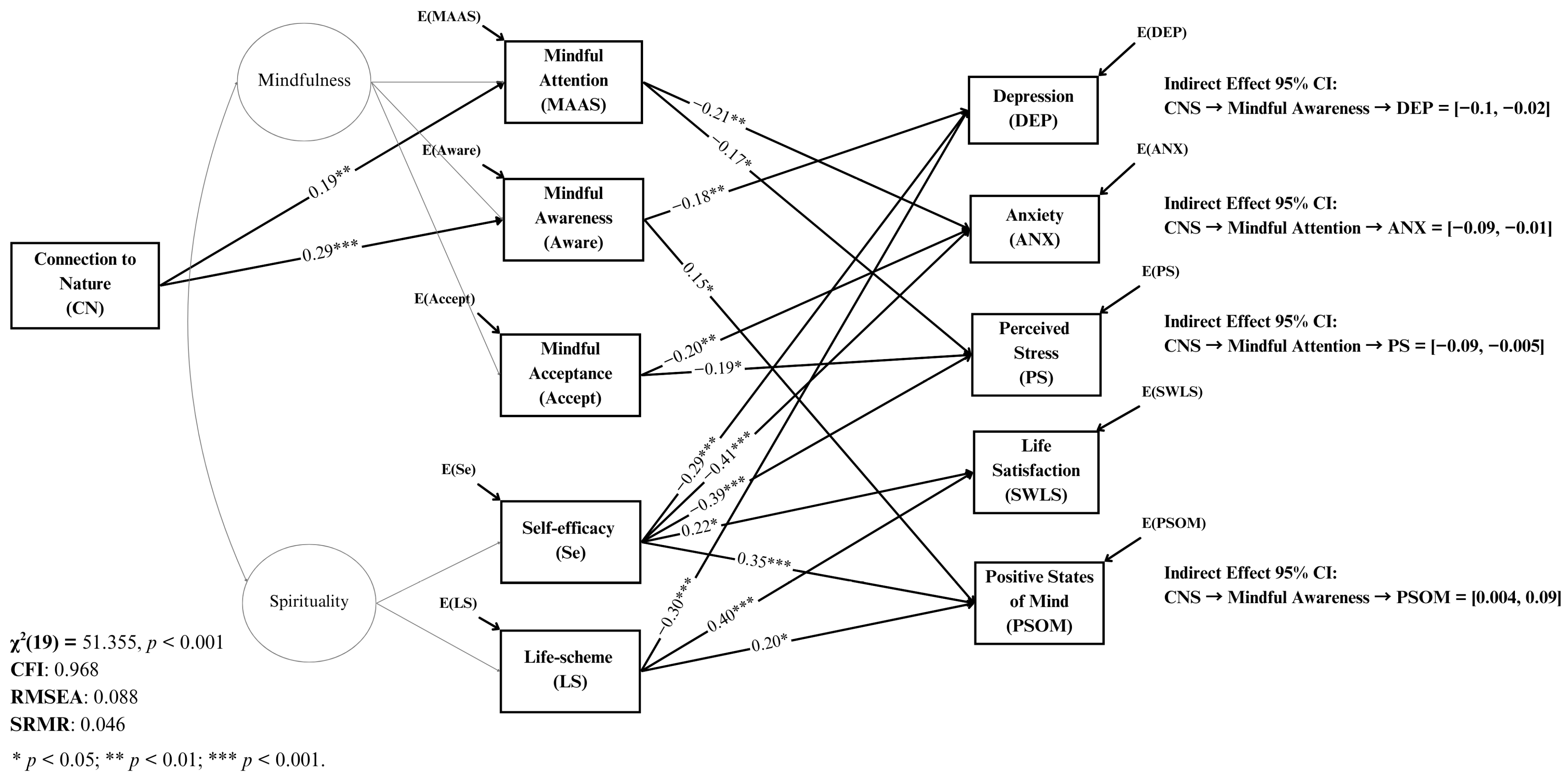
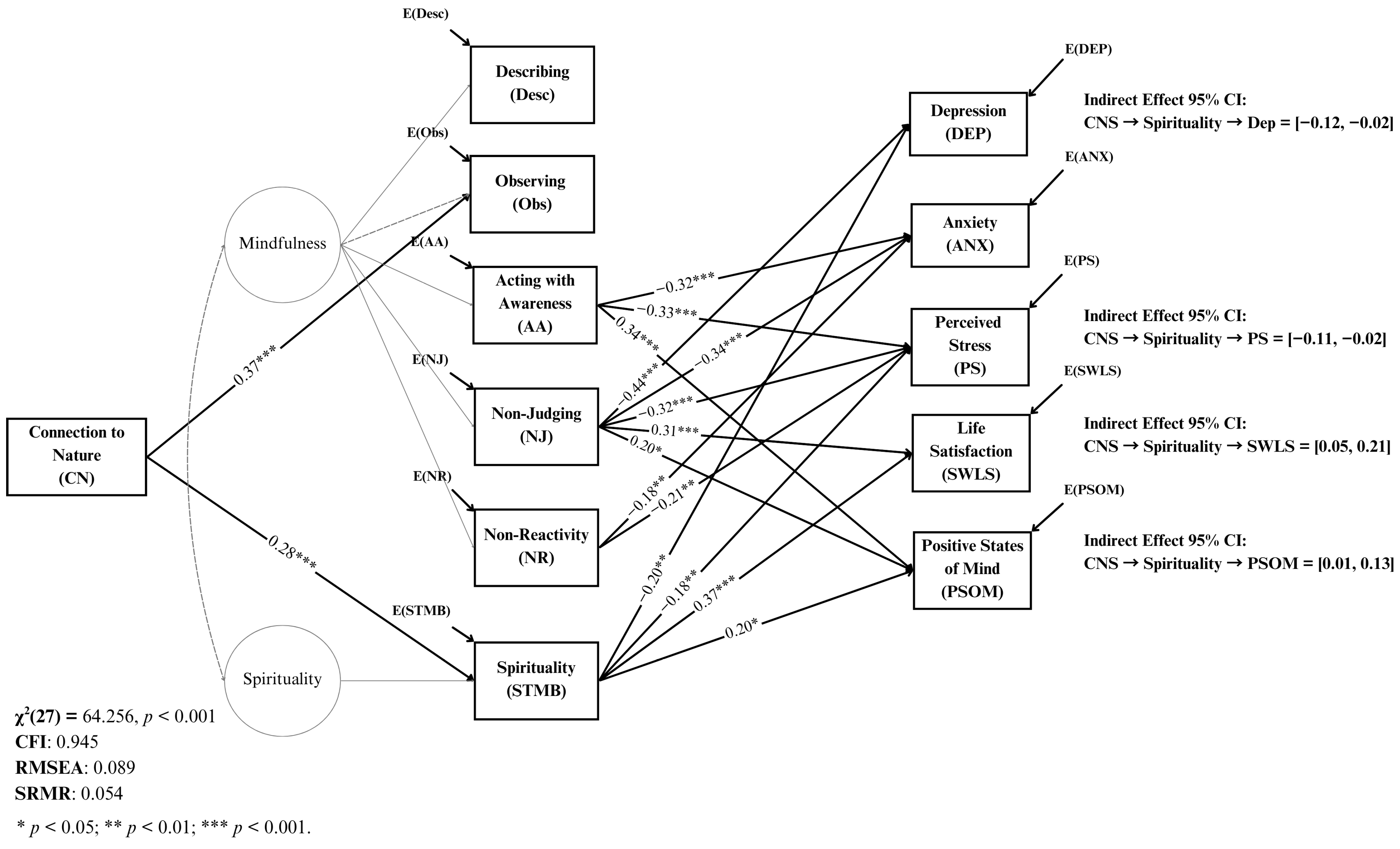
- Across two studies, we show that mindfulness and spirituality serve as pathways linking connection to nature to reduced depression, anxiety, and perceived stress, as well as increased life satisfaction and positive states of mind.
- The impact of these pathways varies depending on how mindfulness and spirituality are conceptualized and measured. Moreover, different facets of mindfulness (e.g., attention vs. acceptance) affect psychological wellbeing in distinct ways.
- Practitioners and policymakers should move beyond providing access to nature to fostering a deeper “quality of presence” in nature that nurtures mindful awareness and spiritual relatedness.
- For researchers, the findings underscore the importance of conceptual clarity, as broad or inconsistent measures of mindfulness and spirituality may obscure their role in nature-based mental health interventions.
Abstract
1. Introduction
1.1. Psychological Wellbeing
1.2. Connection to Nature
1.3. Connection to Nature and Psychological Wellbeing
1.4. Mindfulness
1.4.1. Mindfulness and Psychological Wellbeing
1.4.2. Connection to Nature and Mindfulness
1.4.3. Connection to Nature, Mindfulness, and Psychological Wellbeing
1.5. Spirituality
1.5.1. Spirituality and Psychological Wellbeing
1.5.2. Connection to Nature and Spirituality
1.5.3. Connection to Nature, Spirituality, and Psychological Wellbeing
1.6. The Present Study
2. Study 1
2.1. Study 1 Methods
2.1.1. Study 1 Participants
2.1.2. Study 1 Measures
Connection to Nature
Mindfulness
Spirituality
Psychological Wellbeing
2.1.3. Study 1 Data Analytic Plan
2.2. Study 1 Results
2.2.1. Study 1 Pearson Correlations
2.2.2. Study 1 Mediation Analysis
2.3. Study 1 Discussion
3. Study 2
3.1. Study 2 Methods
3.1.1. Study 2 Participants
3.1.2. Study 2 Measures
Connection to Nature and Psychological Wellbeing
Mindfulness
Spirituality
3.1.3. Study 2 Data Analytic Plan
3.2. Study 2 Results
3.2.1. Study 2 Pearson Correlations
3.2.2. Study 2 Mediation Analysis
3.3. Study 2 Discussion
4. General Discussion
4.1. Mindfulness as a Mediator
4.1.1. Attention and Awareness
4.1.2. Acceptance
4.2. Spirituality as a Mediator
4.3. Strengths
4.4. Limitations and Future Directions
5. Conclusions
Author Contributions
Funding
Institutional Review Board Statement
Informed Consent Statement
Data Availability Statement
Acknowledgments
Conflicts of Interest
References
- Bratman, G.N.; Anderson, C.B.; Berman, M.G.; Cochran, B.; de Vries, S.; Flanders, J.; Folke, C.; Frumkin, H.; Gross, J.J.; Hartig, T.; et al. Nature and Mental Health: An Ecosystem Service Perspective. Sci. Adv. 2019, 5, eaax0903. [Google Scholar] [CrossRef]
- Capaldi, C.A.; Dopko, R.L.; Zelenski, J.M. The Relationship between Nature Connectedness and Happiness: A Meta-Analysis. Front. Psychol. 2014, 5, 976. [Google Scholar] [CrossRef]
- Capaldi, C.A.; Passmore, H.-A.; Nisbet, E.; Zelenski, J.; Dopko, R. Flourishing in Nature: A Review of the Benefits of Connecting with Nature and Its Application as a Wellbeing Intervention. Int. J. Wellbeing 2015, 5, 1–16. [Google Scholar] [CrossRef]
- Hartig, T.; Mitchell, R.; de Vries, S.; Frumkin, H. Nature and Health. Annu. Rev. Public Health 2014, 35, 207–228. [Google Scholar] [CrossRef]
- Richardson, M.; Passmore, H.-A.; Lumber, R.; Thomas, R.; Hunt, A. Moments, Not Minutes: The Nature-Wellbeing Relationship. Int. J. Wellbeing 2021, 11, 8–33. [Google Scholar] [CrossRef]
- Mayer, F.S.; Frantz, C.M. The Connectedness to Nature Scale: A Measure of Individuals’ Feeling in Community with Nature. J. Environ. Psychol. 2004, 24, 503–515. [Google Scholar] [CrossRef]
- Nisbet, E.K.; Zelenski, J.M.; Murphy, S.A. Happiness Is in Our Nature: Exploring Nature Relatedness as a Contributor to Subjective Well-Being. J. Happiness Stud. 2011, 12, 303–322. [Google Scholar] [CrossRef]
- Howell, A.J.; Dopko, R.L.; Passmore, H.-A.; Buro, K. Nature Connectedness: Associations with Well-Being and Mindfulness. Pers. Individ. Differ. 2011, 51, 166–171. [Google Scholar] [CrossRef]
- Martin, L.; White, M.P.; Hunt, A.; Richardson, M.; Pahl, S.; Burt, J. Nature Contact, Nature Connectedness and Associations with Health, Wellbeing and pro-Environmental Behaviours. J. Environ. Psychol. 2020, 68, 101389. [Google Scholar] [CrossRef]
- Pritchard, A.; Richardson, M.; Sheffield, D.; McEwan, K. The Relationship Between Nature Connectedness and Eudaimonic Well-Being: A Meta-Analysis. J. Happiness Stud. 2020, 21, 1145–1167. [Google Scholar] [CrossRef]
- Wu, N.; Jones, C. The Relationship between Connectedness to Nature and Wellbeing: A Meta-Analysis. Curr. Res. Psychol. Behav. Sci. (CRPBS) 2022, 3, 1064. [Google Scholar] [CrossRef]
- Passmore, H.-A.; Krause, A.N. The Beyond-Human Natural World: Providing Meaning and Making Meaning. Int. J. Environ. Res. Public Health 2023, 20, 6170. [Google Scholar] [CrossRef]
- Sanyer, M.M.; Bettmann, J.E.; Anstadt, G.; Ganesh, K.; Hanley, A.W. Decenter to Reenter Nature: Relationships between Decentering, Self-Transcendence, and Nature Connectedness. Psychol. Conscious. Theory Res. Pract. 2023, 10, 205–212. [Google Scholar] [CrossRef]
- Schutte, N.S.; Malouff, J.M. Mindfulness and Connectedness to Nature: A Meta-Analytic Investigation. Pers. Individ. Differ. 2018, 127, 10–14. [Google Scholar] [CrossRef]
- Greenfield, E.A.; Vaillant, G.E.; Marks, N.F. Do Formal Religious Participation and Spiritual Perceptions Have Independent Linkages with Diverse Dimensions of Psychological Well-Being? J. Health Soc. Behav. 2009, 50, 196–212. [Google Scholar] [CrossRef] [PubMed]
- Tomlinson, E.R.; Yousaf, O.; Vittersø, A.D.; Jones, L. Dispositional Mindfulness and Psychological Health: A Systematic Review. Mindfulness 2018, 9, 23–43. [Google Scholar] [CrossRef] [PubMed]
- Smith, B.J.; Tang, K.C.; Nutbeam, D. WHO Health Promotion Glossary: New Terms. Health Promot. Int. 2006, 21, 340–345. [Google Scholar] [CrossRef]
- Ryff, C.D. Happiness Is Everything, or Is It? Explorations on the Meaning of Psychological Well-Being. J. Pers. Soc. Psychol. 1989, 57, 1069–1081. [Google Scholar] [CrossRef]
- Restall, B.; Conrad, E. A Literature Review of Connectedness to Nature and Its Potential for Environmental Management. J. Environ. Manag. 2015, 159, 264–278. [Google Scholar] [CrossRef]
- Tam, K.-P. Concepts and Measures Related to Connection to Nature: Similarities and Differences. J. Environ. Psychol. 2013, 34, 64–78. [Google Scholar] [CrossRef]
- Schultz, P.W. Inclusion with Nature: The Psychology of Human-Nature Relations. In Psychology of Sustainable Development; Springer: Boston, MA, USA, 2002; pp. 61–78. ISBN 978-1-4615-0995-0. [Google Scholar]
- Mayer, F.S.; Frantz, C.M.; Bruehlman-Senecal, E.; Dolliver, K. Why Is Nature Beneficial? The Role of Connectedness to Nature. Environ. Behav. 2009, 41, 607–643. [Google Scholar] [CrossRef]
- Ashmore, R.D.; Deaux, K.; McLaughlin-Volpe, T. An Organizing Framework for Collective Identity: Articulation and Significance of Multidimensionality. Psychol. Bull. 2004, 130, 80–114. [Google Scholar] [CrossRef]
- Zhang, J.W.; Howell, R.T.; Iyer, R. Engagement with Natural Beauty Moderates the Positive Relation between Connectedness with Nature and Psychological Well-Being. J. Environ. Psychol. 2014, 38, 55–63. [Google Scholar] [CrossRef]
- Wolsko, C.; Lindberg, K. Experiencing Connection with Nature: The Matrix of Psychological Well-Being, Mindfulness, and Outdoor Recreation. Ecopsychology 2013, 5, 80–91. [Google Scholar] [CrossRef]
- Trigwell, J.; Francis, A.; Bagot, K. Nature Connectedness and Eudaimonic Well-Being: Spirituality as a Potential Mediator. Ecopsychology 2014, 6, 241–251. [Google Scholar] [CrossRef]
- Zelenski, J.M.; Nisbet, E.K. Happiness and Feeling Connected: The Distinct Role of Nature Relatedness. Environ. Behav. 2014, 46, 3–23. [Google Scholar] [CrossRef]
- Liu, Y.; Cleary, A.; Fielding, K.S.; Murray, Z.; Roiko, A. Nature Connection, pro-Environmental Behaviours and Wellbeing: Understanding the Mediating Role of Nature Contact. Landsc. Urban Plan. 2022, 228, 104550. [Google Scholar] [CrossRef]
- Chang, C.; Lin, B.B.; Feng, X.; Andersson, E.; Gardner, J.; Astell-Burt, T. A Lower Connection to Nature Is Related to Lower Mental Health Benefits from Nature Contact. Sci. Rep. 2024, 14, 6705. [Google Scholar] [CrossRef]
- Küçükaydın, M.A. Understanding Connection to Nature in Turkish Middle School Children: Personal Factors and Nature’s Restorative Effect. J. Environ. Psychol. 2024, 98, 102393. [Google Scholar] [CrossRef]
- Kabat-Zinn, J. Mindfulness. Mindfulness 2015, 6, 1481–1483. [Google Scholar] [CrossRef]
- Baer, R.A.; Smith, G.T.; Hopkins, J.; Krietemeyer, J.; Toney, L. Using Self-Report Assessment Methods to Explore Facets of Mindfulness. Assessment 2006, 13, 27–45. [Google Scholar] [CrossRef]
- Bishop, S.R.; Lau, M.; Shapiro, S.; Carlson, L.; Anderson, N.D.; Carmody, J.; Segal, Z.V.; Abbey, S.; Speca, M.; Velting, D.; et al. Mindfulness: A Proposed Operational Definition. Clin. Psychol. Sci. Pract. 2004, 11, 230–241. [Google Scholar] [CrossRef]
- Cardaciotto, L.; Herbert, J.D.; Forman, E.M.; Moitra, E.; Farrow, V. The Assessment of Present-Moment Awareness and Acceptance: The Philadelphia Mindfulness Scale. Assessment 2008, 15, 204–223. [Google Scholar] [CrossRef]
- Desrosiers, A.; Klemanski, D.H.; Nolen-Hoeksema, S. Mapping Mindfulness Facets onto Dimensions of Anxiety and Depression. Behav. Ther. 2013, 44, 373–384. [Google Scholar] [CrossRef] [PubMed]
- Halladay, J.E.; Dawdy, J.L.; McNamara, I.F.; Chen, A.J.; Vitoroulis, I.; McInnes, N.; Munn, C. Mindfulness for the Mental Health and Well-Being of Post-Secondary Students: A Systematic Review and Meta-Analysis. Mindfulness 2019, 10, 397–414. [Google Scholar] [CrossRef]
- Sadowski, I.; Böke, N.; Mettler, J.; Heath, N.; Khoury, B. Naturally Mindful? The Role of Mindfulness Facets in the Relationship between Nature Relatedness and Subjective Well-Being. Curr. Psychol. 2022, 41, 5358–5373. [Google Scholar] [CrossRef]
- Carlson, L.E.; Doll, R.; Stephen, J.; Faris, P.; Tamagawa, R.; Drysdale, E.; Speca, M. Randomized Controlled Trial of Mindfulness-Based Cancer Recovery versus Supportive Expressive Group Therapy for Distressed Survivors of Breast Cancer. J. Clin. Oncol. 2013, 31, 3119–3126. [Google Scholar] [CrossRef]
- Zainal, N.Z.; Booth, S.; Huppert, F.A. The Efficacy of Mindfulness-Based Stress Reduction on Mental Health of Breast Cancer Patients: A Meta-Analysis. Psychooncology 2013, 22, 1457–1465. [Google Scholar] [CrossRef]
- King, A.P.; Block, S.R.; Sripada, R.K.; Rauch, S.; Giardino, N.; Favorite, T.; Angstadt, M.; Kessler, D.; Welsh, R.; Liberzon, I. Altered Default Mode Network (DMN) Resting State Functional Connectivity Following a Mindfulness-Based Exposure Therapy for Posttraumatic Stress Disorder (PTSD) in Combat Veterans of Afghanistan and Iraq. Depress. Anxiety 2016, 33, 289–299. [Google Scholar] [CrossRef]
- Greco, L.A.; Baer, R.A.; Smith, G.T. Assessing Mindfulness in Children and Adolescents: Development and Validation of the Child and Adolescent Mindfulness Measure (CAMM). Psychol. Assess. 2011, 23, 606–614. [Google Scholar] [CrossRef]
- Mendelson, T.; Greenberg, M.T.; Dariotis, J.K.; Gould, L.F.; Rhoades, B.L.; Leaf, P.J. Feasibility and Preliminary Outcomes of a School-Based Mindfulness Intervention for Urban Youth. J. Abnorm. Child Psychol. 2010, 38, 985–994. [Google Scholar] [CrossRef]
- Song, Y.; Lindquist, R. Effects of Mindfulness-Based Stress Reduction on Depression, Anxiety, Stress and Mindfulness in Korean Nursing Students. Nurse Educ. Today 2015, 35, 86–90. [Google Scholar] [CrossRef]
- Tang, Y.-Y.; Ma, Y.; Wang, J.; Fan, Y.; Feng, S.; Lu, Q.; Yu, Q.; Sui, D.; Rothbart, M.K.; Fan, M.; et al. Short-Term Meditation Training Improves Attention and Self-Regulation. Proc. Natl. Acad. Sci. USA 2007, 104, 17152–17156. [Google Scholar] [CrossRef]
- Sephton, S.E.; Salmon, P.; Weissbecker, I.; Ulmer, C.; Floyd, A.; Hoover, K.; Studts, J.L. Mindfulness Meditation Alleviates Depressive Symptoms in Women with Fibromyalgia: Results of a Randomized Clinical Trial. Arthritis Care Res. 2007, 57, 77–85. [Google Scholar] [CrossRef]
- Keng, S.-L.; Smoski, M.J.; Robins, C.J. Effects of Mindfulness on Psychological Health: A Review of Empirical Studies. Clin. Psychol. Rev. 2011, 31, 1041–1056. [Google Scholar] [CrossRef]
- Sun, S.; Goldberg, S.B.; Lin, D.; Qiao, S.; Operario, D. Psychiatric Symptoms, Risk, and Protective Factors among University Students in Quarantine during the COVID-19 Pandemic in China. Glob. Health 2021, 17, 15. [Google Scholar] [CrossRef]
- Richardson, M.; Sheffield, D. Reflective Self-Attention: A More Stable Predictor of Connection to Nature than Mindful Attention. Ecopsychology 2015, 7, 166–175. [Google Scholar] [CrossRef]
- Barbaro, N.; Pickett, S.M. Mindfully Green: Examining the Effect of Connectedness to Nature on the Relationship between Mindfulness and Engagement in pro-Environmental Behavior. Pers. Individ. Differ. 2016, 93, 137–142. [Google Scholar] [CrossRef]
- Djernis, D.; Lerstrup, I.; Poulsen, D.; Stigsdotter, U.; Dahlgaard, J.; O’Toole, M. A Systematic Review and Meta-Analysis of Nature-Based Mindfulness: Effects of Moving Mindfulness Training into an Outdoor Natural Setting. Int. J. Environ. Res. Public Health 2019, 16, 3202. [Google Scholar] [CrossRef]
- Lymeus, F.; Lindberg, P.; Hartig, T. Building Mindfulness Bottom-up: Meditation in Natural Settings Supports Open Monitoring and Attention Restoration. Conscious. Cogn. 2018, 59, 40–56. [Google Scholar] [CrossRef]
- Labbé, E.E.; Fobes, A. Evaluating the Interplay between Spirituality, Personality and Stress. Appl. Psychophysiol. Biofeedback 2010, 35, 141–146. [Google Scholar] [CrossRef]
- Daaleman, T.P.; Frey, B.B. The Spirituality Index of Well-Being: A New Instrument for Health-Related Quality-of-Life Research. Ann. Fam. Med. 2004, 2, 499–503. [Google Scholar] [CrossRef]
- MacDonald, D.A. Spirituality: Description, Measurement, and Relation to the Five Factor Model of Personality. J. Pers. 2000, 68, 153–197. [Google Scholar] [CrossRef]
- Bhagwandas, K.; Kumar, G.; Satish, L.; Behera, N.; Mohanty, S.; Mahadevan, J. A Systematic Review of Spirituality Tools Based on Psychometric Qualities and Recommendations for Future Research. J. Relig. Health 2024, 64, 1257–1275. [Google Scholar] [CrossRef]
- Sawatzky, R.; Ratner, P.A.; Chiu, L. A Meta-Analysis of the Relationship between Spirituality and Quality of Life. Soc. Indic. Res. 2005, 72, 153–188. [Google Scholar] [CrossRef]
- Nonis, S.A.; Hudson, G.I.; Hunt, C.S. Mental Health among College Students: Relationships with Actively Open-Minded Thinking, Spirituality, and Psychological Wellbeing. J. Educ. Bus. 2024, 99, 223–236. [Google Scholar] [CrossRef]
- Ryff, C.D. Spirituality and Well-Being: Theory, Science, and the Nature Connection. Religions 2021, 12, 914. [Google Scholar] [CrossRef]
- Bethelmy, L.C.; Corraliza, J.A. Transcendence and Sublime Experience in Nature: Awe and Inspiring Energy. Front. Psychol. 2019, 10, 509. [Google Scholar] [CrossRef]
- Navarro, O.; Tapia-Fonllem, C.; Fraijo-Sing, B.; Roussiau, N.; Ortiz-Valdez, A.; Guillard, M.; Wittenberg, I.; Fleury-Bahi, G. Connectedness to Nature and Its Relationship with Spirituality, Wellbeing and Sustainable Behaviour (Conectividad con la Naturaleza y su Relación con la Espiritualidad, el Bienestar y la Conducta Sustentable). PsyEcology 2020, 11, 37–48. [Google Scholar] [CrossRef]
- Hamman, G.; Ivtzan, I. 30 Minutes in Nature a Day Can Increase Mood, Well-Being, Meaning in Life and Mindfulness: Effects of a Pilot Programme. Soc. Inq. Well-Being 2016, 2, 34–46. [Google Scholar] [CrossRef]
- Kamitsis, I.; Francis, A.J.P. Spirituality Mediates the Relationship between Engagement with Nature and Psychological Wellbeing. J. Environ. Psychol. 2013, 36, 136–143. [Google Scholar] [CrossRef]
- Howell, A.J.; Passmore, H.-A.; Buro, K. Meaning in Nature: Meaning in Life as a Mediator of the Relationship Between Nature Connectedness and Well-Being. J. Happiness Stud. 2013, 14, 1681–1696. [Google Scholar] [CrossRef]
- Huynh, T.; Torquati, J.C. Examining Connection to Nature and Mindfulness at Promoting Psychological Well-Being. J. Environ. Psychol. 2019, 66, 101370. [Google Scholar] [CrossRef]
- Brown, K.W.; Ryan, R.M. The Benefits of Being Present: Mindfulness and Its Role in Psychological Well-Being. J. Pers. Soc. Psychol. 2003, 84, 822–848. [Google Scholar] [CrossRef]
- Wong, P.T.P.; Arslan, G.; Bowers, V.L.; Peacock, E.J.; Kjell, O.N.E.; Ivtzan, I.; Lomas, T. Self-Transcendence as a Buffer against COVID-19 Suffering: The Development and Validation of the Self-Transcendence Measure-B. Front. Psychol. 2021, 12, 648549. [Google Scholar] [CrossRef]
- Faul, F.; Erdfelder, E.; Buchner, A.; Lang, A.-G. Statistical Power Analyses Using G*Power 3.1: Tests for Correlation and Regression Analyses. Behav. Res. Methods 2009, 41, 1149–1160. [Google Scholar] [CrossRef]
- Fritz, M.S.; MacKinnon, D.P. Required Sample Size to Detect the Mediated Effect. Psychol. Sci. 2007, 18, 233–239. [Google Scholar] [CrossRef]
- Bjelland, I.; Dahl, A.A.; Haug, T.T.; Neckelmann, D. The Validity of the Hospital Anxiety and Depression Scale. J. Psychosom. Res. 2002, 52, 69–77. [Google Scholar] [CrossRef]
- Cohen, S.; Kamarck, T.; Mermelstein, R. A Global Measure of Perceived Stress. J. Health Soc. Behav. 1983, 24, 385–396. [Google Scholar] [CrossRef]
- Diener, E.; Emmons, R.A.; Larsen, R.J.; Griffin, S. The Satisfaction with Life Scale. J. Pers. Assess. 1985, 49, 71–75. [Google Scholar] [CrossRef]
- Horowitz, M.; Adler, N.; Kegeles, S. A Scale for Measuring the Occurrence of Positive States of Mind: A Preliminary Report. Biopsychosoc. Sci. Med. 1988, 50, 477–483. [Google Scholar] [CrossRef]
- Muthén, L.K.; Muthén, B.O. Mplus User’s Guide: Statistical Analysis with Latent Variables, 7th ed.; Muthén & Muthén: Los Angeles, CA, USA, 1998. [Google Scholar]
- Enders, C.K. Applied Missing Data Analysis; Methodology in the Social Sciences; Guilford Press: New York, NY, USA, 2010. [Google Scholar]
- Hu, L.; Bentler, P.M. Cutoff Criteria for Fit Indexes in Covariance Structure Analysis: Conventional Criteria versus New Alternatives. Struct. Equ. Model. Multidiscip. J. 1999, 6, 1–55. [Google Scholar] [CrossRef]
- Schreiber, J.B. Core Reporting Practices in Structural Equation Modeling. Res. Soc. Adm. Pharm. 2008, 4, 83–97. [Google Scholar] [CrossRef]
- Shrout, P.E.; Bolger, N. Mediation in Experimental and Nonexperimental Studies: New Procedures and Recommendations. Psychol. Methods 2002, 7, 422–445. [Google Scholar] [CrossRef]
- Hayes, A.F. Beyond Baron and Kenny: Statistical Mediation Analysis in the New Millennium. Commun. Monogr. 2009, 76, 408–420. [Google Scholar] [CrossRef]
- Preacher, K.J.; Rucker, D.D.; Hayes, A.F. Addressing Moderated Mediation Hypotheses: Theory, Methods, and Prescriptions. Multivar. Behav. Res. 2007, 42, 185–227. [Google Scholar] [CrossRef]
- National Academies of Sciences, Engineering, and Medicine. Mental Health, Substance Use, and Wellbeing in Higher Education: Supporting the Whole Student; The National Academies Press: Washington, DC, USA, 2021. [Google Scholar] [CrossRef]
- Baer, R.A.; Smith, G.T.; Lykins, E.; Button, D.; Krietemeyer, J.; Sauer, S.; Walsh, E.; Duggan, D.; Williams, J.M.G. Construct Validity of the Five Facet Mindfulness Questionnaire in Meditating and Nonmeditating Samples. Assessment 2008, 15, 329–342. [Google Scholar] [CrossRef]
- Kaplan, R.; Kaplan, S. The Experience of Nature: A Psychological Perspective; Cambridge University Press: New York, NY, USA, 1989; 340p. [Google Scholar]
- Bränström, R.; Duncan, L.G.; Moskowitz, J.T. The Association between Dispositional Mindfulness, Psychological Well-Being, and Perceived Health in a Swedish Population-Based Sample. Br. J. Health Psychol. 2011, 16, 300–316. [Google Scholar] [CrossRef]
- Moriya, J. The Maladaptive Aspect of Observing: Interactive Effects of Mindfulness and Alexithymia on Trait Anxiety. Curr. Psychol. 2022, 41, 622–630. [Google Scholar] [CrossRef]
- Hanley, A.W.; Nakamura, Y.; Garland, E.L. The Nondual Awareness Dimensional Assessment (NADA): New Tools to Assess Nondual Traits and States of Consciousness Occurring within and beyond the Context of Meditation. Psychol. Assess. 2018, 30, 1625–1639. [Google Scholar] [CrossRef]



| Characteristics | N (%) |
|---|---|
| Age | |
| 19–24 years old | 214 (97.7) |
| Older than 24 years old | 5 (2.3) |
| Gender | |
| Woman | 152 (69.4) |
| Man | 67 (30.6) |
| Grade | |
| Freshman | 31 (14.2) |
| Sophomore | 69 (31.5) |
| Junior | 67 (30.6) |
| Senior | 52 (23.7) |
| Race/Ethnicity | |
| Asian | 20 (9.1) |
| Black or African American | 4 (1.8) |
| Native Hawaiian or Pacific Islander | 1 (0.5) |
| White | 184 (84) |
| Other | 10 (4.6) |
| Marital Status | |
| Married | 4 (1.8) |
| Divorced | 1 (0.5) |
| Never Married | 214 (97.7) |
| Variables | 1 | 2 | 3 | 4 | 5 | 6 | 7 | 8 | 9 | 10 | 11 | |
|---|---|---|---|---|---|---|---|---|---|---|---|---|
| Connection to Nature | ||||||||||||
| 1. | CNS | -- | ||||||||||
| Mindfulness | ||||||||||||
| 2. | Mindful Attention | 0.19 ** | -- | |||||||||
| 3. | Mindful Awareness | 0.29 ** | 0.29 ** | -- | ||||||||
| 4. | Mindful Acceptance | −0.03 | 0.52 ** | 0.02 | -- | |||||||
| Spirituality | ||||||||||||
| 5. | Self-Efficacy | 0.02 | 0.36 ** | 0.21 ** | 0.44 ** | -- | ||||||
| 6. | Life Scheme | −0.06 | 0.30 ** | 0.16 * | 0.41 ** | 0.62 ** | -- | |||||
| Psychological Wellbeing | ||||||||||||
| 7. | Depression | 0.04 | −0.24 ** | −0.25 ** | −0.32 ** | −0.54 ** | −0.54 ** | -- | ||||
| 8. | Anxiety | 0.04 | −0.44 ** | −0.06 | −0.49 ** | −0.52 ** | −0.35 ** | 0.48 ** | -- | |||
| 9. | Perceived Stress | 0.04 | −0.43 ** | −0.08 | −0.49 ** | −0.54 ** | −0.41 ** | 0.51 ** | 0.64 ** | -- | ||
| 10. | Life Satisfaction | −0.04 | 0.26 ** | 0.17 * | 0.40 ** | 0.54 ** | 0.60 ** | −0.57 ** | −0.46 ** | −0.57 ** | -- | |
| 11. | Positive State of Mind | 0.07 | 0.33 ** | 0.29 ** | 0.30 ** | 0.55 ** | 0.47 ** | −0.68 ** | −0.57 ** | −0.57 ** | 0.53 ** | -- |
| M | 3.56 | 3.59 | 3.61 | 2.68 | 3.85 | 3.60 | 1.60 | 2.23 | 3.03 | 5.01 | 3.20 | |
| SD | 0.58 | 0.66 | 0.50 | 0.72 | 0.76 | 1.01 | 0.49 | 0.57 | 0.61 | 1.24 | 0.57 | |
| α | 0.82 | 0.84 | 0.77 | 0.88 | 0.83 | 0.91 | 0.72 | 0.83 | 0.85 | 0.89 | 0.83 | |
| Characteristics | N (%) |
|---|---|
| Age | |
| 19–24 years old | 174 (96.7) |
| Older than 24 years old | 6 (3.3) |
| Gender | |
| Woman | 135 (75) |
| Man | 42 (23.3) |
| Non-Binary | 2 (1.1) |
| Prefer not to answer | 1 (0.6) |
| Grade | |
| Freshman | 29 (16.1) |
| Sophomore | 67 (37.2) |
| Junior | 41 (22.8) |
| Senior | 40 (22.2) |
| Graduate | 3 (1.7) |
| Race/Ethnicity | |
| Asian | 3 (1.7) |
| American Indian or Alaska Native | 1 (0.6) |
| Black or African American | 14 (7.8) |
| Native Hawaiian or Pacific Islander | 1 (0.6) |
| White | 139 (77.2) |
| Other | 22 (12.2) |
| Marital Status | |
| Married | 4 (2.2) |
| Divorced | 1 (0.6) |
| Never Married | 175 (97.2) |
| Variables | 1 | 2 | 3 | 4 | 5 | 6 | 7 | 8 | 9 | 10 | 11 | 12 | |
|---|---|---|---|---|---|---|---|---|---|---|---|---|---|
| Connection to Nature | |||||||||||||
| 1. | CNS | -- | |||||||||||
| Mindfulness | |||||||||||||
| 2. | Observing | 0.36 ** | -- | ||||||||||
| 3. | Describing | 0.04 | 0.12 | -- | |||||||||
| 4. | Acting with Awareness | −0.06 | −0.01 | 0.34 ** | -- | ||||||||
| 5. | Non-judging | −0.03 | −0.14 | 0.52 ** | 0.51 ** | -- | |||||||
| 6. | Non-reactivity | 0.05 | 0.27 ** | 0.22 ** | 0.10 | 0.26 ** | -- | ||||||
| Spirituality | |||||||||||||
| 7. | Self-Transcendence | 0.28 ** | 0.17 * | 0.23 ** | 0.01 | 0.06 | 0.10 | -- | |||||
| Psychological Wellbeing | |||||||||||||
| 8. | Depression | 0.00 | −0.04 | −0.23 ** | −0.30 ** | −0.46 ** | −0.16 * | −0.22 ** | -- | ||||
| 9. | Anxiety | 0.17 | 0.18 * | −0.28 ** | −0.51 ** | −0.57 ** | −0.29 ** | 0.05 | 0.52 ** | -- | |||
| 10. | Perceived Stress | 0.07 | 0.06 | −0.30 ** | −0.50 ** | −0.53 ** | −0.32 ** | −0.18 * | 0.45 ** | 0.66 ** | -- | ||
| 11. | Life Satisfaction | 0.07 | 0.03 | 0.33 ** | 0.28 ** | 0.43 ** | 0.26 ** | 0.41 ** | −0.48 ** | −0.33 ** | −0.49 ** | -- | |
| 12. | Positive State of Mind | 0.02 | 0.11 | 0.35 ** | 0.47 ** | 0.44 ** | 0.22 ** | 0.26 ** | −0.44 ** | −0.44 ** | −0.49 ** | 0.39 ** | -- |
| M | 3.44 | 3.33 | 3.37 | 2.93 | 3.05 | 2.99 | 4.00 | 1.64 | 2.44 | 3.00 | 4.82 | 3.14 | |
| SD | 0.67 | 0.61 | 0.68 | 0.67 | 0.79 | 0.59 | 0.63 | 0.50 | 0.59 | 0.62 | 1.29 | 0.54 | |
| α | 0.85 | 0.75 | 0.86 | 0.84 | 0.88 | 0.71 | 0.86 | 0.72 | 0.81 | 0.85 | 0.88 | 0.77 | |
Disclaimer/Publisher’s Note: The statements, opinions and data contained in all publications are solely those of the individual author(s) and contributor(s) and not of MDPI and/or the editor(s). MDPI and/or the editor(s) disclaim responsibility for any injury to people or property resulting from any ideas, methods, instructions or products referred to in the content. |
© 2026 by the authors. Licensee MDPI, Basel, Switzerland. This article is an open access article distributed under the terms and conditions of the Creative Commons Attribution (CC BY) license.
Share and Cite
Kazemi, S.; Torquati, J.C.; Huynh, T. Connection to Nature and Psychological Wellbeing: The Role of Mindfulness and Spirituality. Int. J. Environ. Res. Public Health 2026, 23, 725. https://doi.org/10.3390/ijerph23060725
Kazemi S, Torquati JC, Huynh T. Connection to Nature and Psychological Wellbeing: The Role of Mindfulness and Spirituality. International Journal of Environmental Research and Public Health. 2026; 23(6):725. https://doi.org/10.3390/ijerph23060725
Chicago/Turabian StyleKazemi, Simin, Julia C. Torquati, and Tuyen Huynh. 2026. "Connection to Nature and Psychological Wellbeing: The Role of Mindfulness and Spirituality" International Journal of Environmental Research and Public Health 23, no. 6: 725. https://doi.org/10.3390/ijerph23060725
APA StyleKazemi, S., Torquati, J. C., & Huynh, T. (2026). Connection to Nature and Psychological Wellbeing: The Role of Mindfulness and Spirituality. International Journal of Environmental Research and Public Health, 23(6), 725. https://doi.org/10.3390/ijerph23060725