Linking Perceived Hospital-Generated Content to Psychological Well-Being Through Integrated Cognitive and Emotional Resilience Mechanisms Among Emerging Adults


Highlights
- The digital information ecosystem has emerged as a critical social determinant of mental health for Generation Z as a vulnerable population.
- Rising rates of digitally mediated health anxiety and cyberchondria among adolescents and young adults present an urgent global public health challenge.
- The findings suggest that hospital-generated digital content has the potential to serve as a valuable resource for community-level mental health promotion.
- It outlines a conceptual framework indicating that scientifically reliable and humanizing digital messaging supports adaptive coping mechanisms.
- Healthcare providers, such as private and public hospitals, are encouraged to employ mental health professionals to clinically screen public-facing content and ensure it promotes autonomous health management.
- Health policymakers and government agencies are encouraged to co-author digital health policy guidelines that facilitate ‘digital environmental engineering,’ transforming institutional content into a tool for mental health advocacy.
Abstract
1. Introduction
1.1. Background
1.2. Present Studies and Hypotheses Development
2. Materials and Methods
2.1. Study Design and Sampling Technique
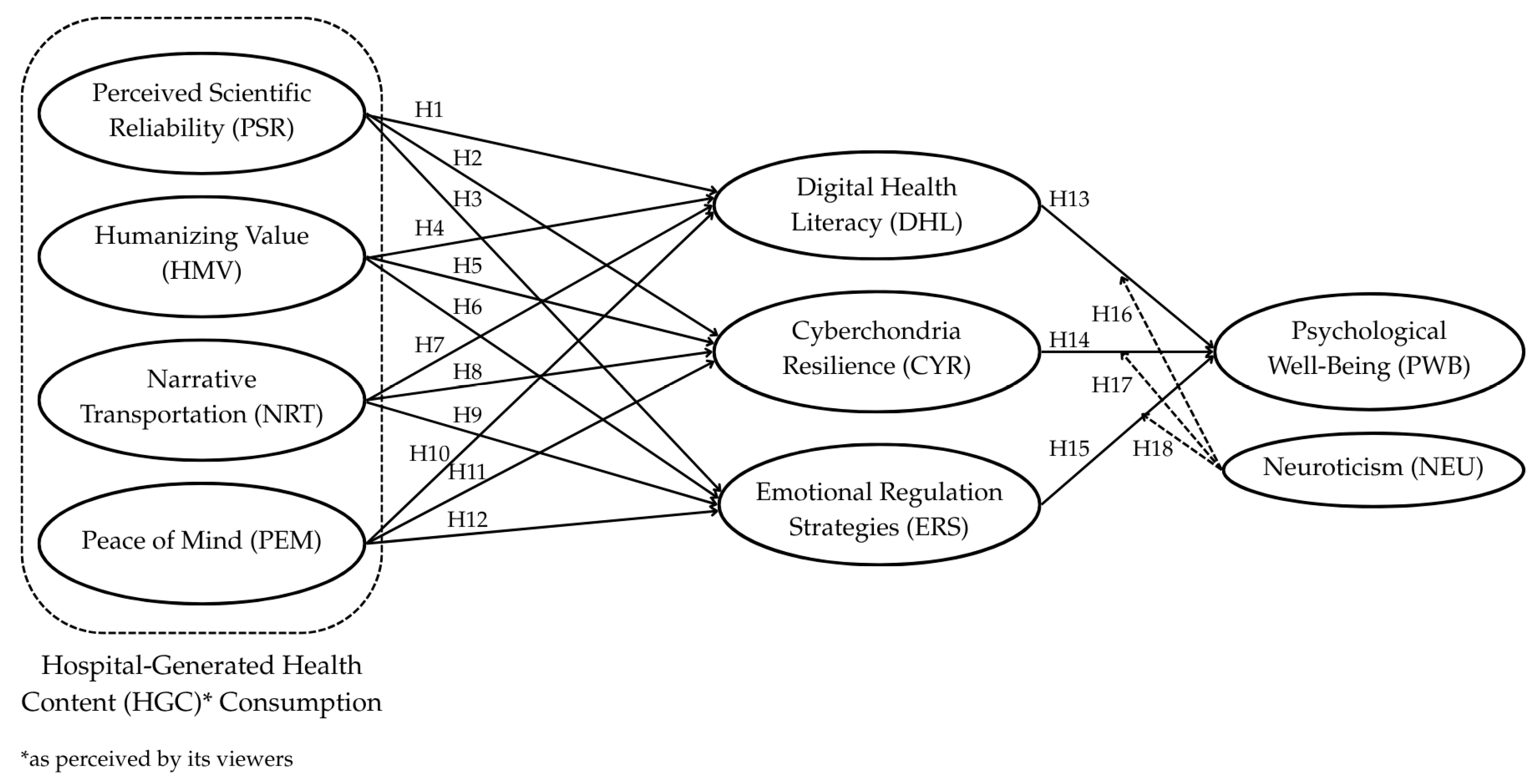
2.2. Conceptual Framework
2.3. Definition of Variables
2.4. Construct Variables
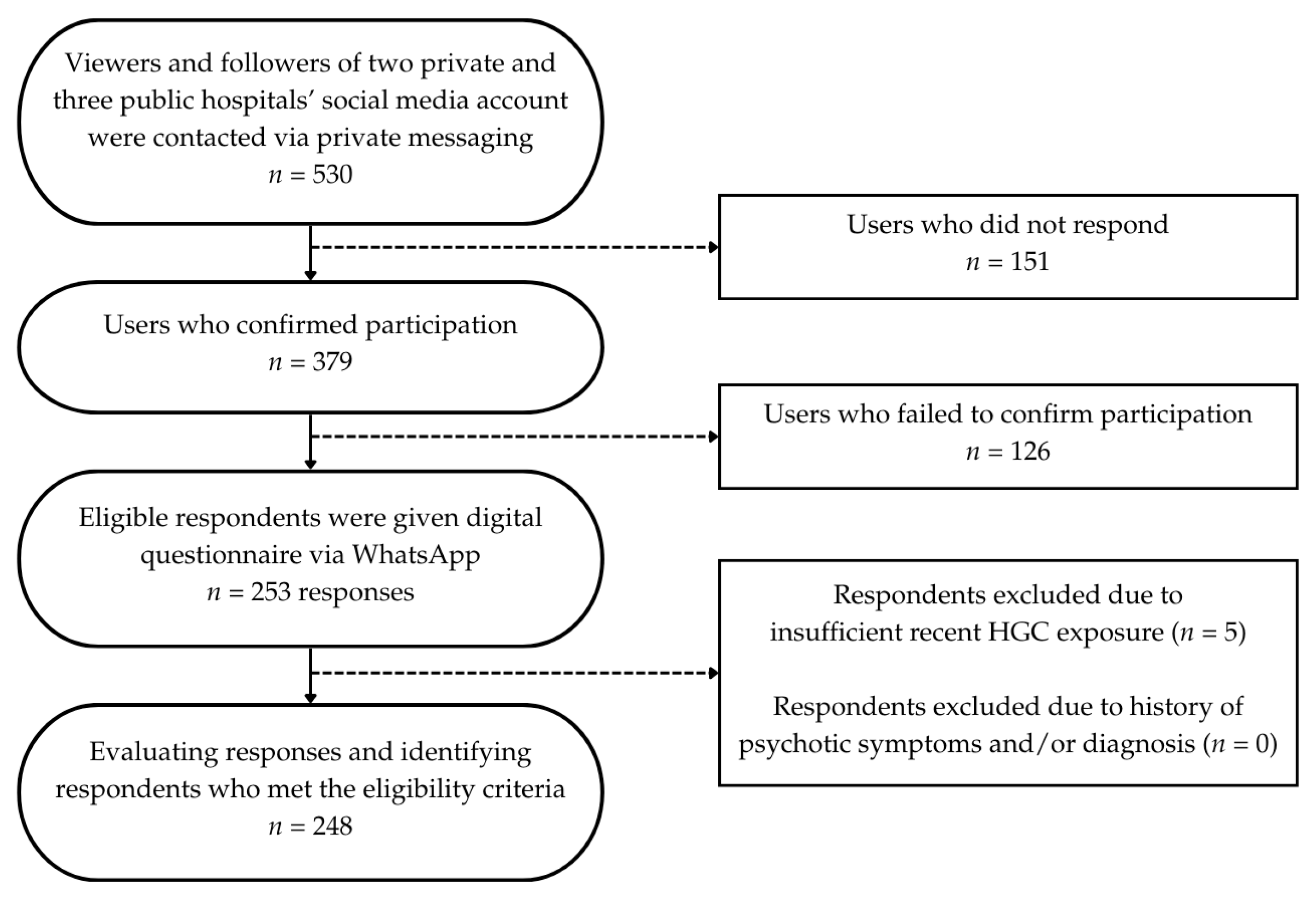
2.5. Data Collection and Screening Procedure
2.6. Data Analysis
2.7. Ethical Consideration
3. Results
4. Discussion
4.1. General Discussion
4.2. Practical Implications for Healthcare Providers
4.3. Study Limitations
5. Conclusions
Author Contributions
Funding
Institutional Review Board Statement
Informed Consent Statement
Data Availability Statement
Acknowledgments
Conflicts of Interest
Abbreviations
| ADHD | Attention-Deficit/Hyperactivity Disorder |
| AVE | Average Variance Extracted |
| CA | Cronbach’s Alpha |
| CBT | Cognitive Behavioral Therapy |
| CI | Confidence Interval |
| CMB | Common Method Bias |
| CVPAT | Cross-Validated Predictive Ability Test |
| CYR | Cyberchondria Resilience |
| DBT | Dialectical Behavioral Therapy |
| DHL | Digital Health Literacy |
| ERS | Emotional Regulation Strategies |
| GAD | Generalized Anxiety Disorder |
| HGC | Hospital-Generated Content |
| HMV | Humanizing Value |
| HTMT | Heterotrait–Monotrait Ratio |
| IA | Indicator Average |
| LM | Linear Model |
| NEU | Neuroticism |
| NRT | Narrative Transportation |
| OL | Outer Loading |
| PEM | Peace of Mind |
| PLS-SEM | Partial Least Squares Structural Equation Modeling |
| PSR | Perceived Scientific Reliability |
| PTSD | Post-Traumatic Stress Disorder |
| PWB | Psychological Well-Being |
| rho_a | Dijkstra–Henseler’s rho |
| rho_c | Composite Reliability |
| SD | Standard Deviation |
| WHO | World Health Organization |
References
- World Population Prospects. Available online: https://population.un.org/wpp/ (accessed on 1 October 2025).
- Chang, F.C.; Chang, C.; Tao, C.C. Adolescent pursuit of health information online during the COVID-19 pandemic: The roles played by eHealth literacy and psychological distress. Glob. Ment. Health 2023, 10, e51. [Google Scholar] [CrossRef] [PubMed]
- Doherty-Torstrick, E.R.; Walton, K.E.; Fallon, B.A. Cyberchondria: Parsing Health Anxiety From Online Behavior. Psychosomatics 2016, 57, 390–400. [Google Scholar] [CrossRef] [PubMed]
- Smailhodzic, E.; Hooijsma, W.; Boonstra, A.; Langley, D.J. Social media use in healthcare: A systematic review of effects on patients and on their relationship with healthcare professionals. BMC Health Serv. Res. 2016, 16, 442. [Google Scholar] [CrossRef] [PubMed]
- Starcevic, V.; Berle, D. Cyberchondria: Towards a better understanding of excessive health-related Internet use. Expert Rev. Neurother. 2013, 13, 205–213. [Google Scholar] [CrossRef] [PubMed]
- World Health Organization. Mental Health of Adolescents. September 2025. Available online: https://www.who.int/news-room/fact-sheets/detail/adolescent-mental-health (accessed on 20 October 2025).
- Tian, J.; Yan, N.; Hu, X.; Tian, S.; Wang, Y.; Mackay, L.E.; Luo, Y.; Wang, Y.; Wang, Y.; Liu, Y.; et al. Global burden of mental disorders among adolescents and young adults, 1990–2021: A systematic analysis of the Global Burden of Diseases Study 2021. Gen. Psychiatry 2025, 38, e102278. [Google Scholar] [CrossRef] [PubMed]
- Kementrian Kesehatan, R.I. Menjaga Kesehatan Mental Para Penerus Bangsa. October 2023. Available online: https://kemkes.go.id/id/menjaga-kesehatan-mental-para-penerus-bangsa (accessed on 20 October 2025).
- Sutrimo, A.; Kusumawardani, L.H.; Sutrimo, A.; Kusumawardani, L.H. Current Community-based Mental Health Promotion Strategies Among children and Adolescents: A Literature Review of Evidence and Feasibility in Indonesia. J. Indones. Health Policy Adm. 2021, 6, 3. [Google Scholar] [CrossRef]
- Yani, D.I.; Chua, J.Y.X.; Wong, J.C.M.; Pikkarainen, M.; Goh, Y.S.S.; Shorey, S. Perceptions of Mental Health Challenges and Needs of Indonesian Adolescents: A Descriptive Qualitative Study. Int. J. Ment. Health Nurs. 2025, 34, e13505. [Google Scholar] [CrossRef] [PubMed]
- Anderson, T.L.; Valiauga, R.; Tallo, C.; Hong, C.B.; Manoranjithan, S.; Domingo, C.; Paudel, M.; Untaroiu, A.; Barr, S.; Goldhaber, K. Contributing Factors to the Rise in Adolescent Anxiety and Associated Mental Health Disorders: A Narrative Review of Current Literature. J. Child Adolesc. Psychiatr. Nurs. 2025, 38, e70009. [Google Scholar] [CrossRef] [PubMed]
- Huang, Y.; Zhao, N. Generalized anxiety disorder, depressive symptoms and sleep quality during COVID-19 outbreak in China: A web-based cross-sectional survey. Psychiatry Res. 2020, 288, 112954. [Google Scholar] [CrossRef] [PubMed]
- Santos, R.M.S.; Mendes, C.G.; Bressani, G.Y.S.; Ventura, S.d.A.; Nogueira, Y.J.d.A.; de Miranda, D.M.; Romano-Silva, M.A. The associations between screen time and mental health in adolescents: A systematic review. BMC Psychol. 2023, 11, 127. [Google Scholar] [CrossRef] [PubMed]
- Petersen, I.; Evans-Lacko, S.; Semrau, M.; Barry, M.M.; Chisholm, D.; Gronholm, P.; Egbe, C.O. Promotion, prevention and protection: Interventions at the population- and community-levels for mental, neurological and substance use disorders in low- and middle-income countries. Int. J. Ment. Health Syst. 2016, 10, 30. [Google Scholar] [CrossRef]
- Ajina, A.S. The role of content marketing in enhancing customer loyalty: An empirical study on private hospitals in Saudi Arabia. Innov. Mark. 2019, 15, 71–84. [Google Scholar] [CrossRef]
- Jeyaraman, M.; Ramasubramanian, S.; Kumar, S.; Jeyaraman, N.; Selvaraj, P.; Nallakumarasamy, A.; Bondili, S.K.; Yadav, S. Multifaceted Role of Social Media in Healthcare: Opportunities, Challenges, and the Need for Quality Control. Cureus 2023, 15, e39111. [Google Scholar] [CrossRef] [PubMed]
- He, F.; Yang, M.; Liu, J.; Gong, T.; Ma, J.; Yang, T.; Zhao, D.; Li, S.; Tian, D. Quality and reliability of pediatric pneumonia related short videos on mainstream platforms: Cross-sectional study. BMC Public Health 2025, 25, 1896. [Google Scholar] [CrossRef] [PubMed]
- Aktar Ugurlu, G.; Ugurlu, B.N. Evaluating the quality and reliability of youtube videos on tympanostomy tubes: A comprehensive analysis for patients and parents. BMC Public Health 2025, 25, 776. [Google Scholar] [CrossRef] [PubMed]
- Zhang, Q.; Li, Z.; Zhang, H.; Han, L.; Zhao, S.; Jia, S. YouTube and Bilibili as sources of information on oral cancer: Cross-sectional content analysis study. Sci. Rep. 2025, 15, 21671. [Google Scholar] [CrossRef] [PubMed]
- Yan, T.; Su, C.; Xue, W.; Hu, Y.; Zhou, H. Mobile phone short video use negatively impacts attention functions: An EEG study. Front. Hum. Neurosci. 2024, 18, 1383913. [Google Scholar] [CrossRef]
- Al-Leimon, O.; Pan, W.; Jaber, A.-R.; Al-Leimon, A.; Jaber, A.R.; Aljahalin, M.; Dardas, L.A. Reels to Remembrance: Attention Partially Mediates the Relationship Between Short-Form Video Addiction and Memory Function Among Youth. Healthcare 2025, 13, 252. [Google Scholar] [CrossRef]
- Arnett, J.J.; Žukauskiene, R.; Sugimura, K. The new life stage of emerging adulthood at ages 18–29 years: Implications for mental health. Lancet Psychiatry 2014, 1, 569–576. [Google Scholar] [CrossRef]
- Schwartz, S.J.; Petrova, M. Prevention Science in Emerging Adulthood: A Field Coming of Age. Prev. Sci. 2019, 20, 305–309. [Google Scholar] [CrossRef] [PubMed]
- Greenhalgh, T.; Robb, N.; Scambler, G. Communicative and strategic action in interpreted consultations in primary health care: A Habermasian perspective. Soc. Sci. Med. 2006, 63, 1170–1187. [Google Scholar] [CrossRef] [PubMed]
- Milevska-Kostova, N.; Devi Duddi, S.R.; Cooper, R.J. Role of patients’ organizations in Health Technology Assessment: A Habermasian system and lifeworld perspective. Int. J. Technol. Assess. Health Care 2021, 37, e6. [Google Scholar] [CrossRef] [PubMed]
- Jaarsma, T.; Westland, H.; Vellone, E.; Freedland, K.E.; Schröder, C.; Trappenburg, J.C.A.; Strömberg, A.; Riegel, B. Status of Theory Use in Self-Care Research. Int. J. Environ. Res. Public Health 2020, 17, 9480. [Google Scholar] [CrossRef] [PubMed]
- Diener, E. Subjective Well-Being. Psychol. Bull. 1984, 95, 542–575. [Google Scholar] [CrossRef]
- Diener, E.; Lucas, R.E.; Scollon, C.N. Beyond the hedonic treadmill: Revising the adaptation theory of well-being. Am. Psychol. 2006, 61, 305–314. [Google Scholar] [CrossRef] [PubMed]
- Pang, H.; Liu, Y. Untangling the effect of cognitive trust and perceived value on health-related information seeking, sharing and psychological well-being: Motivations sought perspective. Telemat. Inform. 2023, 79, 101964. [Google Scholar] [CrossRef]
- Chen, S.-C.; Nguyen, N.T.H.; Lin, C.-Y.; Huy, L.D.; Lai, C.-F.; Dang, L.T.; Truong, N.L.T.; Hoang, N.Y.; Nguyen, T.T.P.; Phaṇ, T.N.; et al. Digital health literacy and well-being among university students: Mediating roles of fear of COVID-19, information satisfaction, and internet information search. Digit. Health 2023, 9, 20552076231165970. [Google Scholar] [CrossRef]
- Jiao, W.; Chang, A.; Ho, M.; Lu, Q.; Liu, M.T.; Schulz, P.J. Predicting and Empowering Health for Generation Z by Comparing Health Information Seeking and Digital Health Literacy: Cross-Sectional Questionnaire Study. J. Med. Internet Res. 2023, 25, e47595. [Google Scholar] [CrossRef] [PubMed]
- Vally, Z.; Ahmed, K. Emotion regulation strategies and psychological wellbeing: Examining cognitive reappraisal and expressive suppression in an Emirati college sample. Neurol. Psychiatry Brain Res. 2020, 38, 27–32. [Google Scholar] [CrossRef]
- Sanchez-Sanchez, H.; Schoeps, K.; Montoya-Castilla, I.; Sanchez-Sanchez, H.; Schoeps, K.; Montoya-Castilla, I. Emotion Regulation Strategies and Psychological Well-Being in Emerging Adulthood: Mediating Role of Optimism and Self-Esteem in a University Student Sample. Behav. Sci. 2025, 15, 929. [Google Scholar] [CrossRef]
- Zhang, S.; Wang, W.; Wu, S.; Ye, H.; Dong, L.; Wang, J.; Ning, X.; Cui, H. Analysis of the mediating effect between ehealth literacy and health self-management of undergraduate nursing students’ mental health literacy. BMC Nurs. 2024, 23, 264. [Google Scholar] [CrossRef]
- McMullan, R.D.; Berle, D.; Arnáez, S.; Starcevic, V. The relationships between health anxiety, online health information seeking, and cyberchondria: Systematic review and meta-analysis. J. Affect. Disord. 2019, 245, 270–278. [Google Scholar] [CrossRef] [PubMed]
- Błachnio, A.; Przepiórka, A.; Kot, P.; Cudo, A.; Steuden, S. The role of emotional functioning in the relationship between health anxiety and cyberchondria. Curr. Psychol. 2022, 42, 31240–31250. [Google Scholar] [CrossRef]
- Schenkel, S.K.; Jungmann, S.M.; Gropalis, M.; Witthöft, M. Conceptualizations of cyberchondria and relations to the anxiety spectrum: Systematic review and meta-analysis. J. Med. Internet Res. 2021, 23, e27835. [Google Scholar] [CrossRef] [PubMed]
- Dwidienawati, D.; Pradipto, Y.; Indrawati, L.; Gandasari, D. Internal and external factors influencing Gen Z wellbeing. BMC Public Health 2025, 25, 1584. [Google Scholar] [CrossRef] [PubMed]
- Habermas, J. The Theory of Communicative Action; Beacon Press: Boston, MA, USA, 1984; 465p. [Google Scholar]
- Sbaffi, L.; Rowley, J. Trust and Credibility in Web-Based Health Information: A Review and Agenda for Future Research. J. Med. Internet Res. 2017, 19, e218. [Google Scholar] [CrossRef] [PubMed]
- Afifi, S.; Bakti, I.G.M.Y.; Yaman, A.; Sumaedi, S. A behavioral intention model of Gen Z female’ health information behavior on social media. Aslib J. Inf. Manag. 2025, ahead-of-print. [Google Scholar] [CrossRef]
- Ishikawa, H.; Miyawaki, R.; Kato, M.; Muilenburg, J.L.; Tomar, Y.A.; Kawamura, Y. Digital health literacy and trust in health information sources: A comparative study of university students in Japan, the United States, and India. SSM Popul. Health 2025, 31, 101844. [Google Scholar] [CrossRef] [PubMed]
- Dağ, E.; Demir, Y.; Kayar, Z.; Nal, M. Relationship between digital health literacy, distrust in the health system and health anxiety in health sciences students. BMC Med. Educ. 2025, 25, 354. [Google Scholar] [CrossRef] [PubMed]
- Huang, Y.; Sundar, S.S. Do We Trust the Crowd? Effects of Crowdsourcing on Perceived Credibility of Online Health Information. Health Commun. 2022, 37, 93–102. [Google Scholar] [CrossRef] [PubMed]
- Wiyono, S.P.; Antonio, F. Development and Validation Humanizing Brand Experience Questionnaire for Hospital Choice Intention. In IoT and Digital Transformation: Innovating Business Models for the Connected World, ICBT 2024; Lecture Notes in Networks and Systems; Springer: Cham, Switzerland, 2025; pp. 353–367. [Google Scholar] [CrossRef]
- Abou Hashish, E.A. Compassion through technology: Digital empathy concept analysis and implications in nursing. Digit. Health 2025, 11, 20552076251326221. [Google Scholar] [CrossRef]
- Howick, J.; Moscrop, A.; Mebius, A.; Fanshawe, T.R.; Lewith, G.; Bishop, F.L.; Mistiaen, P.; Roberts, N.W.; Dieninytė, E.; Hu, X.-Y.; et al. Effects of empathic and positive communication in healthcare consultations: A systematic review and meta-analysis. J. R. Soc. Med. 2018, 111, 240. [Google Scholar] [CrossRef] [PubMed]
- Efthymiou, E. Integrating digital and narrative medicine in modern healthcare: A systematic review. Med. Educ. Online 2025, 30, 2475979. [Google Scholar] [CrossRef] [PubMed]
- Green, M.C.; Brock, T.C. The role of transportation in the persuasiveness of public narratives. J. Pers. Soc. Psychol. 2000, 79, 701–721. [Google Scholar] [CrossRef] [PubMed]
- Hinyard, L.J.; Kreuter, M.W. Using narrative communication as a tool for health behavior change: A conceptual, theoretical, and empirical overview. Health Educ. Behav. 2007, 34, 777–792. [Google Scholar] [CrossRef] [PubMed]
- Mar, R.A.; Oatley, K. The Function of Fiction is the Abstraction and Simulation of Social Experience. Perspect. Psychol. Sci. 2008, 3, 173–192. [Google Scholar] [CrossRef]
- Gebbers, T.; De Wit, J.B.F.; Appel, M. Transportation Into Narrative Worlds and the Motivation to Change Health-Related Behavior. Int. J. Commun. 2017, 11, 21. [Google Scholar]
- Miller, K.E.; Davis, J.L. Narrative Exposure Therapy: A Short-Term Treatment for Traumatic Stress Disorders, by M. Schauer, F. Neuner, and T. Elbert. J. Trauma Dissociation 2013, 14, 592–594. [Google Scholar] [CrossRef]
- Parasuraman, A.; Zeithaml, V.A.; Berry, L.L. SERVQUAL: A multiple-Item Scale for measuring consumer perceptions of service quality. J. Retail. 1988, 64, 12–40. [Google Scholar]
- “Phil” Klaus, P.; Maklan, S. EXQ: A multiple-item scale for assessing service experience. J. Serv. Manag. 2012, 23, 5–33. [Google Scholar] [CrossRef]
- Minartz, P.; Aumann, C.M.; Vondeberg, C.; Kuske, S. Feeling safe in the context of digitalization in healthcare: A scoping review. Syst. Rev. 2024, 13, 62. [Google Scholar] [CrossRef] [PubMed]
- Purgato, M.; Uphoff, E.; Singh, R.; Thapa Pachya, A.; Abdulmalik, J.; Van Ginneken, N. Promotion, prevention and treatment interventions for mental health in low- and middle-income countries through a task-shifting approach. Epidemiol. Psychiatr. Sci. 2020, 29, e150. [Google Scholar] [CrossRef] [PubMed]
- Deci, E.L.; Ryan, R.M. Hedonia, eudaimonia, and well-being: An introduction. J. Happiness Stud. 2008, 9, 1–11. [Google Scholar] [CrossRef]
- Global Coalition for Youth Mental Health. Understanding the Mental Health Impact of Global Challenges on Gen Z; Report; Global Coalition for Youth Mental Health: 2025. Available online: https://www.youthmentalhealthcoalition.org/gen-z#downloads (accessed on 15 January 2026).
- Hjetland, G.J.; Finserås, T.R.; Sivertsen, B.; Colman, I.; Hella, R.T.; Andersen, A.I.O.; Skogen, J.C. Digital self-presentation and adolescent mental health: Cross-sectional and longitudinal insights from the “LifeOnSoMe”-study. BMC Public Health 2024, 24, 2635. [Google Scholar] [CrossRef] [PubMed]
- Thornicroft, G.; Deb, T.; Henderson, C. Community mental health care worldwide: Current status and further developments. World Psychiatry 2016, 15, 276. [Google Scholar] [CrossRef] [PubMed]
- Tek, T.; Özsari, A. Digital literacy, phubbing, and mental well-being in the digital age: A study on young university athletes. Front Psychiatry 2025, 16, 1638959. [Google Scholar] [CrossRef]
- Ding, X.; Wang, Y.; Wang, W. Does Cyberchondria Influence Subjective Well-Being in Online Healthcare platforms?—An Empirical Study. Psychol. Res. Behav. Manag. 2025, 18, 1825–1836. [Google Scholar] [CrossRef]
- Widiger, T.A. (Ed.) The Oxford Handbook of the Five Factor Model; Oxford University Press: New York, NY, USA, 2017. [Google Scholar]
- Robinson, M.D.; Irvin, R.L.; Asad, M.R.; Fereidouni, H. Neuroticism’s link to threat sensitivity: Evidence from a dynamic affect reactivity task. Emotion 2025, 25, 884–895. [Google Scholar] [CrossRef] [PubMed]
- Xia, J.; He, Q.; Li, Y.; Xie, D.; Zhu, S.; Chen, J.; Shen, Y.; Zhang, N.; Wei, Y.; Chen, C.; et al. The relationship between neuroticism, major depressive disorder and comorbid disorders in Chinese women. J. Affect. Disord. 2011, 135, 100–105. [Google Scholar] [CrossRef] [PubMed]
- Aldinger, M.; Stopsack, M.; Ulrich, I.; Appel, K.; Reinelt, E.; Wolff, S.; Grabe, H.J.; Lang, S.; Barnow, S. Neuroticism developmental courses—Implications for depression, anxiety and everyday emotional experience; a prospective study from adolescence to young adulthood. BMC Psychiatry 2014, 14, 210. [Google Scholar] [CrossRef] [PubMed]
- Widiger, T.A.; Oltmanns, J.R. Neuroticism is a fundamental domain of personality with enormous public health implications. World Psychiatry 2017, 16, 144. [Google Scholar] [CrossRef] [PubMed]
- Bajcar, B.; Babiak, J. Neuroticism and cyberchondria: The mediating role of intolerance of uncertainty and defensive pessimism. Pers. Individ. Differ. 2020, 162, 110006. [Google Scholar] [CrossRef]
- Marciano, L.; Camerini, A.L.; Schulz, P.J. Neuroticism in the digital age: A meta-analysis. Comput. Hum. Behav. Rep. 2020, 2, 100026. [Google Scholar] [CrossRef]
- Power, R.A.; Pluess, M. Heritability estimates of the Big Five personality traits based on common genetic variants. Transl. Psychiatry. 2015, 5, e604. [Google Scholar] [CrossRef] [PubMed]
- Schneider, T.R. The role of neuroticism on psychological and physiological stress responses. J. Exp. Soc. Psychol. 2004, 40, 795–804. [Google Scholar] [CrossRef]
- Erdfelder, E.; FAul, F.; Buchner, A.; Lang, A.G. Statistical power analyses using G*Power 3.1: Tests for correlation and regression analyses. Behav. Res. Methods 2009, 41, 1149–1160. [Google Scholar] [CrossRef] [PubMed]
- Erikson, E.H. Identity: Youth and Crisis; WW Norton & Company: New York, NY, USA, 1968. [Google Scholar]
- Erikson, E.H. Childhood and Society; WW Norton & Company: New York, NY, USA, 1950. [Google Scholar]
- Schwartz, S.J.; Luyckx, K.; Vignoles, V. (Eds.) Processes of personal identity formation and evaluation. In Handbook of Identity Theory and Research, 1st ed.; Springer: New York, NY, USA, 2011; pp. 77–98. [Google Scholar] [CrossRef]
- Birrell, L.; Werner-Seidler, A.; Davidson, L.; Andrews, J.L.; Slade, T. Social connection as a key target for youth mental health. Ment. Health Prev. 2025, 37, 200395. [Google Scholar] [CrossRef]
- Bandura, A. Social cognitive theory of self-regulation. Organ. Behav. Hum. Decis. Process. 1991, 50, 248–287. [Google Scholar] [CrossRef]
- Gross, J.J.; John, O.P. Individual Differences in Two Emotion Regulation Processes: Implications for Affect, Relationships, and Well-Being. J. Pers. Soc. Psychol. 2003, 85, 348–362. [Google Scholar] [CrossRef] [PubMed]
- Gross, J.J.; Levenson, R.W. Emotional Suppression: Physiology, Self-Report, and Expressive Behavior. J. Pers. Soc. Psychol. 1993, 64, 970–986. [Google Scholar] [CrossRef] [PubMed]
- Gross, J.J.; Levenson, R.W. Hiding feelings: The acute effects of inhibiting negative and positive emotion. J. Abnorm. Psychol. 1997, 106, 95–103. [Google Scholar] [CrossRef] [PubMed]
- Gross, J.J.; John, O.P. Mapping the Domain of Expressivity: Multimethod Evidence for a Hierarchical Model. J. Pers. Soc. Psychol. 1998, 74, 170–191. [Google Scholar] [CrossRef] [PubMed]
- Tejada-Gallardo, C.; Blasco-Belled, A.; Torrelles-Nadal, C.; Alsinet, C. Effects of School-based Multicomponent Positive Psychology Interventions on Well-being and Distress in Adolescents: A Systematic Review and Meta-analysis. J. Youth Adolesc. 2020, 49, 1943–1960. [Google Scholar] [CrossRef] [PubMed]
- Das, K.V.; Jones-Harrell, C.; Fan, Y.; Ramaswami, A.; Orlove, B.; Botchwey, N. Understanding subjective well-being: Perspectives from psychology and public health. Public Health Rev. 2020, 41, 25. [Google Scholar] [CrossRef]
- Rachmani, E.; Haikal, H.; Rimawati, E. Development and validation of digital health literacy competencies for citizens (DHLC), an instrument for measuring digital health literacy in the community. Comput. Methods Programs Biomed. Update 2022, 2, 100082. [Google Scholar] [CrossRef] [PubMed]
- Gross, J.J. Emotion Regulation: Current Status and Future Prospects. Psychol. Inq. 2015, 26, 1–26. [Google Scholar] [CrossRef]
- John, O.; Srivasta, S. The Big-Five trait taxonomy: History, measurement, and theoretical perspectives. In Handbook of Personality: Theory and Research, 2nd ed.; Guilford Press: New York, NY, USA, 1999; p. 102. [Google Scholar]
- Podsakoff, P.M.; MacKenzie, S.B.; Lee, J.Y.; Podsakoff, N.P. Common Method Biases in Behavioral Research: A Critical Review of the Literature and Recommended Remedies. J. Appl. Psychol. 2003, 88, 879–903. [Google Scholar] [CrossRef] [PubMed]
- Hair, J.F.; Hult, G.T.M.; Ringle, C.M.; Sarstedt, M.; Danks, N.P.; Ray, S. Partial Least Squares Structural Equation Modeling (PLS-SEM) Using R; Springer International Publishing: Cham, Switzerland, 2021. [Google Scholar] [CrossRef]
- Henseler, J.; Ringle, C.M.; Sarstedt, M. A new criterion for assessing discriminant validity in variance-based structural equation modeling. J. Acad. Mark. Sci. 2015, 43, 115–135. [Google Scholar] [CrossRef]
- Shmueli, G.; Sarstedt, M.; Hair, J.F.; Cheah, J.-H.; Ting, H.; Vaithilingam, S.; Ringle, C.M. Predictive model assessment in PLS-SEM: Guidelines for using PLSpredict. Eur. J. Mark. 2019, 53, 2322–2347. [Google Scholar] [CrossRef]
- Htay, M.N.N.; Parial, L.L.; Tolabing, M.C.; Dadaczynski, K.; Okan, O.; Leung, A.Y.M.; Su, T.T. Digital health literacy, online information-seeking behaviour, and satisfaction of COVID-19 information among the university students of East and South-East Asia. PLoS ONE 2022, 17, e0266276. [Google Scholar] [CrossRef] [PubMed]
- Taba, M.; Allen, T.B.; Caldwell, P.H.; Skinner, S.R.; Kang, M.; McCaffery, K.; Scott, K.M. Adolescents’ self-efficacy and digital health literacy: A cross-sectional mixed methods study. BMC Public Health 2022, 22, 1223. [Google Scholar] [CrossRef] [PubMed]
- Greškovičová, K.; Masaryk, R.; Synak, N.; Čavojová, V. Superlatives, clickbaits, appeals to authority, poor grammar, or boldface: Is editorial style related to the credibility of online health messages? Front. Psychol. 2022, 13, 940903. [Google Scholar] [CrossRef]
- Leung, A.Y.M.; Parial, L.L.; Tolabing, M.C.; Sim, T.; Mo, P.; Okan, O.; Dadaczynski, K. Sense of coherence mediates the relationship between digital health literacy and anxiety about the future in aging population during the COVID-19 pandemic: A path analysis. Aging Ment. Health 2022, 26, 544–553. [Google Scholar] [CrossRef] [PubMed]
- Ali, S.S.; Hendawi, N.E.; El-Ashry, A.M.; Mohammed, M.S. The relationship between cyberchondria and health literacy among first-year nursing students: The mediating effect of health anxiety. BMC Nurs. 2024, 23, 776. [Google Scholar] [CrossRef]
- Stifjell, K.; Sandanger, T.M.; Wien, C. Exploring Online Health Information–Seeking Behavior Among Young Adults: Scoping Review. J. Med. Internet Res. 2025, 27, e70379. [Google Scholar] [CrossRef] [PubMed]
- Heiss, R.; Gell, S.; Röthlingshöfer, E.; Zoller, C. How threat perceptions relate to learning and conspiracy beliefs about COVID-19: Evidence from a panel study. Pers. Individ. Differ. 2021, 175, 110672. [Google Scholar] [CrossRef] [PubMed]
- Britton, J.C.; Lissek, S.; Grillon, C.; Norcross, M.A.; Pine, D.S. Development of anxiety: The role of threat appraisal and fear learning. Depress. Anxiety 2011, 28, 5–17. [Google Scholar] [CrossRef] [PubMed]
- Wang, R.; Li, L.; He, J. The Misprediction of Helpers in Comforting Situations and Its Mechanism. Psychol. Res. Behav. Manag. 2024, 17, 329. [Google Scholar] [CrossRef] [PubMed]
- Akyirem, S.; Salifu, Y.; Bayuo, J.; Duodu, P.A.; Bossman, I.F.; Abboah-Offei, M. An integrative review of the use of the concept of reassurance in clinical practice. Nurs. Open 2022, 9, 1515. [Google Scholar] [CrossRef] [PubMed]
- Volkaert, B.; Wante, L.; Van Beveren, M.L.; Vervoort, L.; Braet, C. Training Adaptive Emotion Regulation Skills in Early Adolescents: The Effects of Distraction, Acceptance, Cognitive Reappraisal, and Problem Solving. Cogn. Ther. Res. 2020, 44, 678–696. [Google Scholar] [CrossRef]
- Reffner Collins, M.K.; Lazard, A.J.; Hedrick McKenzie, A.M.; Varma, T. ‘It’s Nothing Like Cancer’: Young Adults with Cancer Reflect on Memorable Entertainment Narratives. Health Commun. 2024, 39, 552–562. [Google Scholar] [CrossRef] [PubMed]
- Slater, M.D.; Rouner, D. Entertainment-Education and Elaboration Likelihood: Understanding the Processing of Narrative Persuasion. Commun. Theory 2002, 12, 173–191. [Google Scholar] [CrossRef]
- Starcevic, V.; Berle, D.; Arnáez, S. Recent Insights Into Cyberchondria. Curr. Psychiatry Rep. 2020, 22, 56. [Google Scholar] [CrossRef] [PubMed]
- Xu, R.H.; Liang, X.; Starcevic, V. Exploring the Relationship Between Cyberchondria and Suicidal Ideation: Cross-Sectional Mediation Analysis. J. Med. Internet Res. 2025, 27, e72414. [Google Scholar] [CrossRef] [PubMed]
- Kraiss, J.T.; ten Klooster, P.M.; Moskowitz, J.T.; Bohlmeijer, E.T. The relationship between emotion regulation and well-being in patients with mental disorders: A meta-analysis. Compr. Psychiatry 2020, 102, 152189. [Google Scholar] [CrossRef] [PubMed]
- Fang, S.; Mushtaque, I. The Moderating Role of Health Literacy and Health Promoting Behavior in the Relationship Among Health Anxiety, Emotional Regulation, and Cyberchondria. Psychol. Res. Behav. Manag. 2024, 17, 51–62. [Google Scholar] [CrossRef]
- Nasiri, M.; Mohammadkhani, S.; Akbari, M.; Alilou, M.M. The structural model of cyberchondria based on personality traits, health-related metacognition, cognitive bias, and emotion dysregulation. Front. Psychiatry 2023, 13, 960055. [Google Scholar] [CrossRef]
- Maftei, A.; Holman, A.C. Cyberchondria During the Coronavirus Pandemic: The Effects of Neuroticism and Optimism. Front. Psychol. 2020, 11, 567345. [Google Scholar] [CrossRef]
- Xu, X.; Yan, X.; Zhang, Q.; Xu, C.; Li, M. The chain mediating role of psychological resilience and neuroticism between intolerance of uncertainty and perceived stress among medical university students in Southwest China. BMC Psychiatry 2023, 23, 861. [Google Scholar] [CrossRef] [PubMed]
- Sahib, A.; Chen, J.; Cárdenas, D.; Calear, A.L.; Wilson, C. Emotion regulation mediates the relation between intolerance of uncertainty and emotion difficulties: A longitudinal investigation. J. Affect. Disord. 2024, 364, 194–204. [Google Scholar] [CrossRef] [PubMed]
- Fusar-Poli, P.; Correll, C.U.; Arango, C.; Berk, M.; Patel, V.; Ioannidis, J.P.A. Preventive psychiatry: A blueprint for improving the mental health of young people. World Psychiatry 2021, 20, 200–221. [Google Scholar] [CrossRef] [PubMed]
- Coelho, J.; Pécune, F.; Micoulaud-Franchi, J.A.; Bioulac, B.; Philip, P. Promoting mental health in the age of new digital tools: Balancing challenges and opportunities of social media, chatbots, and wearables. Front. Digit. Health 2025, 7, 1560580. [Google Scholar] [CrossRef]
- Castaldelli-Maia, J.M.; Ventriglio, A.; Torales, J. The global prevalence of mental disorders among adolescents: Focus on sex, regional and socio-demographic differences. Int. Rev. Psychiatry 2025, 37, 570–580. [Google Scholar] [CrossRef] [PubMed]
- Saboor, S.; Medina, A.; Marciano, L. Application of Positive Psychology in Digital Interventions for Children, Adolescents, and Young Adults: Systematic Review and Meta-Analysis of Controlled Trials. JMIR Ment. Health 2024, 11, e56045. [Google Scholar] [CrossRef] [PubMed]
- Schweizer, S.; Gotlib, I.H.; Blakemore, S.J. The role of affective control in emotion regulation during adolescence. Emotion 2020, 20, 80–86. [Google Scholar] [CrossRef] [PubMed]
- McKay, D.; Sookman, D.; Neziroglu, F.; Wilhelm, S.; Stein, D.J.; Kyrios, M.; Matthews, K.; Veale, D. Efficacy of cognitive-behavioral therapy for obsessive-compulsive disorder. Psychiatry Res. 2015, 227, 104–113. [Google Scholar] [CrossRef] [PubMed]
- Reid, J.E.; Laws, K.R.; Drummond, L.; Vismara, M.; Grancini, B.; Mpavaenda, D.; Fineberg, N.A. Cognitive behavioural therapy with exposure and response prevention in the treatment of obsessive-compulsive disorder: A systematic review and meta-analysis of randomised controlled trials. Compr. Psychiatry 2021, 106, 152223. [Google Scholar] [CrossRef] [PubMed]
- Schuman-Olivier, Z.; Trombka, M.; Lovas, D.A.; Brewer, J.A.; Vago, D.R.; Gawande, R.; Dunne, J.P.P.; Lazar, S.W.; Loucks, E.B.; Fulwiler, C. Mindfulness and Behavior Change. Harv. Rev. Psychiatry 2020, 28, 371–394. [Google Scholar] [CrossRef] [PubMed]
- Fordham, B.; Sugavanam, T.; Edwards, K.; Stallard, P.; Howard, R.; das Nair, R.; Copsey, B.; Lee, H.; Howick, J.; Hemming, K.; et al. The evidence for cognitive behavioural therapy in any condition, population or context: A meta-review of systematic reviews and panoramic meta-analysis. Psychol. Med. 2021, 51, 21–29. [Google Scholar] [CrossRef] [PubMed]
- Ahmadvand, A.; Gatchel, R.; Brownstein, J.; Nissen, L. The biopsychosocial-digital approach to health and disease: Call for a paradigm expansion. J. Med. Internet Res. 2018, 20, e9732. [Google Scholar] [CrossRef] [PubMed]
- Linehan, M.M. DBT Skills Training Manual, 2nd ed.; Guilford: New York, NY, USA, 2015. [Google Scholar]
- Eeles, J.; Walker, D.M. Mindfulness as taught in Dialectical Behaviour Therapy: A scoping review. Clin. Psychol. Psychother. 2022, 29, 1843–1853. [Google Scholar] [CrossRef] [PubMed]
- Stanton, J.; Thomas, D.R.; Jarbin, M.; MacKay, P. Self-determination theory in acute child and adolescent mental health inpatient care. A qualitative exploratory study. PLoS ONE 2020, 15, e0239815. [Google Scholar] [CrossRef] [PubMed]



| Variables | Conceptualized Definition | References |
|---|---|---|
| Perceived Scientific Reliability | The extent to which individuals interpret HGC as factually accurate, evidence-based, verifiable, and delivered by a trustworthy source that communicates transparently and corrects errors responsibly. | [39] |
| Humanizing Value | The extent to which HGC fosters sensorial, emotional, intellectual, and behavioral experiences that feel personal, empathetic, and relational rather than institutional. | [45] |
| Narrative Transportation | The extent to which individuals become cognitively, emotionally, and imaginatively immersed in HGC, experiencing focused mental engagement, enduring affective involvement, and vivid visualization of the scenarios depicted. | [49] |
| Peace of Mind | The sense of security and calm that arises when individuals perceive HGC as trustworthy, easy to understand, and clearly intended to protect their health interests. | [54,55] |
| Cyberchondria Resilience | The ability to manage and recover from health-related anxiety induced by online health information, appropriate control over information-seeking behavior, emotional stability during health-related uncertainty, and discern credible medical content without seeking forced reassurance. | [5] |
| Digital Health Literacy | An individual’s ability to effectively locate, evaluate, and apply health information from hospital-generated digital platforms, enabling informed health-related decisions through critical assessment and practical use of online medical content. | [85] |
| Emotional Regulation Strategies | The deliberate use of cognitive reappraisal and expressive suppression to manage, modify, or control the intensity and expression of emotional experiences. | [86] |
| Neuroticism | A personality trait reflecting an individual’s predisposition toward emotional instability, negative affectivity, and heightened reactivity to stress. | [87] |
| Psychological Well-Being | The subjective experience of frequent positive emotions, low negative affect, and favorable self-evaluations of one’s mental state, emphasizing the quality of emotional life as a dynamic condition that varies across individuals and can be shaped by situational contexts and adaptive coping processes. | [27,28,58] |
| Categories | Description | Amount (n) | Percentage (%) |
|---|---|---|---|
| Gender | Male | 85 | 34.27 |
| Female | 151 | 60.89 | |
| Prefer not to answer | 12 | 4.84 | |
| Age | 26–28 | 116 | 46.77 |
| 22–25 | 90 | 36.29 | |
| 18–21 | 42 | 16.94 | |
| Occupation | Undergraduate students | 77 | 31.05 |
| New hires | 90 | 36.29 | |
| Entrepreneurs | 39 | 15.73 | |
| Part-timers/freelancers | 26 | 10.48 | |
| Others | 16 | 6.45 | |
| Marital Status | Single | 232 | 93.55 |
| Married | 13 | 5.24 | |
| Divorced | 3 | 1.21 |
| Categories | Description | Amount (n) | Percentage (%) |
|---|---|---|---|
| Daily screen time | <2 h | 13 | 5.24 |
| 2–4 h | 78 | 31.45 | |
| >4 h | 157 | 63.31 | |
| HGC exposure | Rarely | 63 | 25.40 |
| Sometimes | 76 | 30.65 | |
| A few times a week | 65 | 26.21 | |
| Almost every day | 44 | 17.74 | |
| Digital platforms | 185 | 30.23 | |
| Tiktok | 125 | 20.42 | |
| Youtube Shorts | 41 | 6.70 | |
| Youtube | 101 | 16.50 | |
| Web search/AI query | 144 | 23.53 | |
| Hospital websites/Healthcare applications | 16 | 2.62 | |
| Total | 612 | 100 | |
| History of known psychiatric diagnosis | Depression | 24 | 9.68 |
| Generalized Anxiety Disorder (GAD) | 16 | 6.45 | |
| Somatic symptoms | 12 | 4.84 | |
| Post-Traumatic Stress Disorder (PTSD) | 4 | 1.61 | |
| Attention-Deficit/Hyperactivity Disorder (ADHD) | 5 | 2.02 | |
| None | 187 | 75.40 | |
| Religious practice | Routinely | 93 | 37.50 |
| Neutral | 77 | 31.05 | |
| Less frequent | 27 | 10.89 | |
| None | 51 | 20.56 |
| Variable | Code | Indicator | OL |
|---|---|---|---|
| Perceived Scientific Reliability | PSR-1 | The information presented by the HGC is reliable and reflects accurate interpretations of medical knowledge. | 0.748 |
| PSR-2 | The information from HGC is supported by verifiable scientific sources and transparent references. | 0.829 | |
| PSR-3 | HGC uses the latest and most credible scientific evidence. | 0.764 | |
| PSR-4 | HGC is transparent and not intended to mislead or overstate medical claims. | 0.730 | |
| Mean = 4.107, CA = 0.769, rho_a = 0.769, rho_c = 0.852, AVE = 0.591 | |||
| Humanizing Value | HMV-1 | HGC makes me feel that the hospital genuinely cares about people like me. | 0.868 |
| HMV-2 | HGC evokes a sense of compassion and empathy. | 0.911 | |
| HMV-3 | HGC encourages me to take an active part in maintaining my own health. | 0.836 | |
| Mean = 4.162, CA = 0.842, rho_a = 0.845, rho_c = 0.905, AVE = 0.761 | |||
| Narrative Transportation | NRT-1 | While viewing HGC, I could clearly imagine the real-life scenarios it depicted. | 0.910 |
| NRT-2 | After finishing HGC, it stayed on my mind. | 0.889 | |
| NRT-3 | I was immersed in HGC while reading or viewing it. | 0.877 | |
| Mean = 4.074, CA = 0.871, rho_a = 0.874, rho_c = 0.921, AVE = 0.795 | |||
| Peace of Mind | PEM-1 | I feel confident in the hospital’s medical expertise and the accuracy of the information they share. | 0.809 |
| PEM-2 | The hospital makes it easy for me to access and understand their health information, which helps me feel secure. | 0.838 | |
| PEM-3 | HGC reassures me that they will support my well-being in the long term. | 0.864 | |
| PEM-4 | Because I already trust the hospital, I feel genuinely cared for through the content they provide. | 0.883 | |
| PEM-5 | Engaging with HGC makes me feel enlightened. | 0.894 | |
| Mean = 4.107, CA = 0.910, rho_a = 0.910, rho_c = 0.933, AVE = 0.736 | |||
| Cyberchondria Resilience | CYR-1 | I am able to manage feelings of anxiety or distress after consuming health information from HGC. | 0.850 |
| CYR-2 | I can minimize panic when I come across HGC that links common symptoms to severe illnesses. | 0.829 | |
| CYR-3 | I can resist the urge to revisit the same HGC or search the same symptoms multiple times online. | 0.896 | |
| CYR-4 | I can ensure that looking up hospital-generated health information does not interfere with my focus at work, study, or other online activities. | 0.895 | |
| CYR-5 | I can remain calm and resist the urge to consult medical professionals for reassurance after consuming HGC. | 0.883 | |
| CYR-6 | I can manage worries that something might be wrong with my body after consuming HGC. | 0.557 | |
| Mean = 4.162, CA = 0.901, rho_a = 0.909, rho_c = 0.927, AVE = 0.683 | |||
| Digital Health Literacy | DHL-1 | I know how to find useful health information from hospital-generated digital platforms (e.g., websites, social media, apps). | 0.698 |
| DHL-2 | I know how to use digital HGC to answer my health-related questions. | 0.788 | |
| DHL-3 | I know how to apply health information from hospital content to support my daily activities or health decisions. | 0.803 | |
| DHL-4 | I can evaluate whether hospital-generated health information I find online is trustworthy. | 0.751 | |
| DHL-5 | I can differentiate between correct and incorrect hospital-generated health information found on digital platforms. | 0.736 | |
| Mean = 3.727, CA = 0.812, rho_a = 0.811, rho_c = 0.870, AVE = 0.572 | |||
| Emotional Regulation Strategies | ERS-1 | I keep my emotions to myself. | 0.708 |
| ERS-2 | I control my emotions by not expressing them. | 0.825 | |
| ERS-3 | When I want to feel more positive emotion, I change the way I’m thinking about the situation. | 0.769 | |
| ERS-4 | I control my emotions by changing the way I think about the situation I’m in. | 0.813 | |
| Mean = 3.979, CA = 0.785, rho_a = 0.798, rho_c = 0.861, AVE = 0.608 | |||
| Neuroticism | NEU-1 | I tend to feel depressed or blue. | 0.893 |
| NEU-2 | I worry a lot. | 0.847 | |
| NEU-3 | I am easily discouraged. | 0.869 | |
| Mean = 4.125, CA = 0.843, rho_a = 0.891, rho_c = 0.903, AVE = 0.756 | |||
| Psychological Well-Being | PWB-1 | Over the past 2 weeks, I have felt cheerful and in good spirits. | 0.763 |
| PWB-2 | Over the past 2 weeks, I have felt calm and relaxed. | 0.717 | |
| PWB-3 | Over the past 2 weeks, I have felt active and vigorous. | 0.682 | |
| PWB-4 | Over the past 2 weeks, I woke up feeling fresh and rested. | 0.737 | |
| PWB-5 | Over the past 2 weeks, my daily life has been filled with things that interest me. | 0.831 | |
| Mean = 3.942, CA = 0.803, rho_a = 0.815, rho_c = 0.863, AVE = 0.559 | |||
| Variable | CYR | DHL | ERS | HMV | NRT | NEU | PEM | PSR | PWB |
| CYR | |||||||||
| DHL | 0.396 (0.258–0.525) | ||||||||
| ERS | 0.803 (0.720–0.870) | 0.537 (0.405–0.648) | |||||||
| HMV | 0.816 (0.737–0.881) | 0.375 (0.213–0.527) | 0.783 (0.689–0.860) | ||||||
| NRT | 0.801 (0.723–0.864) | 0.446 (0.279–0.588) | 0.829 (0.740–0.902) | 0.928 (0.870–0.979) | |||||
| NEU | 0.515 (0.405–0.616) | 0.129 (0.062–0.185) | 0.514 (0.382–0.626) | 0.466 (0.326–0.590) | 0.458 (0.319–0.574) | ||||
| PEM | 0.770 (0.687–0.837) | 0.636 (0.505–0.742) | 0.801 (0.714–0.872) | 0.745 (0.646–0.828) | 0.772 (0.665–0.850) | 0.388 (0.242–0.524) | |||
| PSR | 0.746 (0.646–0.827) | 0.540 (0.420–0.641) | 0.870 (0.788–0.942) | 0.732 (0.629–0.815) | 0.690 (0.581–0.779) | 0.541 (0.417–0.653) | 0.714 (0.619–0.798) | ||
| PWB | 0.779 (0.691–0.849) | 0.670 (0.519–0.788) | 0.778 (0.679–0.858) | 0.642 (0.526–0.739) | 0.739 (0.628–0.828) | 0.299 (0.169–0.436) | 0.927 (0.882–0.965) | 0.653 (0.555–0.735) |
| Variable/Model | PLS-SEM vs. Indicator Average (IA) | PLS-SEM vs. Linear Model (LM) | ||||||
|---|---|---|---|---|---|---|---|---|
| PLS Loss | IA Loss | Average Loss Difference | p-Value | PLS Loss | LM Loss | Average Loss Difference | p-Value | |
| Digital Health Literacy | 0.544 | 0.649 | −0.105 | 0.001 | 0.544 | 0.522 | 0.023 | 0.281 |
| Cyberchondria Resilience | 0.195 | 0.320 | −0.125 | 0.000 | 0.195 | 0.218 | −0.022 | 0.001 |
| Emotional Regulation Strategies | 0.231 | 0.358 | −0.127 | 0.000 | 0.231 | 0.249 | −0.018 | 0.025 |
| Psychological Well-Being | 0.323 | 0.458 | −0.134 | 0.000 | 0.323 | 0.325 | −0.001 | 0.922 |
| Overall/Model | 0.322 | 0.444 | −0.123 | 0.000 | 0.322 | 0.327 | −0.005 | 0.463 |
| Path | Std. Pathcoefficient (β) | p-Value | Confidence Interval (CI) | Interpretation | |
|---|---|---|---|---|---|
| 5% | 95% | ||||
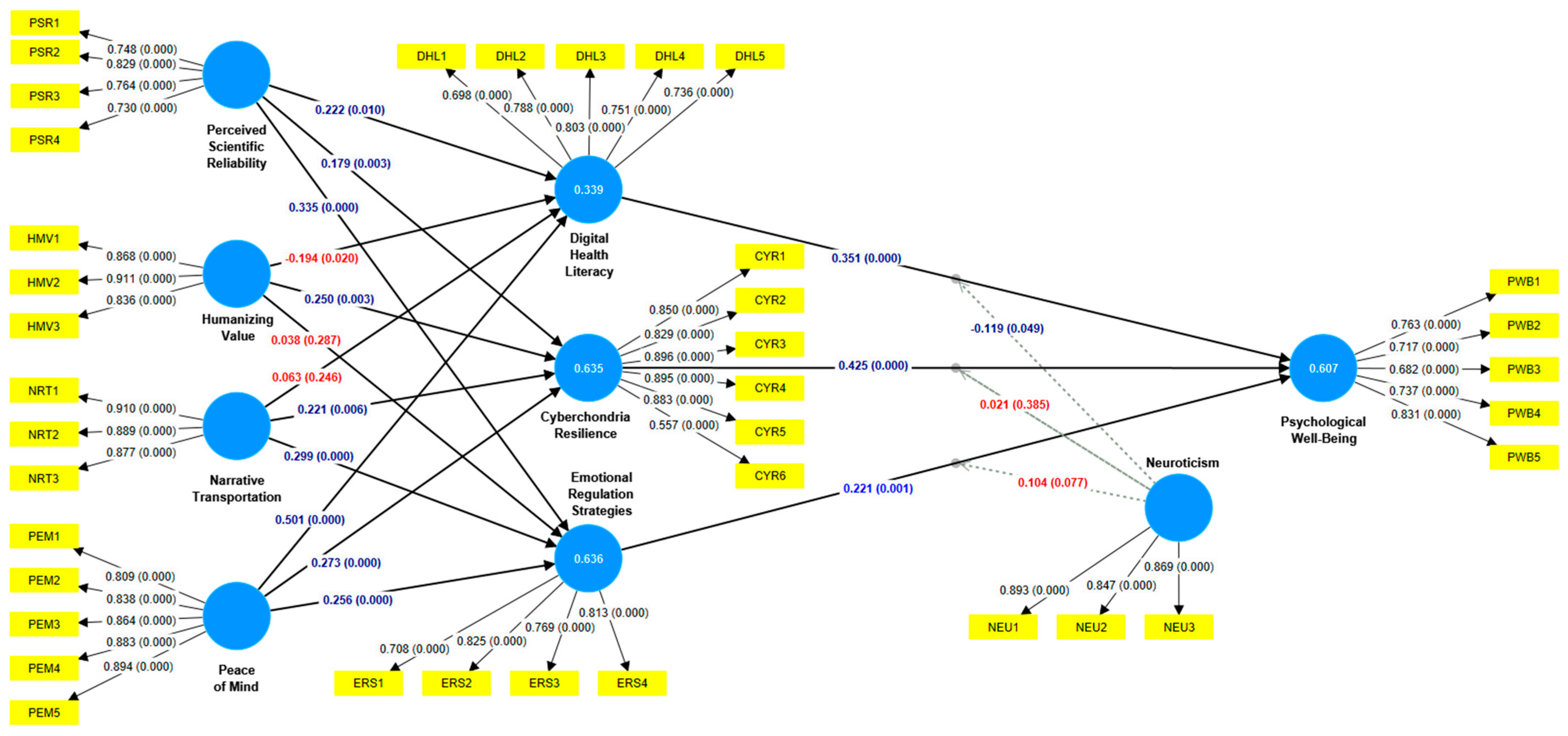
| PSR → DHL (H1) | 0.222 | 0.010 | 0.059 | 0.371 | Significant positive effect |
| PSR → CYR (H2) | 0.179 | 0.003 | 0.074 | 0.286 | Significant positive effect |
| PSR → ERS (H3) | 0.335 | 0.000 | 0.240 | 0.429 | Significant positive effect |
| HMV → DHL (H4) | −0.194 | 0.020 | −0.348 | −0.040 | Significant, but negative effect |
| HMV → CYR (H5) | 0.250 | 0.003 | 0.106 | 0.405 | Significant positive effect |
| HMV → ERS (H6) | 0.038 | 0.287 | −0.077 | 0.145 | Not significant, positive effect |
| NRT → DHL (H7) | 0.063 | 0.246 | −0.092 | 0.210 | Not significant, positive effect |
| NRT → CYR (H8) | 0.221 | 0.006 | 0.074 | 0.359 | Significant positive effect |
| NRT → ERS (H9) | 0.299 | 0.000 | 0.176 | 0.431 | Significant positive effect |
| PEM → DHL (H10) | 0.501 | 0.000 | 0.356 | 0.640 | Significant positive effect |
| PEM → CYR (H11) | 0.273 | 0.000 | 0.157 | 0.379 | Significant positive effect |
| PEM → ERS (H12) | 0.256 | 0.000 | 0.143 | 0.361 | Significant positive effect |
| DHL → PWB (H13) | 0.351 | 0.000 | 0.235 | 0.465 | Significant positive effect |
| CYR → PWB (H14) | 0.425 | 0.000 | 0.309 | 0.553 | Significant positive effect |
| ERS → PWB (H15) | 0.221 | 0.001 | 0.104 | 0.344 | Significant positive effect |
| NEU × DHL → PWB (H16) | −0.119 | 0.049 | −0.233 | 0.001 | Significant negative effect |
| NEU × CYR → PWB (H17) | 0.021 | 0.385 | −0.101 | 0.130 | Not significant, positive effect |
| NEU × ERS → PWB (H18) | 0.104 | 0.077 | −0.004 | 0.232 | Not significant, positive effect |
Disclaimer/Publisher’s Note: The statements, opinions and data contained in all publications are solely those of the individual author(s) and contributor(s) and not of MDPI and/or the editor(s). MDPI and/or the editor(s) disclaim responsibility for any injury to people or property resulting from any ideas, methods, instructions or products referred to in the content. |
© 2026 by the authors. Licensee MDPI, Basel, Switzerland. This article is an open access article distributed under the terms and conditions of the Creative Commons Attribution (CC BY) license.
Share and Cite
Hamdoyo, A.; Antonio, F.; Tengor, J.R.S. Linking Perceived Hospital-Generated Content to Psychological Well-Being Through Integrated Cognitive and Emotional Resilience Mechanisms Among Emerging Adults. Int. J. Environ. Res. Public Health 2026, 23, 718. https://doi.org/10.3390/ijerph23060718
Hamdoyo A, Antonio F, Tengor JRS. Linking Perceived Hospital-Generated Content to Psychological Well-Being Through Integrated Cognitive and Emotional Resilience Mechanisms Among Emerging Adults. International Journal of Environmental Research and Public Health. 2026; 23(6):718. https://doi.org/10.3390/ijerph23060718
Chicago/Turabian StyleHamdoyo, Audrey, Ferdi Antonio, and Janeline Rivana Sefty Tengor. 2026. "Linking Perceived Hospital-Generated Content to Psychological Well-Being Through Integrated Cognitive and Emotional Resilience Mechanisms Among Emerging Adults" International Journal of Environmental Research and Public Health 23, no. 6: 718. https://doi.org/10.3390/ijerph23060718
APA StyleHamdoyo, A., Antonio, F., & Tengor, J. R. S. (2026). Linking Perceived Hospital-Generated Content to Psychological Well-Being Through Integrated Cognitive and Emotional Resilience Mechanisms Among Emerging Adults. International Journal of Environmental Research and Public Health, 23(6), 718. https://doi.org/10.3390/ijerph23060718