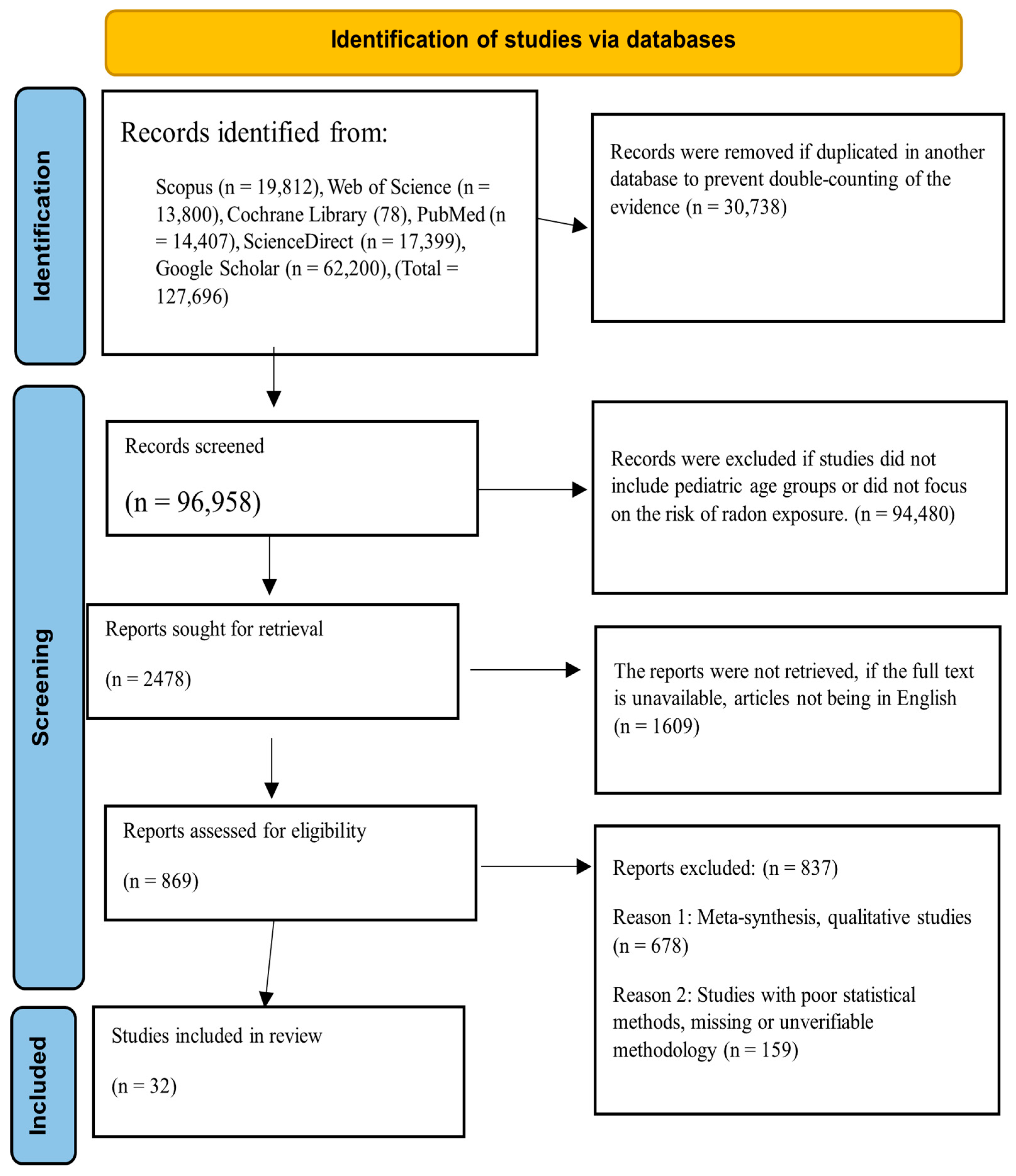
Indoor Radon Exposure Among Schoolchildren: A Systematic Review of Risk Factors

Highlights
- As a Group 1 carcinogen and the leading cause of lung cancer among non-smokers, radon accumulation in schools poses a critical environmental health risk.
- Children spend a substantial amount of time in classrooms; exposure during key developmental stages can significantly increase their cumulative lifetime health risks.
- This review synthesized evidence from various regions of the globe, thereby identifying geological factors, building structural defects, and ventilation-related factors that influence radon concentrations within educational buildings.
- While the average radon levels in this review frequently remain below 100 Bq/m3, there were some radon-prone regions on volcanic subsoil that exhibited extreme outliers surpassing 4000 Bq/m3, thereby necessitating mitigation measures.
- Public health agencies should establish regular radon testing and mitigation policies, with long-term monitoring and remediation in school buildings exceeding recommended reference levels.
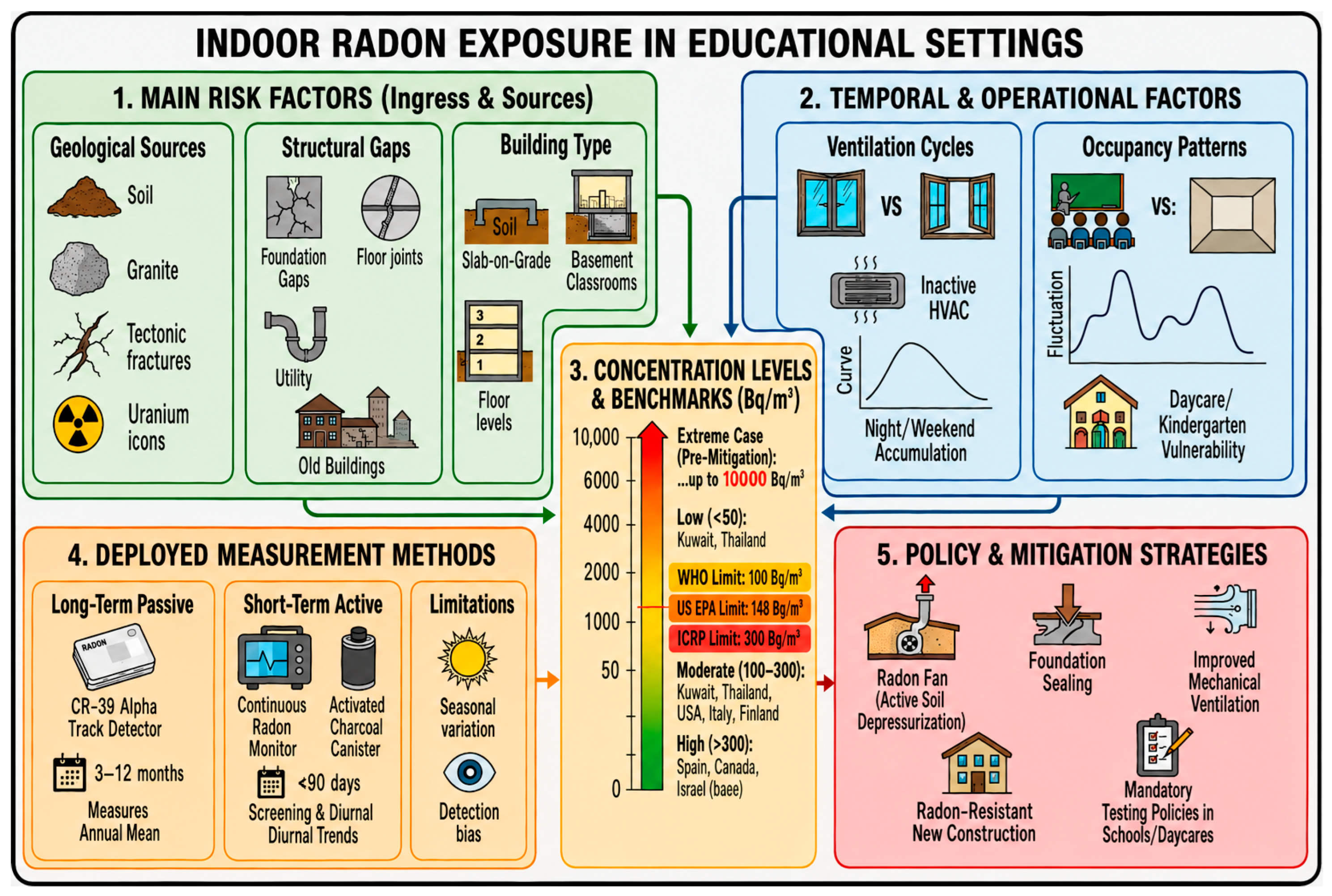
- Policymakers should advance systematic radon risk management in schools by strengthening mitigation policies, including active soil depressurization, foundation sealing, improved ventilation, construction of radon-resistant school buildings, and mandatory radon testing.
Abstract
1. Introduction
- (a)
- What tools and methods are employed for radon measurement within classrooms?
- (b)
- What are the measured indoor radon concentrations in schools across different regions?
- (c)
- What risk factors contribute to increased radon exposure among schoolchildren?
2. Materials and Methods
2.1. Study Design
2.2. Protocols and Registrations
2.3. Information and Search Strategy
2.4. Study Selection and Data Extraction Processes
2.4.1. Study Selection and Data Extraction
- (a)
- Regional location of the study (Country);
- (b)
- Study’s sample size;
- (c)
- Duration of radon monitoring (short-term/long-term);
- (d)
- Reported risk factors (soil geology, floor level, ventilation);
- (e)
- Method of analysis engaged (Mean, Standard Deviation, Pearson’s correlation).
2.4.2. Search Results
2.4.3. Rating the Quality of Evidence
- Cohort and Case–control studies were evaluated using a scoring system that ranged from 0 to 9. Scores of 6 or higher indicated high quality, while scores from 4 to 5 were deemed moderate quality. Studies with scores below 4 were classified as low quality.
- Cross-Sectional Studies: Scores from 0 to 10 were assessed; scores of 7 or higher were deemed high quality, while scores between 5 and 6 indicated moderate quality. Studies scoring below 5 are classified as low quality. The evidence review quality of the 32 included studies is shown in Table 2.
2.4.4. Risk of Bias Among Selected Studies
2.4.5. Dose Estimation Framework
3. Results
3.1. Patterns of Indoor (Classroom) Radon Concentrations
3.2. Observed Determinants of Radon Levels
3.3. Radon Measurement Metrics
4. Discussion
4.1. Indoor Radon Concentrations in Educational Settings
4.2. Mechanisms of Radon Ingress and Exposure Risk
4.3. Deployed Methods of Radon Measurement Within Classrooms
4.4. Strengths and Limitations of the Study
4.4.1. Strengths
- Radon exposure distributions;
- Annual effective dose estimation;
- Structural and environmental determinants;
- Methodological approaches to measurement;
- Policy and institutional frameworks.
4.4.2. Limitations
5. Conclusions
Supplementary Materials
Author Contributions
Funding
Institutional Review Board Statement
Informed Consent Statement
Data Availability Statement
Conflicts of Interest
References
- Pirsaheb, M.; Najafi, F.; Khosravi, T.; Hemati, L. A systematic review of radon investigations related to public exposure in Iran. Iran. Red. Crescent Med. J. 2013, 15, e10204. [Google Scholar] [CrossRef] [PubMed]
- Giraldo-Osorio, A.; Ruano-Ravina, A.; Pérez-Ríos, M.; Varela-Lema, L.; Barros-Dios, J.M.; Arias-Ortiz, N.E. Residential Radon in Manizales, Colombia: Results of a Pilot Study. Int. J. Environ. Res. Public Health 2021, 18, 1228. [Google Scholar] [CrossRef]
- Vengosh, A.; Coyte, R.M.; Podgorski, J.; Johnson, T.M. A critical review on the occurrence and distribution of the uranium- and thorium-decay nuclides and their effect on the quality of groundwater. Sci. Total Environ. 2022, 808, 151914. [Google Scholar] [CrossRef]
- Banzon, T.M.; Greco, K.F.; Li, L.; Mukharesh, L.; Vieira, C.L.Z.; Steiner, M.K.; Hauptman, M.; Ratchataswan, T.; Koutrakis, P.; Phipatanakul, W.; et al. Effect of radon exposure on asthma morbidity in the School Inner-City Asthma study. Pediatr. Pulmonol. 2023, 58, 2042–2049. [Google Scholar] [CrossRef] [PubMed]
- Branco, P.T.; Nunes, R.A.; Alvim-Ferraz, M.C.; Martins, F.G.; Sousa, S.I. Children’s Exposure to Radon in Nursery and Primary Schools. Int. J. Environ. Res. Public Health 2016, 13, 386. [Google Scholar] [CrossRef] [PubMed]
- Kwan, W.S.; Nikezic, D.; Roy, V.A.L.; Yu, K.N. Multiple Stressor Effects of Radon and Phthalates in Children: Background Information and Future Research. Int. J. Environ. Res. Public Health 2020, 17, 2898. [Google Scholar] [CrossRef]
- Kalisa, E.; Clark, M.L.; Ntakirutimana, T.; Amani, M.; Volckens, J. Exposure to indoor and outdoor air pollution in schools in Africa: Current status, knowledge gaps, and a call to action. Heliyon 2023, 9, e18450. [Google Scholar] [CrossRef]
- Oliveira, M.; Slezakova, K.; Delerue-Matos, C.; Pereira, M.C.; Morais, S. Children environmental exposure to particulate matter and polycyclic aromatic hydrocarbons and biomonitoring in school environments: A review on indoor and outdoor exposure levels, major sources and health impacts. Environ. Int. 2019, 124, 180–204. [Google Scholar] [CrossRef]
- Sadeghi, S.; Hajizadeh, Y.; Pirsaheb, M.; Teiri, H.; Sharafi, K. Assessment of indoor radon exposure in kermanshah’s educational facilities, and its determinants, health risks, and mitigation strategies. Sci. Rep. 2025, 15, 42886. [Google Scholar] [CrossRef]
- Bouvard, V.; Baan, R.; Straif, K.; Grosse, Y.; Secretan, B.; El Ghissassi, F.; Benbrahim-Tallaa, L.; Guha, N.; Freeman, C.; Galichet, L.; et al. A review of human carcinogens—Part B: Biological agents. Lancet Oncol. 2009, 10, 321–322. [Google Scholar] [CrossRef]
- International Agency for Research on Cancer (IARC). IARC Monographs on the Identification of Carcinogenic Hazards to Humans. 2026. Available online: https://monographs.iarc.who.int/list-of-classifications (accessed on 5 February 2026).
- Loomis, D.; Guha, N.; Hall, A.L.; Straif, K. Identifying occupational carcinogens: An update from the IARC Monographs. Occup. Environ. Med. 2018, 75, 593–603. [Google Scholar] [CrossRef]
- Frumkin, H.; Samet, J.M. Radon. 2001. Available online: https://acsjournals.onlinelibrary.wiley.com/doi/abs/10.3322/canjclin.51.6.337 (accessed on 6 February 2026).
- Torres-Durán, M.; Barros-Dios, J.M.; Fernández-Villar, A.; Ruano-Ravina, A. Residential radon and lung cancer in never smokers. A systematic review. Cancer Lett. 2014, 345, 21–26. [Google Scholar] [CrossRef] [PubMed]
- Bennett, W.D.; Zeman, K.L. Effect of body size on breathing pattern and fine-particle deposition in children. J. Appl. Physiol. 2004, 97, 821–826. [Google Scholar] [CrossRef]
- Ginsberg, G.L.; Asgharian, B.; Kimbell, J.S.; Ultman, J.S.; Jarabek, A.M. Modeling approaches for estimating the dosimetry of inhaled toxicants in children. J. Toxicol. Environ. Health Part A 2008, 71, 166–195. [Google Scholar] [CrossRef]
- Hall, E.J.; Giaccia, A.J. Radiobiology for the Radiologist, 8th ed.; Wolters Kluwer: New York, NY, USA, 2019. [Google Scholar]
- Azzam, E.I.; Jay-Gerin, J.P.; Pain, D. Ionizing radiation-induced metabolic oxidative stress and prolonged cell injury. Cancer Lett. 2012, 327, 48–60. [Google Scholar] [CrossRef]
- Banzon, T.M.; Jung, Y.S.; Greco, K.F.; Li, L.; Nadeau, K.; Permaul, P.; Koutrakis, P.; Gaffin, J.M.; Phipatanakul, W. Biomarkers of inflammation associated with radon exposure in the School Inner-City Asthma Study (SICAS). J. Allergy Clin. Immunol. 2025, 155, 1866–1872. [Google Scholar] [CrossRef]
- Tong, J.; Qin, L.; Cao, Y.; Li, J.; Zhang, J.; Nie, J.; An, Y. Environmental radon exposure and childhood leukemia. Journal of toxicology and environmental health. Part B, Critical reviews. J. Toxicol. Environ. Health B Crit. Rev. 2012, 15, 332–347. [Google Scholar] [CrossRef] [PubMed]
- World Health Organization (WHO). More Countries Act Against Exposure to Radon and Associated Cancer Risks. 2021. Available online: https://www.who.int/news/item/04-02-2021-more-countries-act-against-exposure-to-radon-and-associated-cancer-risks#:~:text=Globally%2C%20in%202019%2C%20residential%20radon,people%20who%20have%20never%20smoked (accessed on 7 February 2026).
- Yusuf, R.; Rathebe, P.C. Health Implications of Radon Exposure Among Children: A Systematic Review. Children 2026, 13, 208. [Google Scholar] [CrossRef]
- Ambrosino, F.; La Verde, G.; Oliva, R.; Hanfi, M.Y.; Sarno, A.; e Pugliese, M. Indoor radon risk assessment in education buildings from kindergarten to high school in the Campania region. Front. Built Env. 2025, 11, 1532791. [Google Scholar] [CrossRef]
- Nazaroff, W.W.; Doyle, S.M. Radon entry into houses having a crawl space. Health Phys. 1985, 48, 265–281. [Google Scholar] [CrossRef] [PubMed]
- Richter, E.D.; Neeman, E.; Fischer, I.; Berdugo, M.; Westin, J.B.; Kleinstern, J.; Margaliot, M. Radon exposures in a Jerusalem public school. Environ. Health Perspect. 1997, 105, 1411–1416. [Google Scholar] [PubMed][Green Version]
- Dovjak, M.; Vene, O.; Vaupotič, J. Analysis of Ventilation Efficiency as Simultaneous Control of Radon and Carbon Dioxide Levels in Indoor Air Applying Transient Modelling. Int. J. Environ. Res. Public Health 2022, 19, 2125. [Google Scholar] [CrossRef]
- Zhukovsky, M.; Vasilyev, A.; Onishchenko, A.; Yarmoshenko, I. Review of Indoor Radon Concentrations in Schools and Kindergartens. Radiat. Prot. Dosim. 2018, 181, 6–10. [Google Scholar] [CrossRef]
- Appleton, J.D. Radon: Sources, Health Risks, and Hazard Mapping. AMBIO J. Hum. Environ. 2007, 36, 85–89. [Google Scholar] [CrossRef]
- Kelly-Reif, K.; Bertke, S.J.; Rage, E.; Demers, P.A.; Fenske, N.; Deffner, V.; Kreuzer, M.; Samet, J.; Schubauer-Berigan, M.K.; Tomasek, L.; et al. Radon and lung cancer in the pooled uranium miners analysis (PUMA): Highly exposed early miners and all miners. Occup. Environ. Med. 2023, 80, 385–391. [Google Scholar] [CrossRef]
- Nunes, L.J.R.; Curado, A.; Lopes, S.I. The Relationship between Radon and Geology: Sources, Transport and Indoor Accumulation. Appl. Sci. 2023, 13, 7460. [Google Scholar] [CrossRef]
- Otton, J.K. The Geology of Radon—U.S. Department of the Interior. 1992. Available online: https://pubs.usgs.gov/gip/7000018/report.pdf (accessed on 4 February 2026).
- Schumann, R.R.; Owen, D.E.; Asher-Bolinder, S. Effects of weather and soil characteristics on temporal variations in soil-gas radon concentrations. In Geologic Controls on Radon; Gates, A.E., Gundersen, L.C.S., Eds.; Geological Society of America Special Paper 271; Geological Society of America: Boulder, CO, USA, 1992; pp. 65–72. [Google Scholar] [CrossRef]
- Eriksen, M.B.; Frandsen, T.F. The impact of patient, intervention, comparison, outcome (PICO) as a search strategy tool on literature search quality: A systematic review. J. Med. Libr. Assoc. JMLA 2018, 106, 420–431. [Google Scholar] [CrossRef] [PubMed]
- Frandsen, T.F.; Bruun Nielsen, M.F.; Lindhardt, C.L.; Eriksen, M.B. Using the full PICO model as a search tool for systematic reviews resulted in lower recall for some PICO elements. J. Clin. Epidemiol. 2020, 127, 69–75. [Google Scholar] [CrossRef]
- Methley, A.M.; Campbell, S.; Chew-Graham, C.; McNally, R.; Cheraghi-Sohi, S. PICO, PICOS and SPIDER: A comparison study of specificity and sensitivity in three search tools for qualitative systematic reviews. BMC Health Serv. Res. 2014, 14, 579. [Google Scholar] [CrossRef]
- RAYYAN. Getting Started with Rayyan—A Quick Start Guide; RAYYAN: Cambridge, MA, USA, 2025. [Google Scholar]
- Landrigan, P.J.; Kimmel, C.A.; Correa, A.; Eskenazi, B. Children’s health and the environment: Public health issues and challenges for risk assessment. Environ. Health Perspect. 2004, 112, 257–265. [Google Scholar] [CrossRef]
- Sackett, D.L.; Rosenberg, W.M.; Gray, J.A.; Haynes, R.B.; Richardson, W.S. Evidence based medicine: What it is and what it isn’t. BMJ 1996, 312, 71–72. [Google Scholar] [CrossRef]
- Grimes, D.A.; Schulz, K.F. Bias and causal associations in observational research. Lancet 2002, 359, 248–252. [Google Scholar] [CrossRef]
- Mann, C.J. Observational research methods. Research design II: Cohort, cross sectional, and case-control studies. Emerg. Med. J. EMJ 2003, 20, 54–60. [Google Scholar] [CrossRef] [PubMed]
- Kitto, M. Radon testing in schools in New York State: A 20-year summary. J. Environ. Radioact. 2014, 137, 213–216. [Google Scholar] [CrossRef]
- Onishchenko, A.; Malinovsky, G.; Vasilyev, A.; Zhukovsky, M. Radon Measurements in Kindergartens in Ural Region (Russia). Radiat. Prot. Dosim. 2017, 177, 112–115. [Google Scholar] [CrossRef] [PubMed]
- Salonen, H.; Salthammer, T.; Alapieti, T.; Shirazi, A.; Mikkola, R.; Morawska, L. Indoor radon concentrations in European kindergartens and other educational facilities. Environ. Int. 2025, 205, 109877. [Google Scholar] [CrossRef] [PubMed]
- United States Environmental Protection Agency (US EPA). Radon Measurement in Schools. Revised Edition. 2025. Available online: https://www.epa.gov/system/files/documents/2025-06/2025-radon_measurement_in_schools.pdf (accessed on 19 February 2026).
- Maheso, A.M.; Bezuidenhout, J.; Newman, R.T. Indoor Radon Levels in Homes and Schools in the Western Cape, South Africa-Results from a Schools Science Outreach Initiative and Corresponding Model Predictions. Int. J. Environ. Res. Public Health 2023, 20, 1350. [Google Scholar] [CrossRef]
- Rey, J.F.; Cesari, M.; Goyette Pernot, J. Considering the presence of users while assessing indoor radon levels in public schools on short-term periods of investigation. J. Phys. Conf. Ser. 2025, 3140, 92019. Available online: https://iopscience.iop.org/article/10.1088/1742-6596/3140/9/092019 (accessed on 18 February 2026). [CrossRef]
- Kullab, M.K.; Al-Bataina, B.A.; Ismail, A.M.; Abumurad, K.M.; Ghaith, A. Study of radon-222 Concentration levels inside kindergartens in Amman. Radiat. Meas. 1997, 28, 699–702. [Google Scholar] [CrossRef]
- Maged, A.F. Radon concentrations in elementary schools in Kuwait. Health Phys. 2006, 90, 258–262. [Google Scholar] [CrossRef] [PubMed]
- Astuti, A.; Tejamaya, M. An Overview of Radon Concentrations and Risk Factors in Elementary School Classrooms: Systematic Literature Review 2010–2020. In Proceedings of the 11th Annual International Conference on Industrial Engineering and Operations Management, Singapore, 7–11 March 2021. [Google Scholar] [CrossRef]
- Branco, P.T.B.S.; Martin-Gisbert, L.; Sá, J.P.; Ruano-Raviña, A.; Barros-Dios, J.; Varela-Lema, L.; Sousa, S.I.V. Quantifying indoor radon levels and determinants in schools: A case study in the radon-prone area Galicia-Norte de Portugal Euroregion. Sci. Total Environ. 2023, 882, 163566. [Google Scholar] [CrossRef] [PubMed]
- Kouroukla, E.; Gooding, T.D. Distribution of radon in large workplaces: An analysis performed on radon levels measured in UK schools. J. Radiol. Prot. Off. J. Soc. Radiol. Prot. 2024, 44, 10.1088/1361–6498/ad7e35. [Google Scholar] [CrossRef]
- Yao, M.; Ding, K.; Tang, X.; Wu, Y.; Song, Y.; Liu, S.; Bai, B.; Zhang, L.; Ma, Y. Analysis and Monitoring of Indoor Radon Concentrations of 37 Kindergartens—Beijing Municipality, China, 2023. China CDC Wkly. 2024, 6, 272–276. [Google Scholar] [CrossRef]
- Kojo, K.; Kurttio, P. Indoor Radon Measurements in Finnish Daycare Centers and Schools—Enforcement of the Radiation Act. Int. J. Environ. Res. Public Health 2020, 17, 2877. [Google Scholar] [CrossRef]
- Synnott, H.; Hanley, O.; Fenton, D.; Colgan, P.A. Radon in Irish schools: The results of a national survey. J. Radiol. Prot. Off. J. Soc. Radiol. Prot. 2006, 26, 85–96. [Google Scholar] [CrossRef]
- Loffredo, F.; Opoku-Ntim, I.; Meo, G.; Quarto, M. Indoor Radon Monitoring in Kindergarten and Primary Schools in South Italy. Atmosphere 2022, 13, 478. [Google Scholar] [CrossRef]
- Davis, E.A.; Ou, J.Y.; Chausow, C.; Verdeja, M.A.; Divver, E.; Johnston, J.D.; Beard, J.D. Associations Between School Characteristics and Classroom Radon Concentrations in Utah’s Public Schools: A Project Completed by University Environmental Health Students. Int. J. Environ. Res. Public Health 2020, 17, 5839. [Google Scholar] [CrossRef] [PubMed]
- Titipornpun, K.; Gimsa, J.; Bhongsuwan, T.; Kongchouy, N.; Titipornpun, A. Radon Concentration Measurements in Secondary Schools, Surat Thani Province, Southern Thailand. Conf. Int. J. Arts Sci. 2015, 8. Available online: https://www.researchgate.net/publication/275936365_RADON_CONCENTRATION_MEASUREMENTS_IN_SECONDARY_SCHOOLS_SURAT_THANI_PROVINCE_SOUTHERN_THAILAND (accessed on 18 February 2026).
- Vaupotič, J.; Bezek, M.; Kávási, N.; Ishikawa, T.; Yonehara, H.; Tokonami, S. Radon and thoron doses in kindergartens and elementary schools. Radiat. Prot. Dosim. 2012, 152, 247–252. [Google Scholar] [CrossRef]
- Poffijn, A.; Uttenhove, J.; Drouget, B.; Tondeur, F. The Radon Problem in Schools and Public Buildings in Belgium. Radiat. Prot. Dosim. 1994, 45, 499–501. [Google Scholar] [CrossRef]
- López-Pérez, M.; Hernández, F.; Díaz, J.P.; Salazar-Carballo, P.A. Determination of the indoor radon concentration in schools of Tenerife (Canary Islands): A comparative study. Air Qual. Atmos. Health 2022, 15, 825–835. [Google Scholar] [CrossRef]
- Dias, D.C.S.; da Silva, N.C.; Silva, W.L.; Rodrigues, M.V. Indoor radon assessment in kindergartens: Towards a national action plan. Braz. J. Radiat. Sci. 2021, 9, 1–10. [Google Scholar] [CrossRef]
- Al Zabadi, H.A.; Mallah, K.; Saffarini, G. Indoor exposure assessment of radon in the elementary schools, Palestine. Iran. J. Radiat. Res. 2015, 13, 221–228. [Google Scholar]
- Bem, H.; Bem, E.M.; Krawczyk, J.; Płotek, M.; Janiak, S.; Mazurek, D. Radon concentrations in kindergartens and schools in two cities: Kalisz and Ostrów Wielkopolski in Poland. J. Radioanal. Nucl. Chem. 2013, 295, 2229–2232. [Google Scholar] [CrossRef]
- Birovljev, A.; Strand, T.; Heiberg, A. Radon Concentrations in Norwegian Kindergartens: Survey Planning and Preliminary Results. 1998. Available online: https://www.osti.gov/etdeweb/servlets/purl/359845 (accessed on 19 February 2026).
- Everett, J.S.; Foster, S.; Berens, A.S. Radon Testing Status in Schools by Radon Zone and School Location and Demographic Characteristics: United States, 2014. J. Sch. Nurs. Off. Publ. Natl. Assoc. Sch. Nurses 2014, 35, 442–448. [Google Scholar] [CrossRef]
- Shergill, S.; Forsman-Phillips, L.; Nicol, A.M. Radon in Schools: A Review of Radon Testing Efforts in Canadian Schools. Int. J. Environ. Res. Public Health 2021, 18, 5469. [Google Scholar] [CrossRef]
- Azara, A.; Dettori, M.; Castiglia, P.; Piana, A.; Durando, P.; Parodi, V.; Salis, G.; Saderi, L.; Sotgiu, G. Indoor Radon Exposure in Italian Schools. Int. J. Environ. Res. Public Health 2018, 15, 749. [Google Scholar] [CrossRef] [PubMed]
- Darby, S.; Hill, D.; Auvinen, A.; Barros-Dios, J.M.; Baysson, H.; Bochicchio, F.; Deo, H.; Falk, R.; Forastiere, F.; Hakama, M.; et al. Radon in homes and risk of lung cancer: Collaborative analysis of individual data from 13 European case-control studies. BMJ 2005, 330, 223. [Google Scholar] [CrossRef]
- Coretchi, L.; Ene, A.; Virlan, S.; Gincu, M.; Ababii, A.; Capatina, A.; Overcenco, A.; Sargu, V. Children’s Exposure to Radon in Schools and Kindergartens in the Republic of Moldova. Atmosphere 2023, 14, 11. [Google Scholar] [CrossRef]
- Poulin, P.; Leclerc, J.M.; Dessau, J.C.; Deck, W.; Gagnon, F. Radon measurement in schools located in three priority investigation areas in the province of Quebec, Canada. Radiat. Prot. Dosim. 2012, 151, 278–289. [Google Scholar] [CrossRef] [PubMed]


| High-Yield Qualities | Low-Yield Qualities | |
|---|---|---|
| Study Sample Size | Sample size of at least 300 | Sample size less than 300 |
| Findings | Consistent findings | Inconsistent findings |
| Confounders | Confounders controlled within the study | Confounders not controlled |
| Study Type | Systematic review, cohort, case–control, and panel studies | Cross-sectional studies, case studies |
| Duration of Classroom Radon Testing | Long-duration-radon measurement ≥90 days | Short-duration radon measurement ˂90 days |
| Study Location Selection | Randomized selection of study sites | Convenience sampling, e.g., radon-prone sites, radon zone 1 |
| Peer-reviewed Publications | Peer-reviewed articles | Not peer-reviewed |
| Method of Radon Sampling | Alpha track detectors (ATDs) or electret ion chambers (EICs) for radon measurement >90 days | Electronic radon detectors, continuous radon monitors (CRMs), real-time electronic sensors—short-duration radon measurement, usually <90 days |
| Grouping | Description | Included Studies | Justification |
|---|---|---|---|
| Consistent Findings (High-Yield) | Results align with universal principles of radon ingress, including geological drivers and ground-floor risks. | [41,42,43,44,45,46,47,48,49,50,51,52,53]. | Large-scale or long-term (>90 days) studies with >300 participants confirm soil-gas permeability and ground contact as key exposure factors. |
| Inconsistent Findings (Low-Yield) | Results show significant temporal variability or deviations from patterns due to study design. | [5,9,25,54,55,56,57,58,59,60,61,62,63,64]. | Using short-term snapshot monitoring, mixed-method or convenience sampling can overestimate long-term exposure or overlook seasonal “rebound effects.” |
| Reviews/Meta-Data | Studies focusing on secondary data analysis or qualitative synthesis. | [65,66,67,68,69,70]. | Peer-reviewed, synthesized from existing data, and/or offer conceptual consistency without new primary measurements. |
| Radon Assessment | Tools and Methods Deployed for Radon Measurement | Deployment Duration | Key Research Applications & Citations |
|---|---|---|---|
| Long-Term Passive Measurements | Alpha track detectors (ATDs), CR-39 solid-state nuclear track detectors, and Electret ion chambers (EICs). | 3–12 Months | Most commonly used method for calculating the three-month annual mean concentration [5,53,61]. |
| Short-Term Radon Monitors | Activated charcoal canisters and electronic radon detectors | 2–7 Days | Preliminary screening or locations where long-term testing is not feasible [41,44]. |
| Continuous Monitoring | Continuous radon monitors (CRMs), real-time electronic sensors. | 48 h to several weeks | Assessing hourly and diurnal fluctuations of radon levels, evaluating the performance of mechanical ventilation systems, and examining occupancy effects [46,56]. |
| Stratified Sampling | Multi-story and multi-room detector grids | Variable (by device) | Characterizing ground-contact versus upper-floor concentrations [52,62]. |
| Seasonal Variations | Repeated seasonal deployments (Winter vs. Summer) | Multi-phase (Seasonal) | Assessing the “stack effect” and enhancing estimates of the annual mean [5,63]. |
| Statistical Modeling | Modeling with the log-normal distribution and parameter estimation | N/A (Data-driven) | Using geometric means to depict exposure risk distributions [51]. |
| National Surveys | Policy-based reporting, standardized national surveys | Longitudinal | Assessing trends in national testing practices and compliance with policy guidelines [44,65]. |
| Systematic Reviews | Literature review, meta-analysis of existing data | Secondary data | Gathering radon concentration determinants and concentration ranges from existing research [43,49]. |
Disclaimer/Publisher’s Note: The statements, opinions and data contained in all publications are solely those of the individual author(s) and contributor(s) and not of MDPI and/or the editor(s). MDPI and/or the editor(s) disclaim responsibility for any injury to people or property resulting from any ideas, methods, instructions or products referred to in the content. |
© 2026 by the authors. Licensee MDPI, Basel, Switzerland. This article is an open access article distributed under the terms and conditions of the Creative Commons Attribution (CC BY) license.
Share and Cite
Yusuf, R.A.; Mbonane, T.P.; Rathebe, P.C. Indoor Radon Exposure Among Schoolchildren: A Systematic Review of Risk Factors. Int. J. Environ. Res. Public Health 2026, 23, 712. https://doi.org/10.3390/ijerph23060712
Yusuf RA, Mbonane TP, Rathebe PC. Indoor Radon Exposure Among Schoolchildren: A Systematic Review of Risk Factors. International Journal of Environmental Research and Public Health. 2026; 23(6):712. https://doi.org/10.3390/ijerph23060712
Chicago/Turabian StyleYusuf, Rasaq A., Thokozani P. Mbonane, and Phoka C. Rathebe. 2026. "Indoor Radon Exposure Among Schoolchildren: A Systematic Review of Risk Factors" International Journal of Environmental Research and Public Health 23, no. 6: 712. https://doi.org/10.3390/ijerph23060712
APA StyleYusuf, R. A., Mbonane, T. P., & Rathebe, P. C. (2026). Indoor Radon Exposure Among Schoolchildren: A Systematic Review of Risk Factors. International Journal of Environmental Research and Public Health, 23(6), 712. https://doi.org/10.3390/ijerph23060712