Built Environment-Modulated Epigenetics: The Epigenetic Consequences of Architecturally Mediated Allostatic Overload in the Built Environment



Highlights
- The built environment is a near-continuous, population-wide exposure, yet its potential role as a chronic stressor capable of biologically embedding health risk has been largely overlooked in environmental epigenetics, despite robust evidence that chemical pollutants, air pollution, and psychosocial stressors produce lasting epigenetic modifications.
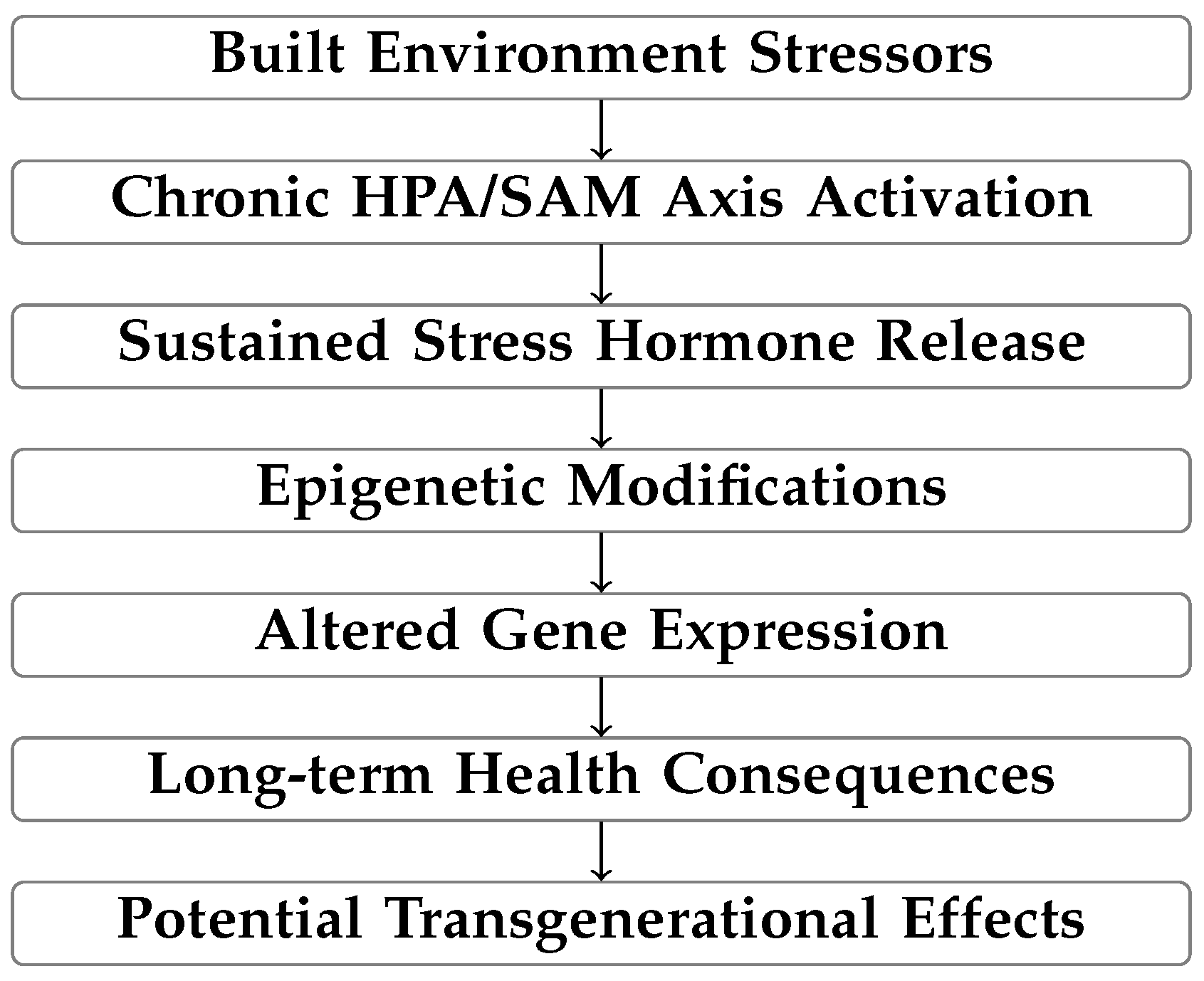
- Stress-inducing architectural features (e.g., spatial enclosure, low ceilings, visually discordant facades, circadian-disrupting lighting) are associated with stress responses and may sustain activation of the HPA and SAM axes, the same pathways through which other environmental stressors are known to drive maladaptive DNA methylation and histone modifications relevant to inflammation, neuroendocrine regulation, and disease susceptibility.
- The built environment-modulated epigenetics (BEME) framework proposes that chronic exposure to stress-inducing built environments may contribute to durable epigenetic changes with potential transgenerational consequences, meaning design decisions could shape health trajectories not only of current occupants but of future generations.
- Because adverse built environment exposures are unevenly distributed across socioeconomically disadvantaged communities, BEME offers a mechanistic lens for understanding how spatial inequities may become biologically embedded, while also identifying enriched and biophilic design features (e.g., green space, daylight, affordances for physical activity) as potential protective levers for resilience and health equity.
- For researchers: A phased empirical agenda is needed, including animal model proof-ofconcept studies, longitudinal human cohorts spanning sensitive developmentalwindows, and intervention trials, supported by a standardised panel of endocrine, inflammatory, and epigenetic biomarkers (e.g., cortisol, IL-6, NR3C1/FKBP5/BDNF methylation, epigenetic ageing clocks) to test BEME and quantify exposure–response relationships.
- For practitioners and policy makers: Architectural design, urban planning, and housing policy should be recognised as potential determinants of long-term biological programming, warranting precautionary, evidence-aware design standards that minimise chronic architectural stressors and prioritise restorative, enriched environments, particularly in settings serving children, pregnant individuals, and populations facing cumulative environmental disadvantage.
Abstract
1. Introduction
- 1.
- Architectural environments trigger chronic stress responses through sustained activation of HPA and SAM axes.
- 2.
- Chronic environmental stressors create lasting maladaptive epigenetic changes in stress-responsive genes through DNA methylation and histone modifications [9].
- 3.
- 4.
- Maladaptive epigenetic modifications can be transmitted across generations, often affecting the un-exposed generation more than the directly exposed individual [13].
2. Environmental Epigenetics and Chronic Stress
2.1. Mechanisms of Environmental Epigenetic Programming
2.2. Environmental Stressors and Epigenetic Modifications
3. Architecturally Mediated Allostatic Overload
Stress Response Systems and Built Environment Triggers
4. The Built Environment-Modulated Epigenetics Framework
4.1. Theoretical Integration and Proposed Pathway
4.2. Built Environment-Modulated Epigenetics (BEME) Biomarkers
- Endocrine Indicators: Measures like cortisol levels to gauge stress responses and autonomic nervous system modulation influenced by architectural design elements [78]. These markers would be deliberately selected for their potential to identify subtle, built environment-induced epigenetic changes. Endocrine indicators can be utilised to help identify environmental stressors in the built environment before exploring their epigenetic consequences.
4.3. Methodological Considerations and Challenges
4.4. Theoretical Limitations
5. Conclusions
Author Contributions
Funding
Institutional Review Board Statement
Informed Consent Statement
Data Availability Statement
Acknowledgments
Conflicts of Interest
References
- Takahashi, Y.; Valencia, M.M.; Yu, Y.; Ouchi, Y.; Takahashi, K.; Shokhirev, M.N.; Lande, K.; Williams, A.E.; Fresia, C.; Kurita, M.; et al. Transgenerational inheritance of acquired epigenetic signatures at CpG islands in mice. Cell 2023, 186, 715–731. [Google Scholar] [CrossRef] [PubMed]
- Webster, A.K.; Phillips, P.C. Epigenetics and individuality: From concepts to causality across timescales. Nat. Rev. Genet. 2025, 26, 406–423. [Google Scholar] [CrossRef] [PubMed]
- Beck, D.; Nilsson, E.E.; Ben Maamar, M.; Skinner, M.K. Environmental induced transgenerational inheritance impacts systems epigenetics in disease etiology. Sci. Rep. 2022, 12, 5452. [Google Scholar] [CrossRef] [PubMed]
- Lee, R.S.; Sawa, A. Environmental stressors and epigenetic control of the hypothalamic-pituitary-adrenal axis. Neuroendocrinology 2015, 100, 278–287. [Google Scholar] [CrossRef]
- Nazzari, S.; Cagliero, L.; Grumi, S.; Pisoni, E.; Mallucci, G.; Bergamaschi, R.; Maccarini, J.; Giorda, R.; Provenzi, L. Prenatal exposure to environmental air pollution and psychosocial stress jointly contribute to the epigenetic regulation of the serotonin transporter gene in newborns. Mol. Psychiatry 2023, 28, 3503–3511. [Google Scholar] [CrossRef]
- Zannas, A.S.; Chrousos, G.P. Epigenetic programming by stress and glucocorticoids along the human lifespan. Mol. Psychiatry 2017, 22, 640–646. [Google Scholar] [CrossRef]
- Valentine, C. Architectural allostatic overloading: Exploring a connection between architectural form and allostatic overloading. Int. J. Environ. Res. Public Health 2023, 20, 5637. [Google Scholar] [CrossRef]
- Valentine, C.; Steffert, T.; Mitcheltree, H.; Steemers, K. Architectural neuroimmunology: A pilot study examining the impact of biophilic architectural design on neuroinflammation. Buildings 2024, 14, 1292. [Google Scholar] [CrossRef]
- Poggi, G.; Treccani, G.; Genini, P.; Da Pian, M.; Cattaneo, A.; Cattane, N. Epigenetic mechanisms affected by stress during adolescence and the increased risk for depression later in life: A systematic review. Mol. Psychiatry 2026, 31, 2815–2832. [Google Scholar] [CrossRef]
- Murakami, S.; Imbe, H.; Morikawa, Y.; Kubo, C.; Senba, E. Chronic stress, as well as acute stress, reduces BDNF mRNA expression in the rat hippocampus but less robustly. Neurosci. Res. 2005, 53, 129–139. [Google Scholar] [CrossRef]
- Musaelyan, K.; Yildizoglu, S.; Bozeman, J.; Du Preez, A.; Egeland, M.; Zunszain, P.A.; Pariante, C.M.; Fernandes, C.; Thuret, S. Chronic stress induces significant gene expression changes in the prefrontal cortex alongside alterations in adult hippocampal neurogenesis. Brain Commun. 2020, 2, fcaa153. [Google Scholar] [CrossRef]
- Niknazar, S.; Nahavandi, A.; Peyvandi, A.A.; Peyvandi, H.; Akhtari, A.S.; Karimi, M. Comparison of the adulthood chronic stress effect on hippocampal BDNF signaling in male and female rats. Mol. Neurobiol. 2016, 53, 4026–4033. [Google Scholar] [CrossRef] [PubMed]
- Nilsson, E.E.; Ben Maamar, M.; Skinner, M.K. Role of epigenetic transgenerational inheritance in generational toxicology. Environ. Epigenet. 2022, 8, dvac001. [Google Scholar] [CrossRef]
- Bollati, V.; Baccarelli, A. Environmental epigenetics. Heredity 2010, 105, 105–112. [Google Scholar] [CrossRef]
- Martinez-Zamudio, R.; Ha, H.C. Environmental epigenetics in metal exposure. Epigenetics 2011, 6, 820–827. [Google Scholar] [CrossRef] [PubMed]
- Skinner, M.K. Environmental stress and epigenetic transgenerational inheritance. BMC Med. 2014, 12, 153. [Google Scholar] [CrossRef]
- Moore, L.D.; Le, T.; Fan, G. DNA methylation and its basic function. Neuropsychopharmacology 2013, 38, 23–38. [Google Scholar] [CrossRef]
- Bannister, A.J.; Kouzarides, T. Regulation of chromatin by histone modifications. Cell Res. 2011, 21, 381–395. [Google Scholar] [CrossRef]
- Kouzarides, T. Chromatin modifications and their function. Cell 2007, 128, 693–705. [Google Scholar] [CrossRef]
- Lister, R.; Pelizzola, M.; Dowen, R.H.; Hawkins, R.D.; Hon, G.; Tonti-Filippini, J.; Nery, J.R.; Lee, L.; Ye, Z.; Ngo, Q.M.; et al. Human DNA methylomes at base resolution show widespread epigenomic differences. Nature 2009, 462, 315–322. [Google Scholar] [CrossRef] [PubMed]
- Li, L.; Chen, R.; Zhang, H.; Li, J.; Huang, H.; Weng, J.; Tan, H.; Guo, T.; Wang, M.; Xie, J. The epigenetic modification of DNA methylation in neurological diseases. Front. Immunol. 2024, 15, 1401962. [Google Scholar] [CrossRef]
- Kimura, H. Histone modifications for human epigenome analysis. J. Hum. Genet. 2013, 58, 439–445. [Google Scholar] [CrossRef] [PubMed]
- Lawrence, M.; Daujat, S.; Schneider, R. Lateral thinking: How histone modifications regulate gene expression. Trends Genet. 2016, 32, 42–56. [Google Scholar] [CrossRef]
- Bottomley, M.J. Structures of protein domains that create or recognize histone modifications. EMBO Rep. 2004, 5, 464–469. [Google Scholar] [CrossRef] [PubMed]
- Wolffe, A. Chromatin: Structure and Function; Academic Press: Cambridge, MA, USA, 1998. [Google Scholar]
- Liu, R.; Wu, J.; Guo, H.; Yao, W.; Li, S.; Lu, Y.; Jia, Y.; Liang, X.; Tang, J.; Zhang, H. Post-translational modifications of histones: Mechanisms, biological functions, and therapeutic targets. MedComm 2023, 4, e292. [Google Scholar] [CrossRef]
- Millán-Zambrano, G.; Burton, A.; Bannister, A.J.; Schneider, R. Histone post-translational modifications—Cause and consequence of genome function. Nat. Rev. Genet. 2022, 23, 563–580. [Google Scholar] [CrossRef] [PubMed]
- Hyun, K.; Jeon, J.; Park, K.; Kim, J. Writing, erasing and reading histone lysine methylations. Exp. Mol. Med. 2017, 49, e324. [Google Scholar] [CrossRef]
- Li, B.; Carey, M.; Workman, J.L. The role of chromatin during transcription. Cell 2007, 128, 707–719. [Google Scholar] [CrossRef]
- Talbert, P.B.; Henikoff, S. Histone variants at a glance. J. Cell Sci. 2021, 134, jcs244749. [Google Scholar] [CrossRef]
- Zhou, V.W.; Goren, A.; Bernstein, B.E. Charting histone modifications and the functional organization of mammalian genomes. Nat. Rev. Genet. 2011, 12, 7–18. [Google Scholar] [CrossRef]
- Thiagalingam, S. Epigenetic memory in development and disease: Unraveling the mechanism. Biochim. Biophys. Acta (BBA) Rev. Cancer 2020, 1873, 188349. [Google Scholar] [CrossRef]
- Sharavanan, V.J.; Sivaramakrishnan, M.; Sivarajasekar, N.; Senthilrani, N.; Kothandan, R.; Dhakal, N.; Sivamani, S.; Show, P.L.; Awual, M.R.; Naushad, M. Pollutants inducing epigenetic changes and diseases. Environ. Chem. Lett. 2020, 18, 325–343. [Google Scholar] [CrossRef]
- Gao, X.; Huang, J.; Cardenas, A.; Zhao, Y.; Sun, Y.; Wang, J.; Xue, L.; Baccarelli, A.A.; Guo, X.; Zhang, L.; et al. Short-term exposure of PM2.5 and epigenetic aging: A quasi-experimental study. Environ. Sci. Technol. 2022, 56, 14690–14700. [Google Scholar] [CrossRef]
- Ward-Caviness, C.K.; Nwanaji-Enwerem, J.C.; Wolf, K.; Wahl, S.; Colicino, E.; Trevisi, L.; Kloog, I.; Just, A.C.; Vokonas, P.; Cyrys, J.; et al. Long-term exposure to air pollution is associated with biological aging. Oncotarget 2016, 7, 74510. [Google Scholar] [CrossRef]
- Marroquin Rivera, A.; Labonté, B. Investigating the molecular ‘scars’ of PTSD in the human brain. Nature 2025, 643, 639–640. [Google Scholar] [CrossRef] [PubMed]
- Marczylo, E.L.; Jacobs, M.N.; Gant, T.W. Environmentally induced epigenetic toxicity: Potential public health concerns. Crit. Rev. Toxicol. 2016, 46, 676–700. [Google Scholar] [CrossRef] [PubMed]
- Zannas, A.S.; West, A.E. Epigenetics and the regulation of stress vulnerability and resilience. Neuroscience 2014, 264, 157–170. [Google Scholar] [CrossRef] [PubMed]
- Kundakovic, M.; Jaric, I. The epigenetic link between prenatal adverse environments and neurodevelopmental disorders. Genes 2017, 8, 104. [Google Scholar] [CrossRef]
- Kavade, P.S.; Parab, S.S.; Capone, V.; Carannante, D.; Ambrosino, C.; Altucci, L.; Carafa, V. Epigenetic regulation in zebrafish development: The roles of polycomb group proteins in heart and pectoral fin development. Epigenet. Commun. 2024, 4, 7. [Google Scholar] [CrossRef]
- Pingault, J.B.; Rijsdijk, F.; Zheng, Y.; Plomin, R.; Viding, E. Developmentally dynamic genome: Evidence of genetic influences on increases and decreases in conduct problems from early childhood to adolescence. Sci. Rep. 2015, 5, 10053. [Google Scholar] [CrossRef]
- Lehmann, M.L.; Herkenham, M. Environmental enrichment confers stress resiliency to social defeat through an infralimbic cortex-dependent neuroanatomical pathway. J. Neurosci. 2011, 31, 6159–6173. [Google Scholar] [CrossRef] [PubMed]
- Pang, T.Y.; Yaeger, J.D.W.; Summers, C.H.; Mitra, R. Cardinal role of the environment in stress induced changes across life stages and generations. Neurosci. Biobehav. Rev. 2021, 124, 137–150. [Google Scholar] [CrossRef] [PubMed]
- McCreary, J.K.; Metz, G.A. Environmental enrichment as an intervention for adverse health outcomes of prenatal stress. Environ. Epigenet. 2016, 2, dvw013. [Google Scholar] [CrossRef] [PubMed]
- Viding, E.; McCrory, E. Individuals as active co-creators of their environments: Implications for prevention of inequalities. Oxf. Open Econ. 2024, 3, i749–i753. [Google Scholar] [CrossRef]
- Blacksher, E.; Lovasi, G.S. Place-focused physical activity research, human agency, and social justice in public health: Taking agency seriously in studies of the built environment. Health Place 2012, 18, 172–179. [Google Scholar] [CrossRef]
- Khalil, M.H. Environmental affordance for physical activity, neurosustainability, and brain health: Quantifying the built environment’s ability to sustain BDNF release by reaching metabolic equivalents (METs). Brain Sci. 2024, 14, 1133. [Google Scholar] [CrossRef]
- Khalil, M.H.; Steemers, K. The neurobiophilia index. Buildings 2026, 16, 637. [Google Scholar] [CrossRef]
- Khalil, M.H. Hippocampal neurosustainability for stress resilience: A pro-neurogenic BDNF-targeted architectural enrichment framework to overcome type 2 allostatic overload. Brain Sci. 2026, 16, 370. [Google Scholar] [CrossRef]
- Galea, S.; Uddin, M.; Koenen, K. The urban environment and mental disorders: Epigenetic links. Epigenetics 2011, 6, 400–404. [Google Scholar] [CrossRef]
- Mendonça, M.S.; Mangiavacchi, P.M.; Mendes, A.V.; Loureiro, S.R.; Martín-Santos, R.; Glória, L.S.; Marques, W.; De Marco, S.P.; Kanashiro, M.M.; Hallak, J.E.; et al. DNA methylation in regulatory elements of the FKBP5 and NR3C1 gene in mother-child binomials with depression. J. Affect. Disord. 2023, 331, 287–299. [Google Scholar] [CrossRef]
- Crielaard, L.; Nicolaou, M.; Sawyer, A.; Quax, R.; Stronks, K. Understanding the impact of exposure to adverse socioeconomic conditions on chronic stress from a complexity science perspective. BMC Med. 2021, 19, 242. [Google Scholar] [CrossRef]
- Wang, Y.Z.; Zhao, W.; Ammous, F.; Song, Y.; Du, J.; Shang, L.; Ratliff, S.M.; Moore, K.; Kelly, K.M.; Needham, B.L.; et al. DNA methylation mediates the association between individual and neighborhood social disadvantage and cardiovascular risk factors. Front. Cardiovasc. Med. 2022, 9, 848768. [Google Scholar] [CrossRef]
- Nwanaji-Enwerem, U.; McGeary, J.E.; Grigsby-Toussaint, D.S. Greenspace, stress, and health: How is epigenetics involved? Front. Public Health 2024, 12, 1333737. [Google Scholar] [CrossRef] [PubMed]
- Kim, K.; Joyce, B.T.; Nannini, D.R.; Zheng, Y.; Gordon-Larsen, P.; Shikany, J.M.; Lloyd-Jones, D.M.; Hu, M.; Nieuwenhuijsen, M.J.; Vaughan, D.E.; et al. Inequalities in urban greenness and epigenetic aging: Different associations by race and neighborhood socioeconomic status. Sci. Adv. 2023, 9, eadf8140. [Google Scholar] [CrossRef] [PubMed]
- Dockx, Y.; Bijnens, E.; Saenen, N.; Aerts, R.; Aerts, J.M.; Casas, L.; Delcloo, A.; Dendoncker, N.; Linard, C.; Plusquin, M.; et al. Residential green space in association with the methylation status in a CpG site within the promoter region of the placental serotonin receptor HTR2A. Epigenetics 2022, 17, 1863–1874. [Google Scholar] [CrossRef] [PubMed]
- Godoy, L.D.; Rossignoli, M.T.; Delfino-Pereira, P.; Garcia-Cairasco, N.; de Lima Umeoka, E.H. A comprehensive overview on stress neurobiology: Basic concepts and clinical implications. Front. Behav. Neurosci. 2018, 12, 127. [Google Scholar] [CrossRef]
- Fich, L.B.; Jönsson, P.; Kirkegaard, P.H.; Wallergård, M.; Garde, A.H.; Hansen, Å. Can architectural design alter the physiological reaction to psychosocial stress? A virtual TSST experiment. Physiol. Behav. 2014, 135, 91–97. [Google Scholar] [CrossRef]
- Vartanian, O.; Navarrete, G.; Chatterjee, A.; Fich, L.B.; Gonzalez-Mora, J.L.; Leder, H.; Modroño, C.; Nadal, M.; Rostrup, N.; Skov, M. Architectural design and the brain: Effects of ceiling height and perceived enclosure on beauty judgments and approach-avoidance decisions. J. Environ. Psychol. 2015, 41, 10–18. [Google Scholar] [CrossRef]
- Sudimac, S.; Sale, V.; Kühn, S. How nature nurtures: Amygdala activity decreases as the result of a one-hour walk in nature. Mol. Psychiatry 2022, 27, 4446–4452. [Google Scholar] [CrossRef]
- Kühn, S.; Düzel, S.; Eibich, P.; Krekel, C.; Wüstemann, H.; Kolbe, J.; Martensson, J.; Goebel, J.; Gallinat, J.; Wagner, G.G.; et al. In search of features that constitute an “enriched environment” in humans: Associations between geographical properties and brain structure. Sci. Rep. 2017, 7, 11920. [Google Scholar] [CrossRef]
- Valentine, C.; Wilkins, A.J.; Mitcheltree, H.; Penacchio, O.; Beckles, B.; Hosking, I. Visual discomfort in the built environment: Leveraging generative AI and computational analysis to evaluate predicted visual stress in architectural façades. Buildings 2025, 15, 2208. [Google Scholar] [CrossRef]
- Gooley, J.J.; Chamberlain, K.; Smith, K.A.; Khalsa, S.B.S.; Rajaratnam, S.M.W.; Van Reen, E.; Zeitzer, J.M.; Czeisler, C.A.; Lockley, S.W. Exposure to room light before bedtime suppresses melatonin onset and shortens melatonin duration in humans. J. Clin. Endocrinol. Metab. 2011, 96, E463–E472. [Google Scholar] [CrossRef]
- Oster, H.; Challet, E.; Ott, V.; Arvat, E.; de Kloet, E.R.; Dijk, D.J.; Lightman, S.; Vgontzas, A.; Van Cauter, E. The functional and clinical significance of the 24-hour rhythm of circulating glucocorticoids. Endocr. Rev. 2017, 38, 3–45. [Google Scholar] [CrossRef] [PubMed]
- Valentine, C.; Mitcheltree, H. Design for well-being. In Routledge Handbook of Neuroscience and the Built Environment, 1st ed.; Lavdas, A.A., Sussman, A., Woodworth, A.V., Eds.; Routledge: London, UK, 2025; pp. 313–329. [Google Scholar] [CrossRef]
- Harris, J.C.; Liuzzi, M.T.; Cardenas-Iniguez, C.; Larson, C.L.; Lisdahl, K.M. Gray space and default mode network-amygdala connectivity. Front. Hum. Neurosci. 2023, 17, 1167786. [Google Scholar] [CrossRef] [PubMed]
- Valentine, C. The impact of architectural form on physiological stress: A systematic review. Front. Comput. Sci. 2024, 5, 1237531. [Google Scholar] [CrossRef]
- Kalenik, S.; Zaczek, A.; Rodacka, A. Air pollution-induced neurotoxicity: The relationship between air pollution, epigenetic changes, and neurological disorders. Int. J. Mol. Sci. 2025, 26, 3402. [Google Scholar] [CrossRef]
- Spencer, R.L.; Chun, L.E.; Hartsock, M.J.; Woodruff, E.R. Glucocorticoid hormones are both a major circadian signal and major stress signal: How this shared signal contributes to a dynamic relationship between the circadian and stress systems. Front. Neuroendocrinol. 2018, 49, 52–71. [Google Scholar] [CrossRef] [PubMed]
- Mourtzi, N.; Sertedaki, A.; Charmandari, E. Glucocorticoid signaling and epigenetic alterations in stress-related disorders. Int. J. Mol. Sci. 2021, 22, 5964. [Google Scholar] [CrossRef]
- Kim, J.Y.; Kim, J.W. Toxicoepigenomics: Epigenetic disruption by environmental exposures and implications for biomarker development. J. Hazard. Mater. 2026, 502, 141070. [Google Scholar] [CrossRef]
- Arnett, M.G.; Muglia, L.M.; Laryea, G.; Muglia, L.J. Genetic approaches to hypothalamic-pituitary-adrenal axis regulation. Neuropsychopharmacology 2016, 41, 245–260. [Google Scholar] [CrossRef]
- Gabay, C. Interleukin-6 and chronic inflammation. Arthritis Res. Ther. 2006, 8, S3. [Google Scholar] [CrossRef]
- Rincon, M. Interleukin-6: From an inflammatory marker to a target for inflammatory diseases. Trends Immunol. 2012, 33, 571–577. [Google Scholar] [CrossRef]
- Münzel, T.; Daiber, A. Environmental stressors and their impact on health and disease with focus on oxidative stress. Antioxid. Redox Signal. 2018, 28, 735–740. [Google Scholar] [CrossRef]
- Costa, G.A.; Silva, N.K.D.G.T.; Marianno, P.; Chivers, P.; Bailey, A.; Camarini, R. Environmental enrichment increased bdnf transcripts in the prefrontal cortex: Implications for an epigenetically controlled mechanism. Neuroscience 2023, 526, 277–289. [Google Scholar] [CrossRef]
- Miao, Z.; Wang, Y.; Sun, Z. The relationships between stress, mental disorders, and epigenetic regulation of BDNF. Int. J. Mol. Sci. 2020, 21, 1375. [Google Scholar] [CrossRef]
- Hjort, L.; Rushiti, F.; Wang, S.J.; Fransquet, P.; Krasniqi, S.P.; Çarkaxhiu, S.I.; Arifaj, D.; Xhemaili, V.D.; Salihu, M.; Leku, N.A.; et al. Intergenerational effects of maternal post-traumatic stress disorder on offspring epigenetic patterns and cortisol levels. Epigenomics 2021, 13, 967–980. [Google Scholar] [CrossRef]
- McCrory, C.; Fiorito, G.; O’Halloran, A.M.; Polidoro, S.; Vineis, P.; Kenny, R.A. Early life adversity and age acceleration at mid-life and older ages indexed using the next-generation GrimAge and Pace of Aging epigenetic clocks. Psychoneuroendocrinology 2022, 137, 105643. [Google Scholar] [CrossRef]
- Khalil, M.H. Comparative analysis of maze complexity: Implications for adult hippocampal neurogenesis. Front. Neurosci. 2026, 20, 1766823. [Google Scholar] [CrossRef]
- Rosenfeld, C.S. Animal models to study environmental epigenetics. Biol. Reprod. 2010, 82, 473–488. [Google Scholar] [CrossRef]
- Khalil, M.H. Environmental enrichment: A systematic review on the effect of a changing spatial complexity on hippocampal neurogenesis and plasticity in rodents, with considerations for translation to urban and built environments for humans. Front. Neurosci. 2024, 18, 1368411. [Google Scholar] [CrossRef]
- Khalil, M.H. Neurosustainability. Front. Hum. Neurosci. 2024, 18, 1436179. [Google Scholar] [CrossRef]
- Ambeskovic, M.; Truica, S.; McCreary, J.K.; Faraji, J.; Fang, X.; Olson, D.M.; Metz, G.A. Maternal social isolation during pre-conception and pregnancy programs inflammatory markers and biobehavioural aging trajectories in distant F4 offspring. Brain Behav. Immun. Integr. 2025, 9, 100104. [Google Scholar] [CrossRef]
- Faraji, J.; Soltanpour, N.; Lotfi, H.; Moeeini, R.; Moharreri, A.R.; Roudaki, S.; Hosseini, S.A.; Olson, D.M.; Abdollahi, A.A.; Soltanpour, N.; et al. Lack of social support raises stress vulnerability in rats with a history of ancestral stress. Sci. Rep. 2017, 7, 5277. [Google Scholar] [CrossRef]
- Vlachokostas, C.; Achillas, C.; Michailidou, A.V.; Moussiopoulos, N. Measuring combined exposure to environmental pressures in urban areas: An air quality and noise pollution assessment approach. Environ. Int. 2012, 39, 8–18. [Google Scholar] [CrossRef]
- Vogel, C.F.; Van Winkle, L.S.; Esser, C.; Haarmann-Stemmann, T. The aryl hydrocarbon receptor as a target of environmental stressors—Implications for pollution mediated stress and inflammatory responses. Redox Biol. 2020, 34, 101530. [Google Scholar] [CrossRef]


| Built Environment Exposure Category | Hypothesised Stress Pathway | Hypothesised DNA Methylation Pattern | Hypothesised Histone Modification Pattern | Hypothesised Associated Downstream Genes/Outcomes |
|---|---|---|---|---|
| Spatial enclosure & low ceiling height | Sustained HPA axis activation; anterior midcingulate engagement; elevated salivary cortisol with attenuated recovery [58,59]. | Hypothesised hypermethylation of glucocorticoid receptor regulatory regions, consistent with patterns reported under chronic glucocorticoid exposure [4,6]. | Predicted reduction in activating histone acetylation (e.g., H3K9ac, H3K27ac) at stress-responsive promoters under chronic HPA activation [18]. | NR3C1, FKBP5—altered HPA reactivity, anxiety-related phenotypes [4,51]. |
| Visually discordant facades & high-contrast repetitive patterns | SAM axis arousal; increased skin conductance and self-reported discomfort indicating sympathetic engagement [62]. | Hypothesised differential methylation of catecholaminergic and inflammatory loci under repeated sympathetic activation, paralleling psychosocial-stress findings [36]. | Predicted shifts in H3K4me3/H3K27me3 balance at inflammation- and arousal-related promoters under chronic SAM signalling [27]. | TH, IL-6—sympathetic tone, low-grade inflammation [73,74]. |
| Artificial/evening light exposure & circadian disruption | Suppressed nocturnal melatonin, shortened scotoperiod, elevated cortisol, raised blood pressure [63,64]. | Documented methylation changes at clock and inflammation-related genes following circadian disruption and shift-work-type exposures [6]. | Disrupted rhythmic histone acetylation at circadian-controlled loci, altering temporal gene expression programmes [26]. | BMAL1, PER, CRY—circadian regulation, metabolic and cardiovascular risk [64]. |
| Urban density, neighbourhood disadvantage & adverse riskscapes | Cumulative chronic stress, co-exposure to noise and air pollution, sustained allostatic load [50,52]. | Empirically observed differential methylation across stress, inflammation and cardiovascular networks linked to neighbourhood disadvantage [50,53]. | Altered chromatin accessibility at inflammatory promoters consistent with chronic psychosocial-stress signatures [36]. | NR3C1, FKBP5, IL-6—depression, PTSD and cardiovascular risk [50,53]. |
| Air pollution & particulate exposure (built environment coupled) | Oxidative stress, systemic inflammation, accelerated biological ageing [35,75]. | Empirically documented PM2.5-associated methylation shifts and accelerated epigenetic-clock measures [34,35]. | Altered acetylation and methylation marks at oxidative stress and inflammation loci [33]. | Inflammation and oxidative stress pathways; epigenetic-age acceleration markers [34]. |
| Greenspace access & biophilic design (protective exposure) | Reduced amygdala activation, lower cortisol, parasympathetic engagement [60,61]. | Empirically observed increased placental methylation of the serotonin receptor gene with greater residential greenness [56]; slower epigenetic ageing with sustained nature exposure [55]. | Increased BDNF-associated histone acetylation under enriched environments, supporting transcription and neuroplasticity [44,76]. | HTR2A, BDNF—neurodevelopment, neuroplasticity, stress resilience [47,56]. |
| Environmental affordances for physical activity (protective exposure) | BDNF release through MET-reaching activity; hippocampal neurogenesis and stress recovery [47,49]. | Hypothesised reduction in stress-induced hypermethylation of neurotrophic and HPA-regulatory genes through repeated activity-induced signalling [77]. | Increased histone acetylation at the BDNF locus, enhancing transcriptional activity [44,76]. | BDNF, NR3C1—neuroplasticity, learning, mood regulation, stress resilience [47,77]. |
Disclaimer/Publisher’s Note: The statements, opinions and data contained in all publications are solely those of the individual author(s) and contributor(s) and not of MDPI and/or the editor(s). MDPI and/or the editor(s) disclaim responsibility for any injury to people or property resulting from any ideas, methods, instructions or products referred to in the content. |
© 2026 by the authors. Licensee MDPI, Basel, Switzerland. This article is an open access article distributed under the terms and conditions of the Creative Commons Attribution (CC BY) license.
Share and Cite
Valentine, C.; Mitcheltree, H.; Sjövall, I.; Khalil, M.H. Built Environment-Modulated Epigenetics: The Epigenetic Consequences of Architecturally Mediated Allostatic Overload in the Built Environment. Int. J. Environ. Res. Public Health 2026, 23, 688. https://doi.org/10.3390/ijerph23060688
Valentine C, Mitcheltree H, Sjövall I, Khalil MH. Built Environment-Modulated Epigenetics: The Epigenetic Consequences of Architecturally Mediated Allostatic Overload in the Built Environment. International Journal of Environmental Research and Public Health. 2026; 23(6):688. https://doi.org/10.3390/ijerph23060688
Chicago/Turabian StyleValentine, Cleo, Heather Mitcheltree, Isabelle Sjövall, and Mohamed Hesham Khalil. 2026. "Built Environment-Modulated Epigenetics: The Epigenetic Consequences of Architecturally Mediated Allostatic Overload in the Built Environment" International Journal of Environmental Research and Public Health 23, no. 6: 688. https://doi.org/10.3390/ijerph23060688
APA StyleValentine, C., Mitcheltree, H., Sjövall, I., & Khalil, M. H. (2026). Built Environment-Modulated Epigenetics: The Epigenetic Consequences of Architecturally Mediated Allostatic Overload in the Built Environment. International Journal of Environmental Research and Public Health, 23(6), 688. https://doi.org/10.3390/ijerph23060688